



Abstract
Although researchers predict that experiencing greater trait mindfulness should be related to less prejudiced attitudes towards others, the evidence has been inconsistent. We suggest that this is due to the narrow operationalizations of mindfulness that have been utilized thus far. Specifically, research to date has relied solely on mindfulness as it pertains to the self. We therefore examined an expanded definition of mindfulness to study the role of nonjudgmental attitudes towards others and its relation with prejudice. Using a new measure of Nonjudgmental Regard towards Others (NRO), the current study found that Ideological Acceptance, or judgments of another’s actions, ideas, and personality, and Emotion Acceptance, or acceptance of another’s emotions and emotional expressions, were independently associated with prejudiced attitudes towards numerous different outgroups such as drug users, people who are overweight, homosexuals, and people with disabilities. Furthermore, they were able to explain variance over and above the Five Facet Mindfulness Questionnaire, Social Dominance Orientation and Right-Wing Authoritarianism. Having a nonjudgmental regard towards others, not just the self, may be an important component of mindfulness that has not yet been explored.
Introduction
Kabat-Zinn (2003) wrote that mindfulness requires attending to the present in a nonjudgmental fashion. Having a nonjudgmental regard for the present moment represents an integral component of many definitions (Chiesa, 2013; Nilsson & Kazemi, 2016; Noguchi, 2017) and measures (Bergomi et al., 2013; Quaglia et al., 2016) of mindfulness. Because being nonjudgmental is considered an important element of mindfulness, we can expect individuals who score highly on mindfulness to be less likely to express or experience opinions about others, less inclined to employ stereotypes when considering other people, and ultimately less likely to endorse prejudiced attitudes towards others (Grossman, 2015; Yusainy & Lawrence, 2014). Although a recent meta-analysis by Oyler et al. (2021) provided some evidence for a relation between trait mindfulness and prejudice, some of the findings were mixed. For instance, Nicol and De France (2018) conducted five studies examining the relation of numerous measures of mindfulness and prejudice and, although some significant relations were found, the majority of results reflected a lack of association between mindfulness measures and indicators of prejudice. This pattern of results was also reported on by Verhaeghen and Aikman (2020). Nicol and De France suggested that mindfulness, as measured by the instruments incorporated in their study, tapped into a nonjudgmental regard to personal and internally directed thoughts, feelings, and behaviors and thus did not assess a tendency to employ a nonjudgmental regard towards others. Being accepting of the self does not mean, necessarily, that a person is accepting of others. Therefore, the purpose of the research presented herein was to examine the association between prejudice and non-judgmental regard towards others, the component of mindfulness that focuses directly on extending mindfulness practices beyond the self.
Prejudice is an intergroup bias, often described as a preference for in-groups over out-groups who may express different attitudes, perceptions, traditions, and actions (Birtel & Crisp, 2015). Outgroups are emotionally and cognitively appraised negatively because they are believed to pose a threat to an individual’s status, distinctiveness, personal attitudes, beliefs, or values (Riek et al., 2006). Thus, prejudice involves making biased judgments about others. Due to the important role of biased judgments in building and maintaining prejudice, mindfulness has been proposed as an effective way to reduce prejudice as it aims to de-automatize thinking and negative appraisals (Kang et al., 2013; Weinstein et al., 2009) and promote a less defensive, more willing exposure to a wide array of novel or threatening events or experiences. Moreover, mindfulness also involves becoming more conscious of one’s thoughts, being more open to others, and not relying on mindless or automatic thoughts to make decisions regarding others (Gervais & Hoffman, 2013; Pinazo & Breso, 2017), and is therefore thought to help reduce the automatic, biased cognitions associated with prejudice.
Despite the theoretical connections between mindfulness and prejudice reduction, research examining the relation between trait mindfulness and prejudice is sparse and contradictory (e.g., Gervais & Hoffman, 2013; Niemiec et al., 2010; Oyler et al., 2021). Jones et al. (2019) found that trait mindfulness was related to more inclusive behavior to members of their own group, however, the authors did not examine inclusiveness to outgroup members. Salvati et al. (2019) examined the relation between mindfulness as measured with the Five Facet Mindfulness Questionnaire (FFMQ; Baer et al., 2006) and sexual prejudice and internalized sexual stigma among heterosexual men. They found that the nonjudging of inner experiences factor of mindfulness was associated with internalized sexual stigma, but it was not associated with sexual prejudice in a sample of heterosexual men. Finally, Nicol and De France (2018) examined in five separate studies the association of three prominent mindfulness measures: the Cognitive and Affective Mindfulness Scale-Revised (CAMS-R; Feldman et al., 2007), the Mindful Attention Awareness Scale (MAAS; Brown & Ryan, 2003), and the Kentucky Inventory of Mindfulness Skills (KIMS; Baer et al., 2004). Moreover, they included several different measures of prejudice: attitudes to stigmatized groups, an affective thermometer scale which measured feelings of warmth to individuals of various outgroups, Social Dominance Orientation, which is an indicator of prejudice measuring an individual’s preference for social inequality and hierarchy (Pratto et al., 1994); and Right-Wing Authoritarianism, which measures a person’s deference to authority and is a strong indicator of prejudiced attitudes (Altemeyer, 1988). All five studies found limited support for a relation between trait mindfulness and prejudice, suggesting inconsistent and unstable relations. For instance, in their first study, they examined whether the CAMS-R and the MAAS were related with negative attitudes towards newcomers, the homeless, handicapped, and Blacks. A higher CAMS-R score predicted fewer negative attitudes to only two groups, homeless individuals and persons with disabilities. Unexpectedly, higher MAAS scores (reflecting greater mindfulness) were associated with more negative attitudes to persons with disabilities. In another study, examining the relation of the KIMS scales with attitudes to these same groups, only one subscale of the KIMS, the KIMS Observe scale (which assesses how observant an individual is of personal feelings, thoughts, sensations, and external stimuli), was a significant predictor of attitudes to the homeless; none of the other KIMS subscales predicted any of the prejudice variables.
The limited and inconsistent associations between trait mindfulness and prejudiced attitudes to specific outgroup members is puzzling; however, the three measures of trait mindfulness included in Nicol and De France’s (2018) research, the CAMS-R, the MAAS, and the KIMS, focus primarily on the self and reflect the ability to be aware of one’s own feelings and actions, as well as being nonjudgmental of the self. Similarly, the FFMQ, as studied in Salvati et al.’s (2019) work, focuses on the self. In fact, all published mindfulness measures that contain items assessing nonjudgmental facets focus exclusively on the self (e.g., Freiburg Mindfulness Questionnaire, Walach et al., 2006; Toronto Mindfulness trait scale, Davis et al., 2009; The Philadelphia Mindfulness scale, Cardaciotto et al., 2008; Southhampton Mindfulness Questionnaire, Chadwick et al., 2008). These operationalizations and assessments of mindfulness have relied exclusively on a focus of the self, thereby not capturing acceptance of others, judgment of others, or reliance on stereotypes or well-learned responses when considering others. Thus, existing measures of mindfulness may be deficient in their assessment of outward-focused acceptance and nonjudgmental regard towards others, which may be limiting our ability to fully investigate and understand the association between mindfulness and prejudice.
Indeed, despite the narrow operationalization of mindfulness, definitions and practices of mindfulness are well-suited for a broader interpretation. Certain mindfulness practices expand the acceptance from the self to others (e.g., Hunsinger et al., 2014; Kang et al., 2015; Oyler et al., 2021; Parks et al., 2014; Pinazo & Breso, 2017; Stell & Farsides, 2016), and numerous definitions of mindfulness suggest facets of mindfulness should not be limited to the self (Baer et al., 2004; Feldman et al., 2007; Nilsson & Kazemi, 2016). Clearly, a broader operationalization of mindfulness including a nonjudgmental regard for others needs to be considered. Based largely on previous work (e.g., Kang & Whittingham, 2010) and Baer et al.’s (2004) definition, “focusing one’s attention in a nonjudgmental or accepting way on the experience occurring in the present moment” (p. 191), we suggest the definition of nonjudgmental regard for others as acceptance of others and preference to not evaluate others. Thus, it involves a type of cognitive or emotional acceptance and suggests being open to others, not attaching labels to experiences or values, and not making positive/negative attributions or assessments with respect to others. We believe that this facet of mindfulness that focuses on nonjudgmental regard for others would be related to prejudice and contribute to describing negative attitudes towards others over and above existing predictors of prejudice such as Social Dominance Orientation or Right-Wing Authoritarianism.
The current study
Being nonjudgmental is a fundamental component of fostering a positive regard for others (Johannesen, 2019). Mindfulness, broadly speaking, is about being aware of and challenging one’s perspective not just towards the self, but also towards other experiences and individuals (Berger et al., 2018). Therefore, mindfulness should, “enhance participants’ abilities to observe their perception of others nonjudgmentally,” (Berger et al., 2018, p. 1770). Indeed, studies relying on a subset of mindfulness exercises, such as an other-perspective-taking activity or a lovingkindness meditation exercise which require individuals to broaden their attention and nonjudgmental regard from themselves to others, have found support for the relation between state mindfulness and prejudice (e.g., Berger et al., 2018; Hayes et al., 2004; Hunsinger et al., 2014; Kang et al., 2015). Yet, existing trait measures of mindfulness do not appear to tap this component of nonjudgmental regard for others. Not only do they show little relation with negative attitudes to outgroups (e.g., Nicol & De France, 2018), they are also not empirically related with the Big Five personality dimensions of Openness to experience and Agreeableness (Giluk, 2009; Hanley & Garland, 2017), both personality factors demonstrated to be related to prejudice (Sibley & Duckitt, 2008).
Two studies are presented herein that were developed to assess the associations between other-directed mindfulness and prejudice. The goal of Study 1 was to identify whether nonjudgmental regard towards others was associated with prejudiced attitudes, above and beyond any associations between traditional, self-directed mindfulness and prejudice attitudes. Further, Study 2 was developed to replicate and extend the results of Study 1. By including additional predictor variables, we sought to establish the ability of nonjudgmental regard towards others to account for variance in prejudiced attitudes above and beyond the variance accounted for by two previously established prejudice indicators, Social Dominance Orientation and Right Wing Authoritarianism.
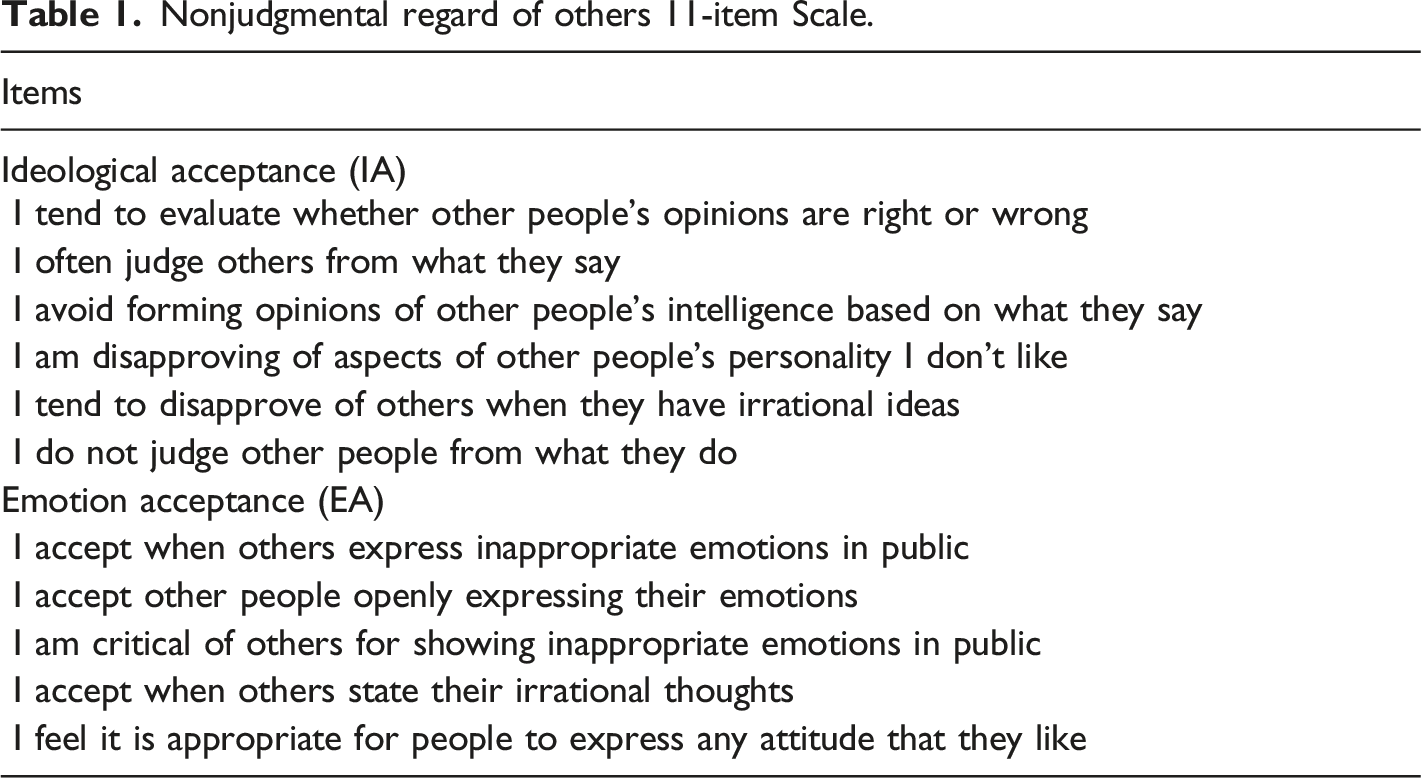
In pursuit of these goals, a new self-report measure was created, Nonjudgmental Regard for Others, to specifically assess an individual’s other-directed mindfulness. Four studies were conducted to develop and critically evaluate the validity of this measure. See Appendix A for full item development and survey validation details.
Study 1
The purpose of this study was to examine the extent to which having a nonjudgmental regard of others is related to having more favorable attitudes to outgroup members. We included heterogeneous measures of prejudice as Brandt and Crawford (2019) suggested it is important to study a broad array of prejudice criteria as some negative outgroup attitudes are related to numerous, identical predictors, but others are related to a narrower set of criteria. We also included the Five Facet Mindfulness Questionnaire (FFMQ; Baer et al., 2006) in order to determine the replicability of previous studies, and to assess whether nonjudgmental regard towards others was associated with prejudiced attitudes above and beyond the predictive abilities of traditional, self-directed, mindfulness measures. We predicted that the newly developed Nonjudgmental Regard for Others measure, in particular, the two subscales, Ideological Acceptance and Emotion Acceptance of others, would be significantly correlated with attitudes to different outgroups (i.e., drug users, feminists, sex workers, overweight individuals, homosexuals, homeless individuals, people with disabilities, and newcomers). Furthermore, we expected the Nonjudgmental Regard for Others subscales to explain variance over and above a well established measure of trait mindfulness, the Five Facet Mindfulness Questionnaire (FFMQ; Baer et al., 2006).
Participants
Participants included 231 individuals recruited from Prolific. Given the large number of survey questions, we included an accuracy check to determine if participants were reading the questions, as per Kam and Meyer (2015). Eighteen participants were removed as they failed to respond to these test items correctly, resulting in a total of 213 participants (52.6% female, mean age = 34.91 years, SD = 12.42). Participants resided predominantly in North America (91.5%) or Europe (4.2%) and the majority of participants self-identified as white/Caucasian (76.1%), Black/African American (7.5%), or Latino/Hispanic (6.6%).
Procedure
The Research Ethics Board of the first author’s academic institution approved the research. Participants were recruited online through Prolific. After clicking the study title, participants were directed to Survey Monkey where they provided informed consent, followed by completion of the study measures and demographic information, such as gender, country of residence, and ethnicity. All items were presented in random order within a survey, and the Nonjudgmental Regard of Others and Trait Mindfulness measures were presented in a counter-balanced manner to reduce order-bias. Prejudiced attitudes were measured last. Accuracy verification items were presented randomly throughout the survey. Participants were compensated with £1.67 for completing the study.
Measures
Nonjudgmental regard of others 11-item Scale.
Self-directed trait mindfulness. The Five Facet Mindfulness Questionnaire (FFMQ; Baer et al., 2006) is a 64-item self-report survey designed to assess trait mindfulness. The FFMQ consists of five subscales, each representing a core component of mindfulness: (1) Nonreactivity (Nonreactivity to inner experience, seven items, scores ranging from 7 to 35, Cronbach’s alpha = .80), (2) Observing thoughts (Observing/noticing/attending to sensations/perceptions/thoughts/feelings, 15 items, scores ranging from 15 to 75, Cronbach’s alpha = .90), (3) Acting with awareness (Acting with awareness/automatic pilot/concentration/nondistraction, 21 items, scores ranging from 21 to 105, Cronbach’s alpha = .84), (4) Describing/labelling (10 items, scores ranging from 10 to 50, Cronbach’s alpha = .94), and (5) Nonjudging of experience (11 items, scores ranging from 11 to 55, Cronbach’s alpha = .89). Participants responded to each item by indicating how much they felt the items are true for them on a 5-point scale, from 1 (never or very rarely true) to 5 (very often or always true). Higher scores are indicative of higher levels of mindfulness within each subscale.
Prejudice (Measures of attitudes to different outgroups, identified below). We measured prejudice by creating eight composite scales, each based on items used in previous measures of prejudice. For each target group, individuals reported how much they agreed with the statements provided using a 7-point Likert scale, from 1 (strongly disagree) to 7 (strongly agree). Higher scores on each scale reflect higher levels of prejudice towards that group. The following prejudiced attitudes were assessed:
Attitudes towards drug users. Five items assessed attitudes towards drug users (ATDU; adapted from Crandall (1994) and Wright et al. (1999); e.g., “Drug users make me nervous”). Scores could range from 5 to 35. ATDU showed strong inter-item reliability, Cronbach’s alpha = .77.
Antifeminist attitudes. Four items assessed antifeminist attitudes (ATF; adapted from Crandall, 1994; e.g., If I were an employer looking to hire, I might avoid hiring a feminist). Scores could range from 4 to 28. ATF showed strong inter-item reliability, Cronbach’s alpha = .86.
Attitudes towards sex workers. Four items assessed attitudes towards sex workers (ATSW; adapted from Wright et al., 1999; e.g., “Prostitutes make me nervous”). Scores could range from 4 to 28. ATSW showed strong inter-item reliability, Cronbach’s alpha = .78.
Attitudes towards overweight individuals. Five items assessed attitudes regarding individuals who are overweight (ATW; adapted from Crandall, 1994; e.g., “I don’t really like fat people much”). Scores could range from 5 to 35. ATW showed strong inter-item reliability, Cronbach’s alpha = .75.
Attitudes of homophobia. Five items assessed homophobic attitudes (AH; adapted from Wright et al., 1999; e.g., “Gay people make me nervous”). Scores could range from 5 to 35. AH showed strong inter-item reliability, Cronbach’s alpha = .75.
Attitudes towards homeless individuals. Four items assessed attitudes to the homeless (ATH; adapted from Zick et al., 2008 and Crandall, 1994; e.g., “The homeless in towns are unpleasant.“). Scores could range from 4 to 28. ATH showed strong inter-item reliability, Cronbach’s alpha = .82.
Attitudes towards disabilities. Five items assessed attitudes to disabled individuals (ATD; adapted from Zick et al., 2008 and Crandall, 1994; e.g., “I really don’t like handicapped people much”). Scores could range from 5 to 35. ATD showed adequate inter-item reliability, Cronbach’s alpha = .66.
Attitudes towards newcomers. Four items assessed attitudes to newcomers (ATN; Zick et al., 2008; e.g., “Those who have always been living here should have more rights than those who came later”). Scores could range from 4 to 28. ATN showed strong inter-item reliability, Cronbach’s alpha = .86.
Accuracy verification items. Four items adapted from Kam and Meyer (2015) were presented randomly throughout the survey. These asked participants to respond in a particular way to ensure that they were reading the items carefully. For instance, one item stated, “In order to verify that participants are reading the questions we ask that you please click on the ‘4’ on the following scale”. One or more wrong answers to the test items were used to exclude a participant as a random responder from the analysis.
Data analysis plan
All analyses were run using SPSS version 28. To test our first hypothesis, that the Ideological Acceptance and Emotion Acceptance of others subscales of the Nonjudgmental Regard for Others measure would be significantly correlated with attitudes to different outgroups, bivariate correlations were conducted with all study variables. This assessment allows us to examine the independent associations between the acceptance variables and attitudes towards outgroups, without partialling out variance in the dependent variables accounted for by other study variables. To test our second hypothesis, that the Nonjudgmental Regard for Others subscales would explain variance over and above the FFMQ, separate hierarchical regressions were run on each prejudice variable. For each analysis, age and gender were entered as the first step of the model in order to control for age and gender effects. In the second step of the model, the five FFMQ subscales were entered, and in the third step the two NRO subscales were entered. This set of analyses allows us to partial out the unique variance in our dependent variable that is accounted for by each independent variable.
Results
Assessment of variables and assumptions. No significant missing data patterns were detected. Variables demonstrated no significant issues with normality, as assessed with skewness or kurtosis. Tests to see if the data met the assumption of collinearity indicated that multicollinearity was not a concern (VIF <1.68). Homoscedasticity was assessed by plotting the standardized predicted variables against the standardized residuals and examining the scatterplots. No plots demonstrated heteroscedasticity.
Study 1 correlations, means, standard deviations, and gender differences for all study variables.
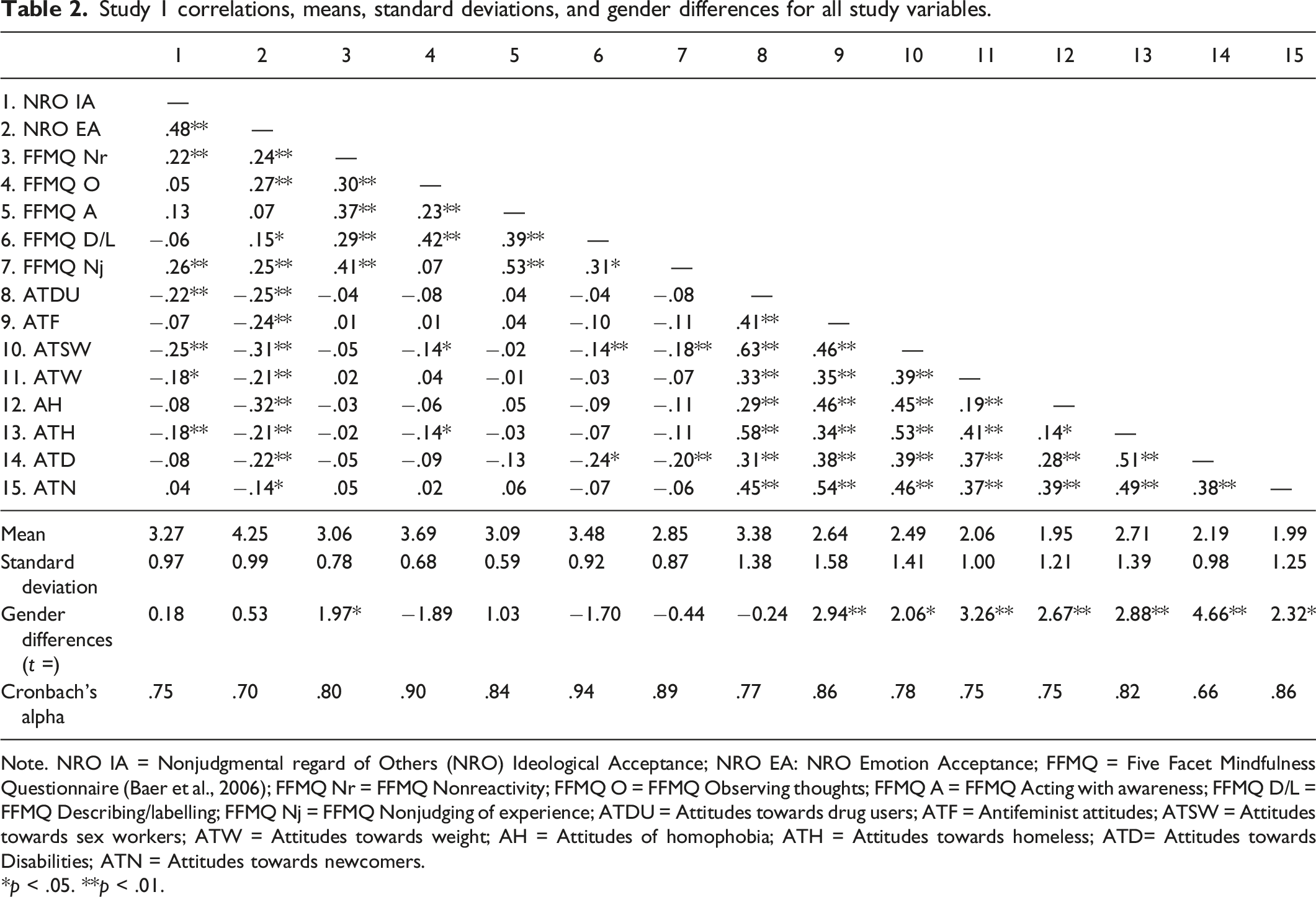
Note. NRO IA = Nonjudgmental regard of Others (NRO) Ideological Acceptance; NRO EA: NRO Emotion Acceptance; FFMQ = Five Facet Mindfulness Questionnaire (Baer et al., 2006); FFMQ Nr = FFMQ Nonreactivity; FFMQ O = FFMQ Observing thoughts; FFMQ A = FFMQ Acting with awareness; FFMQ D/L = FFMQ Describing/labelling; FFMQ Nj = FFMQ Nonjudging of experience; ATDU = Attitudes towards drug users; ATF = Antifeminist attitudes; ATSW = Attitudes towards sex workers; ATW = Attitudes towards weight; AH = Attitudes of homophobia; ATH = Attitudes towards homeless; ATD= Attitudes towards Disabilities; ATN = Attitudes towards newcomers.
*p < .05. **p < .01.
Correlations of all variables. The Emotion Acceptance subscale of the NRO was significantly associated with every index of prejudice, while the Ideological Acceptance subscale was significantly associated with Attitudes towards Drug Users, Sex Workers, Weight, and Homelessness (Table 2). In line with previous studies, the FFMQ showed limited correlational associations with prejudice. Observing Thoughts was associated with Attitudes towards Sex Workers and Homelessness, and Describing/Labelling and Nonjudging of Experience were significantly associated with Attitudes towards Sex Workers and Disabilities.
Study 1 significant predictors of prejudiced attitudes.
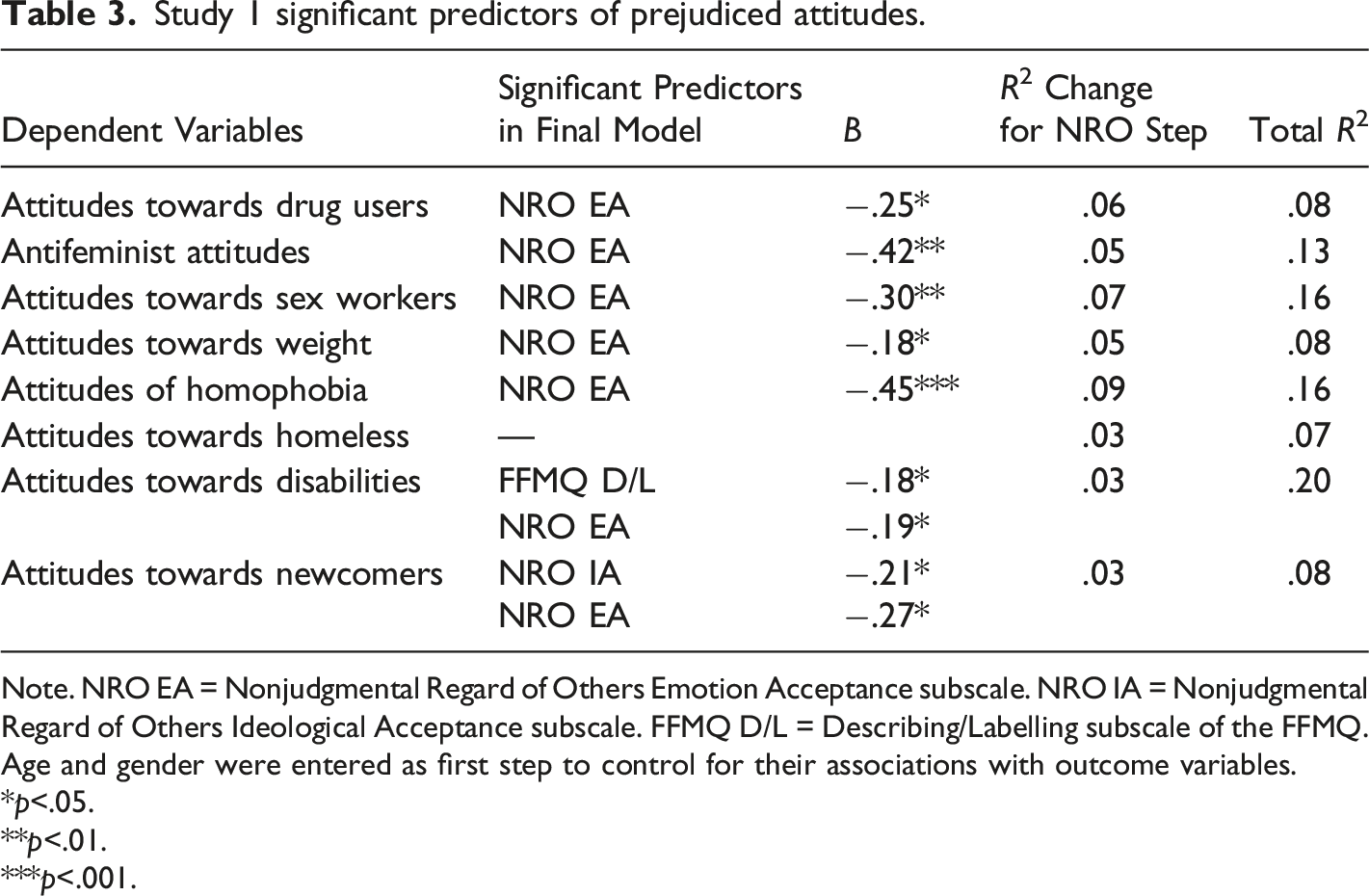
Note. NRO EA = Nonjudgmental Regard of Others Emotion Acceptance subscale. NRO IA = Nonjudgmental Regard of Others Ideological Acceptance subscale. FFMQ D/L = Describing/Labelling subscale of the FFMQ. Age and gender were entered as first step to control for their associations with outcome variables.
*p<.05.
**p<.01.
***p<.001.
Conclusion
These results provide strong evidence that the Emotion Acceptance subscale of the NRO is strongly associated with prejudice, above and beyond the predictive abilities of traditional mindfulness measures. Specifically, higher levels of Emotion Acceptance are associated with lower levels of prejudice. Not surprisingly, as found by Nicol and De France (2018), as well as Verhaeghen and Aikman (2020), the self-directed mindfulness trait measure (the FFMQ), which focuses on being present, aware, and nonjudgmental of the self, showed poor relations with almost all the prejudice indicators. Unexpectedly, the NRO Ideological Acceptance subscale did not predict unique variance in most of the attitude measures except for attitudes towards newcomers.
Study 2
In this study we wished to determine the replicability of the findings of Study 1 and to assess whether NRO scores are associated with prejudiced attitudes over and above two well-established predictors of prejudice, Social Dominance Orientation (SDO) and Right-Wing Authoritarianism (RWA). SDO and RWA are indicators of prejudice as they each have been found to be correlated with attitudes to different outgroup members (e.g., Duckitt & Sibley, 2009; Pratto et al., 2006). Individuals scoring highly on SDO view society and its members as part of a competitive process, prefer social hierarchy to establish order within organizations and society, and prefer inequality (Duckitt et al., 2002; Sibley et al., 2007). Individuals scoring highly on RWA view the world as a dangerous place where authority and traditions maintain a balance and help reduce the threats in society (Duckitt et al., 2002).
Both SDO and RWA are very different conceptually from mindfulness and the NRO measure, and therefore they provide a strong benchmark against which to identify if NRO is predictive of prejudiced attitudes above and beyond these well-established and well-researched indices of prejudice. Again, for comparison purposes, and to assess the reliability of the findings found in Study 1, we included the FFMQ to confirm that the NRO explains variance in prejudice over and above the FFMQ. We predicted that the NRO subscales explain variance in attitudes towards others (i.e., women, drug users, overweight individuals, homosexuals, homeless individuals, and people with disabilities). Furthermore, we expected the Nonjudgmental Regard for Others subscales to explain variance over and above the existing trait mindfulness measure, the Five Facet Mindfulness Questionnaire (FFMQ; Baer et al., 2006), as well as two indicators of prejudice, Social Dominance Orientation (Ho et al., 2012) and Right-Wing Authoritarianism (Zakrisson, 2005).
Participants
Participants included 314 individuals recruited from Prolific. Five participants were removed as they completed less than 75% of the survey items. Given the large number of survey questions, we included an accuracy check to determine if participants were reading the questions, as per Kam and Meyer (2015). Thirty-six participants were removed as they failed to respond to these test items correctly, resulting in a total of 273 participants (58.2% female, mean age = 35.56 years, SD = 12.03). Participants resided predominantly in North America (95.2%) or Europe (4.0%) and the majority of participants self-identified as white/Caucasian (77.7%), Black/African American (5.9%), or Latino/Hispanic (5.5%).
Procedure
See Study 1 for procedure details. Participants were paid £1.67 for completing the study.
Measures
Nonjudgmental Regard of Others (NRO). See Study 1 for a description of the NRO. In the current study, both subscales had strong inter-item reliability (Ideological Acceptance = .79, Emotion Acceptance= .70.
Trait Mindfulness. See Study 1 for details on the FFMQ (Baer et al., 2006). Each subscale had strong inter-item reliability, Cronbach alpha for FFMQ Nonreactivity = .86, FFMQ Observing thoughts = .90, FFMQ Acting with awareness = .89, FFMQ Describing/Labelling = .94, FFMQ Nonjudging of experience = .93.
Social Dominance Orientation. The SDO (Ho et al., 2012) measures preference for social hierarchy, group dominance, and inequality. It is comprised of 16 items scored on a 7-point Likert scale, from 1 (strongly disagree) to 7 (strongly agree). Scores could range from 16 to 112. A sample item is, “Having some groups on top really benefits everybody.” The SDO demonstrated internal consistency, with a Cronbach alpha of .95. Higher scores represent higher levels of social dominance orientation.
Right-Wing Authoritarianism. We employed Zakrisson’s (2005) short 15-item version of right-wing authoritarianism, which assesses participants’ preference for authoritarian principles and ideology. The response scale was a 7-point Likert from 1 (very negative) to 7 (very positive). Cronbach alpha was .90. Scores could range from 15 to 105. A sample item is, “The “old-fashioned ways” and “old-fashioned values” still show the best way to live.” Higher scores represent higher levels of right wing authoritarianism.
Sexism. Sexism was measured using five items reflecting a denial of continuing discrimination against women (Swim et al., 1995). The response scale was a 7-point Likert from 1 (strongly agree) to 7 (strongly disagree). Scores could range from 5 to 35. A sample item is “Discrimination against women is no longer a problem in the United States”. Sexism items were reverse scored so that higher scores on this variable indicate higher levels of sexist attitudes. These items showed high inter-item reliability, with a Cronbach alpha of .90.
Study 2 correlations, means, standard deviations, and gender differences for all study variables.
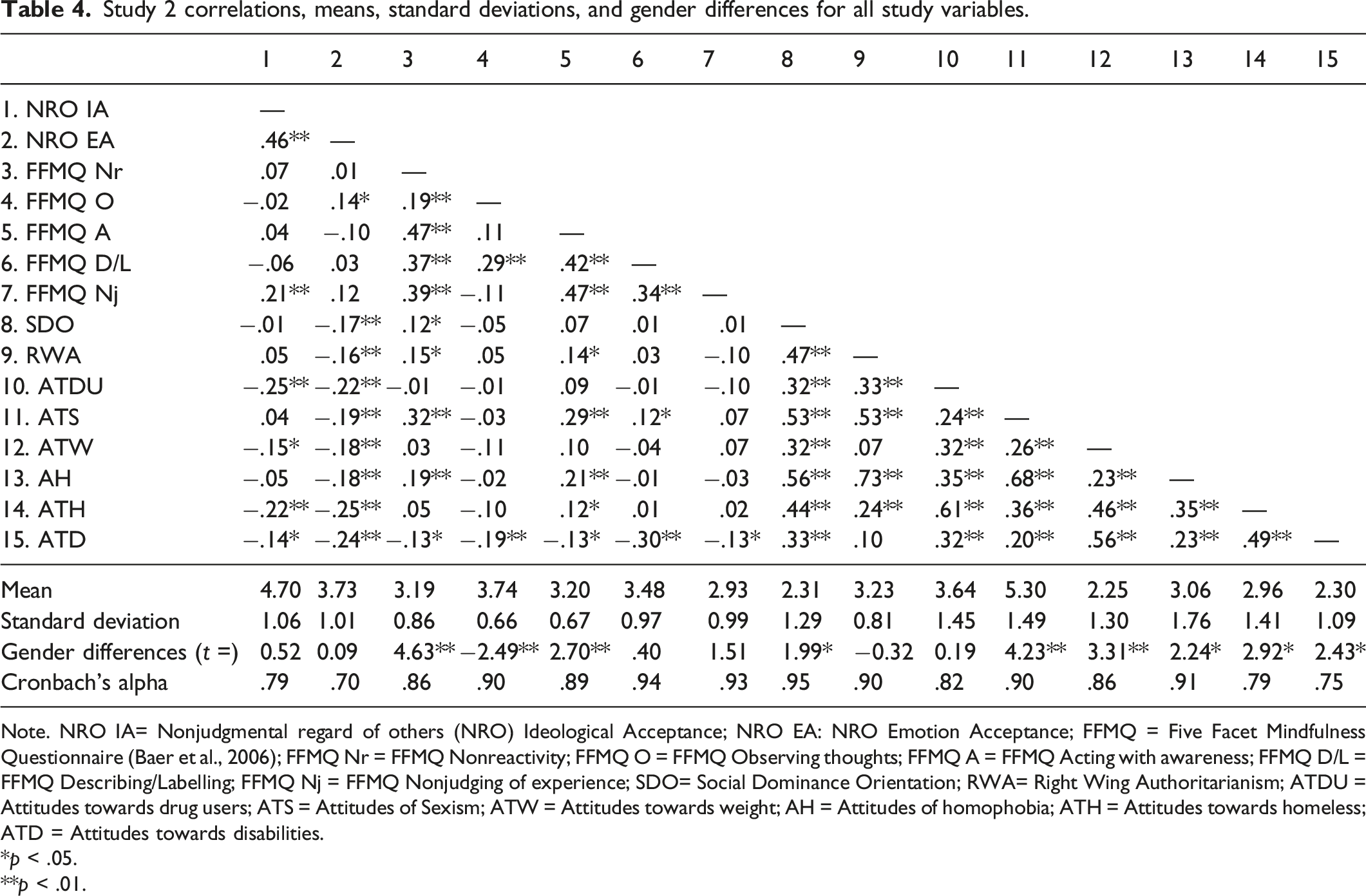
Note. NRO IA= Nonjudgmental regard of others (NRO) Ideological Acceptance; NRO EA: NRO Emotion Acceptance; FFMQ = Five Facet Mindfulness Questionnaire (Baer et al., 2006); FFMQ Nr = FFMQ Nonreactivity; FFMQ O = FFMQ Observing thoughts; FFMQ A = FFMQ Acting with awareness; FFMQ D/L = FFMQ Describing/Labelling; FFMQ Nj = FFMQ Nonjudging of experience; SDO= Social Dominance Orientation; RWA= Right Wing Authoritarianism; ATDU = Attitudes towards drug users; ATS = Attitudes of Sexism; ATW = Attitudes towards weight; AH = Attitudes of homophobia; ATH = Attitudes towards homeless; ATD = Attitudes towards disabilities.
*p < .05.
**p < .01.
Accuracy verification items. See Study 1 for a description of the accuracy items randomly presented throughout the survey. One or more wrong answers to the test items were used to exclude a participant as a random responder from the analysis.
Data analysis plan
All analyses were run using SPSS version 28. To test hypothesis that the NRO subscales would explain variance in attitudes towards others over and above the FFMQ, SDO, and RWA, separate hierarchical regressions were run on each attitude variable. For each model, age and gender were entered as the first step of the model in order to control for age and gender effects. In the second step of the model, SDO and RWA subscales were entered. Step three included the five FFMQ subscales. Finally, Step 4 included the NRO subscales. This set of analyses allows us to partial out the unique variance in our dependent variable that is accounted for by each independent variable, thereby evaluating how much unique variance in our outcome variables that is accounted for by the NRO subscales.
Results
Assessment of variables and assumptions. No significant missing data patterns were detected. Variables demonstrated no significant issues with normality, as assessed with skewness or kurtosis. Tests to see if the data met the assumption of collinearity indicated that multicollinearity was not a concern (VIF <1.15). Homoscedasticity was assessed by plotting the standardized predicted variables against the standardized residuals and examining the scatterplots. No plots demonstrated heteroscedasticity.
Gender differences on all variables. Table 4 shows correlations, means, standard deviations, and gender differences of all study variables. Women scored significantly higher than men did on the FFMQ subscale of being observant of and attending to sensations, perceptions, thoughts, and feelings, while men scored significantly higher on the FFMQ subscales reflective of nonreactivity to inner experiences and acting with awareness/being on autopilot. Men also scored significantly higher on all indicators of prejudice with the exception of RWA, for which there were no gender differences.
Correlations of all variables. As found in Study 1, correlational associations show that the Emotion Acceptance subscale of the NRO measure was significantly associated with every prejudice index, and the Ideological Acceptance subscale was associated with Attitudes towards Drug Users, Weight, Homelessness, and Disabilities. The FFMQ subscales showed less consistent correlational associations with prejudiced attitudes. While all subscales were significantly associated with Attitudes towards Disabilities, the Acting with Awareness subscale was associated only with Sexism, Homophobia, and Attitudes towards Homelessness, the Nonreactivity subscale was associated only with Sexism and Homophobia, and the Describing/Labelling subscale was associated with Sexism. It is worth noting that despite somewhat strong associations between some of the FFMQ subscales and some of the prejudice variables, these findings represent a conflicting pattern of results when compared to the correlational results of Study 1. Finally, SDO and RWA showed strong associations with almost every prejudice index.
Study 2 significant predictors of prejudiced attitudes.
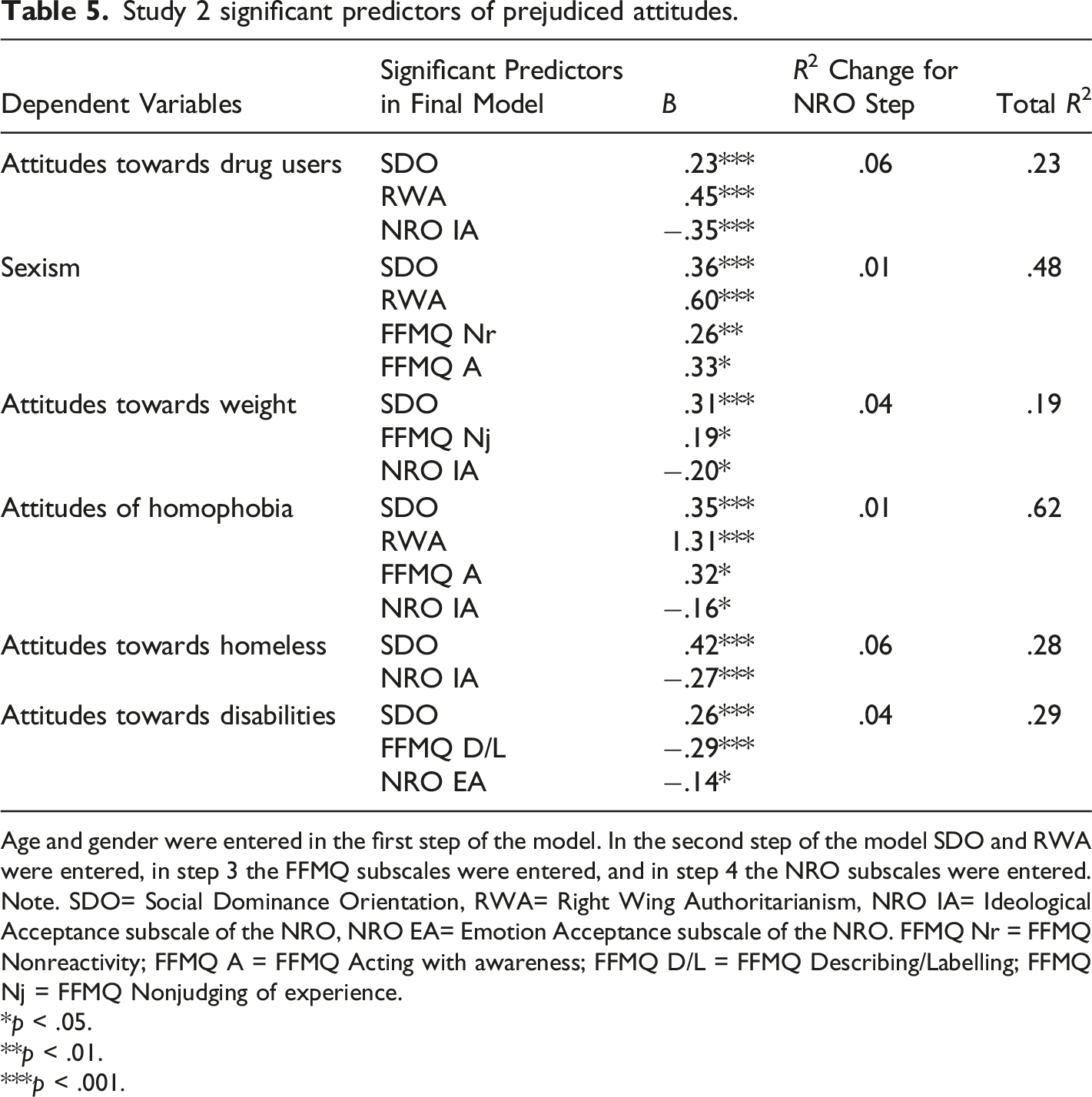
Age and gender were entered in the first step of the model. In the second step of the model SDO and RWA were entered, in step 3 the FFMQ subscales were entered, and in step 4 the NRO subscales were entered.
Note. SDO= Social Dominance Orientation, RWA= Right Wing Authoritarianism, NRO IA= Ideological Acceptance subscale of the NRO, NRO EA= Emotion Acceptance subscale of the NRO. FFMQ Nr = FFMQ Nonreactivity; FFMQ A = FFMQ Acting with awareness; FFMQ D/L = FFMQ Describing/Labelling; FFMQ Nj = FFMQ Nonjudging of experience.
*p < .05.
**p < .01.
***p < .001.
Conclusion
We wished to examine whether having a nonjudgmental regard towards others, an important component of mindfulness, can explain variance in prejudice over and above two well-researched predictors of prejudice (SDO and RWA) as well as the FFMQ measure of mindfulness. In line with the large body of work linking SDO/RWA with prejudice (e.g., Duckitt & Sibley, 2009; Pratto et al., 2006), we found both SDO and RWA differentially predicted the various attitudes to outgroups. Interestingly, the FFMQ subscales also differentially predicted the attitude criteria, although the direction of those relations were opposite to what was expected based on the results of Study 1. Although the Describing/Labelling subscale of the FFMQ explained unique variance in attitudes towards individuals with disabilities in the expected direction (i.e., the less likely a person labels, the more likely they have a favourable attitude towards individuals with disabilities), as found in Study 1, counterintuitive results were found for a few of the FFMQ subscales and attitudes towards certain outgroups. In particular, both the FFMQ Nonreactivity and Acting with awareness subscales were related to higher sexist attitudes. Similarly, the FFMQ nonjudging of experience (for the self) and the FFMQ Acting with awareness both explain an increase in prejudice towards overweight individuals and homosexuals, respectively, suggesting that focussing on the self and awareness of the self can increase the perception of outgroup members as being different when SDO and RWA, two important predictors of prejudice, are included. This was not the case for the NRO scales whereby after partialling out the variance accounted for by SDO and RWA, the NRO Ideological Acceptance (NRO IA) served to be a consistent predictor for four of the attitudes towards others prejudice measures and the NRO Emotion Acceptance (NRO EA) subscale predicted one of the criterion measures.
In comparison with the results of Study 1, our findings suggest that the NRO IA subscale is a better predictor than is the NRO EA when SDO and RWA are included in the model. The NRO EA subscale had significant correlations with both SDO and RWA. Therefore, it is possible that the significant relations found in Study 1 between NRO EA and the criteria may be due to shared variance with both SDO and RWA. This would suggest that while both subscales are associated with significant amounts of variance in these prejudice outcomes, the NRO IA subscale contributes unique variance to the explanation of prejudice, over and above SDO, RWA, and the FFMQ.
The findings also support the notion that focussing on the self, as the items in the FFMQ scales do, may serve to either not predict prejudice (as for the majority of outgroup attitude measures of Study 1) or, when variance by SDO and RWA are accounted for, may actually be related to greater prejudice as the unique focus may be on the self. More research examining this supposition needs to be conducted to support these claims.
General discussion
The aim of the research presented here was to assess the association between nonjudgment towards others (rather than to the self, which most mindfulness instruments measure) and prejudice. It is clear that the two Nonjudgmental Regard for Others subscales are weakly related with the FFMQ scales, indicating nonoverlapping measurement of constructs. In particular, the Nonjudgmental Regard of Others scales were both correlated with the FFMQ Nonjudging of (personal) experience in the first study, but less so in the second study, illustrating some construct overlap, but not a lot. This provides evidence that non-judgment and awareness towards the self does not extend to others. The Nonjudgmental Regard of Others scales predicted prejudiced attitudes over and above existing indicators of prejudice and the FFMQ, and therefore assessing judgment regarding others merits being assessed on its own right. Certainly, being mindful extends to others, not just the self, in contemporary definitions of mindfulness (Baer et al., 2004; Feldman et al., 2007; Gervais & Hoffman, 2013; Nilsson & Kazemi, 2016; Pinazo & Breso, 2017). Many practices of mindfulness suggest the importance of including consideration of others, not just the self (e.g., Hunsinger et al., 2014; Kang et al., 2015; Oyler et al., 2021; Parks et al., 2014; Pinazo & Breso, 2017; Stell & Farsides, 2016). Therefore, having instruments that focus beyond the self, which is currently not present in published mindfulness measures (e.g., Freiburg Mindfulness Questionnaire, Walach et al., 2006; Toronto Mindfulness trait scale, Davis et al., 2009; The Philadelphia Mindfulness scale, Cardaciotto et al., 2008; Southhampton Mindfulness Questionnaire, Chadwick et al., 2008), is vital to operationalizing mindfulness to its complete extent. Having a nonjudgmental regard for others is an important component of gaining a broader understanding of others and, hence, the self (Berger et al., 2018). Although the initial pursuits of developing measures of mindfulness to focus on self-awareness and acceptance are laudable, mindfulness is more broadly defined, going beyond the self and extending to the environment, viewing individuals, situations, and events impartially (Brown et al., 2007). Taken together, the results of the current two studies suggest that having a nonjudgmental regard towards others is related to prejudice over and above self-directed mindfulness indices, such as the FFMQ, as well as Social Dominance Orientation and Right-Wing Authoritarianism, two well-established predictors of prejudice.
Conceptualizing an important facet of mindfulness as attending to the present in a nonjudgmental fashion beyond the self suggests that broadening our understanding of being nonjudgmental may help further our understanding of prejudice and mechanisms to reduce it. Perceptions of, and experiences with, outgroups can provoke anxiety, and therefore developing a nonjudgmental regard of others through lovingkindness programs may be one mechanism by which these programs reduce negative attitudes towards outgroup members. If mindfulness is to de-automatize thinking (Kang et al., 2013) regarding others, it will achieve this most probably through a promotion of nonjudgmental thinking of others rather than of the self. This is in support of the idealizations made regarding mindfulness and its potential to reduce prejudice (Kang et al., 2013; Weinstein et al., 2009)
While our studies represent a substantial contribution to our understanding of the link between mindfulness and prejudice, they were not without limitations. Given the number of correlations, there is the possibility of Type I error as alpha level was not adjusted. Although the findings with the established measures (e.g., FFMQ, SDO, and RWA) mirror that of published studies, such as gender differences in prejudice and correlations between variables (e.g., Nicol & De France, 2018; Pratto et al., 1994), participants comprised primarily of North Americans, and therefore generalizability beyond the North American context is untenable at this time. We hypothesized that mindfulness leads to prejudice, but because the data was taken in one session from the same respondents, we could not assess the directionality of this relation, it is possible that people lower in prejudiced attitudes experience less judgment towards others. Furthermore, how nonjudgmental regard of others is related to other measures of mindfulness beyond the FFMQ was not assessed. Finally, the current studies did not evaluate participant exposure to, or experience with, mindfulness interventions. Future research should compare NRO scores as well as nonjudgmental evaluations of the self of those individuals with and without extensive experience and practice with mindfulness techniques, particularly those techniques directed to others such as lovingkindness meditation. Further, future studies aimed at better understanding the underlying psychological mechanisms that explain the associations between nonjudgmental regard of others and prejudice attitudes would represent a significant contribution to the field. Examining NRO’s relation with other constructs related to the consideration of others, such as the interpersonal mindfulness instrument (Pratscher et al., 2019) or a measure of empathy, would provide information as to whether a nonjudgmental regard of others is an important component of interrelating with others.
The research on mindfulness has focused primarily on the mental and physical health domain, which has had reciprocal implications for the conceptualization of mindfulness and the instruments employed to assess it. Although meaningful and helpful, research exploring the role of mindfulness outside of the domain of mental and physical health will help to expand our understanding of the multifaceted nature of mindfulness and its influences in other areas of human experience. This research suggests the importance of broadening the operationalization of mindfulness measures to reflect a more expansive understanding of mindfulness.
Footnotes
Declaration of Conflicting Interests
The author(s) declared no potential conflicts of interest with respect to the research, authorship, and/or publication of this article.
Funding
The author(s) disclosed receipt of the following financial support for the research, authorship, and/or publication of this article: This research was supported by a grant to the first author from the Department of National Defence Canadian Defence Academy Research Program (2018–2020). The views, opinions, and/or findings contained in this article are solely those of the authors and should not be construed as official Department of National Defence policy, position, or decision.

Appendix A
Methods
Results and conclusions
We first examined the question of whether participants felt that the items met the definition of nonjudgmental regard for others. Participants reported feeling that items reflected this definition (mean score across items = 3.12, SD = 1.00), with scores per item ranging from 2.88 through 3.35. We next examined whether participants felt that the items were written clearly. Results showed that participants reported that the items were clearly written (mean score = 3.19, SD = 0.86), with item scores ranging from 2.75 through 3.42. Finally, we examined whether participants felt that the items reflected any bias. Results showed that items did not reflect strong bias (mean score = 1.99, SD = 0.96), with individual item scores ranging from 1.43 through 2.95. No items were flagged as particularly problematic as no items were identified as outliers from the normal distribution of these questions. As such, we were confident that all items reflected good face and content validity. Based on these results, we chose to retain all items for Study 2.
Study 2 of NRO development: Factor structure
The second study involved conducting an exploratory factor analysis with all 21 items of the Nonjudgmental Regard of Others scale. We hypothesized that a single factor solution would be the best fit for these items.
Results
All items were assessed for missing values and normality of distributions. In total, there were 17 missing data points, which were distributed throughout individuals and items. These missing data points accounted for less than 1% of the total dataset, and therefore imputation was not necessary (Fidell & Tabachnick, 2003). A principal axis factor analysis was conducted on all 21 NRO items, using an oblimin rotation. Individual items were restricted to factor loadings of |.30| and higher. The analysis produced a five-factor solution, however, one factor was comprised of only two items, and therefore the analysis was rerun without these items.
The second factor analysis produced a four-factor solution, however, only the first two factors were associated with eigenvalues greater than 1. Therefore, only items in the first two factors were retained, resulting in an 11-item solution (see Table A2). Items that loaded onto more than one factor were assigned to the factor on which they loaded most strongly. The first factor reflected judgments of a person’s actions, ideas, and personality, and was therefore labelled Ideological Acceptance. The second factor contained items centered around acceptance of someone’s emotions and tendency to express their feelings and attitudes and was therefore labelled Emotion Acceptance. Two new scores were calculated for each participant (Ideological Acceptance and Emotion Acceptance) by generating the mean of items within each factor. Women and men showed no significant differences in their scores on either factor. Both subscales showed strong inter-item reliability (Cronbach’s alpha >.71).
Conclusion
The factor structure of the revised scale suggests that acceptance (or being nonjudgmental) of opinions, behaviors, and personality may differ from acceptance of expressing emotions and attitudes. Because both positively and negatively-valenced items loaded on each subscale, this suggests that the two-factor solution is not based on the valence of the items, such that one factor represents positively-valenced items while another factor represents negatively-valenced items, which could be a concern with exploratory factor analyses (Schmitt & Stuits, 1985). Thus, evaluating others may be conceptually different from that of acceptance of others.
Study 3 of NRO development: Confirmatory factor structure
A confirmatory factor analysis with the shortened, 11-item NRO survey identified in Study 2 was conducted to determine the stability of the factor structure with a different sample.
Results
All items were assessed for missing values and normality of distributions. In total, there were seven missing data points, which were distributed throughout individuals and items. These missing data points accounted for less than 1% of the total NRO dataset, and therefore imputation was not necessary (Fidell & Tabachnick, 2003). A principal axis factor analysis was conducted on all 11 NRO items, using an oblimin rotation. The analysis was set to extract two factors, and individual items were restricted to factor loadings of |.30| and higher. The analysis confirmed the two-factor solution found in Study 2: both factors were associated with an eigenvalue higher than 1.0 and each item loaded onto its respective factor.
Two new variables were created by generating the mean of items within each factor. Negatively-valenced items were reverse-scored such that higher scores represent higher acceptance. Both variables showed strong inter-item reliability (Cronbach’s alpha >.74). While men and women did not show significant differences in Emotion Acceptance, men (mean = 3.13) reported significantly lower levels of Ideological Acceptance than women (mean = 3.48, t = 2.73, p = .01). Moreover, the two subscales were moderately correlated (r = .46), suggesting a level of independence between the two constructs being assessed. See Table A2 for factor loadings, reliability estimates, and correlation between subscales.
Conclusion
These findings provide evidence for the stability of the two subscales of the NRO. This suggests that while Ideological Acceptance and Emotion Acceptance are related, they also represent conceptually distinct aspects of nonjudgmental regards towards others.
Study 4 of NRO development: Convergent and divergent validity
The purpose of this study was to obtain evidence of convergent and divergent validity of the NRO subscales. We examined the extent to which the NRO correlated with personality, as measured by the HEXACO-60 (Ashton & Lee, 2009) and with mindfulness, as measured by the Five Facet Mindfulness Questionnaire (FFMQ; Baer et al., 2006), a well-researched trait measure of mindfulness.
Personality is an important behavioral and cognitive predictor. We wished to include it here for comparison purposes with the new measure of nonjudgmental regard of others as the Big V subscales have been found to be related to mindfulness. A meta-analysis by Giluk (2009) examined the relation between the Big V personality dimensions and overall mindfulness and found significant correlations with all of the Big V dimensions. However, the strongest relations appeared to be with conscientiousness and neuroticism, suggesting self-regulation and emotional stability are the primary characteristics of dispositional mindfulness. More recently, similar results were found by Hanley and Garland (2017), who conducted a meta-analysis of the relation between the FFMQ subscales and the Big V and found the FFMQ subscales were differentially correlated with the Big V dimensions. We employed the HEXACO-60 (Ashton & Lee, 2009); very few studies have examined the relation between the HEXACO and mindfulness (e.g., Schwager et al., 2016).
In the current study, we hypothesized that the NRO subscales are correlated with the FFMQ subscales reflective of nonjudgmental attitudes/experiences and describing/labelling feelings, as well as the personality dimension of agreeableness. It is possible the two NRO subscales will be differentially related with other personality dimensions, however we made no such hypotheses.
Results
All items were assessed for missing values and normality of distributions. In total, there were seven missing data points, which were distributed throughout individuals and items. No study variables showed problematic skew or kurtosis values, and no significant patterns of missing data were found. Men scored significantly higher on the FFMQ subscale of Non-reactivity, while women scored significantly higher on the HEXACO subscales of Honesty-Humility, Emotionality, Agreeableness and Conscientiousness. See Table A3 for correlations, means, standard deviations, and gender differences.
A series of Pearson’s correlations were run between the two NRO subscales, Trait Mindfulness, and HEXACO-60 personality dimensions. The NRO subscales correlated differentially with the FFMQ Trait Mindfulness subscales. Ideological Acceptance scores were positively associated with Acting with Awareness and Nonjudging of Experience, while Emotion Acceptance scores were associated with Observing Thoughts and Describing/Labelling.
The NRO subscales were also differentially associated with the HEXACO-60 personality dimensions. Ideological Acceptance scores were positively associated with Honesty-Humility and Extraversion, and Emotion Acceptance scores were associated with Openness to Experience. As predicted, only Agreeableness was associated with both NRO subscales, which reflects a nonjudgmental quality. Similar to Hanley and Garland (2017), the results with the FFMQ suggest that the HEXACO personality dimensions were significantly correlated with most of the FFMQ subscales, but that there were different patterns of relations between the FFMQ subscales and the HEXACO-60 dimensions.
Conclusion
The current study results suggest two important conclusions. First, while the NRO subscales are significantly associated with the FFMQ mindfulness subscales and the HEXACO personality dimensions, given the relatively small size of most of these correlations, we suggest that these constructs are predominantly distinct. Although the two NRO subscales share some variance with these personality dimensions, overall, the results suggest they measure unique characteristics that differentiate them from the existing mindfulness and personality measures. Therefore, these results suggest that, with one minor exception, the two NRO subscales represent considerable proportions of unique variance not accounted for by trait mindfulness or personality, as currently assessed.
Second, the correlations between the FFMQ, HEXACO, and NRO subscales reinforce the interpretation that the NRO subscales measure distinct aspects of nonjudgmental regard. The NRO Ideological Acceptance scale was positively related with the FFMQ subscale reflect nonjudging of experience, and the HEXACO honesty-humility, extraversion, and agreeableness factors. The NRO Emotion Acceptance subscale was positively associated with the FFMQ subscale of observing thoughts and the HEXACO agreeableness and openness factors. These results confirm the distinctiveness suggested by the factor analysis of the NRO; the two subscales capture different aspects of a nonjudgmental regard for others.
Initial nonjudgmental regard of others 21-item scale of study 1. Note. KIMS: Kentucky Inventory of Mindfulness Skills (Baer et al., 2004); FMI: Freiburg mindfulness inventory (Walach et al., 2006); CAMS-R: Cognitive and Affective Mindfulness Scale-Revised (Feldman et al., 2007).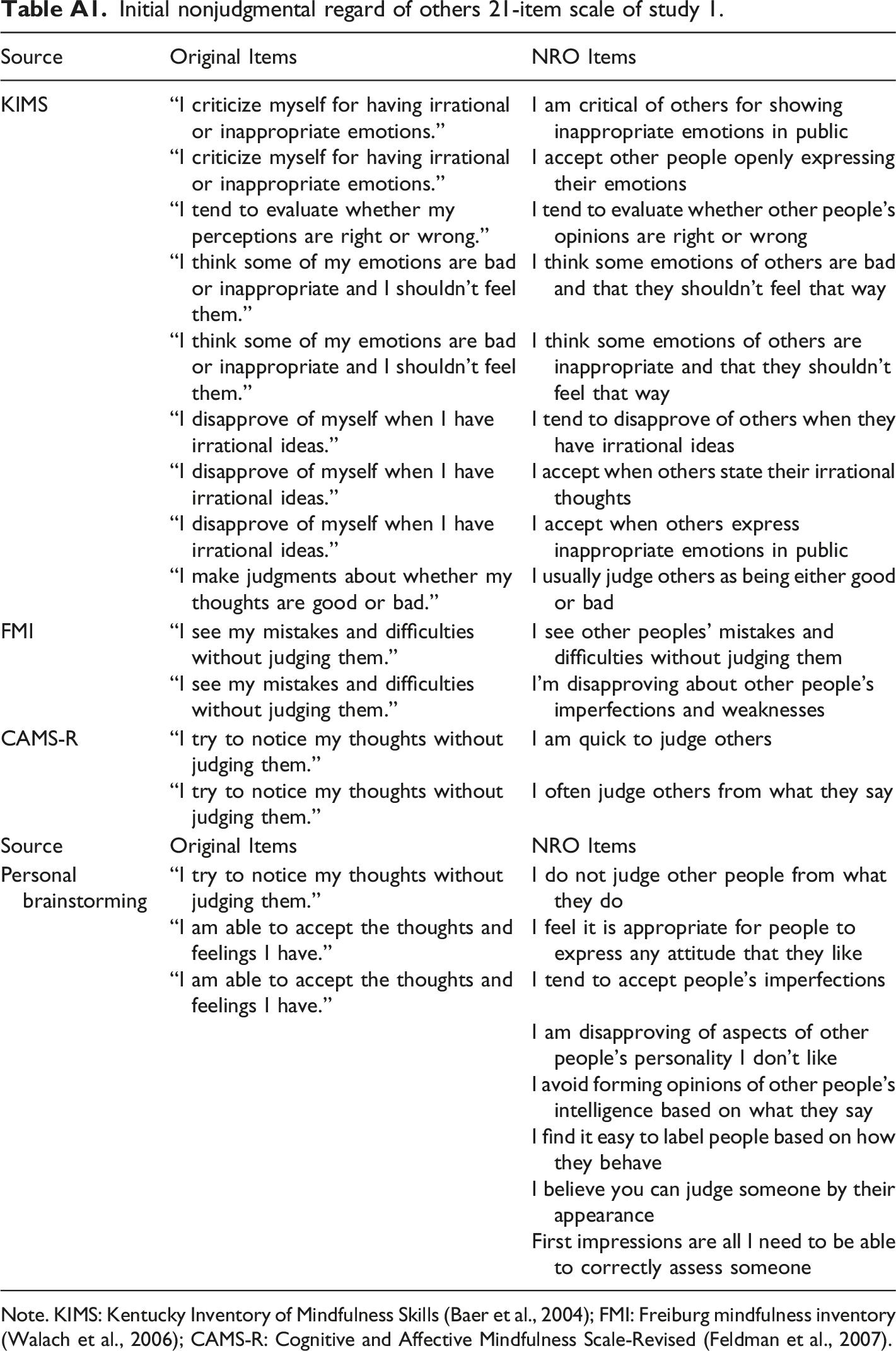
Source
Original Items
NRO Items
KIMS
“I criticize myself for having irrational or inappropriate emotions.”
I am critical of others for showing inappropriate emotions in public
“I criticize myself for having irrational or inappropriate emotions.”
I accept other people openly expressing their emotions
“I tend to evaluate whether my perceptions are right or wrong.”
I tend to evaluate whether other people’s opinions are right or wrong
“I think some of my emotions are bad or inappropriate and I shouldn’t feel them.”
I think some emotions of others are bad and that they shouldn’t feel that way
“I think some of my emotions are bad or inappropriate and I shouldn’t feel them.”
I think some emotions of others are inappropriate and that they shouldn’t feel that way
“I disapprove of myself when I have irrational ideas.”
I tend to disapprove of others when they have irrational ideas
“I disapprove of myself when I have irrational ideas.”
I accept when others state their irrational thoughts
“I disapprove of myself when I have irrational ideas.”
I accept when others express inappropriate emotions in public
“I make judgments about whether my thoughts are good or bad.”
I usually judge others as being either good or bad
FMI
“I see my mistakes and difficulties without judging them.”
I see other peoples’ mistakes and difficulties without judging them
“I see my mistakes and difficulties without judging them.”
I’m disapproving about other people’s imperfections and weaknesses
CAMS-R
“I try to notice my thoughts without judging them.”
I am quick to judge others
“I try to notice my thoughts without judging them.”
I often judge others from what they say
Source
Original Items
NRO Items
Personal brainstorming
“I try to notice my thoughts without judging them.”
I do not judge other people from what they do
“I am able to accept the thoughts and feelings I have.”
I feel it is appropriate for people to express any attitude that they like
“I am able to accept the thoughts and feelings I have.”
I tend to accept people’s imperfections
I am disapproving of aspects of other people’s personality I don’t like
I avoid forming opinions of other people’s intelligence based on what they say
I find it easy to label people based on how they behave
I believe you can judge someone by their appearance
First impressions are all I need to be able to correctly assess someone
Study 2 and study 3 factor loadings, reliability estimates, and correlations between subscales for revised, nonjudgmental regard of others 11-item scale. Note. IA = Ideological Acceptance; EA: Emotion Acceptance.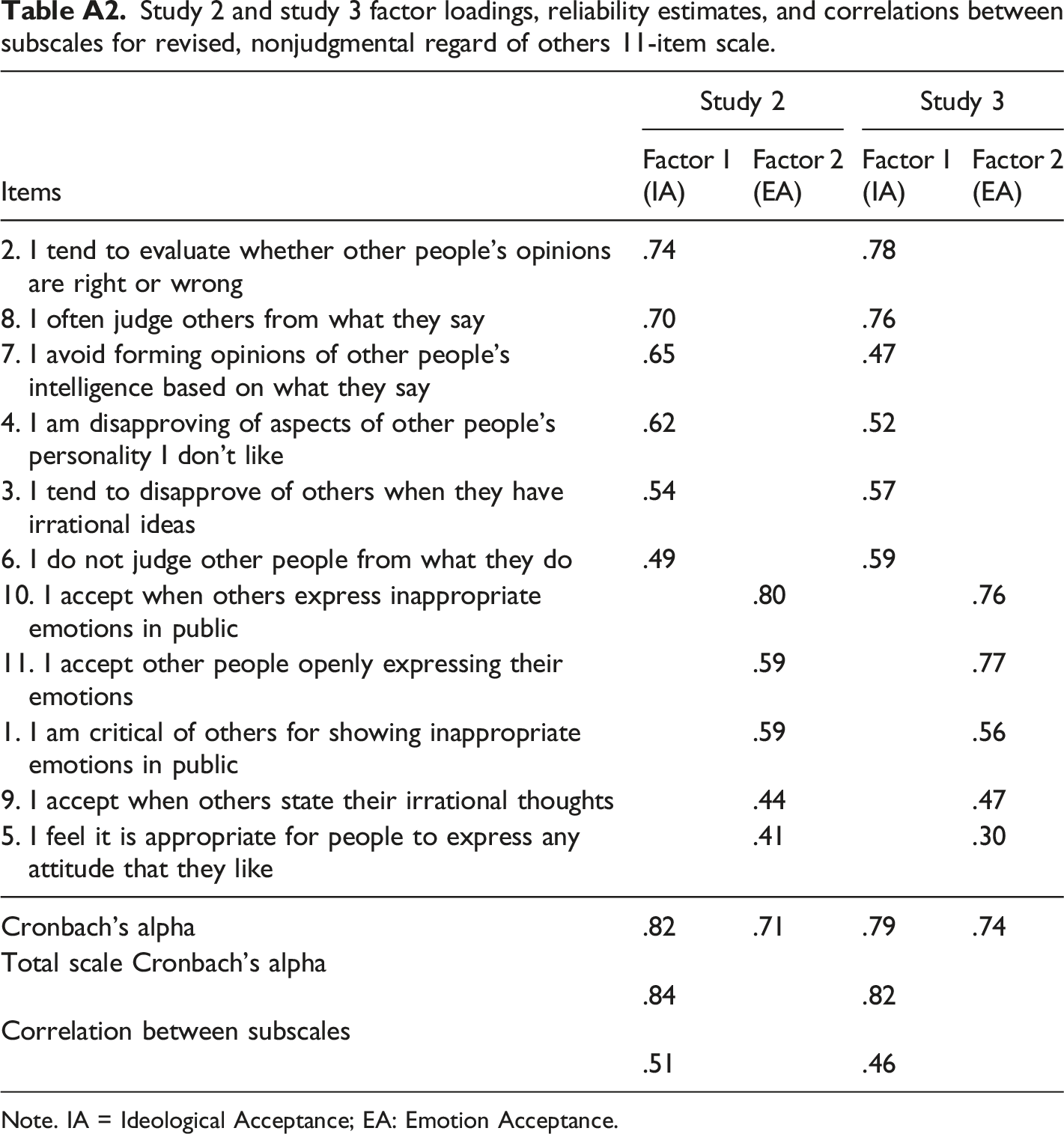
Items
Study 2
Study 3
Factor 1 (IA)
Factor 2 (EA)
Factor 1 (IA)
Factor 2 (EA)
2. I tend to evaluate whether other people’s opinions are right or wrong
.74
.78
8. I often judge others from what they say
.70
.76
7. I avoid forming opinions of other people’s intelligence based on what they say
.65
.47
4. I am disapproving of aspects of other people’s personality I don’t like
.62
.52
3. I tend to disapprove of others when they have irrational ideas
.54
.57
6. I do not judge other people from what they do
.49
.59
10. I accept when others express inappropriate emotions in public
.80
.76
11. I accept other people openly expressing their emotions
.59
.77
1. I am critical of others for showing inappropriate emotions in public
.59
.56
9. I accept when others state their irrational thoughts
.44
.47
5. I feel it is appropriate for people to express any attitude that they like
.41
.30
Cronbach’s alpha
.82
.71
.79
.74
Total scale Cronbach’s alpha
.84
.82
Correlation between subscales
.51
.46
Study 4 correlations, means, standard deviations, and gender differences for all study variables. Note. NRO IA = Nonjudgmental regard of others (NRO) Ideological Acceptance; NRO EA: NRO Emotion Acceptance; FFMQ Nr = FFMQ Nonreactivity; FFMQ O = FFMQ Observing thoughts; FFMQ A = FFMQ Acting with awareness; FFMQ D/L = FFMQ Describing/labelling; FFMQ Nj = FFMQ Nonjudging of experience; HH= HEXACO Honesty/Humility; EMO= HEXACO Emotionality; EXT= HEXACO Extraversion, AGR= HEXACO Agreeableness, CON= HEXACO Conscientiousness, OPEN= HEXACO Openness to Experience. *p < .05. **p < .001.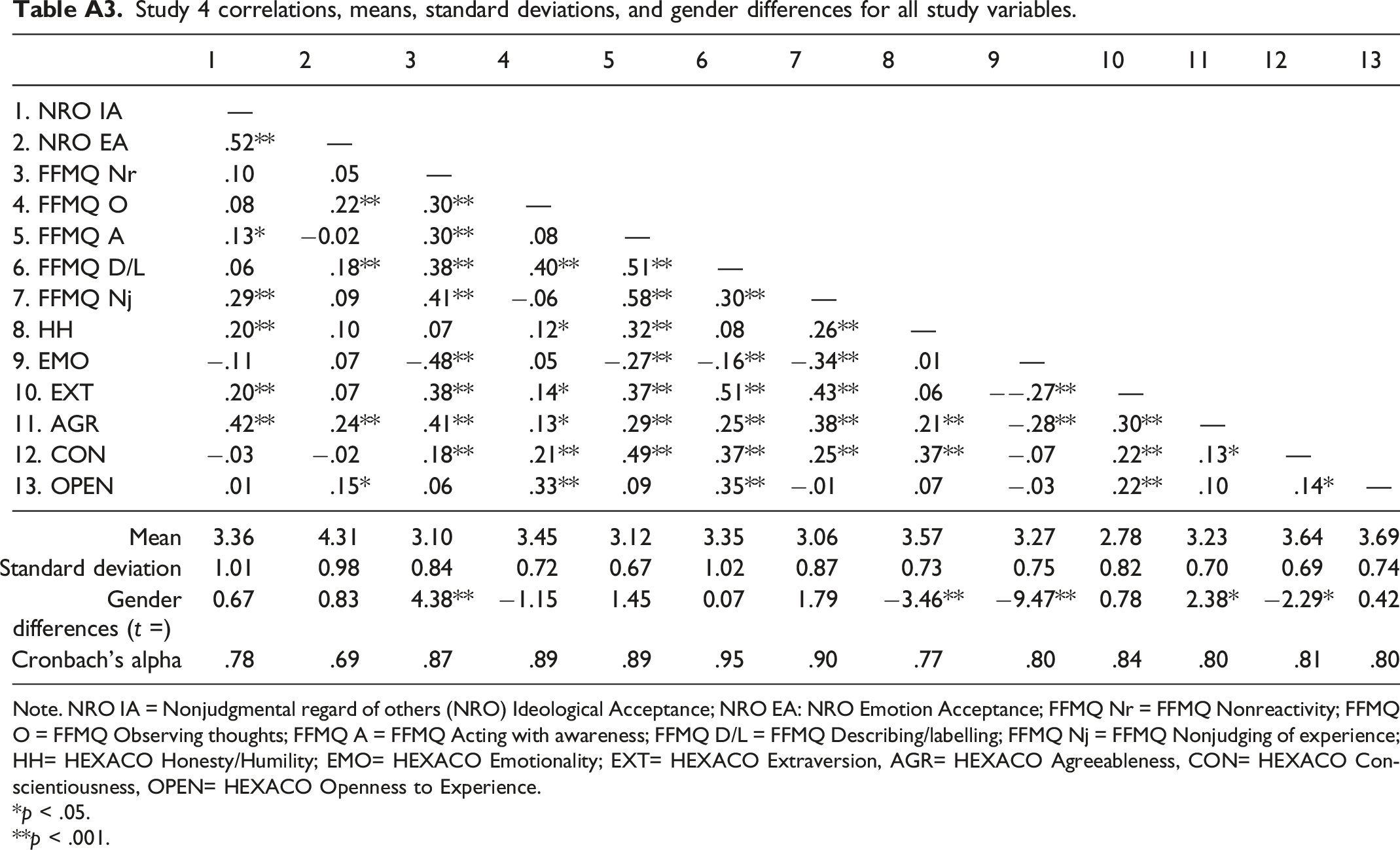
1
2
3
4
5
6
7
8
9
10
11
12
13
1. NRO IA
—
2. NRO EA
.52
**
—
3. FFMQ Nr
.10
.05
—
4. FFMQ O
.08
.22
**
.30
**
—
5. FFMQ A
.13
*
−0.02
.30
**
.08
—
6. FFMQ D/L
.06
.18
**
.38
**
.40
**
.51
**
—
7. FFMQ Nj
.29
**
.09
.41
**
−.06
.58
**
.30
**
—
8. HH
.20
**
.10
.07
.12
*
.32
**
.08
.26
**
—
9. EMO
−.11
.07
−.48
**
.05
−.27
**
−.16
**
−.34
**
.01
—
10. EXT
.20
**
.07
.38
**
.14
*
.37
**
.51
**
.43
**
.06
−−.27
**
—
11. AGR
.42
**
.24
**
.41
**
.13
*
.29
**
.25
**
.38
**
.21
**
−.28
**
.30
**
—
12. CON
−.03
−.02
.18
**
.21
**
.49
**
.37
**
.25
**
.37
**
−.07
.22
**
.13
*
—
13. OPEN
.01
.15
*
.06
.33
**
.09
.35
**
−.01
.07
−.03
.22
**
.10
.14
*
—
Mean
3.36
4.31
3.10
3.45
3.12
3.35
3.06
3.57
3.27
2.78
3.23
3.64
3.69
Standard deviation
1.01
0.98
0.84
0.72
0.67
1.02
0.87
0.73
0.75
0.82
0.70
0.69
0.74
Gender differences (t =)
0.67
0.83
4.38
**
−1.15
1.45
0.07
1.79
−3.46
**
−9.47
**
0.78
2.38
*
−2.29
*
0.42
Cronbach’s alpha
.78
.69
.87
.89
.89
.95
.90
.77
.80
.84
.80
.81
.80