



Abstract
In the current study, we examined the direct and indirect paths from mindfulness to adolescents’ sibling relationships through their cognitive empathy and sympathy. The sample consisted of 220 adolescents (50.9 % female) between age of 13 and 17 years (M = 15.86, SD = 0.91). Participants reported their mindfulness (acceptance and awareness), cognitive empathy and sympathy, and sibling relationships. The parallel mediation model revealed that mindful awareness and acceptance predicted kindness, involvement, and empathy within sibling relationships through sympathy. In addition, there was a significant indirect effect of mindful awareness to empathy in sibling relationships through cognitive empathy. Findings provided information regarding the importance of indirect contributions of mindfulness to sibling relationships through cognitive empathy and sympathy.
Introduction
Individuals’ behaviors and social functioning are influenced by their environments such as home, school, and cultural context (Bronfenbrenner & Morris, 2006). The qualities of the social environment may determine the extent to which individuals become effective agents in their society. Adolescence is a period by which individuals work on their identity formation and could be more vulnerable to relational effects in their environment. On that ground, the immediate family context as a social environment could affect how children develop their understanding of relationships. From the Family Systems perspective, all family members, including siblings, influence their own and other members’ social functioning within a family (Cicirelli, 1995). The quality of sibling relationships established early years has long-lasting influences on the social functioning of individuals (Cicirelli, 1995; Riggio, 2000). In detail, through reciprocal socialization, mutual responsibilities and activities, and prosocial behaviors towards each other, siblings play an important role in each other’s behaviors, development, and well-being (Cicirelli, 1995; Mchale et al., 1986; Riggio, 2000). From both theoretical and empirical perspectives, understanding how sibling relationships are formed and the underlying mechanisms could provide a ground for effective intervention programs (Kothari et al., 2017). In addition, positive sibling relationships established during adolescence may lay a foundation for their identity development, self-esteem, and peer relations (Kramer & Bank, 2005). Based on these conceptual and empirical arguments, we aimed to understand adolescents’ sibling relationships in the context of their mindfulness, cognitive empathy, and sympathy.
The positive sibling relationships reflecting involvement, kindness, and empathy between siblings could support higher social competence, self-esteem, self-worth, and better social cognition in adolescents (Caya & Liem, 1998; Herrera & Dunn, 1997; Howe & Ross, 1990; Yeh & Lempers, 2004). Considering the multifaceted structure of sibling relationships, researchers have focused on assessing multiple dimensions representing the aspects of the relationship between siblings (Volling & Blandon, 2005). On that ground, in the current study, we conceptualized the sibling relationships by taking involvement, kindness, and empathy dimensions into account. These dimensions represent the different aspects of sibling relationships, promising individual examination of these constructs.
Besides the direct influence on social and emotional development, sibling relationships also buffer the stress of children and adolescents in high-conflict family environments and protect them from adverse experiences (Caya & Liem, 1998; Oliva & Arranz, 2005). In adolescence, due to changes in the biological, cognitive, and social developmental domains, the nature of sibling relationships may change (Yeh & Lempers, 2004). According to Buhrmester and Furman (1990), as children return to adolescence from early childhood, their sibling relationships become less interactive and less affective. Although the nature of sibling relationships becomes less intense in adolescence, the importance of the relationship remains and could still be defined by closeness (Yeh & Lempers, 2004). Thus, adolescents reported that intimacy, nurturance, and companionship with closest siblings were ranked as more important than their parent-child relationships (Lempers & Clark-Lempers, 1992). Siblings could be an important source of emotional support and could have meanings and functions for adolescents besides other social resources such as parents, friends, or romantic partners (Moser et al., 1996; Seginer, 1998; Yeh & Lempers, 2004).
Mindfulness and sibling relationships
Mindfulness is defined as being aware of, open, and conscious about what is happening internally and externally in the moment and accepting these experiences without being judgmental (Brown & Ryan, 2003; Cardaciotto et al., 2008). The nature of the term has two main components: awareness and acceptance (Cardaciotto et al., 2008). Awareness refers to monitoring and being attentive in the present moment rather than focusing on the past or the future (Cardaciotto et al., 2008). Thus acceptance refers to welcoming the experiences fully as they are, without judgmental attitudes or interpretations (Cardaciotto et al., 2008). It emphasizes the importance of being conscious about the experience fully rather than evaluating it to change or avoid.
When the concept of mindfulness is considered within the social interactions, research claims that mindfulness is linked to lower stress reactivity, better relationship satisfaction, and more constructive responses to relationship conflicts within the social environment (Barnes et al., 2007; Brown et al., 2007; Ryan et al., 2007; Shaver et al., 2007). According to Ryan et al. (2007), as mindfulness promotes full acceptance and awareness, the relationship quality increases. Being open to the experience without judgment inhibits the susceptible scenarios and leads to less conflict within a relationship. Shaver et al. (2007) extend the argument stating that people who are mindful could be more aware of the surrounding environment, legitimately analyze problems, and develop effective coping strategies in their relationships. Furthermore, Brown et al. (2007) added that mindful awareness fosters closeness in relationships because being attentive to the content leads to greater capability and motivation toward the other person’s interests, thoughts, or emotions. In the same token, in the study of Barnes et al. (2007), mindfulness was related to higher relationship satisfaction and increased ability to deal with relationship stress constructively. Sibling relationships as a social context require each individual to be aware of each other’s social cues and emotional needs, which could be provided by utilizing mindful attunement to demands in that social context. In addition, grounded in the long-standing conceptualization that mindfulness support individuals to initiate and maintain quality relationships in social contexts (Barnes et al., 2007; Shaver et al., 2007), we aspired to explore sibling relationships from the perspective of mindfulness. However, given the paucity of previous research that has investigated the link between mindfulness and sibling relationships per se, in the light of these findings regarding the strong association between mindfulness and social relationship quality, we could speculate that adolescents who are with better mindful awareness and acceptance may establish and maintain quality sibling relationships.
Cognitive empathy and sibling relationships
Cognitive empathy, according to Baron-Cohen (2000), could be used as a synonym of “theory of mind” as “mindreading”. He explains these terms in the context of cognitive empathy as being able to detect and reason the beliefs, intentions, desires, imaginations, and emotions of others’ minds. Understanding the perspective of others, cognitive empathy, is empirically and conceptually linked to prosocial behaviors and moral judgment like sharing, helping, or comforting, especially among adolescents (Eisenberg & Morris, 2013). Furthermore, as adolescents understand each other’s perspectives, their relationship quality and closeness increase with their contacts like friends, romantic partners, or siblings (Eisenberg & Morris, 2013; Selman, 1975). Supporting this view, a large body of research has linked cognitive empathy with sibling relationship quality (Eisenberg & Morris, 2013; Harris, 1994; Howe et al., 2001; Jambon et al., 2018; Lam et al., 2012; Pike et al., 2005; Tucker et al., 1999; Walecka-Matyja, 2017). Consequently, the association between cognitive empathy and sibling relationships is bidirectional in nature. For cognitive empathy development, the positive aspects of sibling relationships like warmth and closeness may contribute to gaining perspective about others’ minds (Harris, 1994; Howe et al., 2001; Jambon et al., 2018; Tucker et al., 1999). Moreover, the older sibling may be a role model for the younger sibling for their cognitive empathy and social development (Jambon et al., 2018; Tucker et al., 1999). On the other hand, the positive outcomes of cognitive empathy may facilitate the involvement and kindness within the sibling relationships (Lam et al., 2012; Walecka-Matyja, 2017). Adolescents who are with better empathy have more positive social relationships, and hence more likely to form positive relationships with their siblings (Lam et al., 2012).
Sympathy and sibling relationships
Sympathy refers to an emotional response toward the deprived person’s emotional state with sorrow and concern, instead of feeling the same emotional state as the other person experiences (Eisenberg & Eggum, 2009; Eisenberg et al., 2015). This emotional concern has an important role in the optimal social functioning of children and is found to be related to positive developmental outcomes such as higher levels of prosocial behaviors and lower levels of externalizing behavior problems (Eisenberg et al., 2007). Sympathy is additionally related to high-quality parent-child and teacher-child relationships (Kienbaum et al., 2001; Malti et al., 2013). Harper et al. (2014) found that as positive sibling relationships require perspective-taking and problem-solving skills through understanding the others’ needs, adolescents could enhance each other’s sympathy throughout the daily interactions. Furthermore, it has been suggested that sibling relationships promote skill development for younger siblings, including problem-solving, prosocial behavior, and sympathy (Recchia & Howe, 2009; Tucker et al., 1999). Parallel to empathy, the association between sibling relationships and sympathy could be bidirectional in nature. In that manner, the positive sibling relationships may enhance sympathy development for adolescents, or adolescents’ sympathy development may foster better social relationships as they have concerns about their siblings.
Empathy and sympathy are interrelated terms and used interchangeably in the literature, yet the distinction between them is clear. For empathy, the person needs to understand the cognitions and emotions of another and feel the same sort of affect (Chismar, 1988). On the other hand, for sympathy, in addition to empathy, a person also feels positive regard or concern for another (Chismar, 1988). In that manner, besides understanding, a person supports and has benevolence toward the other. According to Harper et al. (2014), sympathy is a broader term of empathy and could be defined as an empathic concern. Based on these conceptual and empirical distinctions, we used these two terms as distinct entities predicting sibling relationships in adolescents.
Indirect process: Mindfulness, cognitive empathy, sympathy, and sibling relationships
The evidence has suggested that mindfulness could be an important driver for interpersonal relations (Brown & Ryan, 2003); therefore, utilization of mindfulness-based treatments has been used in enhancing interpersonal relations (Carson et al., 2004). Although there has been no study examining the association between mindfulness and sibling relationships, we could naturally assume that mindfulness could be an important factor in establishing high quality sibling relationships, given promising findings from previous research regarding its effect on interpersonal relations (Carson et al., 2004). Nevertheless, the association between mindfulness and interpersonal relations (including with siblings) may be due to mindfulness could underpin some other factors in a relationship context such as emotional and intellectual instruments (Jones et al., 2016). Mindfulness has been found to be associated with both empathy and sympathy, and showed that mindful people report high levels of empathy and sympathy (Dekeyser et al., 2008; Greason & Cashwell, 2009). In addition, mindfulness could help an individual to foster a nonjudgmental, in-the-moment attitude toward self-experience in a relationship. Being mindful may encourage adolescents to remain in the moment, which could cultivate their empathy and sympathy abilities (Shapiro et al., 2010), which in turn could provide a context for positive relationships with siblings. For example, cognitive empathy was a significant mediator between mindfulness and relationship satisfaction (Wiggins, 2012). Even though the direction of the association has not been tested for sibling relations, it is clear that empathy and sympathy were found to be directly related to better sibling relationships (Lam et al., 2012; Recchia & Howe, 2009). It is clear from the evidence presented above that the quality of sibling relationships could be an outcome of siblings’ individual characteristics such as mindfulness, sympathy, and cognitive empathy. We focused on mindfulness, sympathy, and cognitive empathy as predictors of sibling relationships because unveiling supporting or inhibiting roles of these predictors could provide premises for effective intervention programs. Grounding on the previous work and theoretical conceptualizations, the purpose of the current study was to examine the association between mindfulness (acceptance and awareness) and sibling relationships (i.e., kindness, empathy, and involvement) through cognitive empathy and sympathy. The following hypotheses were tested to address the purpose of the current study: 1. Mindfulness (acceptance and awareness) would be positively related to sympathy, empathy, and sibling relationships (i.e., kindness, empathy, and involvement). 2. Empathy and sympathy would be positively associated with sibling relationships (i.e., kindness, empathy, and involvement). 3. Empathy and sympathy would mediate the association between mindfulness and sibling relationships. Such that, adolescents with better mindfulness would have better empathy and sympathy, which in turn would positively affect their sibling relationships (i.e., kindness, empathy, and involvement).
Method
Participants
The sample for the present study consisted of 220 adolescents (50.9 % female) enrolled in three high schools in Istanbul, Turkey. Participants’ age ranged from 13 to 17 years (M = 15.86, SD = 0.91). A total of 186 participants reported that they had at least one sibling. A total of 42.8 % of mothers and 49.1% of fathers of participants finished high school and higher grades. In the current study, we utilized the chain-referral sampling technique in a cluster nature (e.g., students in schools) (Gravetter & Forzano, 2016). In detail, we primarily contacted students in one school and then additional schools through the primarily contacted school. See details in data collection procedures.
Measures
Sibling relationships
We used the Schaeffer Sibling Behavior Rating Scale (SSBRS; McHale et al., 1986) to examine adolescents’ sibling relationships. The scale has been used and validated with Turkish sample, including 8–18 age children (Ahmetoglu & Aral, 2008). For the current study, we used the involvement (seven items, α = .89, example item: “I have a good time with her/him at home”), empathy (five items, α = .85, example item: “I take care of her happiness and health”), and kindness (nine items, α = .77, example item: “I help her in any way possible”). Participants reported on a five-points Likert-type scale ranging from never (1) to always (5). We averaged the items to create each subscale, where higher scores meant higher target variable values.
Sympathy and cognitive empathy
We used the Adolescent Measure of Empathy and Sympathy Scale (AMES; Vossen et al., 2015) to assess adolescents’ sympathy and cognitive empathy. The scale has been validated and used with Turkish adolescents (Zengin et al., 2017). Participants rated on a five-point Likert-type scale ranging from (1) strongly disagree to (5) strongly agree. Sympathy refers to being aware of another person’s suffering and suffering with him/her (four items, α = .72, example item: “I feel sorry for someone who is treated unfairly”). Cognitive empathy is understanding another person’s perspective (four items, α = .69, example item: “I can easily tell how others are feeling”. We averaged the items to create each subscale, where higher scores meant higher target variable values.
Mindfulness
We used the Philadelphia Mindfulness Scale (Cardaciotto et al., 2008) to examine adolescents’ mindfulness awareness and acceptance. The scale has been used and validated with Turkish sample (Çelik & Kocabıyık, 2018). Participants reported on a five-point Likert-type scale. An example item for awareness is “I am aware of the thoughts in my mind” (α = .81) and an example item for acceptance is “I tell myself that I shouldn’t have certain thoughts” (α = .75). We averaged the items (reverse-scored items for acceptance) to create each subscale (Cardaciotto et al., 2008) where higher scores meant higher values of that target variable.
Data collection procedures
The Ethics Committee of the University approved the study protocol. Potential schools’ directors were contacted to obtain their permission to ask teachers for their permission. After receiving permission from school administrations, we contacted parents through students to receive their consent and students’ assent. Students were assured that their responses would be treated as confidential and kept anonymous. After all these procedures, we distributed all questionnaires to consented and assented students. Data were collected during the 2018-2019 academic year. Research assistants collected all completed questionnaires from the schools in enclosed envelopes.
Analytical approach
Bivariate correlations and descriptive statistics for study variables (N = 220).
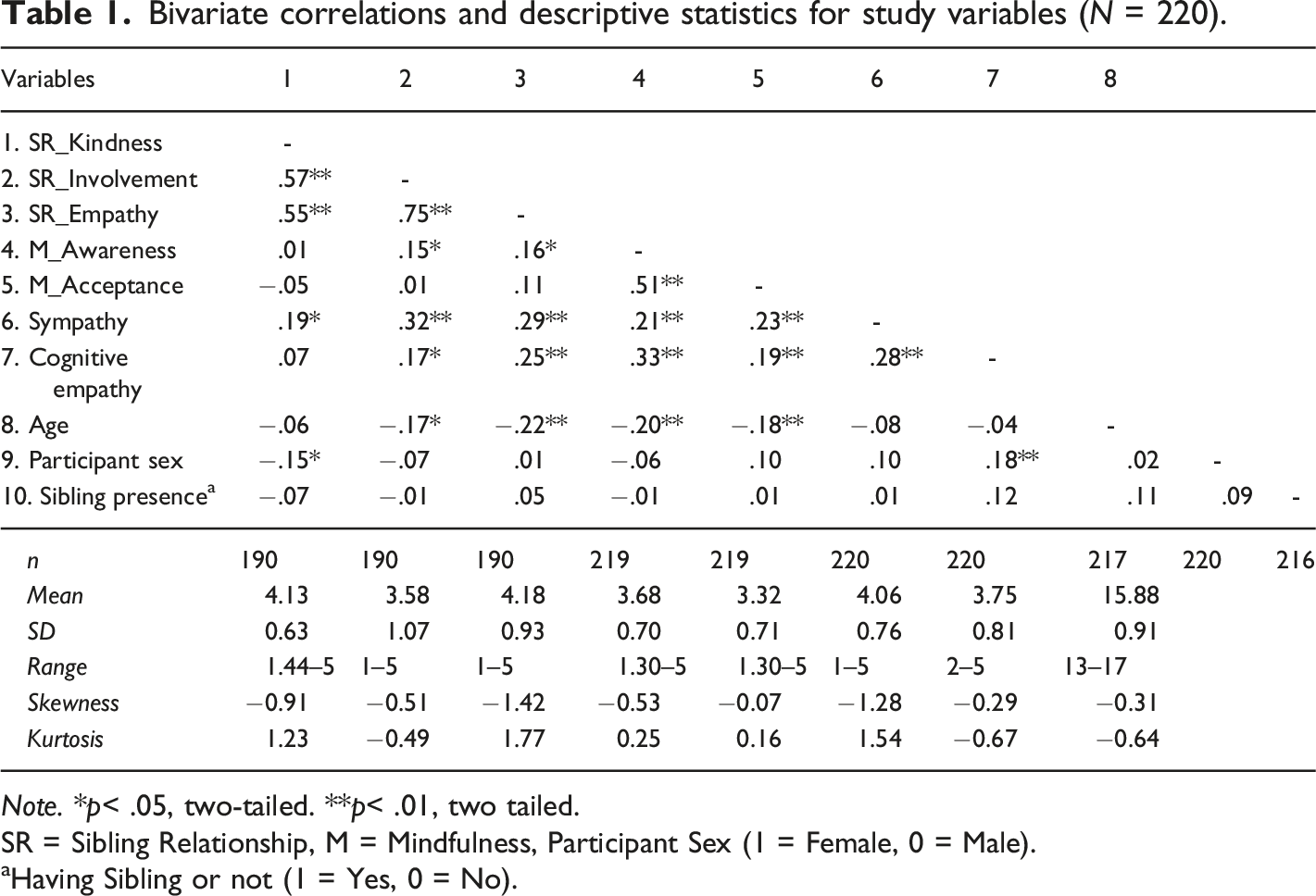
Note. *p< .05, two-tailed. **p< .01, two tailed.
SR = Sibling Relationship, M = Mindfulness, Participant Sex (1 = Female, 0 = Male).
aHaving Sibling or not (1 = Yes, 0 = No).
Results
Preliminary results
Results from the bivariate (Pearson) correlations showed that adolescents’ sympathy was associated with their kindness (r = .19), involvement (r = .32), and empathy (r = .29) in their sibling relationships. Mindful awareness was associated with sympathy (r = .21) and cognitive empathy (r = .33). Mindful acceptance was associated with sympathy (r = .23) and cognitive empathy (r = .19). See Table 1 for complete results.
Direct associations
Final structural model using manifest variables fit the data well, χ2 (10) = 15.491, p = .11, CFI = .98, TLI = .95, RMSEA = .05 [90% CI: .01–.09], SRMR = . 04, AIC (Akaike Information Criterion) = 3027.554, BIC (Bayesian Information Criterion) = 3159.370. As seen in Figure 1, we conceptualized sibling relationships by three manifest variables: kindness, empathy, and involvement. The reason behind this decision was to see specific paths from predictors to each component of the sibling relationships. The path model with standardized coefficients. Note. *p < .05, **p < .01, ***p < .001. SR: Sibling Relationship. Only significant paths are depicted for brevity. Participants’ sex as a covariate was controlled for kindness in sibling relationships (B = −.16, β = −0.13, p < .05), favoring males. Participants’ age as a covariate was controlled for mindful awareness (B = −.15, β = −0.19, p < .01) and acceptance (B = −.14, β = −0.18, p < .01).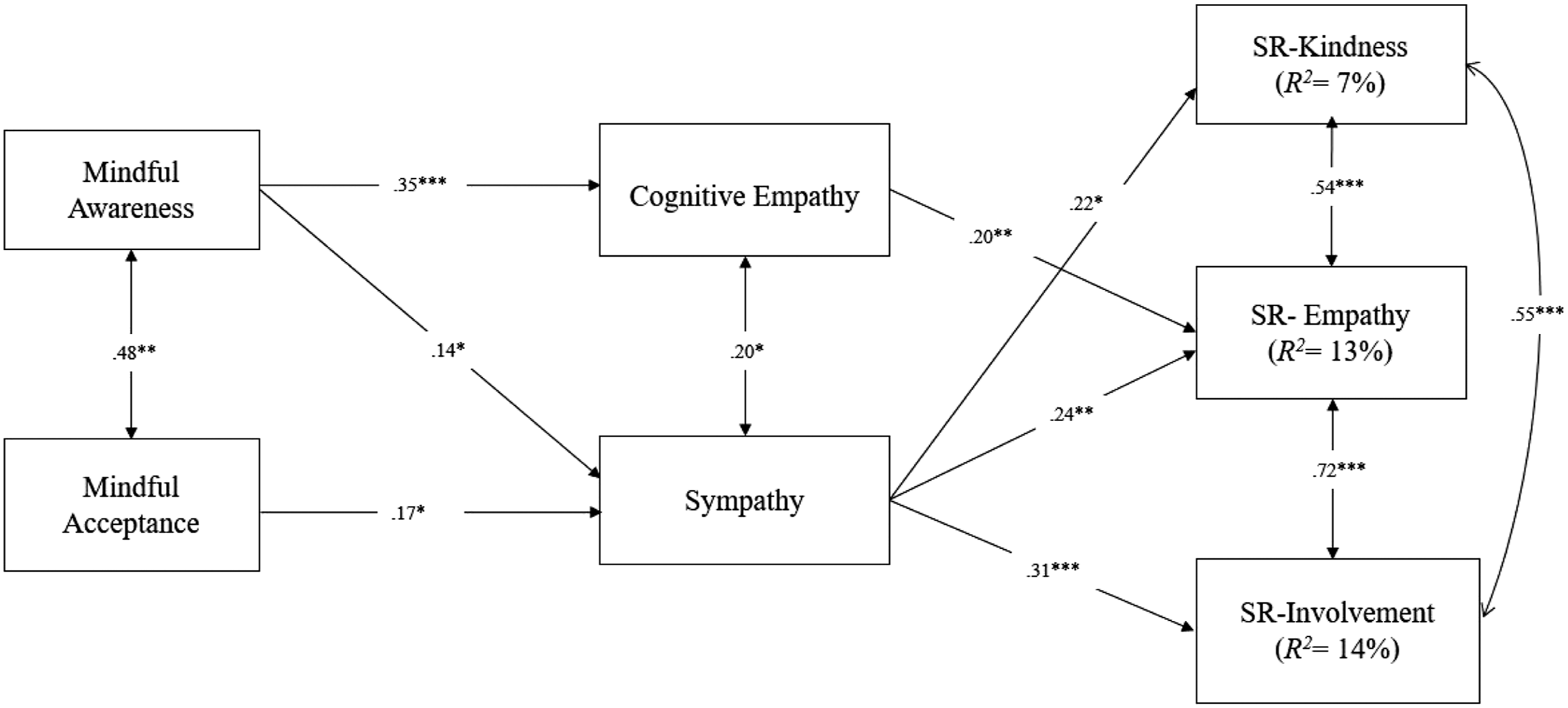
In the final model, adolescents’ kindness in sibling relationships was predicted only by sympathy (B = .17, SE = .07; β = .22, SE = .08). Adolescents’ empathy in sibling relationships was predicted by sympathy (B = .29, SE = .10; β = .24, SE = .08) and cognitive empathy (B = .23, SE = .09; β = .20, SE = .07). Adolescents’ involvement in sibling relationships was predicted by sympathy (B = .43, SE = .12; β = .31, SE = .09). Mindful awareness predicted cognitive empathy (B = .40, SE = .08; β = .35, SE = .06) and sympathy (B = .15, SE = .07; β = .14, SE = .06). Lastly, mindful acceptance predicted sympathy (B = .18, SE = .09; β = .17, SE = .08). See Figure 1 for complete results.
Indirect associations
There was a significant indirect effect of mindful acceptance to kindness (β = .03, [95% CI: .002 - .124], empathy (β = .04, [95% CI: .005 - .124], and involvement (β = .05, [95% CI: .006 - .146] in sibling relationships through sympathy. In addition, there was a significant indirect effect of mindful awareness to kindness (β = .02, [95% CI: .001 - .065], empathy (β = .03, [95% CI: .004 - .086], and involvement (β = .04, [95% CI: .005 - .102] in sibling relationships through sympathy. Lastly, there was a significant indirect effect of mindful awareness to empathy in sibling relationships via cognitive empathy (β = .03, [95% CI: .004 - .086]. See Figure 1 for the depiction of the model and Supplementary Material for graphical depictions of bootstrap distributions with bias corrected 95% credible confidence intervals.
Discussion
The aim of the present study was to understand the direct and indirect contributions of mindfulness (awareness and acceptance), cognitive empathy, and sympathy to sibling relationships in adolescents. We discussed each finding below in detail.
First, we found that mindful awareness was positively related to cognitive empathy, sympathy, and mindful acceptance was positively related to only sympathy. The notion behind the significant association between mindful awareness and cognitive empathy and sympathy could be explained from the perspective that being mindfully aware of the social surrounding may provide a capacity to direct the attention more efficiently and purposefully towards that socially demanding context. Further, mindful awareness is the behavior that is conducted and conceptualized as constant monitoring of experience, regulating the attention on the present rather than past or the feature (Cardagiotto et al., 2008; Hölzel et al., 2011). This attention regulation allows understanding the others’ mental state, to be attuned to the needs of others, and leads compassion towards others in the social context (Block-Lerner et al., 2007; Cheang et al., 2019; Tan et al., 2014). On that ground, mindfulness intervention studies with adolescents found improvement in cognitive empathy and empathetic concern when they learned to sustain and regulate their attention in the present contexts and moments (Cheang et al., 2019; Schonert-Reichl et al., 2015; Tan et al., 2014). Mindful acceptance however is how the behavior is conducted and conceptualized as experiencing the reality without a belief or disbelief (Cardagiotto et al., 2008). In the context of acceptance, there is no attempt of change, no judgment, no interpretation or elaboration of internal events, and the person does not avoid or escape from the experience in a given context (Block-Lerner et al., 2007; Cardagiotto et al., 2008). Correspondingly, in the perspective of acceptance, one fully accepts the perception and interpretation of the others without any manipulation; however, it may not necessarily mean that they are fully aware of the demands in the context to reflect sympathy (Block-Lerner et al., 2007). However, for cognitive empathy, the person needs to be fully aware of the situation and regulate attention as a cognitive aspect of mindfulness to understand the other’s mental state. Overall, mindful awareness provides a greater capability to recognize and take the other’s perspectives (Block-Lerner et al., 2007), explaining the association between mindful awareness and cognitive empathy.
Second, we found that cognitive empathy and sympathy were positively associated with empathy in sibling relationships. In addition, sympathy was positively related to kindness and involvement in sibling relationships. The adolescents’ empathy and sympathy development might enable them to form better social relationships with their siblings (Lam et al., 2012; Walecka-Matyja, 2017). Although both cognitive empathy and sympathy were associated with sibling relationships, sympathy was positively related to kindness, involvement, and empathy within sibling relationships; whereas cognitive empathy was only associated with empathy in sibling relationships. The notion behind the association between cognitive empathy, sympathy, and distinct aspects of sibling relationships relies on the natures of the components of cognitive empathy and sympathy. Cognitive empathy is the facility to understand what others feel and what they might think, sympathy instead, is beyond basically understanding the others’ mental state or emotions, but it also involves compassion, support, and attempt for action to help the other (Chismar, 1988; Wispé, 1986). Hence in the context of cognitive empathy, one does not have to agree with the perception of the other, yet the ability to understand the others’ feelings and thoughts still has a vital role in relationships (Kerem et al., 2001). Findings from the previous research also supported that cognitive empathy was related to better sibling relationships in adolescents (Howe et al., 2001; Jambon et al., 2018; Lam et al., 2012). Moreover, similar to our results, according to Howe et al. (2001), although cognitive understanding is related to positive feelings toward the other sibling, understanding siblings’ emotions is not related to greater involvement in sibling relationships. From this perspective, one sibling may require emotional concern beyond cognitive empathy towards his/her sibling to involve with and provide kindness. Thus feeling sympathy, compassion, support, and emotional concern toward the other could be related to more generous aspects of sibling relationships: kindness, involvement, and empathy. Supporting this statement, the sympathy of siblings was found to be associated with better involvement, kindness, and more affectionate relationships with other siblings (Harper et al., 2014; Padilla-Walker et al., 2015).
While research on the association between mindfulness and social relationships has made tremendous progress, there continues to be a scarcity of understanding on the contribution of mindfulness to sibling relationships. On that ground, we extended the previous work by examining the contribution of mindfulness to sibling relationships through sympathy and cognitive empathy. By doing so, we further explored the idea that cognitive empathy and sympathy may lead adolescents to initiate and maintain different patterns of relationships with their siblings. Nevertheless, the cross-sectional nature of the current study may lead one to interpret results the way around too. Positive sibling interactions provide a context for children to develop care for others, indicating empathy and sympathy (Dunn, 2014).
Third, we found that mindful awareness predicted kindness, involvement, and empathy within sibling relationships through sympathy. In detail, the association between mindful awareness and sibling relationships was due to the reinforcement of greater sympathy in adolescents. As discussed earlier, compassion and emotional concern for others lead adolescents to have greater involvement, kindness, and empathetic relationships with siblings. Previous empirical findings showed that mindful awareness was related to greater sympathy (Cheang et al., 2019; Schonert-Reichl et al., 2015). Additionally, sympathy was associated with better relationship quality, involvement, and kindness, especially for siblings (Harper et al., 2014; Padilla-Walker et al., 2015). Grounding our discussion on that intentionally sharing emotions with others and feeling concerned is a fundamental component for the relationship quality (Denham et al., 1990) and given that there has been no other research that investigated the mediation path between these constructs, we could argue that our findings supported the notion that sympathy is an important additional construct in explaining the association between mindful awareness and sibling relationships.
Another finding worth discussing is that mindful acceptance predicted kindness, involvement, and empathy within sibling relationships through sympathy. Such that the link between mindful acceptance and sibling relationships could be explained by the underlying influence of sympathy. Experiencing the relationship without judgment or an attempt to manipulate, and accept the other’s perception without avoiding, increases the ability to share the emotions and need to help the other (Aydın Sünbül, 2021; Block-Lerner et al., 2007). Further, as stated in previous elaborations, the emotional concern and willingness to reduce the others’ misfortune prognosticate greater involvement, kindness, and empathy within sibling relationships. As adolescents share the feelings of their sibling(s) and are ready to help each other, they have a more affectionate relationship, investigate the events more deeply, are more involved with their lives, and be kind to each other (Harper et al., 2014; Padilla-Walker et al., 2015). The last indirect path revealed that mindful awareness predicted empathy in sibling relationships through cognitive empathy. The association between mindful awareness and empathy in sibling relationships may also be due to the underpinning influence of having a greater cognitive empathy in adolescents. Attending to the moment intentionally rather than being preoccupied in past or the future, and focusing on the experience directly underline the capacity to understand others’ mental states, emotions, or intentions (Ridderinkhof et al., 2017; Schonert-Reichl et al., 2015; Tan et al., 2014); in turn which could elevate the capacity to establish empathetic sibling relationships in adolescents (Howe et al., 2001; Kerem et al., 2001; Lam et al., 2012).
The existence of two different pathways from mindfulness awareness to sibling relationships and one path from mindfulness acceptance to sibling relationships somewhat coincides with previous direct findings. As mindfulness awareness requires directing attention efficiently to the present moment, it creates an opportunity to understand the mental state and needs, further leading to feeling concerned for others (Block-Lerner et al., 2007; Cheang et al., 2019; Tan et al., 2014). Consequently, mindfulness awareness was associated with both cognitive empathy and sympathy. On the other hand, mindfulness acceptance was only associated with sympathy, since it was constructed as an unquestioning acceptance of the situation without requiring a complete awareness (Block-Lerner et al., 2007). Moreover, other direct results emphasized that while cognitive empathy was associated with empathy in sibling relationships, sympathy was additionally associated with involvement and kindness in sibling relationships. This could be explained by the fact that in the nature of sympathy, there is support and willingness to help beyond understanding the other person (Chismar, 1988; Wispé, 1986). As understanding their siblings’ mental state does not require an agreement, it is not associated with higher involvement within sibling relationships (Howe et al., 2001).
It is important to acknowledge that both components of mindfulness (awareness and acceptance) were not directly associated with any components of sibling relationships. Given there has been no research examining all these direct and indirect paths; further research is warranted to explore these nonsignificant direct paths from mindfulness to sibling relationships.
Implications of the current study
In the current study, we examined the contributions of mindfulness (awareness and acceptance), cognitive empathy, and sympathy to sibling relationships (kindness, involvement, and empathy). Although more research is needed to understand the contributions of these constructs to sibling relationships, findings from the current study provided information regarding the importance of indirect contributions of mindfulness to sibling relationships through cognitive empathy and sympathy. Grounding on our findings, mindfulness practices for adolescents would help them to gain emotional and intellectual instruments (cognitive empathy and sympathy), and in turn to have better interpersonal relationships exclusively with their siblings. Through mindfulness practices, adolescents might gain competencies to be attuned to their own and others’ mental and emotional states and to develop a sense of compassion to reduce the problems in their relationships (Block-Lerner et al., 2007; Cheang et al., 2019; Schonert-Reichl et al., 2015; Tan et al., 2014). This cognitive empathy and sympathy will help adolescents have better sibling relationships (Harper et al., 2014; Howe et al., 2001; Kerem et al., 2001; Lam et al., 2012; Padilla-Walker et al., 2015). Integrating app-based mindfulness practices (e.g., Headspace) could be an additional supporter for adolescents in their daily routines (Champion et al., 2018). Sibling relationship has long-lasting influences on social functioning and is an important source of support, and become more important than the parent-child relationship in the adolescence period (Cicirelli, 1995; Lempers & Clark-Lempers, 1992; Riggio, 2000; Yeh & Lempers, 2004). In that manner, supporting adolescents’ positive sibling relationships are crucially important by scaffolding their in-the-moment awareness, attention regulation, non-judgmental acceptance, cognitive empathy, sympathy through mindfulness practices.
Limitations and future research
Some limitations should be considered in the current study, and we lend some recommendations for future research. First, our study used a cross-sectional design, limiting our capacity to talk about causal inferences of the direct and indirect paths. Future research should examine the model with a longitudinal design to infer causality. Second, all the measures were based on self-report which could have brought in rater bias in our assessments. To overcome this issue, future work should utilize peer or adult reports (e.g., parents or teachers) and observation of behaviors for sibling relationships in particular. Lastly, adolescents in the current study were only from one city (albeit it was a metropolitan city), limiting the generalizability of the findings.
Supplemental Material
Supplemental Material - Associations Among Adolescents’ Mindfulness, Sympathy, Cognitive Empathy, and Sibling Relationships
Supplemental Material for Associations Among Adolescents’ Mindfulness, Sympathy, Cognitive Empathy, and Sibling Relationships by Özge Barata, Ibrahim H. Acar, and Selen Bostancı in Psychological Reports
Footnotes
Author Contributions
OB: wrote and revised the manuscript, and collaborated in the writing and editing. IA: collaborated in the conceptualization of the study, performed data analyses. SB: Executed data collection and collaborated in the writing and editing of the manuscript. All authors approved the final version of the manuscript for submission. The authors declare that they have no known competing financial interests or personal relationships that could have appeared to influence the work reported in this paper
Declaration of Conflicting Interests
The author(s) declared no potential conflicts of interest with respect to the research, authorship, and/or publication of this article.
Funding
The author(s) received no financial support for the research, authorship, and/or publication of this article.
Data and/or Code Availability
The data that support the findings of this study are available from the corresponding author upon reasonable request.

Supplemental Material
Supplemental material for this article is available online.
Author Biographies
References
Supplementary Material
Please find the following supplemental material available below.
For Open Access articles published under a Creative Commons License, all supplemental material carries the same license as the article it is associated with.
For non-Open Access articles published, all supplemental material carries a non-exclusive license, and permission requests for re-use of supplemental material or any part of supplemental material shall be sent directly to the copyright owner as specified in the copyright notice associated with the article.
