




Abstract
An online survey (N = 210) is presented on how the perceived utility of correct and exaggerated countermeasures against Covid-19 is affected by different pronominalization strategies (impersonal form, you, we). In evaluating the pronominalization effect, we have statistically controlled for the roles of several personal characteristics: Moral Disengagement, Moral Foundations, Health Anxiety, and Embracing of Fake News. Results indicate that, net of personal proclivities, the you form decreases the perceived utility of exaggerated countermeasures, possibly due to simulation processes. As a second point, through a Structural Equation Model, we show that binding moral values (Authority, Ingroup, and Purity) positively predict both fake news embracing and perceived utility of exaggerated countermeasures, while individualizing moral values (Harm and Fairness) negatively predict fake news embracing and positively predict the perceived utility of correct countermeasures. Lastly, fake news embracing showed a doubly bad effect: not only does it lead people to judge exaggerated countermeasures as more useful; but, more dangerously, it brings them to consider correct countermeasures as less useful in the struggle against the pandemic.
Introduction
The widespread of Covid-19 offers a concrete opportunity to deepen many risk-related themes, among which risk management and legislative aspects on prohibitions to adopt in such extreme circumstances. In situations like these, it becomes fundamental to contain contagion by helping citizens to understand the new laws and maximize their scrupulous observation. Moreover, such an issue is morally relevant since, unlike other phenomena, an epidemic makes it evident the extent to which an individual's behaviour may put at risk the health of many other people.
In this perspective, it is crucial to frame prescriptions and prohibitions to be easily understood, incapable of generating misunderstandings, and apt to encourage beneficial behavior for the individual and collectivity (Thaler & Sunstein, 2009). The great majority of the literature insisted on the well-known framing effect (Tversky & Kahneman, 1981). Such an effect has already proved to be essential for the improvement of several messages (Levin et al., 1998), including those related to health (Gallagher & Updegraff, 2012; Gong et al., 2013).
Another particular frame can be considered the perspective taken into the message, according to whether it encourages a point of view which can be very close to the Self, the community, or detached from both (Behavioural Insights Team, 2014; Kross & Grossmann, 2012; Ramsey et al., 2013). In the moral domain, this also results in showing different moral standards depending on whether the message is directed toward the individual, the community, other people, or it is impersonal (on the difference between 1st and 3rd person, see Nadelhoffer & Feltz, 2008).
When it comes to the communicative aspects of an epidemic, one should not rely on a single strategy; on the contrary, several messages should be employed, differing from one another in terms of phrasing, communication style, contextualization, the lexicon used, etc., in order to reach several diverse sectors of the population. This can be useful to provide the greatest part of the population with helpful instructions to be observed during the epidemic.
For these reasons, we were interested in understanding whether and how a mere grammatical difference in the phrasing of some behavioral instructions (Covid-19 countermeasures) could affect the related perceived utility. More specifically, since to our knowledge no work has ever directly employed such a strategy, we focused on pronominalization, that is, the use of different pronouns in describing the norms to respect in order to prevent contagion and successfully face the emergency. Moreover, given the spread of anxiogenic Covid-related fake news, not only were we interested in analyzing the communication of correct countermeasures against contagion, but also that of exaggerated countermeasures that could be elicited by giving credibility to certain fake news.
Moreover, we supposed that some personal characteristics could also have an impact on the perceived utility of the countermeasures; therefore, in our experiment, not only did we measure the perceived utility in dependence of the grammatical phrasing, but also some psychological constructs, in particular: Moral disengagement (Caprara et al., 2009), Moral foundations (Graham et al., 2011), Health anxiety (Salkovskis et al., 2002), and susceptibility to fake news (Pavela Banai et al., 2020).
To better grasp the two focal points of the current work, it needs to be stressed that our use of the above-mentioned personal characteristics is twofold: on the one hand, we assessed them in a co-variation perspective, to control for them and search for an effect of the pronominalization net of any personal proclivities. That is, given that we are measuring the perceived utility of several countermeasures affecting personal freedom for the purpose of public health, we must be sure that our participants could be experimentally controlled for some personal tendencies that could have biased their answers to a greater extent as opposed to the manipulation. To put it briefly, we had to adjust the preexistent differences among our participants, and the co-variation approach allowed us to draw safer conclusions with respect to our manipulation (see § Results / Pronominalization).
Furthermore, we hypothesized that, beyond the pronominalization, some of the personal characteristics played a key role per se in the mechanism that leads citizens to perceive some countermeasures as correct or exaggerated. Therefore, we resorted to a SEM model to shed light on the relationship between individual moral proclivities (i.e., moral foundations), the embracing of fake news, and the perceived utility of correct and exaggerated countermeasures (see § Results / Moral Foundations and Fake News Embracing).
For starters, in the following section, we deepen the role of pronouns in communication. In the next sections, we present our survey study, discussing in detail the theoretical constructs employed and the relative research questions; the materials and tools employed, procedure, analyses rationale, and results. In the final sections, discussion and conclusions are provided.
Pronouns and pronominal choices in communication
Every communication has an addressee, and every speaker (or, more generally, every sender) has several options to refer to his/her addressee(s). The use of pronouns is a widely used strategy; they are part of those linguistic expressions whose referent is bound by the coordinates of the communicative situation, called deixis. Speakers and listeners use deictic fields (Bühler, 1990) each having its own center, the origin to orient these expressions. Specifically, pronouns are manifestations of the personal deixis whose origin is the sender of the message, from which the receiver and the “third party” participants are distinct. This allows for various pragmatic effects.
For instance, it has been shown that specific pronouns predict how couples think and feel about their relationship and behavior (Williams‐Baucom et al., 2010), how they cope with worry (Biesen et al., 2016). When it comes to mass and political communication speeches, in which the speaker has the explicit or implicit goal to persuade the audience (Mutz et al., 1996; Poggi, 2005; Poggi & Vincze, 2009; Vincze, 2010), the mere choice to pronounce “we” instead of “you” can have a different impact on the audience’s interpretations (Gunsch et al., 2000), namely on how the addressees introject the speaker’s message. Such types of communication like discourses or ads “address millions of people at once, [but] they should give the impression that they are addressing a consumer personally” (Fuertes-Olivera et al., 2001, p. 1298); and this is achieved through the use of pronouns.
Fetzer and Bull (2008) state that three different personal pronouns can express self-reference (i.e., I, we, and you): if the first-person singular is the most common way through which each speaker refers to herself, and shows personal responsibility and authority, the first-person plural is a non-default (and therefore marked) form that expresses the speaker’s affiliation to a particular social group. The pronoun you has several roles and therefore implications; it is typically used in parental reproaches, thus associated with prohibitions and limitations since early childhood (Orvell et al., 2018), but it can also have a generic meaning. At last, impersonal forms do not express self-reference, but they are more linked to the description of general norms, as in This door must remain closed.
In the following paragraphs, we briefly describe some conceptualizations of these three ways of providing information, and in particular prescriptions. We do it by referring to the literature and by analyzing the same utterance in its three different forms.
We (We should do it)
Using we is a way of identifying oneself with the addressee(s), or at least with some of the characteristics of the audience; it constitutes a way through which the speaker comes closer to their audience, and theirself is also portrayed as a proper member of the addressee(s) group: the pronoun we is assigned a key function in the process of establishing membership categorization while at the same time signifying proximity, if not solidarity with the category’s ideology. […] Speakers define explicitly and publicly social groups vis à vis their interlocutors by using we pronouns. At the same time, they state their membership to these groups. (Fetzer & Bull, 2008, p. 279)
From the addressee’s point of view, receiving an utterance with the pronoun we provokes an automatic sense of inclusion within the speaker’s proposals. An utterance such as We should do it implies that the speaker will embrace the effort together with the addressee(s). Each receiver feels like a member of a group who is going to endeavor to do something. Not surprisingly, the use of we is widely employed in primary care consultations (Skelton et al., 2002)
You (You should do it)
The case of the second person singular is more complex; as a matter of fact, a clear distinction has to be made between its impersonal use and the uses in which the referential domain is completely determinate (e.g., you, as the Editor-in-chief, are responsible for this work). In the first case it has been suggested by Wilson (1990) that indefinite you is used to discuss “conventional wisdom”, therefore inviting empathy with the hope of receiving the agreement of the audience (Pearce, 2001). For such an ambiguity, to better grasp the underpinnings of the use of you, one should always make inferences from context. 1
It must be highlighted that, in Italian, contrarily to English, the second person singular pronoun (Tu) is totally different from the second person plural pronoun (Voi), they cannot be confused in any case. For a more specific dissertation on the impersonal use of the second person pronoun in several languages, please refer to Kitagawa and Lehrer (1990).
From an Italian addressee’s perspective, receiving an utterance with the second person singular pronoun provokes, contrarily to the first-person plural, a sense of asymmetric exclusion. An utterance such as You should do it is likely to be perceived as a performative act of order or, as Orvell and colleagues (2019) suggest, “generic-you functions as a linguistic nudge that carries persuasive force”. Furthermore, it is implied that the speaker will not embrace the effort together with the addressee(s); quite the opposite, s/he is commanding the addressee to do something that s/he is too high ranked to do. Indeed, it has been shown that the use of you can have negative consequences also in customer-firm interactions (Packard et al., 2018).
Impersonal forms (It should be done)
We already mentioned that the pronoun you could represent an impersonal form (Gast et al., 2015); in fewer cases, also the first person plural can be referentially ambiguous and potentially felt as impersonal; nevertheless, in this paragraph, we explicitly refer to those utterances that do not imply a specific agent, as in “the environment should be respected”. Both in English and in Italian, when we need to express advice or prescriptions without making explicit the agent, namely who will do what is described, we often resort to verbal passive alternation (Levin, 1993). Therefore, You/We should do it becomes It should be done. This impersonal strategy leads to vagueness, namely, uttering less (Lombardi Vallauri, 2019). In general, even though vagueness offers several advantages in persuasive communication, such an argumentative choice would not be useful in the light of eliciting compliance to prescriptions for several reasons: firstly, because the sender appears as deresponsabilized towards the contents that they may have suggested (Caffi, 2012, 2013); secondly, the sender does not include theirself nor the addressee(s), and, thirdly, by using such a vague form, the utterance appears as a general norm more than an invitation to cooperation.
The current study
Theoretical issues and research questions
Here an online experiment on an Italian sample is presented on the perceived utility of adequate and exaggerated behavioral instructions in dependence of different pronominalizations (grammatical phrasings) and with consideration to personal characteristics such as Moral Disengagement (Caprara et al., 2009), Moral Foundations (Graham et al., 2011), Health Anxiety (Salkovskis et al., 2002), and susceptibility to fake news.
As for the pronominalizations, we opted for three: 2nd person singular (you should do it), 1st person plural (we should do it), and impersonal form (it should be done). We decided on these phrasings since each of them evokes different social feelings: the impersonal form leads to think of a general norm, without a proper reference to the contextual reality, the 2nd person singular is the most direct way to provide orders and suggestions (see § You); besides, it is linked with the classic parental reproaches. Conversely, the 1st person plural evokes a true social feeling (see § We), it contributes to make the reader perceive theirself as a member of a larger community.
Perceived utility (the good precursor to compliance)
What we are aiming at is a better understanding of the mechanisms that lead one to be compliant with correct countermeasures and discourage exaggerated behaviors that can have negative social and psychological effects. But to do so, an explanation is required on why we used perceived utility instead of mere compliance. The reason lies in two facts: the first one is that several studies have already shown promising results in analyzing the factors that influence compliance the most: political orientation (Harper et al., 2020; Kushner Gadarian et al., 2020), social influence (Cialdini & Goldstein, 2004), social responsibility, trust (Almutairi et al., 2020; Bargain & Aminjonov, 2020; Freeman et al., 2020; Schmeisser et al., 2020), moral values (Díaz & Cova, 2020), personality traits (Schmeisser et al., 2020), self-interest (Dishman & Ickes, 1981; Kuiper et al., 2020; Nivette et al., 2020; Oosterhoff & Palmer, 2020), and attitudes about Covid-19 severity or fear of the virus (Harper et al., 2020; Oosterhoff & Palmer, 2020).
The second one is that inner motivations that widely differ from one another can all lead to compliance, indiscriminately. In other words, compliance is an outcome while we are interested in the input. For instance, two individuals can be compliant to a given rule for opposite motivations: one could adhere to it because s/he is genuinely convinced of its utility for the community, the other could respect it only for fear of peer pressure, social judgement, or, more prosaically, penalties or convictions. Such motivations are what Allen (1965) described as private acceptance and public compliance (for a study on the compliance to Covid-19 mitigation measures, see Van Rooij et al., 2020). These two are, in a nutshell, those that we define as good and bad precursors of compliance. In this study, we focus on private acceptance for two main reasons: first, it is more likely that an individual who genuinely perceives a behavior as correct will embrace it even over time. Vice versa, those who embrace that behavior without perceiving it as appropriate are more likely to defect at any time. Secondly, we are convinced that, therefore, in the long run, they grant more substantial and more aware compliance.
Moreover, the concept of perceived utility is very complex and affects our daily life in a very subtle way, mainly helping us in making decisions (Thaler, 1999, 2008). From a psychological point of view, it clearly emerges that perceived utility is a concept to be taken into account, mostly thanks to the role it plays as a mediator of phenomena such as the proportion dominance effect, resulting even more decisive than sympathy (Erlandsson et al., 2014; Rodríguez et al., 2020). It is not so surprising that the perceived utility plays a fundamental role also in the acceptance of safety measures to protect oneself from Covid-19 (Hu et al., 2020).
Moral disengagement
As stated above, an epidemic raises nontrivial moral issues: in such cases more than others, the actions of each individual have a crucial and determinable impact on the lives of every other person within one’s family and social network. As a matter of fact, even single actions, such as the choice to visit someone, or make a trip, can dramatically affect the health of an enormous number of people unknown and probably underestimated by the decision maker. Things are radically complicated by the fact that, in every decision, the alternative to the safer choice is always more pleasant or fun. Furthermore, after living several months in lockdown, and therefore with a vast number of social restrictions, prohibitions, and limitations, the need to experience pleasure at various levels becomes more urgent; thus increasing the odds that the safer choice will be avoided and perceived as a further limitation to one's desire for fun.
In such a context, a psychological construct as the Moral Disengagement (MD) (Bandura, 1999, 2002; Bandura et al., 1996) becomes extremely relevant since it can lead to harmful civic behaviors that go against social rules (Detert et al., 2008), discourage prosocial behavior and guilt, and promote aggression proneness and delinquent behavior (Bandura et al., 1996). Last but not least, it can lead to unsafe behavior in a crisis like the one we are experiencing (Alessandri et al., 2020). For these reasons, such a psychological construct deserves particular attention in an unprecedented crisis such as the Covid-19 pandemic to understand the reasons behind the behavior of individuals in respecting or not the safe behaviors to be adopted in such a situation.
It remains unclear the actual link between MD and unsafe behaviors. In this study, we try to understand how the MD can affect the reception of safe behaviors to be put into practice.
Moral foundations
If the MD and its subcomponents can enhance or reduce the compliance to norms that safeguard the well-being of the population, other moral features of the individual might shape not only one’s adherence to norms but also one’s inner motivations to behave more or less safely, regardless of the law. As a matter of fact, an individual can avoid social contacts because s/he genuinely convinced that it is safer to do so to prevent others from contagion, or because s/he fears a penalty applied by the police.
In the literature of moral psychology, the Moral Foundations Theory (MFT) (Haidt & Joseph, 2004) lists five “universally available (but variably developed) sets of moral intuitions: Harm/Care, Fairness/Reciprocity, Ingroup/Loyalty, Authority/Respect, and Purity/Sanctity” (Graham et al., 2011, abstract).
The five universal moral intuitions might be in turn split into two main branches: Harm and Fairness have been described as individualizing values (or person-focused). These values are typical of those moral systems that suppress selfishness “by protecting individuals directly (often using the legal system) and by teaching individuals to respect the rights of other individuals” (Graham et al., 2009, p. 1030). On the contrary, Authority, Ingroup, and Purity have been defined by the same authors as binding values (or group-focused), namely these values are central in those moral systems that suppress selfishness “by strengthening groups and institutions and by binding individuals into roles and duties in order to constrain their imperfect natures” (Graham et al., 2009, p. 1030).
Traditionally, the former values are linked to Anglo-Saxon liberal thinking, while the latter emerge more clearly as the prototypical values of the traditional religious American right-wing (Greenway et al., 2019; Haidt, 2007). Nevertheless, Graham et al. (2009) clearly express the caveat not to generalize such a distinction within the right/left oppositions in all groups and all societies.
Another essential difference between such two types of values might lie in how the people who embrace them perceive the organization of the society: we propose that the individualizing values imply a horizontal setting of the society and an inclusive system; on the contrary, the binding values assume a vertical and thus hierarchical organization; in other words, an exclusive system. Moral values such as Fairness and Harm have at least two crucial implications for the individuals who endorse them: everybody has to be treated equally (Fairness), and everybody needs to be protected and cherished (Harm/Care); the accent in these cases is on “everybody”, in that these moral values by no means imply differences among the individuals. In the evolutionist theory of Graham et al. (2013), the ancient Harm/Care phylogenetic triggers have been visual and auditory signs of suffering; similarly, the Fairness moral intuitions' roots lie in the search for mutual cooperation against cheaters.
On the contrary, the binding values presume and imply differences among the individuals based on at least three entities: the Authority domain directly implies the existence of someone higher that must be considered and respected regardless of its correctness, merely because of its higher role; likewise, the Ingroup domain implies the preference for the Ingroup, perceived as more entitled to be supported and protected, as opposed to other outgroups. Lastly, the Purity/Sanctity domain deals with clear boundaries between what is virtuous and what is depraved, what is pure and what is not. Indeed, in Graham et al.’s (2013) evolutionist view, the Authority and Ingroup domains can be seen as the natural evolution of the dominance hierarchies that exist among any primates, while Purity is a prototypical value the first hominids build out of the need to defend oneself and the Ingroup against pathogens and parasites.
To sum up, the binding values are more or less straightforwardly more prone to divisions, whereas individualizing values prefer inclusions.
If we take a look at the characteristic emotions of these two moral systems (Graham et al., 2013), we discover that the binding values’ emblematic emotions are group pride/rage at traitors, fear, and disgust, whereas the emotions of the individualizing values are compassion for the victims and gratitude.
For these reasons, we hypothesized that two different reactions might arise in dependence of the endorsement of such two moral systems (i.e., individualizing vs. binding values): if an epidemic is a danger for both group-focused and person-focused individuals, for the former it might also constitute a more serious threat to the maintaining of the social order (Authority), the Ingroup (especially considering that the virus – for the Italians – came from an outgroup, that is China), and the contamination (Purity), namely, a virus is primordially a prototypically dirty agent that contaminates the individuals. We imagined that such a deeply perceived threat could lead people with high binding values to overreact by overestimating the perceived utility of exaggerated countermeasures due to a reactance-like phenomenon (see Discussion). Moreover, a reflection needs to be made on the fact that the great majority of the fake news proposes an alternative version of some facts. The inner narration of much fake news might be described as something like “The mainstream communication tells you that story, but you mustn’t believe it; you don’t have to be a fool, this is really something you must know; things are different from what they tell you; they are hiding something from you”. A narration shaped to convey such a deep message resonates nicely to someone in need of clear-cut boundaries to tell what is wrong or right for at least three reasons: There is an appeal to fear within such a message, and fear is one of the characteristic emotions of binding values (especially Authority) (Graham et al., 2013). Suggesting the existence of “another truth” implies an attempt to include the reader within the prestigious Ingroup of those who know, as opposed to the mass (outgroup) that ignores the truth. It is not rare to hear conspirationists accusing others of being “filled with bullshit”, or “slaves of the mainstream information”; we suggest that the domain of Purity is implied here, namely those who embrace alternative versions of the truth want by no means to be “contaminated” with the mainstream information, on the contrary, they repute it to be degrading or something that only fools can buy.
For these reasons, and coherently with similar studies (Calvillo et al., 2020), we also expect that binding values lead to a significant embracing of fake news.
On the other hand, individualizing values rely more on the protection of the public health and are therefore more coherent with the Italian mediatic communication that in the period at hand insisted on the possible harmful consequences for the groups at risk such as older people, immunocompromised, and immunosuppressed. For such motivations, we imagined that people more inclined to individualizing values paid more attention and relied more on mediatic communication; such a tendency would lead to a higher perceived utility of the correct countermeasures together with a lower embracing of fake news.
Health anxiety
It seems fair to assume that also anxiety, and in particular health anxiety, could affect the way in which one interprets health suggestions and prescriptions during the epidemic. Anxiety might constitute a proper lens through which any information is filtered and interpreted more alarmingly.
In greater detail, we hypothesized that Health Anxiety could have played a crucial role in at least two directions: It has been shown that high Health Anxiety levels favor an attentional bias toward virus-related stimuli (Cannito et al., 2020), thus increasing the state of alert. Therefore, we predicted that people with high levels of health anxiety, being more exposed to fake news due to the above-mentioned attentional bias, would have embraced them to a greater extent. Previous research has also proved that “people with high health anxiety also tend to engage in a variety of other maladaptive safety behaviours. In the context of viral outbreaks, this may include excessive hand washing, social withdrawal, and panic purchasing” (Asmundson & Taylor, 2020, p. 1; for a review on the cognitive issues in health anxiety, see Norris & Marcus, 2014). That is the reason why we thought Health Anxiety could distort the perceived utility of the epidemic countermeasures.
Embracing of fake news
The influence of prescriptions’ phrasing on their perceived utility might also be affected by the extent to which the Addressee is keen to embrace fake news. We hypothesize that people more prone to trust fake news will tend to attribute more utility to exaggerated behavioral instructions and plausibly less utility to correct countermeasures. Moreover, we suggest that certain moral values might favor or disfavor the embracement of fake news (see § Moral Foundations and Fake News Embracing).
Materials and methods
Perceived utility
To assess people’s perceived utility of Covid-19 countermeasures, we employed two sets of items: one listing correct hygiene measures promoted by the World Health Organization (WHO, 2021) (N = 6), and one filled with what we called exaggerated precautions (N = 8) (Table 1). The presentation order was randomized. To avoid a proper framing effect, no positive or negative consequences of the acts were described. Participants were asked to rate, on a 6-point Likert scale, to what extent they perceived the described act as useful.
Correct and exaggerated hygiene countermeasures.
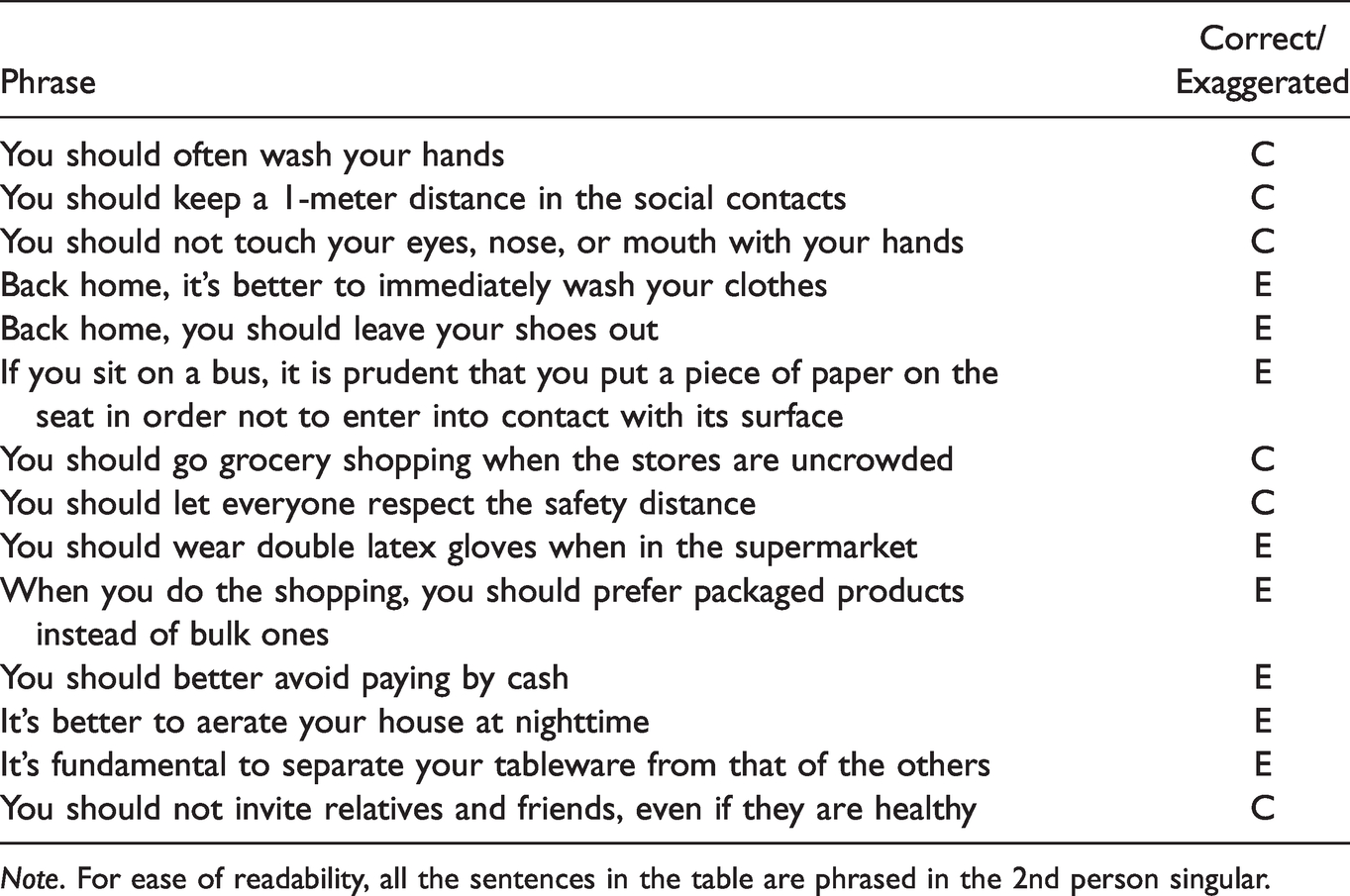
Note. For ease of readability, all the sentences in the table are phrased in the 2nd person singular.
Moral disengagement
To assess MD, we employed the scale of Caprara et al. (2009), already validated on an Italian sample. The scale measures eight components of MD: Advantageous comparison, Attribution of blame, Dehumanization, Diffusion of Responsibility, Distorting consequences, Euphemistic language, and Moral justification; moreover, it can be used as a whole to assess the global level of MD.
Moral foundations
In order to assess what we called “moral foundations”, we employed the 14-item short form of the well-known Moral Foundations Questionnaires (Graham et al., 2011), the items of which had already been translated and validated on an Italian sample by Bobbio et al. (2011).
Health anxiety
Given our necessities, to measure Health Anxiety we planned to include a useful and reliable tool to “differentiate people suffering from health anxiety from those who have an actual physical illness but who are not excessively concerned about their health” (Salkovskis et al., 2002, abstract). To this aim, we employed the short form of the Health Anxiety Inventory (SHAI) by Salkovskis et al. (2002); in particular, in the current survey, we employed the 14 item short-form of the HAI (SHAI); in addition, we used four more items representing the “negative consequences” subscale, since “the cognitive theory of health anxiety suggests that perceived negative consequences of being ill are important, because threat is a function not only of likelihood but also of anticipated burden or awfulness” (Salkovskis et al., 2002, p. 850).
Fake news embracing
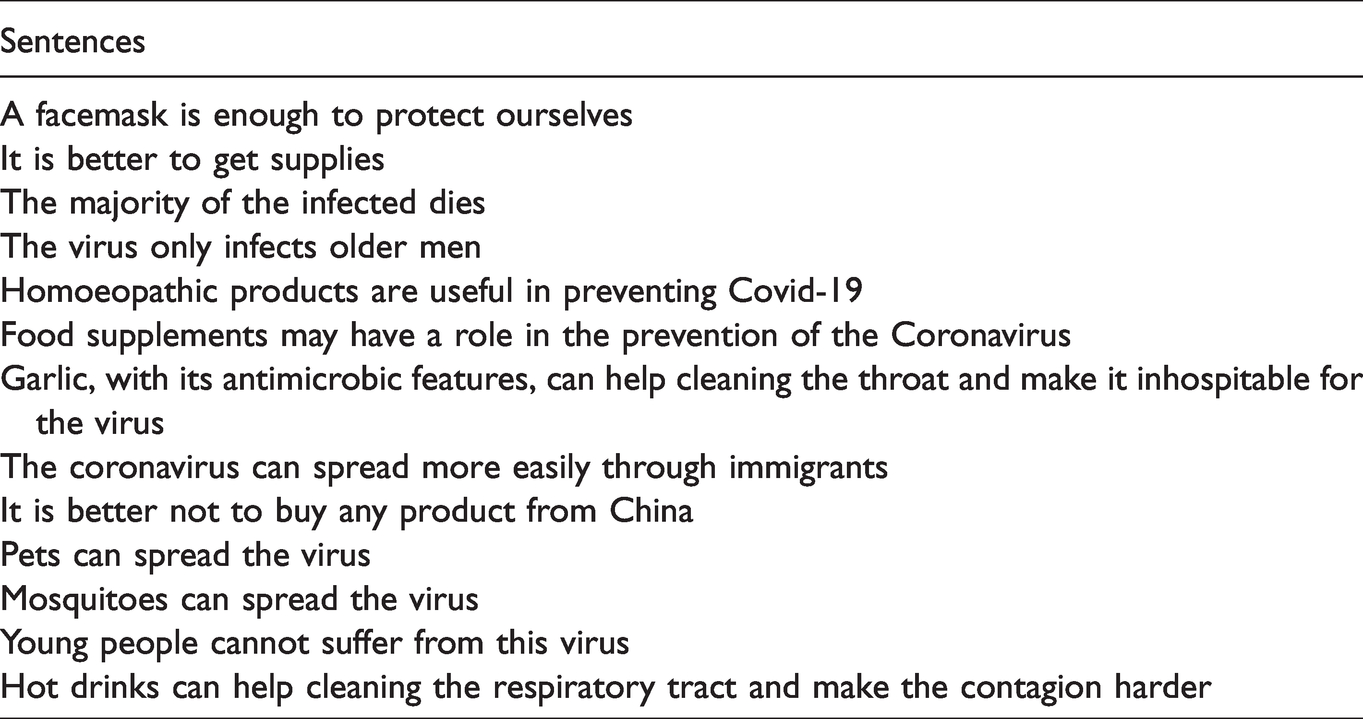
To assess the embracing of fake news, we selected statements (N = 13) taken from an official list of fake news published online by the Italian Health Ministry (Ministero della Salute, 2020) and several other debunking sites. All this news was officially debunked by very well-known debunking sites (Table 2). The participants were asked on a 5-point Likert scale to what extent they believed each statement to be true.
Fake news list.
Participants
First, an a priori power analysis on G*Power (Faul et al., 2007, 2009) was run to assess the required sample. Finding no previous similar studies, we opted for a medium effect size (f = .25), with α = .05 and 1−β = .80; 8 covariates and 3 groups were contemplated. With such parameters, the required sample was N = 158. Nevertheless, being familiar with the high abandonment rates and incomplete data of online studies, we planned to reach at least 50% more (N = 237).
Finally, we ended up recruiting 250 Italian participants; those who completed < 98% of the questionnaire were excluded from the analyses (N = 40); therefore, we analyzed the answers of 210 valid participants (72.3% females, mean age = 30.02, SD = 11.84). Data collection started on March 14, 2020 and ended on April 5, 2020.
Procedure
As the lockdown was on during data collection, we built an online procedure. The participants could run the experiment directly from home on their laptops, smartphones, or tablets by accessing a single un-reusable link. An anti-ballot box stuffing was employed in order to avoid multiple participations from the same device. The questions on perceived utility appeared right after an introductory screen with the informed consent. For all the other questions, the presentation order was randomized for each participant so to avoid potential sequence effects.
Analyses rationale
The current study has two purposes: on a first level, we want to understand whether and how the different pronominalization strategies impact on the perceived utility of the Covid-19 countermeasures. To this aim, in our first analysis, we consider the pronominalization as the factor, and we add the personal characteristics (i.e., Moral Disengagement, Moral foundations, Health Anxiety, and Fake news embracing) as covariates in the design to control them, i.e., to be sure that the effect of the pronominalization exists net of the personal characteristics, whose effect we hypothesize to be much stronger as opposed to a subtle manipulation such as the pronominalization.
On a second level, beyond the manipulation, we want to deepen the relationships between some of the personal characteristics in the design and the perceived utility of the countermeasures; in particular, by means of a SEM model, we want to test a mediation hypothesis according to which the personal moral foundations predict the perceived utility with the mediation of the Embracing of fake news.
Results
For all statistical analyses, IBM SPSS 26.0 was used; violin plots were made through R version 4.0.2 (ggplot2 package). The Structural Equation Model was built and run on Mplus 7.0 (Muthén & Muthén, 2012).
Before proceeding to the analyses, we assessed the internal consistency of the scales that we used by means of Cronbach’s alpha coefficients. The scales related to the personal variables showed good reliability: Moral Foundations Questionnaire α = .84, Moral Disengagement α = .86, Health Anxiety Inventory α = .85, and Embracing of Fake News α = .83. As for the measures of the perceived utility, they both showed reliability scores above the acceptability threshold: Exaggerated countermeasures = .74, and Correct countermeasures α =.79.
Pronominalization
A one-way MANCOVA was conducted with the perceived utility of the correct and exaggerated countermeasures as the dependent variables, the grammatical phrasing as the factor, and Moral Disengagement, Moral foundations, Health anxiety, and Fake News Embracing as covariates.
A significant multivariate main effect of the condition was found, F(4, 199) = 4.31, Wilks’ Λ = .92, p = .002 ηp2 = .042, (1−β) = .93. In greater detail, the univariate effect on exaggerated countermeasures was significant, F(2, 199) = 5.92, p = .003 ηp2 = .056, (1−β) = .87. Subsequent pairwise comparisons with Bonferroni correction highlighted a significant difference between You (M = 2.36 S.E. = .07, N = 68) and Impersonal (M = 2.67 S.E. = .07, N = 70) (p = .013), and You and Us (M = 2.69 S.E. = .07, N = 72) (p = .007), 2 namely the participants in the You condition reported significantly lower ratings as opposed to those in the other conditions (Figure 1).
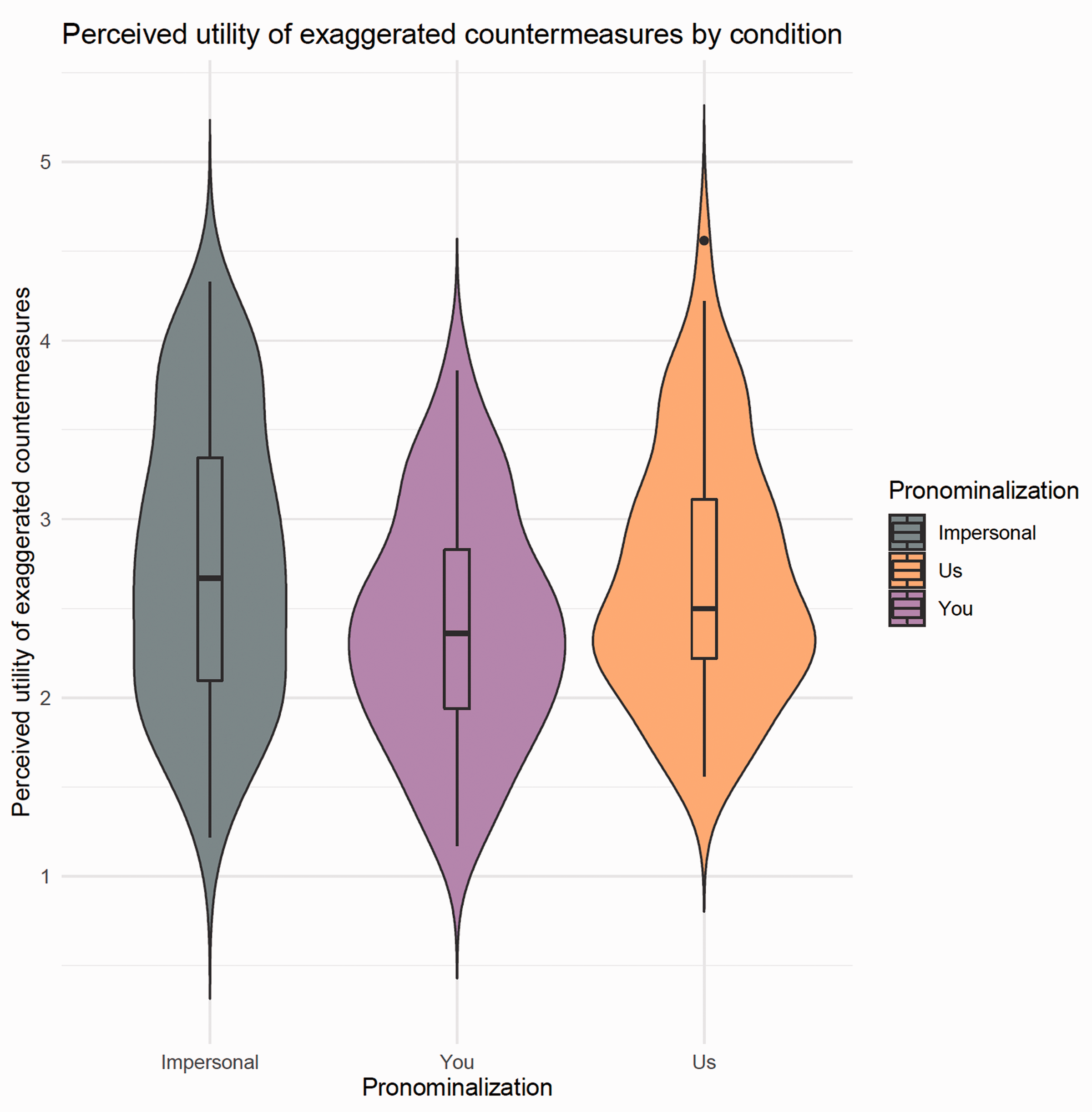
Perceived utility of exaggerated precautions.Note. Effect of pronominalization on the perceived utility of exaggerated countermeasures. The boxplots within each violin represent interquartile ranges (IQRs). Black horizontal lines indicate means, and black points are outliers.
No main effect was found of the pronominalization on the correct countermeasures F(2, 199) = 2.34, p = .10 ηp2 = .02, (1−β) = .47.
Personal variables
As for the covariates, some of them showed significant multivariate effects:
Moral disengagement [F(2, 198) = 3.59, Wilks’ Λ = .96, p = .029 ηp2 = .03, (1–β) = .66] as a whole proved to be significant on the perceived utility of the correct hygiene measures only, F(1, 199) = 7.21, p = .008 ηp2 = .03, (1−β) = .76; the parameter estimate being β = −.25 S.E. = .09 t = −2.68.
Also the Harm domain of MFQ [F(2, 198) = 5.58, Wilks’ Λ = .95, p = .004 ηp2 = .05, (1−β) = .85] showed a similar pattern, that is it had an effect on the perceived utility of the correct hygiene measures F(1, 199) = 11.17, p = .001 ηp2 = .05, (1−β) = .91; not surprisingly the parameter estimate indicates a positive direction β = .15 S.E. = .04 t = 3.34, namely those who take into consideration the fact that no one is harmed are more willing to comply to correct measures.
Embracing of fake news [F(2, 198) = 10.04, Wilks’ Λ = .91, p < .001 ηp2 = .09, (1−β) = .98] was significant on the exaggerated countermeasures [F(1, 199) = 14.44, p < .001 ηp2 = .07, (1−β) = .96; β = .51 S.E. = .13 t = 3.80]. In other words, embracing fake news leads to perceive the exaggerated measures as helpful.
Health anxiety showed no multivariate effect (p = .12) but a slight positive univariate effect on the exaggerated measures in the direction predicted by our hypotheses [F(1, 199) = 4.22, p = .041 ηp2 = .02, (1−β) = .53; β = .01 S.E. = .006 t = 2.05].
Moral foundations and fake news embracing
Since we employed an effective manipulation, it would not be the case to analyze the roles of each trait variable without consideration to our treatment. Nevertheless, as a prerequisite, we ran a MANOVA to verify whether our personal variables were casually distributed across our three experimental subsamples; indeed, that is the case. We did not find any multivariate effect (p > .97) nor between-subjects effect (all ps > .36). Thus, we can safely state that our three subsamples did not differ for any of the personal variables; therefore, an analysis of their roles net of the manipulation can be performed reliably.
By means of a Structural Equation Model (SEM), we wanted to verify a mediational hypothesis, namely that personal characteristics such as moral values could exert an influence on the perceived utility of the correct and exaggerated hygiene countermeasures with the mediation of the fake news embracing.
Model
A structural equation modeling (SEM) analysis was conducted with Mplus software version 7 (Muthén & Muthén, 2012) in order to test a model hypothesizing that personal participants’ personal characteristics such as moral values (i.e., individualizing and binding values) exert an influence on the perceived utility of the correct and exaggerated hygiene countermeasures with the mediation of the fake news embracing. The model parameters were estimated using the maximum likelihood estimation method (i.e., ML). The model's adequacy was ascertained using several indices attesting the degree of fit between input data and model-based estimates. More specifically, the following indices were recognized by the literature as indicative of a good fit: CFI (Comparative Fit Index) values close to .95 (Hu & Bentler, 1999); RMSEA (Root Mean Square Error of Approximation) and SRMR (Standardized Root Mean Squared Residuals) values below .08 (Marsh et al., 2004); a chi-square/df ratio below or equal to 3 (Kline, 2015).
According to standard SEM procedures, we used the five subscales of the Moral Foundations Questionnaire as measure indicators of binding values (i.e., Authority, Ingroup, and Purity) and individualizing values (i.e., Harm and Fairness). In contrast, we used an item parceling procedure (Kim & Hagtvet, 2003) to calculate the measurement indicators for the other key latent variables of the model (i.e., perceived utility of the correct and exaggerated hygiene countermeasures, fake news embracing). More specifically, item parceling is a procedure that combines the items of a scale into a smaller set of items in order to reduce the dimensionality and the number of parameters being estimated in the model, resulting in a more parsimonious measurement model and more stable parameter estimates (Little et al., 2013, 2002). In the present study, the item parcels for each latent variable were created by grouping the items of each scale into three separate item sets (parcels) and by averaging the item scores within each set.
Before testing the different paths of the hypothesized model (see Figure 2), we tested the measurement model that included the estimations of the factor loadings linking each item parcel to its latent construct and the estimations of the covariances between the latent factors. The results showed that measurement model fit the data well (CFI = .994; RMSEA = .020, 95% C.I. = .000 −.046; SRMR = .039; χ2/df = 1.09).
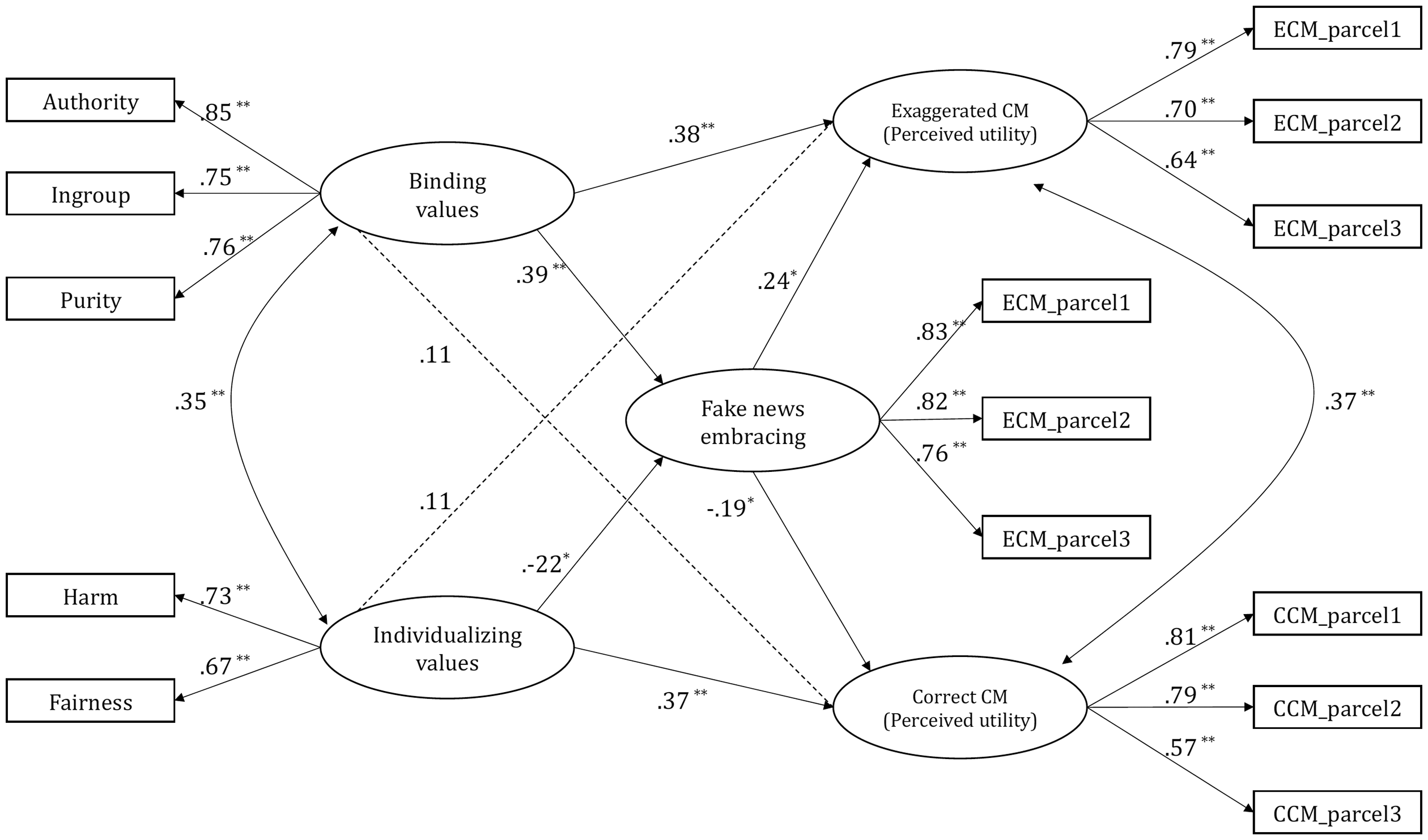
Model.Note. Dotted lines indicate not significant path estimates (i.e., p > .05); *p values < .05; **p values < .001.
With respect to the paths linking the model’s variables, as reported in Figure 2, participants’ binding moral values showed a positive and direct relation both with embracing of fake news (β = .39, p < .001) and the perceived utility of exaggerated countermeasures (β = .38, p < .001), while it showed no significant direct association with the perceived utility of correct countermeasures (β = .11, p = .244). Conversely, the individualizing values showed a negative and direct relation with the fake news embracing (β = −.22, p = .038) and a positive and direct relation with the perceived utility of correct countermeasures (β = .37, p < .001), while it showed no significant direct association with the perceived utility of exaggerated countermeasures (β = .11, p = .241). Additionally, the participants’ fake news embracing showed a positive and direct relation (β = .24, p = .005) with the perceived utility of exaggerated countermeasures, while it showed a negative relation (β = −.19, p = .029) with the perceived utility of correct countermeasures.
Finally, the indirect effects were examined using bootstrapped confidence interval estimates (95% confidence interval with 5000 bootstrap resamples) to test the mediating role of fake news embracing in the relations between values (i.e., binding and individualizing moral values) and participants’ perceived utility (i.e., Exaggerated and Correct countermeasures). Results indicated that only the indirect effect of binding moral values on the perceived utility of exaggerated CM through the fake news embracing resulted statistically significant (αβ = .093; 95% confidence interval: .017 - .17).
Discussion
Pronominalization
As we hypothesized, the different phrasings had an impact on the self-reported perceived utility of Covid-19 countermeasures. In general, the effect was found only in the case of the exaggerated prescriptions; more precisely, the participants who were presented with the prescriptions at the second person singular had lower ratings in the perceived utility of exaggerated countermeasures. In the search for a plausible theoretical framework, we can account for this by referring to three different cognitive processes, namely, epistemic vigilance (Sperber et al., 2010), reactance (Brehm, 1966), and simulation (Brunyé et al., 2009, 2011; Ditman et al., 2010; Gast et al., 2015), that sequentially come into play during information evaluation, as we plan to debate in the following.
As a species, during the phylogenetic history, humans developed a new and unique tool to persuade their conspecifics, that is, language. What extensive research in evolutionary psychology has theorized is that the origins of the human language heavily deal with the need to persuade the conspecifics (Mithen, 2006), namely, to make them do what the agent wants them to do, to make others adopt one’s goals (Poggi, 2005). Needlessly to say, the term persuasion here has no negative connotations; on the contrary, the ability to lead a conspecific to do something, way before being a bad manipulative strategy, is a manner through which the human species improved cooperation to an extraordinary extent (Dor et al., 2014; Tomasello & Vaish, 2013).
Nonetheless, manipulation, that is the strategy to persuade others without letting them know about the underlying goal of persuasion, happens to have become a widely used strategy in our species. It follows that we had to develop a contrasting ability in order not to be easily fooled; furthermore, in fact, Mercier and Sperber (2011) suggest that the whole human reasoning skill evolved to devise and evaluate arguments intended to persuade, and that to this end we developed a tool that can be named epistemic vigilance (Sperber et al., 2010). 3 To be more specific, epistemic vigilance warns us each time we feel that someone is trying to persuade us; we then become more vigilant towards the source of the message, and, most of all, its content. The more we feel in the danger of being fooled, the more we are vigilant. Naturally, we rarely feel in danger when we perceive the message as very likely to be true, obvious, clear, or self-evident. Indeed, that is the reason why tests as the “Moses illusion test” (Erickson & Mattson, 1981; Park & Reder, 2004) are so effective. We can state, in brief, that we consider ourselves in jeopardy, and thus we pay closer attention when the message involves uncertain contents, or more in general contents the embracing of which would have a high cognitive cost (i.e., “I saw a flying pig”).
In our experiment, there were two types of messages: normal and exaggerated. The former are clear enough messages, bona fide true and reasonable; the latter, on the contrary, very less so. One can hypothesize that when our participants faced the former messages, they assumed them to be reasonably true; therefore, they took them for granted without scrutinizing their contents. This can explain why we found no effect of the pronominalization: if a message is reasonably non-hazardous, its content can be embraced with no further attentive processing of its structural or semantic details.
Conversely, the exaggerated messages elicited more vigilant processing that shifted the recipients’ focus on the structural aspects of the utterances. According to our hypothesis, such a process made the pronominalization salient, thus creating significant differences among the experimental conditions.
When it comes to better understanding what happened within the exaggerated messages, another psychological phenomenon comes to our aid: reactance. Since the seminal work by Brehm (1966), reactance is considered “unpleasant motivational arousal that emerges when people experience a threat to or loss of their free behaviors. It serves as a motivator to restore one’s freedom. The amount of reactance depends on the importance of the threatened freedom and the perceived magnitude of the threat.” (Steindl et al., 2015, p. 205). Now, our exaggerated messages appear to be tailormade to elicit epistemic vigilance and reactance together: on the one hand, they appear to be far from reasonable and thus worthy of careful analytic processing; on the other, they exhibit a high cognitive cost and several restrictions to the addresse’s freedom.
What deserves to be underlined is that both the elicitation of the epistemic vigilance and reactance are due not only to the explicit messages, but especially to implicatures, and therefore they work in a subtler and more effective fashion (Lombardi Vallauri, 2019). For instance, a sentence as “you should wear double latex gloves when in the supermarket” has at least two implicatures: The virus can pass through latex gloves One latex layer is not enough You should buy a double number of gloves for the same period, spending more money You have to spend more time putting the gloves on each time you go to a supermarket
The first and the second are highly implausible, thus, eliciting epistemic vigilance.
The third and fourth implicatures constitute potential restrictions to our freedom of saving time and money; thus they might elicit reactance.
Likewise, an item as “back home, it's better to immediately wash your clothes” may imply that The virus can spread through clothes (surfaces) by mere contact You get the chance to touch just someone that is tested positive and contagious You will have to use your washing machine a lot, consuming water and energy You must probably buy new clothes, especially if you leave the house frequently. You will have to spend a considerable amount of time washing your clothes every single day (or every time that you go outside).
Also in this case, the cognitive cost of implication 1 and 2 elicits epistemic vigilance, whereas implications 3, 4, and 5 favor reactance.
We now need to account for why we observed significant differences between the scores of our You group and the others, and in particular why such scores were lower (i.e., minor embracement of exaggerated precautions) than those of the other two experimental conditions.
There might be a linear explanation. The three levels of our independent variable (i.e., pronominalization) may be ordered by “directedness”, from a minimum degree of the recipients’ involvement, namely the impersonal form to a maximum involvement in the case of the You form; the We form being in the middle. As we described in the impersonal forms section, the impersonal form is the vaguest one: it is not clear who the real recipients are, nor the degree of involvement of the sender. When it comes to the We form, we deal with a clear common involvement of the sender and the recipient(s); namely who utters the message puts theirself de facto on the same level as those who receive it, in a horizontal manner. But still, there is vagueness to some extent: it is not clear who the real recipients are. One receiving a message in the We form could legitimately believe not to be included within the actual addressees. The same thing cannot be said for the You form: especially in Italian, such a pronoun designs a self-evident and direct relationship between the sender and the addressee, with the reinforcing advantage of intending the latter as a single specific individual. Therefore, the recipient can have no doubts on whom the message is referring to; moreover, she is not put on the same level as the sender; and this can significantly increase the gap within the communicative relationship, favoring reactant responses.
Furthermore, in an integrative manner, the finding of the lower ratings of the You group in the perceived utility of the exaggerated countermeasures can be explained by referring to some known results. For instance, Packard and Berger (2020) showed that second-person pronouns could encourage audiences to think of someone in their own lives. On the same line, through a pragmatic analysis on the uses of the second person singular, Gast and colleagues (2015) claimed that the impersonal uses of the second person, as those related to norms might be, involve an invitation to simulation. It would be not trivial to claim that the participants in our You group, imagining themselves (i.e., simulating) in the act of engaging in those exaggerated behaviors, on the one hand, grasped the implausibility of those actions to a greater extent than the other participants; on the other, such a simulation process might have fostered reactance to a wider degree, given its directedness toward the addressee.
Indeed, the you form is widely described as the most direct one (see § You): when a sentence is framed with the you form, it is more plausible for the addressee to “make it personal”; indeed, several studies support the role of pronouns in modulating readers’ adopted perspective when comprehending simple sentences; for instance, Brunyé et al. (2009) found that when the pronoun you was used, readers embodied an actor's perspective more than an external one. In a subsequent study, Ditman and colleagues (2010) proved that readers had better memory for actions after reading sentences preceded by you, thus implying a higher degree of embodiment. Finally, Brunyé et al. (2011) found that when the pronoun “you” was used, readers were more emotionally reactive to valenced narrative events. Together with those of Gast (2015), all of these findings suggest that simulation processes are active when the you form is used. In our hypothesis, these processes are also responsible for the elicitation of a reactant feeling.
In the following paragraphs, we discuss the roles of the personal characteristics we assessed.
The role played by the personal characteristics
Moral disengagement
Analyzing the data, it emerged that subjects with greater Moral Disengagement tend to consider communications that invite to follow safe and correct behaviors as less useful; on the contrary, there is no effect concerning exaggerated countermeasures, namely, exaggerated and incorrect behaviors are not considered as less useful by subjects with high Moral Disengagement.
These results are really interesting, allowing us to try to wonder how Moral Disengagement can influence a subject’s acceptance or rejection of some lines of behavior in a period of crisis.
This particular effect might be linked to the lifestyle of people with a high level of Moral Disengagement. These people tend to face life by focusing on their own fun, not setting too rigid moral limits, hence, they could suffer from the strong media overexposure of the correct prevention measures for Covid-19. Listening to or reading the same recommendations every day, several times a day, being aware of the risk of being bothered or worse, fined if these safety measures are not respected, could lead these people to be reactant and discredit these correct guidelines, seeing them as a threat to their welfare.
Moral foundations and fake news embracing
Considering the five moral domains separately, net of the manipulations, Harm was the only domain that predicted an increase in the perceived utility of correct countermeasures. When considering the major division between binding and individualizing values ( Model), we realize that moral values have a complex triangular intertwining with fake news embracing and perceived utility. Through a structural equation model, we tried to shed light on such a complex relationship. Compatibly with what hypothesized, the binding values (Authority, Ingroup, and Purity) positively predicted both fake news embracing and perceived utility of exaggerated countermeasures (direct and indirect effects). On the other hand, the individualizing values (Harm and Fairness) negatively predicted fake news embracing and positively predicted the perceived utility of correct countermeasures. Finally, the embracing of fake news positively predicted the perceived utility of the exaggerated countermeasures and, especially, it negatively predicted the perceived utility of correct countermeasures. The model suggests that high levels of fake news embracing have a doubly bad effect: not only do they drive people toward misbehaviors (i.e., exaggerated behaviors); more dangerously, it prevents them from engaging in the right behaviors to face the pandemic.
Health anxiety
We hypothesized a role of Health Anxiety on the perceived utility of both the kinds of countermeasures and especially that high levels of anxiety could have led to judge exaggerated countermeasures as more useful. As a matter of fact, the effect of Health Anxiety was modest and concentrated on the perceived utility of the exaggerated countermeasures. Such a finding confirms that anxious people do not merely have an abnormally augmented perception of risk; if that were the case, Health Anxiety would have led to both an increased perception of correct and exaggerated countermeasures. Conversely, the bias mentioned above towards virus-related stimuli (Cannito et al., 2020), already found in anxious people, could have increased the cognitive saliency of those stimuli to the point of an overreaction. Indeed, anxious people have already been proven to be more prone to engage in misbehaviors (Asmundson & Taylor, 2020).
Besides, trying to shed light on such a result, we found abnormal inflation of the scores. We analyzed two works by the author that build the SHAI: in these works, the scale has been used for chronic pain patients with/out insomnia (Tang et al., 2007) and hypochondriac and anxious patients (Salkovskis et al., 2002). Both the studies involved control populations; the levels of HA for controls were M = 6.9 SD = 4.5 and M = 12.2 SD = 6.2; the clinic anxious group of the second study rated M = 18.5 SD = 7.3. As for our sample, the mean was comparable to that of the above-mentioned anxious group, M = 16.37 SD = 7.25 – 95% CI [15.41, 17.33], with skewness = .97 and kurtosis = 1.39. We believe such inflation to be due to the early pandemic situation. Indeed, the SHAI items measure the extent to which one feels worried about her health by taking into consideration the perception of even the smallest bodily changes. The circumstance of having collected the data in a context in which all the mediatic communication insisted on the attention to the early symptoms, and the general attention was totally focused on the spread of the epidemic could have led to an overestimate of the Health Anxiety.
Conclusions
With this study, dealing with countermeasures against Covid-19 contagion, we proved that the simple variation of a pronoun impacts the perceived utility of a health countermeasure phrased in a sentence, net of several personal characteristics, namely, Moral Disengagement, Moral Foundations, Health Anxiety, and Embracing of Fake News. In greater detail, the use of the you pronoun, as opposed to we and the impersonal form, decreases the perceived utility of exaggerated countermeasures, thus implying more correct compliance to Covid-related norms. Further studies need to better address the inner socio-cognitive mechanisms of such a finding. In our interpretation, our results suggest the intertwining of three involved cognitive components: epistemic vigilance, reactance, and simulation (Discussion / Pronominalization).
To sum up, when an addressee reads an exaggerated sentence framed at the second person singular, first, she notices that it can be absurd, thus eliciting the epistemic vigilance that leads to further analyze the sentence, paying attention to the pronominalization strategy employed. Secondly, she simulates what is described, grasping its implausibility, finding it to be not only absurd but also costly and limiting; hence she refuses the act described in the sentence by assigning a low perceived utility to it.
Finally, some personal characteristics seem to be relevant to influence individuals' perceived utility, especially in times of such pandemic crisis. We found that Moral Disengagement plays an important role when individuals see their freedom limited, thus leading to a greater intolerance to correct countermeasures.
The relationship between the moral foundations, perceived utility, and embracing of fake news, has proved to be predictable. Individualizing values led to a major embracement of fake news, and therefore increased perceived utility of excessive countermeasures, whereas binding values decreased fake news embracing, and thus promoted the perceived utility of right countermeasures. Such a complexity surely deserves new studies to be further addressed.
Lastly, in this study, for the first time, a manipulation of the pronominalization strategy was employed to analyze the perceived utility of some recommendations. We are convinced that, beyond its use in similar themes, such an approach, with large-scale employment, could shed light on a wide range of topics related to linguistic strategies of persuasion (e.g., topicalization, degree of semantic vagueness, certainty markers, etc.).
Although our results support what we hypothesized satisfyingly, in the future, we plan to test similar effects by using within-subjects designs. Such a strategy will allow us to understand whether the differences in perceived utility are due to the perception of a peculiar communication strategy (in a broader sense) or a more punctuated cognitive phenomenon of semantical sentence processing.
Footnotes
Acknowledgments
A. A. is deeply grateful to prof. Edoardo Lombardi Vallauri for his insights on the explanation of the results.
Declaration of Conflicting Interests
The author(s) declared no potential conflicts of interest with respect to the research, authorship, and/or publication of this article.
Funding
The author(s) disclosed receipt of the following financial support for the research, authorship, and/or publication of this article: The APC was funded by Sapienza University of Rome, Italy (Department of Psychology).

Notes
Author Biographies
References
Supplementary Material
Please find the following supplemental material available below.
For Open Access articles published under a Creative Commons License, all supplemental material carries the same license as the article it is associated with.
For non-Open Access articles published, all supplemental material carries a non-exclusive license, and permission requests for re-use of supplemental material or any part of supplemental material shall be sent directly to the copyright owner as specified in the copyright notice associated with the article.
