




Abstract
The holy grail of emotion theory is arguably still the discovery of a taxonomy, but one that is predicated on first establishing a corresponding structure of affect. Plans for the construction of a taxonomy are presented, based on the emotions and supported with the tripartite mind. A two-axis circumplex-like framework forms the proposed structure. The fundamental orthogonal axes are a temporal vertical axis and a spatial horizontal axis, which subsume another five essential opposing and complementary properties that underpin affect. These dimensions create four basic states that categorize affect and account for the differences and similarities between emotions within categories. A binomial labeling method posits the view that the valence of emotions is determined by the valence of the category they emanate from. The Euclidian spaces created account for mixed emotions and conditions and show how basic emotions from different categories create complex emotions and conditions. This model will also explore why some emotions like shame-embarrassment and contempt-disgust are often seen as synonyms due to a categorical error. It also provides an exposition of the function of reactive and self-reflective emotions and anxiety.
Keywords
Introduction
The analogy of the blind men and the elephant conveys a fair if somewhat hackneyed account of the current state of emotion theory. It is clear that there is little agreement on the fundamental matter of what constitutes an emotional episode, much less a taxonomy. Although progress has been made, there remain numerous competing theories and this suggests it is far from being a fait accompli.
One of the most salient issues within the literature is the ongoing debate between those who regard emotions as basic categories and those who favor a dimensional approach. Theorists who share the view that emotions are basic suggest that each emotion is separate or distinct, with a unique biological response, expression, and recognition that is similar for all individuals regardless of culture or ethnicity (Ekman, 1973, 1992; Izard, 1977, 1992; Panksepp, 1998; Tomkins, 1962, 1963). In this sense, emotions are natural kinds, entities that have clear boundaries, independently identifiable from human perception (Lindquist, 2013). However, Prinz (2004) argued that evolutionary psychologists have not been able to establish that emotions are exactly the same across culture or delineate between emotions that are primitive and emotions that are cognitively sophisticated. He also argued that evolutionary psychology is unable to accommodate the input of learning and culture. Strongman (2003) found physiological theories to be lacking on sociocultural matters. He also posited the view that there is rarely a mention of unconscious causes of emotion, or consideration of folk psychological aspects, nor of emotions in an interpersonal context, even though that is where they mainly occur.
Another school of thought originates from theorists who favor a dimensional approach to emotion (Bradley, Greenwald, Petry, & Lang, 1992; Lövheim, 2012; Mehrabian & O’Reilly, 1980; Russell, 1979, 1980, 2003; Russell & Barrett, 1999; Schlosberg, 1954; Watson & Tellegan, 1985). Proponents of this approach, Barrett and Wager (2006) argued that emotions are “highly elaborated responses constructed from more fundamental, biological properties” (p. 79). Most constructionist theorists include valence and at least one other dimension, usually arousal or activation, to account for the whole range of emotions (Bradley et al., 1992; Russell, 1990; Russell & Barrett, 1999; Watson & Tellegan, 1985; Yik, Russell, Steiger, & Phelps, 2011). Russell (2003) acknowledged that the circumplex model of core affect defined by the valence and arousal dimensions of pleasure–displeasure and activation–deactivation fails to explain adequately how fear, jealously, anger, and shame are different from each other. He resolved this by the addition of perception as an attributional stage to account for discrete emotional episodes. Lindquist (2013) added conceptualization to valence and arousal to account for discrete emotion and stated that “all constructionist models hypothesize an ingredient that transforms core affect into instances of discrete emotion” (p. 362). This ingredient is some form of attribution, called cognitive interpretation (Duffy, 1941), conceptualization (Barrett, 2006b), perception (James, 1884), and ideational content (Wundt, 1897/1998).
According to these theorists, individuals categorize their core feelings into discrete emotional episodes. Categorization is determined by the labels used to identify individual emotional experience based largely on context, language, knowledge, core affect, and so on. This approach relies on valence and intensity to account for emotional experiences but fails to explain the variation between emotions beyond general interpretation and personal understanding. These models lack an explanatory framework to account for felt differences between types of emotion beyond valence—for example, emotions that are often seen as synonymous but that are experientially different, like shame and embarrassment or disgust and contempt. It could be argued that the vulnerable dimension for the constructionist model is arousal. This dimension is poorly defined, with too much attention having been given to valence and too little to arousal (Grob & Schimmack, 2000; Strongman, 2003). The reliance on an attributional ingredient leaves much breadth to individuals or cultures and little to nature when accounting for emotions. This view was supported by Prinz (2004) when he stated “we should not adopt a globally evolutionary approach, nor indulge the radical view that emotions derive entirely from us” (p. 69).
Despite the considerable efforts of theorists, the claim by Ortony and Turner (1990) that there is no agreement on what constitutes a basic emotion remains valid. They highlighted three perennial problems with the concept of “basicness.” First, how many emotions are basic? Second, which emotions are basic? And third, why are they basic? Arguably, the third point is the crux of the problem and answering this would help resolve the other two concerns. The importance of this was exemplified by Barrett (2006a) in her claim that “questions about the fundamental nature of emotions strike at the heart of what psychology is” (p. 28). Russell (2003) asserted, “Psychology and humanity can progress without emotion—about as fast as someone running on one leg” (p. 145). Lindquist (2013) articulated another important function of emotions: for understanding human experiences and when disorder in those experiences occur. Emotions are foremost about relationships, personal and interpersonal, and people’s relationship with their environment. Emotions are clearly important for survival, but they also help provide meaning.
The salient issues relating to both the constructionist and basic emotion theories have been outlined. Despite the concerns highlighted, there is evidence to support both. To dismiss these theories would be to fly in the face of the evidence that sustains them. For a cogent discussion of both perspectives, see Prinz (2004). Given that there is support for both views, the present spatiotemporal model aims to synthesize essential elements of each, namely, the orthogonal framework and the principle of basicness.
Theoretical methods
According to Kant (1781/1998), the primary conditions of all our experience are time and space. Kant identified time and space as a priori elements of a systematic framework by which we construct all our experiences. These two fundamental dimensions provide the necessary structure upon which the new taxonomy of affect can be constructed. It is interesting to note that “a neural correlate for four dimensional conscious experience has been found in the human brain which is modelled by Einstein’s Special Theory of Relativity” (Sieb, 2016, p. 630). Recent studies have suggested that neural activities in the hippocampus are involved in constructing the spatial and temporal elements of experience. In 1978, O’Keefe and Nadal hypothesized place cells, neurons that fired in correlation to spatial locations in rat studies. Further research identified neurons in the dorsocaudal medial entorhinal cortex that fired in a hexagonal, grid-like pattern. The pattern of activation was linked to external landmarks yet persisted in their absence, which suggested the grid cells may be part of a specialized spatial map within the brain (Hafting, Fyhn, Molden, Moser, & Moser, 2005; Moser, Moser, & Bruce, 2017). In addition to spatial place cells, researchers have recently found neurons in the hippocampus, termed time cells, which are believed to represent the flow of time and differentiate overlapping sequences of events into temporal episodes (Eichenbaum, 2014; MacDonald, Lepage, Eden, & Eichenbaum, 2011). Hassabis and Maguire (2007) suggested that the episodic memory system—a wider network of brain regions including the hippocampus, parahippocampal gyrus, retrosplenial cortex, posterior parietal cortex, and ventromedial prefrontal cortex—allows for a spatiotemporal representation of the world past, present, and future.
All emotional experiences occur in the world (space) and many of these are powerfully affected by time. The emotions or responses from the spatial dimension divide naturally into the most basic of behaviors—approach and withdrawal. In brief, the spatial is observable, measurable, and objective. The behaviors prioritized by this dimension are reactive and are concerned with physical security, procreation, and satiety as indicated by approach behavior, while protection and avoidance take priority, indicated by withdrawal behavior. Reaction occurs in the present and is spatial. The temporal dimension divides into past, present, and future. The temporal is responsive but can be internalized and therefore subjective, and the emotions derived from it are characterized by duration and are reflective and projective rather than reactive. The emotions emanating from the temporal dimension are also dichotomized by valence into loss and gain.
The present spatiotemporal approach is dualistic in the sense that it views emotions as having both a biological (physical) and a psychological (psychical) content. According to Kierkegaard (1844/1980), human beings are characterized by this psychical and physical synthesis. Candland (2003) argued that the problem of using a Cartesian interpretation is rooted in relating the worlds of mind and matter. He identified this as one of the persistent problems for emotion theorists, that of establishing the difference between two distinct entities that have common features. Hence time and space are the proposed dimensions that meet this need as they distinguish emotions that are not only different in terms of valence and intensity, but which are categorically different. This category difference is characterized by the capacity people have to priority shift between spatial (physical) and temporal (psychical) concerns. Most emotional experiences are interpersonal, but these are often some way from the visceral emotions that are experienced by encountering a bear in the woods (Strongman, 2003). It should be made clear that the term priority shift has similarities to the prioritization in appraisal theory (Arnold, 1960a, 1960b; Lazarus, 1991, 2001), but the present spatiotemporal model differs in terms of the categorization of emotions. Appraisal prioritizes between good, bad, and indifference, while priority shift is concerned with valence and psyche/physical distinctions. This approach allows for automaticity and reflection/appraisal to be accounted for. The spatiotemporal model gains support from the process model of emotions, which included at least two modes of evaluative processing, a higher conceptual mode and an automatic or schematic mode (Leventhal, 1979; Murphy & Zajonc, 1993; Power & Dalgleish, 1997; Robinson, 1998; Smith, Griner, Kirby, & Scott, 1996). Priority shift and the modes of evaluative processing can be considered complementary in the present model. In addition, the terms spatiotemporal and psychophysical are interchangeable because of the direct affect proximity and distance in both the temporal and spatial have on the psyche and the physical.
This present view of emotions resembles the constructionist perspective in some ways and in particular Russell and Barrett’s (1999) concept of core affect, which refers “to the most elementary consciously accessible affective feelings (and their neurophysiological counterparts)” (p. 806). However, their dimensions are based on valence and arousal, whereas the present model is constructed on temporal and spatial dimensions that are elementary in the hierarchical structure of affect. The variation between emotions can be placed on a tangible level at a more primitive stage.
Core affect postulates that a person is always in some state of affect, which can vary in intensity from neutral to intense (Diener & Iran-Nejad, 1986; Pavot, Diener, Randall Colvin, & Sandvik, 1991). These degrees of activation make bodily or visceral distinctions between, for example, fear-based emotions like apprehension and terror on the negative side and contentment and ecstasy on the positive side. On the circumplex model, valence provides a clear distinction between emotions that are positive and negative and are polar opposites and thus mutually exclusive (Russell & Carroll, 1999). In contrast, the present spatiotemporal model concurs with Cacioppo and Berntson’s (1994) view of affect as separable and therefore mixed feelings of different valence can co-occur. The spatiotemporal model does not negate the contributions of the conceptual unidimensionality, summation, or conditional co-occurrence of pleasure and displeasure theories (Larsen, McGraw, & Cacioppo, 2001; Schimmack & Colcombe, 1999). The present model allows for the experience of mixed feelings because it has two separate dimensions, a horizontal spatial and a vertical temporal, which can account for co-occurring experience of affect, both of similar and opposing valence.
Concepts of emotion
Conceptualization, the additional ingredient advanced by constructionists (Barrett, 2006b; Lindquist, 2013), is contextual, which is necessary in labeling individual emotional episodes. However, in light of new understanding the addition of an attributional ingredient lacks the power to account for all of the distinctions between the necessary categories of the proposed taxonomy. For instance, what are the basic ingredients that distinguish the type of fear a person may experience when encountering a bear in the woods from the type of fear a person may experience when contemplating an uncertain future?
It is proposed that distinctions can be made in a more fundamental way. Emotions have a physiological and psychological component (Lang, 1984; Lang, Rice & Sternbach, 1972) or in current parlance a physical and psychical component. When the psychological and biological are reduced to the most fundamental constituents, they begin to reflect our nuanced experiences of affect. Affective extremes and nuances of intensity are experienced (real or imagined) through the proximity or distance of an internal or external stimulus. The felt experience or qualia including valence add the different flavors.
Clearly, not all human emotions are concerned with physical survival, escaping danger, procreation, or competition. The emotions associated with these behaviors are focused on the physical self and are well explored. Conversely, there is a whole category of emotions which have a different experience than that of a reaction to an external stimulus. These emotions, like shame and guilt, which are of negative valence, and joy and love, which are of positive valence, are subjective and difficult to explore empirically but deserve fresh attention. Exploring discrete or basic emotions in isolation or on one dimension (physical/spatial) has limited value, as it is akin to studying an artefact out of context—meaning is lost. Emotions must be explored as segments of the whole that creates affect if we are to advance our understanding.
Emotion deconstructed
Leibniz’s (1686/2004) principle of the identity of indiscernibles highlights a pertinent concern relating to emotions. Leibniz argued that if there is no way of telling two things apart then they are the same thing. However, the psychophysical model and the temporal and spatial dimensions, together with valence and the psychical and physical distinction, supply the necessary differences for discerning affective states and emotion categories. The Kantian interpretation (1781/1998) perceived time and space a priori categorization of affect, and conceptualization (labeling) a posteriori. The spatiotemporal framework divides affect naturally into four main categories that provide the fundamental states. From each of these four categories emerges a population of emotions that have similarities and differences that justify their respective state. Prinz (2004) argued that “every emotion that we have a name for is a product of both nature and nurture” (p. 69). The spatiotemporal framework fulfils the much-needed natural requirement. Time and space (i.e., past, present, and future) together with valence naturally categorize emotions followed by conceptualization: therefore, categorization precedes conceptualization. The latter is required to make distinctions between emotions that are categorically similar, such as rage and anger or depression and grief.
The term category is often used to describe an individual emotion like anger, greed, contempt, and joy. In this work, the terms category and state are interchangeable and are the antecedent of emotions. Emotions are better understood as emanating from states. However, although the essential qualities of the features are unchanging within each state, the same features are dynamic and in flux. Emotions appear higher in the hierarchy but are not less complex in their construction than the state they emerge from. They are more specific in their adaption, are context sensitive, and differ in intensity. Emotions within a category are given their different labels because of context and intensity.
Each emotional experience can be divided into its two basic parts: the psychological and the biological. Figure 1 shows the dualistic properties and features underlying each. The fundamental principle underlying the biological is spatial, which subsumes the properties of quantity, valence, objectivity, and physicality. The principle underlying the psychological is temporal, which includes properties of quality, valence, subjectivity, and the psychical. The psychological and biological are not mutually exclusive as an emotion is comprised of both. Priority determines which component is dominant within the experience of an emotion. For example, imagine a man walking in a wood reflecting on his recent extra-marital affair. He is wracked with guilt, as he recalls his undiscovered infidelity. Suddenly, he is brought back into the present when an angry bear appears from behind a tree. It would be expected that his reflections on his infidelity and the accompanying subjective emotion of guilt would instantly recede. Automatically, reaction has replaced reflection as concern for his physical security takes priority. In this example, the difference between reactive fear in the case of encountering a bear in the woods and reflective fear begins to become apparent.
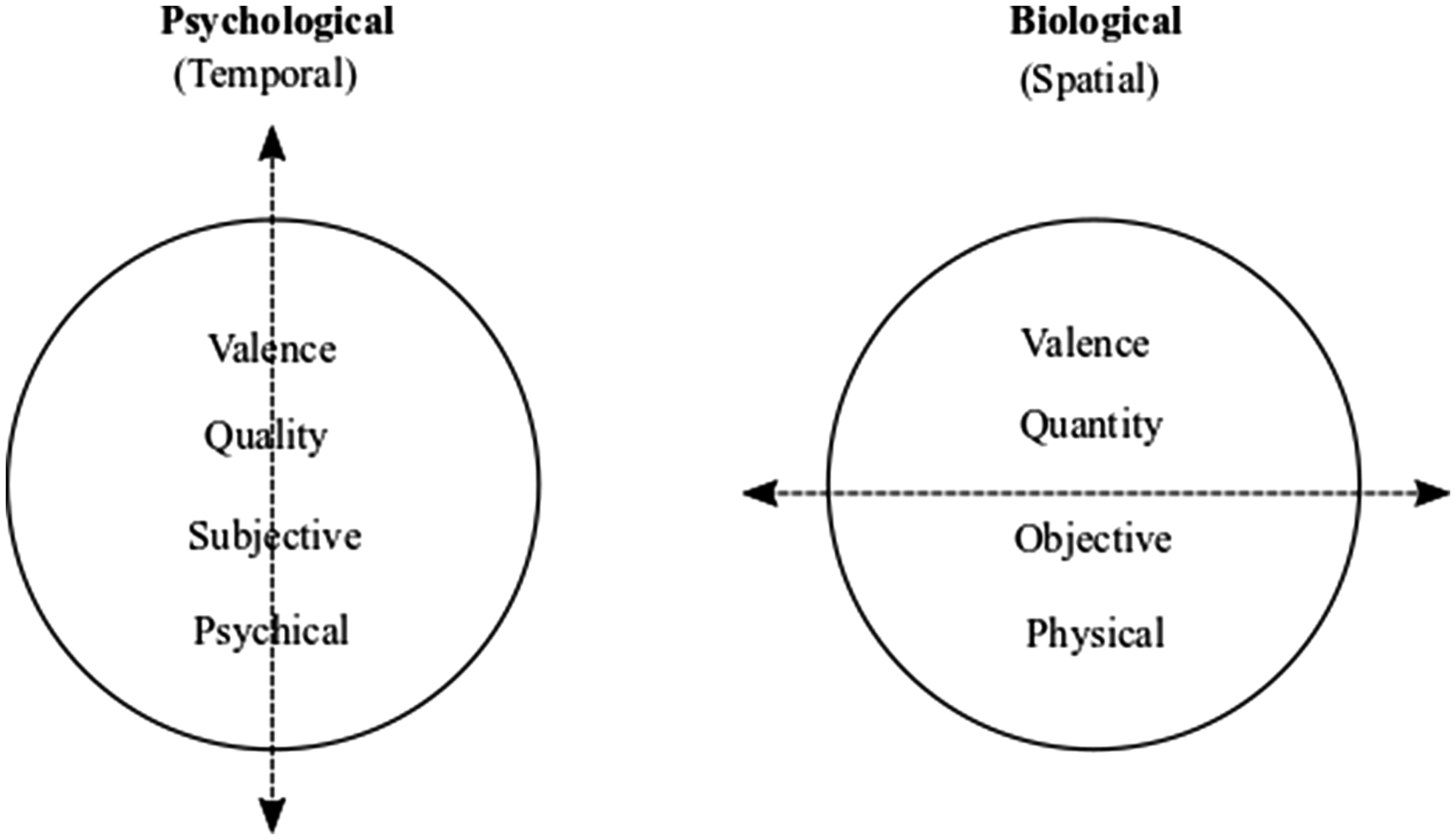
Fundamental properties of affect. The spatial and temporal principles underlying the biological and psychological structure of emotion and the dualistic properties they subsume.
In the instance above, a psychical reflective emotion of negative valence (guilt) gives priority to physical reactive concerns of negative valence (fear of attack). Priority can also shift from psyche positive to psyche negative, physical negative to physical positive, physical negative to psyche negative, and so on. These priority shifts are not always consciously dictated by the individual. The underlying distinction between the physical and psychical is determined by the primary conditions of all our experiences—time and space. The spatial corresponds to and prioritizes the physical and quantitative, while the temporal aligns to the psychical and qualitative. The fundamental spatial temporal dimensions and their effect on the physical and psychical realms allow emotions that are different to be categorized.
LeDoux’s (1996) discovery of two different fear pathways named the high road and low road would appear to support this view. The low road is an instant reaction (including freeze) to a stimulus that needs immediate attention. The high road is slower and involves conscious thought where immediate action is not required. LeDoux’s insight appears to bifurcate an emotional experience into its spatial and temporal parts. Arguably, the high road requires reflection, which makes it distinct from the reactive low road. William James (1884) expressly proposed considering emotions that have a “distinct bodily expression” (p. 189). It can be suggested that James’s counterintuitive theory, which argues we are afraid because we run, or are sad because we cry, was concerned with reactive spatial emotions, or emotions concerned exclusively with the physical self—low-road emotions like visceral fear, anger, and rage. The Jamesian theory of emotion may give an account for a response to an external stimulus in the present, but it does not account for past- or future-focused emotions such as nostalgia and anticipation. Keen elucidations concerning affect are not confined to the psychologist or philosopher. In A Grief Observed (1961/2013), C.S. Lewis correlated the experience of grief with fear: “No one ever told me that grief felt so like fear” (p. 5). Grief is identified as psyche fear in this work. Later in his writing he described another type of fear recognisable as physical fear: “merely animal fear, the recoil of the organism from its destruction” (p. 13).
The present is demonstrably the focus of some emotions, where survival, security, and satiety of the physical self is the priority. By contrast, other emotions can be stored in cognition, have duration, and do not require immediate action. These categories of emotion are also as crucial to understanding affect as valence. For example, an obvious distinction between rage and shame is that rage has physicality and therefore can be observed, whereas shame can remain private indefinitely. In brief, the emotion labeled rage is concerned with the here-and-now, whereas shame is concerned with the past but can impact the present and future. These temporal and spatial considerations when combined with valence aid the construction of the new framework.
The observation of approach–withdrawal biphasic behavior has significantly contributed to the development of an explanatory framework in the development of theories of emotion since first noted by Darwin (1899) and further developed (e.g., Duffy, 1934, 1941; Schneirla, 1939). Within the spatiotemporal model, approach–withdrawal is primarily concerned with the spatial emotions under the rubric of procreation, defense, and appetites. These behaviors are concerned with the physical self and are observable in both animal and human. Typical approach emotions and behaviors are curiosity, pleasure, and comfort, whereas withdrawal includes defense, rejecting, distancing, and so on. Yet the terms approach and withdrawal do not account for temporal emotions that can be of either valence, for example, guilt or love. These emotions are not simply about surviving but also have endurance. They are subjective, reflective, and can remain hidden from outside observers. These psychical emotions are better understood through temporal proximity-distance, while the physical behaviors are better understood spatially and are suited to the approach–withdrawal interpretation. These biphasic modes are not in competition but are complementary.
The proposed new model replaces the intensity and valence dimensions with time and space as the orthogonal axes. Proximity and distance together with context have a transforming influence on affect. In the physical realm, seeing a bear through binoculars and seeing one just 20 feet away produces different intensity. A bear in close proximity would produce higher intensity (e.g., terror) while viewing a bear on the distant horizon may only produce unease. This is true for all emotions; intensity is determined by proximity as demonstrated by approach–withdrawal behaviors as much as context. The intensity of any emotion event, either physical or psyche, is largely determined by proximity, context, and experience. Proximity in the physical sense simply refers to physically measurable or objective space or distance from an event, while in the realm of the psyche proximity refers to subjective distance or separation from one’s ideal.
Most emotional experiences are interpersonal and rarely life threatening. Returning to the man who encountered the bear in the woods: we could expect that once distance is put between the man and the bear his feeling of terror would subside. After some time has passed, his initial thoughts concerning his wife would resurface and take priority. Emotions belonging to the category of psychical fear do not diminish with distance (space), whereas emotions like anger, rage, and panic can diminish to a great extent or completely with distance. Both physical fear and psychical fear are concerned with loss, but their difference is priority. Physical fear prioritizes the physical self, whereas in psychical fear priority is personal integrity. The emotions and attitudes emerging from psychical fear are the emotions that are more commonly experienced in most people’s lives.
Positive and negative affect: The four states
Figure 2 depicts the temporal and spatial framework categorized into the proposed positive/negative (valence) and physical/psychical (biological and psychological) dimensions. Four basic affective categories or states emerge from this arrangement: psyche positive, psyche negative, physical negative, and physical positive. Nevertheless, it will be helpful to use the emotional designations love and fear in place of the positive and negative labeling. Semantically, this enables the scope and nuances of both the physical and psychical valence to be more accurately conveyed. For instance, a physical threat can arise in many ways, from a stumble to encountering a bear, but to use the term physical negative to describe these experiences sounds prosaic and conveys little of the context of the affect experienced. The term physical fear is more intuitive and allows for the nuances of the fears expressed. As the above example demonstrates, the population of fears such as alarm and terror within a category provides light and shade where the description “negative” cannot. Hence, the terms psyche love, psyche fear, physical love, and physical fear will be used to identify the four basic categories. The main difference between emotional designations emanating from within each basic category occurs as a result of context and intensity. For example, in the state of physical fear, agitation and rage could arise in different contexts and differ in intensity. In the former, a person may feel agitated waiting in a long traffic jam and anger when another driver jumps the traffic light.
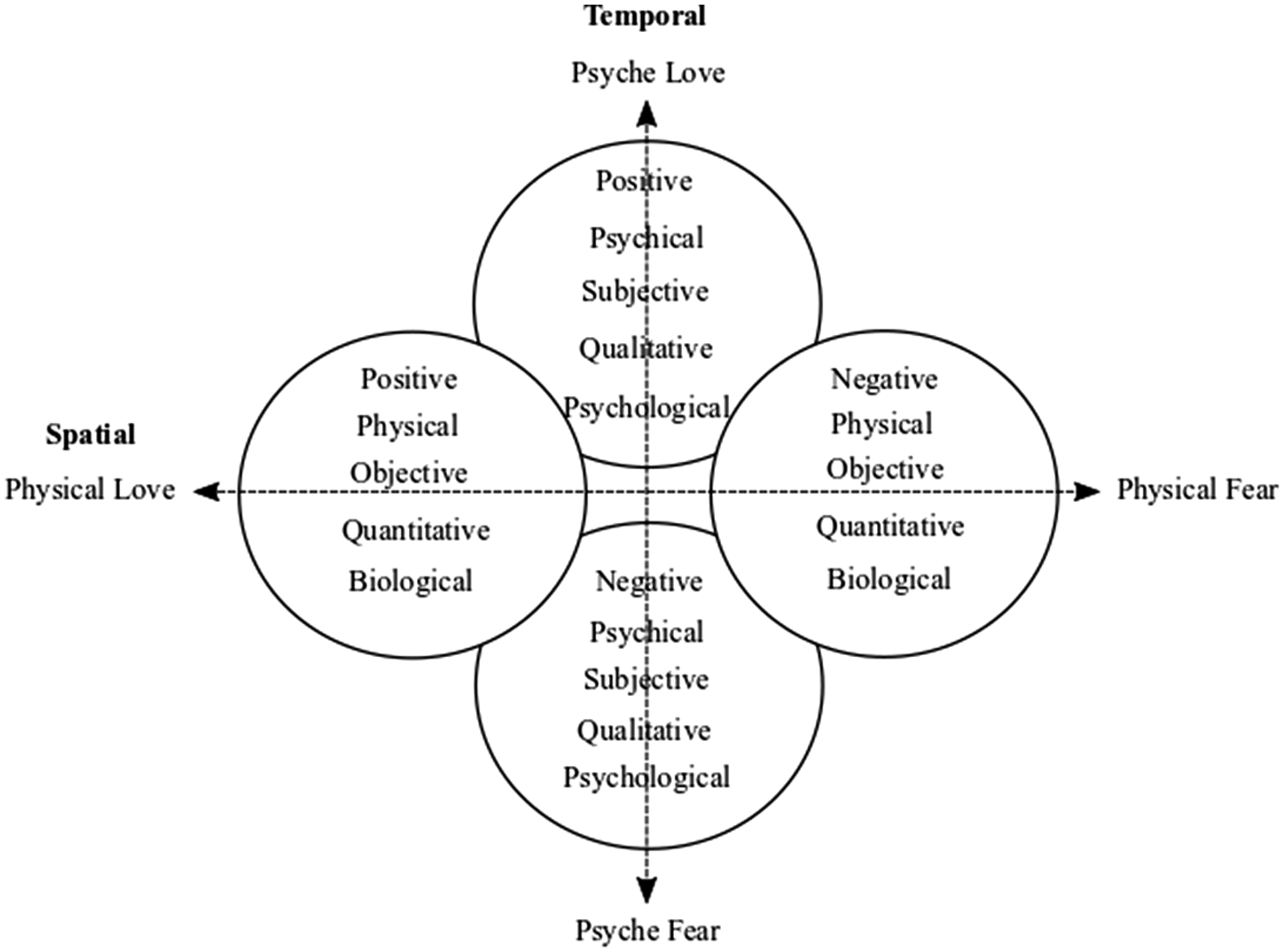
The temporal and spatial framework. The framework that underpins the four basic affective states and the properties that emanate from them.
Fundamental to these four states is the temporal and spatial framework, which uses a Linnaean (1753/2007) binomial labeling method. This method allows for a precise descriptor of an emotional event by bisecting affect. Each basic state has a clear function and adaptations that are determined by biological or psychological priority. The use of binomial labeling does not mean that each state is mutually exclusive. Each affective state has properties that allow them to be combinational through the psychological/biological, subjective/objective, positive/negative, quantitative/qualitative, and psychical/physical constructs (see Figure 2). This view complements Wundt’s (1897/1998) proposal that simple feelings have two common determinants. He saw quality as the psychical element by which feelings are distinguished from one another and intensity the quantitative means of differentiating the strength of feeling. As individual emotions are comprised of both a biological and a psychological element, the binomial label therefore emphasizes the physical or psychical priority. It provides for distinctions between emotions that are experientially different but of similar valence without over-reliance on intensity.
Flight–fight responses
Within the present framework, anger is not viewed as the opposite of fear but is seen as emanating from fear. This view concurs with Cannon’s (1953) flight–fight theory of emotion, which posited that fear and anger are reactions to a threat. However, it diverges from Plutchik’s (1980) psychoevolutionary wheel of emotions, where anger is the opposite to fear. Plutchik argued that fear and anger are biologically primitive and therefore cannot be experienced simultaneously because they are opposites. Behaviorally, fear and anger appear to be opposites but in terms of affect experienced (distress and insecurity) they are similar. Other prominent studies demonstrated few consistent somatovisceral differences between fear and anger responses during real life experiences (Ax, 1953; Funkenstein, King, & Drolette, 1954; Levenson, Ekman, & Friesen, 1990; Schachter, 1957; Schwartz, Weinberger, & Singer, 1981; Stemmler, 1989). Stemmler, Hedmann, Pauls, and Scherer (2001) suggested that Cannon’s flight–fight response should be redefined as the alerting response or defense reflex. Arguably, a valid opposite necessitates an opposing valence. The psychophysical model proposes that an angry person is feeling insecure and therefore in a fear state.
Behaviorally, a frightened person is capable of fighting if escape is not an option and an angry person can be full of fear. Bouton (2005) argued that situational demands determine behavioral responses such as flight or fight as opposed to specific emotional categories. Lang, Bradley, and Cuthbert (1990) noted that behaviors associated with fear can change and be associated with other emotion categories (anger). The behaviors accompanying emotions can be counterintuitive: paradoxically, courage may arise despite the presence of fear or an angry person may display deep-seated insecurity. Not only are different behaviors associated with fear, but one type of behavior can be associated with many emotions. For example, people run for health reasons, for fun, to gain time; alternatively, cry when grieving, or in joy, or fits of laughter. To clarify, conceptualizing fear and anger as opposites is analogous to viewing ice as the opposite of water.
Taxonomy of emotions
A taxonomy needs to be able to account for natural relationships between phenomena and that includes affect. Consequently, a taxonomy of affect needs to organize and manage information, including what justifies the different categories and how the emotions are derived from these categories. Describing emotions with single-name labels is restrictive because simply identifying emotions tells us little of how they are related to each other beyond valence and intensity. Binomial labeling allows for accurate description of the two main components (biological and psychological) that create an emotional experience. Furthermore, mixed emotions must also be considered when creating a taxonomy and especially whether a person can experience two emotions simultaneously (Larsen et al., 2001). The psychophysical construction of emotions can help distinguish between emotions that are often seen as synonyms, such as shame and embarrassment or contempt and disgust. It will also forward an account of how mixed emotions are experienced. Figure 3 depicts the types of emotion that emerge from the four different states determined by valence, time, and space, which provide the basis of the taxonomy. Another feature of the spatiotemporal model that differs from Russell’s (2003) circumplex model is the function of intensity. Basic emotion theory and construction theory view valence and intensity from one perspective or on one dimension. Intensity within the spatiotemporal model can be accounted for by closeness or distance relative to an object or event either in time or in space.
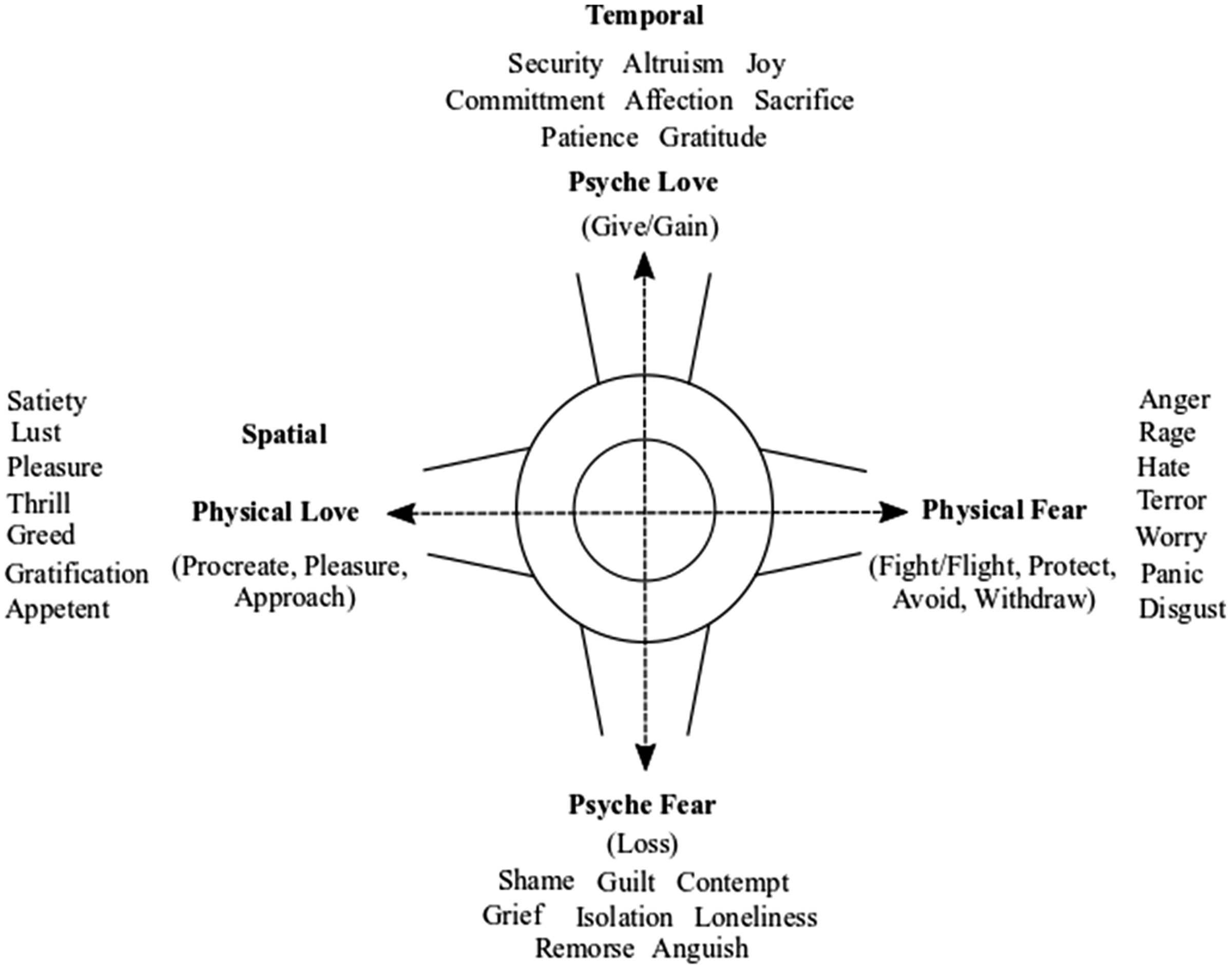
The four affective states. The categories of emotion that emanate from the four basic states that create the taxonomy.
The psychophysical model asserts that mixed emotions can exist simultaneously but are experienced as priority determines. Returning to the man in the woods and his sudden meeting with a bear, his shame, and guilt concerning his infidelity did not disappear when he encountered the bear, but his physical security naturally took priority. The present model therefore offers a solution that allows for two categorically different emotions to exist simultaneously, albeit with one taking priority. This is possible when emotions are categorized as suggested and where their function is to prioritize either the psyche (psychological) or physical (biological) concerns. For instance, psyche emotions such as shame and guilt have duration, but people can distract themselves by seeking satiety in the behaviors associated with physical love. This emotion regulation is usually understood as a way of changing affect from a negative to positive valence, but regulation can also be shown to change affect from psychical to physical concerns intentionally or unconsciously.
The principles and properties of affect depicted in Figures 1 and 2 are necessary to account for the complexity that produces the categories (states) and labels (emotions). The idea of basicness is not useful when used to categorize an individual emotion as a distinct entity. However, utilizing the notion of basic affective states as a starting point provides a mechanism to account for all emotions including mixed emotions. Without this reconstruction, the other principles in relation to affect remain opaque. Greenberg (2002) suggests that secondary emotions and meta-emotions are a similar kind; that is, sequential concepts in which a secondary emotion follows a primary emotion. In the spatiotemporal interpretation, in terms of its fundamentals, meta-emotions can also be understood to originate from the four basic states. Meta-emotions can be mixed and given valence determined by priority and context. For example, our unfaithful husband’s thinking and feeling concerning his infidelity may have originated in the category of physical love (lust) but shifted to the category of psyche fear as a meta-emotion (guilt). This guilt attests to a loss due to a violation within the category of psyche love. Demonstratively, the experience of loss could only be felt because of the existence of something else, namely, love.
It will be helpful to summarize the main points before looking more closely at the relationship between states and emotions. Clearly, priority shift is integral to the present four-category ontology. The spatial and temporal principles that determine affect are psychical/physical, psychological/biological, quality/quantity, subjective/objective, and valence. The physical dimension is reactive and the priority is to protect, avoid or withdraw on the negative valence, or to approach, sustain or seek satiety and pleasure on the positive valence. Approach and withdraw are fundamental to the physical states. The behaviors of withdrawal are similar to the responses emanating from the flight–fight theory of emotion (Cannon, 1953). The psychical dimension is reflective and the priority of the positive valence is to thrive and have healthy relationships, whereas the negative valence is defined by loss.
Emotions and the four states
Physical love is similar to physical fear in that it lends itself to description primarily in terms of the associated physicality or behaviors. Physical love requires proximity because of the appetitive desire for consumption, satiety, gratification, or comfort to achieve satisfaction and reward. The most obvious difference between physical fear and physical love is valence, demonstrated by the approach or withdrawal behaviors. A primary function of physical love is nurturance and procreation, maintenance, and survival of the physical self through the appetites. With physical fear, the priority is for the protection of the physical self. Both physical fear and physical love are demonstrative, observable, and measurable. The methodological behavioral approach has had success with this visceral type of emotion but has been less successful with the self-reflective, moral, and psychical emotions. Arguably, this is because of their lack of physicality and observable behavior, which has proved to be a knotty problem in the experimental setting.
Reflective emotions are also concerned with protection and nurturance of the physical self, but the primary concern is the psychical. They are emotions that are characterized by their duration and where distance from a stimulus, elimination of competitors, or achieving satiety or gratification does not equate to a problem being resolved. Emotions that are significantly time dependent are often subjective and are generally concerned with psychical loss on the negative side, such as grief or depression, and gains on the positive side, such as gratitude and altruism. Emotions are similar to human beings, as they are comprised of both a biological and psychological component. It is this combination that has made both emotions and people difficult to comprehend. In addition, positive emotions are arguably more difficult to define than to experience, especially the emotions emanating from psychical love. A possible analogy would be attempting to describe a color by comparing it to other colors.
Psyche fear is about loss and separation. Conversely, distance (temporal or spatial) from the cause of psyche fear, which may manifest as shame or guilt, does not assuage the feeling associated with these experiences as it does with physical fear. For example, distance from the bear in the woods that the man encountered reduced the intensity of the physical fear he experienced, but it had no influence on his feelings in relation to his infidelity. Emotions emanating from psyche fear arise from loss of faith, loss of meaning or purpose, loss of an ideal, loss of love, and so on. The fundamental feeling of loss is always the same except for intensity, but it is the context that necessitates the different labels used to communicate accurately what the loss is. This is similar to physical fear, where intensity and context determine the different modes of fear experienced, ranging from concern to panic.
Another significant difference between the physical and psychical dimensions is that physical fear and physical love are mutually exclusive, whereas psyche love and psyche fear are on a continuum. That is, psyche fear can only exist because of the existence of psyche love, as all emotions emanating from psyche fear result from a loss in relation to psyche love. Therefore, the origin of loss is rooted in love; loss of faith, purpose, and meaning is a consequence of first possessing love. Our emotion lexicon is limited, hence we often lack a single term that neatly communicates a particular emotion and accordingly we tend to describe these feelings with the prefixes “loss of” or “fear of,” for example, “fear of failure” or “loss of direction.” Another interesting point concerning the psychical realm that may appear counterintuitive is that you cannot explain a positive emotion by the absence of a negative emotion, but you can explain the experience of a negative emotion by the absence of a positive emotion through loss. It is analogous to a hole in the ground—it only exists because the ground exists. In ontological terminology, psyche love is necessary while psyche fear is contingent.
Contempt emerges from the category of psyche fear, whereas disgust emerges from the category of physical fear. Miller (1997) accounted for these emotions by positing that contempt is a cooler emotion than disgust. Fischer (2011) described contempt as “a hot feeling, hidden under a cold jacket” (p. 77). The intensity of these two negatively valenced states is represented by the notion of heat. Constructionist theorists separated emotions by the use of perception or conceptualization (Lindquist, 2013; Russell, 2003). In the present psychophysical model, contempt and disgust belong to two separate categories. All fear-based emotions are concerned with loss, but the difference between contempt and disgust is that the former holds an attitude or feeling toward another judged as inferior or worthless. Hume (1739/2018) argued that contempt required a tacit comparison between ourselves and the object of contempt. This self-reflective element induces a psychical withdrawal, which is a rejection of the object of one’s contempt. The fear at the root of contempt is the fear of social contamination and a loss of esteem or respect for the offending person, behavior or object. Disgust, at least behaviorally, is associated with the expulsion or removal of the offending stimulus (gagging or washing) or the removal of the self (distancing) from a disgusting situation or object (Rozin, Haidt, & McCauley, 1999). The fear at the root of disgust is fear of the threat of physical contamination. The experiential difference between these emotions, which are of the same negative valence, is due to the dualistic temporal-spatial, psychological-biological properties that comprise the structure of the fear-based affective states from which they emanate, rather than intensity of the feeling alone.
These dualities also allow for distinctions between the emotions and behaviors emanating from the state of physical love that are concerned with the appetites from the emotions emanating from psyche love that typically have duration. In plain terms, physical love is concerned with the physical self, whereas the focus of psyche love is also on another. These two types of love can subsume other definitions of love, including eros, mania, pragma, and so on (Lee, 1973). A gastronome may claim love of food; a thrill seeker a love of sky diving and an alcoholic may profess his love of alcohol. These types of love are all concerned with the physical self and the affect that each behavior or substance creates.
Psychical love is the most subtle of the four categories and like psychical fear it is subjective and qualitative, with the main difference between them being valence. The emotions emerging from psyche love have duration; contentment, intimacy, security, and joy emanate from this type of love, but these are not necessarily felt all the time. People do not always stop loving someone because they had an argument, but the negative affect may take priority in the short term. One of the main features of this type of love is a willingness to make a commitment to others and not only to the self. Indeed, there may need to be some sacrifice for the other. To excuse, pardon, forgive, grant mercy, and so on also belong to this family of affect.
Anxiety and its place in the spatiotemporal framework
For present purposes, anxiety, angst, and dread are viewed as synonyms because of a similarity inherent within these particular fears. The felt experience is reflected in the etymology of the word angst, which derives from the words that describe chocking, clogging, or strangling (Glare, 1982), creating the sensation that one is surrounded as opposed to facing a single threat. Kierkegaard (1844/1980) believed that anxiety is a uniquely human emotion, an unfocused fear, arising from awareness of complete freedom of choice.
Heidegger (1927/1962) argued that “anxiety is characterized by the fact that what threatens is nowhere.” For Heidegger, the threat does not approach from a definite direction (unlike the bear in the woods), as it is already “there, and yet nowhere; it is so close that it is oppressive and stifles one’s breath” (p. 231). The spatiotemporal interpretation of anxiety epitomizes an affective experience prioritized in time rather than space. This accounts for the affect experienced despite the lack of a physical threat. Angst, dread, and anxiety differ from other emotions within the psyche fear category such as guilt and shame, which are experienced as a result of past or present loss. Angst, dread, and anxiety are concerned with future (projective) loss and surface because the subject of the loss is rooted in existence. This potential for loss produces a unique felt experience that is typically first experienced in infancy (Craske & Stein, 2016) and is often associated with a growing awareness of self, responsibility, and maturation culminating in a sense of judgment.
Stuckness and repetition
The physical love state accounts for the emotions associated with the appetites. Individuals experiencing neurotic and traumatic conditions and those who suffer high levels of stress have a greater tendency to use negative coping behaviors, including increased alcohol or nicotine consumption (Wiebe & McCallum, 1986). Addictive behaviors, whether substance abuse or process impulses, are referred to as a maladaptation of the appetites in this work. Stuckness refers to the repetition of cognition that attempts to assuage personal suffering by engaging in a range of behaviors such as excessive consumption.
Stuckness originates in fear, pain, or loss and can affect the present, but it also impacts perception of the past and future. This is not restricted to individuals who have experienced past problems and seek relief, distraction, and pleasure through affective regulation. It can also be a future-orientated mind-set where desire for power, image, money, prestige, or success dominates conation. Numerous therapies have developed, and each has a preferred tense in the exploration of problems that individuals present with. For example, Rogerian therapy focuses on the here-and-now (present) (Rogers, 1959); Freudian analysis looks to a client’s childhood (past) (Freud, 1905/2017), and existential therapists may explore “being towards death” (future) (Heidegger, 1949/2008). Individuals are prone to experience stuckness after negative physical or psychical life events. The experience of a negative event can produce a freezing of the event in cognition and affect, in which a stimulus can trigger a re-experiencing of the initial event. Stuckness not only occurs in conditions like posttraumatic stress disorder (PTSD), it can also occur with emotions like guilt and shame. Guilt can cause painful repetitive thoughts, but the loss may not have obvious physical symptoms. In brief, stuckness refers to a state of mind where one is compelled to repeat thoughts, behaviors, and feelings in an attempt to fulfil a desire or longing by means which do not satisfy the need.
These behaviors can become increasingly debilitating and prolong the stuckness when the efficacy of the distracting behavior or substance loses potency or promise. Not all repetitive behavior is negative; studies have found that frequently engaging in enjoyable leisure activities correlated with positive psychosocial states and a decrease in negative affect (Pressman et al., 2009; Zawadzki, Smyth, & Costigan, 2015).
Conation, affect, and cognition
Although the spatial-temporal dimensions are valuable in constructing a taxonomy, they are limited without consideration of the three domains of the mind attributed originally to Galen—namely, the cognitive, conative, and affective. Hilgard (1980) viewed the trilogy model of mind as causing a “division of labour” in the field of psychology, in which at various times one aspect took priority over the others. This preference led to individual domains being studied, rather than the whole mind (p. 116). This separation continues to create controversy around how something unitary like the mind can be divided. The present spatiotemporal interpretation proposes to show how affect through the past, present, and future tenses can demonstrate the trilogy working as one.
The tripartite structure of mind merged with valence and the temporal-spatial dimensions completes the new framework of affect. A current definition of a prototypical emotional episode includes core affect, overt behavior, attribution, experience of having a specific emotion, bodily events, and being goal-directed. A non-prototypical emotion episode is an emotion with one or more of the above elements missing but which is more commonly experienced than prototypical emotional episodes (Russell & Barrett, 1999). It is posited here that an emotion is a reaction or response to an exogenous or endogenous disturbance within the cognitive, conative, and affective domain of the mind. The prioritized tripartite response determines what action, if any, is required/desired based on past, present, or future concerns and proximity or distance to the internal/external stimuli.
The importance of conation in relation to mind cannot be overstated. Bagozzi (1992) proposed that conation is necessary to explain how knowledge (cognition) and emotion (affect) are translated into behavior in humans. He also suggested that the researcher’s ability to predict behavior is hindered because the construct of conation has been omitted. Other theorists argued that will or volition is an essential and voluntary element of human behavior that must be taken into consideration in order to fully explain behavior (Bandura, 1997; Donagan, 1987). Although intentionality is common to both humans and animals, human intentionality is different in that only humans can desire to contravene their conditioning (Frankfurt, 1988). Bandura (1997) believed that this is only possible because of the singularly human ability for self-reflective evaluation. In this work, intentionality, desire, longing, and craving come under the rubric of conation. Although they are not synonymous, it is the purposeful direction of travel toward action or action tendency that is significant for current purposes. In a similar way, mood, emotion, and feeling come under the rubric of affect; and thinking, learning, and remembering are under the rubric of cognition. Conative action can be focused on the needs of the self or the needs of the other, so in this sense it is bifocal.
Since antiquity, desire has frequently been viewed as the cause of human distress. In Plato’s Republic, Socrates reasons that an individual’s desires must be delayed for the higher ideal to be achieved (Plato c.380BC/2003). The Buddha claimed that desire was the cause of all suffering. Schopenhauer (1818/2008) argued that if we are to gain tranquillity, we ought to minimize desire. Freud (1905/2006) believed that people were full of unhelpful unconscious desires, while Lacan (1973/2018) saw the desire of the other as fundamentally being a desire for recognition. There are modern theories concerned with varieties of desire including action-based (Anscombe, 2000; Papineau, 1987), learning-based (Dretske, 1988; Schroeder, 2004), and holistic (Davidson, 1980). Within the present spatiotemporal model, conation is dichotomized into desire directed toward the wants and needs of self and desire that considers the needs of the other. The alternating focus of conation toward other or the self can be accorded valence depending on the accompanying cognition and affect (context). Arguably, problems arise when desire is continuously prioritized in favor of self-interest. Figure 3 depicts the appetitive emotions that emanate from physical love, which can become problematic if the objects of desire are used for affective regulation. Excessive conative focus on eating, sex, alcohol, money, power, or prestige may be seen as solutions to problems that desire alone cannot resolve. Consequently, understanding the human condition is considerably more complex than stimulus response associations.
McDougall (1923) described the three domains of mind as the three phases of all mental processes. Although each cycle of activity has this triple aspect, it passes through phases in which one domain has prominence at each moment. He gave an example of a naturalist catching a specimen. First he recognizes it, then catches it, and finally gloats over its capture. This ability to priority shift between the fundamental psyche and physical dimensions and the three domains of mind leads to an exposition that offers insights into an individual’s relationships with self, the environment, and others. In some instances, cognition and affect work together like scissor blades that cut an individual from past or present concerns. This cutting away allows for the redirection of energy toward a new future-orientated goal. This process requires the intentional conative domain, which energizes a person to action. All three domains of mind are always active and are comparable to the sight, sound, and scent senses of a dog, which are prioritized according to context. For example, when foraging in a noisy, crowded environment, scent may take priority, whereas in darkness, hearing may take precedence and so on. Just because one sense is prioritized does not mean that the others have become superfluous. On the contrary, the senses, like the mind, work best when all are in accord. The mind and the body must be in functional compatibility and priority remains essential to continued effectiveness and existence.
All affect is subjectively experienced and based on the prioritization of physical or psychical concerns. For an individual experiencing rage because of an immediate physical (spatial) threat, the interactions within the cognitive, conative, and affective domains will clearly be different from a person experiencing the bitter–sweet (temporal) feeling of nostalgia, where there is no possibility of returning in time. As already stated, priority shift is not a simple spatial/temporal concern; there is also a shift in the cognitive, conative, and affective domains, which are functioning within a dynamic hierarchy of priority dependent on context. Context is both objective and subjective, which suggests that no two individuals’ reactions to a stimulus need be identical, not least because of their unique spatiotemporal position and the effect this perspective has on the three domains of mind. Suppressing a domain of mind does not mean it will not be expressed, but it can result in maladaptation (Carver, Scheier, & Weintraub, 1989).
The emotions represented in Figure 4(a) and (b) are not intended to be a precise representation of how emotions appear in the tripartite mind, given each individual’s unique position in time and space, context, life experience, and so on. Figure 4(a) depicts the construction of three different emotions represented in the mind: rage, nostalgia, and anticipation. The three domains alone do not satisfactorily explain the difference in felt experience of emotions that are categorically different. However, when the spatiotemporal framework is linked to the three domains of the mind, a natural architecture is provided that can account for the different categories and felt experience of affect. The fundamental spatiotemporal dimensions account for intensity in terms of proximity or distance for emotions that come under the rubric of past, present, and future focus. Cognition adds the contextual conceptualization and conation the desire (longing of nostalgia) action readiness (in rage) and curiosity (anticipation).
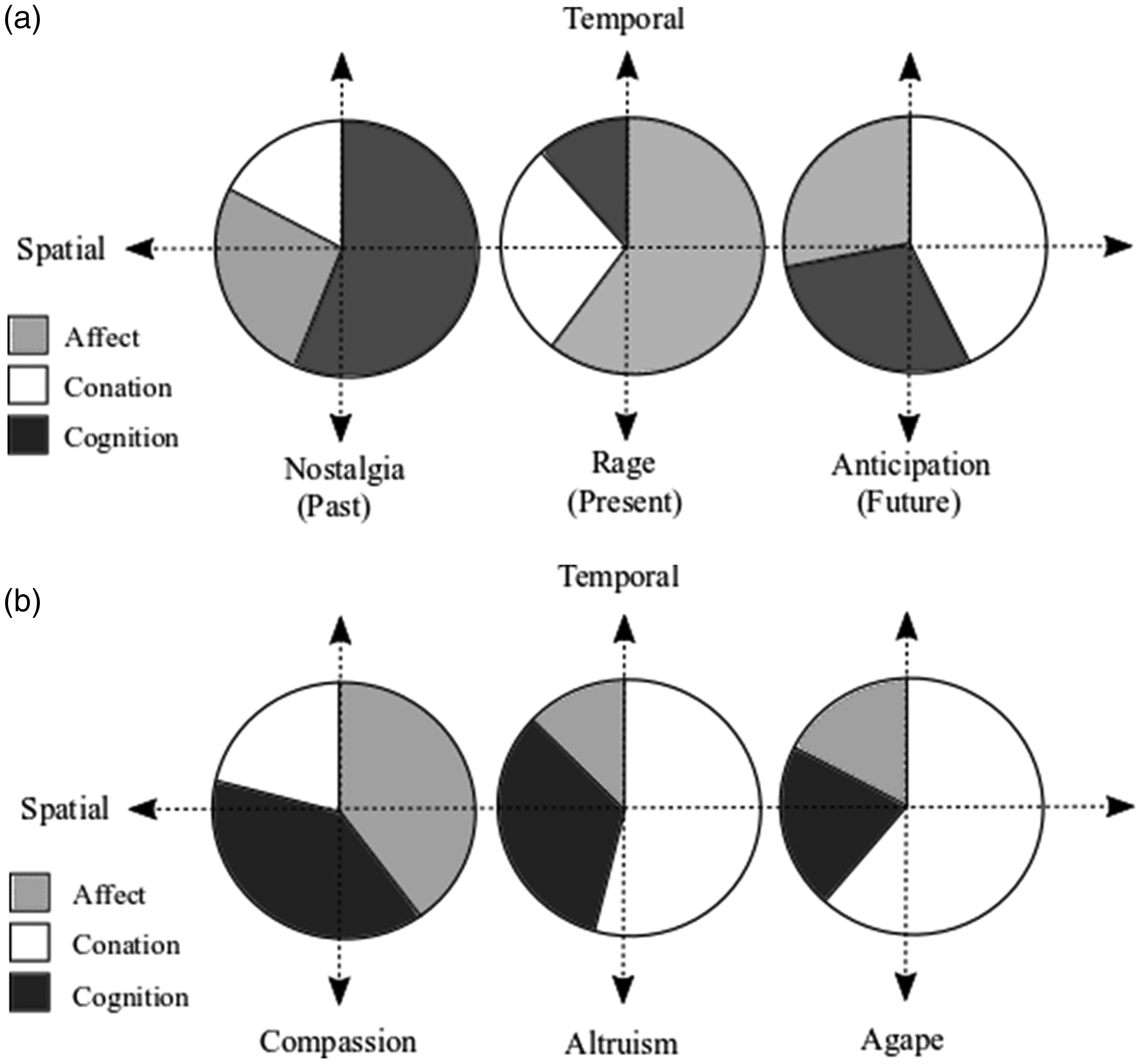
(a) Priority in mind. Three categorically different emotions prioritized by cognition, conation, and affect that contribute a significant difference in felt experience. (b) Priority of mind within one affective state (psyche love). Tripartite diagrams represent the structure of mind where emotions that are categorically similar are illustrated by priority distribution of the conative, cognitive, and affective domains of mind.
In contrast to Figure 4(a), which represents difference between affective states, Figure 4(b) depicts difference within a single state (psyche love), where prioritizing conation leads to action. This differential dynamic is achieved by the prioritizing of the three domains of mind. The prioritization in the three domains would be different, for example, for someone anticipating traveling abroad for the first time compared to a frequent traveler. Nevertheless, it would be predicted that a future-focused emotion like anticipation would have similarities in its tripartite distribution within the minds of both. If the same two individuals were to experience an emotion like rage, it would be expected that the tripartite distribution would differ from the distribution experienced in anticipation. It could be predicted that affect and conation would take priority in the mind of most individuals experiencing an extreme emotion like rage.
Experience and the tripartite structure of mind
Conation is not alone in terms of being viewed as a problematic sphere of mind. Noted thinkers including Plato (c.380BC/2003) and Kant (1788/2006) generally saw emotions as negative, blurring one’s experience, or in a battle with reason. These views of emotion have been challenged by Damasio’s (2006) somatic marker hypothesis, which argued that both emotion and reason are necessary for functioning. Theories of emotion are not as concerned with the emotional/rational debate, where emotions were seen as an epiphenomenon. Constructionist theories of emotion consider the valence and intensity of emotions to be of great importance. This basic division coupled with the psyche/physical distinction and underpinned by the tripartite division of mind accounts for a range of emotions including secondary emotions, mixed affect, and conditions.
Understanding how affective states can mix and create complex affective conditions and experiences is another concern of this work. The spatiotemporal model forwards the view that the complexity of mixed affect is not solely due to emotions of opposing valence being experienced simultaneously. The experiences can also arise when emotions from different spatiotemporal affective states co-occur. It is posited here that mixed affective states interact with the components of the tripartite structure of mind to define many pathologies including neurotic conditions, addictions, and trauma-related conditions, as well as positive states of well-being (Figure 5). The interactions of the domains of mind and affective states create a mechanism that provides an account of affective disorder and health that has been until now obscure.
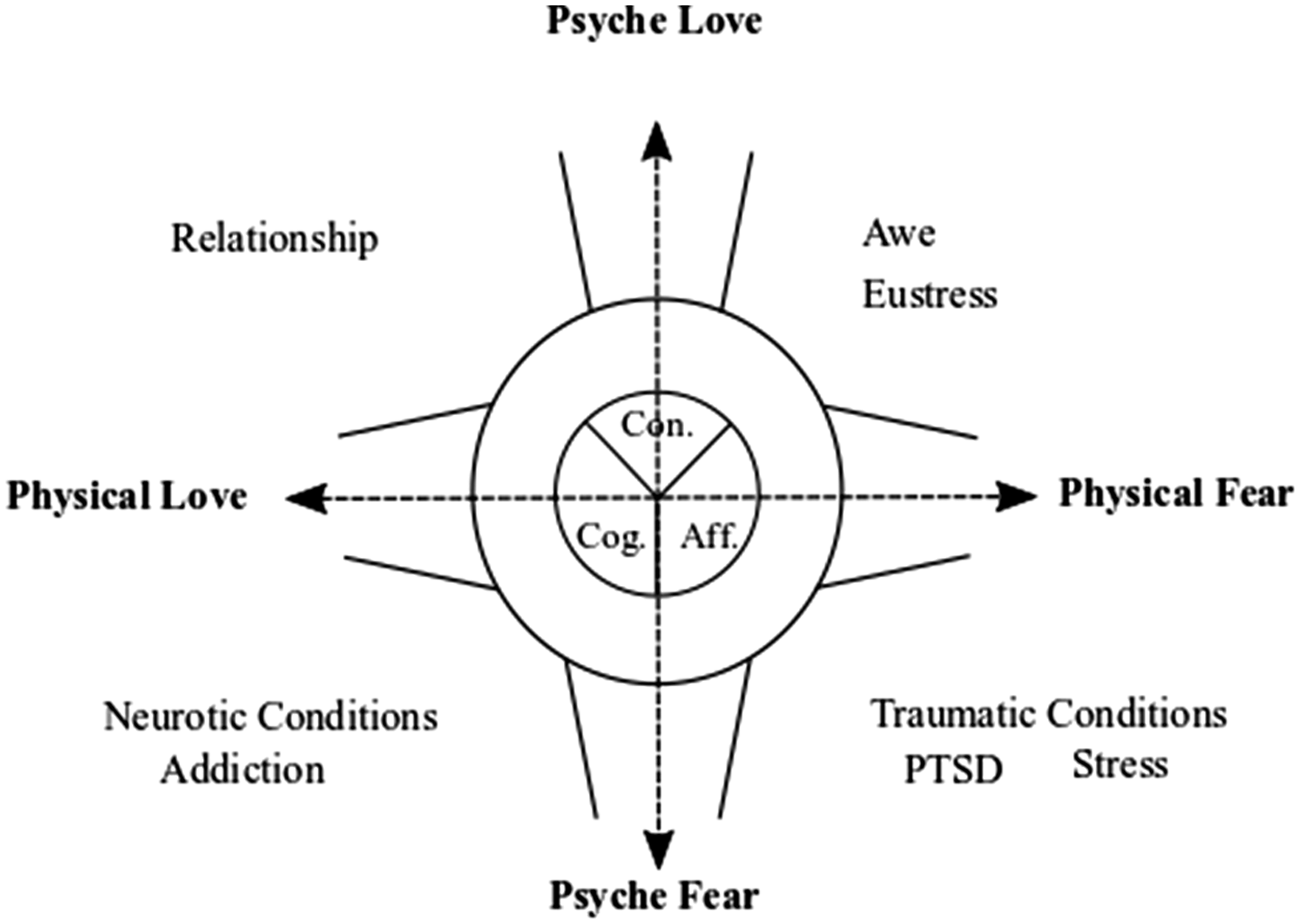
Mixed affective states. Some of the conditions, experiences, and significant bonds created from the four basic states.
The four basic affective states account for the physical and psychical dichotomy of self and the valence of affect. Intensity of feeling is explained through proximity and distance and includes past, present, and future emotions. The interplay between the four basic states and the three domains of mind determines an individual’s reactions, reflection, desires, and behaviors. Figures 3 and 5 and Table 1 depict a selection of conditions and emotions shown in this work to be categorically different. The variation within basic categories is explained through the prioritizing domains of the mind, intensity, and behavior. Establishing differences between conditions and emotions is helpful, but this is not intended as an exhaustive exploration of identifiers of uniqueness of affect and conditions. The primary purpose is to demonstrate how prioritization of the four basic states and the three domains of mind create nuances in affect and behavior (Table 1).
Experience of affect.
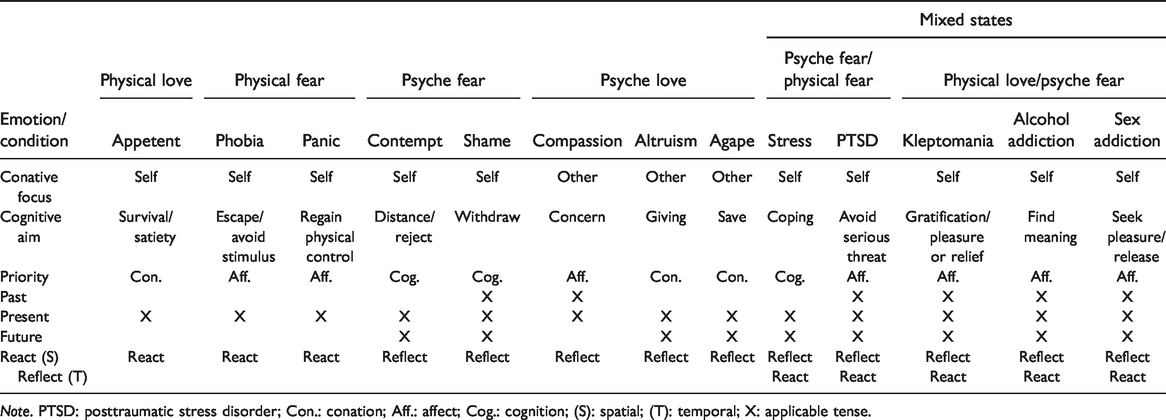
Note. PTSD: posttraumatic stress disorder; Con.: conation; Aff.: affect; Cog.: cognition; (S): spatial; (T): temporal; X: applicable tense.
Physical love, or the appetites, refers in a positive sense to self-care and tending to one’s needs through developing relationships with others and the environment. This state is essential for survival and provides the comfort and companionship necessary for procreation and thriving. The emotions and behaviors emanating from physical love have a pronounced conative bias because they are primed for action. This conative focus is primarily on self, and affect is concentrated in the present for meeting immediate physical needs and achieving satiation as illustrated by appetent in Table 1.
Physical fear refers to defense and protection, but in terms of psychopathology can manifest in the extreme as phobia (specific, social, and agoraphobia). Phobia is a fear response to a stimulus where space—that is, distance from the source of the fear eliciting stimulus—determines the intensity of the fear experienced. Panic disorder is similar to phobia hence appearing in the same category (see Table 1). Nevertheless, there are observable differences; both panic and phobia are at their most potent during the experience of the episode of the condition, hence the present tense takes priority, while fear (affect) for physical safety takes priority in mind. In terms of affect, the phobic individual may fear an external object or situation, whereas the individual in panic fears losing control (American Psychiatric Association, 2013). In the conative domain, any purposeful action or desire is primarily focused on protection of the physical self from the perceived threat. The behavioral focus of phobia is to increase distance by escape, and with panic disorder, the focus is on avoidance of stimuli and regaining control over physiology.
The factors and context that determine stress are more complicated than those that define a phobia or panic disorder. This complexity arises because stress is a mixed-state condition that straddles physical fear and psyche fear, as it is both a present- and future-focused condition (see Table 1). The cognitive domain of mind takes a greater role than it does with phobias and panic disorders in making judgments and deciding whether the individual can cope with the perceived pressure or threat. As with all emotions emerging from physical fear, the priority in stress is the physical self. However, stress is also projected forward as psyche fear in the form of anxiety as the individual worries about whether they can handle future pressures. Consequently, the prioritizing of cognition reduces the flight experience of stress by decreasing the intensity of affect and the desire to escape. By contrast, the intensity of affect in phobia and panic increases with the overwhelming desire (conation) to escape and cognition is diminished. Stress can cause ongoing anxiety as a person fears future exposure to the situation that they feel ill-equipped to handle. Due to the temporal component, physical distance from the source of the stress in this instance does not necessarily lessen the stress, as it does for panic and phobia.
A debilitating type of stress is PTSD. Some 15.8% of US veterans deployed in Operation Enduring Freedom/Operation Iraqi Freedom present with this condition (Dursa, Reinhard, Barth, & Schneiderman, 2014). PTSD also straddles the physical and psychical fear states but spans all three temporal tenses (see Table 1). According to the American Psychiatric Association (2013) criteria, symptoms concerned with the present include an exaggerated startle response, sudden angry outbursts and hypervigilance. Future-focused affect is observed as an exaggeration of negative beliefs projected forwards. Negative emotions such as the recurrence of traumatic memories, grief, resentment, and shame, with their focus on the past, make up the final tense, compounding the suffering that commonly characterizes this condition. The fear of physical harm in the present is accompanied by persistent psyche fear of the potential and actual losses that span the temporal component in both directions (reflection backwards and projection forwards). Fear of further trauma causes the sufferer to be hypervigilant in an attempt to avoid event triggers. Conation in terms of desire is focused back onto protecting oneself, resulting in stuckness, which is demonstrated in repetitive behaviors and cognition. In part, PTSD is a result of pressure expressed in all three domains of mind. The individual feels confined by the anguish of the past and fear of future suffering and hence is a captive of the present. Enclosed by the negative affective states, the ability to experience happiness, satisfaction or loving feelings diminishes and hope decreases.
Addiction is another mixed-state combination of psyche fear and physical love and is arguably one of the most obvious manifestations of behaviors that epitomize stuckness. Common to all types of addiction are attempts to overcome a deeper malaise characterized by repetitive behavior, thinking, and desires, which the sufferer practices in an attempt to cope with being in the world. The Oxford Dictionary (2018) defines an addict as “dependent” or “devoted,” and the general interpretation of this is that an individual is dependent on or devoted to the process, impulse, or substance. The addictions depicted in Table 1 are kleptomania (impulse control disorder) alcoholism (substance abuse) and sex addiction (process addiction). Reoccurring behaviors are apparent in all types of addiction because of the sense of distraction, reward, or power that they offer (Johnson, 2013). Conversely, as the substance or process addiction progresses, the sense of powerlessness, loss of meaning, and dependency increases (Sussman & Sussman, 2011). With some addictions, such as addiction to making money or acquiring position, the ambition is for power over others and to appear successful. In contrast, with substance and process addictions, the desire is for power over self through emotional regulation. Arguably, the subject of the addiction is not exclusively focused on the substance, or the process, but on self. In terms of the spatiotemporal model, addiction is an attempt to reduce psychical negative affect by using physical love (appetites) and this is when conation is focused on the self. Addiction may be an attempt to overcome negative memories, find hope, or distraction in an intolerable present or seek courage to face the future through affective regulation. Distracting oneself from a sense of powerlessness and emptiness (psyche fear/loss) is of paramount importance and as already suggested is at the root of addiction. Addiction does not lead to fulfilment, as the pursuit of physical love can only satisfy the physical appetites. It is not in the gift of the physical appetites to satisfy the psyche need for hope, purpose or meaning. This mind configuration demonstrates an attempt to control one’s own emotions through negative regulation, and this can be understood as the etiology of addiction.
The category psyche fear is concerned with “loss emotions” demonstrated by contempt and shame (Table 1). Contempt, as already mentioned, is a fear of social contamination by being associated with another individual who is seen as inferior or worthless. The disdainful facial expression that accompanies contempt warns an individual to stay away. It also signals to any observers that the contemptuous person is in some way superior to the individual who is the object of contempt. Experiencing the contempt of others can elicit another emotion from the same category: shame. Psychical fear is the basic state underlying both contempt and shame, and distance or withdrawal is the conative priority. Shame or loss of self-worth and contempt are similar in construction, but context creates difference; this necessitates the labeling of discrete emotions to communicate the complexities of affect. The difference in feeling could arise in someone experiencing contempt distancing themselves from perceived psychical contamination. Conversely, with shame, separation may be an attempt to avoid further rejection. Shame can remain a private emotion as experienced by the man encountering a bear in the woods where the thought of his infidelity elicits a sense of compunction. When this painful emotion arises, conation is forced back on self.
Psyche love is the last of the four basic states depicted in Table 1 and Figure 4(b) by three emotions that are often seen as synonymous: compassion, altruism, and agape. Unlike the other three basic states where conation is predominantly focused on self, priority switches to the needs of others, triggering emotions like compassion, altruism, or agape. The difference between these three categorically similar emotions is related to the degree to which conation is prioritized leading to giving to others—affectively, materially, and in self-sacrifice. Compassion evokes empathy and sympathy but does not always lead to action as compassion is action-readiness or tendency. Without conation, compassion remains an emotion in mind. Conation provides the action that elevates compassion to altruism by generosity in giving. Clearly, true altruism is never a secondary concern as it is not seeking reciprocation. Altruism can be present- and future-focused, whereas compassion is elicited by present or past events. Agape is present- and future-focused and conation on self is minimal. Instead of giving something to another, the giving is a sacrificial willingness to risk one’s safety or life for the benefit of another. The conative action of generosity in altruism and sacrificial giving characterizing agape demonstrates how a complexity of components create differences between emotions within states as well as a myriad of opposing emotions.
Conclusion
The three domains of mind are imperative to our understanding of self as they produce the condiments of experience. Emotions have proved to be difficult to pin down because of their mercurial nature, derived from the experiences, processes, punctuations, events, reflections, expectations, hopes, and losses in life. They are valenced and potently combined with cognition and conation, which creates the diversity of affect. This spatiotemporal construction and its manifestation in the psychical and physical spheres allow for a dualistic interpretation of affect. It is clear that understanding emotions is important, and not just in the sense that they are somatic markers as Damasio (2006) advanced, but also in knowing ourselves and how the affective relates to the cognitive and conative domains of mind. The reunion of disciplines is helpful in providing new insights and offering a more holistic view of the self.
A simple definition of philosophy is the “love of wisdom,” but it is Levinas’s (1974/1981) reinterpretation of philosophy as the wisdom of love that perhaps strikes a chord for those concerned with human affect and experience, with its benefits, losses, loves, and fears. The spatiotemporal model concurs with his interpretation of wisdom and love as synonymous and has further argued that psyche love is fundamental to our understanding of affect. This view has implications given the prevailing paradigm that requires competition be the exclusive interpretation of reality. The elevation of the survival of the fittest adage where conation is required to be focused on self has incubated disease and sickness on the petri-dish of the mind, creating the psychological climate that cultures mental, social, and spiritual disease in individuals and society alike. It is clear that psychopathology is not the product of the emotions emanating from psyche love but the absence and loss of them. The fecundity of psyche love and its quality of producing, creating, sharing, and giving is an essential component of conation directed away from self toward others. The absence of this practice and discipline is the etiology of much of human suffering, manifesting in isolation, addiction, trauma, pathology, and meaninglessness. The reaction to these maladies tends to be a physical one, such as seeking ataraxic relief in substances, satiety in the appetites or a sense of security in power, money, prestige, or surrendering to life. This strategy functions only as a buffer from reality by providing distraction and abdication from these psychological and behavioral maladies, which are void of hope and meaning.
A new taxonomy of affective states has been proposed, and their relationship to the cognitive and conative domains of mind and how these may impact well-being and behavior has been discussed. Naturally, all individuals possess the full range of affective states and priorities of mind, which impact on relationships both negatively and positively. This complexity makes negotiation between individuals and groups challenging, especially when their Weltanschauung differs. Nevertheless, nothing impedes progress between humans more than when conation is focused on self and self-interest takes priority no matter what the circumstances, needs, or experience of the other. A change of paradigm is the solution to the inculcated prevailing mind-set. A subsequent paper will explore the mechanism that allows for changes in valence and between states.
