




Abstract
The prevention of community violence is a key issue for the criminal justice system due to its significant impact on victims and society. Within Dutch prisons, the recently implemented easy-to-use Risk Screener Violence (RS-V) enables the early detection of violent behaviors among incarcerated individuals in support of timely intervention. The current prospective study found sound predictive validity of RS-V's rated by prison staff for violent (re)offending 6 and 12 months after release from prison. Predictive accuracy was higher for violent recidivism than general recidivism. These results indicate that the RS-V may contribute to overall risk management. However, effective intervention strategies and risk communication are essential.
Introduction
A critical concern in the criminal justice system is recidivism after incarceration, especially regarding violent offenders. In particular, the incidence of violence has significant effects on victims and society as a whole. Besides physical injuries, victims of these high-impact crimes often experience persistent socio-emotional and psychological problems, such as difficulties with work/school, (romantic) relationships, victim blaming, and PTSD, stress, and depression diagnoses (Andrews et al., 2003; Gracia, 2006; Langton & Truman, 2014; Tan & Haining, 2016). Moreover, the impact of violent assaults extends beyond the immediate victim, as violence may also affect the victim's family, friends, neighbors, and involved professionals, generating public fear and disrupting community functioning (Fowler et al., 2009; Ruback & Thompson, 2001). In this study, we examine whether a newly developed and easy-to-use screening instrument (the Risk Screener Violence) is able to identify which incarcerated individuals are more prone to display violent recidivism after release from prison.
When examining recidivism rates, the public fear of violent crimes committed by formerly incarcerated persons seems warranted. In the United States, approximately one in four (26%) detainees were imprisoned for a violent offense in 2005 (Durose et al., 2015). In addition, the rearrest rate for a violent offense eight years after release from prison in 2010 was higher among violent offenders (39%) compared to non-violent offenders (22%) (Cotter et al., 2022). Similar statistics applied to the Netherlands in 2017. Roughly 20% of Dutch offenders were convicted for a violent crime, and approximately 17% of the Dutch ex-detainees were re-convicted for a violent offense within two years after release from prison (Verweij et al., 2021). These considerable violent offending rates and subsequent negative effects on victims and the community highlight the need for prevention and intervention for violent offenses in order to enhance desistance from violent crime.
Prison sentencing serves as an intervention strategy for violent offenders aimed at improving public safety and preventing further offending, at least during the term of incarceration. Copp (2020) offers two main hypotheses regarding the actual effect of imprisonment on subsequent recidivism rates. The first hypothesis is that prisons diminish criminality. This view is embedded in deterrence theory which suggests that the threat of (further) punishment can prevent individuals from committing future offenses (Andenaes, 1968). In contrast, the second hypothesis proposes that incarceration increases criminal behavior. That is, according to the social experience model, incarceration may expose individuals to various criminogenic risks (e.g., victimization, stigmatization, overcrowding, and the criminogenic beliefs of other detained individuals), leading to an increase in the likelihood of re-offending after release (Copp, 2020; Cullen et al., 2011). Moreover, the often harsh prison environment may exacerbate mental health problems, thereby increasing criminalization (Parsons and Bergin, 2010). Clearly, more quality research is needed in order to confirm whether incarceration has a preventive or a criminogenic effect. Yet, the research literature tends to support the latter, which could have significant policy implications (Copp, 2020; Gendreau et al., 1993; Nagin et al., 2009).
To counter the possible criminogenic effects of time in prison and to design effective prison programming that addresses recidivism, the mapping of individual risk factors and protective factors that potentially influence the likelihood of future violence is a useful starting point. This is of particular importance as the prison setting provides a unique window of opportunity to gain insight into the offender's strengths and problems. In the Netherlands, prison staff utilize the Risk Screener Violence (RS-V) to assess the most relevant risk and protective factors of each detained individual upon entry into a Dutch prison (De Vries Robbé & Van den End, 2020). Consequently, concerns regarding future violent behavior of this individual inside and outside prison are discussed following the Structured Professional Judgement (SPJ) methodology. The RS-V may be rated by trained general prison staff without specific behavioral expertise, i.e., not requiring dissemination by psychologists or psychiatrists. Further, the discussion of the results of the RS-V in a multidisciplinary team meeting supports the implementaion of follow-up measures aimed at the prevention of future violent behavior. For individuals for whom moderate or serious concerns arise regarding future violent behavior, complementary extensive risk assessment (e.g., by means of the HCR-20V3 for risk factors (Douglas et al., 2013) and the SAPROF for protective factors (De Vogel et al., 2012) can be initiated. These are recommended in order to gain more in-depth insights regarding the risk profile of an individual. In this manner, the RS-V serves as a triage tool. In addition, the results of the RS-V may provide guidance for prison personnel for the deployment of personalized follow-up measures, such as single-celling, aggression replacement training, or communicating the individual's risk profile to collaborating institutions and/or aftercare programs.
Implementation of the RS-V in all 25 Dutch prisons commenced in 2021. User evaluations across three years from implementation revealed that prison staff considered the administration of the RS-V to be useful and fairly easy (Smeekens et al., 2024d). Additionally, the RS-V has been scored with excellent inter-rater reliability (Smeekens et al., 2024b). Moreover, both file-based and prison practice studies showed that RS-V ratings have sound predictive value for violent and aggressive incidents occurring within the prison setting (Smeekens et al., 2024a; 2024c). This result was documented for both violence towards staff and violence towards other detained individuals during a four-month in-prison follow-up period. Regarding the prediction of violent behavior within the community after release, a previous investigation, which included RS-V's rated retrospectively by researchers based on (digital) file information of detained individuals, found sound predictive validity of RS-V ratings for violent recidivism at 6, 12, and 24 months post-release (Smeekens et al., 2024b). For females, the predictive validity of RS-V scores for violent offending after release was even higher than for males.
The current study's goal was to replicate the findings of Smeekens et al. (2024b) regarding the prediction of violent recidivism. However, instead of retrospective file-based data, this research includes actual prison practice data; RS-V's prospectively completed by prison staff in daily practice. We expect ratings on these RS-V's to have sound predictive validity for violent (re)offending during both 6 and 12 months after release from prison. To investigate whether the RS-V is specifically predictive of violence, general (re)offending was included as an additional outcome measure. Since the main goal of the RS-V is to predict and map out concerns regarding future violent behavior of individuals, it is hypothesized that scores on the RS-V are primarily able to predict violent (re)offending as opposed to general (re)offending.
Method
Participants
The Dutch prison system is comprised of 25 prison units, with maximum capacities ranging from less than 200 to more than 500 individuals. The 2022 Netherlands incarceration rate was 54 per 100,000 Dutch inhabitants, and the average detention length of stay is four months (Dutch Custodial Institutions Agency, 2024; Statista Research Department, 2023). In addition, 10% of the individuals are incarcerated for more than one year, with 72% staying in prison for less than 12 weeks.
The individuals in this study were (former) detainees from all 25 prisons within the Netherlands for whom several inclusion criteria applied. First, Part 3 of the detainee's RS-V (the final conclusions; see ‘The Risk Screener Violence (RS-V)’) had to be completed within the first six months after implementation of the RS-V within Dutch prison practice - between September 2021 and February 2022. Thus, an eligible participant had to have been incarcerated during this time period, except for individuals who resided within one particular prison. Within this prison, implementation of the RS-V commenced from April 2021 onward. Hence, the inclusion period for this prison contained an additional five months. Second, in order to have enough time to prospectively map out violent re-offending rates after release from prison, an individual could not have remained imprisoned for more than 90 days after the rating of Part 3. Third, the RS-V of this individual needed to include Part 1 (the historical risk factors), Part 2 (the dynamic risk and protective factors), and Part 3 (the final conclusions) of the RS-V, with overall no more than two factors rated as ‘unknown’. Applying these inclusion criteria resulted in an initial sample of 1,460 eligible individuals.
Subsequently, other inclusion criteria were checked. Namely, an individual had to have been formally convicted for the offense for which they received the corresponding prison sentence. In addition, after release, the individual had to have remained within the Netherlands and not have passed away during the follow-up period. Finally, this study applied a time-at-risk (TAR) criterion to account for the number of days someone was at risk of committing a (new) violent offense within the community after release. Every day that an individual was not at risk within the community during the follow-up time (for example, due to re-incarceration for a non-violent crime or admission to a forensic clinic) was counted. If the individual was not at risk during more than half of the follow-up period, they were excluded. In case of multiple institutionalizations for non-violent crimes during follow-up, these were added to calculate the total time not-at risk. Individuals were excluded if the sum of the number of days incarcerated for non-violent crimes during follow-up added up to more than 3 months for the 6-month follow-up sample, and to more than 6 months for the 12-month follow-up sample.
The final sample contained 1,320 ex-detainees, 1,241 males and 79 females. The 6-month follow-up sample consisted of 1,230 detained individuals (1,154 males and 76 females), whereas the 12-month follow-up sample included 1,233 individuals (1,158 males and 75 females). The average age of the total group of included individuals upon release was 37 (SD = 12.00, range = 18–79), for both males and females alike (respectively: SD = 11.96, range = 18–79; SD = 12.58, range = 19–72). The total group had an average detention duration of 260 days (SD = 356.55, range = 29–4043), males were imprisoned for an average of 258 days (SD = 354.86, range = 38–4043), and females for 303 days (SD = 381.96, range = 29–2310). In total, 31.9% of the ex-detainees were incarcerated for the first time (males = 30.2%, females = 56.4%, missing values = 116). All individuals were released from prison between May 2021 and May 2022. The average time between the rating of RS-V Part 3 and the actual release date from prison was 40 days (SD = 23.80, range = 0–90).
The Risk Screener Violence (RS-V)
The Risk Screener Violence (RS-V), initially developed for prison settings, is an easy-to-use risk screening tool to estimate concerns regarding future violent behavior of incarcerated persons (De Vries Robbé & Van den End, 2020). The RS-V is a relatively short and compact instrument compared to the elaborate and in-depth extensive risk assessment instruments usually utilized in carceral settings, such as the HCR-20V3 and the SAPROF (Douglas et al., 2013; De Vogel et al., 2012). The definition of violence used in the RS-V is ‘attempting, threatening with, or actual physical violence towards others (including sexual violence)’. The RS-V evaluates the most relevant risk and protective factors of a detained individual, and is based on SPJ principles, which is reflected in the multidisciplinary discussion of the final conclusions of the RS-V (see Table 1). The RS-V may be used across different prison regimes, for both males and females. Within the Dutch prison system, the RS-V is administered at the beginning of the prison sentence, and, later, during the detention process, when a detainee qualifies for leave. In addition, the RS-V may be reassessed at any time when deemed necessary. For example, when new individual risk-related information becomes available, or when much time has passed since the previous screening and a re-evaluation is deemed useful to gain an updated picture of the individual's risk and protective factors. An additional feature of the RS-V is that it does not require the specific behavioral expertise of a trained psychologist or psychiatrist and may be rated by general prison staff. All employees involved in the application of the RS-V were trained in the use of the tool.
An Overview of the Individual Factors and Subscales of the RS-V, and the Administration Process of the RS-V Within Dutch Prison Practice.
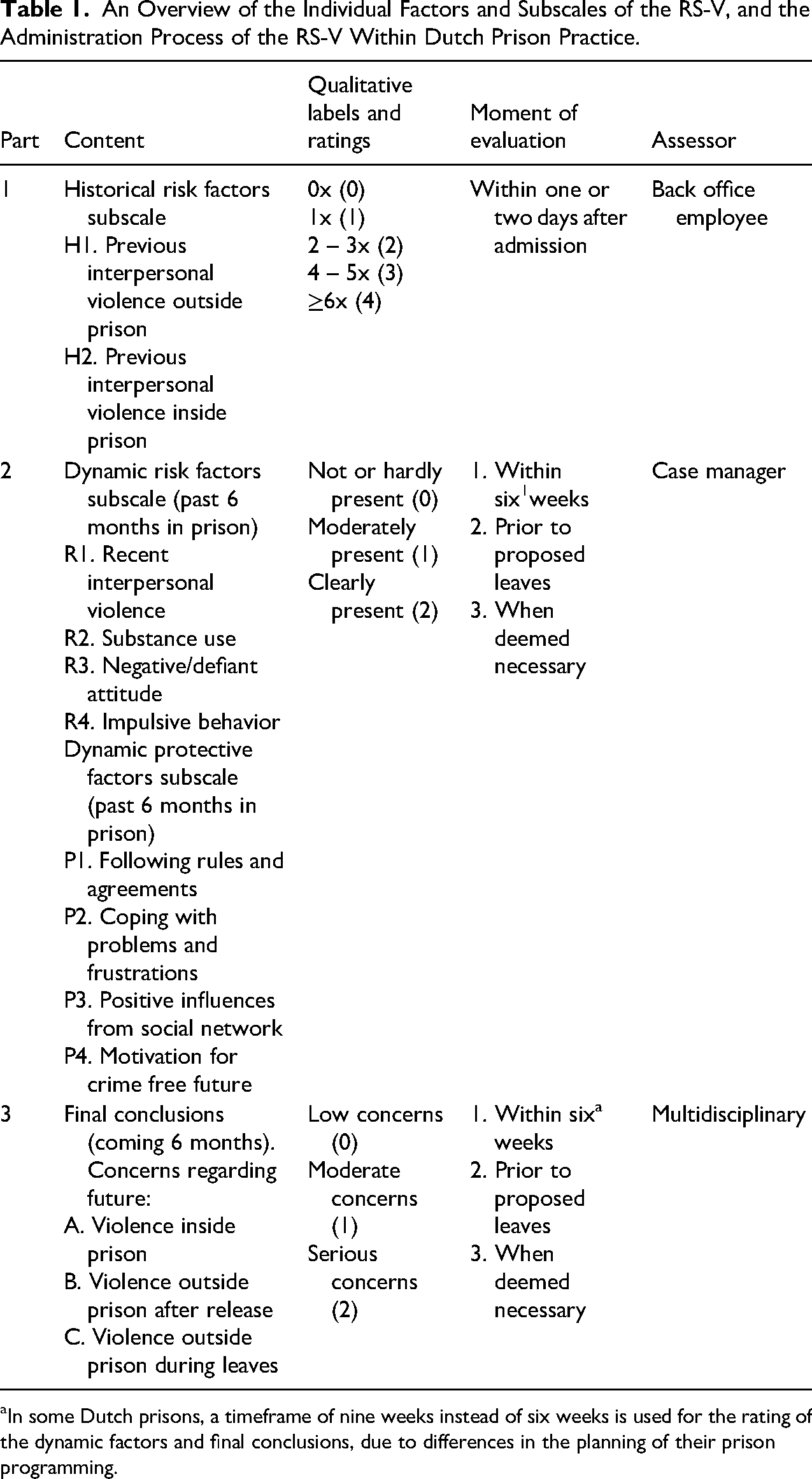
aIn some Dutch prisons, a timeframe of nine weeks instead of six weeks is used for the rating of the dynamic factors and final conclusions, due to differences in the planning of their prison programming.
The RS-V consists of three parts (see Table 1). In the Dutch prison context, these parts are completed by different prison staff at different time points during incarceration. Part 1 of the RS-V contains two historical risk factors that map both the frequency of previous violent convictions within the community and previous violent incidents during prison stay. These historical risk factors are rated on a five-point scale (0–4) based on official criminal records and disciplinary prison reports. Any relevant historical risk-related information may be added (e.g., relevant non-violent offenses or infractions, trauma, placement in foster homes, or homelessness). Each individual that enters a Dutch prison will receive ratings on the historical risk factors, since these factors are rated within one or two days after admission. This serves as an initial rough estimate of the violence risk profile, which is informative for the early stage of prison stay.
Part 2 consists of four dynamic risk factors and four dynamic protective factors, rated on a three-point scale: ‘not or hardly present’, ‘moderately present’, and ‘clearly present’. A higher score on a dynamic risk factor indicates a potential risk for violence, whereas a higher score on a dynamic protective factor indicates a potential protective effect against violence for that particular factor. The ratings of the dynamic factors are supported by sound argumentation. Furthermore, additional relevant dynamic risk-related information may be added (e.g., medication use, symptoms of psychiatric illness, or financial problems).
The third part of the RS-V is comprised of three final conclusions regarding an individual's future violent behavior during different situations. Namely, these conclusions contain concerns regarding future violent behavior: A) inside prison; B) outside prison after release, and C) outside prison during leaves. Final conclusion C is only rated in the case of proposed leaves. The current study focuses on final conclusion B (Concerns regarding violence after release). The final conclusions are discussed and rated in consensus by various prison staff (e.g., correctional officer, case manager, psychologist, and unit manager) during multidisciplinary team meetings. The final conclusions regarding future violent behavior may have the following results: ‘low concerns’, ‘moderate concerns’, or ‘serious concerns’.
Because the final part of the RS-V is discussed in a multidisciplinary fashion, it becomes possible for prison staff to directly implement follow-up measures. This applies especially to detained individuals with moderate or serious concerns for future violent behavior, as follow-up measures are necessary in order to prevent future violent behaviors. Examples of follow-up measures include: discussing the results of the RS-V with the detained individual during a trajectory meeting, conducting extensive risk assessment instruments (such as the HCR-20V3 and the SAPROF) to gain a more comprehensive image of the individual risk profile, offering behavioral interventions (e.g., aggression replacement training or treatment for addiction), and informing collaborating partners or after-care facilities such as probation officers or forensic outpatient services. Previous research by Smeekens et al. (2024a, 2024b, 2024c) may be consulted for a more comprehensive description of the RS-V.
Post-Release Violent (re)Offending
This study's primary outcome measure was violent recidivism, defined as post-release violent (re)offending within 6 or 12 months after release from prison. Specifically, this study included formal convictions (excluding dismissals and acquittals) for a violent offense committed after release within the community. A conviction was categorized as violent based on the penal code given to the conviction within the criminal record of the detainee. Examples of violent convictions were actual or attempted manslaughter, (aggravated) assault, sexual violent offenses, stalking, and arson with immediate danger for other persons. Convictions for verbal violent threats were also included. The RS-V initially makes predictions about violent behavior for the coming 6 months. However, this investigation additionally included a follow-up period of 12 months to explore whether the RS-V may also predict violent recidivism during a longer follow-up time. In addition, this study included general (re)offending (6 months and 12 months post-release) as a secondary outcome measure, which includes violent (re)offending as well as non-violent (re)offending. Data regarding criminal records were obtained from the judicial information service, part of the Dutch Ministry of Justice and Security.
The present study also aimed to investigate differences regarding the predictive validity of the RS-V for males versus females. However, due to the low base rate of violent offending among females in the current sample, it was not possible to investigate these subgroup differences (see Table 2).
(re)Offending Rates Among the Total Group of Included ex-Detainees, for Males, and for Females.
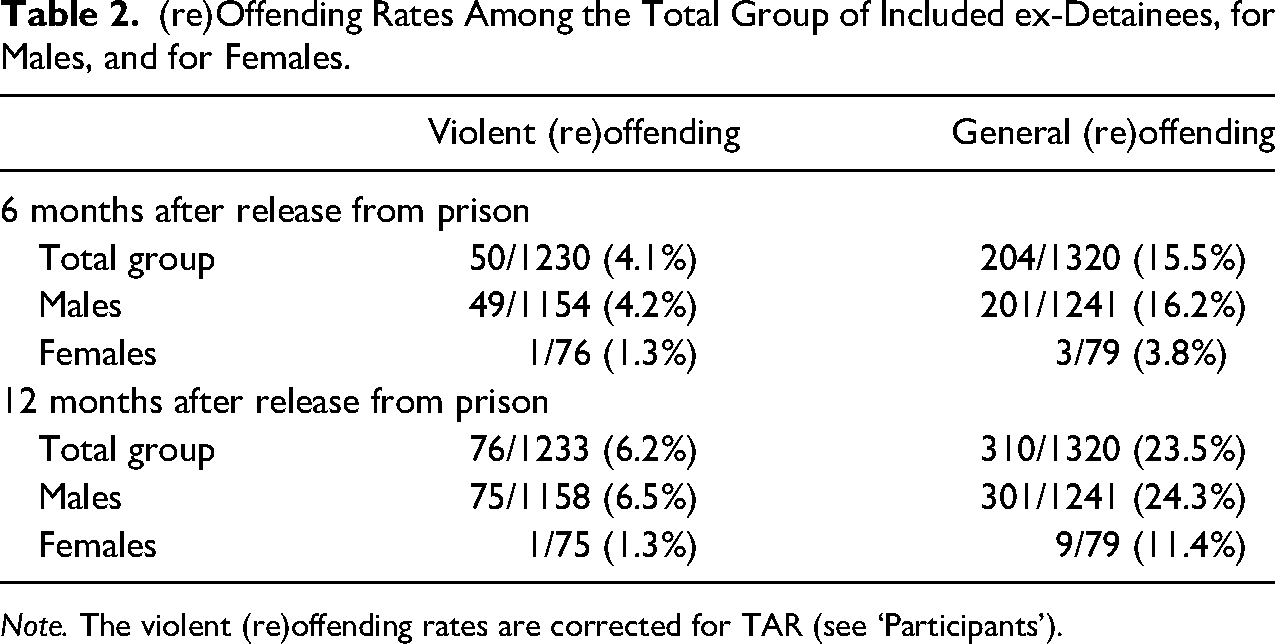
Note. The violent (re)offending rates are corrected for TAR (see ‘Participants’).
Procedure
This study protocol was approved by the Ethics Committee of the Institute of Pedagogical Science of the University of Leiden (Reference Number: ECPW-2021/33). The design is comparable to the study design of Smeekens et al. (2024b), although it includes RS-V's rated by prison staff rather than RS-V's rated by researchers. Data for the current research were retrieved between November 2023 and June 2024. The first step of data collection consisted of checking the inclusion criteria and acquiring the RS-V's and demographic information of eligible participants from their digital files. These RS-V's were rated by prison staff in real-life prison practice between April 2021 and February 2022, and were retrieved from the digital database of the Dutch Custodial Institutions Agency, called MetIS. MetIS is a centralized system that safely stores information about Dutch detainees from different information systems.
The second step of data collection consisted of mapping out community recidivism and adjusting for time-at-risk. The criminal records of the former detainees in the sample were retrieved from the judicial information service (part of the Dutch Ministry of Justice and Security). Researchers searched a participant's criminal record for offenses that occurred within 6 months or 12 months after the individual's prison release date. For each offense, researchers noted the date, the penal code, the public prosecutor's office reference number, the offense classification, the corresponding court decision, and, if applicable, when the penalization was executed. Subsequently, post-release violent (re)offending rates were coded as 0 (no/not present) or 1 (yes/present) for the 6-months follow-up period and for the 12-months follow-up period. TAR was corrected for non-violent incarcerations during follow-up (see ‘Participants’).
In some cases, it may take as long as one year for convictions to be formally entered in the official digital criminal record of an individual. Therefore, to ensure that all possible new offenses were registered and finalized in the criminal record, the criminal records were retrieved two years after an individual's release from prison.1
Data Analyses
IBM SPSS Version 28 and R Version 4.4.0. were used to analyze the collected data. First, data preparation involved adjusting for missing values in the RS-V dataset. Missing values of the individual RS-V factors were replaced by the mean value of the other factors within the corresponding subscale through the method of pro-rating. Pro-rating occurred the most frequent for dynamic protective factor P3 (Positive influences from social network) and dynamic protective factor P4 (Motivation for crime free future). These factors contained respectively 25.4% and 14.9% missing values, while the other individual RS-V factors had missing values between 0.1% and 5.3%.
Second, the subscale scores (see Table 1) and the total RS-V score were calculated. The numerical subscale scores and RS-V total score were calculated for research purposes only in order to gain insight into the predictive validity of the separate parts of the RS-V. Prison staff solely use the qualitative labels of the individual RS-V factors (not or hardly/moderately/clearly present) and the final conclusions (low/moderate/serious concerns), including their argumentation, to arrive at an overall judgement regarding the individual's violence risk. An individual's RS-V total score was calculated by adding up the historical risk factors subscale and the dynamic risk factors subscale, while subtracting the dynamic protective factors subscale. To be able to calculate the RS-V total score, the historical risk factors, which are rated on a five-point scale, were recoded to a three-point scale (i.e., ‘0x’ = 0, ‘1x’ and ‘2 – 3x’ = 1, ‘4 – 5x’ and ‘≥6x’ = 2). Thus, a more negative RS-V total score indicated a greater presence of protective factors compared to risk factors.
Subsequent analyses consisted of retrieving descriptive statistics regarding the RS-V's included in this study. To be more specific, the mean, the standard deviation, minimum and maximum values of the individual RS-V factors and final conclusion B (unadjusted for missing values), and the subscale scores and RS-V total score (adjusted for missing values) were consulted. In addition, cross tabs were performed to gain insight into the true positives, true negatives, false positives, and false negatives regarding the prediction of final conclusion B (Concerns regarding violence after release) versus the actual occurrence of violent convictions within 6 and 12 months after release from prison.
Further, Receiver Operating Curve (ROC) analyses were conducted to investigate the predictive validity of RS-V ratings for violent and general recidivism post-release. ROC analyses result in Area Under the Curve (AUC) values. These AUC values reflect the discriminant ability or predictive validity of an instrument regarding a certain outcome and may vary between 0 and 1. An AUC value of 1 represents a perfect prediction, whereas an AUC value of .50 means that the instrument performs at chance level. Regarding the current ROC analyses, an AUC value of .65 means that there is a 65% chance that a randomly selected recidivist will have a higher score on the RS-V than a randomly selected non-recidivist. A common classification of AUC values is: small (between .56 and .64), medium (between .64 and .71), or large (above .71) (Rice & Harris, 2005).
ROC analyses were conducted to test the predictive value of: 1) the historical risk factors subscale, 2) the dynamic risk factors subscale, 3) the dynamic protective factors subscale, 4) the RS-V total score, and 5) final conclusion B for four different outcome measures. The AUC values of the dynamic protective factors were reversed: a higher AUC value represents a protective effect against the chance of community violence. The two primary outcome measures were: 1) violent (re)offending within 6 months after release, and 2) violent (re)offending within 12 months after release. Additionally, two secondary outcome measures were included: 3) general (re)offending within 6 months after release, and 4) general (re)offending within 12 months after release.
By means of the DeLong test (DeLong et al., 1988), statistical differences between AUC values were tested. Specifically, we tested whether the AUC values of the predictors were statistically different between violent and general (re)offending (6-month violence versus general, and 12-month violence versus general), and between the follow-up periods of the outcome measures (6-month violence versus 12-month violence, and 6-month general versus 12-month general). In addition, the statistical differences between the predictive validities of the RS-V total score and of the final conclusion B rating were analyzed, as well as the statistical differences between the AUC values of the three subscales (historical risk factors, dynamic risk factors, and dynamic protective factors) for all outcome measures.
Results
Descriptive Statistics
Table 3 displays the mean, standard deviation, minimum value, and maximum value of the individual RS-V factors, the subscale scores, the RS-V total score, and final conclusion B. The mean negative RS-V total score indicates that, on average, the included incarcerated persons had relatively higher scores on the dynamic protective factors compared to the historical and dynamic risk factors. Regarding final conclusion B of the RS-V, 41.7% of the included individuals received low concerns, 27.6% received moderate concerns, and 30.7% of the ex-detainees received serious concerns regarding future violent behavior after release from prison.
The Mean, Standard Deviation, minimum Value, and maximum Value of the Individual RS-V Factors, the Subscales, the RS-V Total Score, and Final Conclusion B for the Total Group.
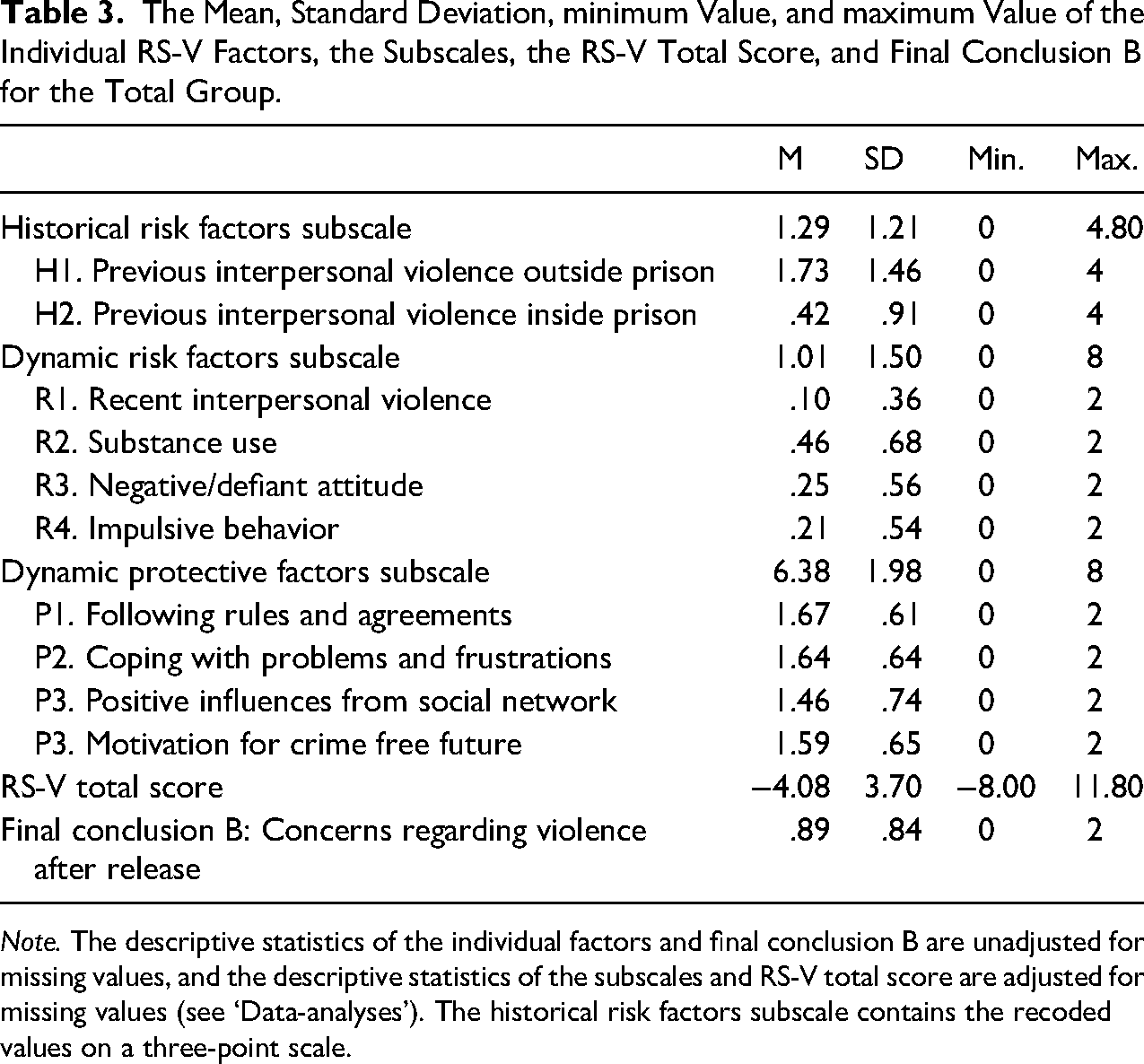
Note. The descriptive statistics of the individual factors and final conclusion B are unadjusted for missing values, and the descriptive statistics of the subscales and RS-V total score are adjusted for missing values (see ‘Data-analyses’). The historical risk factors subscale contains the recoded values on a three-point scale.
Predictive Validity of the RS-V for Post-Release Violent and General (re)Offending
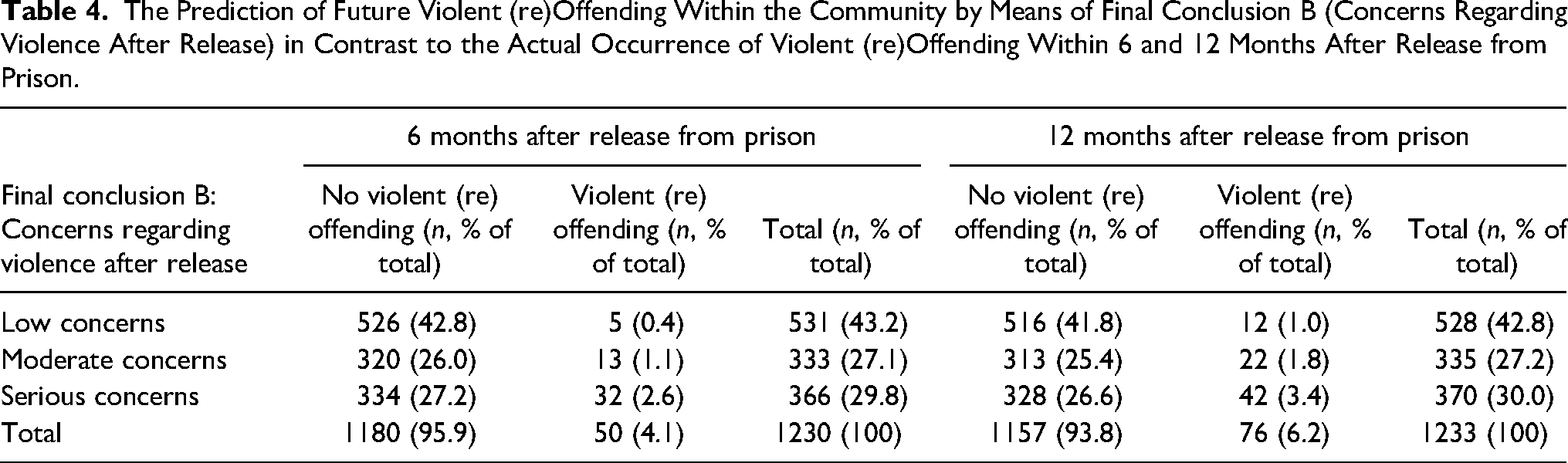
Table 4 displays the true positives, true negatives, false positives, and false negatives regarding the prediction of violent (re)offending within 6 and 12 months after release compared to final conclusion B (Concerns regarding violence after release). Within the group of ex-detainees with low concerns, 0.9% and 2.3% of them committed a violent offense in the community in respectively 6 months and 12 months following release. For the individuals with moderate concerns, this was 3.9% and 6.6% respectively, and for ex-detainees with serious concerns, this was 8.7% and 11.4% respectively. There are relatively more false positive predictions than false negative predictions regarding violent (re)offending within the community for both 6 and 12 months after release.
The Prediction of Future Violent (re)Offending Within the Community by Means of Final Conclusion B (Concerns Regarding Violence After Release) in Contrast to the Actual Occurrence of Violent (re)Offending Within 6 and 12 Months After Release from Prison.
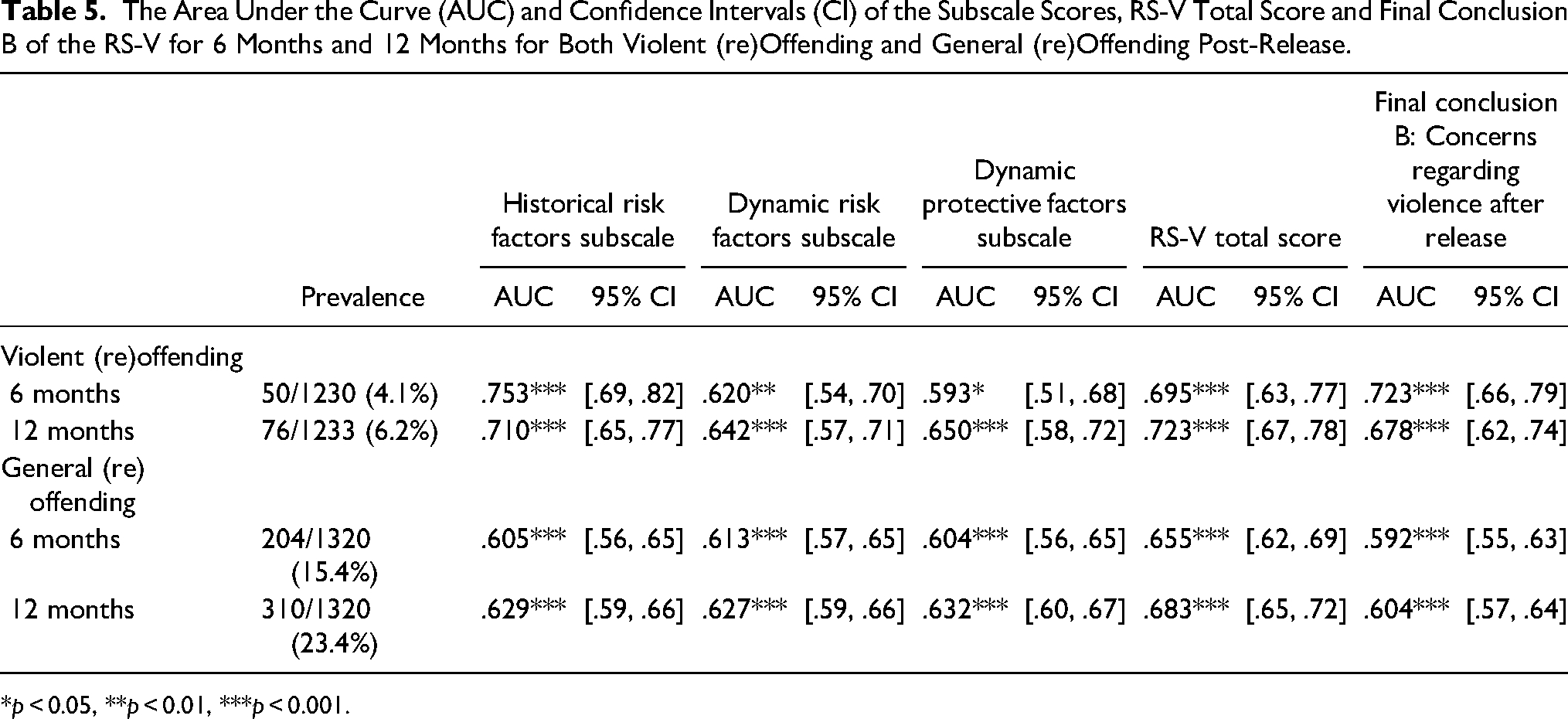
The AUC values of the subscale scores, the RS-V total score, and final conclusion B for violent and general (re)offending are displayed in Table 5. The analyses regarding the difference between AUC values of violent (re)offending and general (re)offending revealed a significant difference for final conclusion B (D = 3.88, p < .001; D = 2.35, p = .018) and the historical risk factors subscale (D = 4.09, p < .001; D = 2.52, p = .011) for both the 6-months follow-up period and the 12-months follow-up period respectively. Regarding violent (re)offending, there was a significant difference between the AUC value of the historical risk factors subscale and the dynamic risk factors subscale (Z = 2.97, p = .003, 95% CI [.05, .22]), and between the AUC value of the historical risk factors subscale and the dynamic protective factors subscale (Z = 3.60, p < .001, 95% CI [.07, .25]) for the follow-up period of 6 months after release. For the general (re)offending outcome measures, there was a significant difference between the AUC value of the RS-V total score and final conclusion B for the 6-months follow-up (Z = -3.41, p < .001, 95% CI [.03, .11]) and the 12-months follow-up (Z = -4.50, p < .001, 95% CI [.04, .11]) No other AUC values differed significantly from each other.
The Area Under the Curve (AUC) and Confidence Intervals (CI) of the Subscale Scores, RS-V Total Score and Final Conclusion B of the RS-V for 6 Months and 12 Months for Both Violent (re)Offending and General (re)Offending Post-Release.
*p < 0.05, **p < 0.01, ***p < 0.001.
Discussion
The current prospective study aimed to analyze the predictive validity of RS-V's rated by prison staff for violent recidivism 6 months and 12 months after release from prison. The results reveal that the predictive validity of the ratings on final conclusion B (Concerns regarding violence after release) are large for the follow-up period of 6 months post-release, and medium for the follow-up period of 12 months post-release. This study thereby replicates the findings of an earlier retrospective study that included RS-V's rated by researchers based on file information of detained individuals (Smeekens et al., 2024b). However, the results regarding gender differences could not be replicated in this investigation due to the considerably low base rate of violent (re)offending for the group of females (1.3% during both the 6-months and 12-months follow-up, see ‘Limitations’). The predictive values of the RS-V ratings regarding general (re)offending were small to medium. The ratings on the historical risk factors subscale and final conclusion B showed significantly higher predictive values for violent (re)offending compared to general (re)offending after release from prison, highlighting the relative specificity of RS-V scores to predict future violence.
To be more specific regarding the 6-months follow-up period, the ratings on final conclusion B and the (for research purposes calculated) historical risk factors subscale showed large predictive validity for post-release violent behavior, while the ratings on both the dynamic risk factors subscale and the dynamic protective factors subscale showed small predictive validity for future violence. One possible explanation for this difference in predictive values is that predicting behavior occurring outside the prison context based on behavior displayed within the prison context is complex, especially since behavior is (partially) context dependent and the current living environment can greatly influence one's behavior. The dynamic factors are rated based on behavior occurring in the recent past: behavior within the prison context. Nevertheless, final conclusion B (Concerns regarding violence after release) demonstrates large predictive validity. Although prison staff often lack sufficient insight into an individual's behavior outside the prison context, they appear capable of drawing sound conclusions regarding violence after release based on Part 1 and Part 2 of the RS-V. This finding is somewhat surprising, given the lower predictive validity of the ratings on the dynamic factors and the fact that for some detainees that are soon to be released it is not known what their living situation will be after discharge (for example because they do not have a permanent residence or because prison staff do not have sufficient insight into the home environment); this complicates the final conclusions. It could be that, during the multidisciplinary discussion where Part 1 and Part 2 of the RS-V are combined to arrive at final conclusion B, prison staff rely more heavily on previous behavior within the community (factor H1) than previous and recent behavior within the prison (factor H2, and dynamic factors R1 – R4 and P1 – P4) in order to draw conclusions regarding violent behavior outside the prison context. Post-hoc analyses indeed revealed that the scores on factor H1 (Previous interpersonal violence outside prison, AUC = .750) showed a higher predictive validity than the scores on factor H2 (Previous interpersonal violence inside prison, AUC = .650). This could clarify the relatively large predictive value of the ratings on final conclusion B for the 6-months follow-up period, although additional research into the multidisciplinary discussion is needed to confirm this explanation.
For the 12-months’ follow-up period, all predictors showed medium to large predictive validity for violent (re)offending after release, thereby diminishing the relatively large difference in predictive values between the ratings on the historical risk factors subscale and final conclusion B versus the ratings on the dynamic subscales that were observed for the 6-months follow-up. A possible explanation for this observed variation between the 6-months and the 12-months follow-up could relate to the difference in violent (re)offending base rates between the two follow-up periods. The 6-months follow-up period had a base rate of 4.1%, compared to 6.1% for the 12-months follow-up period. Even though the included samples are large (respectively n = 1230, and n = 1233), a higher base rate generally leads to more accurate and reliable predictions (Elwood, 1993).
Final conclusion B (Concerns regarding violence after release) is the primary predictor of the RS-V for community violence and is formulated through a multidisciplinary discussion within prison practice. This study found that final conclusion B showed higher predictive validity regarding violent offending compared to general offending after imprisonment. These findings indicate that professionals in prison practice are indeed able to consider violent recidivism specifically when they draw final conclusions regarding their concerns about offending after discharge. This result is in line with previous research regarding other risk evaluation tools such as the VRAG and the VRS that show similar results regarding their distinctiveness in predicting violence (Kröner et al., 2007; Wong & Parhar, 2011). Additionally, a meta-analytical systematic review revealed that, in general, the predictive validity of risk assessment instruments is greater for violent offending than general offending (Singh et al., 2011). The RS-V has been developed specifically for the prediction of future violence, and this study shows that RS-V scores and conclusions indeed have a specific ability to estimate concerns regarding future community violence. However, in general, one would expect the predictive values of RS-V scores to be lower if preventive measures were instated based on the results of the screening, and if these measures were effective in reducing community violence.
There are considerably more false positives than false negatives when it comes to the prediction of final conclusion B (Concerns regarding violence after release) versus the actual recidivism convictions for violent behavior. On the one hand, it could be that based on the RS-V, concerns regarding future violence after release are generally overestimated. On the other hand, it is plausible that an individual shows violent behavior within the community, but this is not reflected by the actual convictions in their official criminal record. Actual convictions are assumed to only represent a small portion of actual violent behavior (Minkler et al., 2022). For instance, domestic violence and sexual assaults are not always reported to the police, and charges do not always lead to convictions. In addition, even when someone is accused of a violent crime, they may not always be convicted due to lack of evidence. These so called ‘dark numbers’ of violent recidivism may therefore go unnoticed when only formal convictions are considered. A similar false positive versus false negatives ratio was found regarding the ratings on final conclusion A (Concerns regarding violence inside prison) in comparison to the actual occurrence of violent incidents within prison (Smeekens et al., 2024c). In general, a relative higher number of false positives in contrast to false negatives is preferred when it comes to violence risk assessment within forensic contexts (Kang & Wu, 2022), for the purpose of community safety. Although, from an ethical and community reintegration perspective, one should be aware that overestimating recidivism risk could lead to overly restrictive risk management strategies because being too restrictive may have negative consequences for the reintegration of an individual.
The overall ratings on the RS-V reveal that the included detained individuals had relatively higher scores on the dynamic protective factors compared to the historical and dynamic risk factors, meaning that they behaved reasonably well during their prison stay. Nevertheless, almost one-third of the sample received serious concerns on final conclusion B regarding future violent behavior after release from prison. This result highlights the likelihood of further offending once a detainee is released, even when behavior during prison stay appears positive, and the importance of instating follow-up measures based on the final conclusions of the screening. Especially for individuals who received moderate or serious concerns regarding violence after release, constructive risk communication and collaboration with other institutions (such as probation services or the municipality to which the individual will return) and aftercare facilities (such as treatment programs or supervised housing) is necessary. A recent Dutch study emphasizes that the re-integration of ex-detainees in the Netherlands is quite often unsuccessful and requires ongoing monitoring, especially for individuals with short sentences and individuals with complex problems (Doekhie et al., 2024). Therefore, the use of alternative sanctions to prison sentence and/or more effective re-integration programs are advisable, such as day reporting centers, halfway houses, or community treatment orders (Oselin et al., 2023; Van den Broek et al., 2024). It is possible that within these treatment and supervision contexts, the RS-V may be of added value as well to assist in preselecting individuals that require additional supervision and guidance.
Limitations
A first limitation of this study relates to the observed (re)offending rates. That is, the base rates of new convictions for violent (re)offending (6 months: 4%, 12 months: 6%) and general (re)offending (6 months: 16%, 12 months: 24%) were considerably lower compared to previous research. For instance, a retrospective prison study conducted in the Netherlands that used a similar study design reported base rates of 7% and 15% for respectively 6 months and 12 months violent (re)offending in the community, while base rates of 24% (6 months) and 38% (12 months) for general (re) offending were found (Smeekens et al., 2024b). These substantial differences in (re)offending rates can largely be explained by the data collection time period. The cited retrospective research included violent offenses that were committed during September 2014 and October 2018, whereas the current study included violent offenses that occurred between May 2021 and May 2023. As in many countries, the Dutch government imposed several lockdown measures in 2021 due to the COVID-19 pandemic including, for example, evening curfews, stay-at-home orders, travel bans, and the closure of schools and retail businesses. It is known that the COVID-19 pandemic and consequent restrictive measures decreased most types of crime rates globally (Hoeboer et al., 2024). Specifically, crime rates for robberies, property crimes, physical violence, and sexual violence clearly decreased. As well, some types of crime yielded mixed results (i.e., homicides, intimate partner violence, and cybercrime), while domestic violence increased. It is plausible that the COVID-19 pandemic also partially influenced this study's offending rates. In addition, the commission of violent crimes is generally less frequent among females than males, referred to as the gender gap (Heimer, 2000; Rennison, 2009). The pandemic likely further lowered the female violent crime rate in this investigation (1.3% for both 6 and 12 months), making it not feasible to separately analyze the predictive validity of the RS-V for females.
In line with the first limitation, a second study limitation is the operationalization of the outcome measure of violent recidivism. Besides mapping out formal convictions for violent (re)offending as an outcome measure, adding formal charges for re-arrests and pseudo-anonymous self-reported data of ex-detainees regarding committed crimes would likely have yielded a richer profile regarding violence after release. However, unfortunately these data could not be retrieved.
A third limitation involved the inclusion of individuals that were released from prison within 90 days after the rating of the RS-V final conclusions. The RS-V initially makes predictions about violent behavior for the coming 6 months. However, the average number of days between the rating of final conclusion B and the release date from prison was 40. Thus, even the 6-months’ follow-up period already exceeded the actual intended timeframe of the RS-V evaluation. Thus, the robustness of the predictive values of the RS-V for individuals who had a relatively long prison stay between screening and release could have been affected. Regardless of this limitation, RS-V ratings are still able to sufficiently predict community violence.
Conclusion and Future Research Directions
Accurately predicting and successfully preventing violent (re)offending after release from prison remains a challenging task. This study shows that based on RS-V ratings, prison staff without specific behavioral expertise are able to sufficiently classify which individuals are most likely to commit violent offenses after release from prison. The RS-V provides a valuable evaluation measure to gain more insight into concerns regarding future violence for individuals soon to be released from prison. The tool offers guidance regarding which individual risk factors and protective factors require more monitoring in the rehabilitation process. In addition, the tool may serve as a triage instrument to determine the need for the application of a more comprehensive violence risk assessment.
Once an individual is close to being released, communicating about an individual's risk factors and protective factors is an important step in providing appropriate and tailored care after imprisonment. Effective risk communication with after-care institutions such as probation officers and local governmental institutions is necessary to optimize successful, smooth, and non-violent re-integration into society. Therefore, it is important for future research to describe current operational processes regarding risk communication between forensic institutions, and to discover best practices and formulate recommendations to improve the quality of risk communication. Finally, in order to investigate the predictive validity of the RS-V specifically for female offenders, it would be beneficial to conduct a similar study during a pandemic-free period with likely a greater base-rate of reoffending for this subgroup of individuals.
Footnotes
Declaration of Conflicting Interests
The authors declared no potential conflicts of interest with respect to the research, authorship, and/or publication of this article.
Funding
The author(s) disclosed receipt of the following financial support for the research, authorship, and/or publication of this article: This research project was funded by the Dutch Custodial Institutions Agency, part of the Dutch Ministry of Justice and Security.