




Abstract
Paroling authorities should have a clear understanding of the empirical support for factors considered in suitability determinations. We presented a survey to paroling authorities across the United States and Canada to examine their purview and information considered in decision-making. We situated the findings among existing empirical research suggesting best practices for consideration of specific factors in parole decision-making. Paroling authorities claim to give equal consideration to all information available, regardless of its empirical relation to suitability for release. Probed further, they display a good understanding of the empirical support for and the weight to be applied to each factor.
Introduction
Paroling authorities differ in their makeup, scope of review, purview, and processes both by historical practice and policy requirements. Insight into parole decision-making practices is difficult to assess on a large scale due to variation across jurisdictions (Reitz & Rhine, 2020).
Some practices are transparent for public review, while others occur in closed session. Some practices follow an evidence-based model (e.g., SDMF; Serin, 2007), while others are not directed by an empirical approach.
Regardless of the policy requirements in place, decision-makers should have a clear understanding of the empirical support for the factors they consider in making suitability determinations. Research suggests that decision-makers rely upon some factors that do not empirically predict successful release outcome. In a survey by Ruhland et al. (2016), the top five items listed (prosecutor input, inmate family input, judge input, inmate testimony, inmate demeanor at hearing) have not been supported as reliable predictors of release suitability and outcome in empirical research. These findings underscore the necessity for differentiating between risk factors and release suitability factors (Serin et al., 2022). Further, research suggests that the weight assigned to factors considered varies by the type of offender. Results of an experimental study of parole board members in New Zealand and Canada by Gobeil and Serin (2009) suggest decision-making criteria shift depending upon the offender's characteristics and frequency of file review. Women were more likely to be released. Victim information was accessed less frequently for Aboriginal individuals. Release plan, risk assessment, and programming information were reviewed and considered more than other information such as mental health history, criminal history, and victim input. This suggests Board members may not be evenly weighing factors across individuals; weighting is left up to decision-makers’ discretion.
Factors Considered by Paroling Authorities
Policy and practice recognize a number of factors historically considered by paroling authorities. Below we examine the empirical literature surrounding the most cited factors in order to answer two important questions: (1) How have paroling authorities historically incorporated factors into their decision-making process? (2) What factors have empirically predicted suitability for release? Understanding this will lay the foundation for empirically-based recommendations for how paroling authorities should weigh the information available.
Risk Assessment
Risk assessment instruments are standard practice and highly scrutinized for use in release decision-making. Empirical research supports the use of validated risk assessments to guide release decision-making (Serin et al., 2016). Recommendations for practice similarly support using risk assessments wherein they are implemented with accuracy, fairness, and transparency (Desmarais et al., 2022; McCallum et al., 2017; McGarraugh, 2013; Rhine et al., 2015; Serin et al., 2022). Boards are advised to use these tools as an anchor to guide decisions (Guy et al., 2015; McVey et al., 2018; Rhine et al., 2015; Serin et al., 2016), wherein low risk is presumptive release and high-risk flags further scrutiny (Rhine et al., 2018; Serin et al., 2022).
Despite strong empirical support and policy recommendations, many jurisdictions in the United States do not require paroling authorities to consider risk assessment in their decision-making (Alper et al., 2015). Disconcertingly, where assessments are implemented, decision-makers do not always express confidence in their validity (Robina Institute, 2017) or their ability to improve practice (Ruhland et al., 2016). According to a small survey of paroling authorities in the United States, 26% of respondents (N = 38) reported having no formal requirements to incorporate risk assessments into revocation decisions (Robina Institute, 2017). Of those that do, only 21% provide the results to the individual assessed. Respondents in this study mostly considered risk assessment to be important in their decision-making, but 13% did not.
Criminal & Supervision History
Criminal history is a strong predictor of recidivism (Goodley et al., 2021) and release decision (see Caplan, 2007; Mooney & Daffern, 2014). Information specific to the index offense, such as victim information and the type or severity of offense will likely be accounted for by a risk assessment instrument and useful in sentencing. Paroling authorities can account for additional context regarding an individual's criminal history that may speak to release suitability such as whether the individual has established a pattern of criminal behavior that indicates escalation or lifetime criminality indicative of re-offense (Serin & Rieger, 2023).
An individual's history on community supervision is also an important indicator of their suitability for release as it establishes a pattern of behavior. Prior failure on community supervision predicts parole denial (Bowman & Ely, 2017; Lackenby, 2018). However, failure on supervision may be influenced by other factors such as parole conditions, which is a complicated area of consideration. More conditions are imposed on individuals with greater criminogenic needs (Ricciardelli et al., 2019). More conditions predict a higher likelihood of revocation, however (see Caplan, 2007). This is complicated because revocation is not considered by some researchers to be failure on parole (Ferguson, 2016; Ostermann et al., 2020), as the revocation would not occur had the individual been released without conditions or by other means. That is, revocations are not re-involvement in new crimes. Thus, the type of failure should be considered in release decisions more than the dichotomous presence or absence.
Institutional Misconduct
Institutional conduct is considered in release decisions in the United States and elsewhere (Kinnevy & Caplan, 2008; Robina Institute, 2017). This factor significantly predicts release decisions (see Bowman & Ely, 2017; Caplan, 2007; Lackenby, 2018; Mooney & Daffern, 2014; Young et al., 2016). While paroling authorities examine institutional misconduct in their release decision-making, the relationship between such behavior and success on release is unclear. A meta-analysis by Goodley et al. (2021) revealed mixed results regarding whether it predicts release success; variation may be due to differences in the way paroling authorities define misconduct overall and over time. A study by West-Smith et al. (2000) found only misbehavior, not good behavior was considered at the time in Colorado. Yet, inmates believed good behavior favored release. The nature and recency of institutional violations may affect their relevance to release suitability determinations (Serin & Rieger, 2023; Sorenson & Reidy, 2019). Some decision-making recommendations specify that, for violations to be considered aggravating, they must be recent (within 3–5 years for long-term sentences), serious, and relevant to the individual's previous pattern of criminal behavior (Serin & Rieger, 2023).
Substance Abuse
Individuals with a history of substance abuse are less likely to be granted parole than individuals without such history (Bowman & Ely, 2017; Lackenby, 2018). A lack of substance use history is a reliable predictor for success on release (DeLisi & Tahja, 2019; Katsiyannis et al., 2018). Note the type of substance and current state of remission is important. A meta-analysis by Goodley et al. (2021) reported a history of drug abuse as a reliable predictor of recidivism across 14 studies, but a history of alcohol abuse was not. Literature does not always account for clarification beyond a binary indicator of whether a previous history of any substance abuse is present. Paroling authorities should probe into an individual's substance use history to more accurately gauge whether it is relevant to a discernable pattern of criminal conduct.
Release Plan
Research links failure on parole with inadequate release plans (Dickson & Polaschek, 2014; Dickson et al., 2013). An adequate release plan that accounts for housing and employment may affect parole decisions (Lackenby, 2018; Young et al., 2016) and reentry team recommendations for release (Bowman & Ely, 2017). Paroling authorities are thus recommended to account for the feasibility and sufficiency of a release plan to adequately support reentry. Holistic reentry support includes basic stability factors, prosocial support, and risk management specific to the individual's needs. Basic stability factors include housing and stable employment (Clark, 2016; Goodley et al., 2021; Ullrich & Coid, 2011). Prosocial support can come from family, friends, and the community (Bahr et al., 2010) and can be evidenced by regular visitation while incarcerated (Baker et al., 2022). An individual's personal needs and risk factors should also be addressed; these could include programming and risk management plans in the community. Basic stability and prosocial support may mitigate the influence of risk factors such as a high-crime neighborhood (Clark, 2016; Martin et al., 2016).
Program Participation & Change
Many correctional institutions offer rehabilitative programming to eligible incarcerated individuals. Such interventions are designed to provide education, build skills, and address criminogenic needs of incarcerated individuals in line with the Risk Needs Responsivity (RNR) model of case management (Bonta & Andrews, 2017) and has demonstrated efficacy (Smith et al., 2009). Individuals who do not participate in rehabilitative interventions, where available, are less likely to be granted release than those who did participate (Bowman & Ely, 2017). This is appropriate, as program participation is a tangible way for paroling authorities to gauge an individual's willingness to actively participate in efforts to reduce their risk. Hanson et al. (2017a, 2017b) align program dosage with an individual's risk level.
A goal of the RNR model is that appropriate programming will result in prosocial change. While some literature is mixed on the relationship between change and recidivism (Serin et al., 2013; Wardrop et al., 2019), this may be due to differences in measurement. Where change can be reliably measured to account for improvement in dynamic needs and strengths over time, this factor does predict suitability (Bonta & Andrews, 2017).
Mental Illness
Mental health is considered by parole board members such that it predicts parole denial (Caplan, 2007). This effect is particularly affected by gender, where women with mental disorder are significantly less likely to be granted parole than men (Hannah-Moffat, 2004). Psychological evaluations, considered related but separate from risk assessments, are important considerations for release (Ruhland et al., 2016) and significantly impact odds of release in California lifer inmates (Young et al., 2016). A small study by Shingler and Needs (2018; N = 10) indicated the individual being assessed assumed the paroling authority put greater weight on the psychological evaluation than other factors in their release. Interestingly, while individuals with diagnosed mental disorder are more likely to experience justice involvement, research suggests may be due to other criminogenic risk factors present, rather than symptoms of the illness itself (Bonta et al., 2014; Skeem et al., 2014). The presence of mental illness should be considered a relevant factor in release decision-making if it is risk-relevant—meaning the current symptoms influenced the individual's past criminal behavior and those symptoms have not been managed.
Time Served & Crime Severity
Just deserts may be a factor considered by parole board members in their release decisions (Caplan, 2007; Cumberland & Zamble, 1992; Robinson, 2008; Vilcica, 2018). Just desserts is a retributive concept wherein judgments of release and rehabilitation are considered only after the individual has been sufficiently punished (Robinson, 2008). In parole decision-making, these could include time served, the harshness of the sentence, and the seriousness of the initial offense. Time served is considered wherein the likelihood of parole increases with the proportion of time served (Proctor, 1999). Index offense severity and previous parole denial affect release decisions (Vilcica, 2018). Other research conflicts with this finding, suggesting crime severity did not significantly influence decisions (see Caplan, 2007, Ruhland et al., 2016; Young et al., 2016). Nonetheless, the severity of the crime as well as the harshness of the sentence predicts public perceptions of whether an individual should be eligible for release (Gebotys & Roberts, 1987; Lackenby, 2018). This is supported by earlier research wherein harsh minimum sentences predicted release on first parole hearing (Carroll et al., 1982) but lenient sentences predicted parole denial (Turpin-Petrosino, 1999). Time served has shown some positive association with success in the community in federal and state criminal recidivism data reporting (e.g., Alper et al., 2015), but has not displayed a definitive link in meta-analysis (Goodley et al., 2021). This factor's influence on recidivism may be moderated by other factors, such as age. Therefore, time served, by itself, is not a reliable predictor for release success.
Attitude and Remorse
Anti-social attitude has been linked to parole decisions (Lackenby, 2018) wherein pro-criminal attitudes predict denial of parole (Guy et al., 2015). An incarcerated individual's demeanor during the parole hearing interview is given great weight in decision-making (Ruhland et al., 2016). However, empirical literature suggests paroling authorities cannot reliably gauge remorse through their interview (Bronnimann, 2020; Young & Chimowitz, 2022).
Experts recommend relying upon empirically supported factors that can reliably measure change in criminal thinking, as this has displayed an empirical relationship with release suitability (Kroner & Yessine, 2013; Serin et al., 2013). Criminal thinking can be more accurately gauged by examining patterns of behavior that align with the individual's previous pattern of criminality (Gordon & Wong, 2011). This requires information from third party sources indicating the individual has made active efforts to shift to a more prosocial orientation.
Victim Input
The presence of victim input significantly increases parole denial and in-person victim attendance even more so (Morgan & Smith, 2008; Proctor, 1999; Smith et al., 1997). A survey by the Robina Institute (Ruhland et al., 2016) suggests input by victims, prosecutor, and sentencing judge are the most important factors in release decisions. Empirically, this factor has failed to demonstrate empirical association with success on release, with the exception of intimate partner violence offending (Ménard et al., 2009). Of note, victim concerns are addressed at sentencing (Roberts, 2009) and may unduly give victims an expectation they can veto release. Consideration of this factor, despite its lack of association with suitability may be driven by policy considerations and statutory requirements. Paroling authorities are encouraged to account for victim input that speaks to an individual's current risk, such as with intimate partner offending risk, that informs suitability for release and appropriate release considerations.
The Current Study
Currently, much of the relevant literature examining parole decision-making is sparse and not peer reviewed (see research from the Robina Institute). In this study, we sought to update existing literature on parole decision-making. We offered a survey to paroling authorities to assess what factors they consider, the importance of each factor, and how the influence of those factors change depending upon the individual's risk level. We went into specific detail regarding the role that risk assessment played in their decision-making process (see a copy of this survey in the Appendix).
Method
Procedure
In October 2021, a survey was distributed by the Association of Paroling Authorities International (APAI) to its members. Ethics approval for this survey was granted by the Carleton University Research Ethics Board (No. 115957). Members of paroling authorities were invited via email to participate in the short survey via survey platform Qualtrics. The 62-item survey asked parole board members for information regarding the functioning of the Board and the information the Board relies upon in decision-making. Responses were collected anonymously.
Analytical Plan
Due to small samples, most of the results will be reported as descriptive. McNemar's Change Test will be used to examine significant differences in proportions of responses between dependent dichotomous variables. McNemar's test is a nonparametric test appropriate for use in comparing proportions of responses in related samples.
Sample
In total, 62 members participated in the survey. Respondents were asked to report the location of their paroling authority (Board), and were mostly from the United States (n = 50, 80.6%) or Canada (n = 9, 14.5%), with one from Australia and two others who did not specify. Participants were distributed geographically across the United States, but most were from the Midwestern (n = 12, 19.4%) and Northeastern (n = 21, 33.9%) regions. Canadian participants were exclusively from the provinces of Ontario (n = 5, 8.1%) and Quebec (n = 4, 6.5%).
Demographically, respondents were split across gender with about half female (n = 28, 45.2%), half male (n = 26, 41.9%). Participants were experienced in serving on Boards, with an average of 6.3 years (SD = 5.4, min = 0, max = 25). About half of respondents have background experience in corrections or law enforcement (n = 30, 38.4%). Respondents also have backgrounds in law (n = 25, 40.3%), social services (n = 13, 21.0%), policy (n = 11, 17.7%), non-profit or non-governmental organization (n = 8, 12.9%), psychology (n = 2, 3.2%), or other (n = 6, 9.7%).
Results
Board Purview
Boards have different mandates for practice. The first portion of the survey examined what kinds of release decisions participant Boards make. Boards differ somewhat in the types of individuals they make release decisions for, but a majority make decisions for all types of sentences and cases (n = 44, 72.1%). Most Board members surveyed make decisions for parole violators (n = 58, 95.1%), high risk or serious cases (n = 37, 60.7%), or indeterminate and long-term sentences (n = 36, 59.0%) with less making decisions about clemency and/or pardons (n = 28, 45.9%). Most Boards make decisions for the timing of release (n = 48, 78.7%). For a minority of Board members, release decision is made by statute, while the Board assigns release conditions (n = 24, 39.3%). Some Board members also reported making decisions for early release from parole (n = 2), medical release (n = 1), and transfer (n = 1). However, this question was not followed up, so it is unclear if other members also make similar decisions.
Role of Risk Assessment
Several questions were posed to assess what information Boards use to make decisions. First, participants were asked to identify the types of risk assessment instruments used in their decision-making. A majority of Board members utilize risk assessment instruments related to case management (n = 46, 75.4%) that include dynamic factors. Fewer Boards utilized risk scales that include only static factors (n = 24, 39.3%). Some also included instruments specific to subtypes of offending: sex offense (n = 50, 82.0%), violent offense (n = 23, 37.7%), female offending (n = 15, 24.6%), and intimate partner violence (n = 6, 9.8%). Interestingly, four Board members reported not using risk assessment at all in their decision-making (6.6%).
We also examined whether Boards reviewed risk instruments specific to an offense type. Most were likely to examine sex offense-specific risk assessment instruments (n = 51, 82.0%). Less were likely to examine instruments specific to other offending subtypes, such as violence (n = 23, 37.7%), gender (n = 15, 24.6%), or domestic violence (n = 6, 9.8%). Board members who use risk instruments report confidence in the tools provided for their review, with most responding with moderate to complete confidence (n = 54, 93.1%), and a small minority responding with slight confidence (n = 4, 6.6%).
For the Boards that use risk instruments in their decision-making, we examined the criteria used to determine who is assessed for risk. This decision can be made by the corrections agency (n = 38, 61.3%) and paroling authority (n = 32, 51.6%). It may be determined by the individual's risk level (n = 14, 22.6%) or type of offense (n = 25, 40.3%). Risk assessments are completed by corrections staff (n = 46, 74.2%), paroling authority staff (n = 30, 48.4%), or an independent assessor, such as a contracted psychologist (n = 19, 30.6%).
Factors Considered
Participants indicated how an individual's risk assessment could impact their release decision. Most respondents reported an individual rated low risk would be unlikely to be denied release, while an individual rated high risk is likely to be denied release. On a scale of likelihood to be denied release: −2 = Extremely unlikely to 2 = Extremely likely, low risk exhibited a mean of −0.51 (SD = 1.01), between neutral and somewhat unlikely to be denied release, and high risk exhibited a mean of 1.00 (SD = 0.79), or somewhat likely to be denied release.
Respondents reported how individual factors inform release suitability determinations about individuals. Average responses indicate each of these items are at least moderately important in suitability determinations (see Table 1). Participants reported weighting factor importance differently by risk level. McNemar's Tests compared the influence of problematic factors in denial decisions based on whether the individual was rated as low or high risk. We found Board members placed greater weight on most factors being rated problematic in denying release for individuals rated as high risk versus low risk. The exception was Type of index offense, Presence or absence of remorse, or Victim information, which were weighted similarly regardless of risk level. The factors rated to be important in determining release in Table 1 hold for the high-risk group. For low-risk individuals, only institutional behavior and, to a lesser extent release plan, was overwhelmingly rated a consideration for denial of release.
Influence of Factors in Release Decision-Making.
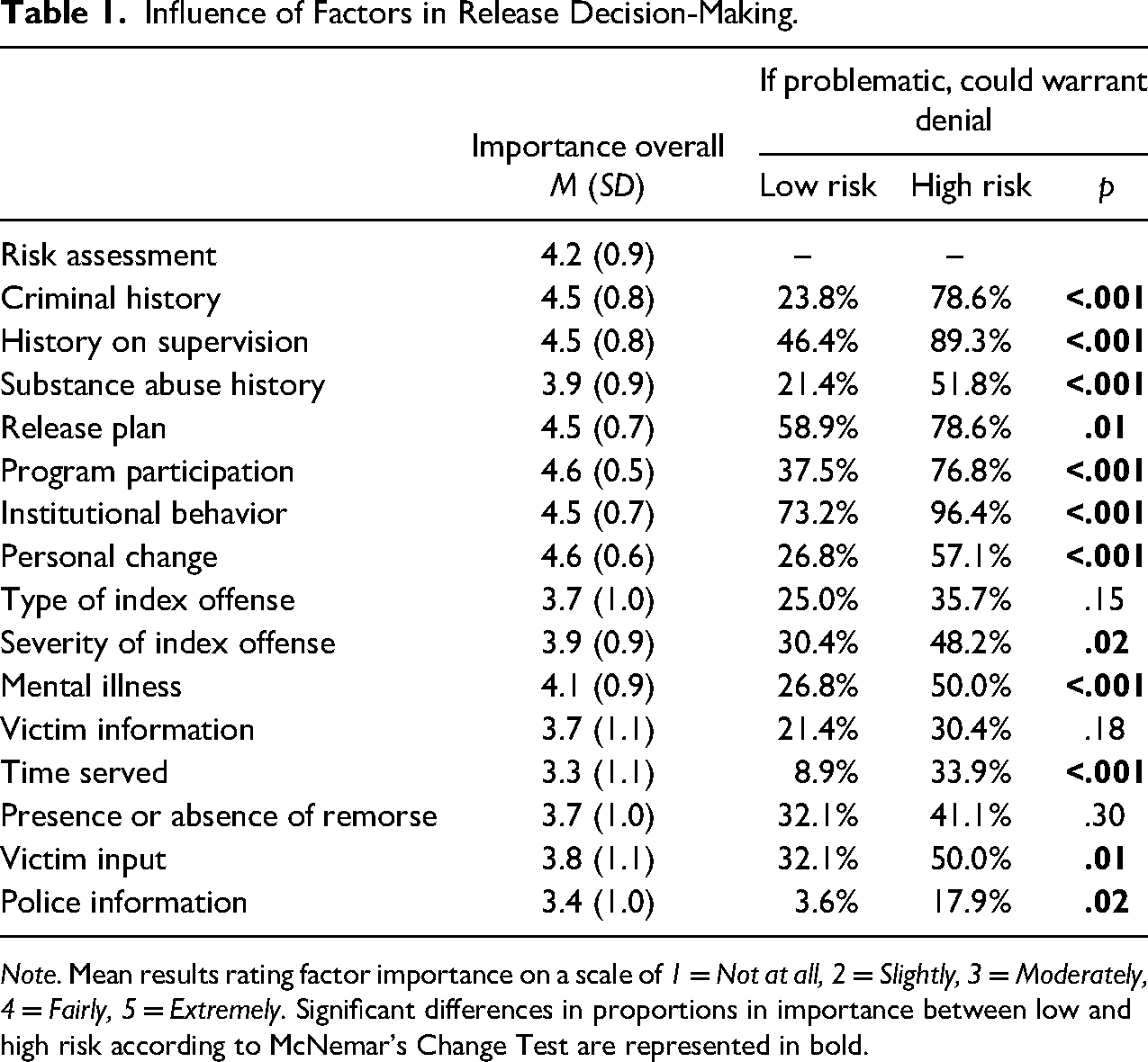
Note. Mean results rating factor importance on a scale of 1 = Not at all, 2 = Slightly, 3 = Moderately, 4 = Fairly, 5 = Extremely. Significant differences in proportions in importance between low and high risk according to McNemar's Change Test are represented in bold.
We then assessed Board member understanding of the empirical support for these factors. Participants were asked which factors have been demonstrated by empirical evidence to be related to both release suitability and recidivism. In Table 2, we compare Board member understanding with empirical support (as summarized in Serin et al., 2022). Participants appear to have an accurate understanding of the factors with the most empirical support. Some factors have mixed empirical support that may depend on other factors. For these, Board members express less consensus on these relating to suitability decisions. Notably, three factors (Remorse, Victim input, and Police information) do not have empirical support in the literature, yet 13–32% of Board members believe they are reliable in making release decisions.
Empirical Support for Factors Informing Outcomes, From Board Member Understanding.
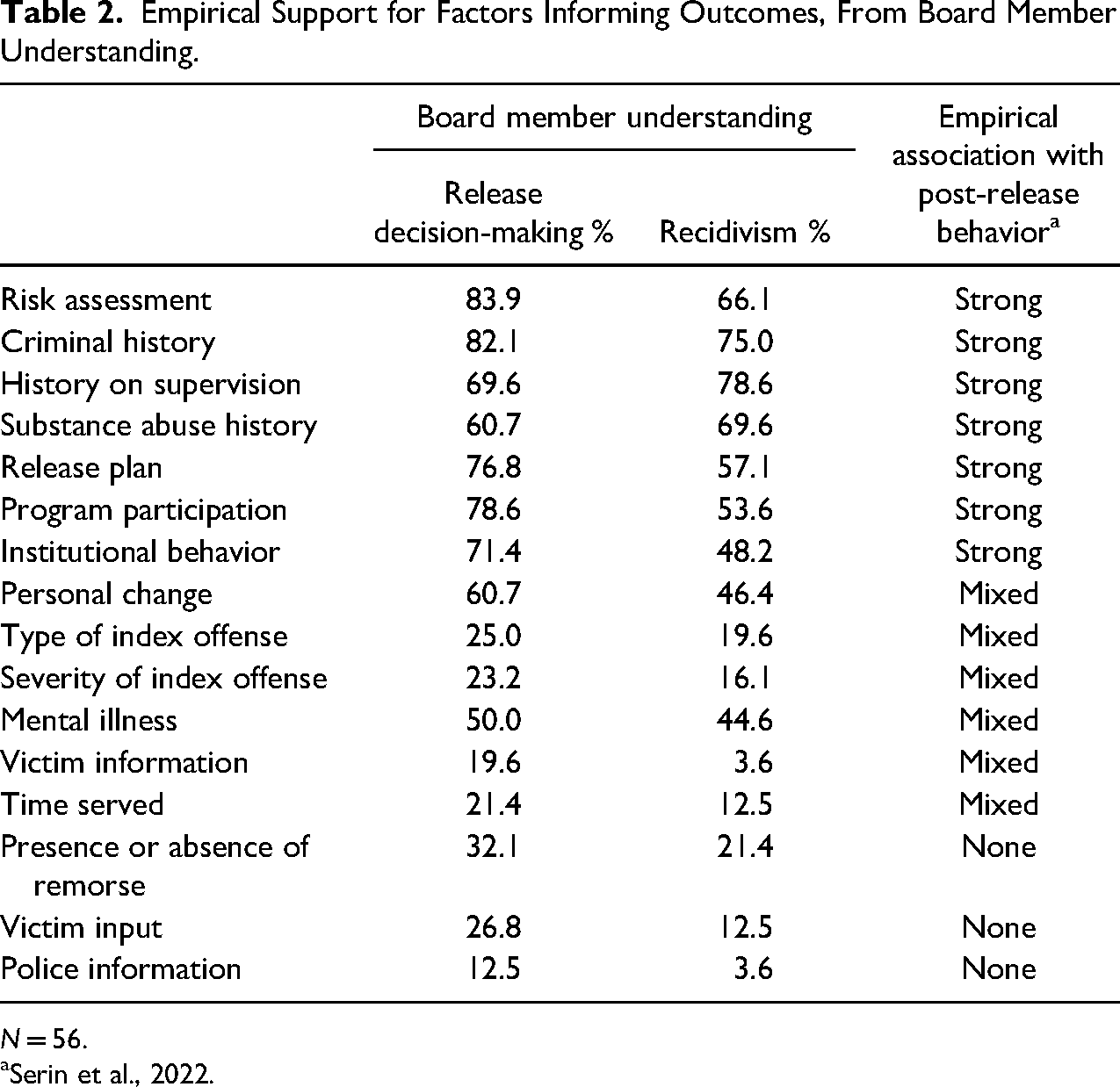
N = 56.
Serin et al., 2022.
Discussion
The purpose of this survey was to examine Board purview and practice as it relates to what factors Board members report relying upon in their release decision-making, particularly risk assessment instruments. We found that almost three quarters of Board members surveyed make decisions for all types of individuals, including individuals with determinate sentences, indeterminate sentences, sex offenses, higher risk, and long-term sentences. Variation in who is eligible for consideration before a Board is outlined by statute in that jurisdiction.
Most Boards surveyed make decisions regarding parole violators and timing of release (95% and 79%, respectively). Alternately, less than half make decisions regarding clemency (46%). Even less make decisions regarding release conditions for those released by statute (39%). Again, Board authority is likely outlined by local policy and statute.
Factors Board Members Rely Upon in Release Decision-Making
A strong majority of Board members surveyed (97%) reported that each of the factors listed are at least somewhat important in their release decision-making. The factors endorsed as the most important in release decision-making were, in descending order of importance: Personal change, Program participation, Criminal history, History on supervision, Institutional behavior, Release plan, and Risk assessment (Table 1). Reliance on these factors is appropriate, as they have strong empirical support (see Table 2). We outline how Board members report using each factor in line with recommendations based on empirical literature.
Factors Recommended for Consideration
Risk assessment
Risk assessment instruments are reliable, empirically supported tools to anchor decision-making for justice-involved individuals (Serin et al., 2022). Three quarters of Board members surveyed incorporated some type of risk assessment instrument in their release decision-making. These instruments adhere to best practice recommendations to emphasize dynamic factors and deemphasize static factors, and to address case management principles. Also, in accordance with best practice recommendations, some Boards review risk assessment instruments designed for special populations, where appropriate. The most common of these were sex offender-specific instruments.
Boards should use risk classifications to anchor decision-making, with greater scrutiny into other empirically supported factors as risk level increases. We found that Board members adhered to this recommendation, placing significantly greater weight on empirically supported factors when an individual was rated high risk than low risk. Board members displayed more variation in their weighting of factors that were not empirically supported. For these, Board members placed significantly greater weight on Police information and Time served, but no significant differences were noted for Type of index offense, Remorse, or Victim information.
Criminal & supervision history
Criminal and supervision histories are static factors that reliably predict suitability for release (Goodley et al., 2021). How the type and severity of index offense influences risk is complex and is likely accounted for with risk assessment. Respondents correctly flagged these factors as important predictors of release decision and suitability and appropriately placed significantly greater weight on their influence for high risk individuals. Note criminal history is more likely to be aggravating as risk level increases, but supervision history may provide a more dynamic indication of suitability across risk levels.
Institutional misconduct
An individual's institutional adjustment can vary over the course of their incarceration, especially for long sentences. Recent institutional misconduct that indicates a continued pattern of criminal behavior should be considered in release determinations (Serin & Rieger, 2023; Sorenson & Reidy, 2019). Respondents rely on this factor in their decision-making and place significantly greater weight at higher risk levels. It is unclear whether Boards account for the mere presence or the relevant nature of that misconduct. Boards should account for both the recency and relevance of misconduct to reliably gauge release suitability.
Substance abuse
Lack of substance abuse history is a reliable predictor of success on release (DeLisi & Tahja, 2019) and this factor reliably predicts release decision (Bowman & Ely, 2017; Lackenby, 2018). Recent meta-analysis suggests the relationship may be more nuanced (Goodley et al., 2021). Boards should consider whether it was a factor in previous criminal conduct and the individual's current state of remission. Appropriately, respondents cited substance abuse as an important factor in release decisions, especially at higher risk levels, but did not give it great weight over other factors.
Release plan
Adequate and realistic release plans that address stability and prosocial support predict success on reentry (Dickson et al., 2013). Respondents in this study correctly place great importance on this factor for individuals at all risk levels and significantly greater importance for individuals rated high risk. Boards should ensure release plans are feasible and appropriate to counter an individual's risk factors (Clark, 2016; Martin et al., 2016).
Program participation
Receiving programming from an RNR model wherein it is responsive to needs and given at appropriate dosage for risk level has been the industry gold standard and reliably predicts improved outcomes (Bonta & Andrews, 2017). Respondents not only identified this as an important factor in decision-making, they also appropriately anchor their decisions with greater weight for individuals at higher risk levels. Boards should account for whether appropriate programming was completed by an individual, where available.
Personal change
Evidence of prosocial change in attitudes and behavior improve an individual's outlook in the community (Kroner & Yessine, 2013). Respondents correctly rely on this factor in their decision-making, especially regarding individuals rated as high risk, but it is unclear how they evaluate change. This factor can be difficult to reliably measure. Decision-makers should rely on third-party or formal measure of change, which is more reliable than self-report or interview impressions (Serin et al., 2013; McLaren et al., submitted).
Factors not Recommended for Strong Consideration
Time served
Historically, the amount of time served in a sentence has been considered in release decision-making (see Caplan, 2007). Empirically, however, there is no consistent evidence that this factor predicts success on release, as it may be moderated by other factors such as age. In this study, most respondents did not give great weight to this factor in comparison to other factors, though they did apply the principle of anchoring by giving it significantly greater weight for high risk individuals. Boards should not rely on time served to indicate release suitability.
Remorse
Research suggests that paroling authorities cannot accurately interpret genuine remorse in interview (Bronnimann, 2020; Young & Chimiwitz, 2022), which is consistent with a greater body of literature indicating humans are unreliable lie detectors (see Vrij, 2008). While most respondents correctly identified the lack of empirical support for this factor, a large percentage still cited this factor as largely important in making release determinations for individuals at all risk levels. We recommend gauging remorse through more reliable methods that measure change in criminal thinking and patterns of behavior. Sense of entitlement and minimization of harm are likely reasonable proxies for an absence of remorse and relevant for release decision-making.
Mental illness
The mere presence of mental illness is a less reliable predictor of justice involvement than other factors (Bonta et al., 2014). Therefore, when a currently diagnosed mental disorder is present, Boards should rely on psychological evaluation to determine whether this has and could impact success on release for an individual. In this study, respondents placed more importance than may be warranted on this factor, especially at higher risk levels.
Victim input
Historically, victim input has predicted release decision (e.g., Morgan & Smith, 2008) to the extent that paroling authorities in one study rated this as one of the most important factors to consider (Ruhland et al., 2016). It is important to note that victim input has only demonstrated an association with outcome on release when they can provide information regarding current dangerousness, not historic, as seen in intimate partner violence (Ménard et al., 2009). Respondents herein did recognize the lack of empirical support for this factor, but still list it as important in decision-making, especially for individuals rated higher risk. Boards should consider whether victim impact speaks to potential current risk; unfortunately, this nuance was not captured in this survey.
Information specific to the index offense
Information specific to the index offense that led to incarceration, such as victim information, police information, and offense type or severity, is valuable in sentencing but less so for suitability for release where they don’t speak to current risk. Board members recognized the lack of empirical support for these factors compared to others, but should keep in mind the limitations to this information in decision-making. Information that may be relevant, such as victim information that speaks to a pattern of criminality, should be accounted for by formal risk assessment. Where appropriate, Boards should incorporate special assessment for risk of sexual or intimate partner reoffense, for example, but not reexamine the index offense specifically.
Conclusions, Limitations, & Future Directions
Importantly, Board members that use risk assessment instruments appear to correctly use them to anchor their decision-making. For individuals rated as high (static) risk, Board members put greater emphasis on the impact of dynamic factors in returning a decision to deny release.
Overall, a majority of Board members have an accurate understanding of the empirical relationship between factors considered and release suitability, but concerns exist about the correct weight applied in decision-making. Specifically, Board members reported putting more emphasis on victim input, index offense severity, and remorse, despite less awareness those factors were not empirically related to release suitability or recidivism. This may be an artifact of the way the questions from this survey were posed, or policy-related factors that require consideration of some factors with less empirical support.
The sample for this study was small; therefore, mostly descriptive results were reported. A larger sample would permit empirical comparisons, strengthening conclusions and implications for training and policy. Additionally, regional comparisons between and within countries would be a valuable addition for future research. Unfortunately, small samples are not unexpected with this type of research. Even within this small sample, we see wide variation in responses. Follow-up examination of what factors influence responses would be valuable in informing what guides Board practice. Differences in mandates between jurisdictions undoubtedly drive how Boards are required to practice. Nevertheless, this research provides a glimpse into decision-making practices across jurisdictions. The comparison of actual to empirically supported practice is an important addition to the literature on how Boards can move forward.
Supplemental Material
sj-docx-1-tpj-10.1177_00328855231212447 - Supplemental material for Parole Decision-Making and Empirical Practice: A Survey of Paroling Authorities
Supplemental material, sj-docx-1-tpj-10.1177_00328855231212447 for Parole Decision-Making and Empirical Practice: A Survey of Paroling Authorities by Danielle J. Rieger and Ralph C. Serin in The Prison Journal
Footnotes
Declaration of Conflicting Interests
The authors declared no potential conflicts of interest with respect to the research, authorship, and/or publication of this article.
Funding
The authors received no financial support for the research, authorship, and/or publication of this article.
Supplemental material
Supplemental material for this article is available online.
Author Biographies
References
Supplementary Material
Please find the following supplemental material available below.
For Open Access articles published under a Creative Commons License, all supplemental material carries the same license as the article it is associated with.
For non-Open Access articles published, all supplemental material carries a non-exclusive license, and permission requests for re-use of supplemental material or any part of supplemental material shall be sent directly to the copyright owner as specified in the copyright notice associated with the article.
