




Abstract
The landslide victory of the center-left Moon Jae-In in the 2017 presidential election opened a window of opportunity for progressive reform in South Korea. Elected on a platform of social inclusion and fairness and with support from organized labor, the Moon Jae-In government (2017–22) made at first considerable progress in advancing inclusive labor market reform and an alternative growth model against opposition from business, but the administration quickly lost momentum when facing political headwinds. We show that the government's capacity for progressive reform and social concertation was constrained not only by business interests but also by divisions on the left. Opening up the black box of organized labor, we provide a nuanced analysis of tensions on the left and demonstrate how a counterintuitive coalition of labor market insiders and radical outsiders on the movement's left undermined social dialogue and more inclusive unionism.
Labor market dualization and inequality have become pressing social and political issues in many countries. This applies in particular to those that are, at least historically, considered coordinated market economies (CMEs) such as Germany, Japan, and South Korea, where the expansion of low-wage employment is widely regarded as a critical feature of their export-oriented and manufacturing-heavy growth strategies. 1 Power resources theory considers left parties and organized labor as the core political forces for solidaristic policies tackling social inequalities, 2 whereas the insider-outsider approach calls into question their progressive potential in the age of dualization, as they are thought to prioritize the interests of insiders at the expense of those at the margins of the labor market. 3 In this article, we assess the government's reform capacity to challenge deeply entrenched labor market dualism and establish an inclusive growth model as an alternative to the divisive export-oriented growth strategy. For this purpose, we adopt a coalitional perspective to institutional reform with a focus on agency, combining insights from the comparative political economy literature on labor market reform with the industrial relations literature on trade union identities and its distinction between business and social (movement) unionism.
Empirically, the article draws on recent labor market reforms in South Korea—a poster child in international development, where rapid late industrialization produced remarkably egalitarian outcomes in the absence of meaningful welfare state provision. However, Korea's success story has turned sour with labor market dualization, which has elevated social inequality and fairness to decisive electoral issues in Korean politics. This is best exemplified in the election of the center-left President Moon Jae-In (2017–22), who spoke effectively to these concerns and indeed anxiety in Korean society. His landslide victory created an unprecedented window of opportunity for the political left and their agenda of social inclusion for labor market outsiders as part of an income-led, inclusive growth strategy that recognizes the inherent tensions in Korea's aggressive export-oriented model and its reliance on the exploitation of outsiders. Examining Korean labor politics, we find, in line with power resources theory, that the Moon government's project of inclusive growth and progressive labor market reform was initially supported by key union leaders with a long-standing commitment to broader solidaristic goals. With strong political momentum from candlelight protests that ousted the previous conservative president, Park Geun-Hye, from office, this allowed considerable progress in advancing the inclusive agenda against opposition from business. Yet, the new administration struggled in its second year and only regained momentum during the Covid-19 pandemic. Not only was there considerable volatility in policymaking but also growing tensions between the center-left government and labor, and, despite some progress in labor market and social protection reform, the government ultimately failed to consolidate its inclusive growth strategy. Here, it is puzzling how quickly the initial enthusiasm for the coalition of center-left government and organized labor dwindled when experiencing political headwinds. Our analysis of the rise and fall of the progressive coalition of the Moon administration and trade unions shows that the government's capacity for progressive reform and social concertation was constrained not only by business interests but also by divisions on the left.
Opening up the black box of the labor movement for an in-depth understanding of why labor unions turned away from the government they initially supported, we challenge perceived wisdom in comparative political economy by demonstrating how the progressive coalition and inclusive unionism were undermined by a counterintuitive alliance of traditional insiders and radical outsiders, with the latter also providing insider opposition with legitimacy. Business unionism of large enterprise unions (which prioritize the bread-and-butter issues of their core membership of insiders) sabotaged the progressive coalition between center-left government and reformist unionists, who embraced the tradition of social movement unionism. Furthermore, the radical union left (which included many outsiders) exhibited little, if any, trust in the state regardless of the government's party-political orientation, advocating for struggle and fight rather than social concertation. While the dominance of enterprise unions promoting insider orientation and the historical legacy of union militancy are well recognized as long-standing features of Korean industrial relations, 4 our research reveals that divisions cannot be reduced to an interest-based cleavage between regular and irregular workers. The empirical findings of deep ideological divisions within the Korean labor movement not only call into question rational choice–informed approaches but also underscore the importance of ideas in coalition-building. 5 Methodologically, the Korean case is important here since the country and its unions are typically associated with a solid interest-based insider-outsider cleavage holding back the political left with a progressive reform project. 6 In Eckstein's terms, Korean labor relations can hence be considered a crucial case for challenging the explanatory capacity of insider-outsider theory and, more generally, rational choice–informed approaches toward institutional reform and coalition-building. 7 Moreover, Korean politics is widely perceived as fundamentally nonprogrammatic and personality-centered, and political parties are still reduced to “easy prey for ambitious politicians.” 8 In other words, politics is not associated with programmatic competition over policy and, thus, Korea can also be considered a crucial case for demonstrating the vital importance of ideas in the building and collapse of political coalitions.
The article is structured as follows. We introduce labor relations and the growth model in late-industrializing and democratic Korea and then outline our theoretical framework and methodology. We then analyze Moon's early labor market reforms and efforts of social dialogue before turning to the political headwinds not only undermining the nascent alliance between the political left and unions but also creating rifts within the labor movement. Empirically, we conclude with an analysis of the short-lived revival of social concertation during the Covid-19 pandemic, and the article closes by summarizing our main findings, elaborating our contributions to the literature, and discussing the prospects for progressive reform in Korea.
The Korean Growth Model: From Success Story to Labor Market Dualization
Korea was heralded as a successful model for achieving economic growth and greater social equality until the late 1990s. In the aftermath of the Korean War (1950–53), the authoritarian state pursued export-oriented industrialization, in which price competitiveness was vital to break into the world markets. The government justified labor repression for industrial peace and wage restraint, emphasizing the imperative of economic growth to lift people's living standards. Labor's fragmentation was pivotal in this strategy, and only enterprise unions affiliated with the government-controlled Federation of Korean Trade Unions (FKTU) were permitted. Repression and the promotion of enterprise unionism were also aimed at preventing the emergence of class consciousness, which could have challenged the authoritarian regime. 9 The government's late industrialization strategy produced remarkable results: between 1960 and 2000, the average annual economic growth was 7.9%, with the most robust economic performance in the 1980s when the growth rate averaged 9.3%. 10 Social policy was firmly subordinated to economic development and, instead of a social safety net, the state promoted employment as a source of welfare and social cohesion. Full employment—as a functional equivalent to social protection—was made possible by the country's economic performance, which in turn made it possible to retain people in the labor market. The authoritarian government also enforced high employment protection (including a ban on large-scale dismissals in economic crisis), provided de facto employment subsidies (in the form of subsidies for less competitive sectors, namely, farming and small businesses), and ran public work schemes. 11 The export-oriented industrialization strategy rested on labor market dualism (notably, extensive subcontracting in manufacturing sectors), 12 but the government's wage guidelines prevented huge differences between those employed in large workplaces and those in small and medium-sized enterprises (SMEs). 13 Businesses consented to the state interventionism of the authoritarian government in exchange for an otherwise business-friendly environment, which allowed the rise of family-run business conglomerates, the so-called chaebols. 14
The labor movement's repression and fragmentation promoted pragmatic business unionism, in which enterprise unions focused on narrow workplace issues, namely, wages and occupational benefits. 15 This strategic orientation, and indeed the focus on interest mediation at the firm level, remained dominant when Korea democratized in the late 1980s, even though labor activists were at the heart of the democratization movement. These activists pursued broader goals of economic and social justice, but their social unionism changed little in enterprise unions prioritizing workplace issues. This insider orientation was paradoxically the strongest in enterprise unions affiliated with the newly established Korean Confederation of Trade Unions (KCTU), which grew out of the democratization movement as an alternative labor federation to the previously state-controlled FKTU. Increasingly militant chaebol unions in KCTU achieved remarkable results for their insiders, and we see greater wage inequality emerging between insiders in chaebols and outsiders. Progress in large firms was underpinned by a high degree of unionization (70.9% in workplaces with more than 300 employees in 2000), whereas unions were virtually absent in the rest of the economy (unionization of 1.1% in workplaces with fewer than 100 employees). 16 With organized labor struggling to gain footholds in smaller workplaces, union density has been on a steady decline after peaking at 18.6% in 1989 and has remained around 10% since the early 2000s. 17
Low density notwithstanding, unions established themselves as a formidable political force in democratic Korea because of their unrivaled mobilizing power and militant tactics, largely drawing on highly organized and well-resourced enterprise unions in manufacturing sectors. A general strike launched by FKTU and KCTU stopped an attempt at labor market deregulation during the conservative Kim Young-Sam administration (1993–98). Both government and employers in early democratic Korea displayed policy preferences in line with their counterparts in liberal market economies (LMEs) rather than in CMEs. However, the massive shock of the Asian financial crisis of 1997–98 left the Korean economy in turmoil, forcing the government to approach the International Monetary Fund (IMF) for a bailout. Elected amid the crisis, the first progressive president, Kim Dae-Jung (1998–2003), pushed through a comprehensive economic reform agenda, including the deregulation of the labor market. In particular, the ban on large-scale dismissal, a legacy from the authoritarian era, was deemed to make it impossible for corporate restructuring to save tumbling business conglomerates from collapsing in the financial crisis, besides more general concerns over the labor market exhibiting excessive rigidity. A tripartite agreement paved the way for relaxed dismissal regulations (most importantly, the legalization of layoffs because of “managerial needs”), in addition to the legalization of temporary agency work, which allowed firms to recruit staff through dispatching agencies without having to enter into any formal obligations with new workers. 18 The rigidity of the Korean labor market dropped markedly: from 3.08 in 1997 to 2.42 in 1998 according to the OECD Employment Protection Legislation indicator. This moved Korea very close to the OECD average of 2.20 and below countries that are commonly associated with high employment protection (e.g., Greece [3.13], Germany [2.60], and France [2.52]). Still, the labor market remained considerably more regulated than in liberal countries with low employment protection (such as the United Kingdom [1.35] and the United States [0.09]). 19
Union leaders from both FKTU and KCTU agreed to labor market deregulation in exchange for improvements in unemployment protection. The bankruptcy of chaebols was here of critical importance: these could no longer be considered safe havens of employment, and union leaders hence assigned more importance to unemployment protection, which was previously regarded as largely immaterial for the vast majority of their members. Furthermore, widely discredited in the public for their perceived uncompromising insider orientation, unions were under much pressure to reestablish themselves as legitimate political forces; they could not turn their back on the newly elected progressive president. Counterintuitively, unions pushed the administration to improve unemployment protection for outsiders—far beyond the government's initial readiness. This show of inclusive unionism was short-lived, however, when the KCTU National Congress rejected the tripartite agreement and replaced the reformist leadership with a more radical one. 20 It is this episode, amplified by increasing dualism that followed, that ushered in social concertation skepticism in large parts of KCTU—especially among insiders, even though their de facto job security was hardly compromised.
Unsurprisingly, labor market deregulation promoted the proliferation of jobs at the periphery of the labor market. 21 Fixed-term employment represents over a quarter (27.3%) of jobs in Korea, considerably higher than the OECD average of 11.3%. 22 The labor market is also plagued with widespread disguised employees in a production regime where large companies rely on excessive subcontracting to SMEs to press costs. 23 Wage inequality accelerated: Korea has the largest gap in average labor income between firms at the 90th and 50th percentile, 24 and until recently low-wage employment was also at the top end in the OECD world with between 22% and 26%. 25 But dualization in Korea is not restricted to dependent workers: the labor market displays very high levels of self-employment (23.5% of total employment), which is considerably higher than most other developed countries, including Germany (8.8%), often seen as the archetype of dualization. 26 A large proportion of the Korean self-employed are essentially precarious workers with income insecurity and in-work poverty that is similar to the experience of labor market outsiders. 27
Growing inequality in the labor market is compounded by low welfare benefit generosity. The growth of social welfare after democratization, including the (formal) expansion of unemployment protection during the Asian financial crisis, did not keep pace with the increase in job precarity and insecurity. The coverage and redistributive capacity of the Korean welfare state are poor, especially for labor market outsiders, who are often excluded from social insurance—either because of legislative loopholes or employers’ poor legal compliance. Estimates suggest that approximately four million workers are not enrolled in unemployment insurance in violation of legal requirements. Because of high levels of irregular work and self-employment, a large share of the workforce does not therefore enjoy social protection through social insurance but relies on inadequate social assistance when in need. 28 Poor social protection exacerbates the insecurity of those at the margins of the labor market and widens inequality between insiders and outsiders. Labor market reregulation during the center-left Roh Moo-Hyun government (2003–8) had little impact on the scale of irregular and precarious employment, but unions with growing concerns over job security prevented new deregulation during the subsequent two conservative administrations, Lee Myung-Bak (2008–13) and Park Geun-Hye (2013–17). Critically for the solidaristic potential of organized labor, many enterprise unions perceived irregular workers as buffers to improve job security for insiders, while the export-oriented growth strategy remained dominant, with low-wage employment used to boost the competitiveness and profitability of large companies. Hence, there were ongoing tensions between those in the union movement who recognized their responsibility for outsiders (and thus pushed for social unionism) and those who focused on their narrow interests in large companies (and therefore adhered to business unionism). 29
Theoretical Framework and Methodology: Coalition Building in Labor Market Policy
Our study of Korean labor market reform is embedded in the comparative political economy literature on labor market reform and institutional change, and we combine these with insights from the industrial relations literature on trade union identities for a better understanding of labor and tensions in their preferences and strategies in labor market reform. We adopt a coalitional perspective, which focuses on agency in institutional reform and appreciates that the capacity of government typically depends on successfully forming political coalitions for their reform projects—here specifically, progressive labor market reform to reverse labor market dualization and reduce social inequality. It might not be surprising that the Moon government was unsuccessful in convincing Korean business to support their strategy, considering employers’ long track record of labor market and social policy preferences resembling those of business in LMEs. 30 Although this points to high barriers for cross-class coalitions aligned with Varieties of Capitalism theory, 31 it is important to highlight that Korean employers initially made substantial concessions and, in Korpi's terms, “consented” to progressive labor market initiatives in the face of the political mandate and overwhelming public support for the Moon administration. 32
The strength of the left thus appears to be pivotal for social progress in the Korean political economy given principally antagonistic employers. In the best tradition of power resources theory, 33 Moon recognized organized labor as a crucial coalition partner in his inclusive growth project, and social concertation was deemed vital for mediation with business. Critically, in the power resources approach, progressive coalitions between the political left and trade unions rely on the latter's commitment to broader solidaristic goals beyond their traditional constituencies; that is, a trade union identity of social (movement) unionism. 34 By contrast, insider-outsider theory questions the viability of progressive coalitions between the labor movement and the political left advancing outsider interests because of an inherent interest-based cleavage between regular and irregular workers. Rather than an ideological commitment to egalitarianism, unions, with their core membership of insiders, are seen as prioritizing the economic interests of these (most notably, their job security and remuneration) at the expense of those at the periphery of the labor market. 35 This view of labor corresponds with business unionism in the industrial relations literature: they do not pursue ultimate ends but, as labor market actors, reduce their effort to the representation of narrow occupational interests. They show little interest in unemployment protection and active labor market policies, as insiders do not expect much benefit from these because of their high job security, but they loathe the costs they would incur from more solidaristic policies. 36 Historically, a strong insider orientation is typically ascribed to the Korean labor movement, with its sociopolitical foundation in the dominance of enterprise unions in large workplaces. 37 The prevalent business unionism in chaebol unions combined with low union density in the wider economy has compromised the Korean labor movement's capacity to develop and pursue broader solidaristic goals beyond insiders’ particularistic interests in wage growth, job security, and fringe benefits.
Considering the strong political momentum from the successful candlelight protests against the Park Geun-Hye administration, it is puzzling, though, how fast the enthusiasm for the coalition of the center-left party and organized labor dwindled when experiencing political headwinds. Power resources theory points to business as the antagonist in progressive reform, but by opening up the black box of organized labor, we provide a nuanced analysis of tensions on the left and show how the government's reform capacity was constrained not only by employers but also by continued ideological division and contestation over progressive policies and politics on the left. In crisis, labor did not double down their commitment to the more inclusive social unionism before the Moon government, 38 but, internally divided, they quickly reverted to their historically dominant exclusive business unionism. Not only does our research underline the importance of studying tensions within labor in public policy analysis (challenging widespread assumptions of a broadly cohesive actor); it also highlights that union strategies are not fixed but subject to contestation and change—including, notably, past conflict beneath the surface reemerging with profound consequences.
Besides our contribution to comparative political economy, we also advance the Korean literature on labor market reform and social progress. As a result of suppressing and discrediting social-democratic ideas during the military dictatorship, the Democratic Party is widely argued to have failed to develop into a leftist party and it is instead overwhelmingly considered a liberal party, 39 while unions are seen as inescapably caught up in the insider orientation of business unionism, which is likewise regarded as the product of the authoritarian era. 40 In a rather path-dependent manner, an alliance of the Democratic Party and organized labor is hence thought of as providing little prospect for social progress in Korea. Instead, civil society organizations as “pseudo-political parties” are commonly regarded as the only meaningful vehicles for social reform. 41 More specifically, with respect to the Moon administration, Kwon argues that the government's ambitions were “closer to an ideal than a feasible policy” given the structural weakness of the Korean left because of the economy's extraordinary reliance on chaebols and the dominance of their self-interested enterprise unions. 42 With a similar impetus, Song refers to the legacy of state-led late industrialization to underscore the poor coordination capacity of business and labor as undermining social concertation in democratic Korea, including notably powerful enterprise unions hampering KCTU's pursuit of inclusive unionism. 43 It is certainly difficult to deny that the power of chaebols, along with prevailing tensions within organized labor and the left as a whole, compromised social progress in Korea. Yet, our findings challenge the predominant assessment that points in a rather deterministic manner to path dependence rooted in the authoritarian era to explain the shortcomings of the progressive government. We show that the literature not only underestimates the dynamics on the left (as evidenced by the emergence of a progressive coalition of the Democratic Party and organized labor in the wake of the candlelight protests) but also struggles to account for the considerable social progress the Moon administration achieved despite fierce opposition from business (among others, the improvements in social protection and the minimum wage; the latter allowed the incidence of low pay to drop from 22.3% in 2017 to 15.6% in 2021). 44
Our research uses the qualitative tool of process tracing, which is particularly suitable for establishing causal chains and mechanisms in within-case analysis. 45 For the policy positions and political strategies of key stakeholders and their rationale and justification, we draw on extensive documentary evidence from trade unions, employers’ associations and government (including, among others, position papers, white papers, and press releases), as well as make use of media coverage (including media interviews with key stakeholders). The latter is essential since official documents do not commonly cover changes in stakeholder positions and strategies in fast-evolving political debate, and they often fail to capture when opinions within an organization diverge. Last but not least, we have interviewed seventeen stakeholders in labor market policymaking (including a diverse range of union officials and policymakers in government and the center-left party; see the appendix for details). These semi-structured elite interviews and the complementary evidence from documents and media coverage allow us to develop an in-depth understanding of labor market policymaking during the Moon government. Besides the utilization of multiple methods (i.e., methodological triangulation), the drawing on a wide range of data sources (data triangulation) and data analysis by multiple investigators (investigator triangulation) facilitate empirical rigor and robust findings. 46 In the empirical analysis, both labor federations, the FKTU and KCTU, are carefully scrutinized but the latter receives greater attention since KCTU with its militancy and powerful insider-oriented enterprise unions is the linchpin for a sustainable progressive coalition between the Democratic Party and organized labor. By contrast, FKTU historically adopts a more pragmatic approach. In this tradition, it collaborated with Moon Jae-In from the outset and even continued to do so when divisions emerged.
In Pursuit of Inclusive Growth: Moon Jae-In's Early Labor Market Reforms
Inequality and fairness have become critical electoral issues with the deepening of labor market dualization. Moon spoke effectively to voters’ anxiety and concerns about poor job and social security. After Park Geun-Hye's impeachment for corruption involving Samsung Group, the country's largest chaebol, Moon and the Democratic Party took advantage of mounting public criticism against the old growth model and worked proactively toward building a progressive alliance with organized labor for the upcoming presidential election. Trade unions, especially KCTU, were recognized as crucial forces in mobilizing for the candlelight protests against the Park Geun-Hye administration, 47 and following these protests, KCTU saw their membership increase, capitalizing on its public perception as a positive social force. 48 Though lacking the institutional linkages between the political left and labor we know from European countries that are typically associated with the power resources model, Moon and the party considered unions as vital partners in their economic and social reform project. 49 They successfully allied with both labor federations: 50 the cooperation with KCTU was somewhat more informal, whereas FKTU formally endorsed Moon's presidential candidacy. 51
The Democratic Party pledged in its manifesto to create “a society where labor is respected” and accommodated many long-standing union demands, including new institutional structures for social concertation. 52 This underlined the party's commitment to labor values and priorities, opening the door for unions to engage with the new government, especially KCTU, which had been boycotting the previous Tripartite Commission since their brief participation during the Asian financial crisis. Labor market reform was at the heart of the inclusive growth strategy that Moon advocated to overcome social divisions. First, the minimum wage was to rise from 6,470 to 10,000 KRW by 2020 (from approximately $5 to $7.50), a considerably higher increase than under any previous administration. Second, the party committed to converting irregular workers in the public sector into regular ones, in addition to curtailing the proliferation of nonstandard employment in the private sector by restricting the use of irregular workers and by fining large enterprises with a high share of atypical workers. Third, working time was to be reduced from the maximum of sixty-eight to fifty-two hours per week for better work-life balance and to create five hundred thousand new jobs in the private sector. Lastly, better unemployment protection was promised by improving the generosity of the unemployment insurance benefit and expanding coverage to a larger number of irregular and self-employed workers, in addition to an unemployment assistance benefit of 300,000 KRW ($230) for up to nine months. 53
Moon Jae-In and the Democratic Party offered a decisively progressive reform program to the electorate, informed by post-Keynesian ideas about an income-led growth model with the ambition of a virtuous circle of expanding domestic demand and reducing social inequality by boosting low wages, providing better social protection (especially for those at the periphery of the labor market) and pushing back precarious employment. 54 It is noteworthy, however, that all other presidential candidates pledged broadly similar reforms, most notably the candidate of the conservative Liberal Korea Party. 55 The cross-candidate pledges for greater fairness might not have been genuine in all cases, but the convergence of labor market policy platforms suggests that all major parties, albeit to different extents, had recognized not only fairness as a pressing electoral issue but also progressive labor market reform as a vote winner. Concerns over inequality, Park's impeachment, and the involvement of Samsung Group in the corruption scandal made it difficult to ignore the discrediting of the old economic model. This episode resembled the failings of the chaebols during the Asian financial crisis, eventually spurring a perception of crony capitalism in Korean society. 56
A landslide victory provided Moon Jae-In with a strong mandate for progressive economic and labor market reforms. The appointment of well-known advocates of an income-led growth model and chaebol reform to crucial government posts demonstrated the president's determination to pursue an alternative growth strategy. Also, senior members of the president-elect's transition team visiting both labor federations was widely understood as signaling Moon's sincerity to work with organized labor. 57 In recognition of KCTU's long-standing boycott of the tripartite commission, the government swiftly initiated a consultation to establish new institutional structures for social concertation, the Economic, Social and Labor Council (ESLC). In fact, KCTU—with a new chairman who ran on a platform of returning to tripartite consultation—was a vital force behind the ESLC. 58 The new chairman represented the reformist faction in KCTU with a solid commitment to social unionism, for which social concertation was considered imperative to address labor market dualism and the precarity of outsiders. Enterprise unions with their predominant business unionism continued to show little interest in more inclusive unionism and policies at the firm level. 59 The aspiration of becoming a progressive stakeholder in policymaking was encapsulated in KCTU's new slogan: “For Grand Social Reform Beyond the Walls of Workplaces.” 60 The inclusive orientation of the new leadership and the commitment to the ESLC allowed for overcoming divides not only between KCTU and the Democratic Party government but also between KCTU and FKTU. This paved the way—consistent with power resources theory—for a progressive coalition between the Moon administration and organized labor. However, outsider representation was not purely a normative concern but had a strategic motivation, too: increasing union membership and ultimately reviving the labor movement through the mobilization of outsiders. 61
The leadership's ambitions of overcoming narrow business unionism and gaining more influence over labor market policy received, at this critical stage, support from industrial unions, most notably from the Korean Metal Workers’ Union (KMWU) and the Korean Public Service and Transport Workers’ Union (KPTU), the two most influential industrial unions in KCTU. 62 KMWU considered the ESLC a means for engaging employers in their sectors, which were going through difficult times, especially the shipbuilding and automobile industries. 63 Workers in big companies enjoyed good job protection through firm-level collective bargaining agreements, but those in SMEs were extremely vulnerable. Hence, the ambition to establish industry-level collective bargaining was to better protect outsiders—a genuine industry union commitment (which could be read in terms of social unionism) that could not, however, be assumed among enterprise unions with their core membership of insiders. 64 Also, enterprise unions were worried that strengthening KMWU would challenge their autonomy and eventually compromise their ability to prioritize insider interests, and they hence viewed social dialogue critically and opposed the creation of industry committees within the ESLC. 65 For KPTU, the priority was gaining more influence over public policy, particularly improving the working conditions of irregular workers and, more generally, enhancing social protection. Moving the organization toward social unionism was also viewed somewhat critically by some enterprise unions, with KPTU specifically facing strong opposition from insider unions against the conversion of irregular into regular workers at the same wage level (for instance, enterprise unions at the National Health Insurance Service and Incheon airport). 66
Besides enterprise unions, the left faction of KCTU, known for their fundamental rejection of social concertation based on more radical ideology, voiced the most vigorous opposition to participation in the ESLC. Although a relatively small group within the KCTU, they were often regarded as de facto representatives of outsiders in the federation, as they were a vital force in organizing irregular workers. Opposition from this group was clearly not grounded in business unionism. In fact, it is difficult to question the social movement unionism in their activism, which is, however, blended with the antagonism of class unionism. Arguing that labor should prioritize “struggle and fight,” not social concertation, to protect outsiders, this group hence diverged with their militant strategy sharply from the reformist faction around the new KCTU leadership despite a very similar ultimate goal. 67
The electoral victory of Moon Jae-In created a genuine window of opportunity for progressive labor market reform and an inclusive growth strategy. The president's political mandate was further boosted by strong and sustained approval ratings (mostly well above 70%), 68 which effectively stifled political opposition, while KCTU's reengagement laid the foundations for a powerful progressive coalition aligned with the power resources model. Discredited business faced a still outraged public, which severely compromised their capacity to challenge the popular president. Past tensions within KCTU over policy goals and strategy had obviously not disappeared, but union leaders were steadfast in their conviction that social concertation was vital for their vision of overcoming insider-focused business unionism and moving toward inclusive social unionism. The candlelight protests provided pivotal momentum for reformists and the new Moon government, even though the latter remained acutely aware of rifts within the labor movement. Notwithstanding the recognition of labor's potential as a progressive force, 69 what was described by one official as “love and hate feelings toward unions” captured government concerns over the business unionism in parts of the movement. 70 The election of the new KCTU leadership, however, filled the administration with optimism about the prospect of collaboration. As one interviewee remarked, “Never before [had] a KCTU chairman and leadership showed such strong drive for social concertation, despite the federation's history of social concertation skepticism and the associated factional division.” 71
The administration implemented key election pledges in the first year. The minimum wage was center stage in the inclusive growth strategy: as the first stepping stone toward 10,000 KRW by 2020, the minimum wage was sharply increased by 16.8%, 72 against initially strong opposition from employers. 73 Pushing the agenda of converting irregular workers in the public sector, the president declared unambiguously the policy goal of “zero irregular employment in the public sector.” 74 By 2021, nearly 200,000 workers were moved into regular employment, overshooting the government's goal of 175,000 workers, 75 far greater than the 60,000 and 80,000 conversions that the conservative Lee and Park governments achieved. 76 The Korea Employers Federation (KEF) initially voiced their objection: the government's initiative would lead to shorter job tenure of SME workers by drawing them into the public sector. 77 This provoked a backlash from President Moon, who blamed KEF for “being responsible for the irregular employment and aggravating dualism in the labor market.” 78 The business community then accepted their limited influence on policy and kept a low profile to avoid further deterioration of their relationship with the new government. 79 The president's approval ratings put the government in a strong position, allowing them to rebuke dissenting voices from employers.
In stark contrast to the public sector, no meaningful progress was made in private workplaces. Fines that were once promised for large enterprises excessively using irregular workers were abandoned after the election when the government decided to prioritize legislation limiting the use of irregular workers. 80 It argued that the pursuit of fines and stricter regulation would create a “double burden” for companies, 81 but the latter did not materialize either. First, opposition from business did not allow a labor ministry task force to produce consensual proposals for legislation, and later in the second year, the ESLC produced no progress because of employer opposition. 82 The government was more successful in spearheading working time reduction. Business agreed to consultation, but they demanded more flexibility in return for any working time reduction, arguing that the flexible working time scheme introduced during the Asian financial crisis was too rigid. In particular, they pushed for a longer unit period for the calculation of average weekly working hours, one year instead of three months, 83 which not only would make it easier to accommodate overtime work within new regulations but also would reduce the payment of overtime premiums. Unions strongly opposed this concession. 84 Eventually, the fifty-two-hour workweek passed the National Assembly with cross-party support—excluding small workplaces with fewer than five employees but without reforming flexible working time as demanded by employers and the conservative party. As a compromise, though, legislation stipulated that the relaxation of working time regulations should be revisited by the end of 2022; this was to allow reduced working hours to be established properly before introducing any further measures. 85 In their first year, the new administration made considerable progress in the implementation of election pledges toward a more inclusive growth model, even without formally establishing the ESLC. Government, unions, and employers were still working on setting up the ESLC, but this did not hamper dialogue and the move forward with progressive policies.
Turn of the Tide: Challenges to the Government's Inclusive Growth Strategy
Approaching the second year, however, the government started losing momentum. Poor employment performance in the first few months of 2018 because of job losses at the bottom end of the labor market put the government's minimum wage hike under fire, despite the IMF forecasting that stable economic growth in 2018 would be supported by “private consumption growth benefitting from the large minimum wage increase.” 86 The OECD was also unambiguous that it “expected [the Moon government's ambition of raising the minimum wage by 54% by 2020] to boost household income and consumption” instead of holding back the economy. 87 In the OECD's Economic Outlook in June 2017, economic growth in the following year was expected to “edge up to 2.8%” (up from 2.6% in 2016), 88 and in the Economic Outlook published in November, the OECD even raised their forecast to “around 3%.” 89 Moving from projections to hard data that were available to policymakers, it is also difficult to associate the increase of the minimum wage, and specifically the first hike, with jeopardizing economic development. In the first quarter of 2018, GDP growth reached 3.2% over the same quarter of the previous year, and the quarterly growth at the beginning of 2018 compared reasonably to the annual GDP growth of 3.4% in 2017. 90
Calls for slowing down minimum wage rises became, nevertheless, more potent when the powerful minister of the economy and finance openly joined critics in mid-May. 91 Increasingly worried about the adverse employment impact of their minimum wage policy, the need to accommodate employer concerns was conceded by the wider government and the party in order to prevent further deterioration of the labor market. It was a long-standing business demand to include regular bonuses and other allowances (e.g., for meals and transport) instead of only the basic wage when calculating the minimum wage for legal purposes, as these extra payments could make up a significant proportion of pay, 92 but earlier in the year discussion of the so-called minimum wage formula reached a stalemate in the minimum wage commission. The lack of compromise between business and labor prompted the Democratic Party's floor leader in the National Assembly to push for the political parties to resolve the gridlock. The assembly's labor committee entered into deliberation while rejecting KCTU calls to restart consultation in the minimum wage commission, as there was little confidence particularly in KCTU, which was publicly described as “stubborn” by the floor leader (notably, a former leader of a KCTU-affiliated enterprise union). 93 Despite opposition from the labor minister, the Democratic Party in the assembly relaxed its initial position of only considering regular bonuses, typically only enjoyed by labor market insiders. To ease the burden on businesses, the party conceded to conservative demands to include other allowances, at first only in part but gradually raised to full amounts from 2024. 94 The government also slowed down the pace of the minimum wage increase (i.e., 10.9% for 2019), which jeopardized the election promise of 10,000 KRW by 2020. The president was forced to apologize for the failure to deliver this central election pledge. Unions were furious: FKTU threatened to boycott any social concertation, 95 and KCTU even mobilized their membership for protests against the government. 96 This did not change the government's U-turn.
The concession did not provide the administration with much political respite: government statistics released in August showed the worst income inequality in ten years and the highest unemployment since the Asian financial crisis. Employers and the conservative opposition were quick to use this opportunity to challenge the president's authority and public standing, claiming his flagship policy of minimum wage and income-led growth produced an “employment and distribution disaster.” 97 Not only did political pressure from the outside build up, but also the finance ministry and the new ministry of SMEs pushed more firmly for further slowing down of minimum wage increases. 98 They received support from the Korea Development Institute, an influential government think tank, which argued that any additional steep increases would harm employment. 99 Such claims were strongly rebutted by the labor ministry and the senior presidential secretary for policy planning, 100 while the Korea Labor Institute and the Korea Institute for Health and Social Affairs, two specialist government think tanks, pointed out a new sampling method introduced for the 2018 household income survey as an explanation for the reported rise in income inequality. 101
The tide was turning, however. President Moon and the Democratic Party were particularly susceptible to criticism that their inclusive growth strategy caused hardship to low-wage workers, the very group they envisaged as beneficiaries of their policies. 102 Having good insights into the Moon administration, Lee resists common deterministic thinking in the Korean literature but instead laments incompetence in the implementation of the ambitious reform agenda, especially the government's failure to handle more skillfully the countermobilization of business and the conservative party. 103 Without doubt, the government made strategic mistakes. Questions could be asked, among others, about the absence of adequate policies to support labor market restructuring prompted by sharp minimum wage rises. “Spooked” by the poor labor market performance, the president allowed the opening up of rifts in the administration to weaken his agenda. Having said this, it is hard to ignore that a failure to deliver more fairness in the labor market effectively raised questions about the legitimacy of the progressive administration and, politically, put the president at risk of becoming a “lame duck.” Public approval is commonly recognized as being vital for the authority of the Korean presidency. 104 Unsurprisingly, Moon's exceptionally high approval ratings started eroding and eventually dropped below 50% in September, with more than 60% of respondents in a Gallup survey, for example, criticizing the government's “inability to improve the livelihoods of ordinary citizens” and “minimum wage increases.” 105 Not only did the decline in Moon's popularity allow the conservative opposition and business to attack the previously “untouchable” president without the fear of public backlash, it also triggered serious concerns about the National Assembly election in April 2020 within the governing party, which increasingly perceived the imperative to restore public confidence in the administration. The balance of power in the administration shifted toward the skeptics of the income-led growth strategy, 106 and key progressive reformists were eventually replaced, primarily by moderate technocrats.
The administration also signaled, under political pressure and fearing further job losses, its readiness for an early reform of flexible working time, another core employer demand, to reduce the burden on small businesses, for which the fifty-two-hour workweek would come into effect in 2020. 107 Legislation only required revisiting working time regulations by the end of 2022. Business, with support from the finance ministry and the conservative opposition, pushed for a unit period of one year, whereas the Democratic Party was prepared to compromise on six months. 108 The labor ministry initially opposed the unit period extension because of concerns over the offsetting of achieved working time reduction, 109 but toed the line after the replacement of its reformist minister. 110
Meanwhile, the KCTU leadership, which was at the heart of the idea and the process of establishing new structures for social concertation, sought their members’ formal approval for joining the ESLC—but without success at an ad hoc National Congress meeting in October, as a boycott of large numbers of delegates undermined reaching the quorum. 111 The failure of the national congress was a reflection of the ongoing tensions within KCTU, and the government's U-turn on the minimum wage and the looming concessions on working time strengthened long-standing social concertation skeptics and ultimately tipped the power balance in the union. 112 It was the end of the rope for the government: already waiting for KCTU to join the ESLC for more than one year, it concluded that the federation's participation had become a remote prospect. 113 Having lost faith in KCTU and under mounting political pressure and waning public support, the president convened a meeting with the leaders of all parliamentary parties to seek a cross-party consensus on the relaxation of flexible working time regulation. 114 The ESLC was finally launched without KCTU, and the government tabled flexible working time as the commission's first agenda.
This episode consolidated the growing hostility toward social concertation in KCTU. 115 Unsurprisingly, it reinforced the more fundamental opposition of the union's left (notably, the Workers’ Front) and their radical outsiders (organized, among others, in the activist group No More Irregular Work). They condemned the ESLC as “a cunning divisive strategy . . . to protect the interests of capital and to force sacrifice from workers unilaterally” and denounced it as “a body that exists to turn KEF's demands into legislation.” 116 The joining of social concertation was thus simply considered a “betrayal” of workers. 117 More importantly, though, previously supportive industry unions turned against the ESLC. The KMWU chairman openly expressed his objection, arguing that the government's policies were most detrimental to irregular workers and insisting that KMWU's objection was motivated by the intention to show solidarity with outsiders. 118 For KPTU and also KFSU (Korea Federation of Service Workers’ Union), both with a larger share of irregular workers in their membership, changes to the minimum wage particularly undermined their outsiders’ trust in the government and the ESLC by extension. 119
KCTU outsiders’ rejection of the ESLC received support from powerful enterprise unions (most notably in KMWU). Insiders were not affected by changes to the minimum wage, but they staunchly opposed any revision of working time regulation that would reduce overtime premiums and, therefore, their take-home pay. 120 More generally, insiders did not change their prevailing belief that they had little to gain from national social dialogue, as their enterprise unions were previously successful in securing material gains at the company level. Rather, concertation was feared to force them to share the “burden” with employers in times of economic crisis or a major policy reform, 121 besides claiming it “never produced good outcomes for workers.” 122 With reference to the Asian financial crisis, KMWU argued that they did not want to relive their “historical trauma” when KCTU approved, in the tripartite commission, labor market deregulation that promoted the casualization of employment and, critically, undermined insiders’ job protection, too. The KMWU chairman elaborated: “We have memories: government and capital passing dismissal legislation in the name of tripartite concertation. Thus, to us, the image of tripartite dialogue is that things are taken away from workers, leaving us only with suffering.” 123 Further to this, enterprise unions continued to view their industry unions’ ambitions for greater industry-level collective bargaining skeptically and maintained a strong preference for business unionism at the firm level. For this reason, powerful enterprise unions in the automobile and shipbuilding industries had previously objected to the creation of industry committees at the ESLC. 124 This latent social concertation skepticism among insiders allowed the emergence of an alliance of radical outsiders and traditional insiders with fundamentally different interests but sharing their objection to social dialogue—neither the power resources model nor insider-outsider theory can explain this. When KCTU convened a regular congress meeting in January 2019, it was no surprise that the membership formally rejected the leadership's proposal to join the ESLC. 125
Not only did the government lose faith in KCTU, 126 but also independent activists outside KCTU lamented that an uncompromising refusal of social dialogue was not in outsiders’ interest. These could potentially benefit the most from public policy innovations through social concertation, given their low workplace representation and insiders’ lack of interest in inclusive unionism. 127 An independent trade union activist explained the ideological rigidity of radical KCTU activists: “The struggle-and-fight-only approach is entrenched to the extent that employers are demonized. They hence freak out about [joining social dialogue where] you have to negotiate with the demons.” 128 Not without frustration, another independent activist argued that “the radical left claimed to advocate for irregular workers but their fundamentalism afforded the affluent [insiders] legitimacy to veto ESLC,” 129 while an independent presidential adviser with a long track record of labor activism noted that “they believe that social concertation pits workers against workers (such as insiders versus outsiders), only leading to internal division of the labor movement.” 130 KCTU's rejection of social dialogue received a hostile response from FKTU, too, which pointed to KCTU's failure in taming the factions that “pursued their distinct ideologies at all costs” 131 and “criticized their own chairman as the capital's hunting dog.” 132 Old divisions between the two labor federations resurfaced with principal disagreement over how workers’ rights were best defended. FKTU, despite their reservations about flexible working time reform, joined the ESLC maintaining that tripartite concertation was the best way to prevent the worst-case scenario of extending the unit period to one year, 133 and they achieved a compromise of six months with employers, even though the conservative opposition continued insisting on one year and additional deregulation measures. 134 In turn, KCTU accused FKTU of “collusion” with the government and employers. 135 On the earlier revision of the minimum wage formula, FKTU argued that if organized labor had formed a united front in the concertation and compromised on a partial revision (i.e., only including regular bonuses typically enjoyed only by insiders), they could have achieved a better outcome for low-wage workers. 136 KCTU's unwillingness to compromise and continued absence in tripartite concertation was seen as having provided the political parties an “excuse” for forgoing tripartite concertation. Hence, their fundamental opposition ultimately harmed outsiders. 137
The labor market reforms in the second year of the presidency exposed the vulnerability of the nascent alliance between the Democratic Party and unions, especially KCTU, and revealed the continued deep-rooted schism within labor. Under pressure from employment losses among the most vulnerable in society, the government turned toward consensus-building with the opposition in parliament instead of time-consuming efforts to accommodate KCTU. Speedy policy action was considered imperative in fear of further deterioration in the labor market, and this was amplified by perceived political pressure from the upcoming National Assembly election. The president eventually concluded, with apparent reluctance, that KCTU was no longer a reliable partner when the ad hoc union congress meeting demonstrated unambiguously that the membership turned its back on its own leadership.
Covid-19 and the Short-Lived Revival of Social Concertation
During the Covid-19 pandemic, the reformist KCTU leadership made a bold strategic move to revive social unionism in their organization. Criticizing the fact that government support packages focused on large enterprises, the leadership proposed tripartite concertation with the priority objective of protecting labor market outsiders—namely, “micro-firm workers, dispatched workers and disguised employees,” who were particularly vulnerable to the economic repercussions of the pandemic. 138 In the face of the crisis created by the pandemic, there was no open opposition within KCTU, neither from industry unions nor from the left faction. 139 When the Democratic Party, notwithstanding the government's difficulties in the second year, secured a decisive victory in the National Assembly election (in large parts because of the administration's Covid-19 crisis management), KCTU delegates formally approved, on the day after the election, their leadership's initiative for an ad hoc social concertation. The president accepted the proposal, and FKTU and KEF followed suit: the so-called Social Dialogue to Tackle the Challenges of Covid-19 was set up. In unison, both labor federations demanded a ban on any dismissal during the pandemic and an expansion of unemployment protection. 140
The Moon government failed to address unemployment protection during the first half of its tenure, but Covid-19 and the KCTU-initiated social concertation opened a window of opportunity to revisit election pledges. Unemployment insurance coverage was extended to disguised employees from July 2021 and to platform workers from January 2022, in addition to improving benefit generosity. Aware of remaining protection gaps, the government introduced an unemployment assistance scheme for those from low-income households. 141 Employers opposed these reforms: less concerned about tax-funded unemployment assistance, they fiercely rejected the expansion of unemployment insurance in fear of rising insurance contributions. They insisted on postponing the inclusion of disguised employees, in particular, estimated to be more than 1.6 million people, 142 until the next administration, and demanded a separate insurance fund for these workers because of their higher risk of unemployment. 143 Politically strengthened by the National Assembly election, the government seized the moment and pushed through, with support from organized labor, more inclusive and generous unemployment protection against faltering business opposition in the best tradition of the power resources model.
The Covid-19 social pact also stipulated that employers “shall make every effort” to maintain jobs while workers “proactively cooperate” with them. 144 This fell short of the union demand of a strict nondismissal policy during the pandemic. The KCTU chairman conceded that, “given the nature of social pacts, it is difficult to prescribe ‘no layoffs’ in the way one can prescribe x% wage increase in a collective bargaining agreement; in addition, applying a blanket layoff ban from chaebols to micro-firms is practically impossible” 145 —an assessment that FKTU shared. 146 Nonetheless, KCTU's left faction and their radical outsiders vigorously rejected any social pact without the nondismissal guarantee, claiming that by approving it, “we might gain one or two but would lose ten or more.” They insisted that “forcing a wage freeze on the insiders is not what irregular workers want, but what capital wants,” besides arguing that employers could abuse required “cooperation” for imposing unpaid working hour reduction or leave on workers. 147 Last but not least, the proposed expansion of unemployment protection was criticized as “not good enough.” 148 A statement from the Workers’ Front reiterated the left's fundamental rejection of social dialogue: “The Covid-19 social concertation is the government's blatant demand for the KCTU to bear the bulk of the pain. Now, it is the time to fight for the protection of workers and the people.” 149 Not only did their ideological opposition toward concertation resurface, but around 100 militant activists also occupied the union's headquarters to prevent the KCTU chairman from attending the formal signing of the social pact by locking him in the office for five hours. The chairman then called for an emergency National Congress meeting to secure formal support for the social pact, 150 but ten out of sixteen industrial unions, including KMWU and KPTU, adopted the hardline position insisting that the tripartite agreement would permit employers to undermine employment conditions and allow corporate restructuring at the expense of workers. Eventually, 61% of votes rejected the pact. 151 On this occasion, the alliance between radical outsiders and traditional insiders forced the resignation of the reformist leadership, replaced by a new chairman widely associated with radical interest representation of irregular workers. 152
The withdrawal of KCTU from the Covid-19 social pact had no material impact on the already agreed-upon policy measures, but their boycott provides additional evidence for the deep divisions within organized labor and the left, as well as the fragility of any coalition with labor. Hardliners in KCTU showed no meaningful flexibility in their strategy of struggle and fight and in their rejection of engagement in formal policymaking, maintaining that “when workers have power, we can achieve our demands without tripartite bargaining,” 153 and that “we achieved the initial minimum wage hike and working time reduction not by joining the ESLC but through struggle and fight.” 154 They argued that the social dialogue was “only to the benefit of peak organizations as they could enhance their political power, but not to the advantage of workers.” 155 Interviewees, though, questioned whether KCTU's insistence on the dismissal ban was genuinely informed by their ambition to protect outsiders, since this policy was typically thought to be impossible to enforce. Insiders’ unwillingness to make concessions in the crisis was criticized as selfish behavior, as insiders regarded social concertation as “no gain but possible loss” for them. 156 They feared it could pressure them into making wage concessions. 157 Notably, when facing the threat of large-scale dismissals during the pandemic, the KMWU leadership tabled a motion for a wage freeze to create a solidarity fund with the primary purpose of up-skilling dismissed workers to support their reintegration into the labor market. Enterprise unions fiercely opposed the proposal, narrowly voted down by the union's central committee. 158 This episode was perceived as insiders prioritizing their interests—captured in a union official's remark: “[Insiders] do not think they would be fired. That is to say: I won’t be fired. So, why do I have to [freeze my wage]? And, as a matter of fact, it was by and large the unorganized and irregular workers who were laid off.” 159 Prominent independent labor activists outside KCTU called for a similar national solidarity fund and wage freeze. Despite his long-standing commitment to social (movement) unionism, the reformist KCTU chairman at that time had to denounce any intention of supporting such a policy because of strong opposition from enterprise unions whose insiders firmly adhered to business unionism. 160 FKTU repeatedly argued that KTCU's absence in tripartite concertation and their inability to compromise effectively weakened the representation of workers’ interests, and the relationship between KCTU and FKTU thus suffered greatly as any remaining informal coordination between them withered away. 161
Conclusions
Social progress is difficult to achieve in Korea because of employers’ extraordinary economic and political power, and it is particularly challenging in the labor market, where government intervention directly threatens employer prerogatives. Considering the economic concentration in the chaebol-dominated political economy, 162 it is hard to think of an OECD country in which business enjoys a more “privileged position.” 163 Nevertheless, in correspondence with power resources theory and in defiance of prevailing perceived wisdom, the formation of a progressive coalition of the Democratic Party and organized labor and the considerable achievements of the Moon administration demonstrate the viability of ambitious labor market reform that confronts the dominant divisive growth model and its chaebol beneficiaries. At first, the political strength of the left stifled opposition to the progressive labor market agenda. Business was effectively silenced, and widespread concerns over inequality and fairness initially forced the political right toward the center, too. The episode leading to Moon's election and the first year of the new administration thus indicate the potential of unions as agents for social reforms and, indeed, the formidable power of progressive forces when they stand united. Despite the early progress, tensions developed within the alliance between the center-left government and organized labor, between KCTU and FKTU, and especially within KCTU. Visibly unprepared for unfavorable employment statistics, the government conceded that speedy policy action was unavoidable to avert further deterioration of the labor market. The presidency's political legitimacy was at risk when the public support for Moon eroded, and the upcoming National Assembly election aggravated fear in the ruling party. Immense vulnerability was perceived when their labor market reforms were portrayed as damaging the livelihoods of labor market outsiders; regaining public trust was imperative for the survival of the progressive government.
In crisis, a lack of support from labor undermined the administration's ability to withstand the counteroffensive of business and conservative opposition. The accommodation of employer demands under political pressure proved lethal for the nascent progressive alliance in the absence of a long-established “European-style” partnership between the political left and unions. Trust remained low despite progress made during the candlelight protests. Unable to compromise, KCTU turned away from the ESLC and closed the door for mediation with business, which the government considered vital for sustainable social progress. Attempts by reformists in the federation to make the union a force for more solidaristic labor market policies outside the industrial relations domain triggered, as in the past, militancy on the union's left and opposition from insiders. Their hardline positions obstructed the return to social dialogue and crushed the leadership's project for more inclusive social unionism. Critical of the government's response to the poor employment record, one could argue that the administration, when accepting the accommodation of business demands in minimum wage policy, turned away from labor rather than KCTU turning its back on the progressive presidency. Although the government U-turn rekindled, not in an unexpected manner, skepticism toward social concertation, it is important to note that it had been one year between the presidential election and the floor leader pushing the political parties to resolve the conflict over the minimum wage formula. KCTU had yet to formally approve their participation in the new ESLC, even though the KCTU chairman was not only a driving force behind the ESLC but also the return to tripartite concertation was his key agenda at the election to the federation's leadership. President Moon waited for nearly one and a half years when the ad hoc congress meeting failed to approve KCTU's participation in the ESLC.
Against this background, it is difficult in our assessment not to emphasize internal divisions as impairing KCTU's strategic capacity and, by extension, frustrating the progressive alliance. We underline that past conflict in KCTU resurfaced and became dominant when the opposition to social concertation among hardline outsiders, who fundamentally rejected social dialogue primarily based on their radical ideology of struggle and fight, received critical support from traditional insiders, for whom participation in tripartite concertation and the pursuit of inclusive unionism presented a threat to their privileges. Hence, KCTU's failure to return to social dialogue was not solely driven by insiders and their exclusive business unionism, as the insider-outsider approach would suggest, but their objection was supported and indeed legitimized by radical labor market outsiders, notwithstanding their very different end goals. This context created considerable obstacles for those who wanted to advance more inclusive unionism that could address the vulnerability of outsiders in the Korean labor market, and the counterintuitive alliance of radical outsiders and traditional insiders in KCTU ultimately broke up the political coalition between the Democratic Party and organized labor. In other words, the collapse of the progressive alliance cannot be reduced to the simple conflict of interests between regular and irregular workers, as insider-outsider theory suggests. Our empirical findings thus challenge purely interest-based explanations and contribute to the literature questioning the empirical validity of insider-outsider theory. 164 The findings of deep ideological divides in the union movement (from a case that is widely associated with an extreme interest-based insider-outsider cleavage) also call into question, more broadly, rational-choice approaches toward institutional reform, while underscoring the importance of ideas in coalition-building and in maintaining these coalitions (and this from a case typically perceived as lacking programmatic competition over policy).
The prevailing tensions within labor and, more generally, on the left clearly undermine the broad political coalition-building that is vital for social progress in Korea, but our research also shows that union strategies are not fixed. These are subject to contestation, and unions have demonstrated their progressive capacity in response to changes in their socioeconomic and sociopolitical environment. The historical trauma of the Asian financial crisis is often referred to when explaining the social dialogue skepticism in KCTU, but labor market dualization and eventually the political turmoil of the conservative Park Geun-Hye administration opened up a window for more inclusive unionism and coalition-building with the Democratic Party. Even before the election of Yoon Suk-Yeol, let alone his botched attempt to impose martial law in December 2024, Korea presented a highly polarized political context: on the eve of his inauguration in the spring of 2022, nine in ten Koreans perceived either strong (41%) or very strong (49%) conflict between supporters of different political parties, which put Korea ahead of the United States as the most polarized country among the so-called advanced economies. 165 From the outset, the right-wing administration pursued a “war on unions,” 166 and democracy was threatened in the most apparent manner with the proclamation of martial law. This dramatic episode might reinvigorate social movement unionism and the broader political agenda of the democratic labor movement, and, therefore, empower those union forces who seek closer ties with the center-left party for this purpose. Though controversial and much criticized, KCTU has retained remarkable mobilizing power, as evidenced in the candlelight protests, and the Moon government has demonstrated that social progress can be made in Korea's chaebol-dominated political economy.
Powerful business in Korea remains, nevertheless, the biggest obstacle to progressive reform, and the experience of the progressive administration has revealed the significant political leverage business and probusiness conservatives are afforded by the divisions on the left. Failing to improve the strategic capacity of union federations, these divisions will leave progressive forces incredibly vulnerable and therefore jeopardize ambitious inclusive social reform. In other words, unless the Democratic Party turns away from outsiders (which would allow for a divisive insider-oriented coalition between political left and labor as expected by insider-outsider theory), the findings of our research suggest that the prospect of sustainable collaboration between the center-left party and unions hinges on labor federations’ ability (most notably, KCTU) to restrain, if not overcome, the prevailing business unionism in their enterprise unions. This supports long-standing calls in the labor movement for stronger industrial unionism to promote greater social solidarity among workers in Korea. 167 In this context, one could argue, drawing on our empirical analysis, that the relative strength of Korean labor—the continued though also declining relevance of enterprise unions in large workplaces—is at the same time their weakness: it hampers the labor movement's ability to reinvent itself and ultimately to remain a meaningful social actor by representing a more significant proportion of working people not only in the workplace but also in public policy, which has become increasingly important for economic security and social welfare (not least because of the erosion of occupational welfare). The drive for organizational reform for stronger industry unions in Korean labor relations is motivated by the desire to overcome narrow interest representation at the firm level and, acknowledging the long-term erosion of labor power, the ambition to strengthen unions’ organizational capacity. However, attempts to move the center of gravity away from enterprise unions for stronger industry unions and labor federations might continue to prove futile until insiders in large workplaces are persuaded of the inherent limits of firm-level bargaining for their economic and job security.
Footnotes
Acknowledgments
We are grateful to the editors of Politics & Society for insightful comments on the earlier drafts of the article.
Declaration of Conflicting Interests
The authors declared no potential conflicts of interest with respect to the research, authorship, and/or publication of this article.
Funding
The authors disclosed receipt of the following financial support for the research, authorship, and/or publication of this article: This work was supported by the Laboratory Program for Korean Studies through the Ministry of Education of the Republic of Korea and Korean Studies Promotion Service of the Academy of Korean Studies [AKS-2018-LAB-1250002].
ORCID iDs
Soohyun Christine Lee https://orcid.org/0000-0001-6679-8543
Timo Fleckenstein https://orcid.org/0000-0002-0154-7644
Yooseop Chun 
Notes
Author Biographies
Appendix: List of Interviews
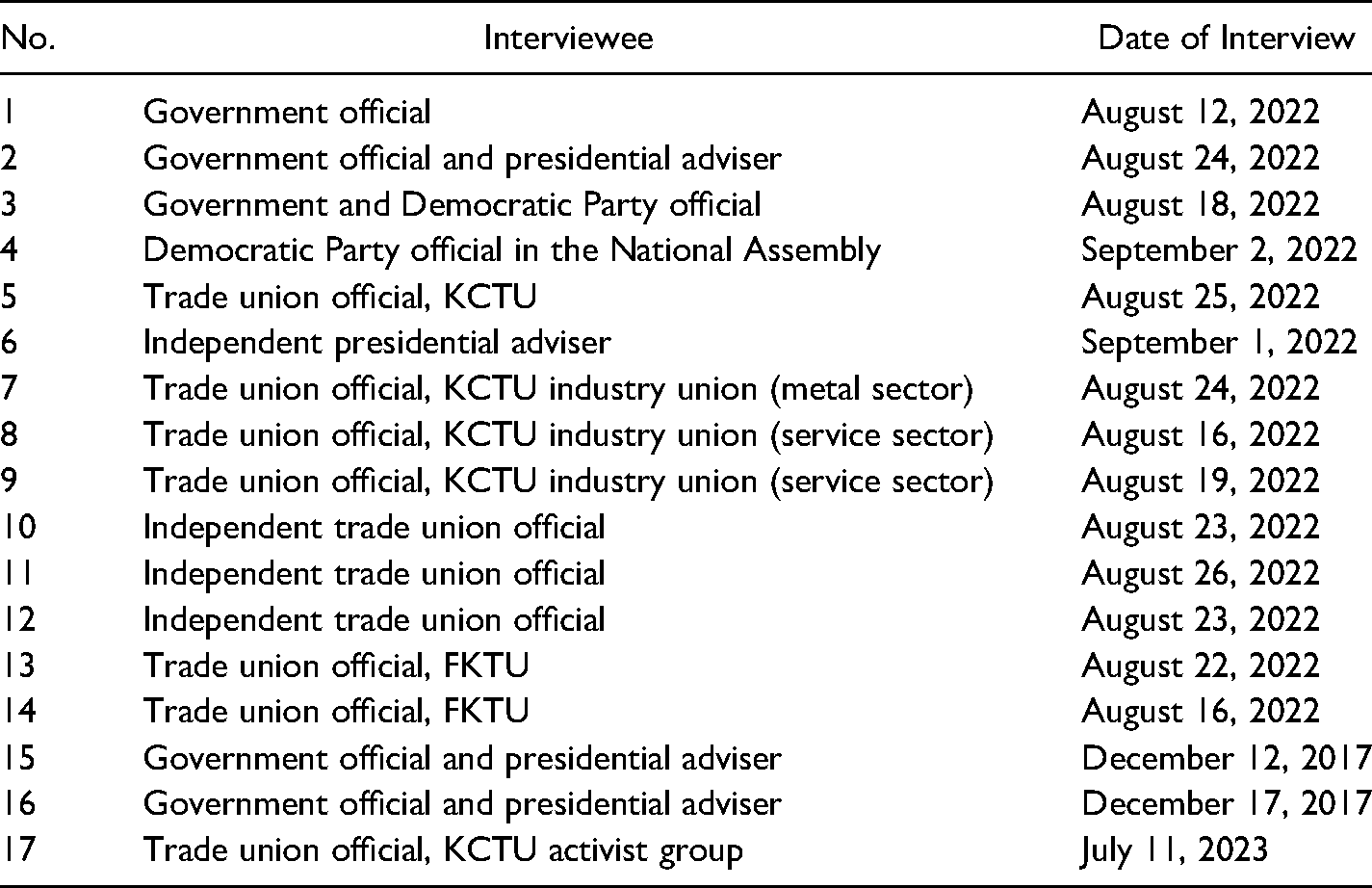
| No. | Interviewee | Date of Interview |
|---|---|---|
| 1 | Government official | August 12, 2022 |
| 2 | Government official and presidential adviser | August 24, 2022 |
| 3 | Government and Democratic Party official | August 18, 2022 |
| 4 | Democratic Party official in the National Assembly | September 2, 2022 |
| 5 | Trade union official, KCTU | August 25, 2022 |
| 6 | Independent presidential adviser | September 1, 2022 |
| 7 | Trade union official, KCTU industry union (metal sector) | August 24, 2022 |
| 8 | Trade union official, KCTU industry union (service sector) | August 16, 2022 |
| 9 | Trade union official, KCTU industry union (service sector) | August 19, 2022 |
| 10 | Independent trade union official | August 23, 2022 |
| 11 | Independent trade union official | August 26, 2022 |
| 12 | Independent trade union official | August 23, 2022 |
| 13 | Trade union official, FKTU | August 22, 2022 |
| 14 | Trade union official, FKTU | August 16, 2022 |
| 15 | Government official and presidential adviser | December 12, 2017 |
| 16 | Government official and presidential adviser | December 17, 2017 |
| 17 | Trade union official, KCTU activist group | July 11, 2023 |