




Abstract
In October 2022, a new employment protection regulation, often seen as a core aspect of the Swedish model of industrial relations, was implemented in Sweden. While the debate around the new regulation was heated, one interesting omission was that, in the unions’ advocacy for maintaining various forms of labour market security, the racialised labour market was never discussed, despite a strong racially segmented labour market with varying working conditions. In this article we explore how three white, male-dominated trade unions representing employees in different class locations positioned themselves around the change in the new Employment Act. Inspired by contributions on racial capitalism, we unravel how trade unions take part in the contestation over industrial relations in a context in which neoliberal and ethnoracial policies are growing. Using the ‘Swedish model’ as an ‘empty signifier’ – highly variable in meaning, hence contestable – we find that the unions advance three different positions on employment protection regulation: flexible, skilled and protective, and in doing so contribute to the self-racialisation of white male workers in working life.
Keywords
Introduction
In October 2022, a new employment protection regulation (EPR) was implemented in Sweden, consisting of both a new collective agreement and changes in the Employment Protection Act (EPA). This change is the outcome of a long and conflictual rewriting of EPR, a regulation often seen as a core aspect of the Swedish model of industrial relations concerning which rules apply to employment, termination and dismissal. 1 While the debate around the new regulation was heated, one interesting silence during the debate was that, in the unions’ advocacy for maintaining various forms of labour market security, the racialised labour market (and rarely the gendered labour market) was never discussed. This is remarkable considering Sweden’s highly racially segmented labour market and its varying working conditions.
To some extent, this is linked to the idea of Swedish exceptionalism, whereby the Swedish labour market and the Swedish welfare state are understood as having been neither affected by, nor gained from, colonialism and imperialism, and that racism is external to Swedish labour market relations. 2 While the Swedish model (which is, according to Kjellberg, the archetypical representation of the Nordic model) in some senses differs from other forms of industrial relations, we argue that analyses of the Swedish model often take for granted that the model itself is delinked from the global economic system, creating a picture of a model that is shaped only by internal dynamics and labour relations. Analyses of the Swedish model have hence often been made from a methodological, nationalist point of view, according to which the model itself has not been explored as part of, shaped by, and reproducing, racial capitalism.
According to Lipsitz, analyses of state legislation – industrial relations in our case – cannot be reduced to exploring the overt presence of race, as many of the mechanisms maintaining racial inequality have historically been achieved without having an explicit racial intent (or at least content). 3 In other words, while the concept of race was not present in the debate around the new regulation (or other concepts such as ethnicity, foreign born, migrant), the new regulation will still have racial effects. Inspired by the concept of racial capitalism, this article aims to explore how three white, male-dominated trade unions representing employees in different class locations positioned themselves around the change of EPR, and how racial inequalities are, in different ways, inscribed in their politics and discourse on employment protection.
The article starts with a dialogue with earlier studies exploring the relationship between trade unions and whiteness. In the next section, we introduce the concept of racial capitalism as our theoretical frame, which is followed by a presentation of the material and the method of exploring silence. The following section looks at three shades of racial silence that, in different ways, we argue, are embedded in and reinforce racial capitalist inequality in Sweden.
Class, whiteness and trade unions
In setting out the scene for the change of the EPR, understanding the Swedish model of industrial relations is important. In a formal sense, this is distinguished by a high degree of self-regulation between organised capital (employers’ associations) and labour (trade unions) through collective agreements on wages (without legislated minimum wages) and other employment conditions. While most social insurances are fully government organised, unemployment insurance (in line with the Ghent system) entails a mix of union-led funds with government subsidies. Thus, the regulation of employment protection contains both collective agreements and legislation. However, to what extent substantial features should be included within the model is more debated. This would historically entail ‘social democratic’ welfare states, with economic policies strengthening the position of workers vis-à-vis employers, especially through decommodification, that is enabling a degree of independence in living standards from purely market forces, 4 as well as through active labour market policies and strong employers’ associations and unions. While the formal parts are still there, the substantive parts are (slowly) eroding, raising the question: can Swedish industrial relations of today still be characterised as ‘the Swedish model’? The changing regulations discussed in this article unfold in a context where economic policies are no longer Keynesian but monetarist; social insurances are less encompassing, and active labour market policy is more restrictive, with a substantial increase in labour market precarisation. Finally, the relative strength of blue-collar trade unions has rapidly declined vis-à-vis both employers’ associations and white-collar unions. However, trade unions are still central political actors, shaping not only issues of salaries, working environment and working hours, but also partially shaping their members’ political views and visions. 5
Research on the Swedish model has generally focused on class relations – especially those between organised labour and capital, marginalising the gendered, and, of more relevance in this article, the racialised character of the labour market. Inspired by Roediger’s argument that we should ‘draw lines connecting race and class’, 6 we note some features of the Swedish regime of racial capitalism. Departing from the classic quote that ‘Race is the modality in which class is lived’, 7 we would add that, in the Swedish context, migrant background is a central modality in which race is lived. While the structure of Sweden’s racial capitalism is fluid and complex, the migrant ‘other’ often becomes shorthand for racialisation as only certain migrants are considered migrants, while the children of these migrants are reproduced as racialised ‘others’ through oxymorons like ‘second-generation migrants’. In Sweden, more than two-thirds of employees with a migrant background are working class, compared to half of employees of Swedish background. Furthermore, within different class locations, racialised workers are over-represented in those occupations with the worst working conditions, and, within the same occupations, over-represented in performing the most precarious working tasks. The situation of racialised workers in Sweden is characterised by a substantially lower employment rate, much higher unemployment, a higher degree both of precarious temporary employment and over-education in employment, less access to internal training as employees, and substantially lower wages. 8 Furthermore, alluding to Becker’s theory of ‘taste-based’ discrimination, economist Ali Ahmed summarises an increasing number of quantitative studies showing systematic discrimination against people from a non-European background in all spheres of society, not the least the labour market. 9 The racialised segmentation of the Swedish labour market may be exemplified by the statistical over-representation of foreign-born workers from Africa, Asia and South America, comprising some 11 per cent of the total number of employees, in low-income, often precarious, employment. These occupations, in which racialised workers constitute around 30 per cent of the workforce, encompass nursing assistants, cleaners, domestic workers and others, fast-food, kitchen and restaurant workers, alternative medicine therapists, car, motorcycle and bicycle drivers, machine operators, textile, laundry and leather workers, and laundry, window-cleaning and other cleaning workers.
Together with shifts in economic and labour market policies, and rapid curtailment in migration legislation, there is pressure towards deploying unfree labour, temporary employment contracts, and a move to general precarisation. Thus, the issues of employment security are more pressing for racialised workers despite the colour-blind discussion of changes in the regulation. But, notwithstanding, this discussion around employment protection is hegemonised through a focus on the situation of the true (read white male) worker.
Internationally, there is today a growing field of research exploring the intersection between whiteness, class and trade unions. Researchers have, among other things, explored how trade unions tackle issues of ethnicity and race, often focusing on issues of exclusion, subordination and representation; the role of whiteness in the self-representation of trade unions, and the ways that race and ethnicity shape the worldview of trade unions and their political positions. 10 Although diverse, this research shows that imaginaries around race and nation within labour unions have, as Virdee writes, not only been ‘constitutive in the making, unmaking and remaking of the working class’, but also of the nation itself. 11 One of the central contributions of this line of research consists of analyses showing that questions of race are central to understanding why unions act as they do. Race is not a marginal phenomenon, but at the core, together with class and gender, of how trade unions formulate strategies and visions of what they are, how they act, and what they want to become. In the Swedish context, analyses of the relationship between whiteness and how unions mobilise are few and have predominantly, not to say almost exclusively, been done in relation to the LO trade union confederation, reflecting a general international scholarly trend of locating racism within the working class. 12 In Sweden, as well as internationally, this has often been linked to an interest in why a large section of the white, especially male, working class and its unions have, in a neoliberal, racially segmented and ethnonationalist conjuncture, increasingly embarked on exclusionary strategies, defending the wages of whiteness instead of advancing working-class unity and struggles.
While research on the role of whiteness in shaping union politics is still limited in the Nordic context, there is an increasing interest in the role of whiteness and class as shaping restrictionist social movements. 13 However, in a similar way to most analyses of trade unions, research on the resurgence of the radical Right in Sweden has been dominated by analyses of the role of the white working-class male (and especially as supporters of these movements) in transferring his historical allegiance from the Social Democratic Party to the rightwing Sweden Democrats. 14
One of the limitations of what Moody calls the blue-collar narrative, which focuses on the role of the white male working class in support of different nationalist and white supremacist movements, is that it obscures the centrality of other social classes in supporting those movements and representatives (as in the case of Trump, the Brexit vote or the Swedish election). It gives ‘an impoverished account of the dynamics of nationalist populism and its larger relationship to neoliberalism’. 15 According to Bonilla-Silva, the problematic blue-collar narrative focus has tended to make invisible the role of whiteness in shaping politics beyond the white (male) working class. 16 It has thus hidden the role of whiteness for other class fractions in identifying their politics only as (pure) class politics (in analyses of neoliberalism) or making them invisible as a political force shaping class and race politics.
Another risk, as we see it, with the single focus on whiteness as an expression of working-class loss and resentment, is that whiteness then only becomes an entity to be analysed when formulated as a loss of the past, and not as something expressed though emotions and discourses of, for instance, innovation, flexibility and modern transformation. In this article, therefore, using the concept of racial capitalism, we examine how trade unions from different class locations position themselves in the debate over changes to the EPR in Sweden.
Racial capitalism: moving beyond nostalgic racism
In Black Marxism: the making of the Black Radical Tradition, Robinson creates a theoretical frame for the concept of racial capitalism.
17
A central argument is that capitalism emerged within the feudal order in an already racial regime (‘racialism’ is the term he uses) and thus, there is not, and has never been, a capitalist system that is not racialised. Robinson argued that hierarchies based on ‘racialised’ differences were already in place prior to the emergence of capitalism. In opposition to dominant Marxist theories, Robinson argued that the capitalist system does not have a tendency towards homogenisation, but rather a tendency to differentiate. He writes: The tendency of European civilization through capitalism was thus not to homogenize but to differentiate – to exaggerate regional, subcultural, and dialectical differences into ‘racial’ ones.
18
Capitalism, he argued, harbours and creates multiple differentiations of forms of labour, involving varying degrees of non-economic coercion, and that differentiation is partially organised through race. Accordingly, each period of capitalism finds distinctive ways to reify regional and cultural differences into races in order to structure social divisions between different forms of labour. Racism is not reducible to a legacy of the past 19 but is continuously regenerated in new forms out of globally dispersed divisions of labour and the struggles against them. 20 Following Robinson’s argument, Kundnani argues that capitalism constantly recreates itself through the differentiation of waged and unwaged labour. Race, according to this author, provides the means of coding and managing the material boundaries between different forms of labour, hence: ‘Race is a material feature of the division of labour that neoliberalism produces’. 21 Thus, research, he argues, often ‘excludes the possibility of neoliberalism itself constituting distinctive new structures of racism which are not comprehensible in terms of weakened legacies of the past’. 22
The emphasis on racism as a form of resentment and nostalgia tends to focus on racism expressed in terms of loss, and while we do not argue that this is not an existing form of racism – the articulation of racism expressed as nostalgia, linking the lost, for instance, in Sweden to the concept of the nation as the People’s Home, the Swedish model, and the welfare state – we argue, inspired by Kundnani, for the need to explore forms of racism, articulated and mobilised in other emotional and discursive terms. This would facilitate a more open understanding of both if and how racism permeates society, in stories of the past, in living the present and in imaginaries of the future.
Method and material: colour blindness and three shades of whiteness
As already stated, our analysis concerns the debate on EPR. Following Espeland and Rogstad, we use the re-regulation of employment protection in Sweden, as a critical event in which ‘the magnitude of the event itself but also . . . the meaning ascribed to it; the degree to which this new meaning challenges established truths, and to which it resonates with a wider public of potential protagonists’, is explored through the lens of racial capitalism. 23 We examine material both from public media and the trade unions’ own membership sources. In our analysis, we are particularly interested in how race enters these debates. We are inspired by Bonilla-Silva arguing that racial ideology is often articulated within ideological items expressive of other social divisions, or wedged in generic arguments. Texts seldom reflect a specific discussion around race (reflecting more, instead, about nation).
That the manoeuvring around the EPR did not name race does not mean that it does not have racial content or racial effects. According to Bonilla-Silva, the rhetoric of colour blindness is a diversion intended to direct our attention away from such things as racial inequalities in relation to wealth, occupational stratification and segmentation. That race is not named does not mean that is not there, as Lipsitz argues: To focus only on overt uses of race by the state in the past or present hides from scrutiny most of the actions that produce, preserve, and protect racial stratification.
24
In other words, that race was not articulated in the struggle about the EPR does not mean that the regulations and practices it creates will not affect racial inequality and white (male) societal positioning. Methodologically, therefore, we have explored what forms of silences are embedded in the three different trade unions’ positions over the EPR.
Thus, a challenge has been to try to grasp if and how race and whiteness are articulated through other social divisions and through silence, as they, as terms, do not appear. We, therefore, chose to focus on the concept of the Swedish model, as this was what all three unions, while having different positions, argued that they and the employers in different ways were protecting or challenging. The material consists of articles in internal union magazines and public debates around EPR between June 2020 and June 2022. We began by searching for words such as race (which in Sweden is almost exclusively used by a few critical scholars and anti-racist social movements), and ethnicity. However, none of those words were used in the debate. We therefore searched for concepts such as Sweden, the Swedish model, and the Swedish welfare state that, of course, were much more present. In the debate one could read the concept of the Swedish model as a (partially) empty signifier as defined by Laclau and as a ‘signifier without a signified’. 25 It is a concept that, he argues, gains meaning temporally, though discursive struggles, in which actors engage in competing hegemonic projects over which particular meanings will come to stand for the whole.
By using the concept of empty signifier, we can then examine how the idea of the Swedish model is used in the debate around EPR, as the three unions all use it, albeit in different and changing ways. According to Laclau, empty signifiers are inherently political as they create room for oppositional meaning, where actors struggle to define the whole. For Laclau, struggles in the space of the empty signifier are central to hegemony, where the signifier tries to represent ‘the pure cancellation of all differences’. 26 The shifting uses of empty signifiers reflect competing hegemonic projects. As will be explored in this article, we understand the concept of the Swedish model as a (partially) empty signifier, as it is at the core of the struggles over the new labour regulation, and all three unions argue that their position is the best way of securing the Swedish model, while they all ascribe different meanings to what this is. Central to the debate is also how the concept is, in itself, based on the idea of a whole that obscures, or at least subordinates, the class, gender and race conflicts embedded in labour market relations within a methodological, nationalist Swedishness. As the silence on race was perhaps the most palpable aspect of our material, we explore what we identify as the three shades of racial silence: the racial silence of flexibility, the racial silence of skill, and the racial silence of labour security.
We are particularly interested in examining how white masculinity intersects with class locations; what Eric Olin Wright defined as ‘contradictory locations within class relations’. 27 Influenced by both Bonilla-Silva’s and Bhambra’s thinking, we argue the need to expand the analyses of collective articulation of racism and whiteness beyond the white working class. 28 Hence, in order to explore the role of unions in shaping and challenging racial class inequalities, we needed to study unions from different class locations. For today, as the EPR debate made clear, unions organising white-collar workers are not only larger in membership, but are also actors that, together with organised capital, seem to be more crucial to defining what the Swedish model is and should be; in so doing, they also rewrite the history of what it was.
Inspired by the distinctions of class locations, the three unions analysed in this article are the Swedish Construction Workers’ Union, 29 the Managers’ Union 30 and the Swedish Engineers’ Union 31 (see Table 1).
Central characteristics of trade unions studied.
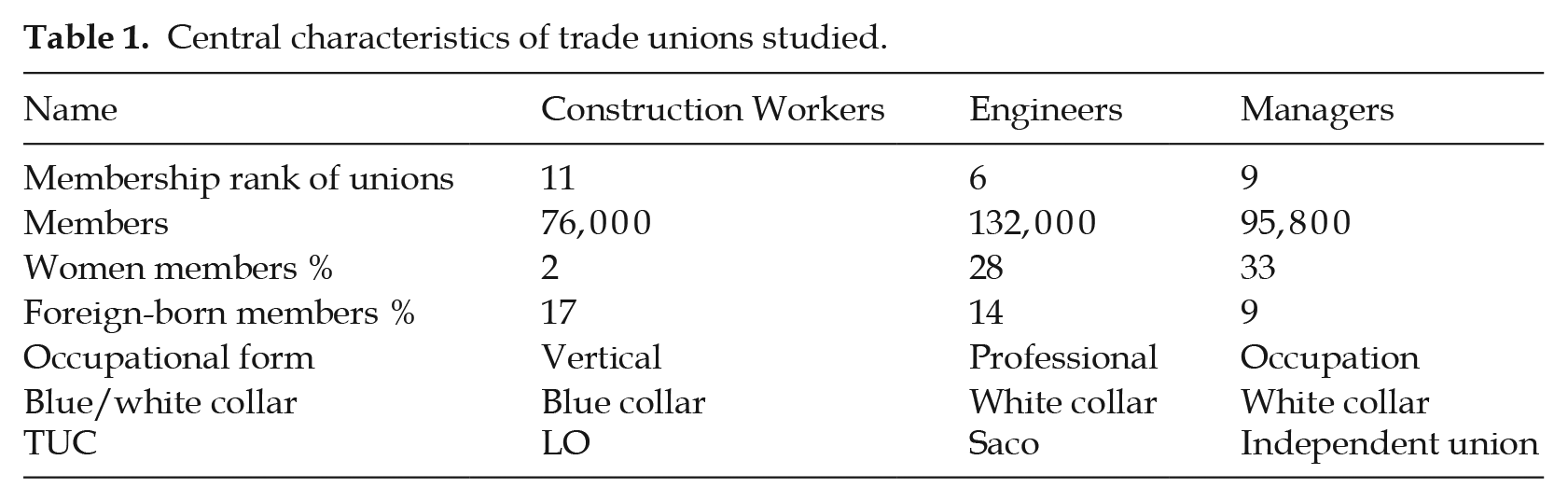
The table describes some central characteristics of the trade unions, with two unions representing two different, contradictory locations: Managers – employees representing capital, controlling and organising the work of others; Engineers – employees, but semi-autonomous through knowledge and expertise, having considerable control over their labouring activity. Their contradictory locations within class relations give them a stronger market position in both individual and collective agreements with employers. By focusing on the comparatively high percentage of white male members of the three unions, we contribute to an analysis of the intersection of white masculinity with class, not only as the traditional working class but also encompassing employees with contradictory class locations. 32 We argue that it is essential to do this to explore and capture the different ways through which racial capitalism in Sweden is reproduced and changed in labour market conflicts and to avoid, a priori, locating racialised practices among blue-collar workers.
Responsible and flexible racism: the Managers’ Union
In the general election of 2018, the Swedish Social Democratic Party, which had governed with the Green Party from 2014 to 2018, lost parliamentary support and approached two smaller rightwing parties for additional support. The Liberal Party and the Centre Party both demanded strong political influence in return for accepting a Social Democrat prime minister, resulting in the January agreement which, among other things, meant reformation of EPR, expressed as the ‘modernisation of the labour regulation’. With negotiations deadlocked between employer associations and trade unions, a state inquiry was ordered and, on 1 June 2020, the Toijer inquiry presented its proposal, entitled ‘A modernised labour law’. 33 A central change in the proposal was that the principle of ‘last in, first out’ be further weakened, from the right of companies with no more than ten employees to exempt two people when laying off staff, to the right to exempt five employees, regardless of the size of the company. At this point, all three unions analysed here opposed the proposal, arguing that it shifted substantial power from the trade unions to the employers.
The strong critique from the unions led the government to give the labour market actor a chance to agree new terms for the EPR. In December 2021, PTK, Unionen and the Swedish Employer Association
34
presented a new proposal, the ‘Security agreement’. The Managers’ Union argued that substantial changes had been made since the Toijer proposal and that the new regulation was a way to modernise the Swedish model for the future. The chair of the Managers’ Union, Andreas Millers wrote: When the winds of change are blowing, it is not possible to put your head in the sand and hope that everything will return to something that was the case before. For Managers – Sweden’s management organisation – it is obvious to be involved and influence, and take responsibility. And I think we all need to realise that security in the labour market of the future cannot be limited to permanent employment . . . During the pandemic, the term ‘being a part of the solution’ was used quite frequently. I hope that the meaning of this penetrates all the parties that are crucial for this issue. It would be good for Sweden.
35
Central to the Managers’ Union position is that the new regulation is needed, and to refuse it, as LO initially did, was to refuse to acknowledge that this would be best for Sweden. The new agreement was therefore identified not as a change of the Swedish model but, on the contrary, as a way to protect the Swedish model.
It is also important that the parties resolve this in the context of negotiations and avoid legislation. As Sweden’s management organisation, Managers stand up for the Swedish model. Not least in times of political intervention, from both the government and the parliament as well as from the EU, the social partners are required to show that we can resolve even complicated issues in dialogue and negotiation.
36
The headline of the article read, ‘PTK and SN solution is good for Sweden’. The Managers’ Union changed its position, as in the proposition that the two parties presented. The possibilities of adjustment and skills development were included more clearly, while the right to secure employment still was not. Andreas Miller argued that: I think we all need to realise that employment security in the labour market of the future cannot lie solely in a permanent job. The possibility of adjustment and skills development, the financial security when you are unemployed or in education, and the conditions to quickly find a new job are equally important for the individual’s security.
37
The Managers expressed this as necessary ‘[b]oth for the manager in his professional practice of leading and distributing work and for the manager as an employee’. For the Managers’ Union, the central issue was that the need for competence development was guaranteed, rather than security in terms of the actual employment. To agree was defined as a ‘message of strength’ for the Swedish model.
The Managers, although they had been critical of a too employer-friendly EPR, in their capacity as employees representing the employers, emphasise – as shown in the quote above – their responsibility and flexibility towards tomorrow’s needs in the Swedish labour market. While silent on the racialised segmentation of the labour market, they affirm the new EPR which strengthens their position as managers vis-à-vis employees. The increased flexibility highlighted means increased employment insecurity which, in a general sense, affects all workers, but because of the racialised segmentation of the labour market implies the additional precarisation of racialised workers. While neoliberal restructuring is often correctly seen as increasing class polarisation, in addition, an analysis through the lens of racial capitalism makes it clear that this restructuring has a stronger effect on already precarious racialised workers. It indicates a successful rearticulation of the Swedish model in which ‘today’s and tomorrow’s needs’ are framed by the need to increase insecurity for all, but especially racialised workers.
The new regulation gives Managers greater power in terms of recruitment and dismissal. It also gives them greater power over employing people on short-term contracts that, together with the subordinated and marginalised position of the racialised labour force, will further consolidate the segmented character of Swedish racial capitalism. At the same time, the strong emphasis on skill development gives the Managers an individual market power that is less tied to employment security and more to employment opportunities.
When we now turn to the outlook of the Engineers’ Union, who have a different but also somewhat contradictory class location based on expertise, as compared to the authority of the Managers’ Union, we see certain similarities in the Engineers’ modernist, future-affirming position, but also some differences concerning employment security.
Competitiveness and skilled racism: the Engineers
The Engineers’ Union was highly critical of the Toijer proposal when it was presented, even more critical than the Managers’ Union. Specifically, it argued for the need to create greater possibilities for the right to skills development and against the proposal’s lack of balance in giving the advantage to the employers. Presenting the new proposal, Camilla Frankelius, the union’s chief negotiator, said: ‘It is a gratifying message and we have made a great effort to come up with a proposal that benefits the entire labour market.’ 38
The central change made, according to the Swedish Association of Graduate Engineers, was a greater emphasis on the right to skills development, identifying engineering skills as a key issue for Sweden’s competitiveness. Like the Managers’ Union, the Engineers’ Union stressed that the new agreement expanded the right for employees to continuous reskilling and thus was in line with the needs of a modern labour market. The idea that there is a need to ‘reform’ labour market security was stressed. Göran Arrius, chair of the Swedish Confederation of Professional Associations (of which the Engineers’ Union is a member) declared that the new EPR would protect the Swedish model: There is a need to reform the conditions for security, adjustment, and employment protection in the labour market. Now that there is a broad social partner solution, the EPR inquiry must be thrown in the trash. Then the Swedish model is protected. The cooperating social partners say they agree on that, and we assume that everyone keeps that promise.
39
The Engineers stressed that it is their competence to be competitive that needs to be secured through the Swedish model, rather than employment security (which many of them already have, it should be stressed). The chairman of PTK, Martin Linder, said: It is gratifying that the Parliament has now decided on this historic reform for security, adjustment and employment protection. It will strengthen civil servants’ job security and improve Swedish competitiveness.
40
For the Engineers, it was crucial to maintain employment security in a global market. In that sense the new proposal, through its increased focus on competence development, protected professional white male workers from global competitiveness, at the same time as it secured their national position.
The Engineers’ Union stressed the importance of competence, the importance of more secure employment, and said that its members are central to Sweden’s export capacity and global competitiveness. In doing so, the union defined its profession as central to Sweden’s global competence, and as essential to the future of the Swedish labour market through its members’ creativity and expertise. In relation to racial capitalism, we argue that the Engineers can be seen as positioning themselves, and their interests, as the guardians of a white nation and its borders. The Swedish model here becomes more a way of securing the nation’s global position than of mediating the relationship between labour and capital. In that sense, what we call ‘the silence of competitiveness’ has to do with the wages of whiteness derived from a particular contradictory class location, embedded in a rhetoric of progress and global market forces.
The rhetoric of competitiveness and skills creates a space where the protection of Engineers as skilled and expert workers can be included, at the same time as they can secure their national protection from competing Engineers from the Global South. In a racial capitalist labour market like Sweden’s, with a higher degree of racialised workers in areas demanding fewer skills, who are in insecure work and often overeducated, the new regulation promotes precarisation of workers. However for Engineers (and other skilled employees), the affirmation and facilitation of competence development and employment mobility serves to protect them from increased insecurity.
When we look at the Construction Workers, the focus on employment security that, in some ways, they have in common is differentiated by two factors. First, there are the limits to skills development, given the labour market position of Construction Workers, and, second, the inescapable physical limits of worn-out bodies that come with age. Thus, the optimism of the Engineers for the future, linked to their affirmation of competence development and employment mobility, is less valid for Construction Workers. Their position on the new EPR expresses the threat of insecurity, and consequently looks back in part to what their union considers was the true Swedish model.
Security and protection racism: the Construction Workers
With four out of five Construction Workers over the age of 55 taking painkillers to cope with their job, and with an average retirement age of 63, the pension reform of 2019, which increased the retirement age, made their opposition to the new EPR logical.
When the new agreement was presented, the Construction Workers’ Union declared that there was no solution to the question of employment security, which was a central issue for its members. While both Managers and Engineers stressed the importance of being able to educate oneself after dismissal, as was inscribed in the new agreement, the Construction Workers stressed that its members needed employment security at work, not skills development to go from employment to employment, as physically they would not have the same productivity throughout a working lifetime. Hence, the question over whether managers would have a greater right to dismiss people, for instance, because of lower productivity, became a central issue.
During an entire working life, it is reasonable to possess different levels of productivity. For example, a 27-year-old bricklayer may work slightly faster than a 63-year-old colleague. But the 63-year-old colleague probably worked just as fast when he was 27. In other words, during an entire working life, employees give of their power to the company . . . Here we must find legislation that provides security throughout life. What we have today, with two exceptions to the rule, last in first out, which we consider to be two too many, is further expanded in the final offer. It hits hard on many employees in our industries where companies are often small, which means that the exceptions hit harder.
41
The Construction Workers, in contrast to the other two unions, emphasised the need for employees to be able to remain in the same line of work, with reduced productivity, as their bodies got older. The central difference is, of course, that while the Managers’ and Engineers’ work is less physically demanding, the focus of Construction Workers is on guaranteeing that workers do not get dismissed while working, even though they are guaranteed competence training. While, after pressure, part of the LO went back to negotiations, several unions maintained their opposition, among them, the Construction Workers, arguing, in the words of Johan Lindholm: We see a clear risk that employers take the chance to get rid of older employees who may not be able to keep the same pace as the younger ones . . . In this way, it is a matter of solidarity with those who have sacrificed their bodies for this industry.
42
The Construction Workers’ Union has been a consistent defender of the EPR against both the Toijer proposal for new legislation and the agreement between the employers’ association and white-collar unions, later also supported by the two dominant blue-collar unions IF Metal and Municipal Workers; subsequently this included the LO (but not all its member unions). With physically heavy work, a central argument has been to defend older members whose bodies are marked by many years of hard labour (as the quote above indicates). The Construction Workers’ Union is today one of three LO unions that have not signed the agreement.
We have been critical throughout the journey and will not sign the main agreement in the foreseeable future. What our counter-party wants is to be able easily to fire those especially who have reached a certain age and are worn out . . . Finally, there are the turn order rules. The agreement means that the employer can exclude at least four people from the priority list for dismissal. Previously, only companies with up to ten employees could exempt two people. Now all companies, regardless of size, can make exceptions to the order of rotation. Then the employees become just a commodity.
43
However, while the Construction Workers have historically been left-leaning over labour market issues, their union has also been characterised by a certain craft guild ideology and successfully defended wages that are among the highest within the LO federation. Compared to other LO trade unions, there are extremely few women and few foreign-born members. The Construction Workers have, for a long time, been relatively successful in defending their skilled-worker position in the labour market, with high wages and a low percentage of temporary employment compared to other blue-collar worker unions increasingly threatened by neoliberal re-regularisation. A central problem for the Construction Workers’ Union was that its central role as a union was reduced: We think it is sad that the Social Democratic Workers Party now prefers to listen to the Centre Party, the Liberals and the Confederation of Swedish Enterprise than to 1.2 million LO members. It is quite clear that this means a great strain on the trade union-political cooperation.
44
In our analysis of the Construction Workers’ participation in the debate on the regulation of employment security, we did not find any explicit reference to whiteness and the racialised labour market. Yet this has been an important issue in the internal discussions of the Construction Workers. On the one hand, there has been a discussion on how to manage the very strong support of union members for the Sweden Democrats, which the union sees as a racist party opposed to its core values and ideology. On the other hand, the Construction Workers’ Union has struggled between an exclusionary racism and inclusionary politics concerning what it perceives as threats to its members. The EU Posted Workers Directive, 45 bogus self-employed EU citizens, irregular labour and unauthorised migrants have often been seen as threats. Thus, the union makes a distinction between being critical towards migrants threatening the labour market position that it has achieved, and fighting the exclusionary racism manifested by the Sweden Democrats and their supporters within the union.
In this sense, one could argue, that one of the limits of the Swedish model as an analytical concept and in everyday discussion is its silencing of race in racial capitalism. As Virdee argues, the idea of the nation, or in this case the Swedish model, operates as a powerful container ‘limiting the political imagination of even most of those who were representative of the exploited and oppressed’. 46 So, while the Construction Workers’ Union and its members are, in many ways, sold out by the EPR changes made by the other white-male dominated unions, one could also argue that the Construction Workers, when losing their small class fraction privilege attempt in part to defend it though the wages of whiteness, arguing that they are the core of the Swedish model.
Conclusion
In this article, inspired by Robinson’s concept of racial capitalism, we have shown that, although none of the unions talk about race, the effects of the new EPR and the positions they took were shaped by racialised worldviews and have racialised effects. The silence is, in other words, heard in the sound of racial labour market inequalities, where the racialised ‘others’ find themselves in the most precarious employment as the lowest paid and with the worst working hours and work environments. While race is here never an overt issue, it is always a real issue in the labour market relations of Sweden’s racial capitalism.
By using Wright’s class location frame 47 to capture the variations between the trade union of a traditional but strong working-class occupation, the Construction Workers, and two different unions embodying contradictory class locations, the Engineers’ Union (characterised by autonomy and expertise) and the Managers’ Union (significant in the labour market for its workplace authority), the different arguments in relation to the restructuring of EPR become understandable. However, in all this positioning there remains the silent presence of the racialised workforce. The Managers’ rhetoric concerning responsibility and flexibility is actually a trade-off between a decrease in formal employment security and increased workplace power, complemented by continuous skills development to maintain market value. This workplace power, which earlier research has shown plays an important role in reproducing racialised segmentation in recruitment as well as in work conditions, is hence set to be further strengthened. In contrast, the Engineers’ Union’s rhetoric is focused mainly on negotiating a strengthened position vis-à-vis employers through the right to skills formation and support in adjustment between jobs, but, like the Managers, accepting a decrease in formal employment security. The Swedish model for the Engineers is focused on securing Sweden’s global competitiveness, in which they see themselves as a core actor. The silent presence of race here is, on the one hand, linked to the challenge from the Global South that competes with lower working conditions and wages, but also on the acceptance of the labour market polarisation that facilitates the Engineers’ privileged, hence contradictory, class location. The trade union rhetoric of the Construction Workers, the only one of the three unions that did not accept the collective agreement ushering in the new EPR, saw the change as a threat to its members’ employment security and did not see skills development as something that could compensate for the weakening of that security, especially not for the older workers who risk becoming unemployable following redundancies that they are no longer protected against. As a wage-privileged fraction of the working class, the threat in an increasingly polarised labour market is of joining the ranks of workers whose working conditions and relative wages are in decline. Here, the silent presence of race involves joining an increasingly precarious racialised workforce, while losing out on the wages of whiteness.
There has been an overall tendency in analyses of trade unions and racism to focus on working-class trade unions, and there is a similar tendency within research on the relationship between whiteness and political mobilisation. Through the concept of racial capitalism, we explore how racism can be traced in the debate around the Swedish model by studying what forms of meaning are given to the model.
As Robinson argues, racism cannot be reduced to a legacy of the past but is continuously regenerated in new forms out of globally dispersed divisions of labour. 48 While ostensibly silent on race, the various unions’ positioning reflects processes of self-racialisation. The Managers, from their contradictory class position, often employing people and often themselves with permanent employment, focused on improving their right to future development, rather than employment security. At the same time, ‘flexibility’ is defined as essential for the future. Central to our argument is that, while the Managers’ position can be seen as a way to reinforce racial and class inequalities in Sweden, this is not formulated in terms of nostalgia or resentment, but, on the contrary, couched in terms of future responsibility for the Swedish model, of progression and optimism. In this, it places the issues of whiteness and racism not as a nostalgic project, but rather as modern and optimistic features of the (reconstructed) Swedish model. The new Swedish model is thus filled with responsible Managers who are skilled and flexible and can rapidly adjust to new circumstances.
However, the implication of the new regulation, as Kundnani argues in relation to neoliberalism’s racial constitution, clearly increases the division between different kinds of employees, securing the position of both Managers and Engineers in their different contradictory class locations. 49 The silencing of race in relation to ideas around responsibility and flexibility, if not critically analysed, conceals the way that both those terms will increase the inequality of racialised workers – first, because it gives Managers greater liberty to dismiss, especially in small enterprises where racialised workers are over-represented, and, second, because the increased flexibility conferred by the new regulation increases the already high precarity of racialised workers. Hence, the Managers’ and Engineers’ positions can be read through the lens of racial capitalism as a way for them to secure the wages of whiteness and masculinity, whereby their labour market position is strengthened though their control over their and others’ work, greater ease of dismissal, and skills development. By protecting their own wages of whiteness, however, they are at the same time decreasing the same wages for the hitherto relatively privileged white working class (such as the Construction Workers). In this sense, an analysis of the trade unions’ positioning in the re-regulation of employment protection shows how racial capitalism is moving towards increased racialised class polarisation and exacerbating the weakness of a traditionally strong fraction of the white male working class in maintaining their wages of whiteness. Future research needs to study how this process strengthens or weakens working-class solidarity across LO trade unions and explore the role of white female-dominated trade unions’ positioning in this development.
Following the 2022 national election, the new government, with a political programme largely based on the politics of the Sweden Democrats, is ushering in a new scenario in which the volatile and dynamic balance built into racial capitalism is being renegotiated. With members of the Construction Workers heavily over-represented as supporters of the Sweden Democrats, the question of wages of whiteness for the white male working class may well resurface in new forms.
Footnotes
Acknowledgements
This work was supported by Forte: Swedish Research Council for Health, Working Life and Welfare Trust (grant number: 2018-00381); Riksbankens Jubileumsfond (grant number: P16-0718).
Paula Mulinari is associate professor at the Institution of Social work, Malmö University, exploring issues of labour conditions, social movements and workplace resistance, with a special interest in questions related to issues of racism, anti-racism, class and gender.
Anders Neergaard is professor at REMESO, Linköping University, whose research focuses on power, inequality, resistance and social movements, especially linked to discrimination, racialisation and racism, but also class and gender.