




Abstract
This article explores the intricate relationship between the Israeli state and Jewish settlers in the occupied Palestinian West Bank after the Oslo Accords (1993). It shows that, despite the accords, which prohibited the establishment of new settlements, such activities persisted. Instead, the accords triggered the seemingly spontaneous emergence of numerous illegal “hilltop settlements,” tolerated by higher echelons of government and actively supported by lower levels. These settlements subsequently underwent a gradual post hoc formalization process, ultimately leading to their full legalization. The article elucidates how a faction within Israeli society influenced segments of the government, employing blame games as a strategy to rationalize the legitimization of the Israeli land grab. Notably, it highlights the strategic and deceptive tactics employed by various Israeli governments in their dealings with the settler movement. The article concludes by reflecting on the political implications of the settler movement's success for the democratic character of the Israeli state.
In 1999, a group of West Bank settlers lodged a complaint with the telecommunications officer of the Civil Administration within the Israeli Coordination of Government Activities in the Territories (COGAT). Their complaint to COGAT, which is the equivalent of a military government in the occupied West Bank, was about poor cellphone reception on Highway 60. The telephone provider, Orange, agreed to erect a new antenna to improve the connection. The settlers suggested a hilltop fourteen kilometers north of Jerusalem. This same hilltop, Migron, had already been the object of several colonization attempts. According to the Israeli military, installing an antenna constituted a security issue and, consequently, meant that private land could be seized without the consent of its Palestinian owners. The Israel Electric Corporation connected the hilltop to the national electricity grid and the public water network in preparation for erecting the antenna. In the meantime, the settlers erected a fake antenna in 2001 and requested military permission to hire a security guard to speed things up. Military approval was given, and a guard was hired to surveil it. The guard's family soon joined him. A year later, other families joined them on the hilltop as well. In this way, the Migron outpost was established and grew in size: settlers arrived in mobile homes. Telephone lines and sewage pipes were established. All the infrastructure was paid for by different branches of the Israeli government, even though the government never formally authorized the settlement.
1
A former liaison officer for COGAT and the Office of the Minister of Defense described the collusion between the settlers and the military administration in the following way: First, you have to know that both the head of the infrastructure department at the Civil Administration and the person responsible for the inspection unit are settlers. They, therefore, methodically disregard their friends’ and sometimes their families’ building violations. Consequently, any report or mention of illegal construction systematically landed very late at the Office of the Minister of Defense. All of them participated in a covert scheme that was advantageous to them all. Then, once there is a clear decision to enforce, it is either too late, or the army doesn’t enforce the law because they believe that the government would not be able to go against the settlers.
2
The central research question of this article is twofold. First, what explains the steady growth in nominally illegal outposts in the OPT? Moreover, how can we understand their successful campaigns to obtain legal status despite the official settlement construction ban and the considerable external and internal pressures facing successive Israeli governments?
This article argues that a distinct division of labor has emerged within Israel between the government and Jewish settlers in the OPT, shaped in response to international constraints on settlement construction. The argument unfolds as follows. Despite explicit prohibitions outlined in the Oslo Accords against establishing new settlements, such prohibitions did not prevent their formation. Instead, they led to the seemingly spontaneous emergence of numerous illegal “hilltop settlements,” facilitated by tacit approval from higher government authorities and active collaboration at lower levels. Subsequently, after 2011, these settlements underwent a gradual process of post hoc formalization, ultimately resulting in their full legalization. Later on, there came a point where the Israeli government ceased working even under the pretence of distancing itself from the settlers’ actions by aggressively attempting to formalize all “illegal” settlements.
This article seeks to contribute to the expanding literature on Israeli settlements in the OPT. The existing literature on settler movements categorizes settlers into three primary classifications: those driven by ideological convictions, those driven by political considerations, and those from underprivileged backgrounds seeking better economic prospects. 4 This categorization framework is frequently employed in analyses of Israeli settlers. 5
Religious Zionist settlers, particularly those associated with the Gush Emunim movement, have been extensively explored in the literature. 6 Quality-of-life settlers play a significant role in supporting the visions of Likud and Gush Emunim, compensating for the decline of the Israeli welfare state. 7 The Ultra-Orthodox settlers, distinct in their beliefs from the religious Zionist camp, represent a rapidly growing West Bank demographic facilitated by government subsidies. 8 The emergence of “illegal outposts” represents a unique group of settlers who began establishing settlements without government authorization in the early 1990s, reacting to challenges imposed by the Oslo Accords of 1993. Scholarly perspectives on these outposts diverge, with some viewing them as exceptions to Israel's established settlement practices and others as instruments for informal annexation. 9
Another aspect of the existent literature examines state behavior concerning occupation and settlements. It argues that both right- and left-wing Israeli governments have appeased religious and settler extremists, occasionally even providing support to them, despite these extremists operating outside of Israel's political system, violating the law, employing unauthorized violence, and undermining state authority. 10 Others suggest that the outposts are a response by the Israeli regime to the Oslo Accords and not just a reaction by radicalized settlers, proposing that the “outposts” have become a “new colonial paradigm” that would lead to new settlement creation while the old settlements are progressively “normalized.” 11
These are valuable contributions. But they are unconvincing regarding the question of indirect governance arrangements between the Israeli government and the settler movement—especially concerning the outposts and their transformation into settlements. Further, when they claim that outposts are established with the support of the government, they fail to demonstrate the process through which this took place and how these outposts ultimately became settlements. In addition, the ambivalent role of the state is underscored, except for a few state officials who have pointed out the state's responsibility and duplicity in this matter. 12
This article takes the latter position seriously and expands it further, underscoring its significance in fostering a more focused understanding of settlement expansion during the critical post-Oslo period. A primary contribution of this article lies in its depiction of how the Israeli government has strategically engaged with the settler movement through ambiguity and duplicity to conceal the unlawful policy of settlement expansion. This strategy allows the government to maintain the illusion of compliance with and commitment to international law while at the same time perpetuating this deceptive practice.
In line with the qualitative methodological foundations of this research, with process tracing as its central approach, the study aims to obtain robust information about a well-defined sequence of events and processes. Therefore, I rely on data collected through interviews to gather data, and to explore, meticulously trace, and compare the sequences of events constituting the process at the center of this study. Consequently, this article's research is based on twenty extensive interviews with current and former IDF officers, civil servants in the civil-military administration, local and regional council members, politicians, and settlement residents and representatives. These interviews were conducted between January 2018 and February 2019. All interviews were one-on-one, conducted in English, and lasted approximately one to two hours each. In some instances, follow-up interviews were also done. I transcribed and coded the interviews manually, separating the narratives of officials and settlers and comparing my findings for triangulation. I recorded some of the interviews, and when the interlocutor did not agree to record the interview, I took notes, including as many verbatim quotations as possible.
In addition to interviews, the analysis also incorporates a corpus of primary sources. These include the following reports: “Talia Sasson, Opinion Concerning Unauthorized Outposts” (2005), hereafter referred to as the Sasson Report; “The Levy Commission Report on the Legal Status of Building in Judea and Samaria” (2012), hereafter referred to as the Levy Report; “The Settlement Regularization in Judea and Samaria Law of 5777–2017,” hereafter referred to as the Regularization Law; and “The Report from the Expert Committee for the Regularization of Construction in the Judea and Samaria Area,” hereafter referred to as the Zandberg Report. 13 Additionally, legal commentaries and reports from nongovernmental organizations (NGOs)—such as Breaking the Silence, Yesh-Din, and Peace Now—were analyzed. These documents served as essential supplements to my fieldwork, providing nuanced legal insights and statistical data.
The initial part of the article provides a summary of the pivotal historical period under examination. The section following delves into the dynamics of blame avoidance in establishing outposts, exploring the incremental and covert institutional transformation of these outposts into settlements. The article concludes by reflecting on the political ramifications of the Israeli settler movement's success on the democratic character of the state.
Political Intrigue and the Rise of Illegal Outposts
Fifteen years of the right-wing, Likud-led coalition government (1977–92) largely transformed the landscape in Israel and the OPT. Yet, despite the intangible achievements on the ground in terms of the number of settlers, the excesses and contradictions of the occupation and settlement expansion caused frustration not only among the Palestinian population but also generated intense criticism and debate within Israeli society at large 14 and the international community, particularly the United States. 15 These Likud incongruities precipitated Labor's return to power, thus halting settler expansion in the OPT. In 1992, the Labor Party was elected on a ticket to change national priorities: more flexibility in peace talks with Arab countries, curbing the settlements, reducing the amount of money channeled to settlements in the territories, and restoring good relations with the United States. 16 Accordingly, and as part of the Oslo process, Israel formally pledged not to “establish new settlements or expand existing ones, except where necessary to accommodate the ‘natural growth’ of the local population.” 17
As a consequence, the Oslo Accords were a watershed for the settler community. The settlers’ reaction was twofold. On the one hand, further institutionalizing the settlement movement expanded settlers’ power within the state at the expense of their moderation. 18 On the other hand, the radicalization of a small fringe of the settler movement opted to engage in an unprecedented campaign of protests and slander against the accords to undermine their credibility and legitimacy.
A crucial element of the latter reaction is the instigation of new methods of protest through the construction of “illegal outposts” throughout the West Bank. The advent of the “outpost method” would later dominate Israeli politics and geography. Zertal and Eldar explained that “the aim, the method, the practices, the selecting of the sites, and the rules of behaviour on the ground” established by the Oslo protest movement would set the modus operandi of the illegal outposts. 19 Part and parcel of the redefinition of the settler sector in the mid-1990s was the reappearance of extreme branch forms of political violence directed at both Palestinians and the Israeli state and its institutions. 20 The most important illustration of this violence was the assassination of Yitzhak Rabin by Yigal Amir, as well as the killing on February 25, 1994, of some thirty Palestinian worshippers in the Tomb of the Patriarchs (for Muslims, the Ibrahim Mosque, or Mosque of Abraham) by a religious right-wing fanatic, the American-born Baruch Goldstein. Rabin's assassination disrupted Israeli political life and the large pre-assassination alliance among prosettler groups and plunged settler Zionism into a deep crisis. 21 Despite this, a peculiar set of circumstances returned Likud to power a year after Rabin's assassination. 22
Likud returned to power in 1996 in one of the most surprising elections in Israel's history. Likud's pragmatism in dealing with Rabin's assassination was decisive for the victory of his successor. As an opposition leader (1992–96), Benjamin Netanyahu attempted with relative success to unify the Israeli nationalist bloc with its robust and genuine opposition to the Oslo Accords. However, following the assassination of Yitzhak Rabin, Netanyahu was aware of the need to distance himself from the extreme right without losing the party's sizable electoral base. Hence, his strategy embraced acquiescing to the Oslo Accords while calling for an unprecedented mobilization of Israel's nationalist and radical right, in addition to what Sprinzak calls the “soft right,” 23 namely, a new electoral base consisting of the unusual combination of Ultra-Orthodox Jews and the new secular immigrants from the Soviet Union. 24 Netanyahu's strategy stemmed from an electoral calculation and, perhaps most importantly, the realization of the impracticality of withdrawing from the Oslo Accords. Indeed, the assassination threatened the existing social order, shook the foundations of democracy in Israel, and brought the country to the brink of a civil war. 25 Likud conceded, at least nominally, not to topple the Oslo Accords for fear of provoking a civil war. At the same time, Netanyahu managed to limit the alienation of the right by offering a stricter position regarding the Palestinians. According to Ehud Sprinzak, “Israel's right was salvaged by Hamas. A series of four terrorist attacks in February and March 1996 destroyed Peres's solid lead over Netanyahu. The bombings, which claimed the lives of seventy Israelis and wounded two hundred, created a ‘counter-trauma’ to offset the trauma of Rabin's assassination.” 26
Netanyahu became Israel's tenth prime minister with the narrowest margin in its history, leading to an extremely divided country. In addition, he was in the thick of an international peace process he did not initially support. This outcome meant that Netanyahu and Likud had inherited the task of reaching an agreement with the Palestinians and, crucially, of freezing settlement construction to proceed with significant territorial and authority transfers to the Palestinian Authority (PA). The international community firmly supported the peace process and stepped up its involvement in the Israeli-Palestinian negotiations, which put Israeli actions vis-à-vis the settlements in the limelight. 27 On the internal front, the majority of Israelis still backed the peace process, despite the increasingly violent attacks taking place in Israel during the 1990s. 28
This left Netanyahu in a bind. On the one hand, he faced unprecedented pressure to halt all settlement activity. In a programmatic speech to the Israeli Council for Foreign Affairs, he criticized the Oslo Agreements. However, he added that “we cannot ignore the facts. . . . The Likud government will recognize the facts . . . created by the Oslo Agreements but will try to minimize the inherent dangers.” The government stood by its international commitments while concealing its efforts to “arrest, undermine, and subvert the Accords concluded by his Labor predecessors.” 29 On the other hand, given the distinctly right-wing nature of the coalition, Netanyahu faced mounting internal pressure from settlers and their allies.
Despite the official ban on new settlements, by 2020 twenty-one settlements had been established since the Oslo Accords through the legalization of previously established illegal outposts. These unauthorized hill outposts were politically convenient for the government as they enabled the continuation of settlement construction while deflecting the blame onto other actors. An example of this is that shortly after its inception, the outpost movement received a boost from the then foreign minister, Ariel Sharon, who made a famous radio declaration on November 16, 1998: “Everybody [should] move, run, and grab as many hilltops as they can to enlarge the settlements, because everything we take now will stay ours. . . . Everything we don’t grab will go to them.” 30
Ahaz Ben Ari, the legal advisor to the Defense Ministry, appeared before the Levy Committee in 2012 and explained the government's incapacity to openly build settlements despite its wishes to do so: “At the end of the day, it isn’t that we oppose the establishment of a settlement. After you see involvement, [and] that people have come and settled, it isn’t that it is impossible to approve this behaviour retroactively. However, it is a political question—the government is unwilling or unable, in diplomatic terms, to declare the establishment of new settlements.”
31
In a similar vein, Boaz Melet, the founder of the Adei Ad outpost, explained quite candidly the duality of the Israeli political establishment's attitude regarding the outposts: Government officials, of course I don’t want to say [who], but they came and said, “Guys, you settle on the land and we’ll take care of you, we’ll get you a generator, electricity, your needs, roads. . . .” It was the state that paved the asphalt road, but it paved it on days when the Civil Administration inspectors couldn’t see they were laying asphalt. That is the game the state plays with itself. Its right hand says, “run along, do it,” while its left hand comes after it with reports and stop work orders and so on. So we understood how the system works and agreed to cooperate with it even though in the end they put all the blame on us, as if it were the settlers who created this reality.
32
The Sasson Report accused the entire range of authorities—military and civilian—of breaching the law and pointed to the OPT Civil Administration as the epicenter of illegality. Spiegel's database revealed the bigger picture: even some authorized settlements had profited from rampant illegality and the annexation of privately owned Palestinian land. Yet, despite their strident accusations of corruption and illegality among Israeli authorities, the report did not view the issue as an implication of the political sphere. The report explained that the decision to establish new settlements had “dropped one scale” and was now in the hands of bureaucratic authorities and not their political masters. The report's author observed that after studying all Government resolutions, Ministerial Security Committee meetings, whether named so/as such, or operating as sub-committees for settlements of Ministerial Security Committee—I have not found a single government or committee resolution, since the early 1990s, to establish a new settlement in the territories, or to expand a neighbourhood of an existing settlement. Since many outposts were established in the Judea, Samaria, and Gaza territories, it seems that it was not the result of government decision.
38
Blame Avoidance through Delegation: Losing Control by Design
Networks of Influence in the Establishment of Illegal Outposts
As we delve into the intricate process of outpost establishment, it becomes evident that various actors (Figure 1) play pivotal roles in shaping the landscape of outpost development (Figure 2). These actors collaborate and, at times, diverge in their efforts to establish and legitimize outposts within the occupied Palestinian territories (OPT).
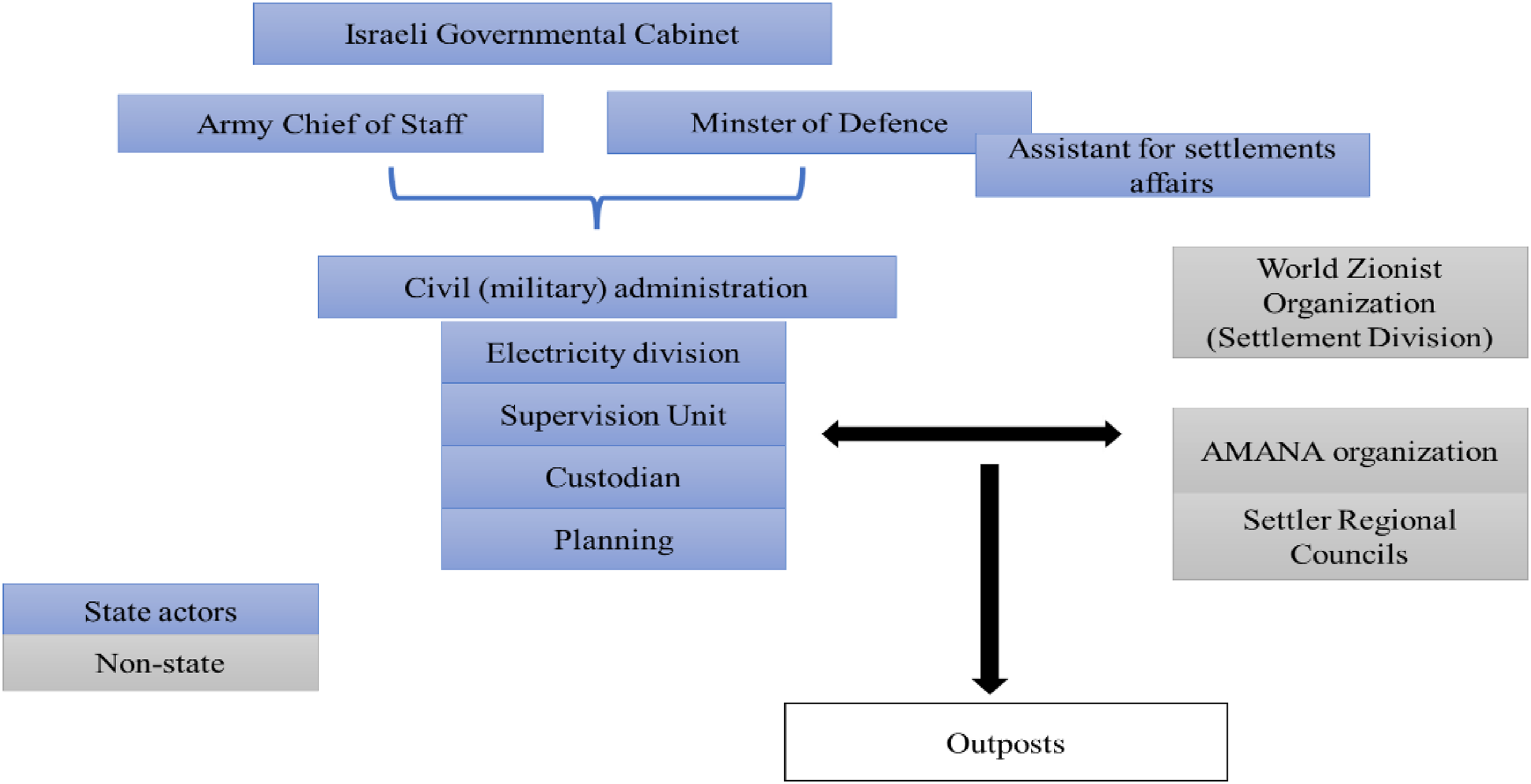
Actors involved in setting up outposts.
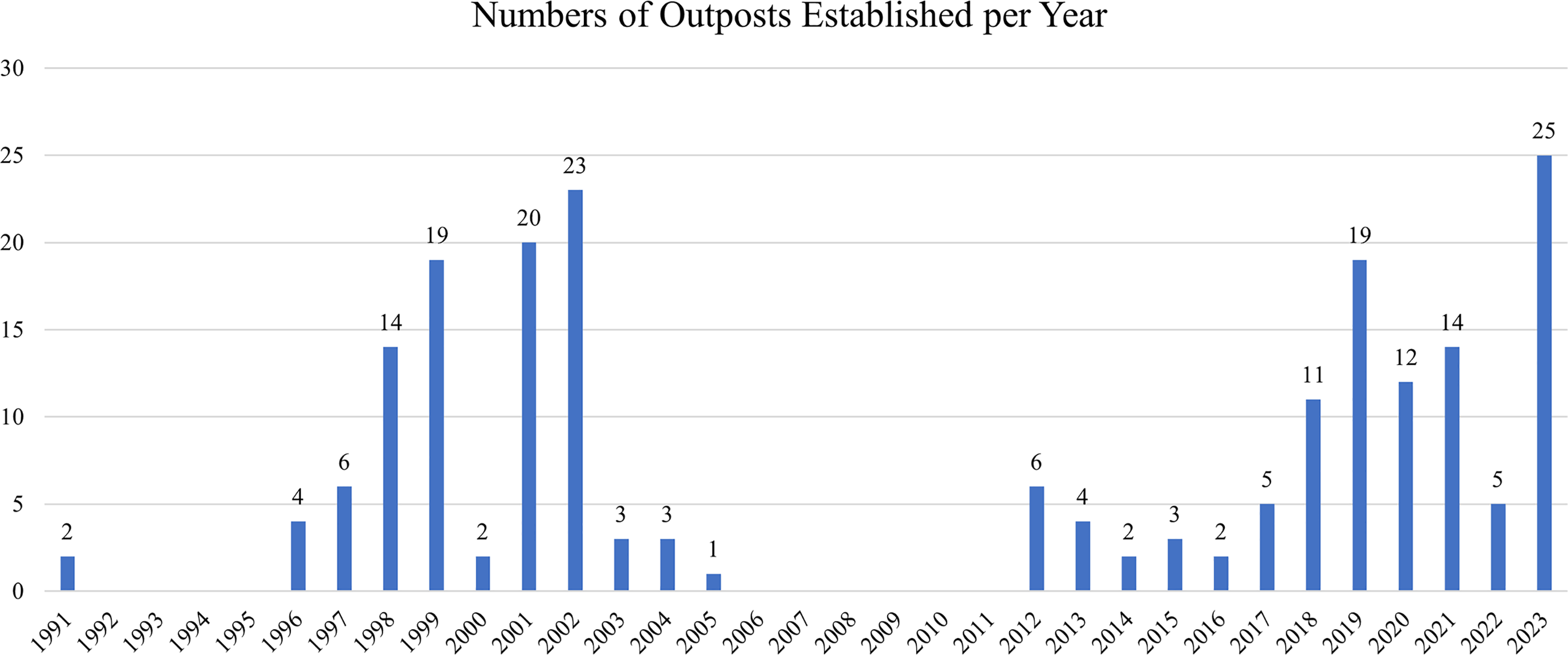
Evolution of outposts in the West Bank (1991–2023). Peace Now Data, online at https://peacenow.org.il/en/settlements-watch/settlements-data/population.
First, bureaucratic entities, including the Civil Administration and the Supervisor of Governmental and Abandoned Property Unit, navigate the legal and administrative aspects of outpost establishment. The Civil Administration, operating within the military administration of the OPT, oversees the management of state lands and law enforcement concerning illegal construction. The Supervisor plays a crucial role in permitting mobile homes’ access to the territories, a process heavily influenced by the Assistant for Settlement Affairs. 39
Second are settler entities. The Settlement Division, established in 1971 under the auspices of the World Zionist Organization, operates to assist the Israeli government in the creation of settlements within the Occupied Territories. Despite being exclusively funded by the government, the Division does not assume a governmental status and, consequently, is not bound by the regulations and constraints applicable to public bodies. Notably, the government has conferred upon the Division two principal authorities: the management of land, which includes the allocation of state-owned land to settlers through suballocations, and the allocation of budgets and execution of projects within the settlements. AMANA (“Covenant”) is another settler organization similar to the Settlement Division, with the distinction that it originated and evolved through settlers’ efforts before attaining formal recognition in the late 1970s.
Finally, the political landscape is shaped by influential figures such as the Minister of Defense (MoD) and their Assistants for Settlement Affairs. These figures hold the authority to approve critical actions, including land surveys, planning, and the introduction of mobile homes into the OPT. Over time, the Assistant for Settlement Affairs has evolved from a position created to counter settler influence to becoming a valuable asset for the settlers, providing them with a direct link to the MoD's administrative and political resources. 40
The evolution of the role of the Minister's Assistants signifies a notable transformation in its original purpose. Initially established during Rabin's premiership, Mordehai “Mota” Gur, a former minister and ex-IDF chief of staff, was appointed by Rabin as Deputy Minister and Assistant for Settlement Affairs. Gur's appointment aimed to counteract settler influence on governmental decisions. However, over time, the position of the Minister of Defense's Assistant evolved into a valuable tool for settlers, providing them with the means to exert influence over the administrative and political resources of the Ministry of Defense (MoD) and shape outpost construction. This shift in dynamics became apparent as settlers, who had experienced marginalization during the Rabin administration, recognized the necessity of securing access to loyal officials capable of influencing MoD decisions directly.
In the words of Rabbi Yoel Ben-Nun, a spiritual leader among religious settlers, “With all my love for Mota, I cannot count on agreements with people whose position is too weak to commit to, or [who do not] stand behind their commitments.” 41 Consequently, since the return of Likud to power in 1996, influential settler leaders have consistently filled the assistant position with a strategic focus on advancing outpost construction. A settler leader emphasized the importance of having a representative within the Ministry, stating that “it's important to have one of us next to the Minister of Defense; therefore, we are very careful who represents us in the Ministry.” 42 Simultaneously, the Minister of Defense seeks an Assistant appreciated by settlers and knowledgeable about their security needs, especially considering the escalating violence in the territories during the 1990s.
In 2000, Netanyahu explained how he had deceived the then president Bill Clinton into imagining he was improving the application of the Oslo Accords while at the same time destroying them. The “trick,” he said, is “not to be there [in the occupied territories] and be broken; the trick is to be there and [to] pay a minimal price.” 43 This “trick” consisted in enlisting hilltop settlers so that the government could officially oppose any illegal construction yet choose to tolerate it and, in most cases, to empower its instigators.
The following section explores the roles played by the aforementioned actors in creating outposts. It is usually assumed that the outposts were created by individual settlers who acted in defiance of state authority. Thus, correctly understanding the process of establishing outposts means placing it within the complex interplay of three phases: (1) establishing a human presence and land acquisition; (2) planning, construction, and maintenance; and (3) retroactive legalization.
Human Presence and Land Acquisition
The first step in setting up an outpost is smuggling mobile homes into the OPT.
44
Once parked in the intended location, only a small number of settlers are needed to sow the first seeds of an outpost.
45
Often, these forerunners used false pretexts to establish a settlement, such as complaints about poor internet connection, requesting a communication antenna on a coveted hill, or requesting permission for an agricultural farm. Alternatively, outposts are established as expanding existing ones.
46
Boaz Melet, founder of the Adei Ad outpost, describes the founding moment of its outpost: With the help of Ze’ev Hever (Zambish), one of the leaders of Yesha, we founded a yeshiva here. In the first month only, the bachelors stayed to live here in an empty bus we brought for that purpose, and those of us who are married took turns guarding at night. A month later we brought a caravan up to the hill and I moved into it with my wife and children.
47
The people from the inspection unit of the Civil Administration report to the head of the Civil Administration on an illegal outpost; the head of the Civil Administration sends the information to the commanding officer; this officer forwards the hot potato to the Defense Minister's Office; the Defense Minister's Office requests the opinion of the Deputy Chief of Staff; the Deputy Chief of Staff lobs the list of illegal outposts to the Chief of Staff; the two of them request instructions from the Defense Minister; the Defense Minister convenes a meeting of everyone involved and declares that illegal construction must not be permitted in the territories; the invitees depart and the Minister remains in his office with the deputy for settlement matters and the Chief of Staff. While the commanding officer and the head of the Civil Administration wait for instructions from the Minister, they, the settlers, do not wait for even a moment. They transfer in more and more mobile homes, hook up a generator, erect a synagogue, build a mikveh [ritual bath] and push a road through.
49
Such ceremonial procedures mean that the state apparently sticks to established procedures, yet at the same time it allows the construction of outposts “under the radar.” The Sasson Report gives an important summary of the role of the Assistant to the Minister of Defense in enabling these illegal settlements, stating that he “acts contrary to the policy of the Minister of Defense. . . . His job is to implement the policy of the Minister and the Ministry, and not to create his [own] independent policy, which is opposite to official policy.” 50
Once a human presence is established and the basic buildings remain intact, the next step is to erect a permanent construction. Here, the two key institutions in the Civil Administration come into play: the Settlement Division and the Supervisor of Government and Abandoned Property. It is important to note that most of the land in the OPT is considered state land. 51
The state of Israel seized and controlled land in the OPT by using four different mechanisms: (1) the declaration of land as abandoned property, (2) the expropriation of land for public needs, (3) the requisition of land for “essential and urgent military needs,” and the most far-reaching of all, (4) the declaration of coveted areas as state land. 52
As mentioned earlier, several of today's permanent settlements started as illegal outposts. Over time, a system of anarchy developed in the different land allocation processes between the Supervisor and the Division. The latter increasingly gained independence and autonomy in its allocations. In the Sasson Report, it is noted that “the State does not supervise or even know what the Settlement Division does. The problems associated with the independent system run by the Settlement Division for land management are well known to the relevant parties and were even mentioned in the State Comptroller's Audit Report. The lawlessness that characterized the relationship between the two parties is convenient for all parties involved.” 53 Thus, the Division became a significant actor in expanding the outposts. Legally, it can only allocate land for settlers with government approval. In fact, it exceeds its authority and acts on its own initiative to establish new outposts: it sets settlement priorities, allocates funding, and shapes policies with the passive approval, and sometimes the active knowledge, of government. The government has commissioned investigations and legal inquiries, and NGO reports recount Division transgressions in land allocation, instances where it allocates land initially received for planning purposes or even without a valid planning scheme. 54 Some of these outposts exceeded their assigned limits and were partly built on privately owned Palestinian land. 55
Indirect governance is at the core of Israel's approach to the OPT. According to Deputy Attorney General Dina Zilber, this is delegation to a body where “the obligations of administrative law do not fully apply [and which is enabled] to shield the government from blame over the expansion of the outposts.” 56 Zilber later described the relationship between the Supervisor and the Division as a “forbidden delegation of power” tainted by structural pathologies. Thus, this allows the political echelon to shield itself from blame while hiding the process from government bodies that do not have the powers to bypass such illegality. As repeatedly explained by Zilber, over the years, the Division became the government's “backyard.” 57
Planning, Construction, and Maintenance
The next step in transforming outposts into permanent homes is planning and construction. Planning in the OPT is a tightly regulated and expensive process, 58 yet necessary to proceed with construction and, perhaps a lesser-known fact, necessary for settlers to be allocated mortgages for settlement buildings. The planning system in the OPT was initially inherited from the Jordanian model. However, it underwent some substantial changes under Israeli military rule, which eventually granted settlers planning powers. The Jordanian planning system encompasses a triple-layered hierarchy of local, district, and Higher Planning councils (HPCs). In 1971, Israeli Military Order no. 418 altered this planning hierarchy: it eliminated the district councils, impeded any Palestinian representation in the planning institutions, and eliminated the option of selecting village councils as local planning councils. Simultaneously, the Order also established that the military commander should appoint the HPC, which appoints subcommittees to remedy the vacuum left by suppressing the district councils. Interestingly, the newly established councils were allowed to include external parties. 59 Consequently, for several years, the subcommittees were filled by settlers. 60
The military bureaucracy provided settlers with planning powers by appointing councils for domains that did not exist under Jordanian jurisprudence. Thus, all settlements recognized by the government were declared new planning areas by the Israeli military commander and provided with special planning committees; these local settlement councils were then appointed as special planning committees. 61 These committees can draw up planning schemes, issue building permits, authorize subdivision schemes in certain situations, and complete inspection and enforcement. This sort of development accentuates the Sasson Report's “dropped one scale” comment on the shift in settlement decision making from political actors to bureaucratic officials who are not authorized to make such decisions. According to the Sasson Report, this method of building without planning permission did not occur “by accident, but rather as a system.” The report notes that “the Division never even attempted to authorize a plan before building started.” 62
Consequently, regional settlers’ authorities had become the engine to preempt planning requirements. As already mentioned, any construction must obtain approval from the MoD and the HPC of the Civil Administration. However, the local settlers’ councils use their authority to initiate planning procedures to start construction without planning approval. Planning procedures are costly, but this is usually handled by regional councils, AMANA, and the Settlement Division through private planners using resources from the Ministry of Housing.
63
They are then submitted to the HPC for approval. Concomitantly, the settlers do not wait for planning approval to start building. The special planning committees issue fictitious building permits under ambiguous titles such as “subject to the approval of the commissioner for granting permits in the West Bank,” “construction permit in principle,” or “contingent construction permit.” These initiatives are illegal, as emphasized by the Civil Administration's Legal Advisor: “The Special Committee for Planning and Construction [of the Jordan Valley Regional Council] acted illegally while issuing documents in the guise of permits, without any authority and with illegal backing.”
64
Significantly, such permits not only enable the start of construction but also allow settlers to obtain a mortgage for illegal homes and, in some cases, to have connections to public infrastructure (electricity, water, sewage).
65
These documents give a particular impression of legality, thus misleading the settlers themselves. The secretary of one illegal outpost, Givat Harel, describes such procedures: The construction . . . involves the Council and has the Council's certificates and everything. The settlement is not yet defined as legal; we do not have a settlement emblem. . . . Whoever builds here and gets a parcel number is recognized in the Council, and the settlement is run very much according to the Council's building regulations.
66
You don’t need the state budget; there is the Settlement Division budget. The state allocates 500 million [shekels] per year [and says] do with it whatever it takes to build a settlement.
69
In addition to the social and political support it provides to the outposts, AMANA is also a significant contributor to the development of outposts through lobbying on their behalf with the relevant electricity company to increase the power supply. The Esh Kodesh outpost treasurer explains that AMANA is an ideological body that helps and supports the settlements, but it is not only a sponsor; it helps in consulting, providing opinions, in planning. . . . AMANA is like our support system, the body that brings together most of the settlements in Judea and Samaria. It's more like a lobby, it's not a funding body.
70
Finally, outposts also secure resources through tax-deductible donations. This is done through a nonprofit organization, the Fund for Nurturing the Zionist Idea (NFZ), which raises funds for settlements, including illegal outposts. The organization used the Income Tax Ordinance (Section 46A) to offer tax deductions to its donors. It transferred them to illegal outposts while finding fraudulent ways to enable tax-deductible donations. 71
Retroactive Legalization
With this system of collusion between various layers of Israeli bureaucracy in the OPT, by 2010 over 120 outposts had been established. However, given that the Israeli Supreme Court ruled against the construction of settlements on privately owned Palestinian land, and in the face of critical numbers of petitions to the Israeli High Court of Justice filed by Palestinian landowners via Israeli NGOs, government officials pledged the enforcement of the demolition and evacuation orders that are were increasingly issued. Each of these evacuation or demolition orders induced a political storm in Israel and left the respective coalition governments in crisis. The realization that the Israeli Supreme Court was likely to authorize the evacuations and demolitions of illegal settlements pushed the Netanyahu-led Thirty-Second Government of Israel (2009–13) to start looking for legal solutions to avoid such action. One way to accommodate the settlers’ desires was to annex the entirety of the occupied territories to Israel, or to legalize all outpost construction with a sweeping expropriation of private property rights. A range of factors militated against this aggressive response. Internally, such moves faced strong partisan opposition and constitutional challenges likely to lead to its annulment by the Israeli Supreme Court. Externally, the move reinforced the argument that Israel operates an apartheid regime. These factors make an authoritative replacement of the existing institutions difficult and tend to make gradual transformation more attractive as a pathway to change. As such, by 2011, the Israeli authorities pursued a quieter policy that sought the “reinterpretation, redirection, and reappropriation of existing planning and land ownership rules, introducing new legal doctrines such as administrative promise, marché ouvert, and flexible contiguity.” Kobi Eliraz, former Advisor to the Minister of Defense for Settlement Affairs, calmly explained that this process of retroactive legalization of outposts is “wisely being pursued quietly,” 72 and that the processes undertaken would lead to the approval of 99 percent of the outposts.
The attempt to legalize the outposts without going through the head-on creation of new settlements led to the establishment of the Levy Committee in 2011. The Committee's remit was to assess the legal status of Israeli structures in the OPT. 73 It consisted of Edmund Levy, formerly from the Tel Aviv District Court, Judge Tehiya Shapira, and the international lawyer Alan Baker. The Committee was appointed by Prime Minister Netanyahu and the Minister of Justice Yaakov Ne’eman. It is important to remember that all three members of the Committee had clear connections to the right-wing camp. 74 A year after its nomination, the Levy Committee submitted its report on June 21, 2012. Its main conclusions were, on the one hand and from an international perspective, that the occupation is not belligerent. Therefore, the international law of occupation is not applicable in the OPT, making Jewish settlements completely legal. On the other hand, from the perspective of Israeli public law, the establishment of unauthorized outposts is legal. Thus, the government should retroactively authorize all outposts built on public and privately owned land. The second part of the Levy Committee is the focus of the rest of the article.
The Levy Committee is based on the rationale for retroactively legalizing the “administrative assurance” doctrine. This doctrine establishes that a promise made by a government agent to a citizen is “binding.” Thus, the state must fulfil its promises even though it may oppose the prospect of doing so. The Committee derives the concept from interpreting previous cases handled by the Israeli Supreme Court.
75
Most importantly, it based its position on the 2005 Sasson Report but reinterpreted its conclusions. The Committee examined the testimonies presented by the Sasson Report. It stated that given the continuous and consistent government activity in their favor, the settlers had reason to believe they were acting with permission. The report avers that government encouragement of outpost construction, through its agents, conferred an “administrative assurance” to outpost settlers, even if no legal and official permits were issued. The Committee concluded that the government, through its agents, had made the outpost settlers an administrative promise. As a consequence, the Committee contends that the state made a binding promise and that there is no legal justification to releasing the state from that promise. The Committee summarized its comments on the matter as follows: As noted, the latter [the settlers] were entitled to assume that the government was acting as required by law and without contradicting its own decisions regarding settlement in Judea and Samaria. . . . Moreover, there can be no doubt that a promise of this type was made by a person empowered to do so, with the intention of granting it legal validity, and that those making the promise (the Government of Israel, through its agents) are capable of fulfilling it. A further question is whether the government has grounds to retract the said promise, and a negative response to this question would seem to be obvious. . . . Regarding the substance of the promise, too, we did not find that the government has grounds for retraction. . . . Our conclusion is that the establishment of these settlements was undertaken with the knowledge and encouragement of the most senior political echelon . . . and, accordingly, this conduct is to be considered tantamount to implied consent. Accordingly, in our opinion, it is possible to proceed to regularising the status of these settlements without requiring a further decision by the government or any of its ministers.
76
To find solutions for these legal and planning obstacles, in 2016 the government appointed a special committee to resolve the legal planning issues and to regularize planning. The team's establishment was part of the coalition agreement between Likud and the Jewish Home party. According to the Letter of Appointment, the Committee was established as “a professional team for the purpose of drafting a plan for regularizing structures and neighbourhoods in Jewish settlements in Judea and Samaria constructed with assistance from the authorities.” The Committee was headed by Dr. Haya Zandberg, former director of the State Attorney's Office Department for Civil Matters. 77 In line with the reasoning of the Levy Committee, the Zandberg Committee attempted to provide the government with the tools to resolve the issue of privately owned land for the retroactive approval of outposts and neighborhoods, even without an explicit law and thus in a covert way. In his briefing to the Knesset Internal Affairs Committee, Kobi Eliraz, Advisor to the Minister of Defense for Settlements, referred to the Levy Report and the members of the Zandberg Committee as the “Ten Commandments,” and to the Zandberg Committee Report as a “more detailed codex.” He added that work on implementation with the Civil Administration was underway and that it was “wisely being pursued quietly.” 78
On February 15, 2018, the Zandberg Committee delivered its final report to the Prime Minister. Unlike other investigations on illegal Jewish buildings in the West Bank, such as the Sasson and Levy Reports, the Zandberg Report was not presented to the government in an official ceremony and was never publicly published. 79 Like the logic of the Levy Committee, the Zandberg Committee reinterpreted existing planning and land rules by introducing legal concepts such as marché ouvert and the reappropriation of the principle of contiguity. Importantly, it provided a practical outline for regulating Jewish settlements in the West Bank by addressing the issues of ownership, planning, and municipal and governmental approval. The Committee classified the outposts and neighborhoods with a status difficult to “regularize” according to three “archetypes.”
The first of these archetypes is “flaws uncovered retrospectively.” This method concerns structures built on land that had been erroneously considered public land and later revealed to be privately owned Palestinian land. The Committee recommended using the marché ouvert doctrine to legalize these unauthorized outposts. The Israeli authorities interpret the “open market” doctrine as a legal framework to protect parties who acquired land based on incorrect documents or in circumstances where land was sold by someone other than its legal owners. The Committee relied on Section 5 of the Military Order on Governmental Property, which states that the “open market” applies to persons who participated in good faith agreements with the Supervisor of Governmental and Abandoned Property: “Any transaction entered into in good faith between the Supervisor and any other party with regards to any property the Supervisor held to be governmental property at the time of the transaction shall not be disqualified and shall remain valid even if it is proven that the property was not, at the time, governmental property.” 80 The Committee recommended that the “open market” doctrine be transformed from a “defensive” argument into proactive government policy with few, if any, constraints in order to legalize the 2,700 to 3,000 structures. 81
The second archetype is the “suspended islands” method. This refers to unauthorized Israeli outposts built on public land at a considerable distance from any approved Israeli settlement. The Committee recommended the flexible application of the contiguity principle, which stipulates that new communities should be created close to existing ones to maintain urban continuity. The report states that “a dogmatic, rigid application of this Israeli planning principle in Judea and Samaria might present difficulties to the feasibility of planning ‘regularization’ of ‘suspended islands.’” 82 This enables the Israeli authorities to create new settlements and to circumvent the obligation to obtain the necessary approval by misrepresenting outposts as part of the neighborhood of an existing settlement and thus sidestep potential domestic and international criticism.
The third is “existing settlement expansions.” This method refers to structures located near older Israeli settlements that were set up with government approval and that invade privately owned Palestinian land. The Committee acknowledged that it would be impossible to regularize these structures in terms of planning and property. However, it suggested refraining from evacuating outposts at all costs. It also suggested initiating municipal regularization that would enable settlers to receive municipal services from the nearest Israeli regional or local council. It also suggested alternative ways to legalize settlements by using a process of “consolidation and subdivision, or reparceling,” 83 where plots in a particular area are merged into a single plot and then divided among all rights-holders in line with their planning needs.
The settler community praised the Zandberg Committee's recommendations. The Justice Minister, Ayelet Shaked, of the Jewish Home Party commented that “the end of the era of uprooting settlements without purpose in Judea and Samaria was led by a team that found legal ways to regulate settlements in Judea and Samaria and to end the shame of evacuating settlements for no real reason.” 84 The report provides legal tools compatible with international law for building settlements in the OPT. Even before the report was presented, the Israeli authorities started implementing the Committee's recommendation. Already in 2017, Minister Shaked stated that they “have been relying heavily on the solutions recommended by the regularization committee during the past two years.” 85
Similarly, in 2017, the governmental security cabinet appointed a Task Force for the Regularization of Structures and Neighborhoods in Judea and Samaria to implement the Zandberg Committee's recommendations within three years. It established a team of ten reporting directly to the Prime Minister's Office with a 5-million-shekel annual operating budget.
86
Significantly, the chair of the implementation task force was given to Pinchas Wallerstein,
87
a prominent member of Gush Emunim, leader of the Yesha Council who had served as head of the Binyamin Regional Council in the West Bank for almost thirty years. Other task force members included the Ministry of Justice representative who had joined the team shortly beforehand, Amir Fischer (Ministry of Justice), and Kobi Eliraz, who participated in the Zandberg Committee discussions. The settler community warmly welcomed this appointment. The head of the Efrat Settlement Council, Oded Ravivi, explained that the government did well by deciding to establish this committee, and no one is more fitting to lead it than Pinchas Wallerstein. . . . Wallerstein is a man of action and everyone knows that he is familiar with the field. I am certain that his efforts will help us settle Judea and Samaria.
88
Despite the regular pace of the retroactive legalization of Israeli outposts, in 2017 the religious national and settler community expressed its dissatisfaction with the government's decision to finally implement a longstanding decision by the Israel Supreme Court to begin dismantling the settlement of Amona. As a reaction, the settler movement demanded its price. The Knesset approved the “Settlement Regularization” Law. This was an aggressive response by the Israeli establishment to the Court petitions with which Palestinians hoped to repossess their property. The new legislation created a way to expropriate usage rights in privately owned Palestinian land. It was intended to regulate building on privately owned land in the West Bank by appropriating rights of use and possession, and its allocation to the settlements that were built on that land, with compensation for the Palestinian landowners. The second is construction on land that was not declared state land through registration as government property, with the provision of a period of one year to allow land claims with proof of rights. The Law applied to all buildings carried out in good faith or with the state's consent, implicit or explicit. The adoption of the Settlement Law caused intense public protest. In particular, the Attorney General refused to endorse it, claiming it was unlawful. In an unprecedented step, the state engaged a private counsel to represent its interests in Court. As intended, the Court declared the Law unconstitutional by an eight-to-one majority, ruling that it breached the fundamental rights to property, dignity, and equality guaranteed under “Basic Law: Human Dignity and Liberty (the Basic Law),” one of the fourteen Basic Laws of Israel's constitutional framework.
Public opinion inside and outside Israel applauded the decision, 89 yet the choice had unforeseen consequences. The logic and legal bases of the Court's ruling were complex. The constitutional path for invalidation was not based on the Knesset's lack of authority to legislate in the OPT as per International Humanitarian Law. Instead, the Court asserted that the Law breached the Israeli Basic Law on Human Dignity and Liberty and was thus unconstitutional. The Court's decision was an exceptional challenge to the traditional principle that the Israeli Military Administration had legislative authority over the OPT. The decision sidestepped the question of whether a Knesset law is applicable in the OPT and instead investigated whether the Law's violation of Palestinians’ property rights was in line with “Israeli constitutional norms.” This can be interpreted as “annexationist reasoning,” implying the indirect implementation of Israeli constitutional law to Palestinians in the OPT.
Concluding Remarks: The Settler Movement's Success and the “Jewish and Democratic State”
This article demonstrates how the varying competence requirements of different Israeli governments—namely, operational deficits and legitimacy concerns—have shaped Israel's attitude toward nonauthorized outposts, resulting in their subsequent transformation into permanent “legal settlements.”
The article presented two main arguments. The first argued for a blame-avoidance strategy, suggesting that the government was able to achieve its desired outcome by allowing outpost settlers to act on its behalf, especially when the Israeli authorities faced constraints in establishing new settlements owing to internal and external condemnation following the Oslo Accords. The second part argued for a strategy to “regularize” outposts into new settlements by actively redirecting existing planning and land ownership laws.
Within a broader context, this article displayed some aspects of the success of the Israeli settler movement. For over five decades, Israeli governments spanning the political spectrum, including both left-wing and right-wing administrations, have tolerated and utilized the settlers to control the Palestinian population and their territory indirectly. The government's dependence on the assistance of the settlers eroded its control over them. This, in turn, gave the settlers the freedom to make the occupation permanent and virtually reversion-proof. 90 As of 2023, Israel's settlement project has led a population of over 475,000 Israeli settlers (excluding East Jerusalem) to reside in ever closer proximity to approximately three million Palestinians. The settler movement became a powerful interest group whose ideological program has been embraced, to varying degrees, by successive Israeli governments. Today, the current Israeli government endorses a right-wing political agenda that was formerly championed by only a faction within the Zionist movement. This group historically held relatively minor influence. 91
Hence, the achievement of the Israeli settler movement is undeniable. This success is evident in the realization of the dream held by right-wing settler movements—the vision of a united Greater Israel, even if de facto and not de jure. However, such success comes at a twofold cost. First, the increasing abandonment of the two-state solution agenda, both in rhetoric and policy. 92 In recent years, Israeli authorities have not only embraced a different discourse wherein the desirability of the two-state solution seems compromised, but they have also been actively involved in establishing the organizational groundwork for potentially annexing the West Bank. 93 Secondly, there has been a noticeable shift away from the liberal Zionist vantage point, with growing skepticism about the feasibility of maintaining both a Jewish and democratic state. This shift is coupled with increasing parallels between the ongoing occupation and the historical South African apartheid regime. Renowned liberal Zionist scholars like Peter Beinart have articulated the idea that Israel's enduring control over the West Bank poses a challenge to the concept of a Jewish and democratic state. 94 Additionally, several prominent Israeli-Jewish figures, including former Prime Ministers Ehud Barak and Ehud Olmert, have likened the occupation to an apartheid regime. 95
The discourse surrounding the tension between the Jewish and democratic facets of Israel's identity is not new. 96 However, this debate has gained prominence due to the recent proliferation of legislative acts emphasizing the state's Jewish character at the expense of its democratic nature. It is noteworthy that, while Israel was established as a Jewish state in 1948, the term “Jewish” was formally integrated into the legal framework only in the 1990s. 97 The Jewish Nation-State Basic Law of 2018 marked a significant juncture, indicating the Israeli government's prioritization of its Jewish identity over its democratic nature.
A key point meriting further research is the relationship between the increasing institutionalization of the state's Jewish identity and the achievements of the settler movement. The success of the Israeli settler movement lies in its ability to blur the distinction between Israel and the OPT, thereby challenging the once self-evident concept of a Jewish majority. One might conjecture that the assertion of the state's Jewish identity through legal mechanisms suggests the inadequacy of past tools employed to maintain ethnic separation. This engenders an inherent paradox between maintaining a Jewish and democratic state and reopens the debate concerning the state's self-definition as such for the foreseeable future.
Footnotes
Acknowledgments
I would like to thank the editors of Politics & Society for very helpful comments on the earlier version of the article. I also profited from insightful comments from Dianna B. Greenwald, Philipp Genschel, and Seth Anziska.
Declaration of Conflicting Interests
The author declared no potential conflicts of interest with respect to the research, authorship, and/or publication of this article.
Funding
The author disclosed receipt of the following financial support for the research, authorship, and/or publication of this article: Funding of this work was supported by a grant from the Italian Ministry of Foreign Affairs and several fieldwork grants by the European University Institute.