



Abstract
Strong claims have been made about the incompatibility between large-scale migration and advanced welfare states. The free movement of workers within the European Union (EU) offers an interesting case for the study of the fiscal effects of unrestricted labor migration in different types of welfare states This article therefore investigates the alleged tension between advanced welfare states and liberal migration policies by analyzing how the fiscal effects of EU migrants vary across European welfare state regimes. In contrast to arguments commonly made in public debates, we argue and explain why theoretical reasoning should lead us to expect limited differences in fiscal effects of EU migrants in different welfare states. The empirical analysis, covering twenty-nine countries during 2004–15, shows that the net fiscal impact of EU migrants in the different welfare state regimes of West European countries is positive, and we find no major differences in the fiscal impacts of EU migrants across Western regimes. These results from the EU case cast doubts on the claim that advanced welfare states are incompatible with large-scale immigration because of adverse fiscal effects, and on the idea that broad institutional characteristics of welfare states have substantial consequences for the fiscal impact of migration.
Whether an advanced welfare state may be combined with liberal migration policies has been a pivotal topic for decades, both in public debates and among scholars of politics, migration, and economics. Milton Friedman famously argued that “it is one thing to have free immigration to jobs, it is another thing to have free immigration to welfare, and you cannot have both.” 1 Gary Freeman reasoned in a similar way when he in a prominent article concluded that “the relatively free movement of labor across national frontiers exposes the tension between closed welfare states and open economies and that, ultimately, national welfare states cannot coexist with the free movement of labor.” 2 Another example stressing a specific aspect of the same logic is the so-called welfare-magnet hypothesis, put forth by George Borjas, 3 which suggests that migrants disproportionally will move to more generous welfare states to take advantage of benefits and services. The fundamental argument in these seminal works is that advanced welfare states are incompatible with unrestricted migration because if migrants get full access to welfare benefits and services, it will imply an unsustainable fiscal burden on the host country.
The system of free movement of labor in the European Union (EU) is an intriguing case in light of this incompatibility argument as it largely represents what is alleged to be impossible. EU citizens enjoy the unrestricted right to move and take up employment in any other EU country and—as long as they are “workers”—have full and equal access to the host country's national welfare system (for more details, see the section on institutional background below). Furthermore, national welfare states within the European Union differ considerably in terms of generosity, qualification requirements, and funding principles. We reason that these differences in national welfare states within the common system of free labor migration make the European Union a well-suited case for testing the fundamental reasoning behind the incompatibility argument above: it enables us to study not only if there is a negative or positive effect of immigration but also to analyze if the fiscal effects of EU migration vary across different European welfare states and, particularly, whether there are larger fiscal burdens connected to more inclusive and generous welfare states. Because institutions governing intra-EU migration are the same within the union, we avoid the problem that the fiscal effects of migrants may be affected by cross-country differences in migrant admission policies, migrants’ rights to access employment, and legal restrictions on migrants’ access to welfare in the host country. Instead, by focusing on free movement of labor within the European Union (where all EU countries use the same rules on these issues), we are able to focus on the specific role of national welfare institutions in shaping the fiscal effects of migrants.
Our study is also motivated by recent public discussion within the European Union. While the system of free movement has benefited millions of EU workers, its consequences for host economies and societies have been the subject of intense public and political debates in many European countries, especially since the Great Recession in 2008–12. The fiscal effects of intra-EU mobility have been a central concern in these discussions, particularly regarding the effects of granting EU workers unrestricted access to the host country's welfare state. Questions have been raised in line with the alleged tension between open borders and advanced welfare states. Does free movement encourage so-called benefit tourism 4 and do generous welfare states function as “welfare magnets” and thereby create negative fiscal effects for host countries that also vary between welfare state regimes? Is the alleged tension between unrestricted migration and advanced welfare states finally coming to the fore also in the apparently “exceptional” case of free movement of labor in the European Union? The discussions surrounding the United Kingdom's Brexit referendum in 2016 (i.e., the national referendum on whether to leave or stay in the European Union) provide the most conspicuous example of heated public debates about this tension in recent years. The Leave campaign frequently criticized the European Union's system of free movement 5 for resulting in high levels of EU migration to the United Kingdom, and for allowing EU migrants the right to claim a wide range of benefits, which in turn was presumed to be highly costly to the United Kingdom. Such views among the public were also important for explaining the outcome of the referendum. 6 However, in recent years leading politicians in Austria, Denmark, and the Netherlands have also proposed restrictions on EU workers’ access to welfare benefits, based on the argument that specific aspects of their national welfare systems create particular (and unwarranted) costs and effects due to differences in the organization of social protection systems across member states. 7
Even though the system of free movement is such an interesting case for testing long-standing theories of migration and welfare states, and despite the high salience of the issue in public policy debates in European countries, research on the fiscal effects of intra-EU migration, especially across different countries and welfare systems, has been limited. Most existing studies of the fiscal impacts of intra-EU migration have focused on single countries or a small group of countries. 8 Most comparative research on the fiscal effects of immigration in Europe has not differentiated between intra-EU and other migrants, 9 although recent research has begun to address this issue. 10 However, with one exception, 11 these recent studies do not systematically examine variations in the fiscal impact of EU migrants across different types of welfare states.
The aim of this article is to investigate whether unrestricted migration may be combined with advanced welfare states by analyzing the direction of the fiscal impact of free movement in the European Union, and whether and how these effects vary between different welfare regimes in Europe. We develop an institutional perspective on the fiscal effects of intra-EU mobility and test our expectations by exploiting data 12 on the fiscal effects of EU migrants in almost all countries of the European Economic Area (EEA). We focus on the institutional aspect to address the general question of whether the fiscal effects of unrestricted labor migration vary with the institutional design of welfare states, but also because scholarship on intra-EU migration commonly argues that different welfare state institutions impact the fiscal effects. 13 However, this latter claim has not been subject to systematic empirical assessment. Our data cover the time period 2004–15 and thus make it possible to also study variations over time, particularly in relation to the Great Recession of 2008–12.
Our empirical analysis seeks to cover the full fiscal impact of EU migrants in the host countries (inward mobility), including all public expenditure—such as welfare benefits and services—as well as public revenue stemming from migrants through, for instance, income tax payments. We take this broad approach to be able to assess the total fiscal impact of intra-EU migration, thus avoiding a possibly biased view of the actual impact by focusing on isolated parts of the public budget. However, the article does not consider the fiscal effects of emigration (outward-mobility) on migrant-sending countries. Our analysis includes all EU countries, except Luxembourg and Romania, and adds Norway, Iceland, and Switzerland, which are part of the system of free movement of labor in Europe.
Our analysis focuses on the fiscal impact of intra-EU migration because of its bearing on the general question of the compatibility of open borders and generous welfare states. There are, of course, other important issues and highly contested dimensions of European migration debates that we are not analyzing in this article. These other dimensions include, for example, long-standing debates about labor market competition between citizens and migrant workers from within and outside the European Union and, especially in recent years, a range of issues related to asylum and refugee protection including public attitudes and policy preferences. 14
To preview our results, we find that the fiscal effect of an average EU migrant household is positive in all of the different welfare state regimes of West European countries, where most of the intra-EU migrants reside. The differences in the fiscal effects between these regimes are relatively small and not statistically significant. However, the fiscal effects are significantly less positive—or even negative—in the East European welfare regime. To the degree that there are differences between the regimes, these variations in the fiscal effects can largely be attributed to differences in migrants’ age, employment, wages, and the fiscal balances of the countries included in each regime. The fact that we do not find any significant differences between the Western regimes, in spite of their considerable institutional differences in terms of, for instance, welfare state generosity and coverage, implies that previous literature may have overestimated the impact of national institutions on the fiscal effects of intra-EU migration. Our findings also imply that policymakers do not have reason to restrict EU migrants' access to national welfare states within the system of free movement because of risks of adverse fiscal effects. On a more general level, our study suggests that there is no absolute incompatibility—at least in terms of fiscal effects—between generous welfare states and unrestricted labor migration within a region. The absence of a relationship between welfare state regime and the fiscal effects of EU migration implies that welfare state institutions are not necessarily a primary driver of the fiscal effects of migration.
Institutional Background: Free Movement of Labor within the European Union
The principle of free movement of labor is one of the fundamental freedoms of the EU single market, instituted already through the Rome Treaty in 1957. 15 This principle stipulates that EU citizens who are “workers” are entitled to look for and take up jobs in other member states as well as to stay there during, and to some extent also after, their employment. Furthermore, workers are entitled to equal treatment compared to host country nationals in regard to working conditions and access to the national welfare state. However, the design of social policy is mostly the responsibility of each EU member state and differs substantially across EU countries. Equal treatment does not entail harmonization of social policy within the union but only that EU member states cannot discriminate between EU migrant workers and host country citizens in terms of eligibility or generosity of welfare state benefits and services. However, for economically inactive EU citizens, long-term residence and access to national welfare systems are restricted.
Moreover, immigration of non-EU citizens is governed by national institutions (including immigration policies and restrictions of migrants’ access to welfare) and therefore subject to substantial differences across member states. In line with other high-income countries, most EU member states operate different labor immigration policies, with different admission requirements and rights after admission for low- and high-skilled migrants from outside the European Union. 16
The system of free movement of labor also applies to the non-EU countries of the European Economic Area (EEA)—Iceland, Liechtenstein, and Norway—as well as Switzerland. 17 Whenever we refer to EU migrants in this article, we also include EU migrants in the EEA countries and in Switzerland. As of 2021, there were 16.2 million EU migrants and 23.1 million non-EU migrants in the European Economic Area. 18
Welfare State Regimes and the Fiscal Effects of EU Migrants: What Can We Expect?
We develop our theoretical expectations in three steps. Our discussion begins with a brief review of the central role of migrants’ individual characteristics in influencing their fiscal effects in host countries. As a second step, we discuss why and how the fiscal impact of EU migrants may vary across countries with different welfare institutions, without yet considering differences in other related institutions. In the third step, we consider the national tax system and labor market regulations, and their links to the characteristics of national welfare institutions, discussing what they mean for the expected variations of the net fiscal effects of EU migrants across European welfare state regimes.
Individuals’ Characteristics and the Fiscal Effects of Migrants
Existing research on the determinants of the fiscal impact of immigration has mostly focused on the characteristics of migrants. 19 A well-known finding is that labor market participation and earnings of migrants are key determinants of their net fiscal contribution. This is mainly because revenues, for instance, from income tax and social security contributions, are positively related to wage income, whereas there is a negative relationship between earnings and the take-up of welfare benefits. Given the centrality of employment and wage income, it is not surprising that the reason for migration (e.g., migration for work, family reasons, or refugee protection) has been found to influence the fiscal effects of migrants, as labor migrants tend to have markedly more positive labor market outcomes than family migrants or refugees. 20 While most intra-EU migration governed by the principle of free movement involves labor migration, the potential role of different reasons for migration in shaping fiscal effects is relevant as not all EU migrants are in employment and some move for family reasons, to study, or for their retirement.
Apart from employment and labor income, a number of other individual characteristics can affect the fiscal impact of immigration, including migrants’ age, education, qualifications, and family composition. 21 However, many of these characteristics have a bearing on the fiscal impact of immigration through their effect on migrants’ employment and earnings. For instance, young migrants are more likely to work, and more highly qualified migrants typically receive higher wages. Naturally, migrants also create costs as they make use of public services and the welfare state in the host country, such as schooling for their children, health care, unemployment benefits, and pensions. To what degree these services and benefits are used by migrants depends on factors such as employment status, age, family composition, and whether family members have moved to the host country. 22
It is important to emphasize that these individual-level determinants of the fiscal effects of migrants are likely to be linked to the prevailing national institutions in two different ways. National welfare, the labor market, and other institutions influence the fiscal effects of a given group of migrants with certain characteristics, and they can also affect the characteristics and composition of migrants, for example, by influencing the numbers and share of migrants who are employed and, among those employed, who take up lower-paid jobs in the host country. Any theorizing of the potential links between national institutions and fiscal effects of EU migrants thus needs to take account of both “direct effects” (i.e., how institutions shape the fiscal effects of a given group of migrants) and “indirect effects” (i.e., how institutions may affect the composition of migrants in a particular country). Disentangling direct from indirect effects of institutions raises difficult methodological issues that we discuss later in the article.
The Role of Welfare State Regimes
We use the institutional regime approach to analyze how institutions are related to the fiscal impact of intra-EU migration. 23 In contrast to a “variable approach” that captures specific aspects of institutions, 24 the regime approach has the advantage of summarizing complex patterns of institutional similarities and differences across countries in a way that allows for analyzing relationships between composite institutional configurations and outcomes. This squares very well with our interest in examining the role of a large set of institutions and provides a strong rationale for our choice of the regime approach over the variable approach. While the latter is valuable for distinguishing effects of single distinct institutions, we aim to study how a considerable number of interconnected institutions within different institutional domains—that is, the welfare state, the labor market, and the tax system—are related to the fiscal impact of migrants. Thus, we apply a broad regime approach, considering not only welfare state institutions but also interconnected institutions governing the labor market and the funding of the welfare state, 25 because these latter institutions strongly influence the contribution from migrants to the public finances.
A common criticism of the regime approach is that it assumes that regimes are fixed over time and, consequently, does not capture policy changes. However, despite the turbulence created by the Great Recession, the social policy changes that have taken place during our studied time period have typically been small, implying that the regimes have largely remained intact. 26
Following the categories defined by Korpi and Palme, Ferrera, and Kuitto, 27 we distinguish five welfare state regimes: Basic security, Continental corporatist, Mediterranean corporatist, Universal, and State insurance (using our own labels). Table 1 summarizes the core characteristics of these regimes and presents the classification of countries.
Welfare State Regimes: Core Characteristics and Classification of Countries.
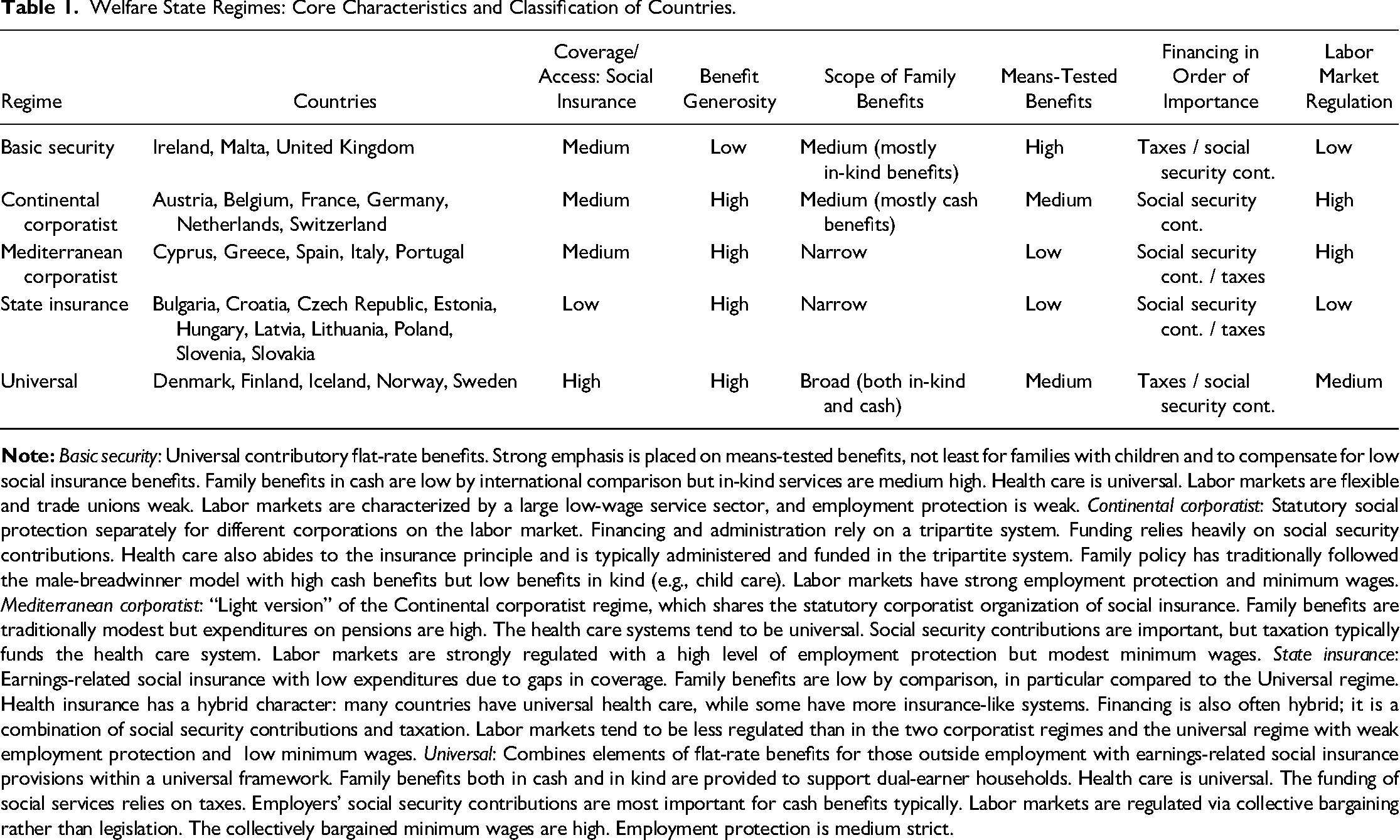
We identify six core characteristics of the different welfare state regimes that we expect to be of relevance for the fiscal impact of intra-EU migration. The first characteristic refers to the conditions in the social protection systems that regulate coverage. Differences in coverage may for instance be related to the length of contribution or qualification periods. The second regards the generosity of provisions, that is, how high benefit levels are. The third is about the scope of family policies; to what extent are cash benefits and benefits in-kind provided, for example, child allowances, maternity or parental leave benefits, and publicly funded child care. The fourth aspect concerns the role and relative importance of means-tested benefits, that is, to what degree are benefits only given after means-testing, in contrast to being universal or based on prior contributions. The fifth dimension captures the funding side—the relative importance of social security contributions versus taxation. While social security contributions are paid by employers or employees as a proportion of an employee's wage, taxation may include income taxes as well as other taxes. The sixth aspect is about the degree of labor market regulation, notably employment protection and minimum wages. Because of long-standing historical legacies and recent reforms, contemporary European welfare states differ significantly along all of these dimensions. 28 In Table 1, we offer short descriptions of the regimes and summarize the six core characteristics, primarily in terms of low, medium, and high, which helps us to formulate expectations about fiscal effects across the regimes.
Welfare Institutions and Fiscal Effects of Migration
If welfare institutions were the only type of national institution that influenced the fiscal effects (and specifically the costs) of EU migrants—as is commonly assumed in public debates—we would expect a strong linkage between welfare state regimes and the fiscal effects of EU migrants. Based on the stylized regime differences shown in Table 1, we would expect a “ranking” of fiscal costs along the following lines: The Universal regime would generate the highest costs, primarily because of the high coverage and generous benefit levels as well as broad scope of family-related benefits. The Continental corporatist regime would generate the second-highest costs; the generous insurance benefits contribute to high costs but the medium level of coverage, scope of family benefits, and means-tested provisions imply lower total costs than in the Universal regime. In the Basic security regime, costs would be lower than in the Continental corporatist regime because of less generous benefits. The Mediterranean corporatist regime would have slightly lower costs than the Basic security regime, even if benefit generosity is higher. This has to do with the limited scope of family and means-tested benefits. Finally, the fiscal costs are expected to be smallest in the State insurance regime, despite the generous benefit levels. The reasons include the gaps in coverage, the comparatively small scope of family benefits and services, and the modest provisions of means-tested programs.
Moreover, we would expect this ranking to be further reinforced if there is a “welfare-magnet” effect, that is, immigration caused primarily by a desire to access welfare benefits rather than work, as it can be expected to be greater in welfare states with higher coverage and benefit levels. 29 However, empirical research offers mixed support for the welfare magnet hypothesis. 30
Welfare state regimes also differ in the organization of health care. We follow the mainstream distinction between universal health care and health insurance systems. All regimes in our analysis, except for the Continental corporatist regime, have universal health care systems. While health insurance systems found in the Continental corporatist regime tend to generate high costs, it is often assumed that the more generous access in universal systems implies higher costs of migrants (as exemplified in the Brexit debate). Thus, we cannot formulate a clear expectation about differences in cost levels (which is why we do not provide a separate column for health care in Table 1).
Welfare Institutions and Their Associated Tax Systems and Labor Market Institutions
As suggested above, welfare institutions are not the only type of institution that have consequences for the net fiscal effects of migrants, by influencing the expenditure side of the equation. The tax system plays a critical role by affecting the fiscal contributions that migrants make through tax revenues. Importantly, the characteristics of national welfare institutions are related to the characteristics of the prevailing tax system.
As indicated in Table 1, the Corporatist regime has the strongest reliance on social security contributions that typically cover both cash benefits and services. The Mediterranean regime has a slightly stronger reliance on taxation because of the more universal health care system. The Universal regime combines a strong reliance on taxation with typically high employer social security contributions. The Basic security regime also relies heavily on taxation and combines that with some social security contributions. The State insurance regime is similar to the Mediterranean regime with a strong reliance on social security contributions combined with a larger importance of taxation than in the Continental corporatist regime.
Assuming that the public finances of a country are balanced in the long term, more generous welfare institutions will go hand in hand with higher tax revenues or other forms of public revenues. It thus follows that a more generous welfare state does not necessarily imply higher fiscal costs of immigration if these costs are compensated by higher revenues from migrants.
In addition to the role of the tax system, labor market institutions can shape both fiscal costs and contributions for the host country. These institutions can play an important role in shaping employer demand for migrant workers, thus impacting the scale of labor immigration, the composition of the migrant population in terms of their skills and earnings, and also migrants’ labor market participation. 31 Changes in labor market regulations can have contradictory consequences for the fiscal effects of migrants. For example, labor market regulations (see Table 1) that facilitate flexible markets with a large share of low-wage jobs (associated with low minimum wages and low benefits) can on the one hand be expected to promote the employment rates of existing migrants and thus be positive for the fiscal effects of migration. On the other hand, such regulations are also likely to generate a large demand for new migrant workers for employment in low-wage jobs, thus changing the skill composition of migrants in a way that could decrease tax revenues per migrant and increase the number of migrants qualifying for means-tested support or in-work benefits.
Even though EU member states cannot discriminate between EU migrants and host country citizens in their welfare states, different general institutions might imply differences in the degree to which EU migrants are entitled to welfare provisions, which in turn affect the fiscal costs of host countries. Scholars have, for instance, suggested that welfare states relying more on means-tested benefits may be especially exposed to high fiscal costs related to intra-EU migration. 32 These costs would arise, the argument goes, as EU workers with low wages would become eligible immediately upon arrival for (noncontributory) means-tested benefits, whereas such costs would not arise in welfare states that require previous contributions for benefit eligibility. 33 In our categorization of welfare states, the Basic security regime with its high reliance on means-tested benefits would be the regime most exposed to this mechanism. This also resonates with the fact that leading politicians in a number of EU member states, most notably in the United Kingdom, raised concerns about such a mechanism following the Great Recession, and called for restrictions of the access of EU migrants to such targeted benefits. 34 However, one may reason that the Universal regime would be subject to high costs in a similar way since universal coverage also implies that EU labor migrants immediately become eligible for benefits and services, which in addition are quite generous in the Universal regime.
We argue that the fiscal effects of welfare state regimes have to be analyzed in the context of how they are funded and with recognition of how the prevailing labor market institutions in a country are linked to the characteristics of the national welfare state. 35 As indicated in Table 1, Corporatist welfare states, including the Mediterranean version, with relatively generous benefits tend to be associated with more rigid labor market regulations, such as stricter employment protection. The Universal regime combines generous benefits with high, collectively bargained minimum wages. In contrast, the Basic security regime combines less labor market regulation and a large low-wage sector with welfare states that pay lower benefits and make greater use of means-testing. The State insurance regime is associated with comparatively low levels of labor market regulation (but countries in this regime have relatively few intra-EU migrants). While more generous welfare states can, ceteris paribus, create larger fiscal costs of immigration, more regulated labor markets are likely to result in fewer EU migrants in low-wage jobs and thus also relatively greater fiscal contributions per migrant. In other words, the fiscal effects of welfare and labor market institutions are often opposing and can potentially offset each other.
In light of interactions and interdependencies between the prevailing national welfare institutions, tax systems, and labor market regulations, and because the direction of the fiscal effects of welfare institutions are often the opposite of those of the associated tax system and labor market institutions, we go against the mainstream view and do not expect large differences in the net fiscal effects of EU migrants across European welfare state regimes. That is, each regime builds on its own internal logic in terms of fiscal contributions and costs—for citizens as well as migrants—and we largely expect the fiscal effects to balance out.
Methods and Data
Analyzing the fiscal effects of immigration is a complex exercise that requires a range of assumptions and methodological choices. 36 The methodological challenges are even greater when trying to relate the fiscal impact of migrants to national institutions. As discussed above, a key challenge is that national institutions may affect the fiscal impact of migrants directly as well as indirectly via effects on other determinants, especially migrants’ individual characteristics. This challenge implies that it is inherently difficult to delineate institutional effects from possible confounders. For example, it seems quite clear that the composition of migrants should be regarded as a confounder that should be controlled for when a country has an old migrant population because of large historic immigration but little recent immigration, especially if these historic migration flows have little to do with institutional factors. However, it is less clear whether differences in the fiscal impact arising from differences in wage levels of migrants should be controlled for in an institutional analysis—especially if we have the strong expectation that these differences in migrants’ wages arise because some welfare state regimes are more attractive for high-skilled migrants whereas others mostly attract low-skilled migrants. These challenges imply that any analysis of the cross-country variations of fiscal effects of migrants needs to be cautious with causal interpretations of the differences between welfare state regimes.
Considering these challenges, the road map for our empirical analysis follows three steps. First, we present descriptive evidence on the average fiscal effects per migrant household across the different welfare state regimes defined above, exploring whether there are systematic differences in the fiscal impact of migrants across these regimes. Second, we run a series of regression models explaining the differences in fiscal effects per EU migrant household across regimes, controlling for factors that we know are important determinants of the fiscal effects of immigration but that may also, at least in part, be related to institutions. This approach enables us to “decompose” the fiscal effects of EU migrants across different welfare state regimes. Third, we present the aggregate fiscal impact of immigration in each regime, taking the number of migrant households into consideration, thereby showing the actual impact on the public finances.
Data and Definition of Migrants
The analyses in this article build on estimates of the fiscal impact of EU migrants by Nyman and Ahlskog. 37 The data include all EU countries, except Luxembourg and Romania, plus Norway and Iceland (two EEA countries) as well as Switzerland. Luxembourg is excluded because of the exceptionally high share of cross-border workers. Romania is left out because the underlying survey data (EU-SILC) include very few migrants living in Romania. For most countries, the data cover the time period 2004–15.
We rely on place of birth as the primary criterion to distinguish between migrants and nonmigrants. 38 An alternative would be to use citizenship but this is problematic as legal requirements for acquiring citizenship vary widely across countries. We use the term “natives,” for linguistic convenience, to refer to persons born in the country where they are currently residing. We define an “EU migrant” as a person born in a country that is a member state of the European Union during the time period under consideration in our analysis, but who is currently residing in another EU country, or in Norway, Iceland, or Switzerland. As a consequence, migrants’ countries of origin (i.e., countries of birth) only include EU countries, whereas the host countries include a slightly larger group of European countries, some of which are not members of the European Union but still follow the rules for free movement. This asymmetry in countries of origin and host countries is a result of limitations in the underlying data. 39 However, the additional host countries—Norway, Iceland, and Switzerland—tend to mainly be receivers of EU migrants rather than act as migrant-sending countries, alleviating this limitation. Using country of birth to define an EU migrant entails that migrant status is “permanent,” meaning that someone born in, for instance, Poland who first moves to Germany and later moves to Italy will be an EU migrant in both of these host countries. Our definition of natives and migrants also implies that the children of migrants that are born in the host country are defined as natives when they become adults. However, children living in households with migrant adults are counted as migrants, regardless if they are born in the host country or not. 40
Apart from distinguishing between the fiscal effects of natives and EU migrants, the data also allow us to separate the fiscal impacts related to migrants from outside the European Union. We refer to the latter group as “non-EU migrants,” and this group is defined as individuals born in a country that is not an EU-member state during the time period analyzed. Non-EU migrants in one way represent an interesting point of comparison to the fiscal effects of EU migrants because the former group typically does not have full access to the host country's welfare state in the same way as EU migrants do. However, since there is no common system regulating non-EU migration, nor non-EU migrants’ access to national welfare states, both the composition of this group and to what degree they may qualify for welfare state benefits and services vary widely across EU member states. For instance, some member states have focused on promoting skilled labor immigration from outside the European Union, while others have received large numbers of refugees. Furthermore, non-EU migrants' access to the welfare state could be similar to that of natives or require many years of work and contributions. These differences between EU member states (and also between different non-EU migrant groups within EU countries) make it extremely challenging to analyze how welfare state institutions are related to the fiscal impact of non-EU migration. We have therefore chosen to only conduct limited analyses of this group.
The estimates of the fiscal effects of EU migrants that we analyze are based on individual-level data from the European Survey of Income and Living Conditions (EU-SILC). 41 EU-SILC contains both individual- and household-level data on demographics and several types of income, transfers received, and taxes paid for large samples from all EEA countries. The individual economic data in EU-SILC are generally only available for migrants who stay for more than a year, meaning that the fiscal estimates we use do not cover short-term migrants. This is likely to result in a negative bias in the fiscal effects of immigration as short-stay migrants are predominantly labor migrants who can be expected to contribute to the public finances through employment but generate few fiscal costs for the host country. It is, for instance, less likely that short-term migrants bring their family and make use of welfare services such as schooling and health care.
Dependent Variable: The Net Fiscal Effects of EU Migrant Households
Our main indicator of the fiscal impact of immigration is the annual net fiscal effect per migrant household in different welfare state regimes. This indicator summarizes the revenues and expenditures that may be attributed to an average EU migrant household, taking the complete public budget into consideration to give an estimate of the impact of an EU migrant household on “the bottom line” of the national accounts. That is, this estimate includes all public expenditure such as social expenditure, costs for infrastructure and education as well as all public revenue, covering for instance taxes on income and capital, social security contributions, and consumption taxes. The indicator is first derived annually for each country, and then the annual average is calculated per regime. This measure portrays the average fiscal effect of an EU migrant household in different welfare state regimes, taking all public expenditures and revenues into account, thus enabling us to show differences in the average fiscal effect across regimes. The indicator is expressed in euros per year, and it is adjusted using data on purchasing power parities. 42
The aggregate effect of migrants on the public finances depends heavily on the number of migrant households across countries, which varies widely among the studied countries. However, making the estimates of the fiscal effects contingent on the total number of migrant households would run counter to the aim of distinguishing the average effect of a migrant household in a particular welfare state regime. Nevertheless, it may still be of interest, particularly from a policy perspective, to also see to the aggregate fiscal effect of intra-EU migration in a country. Arguably, the average effect of a migrant household might be of less relevance if the migrant households are so few that the effect on the public finances is negligible. Consequently, we also present the aggregate net fiscal effect of migration in the different welfare state regimes, expressed as a percentage of GDP.
Figure 1 presents the average share of EU migrant households during the studied time period in relation to the total population in each country as well as the share of migrants who are employed. Switzerland and Ireland stand out with more than 10 percent EU migrants, whereas the countries with the lowest shares of EU migrants are almost all located in Eastern Europe. When it comes to employment of migrants, the highest levels are found in the Nordic countries (especially Iceland, Norway, and Finland) and in Switzerland. Conversely, the lowest levels of employment are observed in several of the Eastern European countries of the State insurance regime, particularly in Bulgaria and Poland.
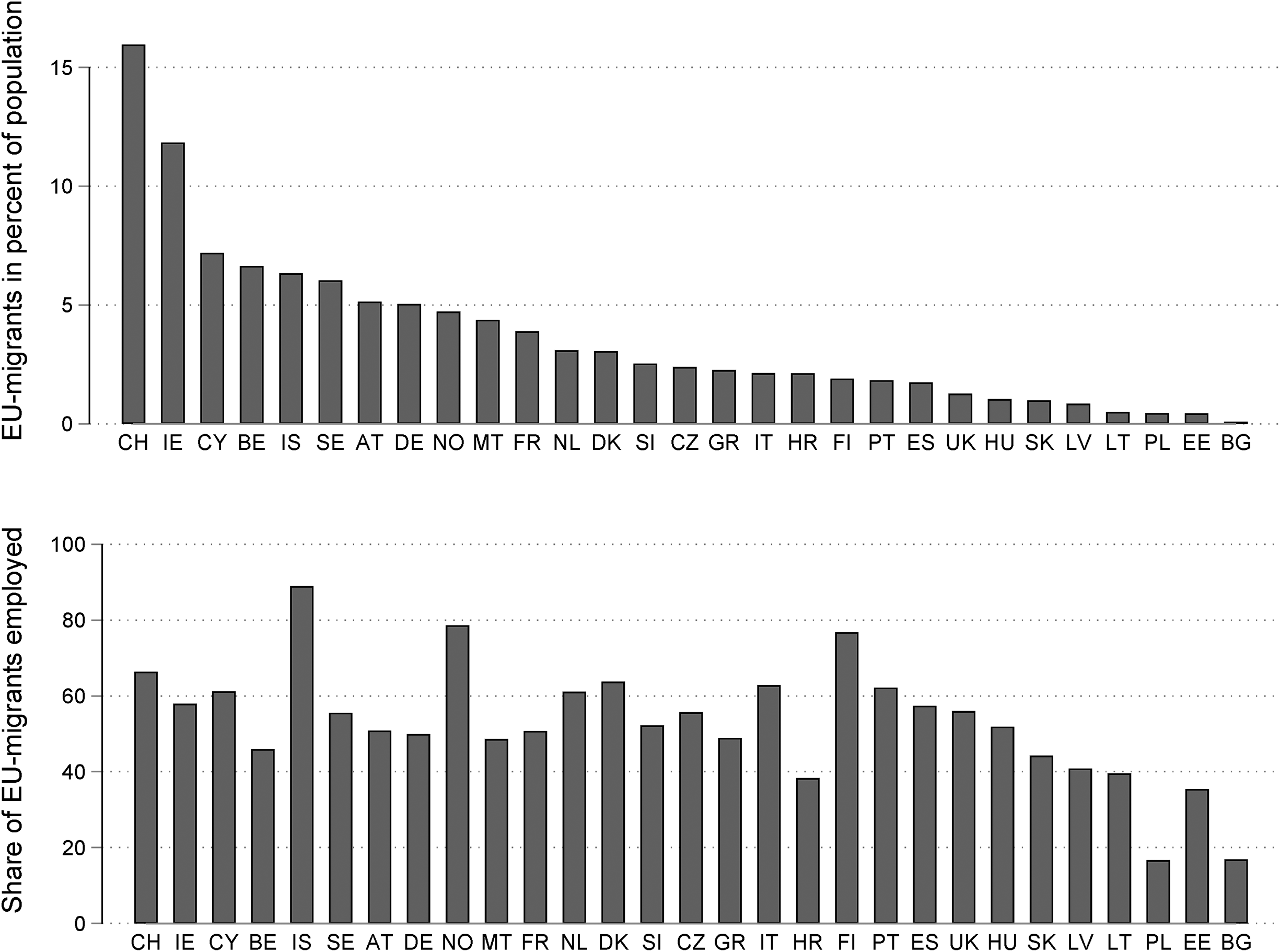
The relative size of the EU migrant population and the share of employed EU migrants per country. Averages during the 2004–15 time period for the full EU migrant population in each country (including children and people older than sixty years of age). Employment is defined as having an annual wage of at least 1,000 euros (as in our regressions). See the Supplementary Appendix for a similar figure across regimes (Figure A.1).
The underlying data on the estimated fiscal effects of EU migrants is based on a “static model.” 43 This model estimates the fiscal impact of migrants for each year during the time period under consideration, without considering any dynamic effects of immigration that will occur in the longer term, such as migrants growing older, earning higher or lower wages over time, and so on.
The exclusion of dynamic effects also means that the estimates of the fiscal effects of EU migrants do not take account of potential labor market effects of immigration on natives; that is, it is assumed that the labor incomes of natives are unaffected by immigration. This assumption could be questioned as there is a vast research literature on how immigration affects natives’ employment and wages—so-called displacement effects. The findings of this literature differ depending on context and methodology, but most studies tend to show insignificant or small average effects, even from large inflows of immigrants, thus supporting our assumption. 44 The literature usually explains the lack of substantial negative effects by the imperfect substitutability between immigrants and natives, meaning that immigrants and natives often do not compete for the same jobs. 45 In fact, there are also some studies showing small positive average wage effects for natives. 46 However, there is also evidence of negative labor market effects of immigration for the host country population, but these effects tend to mainly affect prior migrants or low-skilled natives. 47 As we focus on average fiscal effects, we believe our assumption that natives’ labor market outcomes are unaffected by migration to be reasonable. Nevertheless, it would have been highly relevant to be able to consider possible displacement effects among natives and other dynamic effects. However, the difficulty with estimating dynamic effects is that they require data that are unavailable to us and, therefore, would need to be based on very bold assumptions about the future, such as how long EU migrants will stay in their host countries.
To estimate the fiscal effects of migrants, annual national accounts data on different types of public revenues and expenditures, taken from the AMECO macroeconomic database and other Eurostat data sources, have been utilized. These national data comprise the whole public budget in each country, and costs and revenues are then—following a top-down logic—“assigned” to either migrants or natives using certain allocation criteria. For some costs and revenues this is done on the basis of individual- or household-level survey data (EU-SILC), such as information on social benefits and incomes. Other costs and contributions are modeled using demographic characteristics of the migrant and the native populations. Yet other costs and contributions are allocated on a per capita basis. The estimates of the fiscal effects can be presented as a “per annum estimate of the effect on the public budget, on the margin, of adding a particular type of person or household to the population, in a given fiscal year.” 48 The fiscal estimates are aggregated from individuals to households, as some data are only available on the household level. In households that include both migrants and natives, the costs and contributions are allocated by the fraction of the household that belongs to each group.
The major types of expenditure included in the estimates of the net fiscal impacts of migrants and natives relate to costs arising from the provision of welfare benefits, pensions, public goods, 49 education, health services, police, and prisons. The major types of revenues considered include consumption taxes, income and wealth taxes, capital and corporate taxes, and social security contributions.
Data availability varies across countries on some EU-SILC variables, and imputation has therefore been used in some cases. 50 A particular issue relates to the fact that EU-SILC does not allow for the separation of EU migrants from other migrants in Germany, Estonia, Latvia, Malta, and Slovenia. Migrant status in these countries has been imputed based on how intra-EU migrants differ from non-European migrants in other countries. Clearly, the estimates of these countries should be interpreted cautiously, and we therefore run robustness checks where we exclude them.
Decomposing the Differences in Fiscal Effects across Regimes
We estimate a set of regression models to examine to what extent differences in the fiscal effects across regimes may be explained by country-level variables that vary across regimes. Put differently, we decompose the differences in the fiscal effects across the regimes. We run these models on the country level, and the unit of analysis is thus the country-year (see the statistical model below).
Given the aim of this article, the type of welfare state regime is the central independent variable in these regression models. We have chosen to use the Basic security regime as our reference category, and we have two main reasons for doing so. First, the debate on EU migration and migrants’ access to the welfare state has been fierce in the Basic security countries, particularly in the United Kingdom. Second, among the Western regimes, the Basic security regime is commonly portrayed as the least generous welfare state regime, with relatively meager benefits and limited public-funded welfare services. Hence, there may be a sharper difference between this regime and the other Western regimes, so using it as the reference category allows for the testing of these potential differences.
We apply three types of control variables: migrants’ background characteristics, migrants’ employment and earnings, and the country-level fiscal balance. These control variables can all be expected to exert an independent impact on the fiscal effects of migrants, but, as discussed earlier in the article, these variables may also be affected by national institutions (indirect effects of institutions). However, to determine whether these variables should be regarded as exogenous or endogenous to the welfare state regimes is an inherently difficult question that cannot be settled within this article. For instance, the fiscal balance is on the one hand dependent upon factors that are largely exogenous to the welfare state, such as whether a country was hard hit by the Great Recession or has ample access to natural resources. On the other hand, some countries might struggle with negative fiscal balances because of relatively generous welfare state institutions that are not adequately funded. Against this backdrop, we chose to present models where we add one of these different types of variables at a time to reveal their potential impact on the differences in fiscal effects across regimes. That is, we are showing how the results would look like if we were to treat these variables as fully exogenous to the welfare state regimes. However, as this is an assumption that is unlikely to hold, the impact of the control variables on the estimates of the differences in the fiscal effects across regimes should not be given a causal interpretation. In other words, to the extent that the control variables are endogenous to the welfare regimes, they would be so-called bad controls. 51 Hence, as discussed above, the purpose of adding the different control variables is to decompose the differences in the fiscal impact across regimes rather than reveal causal estimates.
To explore how the background characteristics of migrants affect the differences in fiscal effects of EU migrants across welfare state regimes, we use control variables for age (four age groups: 0–14, 15–29, 30–59, and 60+ years), education (using dummies for six levels of education on the individual level), civil status (dummy for cohabitating/married or not), and the number of persons in the household. All of these variables are then summarized annually on the country level, separately for migrants and natives, describing for example the share of EU migrants in a country who are between 30 and 59 years old or who have acquired a certain educational level. These variables thus describe the average differences in the composition of migrants across countries and over time.
To study the impact of employment and labor income, we use two specific variables. First, the dichotomous control variable “employment” is defined as having an annual wage income of 1,000 euros or more. Second, we use the whole scale of wage income to take into account differences in wage levels. These variables are also aggregated per country and year. These controls are included to take account of, first, differences across regimes in the degree to which economically active EU migrants—who have access to the host country welfare state—currently have a footing on the labor market and, second, to what degree there are differences in whether the EU migrant population in a country is economically active at all. This latter aspect is relevant as the economically inactive do not generally get full and equal access to the host country welfare state, if they were not economically active at the time of arrival.
A third important variable to take into consideration relates to the balance of the public budget, which can have a profound effect on whether the average resident in a country is a net asset or liability. In countries with large budget surpluses, most people tend to be net assets, whereas the reverse is the case in countries with large budget deficits. Since this holds for natives as well as migrants, it may at least partly be regarded as an exogenous factor. Norway, Greece, and Ireland constitute the extreme cases in our data. Norway averaged a budget surplus of 12.8 percent of GDP during the period under consideration in this article, which is far higher than any other country. Greece is at the opposite end of the spectrum, with the largest average budget deficit of 8.8 percent of GDP. However, when looking at single years, the Irish case is also exceptional. Ireland had a budget deficit of 32.1 percent in 2010 and an average deficit of 7.0 percent during the entire studied time period. Many countries had considerable budget deficits during the years of our study. The average deficit over the period was, for example, 6.0 percent in the United Kingdom, 4.8 in Spain, 4.3 in France, and 3.4 in Italy. To take account of this factor in our analysis, we use macrodata from Eurostat on net lending for the general government, expressed as a percentage of GDP. This variable thus captures the size of a country's public budget surplus or deficit in relation to GDP.
Statistical Model
We use OLS regression to explore to what degree the control variables can explain the differences in the net fiscal effects of an EU migrant household across the welfare state regimes. An alternative would be to compare the difference in the fiscal impact of natives and migrants across regimes and see to what extent these differences depend on our control variables.
52
However, such an approach would make the characteristics of the native population, such as labor market participation, very decisive for the results, which would be inappropriate given the aim of this article. We therefore specify our regression model as follows:
Results and Discussion
We present our results in three steps. We begin by showing the descriptive results for our main indicator, the annual fiscal impact of an EU migrant household across the welfare state regimes. In the second step, we run a set of regression models to investigate the impact of adding controls. Lastly, we present the aggregate fiscal effects that also take into account the number of EU migrant households.
The Fiscal Impact per Household
Figure 2 shows the fiscal impact of EU migrants in relation to the two other main groups in the data, natives and migrants from outside the European Union, separating the five different welfare state regimes. EU migrants have a more positive effect on the public finances than natives in all regimes except for the State insurance regime. The net contribution of EU migrants is highest in the Universal regime, corresponding to 7,300 euros per migrant household annually. The contributions in the Continental corporatist and Mediterranean corporatist regimes are somewhat lower, corresponding to 5,400 euros and 6,000 euros per year, respectively. The contribution of an average EU migrant household in the Basic security regime is lower at 3,900 euros annually.
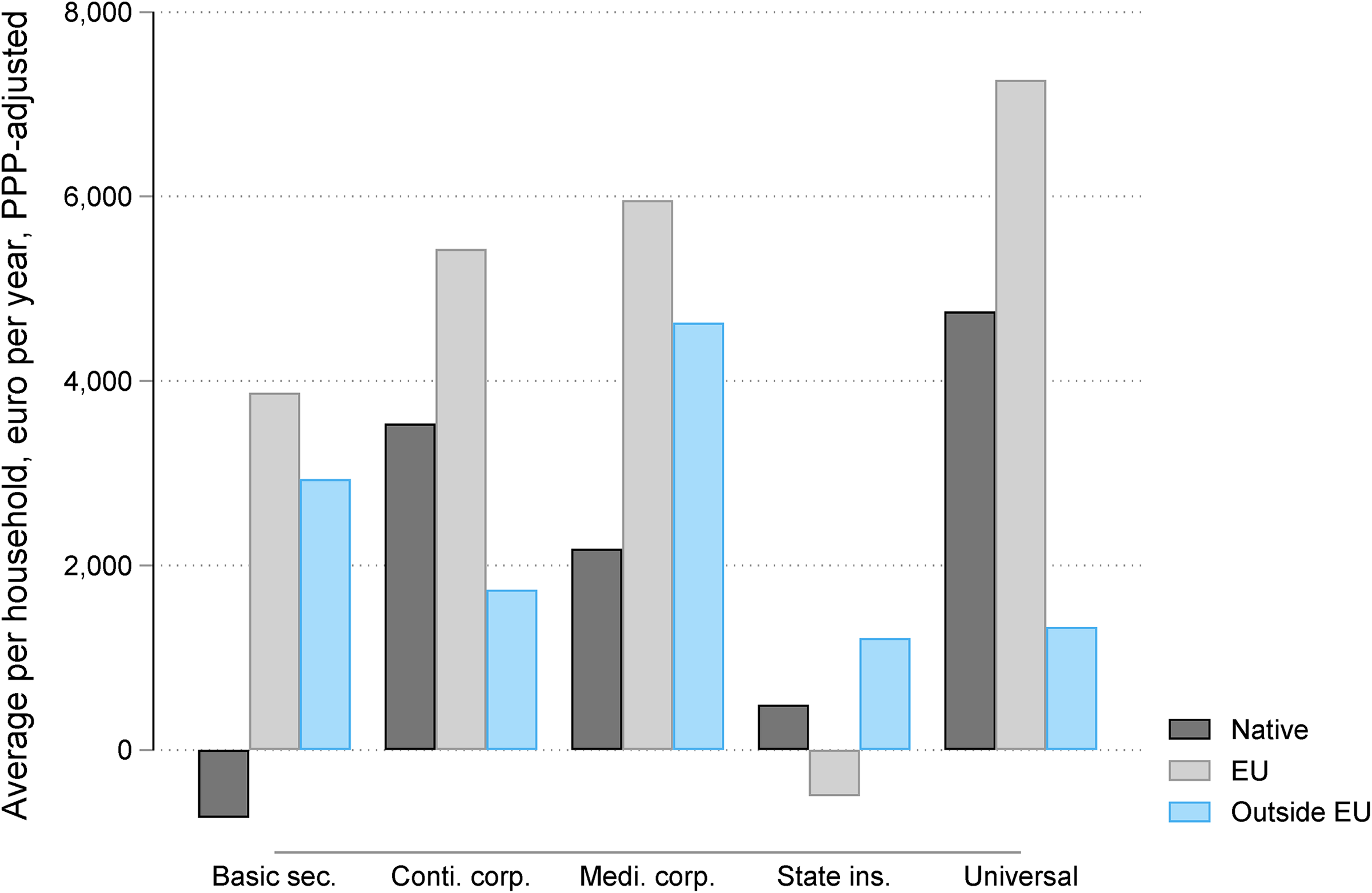
Net annual fiscal effect per household in different institutional regimes, by migrant status, annual averages for 2004–15.
In the Basic security regime, natives constituted a net fiscal burden during the period under consideration. This is mainly explained by the considerable budget deficits in both the United Kingdom and especially Ireland during this period. Figure 2 suggests that, in contrast to the net deficits associated with natives, migrants generated positive net fiscal effects during this period in the Basic security regime. The State insurance regime stands out, in that the data suggest that EU migrants in these countries generated a slight fiscal burden of about 500 euros annually. There are, however, few EU migrant households in these countries (see Figure 1), and the composition is quite different compared to the Western regimes. They are, in particular, much older and earn considerably less than EU migrants in the Western regimes (see Tables A.1–A.5 in the Supplementary Appendix), which is connected to higher costs for pensions and health care whereas revenues from taxes are lower. This age composition may partly be related to the fact that the country of birth indicator for identifying migrant status can be problematic for some Central and East European countries because of changes of national borders, mainly in the aftermath of the Second World War. 53 Poland is the country most affected by this issue, which is one reason for why we test to exclude it below. Another explanation of the less favorable—from a fiscal point of view—composition of EU migrants in the State insurance regime is the very limited EU labor migration to the countries in this regime (see Figure 1). Instead, migration flows in these countries are dominated by emigration to Western EU member states and immigration from other, non-EU, Eastern European countries such as Ukraine (also before the war between Russia and Ukraine). 54
The net fiscal contribution of EU migrants is larger than that of non-EU migrants in all Western regimes, and the difference is especially pronounced in the Continental corporatist and the Universal regimes. The more positive effects of EU migrants in the Western regimes are likely explained by the fact that, compared to non-EU migrants, EU migrants in these regimes are more likely to be labor migrants and therefore in employment.
The smaller net fiscal contribution of EU migrant households in the Basic security regime is mainly connected to lower revenues compared to the Continental corporatist and Universal regimes, as expenditure in these three regimes is on a similar level (see Figure A.2 in the Supplementary Appendix). The Continental corporatist and Universal regimes have the highest revenues among all regimes, whereas the levels of both revenues and expenditure are clearly lower in the Mediterranean corporatist regime and lowest in the State insurance regime. This is an expected result considering the lower income levels in these countries.
There are some outlier countries that stand out in terms of fiscal effects from the other countries in the same regime. The most influential outliers are Ireland (negative outlier, large budget deficit), Poland (negative outlier, high costs related to an old immigrant population), and Norway (positive outlier, large budget surplus). 55 Excluding these three outliers makes the fiscal impact of EU migrant households much more similar across regimes (see Figure A.3 in the Supplementary Appendix). The fiscal contribution of EU migrants in the Basic security regime and the Universal regime now approaches the level in the two corporatist regimes, resulting in very small differences. Excluding these three outliers, the annual fiscal contribution of an EU migrant household is found within the boundaries of 5,100 euros to 6,000 euros in all Western regimes. Excluding Poland from the State insurance regime switches the regime average from slightly negative to slightly positive (to an estimated annual net contribution of about 400 euros per EU migrant household).
The average annual effects for the period 2004–15 presented above conceal considerable variations over time, especially around the Great Recession of 2008–12. Figure 3 shows how the annual net fiscal effect of an EU migrant household changes over time in the different welfare state regimes. The left panel includes all countries, whereas the right panel excludes the outliers (Ireland, Norway, and Poland). The left panel of the figure shows a large drop in the net fiscal contribution of an EU migrant household in the Basic security regime at the time of the financial crisis. This is almost completely driven by Ireland as can be seen by comparing the two panels in Figure 3. For the Universal regime, excluding Norway lowers the fiscal contribution from EU migrants, particularly so during the first years of the period under consideration, when Norway was running exceptionally large budget surpluses in the range of 14–19 percent of GDP. The exclusion of Poland leads to more positive net fiscal effects of EU migrant households in the State insurance regime, without influencing significantly the character of the development over time.
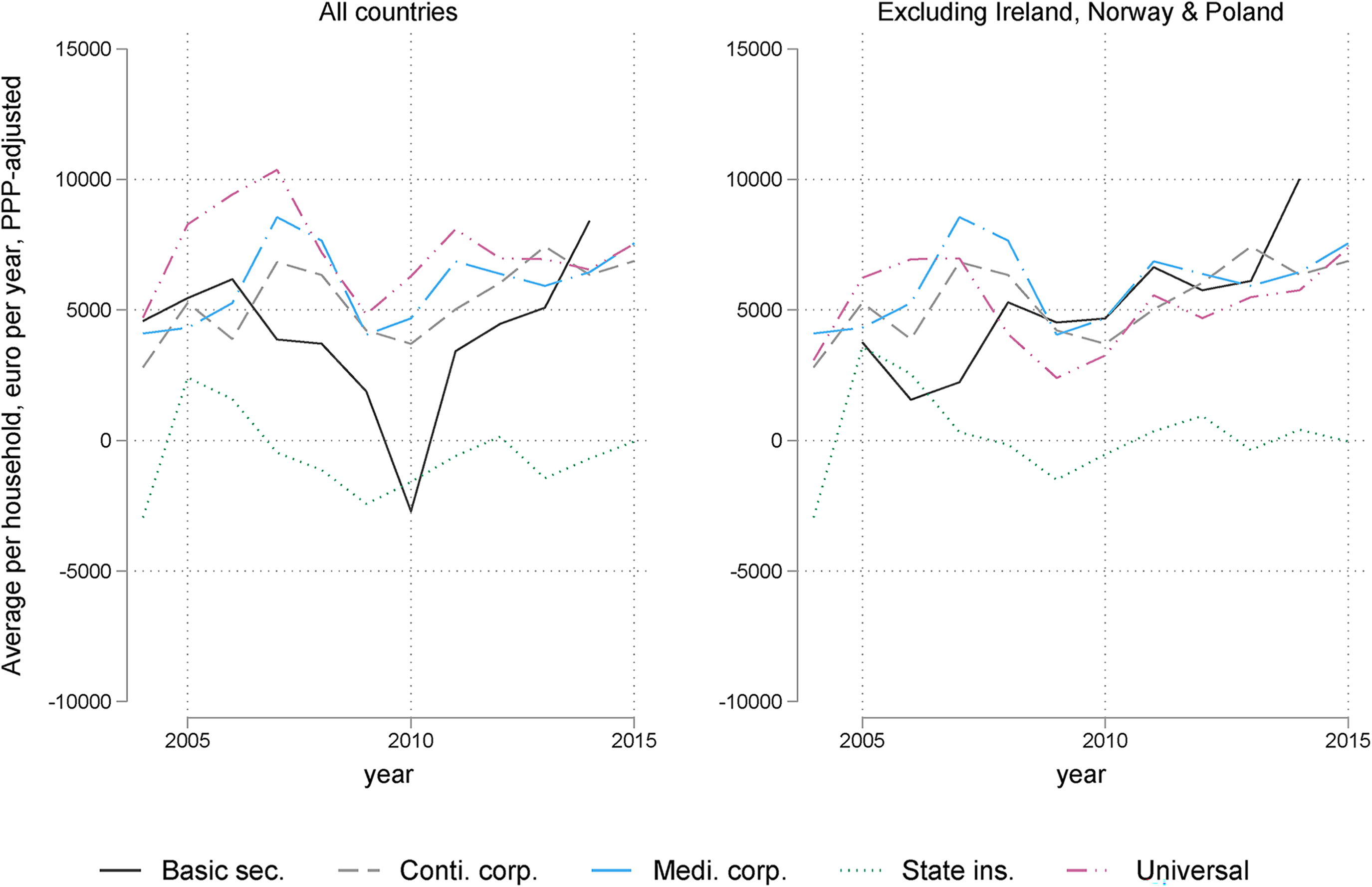
Annual net fiscal effect per EU-migrant household in different institutional regimes over time, 2004–15.
There is a clear drop in the net fiscal contribution of EU migrants in all regimes when the economic crisis hit in 2009. For the Western regimes, the crisis was associated with a drastic drop in the net contribution of an EU migrant household of about 3,000 to 5,000 euros per year. Nevertheless, if we exclude the three outliers (right panel of Figure 3), EU migrant households in the four Western regimes still made a clear net contribution to the public finances of at least 2,500 euros. In contrast, in the State insurance regime the net fiscal impact of an EU migrant household turned negative during the economic crisis, even though this development appears less drastic if Poland is excluded. From 2011, all regimes started to recover, with the net fiscal contribution of EU migrants increasing and, by 2015, reaching close to precrisis levels. The recovery seems to have been especially strong in the Basic security regime but quite weak in the State insurance regime.
One of the clearest patterns emerging from these figures is that the Western regimes tend to have developed in very similar ways over time, especially if the outliers are excluded. But even with all countries included, the developments after the crisis in the Continental corporatist, Mediterranean corporatist, and Universal regimes are strikingly similar. This suggests that differences in national institutions may have had relatively little impact on how the Great Recession affected the fiscal contribution of EU migration. However, the development in the State insurance regime stands out. Not only is the level of the fiscal impact less positive, and partly also negative, but its development after the crisis was also less positive than in the other regimes.
Decomposing the Differences between the Welfare State Regimes
In Table 2 we present the results of our regression models that explore to what degree the variation in the fiscal impact of EU migrants across welfare state regimes may be attributed to our set of control variables. The regression coefficients describe the relative differences between regimes, with and without the controls, using the Basic security regime as the reference category. These results thus tell us whether there are any significant differences between the Basic security regime and the other regimes, as well as the impact of the controls on these differences. However, the absolute (i.e., magnitude of the) fiscal impact is also of interest, and to facilitate interpretation, Figure 4 shows the predicted net fiscal effect per EU migrant household in each of the five regimes. The predicted effects with the control variables can be interpreted as what the net fiscal impact would be if the differences in the respective control variables were to be canceled out across regimes. However, as discussed above, these estimates should not be given a causal interpretation since we are, at least partly, also controlling away institutional factors defining the regimes. That is, the aim of these models is to better understand the nature of the descriptive differences across the regimes rather than to identify causal effects. The five different estimates for each regime shown in Figure 4 correspond to the five regression models in Table 2. Descriptive statistics on the underlying data per regime are available in the Supplementary Appendix (Tables A.1–A.5).
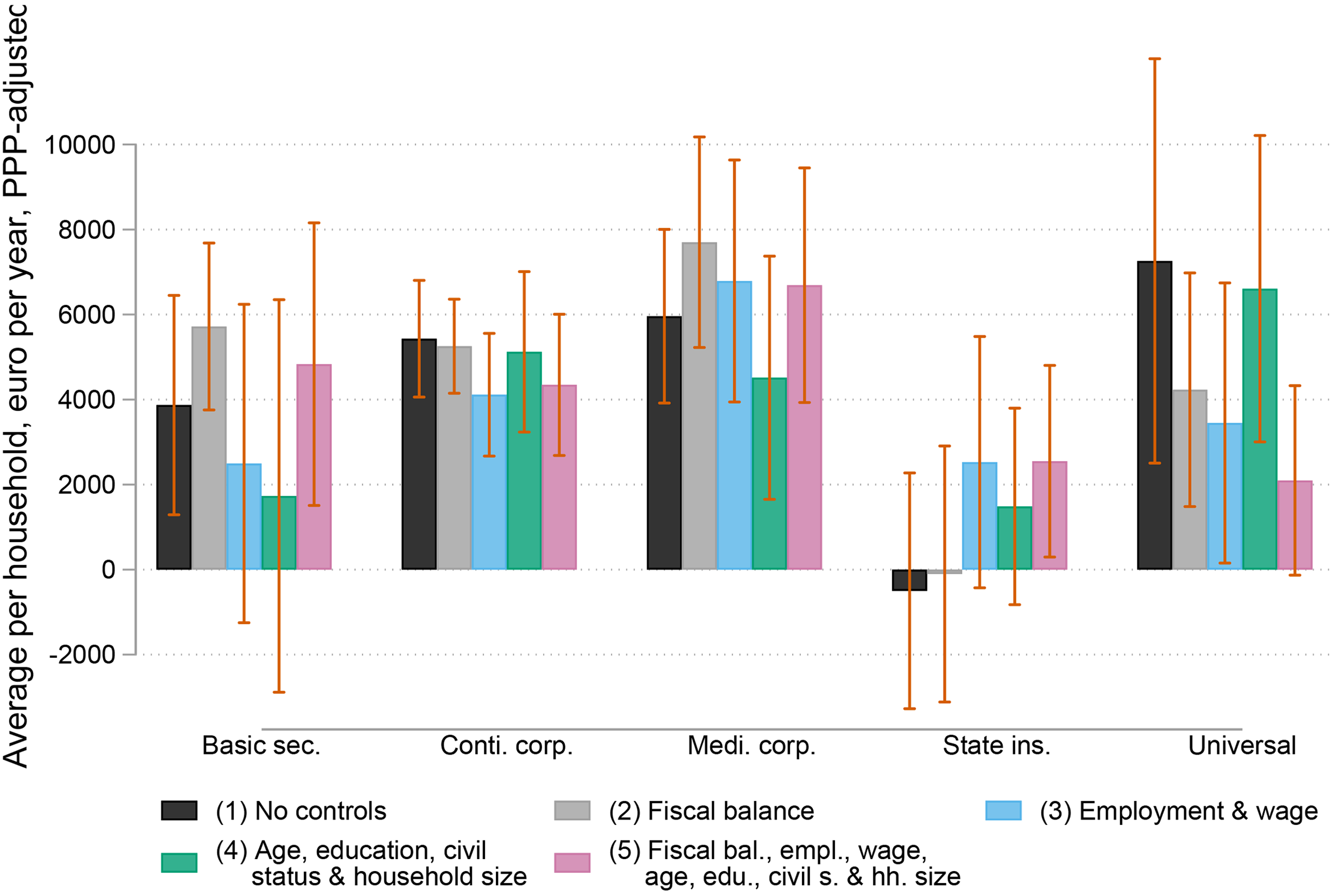
Predicted net fiscal effect per EU migrant household: controlling for regime differences in the fiscal balance and migrants’ background characteristics and economic status, 2004–15. The five estimates shown for each regime in this figure correspond to the five regression models in Table 2. Error bars show 95 percent confidence intervals based on country-clustered robust standard errors.
Differences across Regimes in the Net Fiscal Effect per EU Migrant Household (in Euros): Controlling for Fiscal Balance, Migrant Background Characteristics, Migrant Employment, and Wages.
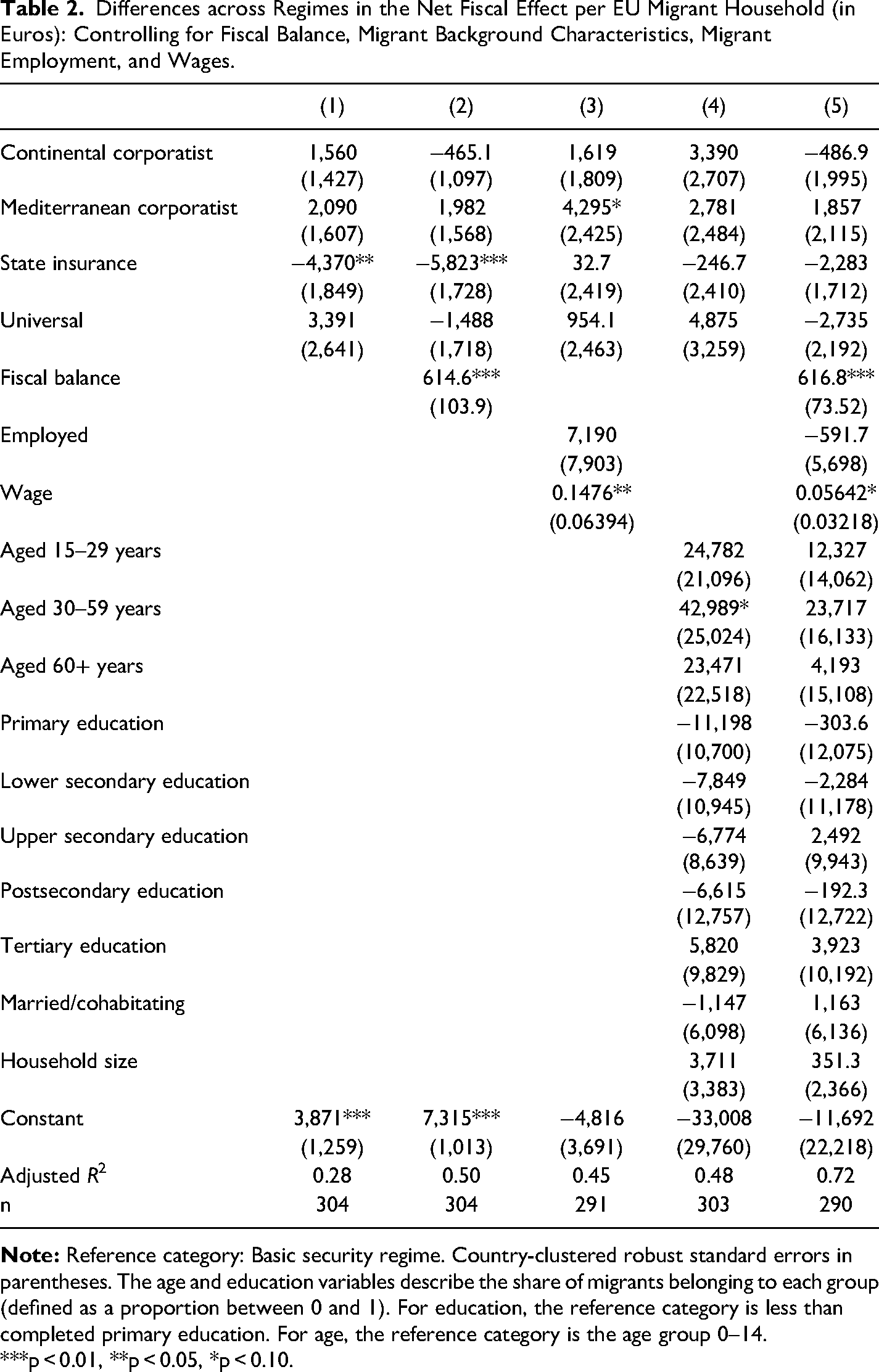
***p < 0.01, **p < 0.05, *p < 0.10.
Model (1) only includes the dummy variables for the different welfare state regimes. It thus portrays the same cross-regime differences in the annual fiscal impact of an EU migrant household that were presented in Figure 2. Only the difference in the fiscal impact between the Basic security regime and the State insurance regime is statistically significant (at the 95 percent level). The first control is added in Model (2), a linear variable for the balance of the public budget. As could be expected, this variable has a positive and highly significant effect. Adding this control eliminates the cross-regime differences in the fiscal impact of intra-EU migration that are correlated with differences in the fiscal balance, thus “increasing” the fiscal contribution of EU migrants in regimes with budget deficits and “decreasing” the contribution of migrants in regimes with budget surpluses. The consequence is a more favorable outcome for the Basic security regime, bringing it closer to the other Western regimes, as indicated by the smaller point estimates for these regimes. For the State insurance regime, the gap instead widens. These results are expected because the members of the Basic security regime ran large budget deficits during most of the studied time period.
As is shown in Figure 4, comparing Models (1) and (2), adding the fiscal balance control has a small effect on the average fiscal impact of EU migrants in the Continental corporatist regime while there is a larger and positive effect on the impact in the Mediterranean corporatist regime, and a large negative effect in the Universal regime. These changes reflect the fact that the Continental corporatist countries had relatively balanced budgets during this time period, whereas the Mediterranean corporatist countries ran quite large budget deficits and the Universal countries, particularly Norway, ran large budget surpluses.
In Model (3) we use employment and wage income as controls. Adding these controls has a positive effect on the relative outcome of the Mediterranean corporatist regime and particularly the State insurance regime, in comparison to Model (1). In Model (3) the fiscal contribution of EU migrants in the Mediterranean corporatist regime becomes clearly larger than in the Basic security regime, a difference that is statistically significant at the 90 percent level. However, as shown in Figure 4, this difference is as much an effect of the fact that these controls lower the contributions from EU migrants in the Basic security countries as of higher contributions in the Mediterranean corporatist countries. The explanation for this is that this model “cancels out” the impact of the substantially lower wage levels of EU migrants in the Mediterranean corporatist countries, as well as the relatively higher wages in the Basic security countries. Furthermore, the fiscal impact of EU migrants in the State insurance regime improves massively, coming close to the Western regimes, and there is no longer a significant difference between the State insurance and the Basic security regimes. This change is a result of markedly lower employment levels and wages among EU migrants in the State insurance regime. Taken together, these factors seem to explain the consistently less positive fiscal impact of EU migrants in this regime, a result that has been evident in our earlier analyses. Furthermore, the fiscal contribution of EU migrants in the Universal regime is cut in half in Model (3) compared to Model (1), as shown in Figure 4. This change reflects the fact that, among all the regimes considered, the Universal regime has the highest levels of both employment and wages of EU migrants. That controlling for employment and wages can bridge most of the gap between the fiscal impacts in the State insurance and Universal regimes, found at the opposite ends in the descriptive evidence shown in Figure 2, underlines the well-known influence of these factors for the fiscal effects of immigration. 56
The fourth model controls for migrants’ age and education as well as civil status and household size. Figure 4 shows that adding these variables leads to reductions in the predicted fiscal contribution of the average EU migrant household in all Western regimes, compared to Model (1), but the reduction is greatest in the Basic security regime, which also explains the larger relative differences to this regime shown in Table 2. The likely explanation is that EU migrants in the Basic security countries are more highly educated and younger than in the other regimes. Moreover, adding these demographic controls increases the estimated fiscal contribution of an EU migrant household in the State insurance regime, and there is no longer a statistically significant difference to the Basic security regime. This most probably reflects the fact that the State insurance countries have considerably older EU migrants than the countries in the other regimes and old age correlates with higher fiscal costs.
Finally, Model (5) includes all controls in one model. The point estimates of the fiscal impact of EU migrants across the different regimes become more similar than in any of the earlier models, and there are no statistically significant differences between the regimes. However, applying all of these controls jointly most probably implies that we also are controlling away differences that are at least partly related to institutions.
The control models presented above improve our understanding of what is driving the differences in the point estimates of the fiscal impact of EU migrants across the welfare state regimes. The variables that have the greatest potential for helping explain these differences are the fiscal balance, migrants’ age, employment, and wages. In particular, the fiscal impacts of EU migrants in the Basic security and Universal regimes appear to be highly dependent on these variables. Both regimes have relatively young, well-educated EU migrants who work more and earn more than in the other regimes. The Universal regime also benefits from strong fiscal balances. Comparing the result for the Universal regime in Model (1) to Model (5) is a case in point. When we add all of our control variables in the latter model, the fiscal contribution of EU migrants in the Universal regime changes from being the largest to the smallest among all of the regimes.
Overall, the results of the regression significance tests support the view that the differences in the net fiscal impacts of EU migrant households across the different welfare state regimes are small. In the base model, without any controls, only the difference between the Basic security regime and the State insurance regime is significant—at the 95 percent level. Adding the fiscal balance as a control in Model 2 increases the statistical significance of this difference to the 99 percent level. Furthermore, when controlling for employment and wages the difference between the Basic security and Mediterranean corporatist regimes becomes statistically significant at the 90 percent level. Except for these three differences, none of the other differences between the Basic security regime and the other regimes in Figure 4 are significant.
The significance tests have to be interpreted cautiously since the variation in the data is limited and the standard errors are quite large. Nevertheless, the general lack of significant differences between the estimated fiscal impacts of EU migrants in the Basic security regime and the other Western regimes is still informative. These results simply give no indication that the broad characteristics of the welfare state have strong impacts on the fiscal effects of EU migrants.
We have carried out a range of robustness checks. These include regressions where the different types of control variables are added one at the time (Tables A.6–A.7 in the Supplementary Appendix). We have also rerun the main models with a control for the share of non-EU migrants as such migration potentially could affect EU migrants’ economic performance. However, this variable does not have a clear relationship with the average fiscal impact of EU migrant households and hardly affects the main results regarding the welfare regime differences for EU migrants (Table A.8).
To address the issue of possible multicollinearity in the data and the somewhat imprecise estimates, we present VIF measures for each variable for all of the models in Table 2 (see Table A.9). While these measures indicate multicollinearity for some variables, and especially so in the models including many controls at once, this is mainly a problem related to the control variables and not the regime indicators. Since the regime indicators—and their precision—are our primary interest, the multicollinearity should not substantially affect our main results regarding the regime differences.
Furthermore, we have rerun both the descriptive analyses and the regression models without the countries for which migrant status was imputed (Figures A.4 and A.5 and Table A.10). The two corporatist regimes as well as the State insurance regime perform somewhat better in these models when compared to the Basic security regime. We also lose some precision, likely due to the smaller sample. The difference between the Basic security regime and the State insurance regime in Model (1) becomes insignificant, and significance is reduced to the 95 percent level between these regimes in Model (2). However, these changes in significance are to a considerable degree related to larger standard errors rather than substantial changes in the point estimates. The difference between the Basic security regime and the Mediterranean corporatist regime in Model (3) also reaches the 95 percent level (compared to 90 percent in Table 2). However, the overall differences in the point estimates are relatively small and do not suggest any changes to our key conclusions.
Aggregate Fiscal Effects
All of the results presented above relate to the fiscal impact of EU migrants in terms of the annual net fiscal impact of an average EU migrant household. In this section, we instead examine the aggregate effect of EU migration on the public budget of host countries by also considering the number of EU migrant households in the different regimes. To improve comparability across countries, we chose to evaluate the aggregate fiscal effect of EU migrants relative to the GDP of the host country. Additional figures and information on these models are available in the Supplementary Appendix.
Figure 5 demonstrates the aggregate net fiscal effect of EU migrants. The aggregate effects are positive in all regimes but are modest relative to the economy at large as they amount to at most 0.56 percent of GDP in the Continental corporatist regime. In the Mediterranean corporatist and Universal regimes, the contribution is slightly lower at 0.42 percent and 0.39 percent of GDP, respectively. The aggregate effect in the Basic security regime is again smaller at 0.26 percent of GDP. The effect is close to zero in the State insurance regime at 0.02 percent, reflecting the small number of EU migrants in these countries. In contrast to the negative per household effect, the aggregate effect for the State insurance regime is positive because there are relatively few EU migrants in the countries where the per household effect is negative in this regime—and a larger number of EU migrants in countries where the per household effect is positive. We also in this analysis test to remove the outliers Ireland, Norway, and Poland. This substantially improves the effect in the Basic security regime and lowers the positive effect in the Universal regime, while the difference is small in the State insurance regime.
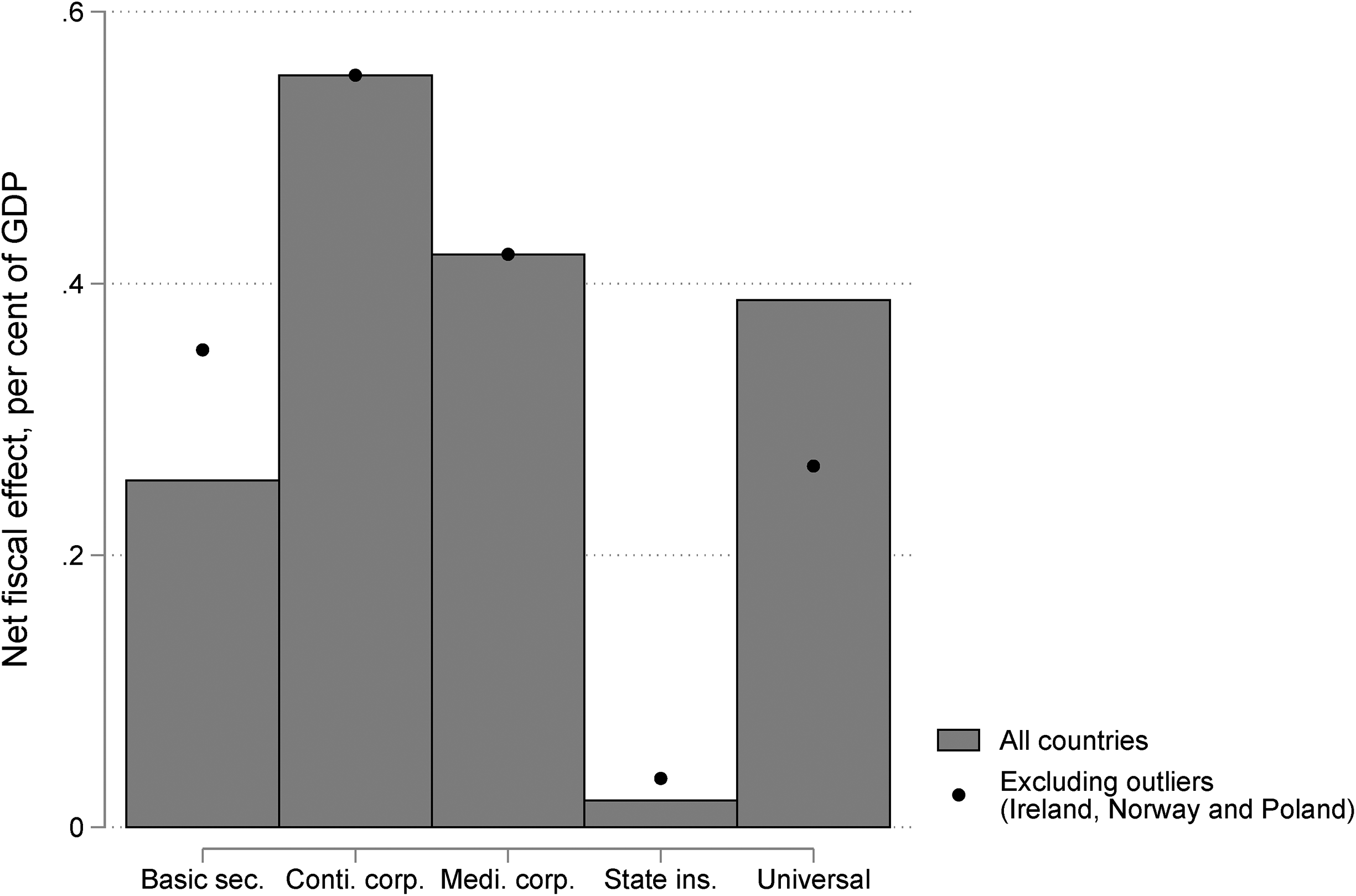
Aggregate annual net fiscal effect of EU migrant households in different institutional regimes, 2004–15.
Conclusion
The aim of this article has been to investigate whether unrestricted migration may be combined with advanced welfare states by analyzing the fiscal impact of free movement in the European Union, and whether and how these effects vary between different welfare regimes in Europe. We find the average fiscal impact from EU migration to be clearly positive. Furthermore, distinguishing between five different regimes covering twenty-nine countries, our analysis suggests that the main cross-regime difference in the fiscal impact of intra-EU migration can be found between the Eastern State insurance regime and the four Western regimes. The fiscal impact of EU migrants in the Western regimes is significantly more positive than in the State insurance regime. This difference is likely explained by the fact that there has been little intra-EU labor migration to the countries in the State insurance regime during recent years and that the EU migrants residing there today are relatively old. However, among the Western regimes, where the great majority of EU migrants reside, the differences between the welfare state regimes are limited. The differences that can be identified may largely be attributed to a few single countries with rather exceptional circumstances, in particular, Norway and Ireland.
A case in point is that we do not find any statistically significant differences between the fiscal effects of EU migrants in the Basic security and Universal regimes, despite the fact that these two regimes are often depicted as diametrically opposed in terms of welfare state and labor market institutions. Expenditure per EU migrant household is higher in the Universal regime, in line with what we would expect in more inclusive and generous welfare states. However, this higher level of expenditure is more than compensated by higher revenues per migrant household, leading to a point estimate of the net fiscal contribution in the Universal regime that is larger than that in the Basic security regime. In other words, we do not find any evidence in support of the common idea that EU migrants on average generate more of a fiscal burden in welfare states with broad coverage and generous benefits.
This finding contradicts the general proposition that unrestricted migration is incompatible with advanced welfare states because the fiscal cost will be unsustainable. 57 The lack of a relationship between welfare state generosity and fiscal costs also speaks against the “welfare magnet hypothesis,” 58 according to which migrants who are less competitive on the labor market would migrate to more generous welfare states to receive benefits. On the contrary, the Universal regime has the highest levels of employment and wages among EU migrants. Instead, the results lend support to our expectation that there is a balance between the fiscal costs and contributions related to EU migrants across welfare regimes, such that higher costs are compensated by higher revenues from migrants.
Our study focuses on the European Union, and naturally we have to be careful with generalizing our results to other contexts. The system of free movement within the European Union allows for unrestricted migration under certain conditions, predominantly labor migration, and unrestricted migration for other categories of migrants and in other contexts may have different effects. Still, the fact that there are fundamentally different types of welfare states within the European Union, with differences in, for instance, coverage, means-testing, and benefit generosity, offers some support for the argument that the effects may hold also outside of Europe where similar differences can be found. However, we believe that it is difficult to generalize the effects to other forms of migration than labor migration, such as humanitarian migration.
In addition to contributing new insights to existing research on the fiscal effects of immigration, including the potential tensions between migration and the welfare state, our findings can also be seen as an input to ongoing political debates about whether, why, and how to reform the current rules for free movement in the European Union. In recent years, some EU Member States have argued that EU workers’ access to national welfare states need to be restricted based on the claim that cross-country differences in the characteristics of national welfare states and labor markets imply differences in the net fiscal impacts of EU migrants. A specific argument has been that the right to full access to the host country welfare state would have particularly adverse fiscal effects for welfare states relying on means-tested benefits—most common in the Basic security regime in our classification of regimes. This article has found no evidence to support this particular argument, which suggests that other factors are at play in political debates between EU countries about whether and how to restrict welfare benefits of EU migrants. This could involve simple misperceptions of the fiscal effects, 59 or differences in ideas about fairness in migrants’ access to welfare benefits across welfare state regimes. 60 Such factors appear more important to consider when discussing potential reforms of the current regulations of free movement and EU workers’ access to host country welfare states.
Considering that this article is one of the first attempts of a broad comparative institutional analysis of the fiscal impact of the immigration of EU workers, there are plenty of avenues for further research. In this article, we have prioritized a comprehensive approach to be able to evaluate the overall fiscal impact of EU migration across complete institutional regimes, including welfare state institutions, their funding, and labor market institutions. However, with detailed institutional data, it would be intriguing to study the effects of specific welfare state or labor market institutions including their interactions. Such detailed analyses may reveal more fine-grained differences in fiscal effects related to specific institutions.
Future research should also consider how the impact of immigration on the labor market outcomes of natives differs across welfare states, as a limitation of the present study is that we could not include dynamic effects on natives in our analyses. Furthermore, albeit challenging, it is of major significance to study the emigration effects of intra-EU migration in the migrant-sending countries. Are the large flows of labor migration, mainly from Eastern to Western member states, also benefiting sending countries, and do the fiscal effects of emigration vary across countries with different institutions? Lastly, although difficult, there is a great need for studies on the fiscal impact of unrestricted migration across different welfare states outside of the European context, also considering different forms of migration.
Supplemental Material
sj-pdf-1-pas-10.1177_00323292231182516 - Supplemental material for Free Movement versus European Welfare States? Variations of the Fiscal Effects of EU Migrants across Welfare State Regimes
Supplemental material, sj-pdf-1-pas-10.1177_00323292231182516 for Free Movement versus European Welfare States? Variations of the Fiscal Effects of EU Migrants across Welfare State Regimes by Marcus Österman, Joakim Palme, and Martin Ruhs in Politics & Society
Footnotes
Acknowledgments
For their helpful comments, we are grateful to Rafael Ahlskog, Moa Mårtensson, Pär Nyman, John Stephens, Carlos Vargas-Silva, and the Politics & Society editorial board.
Declaration of Conflicting Interests
The authors declared no potential conflicts of interest with respect to the research, authorship, and/or publication of this article.
Funding
The authors disclosed receipt of the following financial support for the research, authorship, and/or publication of this article: The research for this article was supported by the European Commission Horizon2020 “REMINDER” project, grant number 727072.
Supplemental Material
Supplemental material for this article is available online.
Notes
Author Biographies
Supplementary Material
Please find the following supplemental material available below.
For Open Access articles published under a Creative Commons License, all supplemental material carries the same license as the article it is associated with.
For non-Open Access articles published, all supplemental material carries a non-exclusive license, and permission requests for re-use of supplemental material or any part of supplemental material shall be sent directly to the copyright owner as specified in the copyright notice associated with the article.
