




Abstract
Subnational governments are generally funded by fiscal rents, that is, transfers of centrally levied taxes. Existing literature concurs that fiscal federalism breeds rentierism and, consequently, hinders subnational democracy. However, in Argentina, fiscal rents do not always lead to low provincial contestation. Building on research on oil-based rentierism and fiscal federalism, we argue that this variation results from the provincial fiscal institutions that distribute central-government transfers from the province to municipalities. Specifically, we claim that as provincial fiscal institutions decentralize fiscal rents from the province to municipalities, they empower mayors to challenge governors. Conversely, as these institutions centralize rents at the province, they empower governors and weaken opposition from below. Using panel data and a comparison between Tierra del Fuego and Santa Cruz—the provinces that receive the largest fiscal transfers—we show that the effect of fiscal rents on incumbent party advantage decreases and eventually disappears as institutions become province-decentralizing.
In the last few decades, several countries have undergone important decentralization reforms in order to improve government accountability and public service delivery. These decentralization reforms have involved the devolution of important public services to subnational governments, increasing the share of government expenditure managed at the subnational level. Nonetheless, despite growing expenditure responsibilities, fiscal arrangements worldwide assign most taxing powers to central governments. 1 Consequently, subnational units, especially in the developing world, rarely fund through local taxation but rather from fiscal transfers of centrally levied taxes.
Building upon rentier state theories, several scholars argue that large central-government transfers hinder subnational democracy at intermediate levels of government (province hereafter), as they generate the same rentier dynamics associated with resource rents. This is because fiscal reliance on transfers also separates spending authority from revenue-raising responsibilities, 2 allowing governors to sustain high spending without taxing citizenry. 3 Along these lines, Gervasoni's innovative study of the Argentine provinces has been highly influential in establishing that transfers that heavily subsidize provinces create fiscal rents that undermine contestation at the provincial level. 4 Specifically, the author contends that revenue-sharing regimes that provide incumbent governors with large fiscal rents allow them to restrict political competition. Since in most federations subnational governments are financed through fiscal transfers, 5 several scholars have explored the role of fiscal federalism–based rentierism on political contestation. 6
Nonetheless, the underlying assumption in studies of provincial democracy is that provincial fiscal institutions, that is, the arrangements established by provincial legislation for distributing central-government transfers from the province to the municipalities, always centralize the fiscal rents that flow from the center to the provinces. In marked contrast, federal democracies exhibit significant variation in the fiscal institutions that distribute central-government transfers between provinces and municipal governments. Indeed, in most federations, municipal governments are the responsibility of provincial governments, and provincial fiscal institutions regulate municipalities’ access to shared taxes from the central government. 7 In particular, in Argentina each province has its own set of fiscal institutions to distribute fiscal rents to their respective municipal governments, some of which centralize fiscal rents at the provincial level, whereas others allocate a significant proportion of these resources to municipal governments. 8 By determining governors’ capacity to centralize fiscal rents and thus deprive mayors from access to transfers of centrally levied taxes, these distribution schemes may have important effects on the territorial distribution of political power within the province. Hence, we pose the following question: Do provincial fiscal institutions shape the effect of fiscal rents on provincial contestation?
To answer this question, we study the Argentine fiscal federal scheme, known as Coparticipación Federal de Impuestos (Federal Tax-Sharing Agreement, CFI). The CFI scheme is defined as an automatic revenue-sharing program in which the federal government shares part of the nationally collected taxes with the provinces. This fiscal transfer is the main source of revenue for most provinces and approaches the key properties of rents. First, unlike earmarked transfers, CFI has no spending restrictions. This is a critical dimension of rentierism, as discretion in allocation is the crucial link between rents and undemocratic outcomes. 9 Second, the transfer is automatically transferred from the federal government to all provinces according to a fixed formula, 10 and thus it accrues to provincial coffers like “manna from heaven.” Resultingly, CFI is shielded from presidential discretion and is a useless tool for presidential coalition-building. 11 Equally important, while the federal revenue-sharing system does not impose on governors any spending constraints with regard to CFI, provincial fiscal institutions do. In effect, there is wide variation in the provincial fiscal institutions that distribute CFI between the province and municipalities, 12 which implies that governors face different constraints and degrees of discretion over the share of CFI transfers that they must allocate to their respective municipal governments.
Indeed, we argue that provincial fiscal institutions can range between province-centralizing and province-decentralizing. Specifically, the more these institutions concentrate fiscal rents at the provincial level, the more province-centralizing they will be, and the more discretion governors will have over these resources. Conversely, the more provincial fiscal institutions reallocate fiscal rents to municipal governments, the more province-decentralizing these can be considered, and the less discretion governors will enjoy over these funds. We explore whether these provincial fiscal institutions mediate the effect of fiscal rents on provincial contestation and claim that when provincial fiscal institutions are more province-centralizing, mayors become fiscal hostages who rely mostly on discretionary transfers from governors because the provincial government controls the fiscal rents transferred by the center. Consequently, the municipal office is territorially weak and the mayors and the candidates they support are less effective in launching electoral assaults against the provincial incumbent party. Additionally, in these settings, it is harder for mayors to build local political platforms to fill seats in the legislature. Conversely, when provincial fiscal institutions are more province-decentralizing, mayors enjoy higher levels of fiscal autonomy. Thus, the municipal office is strong and mayors can compete—or support candidates that compete—against the incumbent party in provincial elections. Similarly, mayors may help strengthen the opposition in the legislature to preserve the institutions and electoral rules that foster competition.
We test our argument using a mixed-methods strategy. First, we use panel data analysis to assess the effect of CFI, conditioned on provincial fiscal institutions, on executive and legislative electoral dominance at the provincial level. We find strong evidence that incumbent party advantage at the provincial level decreases and eventually disappears as provincial fiscal institutions become more province-decentralizing. Second, we draw on a comparative case strategy, specifically the most similar systems design, 13 and select two provinces, Santa Cruz and Tierra del Fuego. These two neighboring provinces receive the highest amounts of CFI (and resource rents) of all Argentine provinces but have sharply contrasting levels of provincial democracy. Variation in provincial fiscal institutions established by military governors during the last dictatorship, we claim, put each province on different institutional tracks and explains why Santa Cruz, which has a more province-centralizing fiscal institution, is one of the least competitive provinces in Argentina, whereas Tierra del Fuego, which has the most province-decentralizing fiscal institution in the country, is one of the most competitive. It is important to note that while we cannot completely dismiss the possibility that provincial fiscal institutions are endogenous to the provinces’ political and electoral conditions, we provide evidence that suggests this is not the case.
This study contributes to extending research on the politics of rentierism and decentralized governance. Specifically, we combine insights from existing studies on oil-based and fiscal federalism rentierism, which have developed on separate tracks. In particular, we build on Gervasoni's work on fiscal transfers and Diaz-Rioseco's framework on resource rents distribution, developing in the process a theoretical framework that provides the causal mechanisms that explain how provincial fiscal institutions affect provincial contestation. 14 By doing so, we open the “fiscal black box” of provincial governments to explore the political effects of fiscal rentierism at the provincial level and the conditions under which fiscal rents are compatible with subnational contestation.
Nontax Income: Resource and Fiscal Rents
A growing literature in political economy posits that democratic institutions do not emerge or are undermined when governments are financed by external income that accrues to the state without taxing the economy. Several studies have found a negative relationship between oil rents and levels of democracy. 15 Nonetheless, some scholars have argued that oil does not have clear effects on political regimes, 16 and have highlighted ownership structures and the resulting concentration of rents as a crucial variable for explaining the divergent effects on democracy and long-term growth. 17
Unlike national-level studies, subnational research arrives at a robust conclusion: resource and fiscal rents always stabilize incumbents and therefore undermine subnational democracy. Studies on oil-based rentierism in Russia and the United States have found that rents reduce contestation, as incumbents increase spending to build patronage networks. 18 Yet, recent research on Argentina nuances these results, as it finds that oil wealth decreases political contestation and hinders development when provinces and producing districts have monopolies over hydrocarbon rents. 19
Another strand of research has focused on fiscal federalism–based rentierism, arguing that large federal transfers are analytically equivalent to resource rents. Particularly, two common features across federations, especially in the developing world, breed rentierism: the centralization of tax collection at the federal government, and the resulting vertical fiscal imbalances, that is, the gap between subnational governments’ own tax revenue and their expenditures. These features create conditions for fiscal federalism–based rentierism by depriving provinces from raising most of their revenue and making them dependent on central-government transfers to close the vertical fiscal gap. To provide some context, the central government is the largest tax collector in most federations. In these cases, large fiscal imbalances are likely to emerge and, hence, to breed rentier dynamics. For instance, federal revenue constitutes nearly 90 percent of total revenues in Mexico and Russia, and between 70 and 85 percent in other federations like Argentina, Brazil, and South Africa. 20 Conversely, the share of federal revenues in developed countries is smaller, as provinces/states collect a large proportion of their own taxes, making rentier effects unlikely to emerge. For example, federal revenues are about half of total revenue in the United States (55 percent) and Canada (47 percent) and less than half in Switzerland (40 percent). 21
Building on this theoretical framework, studies on Argentina and Brazil, both federations characterized by large vertical fiscal imbalances and heavy reliance on fiscal transfers to finance subnational governments, have confirmed that large fiscal transfers produce rentier effects. Gervasoni's study of Argentina finds that central-government transfers, which benefit demographically smaller provinces with generous central-government transfers, trigger rentier dynamics by enabling governors to control large budgets relative to the size of their local economies. 22 Consequently, governors who receive large transfers use their fiscal muscle to reward supporters. Relatedly, research on Brazil has also explored the effects of fiscal transfers on political contestation. As in Argentina, the Brazilian fiscal scheme transfers generous fiscal subsidies to subnational governments, especially to less populated states. However, Brazil is one of the few federations—along with Mexico, Nigeria, India, and South Africa—in which the federal constitution recognizes municipalities as a third level of government, nondependent on the state. As a result, fiscal rents are allocated to both states and municipalities without the intermediation of state governments. 23 Studies at the state level do not find that greater dependence on fiscal transfers undermines political contestation. 24 Instead, research on municipalities has found that central-government transfers increase the reelection probability of incumbent parties by expanding public spending and increasing spending on corruption. 25
Fiscal Rents and Provincial Fiscal Institutions
Provincial fiscal institutions are crucial for understanding the effects fiscal rents have on provincial contestation, as they determine the discretion that governors have to reallocate fiscal rents from central-government transfers to municipal governments. Thus, these institutions, which may range from province-centralizing to province-decentralizing, can either foster or restrict the emergence of opposition in the provincial political system by defining the fiscal strength of the municipality vis-à-vis the province. Consequently, these fiscal institutions determine the usefulness of the municipal office for electoral purposes, as they define mayors’ access to resources and thus their capacity to use fiscal rents to either buttress their own campaigns for governor, or to support political allies, such as provincial or national legislators, running against the incumbent governor. Likewise, mayors can use these funds to help build party platforms to fill seats in the provincial legislature.
Provincial fiscal institutions that are more province-centralizing concentrate fiscal rents at the provincial level, giving governors wide discretion over municipal funding and thus high leverage over municipal affairs. Consequently, the fiscal institutions in these provinces deprive mayors from access to central-government transfers, creating weak cities and giving low fiscal autonomy to mayors. The imbalance between provincial and municipal executives in these settings reduces provincial competition through two mechanisms.
First, municipalities in these provinces are normally underfinanced, and mayors are thus faced with two options. On the one hand, they may spend the minimum necessary to run the municipality, which makes them economically autonomous from the province, but leaves no funds for public spending, notably the most visible and electorally beneficial aspect of officeholding. On the other hand, mayors who spend additional income on public investment must rely on discretionary transfers from the province to fund their expenses, which means they must be on good terms with the governor. Thus, mayors in this position cannot criticize, let alone challenge, the provincial incumbent party, enhancing the latter's power over provincial politics. In short, mayors who underspend are autonomous but perceived as either incompetent or irrelevant, whereas mayors who overspend become dependent on the province. Hence, mayors in these provinces do not commonly run for provincial executive or, if they do, they are not likely to be successful. The same is true for the support they can provide to allies running in provincial elections, as it will be either too weak or fiscal suicide, as governors are likely to punish those who challenge them.
Second, weak municipal politicians are incapable of mustering support for their party candidates or political allies to obtain a significant share of seats in the provincial legislature. This is crucial for explaining low levels of provincial contestation, as it diminishes the opposition's chances to restrain the governing party's attempts to concentrate power by changing the rules. Indeed, provincial incumbents seeking to prevent challenges are likely to design electoral rules and institutions to their advantage. 26 Since those changes must be approved by the provincial legislature, a strong legislative opposition is key to blocking reforms that foster uncompetitive politics. However, since strong political platforms cannot be built from weak municipalities, it is highly likely that opposition parties will be less successful in securing the required legislative seats to do so. In other words, a weak mayor will not be able to use the benefits of officeholding, such as visibility, administrative experience, or an extended support base built on patronage or public investment, to launch a political alternative to the provincial incumbent's party in legislative elections.
By contrast, fiscal institutions that are more province-decentralizing give both provincial and municipal governments access to fiscal rents from central-government transfers, thus defining a series of constraints on governors’ ability to allocate these fiscal flows at their own discretion. These provincial fiscal institutions thus empower mayors, especially of large cities, and foster higher levels of provincial contestation through two mechanisms. First, challenges to the provincial executive are possible in these settings, given that mayors can engage in public spending without depending on the governor, thus extracting the electoral benefits of officeholding. As a result, municipalities are strong and serve as “strategic launching pads” for mayors, or the allies they support, to run against the governor. 27 For example, the fact that mayors can use their own resources to spend on public investment for the city allows them to publicize their administrative prowess to make a credible argument that they could do the same at the province level, or use that credibility to endorse other candidates for governor. Similarly, spending on public infrastructure gives mayors significant visibility, which is also electorally useful. Also, mayors that spend more on patronage can rely on a larger support base of public employees. Ultimately, provincial elections in these contexts are likely to be competitive because incumbent parties are less effective in neutralizing electoral assaults from below.
Second, strong mayors with access to fiscal rents can also use the aforementioned strategies to strengthen their parties’ position or that of their allies in the provincial legislature. According to Gibson, in settings where municipalities are strong, controlling cities is key for improving a party's electoral prospects at the province level, especially regarding large urban centers, as support from their voters can allow municipal politicians and their allied parties a meaningful number of legislators. 28 Furthermore, securing enough seats in the legislature is essential to preserve the rules and institutions that impose limitations on the provincial incumbent party and to ensure that provincial politics remain competitive. Figure 1 presents a stylized summary of the argument.
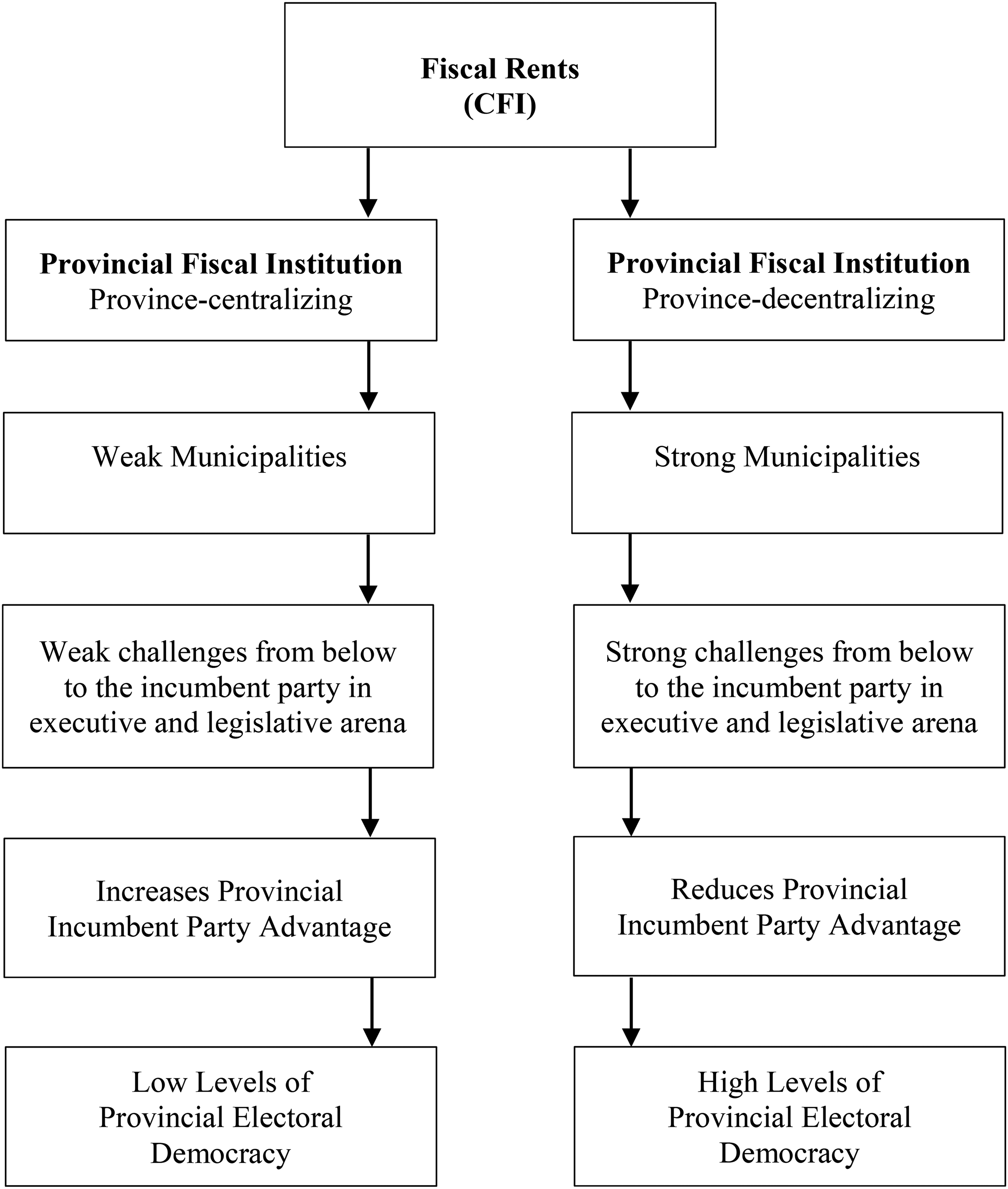
Fiscal institutions and provincial democracy. (Authors’ elaboration.)
Based on these insights, we present the following hypothesis. We argue that provincial fiscal institutions are key for understanding the effects of centrally transferred fiscal rents on provincial democracy. Specifically, we claim that as provincial fiscal institutions become more province-decentralizing, they strengthen municipal coffers, thus making mayors relevant politicians who can help launch electoral assaults against the provincial incumbent party in executive and legislative elections. Conversely, as provincial fiscal institutions become less province-decentralizing, they grant governors wide discretion over fiscal rents, which makes mayors dependent on the province and therefore reduce their capacity to run for provincial elections and help their allies build an opposition force against the incumbent governor's party. This, in turn, contributes to reducing contestation at the provincial level.
Institutional Background: Fiscal Federalism in Argentina
CFI is set up as an automatic revenue-sharing program in which the central government collects most taxes and then shares the proceeds with the provinces according to a predetermined formula. 29 This transfer is the main source of revenue for most provinces and represented nearly 70 percent of the total intergovernmental transfers between 1988 and 2008. CFI approaches the key properties of rents, as it is an automatic transfer without strings attached that is distributed to provinces according to fixed coefficients. 30 Resultingly, Argentine presidents have no discretion over CFI distribution and cannot use it as a political tool to negotiate with governors. 31
Nonetheless, while the fiscal scheme does not impose on governors any spending constraints regarding CFI, it does establish that each province must determine its own revenue-sharing mechanism to reallocate these central-government funds to their respective local governments. 32 Indeed, provincial fiscal institutions exhibit wide variation, ranging from more province-centralizing to more province-decentralizing, thereby giving provincial governments different levels of discretion over the distribution of fiscal rents to fund municipalities. Although it is not possible to entirely rule out the possibility that fiscal institutions are endogenous to the provinces’ level of electoral contestation and political conditions, in the following paragraphs we present evidence regarding the origins of these institutions and their path-dependent nature that suggests otherwise.
The origins of these institutions can be traced back to the last military dictatorship (1976–83) and, once established by military governors, they became path-dependent during the democratic period. The military actively repressed governors and, after removing them from office, the army, the navy, and the air force divided among them the control over provincial governments. 33 Consequently, the pressure of electoral competition was not a driver for provincial decentralization reform in authoritarian Argentina, as pressures from below are absent when governors and mayors are appointees of autocratic rulers. 34
Moreover, prior electoral dynamics did not influence the adoption of provincial fiscal regimes either. Indeed, although all provincial executives were in the hands of Peronist governors before the 1976 dictatorship, 35 the military who succeeded them implemented varied provincial fiscal institutions. Similarly, future elections were not a relevant consideration for the military either, as most fiscal reforms were carried out during the first years of the dictatorship, primarily under the rule of General Videla (1976–81), when electoral concerns were not part of the discussion and there were no signs of democratization in the short term. In Appendix A (all appendixes are available as online supplements), we provide evidence of the historical origins of provincial fiscal institutions, tracing the timing and legal changes that regulate the reallocation of CFI to municipal governments before and during the military dictatorship. We collected this information by reviewing all provincial laws and tracking all the legal changes that modified the percentages of CFI given to provincial governments that are automatically reallocated to municipal governments. Additionally, in this appendix we also conduct a regression analysis to show that the provincial fiscal institutions the military designed during the dictatorship (1976–83), and governors inherited, do not result from the provinces’ key political, economic, and social characteristics.
Furthermore, these fiscal institutions became particularly difficult to reform over time. As extant research shows, the institutions the military implemented altered the institutional paths the democratic governments inherited and proved consequential for future reforms. 36 The provincial fiscal institutions established by the military followed the same path-dependent pattern as the reforms that shaped national-provincial relations, and generated a self-reinforcing sequence, reproducing initial winners (either the provincial or municipal level of government) and leading to incremental change when making subsequent decentralization reforms. 37 Indeed, the few reforms democratically elected governors carried out between 1983 and 2011 illustrate the self-reinforcing effects these regimes triggered once implemented. In Appendix B, we provide a detailed account of the magnitude and number of changes that provincial fiscal institutions reallocating fiscal rents to municipal governments experimented with after national democratization. In particular, we show that during the period under study (1988–2011), these institutions followed a clear path-dependent pattern. For instance, the average number of changes to CFI reached a meager 0.8, with most provinces only modifying their percentages once (7) or not at all (9).
Additionally, it should be noted that provincial fiscal institutions not only define the share of fiscal rents provincial governments must allocate to municipalities, but also include a preestablished formula to define the criteria to distribute CFI funds within the province, which is referred to as secondary distribution. In order to assess the prevailing criteria provinces have used to define their secondary distribution, we reviewed every provincial legislation during the period under study. We found two similarities across provinces. First, provincial laws that define the criteria for distributing the share of CFI across municipalities are particularly difficult to reform over time, with most provinces making either none or one change to the secondary distribution. Second, secondary distribution laws combine several criteria to distribute CFI to municipalities, and we find that most provinces tend to favor their main urban centers in the secondary distribution (see Appendix C for a detailed description of the secondary distribution scheme in each province). Given these similarities, we believe that the relevant variation across provinces is the share of rents provincial fiscal institutions allocate to municipalities.
Finally, this study excludes five of the twenty-four Argentine provinces: Ciudad de Buenos Aires, La Rioja, San Juan, Jujuy, and Corrientes. Ciudad de Buenos Aires is excluded, as it did not have a lower level of government during the period under study. 38 The other four provinces are excluded because they do not have provincial fiscal institutions reallocating CFI, but temporary fiscal arrangements that are continuously negotiated. Consequently, unlike the provincial fiscal institutions of the provinces we study, these ad hoc arrangements cannot be considered exogenous to local political competition. Indeed, for most of the period under study, Corrientes established a minimum transfer to the municipalities by law, but negotiated the final percentage of transfers to the municipalities in the annual budget law, whereas San Juan and Jujuy negotiated temporary fiscal agreements with the municipalities. La Rioja, in turn, went further and suspended the fiscal rules that reallocated the CFI grant, negotiating the percentages bilaterally with each municipality.
Empirical Strategy
To test our hypotheses, we draw on a mixed-methods empirical strategy, which includes regression analysis and a paired comparison of two provinces. In what follows, we discuss the main variables in our analysis. The descriptive statistics are available in Appendix D.
In order to explain the variation in incumbent party advantage at the provincial level, we use two main independent variables, fiscal rents and provincial fiscal institutions. More specifically, as explained below, since we seek to assess whether provincial fiscal institutions condition the effect of fiscal rents on provincial incumbency advantage, we use an interaction between the two fiscal variables in our regression analysis.
First, we measure fiscal rents as the CFI per capita value in hundreds of constant 1993 Argentine pesos. 39 We construct the variable taking the CFI amount that each province receives and dividing it by the total provincial population. The data are gathered from the United Nations Economic Commission for Latin America and the Caribbean, Argentina's Office, which systematized information on fiscal transfers provided by the Dirección Nacional de Coordinación Fiscal con las Provincias from the Federal Ministry of Economy.
Second, we gauge provincial fiscal institution as the share of fiscal rents that provincial governments are mandated to transfer to municipalities. Since this is a provincial law, we build this variable by analyzing the provincial legislation that regulates the amount of CFI the provinces receive and that must be reallocated to municipal governments. If, for instance, provincial laws reallocate 6 percent of provincial CFI to municipalities, we give provincial fiscal institutions a 0.06 score. High values of this variable represent province-decentralizing institutions, whereas low values signal province-centralizing systems. This variable ranges from a minimum of 0.07 to a maximum of 0.3 in our sample. To contextualize, provincial governments must sustain high expenses with the CFI they receive, such as provincial administration, health, education, public security, and social services. Therefore, decentralizing 30 percent of these rents to municipalities entails a significant reduction in the resources they have available after funding their basic tasks. See Appendix E for a more detailed description of the provinces’ main expenses.
Regarding the dependent variable, there is an intense debate about how to conceptualize and measure subnational democracy. 40 Nonetheless, the fact that these less democratic subnational regimes concentrate power within the framework of nationally democratic political institutions has led scholars to equate them with strong electoral dominance. 41 So, we focus on the electoral dimension of subnational democracy as our dependent variable, which we operationalize with various measures of provincial contestation. Specifically, we use the incumbent party vote share in executive and legislative elections as well as an index of incumbent party advantage, which we obtain by multiplying these vote shares. 42 The index ranges from 0 (the incumbent party does not obtain any votes in the executive and legislative elections) to 1 (the incumbent party gets all votes in the executive and legislative elections), with higher values representing lower levels of subnational electoral democracy. In the regression section, we discuss the two additional dependent variables we use in our analysis: incumbent party control of the legislature and party turnover. 43
Table 1 shows the average scores for fiscal rents, provincial fiscal institution, the incumbent party advantage index, and the incumbent party vote share in executive and legislative elections. The provinces are listed in descending order based on the amount of fiscal rents they receive. To contextualize the magnitude of these amounts, it should be noted that in 1993 the Argentine GDP per capita was US$75.58 (in hundreds of current dollars).
Fiscal Rents, Provincial Fiscal Institutions, and Incumbent Party Advantage (1988–2011).
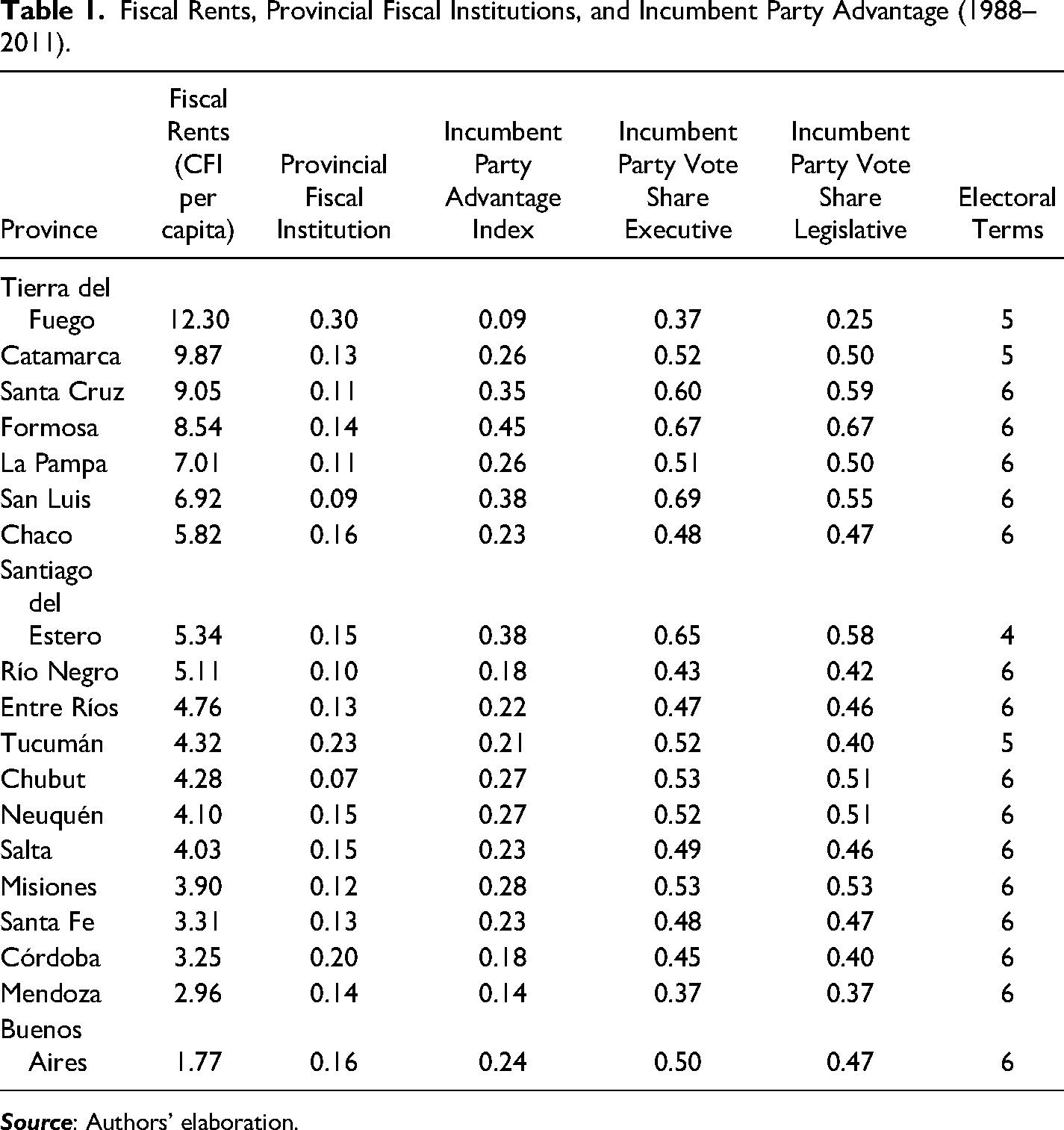
Please note that our analysis excludes the first provincial term (1984–87), as there was no CFI law and this grant was distributed discretionally by the national executive. 44 Additionally, during this first term there were no incumbent parties running for reelection. For the same reason, we exclude provincial terms in which the federal government removed provincial authorities through a federal intervention, as incumbent parties could not finish their terms and thus did not run for immediate reelection. Hence, the following province-terms are not considered: Catamarca (1988–91), Santiago del Estero (1992–95; 2003–5), and Tucumán (1988–91).
Regression Analysis
We collect time-series cross-sectional data for the nineteen eligible provinces. Our sample covers six terms between 1988 and 2011. Thus, independent and control variables are averaged over each provincial term (1988–91; 1992–95; 1996–99; 2000–2003; 2004–7; and 2008–11), whereas the dependent variable measures incumbent party advantage in six executive and six legislative elections (1991, 1995, 1999, 2003, 2007, and 2011).
To examine our hypothesis that the effect of fiscal rents on incumbent party advantage decreases and eventually disappears as fiscal institutions become more province-decentralizing, we specify an interactive model between fiscal rents and the nature of provincial fiscal institutions. So, the coefficients of interest are (1) fiscal rents, which measures the effect of fiscal rents when provincial fiscal institutions are fully centralizing, and (2) the interaction term between fiscal rents and provincial fiscal institution, which gauges the effect of fiscal rents per unit increase in the share of these rents mandated to be reallocated to municipal governments.
In all models, we add the following controls. First, since provincial fiscal institutions not only define the share of fiscal rents distributed from the province to the municipalities but also the criteria based on which that share is reallocated within provinces, we control for urban bias in the secondary distribution. As noted above, provinces use different criteria to redistribute fiscal rents from the province to the municipalities, many of which tend to favor large cities. Criteria such as population/urban population, own resources, expenses, employees, taxes/tax efficiency, and budget benefit urban municipalities because they have more population and more resources, collect more taxes, and have higher expenses than small and rural municipalities. 45 Thus, we added the percentages provincial governments assign to each of these criteria in their secondary distribution and provide an aggregate measure of urban bias. 46
Second, we control for the geographic gross product per capita, as the level of income could affect political contestation. 47 Third, since some provinces receive resource rents for the exploitation of oil and mining activities in their jurisdictions, we include a resource-producer dummy variable to control for potential different dynamics triggered by the existence of extractive industries. Fourth, we add another dummy variable indicating whether the incumbent governor leads the coalition running for reelection. Fifth, since political interactions between different levels of government are critical for the maintenance of uncompetitive regimes, 48 we control for party alignment at two levels: national-provincial and provincial-municipal. Regarding the former, we use the percentage of the term in which the governor and president belong to the same party (or party coalition). As to the latter, given that capturing the main urban centers can prove key to breaking authoritarian governors’ political hegemony, 49 we control for alignment between the governor and the mayors of the two most populated cities and use the percentage of the gubernatorial term in which the mayors of the main cities belong to the same party (or party coalition) as the governor. Ideally, a larger number of cities should be included. Unfortunately, this is not possible because most provinces lack systematic municipal data over time. Nonetheless, we reviewed a wide variety of sources to codify partisanship and collected the municipal data available for the two most populated cities in all the provinces. Although we were able to collect data only for these municipalities, these are the most important ones politically, as previous studies have found that electoral challenges to undemocratic incumbents come from the main urban centers. 50
Finally, the level of fragmentation of provincial party systems (i.e., two-party or multiparty system) might affect the vote share that the incumbent party obtains and thus the strength of the opposition. For instance, in a two-party system, it might be easier for the incumbent party to obtain a higher vote share, but at the same time losing votes could have serious consequences since they may go entirely to the nonincumbent party. As a result, we control for the effective number of parties in each province, and add two control variables: the effective number of parties for both executive and legislative elections at the moment of the respective election. This measure combines “the number and the size distribution of parties in a polity in a single coefficient of fragmentation that sums up the parties in a polity weighted by their size.” 51 Consequently, we are able to control for the number and relative size of parties competing in each provincial election, which allows us to ensure that our coefficients of interest capture the interaction between fiscal rents and provincial fiscal institutions taking into account the party system in which incumbent parties compete.
Results
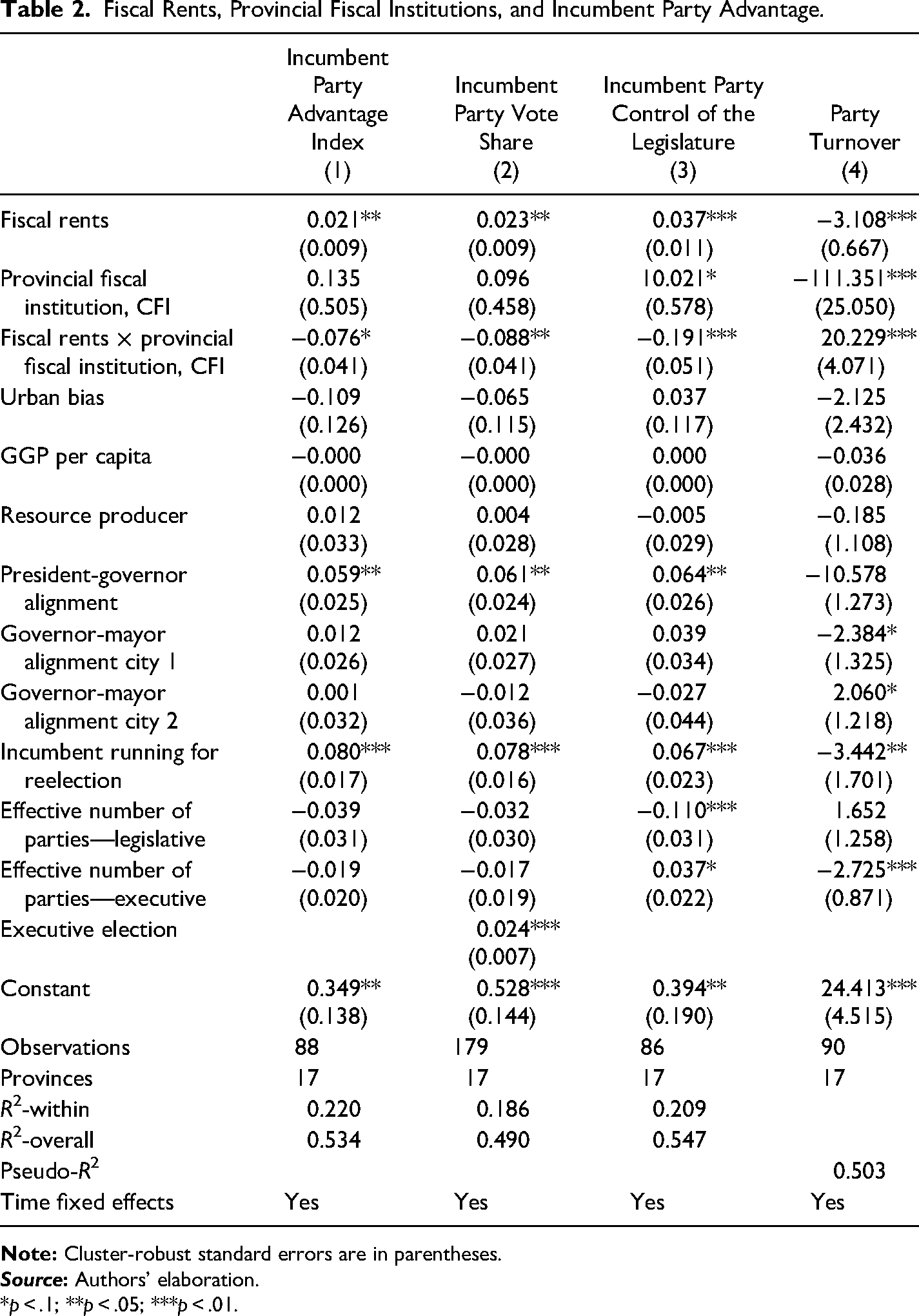
Table 2 reports the results across different random effects specifications. We prefer this estimator over fixed effects because provincial fiscal institutions in Argentina followed a path-dependent pattern. As a result, provincial fiscal institution—one of the constitutive terms of the interaction—is a variable with minimal within variation. Indeed, among the nineteen provinces we study, nine did not change their fiscal institutions over time and seven changed them only once. Accordingly, the interaction term—which is our main coefficient of interest—changes very gradually over time. In this setting, the fixed-effects estimator is highly inefficient and the random effects produce superior estimates, especially considering that, in addition to having a sluggish variable, the cross-sectional units of our study are relatively few. 52
Fiscal Rents, Provincial Fiscal Institutions, and Incumbent Party Advantage.
*p < .1; **p < .05; ***p < .01.
In all models we use robust standard errors clustered at the province level to control for heteroskedasticity and serial correlation, and add time fixed effects to account for temporal dynamics and common shocks that might have affected all provinces in each term. Model 1 reports estimates for the interactive model using the incumbent party advantage index as the dependent variable. As a reminder, the index ranges from 0 (no incumbent party advantage) to 1 (high incumbent party advantage). The minimum and maximum values in the sample are 0.01 (Mendoza 2004–7) and 0.58 (Formosa 2004–7), respectively. As expected, the interaction term remains negative and statistically significant, suggesting that the relationship between fiscal rents and incumbent party advantage is conditional on the nature of the provincial fiscal institutions that reallocate central-government transfers between provinces and their local governments.
In order to fully assess the nature of the relationship, we estimate and plot the marginal effect of fiscal rents on incumbent party advantage at different values of the provincial fiscal institution variable (from 0 to 0.3, the maximum value in our sample). Figure 2A plots the interaction using the coefficients of model 1. As shown, the plot lends support to our theoretical claim, as it shows that the marginal effect of fiscal rents decreases and ultimately disappears across levels of provincial fiscal institution. This decreasing effect is statistically significant at the 5 percent level for values of provincial fiscal institution that range from 0 to 0.16. In this range, the coefficient of fiscal rents drops from 0.021 to 0.009, indicating that the marginal effect of fiscal rents on incumbent party advantage decreases as provincial fiscal institutions become more decentralized. In addition, after 0.16 points, the effect is statistically indistinguishable from 0.
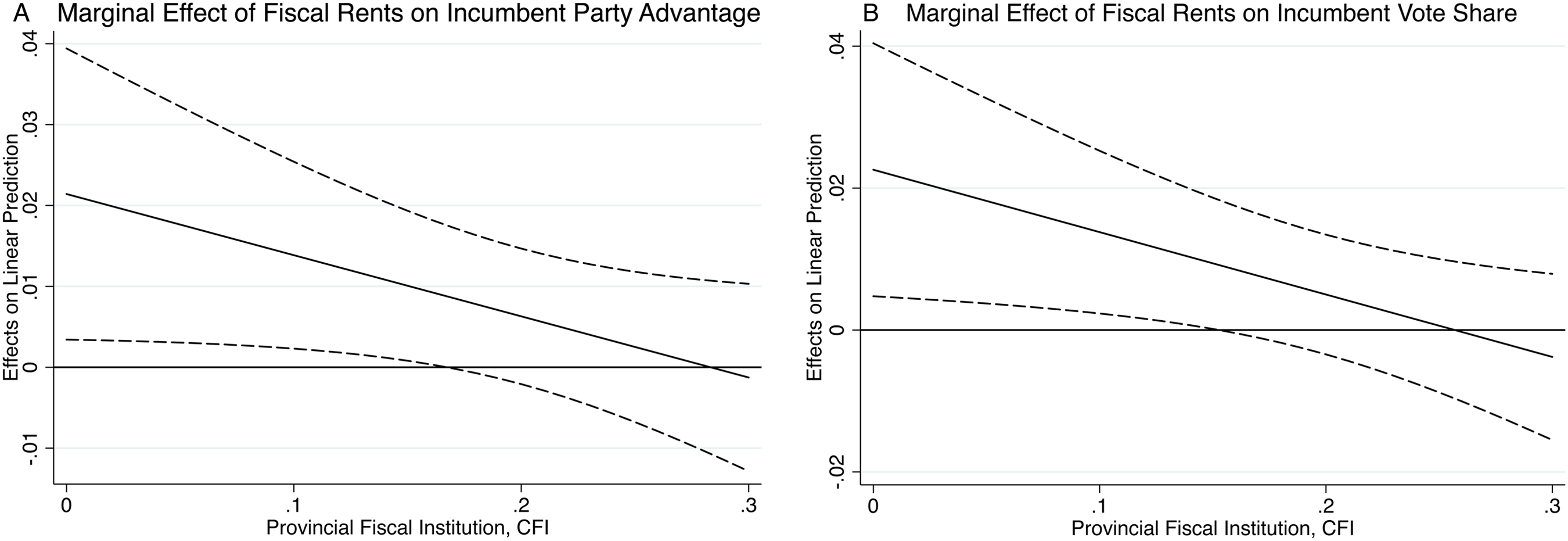
Marginal effects plots with 95 percent confidence interval. A, Marginal effect of fiscal rents on incumbent party advantage. B, Marginal effect of fiscal rents on incumbent vote share. (Authors’ elaboration.)
To fully assess the substantive importance of this decrease, consider the effect of receiving $10.11, that is, moving from the fifth ($1.90) to the ninety-fifth ($12.01) percentile of fiscal rents. When a province does not reallocate any fiscal rents to municipal governments, the expected change in the incumbent party advantage score is 0.21 points. Nonetheless, if the same province reallocates 16 percent, the expected increase in the incumbent party advantage score is 0.09. This is an important effect, as the difference of 0.12 percentage points between both scenarios is equivalent to a decrease in 1 standard deviation in the incumbent party advantage index.
Model 2 reestimates the interactive model using the incumbent party vote share in provincial elections as another measure of incumbent party advantage. This measure has the advantage of being more intuitive and easier to interpret. In this model, we control for the type of provincial election (a dummy that is coded 1 if the election is executive and 0 if it is legislative). The results confirm the previous findings, as the estimated coefficients indicate that the effect of fiscal rents on provincial competition decreases as the share reallocated to municipalities increases. Figure 2B plots the marginal effects based on the results of model 2. Consistent with our hypotheses, the plot shows a decreasing relationship that is statistically significant when the provincial fiscal institution variable is at values lower than or equal to 0.15 points, which represents around 70 percent of all the observations in the sample. In this interval, the point estimate of fiscal rents declines from 0.023 to 0.009, which implies a drop of around 60 percent in the marginal effect of fiscal rents. More importantly, the plot supports our hypothesis indicating that the effect of incumbent party advantage disappears after municipalities receive more than 15 percent of fiscal rents. That is, fiscal rents do not confer an electoral advantage for around 30 percent of the observations in our sample.
To contextualize the size of the decrease predicted by model 2, if a given province experiences an increase in fiscal rents of $10.11 when municipal governments are reallocated 9 percent (around the twelfth percentile and roughly equivalent to Catamarca for most of the period we cover) of these rents, the model predicts that the provincial incumbent party will obtain 15 percentage points more of the vote in provincial elections (an increase of 1.16 standard deviations). In turn, the same $10.11 increase in a province where 15 percent (around the seventieth percentile) of fiscal rents is reallocated to the municipalities, as illustrated by Salta, leads to an increase in the provincial incumbent party's vote share of 10 percentage points (an increase of 0.78 standard deviations). That is, the first province is expected to receive 5 additional percentage points than the latter, which can make a significant difference when elections are close.
We estimate another interactive model using the share of seats controlled by the incumbent party in the legislature as the dependent variable. 53 This measure reflects the actual legislative strength of the incumbent party. This is thus an important measure, as strong control of the legislature might allow the incumbent party to dismantle the institutional constrains on the executive that preserve subnational democracy. Along the lines of our argument, model 3 indicates that the effect of fiscal rents decreases and eventually disappears when provincial fiscal institutions reallocate central-government transfers to municipalities. Figure 3A shows that this effect is statistically significant for values of provincial fiscal institution that range from 0 to 0.14 points, which represents around of 52 percent of the observations in the sample. In this range, the coefficient of fiscal rents declines from 0.037 to 0.010, supporting the hypothesis that the effect of these rents on incumbent party control of the legislature decreases as fiscal institutions become more decentralized. Between 0.15 and 0.24 points, rents have no effect on incumbents’ control of the legislature, which suggests that access to fiscal rents do not grant incumbent parties an advantage to control legislatures in around 25 percent of the observations in our sample. Interestingly, fiscal rents also have a negative effect for incumbent party advantage in the legislature when provincial fiscal institutions reallocate 25 percent or more of fiscal rents (around the ninety-fifth percentile), which applies to 5 percent of the observations in our sample.
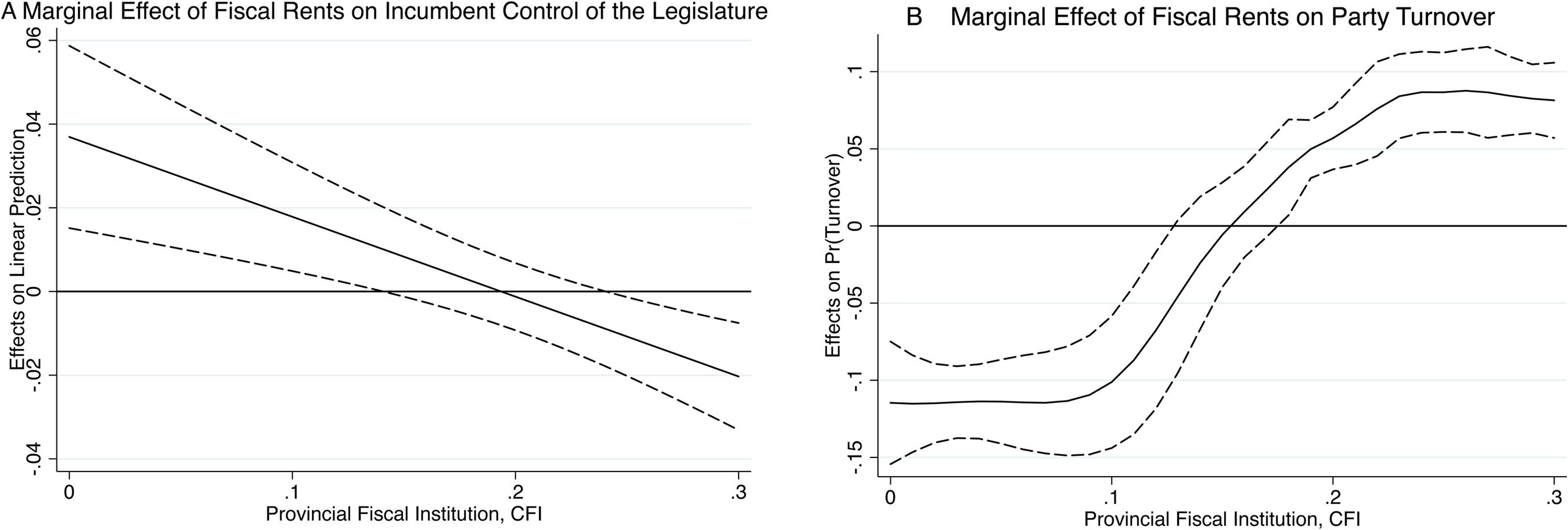
Marginal effects plots with 95 percent confidence interval. A, Marginal effect of fiscal rents on incumbent control of the legislature. B, Marginal effect of fiscal rents on party turnover. (Authors’ elaboration.)
The model predicts that when a province receives $10.11 and decentralizes 10 percent of it to municipal governments, its incumbent party is expected to control 18 percentage points more of the legislative seats. In turn, the incumbent party will control 10 percentage points more of the legislative seats if a province receives the same amount and decentralizes 14 percent of fiscal rents to its municipalities. If one considers that the governor controls 54 percent of the legislature in the average province, this difference of 8 percentage points could be critical for the incumbent party to obtain the legislative supermajorities necessary to modify the rules of the game and dismantle the institutional constraints on the executive that preserve subnational democracy.
Additionally, we also estimate a logit model using provincial party turnover as the dependent variable. This dichotomous measure of alternation of power is coded 1 if there is party turnover in the executive branch and 0 when there is no alternation. Model 4 presents logit coefficients for provincial party turnover. Since turnover is coded 1, we expect to observe an increase in the probability of turnover as provincial fiscal institutions become more province-decentralizing. As shown in model 4, the interaction term is positive and statistically significant, indicating that an increase in decentralization of fiscal rents raises the probability of provincial turnover.
In order to interpret these coefficients, Figure 3B plots the average marginal effect of fiscal rents across different values of provincial fiscal institution. Please note that the average marginal effect takes each individual observation's marginal effect across the sample on the probability that Y = 1, and then averages these values out. In other words, the average marginal effect is the mean over the sample values of the marginal effects calculated for every observation in the data, which provides a strong idea of the representative marginal effect. 54 Figure 3B shows how the mean marginal effect of fiscal rents changes as a function of the decentralization of rents. According to the plot, provinces that decentralize between 0 and 12 percent of fiscal rents—which represents around 39 percent of all the observations in the sample—have a statistically significant negative probability of turnover. For instance, a province that shares 8 percent of fiscal rents (around the sixth percentile and equivalent to San Luis for the terms 1988–91 and 1992–95) is expected to decrease the probability of turnover by 11 percentage points. Nonetheless, this negative effect disappears as provinces decentralize fiscal rents. That is, for 61 percent of the cases in our sample, provincial fiscal institutions do not help provincial parties to entrench themselves in power. What is more, once provinces reallocate 18 percent or more of fiscal rents to municipal governments, the probability of turnover becomes positive and statistically significant. For example, a province that reallocates 20 percent of fiscal rents—around the ninetieth percentile and equivalent to the province of Córdoba for almost all periods—will increase its probability of turnover by 6 percentage points.
Finally, we follow Morrison, 55 who studies the combined effect of all types of nontax income at the national level, and add all rents that provincial governments receive into a single category, which we refer to as total rents. As a reminder, national fiscal institutions transfer CFI, in different magnitudes, to all provinces, but resource-rich jurisdictions receive, in addition, resource rents from hydrocarbon and mineral production in their territories. As a result, the variable total rents equals CFI for resource-poor provinces but CFI plus resource royalties for resource-rich jurisdictions. In order to estimate the provincial fiscal institutions of resource-rich provinces, we also reconstructed the history of legal changes to the distribution of oil and mining royalties from provincial to municipal governments since the first law was established until 2011, and provide a detailed account of the magnitude and number of changes that provincial fiscal institutions reallocating royalties to municipal governments have experimented with (see Appendixes A and B). In particular, we show that during the period under study (1988–2011), these institutions followed a clear path-dependent pattern.
With this information, we calculated the share of all rents that provincial fiscal institutions mandate resource-rich provinces to reallocate to municipal governments. For example, if a resource-rich province receives 40 percent of its total rents from CFI and 60 percent from royalties, and provincial fiscal institutions grant municipalities 10 percent of CFI (4 percent) and 15 percent of royalties (9 percent), we coded the variable “provincial fiscal institution, total rents” with 0.13 score. In Appendix H, we estimate all models for our combined measure of total rents. The results are consistent with the findings presented above, suggesting that our theoretical framework holds for all sources of nontax revenue.
Comparative Case Analysis: Santa Cruz and Tierra del Fuego
For an in-depth analysis of the mechanisms through which provincial fiscal institutions affect provincial competition, we draw on a comparison of two cases, following the most similar systems design. 56 We selected the provinces of Santa Cruz and Tierra del Fuego since they share a common history of colonization and exhibit similar cultural traits, geographic characteristics, and economic structures that make them highly comparable. More important, as showcased in Appendix H, both provinces receive the highest amounts of both CFI and our measure of total rents but have the most divergent provincial fiscal institutions. Indeed, taking the rentiest provinces in Argentina, that is, those above the eightieth percentile, Santa Cruz is the province that grants the lowest percentage of CFI and nontax revenue to its municipalities, whereas Tierra del Fuego reallocates the highest share of both. As expected, Santa Cruz's incumbent party index ranks among the highest, while Tierra del Fuego's score is one of the lowest of all Argentine provinces.
Santa Cruz
Politics in Santa Cruz are heavily tilted in favor of the incumbent party, the PJ-Front for Victory (PJ-FPV). Never has any other party been able to successfully dispute the governorship since the return to democracy. Indeed, between 1991 and 2011, there have been three different PJ-FPV governors: Nestor Kirchner (1992–95; 1996–99; 2000–2003), Sergio Acevedo (2004–6), 57 and Daniel Peralta (2007–11). The result is a province with low levels of provincial contestation, where the PJ-FPV normally wins provincial elections by a landslide. As an illustration, the average vote share of the incumbent party's candidate for governor during the period under study reaches an impressive 60.3 percent, with an average difference with the runner-up of 22.8 percent of the votes. Similarly, regarding the provincial legislature, over the same period, the incumbent party obtained an average of 58.7 percent of the votes, with a margin of victory of 25.8 percent. Consequently, opposition parties in the province stand as weak electoral alternatives.
We argue that this overwhelming incumbency advantage results from Santa Cruz's province-centralizing fiscal institution. The air force, which ruled the province during the dictatorship, designed an overly centralizing set of provincial fiscal institutions. With the enactment of Law 1494 in 1982, the province was mandated to reallocate 7 percent of royalties and 10 percent of CFI to municipalities. These fiscal institutions remained almost unchanged during the period under study. Only CFI changed in 1 percent in 1987 (Law 1955), but there were no further modifications after that year. As a result, Santa Cruz has the most restrictive provincial fiscal institution of Argentina, sharing an average of only 8.9 percent of its total rents with its municipal governments. By sharing a minor portion of the total rents, the provincial fiscal institutions the military established put Santa Cruz on a path that favored the province at the expense of municipalities. Indeed, most municipalities lack the necessary resources to fund their payroll and other minimum expenses. According to former governor Daniel Peralta, “There are entire towns that are not viable without the help of the provincial government. … There is not a single mayor who does not need help.” 58 In this context, poorly funded mayors have been unable to build viable political platforms to challenge the incumbent party in executive and legislative elections.
Regarding direct challenges to the governor, mayors in Santa Cruz are generally weak competitors. They have had to opt between being financially autonomous, but unable to spend in public investment, or, on the contrary, engaging in public spending, but becoming fiscally dependent on discretionary transfers from the province. As an illustration of the first case, Alfredo Martínez, former mayor of Santa Cruz's capital city, Río Gallegos (1991–99), and an opponent of the PJ-FPV government, explained that “there is a mechanism called ‘support for public investment’ which the provincial executive assigns when the municipalities must spend on something outside their basic activities. During the eight years I was the mayor of Río Gallegos, I never received that ‘support’ from Governor Kirchner.” 59 Despite the fact that Martínez was the mayor of the province's main city for two consecutive periods, he unsuccessfully contested the governorship twice, in 1999 and 2003. The same pattern can be illustrated with Héctor Roquel (2003–11), Río Gallegos's mayor under governors Sergio Acevedo and Daniel Peralta, as he claimed that his administration had been undermined because he did not receive funds from the province, whereas smaller municipalities were granted considerable resources just because of their political affinity with the incumbent party. 60 Roquel further criticized Santa Cruz's provincial fiscal institutions for allowing too much room for discretion, and contended that the province needed a new law that “distributes with equity and that santacruceños and municipalities should be governed by the law.” 61 Along the same lines, Marcelo Saa, city councilor of Río Gallegos between 1999 and 2007, contended that Roquel faced severe hardships related to the lack of resources. Specifically, he blamed the provincial fiscal institution that forces municipalities “to beg to be able to pay salaries and fulfill their obligations.” 62 The fact that Roquel remained autonomous from these governors weakened his political standing. Indeed, he decided not to compete for the governorship, and the defeat of the Unión Cívica Radical Party's candidate for governor in the 2007 elections, Eduardo Costa, was partly attributed to his inability to marshal the support of the electorate in Río Gallegos. 63
In the second scenario, mayors who wish to spend beyond the payroll must rely on discretionary transfers from the province. The heavy dependence on these monies has served as a powerful tool for the incumbent party to control mayors. According to Roquel, when mayors get along with the governor, discretion is welcome, as it benefits them. Nonetheless, when mayors and governors stop being allies, the former are no longer benefited by discretionary transfers and therefore demand the modification of the coparticipación law. 64 In the most extreme cases, mayors switched political sides and supported the governor to receive more resources, as exemplified by Jose Luis Martinelli, mayor of Las Heras (1999–2007), who left the Unión Cívica Radical Party (UCR) to join the PJ-FPV. According to UCR provincial politicians, Martinelli opted to do this after months of waiting for the governor to transfer the discretionary resources necessary to administer the municipality. As an act of magic, UCR politicians in Santa Cruz contend, those resources appeared right after Martinelli swore loyalty to Kirchner. In effect, when Kirchner assumed office, there were four UCR mayors in the province, and three of them joined the PJ-FPV, as it was the only way to receive resources from the governor. 65 More generally, it is argued that Kirchner's strategy to co-opt contenders centered around the control of funds, which was colloquially called “golpe de caja.” 66 Certainly, this strategy was possible because provincial fiscal institutions reallocated minor amounts of nontax revenue to municipal governments. As summarized by a former governor of Santa Cruz, “Whoever controls the money controls the province.” 67 Faced with this reality, the former mayor of Caleta Olivia and candidate for governor, Carlos Prades, asserted that “there is no federalism in our province. … The distribution of federal resources must be reversed urgently, passing a new consensual law that allows mayors to rule their towns, freely and with no pressures or humiliations from the provincial government.” 68
In sum, mayors are weak political actors who are unlikely to succeed when contesting the incumbent governor in executive elections or supporting their political allies seeking to obtain the provincial seat. In effect, during the period under study, there were four candidates who competed against the PJ-FPV incumbents, but made it second, namely, Angela Sureda, Ricardo Patterson, Alfredo Martínez, and Eduardo Costa. Of those contenders, only Alfredo Martínez was mayor at the time he decided to run for governor. This suggests that, in Santa Cruz, electoral assaults against the incumbent governor's party are unlikely to come from mayors. Indeed, the media coverage of Eduardo Costa's first campaign for governor stated that mayors like “Carlos Prades, Alfredo Martínez, and Héctor Roquel could barely standout in internal [UCR elections]” and that “at most, they could obtain a municipal post.” 69 The perception was then that these mayors could not hope to win the gubernatorial elections.
As to legislative elections, the weakness of the municipality hinders the capacity of mayors to develop territorial vehicles or support allies to fill seats in the provincial legislature. Indeed, when describing the political scenario in 2007, political analyses posited that Alfredo Martínez and Héctor Roquel, the former and then mayor of Río Gallegos, respectively, could at most obtain “national and provincial legislative seats by minority.” 70 Mayors’ inability to build legislative majorities contributes to weakening competition and strengthening the incumbent party. This, in turn, has allowed the incumbent party to pass a number of laws that concentrate power in the provincial executive. Two constitutional reforms and the enactment of specific laws were crucial to achieve this goal.
The weakness of the legislative opposition becomes evident in the enactment of the constitutional reform in 1994, which, among other things, allowed the governor's reelection for one additional term and introduced plebiscitary powers. This reform finds its origins in a project the PJ-FPV presented to the legislature in 1993. 71 However, although the incumbent party had a majority in the legislature, it lacked the necessary votes to approve the reform. Thus, Governor Kirchner negotiated with UCR politicians, in the so-called Pacto de Río Gallegos, promising more control over provincial resources in exchange for their approval of the reform. Allegedly, Kirchner never fulfilled his promise. 72 Notably, the single promise of increasing control over provincial resources sufficed to make a weakly financed opposition enter into a pact, which years later it would regret because of the consequences it had for provincial politics. 73
In the case of the 1998 constitutional reform, although the PJ-FPV had a majority of 58.3 percent in the provincial legislature, the coalition did not control the two-thirds of the votes required to approve the reform. Faced with this situation, Governor Kirchner decided to use the executive powers to invoke a referendum granted in 1994, so that the citizens decided the reform's approval. The call for a referendum was approved by his copartisans in the legislature, but the opposition, led by Mayor Alfredo Martínez, saw it as a strategy to circumvent the legislature. 74 The PJ-FPV won the plebiscite with 56.8 percent of the vote, and the Constituent Assembly that ensued was formed by fourteen PJ-FPV constitutional delegates and ten from the opposition alliance. However, Alfredo Martínez, along with all the opposition constitutional delegates, abandoned the Constituent Assembly, arguing that they would not validate a process that they considered illegal and unconstitutional. 75 The fact that the opposition opted out provides a powerful indication of their weakness, as they knew they would not be able to block the reforms from within.
The 1998 constitutional reform concentrated power in the executive even further. Indeed, seeking to weaken the opposition, especially in the cities, the PJ-FPV designed a new electoral system that would empower rural areas and underrepresent urban municipalities, where it lacked a strong support base. The new constitution thus established a mixed-member electoral system whereby ten members are elected in a provincewide district by proportional representation and fourteen compete in single-member districts, each of which corresponds to a municipality. This reform was called “one deputy per town.” 76 On paper, this new system empowered the municipalities by ensuring legislative representation. However, since most municipalities are heavily dependent on discretionary transfers, especially the rural ones, these reforms contributed to strengthening the influence of the provincial executive on mayors, who campaign for the incumbent party's candidate in exchange for resources. Consequently, this new system was perceived as a mechanism for the PJ-FPV to “keep all the mayors under its strict dependence” 77 and to dilute the opposition's electoral strength, as each party could obtain only one seat per town, and the provincial incumbent controlled most cities in the province. The results the PJ-FPV obtained in the 1999, 2003, 2007, and 2011 legislative elections reflect the advantage this new system gave to the ruling coalition and the long-term effects it had on provincial politics. In effect, while in the province-wide district the PJ-FPV obtained 5, 8, 7, and 8 seats, respectively (out of 10 seats), in the single-member districts it gained 11, 14, 13, and 14 (out of 14 seats). The incumbent party reached an average of 60.8 percent of the seats under the old system, while it attained an average of 83.5 percent with the new system. Impressively, it obtained 92 percent of the seats in the 2003 and 2011 elections. By introducing an obvious partisan bias and distorting the translation of votes into seats, this system turned Santa Cruz into the most malapportioned province in Argentina, 78 giving weak mayors an important role in securing legislative support for the governor as a way to obtain resources.
Tierra del Fuego
Tierra del Fuego became a province in 1990 and held the first provincial election in 1991. Since then, the province has remained electorally competitive. First, no party has been able to entrench itself in power. Indeed, five parties or coalitions have ruled over the province during the period under study. The Popular Fueguino Movement (MOPOF) governed the province during the first two gubernatorial periods (1992–95; 1996–99), giving way to a PJ government led by Carlos Manfredotti (2000–2003). In the 2003 election, the Front of Provincial Unity (FUP) won with Jorge Colazo the provincial executive for one period (2004–7). Finally, Fabiana Ríos won the 2007 and 2011 elections, but under different parties, the Support for an Egalitarian Republic (ARI) and Patagonian Social Party (PSP), respectively. Second, provincial elections are very competitive, as the incumbent party reached an average of 37 percent of the vote share during the period under study with a difference of 7.2 percent of the votes with the runner-up. In the legislature, the incumbent party obtained 24.5 percent of the votes with a margin of 5.4 percent with the runner-up. The rotation of ruling parties in Tierra del Fuego and the minor differences between the top two contenders evince how competitive this province is, which has led many to assert that, politically, this province “belongs to no one.” 79
We claim that this pattern of competition results from the provincial fiscal institution, which empowers the municipalities, giving them 30 percent of CFI and 20 percent of royalties, thus balancing power relations with the provincial executive. On average, the province has shared 26.7 percent of its nontax revenue with the municipal governments, standing out as the most generous provincial fiscal institution in Argentina. These institutions were put in place by the navy, which governed the then-national territory of Tierra del Fuego during the dictatorship. The military established the first fiscal institutions in 1983 with the enactment of Law 191, which granted municipalities 20 percent of CFI and 15 percent of royalties. Both regimes persisted over time, experiencing only one change in 1988, when Law 343 incremented CFI to 30 percent and royalties to 20 percent. However, since Tierra del Fuego changed its administrative status to a province (1991), the provincial fiscal institutions have remained unchanged. These fiscal institutions demarcated a stark difference between Tierra del Fuego and Santa Cruz. Indeed, according to the province's current vice-governor, “municipalities in Tierra del Fuego receive much more resources than Santa Cruz's, and that is something that obviously strengthens economic autonomy.” 80 Moreover, as Alberto Garramuño, former mayor of Ushuaia, commented, on occasions the fiscal relation has been one of a “poor province, and rich municipalities.” 81 This provincial fiscal institution has had a twofold effect on provincial elections.
First, mayors are governors’ main challengers, and their fiscal strength plays a crucial role in explaining this political power from below. In effect, mayors have defended their autonomy vis-à-vis the province as a key mechanism to govern their municipalities, which has translated into conflicts with the governor. As an illustration, a former governor in the 1990s commented that when he was in power, “it was difficult to deal with Colazo [the mayor of Río Grande] because he wanted to be the governor. I would go to Río Grande and invite him to inaugurate a public work, to share the success of this inauguration, and he would come. However, after I left the city, he would say bad things about me on the radio.” 82 The same pattern was observed years later when Colazo was the governor, as the mayor of Ushuaia, Jorge Garramuño, announced that he would request legal protection against his attempts to intervene in municipal affairs. Specifically, the conflict arose because of the public investment works the province began carrying out in Ushuaia, which Garramuño perceived as competition. Faced with this reaction, Tierra del Fuego's minister of government, Enzo Filosa, replied that “Garramuño should stop thinking of 2007,” 83 hinting that his criticisms reflected his aspirations to compete in the provincial elections. Thus, Garramuño's reaction signals that his capacity to provide for the municipality's needs autonomously was key to showcasing the administrative prowess that would allow him to build an electoral platform. Mayors in Tierra del Fuego do not feel coerced by provincial executives and, to the contrary, use these conflicts to their favor. In short, both examples show that, on the one hand, mayors resist provincial intervention in their internal affairs and, on the other, that governors presume that this resistance and public attacks stem from mayors’ ambition to become governors.
In effect, mayors’ political careers include competing against the incumbent governor. Candidates for governor normally come from the municipal executives, especially from the province's main cities. Using the colloquial language to refer to a soccer game between two major teams, many describe provincial elections in Tierra del Fuego as a “classic between two cities,” in which either the governor or the mayor of one city competes against the head of another city. Clear examples of this include the elections where Jose Estabillo (Ushuaia) competed against Esteban Martínez (Río Grande) and where Carlos Manfredotti (Ushuaia) faced Jorge Colazo (Río Grande). The fact that most elected governors, with the exception of Fabiana Ríos, were previously mayors reinforces the importance of the municipality as an electoral platform.
Relatedly, the competitors for the provincial executive have made use of their municipal experience to marshal the support of their respective cities. The two elections in which Colazo and Manfredotti faced one another serve as an illustration. In the 1999 election, in which Colazo was defeated, he asserted that “we will make the difference with the votes of Río Grande, just like Estabillo did with Ushuaia the two times he was elected governor.” 84 Colazo won the subsequent election and referred to the city as the basis of his electoral victory, claiming that “this is a triumph of the people of Río Grande.” 85 These two references to Río Grande point out that the municipality serves as a launching pad to challenge the provincial incumbent party. Likewise, when Jorge Garramuño competed for governor as the mayor of Ushuaia in 2007, he reached out to the mayor of Río Grande, Jorge Martin, for support. Garramuño emphasized that, unlike the other candidates, he and Martin “could show what they did in their municipalities, both in Ushuaia and, if we seal a deal with the radical party, in Río Grande.” 86 Therefore, mayors’ administrative experience is seen as an asset in the contest for the provincial executive. Moreover, mayors are important political figures to provide support for those running in gubernatorial elections. For example, in the 2007 gubernatorial elections, Jorge Martin became a political figure that all candidates were trying to attract to their side. Indeed, Garramuño asserted that Martin was someone that “everyone wants.” 87
Second, municipal fiscal strength has allowed mayors and their parties to obtain seats in the legislature. The presence of opposition parties in the provincial legislature is key for limiting the power incumbent parties may wield, especially regarding attempts to concentrate power and resources. Indeed, in Tierra del Fuego there is not an evident predominance of one party over another. Between 1991 and 2011, the incumbent governor's coalition only controlled, on average, 30.6 percent of the fifteen-seat legislature. Furthermore, the ruling parties of the main cities in the province have always achieved legislative representation. Indeed, the MOPOF, UCR, and PJ, which have governed Ushuaia, Río Grande, and Tolhuin at different times during the period under study, have managed to obtain and control a fairly similar share of seats in the legislature. For instance, in the 1999 and 2003 elections, when the MOPOF won in Ushuaia, it obtained five and four seats in the legislature, respectively, whereas the UCR, which governed Río Grande, reached four and three. Finally, the PJ, which controlled Tolhuin, won six and five seats in these two elections.
Opposition legislators have recurrently constrained the incumbent party and protected the resources that provincial fiscal institutions grant them. The best illustration of this legislative control is the suspension and later impeachment of Governor Colazo in 2005, following accusations that he attempted to illegally withhold Río Grande's share of CFI funds and bypass the legislature when modifying the 2004 provincial budget. 88 Colazo's motivation to withhold Río Grande's funds was arguably related to his rivalry with the mayor of this city, Jorge Martin, also a UCR politician. 89 Moreover, Colazo accused Martin and Garramuño, then mayor of Ushuaia, of conspiring against him, and decided to bypass both of them, promising to carry out public works in their municipalities. This, in turn, spurred new conflicts with the mayors. Thus, along the lines of our argument, the reasons used to justify the impeachment centered on municipal autonomy. In effect, according to the legislator Norma Martínez, Colazo “was found guilty of a major misdeed owing to his attack against municipal autonomy, causing serious harms to the institutions and the validity of the national and provincial constitution.” 90 Thus, while Colazo attempted to carry out the usual strategy of Santa Cruz's governors, that is, controlling mayors by refusing to transfer discretionary funds, the very same laws the governor sought to circumvent had already empowered a municipal opposition that quickly acted to halt his attempts to concentrate power, especially in the legislature. Ultimately, the governor's attempts to interfere in municipal affairs and bypass the legislature were severely punished by legislators of various parties, signaling that the provincial executive is not above and beyond provincial laws, but rather heavily constrained from below.
Conclusion
We have argued that provincial fiscal institutions that are more province-centralizing lead to high incumbent party advantage at the provincial level, whereas provincial fiscal institutions that are more province-decentralizing increase contestation in provincial elections. In the former, the province centralizes fiscal rents, which allows the incumbent party to control underfinanced municipalities. Thus, mayors are too weak to effectively contest the provincial incumbent party, or support candidates to do so, in executive and legislative elections. Conversely, in the latter, provincial fiscal institutions reallocate significant amounts of fiscal rents to municipalities, which enhances their fiscal strength and turns mayors into relevant politicians who can compete against the incumbent party, or support other candidates running for the provincial executive and legislature.
Our results thus nuance the widely held belief that fiscal federalism–based rentierism undermines subnational democracy. By incorporating the role of provincial fiscal institutions, we complement Gervasoni's seminal work, 91 which presumes that fiscal rents always have negative effects on democracy. Our findings indicate that this argument is accurate, but only in provinces where provincial fiscal institutions centralize fiscal rents. Indeed, it is only in these institutional settings that fiscal strategies of “boundary control” to deprive the opposition of access to centrally levied taxes are feasible.
Argentina resembles the fiscal structure of most federations worldwide, as only two levels, the national and intermediate, are effectively recognized. This creates the conditions for uncompetitive politics when fiscal rents are centralized at the intermediate level, limiting the fiscal autonomy of municipalities. Consequently, the argument we put forth also resonates with broad evidence from other federations, particularly those in developing regions. For example, in India, national and state elites typically promote local democratization without fiscal autonomy as a strategy to establish and control an effective base of local intermediaries to mobilize voters and target patronage. 92 As a result, subnational democracy suffers, as local elections become more a mechanism of control by higher-level politicians than a mechanism of downward accountability that broadens local participation. We further suggest that shifting the focus toward fiscal interactions between subnational levels allows understanding different patterns of provincial electoral dominance. For instance, in Brazil, as in Argentina, fiscal transfers are mostly unearmarked and tend to benefit less populated states, thus granting fiscal rents to subnational governments. However, Brazilian fiscal institutions allocate fiscal rents both to the state and the municipality. Indeed, national fiscal institutions give states 21.5 percent of the federal revenue and manufacturing taxes collected by the federal government and 22.5 percent to municipalities. Thus, the negative political effects normally associated with large transfers are not observed in Brazilian states, as mayors receive enough fiscal rents from the center to be fiscally strong vis-à-vis governors. Brazil's fiscal relations across levels of government resemble those of Argentine provinces that reallocate a significant share of fiscal rents to municipalities, and explains why the mayorship is a political post highly coveted by local and national politicians alike. 93
Finally, by underscoring the institutional settings under which fiscal rents may trigger negative political outcomes, our study highlights the need for appropriate institutional design to manage central government transfers and provides lessons for the design of subnational fiscal institutions.
Supplemental Material
sj-docx-1-pas-10.1177_00323292221137192 - Supplemental material for Fiscal Origins of Subnational Democracy: Evidence from Argentina
Supplemental material, sj-docx-1-pas-10.1177_00323292221137192 for Fiscal Origins of Subnational Democracy: Evidence from Argentina by Diego Diaz-Rioseco and Carla Alberti in Politics & Society
Footnotes
Acknowledgments
The authors thank the coordinating editor and the board of Politics & Society for their helpful suggestions and feedback on previous versions of this article. We also thank Richard Snyder, Giancarlo Visconti, Agustina Giraudy, and the participants of the seminars of Trandes Program, Freie Universität Berlin, and Escuela de Gobierno UC.
Declaration of Conflicting Interests
The author(s) declared no potential conflicts of interest with respect to the research, authorship, and/or publication of this article.
Funding
The author(s) disclosed receipt of the following financial support for the research, authorship, and/or publication of this article: Diego Diaz-Rioseco received financial support from ANID (FONDECYT 11190953), and Carla Alberti from ANID–Millennium Science Initiative Program (Code ICN17_002) and ANID–Millennium Science Initiative Program (ICS2019_025).
Supplemental Material
Supplemental material for this article is available online.
Notes
Author Biographies
Supplementary Material
Please find the following supplemental material available below.
For Open Access articles published under a Creative Commons License, all supplemental material carries the same license as the article it is associated with.
For non-Open Access articles published, all supplemental material carries a non-exclusive license, and permission requests for re-use of supplemental material or any part of supplemental material shall be sent directly to the copyright owner as specified in the copyright notice associated with the article.
