




Abstract
The lead trade associations of the bio-pharma and semiconductor industries have differed systematically in their roles in facilitating the development of innovation networks between Shanghai and Shenzhen, two prominent high-tech metropolises in China. Divergent associational roles stem from variations in the regional state policy regime that has exerted differential shaping influence on the structure of social cleavages and strength of reciprocity norms among member firms and on their willingness to actively and cooperatively engage in association-led networking activities. The bio-pharma and semiconductor associations whose network-building roles have been structured differently through varied state policy regimes have displayed dissimilar abilities to reduce network failures and promote the innovation competences of their member firms between the two metropolises. The empirical findings of the article carry important implications for understanding the causes and consequences of varied associational roles in the process of technology development in China, other emerging markets, and beyond.
This article examines the process through which trade associations have facilitated the development of innovation networks in Shanghai and Shenzhen, two prominent high-tech metropolises in China. Focusing on the bio-pharma and semiconductor industries, it shows that the lead associations of these industries have differed significantly in their network-building roles. In Shanghai, the bio-pharma and semiconductor associations that have played a weak role in promoting dense interorganization relations and extensive innovation linkages have been unable to help member firms find trustworthy and competent collaborators. This has reinforced the centralization of technological activities around the vertically structured groupings of large corporate actors and dented the innovation performance of small and medium-sized enterprises (SMEs). In Shenzhen, by contrast, the more vigorous role of the two high-tech industry associations in developing broad and cross-cutting social and knowledge linkages has enabled member firms to search for innovation resources and provided a safeguard against noncooperative behaviors. The success of network governance has been reflected in the open and horizontal organization of innovation activities and in the strong entrepreneurial capabilities of bio-tech and semiconductor SMEs.
To account for why the role of the high-tech industry associations in building innovation networks has differed between Shanghai and Shenzhen, this article emphasizes the causal importance of divergent state industrial policies. More specifically, it posits that varied associational roles have reflected the dichotomization of such policies into hierarchical and heterarchical regimes in the two metropolises. Shanghai has represented more the hierarchical regime that has increased social cleavages and weakened cooperative norms among bio-tech and semiconductor firms of contrasting sizes. The resultant social and normative fractures have rendered SME members unwilling to contribute to the collective efforts of their associations to build collaborative ties both within the two industries and without. Shenzhen has shared many characteristics of the heterarchical policy regime that has strengthened social ties and reciprocal behaviors among bio-tech and semiconductor firms of different sizes. This has encouraged them to collaborate to support associational roles in developing and sustaining social and technical linkages. Divergent associational roles have produced significant variations in the structure and strength of innovation networks in the two high-tech industries and in the technological competences of bio-tech and semiconductor SMEs between Shanghai and Shenzhen.
The roles of trade associations in promoting social and knowledge networks have been emphasized in key empirical studies on innovation governance. 1 However, these studies have predominantly converged on advanced industrial societies. While the importance of associations in influencing the trajectory and outcome of industrial upgrading in emerging market economies is widely recognized, 2 scholarly discussions on their roles in building and sustaining innovation networks are few and far between. 3 Two recent major volumes on the governance of innovation systems across these economies pay scant attention to this important issue. 4 The present study seeks to fill this critical analytical lacuna by providing a comparative account of variations in the network-building role of trade associations between the regional innovation systems of a major emerging market economy. It draws on the two different yet interrelated dimensions of network governance that manifest themselves in the efforts of associations to promote internal technical and strategic interactions among members on the one hand and coordinate external social and knowledge linkages between members and nonmember actors and organizations on the other. As will be shown below, this account, which sheds important light on the process through which varied associational roles exert differential shaping influence on the efforts of firms to develop knowledge linkages and gain extramural resources, provides an analytical framework for understanding the connection between associations, networks, and innovation patterns in China, other emerging markets, and beyond.
Furthermore, there have been limited theoretical efforts to develop sophisticated models for explaining variations in the network-facilitating and innovation-enabling roles of trade associations. To the extent that these variations are discussed in the context of emerging market economies, the discussion is largely descriptive and thus thin in causal analysis. 5 The weak development of explanatory approaches has stemmed in large part from the paucity of comparative studies on the changing variety of associational governance across sectors, regions, or countries. While we have well-established frameworks on offer for theorizing about divergent associational roles in the making of public policies and corporate political strategies, 6 we are much less armed when it comes to the explanation of variations in the associational promotion and governance of innovation networks across time and space. This study seeks to advance such an explanation that grants causal primacy to the role of state policy regimes in shaping social relations and cooperative practices among firms of different sizes that in turn impinge crucially on the ability of trade associations to mobilize members to engage in the building of innovation networks. This state-centered proposition is particularly pertinent in emerging market countries where the socioeconomic institutions that support the growth of trade associations are relatively poorly developed and where the role of states in nurturing such institutions has varied significantly at the regional and national levels of analysis. 7
Research Sites and Data Collection
Over the past few decades, Shanghai and Shenzhen have emerged as two leading regional innovation systems in China that have developed vigorous yet varied policies and organizations. 8 Equally relevant to the major empirical concerns of this article has been their central position in the process of associational reforms in China. Since the late 1990s, Shanghai has been chosen to pilot regulatory changes designed to grant business associations more autonomy and enable them to represent their members more effectively; Shenzhen, as the leading special economic zone, has been given considerable latitude in experimenting with more liberal forms of state-association relations. 9 By focusing on Shanghai and Shenzhen, this study seeks to explore how the network-building roles of associations have varied against the backdrop of similar reforms in two of China's most prominent regional models of technology development.
The bio-pharma and semiconductor industries are chosen as the empirical sites for examining variations in the associational structuring of innovation networks for three key reasons. First, because technological innovation is viewed by most of the firms in the two industries as the surest path to commercial success, they provide an appropriate context to understand how trade associations have helped their members to develop innovative competences through their roles in fostering knowledge linkages. Second, the population of firms in each of the two industries is heterogeneous, in terms of size and ownership types. Therefore, the two industries offer ample variation for illustrating how firms of various sizes and ownership types perceived the governing roles of trade associations and participated in association-led network-building activities. Third and finally, in both Shanghai and Shenzhen, there has been a leading and long-established trade association in each of the two high-tech industries that has dominated the organized representation of its respective industrial constituents and had a majority of its industry's firms as members. 10 Limiting the comparative discussion to these industries ensures that the organizational dimensions along which associational roles in promoting innovation networks are analyzed are not only comparable but also empirically meaningful, as will be made clear below.
Since the goal of this study is to explore how and why the role of trade associations in organizing their members for network development has differed between Shanghai and Shenzhen, it becomes critical to evaluate the views and experiences of key actors involved in the process. The primary mode of inquiry centered on interviews with member firms and leaders of the bio-pharma and semiconductor industry associations conducted during many extended research trips to Shanghai and Shenzhen between 2013 and 2019. Interviews were conducted in Chinese, lasted on average one and half hours, and were based on two questionnaires, one for member firms and the other for associations. The questionnaires, which were part of a wider study into the political economy of high-tech industrial governance, covered a range of issues related to associational operation and development. They were also reinforced with open-ended questions that helped trace the process through which state policy regimes shaped associational abilities to build innovation networks from the perspective of interviewees. Interviews were supplemented by discussions with industrial analysts, scholars, and government officials in Shanghai and Shenzhen.
Members of the trade associations in question were identified and approached for interviews through such independent sources as industry directories and via suggestions and introductions by academics, associations, other firms, and personal contacts. Only firms that had been established and had joined the associations for at least three years at the time of the interviews were selected, so that their membership was long enough to enable them to understand associational roles. Interviews were held predominantly with the senior executives of the selected firms who were knowledgeable about the key issues of this study by virtue of their position. In Shanghai, fifty-six bio-tech and sixty-five semiconductor companies were interviewed; in Shenzhen, the interviewed bio-tech and semiconductor firms numbered seventy-nine and fifty-one, respectively. While this is not a random sample of the member population across each of the bio-pharma and semiconductor associations, efforts were made to select, as proportionately as possible, firms of contrasting sizes and ownership types from each association to ensure a diversity of perspectives. Association interviewees were the secretaries general or their deputies who were responsible for the day-to-day management of the associations.
Divergent Associational Roles
In comparing the ways in which trade associations mobilize collective efforts to develop innovation networks, this study focuses on two different yet interactive dimensions. The first concerns the development of informational, social, and technical linkages between member firms within the same industry. The roles of associations in building intra-industry or internal networks are contingent on how effectively they encourage members to accommodate each other's interests, exchange information and ideas, develop frequent social interactions, participate in joint R&D activities, and pool resources to develop new products and technologies. The second dimension involves the promotion of extensive and multifaceted ties between member firms and various external innovation actors and organizations outside the industry. This hinges on the ability of trade associations to help industrial members develop business partnerships with nonmember firms and search for innovation resources from, and establish linkages with, academic, financial, and technology extension organizations. These two dimensions are interactive in that strong internal linkages enhance the efforts of trade associations to promote the extramural networks of members as much as broad external ties facilitate intraindustry technical collaborations.
Variations in associational roles in developing innovation networks between Shanghai and Shenzhen that are defined by these two dimensions are summarized in Table 1. Three crucial points can be derived from the table. First, as perceived by their members, the bio-pharma and semiconductor associations have displayed statistically significant differences between the two metropolises in terms of network-building activities and roles. Firms interviewed for this study clearly thought more highly of the ability of their associations to promote and sustain both internal and external network linkages in Shenzhen than in Shanghai. Second, the firm and association perceptions of associational roles in building innovation networks differ significantly in Shanghai, and the difference is statistically robust. By contrast, such difference is much less noticeable in Shenzhen, primarily because the interviewed member firms regarded the bio-pharma and semiconductor associations more active and capable in the promotion of social and knowledge linkages.
Divergent Associational Roles in Network Development.
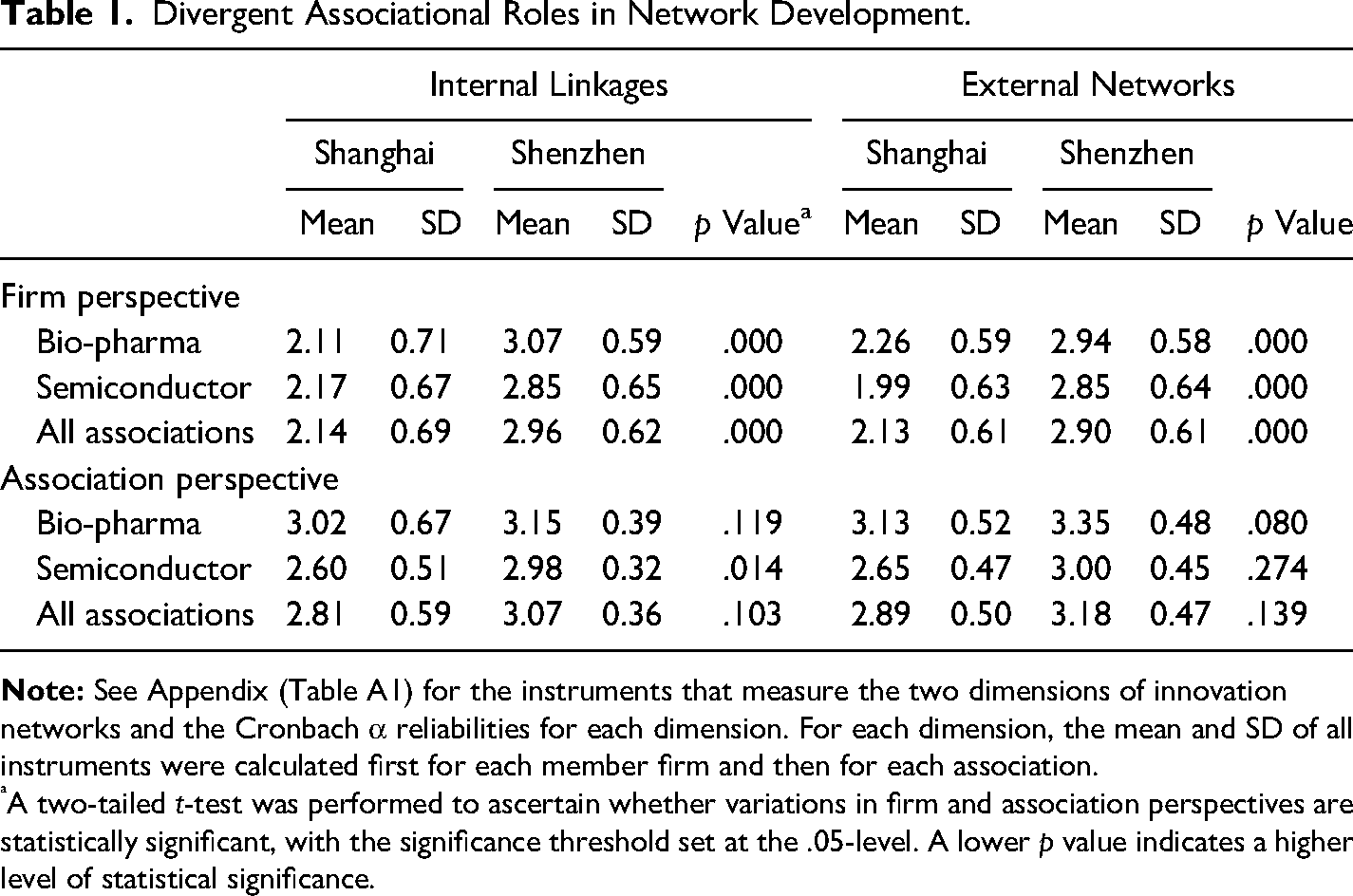
A two-tailed t-test was performed to ascertain whether variations in firm and association perspectives are statistically significant, with the significance threshold set at the .05-level. A lower p value indicates a higher level of statistical significance.
Third, while intersector variations do exist in each of the two metropolises, the associational promotion of collective policy activities and knowledge linkages across the industries was viewed as more effective and robust in Shenzhen than in Shanghai by member firms and, to a lesser extent, by association leaders, as shown in Table 1. Common sector-specific knowledge bases, innovation patterns, and industrial structures have not reduced variations in the pattern of associational roles between the research sites. The desire of both bio-tech and semiconductor firms to seek new knowledge from universities and research institutes and investment funds from financial institutions has not resulted in comparable associational roles in coordinating external interactions, for instance; the disaggregated structure of the two high-tech industries has not weakened the ability of their associations to develop intermember relations in a similar manner; and the reliance of firms on each other for technological and other resources in the process of developing novel drugs and integrated circuits has not homogenized the associational organization of innovation linkages within their industries.
Insufficient Extant Explanations
An appropriate point of departure for explaining varied associational roles in building innovation networks between Shanghai and Shenzhen lies with the consideration of potentially important explanatory variables. A first group of such variables relates to industry-level economic characteristics. Two of those characteristics—firm size and ownership type—have been emphasized in the comparative analysis of association development patterns. 11 As currently theorized, associational roles tend to be stifled in industries dominated by large, particularly state-owned, firms that command more organizational resources to influence public policies and shape market relations on their own. By contrast, associations are likely to be stronger in industries with a large number of small producers that lack such resources and thus depend on greater associational roles. While this proposition illustrates the economic sources of associational vitality, it leaves open the question of how associations populated with small firms are able to overcome the collective action problem postulated in the Olsonian theorem. 12 More importantly, recent studies have suggested that large members may be more willing to contribute to the collective activities of trade associations in China, partly because many of them are association leaders and partly because they benefit more from such activities than SME members. 13 Indeed, the increasing dominance of large firms has not weakened associational operation in the bio-pharma and semiconductor sectors of Shenzhen; nor has the rapid growth of private enterprises strengthened the role of associations in governing the key high-tech industries of Shanghai. 14
Associational roles in organizing collective actions and promoting network linkages among member firms in particular may be influenced not so much by market and industrial characteristics as by political factors. As posited in the literature, firms are keen to join trade associations and contribute to association-led activities when they perceive associations as a collective defensive measure against the abusive and unpredictable regulatory regimes that are invariably caused by bureaucratic corruption. This is particularly the case in transitional or postcommunist countries where institutional deficiencies and instabilities have spawned corrupt enforcement practices. 15 Important as the negative impact of bureaucratic and regulatory corruptions may be on the organizational capacity of associations, they are indeterminant in that the local states and regulatory regimes of Shanghai and Shenzhen have been among the least corrupt in China; as a matter of fact, the local bureaucracy as a whole has been slightly less venal in Shanghai than in Shenzhen. 16 Clearly, the similar level of bureaucratic venality in the two research sites cannot account for varied associational roles in fostering innovation networks between them.
A final plausible argument about the sources of variations in associational roles focuses on international economic forces. It suggests that global market integration has increased the presence of foreign firms in the national economy and enhanced the external linkages of domestic producers. This generates heterogeneous interests and organizational fractures between foreign and national firms and between globally oriented and domestically based enterprises. The theoretical implication is that countries, regions, or sectors that are linked more extensively to the global marketplace are likely to have more fragmented industrial memberships and weaker associational abilities to organize collective activities. 17 This argument, while highlighting the impact of systemic forces on associational operation, is implausible. The implausibility is born out in the two cases examined in this study. Both Shanghai and Shenzhen have been among the most internationalized cities in China; their high-tech industries, including bio-medicines and information and communications technologies, have had diverse corporate actors and interests. 18 Yet associational roles in building innovation networks have differed significantly between the two metropolises.
The Argument
The ability of trade associations, as member-driven organizations, to coordinate such collective activities as the development of innovation networks is contingent on the extent to which member firms actively and cooperatively participate in such activities. 19 The central theoretical proposition of this study is that member participation and cooperation vary with the nature and structure of state policy regimes. 20 Such regimes are crafted through strategic state actions to govern the political, organizational, and normative processes of industrial development. They are an overarching sociopolitical arrangement that shapes the ways in which members engage in and support association-led initiatives across various industries within a given region. Three interactive elements constitute state policy regimes: (1) the range of corporate actors that the state depends on for policy implementation and industrial growth, (2) the orientation of industry and technology policies, and (3) the dominant rules of resource distribution. Reflecting variations in the historical pattern of regional economic and political developments, these three elements interact differently to generate divergent policy regimes. This study distinguishes two ideal-typical configurations of these elements: hierarchical versus heterarchical regimes.
In the hierarchical policy regime, state actors typically depend on a small number of large and state-owned enterprises (SOEs) for implementing crucial economic policies and developing strategic industrial sectors. These firms are chosen as key agents in the regional industrialization process and play a dominant role in policy interactions with state actors. The narrow base of the hierarchical regime is usually accompanied by strong selective industrial policies that earmark specific sectors for promotion and are centrally structured around the interests and operations of large firms. Sectoral targeting further strengthens the position of large corporate actors but relegates SMEs to the periphery of the local economy. As the consequence of large firms dominating industrial policy processes and selective intervention altering the structure of production toward these firms, resources are allocated unequally across enterprises of various sizes, and decision-making procedures concerning resource distribution favor a select few over many others.
By contrast, the heterarchical state policy regime is characterized by a broad structure of business-government relations in which state officials depend on, and obtain support from, a wide range of market agents in the process of policy and industrial development. While vertical ties linking policymakers to lead firms and large producers to small suppliers exist across various industries, horizontal and broad connections among state and business actors are more numerous and extensive. Associated with the inclusive structure of policy regimes are more functional industrial strategies that emphasize technology diffusion and broad-based support for innovative competence development. To the extent that industrial targeting is practiced, it is mainly applied to specific technologies rather than to individual firms or sectors. The keen interest of state actors in maintaining a broad policy regime leads to the fairer manner in which decisions on the distribution of resources are made and generates a more dispersed and equal allocation of these resources among firms of different sizes and ownership types.
Varied state policy regimes impinge differently on member engagement and cooperation through their differential shaping influence on the structure of socioeconomic cleavages and strength of reciprocity norms in local industrial communities. 21 In the hierarchical regime, firms that are treated differently in the process of state-business interactions, policy implementation, and resource allocation tend to segregate into groups of unequal socioeconomic positions. 22 This is likely to establish the belief among such disadvantaged groups as private SMEs that they do not belong to the same community as, and share common interests with, the privileged conglomerates and SOEs. 23 The segregation fuels resentment and creates cleavages between these groups, discouraging them from working collectively to promote innovation networks. Equally, firms that are disaffected by the hierarchical regime are expected to have a strong sense of remoteness from associational activities and experience detachment from collaborative efforts to develop knowledge and technological linkages. While SMEs may join associations for the purpose of kudos or remain members because the marginal cost of membership does not justify withdrawal, they are disinclined by socioeconomic segregation from investing their time and energy in supporting the network-building roles of their associations.
In the hierarchical state policy regime, firms that feel disadvantaged and harbor similar grudges are strongly inclined to cluster around the same social groupings, as made clear in the homophily literature. 24 While homophilous effects may foster in-group relations among disadvantaged firms, they spawn out-group divisions and antagonisms between them and privileged corporate actors. The same logic also asserts itself negatively on the development of shared norms among firms in the same industry. While they may be connected through buyer-supplier relations and other transactional ties, firms at the top and bottom of hierarchical policy regimes are unlikely to perceive a common stake with each other. This fragments value orientations between groups of different socioeconomic standings and prevents such norms as mutuality and cooperativeness from crystalizing. The lack of shared norms between the privileged and the disadvantaged render them reluctant to exchange information, develop technical collaborations, and pool resources in associational efforts to develop innovation networks both inside and outside their industries. In the hierarchical policy regime, social disparities and normative divergences are so significant that they impair the mandates and capabilities of trade associations to resolve or alleviate the problem of network failures. 25
While the hierarchical state policy regime segments firms into various socioeconomic strata, its heterarchical counterpart has opposing effects. Certainly, the heterarchical regime is not free of any form of stratification, as firms of different sizes tend to collect in groups of diverse market positions. Yet, inclusive state-business ties, broad-based policy support, and even-handed rules on resource allocation combine to reduce the likelihood of intergroup conflicts and encourages social mobility across firms of different socioeconomic standings. 26 The resultant horizontal and encompassing social structure plays a critical role both in fostering common interests and in facilitating the sharing of those interests among an array of market actors. This is likely to generate a sense of common fate that is central to motivating firms to participate in, and cooperate to support, the collective actions of their trade associations. 27 Where broad and inclusive state policy regimes prevail, a wide range of firms perceive that their voices can get heard and their interests promoted in the process of industrial development. Such perception encourages industrial members, large or small, to be involved in network-building efforts that may be unobservable and nonrewardable but are crucial to the role of associations in enhancing innovation competences.
Not only do heterarchical state policy regimes reduce socioeconomic cleavages among industrial members, they also play a key role in creating and maintaining reciprocity norms. While recurrent business transactions are important, it is the extensive and frequent social and market interactions structured through such policy regimes that enable firms to develop norms supporting reciprocal behavior. These norms constitute the sinews of socioeconomic institutions that facilitate the joint efforts of member firms to work to see their associations succeed. On the other hand, the inclusive and undivisive character of heterarchical policy regimes that tends to homogenize value orientations also reinforces social affinities among firms of various sizes. These heterophilous effects broaden linkages between diverse economic actors and breed out-group trust across local industrial communities. This enhances the confidence of firms and SMEs in particular in their good faith being reciprocated and incentivizes them to participate in association-led initiatives. Where social and normative affinities encourage members to contribute to collective activities in heterarchical policy regimes, trade associations are likely to be able to inhibit opportunistic behavior and organize business for network development. 28
Shanghai: Hierarchical Regimes and Weak Associational Roles
For decades preceding the communist victory in 1949, Shanghai had featured a vertically structured political economy, with bureaucrats allying with and controlling large businesses situated at the top of the local industrial hierarchy. 29 During the Mao Tse-tung era of 1949–78, the economic prowess of the city was harnessed for national development through the reinforcement of the top-down industrialization pattern in which state-owned conglomerates dominated production and investment activities. For a local state that has long leaned heavily on large enterprises and thus developed a strong preference for the concentrated mode of industrial growth, it has had neither the incentive nor the ability to change its development trajectory in the post-Mao process of market reforms. In interaction with the legacies of dirigiste institutions and industrial concentration, this preference has reoriented local industrial policy, state-business relations, and resource distribution toward a hierarchical regime.
The central policy and organizational elements that have characterized this hierarchical regime have remained stable over the past decades. Shanghai has adhered to the long-standing tradition of seeing large companies as the anchor of industrial restructuring and growth. Economic policies designed to upgrade industrial products, develop new technologies, and build high-tech parks have all been tailored to reinforce the position of these companies. Small and private firms that do not strongly lend themselves to official policy goals have generally been ignored; to the extent that local leaders do pay attention to a few selected SMEs, they have been keen to grow their size and bring them under state tutelage. 30 The local state's strong penchant for the concentrated mode of growth has aligned closely with its policies to promote strategically important industries and conglomerates and shower them with funds and subsidies. 31 These policies have buttressed the dominant role of the favored firms in the local economy and further reduced the number of business actors from whom state officials are able to elicit effective support. The exclusive structure of state-industry relations has combined with selective policy support to generate a concentrated and lopsided distribution of various official resources, such as research budgets, export subsidies, and tax rebates, toward large enterprises. 32 While efforts have been made to direct more policy support to small and private firms since the mid- and late 1990s, particularly in the key high-tech sectors, the allocation of resources has continued to favor SOEs and conglomerates. 33
In Shanghai, firms that have been granted different roles in policy interactions with state actors and unequal access to government resources have self-segregated into groups of distinct standings defined by size or ownership type and have been strongly inclined to interact with other firms of comparable socioeconomic positions. As a result, out-group networking between enterprises of different sizes across the two high-tech industries has been far more limited in Shanghai than in Shenzhen, despite the similar frequency of such networking in the two research localities, as demonstrated in Table 2. Compared to their bio-tech counterparts, semiconductor firms have developed denser production and social linkages through the more integrated value chain and higher level of specialization. However, the segmenting effects of the hierarchical policy regime have been so strong that they have overridden these technical and industrial characteristics and generated extensive and deep social fractures between various firms across the semiconductor industry.
Out-Group Social Networks between Firms of Different Sizes.
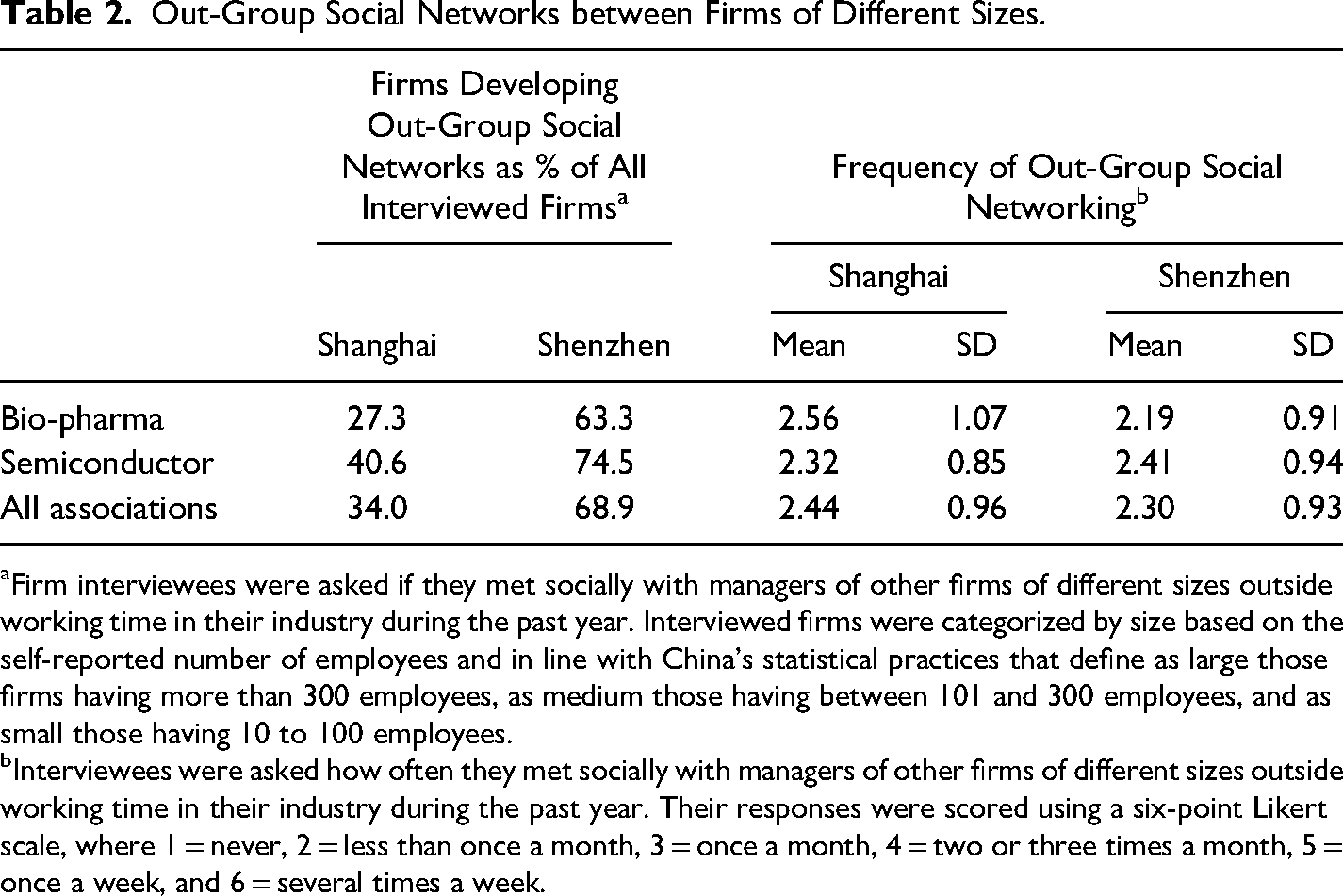
Firm interviewees were asked if they met socially with managers of other firms of different sizes outside working time in their industry during the past year. Interviewed firms were categorized by size based on the self-reported number of employees and in line with China's statistical practices that define as large those firms having more than 300 employees, as medium those having between 101 and 300 employees, and as small those having 10 to 100 employees.
Interviewees were asked how often they met socially with managers of other firms of different sizes outside working time in their industry during the past year. Their responses were scored using a six-point Likert scale, where 1 = never, 2 = less than once a month, 3 = once a month, 4 = two or three times a month, 5 = once a week, and 6 = several times a week.
In the bio-pharma and semiconductor sectors of Shanghai, small and private entrepreneurs who have felt excluded and unfairly treated have been acutely aware of, and empathetic with, each other's positions. Because of the similarity of their sociopolitical standings in the local industrial system, they have developed a common understanding of their experiences and converged in their attitudes toward policy and organizational injustices. This has reinforced the feeling of social and cognitive affinities among SMEs but hardened their perception of status and attitudinal differences between them and large enterprises. As the chief executive officer (CEO) of a small bio-tech company put it, Shanghai is a city of industrial giants. Government officials have been keen to take care of the interests of large companies, invariably at the cost of those of small enterprises. . . . Many small bio-tech firms like us that have had difficulty in getting financial and other support from local state agencies have felt that we have simply been left on our own devices. . . . We have shared similar grievances against current industrial policies and commiserated with each other.
34
This sentiment was quite widespread among other small bio-tech and semiconductor firms, as confirmed in interviews. SMEs that have developed negative views of the organizational and distributive procedures of the hierarchical policy regime have been disposed to mingle socially. While they have been willing to establish business relations with large firms, if only to access resources, deep socioeconomic divisions have reduced the likelihood of them maintaining extensive collaborative ties.
The weak out-group linkages and significant socioeconomic cleavages that have segmented firms of contrasting sizes and ownership types have also impeded the development of common interests and discouraged SMEs from actively engaging in collective activities in the two high-tech industries. As revealed in interviews with small and private bio-tech and semiconductor firms, many of them believed that large and SOE members were pursuing particularistic ends at variance with the interests of the rank-and-file members. Not surprisingly, they evinced only lukewarm passions for, and even strong apathy toward, association-initiated activities. As described by a senior manager of a small, integrated circuit (IC) design house, We do not see eye to eye with large members in our association on many industrial development issues. Different market positions are an important factor. But what is more important is that large members that are favored by government policies do not share our concerns and see many things from our perspective. While we belong to the same association, we do not have similar policy objectives. . . . I think that large firms are simply using the association to promote their own interests because of their powerful position in the industry. And this has often made many smaller member firms hesitant to actively participate in activities organized by the association.
35
Furthermore, the hierarchical policy regime that has subordinated SMEs has made them feel unable to influence decision-making processes at the industrial and associational levels. This has induced, among many of these disadvantaged firms, much disaffection for, and withdrawal from, the bio-pharma and semiconductor associations. For the majority of small and private firms who were interviewed for this study, membership was merely expedient for accessing association services and invoked neither pride nor loyalty.
Many of the interviewed bio-tech and semiconductor SMEs who felt alienated from their trade associations had weak motivation to implement associational strategies to enhance collective innovation capabilities in their industries. Similarly, the feelings of marginalization by and detachment from industry-level policy and organizational processes made them reluctant to contribute to the internal and external functions of their associations. The limited contribution of private and SME firms that account for the majority of membership in the high-tech associations has enervated their organizational legitimacy and capabilities. To some extent, the weak involvement of SMEs has been compensated for by the more active role of large and SOE members. However, there is evidence from interviews with these members that the lack of extensive SME engagement dampened their enthusiasm for strengthening associational roles, particularly in the development of technical interactions both among members and between them and nonmember entities that required concerted and cooperative efforts across the associations.
In Shanghai, not only has the hierarchical state policy regime weakened member engagement in the bio-pharma and semiconductor associations, it has also impaired the organizational and cognitive basis for the development of reciprocity norms and trust relations among member firms and thus lessened their propensity to collaborate. Table 3 suggests that the sharing of cooperative norms has been both weaker and narrower among bio-tech and semiconductor member firms in Shanghai than in Shenzhen. The varied strength of reciprocal values has produced differences in the density of intermember trust between the two research sites. While the overall strength of such trust in the bio-pharma and semiconductor associations is comparable between Shanghai and Shenzhen, out-group trust relations between members of different sizes have been more limited in the former, suggesting a narrower scope of such relations, as shown in Table 4.
Sharing of Reciprocity Norms between Members of Different Sizes.
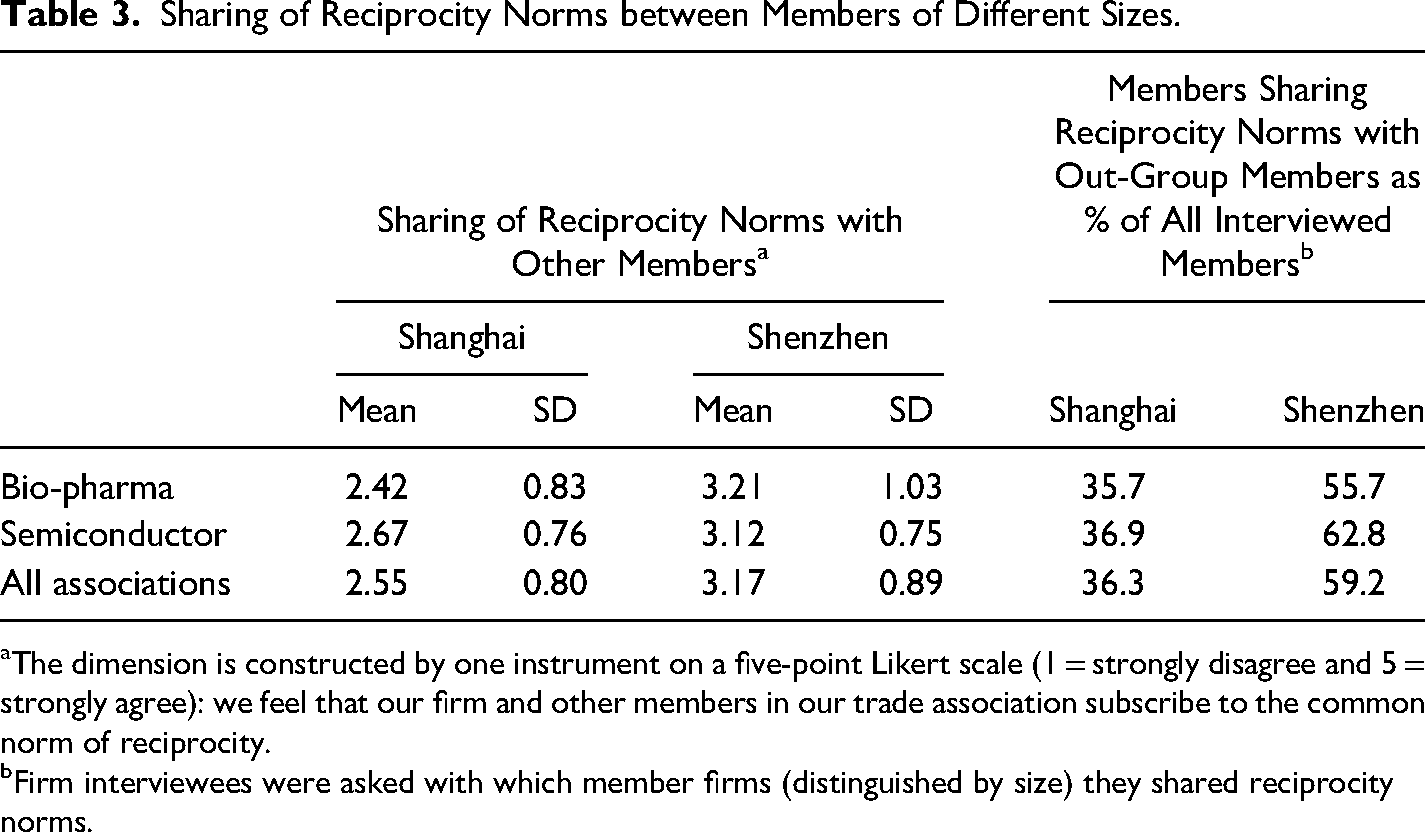
The dimension is constructed by one instrument on a five-point Likert scale (1 = strongly disagree and 5 = strongly agree): we feel that our firm and other members in our trade association subscribe to the common norm of reciprocity.
Firm interviewees were asked with which member firms (distinguished by size) they shared reciprocity norms.
Trust Relations between Members of Different Sizes.
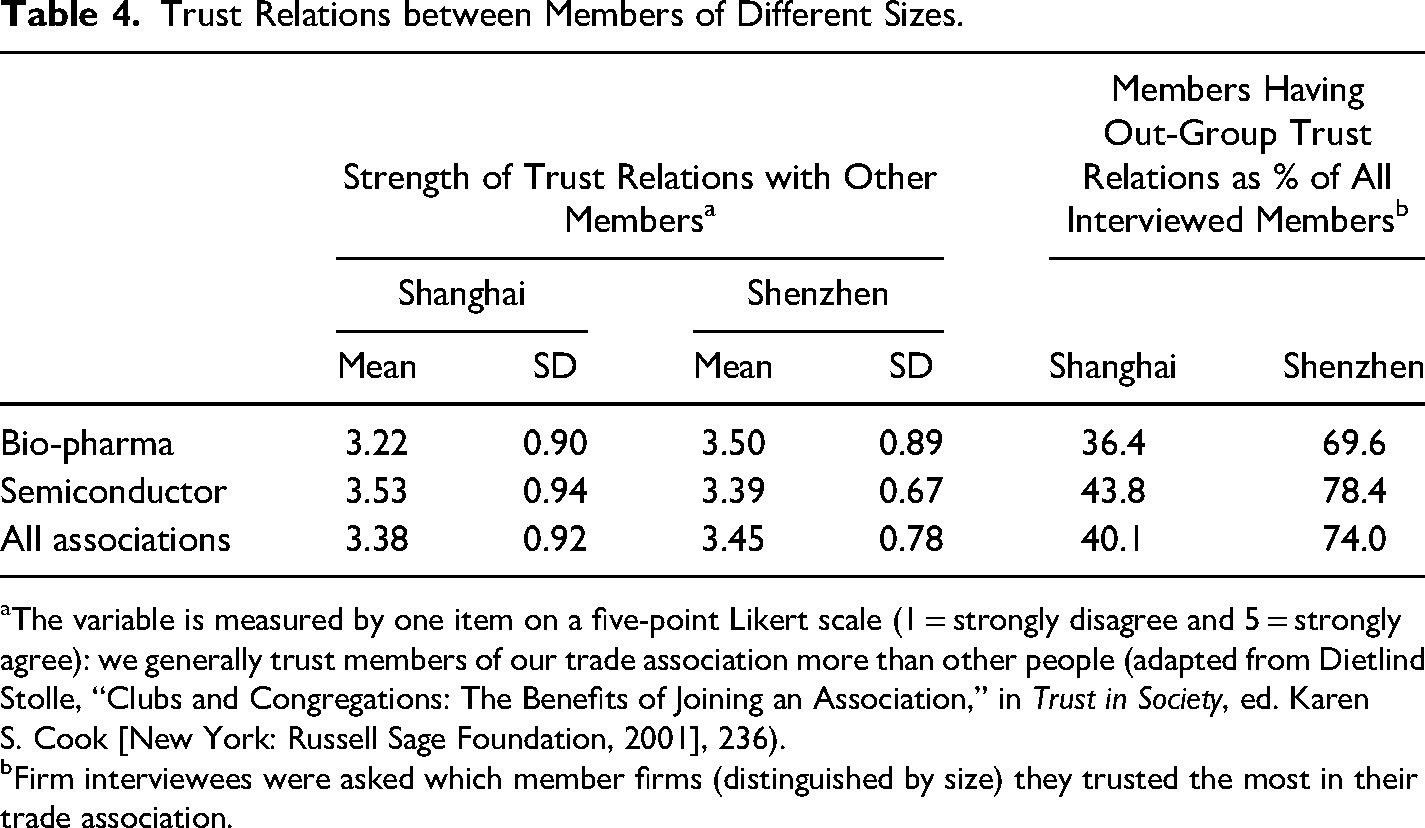
The variable is measured by one item on a five-point Likert scale (1 = strongly disagree and 5 = strongly agree): we generally trust members of our trade association more than other people (adapted from Dietlind Stolle, “Clubs and Congregations: The Benefits of Joining an Association,” in Trust in Society, ed. Karen S. Cook [New York: Russell Sage Foundation, 2001], 236).
Firm interviewees were asked which member firms (distinguished by size) they trusted the most in their trade association.
The fragmentation of intermember linkages and perceptions in the bio-tech and semiconductor industries has weakened the social and normative basis on which firms expect that they should reciprocate each other's contributions to collective activities. Members who have been so widely divided along socioeconomic lines by hierarchical state policies reported that the effect of associational membership on cultivating such expectation has been significantly nullified. Indeed, bio-tech and semiconductor interviewees often emphasized social divisions and divergent policy views as a key factor that prevented the common norm of reciprocity from being developed among members within the same associations. Large and SOE members have often been more actively involved than their private and SME counterparts in the mobilization of resources for association-led activities. However, this has been attributable not so much to large and SOE members valuing reciprocity as to the fact that they have benefited more significantly from these activities by dint of their positions in the focal associations. In fact, the hierarchical policy regime that has motivated large firms to compete with each other for state resources and maintain their independent corporate identity has generated strong disincentives to make mutual contributions to industry-level technology development among these firms, despite their similar sociopolitical status in the local political economy.
The limited development of reciprocity norms has significantly reduced the likelihood of trust and cooperation across members in the bio-pharma and semiconductor associations. Membership within the same association has usually emboldened firms of various sizes and ownership types to contribute to such low-cost, low-risk activities as the exchange of basic market information and association-sponsored trade fairs. However, collaborations have invariably been in short supply when it comes to the collective actions that require the pooling of various organizational and financial resources to develop joint R&D competences, search for new knowledge sources, and diffuse novel technical know-how. In the words of an association leader, Cooperation in the sense of extensive information and knowledge exchanges has been limited in our association, mainly because of the absence of strong collective norms to support trust and collaborative relations among member firms. This has often frustrated our efforts to strengthen business and technical partnerships between member firms and promote collective technological capabilities in our industry.
36
The lack of trust has also reflected the prevalence of power asymmetries among firms in general and between large and small industrial members in particular in the two high-tech sectors. The impact of such asymmetries has been reinforced by the narrow and exclusive organizational structure of the hierarchical policy regime in which large enterprises have dominated interactions with state agencies, largely to the exclusion of a wide range of other firms. Coupled with fragmented and thin social ties between large and SME member firms, this has made it difficult for the latter to understand the former's past behavior and apparent intentions and place trust in them, even within the same associations. As a result, small members have tended to feel serious misgivings about powerful members taking advantage of their good faith without reciprocation and thus had little incentive to cooperate. As described by one manager of a small semiconductor firm, We hesitate to pool resources for association-led technology development activities, mainly because we are not sure if large members will do the same; if they do not, there will be little we can do to get them to contribute.
37
This statement found ample confirmation in interviews with other SME members in the bio-pharma and semiconductor associations of Shanghai.
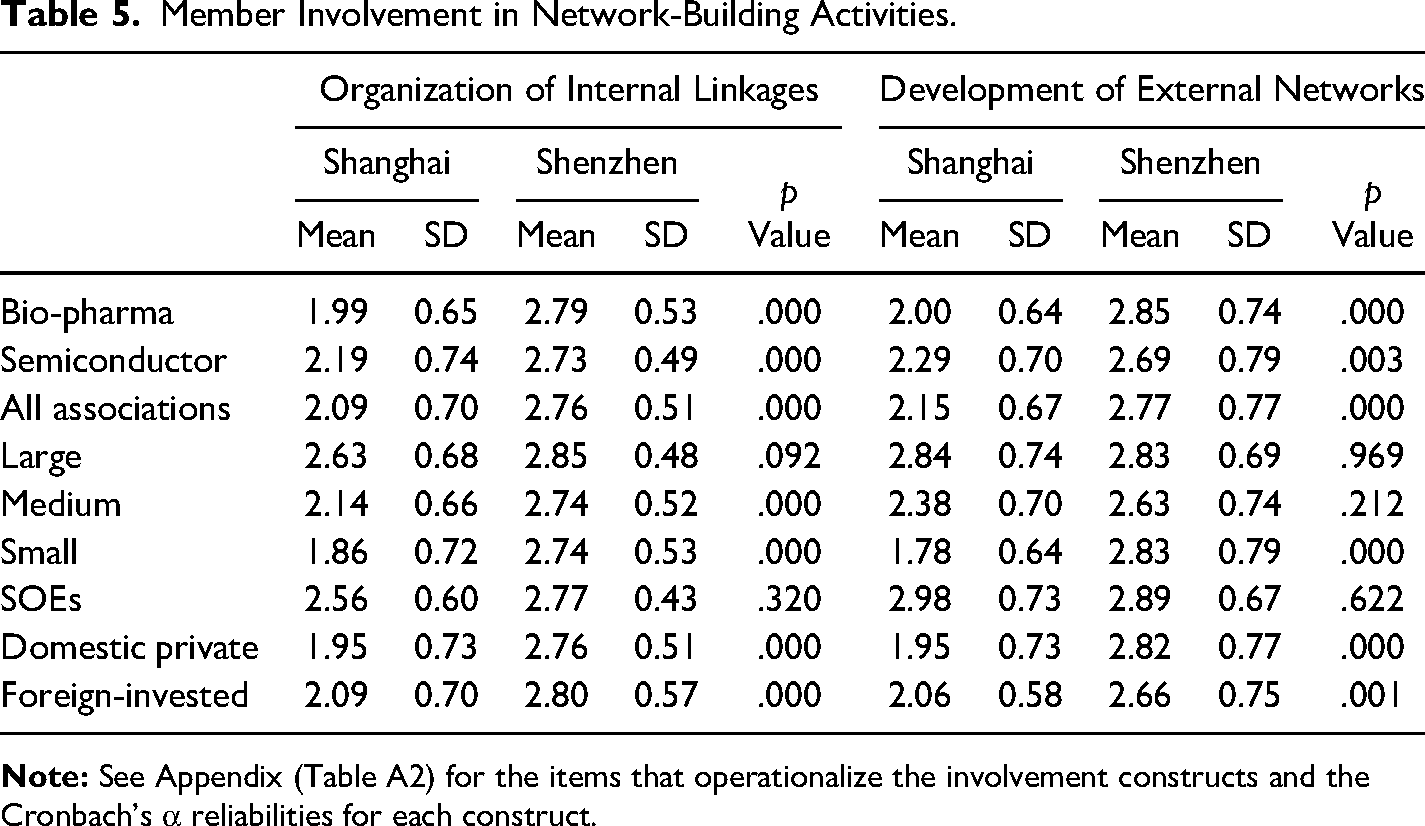
Significant socioeconomic cleavages have interacted with weak reciprocal and cooperative practices to undermine the ability of the bio-pharma and semiconductor associations to mobilize member firms to collectively support the building of internal and external innovation networks. As shown in Table 5, the overall level of member participation in various network-building activities has been more limited in Shanghai than in Shenzhen, although large and SOE firms appear to have displayed a similar level of contribution across the two metropolises. Large firms that have more resources and tend to be office holders in their associations are both able and willing to contribute to network development. However, SME and private members have been reluctant to actively engage in collective efforts to promote innovation linkages, partly because they are socially detached from, and do not share common policy interests and views with, their large counterparts and partly because they are so concerned about the inability of their associations to impose sanctions against noncooperative behaviors, as made clear above.
Member Involvement in Network-Building Activities.
Shenzhen: Heterarchical Regimes and Strong Associational Roles
In the province of Guangdong where Shenzhen is located, the political economy had traditionally been predicated on small-scale production, dispersed industrial structures, and broad state-business ties prior to 1949. These socioeconomic institutions that had become established through a long process that dates back to the late nineteenth century remained largely intact under Mao and disposed local states to rely on bottom-up entrepreneurial initiatives and shun the centralized development pattern. 38 When Shenzhen was designated as a special economic zone (SEZ) in the late 1970s, its economy was built on small rural industries and had a weakly developed state-owned sector. The limited legacies of central planning, combined with the general preference for SMEs and the autonomy to experiment, have enabled local officials to promote diverse ownership structures. A key political underpinning for the development of the SEZ has derived from local state interests in organizing and spreading industrial growth across a wide range of socioeconomic actors. 39
Since the early years of its establishment, Shenzhen has thus relied on a wide range of firms for policy and industrial development. In their efforts to enlist business support for various policy tasks, local economic officials have not deliberately favored large over small producers or state-owned over private enterprises. 40 To the extent that large firms have become increasingly dominant in the process of industrial and technological development, this has been more spontaneous than state-orchestrated. 41 Furthermore, Shenzhen has industrialized rapidly without deliberate industry policies; broad-based development strategies have promoted the growth of manufacturing activities across diverse sectors and enterprises. 42 In recent years, economic policymakers have intensified their efforts to enhance local innovative capabilities through more targeted support. However, such efforts have focused on new technologies, skill development, and R&D activities, particularly among smaller firms, 43 in line with the long-standing practice of maintaining a broad range of corporate partners and bringing the benefits of official policies to more market actors. Finally, the broad state-business alliance and functional industry policies have interacted to produce a more diffused and equal pattern of resource distribution in Shenzhen. The local government has supported all firms, regardless of their size or ownership type, as long as they are viewed as developing innovative potential and yielding growth benefits. 44 These characteristics have rendered the state policy regime of Shenzhen more inclusionary, horizontal, and heterarchical than that of Shanghai.
The heterarchical policy regime has played an important role in fostering stronger and more durable out-group network ties among bio-tech and semiconductor firms of contrasting sizes in Shenzhen than in Shanghai, as illustrated in Table 2. This has in large measure resulted from horizontally structured and encompassing policies reducing economic cleavages and encouraging social interactions between various firms in the two high-tech industries. Out-group linkages have remained robust, despite the growing dominance of large bio-tech and semiconductor companies in recent years. Indeed, when asked if increased asymmetries in market power gave rise to significant social fractures and divided policy perceptions between large and small firms, many SME interviewees replied that the divisive effects of such asymmetries were countervailed by the fair rules and procedures by which firms of divergent market positions were treated in the official process of policy making and resource allocation. As the CEO of a small bio-tech firm described it, Large companies have emerged and developed quickly in our industry. This has raised fears that the practice of close networking between firms of different sizes may weaken. I think that such fears are misplaced. A key reason is that the open and inclusive government policies that have helped create the rough equality of socio-political status and supported close networks among various firms have remained strong. These policies may not make large producers commit themselves to inter-firm networks over the long run. But they have made smaller firms feel that they have shared a common stake with more dominant corporate actors and thus had relatively few qualms about interacting with them socially and technologically.
45
The heterarchical policy regime and resultant intergroup ties have also facilitated the formation of common interests among a wide range of firms in the bio-pharma and semiconductor industries. To quote an association leader, The broad-based business-government system in which all firms, large and small, have enjoyed a parity in getting access to industrial officials and, equally importantly, policy resources has generated a strong feeling that they are members of the same community. . . . While policy interactions and resource allocations do not equalize across firms in our industry, this feeling has induced considerable levels of agreement about what our collective interests are and how these interests should be pursued.
46
Certainly, the policy preferences of industrial members are not identical, reflecting their diverse market positions in the two high-tech sectors. However, social and attitudinal affinities generated through extensive cross-group ties inclined them to accommodate each other's interests and develop broadly convergent perspectives on industry-related issues.
Furthermore, the comparable standing of firms in the policy and distributive process of the local political economy has promoted the belief, particularly among SMEs, that they would be able to get their voices heard and influence industry-level decisions through such collectives as trade associations. Such a belief has disposed them to value their membership and support associational activities and strategies, as made clear in interviews with bio-tech and semiconductor firms. When asked why they were committed to their associations, the interviewed members repeatedly referred to the importance of fair and inclusive state policies in producing a strong perception of equality and a common identity in their industries and a sense of belonging to the associations that were perceived to have promoted such an identity. Firm interviewees from the two industries often stressed the role of shared beliefs and mutual interests in defining associational policies and described the pursuit of such policies in the language of solidarity.
In Shenzhen, the strength of intergroup networks and common interests has enabled leaders of the bio-pharma and semiconductor associations to effectively seek broad support from across the two high-tech industries. Firms of different sizes and ownership types who see memberships as a key mechanism for pursuing both individual and collective interests have displayed a strong commitment to the organizational development and policy goals of their associations. As confirmed in interviews with both members and leaders, associational roles have had a psychological and behavioral correlate in the efforts of members to contribute to collective activities out of their internal feelings of identification with their associations. Such feelings are particularly crucial to the effectiveness of such nonobligatory activities as network development, technical collaborations, and knowledge diffusion both inside and outside the high-tech industries. In the words of the CEO of a semiconductor firm, Ordinary members are aware that their contributions are less visible than those of large firms and may not be observed and rewarded by association leaders. However, a sense of obligation has often motivated SME member firms to get actively involved in association-organized innovation activities. . . . It seems that many of them have been willing to spend time helping the association organize these activities, regardless of whether other members would do the same, particularly in collective endeavors that directly engage their interests.
47
Not only has the heterarchical policy regime promoted extensive cross-group ties and convergent policy perceptions and interests, it has also played a key role in fostering stronger and more diffuse trust relations among bio-tech and semiconductor firms in Shenzhen than in Shanghai, as illustrated in Table 4. As the interview evidence discussed in the preceding analysis suggests, the heterarchical regime has facilitated close and multifaceted interactions between diverse industrial members out of which they have developed a good understanding of mutual expectations and a strong inclination to trust each other in the organization of industry-level collective actions. It is the social bonds and normative convergences that have buttressed the cooperative efforts of bio-tech and semiconductor member firms to support associational roles. While such efforts have varied across different association-led activities, the tendency of members to trust that others will contribute toward these activities has made them willing to reciprocate cooperation with cooperation. Interview data suggest, for instance, that many members in the two high-tech associations were willing to collaborate to implement internal innovation strategies, seek government support for collective technological capabilities, and promote the sharing of technical information.
It is important to note that trust relations may not be necessarily strong enough to support richer forms of member cooperation. Nowhere is this more manifest than in such activities that are more subject to opportunism as associational efforts to promote technological collaborations and resource exchanges both among member firms and between them and nonmember actors. Where trust is inadequate to support such efforts, reciprocity norms have supplemented and even supplanted its role. Such norms have been stronger across bio-tech and semiconductor firms of various sizes in Shenzhen than in Shanghai, as shown in Table 3. They are structured around the expectation that firms should reciprocate each other's collaborations or face sanctions and have acted as a collective mechanism that punishes opportunists. Evidence from interviews concerning their impact abounds. In one case, a chip design firm that had attempted to free-ride on others’ contributions to an association-sponsored R&D project was excluded from the project and many other similar activities. In another, a relatively large bio-tech company was shunned by, and frozen out of relations with, other members for being repeatedly unwilling to return their kindness of sharing informational and technical resources obtained from universities. An association advisor who also moonlighted as a university professor had this to say about the role of reciprocity norms in enabling trade associations to promote member cooperation: The efficacy of reciprocity norms has been maintained through close social interactions among individual firms that have facilitated the flow of information on noncooperative behavior and the collective sanctioning of such behavior. They have provided informal yet enforceable rules about what is acceptable behavior between member firms and stipulated cooperation at the industrial and associational levels. In other words, it is the informal rules of mutuality socially constructed among member firms that underpin associational capabilities to encourage them to reciprocate each other's cooperative efforts.
48
Dense cross-group social bonds and strong reciprocal practices have thus rendered the bio-pharma and semiconductor associations more capable than their Shanghai counterparts of encouraging member firms to actively and cooperatively contribute to various network-building activities, as shown in Table 5.
The cooperation-enhancing effects of diffuse reciprocity and cross-group trust appear to have remained strong, despite growing asymmetries in market power between large and small firms in the bio-pharma and semiconductor industries. While some SME members expressed concerns about being taken advantage of in their collaborations with large members, as revealed in interviews with them, such concerns have been allayed by heterarchical state policies in two interrelated ways. First, the encompassing structure of such policies that has involved both large and small firms in close organizational interactions has enabled them to understand each other's actions and intentions. It has made it easier for SME members to trust and cooperate with their large counterparts who are known to have been trustworthy, as testified in interviews with many of these members in the two high-tech associations. Second, large firms that have played a leading role in maintaining social and technical connections and benefited from the resultant collaborations in their industries have felt both incentivized and obliged to behave cooperatively toward members of inferior market positions. It is the knowledge of such constraints generated through social and normative bonds that has elicited expectations among an array of small members that their good faith will not be exploited by large members. These widespread expectations were well represented by the interviewee of a small bio-tech firm who emphasized the importance of “common social identities and shared fairness views in committing large members to contribute to, and even lead, collaborative innovation efforts that will benefit everyone.” 49
Networks, Collaborations, and Innovation Capabilities
This section first examines the effects of divergent associational roles on technological collaborations in the bio-pharma and semiconductor industries of Shanghai and Shenzhen. Given that the high-tech trade associations in question are regionally based, it focuses on their roles in promoting such collaborations between bio-tech and semiconductor firms and their local customers and partners at universities and research institutes. 50 The section then explores the connection between varied interorganizational networks, technological collaborations, and innovation performance in the two high-tech industries of the research sites.
Technical Interactions with Customers
Varied associational roles in developing innovation networks have exerted differential shaping influence on the pattern of technological collaborations between bio-tech and semiconductor firms and their local customers or buyers. In Shanghai and Shenzhen, the key customers of the interviewed bio-tech firms who were largely drug or medical device makers were hospitals, clinics, and other bio-tech companies. 51 Despite the same composition of their main customers, the overall level of technical cooperation between the interviewed bio-tech firms and their main customers is higher in Shenzhen than in Shanghai, as shown in Table 6. While the variation is relatively small in information exchanges, it increases as such cooperation involves the codevelopment of technological capabilities and products. Compared to its Shanghai counterpart, the bio-tech industrial association of Shenzhen has been more capable of coordinating business initiatives to develop collaborative ties with local hospitals. It has done so by arranging for bio-tech firms and hospital managers to meet in such forums as seminars and trade fairs, introducing its members to potential customers and collaborators, and facilitating joint clinical trials and research projects. This has not only reflected its broad linkages with hospitals, public health officials, and regulatory agencies but, more importantly, its strong abilities to mobilize member firms to actively engage in these networking activities.
Technological Collaborations with Buyers/Customers.
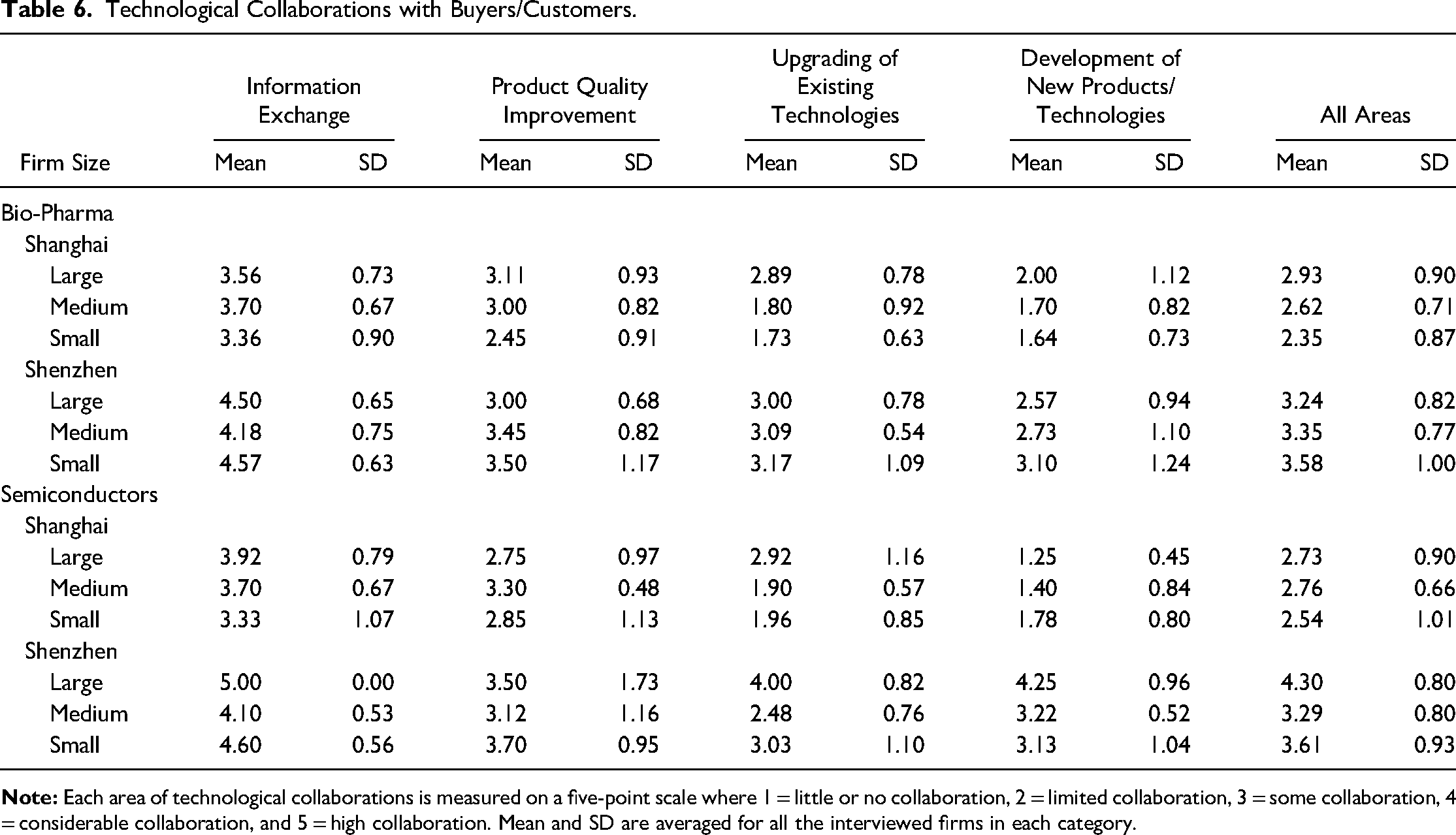
In Shanghai and Shenzhen, the large majority of the interviewed semiconductor companies were IC design houses. The innovation competences of these IC design houses mainly derived from the application of existing knowledge, although sometimes through novel combinations. 52 For them, the main source of technical information, new ideas, and product innovations was their customers who were scattered across a wide diversity of industries, including electronics, automobiles, machine tools, and medical devices, while other semiconductor firms and universities and research institutes were also important providers of knowledge. Given that they mainly depended on customers for knowledge resources, the IC design firms cooperated more closely with their key customers than their bio-tech counterparts within each research site, as illustrated in Table 6. However, technological collaborations between the interviewed IC design firms and their customers were much stronger and more extensive in Shenzhen than in Shanghai, despite the similar knowledge bases and organizational structures of semiconductor innovations.
The divergent network-building abilities of the semiconductor associations in question have played a critical role in shaping the forms and strength of collaborations between member firms and their customers. While the Shenzhen association has been able to encourage member firms to develop extensive network linkages with a wide range of upstream and downstream players, its Shanghai counterpart has largely been unable to do so. Nowhere is this more manifest than in associational roles in facilitating the development and operation of innovation alliances. The local government of Shanghai has actively sponsored and promoted such alliances among semiconductor firms and their customers and other actors in the information and communications technologies industries. However, most of these alliances have either fallen apart or failed to achieve their desired goals, in large measure because the semiconductor association has not been able to foster mutual trust among the diverse participants and failed to resolve their differences in favor of collective interests. Local industrial officials and business leaders interviewed for this study often lamented the lack of broad and durable partnerships among design houses, IC manufacturers, and systems firms operating along the semiconductor value chain, without fully realizing that hierarchical state policies and attendant associational weaknesses were partly culpable.
Unlike in Shanghai, major innovation alliances between semiconductor firms and their customers have been established and maintained not so much by administrative decrees as through business initiatives and efforts, often coordinated by the semiconductor industrial association in Shenzhen. Associational roles in this regard are twofold. First, they have introduced potential collaborators to member firms and provided information on the reputation and competences of the former; they have also helped firms identify suitable researchers and investors, including venture capitalists, and arranged meetings and contract negotiations between them. Second, they have often acted as key mediators when conflicts arise between member firms and their customers and other participants in innovation alliances by preventing communications and interactions from breaking down and by resolving differences, facilitating compromises, and repairing ties, as confirmed in interviews with the association leaders and semiconductor firms that took part in the alliances.
Innovation Collaborations with Universities and Research Institutes
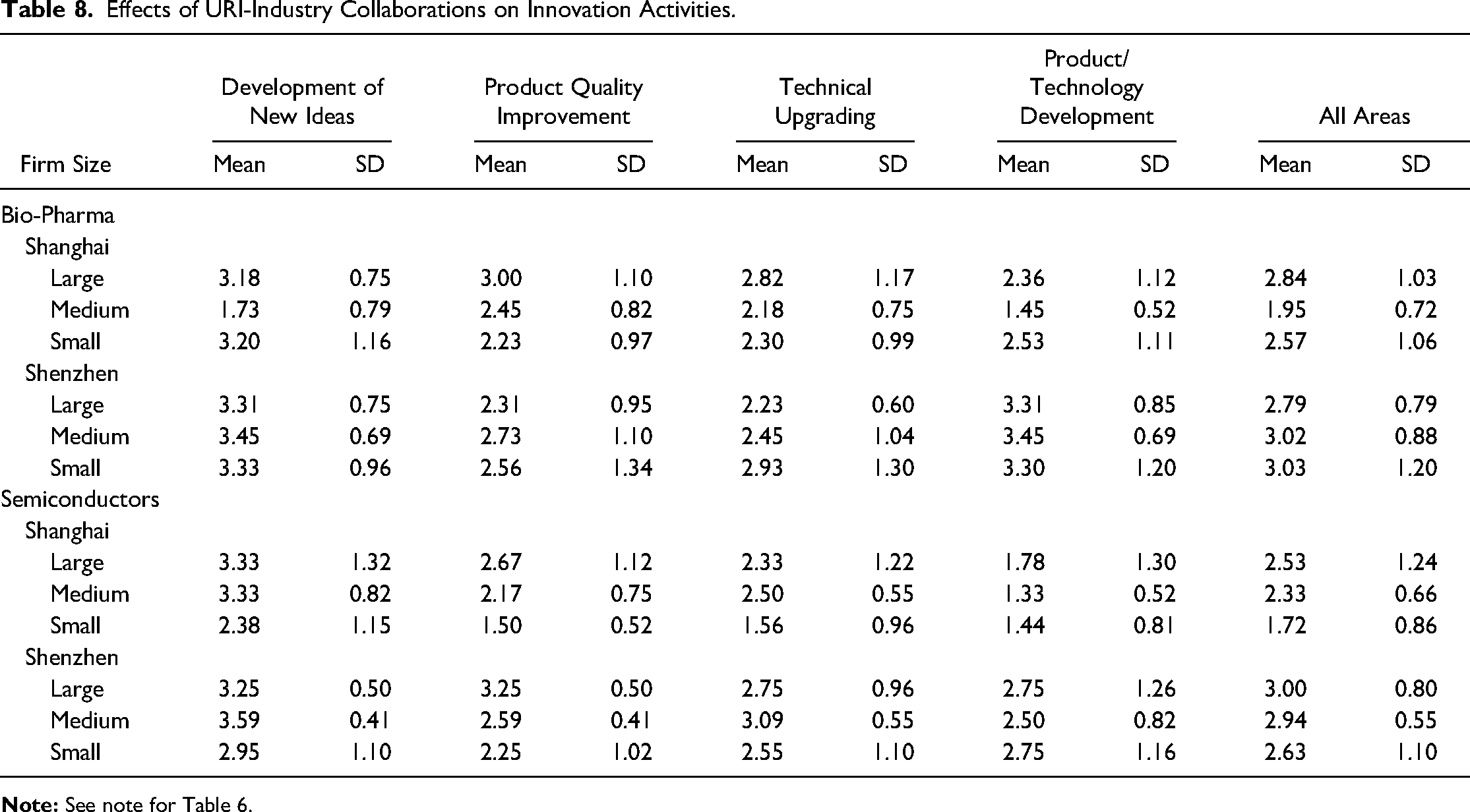
For the interviewed bio-tech firms of both Shanghai and Shenzhen, universities and research institutes (URIs) were the key sources of scientific and technical knowledge. The main forms through which the bio-tech firms collaborated with local URIs ranged from technical, consulting, and training services that were relatively easy to organize and low in financial commitment, on the one hand, to technology transfer and R&D projects that were more costly and difficult to govern yet more innovation-enhancing, on the other. While the bio-tech firms were keen to collaborate with URIs in Shanghai and Shenzhen, the forms of collaborations and the impact of such collaborations on the former's innovation capabilities varied between the research sites. As shown in Table 7, there was no significant variation in the level of collaboration through the relatively simple forms; if anything, the bio-tech firms appeared to interact more extensively with local universities through these forms in Shanghai. However, there were more bio-tech firms cooperating with local universities through joint product and technology development activities in Shenzhen. As a result of the stronger forms of collaborations, the innovation activities of the bio-tech firms benefited more from such collaborations in Shenzhen than in Shanghai, as made clear in Table 8. Equally important, the interviewed bio-tech SMEs of Shenzhen established stronger research ties with local URIs and saw their technological capabilities strengthened more significantly through such ties than their Shanghai counterparts, as illustrated in Tables 7 and 8.
Governance Forms of URI-Industry Collaborations.
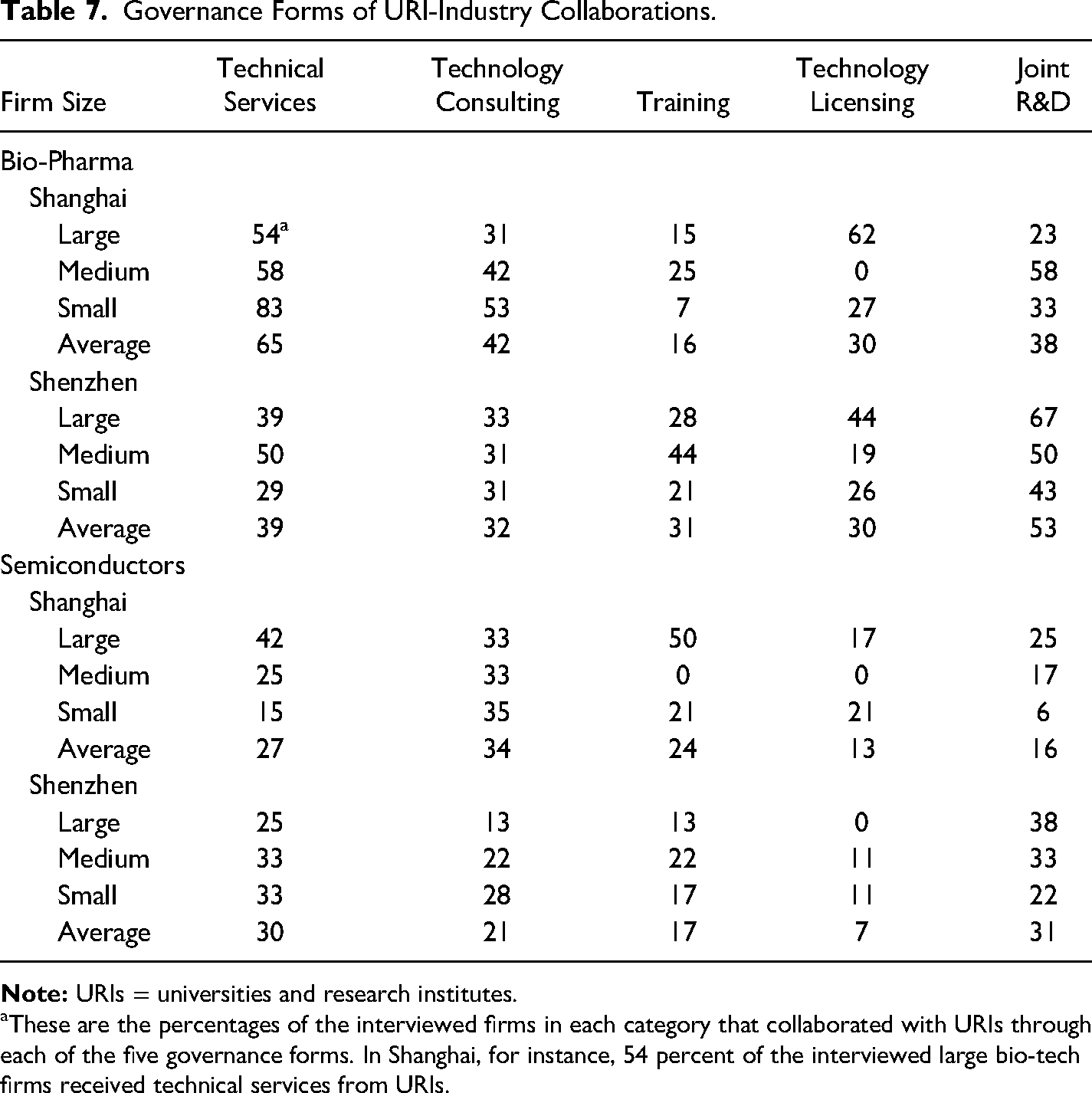
These are the percentages of the interviewed firms in each category that collaborated with URIs through each of the five governance forms. In Shanghai, for instance, 54 percent of the interviewed large bio-tech firms received technical services from URIs.
Effects of URI-Industry Collaborations on Innovation Activities.
From the perspective of the bio-tech firms, collaborations with URIs, particularly through technology licensing and joint research, were hindered by the lack of information on suitable academic partners and their innovation competences, misfits between technological capabilities and commercial interests, and concerns about the opportunistic behavior of powerful research institutions. In Shenzhen, the more cohesive and resourceful bio-tech association played a more important role in mitigating these problems than its Shanghai counterpart, thus strengthening the innovation-enhancing effects of its members’ collaborations with local URIs. It did so by marshalling various network resources to connect member firms with faculties and technology transfer centers at major universities and research organizations in Shenzhen. Equally, it effectively encouraged members to share information not only on the specific technologies that were available or being developed at local URIs but also on the competences and reliability of prospective academic collaborators, as confirmed in interviews. This helped bio-tech firms license the technologies that fitted with their existing repertoire of R&D capabilities, avoid the mismatches between what they needed and what URIs could offer, and identify reliable and competent partners.
As noted earlier, the interviewed IC design houses of Shanghai and Shenzhen relied heavily on their customers for informational and technical resources. However, knowledge inputs from local universities and research organizations were also crucial, particularly with regard to product innovations. While the overall level of cooperation with URIs through consulting and training was largely similar across the two research sites, the codevelopment of technological and research capabilities and the innovation-facilitating impact of such collaborations were stronger in Shenzhen than in Shanghai. Moreover, the interviewed small IC design firms of Shenzhen developed more robust partnerships with local URIs, and their innovations benefited more extensively from such partnerships, as illustrated in Tables 7 and 8. In the semiconductor sector, as in the bio-tech industry, URI-firm collaborations encountered such governance problems as information asymmetries, technological misfits, and opportunism. These problems tended to be more acute for small IC design firms than for large semiconductor companies that usually had stronger in-house research competences and broader extramural knowledge linkages.
Variations in the intensity of R&D partnerships and their effects on innovation activities are in part attributable to the divergent network-building abilities of the semiconductor associations between Shanghai and Shenzhen. While the success of such partnerships is contingent on the congruence of technical capabilities and strategic interests between IC design firms and URIs, the Shenzhen association has contributed more effectively to the alleviation of the above-mentioned governance problems and thus acted as a more significant enabler of research collaborations than its Shanghai counterpart. The description of such a contribution by the CEO of a leading IC design house in Shenzhen is worth quoting at length: Our association has played two key roles in developing collaborative ties with universities in Shenzhen. First, it has helped member firms establish contacts with academic collaborators by organizing research seminars, training courses, and product development programs with universities. This has enabled member firms to keep abreast of new ideas and inventions with potential industrial application developed by universities. The efforts of association officials to develop external linkages have been reinforced by their ability to get member firms to exchange the informational resources that they obtained through these linkages. Such efforts have helped create a collective information-sharing mechanism by which member firms are able to keep tabs on opportunities for accessing new knowledge from, and cooperating with, universities. . . . Second, our association has used its broad and multifaceted relationships to help individual members understand the quality of technologies they intend to license from universities and get information on the reputation of researchers they want to collaborate with. Similarly, the industrial alliances that our association has played an important role in creating have enabled us to interact with many different organizations and thus cross-check how reliable and capable our potential university partners are. This has encouraged us to network with universities and helped us develop appropriate collaboration strategies.
53
Divergent Innovation Performances
Varied associational roles in helping member firms develop vertical and horizontal collaborations with customers and academic institutions have generated divergent innovation performances. As suggested in Table 9, the bio-tech and semiconductor SMEs interviewed for this study had weaker innovation capabilities, measured by the number of patents, in Shanghai than in Shenzhen, although their larger counterparts appear to have been similarly innovative. 54 Small bio-tech and semiconductor firms have commanded fewer innovation resources than larger firms and depended more heavily on business partners and external sources for such resources. In Shanghai, the trade associations of the two high-tech industries, as key intermediary institutions that could have facilitated the access of small member firms to network resources, have failed to do so, as made clear in the preceding analysis. While the associations have provided their members, large or small, with a range of services, such as business consulting, export promotion, and legal advice, these cannot substitute for a stronger associational ability to help members find reliable partners and search for new knowledge. Large bio-tech and semiconductor firms have maintained strong absorptive and innovative capabilities by dint of their dominant market positions, extensive network linkages, and enhanced access to policy support. However, their SME counterparts that have lacked frequent and diversified interactions with other innovation actors and thus had restricted access to new knowledge resources have often found themselves unable to assimilate and apply new research skills and technologies.
Innovation Performance of Bio-Tech and Semiconductor Firms.
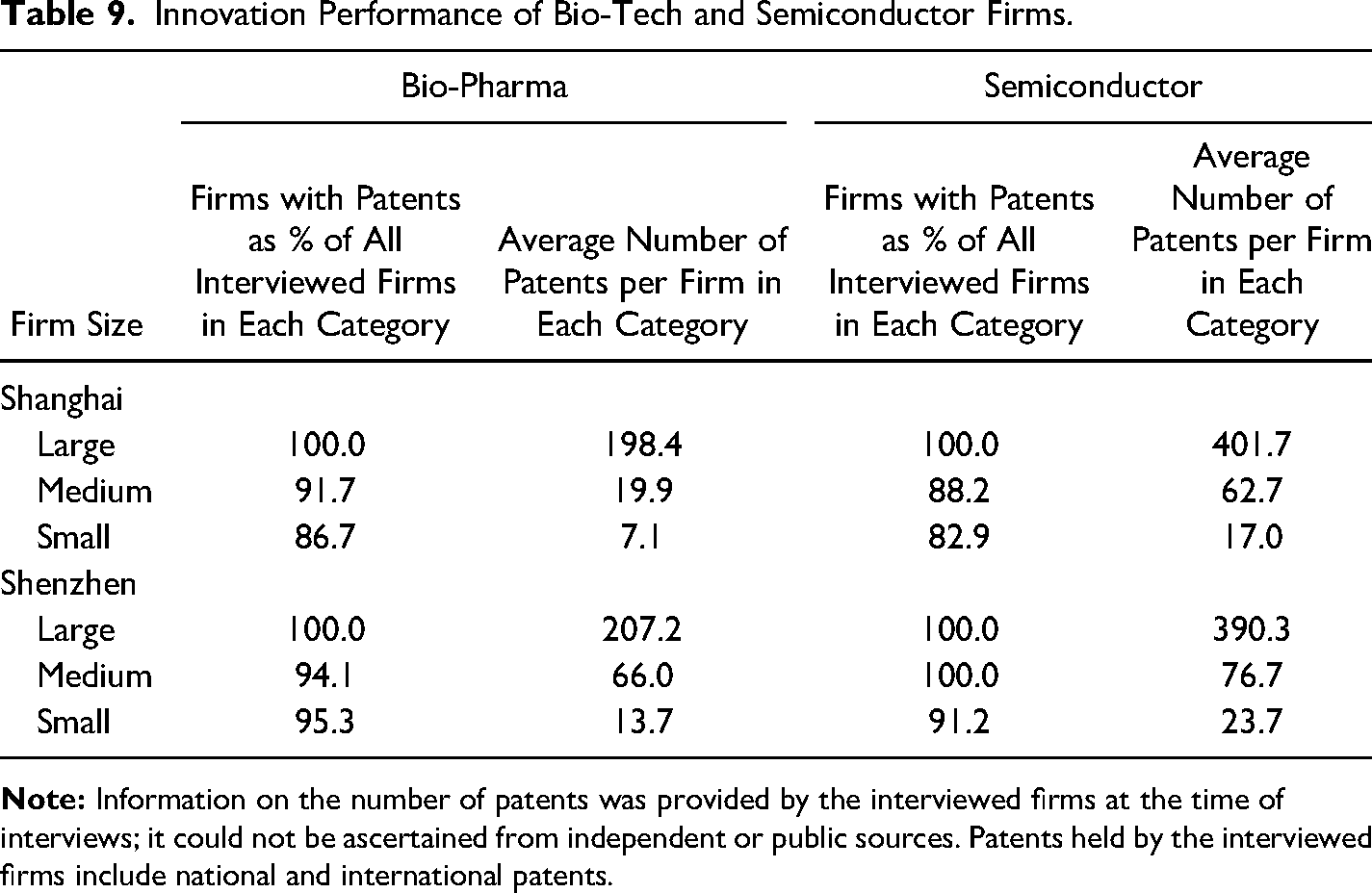
In Shenzhen, by contrast, bio-tech and semiconductor SMEs have benefited more significantly from the active role of trade associations in building social and knowledge networks among different industrial, financial, and academic organizations. These networks both inside and outside the two high-tech industries have offset the real and potential negative effects of social and organizational lock-ins among SMEs on their innovative capabilities by increasing the novelty and diversity of knowledge at their disposal. Most of the interviewed SME member firms regarded their associations as a crucial intermediary institution that not only helped them search for innovation resources from, and cooperate with, other high-tech firms but also engaged them in knowledge exchanges with universities, research institutes, and technology diffusion agencies. While different bio-tech and semiconductor SMEs have developed varied mechanisms for securing inputs for process and product innovations, they have relied on their associations for producing collective goods in the form of multiple and broad linkages and new sources of ideas and technologies that such linkages have provided. These goods have enhanced the access of small and start-up member firms to collective network resources that these firms cannot individually create on their own. The robust network-building role of the associations has contributed to the better innovation performances of bio-tech and semiconductor SMEs in Shenzhen, as shown in Table 9.
Conclusions
The theoretical approach and empirical findings of this article have more general implications for understanding the causes and consequences of varied associational roles in facilitating network and technology development.
This article attributes the network-building roles of trade associations to state policy regimes through their effects on social and cognitive affinities among member firms. This argument suggests the importance of linking causal variables at the micro and macro levels of analysis in any theoretical efforts to understand the changing variety of associational roles in governing innovation networks. Studies that have focused on the interface between member motivation and associational organization have provided a useful micro account of why members are willing to engage themselves in association-led activities. 55 However, the explanatory value of such an account is limited when it comes to the analysis of variations in association roles across industrial settings and geographical localities. On the other hand, the more macro explanations of associational efficacy and vitality have highlighted the impact of broad sociopolitical structures without illustrating convincingly the impact of such structures on associational abilities to orient the behavior of individual members with collective interests and actions. 56 The theoretical approach of this study clearly demonstrates the causal pathways through which state policy regimes impinge on social cleavages and reciprocity norms that in turn shape the ways in which member firms cooperate to support networking activities. By revealing the direct and unambiguous linkage between these micro and macro variables, it establishes a new point of theoretical departure for examining multilevel underpinnings for the associational governance of innovation processes.
Furthermore, this study illustrates the value of integrating the sociopsychological, network, and political economy literatures in the comparative analysis of varied associational abilities to promote innovation networks. On the one hand, it departs from the recent sociopsychological theories that prioritize fairness views over social structures in their explanations of group engagement by showing how network linkages and perceptional orientations interact to motivate member firms to participate in association-led activities. 57 It also improves on the network approach to the governing role of associations that overemphasizes social interactions at the cost of attitudinal factors by paying more balanced attention to the causal weight of both. 58 On the other hand, the central argument of this study avoids the ahistorical tendency of the social-psychological and network approaches and leverages the sensitivity of the political economy perspective to the political origins of social capital and behavioral norms. 59 It emphasizes the effects of historically structured state policy regimes on the development of social and collaborative relations among members of various sizes that in turn shape associational abilities to promote and govern innovation networks.
Finally, the concept of network failures provides a powerful analytical tool for examining the extent to which network-building institutions, such as trade associations, both enable firms to search for informational and technological resources and provide safeguards against opportunistic behaviors among business partners. However, the approach fails to explicate more systematically why such institutions are more effective in building and sustaining innovation networks in some industries, regions, or countries than in others. This article contributes to the literature by emphasizing state policy regimes as a crucial determinant of associational abilities to reduce the severity and frequency of network failures. Equally, key empirical studies that have applied and extended the concept of network failures have mainly focused on advanced industrial societies. 60 The comparative analysis of this study shows that the role of trade associations in facilitating the development of cross-cutting social and knowledge networks is particularly crucial in emerging market countries where densities of such networks are generally low. Future research needs to develop a more systematic theoretical account of the political and policy sources of institutional solutions to the problem of network failures in broader national contexts.
Footnotes
Appendix: Measures and Instruments
Member Involvement in Network-Building Activities.
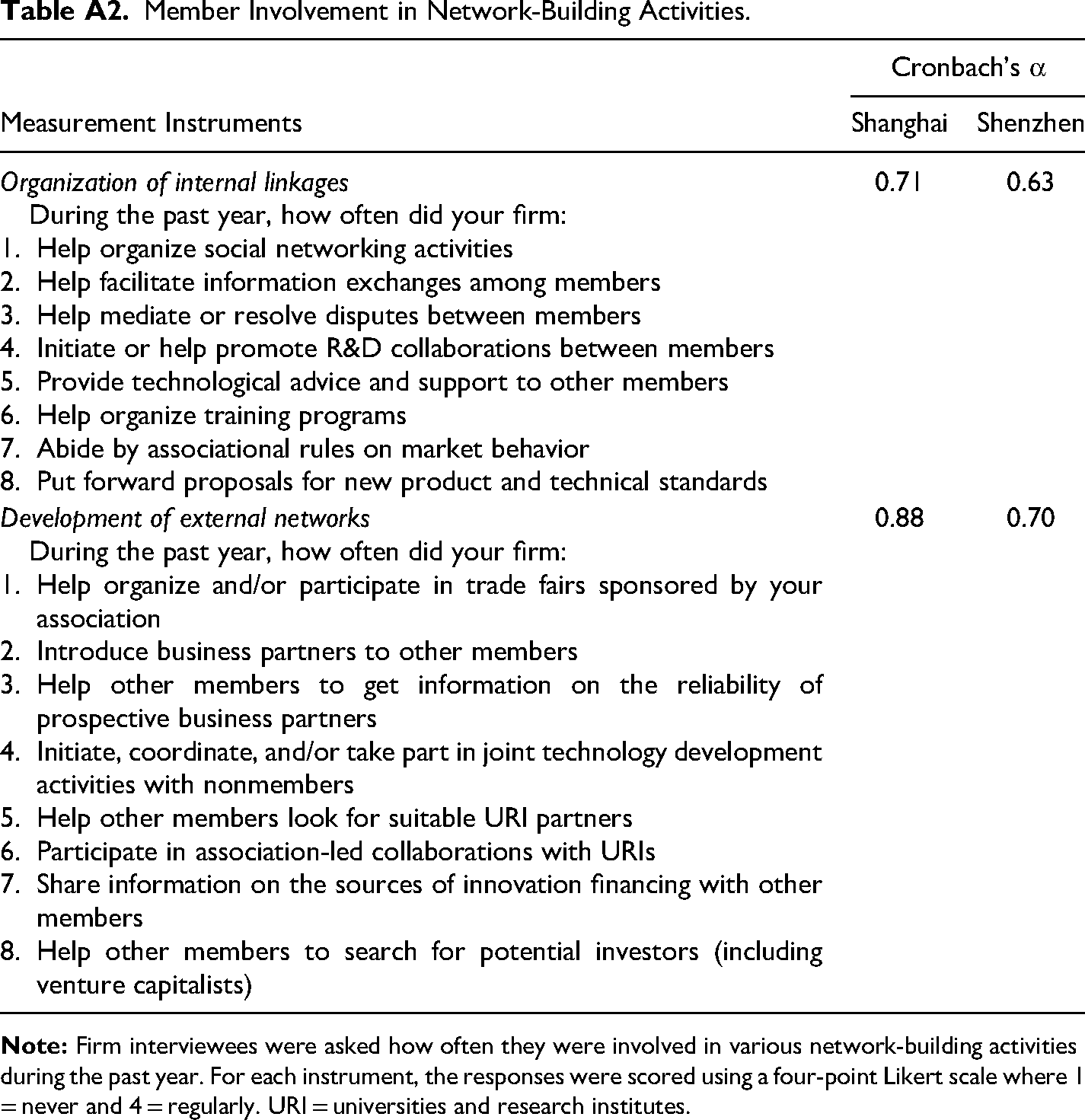
| Measurement Instruments | Cronbach's α | |
|---|---|---|
| Shanghai | Shenzhen | |
| Organization of internal linkages During the past year, how often did your firm: Help organize social networking activities Help facilitate information exchanges among members Help mediate or resolve disputes between members Initiate or help promote R&D collaborations between members Provide technological advice and support to other members Help organize training programs Abide by associational rules on market behavior Put forward proposals for new product and technical standards |
0.71 | 0.63 |
| Development of external networks During the past year, how often did your firm: Help organize and/or participate in trade fairs sponsored by your association Introduce business partners to other members Help other members to get information on the reliability of prospective business partners Initiate, coordinate, and/or take part in joint technology development activities with nonmembers Help other members look for suitable URI partners Participate in association-led collaborations with URIs Share information on the sources of innovation financing with other members Help other members to search for potential investors (including venture capitalists) |
0.88 | 0.70 |
Acknowledgments
The author is grateful to the Politics & Society board for its very helpful comments on earlier drafts of the article.
Declaration of Conflicting Interests
The author declared no potential conflicts of interest with respect to the research, authorship, and/or publication of this article.
Funding
The author disclosed receipt of the following financial support for the research, authorship, and/or publication of this article: This research was supported by the British Academy and the University of Manchester.