




Abstract
What structures voting behaviour under conditions of electoral and political constraints? The impact of authoritarian legacies from dictatorship on voting behaviour is well documented, but we know comparatively less about voting in constrained democracies. This study focuses on the 1963 and 1964 Greek legislative elections, analysing a novel archive of opinion polls. It contributes to the understanding of voting decisions and preference formation under democratic constraints, highlighting the role of the centrist vote in bringing about political and economic change in Greece. We show that political concerns linked to authoritarian practices and political repression were not the most prominent at these elections, but concerns over economic conditions, social welfare and education were. We demonstrate the role of age group, socio-economic stratification, newspaper readership and economic concerns for voting for the centre and left-wing parties. This indicates an emerging political realignment which can produce meaningful political change even in cases of constrained democracy.
Introduction
What structures voting behaviour under conditions of electoral and political constraints? The impact of authoritarian legacies from periods of dictatorship on voting behaviour is well documented (Dinas, 2017; Dinas and Northmore-Ball, 2019), but we know comparatively less about voting behaviour in constrained democracies. Constrained democracies are those with weak democratic institutions, authoritarian governance, political repression and, in some cases, legacies from unresolved (civil) conflict. This study focuses on the 1963 and 1964 Greek legislative elections by analysing a novel archive of opinion polls, contributing to our understanding of voting decisions and preference formation under democratic constraints, highlighting the role of the centrist vote in bringing about political and economic change in Greece.
In Greece, as Papanikolaou and Tzionas (2025) observe, democracy ‘has faced both historic disruptions and contemporary stressors’ and been ‘characterized by abrupt transitions and persistent institutional fragility’ (pp. 170–171). In the early postwar decades until the dictatorship (1967–1974), Greek democracy was characterised as ‘sickly’ (Nikolakopoulos, 2021). The legacy of the 1946–1949 Civil War and realities of Cold War alignments and alliances engendered significant sociopolitical constraints. During this period, the state, dominated mainly by the political right, was operating under the veil of the communist threat, which justified severe limits to civil liberties, political surveillance and policing, within the dominance of the ideology of ‘Ethnikofrosyni’ or ‘national mindedness’ (Papadimitriou, 2022: 145). This ideology stressed loyalty not only to the nation but also in practice attesting loyalty to the state and the political system, via a certificate, and politicised economic survival (Meynaud, 1974: 175–180). The Communist Party was outlawed in 1947, and the remaining left-wing party, the United Democratic Left (Ενιαία Δημοκρατική Αριστερά; EDA), was treated as an ‘antisystem’ force (Mouzelis, 1978).
Within this context, acceptable or legitimate economic and social policies were grounded in the defence and promotion of market capitalism, external economic dependency – particularly on the United States, through official economic assistance and private inflows of capital – and geopolitical Cold War dynamics. In other Western European countries, Cold War alignments were strongly linked to developments in domestic politics. Policies addressing economic inequalities, developing systems of welfare, and the rise of social democratic politics were seen as effective responses to curtail communist parties’ appeal to working-class voters (Petersen et al., 2022: 48). There were also strenuous efforts to keep communist parties out of office by coalition building between mainstream parties and moderation of their ideological positions (Petersen et al., 2022: 48). Greece developed much less extensive welfare provision in the early postwar decades. Expenditure on social welfare comprised a very low share of GDP; there was little political debate over welfare and suppression of popular demands for distributional policies (Maloutas and Papatheodorou, 2004: 331).
The 1950s–1960s saw rapid economic growth but also increased social inequality between rural and urban areas, widespread internal migration to major cities (Nikolakopoulos, 2021: 255) and significant outward labour migration (Tsoucalas, 1969: 137). Victories for the Centre Union (Énosis Kéntrou; EK) party at the November 1963 and February 1964 legislative elections ended the dominance of right-wing parties, removing from office the National Radical Union (Ethnikī́ Rizospastikī́ Énōsis; ERE). These victories heralded both political liberalisation and greater attention to the material needs of the population. The EK campaigned, following the strongly disputed 1961 election, for an ‘unrelenting struggle’ against the dominance of the right, calling for substantive democratisation (Meynaud, 1974: 74, 230, 264) and the need for an ‘equitable distribution of the newly acquired prosperity’ (Veremis, 1981: 86–87). The party leader, George Papandreou, pledged the ‘ordinary people of Greece a better life through a higher standard of living’ (Carey and Carey, 1968: 184).
In this context of Greece as a constrained democracy during a period of right-wing political dominance, our study examines which factors contributed to the electoral appeal of the political centre, assessing the importance of socio-economic characteristics, issue importance and newspaper readership in structuring vote choice. First, we examine the concerns over economic conditions, social welfare and the political situation within public assessments of the EK’s victory and the ERE’s loss of office. Second, given Greece lacked the class cleavage of other Western European societies (Kosmidis, 2020), we examine the basis of voting for the EK and the major left and right parties, within the tripolar structure of political competition that emerged at the start of the 1960s (Papadopoulos, 1989: 59). We contribute new insights into the role of class, issue importance and economic voting at elections in constrained democracies, where patterns of party support realign to herald political and economic change.
We show that it is not political concerns linked to authoritarian practices and the ‘unrelenting struggle’ that were most prominent for the public at the 1963–1964 elections, but instead concerns over economic conditions, social welfare and education, key themes of the EK’s campaigning focus. We then demonstrate the role of age group and socio-economic stratification, as well as newspaper reading, closely linked at the time to political identities, in underpinning support for the EK and EDA relative to the ERE. Support for the EK is also associated with concern over the lack of work and expectations of lower unemployment.
Political, economic and societal developments during Greece’s ‘sickly democracy’
The period of ‘sickly’ democracy (Nikolakopoulos, 2021) saw Greek society fractured along the dividing lines from the Civil War. Official recognition of the Civil War’s end came in 1962 from the Council of the State (Meynaud, 1974: 172–173). This was a period dominated by an anticommunist narrative that justified authoritarian practices, restriction of civil liberties, surveillance and political policing, which extended beyond communists to include left sympathisers or those deemed undermining the state (Meynaud, 1974: 175–177). Measures included outlawing the Communist Party, political prisoners, barring political exiles from returning to Greece and removing citizenship from those seen as threatening the state (Meynaud, 1974: 173–175). It involved ‘Ethnikofrosyni’, an ideology of ‘national mindedness’ that combined nationalism and anticommunism with strong links to Cold War antagonisms (Meynaud, 1974: 168; Papadimitriou, 2022: 145–147). A certificate attesting political loyalty to the state was needed for access to public sector employment, higher education and obtaining a driver’s licence (Meynaud, 1974: 175–180). With limited employment in rural areas, this meant that economic security, access to education and social mobility were heavily politicised.
There was political instability with a series of short-lived governments of different political complexions in the early postwar years. Within a ‘predominant party system’, right-wing parties won six elections between 1950 and 1961 (Tsirbas, 2020: 222), with a combined average vote share of 46% between 1946 and 1967 (Featherstone and Katsoudas, 1985: 29). From 1952 to 1955, the Greek Rally (′Eλληνικòς Συναγερμός, ES), led by Alexandros Papagos, was in office and from 1955 to 1963, the ERE (the renamed ES) led by Constantinos Karamanlis. Parties of the centre and the left were the main challengers (Tsirbas, 2020: 222). These governments emphasised political stability, reinforced by alignment with the institutions of monarchy and church, backed by the United States (Tsirbas, 2020: 222).
Greek foreign policy was strongly aligned with the United States, including NATO membership from 1952. The ES and ERE governments accepted American influence in domestic politics as necessary for national security and economic survival in a Cold War frontline state (Meynaud, 1974: 272–274). With the exception of the Communist left, there was a broad consensus on the country’s Western orientation (Couloumbis, 1966: 43). The increasingly fraught situation of Cyprus and relations between its Greek and Turkish communities, before and after it gained independence from Britain, proved a contentious foreign policy matter, being a highly resonant issue for parties and the public. Anti-Americanism took shape and spread in response to popular feeling over Cyprus (Lialiouti, 2015: 43).
Economically, it was a period of expansion, with an average annual growth rate of 6.1% between 1950 and 1966 (Alogoskoufis, 2024: 20; Kondonassis et al., 1983: 354). The ERE was a strong proponent of a market economy, focusing on progrowth policies, monetary stability, attracting foreign direct investment and industrial development (Meynaud, 1974: 256–257). The ERE governments saw some success, ‘but the fruits of Greece’s rapid and even dramatic economic development had not been evenly distributed’ (Clogg, 1987: 49). Economic growth saw ‘an inability to provide full employment’ and ‘an inability to check the large and growing income inequalities’ (Tsoucalas, 1969: 134). During this period, half of the economically active population were peasants employed in agriculture, characterised by small plots and underdevelopment (Meynaud, 1974: 154, 160). There was significant internal migration due to economic development being concentrated in Athens, with 60% of industrial activity taking place there (Meynaud, 1974: 156–157, 161–163). The population of the capital increased from 1,378,586 (1951) to 1,852,709 (1961), rising significantly over the next decade; the proportion of the population living in urban areas expanded markedly (Clogg, 1987: 242–243). There were major outflows of labour migration to Western European countries, with an estimated 600,000 people leaving between 1955 and 1964, many of them young (Tsoucalas, 1969: 137). In the early 1960s, unemployment rates were higher in younger age groups, contributing to this outflow (Rafailidis, 2004: 174). Significant flows of US aid, foreign investment and high growth rates, coupled with the clientelism that characterised Greek politics, enabled parties in power to use access to public investment as an instrument of parliamentary control and party discipline (Meynaud, 1974: 167–168).
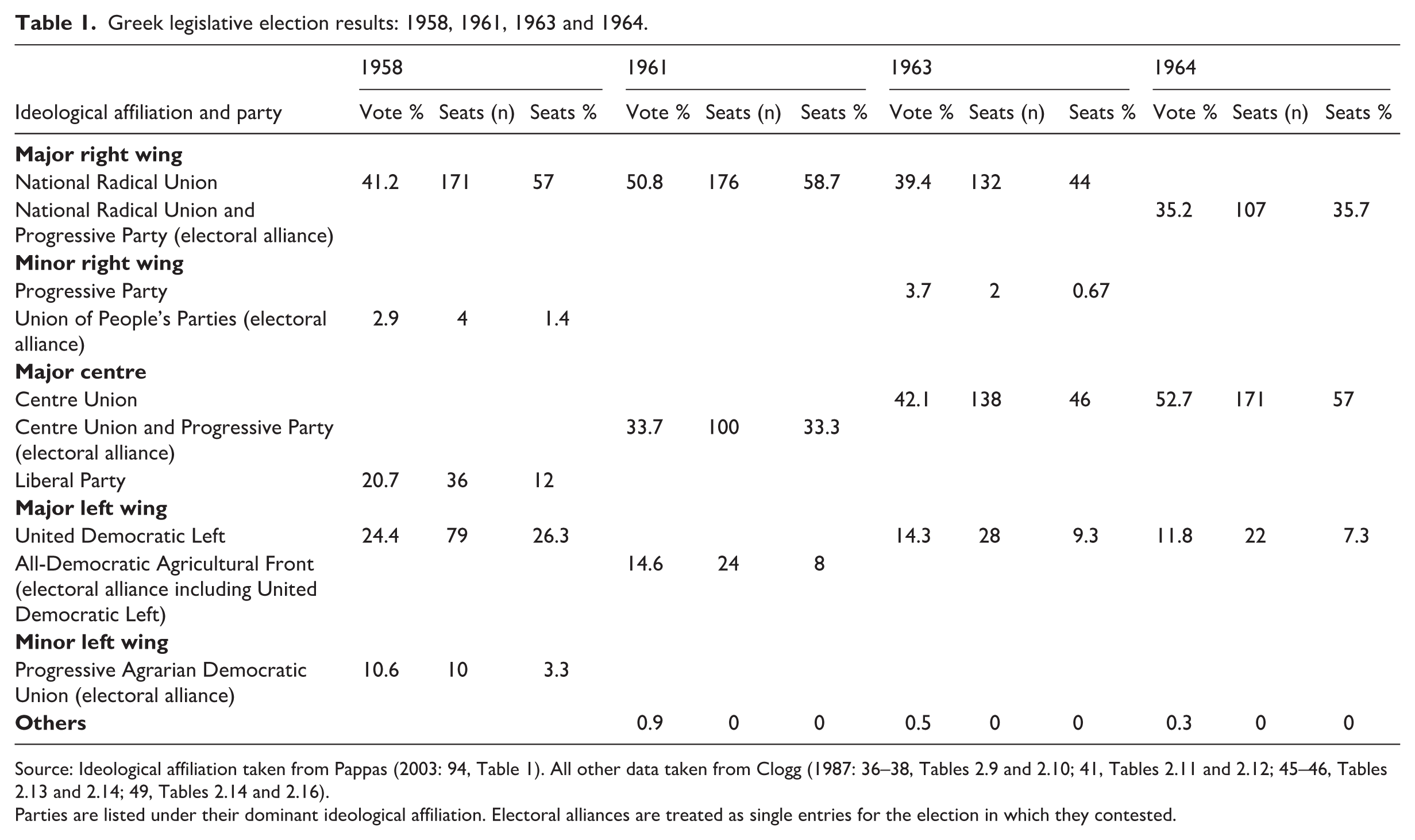
Party vote and seat shares at elections from 1958 to 1964 are shown in Table 1. Discontent over Cyprus featured prominently at the 1958 election (Coufoudakis, 1987: 23–232). The EDA, founded in 1951 and opposed to NATO membership and US involvement in Greek affairs and supportive of Cypriot independence, received the second largest vote share (24.4%) and 79 seats (Clogg, 1987: 36–38). The EDA was subject to some communist influence and, in terms of domestic policy, it argued for radical democratisation, criticised the capitalist system’s social and economic inequalities, and emphasised social justice, protection for farmers, access to education and expansion of the welfare state (Meynaud, 1974: 192–199). The EDA’s performance highlighted the need for a unified centre to undercut its appeal. The ERE won most votes (41.2%) and seats (171). The Liberal Party was third, with a vote share of 20.7% and 36 seats. Some voters backed the EDA, signalling discontent with the centrist parties’ failure to offer a credible alternative (Tsoucalas, 1969: 170). But Papandreou united the centrist forces into the EK before the October 1961 election, exploiting growing discontent with the ERE (Rizas, 2020: 271). The EK was a heterogeneous and loose coalition of politicians from the right and left, united to defeat the ERE and improve democracy, but susceptible to fragmentation (Meynaud, 1974: 276).
Greek legislative election results: 1958, 1961, 1963 and 1964.
Source: Ideological affiliation taken from Pappas (2003: 94, Table 1). All other data taken from Clogg (1987: 36–38, Tables 2.9 and 2.10; 41, Tables 2.11 and 2.12; 45–46, Tables 2.13 and 2.14; 49, Tables 2.14 and 2.16).
Parties are listed under their dominant ideological affiliation. Electoral alliances are treated as single entries for the election in which they contested.
The EK finished second in 1961 in an alliance with the Progressive Party (Κόμμα Προοδευτικών, KP), securing 33.7% vote share and 100 seats. The ERE won the most votes (50.8%) and seats (176). The EDA’s performance was weaker (14.6% and 24 seats won by a left-wing alliance it was part of). The election was strongly disputed due to corruption, vote rigging, intimidation of civil servants and coercion in rural areas (Nikolakopoulos, 2021: 274; Tsoucalas, 1969: 142–143), characterised as an electoral coup (Meynaud, 1974: 65, 264). Papandreou launched the ‘unrelenting struggle’ to contest the ERE’s dominance and restore democracy, concerns shared by the EDA, underlying the emergence of a right versus antiright divide (Meynaud, 1974: 74, 230, 264). Student and left-wing youth movements were at the centre of dissent, mobilising around education, political repression, the United States’ role, the international situation and Cyprus (Tsiganou and Zacopoulou, 2004: 267). In the early 1960s, the number of students at higher education institutions increased significantly, contributing to a wider sense of young people as a ‘distinct community with particular interests’ (Kornetis, 2013: 13–14). Also spurring political mobilisation was the killing of Grigorios Lambrakis, an independent left-wing parliamentary deputy, in Thessaloniki in May 1963 (Kornetis, 2013: 19).
Greater uncertainty around the 1963 election raised its salience (Close, 2002: 105) and produced a turnout of 82.9% compared to 75.3% in 1958 (Clogg, 1987: 36, 41, 45). The ERE leadership were confident of winning, but the margin of victory was in doubt (Nikolakopoulos, 2021: 306–307). In late-September 1963, Andreas Papandreou – EK politician and son of George – predicted a close outcome with the ERE ahead, while some newspapers offered a similar forecast (Nikolakopoulos, 2021: 306–307). Only in the final week of campaigning did the EK and supportive newspapers think a win was possible (Nikolakopoulos, 2021: 306–307). In June 1963, Karamanlis had resigned as ERE leader and prime minister because of a disagreement with the King over a planned royal visit to Britain, replaced by Panayiotis Kanellopoulos (Clogg, 1987: 44). The ERE’s vote share declined to 39.4% (132 seats), with the EDA third-placed (14.3% vote share and 28 seats). The EK won a close-run contest, with 42.1% vote share and 138 seats. It took office as a minority government, and in late-December 1963, Papandreou resigned to obtain the monarch’s agreement for new elections (Clogg, 1987: 47). The EK refused to cooperate with the EDA and maintained competition with the right and left (Meynaud, 1974: 109, 297–298).
In February 1964, the EK secured a decisive victory, with 52.7% vote share. The ERE, in alliance with the KP, secured 35.2% and 107 seats. The EDA finished third, with 11.8% vote share and 22 seats. Its decision not to contest the 22 (out of 55) electoral districts where its support was weakest helped the EK (Tsoucalas, 1969: 180). The EK had campaigned, on a wide-ranging basis, for the extension of democracy, more equitable distribution of prosperity and improving the quality of life, expanding the state’s role in public investment, tax reform, educational reform, labour protections, reducing political polarisation, democratisation and protecting civil liberties and the release of political prisoners (Meynaud, 1974: 292–295; Veremis, 1981: 86–87). Papandreou commented on the ERE’s economic record that ‘The numbers seem to be doing well. It is the people that suffer’ (Tsoucalas, 1969: 174). Clogg (1987) argues that EK’s success partly ‘reflected the aspirations of many Greeks for an increased share of this growing prosperity’ (p. 49). The outcome reinforced the ‘tripolar’ party competition that emerged in 1961 (Papadopoulos, 1989: 59).
Social cleavages and issue voting: Voting behaviour in Greece
In this section, we engage with two major themes in scholarly research on voting in Western European democracies – social cleavages and issue voting – and show their relevance for our study of the 1963 and 1964 elections. Research on these elections has claimed distinctive patterns in the social bases of support for the main parties (Moskos, 1971: 8; Nikolakopoulos, 2021: 311–312, 317, 324). In the postdictatorship period, Greece has been characterised as lacking the strong class-based cleavage that underpinned party alignments and voting behaviour in other democracies, so ‘ties between parties and social classes were less apparent’ (Kosmidis, 2020: 400–402).
Knutsen’s (1988) analysis showed that Greece was one of the Western European countries where voting was weakly anchored in structural cleavages, including the ‘industrial cleavage’ relating to status polarisation in societies, based on income, class and education (pp. 325, 335). Nieuwbeerta (1996: 359) and Nieuwbeerta and Ultee (1999: 136), analysing OECD countries for the period 1945–1990, identified Greece as a country with a low level of class voting (based on a more limited period of 1971–1980 and 1981–1990). Analysing Southern European democracies using data from the 1980s to 1990s, Gunther and Montero (2001) noted, for Greece, the ‘absence of a significant religious cleavage and the apparent shallowness of economic cleavages’ (p. 124). Freire and Costa Lobo (2005), analysing data for Greece, Spain and Portugal for the 1980s–1990s, argued that for Greece, ‘the social anchors of partisanship are generally low . . . and so short-term economic issues are expected to be more important than social factors’ (p. 514). In single-country studies, Tsokou et al. (1986) noted the weakness of socio-economic structures in Greece compared to attitudes for influencing voting nationwide (p. 457), while Dobratz and Kourvetaris (1981) showed the generally weak performance of socio-economic factors – in particular occupation and education – in analysing voting behaviour in Athens (p. 299). We extend this focus on the role of social cleavages and voting behaviour back to the predictatorship period in Greece, examining the group basis of support for the main parties at the 1963 and 1964 elections.
We also, in relation to our analysis of the 1963 and 1964 elections, apply insights from scholarly research on issue voting. First, the role of economic conditions for voting behaviour. The relationship between economic conditions, economic perceptions and voting at Greek elections has been an important focus in the postdictatorship period. Research has shown that ‘Greek voters will “throw the rascals out” when they believe the economy is deteriorating’ (Nezi, 2023: 244). This research has included, first, analysis of Greece as part of cross-country studies often focusing on the 1980s and 1990s (Anderson, 2000; Freire and Costa Lobo, 2005; Powell and Whitten, 1993) and, second, cross-country studies (Lewis-Beck and Nadeau, 2012) and single-country analyses (Kosmidis, 2014, 2018; Nezi, 2012, 2023) in the context of the most recent economic crisis affecting Greece and other European states. This centres on the ‘vote function’ in research on the relationship between economic conditions and electoral behaviour (Lewis-Beck and Stegmaier, 2013: 368). Given the opinion poll data we utilise, our analysis falls within the microlevel approach of ‘measuring the subjective evaluations of performance or prospective and retrospective assessments of a citizen’s or the country’s financial situation’ (Kosmidis, 2020: 405). We also incorporate analysis of economic perceptions for the dimensions of ‘target’ and ‘time’ (Lewis-Beck and Stegmaier, 2013: 369). ‘Target’ differentiates between focusing on the national economy, classified as ‘sociotropic’, or on personal circumstances, classified as ‘egotropic’ (Lewis-Beck and Stegmaier, 2013: 369). ‘Time’ refers to whether the evaluation is forward-looking (prospective) or backwards-looking (retrospective) (Lewis-Beck and Stegmaier, 2013: 369). Roberts and Legg (1991) assessed the macroeconomic conditions at the 1963 and 1964 elections as being favourable for, respectively, the incumbent ERE and EK governments (p. 62, Table 2). We examine whether and how individuals’ economic perceptions were associated with party support in this context.
Most important problem nationally (percent mentioning each problem).

Source: Authors’ analysis of ICR opinion poll datasets.
Multiple responses were allowed, so percentages do not sum to 100.
To further contribute to research into issue voting, we examine the role of perceptions of the most important problems nationally for vote choice (Fournier et al., 2003). The most important problem question has been a long-standing feature of public opinion research in other democracies (Smith, 1985a). This aspect of issue-based voting is particularly appropriate for the Greek context. We have already discussed the economic conditions surrounding the 1963 and 1964 elections, including high rates of growth and growing societal inequalities, and the prominent issues in the EK’s and Papandreou’s election campaigning. This allows us to examine the association between the economic and political concerns of the public and party support in a context of weak democratic institutions.
Opinion poll data
We use the collection of the Institute of Communications and Research (ICR), which undertook opinion polls and market research in Greece, representing the US-based Gallup Institute (Safilios-Rothschild, 1968: 282–283). The Gallup Institute had affiliate organisations conducting opinion polling in various Western European countries in the postwar period, as well as outside Europe (Worcester, 1987: 80–81). Common to some of these efforts across countries was that some polls, or questions included within particular polls, were commissioned by the United States Information Agency (USIA), using local providers for the fieldwork in each country. These efforts to survey the views of the general public formed part of the United States’ public diplomacy in the Cold War, serving the maintenance of relations involving the United States and its allies (Cull, 2008: 494). The USIA’s activities in Greece in the early postwar decades have been researched in depth (Lialiouti, 2019; Stefanidis, 2007).
The ICR undertook regular polling in Athens from the early 1960s until the dictatorship in 1967 and undertook some polls during it (Nikolakopoulos, 2004: 144). We acknowledge the historical context within which public opinion research was undertaken in Greek society and the need to examine results ‘in the light of the political circumstances peculiar to post-Civil War Greece’ (Stefanidis, 2007: 256). This includes concerns over the sociopolitical conditions in Greek society at the time, affecting which individuals and social groups were less likely to participate in and have their views recorded by opinion polls, such as those with left-wing or Communist political attitudes and affiliations. Research on ICR polling (and earlier efforts) has focused mainly on public views towards aspects of Greek foreign policy, the superpowers and the wider Cold War situation, through analysis of documentary evidence pertaining to the USIA’s activities, in archival research (Lialiouti, 2019; Stefanidis, 2007). Nikolakopoulos (2004, 2021) cites some findings from the polls in his seminal study of Greek politics between 1945 and 1967, but notes the general lack of coverage in the media at the time (p. 144).
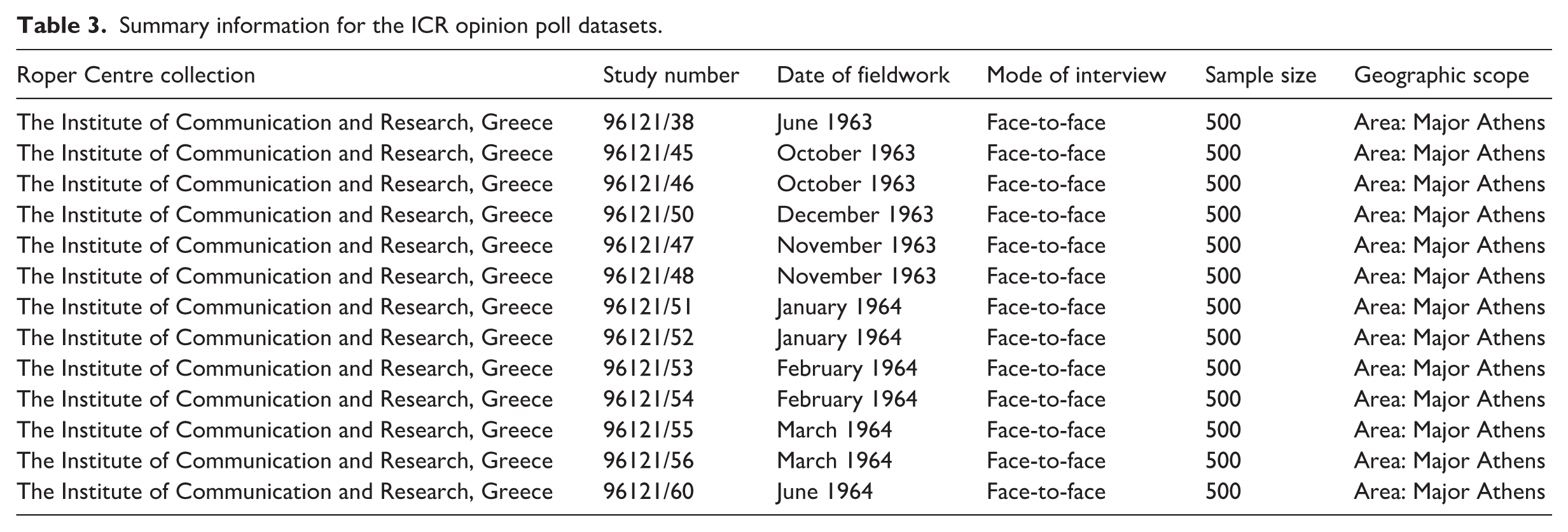
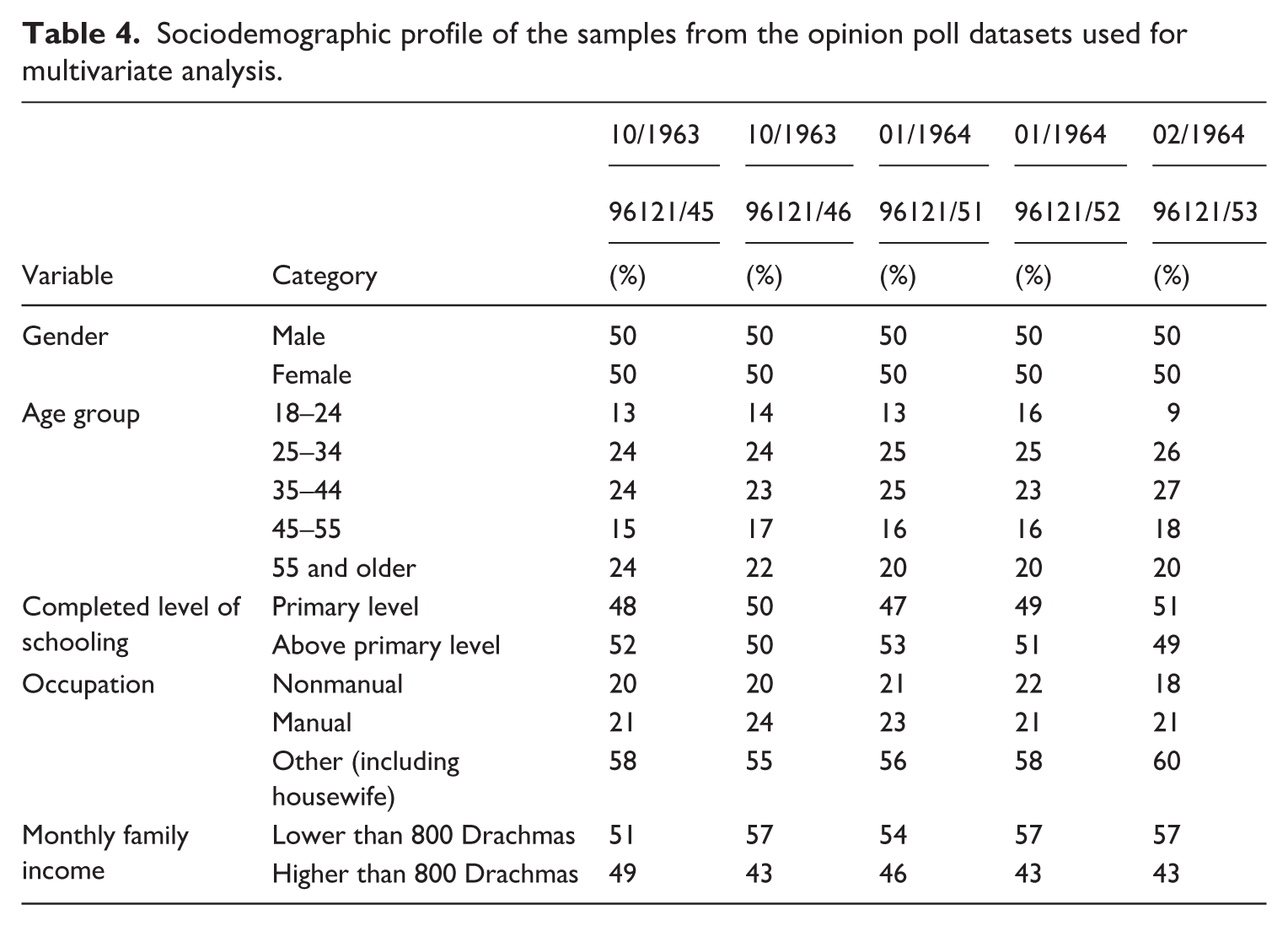
We agree with Stefanidis’s (2007) claim that the opinion poll data represent an important source for analysing attitudes in the early postwar decades (p. 253). We provide the first scholarly analysis of the collection of opinion poll datasets held at the Roper Centre for Public Opinion Research (n.d.). The collection contains over 100 opinion polls from 1958 to 1966. Most polls sampled those living within the Major Athens Area (comprising 21%–22% of the population). Polling in the early postdictatorship period often focused on the Greater Athens Area (Dimitras, 1987, 1990; Dobratz and Kourvetaris, 1981). The polls used the same sampling strategy, consisting of 400–500 respondents based on face-to-face interviews of adults aged 18 and over. They offer consistent coverage of demographic and socio-economic indicators and contain repeated questions focusing on the political and electoral context. A list of opinion poll datasets from the Roper Centre collection used for this study is provided in Table 1. Table 3 shows the sociodemographic profile of the sample for each dataset used for multivariate analysis. The ICR survey documentation was only available already translated into English. We have generally reproduced the question wordings from the documentation, but have edited the phrasing of response categories for clarity of expression.
Summary information for the ICR opinion poll datasets.
The public issue agenda at the 1963 and 1964 elections
Our analysis of the relative prominence of economic and political concerns has two stages. First, we assess perceptions of the most important problems, nationally and personally. Second, we examine the reasons given for the perceived failings of ERE or expectations about the EK in office, as well as related questions.
Perceptions of the most important problems
Several polls asked, ‘Which, to your opinion, is the main problem that our country faces today?’ Respondents were able to select more than one problem. For most polls, a common list of issues was offered, but a somewhat different list featured in the second February 1964 poll (see Table 4). In most of them, the economic situation (low economic standards) was the most-cited problem (ranging 24%–31%). Also mentioned were the lack of work or unemployment (ranging 8%–19%) as well as economic development (5%–15%). A follow-up question in June 1963, asking what the government could do for the issues mentioned, found that most frequently cited were social measures relating to the distribution of national income and more work (19%), economic development (15%), policy relating to fair elections and constitutional freedom (15%), better standard of living (11%) and education (8%). Mentions of the political situation increased markedly to 38% in the first January 1964 poll (having been lower in June and October 1963), before falling away to 26% later in January and decreasing to 21% in February. This upsurge of concern may partly reflect the resignation of Papandreou’s government in December 1963 after his dissatisfaction with a confidence vote in parliament (which the EK won) and the request for new elections, with a caretaker government set up to supervise them (Clogg, 1987: 47). A December 1963 opinion poll showed there was greater support than not for new elections in February (48% vs 32% and 20% did not know). In June and October 1963, the political situation was cited by lower proportions (7%–11%). The only international problem, concerning the safeguarding of peace, was generally ranked low (2%–8%). Smaller proportions selected domestic matters such as education (4%–12%), moral decline, social deterioration and social welfare (1%–17%), though the latter issue was more salient in early 1964.
Sociodemographic profile of the samples from the opinion poll datasets used for multivariate analysis.
In the second February 1964 poll, the economic situation was the most-cited problem (30%); 12% mentioned unemployment and 5% economic development. The second most mentioned was Cyprus (15%), with violent clashes that month between the Turkish and Greek communities (Clogg, 1987: 50). Carey and Carey (1968) assert that the EK and ERE agreed not to campaign on the Cyprus issue in 1964 (p. 190), while Legg (1969) argues that any Greek government’s foreign policy on the issue was constrained by its major allies (p. 154). A very small proportion (4%) mentioned the country’s political problems, perhaps reflecting easing of concern over the consequences of a change of government and Papandreou’s conduct as prime minister. Only small proportions choose peace or calm in the international situation (4%) or immigration (3%), the latter issue referring to labour migration from Greece (Rafailidis, 2004: 165).
Two polls asked about the most important issue personally: ‘What is the main problem you face today personally?’ (June 1963) and: ‘Which is the main (the first, the most important) problem that you face today personally?’ (October 1963). Smith (1985b) remarks that ‘Rather than having only one salient problem and expressing that in national, regional, local, and personal contexts, people often chose different problems as the reference changes’ (pp. 403–404). But the most commonly cited issue was economic in nature (32% and 27%, respectively, in June and October), followed by finding and improving work (22% and 19%) (Table 5). The next most-cited problems were education (at 12% and 9%) and marriage (10% on both occasions). Other concerns were chosen by smaller proportions on one or both occasions. Concerns over the political situation did not feature in this personal context.
Most important problem personally (percent mentioning each problem).
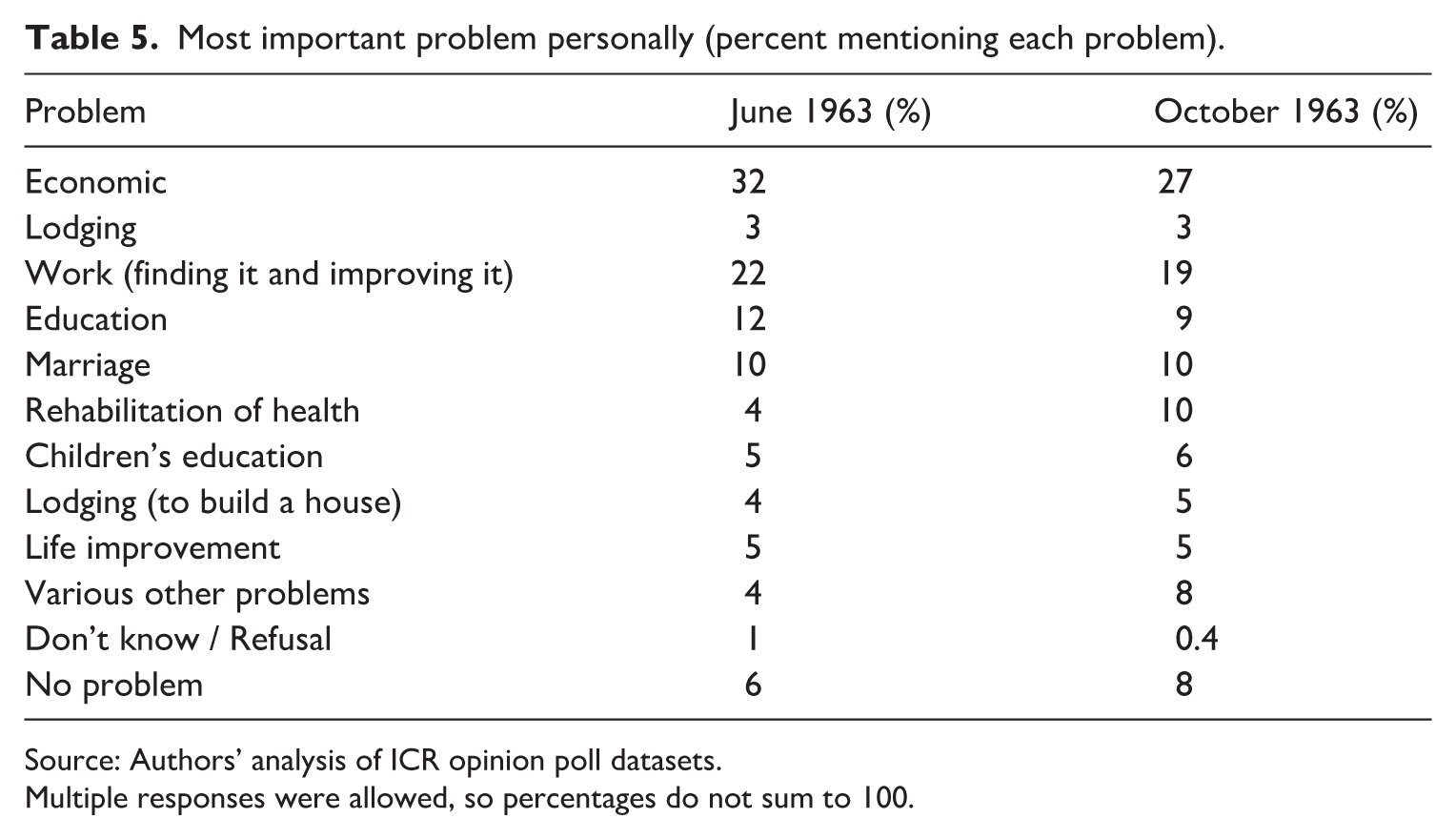
Source: Authors’ analysis of ICR opinion poll datasets.
Multiple responses were allowed, so percentages do not sum to 100.
At both the national and personal levels, economic-related issues were prominent for the public. A June 1963 poll showed that respondents were more likely to think that – comparing this year with last year – their general work situation was worse (35%) than better (19%), although a plurality said it was the same (46%). Concerns about the lack of work and the economic situation may, in an August 1963 poll asking about migrants, have promoted some to respond that life was better for migrants (29%), while 37% thought life was better in Greece, with the remainder thinking it was the same (4%), it depended (14%) or were unsure (16%).
The November 1963 election: Perceptions of government priorities and performance
Economic issues were prominent in perceptions of governmental priorities and performance. In October 1963, respondents were asked, ‘Let us say that the elections are over and that we have a political government. With what subject do you think that the new government should deal first? With which other?’ The most frequently cited problems were 36% mentioning increasing and readjusting salaries, and 33% citing the economic planning and development of Greece. To create work for everybody was cited by 17%, while 19% mentioned ameliorating the conditions of work and job security. The education system was chosen by 27%. Smaller proportions selected other problems: to protect pensioners (6%), to follow the cost of living and make the prices of food lower (6%), to take care of the poor (8%), to stabilise external policy (5%), to assure real democracy (1%) and to revise the taxation system (5%).
Economic concerns also featured in evaluations of the failings of the ERE government and the EK’s electoral success. In November 1963, a question asked ‘It is natural that every government does right and wrong things. What mistakes did ERE make during the 8 years that it governed?’ The most commonly cited was indifference towards the problems experienced by workers and clerks (40%), far ahead of the proportions mentioning the neglect of education (10%), the imposition of heavy taxation (8%), failures connected with public works and infrastructure (11%), neglect of rural people (12%), failure to implement measures to stop rising prices (11%) and not taking care of poor people (9%). Supporting ‘party people’ with advantageous policy was mentioned by 10%. Given the controversy around the 1961 election and the protest movements of the early 1960s, only 7% cited antidemocratic measures. Just 5% mentioned foreign policy, showing the lower salience of external affairs, while 4% said the government had not made any mistakes.
Another question asked, ‘As you correctly mentioned, in 1961 ERE was the first party. Now the EK has come first, where do you attribute this change?’ The factors focused more on negative aspects of the ERE’s performance, and there is some overlap with responses to the previous question. Equally cited were what might be regarded as negative reasons: 22% apiece mentioned, first, people wanting change and amelioration and being fed up with current policy and, second, the ERE not governing well and not caring for the welfare of Greek people. Interestingly, 14% attributed the EK’s win to the changeable character and political immaturity of the Greek people. The next most frequently cited reasons were the ERE government’s decline since 1955 (9%) and the violence and falsification which occurred at the 1961 election (8%). The success of the ‘unrelenting struggle’ was only mentioned by 6%. Other reasons cited included the failures of the ERE’s programme (4%), unbearable taxes (3%), the high costs of goods (4%) and the assassination of Lambrakis (2%).
A poll in November 1963 asked what respondents approved of so far from Papandreou’s prime ministership. Most commonly cited was what Papandreou had done for education (52%), followed by measures for rural people (14%) and support for labourers and increasing salaries (14%). Few cited Papandreou’s democratic tendencies (5%), and other issues received lower response rates. Asked what they did not like, the most common response was that there was nothing to disapprove of (36%), with 9% saying it was too early to say. Other categories were chosen by very small proportions, including that promises would not be kept or had not been delivered on.
The February 1964 election: Perceptions of governmental priorities and performance
Foreign media coverage of the 1964 election emphasised that ‘there was widespread discontent with the domestic economy’ and noted the ‘unemployment and many Greeks were emigrating to northern Europe to find work’ (Binder, 1964: 1–2). The campaign featured claims and counter-claims by party leaders about each other’s handling of economic management and the Greek currency (The New York Times, 1964). Following the election, a poll in March asked which problems the government should prioritise: It is natural that many problems exist that need a solution, so that our country progresses. This is the government’s business. Still it is not possible that all problems find a solution at the same time. To your opinion, which is the main problem that the government should face first? Which other?
Most frequently mentioned was education (59%), a key priority for the EK, which enacted reforms at primary, secondary and tertiary levels and raised expenditure significantly (Close, 2002: 107). This was followed by economic and social welfare concerns: the improvement of salaries (49%), the stability of prices (42%), public works which make Greece richer (31%) and public or rural housing (13%). Stronger armed forces were mentioned by only 4%, with various other reasons cited by 6%.
Given the measures taken to liberalise the political system, with ‘a climate of freedom almost completely restored’ (Tsoucalas, 1969: 183), it is not surprising that, in March 1964, many agreed Greek political life had changed (46% saying yes to 33% saying no). The most commonly cited reasons related to more freedom (including freedom of opinion) and lack of fear; a more normal life, quietness and democratic life; and the mentality of those governing, more democratic government and the attitude of the state towards citizens. Respondents were also asked about the reasons for the EK’s victory: Now that the time has elapsed and things are quiet many people found time to think over the reasons for which the Party of the Center won the elections with such a majority of the votes. Which was, to your opinion, the main reason that made the Party of the Center win? Which other?
The factors can be divided into negative reasons centred on the ERE government and positive attributes of the EK. The most commonly cited negative factor was a desire for change, the waste and deterioration since 1955 and people having had enough (21%). This was followed by the ERE’s disregard and neglect of workers and peasants, poverty, starvation, an expensive life and unemployment (mentioned by 13%). Other criticisms related to its performance or conduct in government: people feeling maltreated or abandoned by the ERE (9%), the violation of democratic principles under the ERE involving the lack of freedom to express opinion, fear of the police and the murder of Lambrakis (6%), bad governing or policy in general (6%) and very heavy taxation (1%). The EK-focused reasons included the promises and grants during its initial time in office (20%), promises and signals of freedom and democracy and the need for change (11%) and hope for a better life (12%).
In March, respondents were asked, ‘If you had the opportunity to meet with Mr. Papandreou and [he] had time to listen to you what would you tell him?’ There was again a strong focus on the economy and welfare: most frequently cited was to ask Papandreou to consider the working class, to improve salaries, to take care of peasants and the prices of agricultural products, and to protect professional people (17%). Another 10% would have told him to give work to the people, and 8% said they would tell him to continue the support of education. Some wanted to convey their best wishes and gratitude (10%), and a further 9% would have asked him to realise the promises made. Less mentioned were restoring the democratic freedom of the people and protecting democracy, liberating political prisoners and abolishing the ‘files’, as well as governing well and having a better administration. Various other responses were cited by 29%.
Sociodemographic groups and issue importance at the 1963 and 1964 elections
The evidence analysed in the above section shows that the public’s concerns tended to cluster around the economic situation, work, education and social welfare. These matters were given more prominence than those relating to the political system and governing practices. This tends to support the assertion that ‘The mounting attacks that were made in the 1960s on various aspects of the power structure were largely driven, therefore, by economic needs and anxieties’ (Close, 2002: 104).
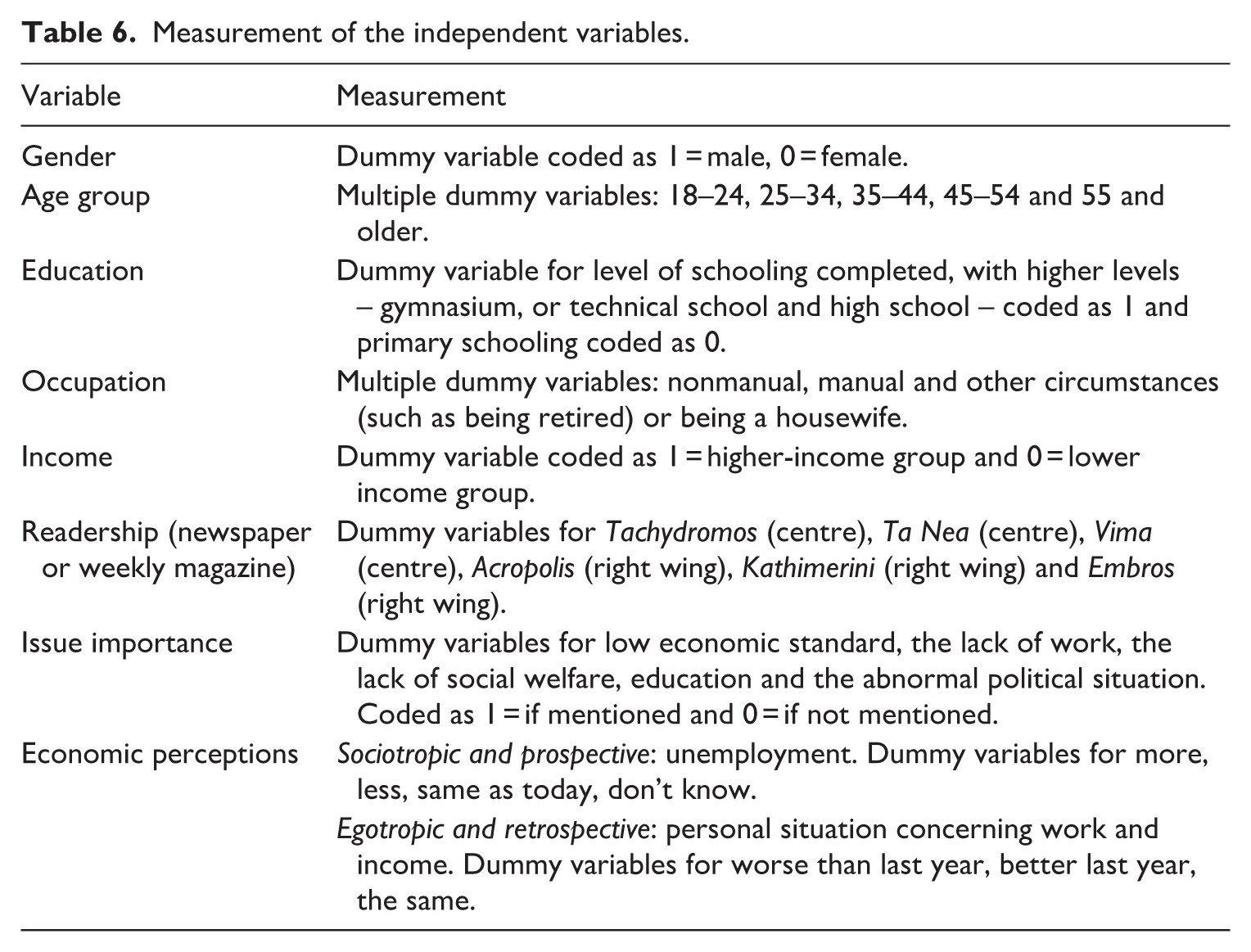
The first stage of our multivariate analysis looks at whether these issues were more important for particular sociodemographic groups. We merged two datasets from polls undertaken in October 1963 (n = 1002) and three datasets from polls conducted in January and February 1964 (n = 1499), which featured the most important national issue question. We focus on five issues that were mentioned by more than, or close to, 10% of respondents. Most of the issues are the same for both data, with the difference that economic development features in the analysis for October 1963 and social welfare in the analysis for January–February 1964. Each issue formed a separate dependent variable: responses mentioning it were coded as 1 and those that did not were coded as 0 (Fournier et al., 2003: 64). Binary logistic regression was used to assess the associations with a set of sociodemographic groups (gender, age group, education and occupation). Measurement of the independent variables is shown in Table 6. For occupation, the housewives and other categories include retired people, given the age distribution of this group. The omitted reference categories are aged 18–24 and manual occupations.
Measurement of the independent variables.
Results and discussion
Results are shown in Tables 7 and 8 (October 1963) and Tables 9 and 10 (January–February 1964). All regression estimations show some significant differences in the relative importance of issues for sociodemographic groups before the November 1963 election. Men were more likely than women to see economic development and education as important problems, but less likely for the lack of work. Those with a higher level of education were more likely to think that four of the five issues were important nationally (except for the lack of work). Those not in an occupation were less likely to think the lack of work was a concern compared to those in manual employment, while both those in nonmanual employment and those without an occupation were more likely to think that education was an important problem. There were no significant differences by age group for the lack of work or the political situation, but those aged 55 and older were more likely to see the low economic standards as a problem, but less likely to support economic development and education (compared to those aged 18–24).
Multivariate analysis of issue importance before the November 1963 election: Sociodemographic group.
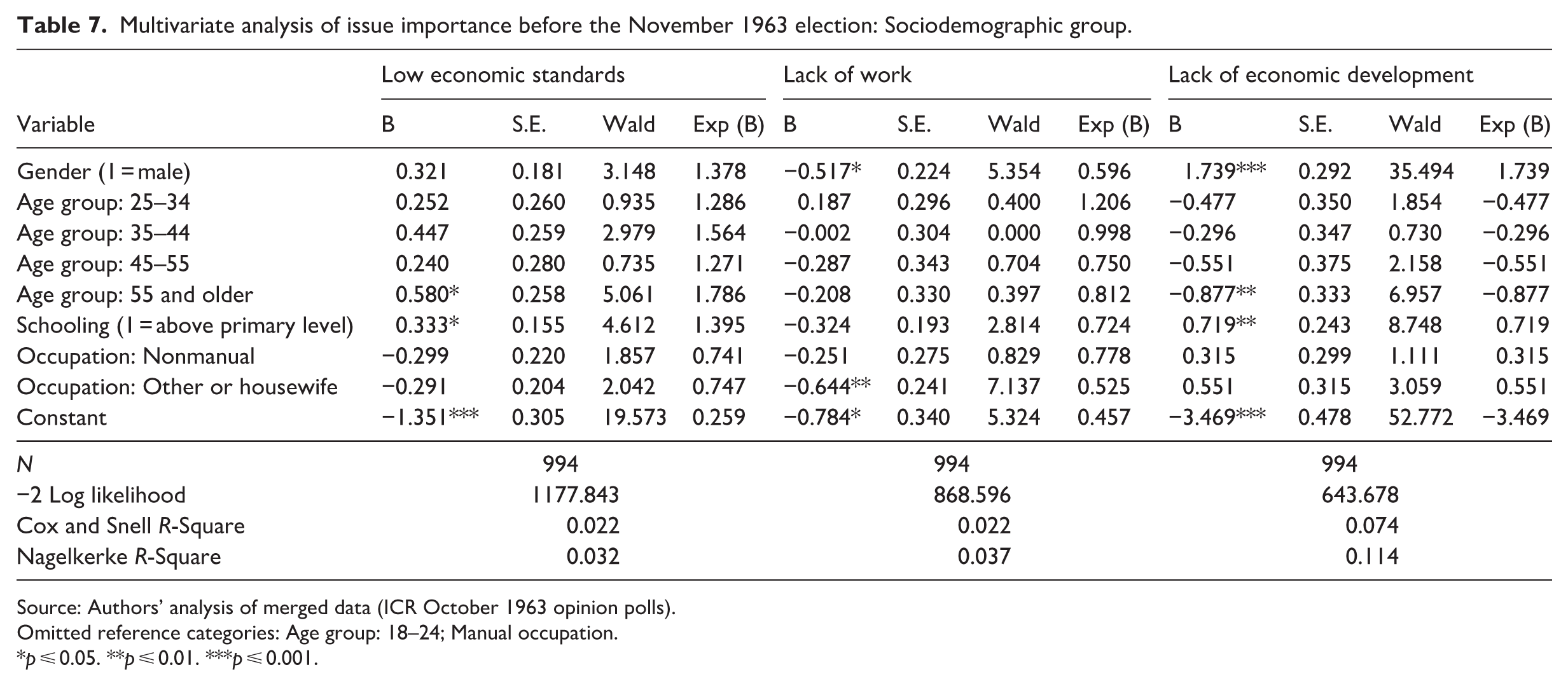
Source: Authors’ analysis of merged data (ICR October 1963 opinion polls).
Omitted reference categories: Age group: 18–24; Manual occupation.
p ⩽ 0.05. **p ⩽ 0.01. ***p ⩽ 0.001.
Multivariate analysis of issue importance before the November 1963 election: Sociodemographic group.
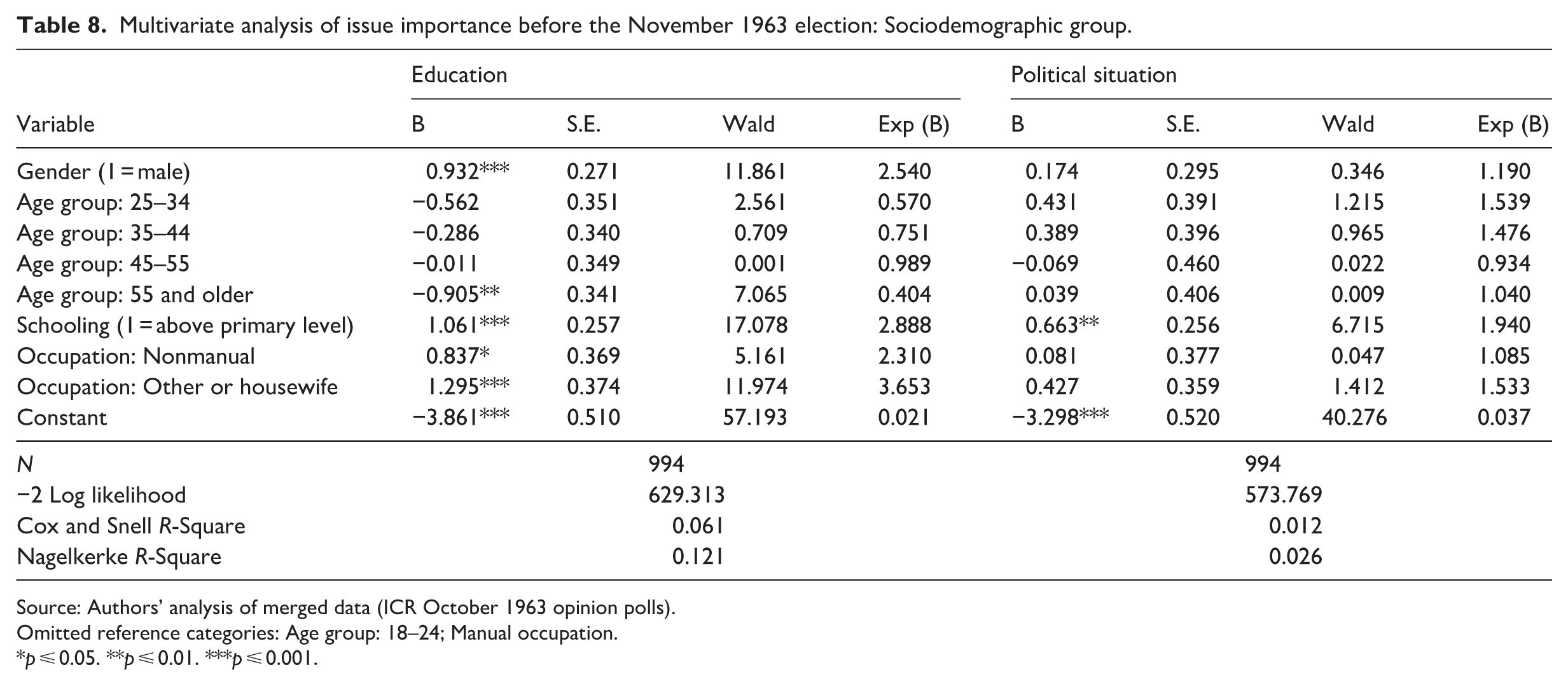
Source: Authors’ analysis of merged data (ICR October 1963 opinion polls).
Omitted reference categories: Age group: 18–24; Manual occupation.
p ⩽ 0.05. **p ⩽ 0.01. ***p ⩽ 0.001.
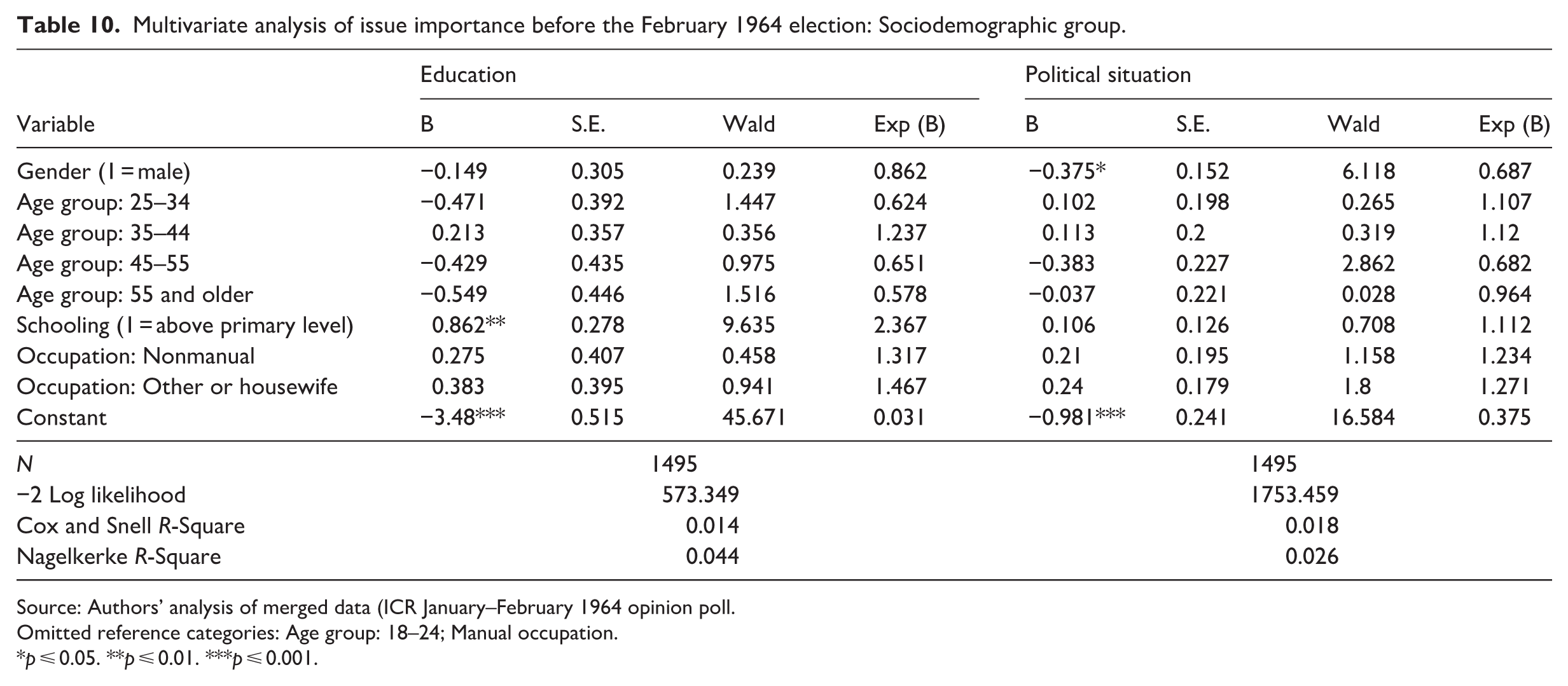
Multivariate analysis of issue importance before the February 1964 election: Sociodemographic group.
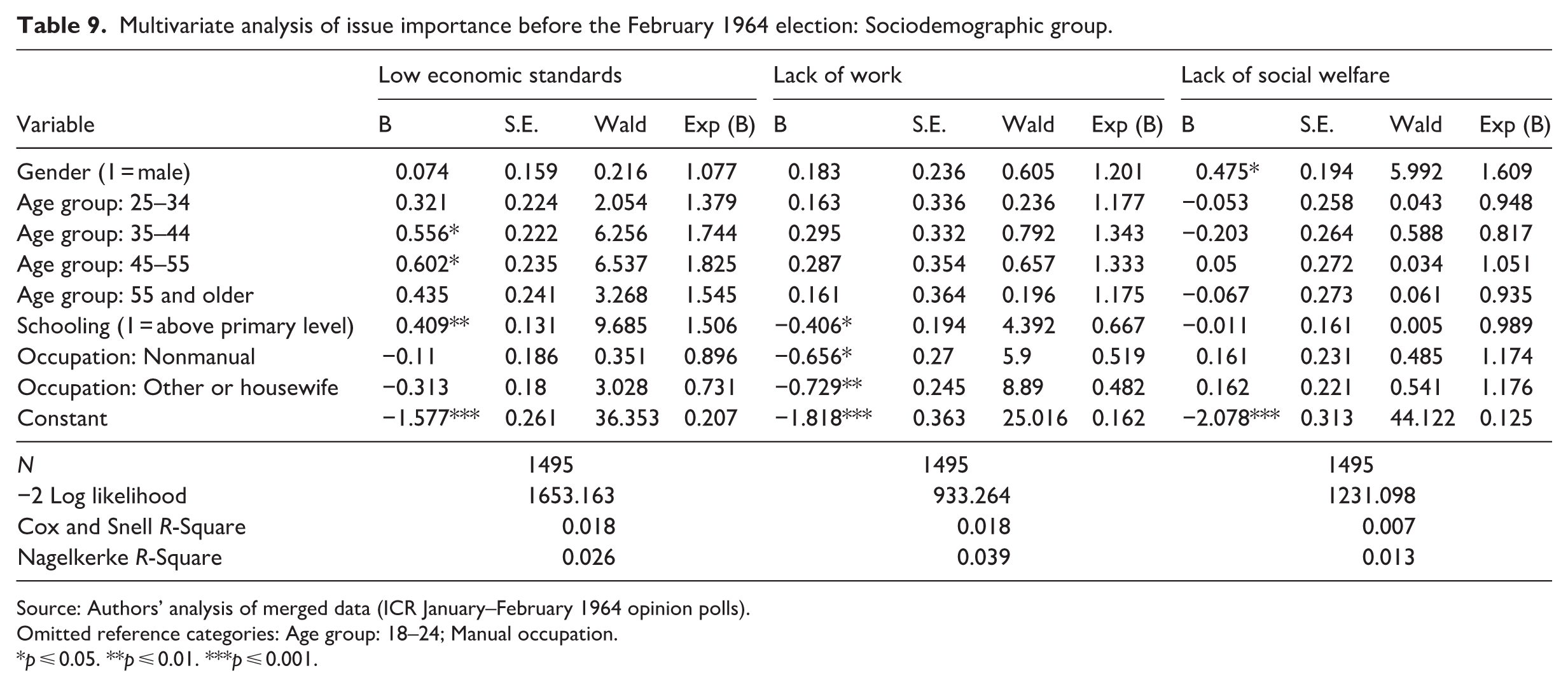
Source: Authors’ analysis of merged data (ICR January–February 1964 opinion polls).
Omitted reference categories: Age group: 18–24; Manual occupation.
p ⩽ 0.05. **p ⩽ 0.01. ***p ⩽ 0.001.
Multivariate analysis of issue importance before the February 1964 election: Sociodemographic group.
Source: Authors’ analysis of merged data (ICR January–February 1964 opinion poll.
Omitted reference categories: Age group: 18–24; Manual occupation.
p ⩽ 0.05. **p ⩽ 0.01. ***p ⩽ 0.001.
Before the February 1964 election, those with a higher level of education and those in nonmanual occupations (as well as housewives and those in other circumstances) were less likely to see the lack of work as one of the most important problems, compared to those on manual work. Those with education above primary level were more likely to have focused on low economic standards and on education, as did two of the intermediate age groups for the former problem. Men were more likely than women to be concerned about the lack of social welfare but less so about the general political situation. In the lead-up to both elections, there is some evidence that perceptions of the importance of national issues did vary by sociodemographic group, and this was the case for issues concerning social and economic conditions.
The basis of support for the main parties at the February 1964 election
To assess the basis of party support at the 1964 election, we include factors central to scholarly research on social cleavages and issue voting in Western European countries. Our analysis was constrained by the content of the questions available in the opinion polls, narrower than the breadth accommodated in academic-led election surveys in some Western European countries in the 1960s (Barnes and Pierce, 1971; Butler and Stokes, 1969; Converse and Pierce, 1986; Klingemann and Urban Pappi, 1969). To examine the role of social cleavages, we used variables for gender, age group, level of education, occupational status and income level. Greece has been regarded as having weaker class-based alignments than other Western European countries (Kosmidis, 2020). There is some variation in party support based on occupation categories from the combined January and February 1964. Manual workers were more likely to have supported the EK (61%) compared to nonmanual workers (55%) and housewives and those in other circumstances (53%). Support for the ERE was higher among those in nonmanual work (32%) and among housewives and those in other circumstances (30%), compared to nonmanual workers (20%). The EDA support was somewhat higher among manual workers (11%) compared to nonmanual occupations (8%).
We assess the role of issue voting in two ways. First, by assessing perceptions of the most important problems for Greece, using as independent variables the most prominent problems (each one coded as a binary variable) (Fournier et al., 2003). Second, we examine the role of economic perceptions by using the two January 1964 polls in a combined dataset. These both contained questions on economic perceptions, covering different combinations of the ‘time’ and ‘target’ dimensions (Lewis-Beck and Stegmaier, 2013: 369): sociotropic and prospective: expectations about unemployment; egotropic and retrospective: personal situation concerning work and income. The question wordings were: ‘What do you foresee about unemployment for the next 6 months, there will be less, more or the same as today?’ and ‘Taking everything into consideration, your work, what you earn, your plans, what do you think, is the situation better for you this year, worse, or the same as last year?’ Responses were recoded into multiple dummy variables (unemployment: there will be more; there will be less; the same as today; don’t know; personal situation: better this year; worse than last year; the same as last year). For the question on the individual’s situation, the very few don’t know responses were omitted. Positive evaluations of economic conditions form the omitted reference categories.
In this period of Greek politics, the ‘views of the major parties were propagated by newspapers, most of which were partisan and dependent on politicians for information’ (Close, 2002: 102). Moreover, the press was the main medium of political information (Frangiskou, 2004: 380). Circulation of daily and evening titles increased year-on-year between 1960 and 1966 (Frangiskou, 2004: 388). In the early 1960s, Athens accounted for over half of total newspaper circulation (Tsoucalas, 1969: 127). There was a widespread view among respondents that newspaper readership was important. In a June 1964 poll, an overwhelming 94% of respondents said it was necessary to read a newspaper every day, with 6% choosing less frequently or being unsure. Regarding their habits, 68% reported reading a newspaper every day, 8% about three times a week, 7% about twice a week, 3% less often and the remainder not at all. The established links with political groupings mean that newspaper readership could function as a proxy measure for affiliation with one of the main political families within the structure of tripolar competition (Papadopoulos, 1989: 59). We focused on publications mentioned by 10% or more of the sample. Two newspapers were published by the Lambrakis Group, the dominant media organisation in the political centre (Ta Nea and Vima). One was a weekly magazine (Tachydromos), which focused on social and political matters, rather than lifestyle, also published by the Lambrakis Group (Meynaud, 1974: 199). As a weekly magazine, the readership of Tachydromos may have reached beyond the political centre. Three were newspapers on the political right: the very right-wing Acropolis, the very right-wing Embros and the more moderately right-wing Kathimerini (Meynaud, 1974: 187–189). Readership of each of these publications was operationalised as a dummy variable.
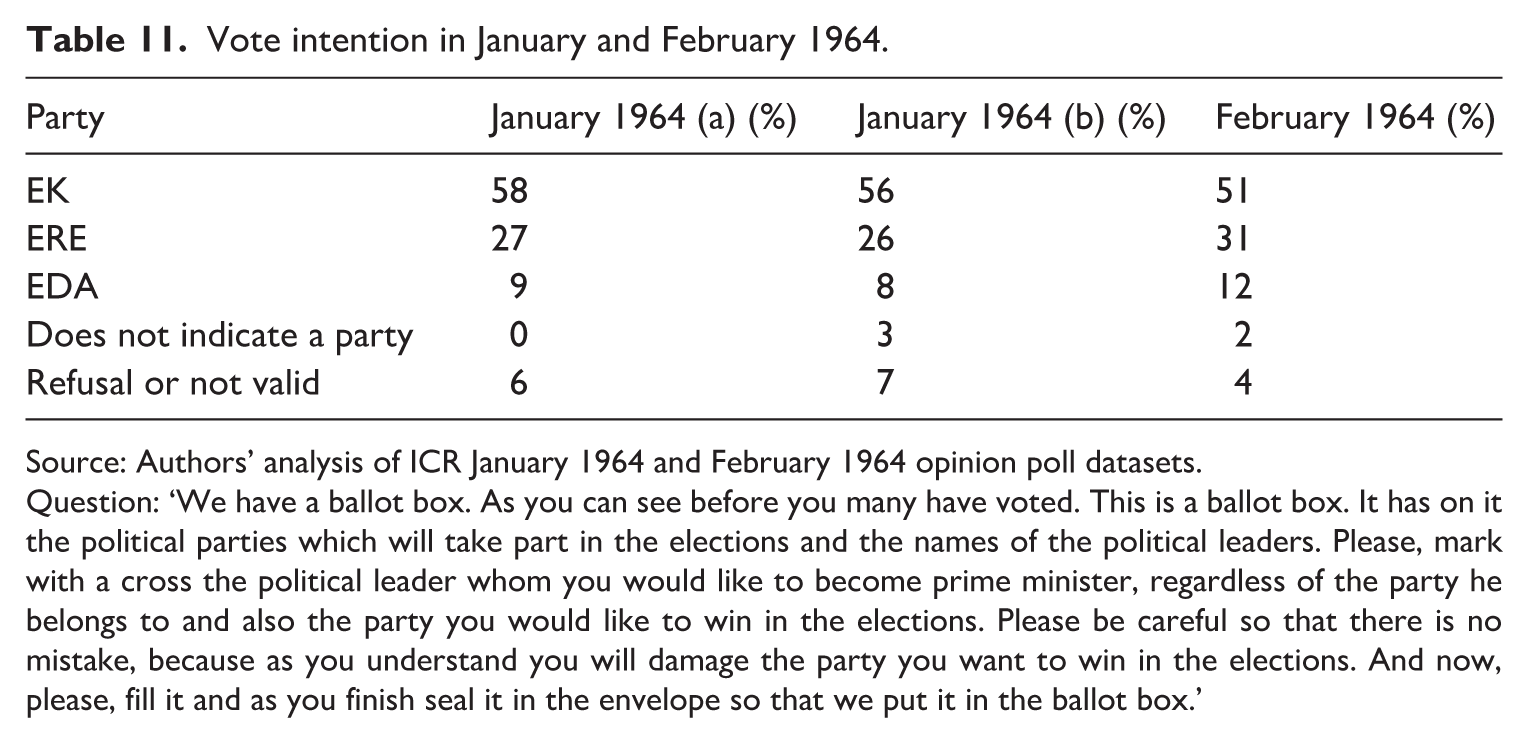
Table 11 shows a broadly similar distribution for vote intention for each poll, but with a decline for the EK and an increase for the ERE in the final poll. The EK’s share was 51%–58%, the ERE’s 26%–31% and the EDA’s 9%–12%. Reflecting the tripolar structure of party competition (Papadopoulos, 1989: 59), the dependent variable was a three-category measure. As the categories have no inherent ordering, multinomial logistic regression was the appropriate estimation technique. It estimates simultaneous pairwise comparisons: those supporting EK versus ERE and those backing EDA versus ERE. The omitted reference categories were aged 55 and older and nonmanual occupations.
Vote intention in January and February 1964.
Source: Authors’ analysis of ICR January 1964 and February 1964 opinion poll datasets.
Question: ‘We have a ballot box. As you can see before you many have voted. This is a ballot box. It has on it the political parties which will take part in the elections and the names of the political leaders. Please, mark with a cross the political leader whom you would like to become prime minister, regardless of the party he belongs to and also the party you would like to win in the elections. Please be careful so that there is no mistake, because as you understand you will damage the party you want to win in the elections. And now, please, fill it and as you finish seal it in the envelope so that we put it in the ballot box.’
Results and discussion
We model the results for each set of independent variables separately. The sociodemographic characteristics show a mixed set of results (Table 12). There were no statistically significant differences between men and women in supporting the EK or ERE and EDA or ERE, providing some evidence for the observation of ‘no discernible pattern’ for gender and voting in Greece (Kosmidis 2020: 402). There were no statistically significant differences in voting for the EK compared to the ERE based on age group. In terms of supporting the EDA rather than ERE, there were statistically significant differences between, on the one hand, those aged 35–44 and 45–54 and, on the other, those aged 55 and older, with the former groups more likely to support the left-wing party. There were statistically significant differences between socio-economic factors in terms of supporting the EK versus the ERE and the EDA versus the ERE. The group with higher than a primary education was less likely to have supported the EK, while those in manual occupations were more likely to have backed the EK. Individuals whose level of education was above primary level were less likely to have voted for the EDA compared to the ERE, but this was not the case for manual workers, though.
Multinomial logistic regression of vote intention at the February 1964 election: Sociodemographic group (including education and occupation).

Source: Authors’ analysis of merged data (ICR January–February 1964 opinion polls).
The reference category for the dependent variable is voting for the ERE. Omitted reference categories: Age group: 55 years and older; Nonmanual occupation.
p ⩽ 0.05. **p ⩽ 0.01. ***p ⩽ 0.001.
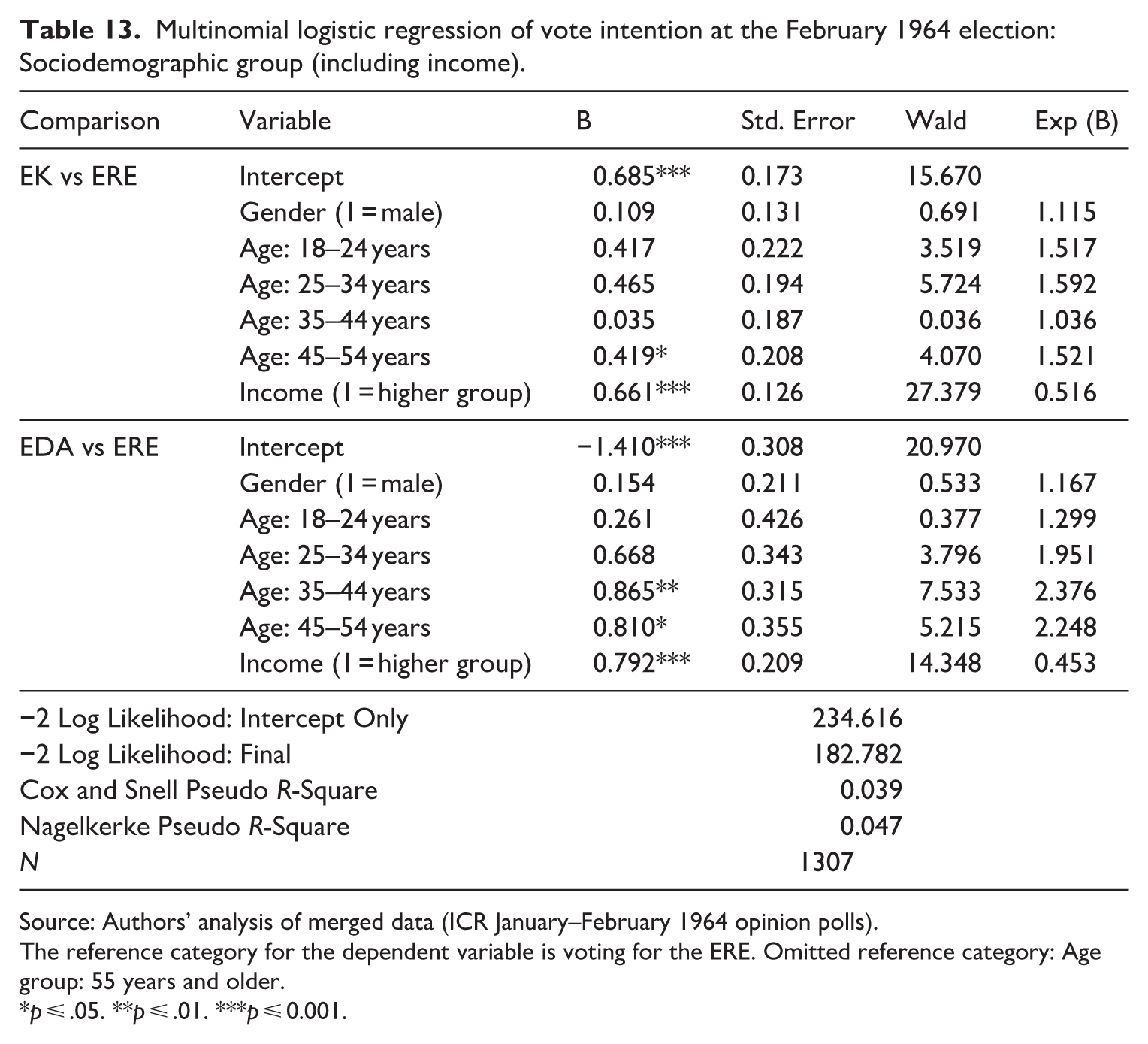
We also estimated a model with income (see Table 13), instead of education and occupation. Individuals in the higher-income group were less likely to have supported the EK than the ERE, further showing the socio-economic basis to the EK’s support (Table 12). This was also the case for the EDA, with those in the higher-income group less likely to support the left-wing party compared to the ERE. Taken together, these results show some socio-economic underpinnings to the basis of the EK’s support in 1964, providing some support for the argument of Nikolakopoulos (2021) regarding a greater alignment between social class and party preferences (p. 334). But class-based divisions were also constrained in affecting electoral support: there was no evidence, for instance, of a linkage between manual workers and voting for the EDA. This could reflect the encompassing coalition of voters that backed the EK at the 1964 election, including former EDA voters (Chadjipadelis and Andreadis, 2007: 103; Nikolakopoulos, 2021: 317). It could also be related to structural features of the Greek economy at the time. These include the limited size of the industrial sector, a very large agricultural sector and widespread public sector employment. In 1961, among those in employment, 53.8% worked in agriculture, 19.3% in industry and 24% in services, a distribution very similar to a decade earlier (Panagiotopoulou, 2004: 204).
Multinomial logistic regression of vote intention at the February 1964 election: Sociodemographic group (including income).
Source: Authors’ analysis of merged data (ICR January–February 1964 opinion polls).
The reference category for the dependent variable is voting for the ERE. Omitted reference category: Age group: 55 years and older.
p ⩽ .05. **p ⩽ .01. ***p ⩽ 0.001.
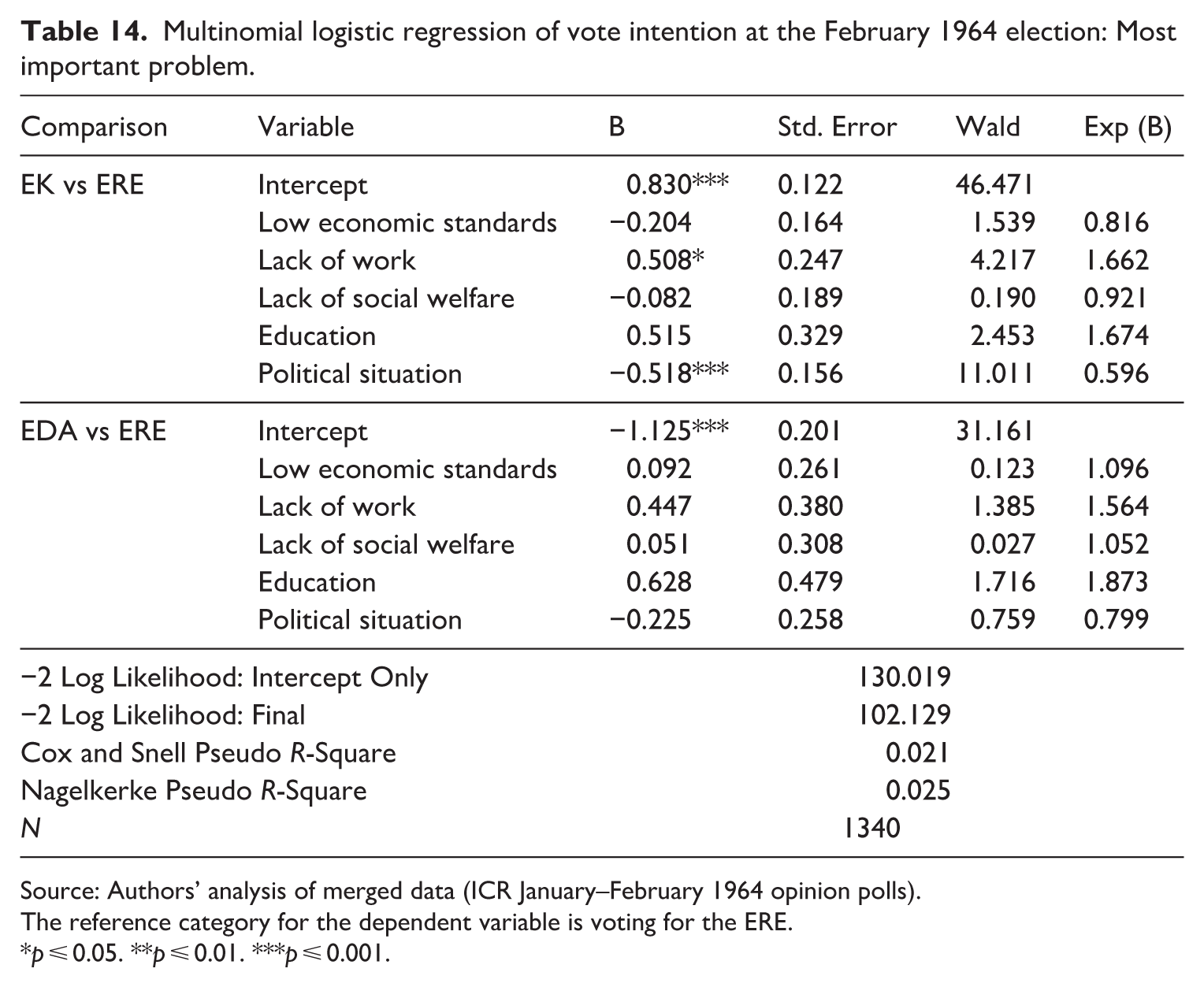
The measures of the most important problem only show associations with voting for the EK versus the ERE (Table 14). Thinking that the lack of work was one of the most important national problems increased the likelihood of supporting the EK. This may reflect the resonance of the EK’s strong campaigning on a fairer distribution of economic prosperity across society (Veremis, 1981: 86–87) and a higher standard of living for ordinary people (Carey and Carey, 1968: 184). This was a period when unemployment rates were higher among younger groups (Rafailidis, 2004: 174). This also links to Table 7, where being in a nonmanual occupation and having an education above primary level reduced the likelihood of concern about the lack of work; both groups were less likely to support the EK.
Multinomial logistic regression of vote intention at the February 1964 election: Most important problem.
Source: Authors’ analysis of merged data (ICR January–February 1964 opinion polls).
The reference category for the dependent variable is voting for the ERE.
p ⩽ 0.05. **p ⩽ 0.01. ***p ⩽ 0.001.
In contrast, being concerned about the political situation reduced the likelihood of supporting the EK. This may have been a particular concern for traditionally rightist voters worried about the prospects for social and political instability and the undermining of traditional institutions if the EK was elected with a majority in February 1964, being able to govern from a much stronger position. It may also have encapsulated fears about possible cooperation between the EK and EDA and the perceived threat of communist forces, which were seen as ‘antisystem’ (Mouzelis, 1978).
Newspaper readership variables perform strongly (Table 15), with meaningful associations with vote intention given the political affiliations of publications. Readers of titles affiliated to the political centre – the newspapers Vima and Ta Nea and the weekly magazine, Tachydromos – were more likely to have preferred the EK to the ERE, as well as the EDA compared to the ERE (but not readers of Vima). Reading newspapers with a right-wing affiliation – Acropolis, Kathemerini and Embros – reduced the probability of voting for the EK and the EDA relative to the ERE.
Multinomial logistic regression of vote intention at the February 1964 election: Readership.
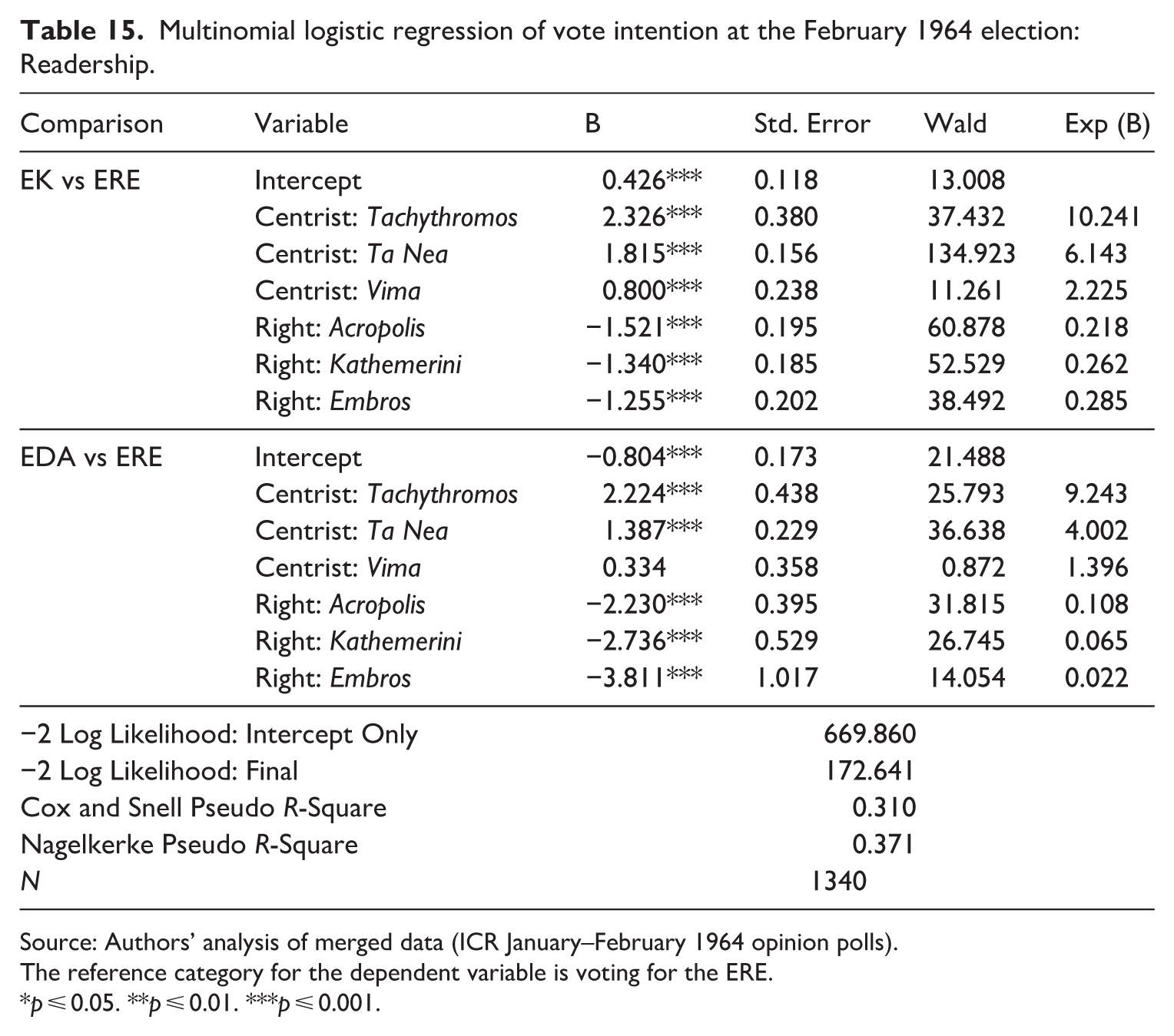
Source: Authors’ analysis of merged data (ICR January–February 1964 opinion polls).
The reference category for the dependent variable is voting for the ERE.
p ⩽ 0.05. **p ⩽ 0.01. ***p ⩽ 0.001.
There are two differing interpretations of these results. First, that readership had some independent impact on citizens’ voting preferences, given that newspapers were the predominant medium for political information in this period and were seen as representing social interests (Frangiskou, 2004: 280). Second, taking a more restrictive interpretation of newspapers’ role in the political process, they are generally limited to a partisan ‘reinforcing’ effect (Legg, 1969: 158). That is, readership acts more as a proxy for political affiliation, rather than having an independent impact on readers’ opinions. Of course, these linkages cannot be resolved with cross-sectional survey data.
The variables for economic perceptions vary markedly (see Table 16), but only in relation to voting for the EK versus the ERE. Those who thought that unemployment would get worse, stay the same, or were unsure, were less likely to have voted for the EK than the ERE compared to those with a positive assessment (thinking unemployment would decrease in the coming months). Those with pessimistic or unchanging assessments seemed to have preferred the ERE’s continuation in office and its record of economic management. Based on the personal situation concerning income and work, there were no statistically significant differences between those who estimated their situation to be either worse or the same and those who adjudged it to be better. Prospective sociotropic assessments of the macroeconomy were associated with the voting decision between the two largest parties, but not egotropic-retrospective perceptions. This provides evidence for a role for issue voting in general and for the specific link between economic perceptions and voting behaviour at elections during the ‘sickly democracy’ (Nikolakopoulos, 2021). There was a link between prospective sociotropic assessments and vote choice, though research on economic voting in Greece has shown the generally stronger role of retrospective-sociotropic evaluations (Nezi, 2012, 2023).
Multinomial logistic regression of vote intention at the February 1964 election: Economic perceptions.
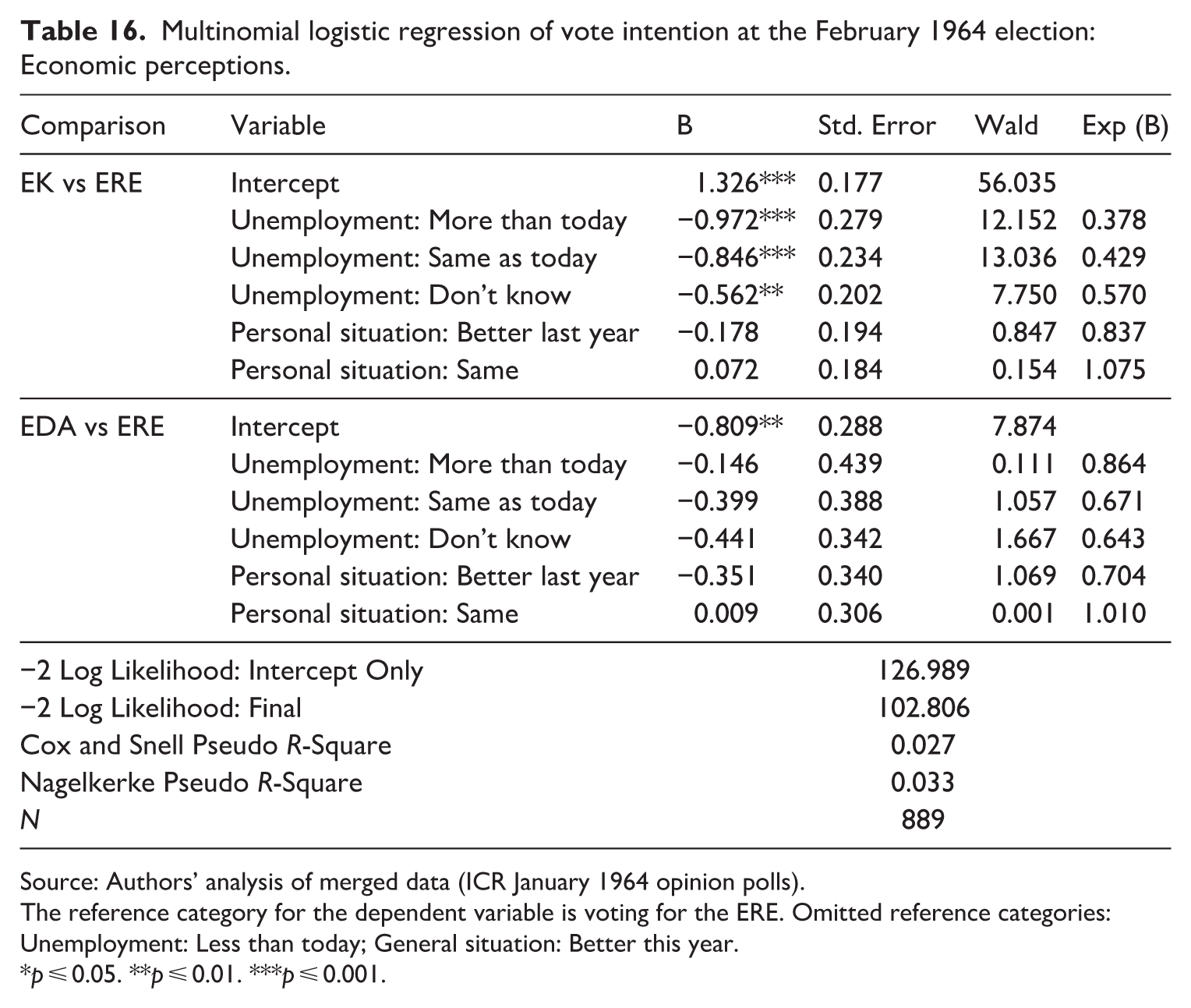
Source: Authors’ analysis of merged data (ICR January 1964 opinion polls).
The reference category for the dependent variable is voting for the ERE. Omitted reference categories: Unemployment: Less than today; General situation: Better this year.
p ⩽ 0.05. **p ⩽ 0.01. ***p ⩽ 0.001.
Conclusion
We have provided a new analysis of public opinion and vote choice in a constrained democracy at a critical moment during the 1963 and 1964 elections, when the EK ended right-wing dominance and offered a more liberal direction for Greek politics and society. During Greece’s ‘sickly democracy’ (Nikolakopoulos, 2021), when the system operated under substantive electoral and political constraints, our analyses showed the prominence of economic and social welfare concerns for the public, congruent with the campaigning focus and governing priorities of the EK. These concerns also formed part of the negative evaluations of the ERE’s time in office, the reasons for why the EK replaced it and the priorities for the latter to focus on. There was also evidence to show group prioritisation of particular issues, with those in manual occupations and with primary-level education more concerned about the lack of work. The salience of economic and social welfare concerns is noteworthy for three reasons. First, it occurred in the context of the ERE governments boasting of an economic miracle amid high growth rates (Tsoucalas, 1969: 139). We would expect, according to theories of ‘valence politics’, that citizens would reward strong economic performance. Second, in this constrained democracy, access to employment, education, resources and material security was politicised and linked to ideological loyalty and ‘national mindedness’. Third, appeals for more equal distribution of economic benefits and investment in social welfare were associated with policies of the left, seen as a proxy for Communist and antisystem forces and linked to criticisms of the capitalist system. These demands found expression in support for the EK’s platform of reform and modernisation. Until that time, economic preferences were formulated in a much more bounded political space with limited democratic choice, masked by the political polarisation between ERE and EDA due to the legacy of the ideological divisions of the Civil War and the Cold War context. It supports the argument of Close (2002) that the increasing contestation in ‘the 1960s on various aspects of the power structure were largely driven, therefore, by economic needs and anxieties’ (p. 104).
In the context of generally weak class-based alignments in Greece (Kosmidis, 2020), we also found socio-economic underpinnings for EK support and, to some extent, for the EDA. This provides support for arguments about the distinctive bases of support for the major parties (Moskos, 1971: 8; Nikolakopoulos, 2021: 311–312, 317, 324). The insights for issue voting suggest the influence of economic factors motivating support for the EK. The findings indicate the emergence of areas of change in Greek politics with longer-term impacts that speak to a changing public agenda and significant pent-up popular demands for improvement in socio-economic conditions. The salience of economic and welfare issues in this electoral context points to the weakening of the divisions since the Civil War (Nikolakopoulos, 2021: 277) and its replacement with a right versus antiright division, which structured Greek politics in subsequent decades (Kosmidis, 2020: 408).
More broadly, our findings contribute to scholarly research into the role of social cleavages, issue importance, economic voting and ideological affiliation, through newspaper readership, in cases of constrained democracy beyond the case of Greece. In such contexts, political realignments at elections can produce meaningful political change. Examining the link between voting behaviour, political constraints and the socio-economic context is essential not only for understanding alignments in Western Europe in the early Cold War context but also for understanding voting behaviour and the dynamics of political change in other cases of constrained democracy and reduced political choice.
Footnotes
Acknowledgements
The authors would like to thank the anonymous reviewers for their insightful comments.
Funding
The authors disclosed receipt of the following financial support for the research, authorship and/or publication of this article: The datasets from the Roper Centre for Public Opinion Research were obtained from funding provided by the School of History, Politics and International Relations’ Research Development Fund (awards of £2157.00 and £1364.40; University of Leicester) and the School of Government and International Affairs’ Research Committee (award of £2167.00; Durham University), for the project ‘The dynamics of political and electoral change in Greece, 1963-64: A new analysis of public opinion surveys’.
Declaration of conflicting interests
The authors declared no potential conflicts of interest with respect to the research, authorship and/or publication of this article.
Data availability statement
All of the datasets and user documentation (questionnaires and codebooks) used in this study are available from the ‘Institute for Communication and Research’ collection, held at the Roper Center for Public Opinion Research:  . The analyses and interpretations of the data are solely those of the authors.