




Abstract
Most African countries are experiencing a youth bulge, where a very large proportion of their populations are made up of young people. How might this affect political participation? To understand this, we conduct an age-period-cohort analysis for two forms of participation: voting and protesting. We find that age has an inverted U-shaped, curvilinear relationship with voting, while there is a negative cohort effect. Protesting becomes less likely with age, even holding period and cohort constant in a cross-classified random effects model, while there is no clear cohort effect. Subsequent predictions on simulated data indicate that the age and cohort effects work in tandem so that as the youth ratio increases, predicted voter turnout declines and protesting rises. This suggests that youth bulges may lead to a shift where political participation increasingly takes place outside of formal political structures.
Introduction
Sub-Saharan Africa is currently experiencing a youth bulge, that is, a very large proportion of young people in its population. Africa is already the youngest continent in the world, and by 2050 it is estimated that one-fifth of all the youth in the world will live in sub-Saharan Africa (ADF, 2022). The political effects of youth bulges are still the subject of debate. Numerous studies have linked youth bulges to political violence, civil conflict, political instability and democratic breakdown (Cincotta, 2008; Urdal, 2007; Weber, 2019), while others argue that they generate ‘dividends’ such as improved economic growth (Bloom et al., 2003; Hasan et al, 2019). Other political implications of youth bulges remain poorly understood.
This article asks how youth bulges might affect two key forms of political participation: voter turnout and attending protests (i.e. demonstrations). Political participation is key in the relationship between citizens and the state, affecting issues like representation, accountability, and regime stability. There is evidence that young people are less likely to vote and more likely to attend protests (Gallego, 2009; Schussman and Soule, 2005; Smets and van Ham, 2013), which implies that the African youth bulge should depress voter turnout and increase rates of protesting. To date, however, most of the existing research on how age affects political participation has been conducted on Western countries and their findings do not always apply to Africa (Kuenzi and Lambright, 2011). Equally importantly, merely identifying an association between age and either voting or protesting does not mean that age or life-cycle effects are responsible. The correlation might simply be the result of ‘period’ or ‘cohort’ effects, in which case changes to a country’s age structure may not affect these outcomes (Fosse and Winship, 2019). Distinguishing between these three effects is difficult, but crucial, since a priori we cannot assume that ‘people in a particular age stratum were like the younger age strata at an earlier period and will become like the older age strata as time passes’ (Nie et al., 1974: 321).
While an age effect refers to the sociological process of aging, commonly described as life cycle effects, cohort effects reflect that a given cohort may differ from previous or later cohorts due to, for example, cultural change or key events during a particular cohort’s formative years. Period effects, on the other hand, ‘represent variation over time periods that affect all age groups simultaneously – often resulting from shifts in social, cultural, or physical environments’ (Yang and Land, 2008: 298).
To properly distinguish between these three types of effects, we disaggregate the correlation between individuals’ age and both voting and protesting into age, period and cohort effects (APC) using a cross-classified random effects model (CCREM) on Afrobarometer data from 39 African countries (Yang and Land, 2006, 2008) To our knowledge, this is the first time that an APC analysis has been conducted on voting or protesting in Africa. The results indicate that there is an age effect on both voting and protesting, as well as a strong negative cohort effect on voting: more recent cohorts are less likely to vote. In contrast, we do not find any clear cohort effects for protest behaviour. The results hold across a range of different subsample analyses. Subsequent predictions on simulated data indicate that, as the youth ratio rises, the age and cohort effects work in concert to depress voter turnout and push up rates of protest attendance. The African youth bulge therefore seems likely to have a clear impact on participation rates, with potentially profound political implications.
Youth and Political Participation
Africa is home to some of the most youthful societies in the world, which is the result of rapid improvements in health and reductions in infant mortality combined with consistently high fertility (Goldstone, 2012; Omoju and Abraham, 2014). The political consequences of these youth bulges are still the subject of debate. It has long been known that youth, particularly young men, are overrepresented in revolutions and violent conflicts (Goldstone, 2012) and large youth cohorts have been linked to civil wars (Yair and Miodownik, 2016), low-intensity conflicts (Flückiger and Ludwig, 2018) and other forms of political violence (Urdal, 2006; Weber, 2019), and democratic breakdown (Cincotta, 2008; Weber, 2013). Unemployment and lack of education are key drivers of these associations (Barakat and Urdal, 2009). This view has become known as the ‘instability thesis’ (Sommers, 2011). Youth may also drive nonviolent resistance campaigns because of the mobilizing potential they represent (Chenoweth and Ulfelder, 2017). On the other hand, other scholars have noted that youth bulges may offer a ‘demographic dividend’ which reduces the dependency ratio and generates economic growth (Bloom et al., 2003; Omoju and Abraham, 2014). This demographic dividend is contingent upon human capital investment and educational attainment. Given that economic growth is believed to foster democracy and tolerance (Diamond, 1992; Lipset, 1959) youth bulges could potentially also lead to greater political stability or strengthen democratization processes.
Other potential political implications of youth bulges, including individual level effects, remain understudied. More generally, we lack a good understanding of age effects outside Western democracies. A priori we cannot know how well the established literature on age and political participation travels to other contexts with different political institutions and political culture, as well as a different demographic structure. In the following we review the existing literature on age and political participation and discuss how these theories may play out in the context of the African youth bulge.
Age and Participation
As a starting point to understand how age may influence political participation in the context of the ongoing youth bulge in sub-Saharan Africa, we take two widely influential models of political action: the civic voluntarism or resource model (Brady et al., 1995; Verba et al., 1995) and the life cycle (Jennings, 1979; Nie et al., 1974) or socialization model (Grasso et al., 2019). The resource model of political participation proposes that, provided that an individual is motivated to participate, the way (s)he chooses to participate depends on available resources, since different forms of political participation requires different (combinations of) resources, namely, time, money and civic skills. These resources, in turn, are not equally distributed across different age groups: Available time typically depends on family situation (e.g. having small children at home or not) and employment status (e.g. full-time or part-time job), while available money depends on type of job as well as seniority. Civic skills, in turn, are developed through formal education, but also membership in churches, trade unions or other types of organizations that may lead to a greater sense of political efficacy or to the acquiring of organizational or communicational capacities that can be transferred to political participation (Verba et al., 1995).
The life cycle model, on the other hand, suggests that movements through different stages in the life cycle, that is, a sociological aging (which typically happen with in tandem with increasing age in years), lead people of different age to participate in different ways and at different rates (Jennings, 1979; Nie et al., 1974). Sociological aging through the life cycle includes early life socialization and education, followed by roles of greater responsibility in adult life, whether through employment or family obligations, and subsequently, a gradual physical debilitation.
The resource and life cycle models are not mutually exclusive, as both consider motivation to act as well as barriers or opportunities at the individual level. Compared to other age groups, young people tend to have less money but fewer obligations, and as levels of education are going up across the globe, young people are overall at least as well educated as earlier generations. This means that youth should have the necessary resources to participate in more time-intensive activities such as protests. This is also consistent with research on contentious politics and political violence, which highlights that the opportunity cost (i.e. foregone income) of such activities is generally lower for young people (Urdal, 2006), who also tend to accept more risk – perhaps due to fewer social obligations (Wiltfang and McAdam, 1991). In line with this, several studies find that protesting decreases with age. Petrie (2004), Schussman and Soule (2005) and Stockemer (2014) found that higher age is linked to lower rates of protest attendance, and Tambe and Kopacheva (2024) reported that this is also the case in Africa, although Gordon et al. (2019) found that that age was positively associated with attendance at political gatherings in South Africa.
Voting is often seen as conceptually different from other forms of political participation, with different determinants (Blais, 2006). Voting typically takes place at regular intervals that are pre-determined by the state, as opposed to political actions that can be citizen-initiated and add up to different volumes of activity (Verba et al., 1995: 46). Moreover, many societies have strong norms of voting as a civic duty (Karp and Brockington, 2005). According to the civic voluntarism model, the only resource it requires is time (Verba et al., 1995), which, as argued above, should be widely available also to young people. Yet, most research finds that youth vote at lower rates than adults. From a life-cycle perspective, this can be attributed to ‘startup’ problems: ‘Young people do not have a stable basis for concern with politics. Such a basis comes with extended residence in a locality, full involvement in the work force, marriage, and a family’ (Nie et al., 1974: 333). Consistent with this, a large literature sees voting as a product of socialization, whether as a set of stable values or attitudes that lead to repeated voting, or, alternatively, that the very act of voting in itself is habit forming and remains stable throughout the life cycle (e.g. Coppock and Green, 2016; Dinas, 2012). Consistent with both these explanation, Wolfinger and Rosenstone (1980) reported that age voting exhibit a curvilinear relationship: voting becomes more likely with age up to a certain point – roughly around 60 or 70 years of age – and then declines slightly. Evidence for a curvilinear relationship has been found in numerous other studies (Bhatti et al., 2012; Gallego, 2009) and it also appears to hold true in Africa (Kuenzi and Lambright, 2011; Resnick and Casale, 2014; Tambe and Kopacheva, 2024). However, several of these earlier studies fail to disentangle properly between age, period, and cohort effects.
Early life socialization is also a common explanation for changing patterns of participation across generations, which would manifest themselves as cohort effects (Yang and Land, 2008). As new generations are coming of age in distinct economic, social and political contexts, differing experiences in people’s formative years will lead to enduring political orientations across cohorts and manifest themselves as generational change in patterns of participation (Neundorf and Smets, 2017). In line with this, Grasso et al. (2019) find that in the UK, the political climate in which different generations experienced their formative years (e.g. during the Cold War, during the global protests of 1968, and during the rise of the New Right associated with former prime minister Margaret Thatcher) have a clear impact on political participation.
Age and Participation in Africa
Assuming like Kuenzi and Lambright (2011), that African citizens like citizens in Western countries, engage in a rational cost-benefit analysis of whether and how to participate, we expect the input to this analysis to differ somewhat. First, the very ideas of youth and ageing may differ and be more closely tied to social roles and interactions (Schwartz, 2010). In many African countries, adulthood is synonymous with getting married and supporting a family, and an unmarried 40-year-old can still be considered a ‘youth’ (Agbiboa, 2015). High levels of youth unemployment may lead to what Honwana (2014) coins ‘waithood’, that is, a state where the transition to childhood to adulthood becomes stalled as young people are unable to reach the next stage of the life cycle because they continue to depend on others. This suggests that the life cycle process or sociological aging may work differently in many African countries, so that the sense of responsibility associated with adulthood may be delayed. While economic resources among the youth should be relatively scarce, time should be more abundant. On the other hand, the expected return from participating and especially voting may be low, given that youth remain severely underrepresented in politics (Stockemer and Sundström, 2025). At the same time, the same underrepresentation and exclusion could also increase the motivation to participate in order to create change, perhaps particularly through protesting and other forms of unconventional participation (Ismail and Olonisakin, 2021). This would be consistent with grievance-based explanations of contentious politics (Hillesund et al., 2018).
The political context must also be taken into account. Due to the empirical focus on mature democracies in the literature, aggregate factors remain undertheorized. African elections ‘differ considerably from those in the advanced industrial democracies’ because of neopatrimonialism, clientelism and the influence of local leaders (Kuenzi and Lambright, 2011), so Western findings may not apply to Africa. If we return to the idea of the formative years as people are coming of age (Neundorf and Smets, 2017), key political events should be particularly important for the political socialization of different cohorts. Young people played a key role in the decolonization movements which swept through Africa from the late 1950s and throughout the 1960s, as well as in the democratic transition that took place in many countries in the 1990s (Branch and Mampilly, 2015). It is likely that these events may have left a lasting imprint on the generations of youth that lived through these changes, so that they would have higher levels of political efficacy (Balch, 1974; Finkel, 1985) and a greater propensity to participate – both in protests, because they have experienced that protests can make a difference, and in voting due to stronger civic norms and support for the democratic institutions. Cohorts coming of age after such historical moments, in contrast, could instead be prone to disenchantment (O’Donnell and Schmitter, 1986) or a post-honeymoon effect (Inglehart and Catterberg, 2002), if they see that, despite large political changes, their daily lives may not necessarily improve (Gerring et al., 2005).
In sum, there are several reasons to believe that the relationship between age and different forms of political participation may look different in Africa than in mature, industrialized Western democracies. However, given the ongoing youth bulge, this relationship is particularly important to understand.
Do Youth Bulges Affect Voting or Protesting?
No previous study has ever tested whether youth bulges specifically affect rates of voting or protesting, although Hart et al. (2004) found that youth bulges in the United States were linked to lower civic knowledge and volunteering, while Nkansah and Papp (2023) report that larger youth cohorts are associated with a lower likelihood of young people voting – seemingly reflecting peer influence. But they did not test whether this had any impact on aggregate-level turnout, which leaves open the possibility that the turnout decline among young people could be offset by an increase among older groups. Based on the review above, we would suspect that a youth bulge will alter rates of voting and protesting. If young people tend to vote less and protest more, a higher proportion of young people in the population ought to entail higher aggregate protesting rates and lower aggregate voting rates. But this would be too hasty. Merely identifying a link between age and political participation is not sufficient to make inferences about the likely impact of a youth bulge. A correlation between age and either voting or protesting could arise because of the ageing process itself, time-specific shocks to the population’s voting or protesting rates, or a process of cohort replacement. These are known as ‘age’, ‘period’ and ‘cohort’ effects, respectively (Fosse and Winship, 2019) and their implications for youth bulges are likely to be quite different. For instance, suppose that the correlation between age and protesting was due to gradual decreases in protest attendance throughout one’s lifetime (i.e. an ‘age effect’). In this case a youth bulge should push up rates of protesting as high-protesting young people come to make up a larger share of the population. On the other hand, suppose the correlation was entirely the result of some event in the past which reduced the protest rates of the now-elderly members of the population (a period effect). In this case, the incoming youths would protest at similar rates to those slightly older than them, so a youth bulge itself should not generate a large increase in aggregate protest rates.
Without distinguishing between age, period and cohort effects (hereafter ‘APC’) it is therefore difficult to understand whether a youth bulge will actually affect rates of voting or protesting. Tambe and Kopacheva’s (2024) analysis illustrates this limitation well. They found that higher age was associated with lower rates of protest attendance in Africa, but did not conduct an APC analysis. This raises the possibility that the trend they identified could have arisen because elderly people experienced a ‘period effect’ several decades earlier which pushed down their protest rates, or perhaps a ‘cohort effect’ where a specific older generation was socialized to avoid attending protests. 1 But, for reasons explained in the preceding paragraph, it is primarily an ‘age effect’ – when changes to voting and protesting are a result of the ageing process itself–which implies that the emergence of a youth bulge will affect rates of voting and protesting. A cohort effect should also have an impact as long as it is a ‘monotonic’ cohort effect where rates of voting or protesting exhibit a clear trend over subsequent cohorts. Since during a youth bulge more recent cohorts will also be larger, these larger cohorts will exert a much greater influence than previous cohorts, and so the monotonic trend will either push up or push down aggregate rates of voting or protesting. Illustrations of these age and cohort effects are shown in Figure 1. Conversely, if the correlation were merely due to period effects or non-monotonic cohort effects – that is, one-off quirks of how particular generations were socialized – it becomes much less likely that a youth bulge will affect rates of voting and protesting.
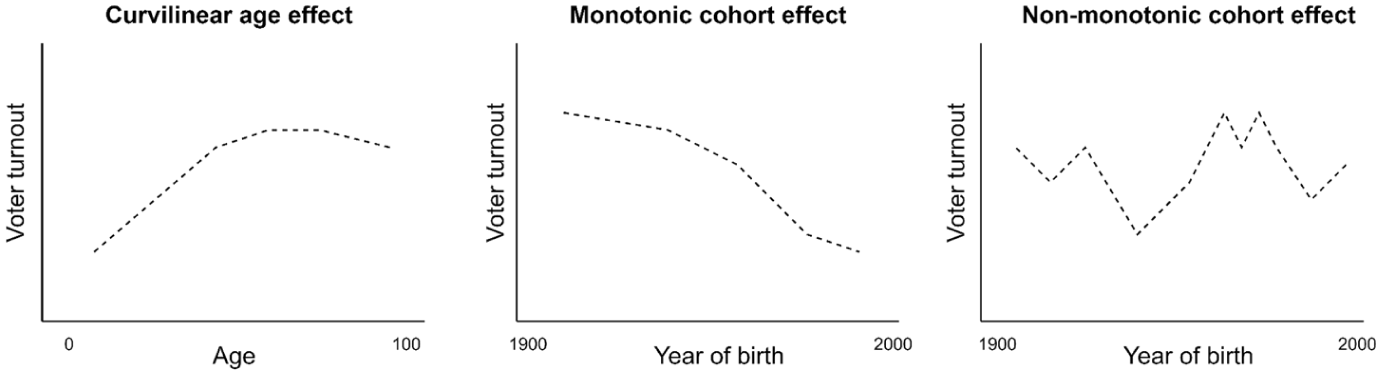
Examples of possible age and cohort effects on voting.
There is already some research which has examined how APC affects voting and protesting. Evidence from Western countries consistently shows that young people are less likely to vote because of cohort effects (Gallego, 2009; Rubenson et al., 2004). For protesting, Caren et al. (2011) found clear evidence for both period and cohort effects: protest rates peaked among 1950s and 1980s birth cohorts, and protesting also became more common over time across all cohorts. Grasso (2014) found a curvilinear cohort effect on protesting in Europe where it became more common up until the mid-1950s birth years, after which it declined slightly. Age effects have also been found to impact political participation (Jennings, 1979) although Grasso (2014) and Grasso et al. (2019) failed to find any age effect upon protesting. However, no APC study has ever been conducted for voting or protesting in Africa. As our review and discussion in the previous section makes clear, there are reasons to believe that age effects could work differently in Africa compared to the advanced industrialized democracies where the dominant theories have been developed, so it is desirable to undertake an APC analysis of voting and protesting in Africa specifically. Moreover, as argued earlier, the ongoing youth bulge makes it particularly important to understand the relationship between demographic structure and participation in this region.
This article proceeds in two stages. First, we conduct the first-ever APC analysis of voting and protesting in Africa. Are these outcomes correlated with age because of an age effect, or merely period or cohort effects? Second, we use those results to generate predictions about how youth bulges should affect aggregate-level voting and protesting. By generating simulated data and applying the APC effects from the first stage, we can predict how rates of voting and protesting change as the age structure changes. The article therefore makes two main contributions. It is the first study to examine systematically how age structure may affect voter turnout and protest attendance in Africa and to predict how the youth bulge will continue to shape patterns of participation in the future. The article also contributes to our understanding of age and political participation more generally by moving beyond advanced industrial democracies.
Identifying Age-Period-Cohort Trends
Data and Methodology
APC effects are by definition difficult to study because there is a linear dependence where age = period – cohort. If two of these are known, then the third can be calculated perfectly. This means that regression models fail to run because the three variables are collinear (Clark and Eisenstein, 2013; Fosse and Winship, 2019; O’Brien, 2017). There are some different methods which have been proposed to deal with this issue. Mason et al. (1973) suggest constraining two different ages, cohorts or periods to have the same effect which causes the linear dependence to be broken. This is known as the ‘equality constraints’ method (Fosse and Winship, 2019). Implementing this method means including dummy variables for each individual APC group, subject to the constraint that at least two of these have equal effects. However, Clark and Eisenstein (2013) note that there are rarely good a priori reasons for selecting any two ages, periods or cohorts to constrain, which somewhat undermines the suggestion of Mason et al. (1973) that the choice of constraints should be guided by strong theoretical assumptions. Indeed, Fosse and Winship (2019: 476) argue that ‘in practice researchers have used such constraints in arbitrary and often atheoretical ways’, even though this approach has been very popular in public health and social science research. The resulting estimates are sensitive to the choice of constraints, which are in many ways arbitrary.
To avoid these issues, we use a more modern approach developed by Yang and Land (2006, 2008) This is usually known as the CCREM (cross-classified random effects model), or occasionally the HAPC (hierarchical age-period-cohort model). It is a multilevel model where individual-level age effects are assumed to be nested within aggregate-level period and cohort effects. Because there is no exact nesting of periods into cohorts, individuals are ‘cross-classified’ into both periods and cohorts (Bell and Jones, 2014). If the data is repeated cross-sectional, like in this article, each respondent is observed in only one period and one cohort, and so period and cohort are treated as random effects at the higher level in which individuals are nested. Unlike the equality constraints approach, the CCREM does not require the analyst to select any coefficient constraints–instead, the multilevel structure of the data allows the collinearity of the APC effects to be broken so the model can run. 2 CCREMs have already been successfully employed to analyse political participation (Smets and Neundorf, 2014), as well as electoral volatility (Dassonneville, 2013), obesity (Reither et al., 2009) and alcohol consumption (Livingston et al., 2016). The random period effect means that the composition of countries in the sample does not need to be the same across the different survey rounds.
Afrobarometer data are used for the analysis. Protest data are available in all 8 Afrobarometer rounds spanning 1999 to 2021, while voting data are available in all rounds except Round 2. The complete dataset with all waves includes over 298,371 total respondents from 39 countries in Africa spanning 22 years. Both outcome variables are re-coded as binary. For protesting, we use the Afrobarometer item asking whether the respondent has participated in a demonstration or protest march in the past year. The values ‘No, would never do this’, and ‘No, but would do if had the chance’ are re-coded to 0, while ‘Yes, once or twice’, ‘Yes, several times’ and ‘Yes, often’ are re-coded as 1. For voting, we use the item which asks respondents whether they voted in the most recent national election. The value ‘You voted in the elections’ is coded as 1, while values indicating any kind of conscious choice not to vote (e.g. ‘Decided not to vote’, ‘Did not have time to vote’) are coded as 0. ‘Too young to vote’ is coded as missing. For both variables, ‘Don’t know’ and ‘Refused’ answers are treated as missing. Afrobarometer also includes the respondent’s age at the time of surveying as well as the year (i.e. period) when the survey was undertaken, which allows us to derive their year of birth (i.e. cohort).
We code age into six groups: 18–24, 25–34, 35–44, 45–54, 55–64 and 65+. 3 Treating age as a set of dummy variables relaxes the assumption of a linear association between age and participation and allows us to estimate and compare separate coefficients for different age groups. The median age in the sample is 34 years, so even if the first interval is shorter than the other intervals, N is still larger for the youngest age group than for most of the older age groups. Like, for example, Grasso (2014) and Grasso et al. (2019), we create 10-year cohorts which correspond to the birth years 1890–1919, 1920–1929, 1930–1939, 1940–1949, 1950–1959, 1960–1969, 1970–1979, 1980–1989, 1990–1999 and 2000–2009.
There are eight period groups which correspond to waves 1 through 8 of the Afrobarometer survey. While some APC studies have been able to use larger numbers of survey periods (e.g. Robinson and Jackson, 2001), this is by no means a requirement and previous studies of APC effects on political participation have used as few as four survey waves (e.g. Grasso, 2014).
Because the goal of an APC analysis is to produce unbiased estimates of the three effects, rather than to make inferences about why they occur, we follow other APC studies such as Clark and Eisenstein (2013) by not using control variables in the APC analysis. While some previous APC analyses do employ individual-level control variables, including controls in APC models can be problematic because they can obscure the APC effects. Indeed, there is a growing awareness in the literature that many control variables may act as ‘bad controls’ (e.g. Cinelli et al., 2024; Dworschak, 2023). For instance, an age effect might exist precisely because people’s income increases as they age. So, if the age term becomes insignificant after controlling for income, this doesn’t mean the age effect does not exist–it might simply be that the effect of age is mediated by systematic income differences across different age groups. In our view, it is crucial to understand in what ways age structure may affect participation (i.e. age, period and cohort effects) before seeking to identifying potential mediators of such effects (e.g. values, resources, political knowledge or media exposure). We also use country fixed effects in some models to account for any unobserved country-level factors which might be correlated with the relationship between age and participation. Descriptive statistics are presented in Appendix A.
To assess the robustness of our findings and provide some more nuanced results, we complement the main analysis with a series of additional analyses, where we compare subsets of countries classified by region, regime type, and time of independence. First, we classified countries into five geographic regions using the United Nations Geoscheme for Africa (East, West, North, South and Central Africa). To measure regime type, we follow Lührmann et al.’s (2018) classification based on V-Dem (Coppedge et al., n.d.) to distinguish between closed autocracies, electoral autocracies, electoral democracies, and liberal democracies. This allows us to assess whether the relationship between age and participation is moderated by level of democracy. Finally, to probe the importance of key political events for different cohorts’ participation rates and particularly for cohorts coming of age as their country became independent, we group the countries in our sample by year of independence (Birmingham, 2008), distinguishing between early independence (prior to 1960; 10 countries), main wave (1960–1963; 24 countries), main wave, late (1964–1968; 8 countries), late (1974–1977; 8 countries), and very late (1980–2011; 4 countries). While we report the results for all five categories, our comparison centres on two groups of countries whose citizens experienced independence at clearly different 4-year time windows, that is, 1960–1963 (main wave) and 1974–1977 (late independence).
Descriptive APC Results
Before proceeding with the CCREM results we analyse APC effects in isolation. This allows us to get a sense of how voting and protesting vary according to APC, although it does not allow the other two effects to be held constant at the same time. The first step in this analysis is to examine trends across survey waves and age groups. 4 Turning first to voting, displayed in the top panel of Figure 2, it appears to increase with age within every Afrobarometer wave. There is also evidence that it has a curvilinear relationship as described in previous research by Wolfinger and Rosenstone (1980), Gallego (2009) and Tambe and Kopacheva (2024). In most survey waves, voting tends to increase as we move from younger to older age groups, but the magnitude of the jumps gets smaller and smaller with age, and when we move from the 55–64 to the 65+ group, it barely increases at all and sometimes even decreases. This appears to be a curvilinear trend.
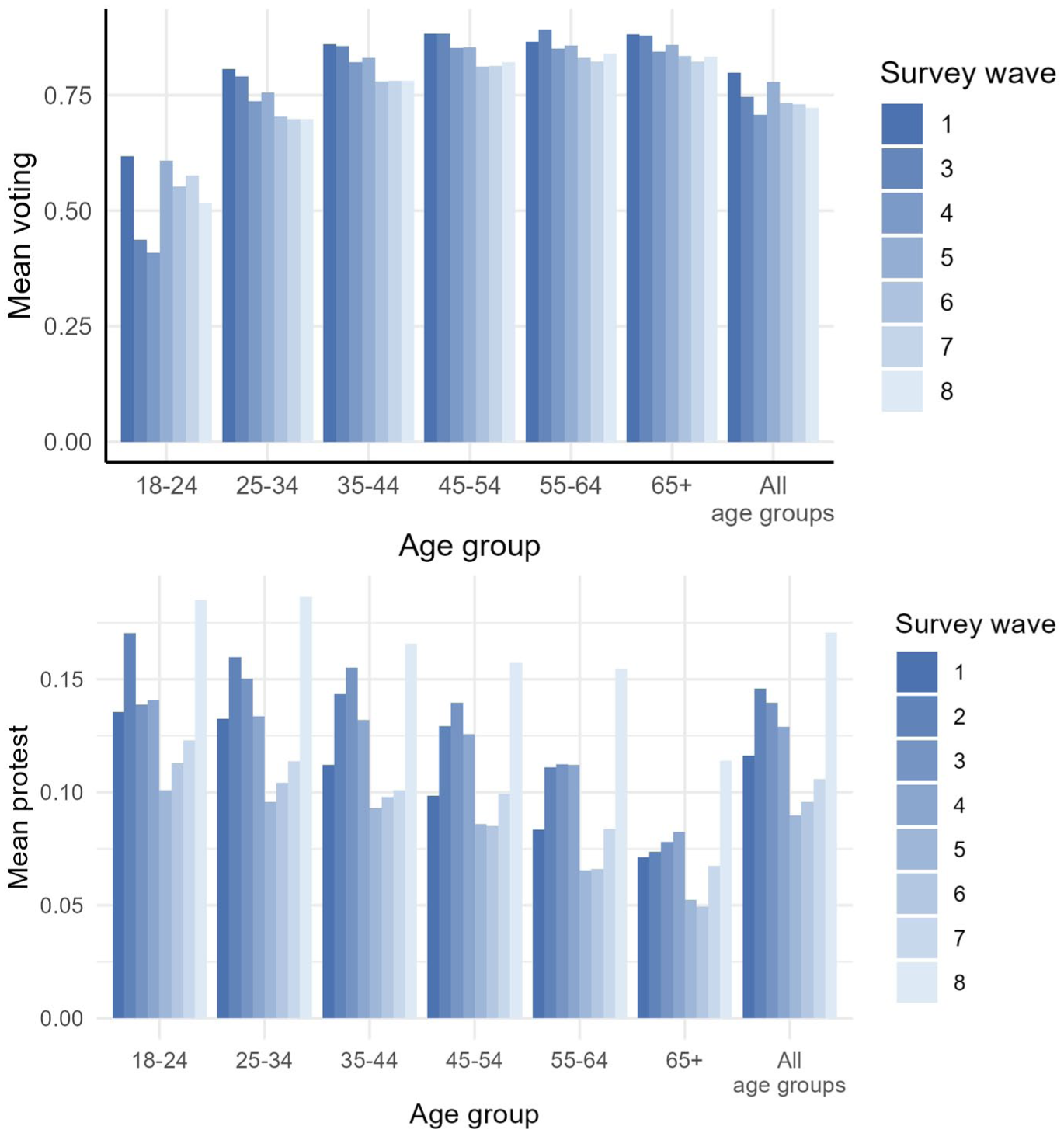
Mean levels of voting and protest by age and Afrobarometer wave.
Because Figure 2 does not allow cohort effects to be identified, we cannot yet be sure if the age effect is genuine or whether it arises from more recent cohorts, rather than younger people, displaying lower levels of voting or higher levels of protesting. 5 The top panel of Figure 2 also appears to indicate a declining trend in voting rates over time as the youth bulge develops. This is again consistent with the expected results of a youth bulge described in section ‘Youth and Political Participation’. Turning to protesting, which is displayed in the bottom panel of Figure 2, there seems to be clear evidence for an age effect. Within each Afrobarometer wave, mean levels of protest attendance seem to decrease as one moves from younger to older age groups. This is consistent with Tambe and Kopacheva (2024). There is also some tentative evidence that protest rates are changing over time: the rate of protest attendance is much higher in Wave 8 (0.171) than Wave 1 (0.117), although the trend is not monotonic.
While we cannot determine cohort trends by looking at Figure 2, these can be visually identified by looking at Figure 3, which displays mean levels of voting and protesting for different age groups depending on their birth cohort.
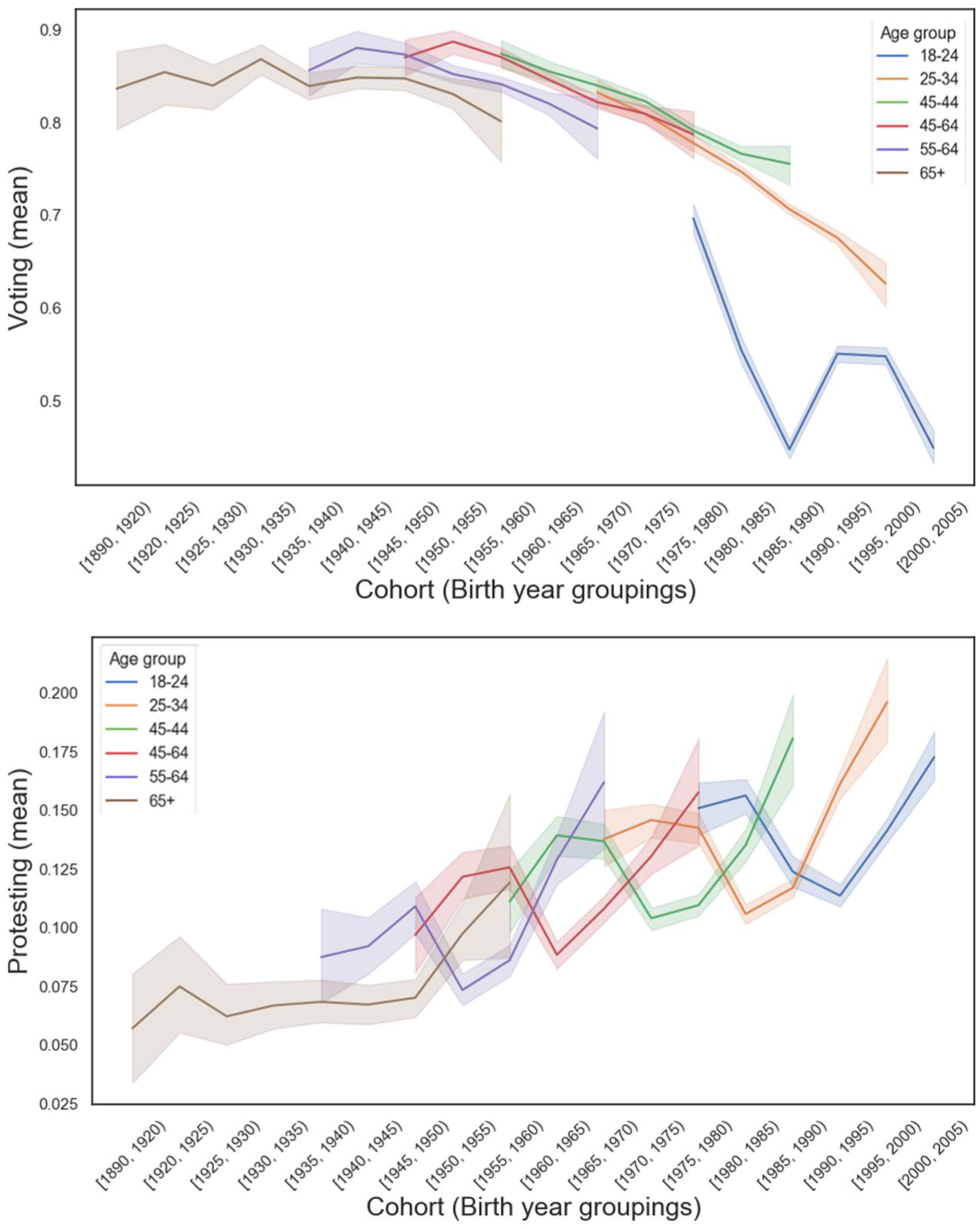
Voting and protest rates by birth cohort.
The top panel of Figure 3 shows mean levels of protesting and provides clear evidence of a cohort effect: more recent cohorts are less likely to vote regardless of age group, and the cohort trend is mostly (although not always) monotonic within each age group. The opposite is true for protest, with more recent cohorts appear more likely to protest, although the trend is non-monotonic.
There is also some indication of period effects (Figure 4). For voting, there is little indication of period effects, with voting rates staying mostly stable from 1999 to 2021, although some minor dips and troughs do exist throughout this timespan. Also visible in Figure 4 is a pronounced age effect: for all periods, 18- to 24-year-olds are far less likely to vote than other age groups. Since respondents who reported that they were too young to vote in the last election were removed from the dataset, the presence of young people who are ineligible to vote does not explain the low voting rates in this age group. For protesting, we can see a large spike in protest participation in all age groups except for 18–24 on surveys conducted around 2007. It is not immediately clear why this would be the case, and the effect is present in almost all age groups. Protest rates rise again during the late 2010s.
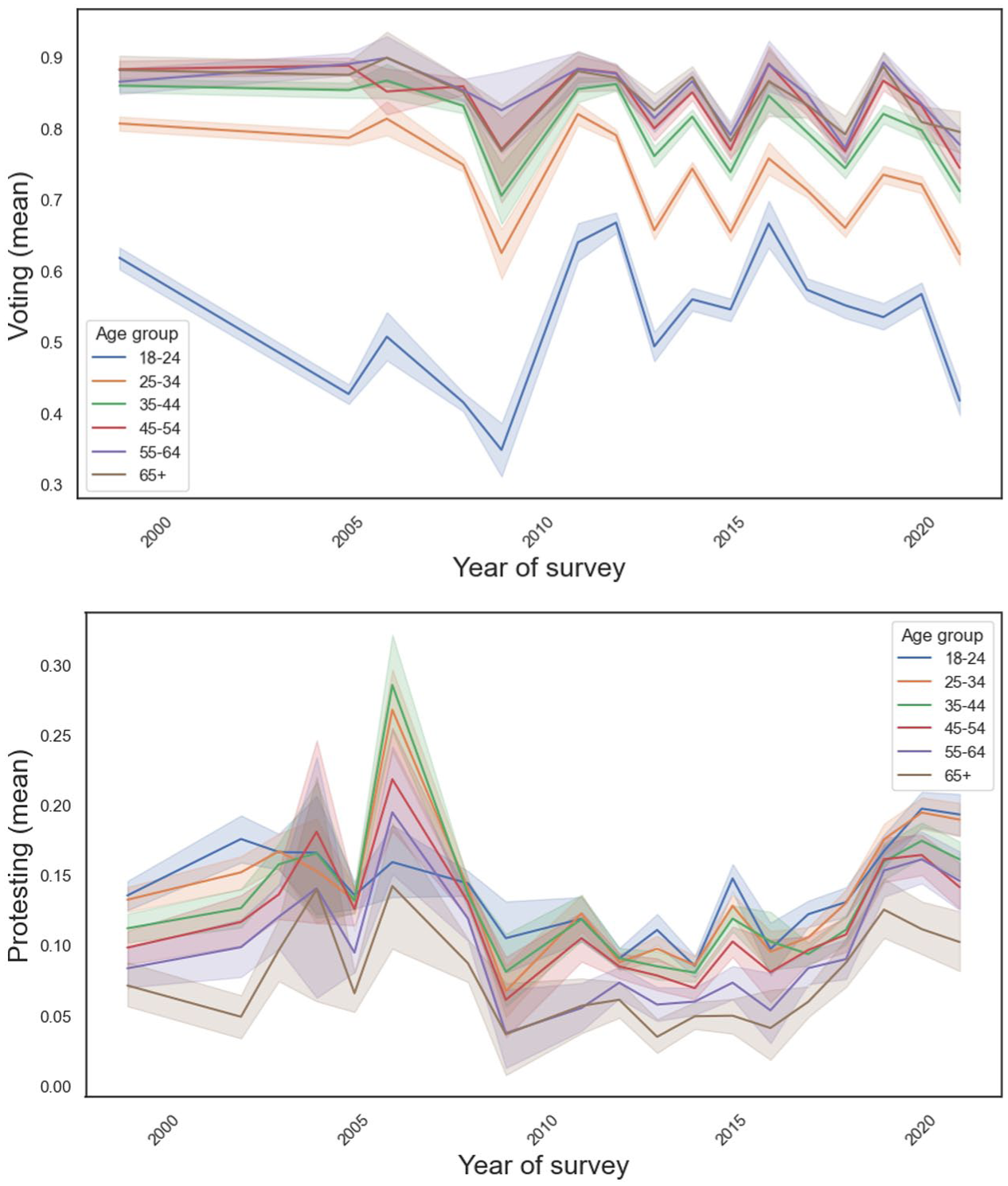
Voting and protest rates by period.
CCREM Results
Since the results in section ‘Descriptive APC Results’ do not allow each APC effect to be examined while holding the other two effects constant, it remains possible that, for example, the age effect in Figure 2 is merely due to more recent cohorts being more likely to protest (which does appear to be the case in Figure 3). To test whether the age effect is genuine we need to hold period and cohort constant. We do that in this section by running CCREMs where, as mentioned above, period and cohort are treated as level 2 random effects in which individuals (each with a particular age) are nested. For ease of interpretation, the results are displayed visually. 6
Starting with age, Figure 5 shows clear evidence of an age effect on political participation. This is as expected based on the literature as well as the descriptive results in the previous section. For voting, there is a significant age effect, and it appears to be curvilinear as expected. People in the 25–34 age group are more than twice as likely to vote than the 18–24 reference group. This increases even further in the 35–44 age group. In older groups, the likelihood of voting diminishes somewhat, with the 65+ group only 26.2% more likely to vote than the 18–24 reference group. This indicates a positive but curvilinear age effect and is therefore consistent with Tambe and Kopacheva (2024), Gallego (2009) and Bhatti et al. (2012) although it is slightly surprising that the ‘peak’ age for voting is only 35–44. However, in substantial terms the difference between the 35–44 age group and the 45–54 age group is negligible, and the real decline does not start until after the 45–54 age group and is more pronounced in the 65+ age group. We return to this in the Discussion.
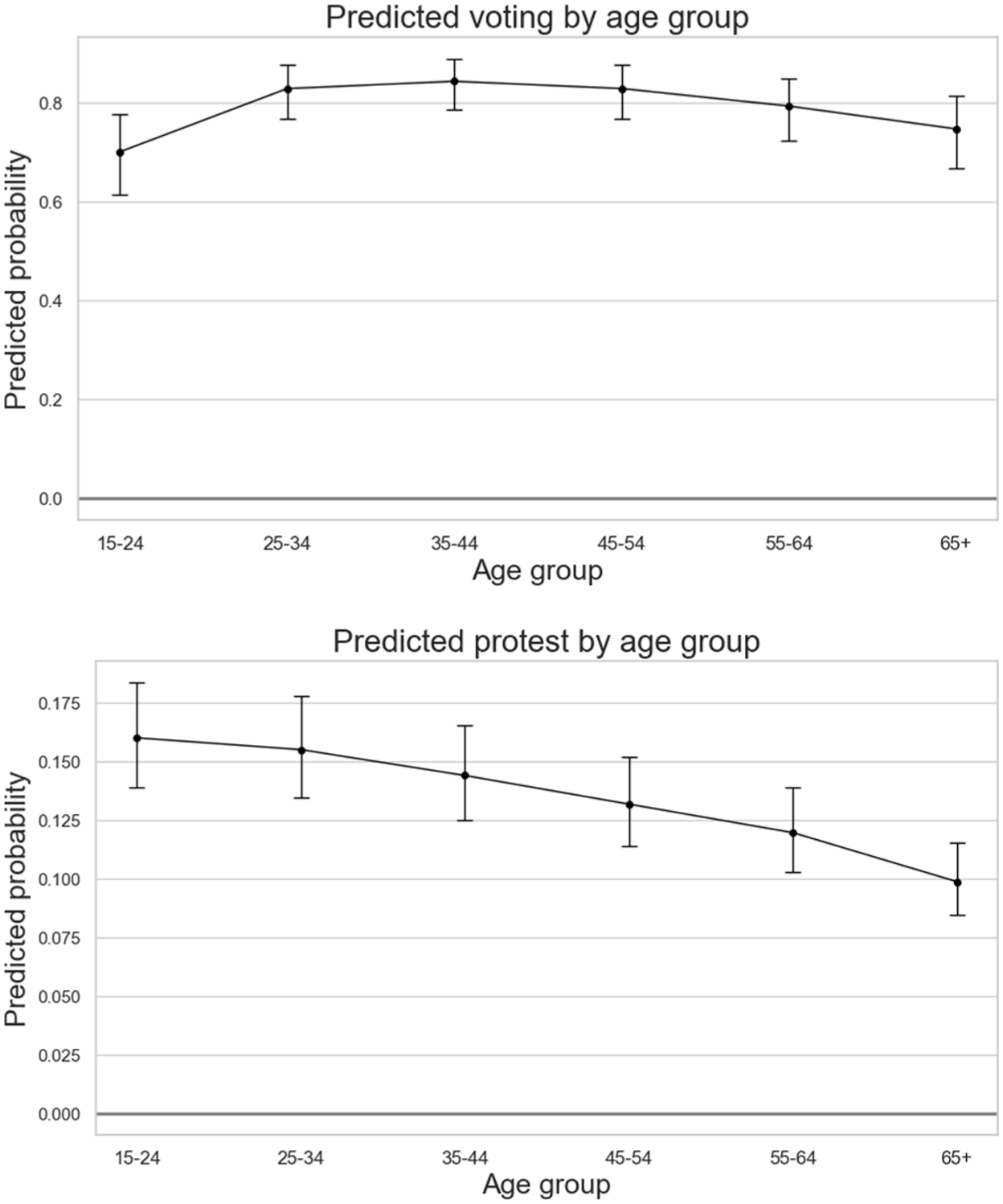
Age effects on voting and protest, predicted probabilities.
The finding underscores the importance of properly accounting for cohort and period effects, as the initial, descriptive analysis (Figure 2) suggested a peak age of 55–64 years, and hardly any decline in voting among the 65+ age group. The results are robust to the inclusion of country fixed effects (see Table B3, column 3).
Turning to protest, the predicted probability of protesting gets smaller and smaller as we move from the younger age groups to the older ones, even though period and cohort are being controlled for. The results are robust to the inclusion of country fixed effects (see Appendix B, Table B3, column 4). This is consistent with Schussman and Soule (2005) and Tambe and Kopacheva (2024) but contradicts Grasso (2014) and Grasso et al. (2019) who failed to find an age effect on protesting with European data.
Figure 6 displays the random effects for voting and protest behaviour across cohorts. The cohort effects for voting (top panel) suggests a clear monotonic decline in voting rates in successive cohorts. From the 1940–1949 cohort onwards, each new cohort shows a lower turnout rate than the previous one. This is consistent with Western evidence from Rubenson et al. (2004) and Gallego (2009). In the context of a youth bulge, this implies that the cohort effect will depress voting rates in African countries. This is because during a youth bulge, new cohorts are larger than the previous. If they are less likely to vote, the overall turnout rate will decline.
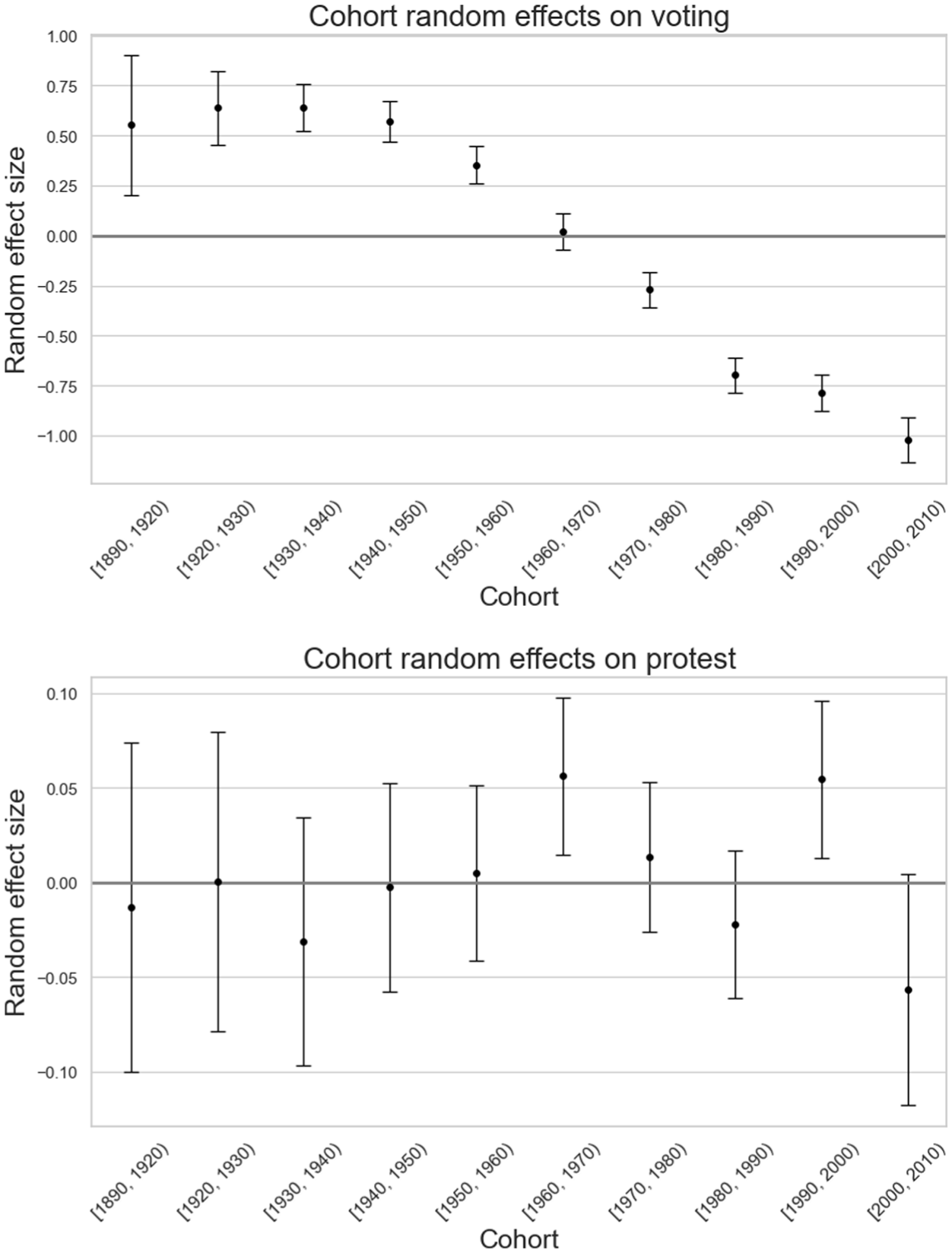
Cohort random effects on voting and protest.
In contrast, there appears to be some cohort effects in play for protesting (lower panel), but these are non-monotonic and do not show a clear pattern. Cohorts born in the 1960s and 1990s show high levels of protesting, but those born in the 1980s and 2000s do not. There is certainly no evidence for the monotonic decline in successive cohorts which would indicate that a youth bulge may reduce protest rates.
Finally, Figure 7 displays the random effects for protest and voting behaviour across periods. For voting, Waves 5 (2011–2013) and 8 (2021–2022) show an unusually high level and Wave 4 (2008) an unusually low level. None of the other waves reach statistical significance, and there is no clear trend. For protesting there is no clear pattern, and the spike in 2007 which was visible in Figure 4 is no longer apparent now that we have controlled for age and cohort. It now seems that Wave 1 (1999–2001) has the highest level of protest activity, although Waves 3 (2005), 4 (2008) and 8 (2022) also show elevated levels.
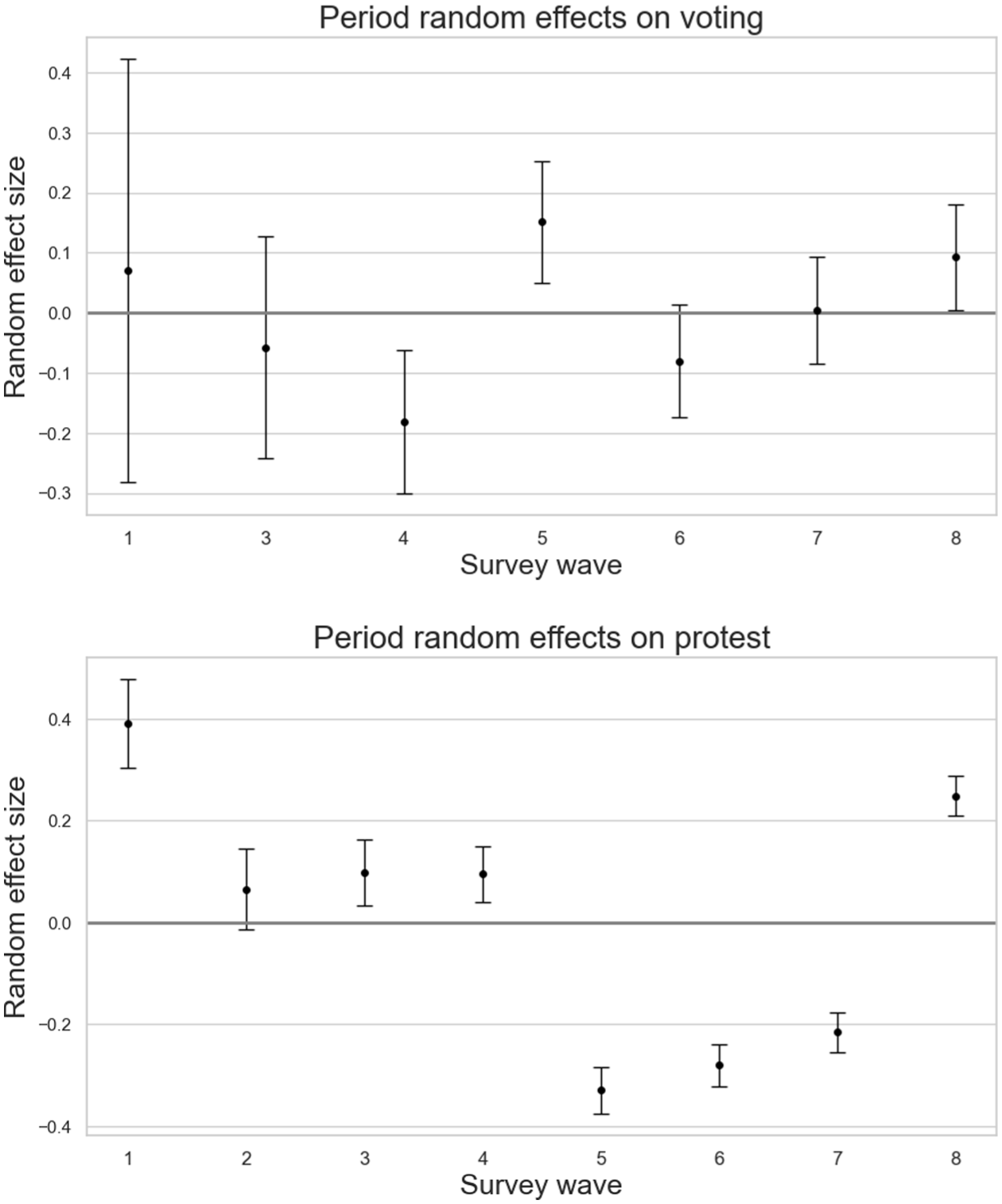
Period effects on protest and voting.
Sensitivity Analyses
To probe the robustness of these results, we split the sample into subsamples by region, regime type and year of independence. Obviously, there is some overlap between these variables, as, for example, the first countries to achieve independence are in Northern Africa and score quite low on democracy, whereas, for example, several countries in East Africa score higher on V-dem’s liberal democracy index and achieved independence in main wave of the early 1960s. This collinearity means that it is hard to assess the root cause(s) of any observed differences. Table 1 summarizes the results. 7 We limit ourselves to reporting age and cohort effects.
Summary of split sample analyses: age and cohort effects.
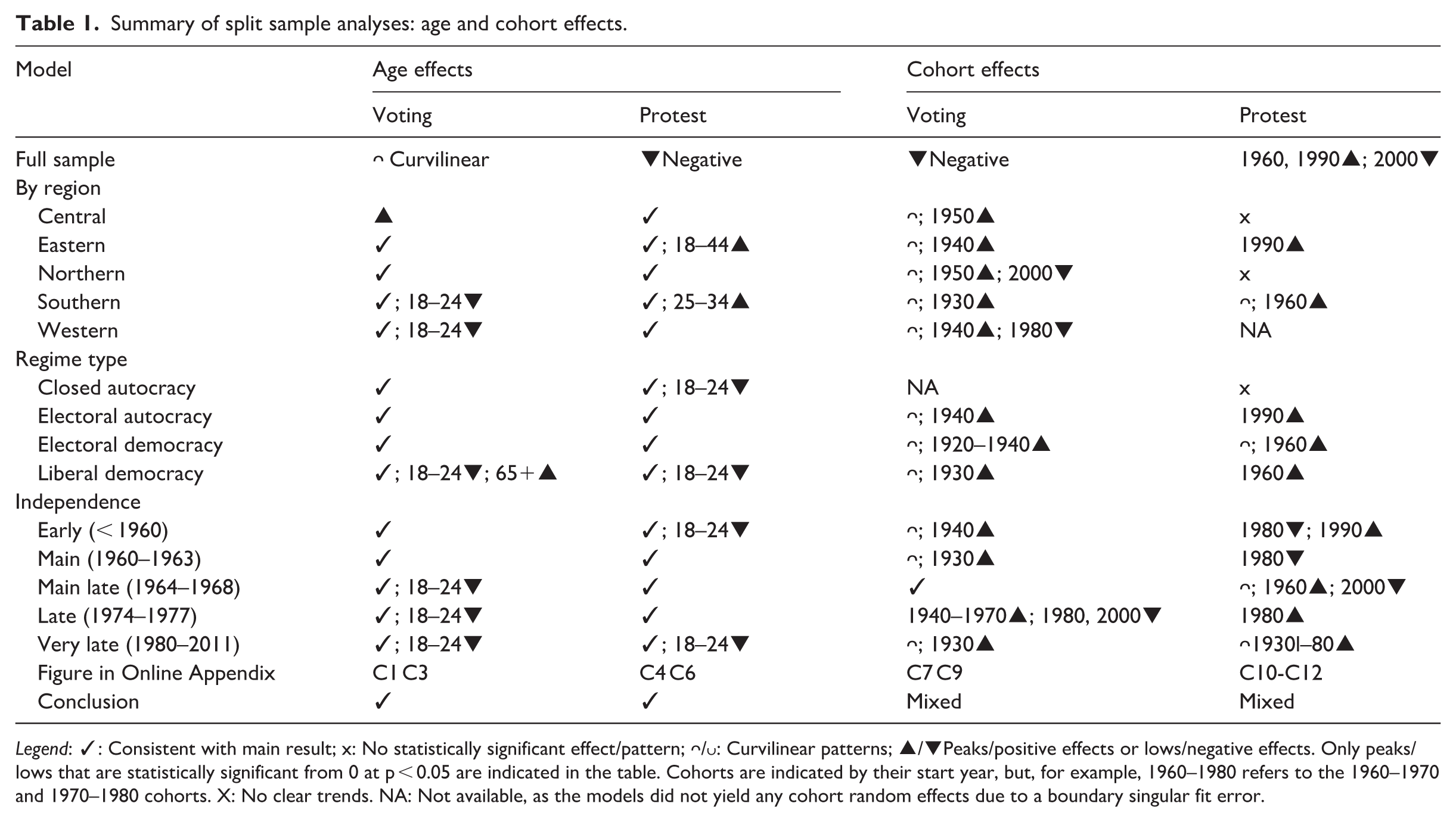
Legend: ✓: Consistent with main result; x: No statistically significant effect/pattern; ᴖ/ᴗ: Curvilinear patterns; ▲/▼Peaks/positive effects or lows/negative effects. Only peaks/lows that are statistically significant from 0 at p < 0.05 are indicated in the table. Cohorts are indicated by their start year, but, for example, 1960–1980 refers to the 1960–1970 and 1970–1980 cohorts. X: No clear trends. NA: Not available, as the models did not yield any cohort random effects due to a boundary singular fit error.
Starting with age, the curvilinear effect of age on voting is robust across most subsamples. Across all subsamples, and in line with our main result, the largest substantial effect is driven by 18- to 24-year-olds being significantly less likely to vote. However, in a few models (Central Africa; liberal democracy) there is no real decline among the oldest respondents. The largest decline among the oldest age group is found in Northern Africa and in closed autocracies. Overall, these findings show that the curvilinear effect of age identified in this study and previous work is highly robust and exists across a range of different societies and regimes. The negative association between age group and protest participation is also robust, but in some samples, the youngest age group (18- to 24-year-olds) is less likely to protest than the 25–34 age group.
For to the cohort effects, the results are somewhat more mixed but still in line with the main findings. For voting, the analyses suggest a general decline with new cohorts showing a lower propensity to vote, and overall, those born in the 2000s vote at particularly low rates. However, there is variation across subsamples as to when the decline starts, and in most samples our model shows an inverted U-shaped trend rather than the monotonic decline reported in the main results, but with different peaks for different groups of countries, which when added together form a general, monotonic decline. In Southern Africa, those born in the 1930s report of the highest level of voting, followed by a nearly linear decline among subsequent cohorts. In contrast, in Central and Northern Africa, those born in the 1950s are the most likely to vote. West Africa, the largest decline started with the cohorts born in the 1980s but seems to have stabilized, whereas in countries classified as liberal democracies, the trend may have turned, so that the 2000–2009 cohort is more likely to vote than the 1980s–1990s cohorts.
In the main model, we did not find a clear pattern of cohort effects on protest participation, and this result holds in the subsample analyses. We find an inverted U-shaped curve in Southern Africa and among electoral democracies, whereas in the other regions and across other regime types, there are no clear patterns.
Finally, previous research suggests that key political events and structures influence the political socialization and subsequent participation of different cohorts (e.g. Grasso et al., 2019), and while some such events or trends may affect people across many countries, other events are likely to have a more localized effect. In a first attempt of assessing such potential events, we focus on the cohorts during the decolonial struggle and immediately after independence. We assume that that these would be crucial political events that would leave an imprint on cohorts that experienced them, leaving a legacy of higher efficacy among the cohorts that took part in the struggle for independence but a risk of disenchantment and political withdrawal (Inglehart and Catterberg, 2002; O’Donnell and Schmitter, 1986) for later cohorts. For empirical reasons, our comparison centres on two groups of countries where we were able to single out two clearly different time windows, that is, 1960–1963 (‘main wave’) and 1974–1977 (‘late independence’). In line with our expectations, those coming of age during the struggle for independence are consistently more likely to vote compared to later cohorts. This is consistent with the argument that being socialized during this crucial period has a positive, lasting effect on participation, perhaps through civic norms and internal efficacy. In contrast, cohorts coming of age immediately after independence (i.e. the 1960s cohort in countries that became independent in 1960–1963, and the 1980s cohort in countries that gained independence in 1974–1977) have a substantially lower probability of voting. Cohorts coming of age after independence also seem to protest at lower rates than earlier cohorts. Similar patterns of decline post-independence can also be observed in countries that achieved independence in the main late and very late waves. This would be consistent with a post-colonial disenchantment (Gerring et al., 2005; Inglehart and Catterberg, 2002). However, such interpretations should be treated with caution and would need further research to be validated or refuted.
Predictions
The CCREM results indicate that there is an age effect upon both voting and protesting. For protesting, the age effect is negative and roughly linear, consistent with Tambe and Kopacheva (2024). If younger people are more likely to protest regardless of period or cohort, then the appearance of a youth bulge should entail an increase in rates of protesting, especially since section ‘CCREM Results’ provides no evidence of any monotonic cohort or period trends which could offset this. For voting, however, deriving the implications for a youth bulge is not so simple. The age trend is curvilinear, which means that an increase in the proportion of 15- to 29-year-olds would not necessarily entail a decline in voting rates if the proportion of adults aged 65+ (who also vote at low rates in Figure 5) also declined to offset this. The impact of a youth bulge on voting therefore depends partly on how the population share of older adults changes. To complicate matters further, there is also a monotonic cohort effect upon voting where, starting from about 1940, each birth cohort votes at lower rates than the previous one. This could plausibly offset the age effect so that no aggregate-level change in voter turnout occurs. It is therefore not possible to make inferences about a youth bulge simply from looking at the APC results above.
To overcome this, we estimate the effect of a youth bulge by using the APC results to make predictions on simulated data. A detailed explanation of this process is contained in Appendix B, but it essentially involved generating simulated datasets, each with a different age structure, and then calculating the predicted level of voting and protesting. The datasets were generated programmatically with youth ratios (the ratio of 18- to 29-year-olds to the total adult population) ranging from 0.2 to 0.8. 8 A higher youth ratio corresponds to a larger youth bulge. To allow cohort effects to be estimated, each dataset was assigned a ‘year’ which increases as the youth ratio increases, as would be expected during the development of a real-life youth bulge. The dataset with a youth ratio of 0.2 was set as year = 1950, 0.21 was set as 1951, and so on up to the 0.8 dataset which was set as year = 2010. 9 We then created prediction functions which take in the APC effects identified in section ‘Descriptive APC Results’ and apply these to each dataset to estimate rates of voter turnout and protest attendance for different youth ratios. Because it applies the curvilinear age effect and the negative cohort effect together, it allows us to see how voter turnout changes even if the two effects push against each other.
The results of the predictions are shown in Figure 8. They indicate that as the youth ratio increases, changes will likely occur to both voter turnout and protest attendance. In Panel A, we can see that changing youth ratios affect predicted rates of voter turnout, although when only the age effect is applied, the decline in voter turnout appears very slight. This seemingly reflects the fact that, since the age effect in Figure 5 is curvilinear, a very young population will not result in greatly lower turnout rates than a very old one. The story is different when the cohort effect is added, however. Because the ‘year’ is coded to increase alongside the youth ratio, higher youth ratios now result in a noticeable decline in voter turnout. This is clearly due to the negative cohort effect identified in Figure 6. In any case, the results in Panel A indicate that the age and cohort effects for voting will reinforce each other. Rather than offsetting the age effect so that there is no overall change, the small decrease in turnout from the age effect becomes a large decrease once the cohort effect is added.
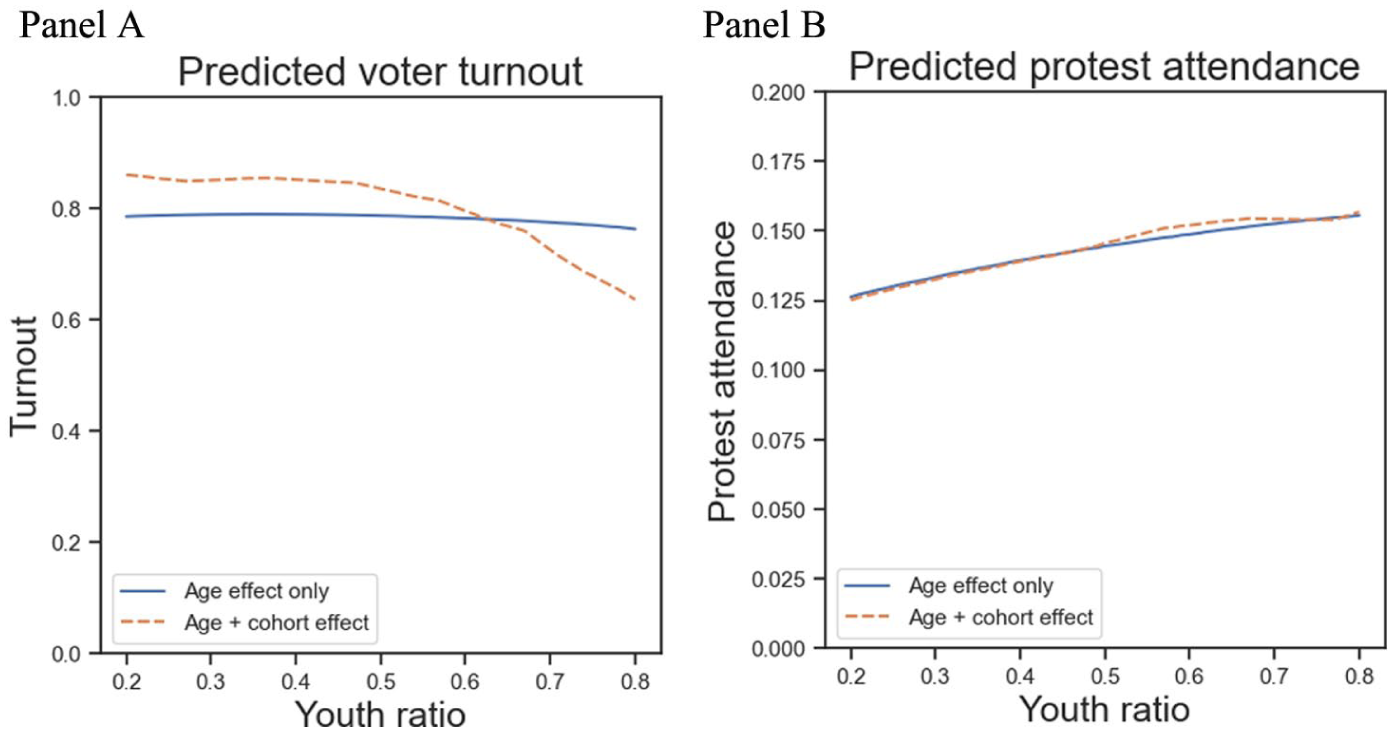
Predicted voting and protesting rates, by youth ratio.
Turning to Panel B, we can see that increasing youth ratios are associated with a higher level of predicted protest attendance – that is, the proportion of people who report that they attended a protest in the last year. The addition of cohort effects seems to make little difference, reflecting the lack of any clear cohort trend in Figure 6.
Discussion
This article has examined whether the African youth bulge is likely to affect voter turnout or protest attendance. Given the link between age and both voting and protesting (Bhatti et al., 2012; Gallego, 2009; Petrie, 2004; Schussman and Soule, 2005; Wolfinger and Rosenstone, 1980) there is reason to suspect an effect. However, since no African study has attempted to disentangle APC effects on voting or protesting, it is unclear whether that link might simply be due to period effects or non-monotonic cohort effects which do not generalize to the start of a youth bulge. We therefore conducted the first-ever APC analysis of voter turnout and protest attendance in Africa. The results indicate that there is a curvilinear age effect on voting where voter turnout peaks in the 35–44 age group, and a negative age effect on protesting, with older people less likely to attend protests. There is also a negative and monotonic cohort effect on voting where more recent cohorts are less likely to vote. The results are robust across different model specifications, including country fixed effects and various subsample analyses. These findings are similar, although not identical to trends previously identified in Western countries (Gallego, 2009; Grasso, 2014; Grasso et al., 2019; Rubenson et al., 2004). Compared to previous studies in Western contexts, the peak age of voting is somewhat lower (35–44 years), even if the substantial decline only starts with the 55–64 age group. While people born in Western Europe today can expect to live until they are more than 80 years old, life expectancy in, for example, Benin or Sierra Leone is just above 60 years and is as low as 54 years in Nigeria, which could explain some of the difference.
The age effect on protesting implies that a youth bulge should lead to an increase in rates of protest attendance. But the existence of two potentially conflicting effects on voting – an age effect and a monotonic cohort effect – makes it difficult to discern the likely impact of a youth bulge on voting. We therefore created a simulated youth bulge and then applied the age and cohort effects to predict voter turnout and protest rates. The simulations indicated that voter turnout should decline as the youth ratio increases, while rates of protest attendance should increase. These changes, in turn, could have potentially profound political consequences. If new cohorts coming of age continue to vote less while protesting more, political participation will increasingly take place outside formal political structures, which in turn could affect political representation (Stockemer and Sundström, 2025) and equality of participation (Dalton, 2017; Verba et al., 1995), and would probably lead to an increase in protest movements. How this may affect the future of democracy in the region, in turn, depends at least in part on the nature of the protests, whether authoritarian or pro-democratic, peaceful or violent (Chenoweth and Cunningham, 2023). However, the literature on youth bulges also suggests that youthful populations can generate dividends like economic growth (Bloom et al., 2003; Hasan et al, 2019). If countries can reap the economic dividends of a youthful population, both the resource model (Brady et al., 1995) and the modernization thesis (e.g. Kostelka and Blais, 2021) suggest that the modes and rates of participation among the youth could change. At the same time, continued youth unemployment and underrepresentation could also affect how young people choose to participate and address their grievances (Hillesund et al., 2018; Ismail and Olonisakin, 2021).
This article also suffers from some limitations, particularly concerning the measurement of key concepts. The voting data rely on self-reported turnout, which is known to be susceptible to over-reporting arising from social desirability bias (Karp and Brockington, 2005) or memory failure if people may not remember if they voted the last election, but rather that they often vote or would vote in future elections (Belli et al., 1999). In addition, people with low political interest are less likely to participate in surveys such as Afrobarometer, further skewing the estimated level of turnout above the true level (Bhatti et al., 2012). If individuals’ misreporting of their turnout varies according to age, period, or cohort (for instance, perhaps older people are more likely to falsely report having voted) this may mean that the link between age voting identified here could be spurious. People may also tend to underreport protesting in more repressive contexts. However, the fact that our results hold across a range of different subsamples and the inclusion of country fixed effects make us quite confident that such misreporting does not systematically vary with country characteristics. At the same time, we believe our findings reflect propensity or inclination to participate, rather than a measure of actually voting in the last election or attending a protest the past 12 months. The protest measure also has other limitations. Afrobarometer asks respondents whether they have attended a protest or demonstration, but this does not tell us whether any of these protests were pro-government or anti-regime, nor of sufficient size to exert any real pressure on the government or local authorities. Finally, Bell and Jones (2014) contend that the three APC effects are logically confounded and therefore cannot be separated in a statistical model, even a multilevel model such as the CCREM. However, Reither et al. (2015) allege that the simulated data used by Bell and Jones bears little resemblance to real-world APC data and that APC models will actually only fail under very specific conditions. For this reason, CCREM models arguably remain an appropriate choice for modelling APC effects (Dassonneville, 2013; Livingston et al., 2016; Smets and Neundorf, 2014).
The results in this article provide a good starting point for future research about the impacts of youth bulges, as the article can be seen as a theory-building exercise: by identifying APC effects, we now have clear expectations about how voting and protesting should change in a youth bulge. The next step is therefore to apply the theoretical expectations obtained in this article and test those against country-level data for voter turnout and protesting, such as the Social Conflicts Analysis Database (SCAD) and the Global Dataset on Turnout (Martínez i Coma and Leiva Van De Maele, 2023; Salehyan et al., 2012). If the implications set out in section ‘Predictions’ are correct, we would expect a higher youth ratio to be associated with increasing rates of protesting and reduced voter turnout.
The article also contributes to our broader understanding of the determinants of political participation. While some previous work has examined correlations between age and both voting and protesting in Africa (Tambe and Kopacheva, 2024), this did not distinguish between APC effects. This article, by contrast, represents the first-ever attempt to identify APC effects on either voting or protesting in Africa. The results differ from those in Western countries in some important ways: the existence of an age effect on protesting stands in contrast to Grasso (2014) and Grasso et al. (2019) who failed to find this in a Western research context, and the negative, roughly linear cohort effect on voting differs from Smets and Neundorf (2014). Grasso’s (2014) finding of a curvilinear cohort effect on demonstrating also differs substantially from the results here. Yet in other ways the results are remarkably similar to those from Western countries. As in this article, Smets and Neundorf (2014) found a curvilinear age effect on voting, while Rubenson et al. (2004) and Gallego (2009) found a negative cohort effect. Our results also contribute to a broader conversation about whether changing levels of political participation are the result of changes in ‘contexts’ or ‘values’. Similar to Blais and Rubenson (2013), the cohort effect identified here is consistent with a process of generational value change, rather than changes in electoral context such as the competitiveness of elections, and in our study, we make a first attempt to understand potential drivers of such change. Further research, perhaps focusing on individual countries or key political events, will be necessary to fully understand patterns of voting and protesting in Africa.
Supplemental Material
sj-docx-1-psx-10.1177_00323217251394166 – Supplemental material for Do Youth Bulges Affect Voting and Protesting? An Age-Period-Cohort Analysis
Supplemental material, sj-docx-1-psx-10.1177_00323217251394166 for Do Youth Bulges Affect Voting and Protesting? An Age-Period-Cohort Analysis by Michael Kumove and Karin Dyrstad in Political Studies
Footnotes
Acknowledgements
We are grateful to colleagues at Norwegian University of Science and Technology, the staff at the Peace Research Institute Oslo, and attendees at the Australian Society for Quantitative Political Science conference for their comments and feedback, particularly Ferran Martinez i Coma and Henrik Urdal.
Author’s Note
Michael Kumove is now affiliated to Department of Sociology and Political Science, Norwegian University of Science and Technology, Trondheim, Norway.
Declaration of Conflicting Interests
The authors declared no potential conflicts of interest with respect to the research, authorship, and/or publication of this article.
Funding
The authors disclosed receipt of the following financial support for the research, authorship, and/or publication of this article: This paper was supported by a grant from the Research Council of Norway (grant no. 314530).

Supplemental material
Additional Supplementary Information may be found with the online version of this article.
Appendix A. Descriptive statistics
Table A1: Descriptive statistics
Table A2: Counts for age, period and cohort groups
Appendix B. Main analysis; numerical results
Table B1: Mean voting levels by age and year of survey
Table B2: Mean protest levels by age and year of survey
Table B3: CCREM results
Appendix C. Sensitivity analysis
Figure C1: Age effects on voting, by region; predicted probabilities
Figure C2: Age effects on voting, by regime type; predicted probabilities
Figure C3: Age effects on voting, by independence wave; predicted probabilities
Figure C4: Age effects on protest, by region; predicted probabilities
Figure C5: Age effects on protest, by regime type; predicted probabilities
Figure C6: Age effects on protest, by independence wave; predicted probabilities
Figure C7: Cohort random effects on voting, by region; predicted probabilities
Figure C8: Cohort random effects on voting, by regime type
Figure C9: Cohort random effects on voting, by independence wave
Figure C10: Cohort random effects on protest, by region
Figure C11: Cohort random effects on protest, by regime type
Figure C12: Cohort random effects on protest, by independence wave
Appendix D. Predictions
Figure D1: Population pyramids for dataframes with youth ratios of 0.3, 0.5 and 0.7
Notes
Author Biographies
References
Supplementary Material
Please find the following supplemental material available below.
For Open Access articles published under a Creative Commons License, all supplemental material carries the same license as the article it is associated with.
For non-Open Access articles published, all supplemental material carries a non-exclusive license, and permission requests for re-use of supplemental material or any part of supplemental material shall be sent directly to the copyright owner as specified in the copyright notice associated with the article.
