




Abstract
This article examines how media framing of election results affects voter perceptions of election winners and losers. We conceive of media framing as equivalency framing because the very same election result can be framed positively or negatively. We expect direct effects on voter perceptions and additionally argue that ambivalent voters should be most affected by such framing in their evaluation of election results. We test these arguments with two pre-registered studies, namely, a survey experiment that employs fictional stimulus material and a two-wave panel survey linked to a news content analysis against the backdrop of the 2021 German Federal Election. The findings reveal framing effects on voter perceptions in fictional settings and conditional effects driven by partisan reasoning in real-world contexts. These findings provide an important mechanism for future research interested in the consequences of election outcomes for government legitimacy or political system support.
Keywords
Introduction
Election outcomes in multi-party systems often leave room for interpretation when it comes to voters considering which parties won and which parties lost (see Plescia, 2019). This has to do with a multitude of objective factors that can be used as yardsticks, such as electoral performance (e.g. largest party status and vote changes compared to the last election) and government-opposition status (after the election), alongside differing subjective factors, most notably partisan predispositions (see Daoust et al., 2023; Plescia, 2019; Singh et al., 2012; Stiers et al., 2018). However, only a few studies have considered the role of the media environment in voters’ assessment of election outcomes (Kolpinskaya et al., 2020; Lelkes, 2016), even though there is considerable variation in whether and how parties’ electoral performances are covered in the media (Gattermann et al., 2022).
This article aims to shed light on the role of the media in shaping public perceptions of election winners and losers: To what extent does media framing of election results affect whether voters perceive certain parties as winners or losers of an electoral contest? In answering this question, our contribution to the extant literature is fourfold: First, conceptually, we propose to conceive of framing effects as equivalency framing effects because identical election results can be framed in different, yet logically equivalent ways (e.g. Druckman, 2001, 2004; Levin et al., 1998; Scheufele and Iyengar, 2017). Although deemed “largely inapplicable to journalism studies” in its traditional notion of gain-vs-loss framing (D’Angelo and Shaw, 2018: 212), in the remainder of this article, we argue that equivalency framing lends itself to understanding variation in the specific journalistic reporting of election results and our study, therefore, complements existing research on emphasis framing effects (Cacciatore et al., 2016; Scheufele and Iyengar, 2017). Second, theoretically, we argue that partisan motivated reasoning moderates the expected framing effects on voter perceptions of party winners and losers to the extent that ambivalent voters are most affected. Third, empirically, we test media framing effects on voter perceptions in two related and pre-registered 1 studies against the backdrop of the German Federal Election of 26 September 2021. Using mixed-member proportional representation in federal elections, Germany is a typical example of a multi-party system where no party is likely to win an outright majority of seats in the legislature. Moreover, the Greens nominated a chancellor candidate for the first time; traditionally, only the Social Democrats and the Christian Democrats used to do so. This added an extra layer of uncertainty in anticipation of the election outcome among pundits and voters allowing us to test media framing effects of (unexpected) election results on voter perceptions. The first study (S1) represents a survey experiment that employs fictional stimulus material. The second study (S2) consists of a two-wave panel survey that is linked to a content analysis. This allows us to assess the nature and strength of any effects in both a controlled and a real-life environment. Fourth, substantially, our findings suggest unconditional framing effects on voter perceptions of election winners and losers in a fictional setting, and conditional effects due to partisan motivated reasoning in the real-life setting. We discuss the implications of these findings in greater detail in the conclusion.
Media Framing Effects on Perceptions of Election Winners and Losers
Who do voters see as winners and losers of an election? Except for landslide victories (e.g. Tony Blair’s 1997 New Labour victory or Law and Justice winning an absolute majority of the seats following the 2019 Polish parliamentary elections) and electoral wipeouts (e.g. when the German Free Democrats lost all of its 93 seats in the Bundestag in 2013), most election results leave some room for interpretation. And, in fact, voters’ perceptions of election winners and losers are anything but clear (e.g. Plescia, 2019). This is because election results can be read in different ways and assessed using different yardsticks. For example, the largest party in an election is usually seen as an election winner (Stiers et al., 2018). Yet, the very same party might have lost votes compared to the last election and in that sense be considered as an election loser (Singh et al., 2012; Stiers et al., 2018). Voters can also use prior expectations of the election outcome to gauge election winners and losers (e.g. Blais and Gélineau, 2007; Plescia, 2019). For example, even the best election results in a party’s history might be seen as a disappointment if opinion polls prior to the election suggested an even bigger victory. In addition, research on the winner-loser gap (e.g. Anderson et al., 2005; Blais and Gélineau, 2007; Nadeau et al., 2023; Nemčok and Wass, 2021) uses government participation (after an election) as the central criterion to distinguish winning from losing parties. Finally, whether voters see an election result in a more positive or negative light depends on partisan predispositions (e.g. Plescia, 2019). All else being equal, voters are more likely to see a party as an election winner (loser), the more they like (dislike) that party.
We currently know little about the media’s role in shaping voters’ perceptions of election outcomes. This is surprising because voters primarily learn about election results from and through the media—be that through social media or traditional media, such as television and radio broadcasts. Recent research suggests that the media have some leeway in framing election results in one way or another beyond actual election outcomes: specifically, Gattermann et al. (2022) found that media reporting in the aftermath of the 2019 European Parliament elections was biased toward parties with radical socio-cultural positions at the expense of moderate parties in such way that extreme parties were considered more newsworthy and more often framed as an election winner. In line with previous research on framing and public opinion (e.g. Chong and Druckman, 2007; Lecheler and De Vreese, 2019; Scheufele and Iyengar, 2017), we expect that media framing of parties’ electoral performance influences voters’ perceptions of election winners and losers.
Framing effects are generally distinguished in terms of effects resulting from emphasis frames (Entman, 1993; see also De Vreese, 2005) or from equivalency frames (e.g. Druckman, 2001, 2004; Scheufele and Iyengar, 2017). As the name suggests, emphasis frames stress a certain aspect of a story, which can additionally vary in terms of valence by which De Vreese and Boomgaarden (2003: 363) mean that “some frames are indicative of ‘good and bad’ and (implicitly) carry positive and/or negative elements.” Examples of valenced frames include either frames that vary in their tone or, more specifically, frames highlighting certain risks or opportunities connected to issues of immigration (e.g. Bosilkov, 2022) or EU enlargement (e.g. Schuck and De Vreese, 2006). Equivalency frames, by contrast, rest on the condition that factual information is presented in a different, yet logically equivalent way (e.g. Druckman, 2001, 2004; Levin et al., 1998; Scheufele and Iyengar, 2017). A prominent example of gain-vs-loss equivalency framing is an experiment by Tversky and Kahneman (1981) which presented participants with a choice between two programs to combat a hypothetical disease. The choice set consisted of two versions shown to two different groups, within which the framing varied in terms of lives to be either saved or lost and statistics providing either numbers or probabilities, but apart from the presentation, each program was identical. In line with their prospect theory (Kahneman and Tversky, 1979), they showed that differences in framing resulted in different preferences and thereby instigated either risk averse or risk-taking behavior (see Hameleers, 2021, for a recent adaptation during the Covid-19 pandemic).
Importantly, although the labels of valence and equivalency are often used interchangeably, valenced frames are considered to be part of emphasis frames and thus distinct from equivalency frames and their effects: “Both types of framing effects cause individuals to focus on certain characterizations of an issue or problem instead of others; however, [emphasis] framing effects do not involve logically equivalent ways of making the same statement. Rather, [emphasis] frames focus on qualitatively different yet potentially relevant considerations (e.g. free speech or public safety)” (Druckman, 2004: 672; see also Cacciatore et al., 2016: 10; Scheufele and Iyengar, 2017: 623). Based on this distinction, media framing of election results can be categorized as equivalency framing. This goes beyond simply declaring some as winners and others as losers. For example, media reports can apply a positive frame by emphasizing vote gains of parties that did not come first or negatively frame the party with the largest vote share as not having fulfilled expectations (see Gattermann et al., 2022). In other words, the very same election result can be framed in either a positive or negative way while it still is “informationally equivalent across different frames” (Scheufele and Iyengar, 2017: 622; see also Druckman, 2004, for valence in equivalency framing).
In what way may equivalency framing of election results affect voter perceptions of winners and losers? Equivalency framing “is clearly not the most widespread in the policy discourse and political news reaching most citizens” (Slothuus, 2008: 3). As a consequence, few political communication studies have formulated and subsequently tested mechanisms that are expected to underlie the potential effects of equivalency framing on attitudes and behavior (e.g. Pedersen, 2017); the literature on emphasis framing effects is much more advanced (Lecheler and De Vreese, 2019). Moreover, prospect theory (Kahneman and Tversky, 1979) does not lend itself to media framing effects because we are interested in resulting voter perceptions of election results rather than preferences (see also Levin et al., 1998: 166). These perceptions then could later affect attitudes such as satisfaction with democracy. Voter perceptions following media framing of election results are, therefore, the most immediate reaction to equivalency frame exposure.
One prominent mechanism in extant political communication research through which framing can affect attitudes is applicability (Price and Tewksbury, 1997). It implies “that the effect of a message depends on the degree to which some aspects of that message resonate with (or are applicable to) a recipient’s existing underlying cognitive schemas” (Scheufele and Iyengar, 2017: 623). Others have labeled this mechanism “belief importance change,” which can be understood as a “change how the individual weights [the] information” that they receive (Nelson et al., 1997: 226). We argue that perceptions of winners and losers are essentially similar to belief importance change because the information voters receive about election outcomes structures how they interpret the results. 2 Voters may rely on existing schemata that, for example, enable them to identify the party with the largest vote share as the election winner. However, if this party’s election result is framed in a negative way (e.g. not meeting expectations), voters may attach less importance to this particular result compared to other results. Vice versa, if a party’s election result is framed positively, this may alter the prior importance voters have attached to it toward a more favorable election outcome.
As voters often hold political predispositions toward parties, we expect partisan motivated reasoning to play a role in the assessment of election winners and losers. According to Kunda (1990: 480), motivated reasoning is a cognitive process that is biased by “any wish, desire, or preference that concerns the outcome of a given reasoning task” and is distinguished by two major goals, namely, a strive for accuracy or an attempt to reach a directional (or desired) conclusion. The latter is associated with partisan motivated reasoning (e.g. Bolsen et al., 2014; Taber and Lodge, 2006). Applying partisan motivated reasoning to the interpretation of election results, therefore, entails that voters’ interpretations of election results are shaped by their party preferences. Voters who feel strongly about the party they voted for—as operationalized through preferences, identity, or attachment—are often more likely to consider their party an election winner (Plescia, 2019; Stiers et al., 2018: 24) or more likely to overestimate their party’s electoral performance (Stiers and Dassonneville, 2018; Stiers et al., 2018: 26). Importantly, those cognitive processes that lead to comparable overestimations of others sharing one’s own political preferences can indeed be linked to partisan motivated reasoning (Nir, 2011). In our case, this suggests that voters hold partisan predispositions that influence their evaluations of election outcomes and that are unrelated to media framing.
Given the hypothesized importance of partisan motivated reasoning, we also expect that it moderates the effect of equivalency framing on voter perceptions. Frames that are sponsored by a certain political party tend to have more impact among those who feel attached to it compared to those who do not hold strong feelings for that party (Bechtel et al., 2015\; Druckman et al., 2013; Slothuus and De Vreese, 2010). However, media framing of election results is not sponsored by political parties. Instead, they represent some parties’ performance in a better light than other parties’ election results (Gattermann et al., 2022). We argue that if partisan motivated reasoning indeed plays a role as expected in H2, those who have strong sympathies toward or against certain parties will be less susceptible to media framing effects of election results. In other words, even those who are exposed to a certain frame that stands in contrast to their preferences should not be affected by framing because evidence suggests that such a disconfirmation bias can still be explained by partisan motivated reasoning (Taber and Lodge, 2006; see also Slothuus and De Vreese, 2010). This entails that those without either partisan sympathies or antipathies are not motivated to base their interpretations of election results on desirable outcomes, but are inclined to provide an accurate assessment (see Lavine et al., 2012). In other words, framing effects connected to a party’s election results are more likely to occur among those with an ambivalent position toward that political party.
Empirical Approach
To test how voters react to media frames of election outcomes, we conducted a survey experiment (S1) and a two-wave panel survey, accompanied by a media content analysis, in the context of an election campaign (S2). Findings from the survey experiment carry higher internal validity as we can directly manipulate media frames and account for rival explanations through randomization. Yet, it is unclear whether such findings also carry high external validity as the information environment in real-world contexts is more complex (Berk, 2025). For example, framing effects might vanish quickly after exposure (Lecheler and De Vreese, 2011), be counteracted by conflicting frames (e.g. Chong and Druckman, 2007), or vary across respondents (e.g. Slothuus, 2008). Moreover, framing effects might be mitigated by other factors such as pre-existing attitudes (Bechtel et al., 2015) or self-selection into a media diet (Ladd and Lenz, 2009).
Thus, we test the hypotheses in two different research designs to increase confidence in our results: S1 should offer a first test of whether and how media framing of election outcomes affects citizens’ attitudes on the election outcome. S2 offers a more conservative test as framing effects are harder to detect due to the additional information in the context of a real election, the time frame, and potential confounders. A limitation of S2 is that we are unable to identify equivalency framing as operationalized in S1. This is because we measure respondents’ individual exposure to overall news reporting of election outcomes that mingles equivalency framing (in individual news items) with the type of news exposure (which is more closely related to emphasis framing).
Study 1
Our first study is a survey experiment that we conducted as part of a larger survey between 29 July and 11 August 2021. Respondents were sampled by the survey company respondi AG from the target population of German citizens (aged 18 to 69) based on quotas for the respondents’ age, gender and place of residence (Bundesland). 3 Of the 3266 respondents who finished the survey, 3178 respondents signed the informed consent and participated in the experiment. All participants were fully debriefed after the survey experiment. Respondents received a financial compensation of one Euro (100 mingle points) for their participation. 4
Our stimulus material consisted of a short news article on a fictional local council election held in June 2021 that reported the results of six parties (see Figure A1 in the Supplementary Appendix A for examples). Instead of a choice set, respondents were randomly allocated to one condition (i.e. they were asked to read only one vignette). This procedure is suitable to measure perceptions rather than preferences after exposure to equivalency framing as respondents are not given a choice, but are exposed to certain framing attributes (see Levin et al., 1998: 166). In our case, these attributes concern positive or negative evaluations of election results. Importantly, and in line with equivalency framing, the actual election results were identical in all vignettes.
In the treatment conditions, we manipulated the headline and the text to frame the electoral results of three parties (P1, P2, and P3) positively or negatively (see Table 1). In the headline, parties “celebrate” (positive treatment) or are “disappointed” (negative treatment) with their election result. Admittedly, such headlines can be considered emphasis frames. They are very common in election reporting and thus our approach not only increases external validity, but also the credibility of the stimulus material. Likewise, we use different descriptions of a party’s election result in the text. In line with real news about election results (see Gattermann et al., 2022), we designed the evaluations in each framing in such a way that they are not outright positive or outright negative, but differentiated. In doing so, we, first, used different yardsticks to evaluate election results. For example, the yardstick to evaluate the performance of the second-largest party (P2) is its electoral performance in the past (“historically best result,” positive frame) and the performance vis-à-vis the largest party (“only comes in second,” negative frame). 5 Second, as shown in Table 1, we tried to balance the evaluations in each framing in such a way that we highlighted two positive (negative) alongside one negative (positive) aspects per positive (negative) frame. A summary of all treatment groups is shown in Supplementary Appendix A (Figure A2).
Positive and Negative Frames of the Election Results (English Translations).
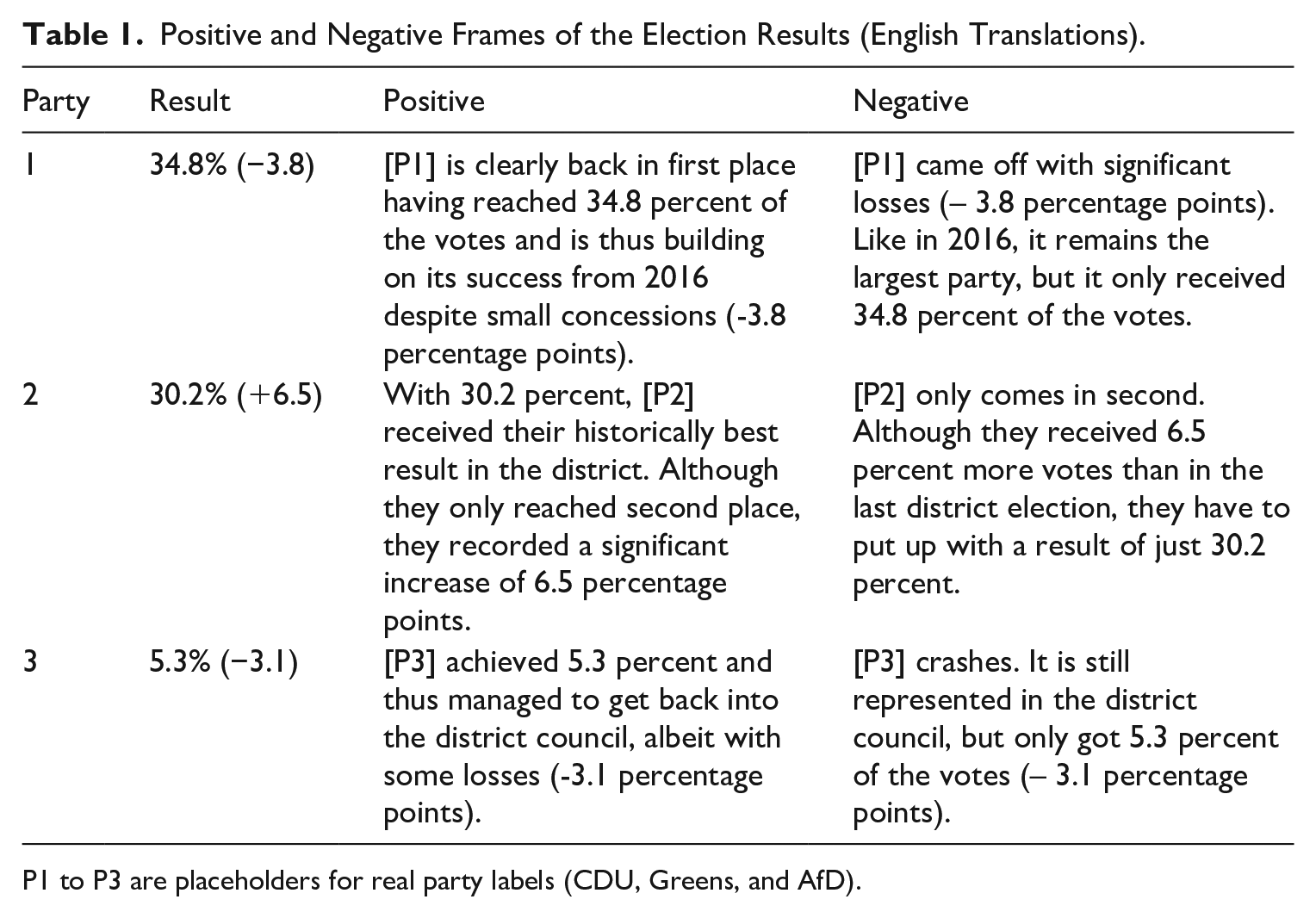
P1 to P3 are placeholders for real party labels (CDU, Greens, and AfD).
In the control condition (no framing), the vignette lists each party’s vote share and the relative change in electoral support since the last election, but no interpretation of the election results. Moreover, the headline is a neutral summary of the election result (“This is how the new council looks like”). In total, there are eight (23) treatments and one control condition.
To test hypotheses dealing with party sympathy (H2 and H3), the vignettes include party labels of real parties. We randomize the party labels for P1 to P3 among three parties in the German Bundestag which differ substantially in their ideology and electoral appeal: CDU, Greens, and AfD. This is to rule out that the effects are driven by one particular party. 6 At the same time, there is significant variation in local election results of those parties, which means that they are realistic options for parties P1 to P3 in local elections. Each vignette also mentions the electoral performance of three additional parties with representation in the German Bundestag (SPD, FDP, and Left). 7
Measures
After exposure to the news report, we asked respondents to evaluate, for each party, whether they think it won or lost the election on a 5-point scale from “clearly won” (1) to “clearly lost” (5). To use it as the dependent variable in the empirical analysis, we reversed the scale so that higher values indicate perceptions of election winners. This measure of winner and loser perceptions advances the existing literature in two important ways as previous research employed binary or other categorical measures and asked voters to only assess the performance of the one party that they voted for (Plescia, 2019; Singh et al., 2012; Stiers et al., 2018). We instead ask respondents to evaluate the performance of all parties that competed in the (hypothetical) election and measure more nuance with an ordinary 5-point scale.
The independent variable to test H1 and H3 indicates whether a party’s election result was framed in a negative (-1) or positive (+1) way, using the control group as our reference category (0). To test H2 and H3, we measure the respondents’ party sympathy on an 11-point scale. This question was asked pre-treatment along with other questions on political interest and political attitudes. Due to item non-response, the number of observations drops to 2973 in some models.
Modeling Strategy
We test the hypotheses in separate linear regression models for parties P1 to P3. For each party, we run two models: one with the main effects of the key covariates (media framing and party sympathy) to test H1 and H2, and a second regression model that includes an interaction between both variables to test H3. In addition, each model includes two control variables. First, we include fixed effects for the party label shown in the vignette (CDU, Greens, or AfD). We do so to account for party affect (beyond party sympathy) that might influence the evaluation of a party’s election result. Second, we include a variable that measures the overall negativity in the media report. Specifically, we expect that respondents evaluate a party’s performance more positively if the election results of other parties are framed negatively. 8
Balance tests indicate statistically significant (albeit substantially small) differences across treatments especially regarding the respondents’ education (Supplementary Appendix C). We, therefore, test the robustness of our results in regression models that account for the respondents’ gender, age, and education level. The results (Supplementary Appendix E) are similar to the ones presented here.
Results
Figure 1 shows the predicted average perception of parties as election winners or losers dependent on media framing (H1). 9 Not surprisingly, voters’ overall assessment of parties as election winners (or losers) varies with party size: respondents on average identify the largest party (P1) as an election winner and the smallest party with significant vote losses (P3) as an election loser. Most importantly, however, we find effects in line with our expectation: framing an election result in a positive (negative) way increases the chances that voters perceive a party as an election winner (loser). For parties P1 and P2, however, the difference between a neutral (control) and positive frame does not reach conventional levels of statistical significance, although respondents in the negative frame conditions were significantly less likely to consider either party as election winners compared to respondents in the control condition. Framing effects for P3 differed across all conditions. This finding indicates that the media’s ability to frame election results is constrained by the actual results. If most voters identify a party as an election winner in the neutral condition, there is little room to frame the election result more positively. 10 Another interpretation of the weaker findings for positive vis-à-vis negative frames is the negativity bias in media perceptions (e.g. Soroka, 2014). Respondents may pay more attention to negative frames and are, therefore, more likely to respond to negative rather than positive framing of election results. However, seeing the rather symmetric results for positive and negative frames for P3, ceiling effects may be more applicable in case of P1 and P2 than a negativity bias.
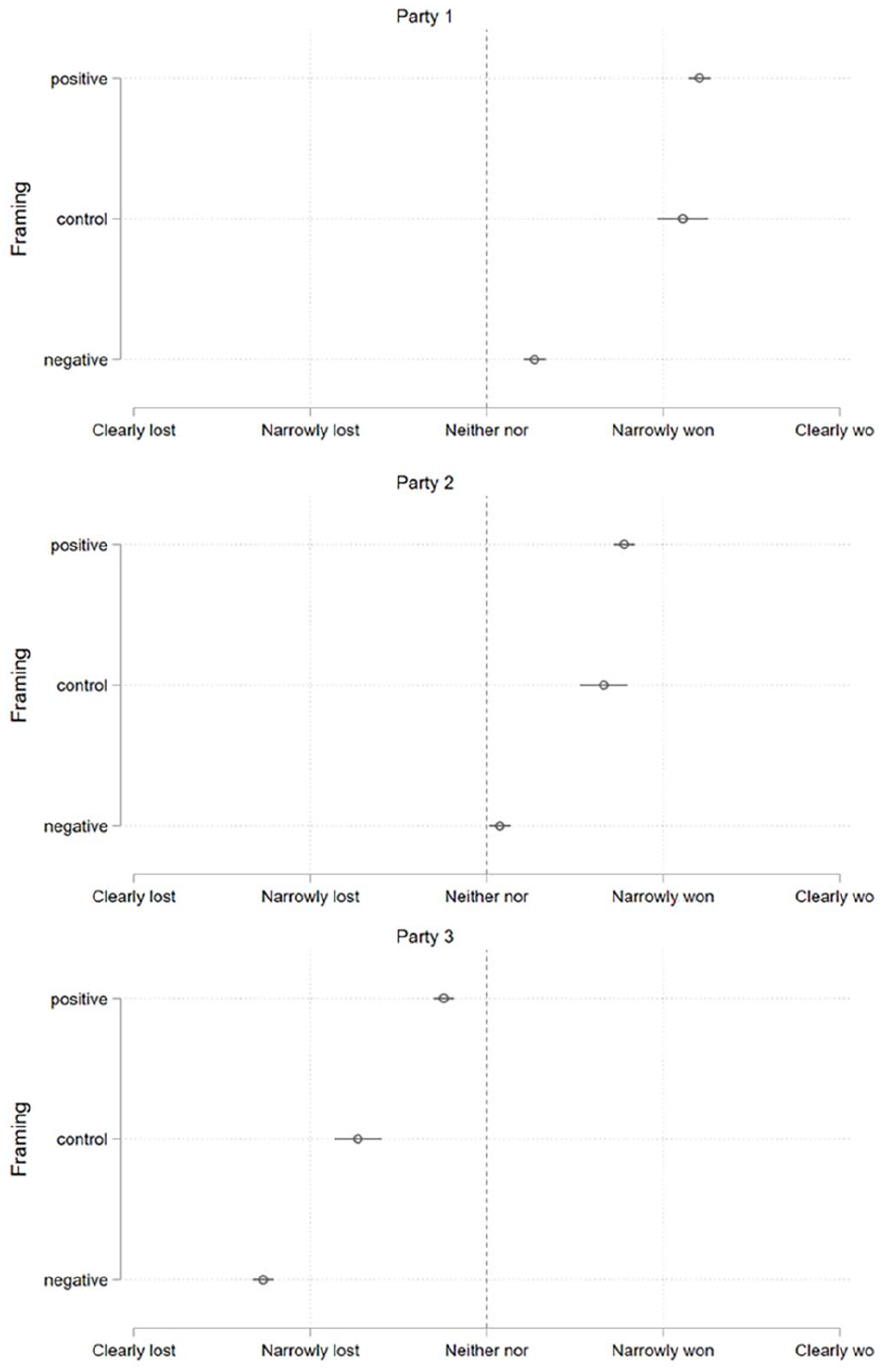
Media Framing and Voters’ Perception of Election Winners and Losers (H1).
Regarding the effects of party sympathy, we find consistent evidence that higher party sympathy increases the perceptions that a party won (rather than lost) the election. Figure 2 shows the marginal effects of party sympathy for parties P1, P2, and P3. Specifically, it shows the change in the perceived performance of a party when sympathy for that party increases from the first to the third quartile (roughly from 0 to 6 on the 0-10 scale). The marginal effects are positive and statistically significant in all three models (i.e. for P1, P2, and P3). This lends support to H2. Increasing party sympathy from the first to the third quartile increases the loser-winner-perception by roughly 0.2 scale points on the 5-point scale. This effect is relatively small compared to the standard deviation in the dependent variables (roughly 1.2) and compared to the framing effects in H1 (see Figure 1).
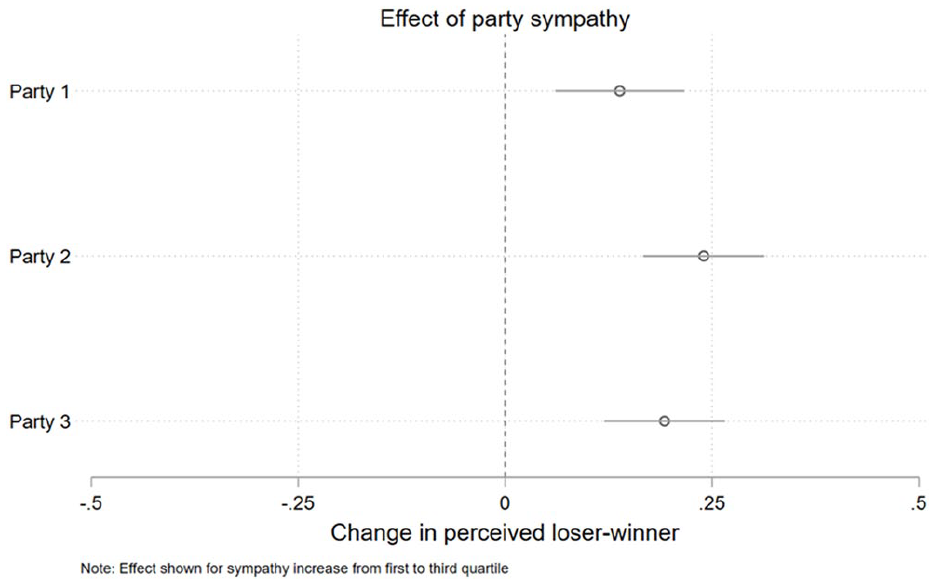
Party Sympathy and Voters’ Perception of Election Winners and Losers (H2).
Finally, we find no evidence that framing effects on loser-winner perceptions are conditional on party sympathy (H3). We expected that framing effects would be weaker for respondents with very positive or very negative affect toward a party. Yet, as shown in Figure 3, media framing effects are quite similar for different levels of party sympathy. The slopes in each panel tend to run in parallel, suggesting that the relative difference between positive and negative framing is pretty stable across different levels of party sympathy. Thus, we reject H3.
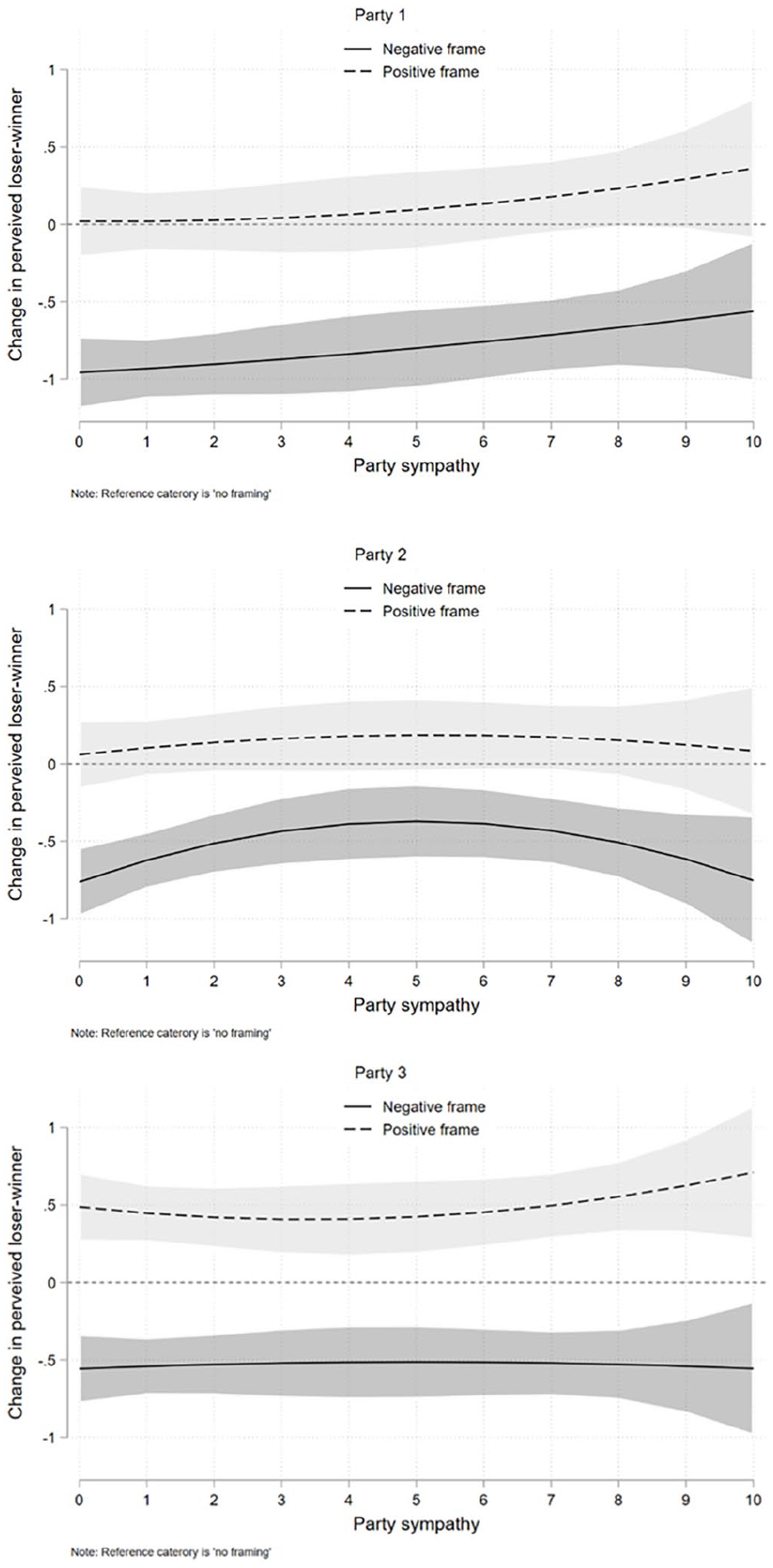
Conditional Effect of Media Framing dependent on Party Sympathy (H3).
In a series of additional analyses, we test the robustness of our findings and provide a better understanding of the data. First, we disaggregate the treatment variable to study how respondents’ evaluation of a focal party (e.g. P1) depends on the media framing of the other parties (e.g. P2 and P3) in the news report. In this (non-pre-registered) analysis (full results shown in Supplementary Appendix F), we indeed find such context effects. For example, respondents are more likely to perceive P1 as an election winner if P2’s electoral performance is framed negatively (and vice versa). In contrast, whether the framing of P3 was negative or positive did not affect respondents’ assessment of P1 nor P2 as election winners or losers. This might suggest that respondents use particular focal parties (here: the second-largest party P2) to assess whether a party (here: the largest party P1) won or lost the election (and vice versa).
Second, as outlined in the pre-analysis plan, we use a Seemingly Unrelated Regression (SUR) model as an alternative modeling strategy to test our hypotheses. The results (shown and described in full detail in Supplementary Appendix G) are similar to the ones presented in this manuscript: we find evidence that media framing affects perceptions of parties as election winners and losers (H1). Moreover, respondents with higher party sympathy are more likely to identify a party as an election winner (H2). 11 This holds for all six parties (i.e. including those where the description does not vary across treatments).
Study 2
In S2, we study voter perceptions of the election outcome with observational data from the German Federal Election of 26 September 2021. As the study needed to be prepared before election results are known, case selection can be challenging. The 2021 German Federal Election appeared appropriate because pre-election polls suggested significant changes in the party system: the incumbent chancellor Angela Merkel did not run again, and for the first time, three instead of the two mainstream parties nominated a chancellor candidate with the Greens captivating on their promising polls. The Social Democrats (SPD) eventually ended up as a largest party (25.7%; +5.2 percentage points) with a narrow lead ahead of the CDU/CSU (24.1%; –8.8 percentage points). The Greens (14.7%; +5.8 percentage points) achieved their best election result in federal elections but did worse than in the preceding polls. The Liberals (FDP) had minor vote gains (11.4%; +0.7 percentage points) but were, together with the Greens, seen as “king-makers” in the upcoming government formation process. The extreme right AfD (10.4%; –2.2 percentage points) lost some of its voter appeal. Finally, the Left Party (Linke) lost substantially (4.9%; –4.3 percentage points) and only entered the new Bundestag because three of its candidates won seats in their districts (Grundmandatsklausel).
We use a two-wave online panel study with a soft quota sample representative of Germany’s voting population regarding age, gender, education, and state (Schuck and Buttgereit, 2021). Interviews took place before (26 August to 13 September) and after election day (27 September to 1 October). 12 The survey was administered by Dynata which also handled the monetary compensation for respondents. A total of 2621 respondents participated in the first wave, and 1129 of them also participated in the second wave. Having removed respondents with untypical survey behavior leaves us with a non-representative sample of 1029 respondents 13 that was slightly older and better educated than the population at the time.
Content Analysis
We link the survey data to a content analysis of the election results reporting of six major German newspapers that differ in political leaning: the tabloid Bild alongside quality papers Frankfurter Allgemeine Zeitung, Süddeutsche Zeitung, Handelsblatt, taz, and Die Welt. We chose newspapers because written text is less ambiguous when it comes to journalists’ evaluations of election results; evaluations on television could vary also within journalists, especially when they are expressed spontaneously or in discussion with others. At the same time, newspapers are agenda-setters for other types of media, including social media (e.g. Gilardi et al., 2022), and hence suitable to gather differences between parties and newspapers.
We pre-selected articles published in the days following the election (27 September to 1 October) that broadly dealt with an election or election results. 14 A coder then read the articles and disregarded those dealing with sub-national elections or those in foreign countries, articles about particular candidates or constituencies instead of nationwide election results, letters to the editor, and comments from authors other than journalists (e.g. pundits or politicians). In the remaining 251 articles, the coder then identified (up to eight) parties and politicians that were mentioned in the headline, sub-headline (if available), lead paragraph (font differs from the main text; if available), and the first paragraph of the article. 15 Thus, for each actor, we coded whether they were framed as election winner, as election loser, or in an ambivalent or mixed fashion (e.g. if a party was framed as having made gains among certain voter groups, but lost overall). We coded 379 such frames in total; and in 285 cases (75.2%) an actor was clearly framed as having either won or lost the election. There is little variation in framing of election results within political parties and framing has been fairly consistent across newspapers. 16
To link these frames to respondents’ news exposure (see below), we first calculated, for each newspaper, the sum of mentions in its articles to parties (or its politicians) as election winners and losers, respectively. 17 We then calculated the difference to get a measure of the overall tonality in framing where higher (lower) values indicate a more positive (negative) tone toward a party. The difference between S1 and S2, therefore, is that we aggregate individual (equivalency) frames to measure framing effects of election outcomes in a real election context.
Measures
The dependent variable in our analysis is respondents’ perceptions of parties as election winners or losers. We asked respondents after the election (in wave 2) to indicate whether, in their view, “the following parties have rather won or have rather lost the election.” As in S1 and for seven parties (CDU, CSU, SPD, FDP, Greens, Left, and AfD), respondents assessed on a five-point scale whether it “clearly won” or “clearly lost” the election. 18 The results are shown in Figure 4. CDU, CSU, and the Left were mostly seen as losers of the electoral contest, the SPD was widely perceived as an election winner, and perceptions of the FDP, Greens, and AfD are more ambivalent. The variation in responses is highest for the Greens (SD = 1.19)
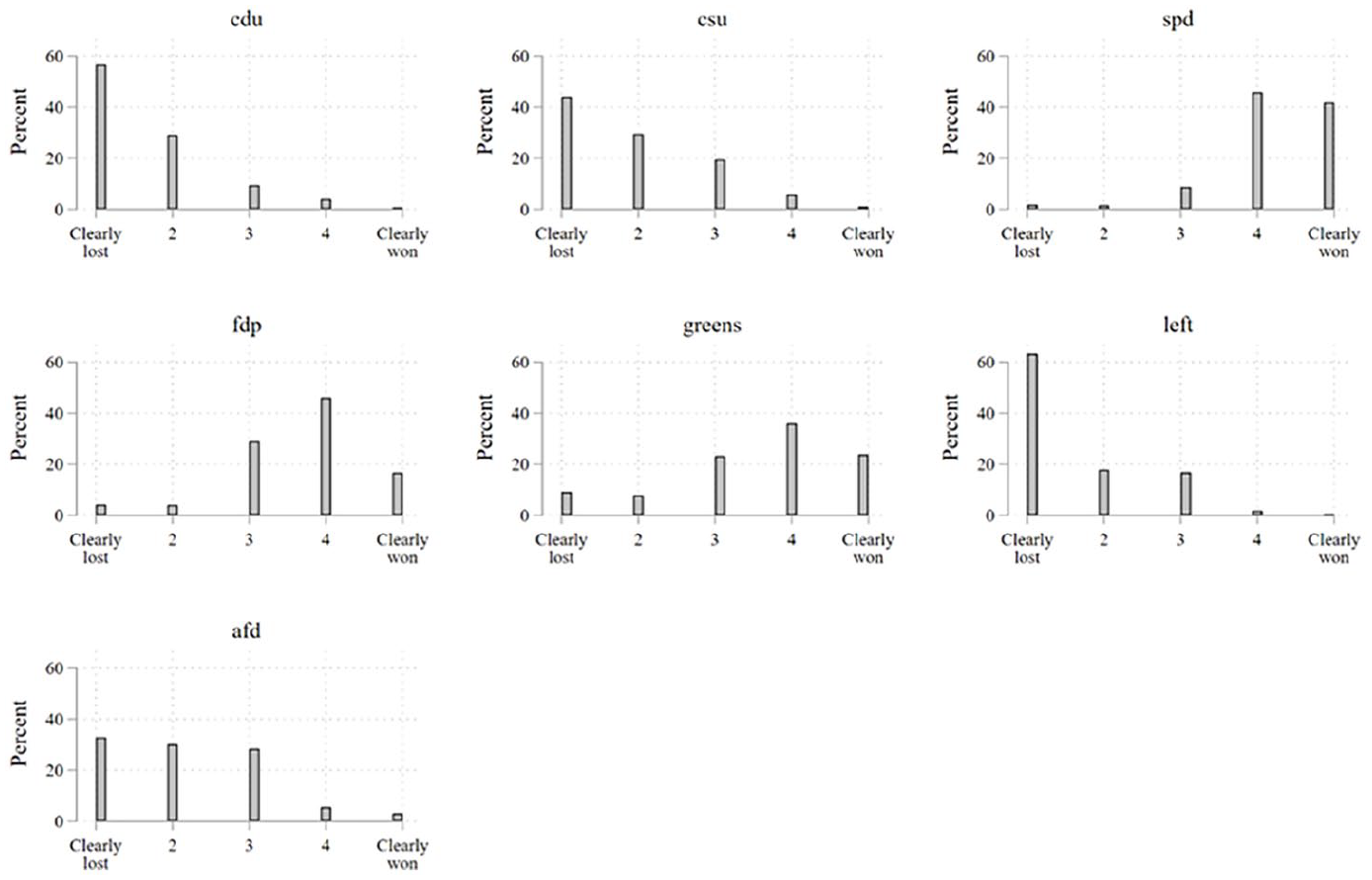
Winner-Loser Perceptions by Party.
To measure the respondents’ exposure to positive or negative framing of parties’ election results (H1), we linked each party’s winner-loser framing from the content analysis to each respondent’s individual news exposure. To do so and for each respondent, we weighed each party’s overall framing in each newspaper by the number of days (per week) s*he was reading the respective newspaper, and added up these values across newspapers. Like in S1, we have one observation per party and respondent, but in contrast to the one-time exposure to a specific frame, this measure captures a respondent’s exposure to media framing about a party’s election performance on the whole. Thereby, this measure accounts for both an individual’s more comprehensive media diet and a more varied information environment in the aftermath of the election. The downside of this aggregation is that we lose information about the initial equivalency framing in each news item.
Party sympathy (H2) is measured on an 11-point scale, asking respondents to assess what they think of each party on a scale from –5 (“think nothing at all of the party”) to +5 (“think a lot of the party”). We also include the respondents’ age (in years), sex, and education as control variables. To account for differences in the respondents’ perception of the election outcome before the media exposure, we include a control variable (collected in wave 1) that measures the respondents’ projected electoral performance of each party in the upcoming election.
Modeling Strategy
The data structure is stacked with parties nested in respondents. The models include fixed effects for parties to account for (unobserved) heterogeneity in winner-loser perceptions across parties. Moreover, we cluster standard errors by respondents.
We test our hypotheses using two (linear) regression models (full results shown in Supplementary Appendix D). Model 1 contains the main effects of the variables of interest (along with the control variables) to test H1 and H2. Model 2 includes an interaction between media exposure and party sympathy (and its squared term) to test whether media exposure matters less for parties when voters have strong (positive or negative) predispositions (H3).
Results
The effects of the main variables of interest are visualized in Figures 5 (for H1 & H2) and 6 (for H3). To begin with H1, we find no strong evidence that exposure to media framing of parties’ election results affects respondents’ perceptions of parties as election winners and losers. While the effect shows the expected positive effect, it is not statistically significant at conventional levels (see left panel in Figure 5). The magnitude of the effect is also diminishable: moving from the 5th to the 95th percentile of the variable increases the respondents’ perception of a party as a winner (rather than a loser) by 0.04 points on the 5-point scale.
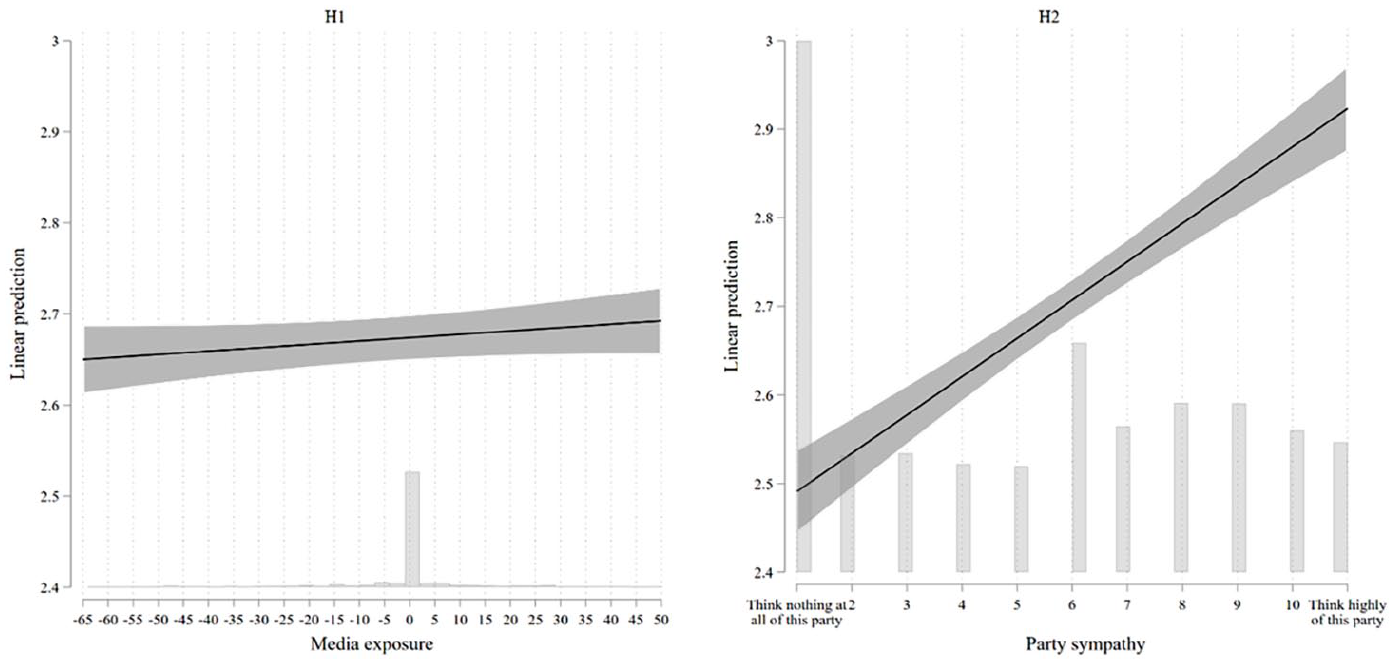
Media Exposure, Party Sympathy, and Voters’ Perception of Election Winners and Losers (H1 & H2).
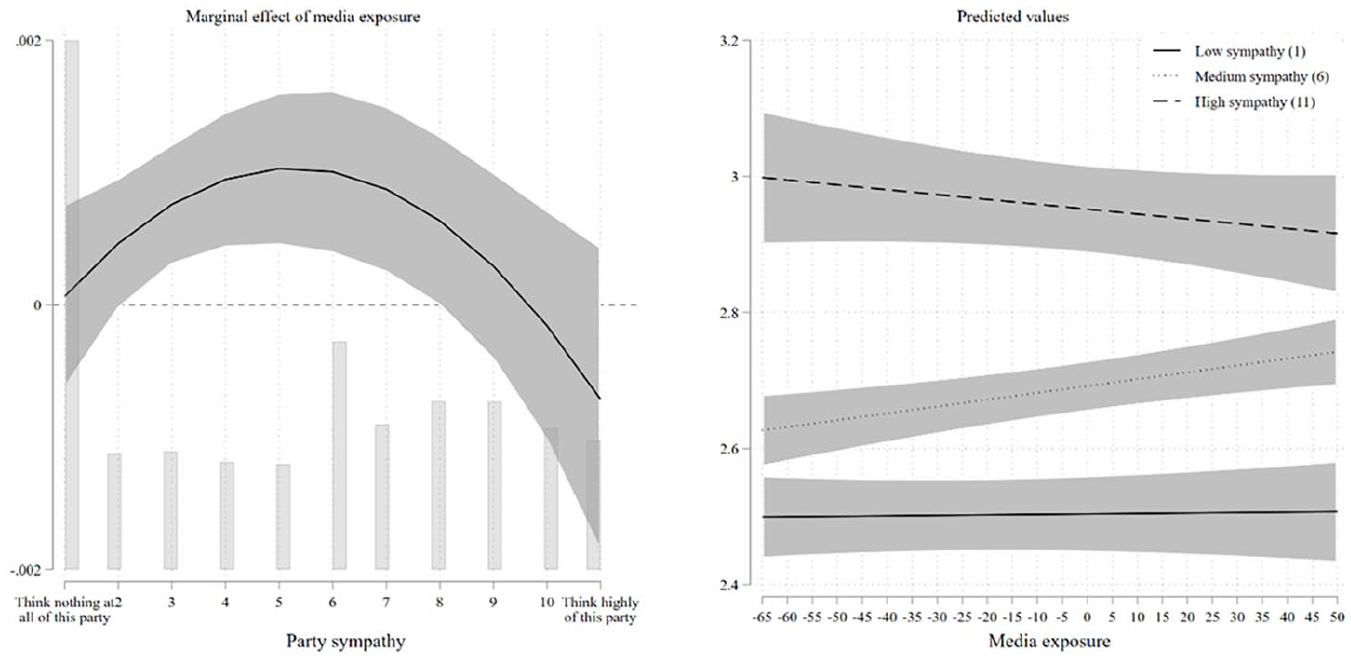
The Conditional Effect of Media Exposure on Voters’ Perception of Election Winners and Losers (H3).
However, in line with S1, we do find evidence for H2 that higher sympathy for a party increases the chance that respondents identify the respective party as an election winner. The effect of party sympathy is positive and statistically significant (see also the right panel in Figure 5): increasing party sympathy from the first to the third quartile increases the loser-winner-perception by roughly 0.3 scale points on the 5-point scale. This is a modest effect compared to the overall variation in the dependent variable (standard deviation: 1.41).
The left panel in Figure 6 shows the marginal effect of exposure to media framing on perceptions of elections of parties as election winners or losers dependent on party sympathy. As expected (H3), the effect of exposure to positive or negative framing of a party’s election result on respective perceptions as election winner or loser is strongest if respondents do not have very low or very high sympathy for that party. The right-hand panel in Figure 6 visualizes the substantial size of the media framing effect for a low, moderate, and high level of party sympathy. For low or high party sympathy, the lines are essentially flat. The media framing effect is only positive and statistically significant for respondents with a moderate level of sympathy toward a party. Yet, the effect is relatively small: increasing the exposure to media framing from the 5th to the 95th percentile increases perceptions of the party as a winner by 0.11 points (on the 5-point scale).
We also test the robustness of these findings across different model specifications. First, we use a SUR model with distinct regression parameters for each party to relax the assumption (in the model above) that we can pool observations across parties. The results (shown and described in full detail in Supplementary Appendix G) lead to roughly the same conclusions as the analysis above: Yet, the curvilinear effect of media exposure dependent on party sympathy (H3) exists for four of the seven parties but is different for the FDP, the Left, and the AfD. Bearing in mind that the analysis only concerns one election in one context, there could be several explanations for the diverging results between parties (see Supplementary Appendix G).
Finally, we run an additional (non-pre-registered) analysis to account for 1) regional variation in media consumption and 2) variation in district election results. 19 While we selected news reporting of national newspapers, exposure to particular newspapers varies somewhat across regions. For example, the Süddeutsche Zeitung has most of its readers in Bavaria while the Bild is being most read in Hamburg. 20 We include fixed effects for the German states (Bundesländer) to account for this regional variation. Moreover, we account for district-level election results as they might also drive respondents’ perceptions of the election outcome (Daoust and Blais, 2017). Specifically, we use geolocation data of the respondents and map these data (Picard, 2015) with information on the district-level election results based on geometric data on the constituencies from the Federal Returning Officer. 21 We include two additional control variables in our analysis: first, the change in party vote share (2nd vote) in the constituency compared to the last election (in 2017), and second, whether or not the respective party won the seat (1st vote) in the respective constituency (0/1). The results are shown in Supplementary Appendix H. In line with previous research (Stiers et al., 2018), the results show that respondents are indeed more likely to perceive a party as an election winner if it won the constituency mandate. The main findings of our analysis are robust to these model modifications.
Comparison of the Findings
Taken together, our findings from S1 and S2 are slightly different but complementary: While we do find an unconditional equivalency framing effect on voter perceptions of election winners and losers in the fictional setting of the survey experiment, media framing effects in the observational study are conditional on party sympathy. These findings can be explained by differences in the research design in both studies: In S1, voters are (randomly) exposed to different media frames of the parties’ electoral performance. At the same time, the context was entirely fictional, that is, the local council does not exist and the election never took place. Our respondents were hence neither involved in voting nor directly affected by the outcome of the election, only the parties were real. Moreover, news exposure to the election was based on a single news report and neither the media diet nor the amount of election reporting did play a role. In S2, in contrast, voters’ exposure to media frames is based on self-selection, and their evaluation of the electoral performance of political parties is heavily shaped by pre-existing attitudes of the competing parties. Those with strong predispositions are most likely to select a particular media diet and least likely to change their opinion based on media framing. Hence, we only observe a conditional media framing effect, namely, among respondents with an ambivalent position toward that political party.
Our central take-away from these results is that media framing of election outcomes indeed affects voters’ perceptions of election results, but its effect is limited in contexts where voters have strong predispositions and are confronted with conflicting frames. Furthermore, the different findings for P1 to P3 in the survey experiment suggest that framing effects are limited by the actual election outcome: when parties are clear winners or losers of an election, voters cannot be swayed by a positive or negative media frame of that result. We elaborate on these potential contextual effects in the conclusion.
Discussion and Conclusion
In increasingly fragmented party systems, there is often no straightforward way to identify winners and losers of elections. Rather, election outcomes need interpretation, and are thus susceptible to framing effects. As voters tend to learn about the outcome of democratic elections from the media, understanding the potential effects of media framing of election results is, therefore, of crucial importance. We studied media framing effects of election outcomes using a survey experiment and a two-wave panel survey that was linked to a content analysis of newspaper coverage against the backdrop of the 2021 German Federal Election.
Substantially, our study shows that media framing of election outcomes can affect voters’ perceptions of election results in controlled settings, but in real-world contexts, these effects are conditional on voters’ predispositions toward political parties. This has at least two kinds of theoretical implications for research interested in media framing effects on attitudes, such as toward the new government (e.g. Kolpinskaya et al., 2020). First, media effects in the aftermath of democratic elections are likely to be mediated by voter perceptions of election results. Second, the conditionality of this mediation effect suggests that also direct effects of (mediated) election outcomes on attitudes, trust and system support (e.g. Anderson et al., 2005; Blais and Gélineau, 2007; Nemčok and Wass, 2021) are likely moderated by partisan motivated reasoning.
Future research should devote more attention to the variation in the pre-election context. Plescia (2019), for example, showed that higher expectations concerning a party winning an election dampen the effect on voters’ subjective feelings that their own party won the election. Likewise, the media may already assign a certain framing during the campaigns, especially in connection with reporting of election polls (see Stolwijk and Schuck, 2021), which may not only affect voters’ expectations but also constrain post-election news reporting of election results. Importantly, we controlled for pre-election expectations of voters in S2, but respondents were unable to rely on any information on the campaigns in S1.
Methodologically, future research needs to tease out potential variation in media visibility, framing, and exposure, particularly in the real-life context. This may be a challenging task as—like us—researchers are bound to prepare the study before the dynamics of the aftermath of elections fully play out. Importantly, while we were able to operationalize equivalency framing in S1 as part of our stimulus material, aggregating framing in news reporting for S2 essentially comes at the cost of losing information about the initial (equivalency) framing in individual news items. We would advise future research to carefully distinguish equivalency and emphasis framing, so that we can also account for variation in framing when aggregating news reporting. In addition, in today’s high-choice media environment, future research also needs to consider additional forms of communication that potentially offer alternative ways to present or frame election results. For example, info graphics may be used on platforms such as Instagram, headlines or short texts are more common on platforms such as X or Facebook, while platforms such as TikTok rely on short videos. Furthermore, the sender becomes important as well. One may think of Sigrid Kaag, then leader of the Dutch D66, dancing on a table following her party’s unexpected and overwhelming success in the 2021 Dutch general elections (e.g. Aerden, 2021). The photos and videos of this instance went viral via social and traditional media. This underlines that politicians can actively influence the interpretation of election results in public, which future research should take into account. As this may also have differentiated effects on different segments among the electorate (e.g. think of supporters of a populist leader), we also need new ways to measure exposure to such communication about election outcomes, such as web tracking (e.g. Stier et al., 2020) or data donations (e.g. Ohme et al., 2024). This will, finally, also help us assess the scope of (traditional) media framing effects: on the one hand, we must not overestimate them (e.g. Berk, 2025). On the other hand, we should consider that these are influenced also by exposure to additional media sources (see De Vreese and Neijens, 2016).
Moreover, it remains to be seen whether we would find similar framing effects in other countries and election contexts. There are good reasons to believe that our findings travel to other electoral contexts in modern democracies. Media framing should be least relevant in contexts where only two parties (or candidates) run in elections and one of them wins a clear majority of seats (or votes). Yet, such contexts have become rare as party systems have become more fragmented and more competitive (e.g. Norris, 2024). The German party system is rather representative in terms of the party system’s fragmentation (Norris, 2024) and competitiveness (e.g. Kayser and Lindstädt, 2015). Hence, we expect them to hold in other electoral contexts as well. Nonetheless, the magnitude of media framing effects might differ depending on the electoral context. For example, in majoritarian systems, the discrepancy between vote and seat shares is larger than in PR systems, and election results can be interpreted based on the parties’ vote or seat shares. Yet, it is unclear which of these interpretations is being used more often and which framing is more relevant for the voters’ perception of election winners and losers. Similarly, we may expect larger media framing effects in highly competitive electoral contexts characterized, for example, by many different viable coalition alternatives, close gaps between the two largest parties, and election inversions. 22
A final open question concerns the extent to which media framing effects last beyond immediate post-election reporting. We know from existing research that framing effects can last over a longer period (e.g. Lecheler and De Vreese, 2011), which would suggest that exposure to media framing of election results immediately after an election can have lasting effects. This assumption needs to be tested but already received some tentative support from extant research which found that the winner-loser gap in citizen satisfaction with democracy tends to last long after an election (e.g. Anderson et al., 2005; Nemčok and Wass, 2021). However, it remains to be seen whether media framing of election results is conditional upon partisanship in media outlets and at what point in the post-election period different media converge to applying a single and dominant frame, if at all. Our findings from the content analysis suggest that different outlets did not diverge too much in their interpretation of election results. Likewise, if the frame settles early on and is repetitively applied in the media, framing effects are likely to become stronger and more persistent over time (see Lecheler et al., 2015). If framing changes, for instance, due to politicians trying to influence the media through second-level agenda-setting or following new developments during coalition negotiations, framing effects are also likely to alter voter perceptions of election winners and losers. These considerations are important because media framing of election outcomes likely has additional consequences for voter satisfaction with democracy and the public legitimacy of the subsequent government, which is why we recommend future research to repetitively measure the mechanism between media framing and attitudes toward the government, the political system, and democracy. We, therefore, hope that the findings of our article will stimulate more research in this regard.
Supplemental Material
sj-docx-1-psx-10.1177_00323217251350742 – Supplemental material for Does Media Framing of Election Results Affect Whether Voters Perceive Parties as Election Winners or Losers?
Supplemental material, sj-docx-1-psx-10.1177_00323217251350742 for Does Media Framing of Election Results Affect Whether Voters Perceive Parties as Election Winners or Losers? by Thomas M Meyer and Katjana Gattermann in Political Studies
Footnotes
Acknowledgements
Previous versions of this manuscript were presented at seminars at the Amsterdam School of Communication Research and at the University of Vienna in 2022 as well as at a workshop organized at the University of Münster in 2023. Presentations at conferences include the EPSA and ECPR Conferences as well as the Etmaal van de Communicatiewetenschap in 2022. We would like to thank all participants, and particularly, Isaïa Jennart, Arndt Leininger, and Giorgio Malet, for the valuable feedback.
Declaration of Conflicting Interests
The author(s) declared no potential conflicts of interest with respect to the research, authorship, and/or publication of this article.
Funding
The author(s) disclosed receipt of the following financial support for the research, authorship, and/or publication of this article: Part of the time invested in this research was supported by a grant from the Dutch Research Council (NWO, grant no.: 406.22.SW.019).
Supplementary Information
Additional Supplementary Information may be found with the online version of this article.
Appendix A: Study 1—Study design and descriptive statistics Figure A1. Example Vignettes (in German). Table A1. Key Survey Items for the Survey Experiment (S1). Table A2. Descriptive Statistics for the Survey Experiment (S1). Figure A2. Treatment & Control Groups (S1). Appendix B: Study 2—Study design and descriptive statistics Table B1. Key Survey Items for the Two-Wave Panel Study (S2). Table B2. Intercoder Reliability Test Results. Table B3. Newspapers and References to Parties as Election Winners & Losers (S2). Table B4. References to Parties as Election Winners & Losers (S2). Figure B1. Winner-Loser Frames for Each Party and Newspaper. Table B5. Descriptive Statistics for the Two-Wave Panel Study (S2). Appendix C: Balance tests (S1) Table C1. Balance Tests. Appendix D: Regression models Study 1 Table D1. Models to Test Hypotheses 1 and 2 (Main Effects). Table D2. Models to Test Hypothesis 3 (Interaction Effect). Study 2. Table D3. Regression Models for the Observational Study (S2). Appendix E: Regression models (S1): accounting for age, gender, and education (S1) Table E1. Models to Test Hypotheses 1 and 2 (Main Effects) Incl. Controls. Table E2. Models to Test Hypothesis 3 (Interaction Effect) Incl. Controls. Appendix F: Regression models (S1): disaggregation of treatment groups Figure F1. Media Framing and Voters’ Perception of Election Winners and Losers (H1): Disaggregated Treatments. Appendix G: Seemingly unrelated regressions Study 1 Figure G1. Media Framing and Voters’ Perception of Election Winners and Losers (H1): Seemingly Unrelated Regression Model for P1 to P3 (S1). Figure G2. Media Framing and Voters’ Perception of Election Winners and Losers: Seemingly Unrelated Regression Model for SPD, FDP, and Left Party (S1). Table G1. Results of the Seemingly Unrelated Regression Model (S1). Study 2 Table G2. Results of the Seemingly Unrelated Regression Model—Main Effects (S2). Table G3. Results of the Seemingly Unrelated Regression Model—Conditional Effects (S2). Figure G3. The Conditional Effect of Media Exposure on Voters’ Perception of Election Winners and Losers across Parties (S2). Appendix H: Accounting for regions and district-level election results (S2) Table H1. Regression Models Accounting for Regions and District-Level Election Results (S2). Figure H1. Media Exposure, Party Sympathy, and Voters’ Perception of Election Winners and Losers (H1 & H2). Figure H2. The Conditional Effect of Media Exposure on Voters’ Perception of Election Winners and Losers (H3).

Notes
Author Biographies
References
Supplementary Material
Please find the following supplemental material available below.
For Open Access articles published under a Creative Commons License, all supplemental material carries the same license as the article it is associated with.
For non-Open Access articles published, all supplemental material carries a non-exclusive license, and permission requests for re-use of supplemental material or any part of supplemental material shall be sent directly to the copyright owner as specified in the copyright notice associated with the article.
