




Abstract
In recent years, there has been an increased scholarly interest in citizen (or mass) polarization and its associated socioeconomic and political consequences. Although substantial evidence supports that citizen polarization affects political (or grand) corruption through a variety of mechanisms, research remains fragmented and contradictory about the precise nature of these mechanisms. This article posits that two broad and relatively distinct types of citizen polarization—affective and ideological polarization—yield differing effects on political corruption. It was hypothesized that (1) moderate levels of affective polarization have minimal effects, whereas higher levels increase political corruption; and that (2) moderate levels of ideological polarization decrease corruption, while excessive ideological polarization leads to increased political corruption. Both hypotheses were validated through panel regressions on a sample of 153 countries with data from 2000 to 2021. The article also investigates the moderating effect of regime type.
Introduction
Democracy is on the retreat in many countries worldwide, including not only hybrid regimes and new democracies but also some of the most established democratic polities (Diamond, 2021; Levitsky and Ziblatt, 2018). Corruption plays a pivotal role in this process as it is both a cause and a consequence of de-democratization. On one hand, corruption erodes democracy as the former fuels anti-establishment sentiments (Engler, 2020), weakens political legitimacy (Dimant and Tosato, 2018), and—primarily in less democratic contexts—is utilized by the ruling elites as a tool to increase their power and eliminate the remaining democratic constraints (Hajnal, 2025). On the other hand, the erosion of democratic institutions undermines accountability and enables more corruption (Kolstad and Wiig, 2016; McMann et al., 2020).
Compelling evidence supports that citizen (or mass) polarization—that is, polarization among societal groups, which is related to but distinct from elite polarization among political parties—is surging globally and substantially affects both democratic quality (McCoy et al., 2018; Orhan, 2022) and corruption (Hajnal, 2024) through various mechanisms. However, while the effect of polarization on democracy—and various other sociopolitical outcomes—has become one of the most salient topics in the political and social sciences, research on the effect of polarization on corruption remains surprisingly scarce, fragmented, and contradictory (Hajnal, 2024).
Against this background, the main ambition of the present research is to assess the impact of citizen polarization on political (i.e. high-level, or grand) corruption. To that end, it is necessary to discern two broad and relatively distinct types of citizen polarization (Lelkes, 2016; Patkós, 2023) that yield differing effects on political corruption (Hajnal, 2024): ideological polarization and affective polarization.
There are two main gaps in the research that this investigation helps to fill. First, the literature on the effect of ideological polarization on corruption has had mixed results and focuses primarily on elite rather than citizen polarization. While some studies have found that ideological polarization among parties limits corruption (Brown et al., 2011; Melki and Pickering, 2020; Testa, 2012), others have arrived at the opposite conclusion (Eggers, 2014). Notably, evidence of the effect of mass ideological polarization on corruption is absent. Second, while the literature on the erosive effect of affective polarization on various outcomes is abundant (Broockman et al., 2023; Janssen and Turkenburg, 2024; McCoy et al., 2018; Orhan, 2022), research on its impact on corruption is scarce.
Moreover, although the importance of the regime context is largely acknowledged in the social and political sciences, extant research on the polarization–corruption nexus has so far disregarded the potential moderating role of regime type. The second ambition of the research, therefore, is to investigate this effect. As such, this article is located at the (thus far relatively neglected) intersections of three broader streams of research focusing on corruption, polarization, and political regime type. The empirical analysis is based on a sample of 153 countries with data from 2000 to 2021 and employs panel regressions with country and year effects.
Conceptual Framework
Corruption is most commonly defined as the use of public office for private gain (Rose-Ackerman and Palifka, 2016; for a conceptual review, see Rose, 2018). While this broad definition includes instances of petty corruption (such as bribes paid to lower-level bureaucrats), the present article focuses on political (or grand) corruption, which involves a systematic and large-scale appropriation of public goods by state elites (Rose-Ackerman and Palifka, 2016). As it will become evident in the next section, the mechanisms through which citizen polarization may influence corruption apply primarily to political, rather than petty corruption. 1
While in its original sense, ideological polarization refers to the ideological distance between parties (Sartori, 2005 [1976]), more recently, several forms of ideological polarization have been discerned around the beliefs of the general population (Lelkes, 2016). In the present article, ideological polarization is broadly defined as the extent to which issue positions and ideologies are opposed within a society (DiMaggio et al., 1996; Fiorina and Abrams, 2008).
Affective polarization refers to a mutual dislike and distrust between opposing political camps (Iyengar et al., 2019). 2 The main distinction between ideological and affective polarization, thus, is the presence of an uncivil and antagonistic element and the pivotal role of partisanship as a group identifier, intrinsic to the latter but not the former. Although ideological divides can lead to affective polarization (Rogowski and Sutherland, 2016), ideological polarization is neither necessary nor sufficient for affective polarization (Iyengar et al., 2012; Patkós, 2023).
Theoretical Framework
In non-fully authoritarian polities, accountability mechanisms—broadly defined as “constraints on the government’s use of political power” (Lührmann et al., 2020: 811)—are among the most important drivers of political corruption (Dimant and Tosato, 2018; McMann et al., 2020; Przeworski et al., 1999). Accountability mechanisms enable citizens and their representatives (i.e. vertical accountability) and independent state institutions (i.e. horizontal accountability) to require information and justification from the government about its actions, and sanction it if they deem necessary (Lührmann et al., 2020; O’Donnell, 1998). 3 Accountability mechanisms shape the incentive structure of (potentially) corrupt state elites and can keep them at bay. Affective and ideological polarization, in turn, can influence accountability, and hence political corruption, through various mechanisms.
While research on the influence of affective polarization on corruption is lacking, the findings of studies focusing on the erosive impact of affective polarization on accountability and democracy are indicative of its influence on political corruption. Affective polarization—usually intentionally fueled by populists and political entrepreneurs for political purposes (McCoy et al., 2018)—inflates the perceived stakes of the political rivalry to cause voters to increasingly consider the opposing group an existential threat (Arbatli and Rosenberg, 2021). Consequently, voters become complacent about their own politicians’ violations of democratic norms. This subverts vertical accountability by creating a space of partisan impunity and paves the way for democratic backsliding. The mechanism has received broad empirical support from both country-level analyses (Arbatli and Rosenberg, 2021; Carothers and O’Donohue, 2019; McCoy and Somer, 2019; Orhan, 2022) and individual-level studies (focusing on democratic norms and support for democracy as outcomes; Graham and Svolik, 2020; Kingzette et al., 2021).
Evidence is not unequivocal, however. Recent survey experiments (Broockman et al., 2023; Voelkel et al., 2023) found no evidence for the erosive effect of affective polarization on support for democracy. Dissolving this apparent contradiction, Janssen and Turkenburg (2024) suggest that affective polarization and democratic norms exhibit a negatively curvilinear relationship, such that moderate levels of affective polarization enhance support for democracy by heightening the political stakes and incentivizing democratic involvement, while extreme affective polarization undermines democratic commitments. In a similar vein, it seems plausible affective polarization exerts a nonlinear effect on political corruption: at moderate levels of affective polarization, its effect may be limited nearly flat), but when it reaches higher levels, it may subvert vertical accountability, and lead to more political corruption. This leads to the following hypothesis:
H1: Affective polarization exerts a curvilinear relationship on political corruption whereby at lower levels of affective polarization have a negligible influence on political corruption, which turns increasingly positive at higher levels of the former.
Evidence regarding the effects of ideological polarization on corruption is similarly inconclusive. Some authors argue that ideological polarization among political parties—which is distinct from but interrelated with mass ideological polarization (Abramowitz and Saunders, 2008; Druckman et al., 2013)—can enhance political competition and accountability, thereby reducing corruption through two mechanisms. First, ideological polarization makes future coalitions less likely, which incentivizes politicians to expose the corrupt practices of their rivals. The increased exposure of corrupt practices fosters both vertical and horizontal accountability by increasing citizens’ and oversight institutions’ ability to hold corrupt politicians accountable and thus leads to lower levels of corruption (Brown et al., 2011; Melki and Pickering, 2020). Second, the larger the ideological distance between rival political parties, the more incentivized they are to win elections. Given that engaging in—and potentially getting caught with—corruption reduces the chances of winning elections, politicians have more incentives to refrain from misconduct in the presence of high ideological polarization (Melki and Pickering, 2020; Testa, 2012).
Conversely, some authors argue that mass ideological polarization causes voters to become more influenced by partisan biases and cues rather than substantive arguments when they form opinions (Iyengar et al., 2019; Lupu, 2015), a phenomenon referred to as partisan-motivated reasoning (Bolsen et al., 2014). Partisan cues affect how voters perceive corruption: they tend to be more indulgent toward the corrupt practices of their preferred politicians (Anduiza et al., 2013; Cornejo, 2023), which reduces the (electoral) costs of corruption. Similarly, Eggers (2014) contends that the intensification of ideological polarization heightens partisan stakes, prompting voters to prioritize ideology over integrity, which results in diminished (vertical) accountability for corrupt politicians.
These opposing propositions point toward a curvilinear relationship between ideological polarization and corruption (Hajnal, 2024). To a certain degree, ideological differences within a society foster accountability and decrease corruption. However, when ideological polarization passes a critical point, it leads to affective polarization and increases the role of partisan bias in opinion formation, which in turn undermines accountability and increases corruption. Thus, the following hypothesis may be formulated:
H2: Ideological polarization exerts a curvilinear “U-shaped” effect on political corruption.
A certain degree of political competition is a crucial theoretical prerequisite of the hypothesized mechanisms (H1 and H2). In fully authoritarian regimes, citizens’ ideologies and views do not constitute a constraint over the state’s actions and thus cannot affect political corruption. By contrast, in polities where political competition is present at least to some extent, citizens’ views and ideologies matter (Guriev and Treisman, 2022). Therefore, the hypothesized mechanisms can be present not only in fully democratic settings but also in hybrid regimes and authoritarian polities that retain certain democratic elements.
However, while it can be assumed that regime type moderates the hypothesized mechanisms, research in this domain is absent. A few articles have considered how distinct institutional features, such as bicameralism influence the effect of ideological polarization on corruption (Testa, 2010), and how democratization affects both (Brown et al., 2011). Focusing on the broader sociopolitical consequences of affective polarization, some qualitative case studies have compared how related mechanisms develop in different institutional contexts (Carothers and O’Donohue, 2019; McCoy and Somer, 2019; Svolik, 2019). When it comes to the (potential) moderating effect of regime type on the polarization–corruption nexus, however, research is virtually absent. Therefore, rather than formulating explicit hypotheses about how regime types may moderate the relationship between citizen polarization and political corruption, the empirical analysis adopts an exploratory perspective to examine this aspect.
Data and Methods
A series of regression models with time-invariant country effects and year effects were constructed to test the hypotheses and examine the moderating role of regime type. The main sample used for these models consists of a panel of 153 countries with data spanning 22 years from 2000 to 2021. Nineteen countries that were ranked as closed autocracies in the Regimes of the World (RoW) data set (Coppedge et al., 2024; Lührmann et al., 2018) during half or more of the 22 years were excluded from the original sample consisting of 173 countries for which data was available, as some level of political competition is a prerequisite for the hypothesized mechanisms.
Political corruption, the dependent variable, was operationalized with the political corruption index of the Varieties of Democracy (V-dem) Institute. Affective polarization was measured by V-Dem’s political polarization index, which captures the uncivil and antagonistic nature of affective polarization. Ideological polarization was operationalized by V-Dem’s polarization of society index, which focuses on differences in opinion on political issues within societies (Coppedge et al., 2024). 4 All three measures are based on expert surveys and were rescaled for the analysis to a range of 0 to 1, with higher values indicating higher levels of corruption and polarization. The quadratic terms of the polarization indices were used to test whether the relationships are curvilinear. The three indices have been utilized extensively in analyses published in high-impact academic journals. 5
Country effects (accounting for time-invariant country-specific factors, such as historical heritages, geographical endowments, norms, and culture) and year effects (accounting for global trends and external shocks) were added to all the models using dummy variables. Further variables potentially affecting both polarization and corruption were added as controls, including GDP growth rate, per capita GDP (both retrieved from the World Bank (2024); the latter was log-transformed), and Inequality, measured by the (rescaled and normalized) equal distribution of resources index of V-Dem (Coppedge et al., 2024). Democracy may also affect both polarization and corruption. However, democracy was not included the main models to pre-empt the endogeneity bias arising from the reverse causal relationship between democracy and corruption (see Introduction) and the corrosive impact of affective polarization on democracy (see section “Theoretical Framework”). 6 Robustness checks addressing this issue are discussed later. Descriptive statistics of the variables are presented in Table 1. A total of 70 country-years were omitted from the main sample due to missing data.
Descriptive Statistics of the Variables Used in the Main Models (Models I to VIII).

Source: Author’s work.
Models I and II (based on the full sample) were used to test the influence of affective (H1) and ideological (H2) polarization on political corruption, respectively. Although the relationship between the two types of polarization may be circular to some extent, evidence suggests that ideological polarization causes affective polarization and not the other way around (Bougher, 2017; Rogowski and Sutherland, 2016). Therefore, as for the influence of affective polarization on corruption, ideological polarization constitutes a potential confounder, and it was thus included in Model I as a control (Békés and Kézdi, 2021). By contrast, affective polarization acts as a (unwanted) mechanism variable through which ideological polarization may affect political corruption, so its inclusion in Model II is unwarranted (Békés and Kézdi, 2021).
Three subsamples were created to investigate the potential moderating effect of regime type. First, countries that were ranked as liberal democracies in the RoW data set in more than half of the 22 years between 2000 and 2021 were considered “stable democracies.” Second, countries ranked as electoral democracies in half or more of the observed period were considered “hybrid regimes.” Third, countries ranked as closed or electoral autocracies in RoW in more than half of the 22 years in the sample were sorted into the “authoritarian regimes” subsample. 7 A list of countries in each group is provided in the Online Supplementary Material. While this approach is a crude way to assess the (potential) moderating effect of regime type, it has several important advantages over the alternative approach of interacting a democracy index with the polarization indices, including more readily interpretable results, better model fits and more precise estimates due the heterogenous effects of certain control variables across subsamples (e.g. the year effects can capture trends and shocks better), and avoidance of endogeneity issues related to democracy (see above in this section). Six regressions with identical specifications to Models I and II were run on the three subsamples (Models III–VIII).
Findings and Discussion
Main Results
The coefficient estimates and model diagnostics are provided in Table 2 and the marginal effects of the main independent variables of the models are plotted in Figure 1. The results lend support for both H1 and H2. In Model I, the linear term of affective polarization is insignificant, whereas the coefficient of its quadratic term is significant and positive (0.146). The slope of the marginal effect of affective polarization on political corruption takes the hypothesized shape (Figure 1): it is close to flat at lower levels but turns positive at higher levels of affective polarization. In Model II, the linear term of ideological polarization is significant and negative (−0.436), whereas the quadratic term is significant and positive (0.335), demonstrating the hypothesized U-shaped effect, also visible in Figure 1.
Results of the Fixed-Effect Regression Models.

Dependent variable: corruption.
Source: Author’s work.
Significance asterisks: *p < 0.05; **p < 0.01; ***p < 0.001; standard errors in brackets; country and year effects.
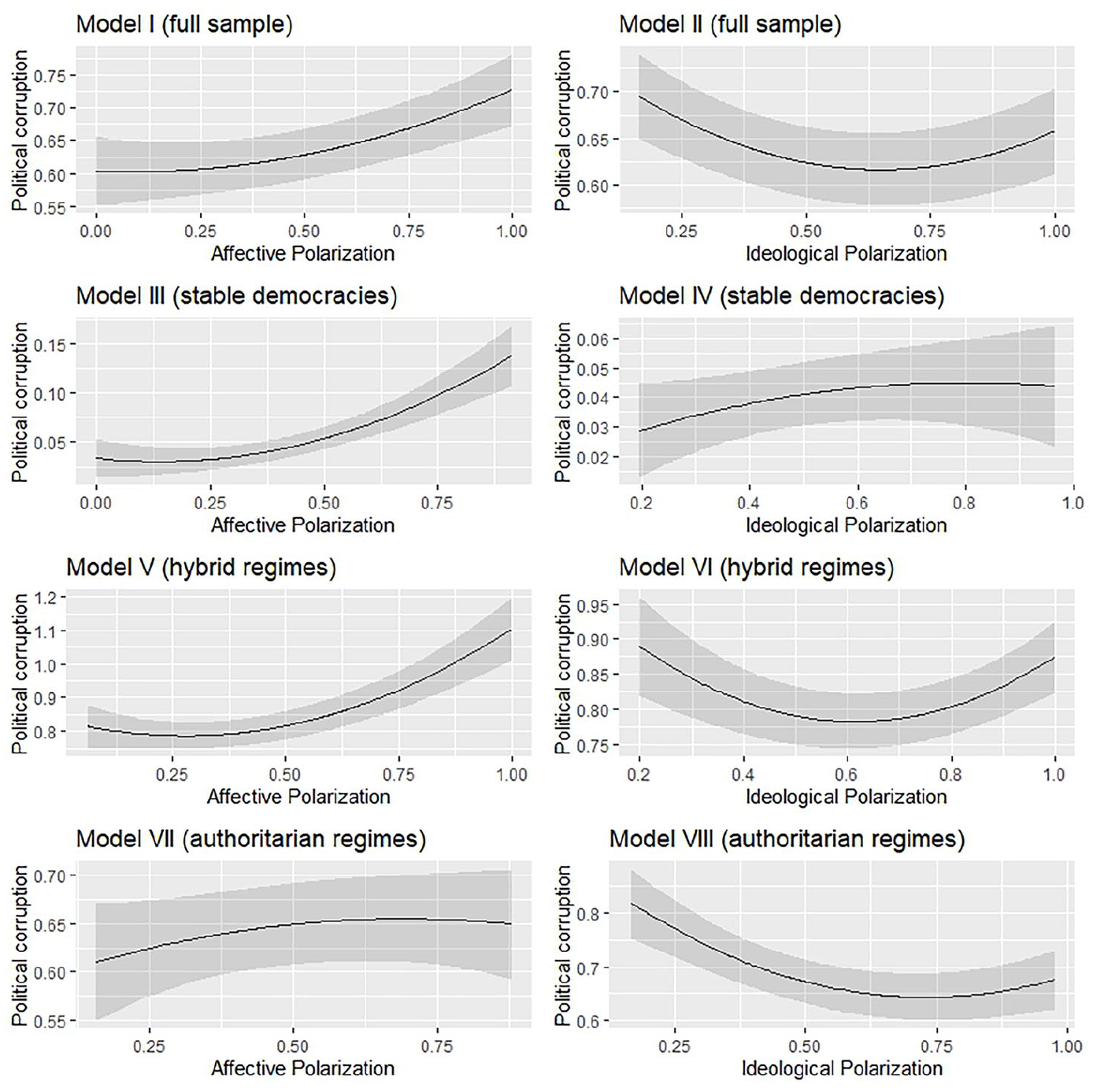
Marginal Effect Plots of Models I to VIII.
The following patterns can be observed regarding the moderating effect of regime type. First, the effect of affective polarization on political corruption in stable democracies (Model III) and hybrid regimes (Model V) takes the hypothesized shape (H1) and is slightly weaker in the former than in the latter group of countries. In authoritarian regimes (Model VII), however, both the linear and the quadratic terms of affective polarization are insignificant. Second, while the effect of ideological polarization on political corruption in hybrid and authoritarian regimes (Models VI and VIII) are in line with H2 and are roughly similar in magnitude to one another, in stable democracies the effect is insignificant (Model IV).
What explains that affective polarization does not influence political corruption significantly in authoritarian settings? H1 stipulates that high levels of affective polarization increase political corruption by subverting vertical accountability. In authoritarian settings, however, vertical accountability is generally weak, thus even if affective polarization undermines it, this effect is less pronounced. Notably, this argument does not imply that ideological polarization should also have a null effect in authoritarian settings (and neither is it the case). As visible in Figure 1, ideological polarization exerts a negative marginal effect on political corruption throughout almost the entire range of the former in Model VIII. Underlying this negative effect is a mechanism whereby ideological polarization incentivizes political competition, which in turn limits political corruption. This mechanism can unfold even in authoritarian settings characterized by limited vertical accountability (Levitsky and Way, 2020).
Why was the effect of ideological polarization on political corruption insignificant in stable democracies? Although Model IV is used to estimate the effect of ideological polarization in stable democracies, the large and significant coefficients of both of its terms in Model III with signs indicating an inverted U-shaped effect—in contrast to the hypothesized U-shaped relationship—are indicative of the former question. As noted above, affective polarization constitutes a mechanism variable (Békés and Kézdi, 2021) through which ideological polarization may affect political corruption. The coefficients of the linear and quadratic terms of ideological polarization in Model III (which includes affective polarization as a control), therefore, capture the part of ideological polarization’s influence that bypasses affective polarization. This suggests that ideological polarization exerts a significant inverted U-shaped (direct) effect on political corruption, whereas through affective polarization it also exerts a U-shaped effect, such that these two effects offset one another rendering the overall effect of ideological polarization insignificant (Model IV). In stable democracies, this mutually offsetting effect may be more pronounced than in hybrid and authoritarian regimes, as ideological divides may translate into affective polarization more directly and rapidly driven by higher levels of political engagement. 8
That said, it is important to emphasize that the insignificance of affective polarization in authoritarian regimes and of ideological polarization in stable democracies does not imply that the hypothesized effects are absent in countries in the respective groups. First, aggregate country-level indices are often criticized for low temporal sensitivity and validity (Kołczyńska and Bürkner, 2021). Although V-dem’s corruption indices outperform alternatives in this regard (McMann et al., 2016), descriptive statistics show that political corruption also exhibits relatively limited within-country temporal variance, particularly in stable democracies. Therefore, coefficients and significance levels may be lower estimates of the true effects. Second, the non-significant average effects within subsamples may mask strong effects in certain countries, which large-n methods cannot delineate. Third, the significance of average global marginal effects of both affective and ideological polarization—especially in light of the first point—underpin the presence of a robust general association between the variables. Consequently, the non-significant effect sizes in certain subsamples should not be interpreted as evidence of no effect. Both H1 and H2 are thus considered supported in spite of the heterogeneity in effects across the three subsamples.
The coefficient estimates of the control variables—inequality, per capita GDP, GDP growth, and year effects (not displayed in Table 1)—vary substantially across regime types both in terms of size and significance. This strengthens the case for utilizing subsamples for studying the effect of regime type, as the alternative approach of interacting a democracy variable with affective and ideological polarization could not capture the heterogeneous effects and would lead to less precise estimates.
To grasp the magnitude of the effect sizes, consider the following illustrative examples. First, the United States, a stable democracy, exhibited a notable surge in affective polarization between 2000 and 2021 (from 0.436 to 0.774, an increase of 0.338). According to Model III, this change in affective polarization is expected to induce an increase of 0.056 in political corruption, ceteris paribus. Second, Hungary, a hybrid regime, experienced a steep increase in ideological polarization (from 0.701 to 0.996, an increase of 0.296) during the same period. Based on the effect size estimates of Model VI, this change is expected to lead to an increase of 0.085 in political corruption. While these predicted changes may appear modest, they are nonetheless substantial (note that political corruption ranges from 0 to 1), underpinning the pivotal role of both affective and ideological polarization as drivers of political corruption.
Robustness
Although the models account for biases resulting from confounders, endogeneity may still be present through reverse causal mechanisms for two reasons. First, corruption undermines democratic norms and legitimacy (Dimant and Tosato, 2018) and fuels anti-establishment sentiments (Engler, 2020), which creates a fertile ground for affective polarization in societies. Second, high corruption levels may lead to the emergence of new political parties claiming to combat corrupt incumbents, resulting in a more fragmented and polarized political environment (Apergis and Pinar, 2023) and thus contributing to ideological polarization.
However, these reverse mechanisms, in contrast to the hypothesized mechanisms, take time to unfold. This delayed effect is evident in both mechanisms, as the erosive effect of corruption on democratic institutions is a slow and incremental process and the foundation of new political parties may take years. Conversely, the hypothesized mechanisms can be assumed to occur more rapidly, as potentially corrupt politicians (who often purposefully fuel polarization) are able to detect or even anticipate rising levels of polarization within a society. Moreover, by contrast to the hypothesized quadratic relationships, the reverse mechanisms described above are linear (at least, there is no evidence suggesting otherwise). This further underpins that the causation underlying the curvilinear relationships runs in the hypothesized direction, and not the other way around.
Further models to check the robustness of the results are included in Online Supplementary Material. In one set of models (Models I.a–VIII.a), democracy, as measured by the RoW (Coppedge et al., 2024; Lührmann et al., 2018), a four-item category variable, was added as a control. While the inclusion of democracy as a control leads to endogeneity bias (this is why it was excluded from the main models; see Data and methods section), this bias can be kept at a minimum using RoW, as it is less responsive to political corruption over the short run than continuous democracy indices. In another set of models (Models I.b–VIII.b), the executive corruption index by the V-Dem was used as an outcome variable. The effect size estimates were largely similar across all the aforementioned models, underpinning the robustness of the findings. Moreover, the low variance inflation factor (VIF) scores of the main independent variables indicate no risk of multicollinearity bias.
Conclusion
Although corruption plays a pivotal role in the global crisis of democracy and different forms of polarization have been shown to affect corruption through various mechanisms, extant research on the latter relationship remains fragmented and contradictory. The present article contends that a significant fraction of this ambiguity can be dissolved by delineating different types of polarization—namely, affective and ideological polarization—which yield distinct effects on political corruption and moving beyond the predominant linear assumptions about causal structures.
Based on a series of panel regressions, it was found that both affective and ideological polarization exert a nonlinear influence on corruption, albeit in different ways. First, moderate levels of affective polarization do not affect political corruption whereas higher levels of affective polarization lead to more political corruption, as antagonistic divides within societies undermine vertical accountability. Second, ideological polarization exerts a curvilinear U-shaped effect on political corruption. It incentivizes political competition and thus negatively influences political corruption until it reaches a tipping point. After the tipping point, the effect turns positive, as ideological divides induce partisan-motivated reasoning and affective polarization. Moreover, the analysis explored the moderating effect of regime type and found evidence of heterogeneous effects across different regime types.
In a broader sense, the findings reconcile two seemingly opposing views regarding the effect of ideological polarization on corruption. The presented mechanism behind the curvilinear effect (confirmed by the analysis) can accommodate both views, as it entails that depending on the extent of ideological polarization and the context in which it occurs, it can yield both a negative and a positive impact on corruption. These findings are in line with recent evidence on the effect on the effect of ideological polarization on citizen’s democratic attitudes: Torcal and Magalhães (2022) found that ideological extremism undermines support for democracy, whereas the perceived level of ideological polarization among parties exerts an inverted U-shaped relationship with support for democracy.
Moreover, the analysis confirms previous findings highlighting the erosive effect of affective polarization (Levitsky and Ziblatt, 2018; McCoy et al., 2018; McCoy and Somer, 2019; Orhan, 2022) by identifying a hitherto overlooked link between affective polarization and corruption. Notably, while the relationship between affective polarization and political corruption is curvilinear, the marginal effect of the former is either positive or close to zero, indicating that affective polarization never (or almost never) benefits corruption control. Finally, the findings showcase the importance of regime type as a moderating factor of the presented mechanisms and underpin the importance of considering the intricate ways through which institutional and contextual factors influence the sociopolitical effects of different forms of polarization.
Populist actors promote a polarizing narrative as they seek to reinvent and exacerbate social divisions (Norris and Inglehart, 2019). Similarly, populist attitudes have been demonstrated to foster affective polarization at the individual level (Pérez-Rajó, 2025). Therefore, the findings provide indirect support for a mechanism whereby an increase in populist sentiment leads to more political corruption. Once in power, populists may purposefully rely on this mechanism to seize public assets through corrupt transactions and further consolidate their power.
The main limitations of the study revolve around issues related to the operationalization and measurement of affective and ideological polarization and corruption. V-dem’s expert-based indices are often criticized for weak measurement validity and reliability. Nevertheless, despite their imperfections, these indices are capable of capturing the general patterns and trends of the underlying phenomena, and they have been widely employed in recent studies (see Note 4). Should better indices with broad geographical and temporal coverage be available, future studies can subject the mechanisms to further empirical scrutiny.
Recent works on corruption have emphasized the importance of delineating distinct forms of corruption (e.g. Ang, 2020; Hajnal, 2025). While it was beyond the scope of the present analysis to assess how polarization (and its subtypes) affect distinct forms of corruption, future studies could explore this domain. Finally, while the present analysis assessed how regime type moderates the relationship between polarization and corruption, this was an initial, explorative endeavor. Further research could examine this moderating effect in greater depth, potentially through the use of qualitative case studies.
Supplemental Material
sj-docx-1-psx-10.1177_00323217251324306 – Supplemental material for Two Tales of Polarization? How Affective and Ideological Polarization Influence Political Corruption—A Panel Analysis of 153 Countries Between 2000 and 2021
Supplemental material, sj-docx-1-psx-10.1177_00323217251324306 for Two Tales of Polarization? How Affective and Ideological Polarization Influence Political Corruption—A Panel Analysis of 153 Countries Between 2000 and 2021 by Áron Hajnal in Political Studies
Footnotes
Acknowledgements
The author expresses gratitude to William Lowe and other participants of the Data Analysis PhD course at the Hertie School of Governance for their valuable suggestions.
Declaration of Conflicting Interests
The author(s) declared no potential conflicts of interest with respect to the research, authorship, and/or publication of this article.
Funding
The author(s) disclosed receipt of the following financial support for the research, authorship, and/or publication of this article: This work was prepared with the financial and professional support of the project identified by EKOP-CORVINUS-24-018, which was supported by the National Research, Development, and Innovation Fund provided by the Ministry of Culture and Innovation, as part of the University Research Scholarship Program announced for the 2024/2025 academic year.

Supplemental Material
Additional Supplementary Information may be found with the online version of this article.
1. List of countries in the subsamples.
Table 1: List of countries in the three subsamples and Regimes of the World classifications.
2. Robustness checks.
Table 2: Results of the fixed-effect regression models (robustness check).
Figure 1: Marginal effect plots of Models I.a to VIII.a (robustness check).
Table 3: Results of the fixed-effect regression models (robustness check).
Figure 2: Marginal effect plots of Model I.b to VIII.b (robustness check).
Notes
Author Biography
References
Supplementary Material
Please find the following supplemental material available below.
For Open Access articles published under a Creative Commons License, all supplemental material carries the same license as the article it is associated with.
For non-Open Access articles published, all supplemental material carries a non-exclusive license, and permission requests for re-use of supplemental material or any part of supplemental material shall be sent directly to the copyright owner as specified in the copyright notice associated with the article.
