




Abstract
Populism is usually understood as a complex multi-dimensional phenomenon that encompasses different manifestations. However, most studies on the demand-side adopt a parsimonious minimal definition approach that hinders the ability to capture different forms of populism and the variable weight of its components. This article tests a new multi-dimensional strategy to measure and compare populist and pluralist attitudes in the context of Brexit Britain. We explore the relationship between populism and Britons’ socio-political views – on borders, democracy, governance, identity, and the European Union – and psychological traits – such as conspiracy belief, social alienation, justification of political violence, and meaning in life—. Our new Multi-dimensional Populist Attitudes Scale (MPAS) reveals two varieties of populism, ‘aspirational/subversive’ and ‘identitarian/protective’, and a non-populist ‘moderate/pluralist’ archetype. The new items introduced in the MPAS can complement (or become an alternative to) extant scales especially in contexts where populist movements do not fully fit narrow conceptualisations of populism.
Keywords
Introduction
The study of populism has historically focused on analysing populist movements and their leaders (Allcock, 1971; Berlin, 1968; Rovira-Kaltwasser et al., 2017). Only recently has the literature in populism turned its attention to measuring the demand-side of this phenomenon and have several scales been designed to capture populist attitudes among the public (e.g. Akkerman et al., 2014; Castanho Silva et al., 2018; Schulz et al., 2018). Populism is theoretically conceptualised as a complex and multi-dimensional phenomenon (Diehl and Bargetz, 2023; Olivas Osuna, 2021; Soares et al., 2024). However, existing scales of populist attitudes adopt a minimal definition approach and are mostly operationalised as one-dimensional indexes. While this choice serves the purpose of parsimony and comparability, it may also entail some drawbacks (Castanho Silva et al., 2020; De la Torre and Mazzoleni, 2019; Olivas Osuna and Rama, 2022; Van Hauwaert et al., 2020; Wuttke et al., 2020).
With a few exceptions (Erisen et al., 2021; Kruglanski et al., 2021), these populism scales are rarely combined with the analysis of psychological traits. Much can be still done to better understand the personality, emotional and motivational underpinnings associated with populist worldviews, and the support for populist parties and their discourses (Aslanidis, 2020; Bonansinga, 2020; Rovira-Kaltwasser, 2021).
This article introduces a new Multi-dimensional Populist Attitudes Scale (MPAS), which seeks to identify nuances and varieties within populism and explores some associations between populist attitudinal traits and a variety of psychological features – such as conspiracy mentality, social alienation (SA), justification of violence, radicalisation, and meaning of life. For this purpose, we designed an extensive survey – that includes a frequently utilised scale of populist attitudes, by Agnes Akkerman, Cas Mudde and Andrej Zaslove (Akkerman et al., 2014), alongside a wide range of other socio-demographic, political, and psychology-oriented questions – and launched it in the United Kingdom as a test case.
Populist leaders and their discourses became prominent objects of analysis during the Brexit era, but there is an abnormal scarcity of studies focusing on the demand-side populism in the United Kingdom. Rather than providing a representative picture of the degree of populism, 1 we seek to identify key attitudinal psycho-social factors associated to British populism. This is an exploratory study into the complex nature of populism and different typologies within that can pave the way for further research into the insufficiently explored intersection between populism and psychology studies. Our analysis confirms that populism, as reflected by the scale of Akkerman et al. (2014), is useful to predict certain political and social attitudes associated to British populism in the literature. However, we show that the new populism items introduced in the MPAS, not only perform well in terms of internal and external validity but also serve to reveal two distinct types of ‘populist’ profiles that extant scales have failed to capture: a somewhat left-leaning ‘aspirational/subversive’ type of populism and a right-leaning ‘identitarian/protective’ one. The former tends to display stronger discontent with political institutions, a higher degree of SA and search for meaning in life. The latter holds significantly more Eurosceptic, anti-immigration and authoritarian views and find that their lives are meaningful, despite feeling their identity threatened. MPAS also captures a non-populist ‘moderate/pluralist’ archetype that correlate negatively with the two populist profiles and with several attitudinal traits and indexes that the literature usually links to populism, but that cannot be simply considered the antithesis of it.
This article first outlines why researchers should pay more attention to the analysis of the demand side of populism. Next, it justifies the methodological choices, including the case study, the selection of items and scales included in the survey, and the strategy followed to assess the psychometric properties of the MPAS. This is followed by a discussion of the results and lessons drawn. Finally, we summarise our findings and some limitations of our study and suggest that a more multi-dimensional conception and operationalisation of populism would help to accommodate cases that do not sit well within the minimal definition approach, that underpins most current demand-side measurement tools.
The Analysis of the Demand Side of Populism
Populism cannot be consistently identified with a particular type of policies, political ideology, or socio-economic group (Müller, 2016: 11–19). While some researchers consider populism as a thin-centred ideology (Mudde, 2004) or define it as political strategy employed by charismatic leaders to reach or exercise power (Weyland, 2001), others focus on either the discursive (Jagers and Walgrave, 2007; Laclau, 2005) or performative nature of the phenomenon (Moffitt, 2016; Ostiguy, 2009). These approaches are complementary and mostly operate on different rungs of the ladder of abstraction, but they have different implications on how the concept is operationalised (Bonikowski and Gidron, 2016; Olivas Osuna, 2021).
Most studies focus on the supply-side of populism, for instance, by measuring support for populist parties (Taggart and Pirro, 2021), how they rule (Bartha et al., 2020), their party manifestos (Rooduijn and Pauwels, 2011) or populist leaders’ discourses (Hawkins, 2009), press releases and social media communications (Lacatus, 2019). The micro-level demand-side component of this phenomenon, – that is, individuals’ attitudes and underlying psychological mechanisms that elicit support for populist leaders, ideas, and proposals – was historically left out of populism research.
The relationship between the supply- and demand-side of populism is complex. Although several studies demonstrate that populist attitudes and beliefs, are strong among prospective voters of populist parties (Akkerman et al., 2017; Loew and Faas, 2019; Marcos-Marne, 2021; Mazzoleni and Ivaldi, 2022; Van Hauwaert and Van Kessel, 2018), other empirical works show that this relationship does not hold consistently across different countries/regions or the left-right ideological spectrum (Castanho Silva et al., 2022; Jungkunz et al., 2021; Olivas Osuna and Rama, 2022; Rovira-Kaltwasser and Van Hauwaert, 2020) or question that people holding populist views are significantly more electorally receptive to candidates’ populist proposals (Neuner and Wratil, 2022).
Populism has been theoretically and empirically connected with problems of political representation (Castanho Silva and Wratil, 2021; Laclau, 2005; Roberts, 2016). This implies that populist attitudes often emerge when voters do not perceive any political party as close to their interests. In countries where the electoral system favours concentration of votes, like the United Kingdom, strategic voting makes even more problematic to detect the growth of populist sentiment among the people via the analysis of electoral success of populist parties. Therefore, equating voters of ‘populist parties’ or supporters of ‘populist leaders’ with ‘populist individuals’ is a problematic assumption (Hawkins and Rovira-Kaltwasser, 2019: 7).
To truly unearth the roots of populism in society it is important to also investigate the demand-side of the phenomenon, that is, individuals’ psycho-social attitudes that may resonate with populist ideas, discourses, performances and strategies. Aware of this need, several researchers began to devise methods to compare the core political attitudinal traits linked to populism using survey questionnaires (Akkerman et al., 2014; Elchardus and Spruyt, 2016; Hawkins et al., 2012; Hobolt et al., 2016; Oliver and Rahn 2016). For example, Elchardus and Spruyt (2016) designed a four-item scale that tries to capture anti-elitist views and the idealisation of ordinary people. Oliver and Rahn’s (2016) introduced a scale that focuses on anti-elitism, mistrust of experts and national affiliation. Hobolt, Anduiza, Carkoglu, Lutz and Sauger (2016) included in the Comparative Study of Electoral Systems (CSES) Module 5 an instrument to measure populism with seven items that reflect the disconnect between ordinary people and elites, and whether the former should have the final say in important policy decisions. Similarly, Schulz, Müller, Schemer, Wirz, Wettstein and Wirth’s (2018) 15-item scale focuses on anti-elitism, popular sovereignty, and the construction of the people as homogeneous and virtuous.
The most widely used instrument is Akkerman et al.’s (2014) scale (Castanho Silva et al, 2020). Built upon the work of Hawkins et al. (2012), it seeks to capture three theoretical dimensions of populism: the notion of popular sovereignty, anti-elitism, and a Manichean worldview (Online Appendix Table A1). Initially tested in the Netherlands, it was later used in a variety of case studies and cross-country comparisons and has proven a significant ability to explain support for populist movements in Europe (Akkerman et al., 2017; Geurkink et al., 2020; Van Hauwaert and Van Kessel, 2018).
The Akkerman et al.’s (2014) scale tends to perform better than most extant populism instruments, but it still presents some drawbacks (Castanho Silva et al., 2020). For instance, studies based on this scale have revealed a more limited capacity to explain populism in non-European contexts and a differential ability to capture supporters of left and right-wing parties (Hawkins et al., 2020; Rovira-Kaltwasser and Van Hauwaert, 2020). Some of the scale items tend to elicit similar responses across participants, what reduces its ability to discriminate individuals that could be considered as populists or strongly populist from non-populist individuals (Castanho Silva et al., 2020; Van Hauwaert et al., 2020). Moreover, when its theoretical subdimensions are aggregated, it becomes difficult to discern which of them explain better certain correlations between populism and other relevant socio-political attitudes (Marcos-Marne et al., 2024). Most studies using the abovementioned populism scales, rarely analyse separately their attitudinal components 2 which limits the capacity to distinguish between different mechanisms and manifestations of populism and risk turning populism into an overly narrow prototype (Diehl and Bargetz, 2023). Akkerman et al. operationalise populism as a single dimension, what hinders the ability to analyse varieties of populism. Other authors have demonstrated the value of supplementing Akkerman et al.’s (2014) scale with the inclusion of additional items to help disentangle the dimensions that theoretically underpin this ideational conceptualisation of populism (Van Hauwaert et al., 2020) or to incorporate other dimensions, such as populist leadership (Kefford et al., 2021) in the analysis.
Extant measures fail to sufficiently distinguish between the core components of populism or adequately account for the underlying framework that connects them. While most scales reference populism’s key elements – its focus on ‘the people’, its opposition to elites, and its Manichean worldview – they rarely enable researchers to explore how these dimensions interact or assess the relative importance of each, a limitation that becomes particularly relevant given that ‘populist attitudes are complex psychological constructs, which lack the empirical consistency often attributed to them in theory’ (Kenny and Bizumic, 2024: 717). In addition, current studies on the demand-side of populism tend to fall short in capturing the heterogenous ways in which the populist ‘people’ is constructed in populist discourses (Roch and Cordero, 2023).
Our proposal of a new instrument to measure populist attitudes – the MPAS – is grounded on a more multi-dimensional understanding of populism (Hameleers and de Vreese, 2020; Olivas Osuna, 2021) and the need to go beyond the minimal definition approach that inspires extant populist scales but also limits their ability to distinguish varieties within populism (De la Torre and Mazzoleni, 2019). MPAS seeks to better capture the usual anti-elitism and people centrism attributes that extant scales investigate, by introducing items with slightly stronger wordings to elicit more differential responses from individuals with a populist worldview. More importantly, we also try to represent other attributes that have been theoretically linked to populism but rarely incorporated in populist attitudes scales. For example, while the items by Akkerman et al.’s items refer specifically to political elites we explore a broader conception of the elites and anti-system/anti-status quo attitudes (Müller, 2016; Panizza, 2005: 3–4). We test several items that refer to the moral nature of the populist antagonism and the attempts to delegitimise the ‘other’ (Arato, 2013; Mudde, 2004). Likewise, we add items that express a romanticised conception of society with a homogeneous people and static identities (Olivas Osuna, 2022; Taggart, 2000: 3–5), as well as others that show a preference for majoritarian rule and direct democratic instruments (Canovan, 1981: 177; Mohrenberg et al., 2021). Finally, we incorporate items suggesting strong personalistic leadership (Laclau, 2005: 99–100; Taggart, 2000: 100–103). 3
Methodology
Case Selection
The United Kingdom is an interesting case-study for several reasons. Although many authors analyse the supply-side – for instance, investigating political speeches (Tindall, 2022), media coverage (Deacon and Wring, 2016), electoral manifestos (March, 2017) and governance (Jennings and Lodge, 2019)—there is an abnormal scarcity of studies on the demand-side of populism in the United Kingdom. The few studies that do it, approach it via proxy measures such as analysis of political trust or satisfaction with the British democracy (Jennings et al., 2020) or focus on a specific subset of the population (Zanotti and Rama, 2021). Equating populism with the analysis of the electoral performance or support for populist parties is especially problematic in the case of the United Kingdom. Using the PopuList party classification (Rooduijn et al., 2019), Taggart and Pirro (2021: 285–291) show that populist party vote share in 2019 national elections was only 3.2% in the United Kingdom. Citizens with populist views do not always or only vote for ‘populist parties’ (Koch et al., 2021; Neuner and Wratil, 2022). Hence the need to directly investigate individuals’ populist attitudes and seek alternative indicators for external validity.
Moreover, British populism has been linked to a wide variety of factors, such anti-establishment rhetoric (Mair, 2002: 92–94), a cultural backlash against ongoing changes in social values (Norris and Inglehart, 2019), a sense of nostalgic deprivation (Gest et al., 2018) and a reaction against economic neoliberalism (Hopkin and Blyth, 2019).
Nonetheless, Euroscepticism is the phenomenon that is most frequently connected to populism in the British context. Historically, left- and right-wing Eurosceptic politicians and media have appealed to the notion of popular sovereignty and re-imagined ‘Europe’ as a ‘other’ against whom building new British political identities (Bale, 2018; Gifford, 2006; Ruzza and Pejovic, 2019). While in the 70s, 80s and early 90s, Euroscepticism was linked to the Labour and Green parties, from 1997 onwards, it became more prominent within the Conservative Party and UKIP (Halikiopoulou et al., 2012; Van Elsas and Van Der Brug, 2015). The relationship between Euroscepticism and populism became evident during the Brexit referendum campaign and the emergence of new (cross-party) political identities: Leavers and Remainers (Clarke and Newman, 2019).
Our survey and analyses contribute to dissect British populism and assess to what extent different archetypes of populism are associated with support for specific political parties and the abovementioned factors suggested in the literature. Moreover, data were collected at a historically very relevant moment: the year when the United Kingdom formally quits the European Union.
Participants and Procedure
Our analyses are based on an original online questionnaire conducted across the United Kingdom between 17 November 2020 and 4 December 2020. A total of 849 responses were collected via Prolific Academic – a platform that is considered to provide high-quality panel data (Douglas et al., 2023; Peer et al., 2022). Those who failed the attention cheques, left the survey unfinished or completed it in an abnormally low time frame were removed from the study.
The final sample consisted of 748 participants (50.5% female, 49.2% male, and 0.3% non-binary), aged from 18 to 76 (M = 45.00, SD = 15.38). Of them, 15.6% completed basic or secondary education, 21.9% further education, and 62.4% higher education. Regarding their nationality, 91.8% were from the United Kingdom, and the remaining were immigrants (4.9% European, 1.4% Asian, 1.2% American, and 0.5% African). Regarding religiosity, 56.9% of the sample were agnostic or atheist, 34.1% Christian, 4.9% Muslim, and 4.1% practised other religions. Although not completely representative of the British population, this sample is appropriate for the purpose of testing a validating a psychology scale, such as the MPAS, and suggesting further avenues for research. 4
Measures
Our survey included overall 107 items. In this subsection, we briefly describe some of the most relevant types of items used in our analysis.
MPAS: The new items designed to capture populism were generated in a process combining deductive and inductive phases and several validation rounds. The initial items were designed to capture different theoretical dimensions and attributes of populism in the literature – antagonistic depiction of the polity, moral interpretation of political actors, idealised construction of society, absence of limits to popular sovereignty and reliance on charismatic leadership. One of the common criticisms to some of the items in previous scales is that some of the questions elicited similar responses across those presumed ‘populists’ and ‘non-populists’. For instance, the Akkerman et al.’s items ‘The politicians in the [Country] parliament need to follow the will of the people’ and ‘Interest groups have too much influence over political decisions’ may not help distinguish ‘populist’ from ‘non populist’ individuals in some countries or be affected by specific political contexts. Hence, the new items not only sought to introduce additional populism attributes that minimal definition approaches ignored but also items that could trigger a more discriminatory response.
The new MPAS items were assessed and revised via two online expert questionnaires responded by specialists in the field. The first one was launched in June 2019 and collected the responses of 10 authors in the field of populism who were asked to rate on 5-point Likert-type scale the degree the ‘representativeness’ and ‘clarity’ of each of the items and provided qualitative feedback on the items. A follow-up expert survey on in October 2019 was responded by nine of the experts participating in the first survey and served to assess the new amended wordings. Later a full-day seminar took place in November 2019 to prepare a pilot survey with 300 responses that was launched later the same month.
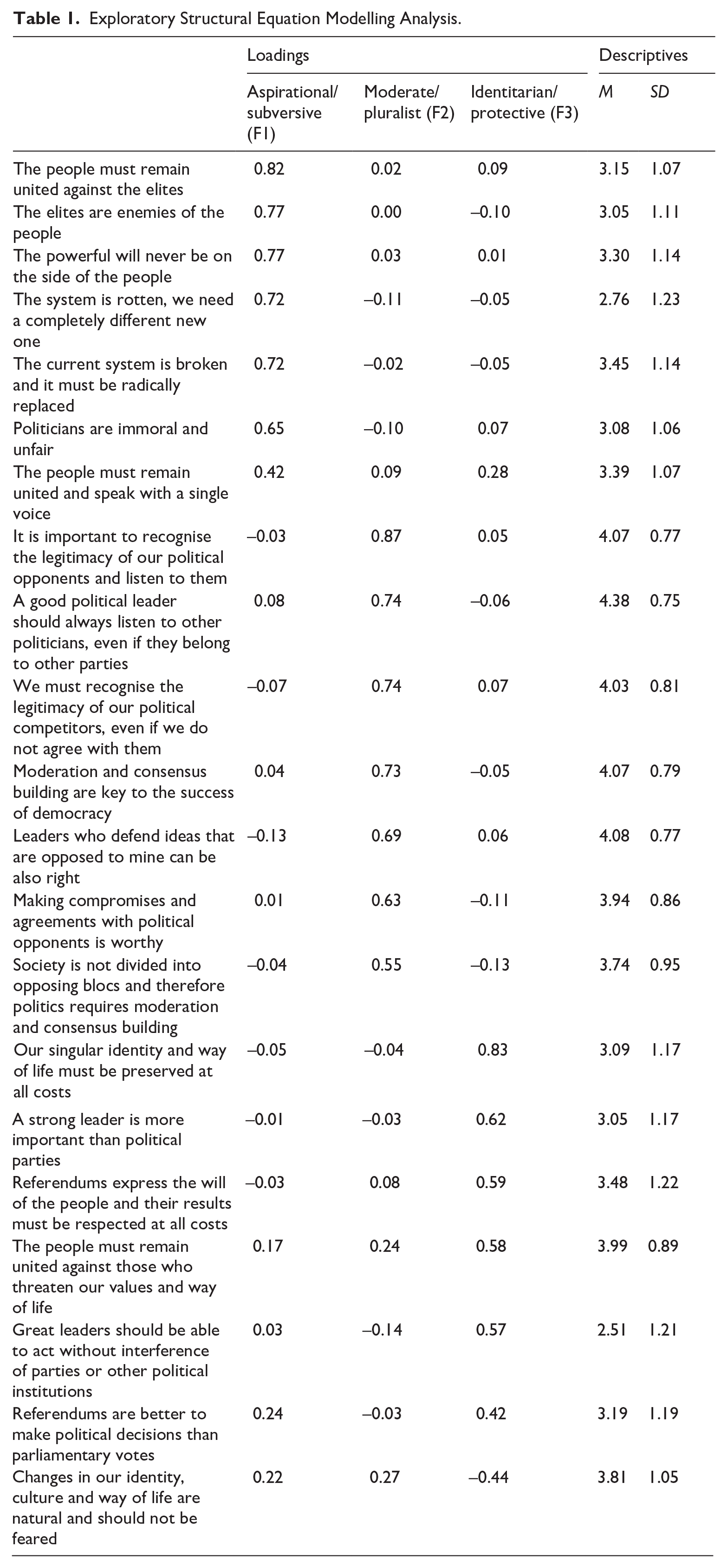
Based on the analysis of this pilot, we included in our UK survey 37 new populism-related items (Table A2 in Online Appendix for full list). Through an exploratory analysis – attending to the factor structure, goodness of fit, the presence of cross-loadings, and theoretical interpretability—21 items, that loaded into three distinct factors were retained. These factors are labelled taking into consideration the higher loading factors in each of them, as well as some significant correlations observed with other indexes used in the process of external validation – such as meaning in life, SA, pluralism, bordering attitudes, and so on – The first factor captures ‘aspirational/subversive’ (populist) attitudes – mostly reflecting negative views on the elites and the will to radically change the system –, the second factor (that correlates inversely with the other factors) reflects ‘moderate/pluralist’ (anti-populist) views – less confrontational approach to politics and preference for consensus building – and the third one with an ‘identitarian/protective’ (populist) belief – emphasis on preserving identity and strong personal leadership—(Table 1 in Results section). Although these populist archetypes, F1 and F3, emerged inductively from our analysis they resonate with theoretical depictions in the literature. The ‘aspirational/subversive’ is close to Canovan’s (1981) and Laclau’s (2005) archetypes of populist citizen, while the ‘identitarian/protective’ are better match to those in Wodak’s (2015) and Norris and Inglehart’s (2019) works.
Exploratory Structural Equation Modelling Analysis.
Akkerman et al.’s (2014) populist attitudes scale: This measure, which is inspired by Hawkins et al. (2012) includes eight items that represent a view of the political world that combines a strong belief in popular sovereignty with a negative perception of politicians (Akkerman et al., 2014: 1333–1334). They try to capture three theoretical dimensions: anti-elitism, Manichean worldview, and popular sovereignty (Van Hauwaert et al., 2020: 8). This scale is consistently cited and used in comparative work on populist attitudes (e.g. Akkerman et al., 2017; Geurkink et al., 2020; Marcos-Marne, 2021; Van Hauwaert and Van Kessel, 2018) and, compared with most other populism scales, performs well in terms of internal coherence and external validity (Castanho Silva et al., 2020). In line with its authors, we operationalise this scale as a unidimensional additive index. The internal consistency of this measure in our sample was adequate (ω-total = 0.8, α = 0.72). We also include the ‘pluralism’ and ‘elitism’ scales from the same authors (Online Appendix Table A1).
Conspiracy beliefs: Conspiracy theory accusations are typical ways to morally delegitimise the ‘other’ and have been often associated to populism (Bergmann, 2018; Eberl et al., 2021). We included items from two different scales. First the ‘Conspiracy Mentality Questionnaire’ (CMQ; Bruder et al., 2013), that is a five-item questionnaire evaluating participants’ tendency to engage in conspiracy theories. Second, we included three items corresponding to one of the subdimensions of the ‘Generic Conspiracist Beliefs Scale’ (GCBS) related to personal welfare (Brotherton et al., 2013). To compute participants’ levels of conspiracist beliefs, the sum of the items was obtained. The internal consistency of each of the sets of conspiracy items (five for CMQ and the three for GCBS) in our sample was good (ω-total = 0.85, α = 0.89 for CMQ and ω-total = 0.85, α = 0.85 for GCBS) (Online Appendix Table A3).
Other sets of psycho-social items: Populism is often linked to a crisis of representation and social integration (Gidron and Hall, 2020; Roberts, 2016). We include six items from a scale of SA (Bélanger et al., 2019) that aims to measure detachment from social and cultural participation. The internal consistency of this measure in the sample was good (ω-total = 0.92, α = 0.87). As populist leaders often try to instrumentalise people’s sense of disempowerment and insecurities, we also include four items from a meaning in life scale (Steger et al., 2006) that captures people’s sense of own worth and place, two of the items reflect the search for meaning in life and the other two the presence of such meaning. The internal consistency in the sample was adequate (presence: ω-total = 0.91, α = 0.91; search: ω-total = 0.84 α = 0.78). Finally, populism is sometimes associated to extremism and vigilantism (Carlson, 2019; Jaffrey, 2021). We also assess support for political violence (SPV) via a simplified six-item version of a scale created by the same team of psychologists that introduced the former (Bélanger et al., 2019). Its internal consistency was fair (ω-total = 0.83, α = 0.76). Next, we include three items that assess personal proximity to a radicalised network (Moyano, 2011) (ω-total = 0.66, α = 0.65) (Online Appendix Table A4).
Bordering attitudes. Given the very important role that internal and external frontiers play in populist discourses as device for ‘othering’ and ‘exclusion’ (Laclau, 2005; Olivas Osuna, 2022) and centrality of immigration in populist discourses in the United Kingdom, we include six items about borders, three questions expressing preference for stricter border controls and three, that were reversed in the scale, expressing the opposite. These questions reflected economic and security arguments. The internal consistency of this measure was good (ω-total = 0.94, α = 0.89) (Online Appendix Table A5).
Brexit-related and other political items. Our survey includes a set of items which reflect some of the main slogans or arguments used by British Eurosceptics and attitudes that the literature theoretically connects with populism in the United Kingdom. We ask participants whether they think that there are places ‘left-behind’ or that ‘don’t matter’ to the government (Rodríguez-Pose, 2018); politicians and experts are ‘out-of-touch’ (Clarke and Newman, 2017); they feel European and Brexit would be positive for the United Kingdom and allow people to ‘take back control’ of their future (Menon and Wager, 2020); if globalisation is good for them (Colantone and Stanig, 2018) and believe their identity to be threatened (Browning, 2019). Since authoritarian values are often associated to populism in the United Kingdom (Norris and Inglehart, 2019; Zanotti and Rama, 2021), we also include four items used in the European Social Survey to measure social liberal views regarding absence of limits to police action, gender equality and same sex couples’ rights to adopt children (Online Appendix Table A6).
For most items, participants had to rate their degree of agreement in a 5-point Likert-type scale (1 =Strongly disagree, 5 =Strongly agree). ‘Self-perceived ubication in the traditional left-right axis’ uses a 11-point scale (Left = 0 – Right = 10) and the Bruder et al.’s (2013) conspiracy index uses a 7-point scale. Party affinity was captured with the question ‘Which party do you most identify with?’ and offered 10 options but we include in our analysis only the most popular ones.
Analytic strategy for the MPAS: To evaluate the psychometric properties of the new populism items, the following analyses were conducted. A descriptive analysis was first carried out, assessing the mean, standard deviation, skew, and kurtosis of the items.
The factor structure of the scale was examined afterwards, conducting a parallel analysis based on the polychoric correlation matrix of the items to determine the number of factors of a scale with categorical data (Garrido et al., 2013). This procedure generates 500 randomised datasets based on the observed correlation matrix of the items by Monte Carlo simulation and compares the eigenvalues of several factor solutions obtained with the empirical data (i.e. one factor, two factors, three factors, etc.) with the eigenvalues obtained with the simulated datasets. When the eigenvalues of the empirical data are below the expected eigenvalue for the simulated datasets, then adding new factors would not explain more variance of the item than the variance expected by chance.
An Exploratory Structural Equation Modelling (ESEM) was conducted once the number of factors for the dataset was determined, as this method allows to assess simultaneously the factorial structure of the scale (i.e. which items load on each factor), the presence of cross-loadings, and to examine correlated residuals between items (Asparouhov and Muthén, 2009; Marsh et al., 2014). We used weighted least squares with adjusted means and variances as estimation method since this procedure performs well with categorical data (Li, 2016). The oblimin rotation was also used, as we expected the factors to be correlated. Model fit was assessed using a combination of fit indices, with values of the comparative fit index (CFI) and the Tucker–Lewis index (TLI) 0.95 indicating good fit, values of the root mean squared error by approximation (RMSEA) below 0.08 and 0.06 indicating mediocre and excellent fit, respectively, and values of the standardised root mean residual (SRMR) below 0.08 indicating also good fit (Hu and Bentler, 1999; Li, 2016) (Online Appendix Table A7).
Once the factor structure of the new set of populism items was established, its internal consistency was assessed. To do so, Cronbach’s α and MacDonald’s ω-total were computed, with values above 0.70 indicating an adequate internal consistency.
Following the logic applied by Akkerman et al. (2014) and Elchardus and Spruyt (2016), we create additive indexes for each of the sets of items described above to explore correlations among them and between them and other variables in our survey. We also analyse the relationship with self-placement in the left-right axis and party identification. All analyses were conducted with R statistical package (R Core Team, 2021), using the psych library (Revelle, 2021), except for the ESEM analysis that was conducted with Mplus 8.2 (Muthén and Muthén, 2017).
Results
Factor Structure and Internal Consistency
The parallel analysis indicated that three factors were sufficient for the MPAS, as adding more than three factors does not contribute to explain more variance that the attributable to the random datasets (Figure 1).
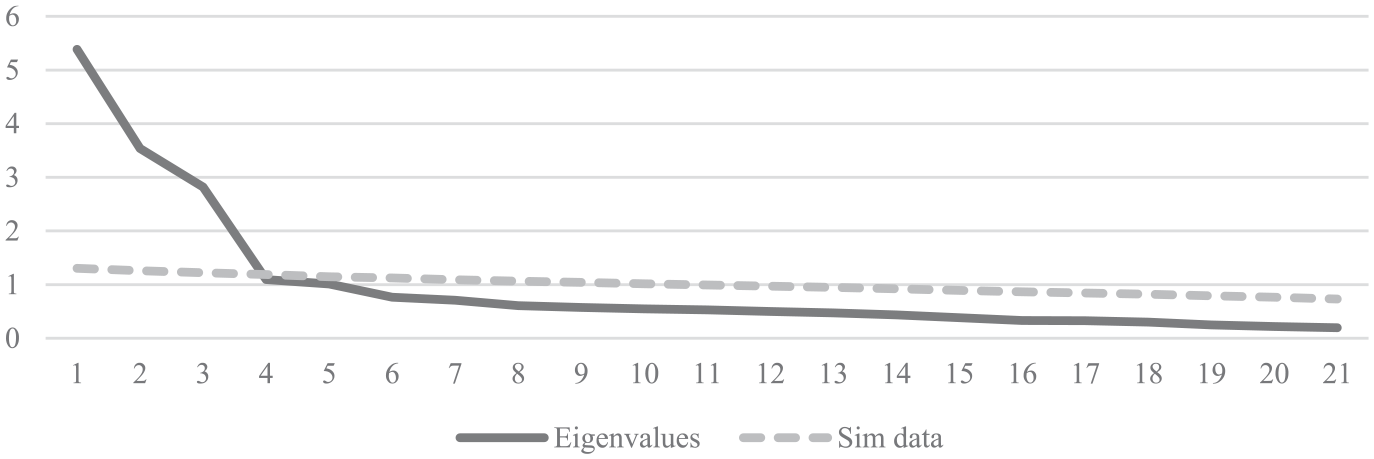
Parallel Analysis.
A three-factors ESEM was conducted afterwards (CFI = 0.91, TLI = 0.87, RMSEA [90% confidence interval (CI)] = 0.089 [0.084, 0.094], SRMR = 0.038). We inspected the residual correlations of the items and found that three pairs of items were strongly related: (1) ‘The current system is broken and it must be radically replaced’ and ‘The system is rotten and we need a completely different new one’; (2) ‘Society is not divided into opposing blocs and therefore politics requires moderation and consensus building’ and ‘Moderation and consensus building are key to the success of democracy’; (3) ‘Referendums are better to make political decisions than parliamentary votes’ and ‘Referendums express the will of the people and their results must be respected at all costs’. Given that each pair of items addressed similar aspects of the construct, we decided to allow their uniqueness to be correlated in the final model.
The new ESEM model showed a good fit to the data (CFI = 0.95, TLI = 0.93, RMSEA [90% CI] = 0.068 [0.062, 0.0], SRMR = 0.032). The items loadings are shown in Table 1. The first seven items presented factor loadings above in the first factor, with values above 0.40. We name this first factor as ‘aspirational/subversive’ (populist) attitudes given that high loading items reflect an opposition to the establishment and will to change it radically, as well as a positive correlation with the ‘search’ component of meaning in life indicator index (Steger et al., 2006), with SA and SPV (Bélanguer et al., 2019). Items 7 through 14 loaded onto the second factor, with factor loadings above 0.50. We named this factor as ‘moderate/pluralist’ (anti-populists) attitudes as the items with the higher factor loading indicate moderate political views and preference for consensus building, correlate positively with Akkerman et al.’s (2014) pluralism scale (PLU) and negatively with their populism one (POP). The last seven items loaded on the third factor—‘identitarian/protective’ (populist attitudes)—, presenting factor loadings above 0.40. This factor was named as ‘identitarian/protective’ (populist attitudes) because the items that display high loadings refer to the need to preserve identity and way of life and significant correlations with our bordering attitudes index and the ‘presence’ component in the meaning in life scale. Only two items from this third factor presented small cross-loadings, ‘The people must remain united against those who threaten our values and way of life’ and ‘Great leaders should be able to act without interference of parties or other political institutions’ (Online Appendix Table A7).
The correlation between aspirational/subversive factor (F1) and the identitarian/protective factor (F3) was null (r = 0.02, p = 0.563), whereas the relation of the of the moderate/pluralist (anti-populist) factor (F2) with the other two was negative (r = −0.18, p < 0.001, for F1 and r = −0.12, p = 0.001, for F2). This finding suggested that participants with higher levels of anti-populism tended to present lower levels of the other two factors. The internal consistency of each of the factors was adequate for the overall scale (ω-total = 0.86), and for the antagonism and morality factor (ω-total = 0.86, α = 0.85), the anti-populism factor (ω-total = 0.84, α = 0.84) and the leadership and sovereignty (ω-total = 0.64, α = 0.75).
Additional Validity Evidence
These results can be found in Table 2. We find a strong positive relationship between Akkerman et al.’s (2014) populist attitudes measure (POP) and both populist factors F1 and F3, and a negative one with the non-populist ‘moderate/pluralist’ factor (F2). The higher standard deviation in F1 and F3 seems to indicate that their items display a higher capacity to discriminate individuals than those in POP. A robust positive relationship emerges between the latter and the Akkerman et al.’s (2014) pluralism index (PLU). It is worth noting that identitarian/protective populism is positively correlated with the Akkerman et al. (2014) elitism index (ELI) (unlike F1 and POP). This result is in line with other recent studies that argue that populism cannot be simply equated to anti-elite views and suggest a more complex relationship between the two (Geurkink et al., 2020; Spruyt et al., 2023). We also find that the two conspiracy indexes included in our survey—Brotherton et al. (2013) and Bruder et al. (2013)—show a positive and moderate relation to F1 and F3, and a negative moderate relation to F2. This is consistent with the literature that predicts a correlation between populism and conspiracionism (Bergmann, 2018; Eberl et al., 2021).
Correlations Between Populism and Pluralism Indexes with Other Socio-Political and Psychological Indexes and Items.
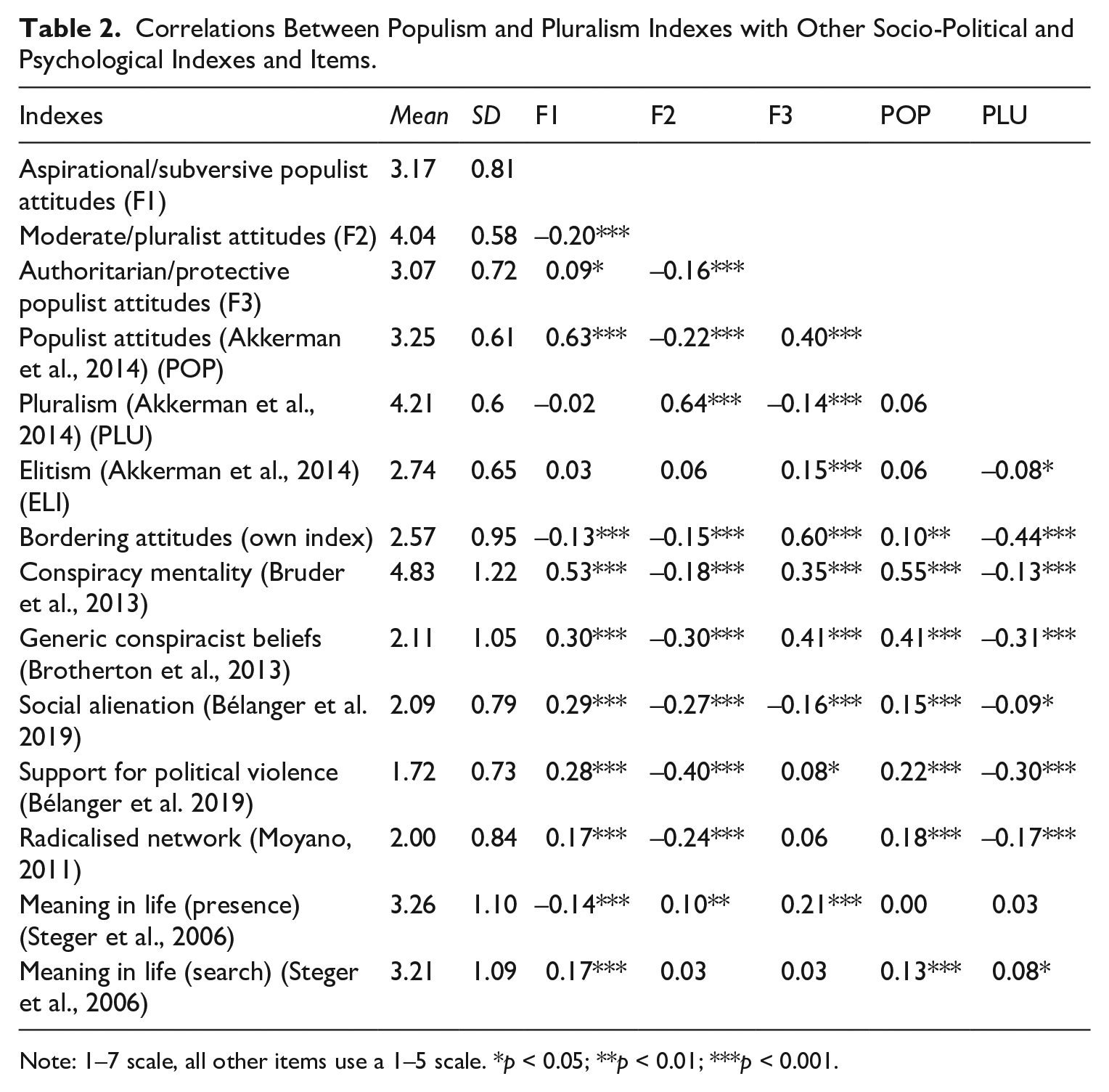
Note: 1–7 scale, all other items use a 1–5 scale. *p < 0.05; **p < 0.01; ***p < 0.001.
Taken together, our findings suggest that British participants with higher levels of aspirational/subversive populism (F1) tend to score higher in the Akkerman et al.’s populist attitudes scale (POP), display a higher degree of SA, a stronger positive correlation with the justification of violence (Bélanger et al., 2019) and radicalised network psychology scales (Moyano, 2011). However, they display a negative correlation with bordering attitudes – less inclined to favour the reinforcement of borders. These individuals show a positive correlation with search for meaning in life and a negative one with the items that capture presence of meaning in life (Steger et al., 2006). Meanwhile participants with higher levels of identitarian/protective populism (F3) in the United Kingdom tend to hold more negative views towards immigration – preferring stricter border controls – and a more frequent presence of meaning in life. The idealisation and instrumentalisation of the Brexit referendum by the Leave campaign, largely dominated by right-wing politicians, seem to have impacted the composition of the ‘identitarian/protective’ factor in this country. 5
Participants with higher levels of moderate/pluralist (non-populist) views (F2), as expected, score lower in conspiracy beliefs, SA, justification of violence, radicalised network and bordering attitudes. As expected, they score higher Akkerman et al. (2014) the PLU index.
The discrepancy shown by both types of populism regarding meaning of life – the aspirational/subversive one correlated positively with the search dimension ‘search’ and the identitarian/protective with the ‘preserve’ one – resonates with Porta Caballé’s (2021) theoretical argument on the relationship of populism and the concept of ‘void’. Drawing from Laclau’s conceptualisation of void not as an objective locus but as a type of identity (Laclau, 2005: 166, 169), Porta Caballé (2021: 70) suggests that it can be precisely the different constructions of the ‘people’ what can be a key to differentiate different types of populisms. While for ‘progressive’ populists ‘the people’ is construed as a void that they are seeking to fill, for ‘reactionary’ populists, it is an ‘essence’ that should not be altered. This differential attitude vis-à-vis meaning in life and existential voids deserves further attention and can lead us to a better understanding of the psychological underpinnings of different populisms.
MPAS and Party Identification in the United Kingdom
Aspirational/subversive populist attitudes are strongly correlated with left-wing self-placement and identitarian/protective populism with a right-wing one (Table 3). Although strategic voting has historically shaped the electoral behaviour in the United Kingdom (Alvarez et al., 2006), and our sample size is insufficient to produce a reliable picture of the entire country, we find that MPAS populism scores predict preference for some parties over other parties (Table A9–A12, Figures A1–A5).
Correlations between Populism and Pluralism Indexes with Other Socio-Political and Socio-demographic Items.
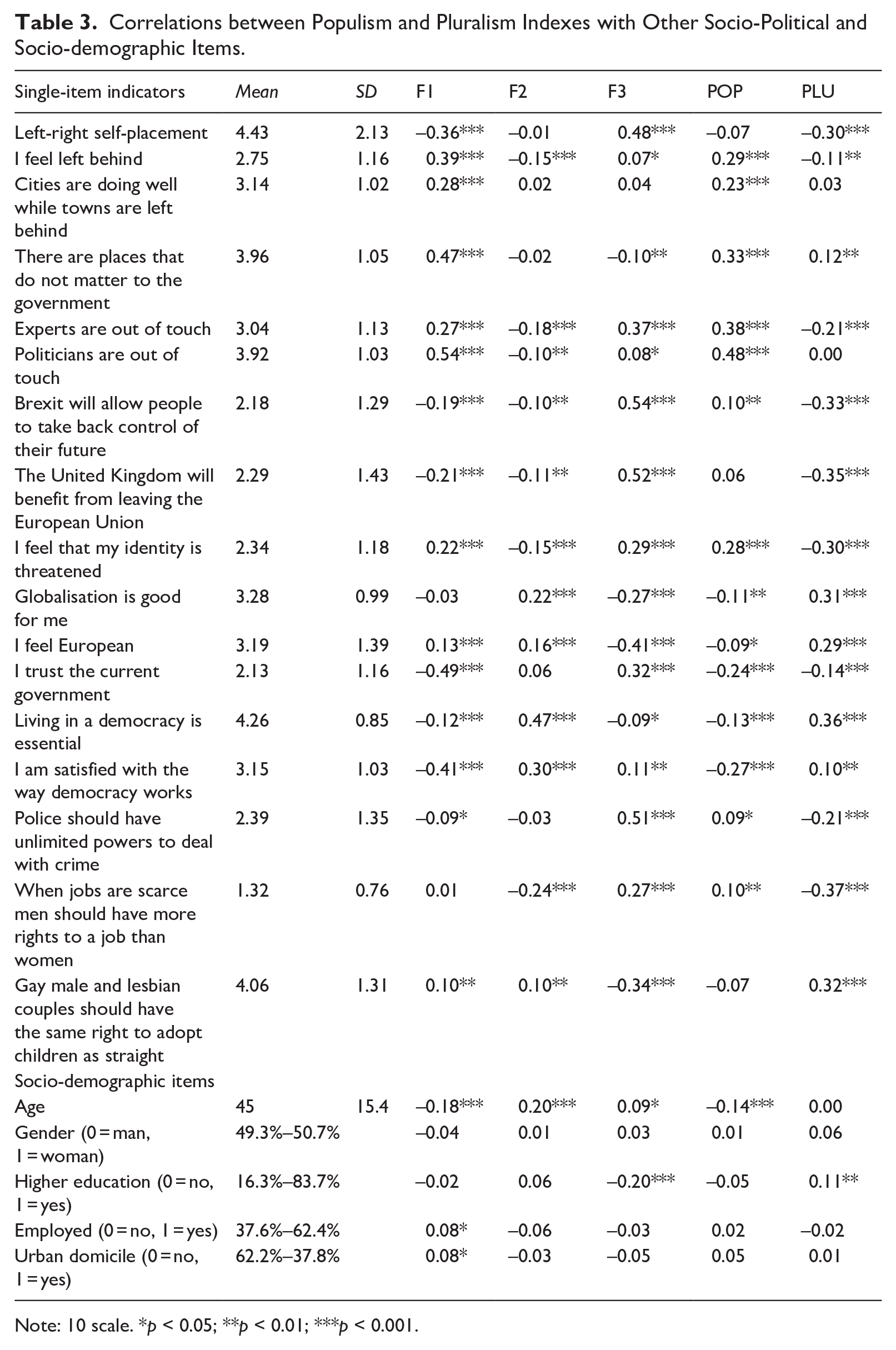
Note: 10 scale. *p < 0.05; **p < 0.01; ***p < 0.001.
We found significant differences in the aspirational/subversive factor (F1) depending on the vote casted (F[df] = 25.40[4], p = 0.013, η2 = 0.02). Tuckey post hoc analysis showed that voters from the conservative party exhibited significant lower levels in the aspirational/subversive factor (M = 2.74, SD = 0.81) than voters from Labour (M = 3.42, SD = 0.72), Green Party (M = 3.48, SD = 0.74), Liberal Democrats (M = 3.01, SD = 0.74) and Brexit Party (M = 3.32, SD = 1.00). Voters from Liberal Democrats also displayed significant lower levels in this factor than voters from Labour and Green parties.
Significant differences were also found in the moderate/pluralist factor (F2) depending on participant’s vote (F[df]= 3.74[4], p = 0.005, η2 = 0.020), with a small effect size. In this case, we found that voters from the Liberal Democrats presented higher levels in the moderate/pluralist factor (M = 4.22, SD = 0.57) than voters form the Brexit Party (M = 3.80, SD = 0.81) and Conservative Party (M = 4.00, SD = 0.53).
Regarding the identitarian/protective factor (F3), we found significant differences depending on participant’s vote (F[df] = 38.46[4], p = 0.013, η2 = 0.189), with a large effect size. Voters from Brexit party (M = 3.78, SD = 0.64) and Conservative Party (M = 3.47, SD = 0.58) showed higher levels in this factor than voters from Liberal Democrats (M = 2.96, SD = 0.63), Green Party (M = 2.70, SD = 0.70) and Labour Party (M = 2.86, SD = 0.71).
MPAS and Other Socio-Political Characteristics in the United Kingdom
The degree of agreement between these items and the factors identified by the MPAS serves to further delineate the two different archetypes of populism. The aspirational/subversive component of populism appears to be strongly correlated with a sensibility towards perceived inequalities and government neglect that had been identified in the context of Brexit (Watson, 2018). Thus, individuals scoring higher in F1 tend to feel ‘left-behind’ and to believe that towns are increasingly lagging behind cities and that there are places that do not matter so much to the government. This association is weaker with F3. Similarly, the lack of political trust – that has been found a key factor in the context of Brexit (Abrams and Travaglino, 2018)—is strongly associated with F1. Those scoring high in the aspirational/subversive populism score high in ‘Politicians are out of touch’ and low in ‘I trust the current government’ and in ‘I am satisfied with the way democracy works’. This level of discontent is not reflected in those displaying identitarian/protective populist attitudes, who tend to trust the Conservative government and are slightly more satisfied than the average respondent with their democracy. Both types of populists believe that experts are out-of-touch, feel that globalisation is not good for them and that their identity is threatened, as predicted by the literature in Brexit (Clarke and Newman, 2017; Colantone and Stanig, 2018; Gartzou-Katsouyanni et al., 2022; Virdee and McGeever, 2018). Neither F1 nor F3 are linked to the belief that ‘living in a democracy is essential’ which is strongly positively correlated with F2 (Table 3).
The position vis-à-vis the EU is a key diverging feature identified. Those scoring high in F3 do not feel European are largely optimistic about the benefits of Brexit and believe that leaving the EU would allow the people to ‘take back control’ of their future. This resonates with previous studies that found different degrees of Euroscepticism across populist movements (Plaza-Colodro et al., 2018). In addition, these identitarian/protective populists display a more socially illiberal stance than aspirational/subversive populists and moderate/pluralist respondents; as they tend to think that ‘police should have unlimited powers to deal with crime’, that ‘when jobs are scarce men should have more rights to a job than women’ and oppose to equal rights for gay male and lesbian couples regarding the adoption of children. Meanwhile, the populism scale by Akkerman et al. (2014) shows a low or null correlation with Eurosceptic attitudes, social liberal views, and trust in the government.
Finally, aspirational/subversive populists tend to be younger and those holding identitarian/protective views have less frequently a higher education degree. We do not find very strong correlations with the rest of socio-demographic variables analysed, such as gender, employment status, or place of residence (Table 3).
Conclusion
Most studies on the demand side of populism have used a minimal definition and operationalised it as a single variable. While this parsimonious approach facilitates comparability across cases, it may obscure the complex and diverse manifestations of populism that can be observed empirically in different historical and geographic contexts. This article introduces a new multi-dimensional measurement tool, the MPAS, and tests it via an extensive original survey in the United Kingdom. The survey encompasses a range of socio-political and psychological indices and indicators that can theoretically be linked to populism, though many of these presumed relationships have not been empirically tested before. Our exploratory structural equation model demonstrates that the new set of populism items in MPAS helps achieve a more nuanced understanding of British populism, than the popular Akkerman et al.’s (2014) populism scale (POP). We identify two considerably different typologies of populism: left-leaning ‘aspirational/subversive’ (F1) and right-leaning ‘identitarian/protective’ (F3); as well as a non-populist ‘moderate/pluralist’ (F2) archetype that is not correlated to any particular left-right ideological standpoint. Our analysis indicates that the ‘populist demand’ is not composed by a homogeneous group and that adopting a one-dimensional, ‘populist’—‘non-populist’, approach is problematic.
Our validity tests show that the two populist typologies, F1 and F3, are not only correlated with the Akkerman et al.’s (2014) POP index, but also with several psycho-social attitudes that the literature has connected with British populism and that appear unrelated to POP scores. Thus, the items associated to F1 and F3 can be employed as independent subscales to test certain hypotheses and predict behaviour patterns that may escape the one-dimensional POP index and similar ones. For instance, individuals scoring higher in the aspirational/subversive factor F1 display a stronger discontent with politicians, the British government and how democracy works, as well as a higher degree of social alienation (SA), feeling ‘left-behind’ and tendency to justify political violence more often than those matching the identitarian/protective archetype. The latter present more elitist, Eurosceptic, anti-immigration, anti-globalisation and authoritarian views. While these somewhat ‘reactionary’ populists claim to be well integrated in society and find that their lives are meaningful – despite feeling their identity threatened, left-leaning populist individuals are more prone to be in search for meaning in life and in touch with a radicalised network.
This study confirms a positive correlation between populist attitudes and conspiracy belief – in both MPAS’ indicators, F1 and F3, and Akkerman et al.’s POP index. The MPAS moderate/pluralist index (F2) presents a strong negative correlation with the Akkerman et al.’s POP index – stronger than these authors’ pluralism (PLU) index. These non-populist individuals tend to hold less-critical views on politicians, experts and globalisation, and score low in conspiracy indexes and in SA. This subscale is correlated to Akkerman et al.’s PLU index but it is not redundant, as our analysis reveal discrepant relationships with indicators such as, ideological self-placement – PLU is associated with left ideological self-placement, F2 is not, trust in the current government – PLU is negatively associated with it, F2 is not, age – F2 associated to higher age, PLU is not, and education – PLU is associated with having higher education.
We acknowledge some limitations to our study. First, the sample size, although appropriate for the purpose of validating a scale and conducting an exploratory empirical analysis of our research, hinders our capacity to measure the relative salience of the archetypes we have identified across the United Kingdom and the degree to which they are linked to specific political parties. Second, our survey does not allow us to specify the type of identity respondents primarily perceive as threatened – whether national, local, religious, sexual, or class identity. Third, the response to items referring to direct democracy and people’s sovereignty has been likely impacted by the polarising effect the Brexit referendum had in the British population. In other countries, the preference for referendums as decision-making tool seems less strongly correlated to right-wing populism, as preliminary analysis with MPAS in Greece, Italy and Spain shows. This is also an indication that socio-political contexts should be taken into consideration when measuring and comparing populist attitudes.
Despite these caveats, our paper presents relevant implications. Social scientists and commentators have often linked Brexit with populism. We have shown that Euroscepticism in the United Kingdom is only related to one of the two streams of populism identified: the identitarian/protective. Likewise, we confirm that populism cannot be simply reduced to its anti-elitism component as some of the proponents of minimal definitions have previously argued. In Britain, right-leaning populists (F3), although distrustful of intellectual elites, show a strong propensity to display elitist views (ELI) (F1 and POP display no correlations with ELI). The two types of populism discovered in the United Kingdom correlate but are not simply bound to left-right ideological self-placement and partisanship. They may share a common logic of articulation of discourses and ‘othering’ processes, but the socio-political and psychological specificities revealed by our MPAS, justify shifting towards slightly more ambitious/multi-dimensional instruments to measure the populist construct that may enable a better grasp of the existing varieties of populism.
Embracing multi-dimensionality and testing new populism items and other related socio-political and psychological factors for external validity entail a higher cost and a sacrifice in terms of comparability of data. However, these efforts can contribute to a better understanding of populism – its typologies, causes and effects – and can be a particularly appropriate strategy when investigating countries outside those that served as templates for the development of extant populism scales. Future research can lead to the development of shortened versions of the MPAS and facilitate its inclusion in large-scale social surveys.
Supplemental Material
sj-docx-1-psx-10.1177_00323217241309962 – Supplemental material for Varieties of Populist Attitudes in Brexit Britain: Socio-Political and Psychological Correlates of a New Multi-dimensional Scale
Supplemental material, sj-docx-1-psx-10.1177_00323217241309962 for Varieties of Populist Attitudes in Brexit Britain: Socio-Political and Psychological Correlates of a New Multi-dimensional Scale by José Javier Olivas Osuna, Manuel Martín, Juan Ramón Barrada, Manuel Moyano and Enrique Clari in Political Studies
Footnotes
Declaration of Conflicting Interests
The author(s) declared no potential conflicts of interest with respect to the research, authorship, and/or publication of this article.
Funding
The author(s) disclosed receipt of the following financial support for the research, authorship, and/or publication of this article: The authors acknowledge the support of the ‘Interdisciplinary Comparative Project on Populism and Secessionism’ (2018-T1/SOC-10152 and 2022-5A/SOC-24238) funded by Madrid’s Regional Government; of the project ‘Populism and Borders: a Supply- and Demand-Side Comparative Analysis of Discourses and Attitudes’ (PID2020-113182RA-I00) funded by the Spanish State Research Agency (AEI); and ‘Project DigiPatch,’ supported by NCN Poland, FORTE Sweden, DLR-PT Germany, AEI Spain, UKRI Economy and Social Research Council and UKRI Art and Humanities Research Council UK, under CHANSE ERA-NET Co-fund programme, which has received funding from the European Union’s Horizon 2020 Research and Innovation Programme, under Grant Agreement no 101004509.

Supplemental Material
Supplemental material for this article is available online.
Notes
Author Biographies
References
Supplementary Material
Please find the following supplemental material available below.
For Open Access articles published under a Creative Commons License, all supplemental material carries the same license as the article it is associated with.
For non-Open Access articles published, all supplemental material carries a non-exclusive license, and permission requests for re-use of supplemental material or any part of supplemental material shall be sent directly to the copyright owner as specified in the copyright notice associated with the article.
