




Abstract
While the diversity of populism has received considerable attention, surprisingly little is known about populist parties that defy clear-cut left-right categorization. We show that valence populist parties are non-positional and substantially different from both left-wing and right-wing populist parties. First, we demonstrate that valence populist parties deliberately take blurry positions on both the economic and socio-cultural dimensions of competition. Second, we show that such an ambiguity is counterbalanced by a disproportionate emphasis on anti-corruption appeals, the most paradigmatic example of a non-positional dimension. Our results have important implications for our understanding of varieties of populism, in particular, and the positional and non-positional competition strategies of political parties, in general.
In a seminal contribution, Paul Taggart (2004: 275) acutely argued that ‘populism tends to be highly chameleonic’. In recent years, by focusing on the interaction between populism (the ‘thin’ ideological element) and specific host ideologies (the ‘thick’ element), scholars have analysed how populist parties can be classified according to their positional character. Generally, by distinguishing between left-wing and right-wing populism (Mudde 2004) and, more recently, by using the category of ‘centrist’ populism (e.g., Učeň 2004; Stanley 2017).
Despite their differences, such approaches assume that populist parties can be meaningfully located in spatial terms. That is, left-wing, right-wing and centrist populism all point to a clear position. More recently, the category of valence populist party has been used to classify the parties that elude clear positioning along the left-right dimension and focus on issues such as anti-corruption appeals (Zulianello 2020). However, so far limited attention has been devoted to how valence populism presents distinctive features that separate it from both left-wing and right-wing populism, which are positional in nature.
In this research note, we use data from the 2019 Chapel Hill Expert Survey (CHES) (Jolly et al., 2022) to examine how valence populist parties differ from other political parties. Specifically, we show that valence populists are intrinsically non-positional. Valence populist parties deliberately display blurry positions on both the economic and socio-cultural dimensions, the two key axes of political conflict in contemporary party systems. In addition, we find that the elusive positions of valence populists are compensated by a predominant competitive focus on non-positional competition, most notably anti-corruption messages.
Our findings have important implications for our understanding of populist parties. First, we demonstrate the distinctiveness of valence populist parties that emphasize non-positional issues, which are particularly common in Central and Eastern Europe. Second, by shedding light on the so far underexplored non-positional dimension of populist politics, we challenge the tendency of the contemporary debate to treat the cases that do not neatly fit the ideological positional categories of left, centre, and right as residual or idiosyncratic.
The limits of positional approaches to understand populist parties
Research on populist parties tends to adopt an ‘ideational’ approach which views populism as a thin-centred ideology (Mudde 2004, 2017). Such an approach refers to a set of ideas grounded in an irreconcilable struggle between the ‘pure people’ and the ‘corrupt elite’ as well as the notion that politics should be, first and foremost, respecting popular sovereignty (Mudde 2004). Understanding populism as a thin-centred ideology addressing only a limited set of issues suggests that, in the real world, ‘almost all populist actors combine populism with one or more other ideologies, so-called host ideologies’ (Mudde and Rovira Kaltwasser 2017: 21).
Accordingly, populism is a receptive partner for full ideologies (Stanley 2008), and a growing body of literature has sought to classify and map the heterogenous universe of populist parties. The typical approach is to distinguish between left-wing and right-wing populism in order to identify sub-types within each broad group, such as the populist radical left and the populist radical right. In some cases, populist parties not clearly fitting neither the left nor the right are placed in a residual category (e.g., Rooduijn et al., 2019). In other cases, such parties are explicitly conceptualized as instances of ‘centrist populism’ (e.g., Učeň 2004; Stanley 2017).
The standard approaches to the study of populist parties in Europe are positional, as suggested by the usage of the terms ‘left-wing’, ‘right-wing’ and ‘centrist’ populism, or positionally-inspired, as those that lack a clear position in spatial terms are left unclassified or treated as idiosyncratic cases. Equally, important approaches which are meant to be alternative to the left-right categorization are still, implicitly or explicitly, inherently built upon positional premises, such as the distinction between inclusionary and exclusionary populism (e.g., Mudde and Rovira Kaltwasser 2013).
The literature suggests that there are two key dimensions of competition in contemporary European party systems (Jolly et al., 2022). First, an economic dimension (economic left vs right) - whose main point of contention is the role of the state in economic life. Second, a ‘non-economic’ dimension made up of socio-cultural issues (libertarian/postmaterialist vs traditional/authoritarian, the so-called GAL-TAN scale). In this respect, the underlying assumption of the positional approaches to the study of populist parties is that such actors do primarily engage in positional competition along the economic and/or socio-cultural spatial dimensions (e.g., left-wing and right-wing populists) or that a positional tendency, even if vague, is nevertheless so important to the point of becoming the criterion for labelling parties (e.g., ‘centrist’ populists).
Most notably, the terms ‘left’, ‘right’ and ‘centrist’ have an intrinsic and evident positional character. For instance, while radical left parties tend to present clear positions especially in the economic dimension (Gomez et al., 2016), radical right parties are characterized by sharp positions in the socio-cultural dimension and by blurred ones in the other dimension (Rovny 2013; Rovny and Polk 2020). Centrist populists, instead, ‘directly or indirectly refers to the ideological or geometric center of the party system’ (Učeň 2004: 47; see also Stanley 2017).
An exception to the positional and spatial paradigm is represented by the recent works on valence populism (Zulianello 2020; Zulianello and Larsen 2021) which underline the non-positional character and non-spatial emphasis of a specific group of populist parties. According to this alternative approach, some populist parties deliberately avoid a clear positioning in spatial terms and constitute a distinct and separate variety of populism in comparison to right-wing and left-wing populism. However, such an alternative approach remains largely theoretical and in need of an empirical examination.
Theoretical expectations
There are two major features of valence populists (Zulianello 2020). First, valence populists lack a clear positional character and do not have a thick ideological element: ‘their policy stances are primarily informed by an unadulterated conception of populism […] and are therefore flexible, free-floating and, often, inconsistent’ (Zulianello 2020: 332). Consequently, they are neither right-wing nor left-wing. However, they should not be considered as centrist either as the notion of ‘centrist party’ refers to an ‘ideologically positioned party’ (cf. Hazan 1997: 27).
Second, while valence populists lack a clear and meaningful position in the left-right political space, they primarily compete by putting emphasis on non-positional issues such as the fight against corruption, increased transparency, democratic reform and moral integrity (Zulianello 2020). Technocratic populism, for example, which relies on technical expertise and ‘promises a-political expert solutions that will benefit the “ordinary people”’ (Buštíková and Guasti 2019: 304; see also Havlík 2019), can be understood as a sub-type of valence populism.
The absence of clear spatial positions of valence populists and their emphasis on non-positional competition can be examined empirically by focusing on two distinct expectations, connecting our understanding of valence populist parties with the broader literature on populism and party competition (see also Breyer 2022).
The first expectation is rooted in the literature on dimensional party competition and position blurring. As Rovny (2013: 5) underlines, ‘some political parties may strategically avoid stances on some dimensions of multidimensional political conflict’ and ‘may attempt to project vague, contradictory or ambiguous positions’ on specific issues. Rovny (2013) further argues that position blurring can be a rational strategy in the context of multidimensional issue competition (see also Rovny and Polk 2020). For instance, ‘radical right parties emphasize and take clear ideological stances on the authoritarian fringe of the non-economic dimension, while deliberately avoiding precise economic placement’ (Rovny 2013: 19). Radical left parties, on the other hand, present very clear positions especially on the economic dimension (Rovny 2013) even though some heterogeneity emerges when it comes to New Politics issues (Gomez et al., 2016).
Hence, right-wing and left-wing populists display clear ideological positions, which are inspired by an underlying thick ideology (e.g., nativism in the case of the populist radical right), in at least one of the two key dimensions of competition of contemporary European party systems. Valence populists, instead, do not have a thick ideological element: they are expected to be substantially different and should display blurry positions. Accordingly, valence populist parties should lack a clear ideological position on both dimensions. We outline this expectation in Hypothesis 1.
Valence populist parties present more blurry positions on both the economic dimension and the socio-cultural dimension compared to other parties.
The second expectation is rooted in the literature on non-positional competition and valence issues. Challenging the Downsian model of competition, Stokes (1963) suggested that a range of topics are better understood as valence issues, which are consistently liked or disliked by the voters. Curini (2018) explains that valence issues are at stake when voters hold identical positions but prefer more to less or less to more. Most notably, in valence politics ‘there is no spatial variation in the locations of parties and voters, and there is no spatial competition’ (Clarke et al., 2009: 40). Already in the seminal work by Stokes (1963), corruption emerged as a typical example of valence issue, and the idea that political corruption epitomizes valence issues informs our second expectation.
Similar to how political parties can intentionally engage with position blurring (cf. H1), we expect that they also decide how much emphasis they put on valence issues, which are, by their own nature, non-positional. Accordingly, valence populists are expected to put more emphasis on valence issues rather than positional issues (cf. H2a and H2b), and do so more than populist parties with a clear ideologically positioned stance (i.e., right-wing and left-wing populists).
Valence populist parties put less emphasis on the economic and socio-cultural positional competition compared to other parties.
Valence populist parties put more emphasis on non-positional issues, such as anti-corruption appeals, compared to other parties.
Method and data
To test our hypotheses, we combine data from different sources. First, we rely on the categorisation of populist parties from Zulianello and Larsen (2021), an extensive dataset on the ideational varieties of populism from 1979 to 2019. Compared to other datasets in the literature on populist parties (e.g., Rooduijn et al., 2019), the dataset employed here goes beyond the dualistic approach to the classification of populist parties and maps, in addition to left-wing and right-wing populists, the key group of interest here, i.e., valence populist parties.
Second, we rely on the 2019 Chapel Hill Expert Survey (CHES) (Jolly et al., 2022). CHES 2019 provides unique information on the ambiguity or vagueness of party positions along the key competitive dimensions of contemporary European party systems: the economic (active role of government in the economy vs reduced role for government in the economy) and socio-cultural dimensions (libertarian/postmaterialist vs traditionalist/authoritarian). The two datasets are merged using Party Facts (Döring and Regel 2019). The countries covered with the data are Austria, Belgium, Bulgaria, Croatia, Cyprus, Czech Republic, Denmark, Estonia, Finland, France, Germany, Greece, Hungary, Iceland, Ireland, Italy, Latvia, Lithuania, Luxembourg, Malta, Netherlands, Norway, Poland, Portugal, Romania, Slovakia, Slovenia, Spain, Sweden, Switzerland, and the United Kingdom.
Overview of valence populist parties included in the 2019 CHES data.
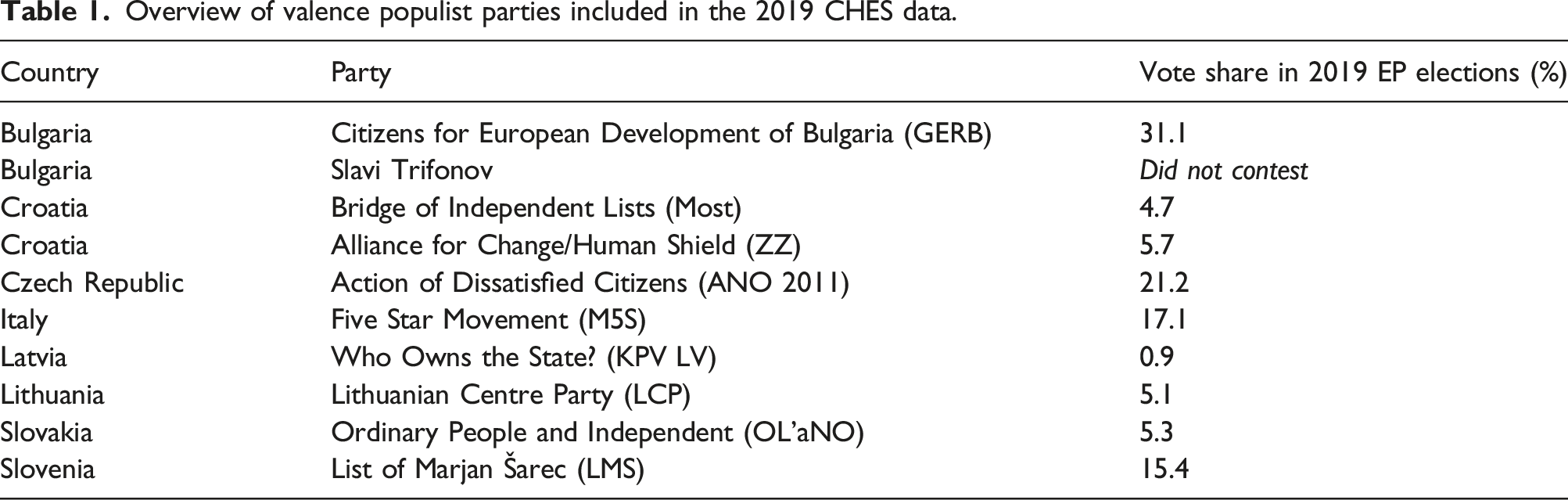
To capture the blurriness of party positions, we rely on two measures from CHES, namely ‘how blurry was each party’s position on economic issues in 2019’ (economic dimension) and ‘how blurry was each party’s position on libertarian/traditional issues in 2019’ (socio-cultural dimension). Both items are measured on a scale from 0 to 10 where 0 is ‘Not at all blurred’ and 10 is ‘Extremely blurred’.
For H2a and H2b, we focus on three items assessing the importance given by political parties to economic issues and socio-cultural issues (positional competition) and anti-corruption appeals (non-positional competition). The specific items are ‘salience of economic issues in the party’s public stance in 2019’ (economic dimension), ‘salience of libertarian/traditional issues in the party’s public stance in 2019’ (socio-cultural dimension), and ‘salience of reducing political corruption’ (anti-corruption appeals).
Descriptive statistics, blurry and salience scores.
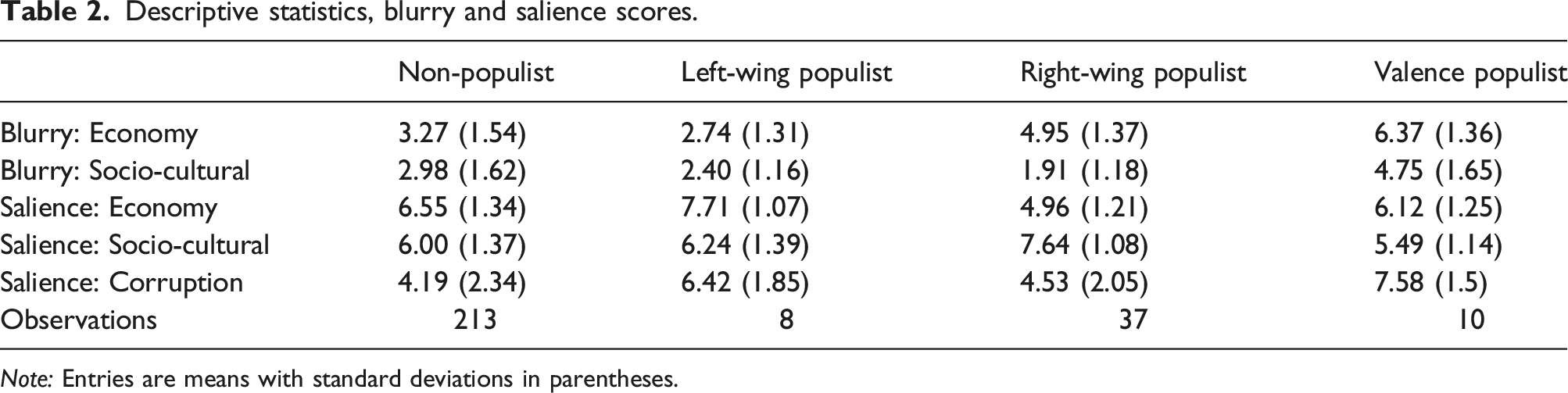
Note: Entries are means with standard deviations in parentheses.
Results
We are interested in two types of comparisons. First, the comparison between valence populist parties and the entire universe of non-populist parties. Second, the comparison between valence populists and the two other major ideational varieties of populism (i.e.. left-wing and right-wing populist parties). Figure 1 shows the positions of valence populist parties among all parties in CHES 2019 along the two dimensions of today’s European party systems: the economic and the socio-cultural dimensions. Position of valence populist parties, economic and socio-cultural dimension. Note: The labelled observations are valence populist parties.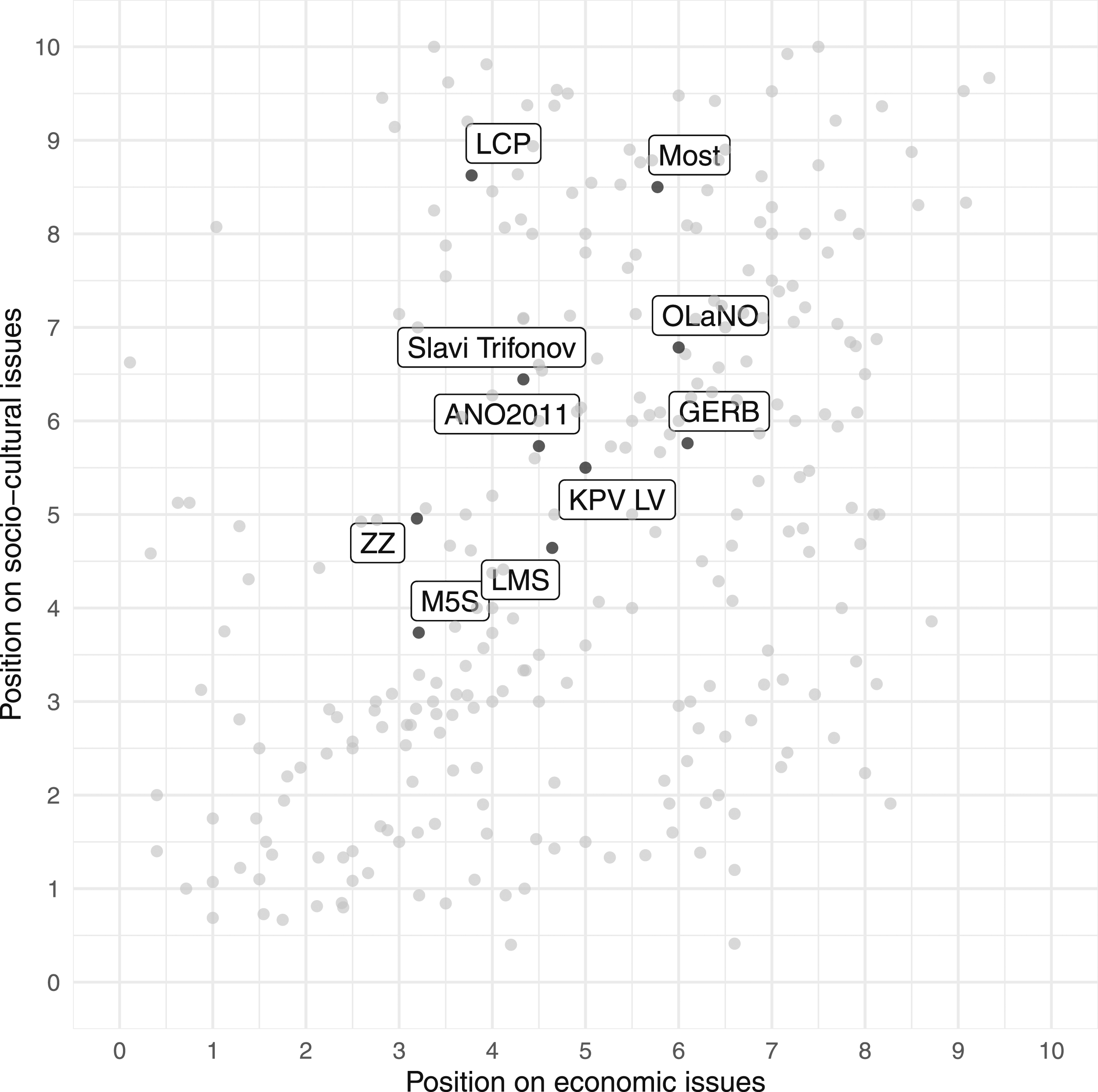
By looking at Figure 1, it might look like valence populists are ideologically centrist. However, as the analyses will demonstrate, such locations do not align with a centrist ideology. On the contrary, they are the outcome of deliberate position blurring and of the emphasis on non-positional competition. Figure 2 shows the position of all parties based on their blurriness on the economic dimension (the x-axis) and socio-cultural dimension (the y-axis). The further up into the upper-right corner, the more blurry positions a party will have on both economic issues and socio-cultural issues. The party labels for valence populist parties are also displayed in the figure. Blurry positions along the economic and socio-cultural dimensions. Note: The labelled observations are valence populist parties.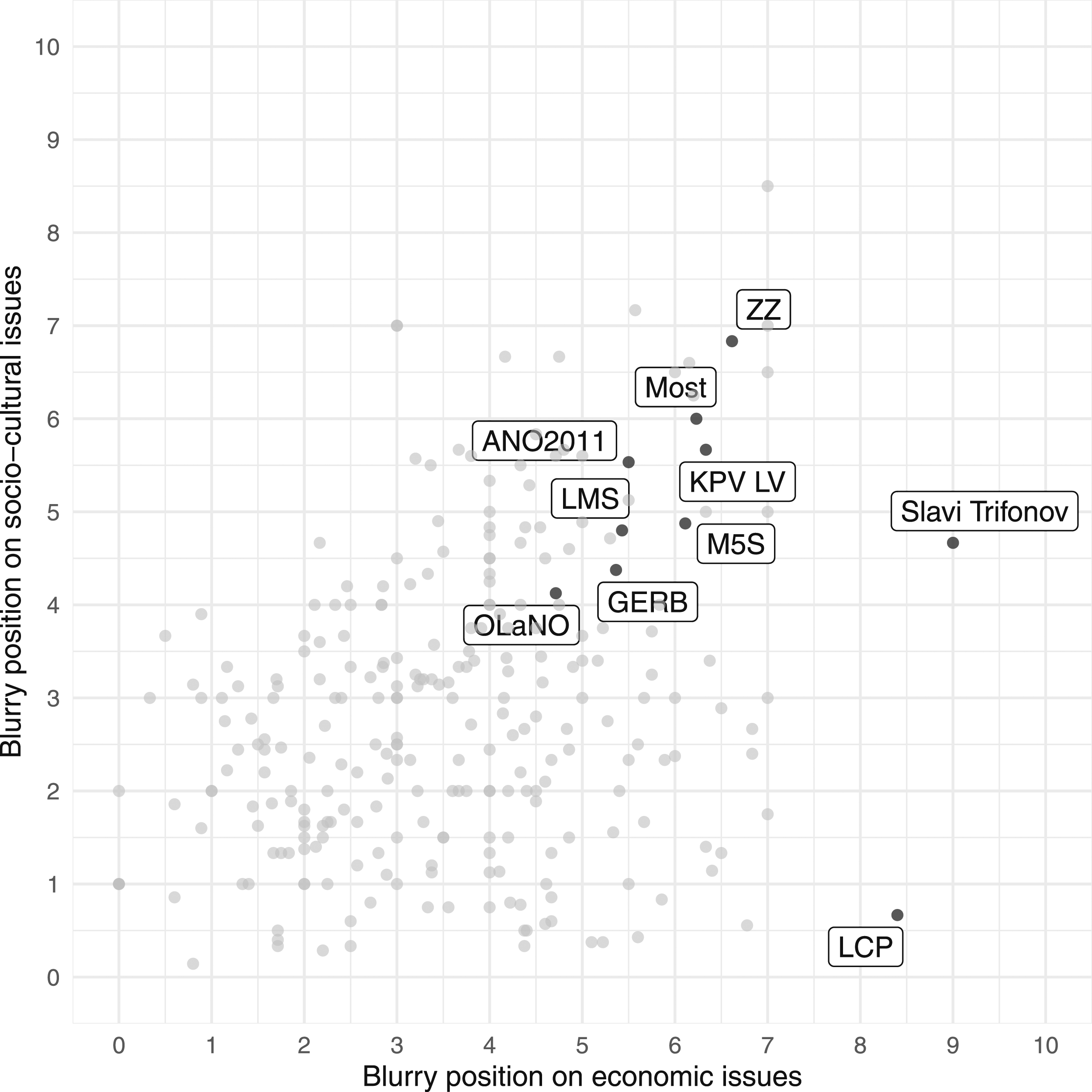
In Figure 2, we observe that valence populist parties are much more likely to have blurry positions on both the socio-cultural and economic dimensions. That is, on the key positional and spatial dimensions of contemporary European party systems, valence populist parties are, on average, more likely to have blurry positions. The partial exception is the Lithuanian LCP, only showing a blurry position on the economic dimension.
Blurry positions for the varieties of populist parties, OLS regression.
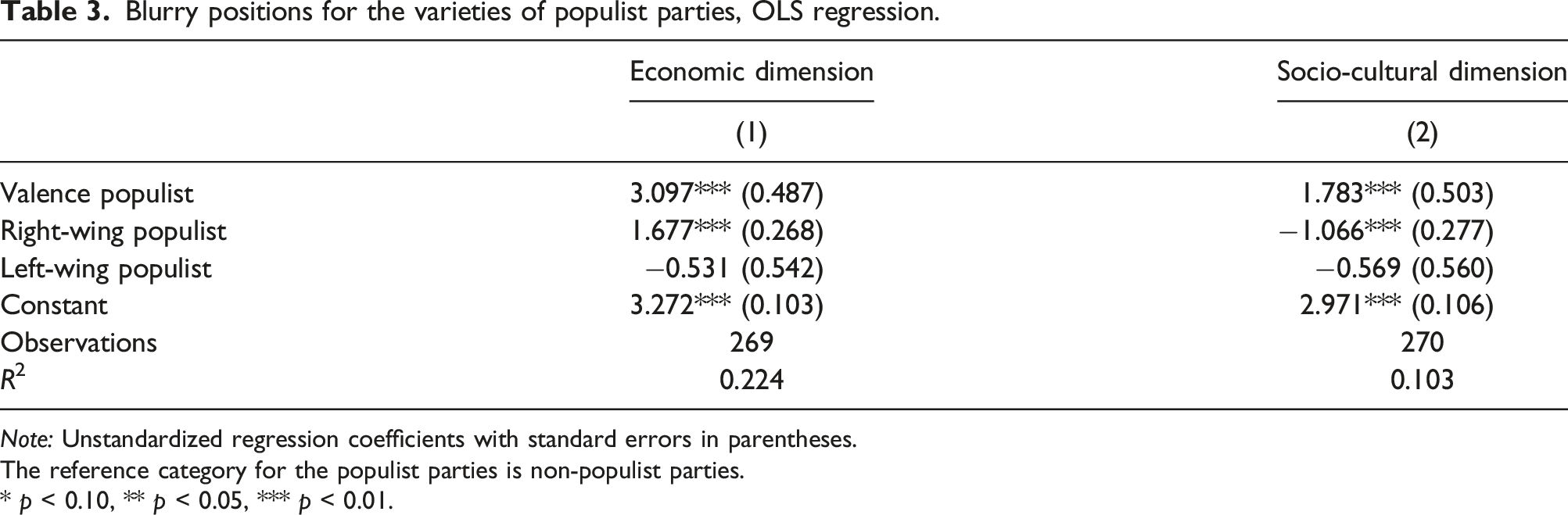
Note: Unstandardized regression coefficients with standard errors in parentheses.
The reference category for the populist parties is non-populist parties.
* p < 0.10, ** p < 0.05, *** p < 0.01.
In both models, we see that valence populist parties take statistically significant more blurry positions in comparison to non-populist parties. Interestingly, we do not see a similar pattern for right-wing populist parties. Right-wing populist parties show, on average, more blurry positions on economic issues but less blurry positions on socio-cultural issues in comparison to non-populist parties, confirming the previous findings by Rovny (2013) and Rovny and Polk (2020). For left-wing populist parties, we see no significant differences with non-populist parties for any of the positional dimensions.
Figure 3 shows the regression coefficients for the different populist parties, i.e., valence, right-wing, and left-wing populist parties (with non-populist parties being the reference group). The figure enables a comparison within the group of populist actors and highlights that valence populists have much more blurry positions on both the positional dimensions (i.e., economic and socio-cultural), suggesting a substantial difference in comparison to both left-wing and right-wing populists. Blurry positions, economic and socio-cultural dimensions. Note: Estimates with 95% confidence intervals. The reference category is non-populist parties.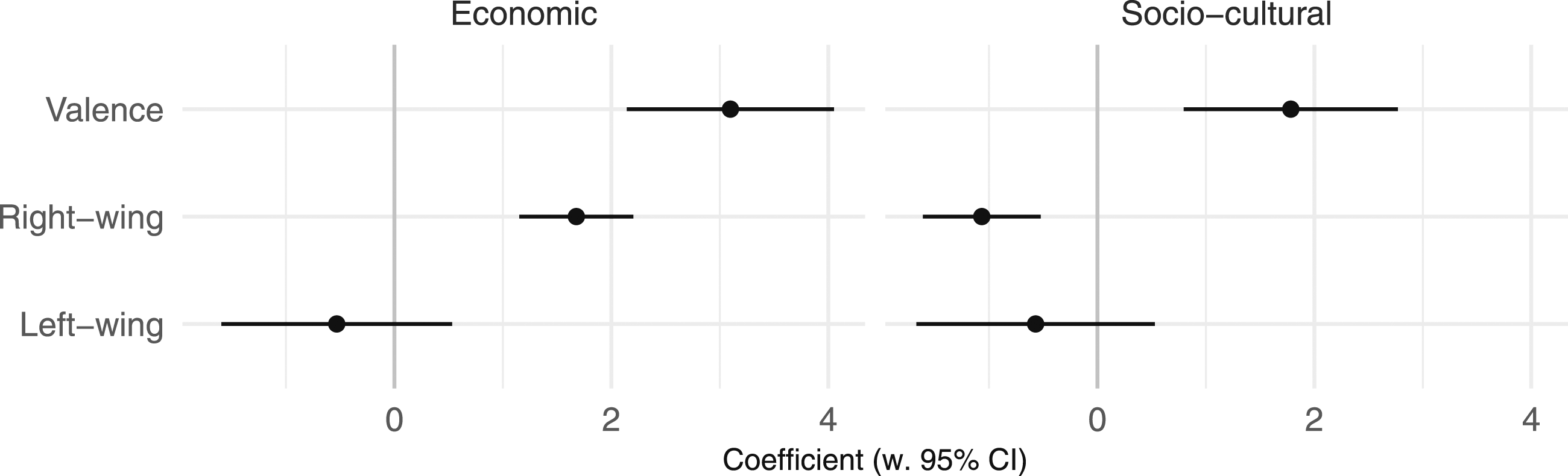
Salience of positional and non-positional dimensions, OLS regression.
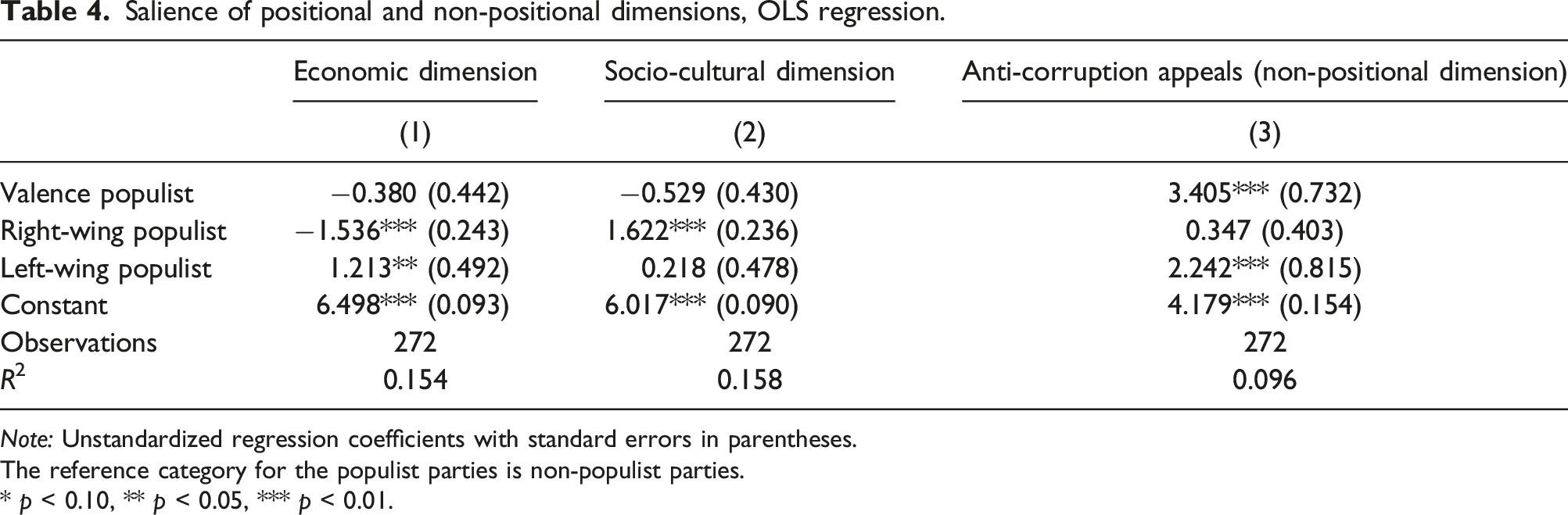
Note: Unstandardized regression coefficients with standard errors in parentheses.
The reference category for the populist parties is non-populist parties.
* p < 0.10, ** p < 0.05, *** p < 0.01.
While right-wing and left-wing populist parties emphasise anti-corruption appeals more than non-populist parties, they do so to a lesser extent than valence populist parties. More importantly, differently from valence populists, right-wing and left-wing populists also put more emphasis on the positional dimensions in comparison to non-populist parties, in line with our expectations. Specifically, left-wing populists focus more on the economic dimension, while the right-wing populists focus more on the socio-cultural dimension. These findings are further illustrated by Figure 4, which shows the regression coefficients for the different varieties of populism. Salient positions, corruption, economic and socio-cultural dimensions. Note: Estimates with 95% confidence intervals. The reference category is non-populist parties.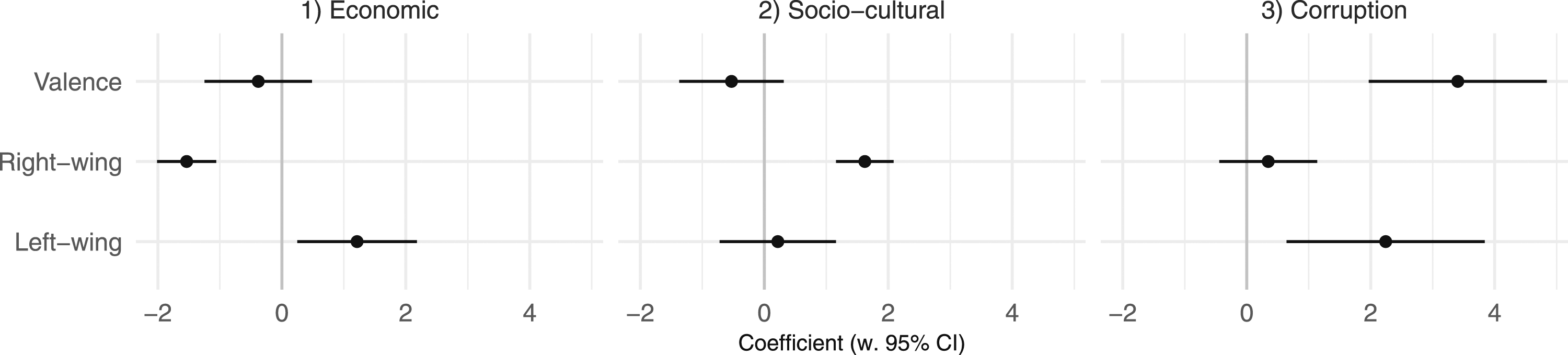
Finally, Figure 5 shows how salient corruption is for the different populist parties. On average, we observe that the valence populist parties are substantially more likely than other populist parties to see the reduction of political corruption as important. Salience of reducing political corruption, populist parties. Note: The darker bars are valence populist parties.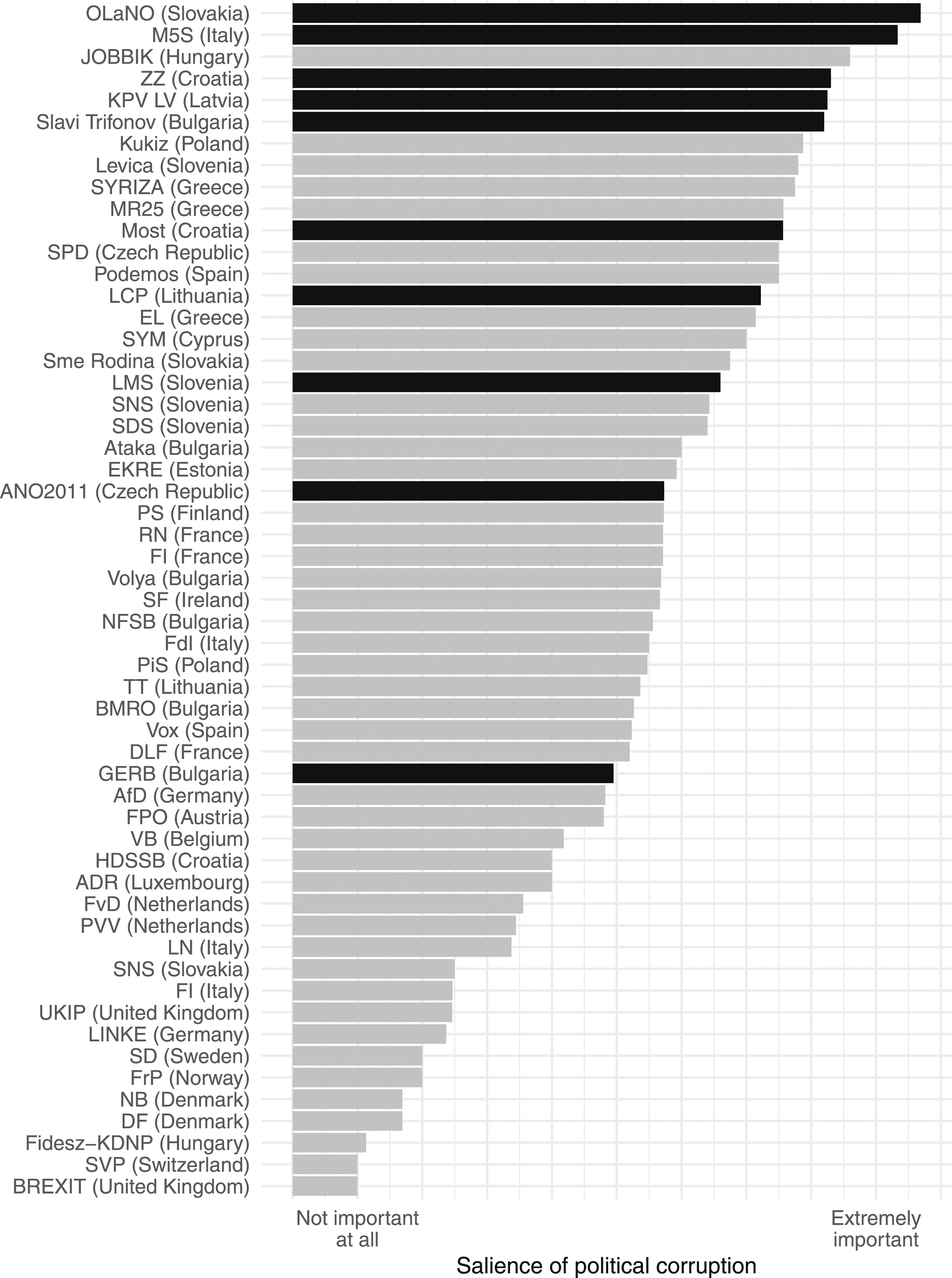
In sum, we find empirical support for the notion that valence populist parties are more likely to have blurry positions on both the positional dimensions of competition, i.e., the economic dimension and the socio-cultural dimension. Furthermore, valence populist parties focus on reducing political corruption, which is the most paradigmatic example of a non-positional (valence) issue. 3
Conclusion
Our results demonstrate that valence populist parties are substantially different from both right-wing and left-wing populist parties. The empirical analyses show that valence populists display blurry positions on the two key dimensions of competition of today’s European party systems, namely the economic dimension and the socio-cultural dimension. Furthermore, the analysis revealed that valence populists, while presenting ideological ambiguity and vagueness in positional terms, rely more on anti-corruption appeals (i.e., non-positional competition).
We maintain that the position blurring of valence populists can primarily be due to the lack of positions altogether along a specific dimension of competition and/or to the inconsistency of the stances adopted by the party. However, both the scenarios point to the absence of a thick ideology, and this explains why valence populists are intrinsically ambiguous. Specifically, party stances on the key positional dimensions of competition are not inspired by ideology but by other strategic, short-term and/or contextual motivations. Such positional ‘noise’ is originated by the lack of a thick ideological element; indeed, for valence populists, the only core ideological element is a thin one: populism itself (Zulianello 2020; Zulianello and Larsen 2021).
Our results suggest that future research can benefit from a deeper understanding of how and when populist parties engage in non-positional competition. Of particular interest are the competitive challenges that populist parties face in the medium to long term. For example, the positional ideological ambiguity of valence populists makes them prone to strategic and organizational conflict when they take part in coalition governments, as shown, for instance, by the recent split and tensions experienced by the M5S in Italy (Ansa 2022). Another promising route is assessing the potential capacity of the concept of valence populism to travel outside countries of the European Union, for example to study the profile of Volodymyr Zelensky’s Servant of the People prior to the Russian invasion of Ukraine, or to explore a plethora of populist parties that lack a clear ideological positioning, such as the Jacqui Lambie Network in Australia or the Pakistan Tehreek-e-Insaf.
The evidence presented here not only suggest that parties ‘may compete by deliberate position blurring’ (Rovny 2013: 20) but also highlights that positional competition may not be the defining feature of some political parties at all. This demonstrates how the term 'valence' populism is a better label than ‘centrist’ populism when describing parties such as the Czech ANO 2011, the Italian M5S and OL’aNO in Slovakia. While proponents of the latter concept argue that parties of this type ‘appear – whether by design or by omission – to be more moderate and “centrist”’ (Stanley 2017: 143), the very term ‘centrist’ has an evident disadvantage: it is inherently positional. Instead, this article has shown that positional competition is precisely what valence populists elude. Most notably, valence populist parties deliberately blur their positions on economic and socio-cultural issues while focusing their efforts on non-positional competition, especially anti-corruption appeals.
Supplemental Material
Supplemental Material - Blurred positions: The ideological ambiguity of valence populist parties
Supplemental Material for Blurred positions: The ideological ambiguity of valence populist parties Approach by Mattia Zulianello and Erik Gahner Larsen in Party Politics
Footnotes
Declaration of conflicting interests
The author(s) declared no potential conflicts of interest with respect to the research, authorship, and/or publication of this article.
Funding
The author(s) received no financial support for the research, authorship, and/or publication of this article.

Supplemental Material
Supplemental material for this article is available online
Notes
Author biographies
References
Supplementary Material
Please find the following supplemental material available below.
For Open Access articles published under a Creative Commons License, all supplemental material carries the same license as the article it is associated with.
For non-Open Access articles published, all supplemental material carries a non-exclusive license, and permission requests for re-use of supplemental material or any part of supplemental material shall be sent directly to the copyright owner as specified in the copyright notice associated with the article.
