




Abstract
Transnational political interest is the sustained attention to politics in at least two polities. Why do some immigrant-origin citizens show high levels of political interest in both their host countries and their familial countries of origin, some none, and others favour one over the other? With the 2017 Immigrant German Election Study, we describe the diverse patterns of transnational political interest among Germans from Turkey and their children, one of the largest immigrant-origin communities. We explicitly focus on the effects of three dimensions of integration and reveal that social integration has, by far, the strongest association with mean political interest. In addition, all dimensions of integration tilt the focus of political interest in favour of German politics, effects that are mediated by the individual identification with Germany and Turkey. Integration thus seems to activate immigrant-origin citizens into politics in general but tilts their transnational political interest towards host country politics.
Introduction
This empirical analysis focuses on transnational political interest among German citizens of Turkish descent. We define transnational political interest as the degree to which an individual pays sustained attention to politics in at least two polities, here Turkish and German politics. It is the connection of individuals to at least two political worlds, with ‘kaleidoscopic’ nuances. Such interest is the cognitive manifestation from which we can deduce how people do or do not connect politics from at least two polities.
Without any transnational political interest, a cosmopolitan and/or multi-plural democratic practice of citizenship is impossible. Transnational political interest can thereby occur irrespective of the institutional landscape of political actors or individual access to citizenship and is thus fully comparable across polities, different from, for instance, transnational electoral participation that is contingent on the electoral system and laws. As we will demonstrate, we observe diverse patterns of transnational political interest ranging from people with no interest in any polity over those with high interest in only one polity to those who show equal interest in both plus all nuances in between. Why do we observe such differences?
To understand transnational political interest among citizens of immigrant origin is relevant because naturalised immigrants and their descendants now constitute a sizable and rapidly growing group in most Western democracies (Bergh and Bjørklund, 2010; Geese, 2023; Schönwälder, 2013). For example, every 10th voter in the 2017 German federal election was a naturalised immigrant or descendent of immigrants (Destatis, 2018; Spies et al., 2020). We specifically focus on Germans of Turkish descent, a group that largely migrated as guest workers in the 1960s and 1970s and are now one of the most numerous groups in Germany (Mayer et al., 2024).
Immigrant-origin citizens show large variance as regards their integration in their host societies. Their family histories and language competences equip them to be political beings in two political worlds, that of the sending country and that of the country they reside in, with transnational political interest at the core. Integration as such comprises multidimensional adaptation into the majority population, sometimes also termed ‘assimilation’ or ‘adaptation’ (Heath and Schneider, 2021). From a political science perspective, we will use one conceptualisation of individual-level integration (Harder et al., 2018) as a heuristic device to structure our empirical analysis.
We thus analyse how their integration status translates into transnational political interest. Including an integration perspective allows us to analyse the full heterogeneity of patterns with which German citizens of the Turkish community are positioned in German society and to understand how the patterns translate into transnational political interest. Moreover, there is a hotly contested public debate in Germany about the interest in and involvement of the Turkish community in Germany in Turkish politics, and what it may mean as to their allegiance (Mayer et al., 2024).
Our data stem from the Immigrant German Election Study 2017 (IMGES) (Mayer et al., 2024); this relies on a random sample of German citizens of Turkish descent, which allows precise and unbiased estimates. This is the highest-quality data set on German voters of Turkish descent in Germany, among those are Turkish citizens only if they also have German citizenship. The Bundestag election in September 2017 is a particularly fruitful context for analysing transnational political interest in German and Turkish politics. April 2017 had witnessed a constitutional referendum in Turkey, changing the polity from a parliamentary to a presidential system. Turkey had already declined massively on the Freedom House Index of Global Freedom from ‘partly free’ to ‘not free’ because of the changes after the attempted coup in 2016. Arguably, therefore, the level of politicisation of the Turkish community in Germany as regards Turkish politics is likely to have been at its height (Adamson, 2019).
The article closes a gap by synthesising ideas from two distinct kinds of literature, political behaviour and immigrant integration research. Researchers contributing to the former aim at explaining how people think and behave in politics and researchers of the latter strive to explain the relationship between newcomers to a society and the host society. As we will demonstrate, the theoretical models in these literatures can be fruitfully combined as their implications are not mutually exclusive and add, when tested in a synthesised model, to our understanding of the world of transnational political interest among citizens of immigrant origin.
Furthermore, the analysis presented here is relevant beyond any particular interest in Germans of Turkish descent or in German politics because numbers of immigrant-origin voters are rising in many countries (Given, 2007; Schönwälder, 2013). The question of how part of this growing group deals with the possibility of political interest in more than one polity affects core qualities of modern democracies. As things stand, we do not know how this group divides or integrates their engagement in different political spheres. It may be that a genuinely new public sphere of transnational democratic discussion and participation is emerging along the lines of cosmopolitan citizens (Linklater, 1998): immigrant-origin voters can be equipped with access to several languages and several citizenships, such that they form a new class of postmodern citizens whose interests and activities can be split or concentrated in one or several polities in a self-chosen manner, which is unprecedented (Guarnizo et al., 2003). The more these voters are integrated into a host society, the more they are enabled to participate in both worlds rather than just one. It might also be possible, however, that even immigrant-origin citizens focus on only one of their worlds, the more they become integrated into the host society, according to the assimilation-mobility thesis and its newer adaptations (Alba and Foner, 2015; Nelson, 1982).
Arguably, transnational political interest is a necessary condition of cosmopolitan citizenship but not a sufficient one. Our minimalist definition of transnational political interest implies the interest in more than polity, but remains silent as to whether the reference system in which citizens assess the political or take political decisions is national.
Our findings indeed point in the direction of the assimilation-mobility thesis as immigrant-origin voters become less distinguishable the more integrated they become and contradict the idea that immigrant-origin voters are per se pluri-local political beings. Instead, with rising integration levels, transnational political interest becomes more tilted towards the national polity of the host society.
We will begin with our theoretical framework, then we will describe the historical context of the year 2017 for the community studied, after that we will present the data and variables that we will analyse empirically before we will conclude.
Theoretical Framework
We will first summarise our theoretical argument and then discuss the existing literature around the themes of increasing opportunities of transnational political engagement and the intersection between political participation and integration research.
Dimensions of Integration and Political Interest – Two Theoretical Perspectives
Integration into the host society and transnational political interest in the country of origin and the host country are important because they help us to make sense of two, in part complementary, theoretical perspectives. 1 On one hand, there are newer theories of international political sociology that posit that immigrants and their descendants are the new ‘super citizens’ of the twenty-first century, equipped with multiple citizenships, multiple language skills and easy access to all kinds of social, economic and political information (Bauböck, 2003; Fox, 2005; Snel et al., 2006; Waldinger, 2015). Therefore, immigrants and their descendants can easily transcend the boundaries of the traditional nation-state in the ways they consume political information, form political interest and become active in politics. Their political profile is pluri-local (Guarnizo et al., 2003). Each immigrant-origin individual can build their own profile, which is the outcome of idiosyncratic circumstances, such as the degree of familial involvement in the country of origin, and conscious choices, such as consuming political information. The configuration of political interest in the country of origin and the host country may not be stable even within one individual, but fluid across time and affected by external events. In this sense, integration into the host society leads to an individual’s empowerment across different political spheres. The more immigrants and their descendants become part of the economic, social and cultural systems of a society, the more they are empowered to navigate two or more polities. Drawing on this strand of explanation, increasing numbers of immigrant-origin citizens in Europe will lead to a new form of post-national, cosmopolitan democracy: the better integrated they are on the other dimensions, the more they are transnationally interested in politics across polities.
On the other hand, there are assimilationist and neo-assimilationist accounts of integration and political participation (Alba and Foner, 2015; Alba and Nee, 1997; Portes and Zhou, 1993). They posit that higher levels of integration lead – in the long run – to individuals who are no longer distinguishable from members of the majority society (Heath and Schneider, 2021: 6), especially if the timing of migration is early in life (Superti and Gidron, 2021). As a final facet of this line of development, fully assimilated individuals will focus their political behaviour only on the host country. Based on this strand of literature, decreasing political interest in the country of origin can be an indicator of successful integration into the host society (Heath and Schneider, 2021).
A change in the immigrant makeup of society in this assimiliationist perspective is only a short-term change in observed patterns of political attitudes and behaviour because, in the end, assimilation processes will lead to indistinguishable patterns of political interest between natives and immigrant-origin individuals. In short, better-integrated immigrant-origin individuals are expected to focus more on politics in the host society.
Increasing Opportunities for Transnational Political Interest
Transnational political interest as the degree to which an individual pays attention to politics in at least two polities is of course not restricted to immigrant-origin individuals – any individual can be transnationally interested. Transnational political interest finds expression, for example, in reading politics sections of national newspapers from different polities or following political developments in different nations through national broadcasting agencies. Higher transnational interest can be a function of a cosmopolitan outlook on the world or of having lived abroad (as maybe be true for many academics).
It is a normative promise of cosmopolitan democracy that one day national borders and citizenship will no longer matter (Held and Archibugi, 1995). In this line of democratic theory, immigrant-origin voters are of special interest. Depending on the constellation of the political institutions in the sending and the receiving countries, their everyday lives can enable them to easily access more than one political process. Potentially, they are politically pluri-local citizens who can take an interest and – citizenship permitting – take part in the political system of the country of origin or the host country, in both, in neither, or can show different variants of democratic practices (Waldinger, 2015). It is not so much whether they engage in cross-border political activities at all, but the mere possibility of being able to do so that identifies them as transnational citizens (Bauböck, 2003). Fox (2005) identified three kinds of transnational citizenship: parallel (individuals are active in at least two communities without interactions between the two), simultaneous (collective actions across borders) and integrated (political actions across borders and across different political levels), for all of which transnational political interest can be seen as a necessary precondition.
Legal opportunities are also changing to incorporate these ideas of transnationality. There is a global trend towards dual citizenship, even though some regions in South East Asia remain laggards in this respect (Spiro, 2018). At the same time, naturalisation numbers are increasing, a development that can also be observed in Germany and Turkey (Lafleur, 2012; Şahin-Mencütek and Erdoğan, 2016; Umpierrez de Reguero et al., 2021). Moreover, the causal impact of citizenship acquisition, besides its formal function of enfranchising citizens, has been estimated to be strong and positive for social and political integration (Hainmueller et al., 2015, 2017). Furthermore, expatriate voting rights and processes are increasingly being facilitated, which is also the case for Turkey (Şahin-Mencütek and Erdoğan, 2016).
Despite all these favourable normative expectations and institutionalist developments, which should make it easier to move politically unrestrained between polities, the lack of empirical assessments of actual transnational political behaviour is sobering: only a minority of immigrants engage in transnational political activities defined as activities reaching across the border of the country they currently live in. For instance, 42% of dual citizens voted at consulates in the April 2017 Turkish referendum (Goerres et al., 2018). In the June 2018 parliamentary election in Turkey, only one-third of all eligible Turkish citizens in Germany (mono or dual citizens) voted (Goerres et al., 2018). And those who participate show a different social profile from those who abstain, showing systematic group differences based on immigrant generation, and social and economic integration (Mügge et al., 2021; Safi, 2018). Furthermore, those who become active transnationally do so under very specific circumstances, such as strong organisational efforts on the part of the diaspora communities of the government of the country of origin (Guarnizo et al., 2003; Østergaard-Nielsen, 2003; Safi, 2018).
In sum, there are very diverse expectations in this line of research: we see an optimistic outlook on postmodern democracy, the expectation of diversity and highly individual patterns of transnational behaviour and involvement, but preliminary empirical studies show that only a small elite is active in both spheres.
Political Interest and Integration Research
Electoral research and integration research developed without taking much notice of one another. Whereas earlier sociological studies of social integration took a generalist approach to individual integration into society, including political integration of any sort (for an overview see Lukes, 1975), newer research strands seem to have run in parallel.
Political interest, in the conventional sense, is individual attention paid to primarily national politics, broadly defined (van Deth, 1990; Zaller, 1992). In this line of thought, transnational political interest can be considered as the degree to which an individual pays sustained attention to politics in at least two polities and links that individual to these two polities. Some studies define the concept solely as immigrants’ political interest to their country of origin (e.g. Herda, 2024) and stress the fact that close transnational relations to the country of origin usually persist as immigrants do not break away from it, which was assumed earlier by assimiliationist theories (e.g. Glick Schiller et al., 1992).
However, we think that with regard to the literature on transnational citizenship (e.g. Bauböck, 2003), it is not useful to restrict the concept only to the country of origin, as immigrants, especially with dual citizenship, are able to transcendent national boundaries. Thus, summing up political interest in the country of residence as assimilation/national and in the country of origin as transnational practice does not fully account for immigrants’ reality as it is not clear for individuals with relations to more than one entity which one is the national one. We thus sum up both under the term ‘transnational’. In addition, this allows us to include two important related but distinct notions, first, the absolute strength of political interest in both countries, second, the relative strength of political interest in the host versus the country of origin.
In general, political interest connects citizens with their political communities and is a necessary condition for other forms of political involvement, especially participation in elections (Eggert and Giugni, 2010). We can think of political interest as a low-threshold form of political behaviour that precedes actual behaviour and can be viewed as a necessary, but not sufficient condition of political action. Political interest, in general, is formed significantly in youth and early adulthood, and affected by various socialisation agents, such as parents, peers and schooling (Shani, 2009).
Integration is the multidimensional adaptation process into the majority population, sometimes also termed ‘assimilation’ or ‘adaptation’. ‘Individuals and groups become fully part of a wider whole, the latter usually thought of as the nation-state in which the individuals reside’ (Heath and Schneider, 2021: 2).
Political interest in the politics of the country-of-residence is sometimes viewed as the attitudinal form of political integration (Eggert and Guigni, 2010). As immigrant integration research states, this often stressful and conflictual process contains several ‘dimensions’ (Harder et al., 2018) or ‘spheres’ (Entzinger and Biezeveld, 2003), including economic, social and cultural integration. Following authors such as Bommes (2012), Esser (2001) and Heckmann (2015), we define immigrant integration as both an ongoing process and an actual (and measurable) status in relation to immigrants’ participation chances in the social systems of their host society.
While integration research provides us with quite different theoretical and normative positions towards this process – assimilation and multiculturalism being the extreme positions (see review in Algan et al. (2012) – we use three dimensions of immigrant integration – economic, social and cultural – as a conceptual map for placing individuals’ current status in the process. We follow Esser (2001) and Heckmann (2015) in that integration is both a process as well as a measurable status as to participation in the different subsystems of the host society. Our empirical indicators of individual integration imply a process of individual adaption with the endpoint of being a full member of the majority population with full access to the opportunities in its social subsystems.
We remain normatively agnostic as to whether it is desirable to reach the endpoints of the latent dimensions, but we use it as a helpful empirical framework to understand the position of the immigrant-origin individual vis-à-vis the German society. We thereby cut short a debate about the general meaningfulness and the endpoints of integration (Alba and Foner, 2015; Berry, 1997; Favell, 2019; Gordon, 1964; Portes and Zhou, 1993; Schinkel, 2018). Educational attainment and participation in the labour market are both key indicators of the economic integration of individuals of immigrant-origin. Economic integration refers to the positioning of immigrants and their descendants in central areas of the host society’s socio-economic systems, most prominently the labour market and the education system. From a political-behaviour perspective, indicators of economic integration are expected to be positively linked to political interest, no matter whether that political interest pertains only to national or transnational politics. The causal mechanisms underlying these characteristics are supposed to be a greater understanding of politics triggered by more formal education, an increased likelihood of being surrounded by people who uphold the social norm of democratic participation, and an increased likelihood of being mobilised by others, for example, in the workplace. Differences in levels of economic integration help, for instance, in understanding gender differences in political interest if levels of labour market participation differ by gender group, because the workplace offers the acquisition of civic skills and exposure to mobilisation (Schlozman et al., 1994).
Whereas the political behaviour literature is agnostic about other forms of political participation beyond the traditional nation-state, it predicts that resources and motivation should work for all forms of democratic politics. Thus, higher levels of education, higher job market participation and status should increase political interest in both German and Turkish politics. If immigrant-origin individuals differ on the dimension of economic integration, they must also differ in an explainable manner in terms of their profiles of political interest.
Social integration refers to the participation of immigrants in the social and civic networks of their host societies. Parallel to the significance of economic resources, social resources such as family and friendship networks, or participation in different civil organisations, such as sports clubs, religious organisations or street communities, are seen as crucial for the political behaviour of immigrants and natives alike (Putnam, 2000). Social networks provide their members with important informational resources, allowing them to gather, process and discuss aspects of their host society’s political system. Also, social networks provide social capital, which again has been found to affect both immigrants’ formal and informal political participation (Fennema and Tillie, 1999; Jacobs and Tillie, 2004), as well as vote choices (Bergh and Bjørklund, 2010; Heath et al., 2013; Sanders et al., 2014).
However, and in contrast to economic integration, authors favouring different approaches to the integration of immigrants disagree on the conceptualisation of ‘successful’ social integration. On one hand, multiculturalists might see immigrants as well integrated when they are part of dense but ethnically defined networks, having, for example, only Turkish-descent friends and colleagues, and, say, playing soccer in an exclusively Turkish team. Authors favouring an assimilationist approach might surely regard such immigrants as poorly integrated, as long as they are lacking any connections to the networks of the mainstream society. Thus, social integration can go hand in hand with bonding or bridging social capital, the former connecting immigrants to their co-ethnics, the latter providing links to indigenous networks (Jacobs and Tillie, 2004). Bonding capital networks to co-ethnics might expose immigrant-origin voters to more information and thus encourage them to take an interest and go to the polls in Turkish politics. Bonding capital with co-ethnics and bridging capital can also have a positive effect on interest in German politics in line with the workings of social capital. We are agnostic about any effect of bridging capital on interest in Turkish politics. 2
Cultural integration refers to knowledge of the country’s language and an emotional attachment to it. In line with former studies, language skills are a necessary requirement for participation in politics (a fact that is often neglected in political behaviour research). Information about policies, political actors, political outcomes and arguments about which policies are best require profound language skills. We thus expect German language skills to be positively related to interest in German politics. 3 Cultural integration also includes identification with the society in question, which should drive integration also on other dimensions. Higher levels of identifying as German should be related to higher interest in German politics. Higher levels of identifying as Turkish should be related to higher levels of interest in Turkish politics (also see Fischer-Neumann, 2014). However, identifications matter not only when analysed separately but when their combined effect is taken into account (Goerres et al., 2020; Heath et al., 2013; Spies et al., 2023). We are therefore interested in the combined structure of identities, asking for the dominant society of identification: compared with those who have no social identity along these two dimensions, we expect those who identify predominantly as Turkish to be most active in Turkish politics, followed by those who equally strongly identify as both, and then by those who identify predominantly as Germans. Analogously, we expect those who identify predominantly as German to be most active in German politics, followed by those who equally strongly identify as both and then by those who identify predominantly as Turkish.
In addition to these three dimensions of integration, we have the overarching dynamics of discrimination experience that crosscuts the integration dimensions. Immigrant-origin voters differ in their levels of perceived discrimination (Oskooii, 2020). Discrimination experience may have different kinds of impact on interest and participation in German politics. Discrimination because of origin, language or religion can materialise in different social spheres, most importantly, housing and labour market (Heath et al., 2013; Ziller, 2020). Perceived discrimination experience in one’s country of residence can have ambiguous effects: on one hand, it could in general lower self-esteem (Oskooii, 2020). This should then lead to lower levels of political interest in both polities. On the other hand, it could motivate individuals to become active to counter their perceived relative deprivation. The evidence is mixed in this direction (Fischer-Neumann, 2014; Schildkraut, 2005). Regarding the question of which country political interest tilts towards, that is, which polity an individual is more interested in, we can assume that perceived discrimination leads to the development of ‘reactive ethnicity’, namely an intensification of sending countries’ lines of identity, a causal mechanism that would go through our dimensions of identity and that we can test with a two-way interaction analysis.
In sum, the literature at the intersection of research into political behaviour and integration reveals competing expectations about the impact of economic, social and cultural integration, as well as the effects of experiences of discrimination on political interest in German and Turkish politics.
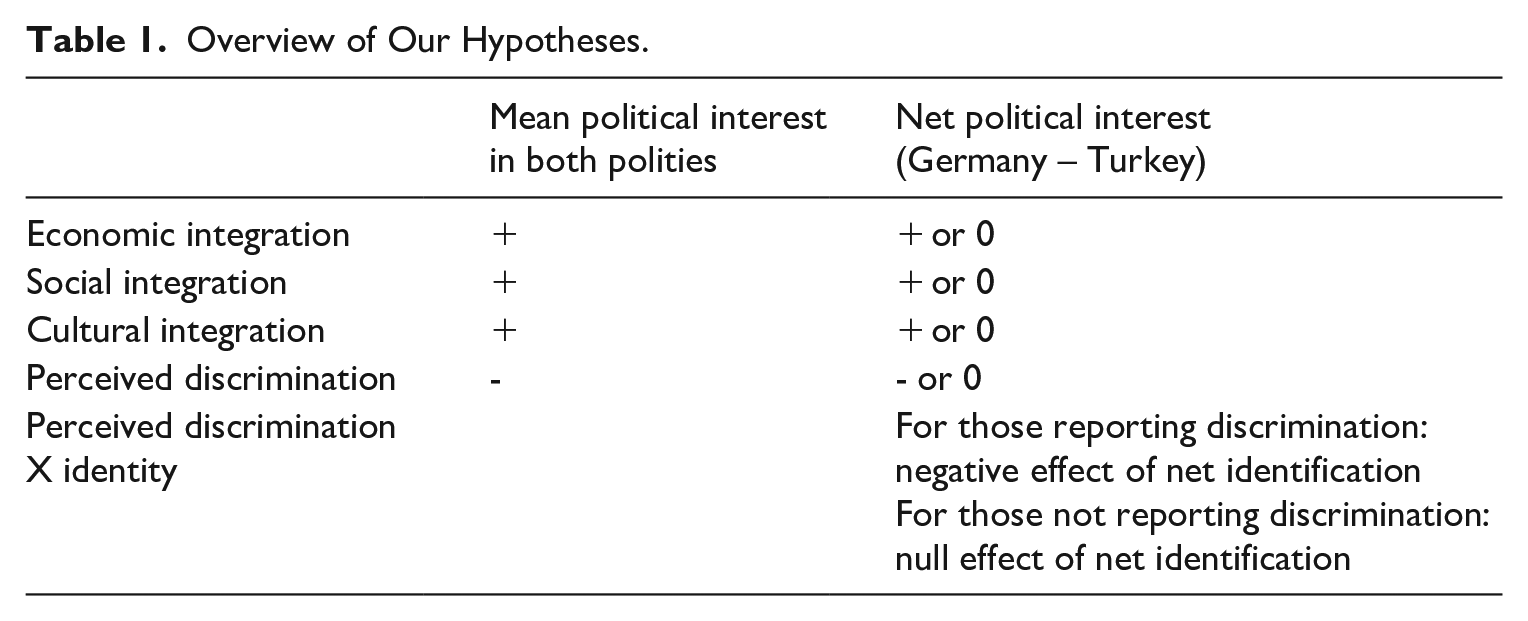
Table 1 summarises our theoretical expectations for the two dependent variables, namely, mean political interest in both polities, and net political interest as the tilt to the polity to which an individual is more drawn. Across the three dimensions of integration, we expect a positive effect on mean political interest. With regard to net political interest, however, we have contradictory expectations (depending on the theoretical perspective): more integration might lead to a stronger tilt towards German politics, or have no effect at all. For perceived discrimination, we expect a lowering of mean political interest and either a null effect on net political interest or a tilt towards more interest in Turkish politics.
Overview of Our Hypotheses.
The Historical Context of the 2017 Constitutional Referendum in Turkey and the Bundestag Election in Germany
The 2017 Bundestag election was particularly politicised in two important ways. The election was highly competitive, and public debate was fierce as the right-populist party AfD was projected to enter the Bundestag for the first time. Immigration and its aftermath, especially around the large intake of refugees in 2015–2016, were high on the political agenda. This mobilised voters, resulting in a turnout of 76.2%, well up on the 71.5% registered in 2013 (Faas and Klingelhöfer, 2019). Moreover, the Turkish community in Germany was politically agitated. April 2017 had witnessed the constitutional referendum, which gave a small majority to the government-sponsored changes that provided President Erdoğan with more powers. Members of the Turkish government had campaigned in Germany for Turkish citizens to vote in favour of the changes, an unusual political action that led to high-profile media events. In addition, President Erdoğan’s government had intervened in the German Bundestag election on 18 August 2017, advising voters not to vote for the Social Democrats (SPD), the Greens or Die Linke (the Left), an unusual intrusion into the democratic politics of another country (as reported in several dailies). One party running for the Bundestag, the Allianz Deutscher Demokraten, used advertising posters featuring the Turkish president and a Turkish-language slogan, albeit only in two Bundesländer.
Because of this high level of politicisation in German and Turkish politics, it is reasonable to assume that it has never been easier to be interested in German or in Turkish politics. Information, competition and disagreement abounded, creating a favourable historical context for interest raising. We argue further that this context makes our estimates particularly conservative: if we find a clear tilt towards German politics among more integrated Germans of Turkish descent even in this context, it is reasonable to expect that this movement would have been even stronger in contexts in which Turkish politics were not salient in German politics.
Data, Empirical Strategy and Variables
We tested our theoretical expectations on German citizens who migrated from Turkey to Germany or who are the children of at least one parent meeting that description. This approach includes German citizens with no Turkish citizenship and dual citizens who hold both German and Turkish citizenship. It does not include Turkish citizens who reside in Germany, or Turkish descendants in the third immigrant generation (who have one or several grandparents who migrated from Turkey, whose numbers at voting age are still small).
The data are one sub-sample of Germans of Turkish descent, first and second immigrant generations, aged 16 and older from the IMGES 2017. This is one of the few high-quality data sets that cover immigrant-origin voters and the only one to fulfil our analytical purposes (Goerres et al., 2022; Mayer et al., 2024). The sample comprises 512 observations and is the result of a complex sampling strategy of drawing a random sample of districts in Germany, random samples in each district, onomastic classification of the first-name-surname combination and the verification of the classification result in the interview. It is thus the most unbiased sample of that target population with a focus on electoral behaviour in existence. The response rate was 28% in this sub-sample. It was possible to conduct the face-to-face interviews in Turkish via a laptop provided by the interviewer (only chosen by 15 out of 512 respondents). Eighty-six percent of interviewees were rated as having good or very good command of German by the interviewers. All are German citizens, some also have Turkish citizenship.
We augment the data by imputing further contextual data at the address level from a commercial micro-marketing specialists in Germany (Microm). We thus have not only interview data, but also contextual data, such as the percentage of residents in those streets who are of Turkish origin. We weight our data with a post-stratification weight that takes into account differences in selection probability due to sample design and non-response. Standard errors are not clustered by neighbourhood because the numbers of observations per neighbourhood are small.
This is a cross-sectional data set that does not allow for the analysis of causal mechanisms. Hence, transnational political interest could also drive other dimensions of integration, but we have to discount the reverse causality that could perfectly well exist simultaneously across time. 4
Regarding the dependent variables, the data set provides two separate variables: ‘How interested are you in politics in Germany’, which we take as interest in German politics, and the follow-up question, ‘How interested are you in politics in Turkey’, which were both asked on five-point rating scales (ranging from 1 = indicating no interest at all to 5 = indicating very strongly interested). We use the two questions (both rescaled to the range 0–1) to create two versions for the dependent variable: (1) the mean political interest in both German and Turkish politics to analyse general involvement, with a mean of 0.55 (SD = 0.28), and (2) net political interest to see which polity an individual is more interested in by subtracting the level of political interest in Turkish politics from the level of political interest in German politics. Positive numbers for net political interest represent a relative tilt in favour of German politics, while negative numbers mean a relative tilt in favour of Turkish politics, with a mean of –0.01 (SD = 0.32).
For the exact coding of independent variables, we followed the approach suggested by Harder et al. (2018). We calculate indexes for each dimension for which all independent variables have been rescaled to the range 0 to 1. To give an example, we used household income, employment status, evaluation of the respondents’ current economic situation and their formal education to construct levels of economic integration. We first recoded the variables’ initial scales to a scale between 0 and 1 and then calculated a mean index. Thus, the resulting index of economic integration ranges between 0 and 1 and takes higher values for more economically integrated respondents. We followed the same approach for social integration. We use the information on respondents’ social networks including the relationship status, whether their partner originated from Germany or abroad, the extent to which their circle of friends and work colleagues consists of native or immigrant-origin individuals and the extent to which they are members of organisations with predominantly immigrant-origin members (the question wording and answer options are shown in Online Appendix Table A1). For example, those with a German partner, more native friends and colleagues as well as memberships in predominantly native organisations would be associated with higher levels of social integration. Cultural integration is split up into two sub-dimensions defined by language and identity. Linguistic integration is operationalised with information on self-reported language proficiency and use of German language. Online Appendix Figure A1 shows the distribution of the three integration variables. As we can see, social integration approaches a normal distribution, economic integration and even more so linguistic integration are negatively skewed, that is, more values are on the right side of the mean.
For the identity sub-dimension of cultural integration, we measured feelings of German- and Turkishness. Similar to the dependent variable, we separate the mean intensity of feeling German and of feeling Turkish from the relative intensity of identification for which we subtract the intensity of feeling Turkish from that of feeling German (positive numbers represent a tilt towards feeling more strongly German and negative numbers feeling more strongly Turkish).
As a final, theoretically relevant variable, we use a dummy variable about whether the respondent feels personally disadvantaged because of belonging to a group that is discriminated against on grounds of religion, descent or language (0 = not discriminated against, 71%; 1 = discriminated against, 29%), an operationalisation also used in the European Social Survey.
The bivariate pairwise correlations between these three numerical indices of integration are moderately positive, as we would expect with such a latent multidimensional construct: economic and social, r = 0.22; economic and linguistic, r = 0.27; social and linguistic r = 0.22. Discrimination has almost no relationship with the measures of integration, the highest being correlation, r = –0.17 with the mean level of identity.
We include the following as control variables: (1) binary gender coded by the interviewer, (2) second immigrant generations with first generation as reference, (3) a dummy variable dual Turkish–German citizenship (yes = 1 or no = 0, recall that we only have German citizens in the sample), and (4) a three-category variable of contact with family in Turkey (none/no family, some up to several times a month, intense = once a week or more often). For net political interest, we also control for mean political interest as we are interested in the tilt towards one of the polities, and not the absolute numbers.
We do not control for media consumption of political news in the main models as we interpret this as a direct consequence of political interest and we want to avoid it for reasons of endogeneity (alternative models in Online Appendix Table A7). We do not include age (as it correlates highly with immigrant generation). Missing values have low prevalence in our variables. We impute reasonable values for each variable, often assuming that something is missing completely at random (details in Online Appendix Table A2).
Apart from the two variables of net political interest and relative identification, which range from –1 to +1, we rescaled all variables to range from 0 to 1. Descriptive statistics for all variables of interest can be found in Online Appendix Table A3.
Empirical Analysis
We first explore the distribution of the two constituent variables from which we construct transnational political interest.
Table 2 shows the distribution for the two kinds of political interest across Germans of Turkish descent aged 16 and older. Two variables are moderately positively correlated (Kendall’s tau = 0.35, p < 0.05). This bivariate finding is a first piece of evidence that interest in both polities has a positive relation.
The Distribution of Interest in German Politics and in Turkish Politics.
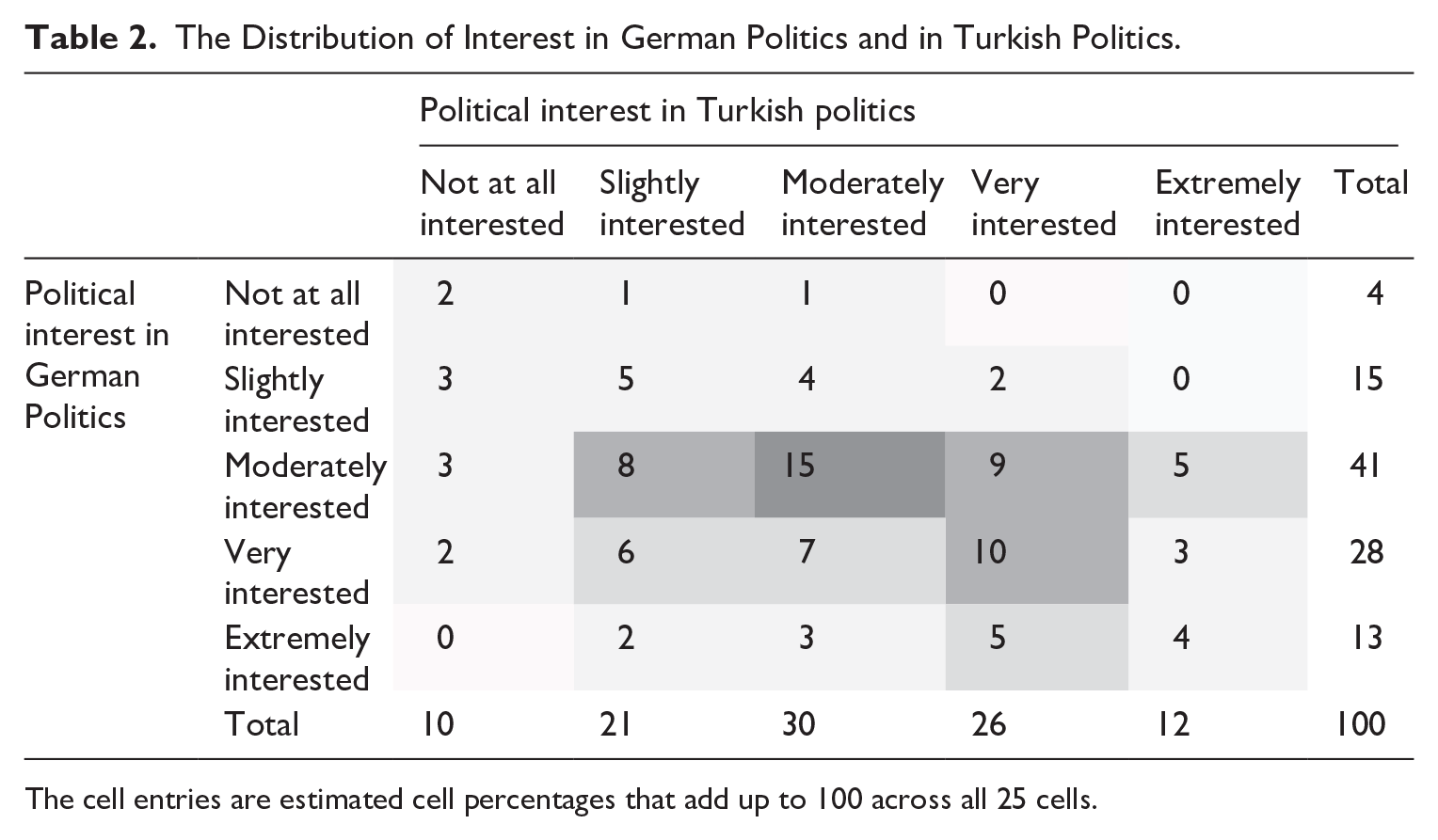
The cell entries are estimated cell percentages that add up to 100 across all 25 cells.
We can observe a high level of heterogeneity within this group. About 36% of Germans of Turkish descent have the same level of interest in both polities. About 23% of Germans of Turkish descent are more interested in German than in Turkish politics, whereas 16% are instead more interested in Turkish than in German politics. Using both variables, we now compute the two dependent variables, mean political interest and net political interest. Figure 1 shows the distribution of net political interest with almost equal shares of respondents having the same political interest in both polities, favouring Turkish politics or favouring German politics.
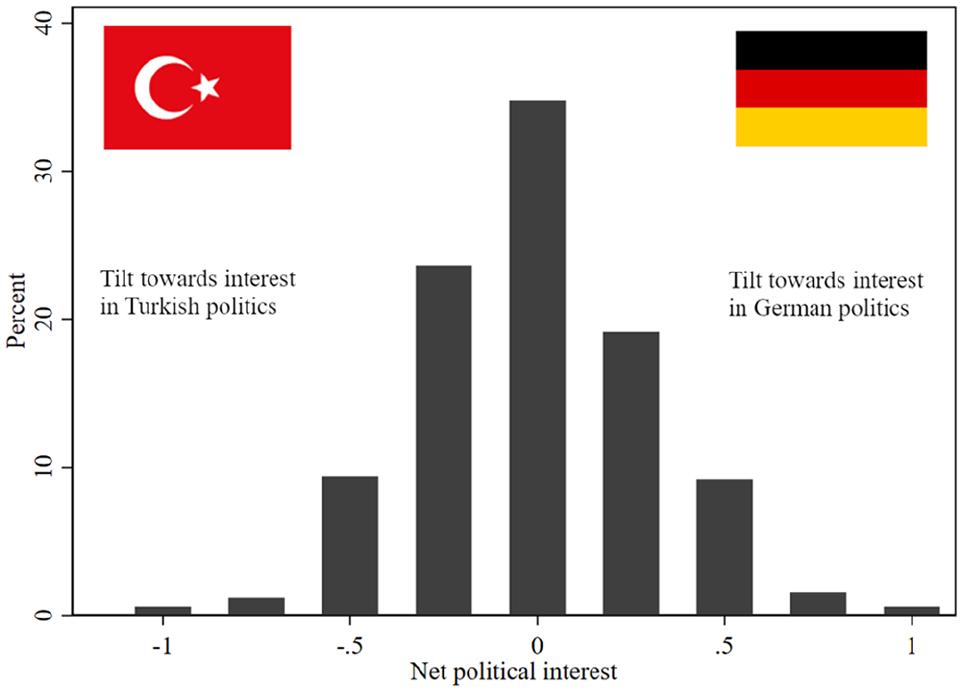
Net Political Interest, Tilt in Favour of German or Turkish Politics.
Next, we are interested in the drivers of transnational political interest. We will analyse the direction of impact of the various indicators of integration, their precision and size relative to one another and relative to control variables. We also test whether experience of discrimination moderates the impact of social identification preference on net political interest. We first look at the changes in adjusted R2 values to gauge the increase in explained variance going back to the different integration dimensions. Then we will simultaneously compare the effects from the complete model in a two-dimensional effect plot. Finally, we will test the two-way interaction between social identification and perceived discrimination.
We estimated a full set of seven regressions for each of the dependent variables that are displayed in Online Appendix Tables A5 and A6. The models containing only the control variables show adjusted R² values of about 13.1% for mean political interest and 18.5% for net political interest. However, we are interested in how much explanatory power the different dimensions of integration add. We report the most important evidence in Table 3 on how the inclusion of different blocks of variables increases the explanatory power of the models (for bivariate associations between the two dependent variables and the predictor variables, confer Online Appendix Table A4).
Regressions on Transnational Political Interest: Increases in Adjusted R² Values, Depending on Independent Variables.
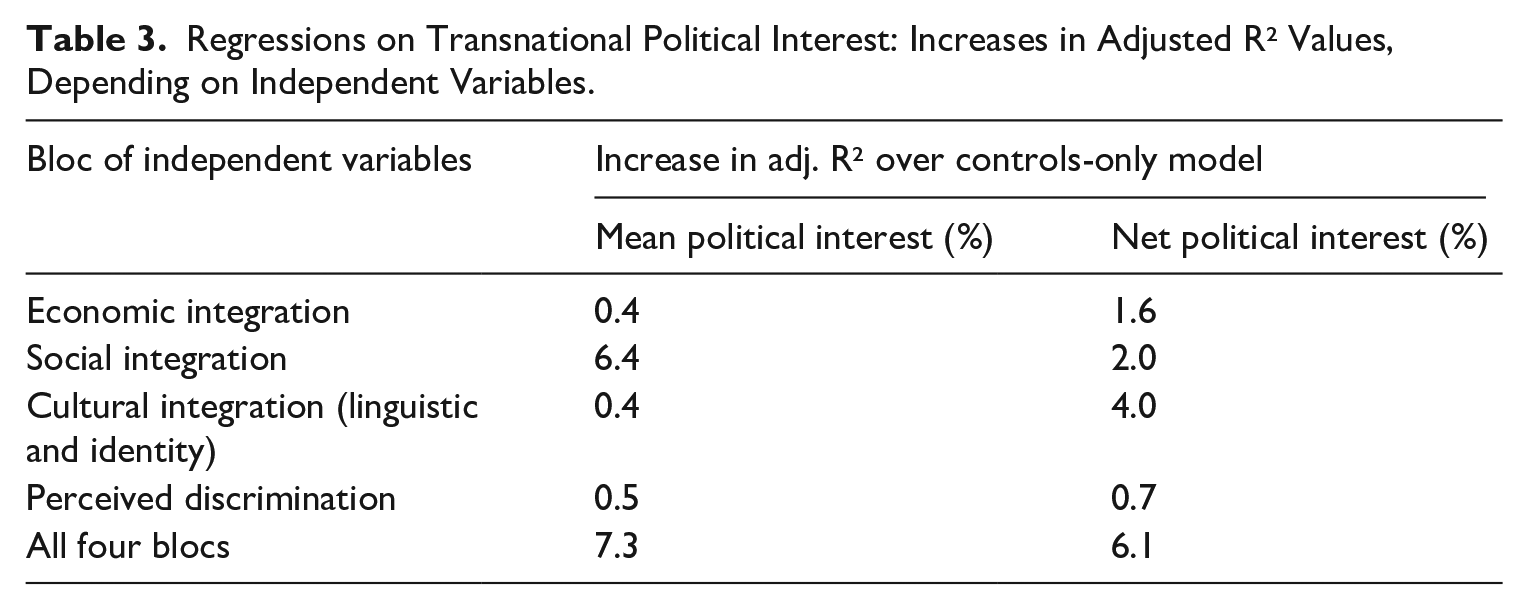
Economic integration shows a low added value for both models. Adding indicators of social integration adds most across the two series of models, followed by cultural integration. This means that we gain most for understanding transnational political interest when we look at the ways in which Germans of Turkish descent are socially and culturally integrated. Economic integration, with its basis in education, income and occupation, is much less relevant, even though it is the standard socio-economic explanation for conventional political interest. Perceived discrimination, however, adds almost nothing to explaining the two variants of political interest. No direct effect is measurable when controlling for the other variables.
Figure 2 summarises the estimated coefficients and their confidence intervals for both dependent variables from the most complex model (Online Appendix Tables A5 and A6) in two sub-panels A and B. Recall that all independent variables range from 0 to 1, so that their point estimates can be compared as they express the change in mean or net political interest when the respective independent variable changes from minimum to maximum. Panel A only displays the theoretically interesting variables, sub-panel B only the control variables. One data point summarises two estimated effects, one for mean political interest and one for net political interest. The confidence intervals give us an indication of where 90% of all point estimates would be if we had more samples from the same population; the intervals are thus an indicator of the precision of the respective effect.
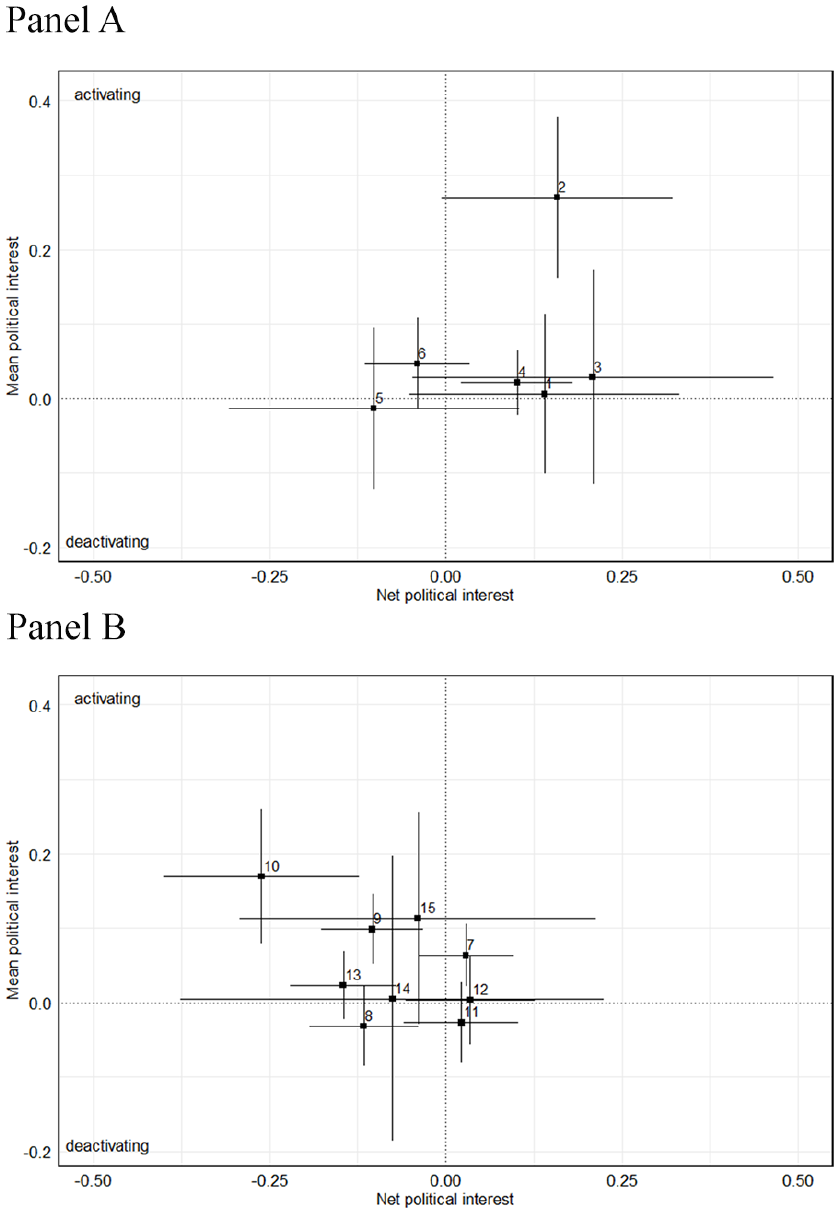
Two-Dimensional Coefficient Plot for Mean and Net Political Interest with Confidence Intervals for Theoretically Interesting Variables (Panel A) and Control Variables (Panel B): Panel A: Theoretically Interesting Variables; Panel B: Control Variables.
On the vertical axis, we see the effects on mean political interest. Coefficients above 0 reflect a generally activating effect in mean political interest. Coefficients to the bottom reflect a de-activating effect in mean political interest. On the horizontal axis, we see the estimated effect on net political interest: above 0 means that the variable has a tilting effect on net political interest towards German politics; below 0, it has a tilting effect towards Turkish politics.
In the top-right quadrant are thus those effects that activate individuals into mean political interest and tilt transnational political interest towards German politics. In it, we find social integration with strong effects on mean political interest and net political interest (barely insignificant for net political interest); economic and cultural integration as well as net identification have small effects in the same quadrant (activating and tilting towards German politics). Only the variable mean identity, capturing the absolute level of identification across the two polities, is in the higher left-hand quadrant because it activates in general but tilts towards Turkish politics. Some of the confidence intervals overlap with the zero lines, reflecting a higher level of imprecision. Perceived discrimination as a direct effect is small and in the left-hand bottom corner.
In Online Appendix Tables A5 and A6, there are also further regression models 2–5 that allow us to see whether the estimated effects are robust against different constellations of independent variables and whether the effects are mediated by other variables in the complex model 6. The strong effect of social integration on mean political interest remains strong throughout all models and does not get picked up by the coefficient of other variables. Its effect on net political interest, however, is only strong when there are no other dimensions in the models (model 3) and gets attenuated once the other integration indicators are included (model 6). More concretely, the effect on net political interest gets picked up mostly by the variable net identification. Germans of Turkish descent who have higher levels of social integration in the host country show relatively stronger levels of identification with Germany and those higher levels of identification with Germany leads to a tilt of political interest more towards German politics.
The mediating role of net identification on net political interest is similarly traceable with regard to the effects of economic and cultural integration. Modelled alone, their coefficients are strong and positive (models 2 and 4). Once the other dimensions are introduced (model 6), their effects run through net identification. Socially, economically and culturally more integrated Germans of Turkish descent feel more strongly German than Turkish, a factor that then tilts their net political interest towards Germany.
Two control variables have sizable point estimates (Figure 2, panel B). Being a dual citizen has a clear activating effect in general and tilts net political interest towards Turkish politics. The causal mechanism is likely to be twofold: those more interested in Turkish politics are more likely to keep Turkish citizenship, and Turkish citizens are more likely to care about Turkish politics. The strengths of the effects reflect the inter-dependence between institutions and transnational political interest even though political interest could develop irrespective of institutions. Self-reported command of Turkish has a strong effect on activating people into political interest in general and it has a tilting effect towards Turkish politics that is independent of integration into the German society. Again, this is not surprising as taking an interest means having to understand political information. The bivariate correlations between command of Turkish and our integration variables are only moderately negative. So even when separating the effects from one another in the multiple regression, command of Turkish tilts transnational political interest towards Turkish politics.
Let us finally turn towards the contingent effect of identification on net political interest, based on perceived discrimination (Table 4). We expect that feeling more Turkish than German has a stronger negative effect on net political interest among those that report discrimination, thus tilting transnational political interest towards Turkish politics. This is, given the way we coded it, the expectation of a stronger positive coefficient for net identification. Indeed, this is exactly what we find: adding the interaction statistically improves the model (Online Appendix Table A8). The marginal effect of net identification for those with no reported discrimination is 0.06 (p = 0.314), while for those with reported discrimination it is 0.27 (p < 0.001). Hence, the experience of discrimination does not have a direct impact but rather moderates the relationship between net identification and net political interest.
Marginal Effect for Variable Net Identification German Minus Turkish.
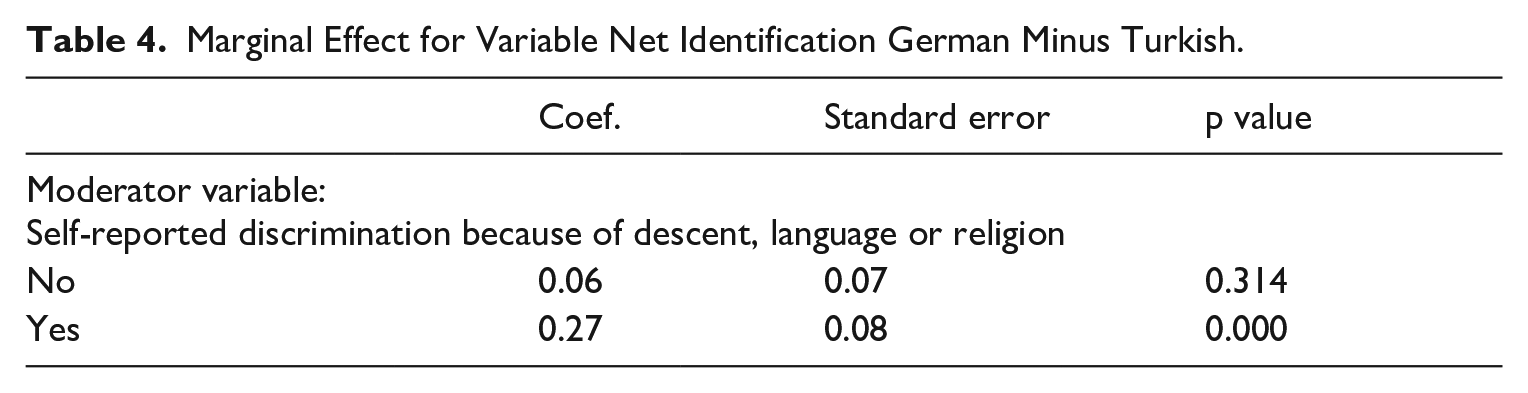
Please recall that the strong effects of the three integration indicators that we saw earlier are mediated by net identification. The last finding adds to this that experienced discrimination moderates this mediation path. For those who feel discriminated against (about 29%), the model predicts that their higher levels of integration are strongly mediated by their level of net identification with German over Turkish. For those, who do not feel discriminated against, net identification has only a small effect on net political interest.
What do all of these empirical patterns tell us theoretically? It reveals that there is a distinct and important pattern of co-variation between different dimensions of integration and the landscape of political interest in German and Turkish politics in people’s minds. First, most integration dimensions are positively related to increasing transnational political interest. Second, integration tilts transnational political interest in favour of German politics. The more integrated people are, the more they seem to be activated and take a relatively stronger interest in German politics. This mechanism is strongly mediated the way people identify: more integration leads to more identification with Germany, which then tilts political interest towards German politics.
Given that the historical context was favourable towards being interested in Turkish politics in Germany, and given the difficulties of that community of assimilating due to structural problems and discrimination, this provides strong evidence for the existence of bumpy-line assimilation. However, there remain huge inter-individual differences, with language skills and dual citizenship standing out as important drivers of a tilt in favour of Turkish politics.
Conclusion
What is the effect of integration in Germany on transnational political interest among Germans from Turkey and their children? Using data from the 2017 IMGES, we rely on three dimensions of integration and two dependent variables of transnational political interest, the mean level of political interest in German and Turkish politics and net political interest as the difference of political interest in Germany and Turkey. Our analysis reveals that out of economic, social and cultural, especially social integration has an activating effect on mean political interest and tilts net political interest towards German politics. All three dimensions of integration have a positive effect on net political interest that is largely mediated by net identification with Germany and Turkey. More integrated individuals are more identifying with Germany and this leads to a tilt of net political interest in favour of German politics.
The experience of discrimination does not have a direct effect, but moderates the effect of social identification on transnational political interest. Those who feel relatively more Turkish and report discrimination are predicted to have transnational political interest with a stronger interest in country-of-origin politics.
Overall, Germans from Turkey and their children empirically show a clear picture that more integration into German society leads to higher general transnational political interest, a pattern mediated by identity and a profile of transnational political interest tilted more towards German politics. Theoretically, these findings allow us to reconcile the expectation of international political theory that immigrant-origin voters will be pluri-local political beings who are much less bound by national territories in terms of their democratic involvement than native voters (Guarnizo et al., 2003) and the assimilation-mobility thesis and its extensions (Alba and Foner, 2015; Nelson, 1982), namely that more integration into the host society leads to more political interest in its politics and less interest in the politics of the countries that they or their parents originated from. We find quite extensive heterogeneity and a positive effect of other dimensions of integration, as predicted by the first theoretical strand, and a sharper focus of political interest in host-society politics, as predicted by the second. The assimilationist pattern is particularly noteworthy for the Turkish community in Germany (Mayer et al., 2024). In contrast to the immigrant groups in the United States before 1965, there is a continuous replenishment of new migrants from Turkey that could have been hypothesised to make straight-line assimilation more difficult (Heath and Schneider, 2021). Considering the historically high level of politicisation in German and Turkish politics in 2017, the low level of information costs and the increasing ease of having multiple citizenships, our analysis provides a conservative test and clearly shows that even under these very favourable circumstances, Germans from Turkey and their children still lean more towards German politics, the more they are integrated.
As our analysis focuses on a specific group of immigrants, we cannot generalise our findings to other immigrant-origin groups, but suppose that a general pattern might be observed no matter what the country of origin. Our findings thus show the importance of analysing different dimensions of integration, especially as immigrant-origin voters still show lower participation rates than native voters. Of course, all of our interpretations are a function of our operationalisation of individual-level integration.
Some findings also have theoretical implications for German society as a whole beyond its immigrant-origin groups. As much as there are immigrant-origin individuals who have low levels of economic integration, there are also natives with low levels of integration. We would hypothesise that native groups with low levels of integration (inasmuch as they can vary among natives, such as economic integration) have the same effect on general political interest.
Another theoretical implication is that transnational political interest, the sustained political interest in more than the polity that people reside in, also materialises among natives because they have lived abroad (as is fitting for many academics, for example) or for some other personal reason. Transnationally politically interested native and immigrant-origin citizens are expectedly alike in social and political outlook and may share cosmopolitan values. This proposition could link the findings to the much broader debate about how people personally deal with their ‘fantasies of home and away’, driven by the simultaneous desire for difference and familiarity (see Calhoun, 2008 drawing on Rushdie).
Supplemental Material
sj-docx-1-psx-10.1177_00323217241308720 – Supplemental material for Integration in the Host Country, Mean Political Interest and Focus Shift towards Host Country Politics: Patterns of Transnational Political Interest among Germans from Turkey
Supplemental material, sj-docx-1-psx-10.1177_00323217241308720 for Integration in the Host Country, Mean Political Interest and Focus Shift towards Host Country Politics: Patterns of Transnational Political Interest among Germans from Turkey by Achim Goerres, Jonas Elis, Sabrina J Mayer and Dennis C Spies in Political Studies
Footnotes
Acknowledgements
An earlier draft of this paper was presented at the 24h of Political Psychology meetings in 2020 and 2022 and at the EPSA General Conference 2022 Praha. We thank all commentators for their helpful suggestions and hints. We are also thankful to Joshua Claassen for research support. Professor Dennis C. Spies passed away while we were working on the paper. He was just 40 years old and had just become the Heisenberg Chair of Political Economy at Düsseldorf. His ideas for data collection, research questions and problems shaped this paper. We miss him dearly as a great political scientist, mentor and friend.
Data Availability
For replication purposes, data is available to the scientific community via Harvard Data-verse: https://doi.org/10.7910/DVN/87V9P9. The data for this study is published in the GESIS data archive, ZA7495 Datenfile Version 1.0.1,  .
.
Declaration of Conflicting Interests
The author(s) declared no potential conflicts of interest with respect to the research, authorship, and/or publication of this article.
Funding
The author(s) disclosed receipt of the following financial support for the research, authorship and/or publication of this article: This work was part of the Immigrant German Election Studies I & II () and was funded by the German Research Foundation under grant numbers GO 1833/5-1 (PIs Achim Goerres and Dennis C. Spies) and GO 1833/7-1 (PIs Achim Goerres, Sabrina J. Mayer and Dennis C. Spies).
Supplemental Material
Supplemental material for this article is available online.
Notes
Author Biographies
References
Supplementary Material
Please find the following supplemental material available below.
For Open Access articles published under a Creative Commons License, all supplemental material carries the same license as the article it is associated with.
For non-Open Access articles published, all supplemental material carries a non-exclusive license, and permission requests for re-use of supplemental material or any part of supplemental material shall be sent directly to the copyright owner as specified in the copyright notice associated with the article.
