




Abstract
In this article, we contribute to the analysis of protest participation on a gradient from non- to actual participation. Using survey data from six European countries, we take the analysis beyond a binary differentiation between participants and non-participants. We evidence a participation gradient underpinned by a combination of social and political variables and separate patterns that allow for distinctions between non-, potential, and actual protesters. We establish that some factors have a gradual, linear, relation to protest participation, increasing the likelihood of moving from non-participation to potential participation and from potential to actual participation. Second, we find evidence of a punctuated rather than a linear participation gradient in as far as a range of variables distinguish protesters and potential protesters from non-participants but do not differentiate them from each other. Our findings provide practical insights into mobilization pathways while also inviting further research into intervening factors influencing protest behavior.
Introduction
The wave of protests that followed the global financial crisis in 2008, and soon after that the popular uprisings for democratic change in the Middle East, prompted observers to reassert the notion that demonstrations were an inherent part of democracy (McAdam and Tarrow, 2010; Porta and Portos, 2020) as well as the physical embodiment of an aspiration to have a say in how countries are run (van Deth, 2020). In liberal democracies, contentious forms of political participation have increasingly been regarded as legitimate and common in a “movement society” (Meyer and Tarrow, 1998). As such, while historically viewed with skepticism for their potential to undermine democratic governments, peaceful demonstrations are now a familiar sight in many democratic countries (Norris, 2011). Indeed, a growing literature shows that people who hold democratic aspirations are especially likely to participate in protests (Dalton, 2017; Norris, 2011); and, in turn, that protest participants are more likely to vote in elections than the general population (Giugni and Grasso, 2019). Despite this renewed prominence of protest participation and its normalization as an outlet for immediate expression of political demands, only a minority among citizens embrace it as part of their political action repertoire, in European democracies (Quaranta, 2013).
This observation leads to the following three crucial questions: what differentiates the minority of participants from the inactive part of the population, including those who would consider participating in protests but who have not done so yet; what distinguishes these potential participants, and how can social movements recruit new participants from among populations that are not (yet) mobilized? In a celebrated article, Klandermans and Oegema (1987: 519) argued that for a collective actor such as a social movement to recruit participants in protest actions, it has to identify its mobilization potential—that is, “the people who could be mobilized” in a given society thanks to their positive view of that movement. Those who fall outside of the mobilization potential—who are not favorable to either the means or the goals of a protest-organizing movement—are unlikely to be successfully recruited even if they are actively targeted for mobilization (Klandermans and Oegema, 1987: 519). Accordingly, mobilization can be described as a stepwise process whereby a movement needs to identify its mobilization potential, motivate it to participate and then help it to overcome barriers to participation. This perspective explicitly shifts the focus away from the supply side of protest, for example, of the opportunities to protest, to the demand side by “identifying the social and political characteristics of individuals drawn to a particular protest or social movement” (Hunger et al., 2023: 813). In this new application of the concept of mobilization potential, these scholars point to one’s willingness to take part in a protest as an important precondition to actual participation.
According to these authors, participation is the result of a process of attrition: only a subgroup among the mobilization potential will eventually join a protest, namely the participants. First, while some people may agree with the goals of a protest, they may not be informed and then motivated enough to participate in it (McAdam, 1986). Second, while some are sufficiently motivated to participate, the likelihood of their participation diminishes if they are not targeted for mobilization. Put simply, being personally invited to a protest increases the likelihood of participation as one’s estimation of costs and benefits associated with participation can be influenced by selective incentives—both social and non-social (Klandermans and Oegema, 1987). Of the two, social incentives are more unambiguously “determinants of willingness to participate” than non-social or material incentives whose suitability may vary with the type of collective action (Klandermans and Oegema, 1987: 520). Finally, even if targeted, one may not be sufficiently motivated to participate when having to put participation in balance with barriers such as, for instance, caring for dependent family members (Verhulst and Walgrave, 2009).
In this article, we build on this seminal body of work, link it to topical scholarship on the use of social media for mobilization and examine the contemporary mobilization potential in six European countries from regions marked by historical differences in protest participation—Denmark, Germany, Hungary, Italy, Romania, and the United Kingdom—that have nevertheless seen important levels of protest, over the last decade. In doing so, we contribute to the predominant analysis of protest participation that has so far paid more attention to differentiating protesters from non-participants, than to the distinction between protest participants, those who do not or who are willing but have yet to participate in a protest (but see Beyerlein and Hipp, 2006). In line with these researchers, we refer to the latter group as “potential participants” and, in what follows, examine the characteristics distinguishing them from participants as well as, additionally, non-participants.
Our findings reveal that, across the six countries, actual, potential, and non-participation are at once inter-related and connected to distinct sets of variables. Our results allude to attrition as a reflection of not just the presence or absence of key characteristics but also of the degree to which common characteristics relate to each step. In other words, the reasons why individuals may not progress from one step to the next in this process may be related to both the presence or absence of some characteristics, as well as to the degree of importance of a factor. In the remainder of the article, our analysis unfolds as follows. First, we survey the literature on protest participation, paying special attention to what drives protest behavior and the relatively less well-understood group of individuals who would consider participating in protests but who have not yet taken that step. On this basis, we construct six hypotheses. Second, we present our data and methodological approach. Third, we report on our results. Finally, we conclude with a discussion of the implications flowing from the distinction between actual, potential, and non-protesters.
Theoretical Framework
The decision to draw our three-tiered distinction is informed by cognate studies into participant mobilization that describe a spectrum from non-participation to participation, which includes those willing to participate who ultimately fail to do so as well as different varieties of protest-goers among participants (Saunders et al., 2012; Van Laer, 2017; Verhulst and Walgrave, 2009; Walgrave and Wouters, 2022; Santos et al., 2024). On the one hand, and especially pertinently, panel surveys designed to capture this continuum, which used data from prominent rallies in Belgium, indicated that specific factors—ranging from structural to motivational ones—relate to separate stages of the mobilization process leading to actual participation (Van Laer, 2017). Seminally, this strand of research showed, first, that becoming part of the mobilization potential hinged on motivational factors such as one’s sense of aggravation and anger regarding a political issue as well as one’s individual efficacy. Thereafter, one was more likely to be willing to participate when embedded in both formal, organizational, and informal networks—of friends, family, and other acquaintances—and when animated by a sense of collective efficacy (Van Laer, 2017). The likelihood of participation was then raised by the combination of both motivational and structural factors. In addition, Walgrave and Wouters (2022) proposed that within formal and informal networks, social ties can play distinct roles such that, for example, participation approval by one’s partner or support from co-members of an organizational network distinctively increased one’s likelihood of participation. On the other hand, protest surveys, conducted at a range of demonstrations (Saunders et al., 2012), highlighted differences among types of participants—extending from the least to more frequent protest-goers—who were set apart by their level of previous political engagement, their embeddedness in recruitment networks and, third, by socio-demographic characteristics widely expected to make people more readily available to participate such as younger age (Corrigall-Brown, 2011).
These insights, together with those on the mobilization potential of social movements, point to a participation gradient and multiple factors that distinguish participants from non-participants as well as actual participants from potential participants, respectively. In this article, we use population-level survey data to consolidate this analysis by first considering whether embeddedness in recruitment networks delineates participants not only among themselves but also from potential and non-participants. We then turn to a larger range of factors to ascertain if they set these three groupings apart, helping to increase the odds of potential participation and, ultimately, of actual participation. Importantly, our principal aim is to understand if we can conceive of a linear gradient from non- to actual participation in as much as one would expect actual participants to be more motivated and deeply embedded in topical social networks than both non-participants and potential participants (cf. Van Laer, 2017); or, alternatively, whether the notion of a punctuated gradient where some factors distinguish non- from potential participants and others separate out potential from actual protest-goers is conceptually more useful when grappling with this continuum. With this distinction, our research advances the understanding of the factors linked to non-, potential, and actual participation by differentiating their gradual relation—whether linear or punctuated—empirically.
Recruitment Networks, Media, and Protest Communication
Recruitment networks have received much attention from students of social movement mobilization. Be they organizational networks, friends and family or more public networks that extend such proximate social groupings including mass media (Klandermans and Oegema, 1987), recruitment networks act as a primary conduit for the provision of incentives motivating participation. A contemporaneous and similarly influential analysis to Klandermans and Oegema’s (1987) proposed that embeddedness in “supportive networks” was a structural factor galvanizing protest participation along with one’s individual motivation and especially a deep sense of “ideological identification” with a movement (McAdam, 1986). The same author remarked that an apparent low conversion rate of the mobilization potential into actual participants could hardly be explained through the degree of attitudinal alignment between potential participants, actual participants, and ultimately the social movement seeking to mobilize them (McAdam, 1986: 68).
Instead, a key part of the explanation for successful mobilization was designated as being the existence of a social relation between a potential participant and a recruitment agent, the latter of which would exact a social cost for non-participation (or to return to Klandermans and Oegema’s terminology, would use a negative social incentive to induce participation). Such connection—either interpersonal or organizational—McAdam (1986) contended, would present an opportunity for further embeddedness into the social networks of a movement and a possible transition from participation in low to participation in more demanding, high-risk activism. Accordingly, social embeddedness would enable and then consolidate participation. This supposition was confirmed by more recent research pointing to a sense of identification to other protest-goers or staging organizations as being a factor increasing the likelihood of participation, which, when controlled for, dampens the effect of motivational factors on that likelihood (Giugni and Grasso, 2019: 183).
The protest survey-based scholarship discussed earlier allows one to further reflect on the characteristics of recruitment networks when considering the role they play in successful mobilization. In the case of Saunders et al. (2012), the most committed of participants, stalwarts, stood apart from the others—and especially protest newcomers—due to their involvement in organizations. Stalwarts had sourced information about the demonstrations from fellow members or through organizational communication channels (e.g. mailing lists or websites). Conversely, cognate research into novices revealed that they were more likely to have learnt about a demonstration from mass media or friends and family than from an organization, its members or its communications—on and offline (Verhulst and Walgrave, 2009). Indeed, informal recruitment networks of personal contacts from the relevant activist milieu were shown to be more instrumental to motivating the mobilization potential to participate than formal, organizational channels, albeit in low rather than high-risk activism (McAdam and Paulsen, 1993; Van Laer, 2017). Consequently, we hypothesize that, while friendship networks have a gradual relation to participation—meaning that protest participants are more embedded than both potential participants and non-participants—and potential participants have greater embeddedness than non-participants, membership of social movement organizations will relate especially to actual participation. Accordingly, we formulate our expectation of a participation gradient such that
H1: Network embeddedness has a gradual relationship to participation.
Further pertinent to this study, the differentiation between recruitment networks signals the importance of various forms of media usage for mobilization. In the pre-Internet age, mass media were regarded as an indirect channel for participant recruitment (McAdam and Paulsen, 1993) that would allow activist groups and organizations to appeal especially to newcomers who otherwise would not have access to the relevant social networks and selective incentives (Jasper and Poulsen, 1995; Mercea, 2014). However, the picture gradually changed with the uptake of social media. The rise in social media usage was deemed instrumental to a structural transformation of recruitment as it opened up the possibility for protests to become “crowds of individuals” (Juris, 2012) relying on social platforms to prime and then repeat their participation in the absence of links to activist organizations and formal movement networks (Mercea, 2014).
Indeed, population-based research (Valenzuela, 2013) showed that social media usage was predictive of street protest participation—as opposed to other forms of protest—and that the effect remained significant even when controlling for other factors (e.g. grievances, values, resources). Valenzuela (2013: 934) illuminated that people who use social media to gather political information, express their views online and join social causes are more likely to participate in protests. Building on his work, Boulianne and colleagues (2020) further stressed that posting about protests on social media correlates strongly with participation. Put differently, all other things being equal, being politically active on social media increases the likelihood of joining a protest.
As to how this process might unfold, scholars have proposed that the use of social media has aided in the “mass aggregation of individuals,” at specific protest sites, through interpersonal linkages and scalable horizontal communication flows (Juris, 2012: 267) that shift the weight from organizations to individuals and from membership to affinity, in recruitment networks. Described as a personalization of protest participation (Bennett and Segerberg, 2012), interpersonal protest communication on social media is attributed to potential participants who thereby become exposed to highly motivated others who, in turn, compel them to participate physically (Larson et al., 2019). Hence, engagement with protest-related content, on social media, can be conducive to the formation of interpersonal ties that motivate the individual choice to join a protest event. In this light, we seek to understand if such social media usage sets out potential participants from non-participants as well as actual participants. We therefore postulate that
H2: Social media usage for protest-related communication has a gradual relation to participation.
Ultimately, not all media have the same relation to participation (e.g. newspaper reading was more likely to be associated with protest participation than watching television as TV reporting likely covers protests in train, or which have already concluded Boulianne et al., 2020; Schussman and Soule, 2005). Longitudinal research has, nevertheless, shown that print and online news sources, broadly understood, can stimulate political interest (whereas television was the medium of those already interested in politics, Boulianne, 2011). Pertinently, protest participants have been described as not only better informed but also as exhibiting a higher level of political interest than non- and potential participants (Giugni and Grasso, 2019; Schussman and Soule, 2005) and being more knowledgeable about politics (Corrigall-Brown, 2012; Saunders et al., 2012; Schussman and Soule, 2005). Participants’ political interest and knowledge can serve to keep them sensitized to and involved in protest activities over the longer run (Corrigall-Brown, 2012; Saunders et al., 2012). We consequently expect to find a gradient such that
H3a: Political interest has a gradual relation to participation.
H3b: Political knowledge has a gradual relation to participation.
Individual Characteristics Germane to Participation
The main thrust of the literature reviewed up to this point is that participation is galvanized through selective social incentives circulating through recruitment networks and the media. At the same time, it is made more likely by a number of individual-level factors. The range of variables considered across multiple bodies of cognate work is expansive, covering a large spectrum of individual psychological characteristics, personal circumstances, and context-specific political preferences. Focusing first on cognitive concomitants to participation, grievances inform one’s motivation to join in collective action (Stekelenburg and Klandermans, 2010). They fuel a sense of anger at a perceived injustice which, in turn, strengthens one’s motivation to participate. On the one hand, grievances may originate in the actions of other political actors, notably the government or one’s reference group (Muliavka, 2021). On the other hand, grievances may be driven by one’s economic situation. An economic grievance with a long history of scholarly interest is relative deprivation or a sense of deterioration in one’s material outlook in relation to one’s past, expected future or a reference group (Buechler, 2004). In comparative research following the 2008 financial crisis, Grasso and Giugni (2016: 673) found relative deprivation to be positively related to protest participation. Scholars, furthermore, differentiate between such egotropic (i.e. perceptions that one’s personal economic situation has deteriorated) and sociotropic grievances (i.e. the view that the country’s economy has worsened, Dalton et al., 2010; Griffin et al., 2021), often finding that the former have more significant effects than the latter (Borbáth et al., 2021). Consequently, we hypothesize a gradient such that protest participants are more aggrieved than potential participants, while both are more aggrieved than non-participants:
H4: Being aggrieved has a gradual relation to participation.
Protest participants are also more likely to be politically active. Evidence to date suggests that they are more likely to be registered to vote (in countries where this is required, Schussman and Soule, 2005) and, indeed, to vote (when compared to the general population, Giugni and Grasso, 2019: 87). Equally, protest participants may have a greater sense of group efficacy—that is, the perception that collective action can help solve group problems—than non-participants (Stekelenburg and Klandermans, 2010). Ultimately, these two factors refer more directly to actual participation. Nonetheless and notwithstanding the higher likelihood of protest participants voting than potential participants and non-participants, we expect protest participants to more likely hold a sense of group efficacy than potential participants and both to have higher group efficacy than non-participants, thus formulating a gradient:
H5: Group efficacy has a gradual relation to participation.
Second, personal circumstances can affect one’s ability to become involved in collective action. Biographical availability, or the absence of competing obligations on one’s resources, has been deemed as an important catalyst for participation. Conversely, life-course theory suggests that people who have responsibilities expected to reduce their availability—for example, have dependents in their care—are equally likely to participate because of their network embeddedness, that is, they have manifold social commitments tying them to “confirming others” (Corrigall-Brown, 2012: 22). Using marriage, child-rearing, and employment as indicators for obligations that compete for the resources one can dedicate to protest participation, Corrigall-Brown found that having dependents in care and being in employment did not have a significant effect on the odds of participation (although being unemployed was a significant predictor of participation among protest-goers, Giugni and Grasso, 2019: 180). Marriage, however, did; those who were single or separated were more likely to take part in protests than people who were married (Corrigall-Brown, 2012: 28).
Notably, the absence of biographical availability—that is, being employed, older, married, a parent or a woman—was found to decrease the likelihood of being willing to protest and, latterly, particularly for women, of participating in a range of public behaviors including protesting (Beyerlein and Hipp, 2006; Xiao and McCright, 2012). Put differently, while not being biographically available dampened the willingness to protest of potential participants, once one was willing to protest, biographical availability—in particular, being a carer to a young child and being in a relationship such as a marriage that involves living together (Xiao and McCright, 2012)—only bore a relation to women’s actual participation. Building on this evidence, we hypothesize a gradient such that
H6: Biographical availability has a gradual relation to participation.
Third, societal context has been associated with distinctive patterns of participation. Over the last decade, protest participation has been a persistent feature of the political action repertoire in the countries at the heart of this study (Quaranta, 2018). However, research comparing protest participation in Eastern and Western Europe, since the early 1990s, pointed to contrasting levels of involvement between the two regions. Protest participation was and largely remained more common in the Western part of the continent, broadly, than in the East (Acik, 2013; Bernhagen and Marsh, 2007). Enquiring specifically into the factors that contribute to protest participation, Bernhagen and Marsh (2007) also alluded to social trust (i.e. trust in others), which we include in our models as a control, as increasing the extent to which people participated in protest activities. Equally, there were important differences between the regions in respect to ideological preferences among participants. In the East, being right-wing increased the number of protest activities in which people were involved while decreasing them in the West where being left-wing was the “single most important determinant of protest activity” (whereas it had no relation to protest in the East, Bernhagen and Marsh, 2007: 61). Borbáth and Gessler (2020) substantiated these findings indicating more recently that right-wing individuals are more inclined to protest in Eastern Europe, whereas left-wing individuals are more inclined to protest in Western Europe. Consequently, we included social trust and ideology in our analysis, as well as country controls. Next, we present the survey data and our research design.
Data and Methods
To conduct this research, we use an original dataset (N = 10,347 respondents) drawn from online panel surveys fielded in six European countries broadly spanning Eastern and Western Europe: Denmark (N = 1,001), Germany (N = 2,024), Hungary (N = 2,051), Italy (N = 2,101), Romania (N = 946), and the United Kingdom (N = 2,224). Country selection was based on the diverse case selection method (Seawright and Gerring, 2008: 297) with the aim to reflect country differences in broad levels of protest participation (Bernhagen and Marsh, 2007; Norris, 2011). Conducted from 21 February to 11 March 2022, the surveys were administered by the international pollster YouGov who used active sampling methods and quotas in each country to match statistics for the national population with respect to age, education, region, sex, and past vote. 1 While questions were previously raised about the representativity of panel-based survey data (Elliott and Valliant, 2017), simulations and online experiments were used to test it (Miratrix et al., 2018). Results showed the data to be “broadly representative,” even in the absence of survey weights, thanks to robust sampling protocols developed by polling companies such as YouGov (Miratrix et al., 2018: 290). Below, we explain how we operationalized the abovementioned hypotheses with our survey data (please see the online Appendix for all survey questions used in the analysis).
Dependent Variable
The analysis that follows measures self-reported participation in public demonstrations. Our choice of dependent variable was informed by earlier indications from protest event analysis for the period 2000–2015, undertaken by the POLCON project, that demonstrations were the most frequently occurring form of collective action in Europe (Wüest et al., 2018), and hence, serve as a viable operationalization of collective, public performances of protest. While protest surveys benefit from a robust measure of actual (observed) participation, they select on the dependent variable by design. For our purpose, of testing relationships between a range of predictors and non-, potential, and actual participation among the general population, a representative survey was the preferred option, despite possible problems with respondents’ recounting of participation due to, for example, over-reporting or social desirability bias (Brenner and DeLamater, 2016). Hence, it is important to keep in mind that our distinction of participation modes is based on self-reported behavior.
We used a single survey item to retrospectively enquire whether respondents had participated in a demonstration, in the last three years (including one year before the COVID-19 pandemic). The item presented respondents with the following statement and question:
People often carry out various activities in order to participate in politics. From among the political activities listed below, please indicate whether you have done any of these things during the last three years, including the period before the pandemic, whether you might do them or would never under any circumstances do them: take part in a public demonstration.
The five answer options were “have done more than once,” “have done once,” “haven’t done but might consider in the future,” “would never do,” “I don’t know.” 2 For our purposes, we generated new dependent variables (DVs) by recoding the first two options as participation, the second as potential participation and the rest as non-participation. The advantage of our chosen DV is that it enables an analysis of a large set of observations. The size of the dataset allowed us to circumvent the issue of the small number of protest participants observed in the general population of a single country (Quaranta, 2013), which may preclude statistical analysis. To that end, we performed the analysis on the aggregated dataset. Likewise, we aimed to contribute to the study of the hard-to-reach population of protest participants recently advanced with protest surveys (Giugni and Grasso, 2019) by differentiating them from non- and potential participants, to elucidate what makes someone likely to move from being a non-participant to a potential and ultimately an actual participant.
Cross-country comparisons of protest participation patterns may be affected by differences in the supply of protest participation opportunities, which are often dependent on national political dynamics (Borbáth, 2024). Actual and potential participation may vary according to the availability of protest opportunities around specific issues. Therefore, aggregated country-level data may obscure protest opportunities unique to a particular context and thus hide distinct results, at that level. For this reason, we report country models in the Supplemental Appendix. As we discuss in more detail below, our results are robust across countries, which indicates that relations among the variables reported in the article are consistent throughout all country contexts.
The proportion of non-protesters, potential, and actual protesters in each country is summarized in Table 1. It invites closer scrutiny of potential participants. They represent between 30% and 40% of the population in our case countries, being a larger social group than protesters. Thus, while in most countries, most individuals may be considered part of the protest mobilization potential, less than half of that group walks the walk to protest participation.
Non-Protesters, Potential Protestors and Protesters in the Six Countries.

Independent Variables
First, as the principal interest in H1 is in embeddedness in recruitment networks, we relied on two survey items to create an activist friendship index (i.e. the proportion of personal contacts who are involved in an organization or who previously participated in a protest, Guttman’s λ 4 = 0.75). Similarly, we used an index of 14 items to record organizational membership and generated a dummy variable for analysis (where 1 = membership of at least one organization and 0 = no membership). Moreover, we generated a “friends who protest” × “member of organization” interaction term to account for a possible relationship between these two variables, as the time dedicated to activities related to one’s organizational membership is also likely to result in stronger friendship links with individuals involved in organizations and protests (see McAdam and Paulsen, 1993). In this way, we can isolate the individual effect of each of these variables.
Second, to consider H2, we used a five-point scale to measure whether respondents wrote anything about a protest on social media or on messaging applications. Third, to measure the extent to which respondents were interested in, informed of, and knowledgeable about politics (H3a), we measured political interest with a five-point scale ranging from “very interested” to “not at all interested.” Next, we used a definition of political knowledge as familiarity with the political system, rules that govern it, and current policy issues (Delli Carpini and Keeter, 1996). Accordingly, our four political knowledge measures (H3b) comprise items measuring basic political knowledge (i.e. an understanding of certain political institutions, how institutions work, and the rules that govern them) and knowledge of current affairs. On this basis, we constructed a political knowledge index (Guttman’s λ 4 = 0.64) for the final analysis. Fourth, we enquired into the frequency with which they used television, radio, newspapers, and social media to source political information. Frequency ranged from “several times a day” to “not once in the last seven days.” In the analysis, we included one item for each medium. Information about the frequency of television and radio use was derived from one separate question for each medium. For newspapers, we created a composite variable comprising the frequency of use of online and print newspapers. For social media, we included items on social media, messaging apps, and online videos.
Fifth, to operationalize political grievances (H4), we used a ten-point scale measuring the degree of satisfaction with the government. We employed two five-point scales to operationalize personal economic grievances and collective economic grievances, respectively. The first of these two items asked, “How does the financial situation of your household now compare with what it was 12 months ago?” and the second “How does the financial situation of [Respondent Country] compare with what it was 12 months ago.” Next, to test H5, we relied on a five-point scale to operationalize group efficacy and we used a binary question to determine whether respondents had voted in the latest general elections in their country. The latter item asked respondents about the extent to which they believed taking part in protests could influence the situation in their country.
Sixth, to examine H6, we used three survey items. We recorded respondents’ relationship status, including whether they lived with a partner or not, with a categorical variable. For the analysis, we recoded the variable into a dummy with 1 as the value for those living with a partner—regardless of whether their relationship was officially recognized through marriage—and all other options coded as 0. Second, another item logged whether respondents had any dependents in care. We created a dichotomous variable for dependents of any age, young or old, coded as 1. For employment status, we recoded a categorical variable with eight separate answer options into a four-point scale. We assigned a value of 4 to those individuals who answered that they were “working full time (30 or more hours per week)”; a value of 3 to those who said they were “working part time (8–29 hours a week)”; 2 to those stating that they were “working part time (Less than 8 hours a week)”; and, finally, we assigned a value of 1 to those that answered any of the following: “Full time student,” “Retired,” “Unemployed,” “Not working,” “Other.” We operationalized working time with a four-point scale based on the following survey item: “Which of these applies to you? Working full time (30 or more hours per week); Working part time (8-29 hours a week); Working part time (Less than 8 hours a week); Full time student; Retired; Unemployed; Not working; Other,” assigning a value of 1 to the last five options and a specific value to each of the remaining ones.
Finally, we included several controls. We operationalized social trust with an ordinal variable and a ten-point scale ranging from “most people can be trusted” to “one can never be too careful in dealing with people.” We used a ten-point Likert-type scale to place respondents on a libertarian–authoritarian index (Guttman’s λ 4 = 0.67) fielded in the “Living in Hard Times” project survey (Grasso and Giugni, 2016) and previously used to gauge cultural liberalism (Pirro and Portos, 2021). We also controlled for education as formal education has been repeatedly associated with protest participation (Bernhagen and Marsh, 2007; Borbáth and Gessler, 2020). Education was measured with categorical variables for each country, which we then recoded into a three-point scale for low, middle, and higher educational attainment. All apart from the dummy variables were standardized to a 0–1 range before we ran the regressions, so the size of coefficients could be compared. Despite its normalization, we expected there to be some difference in the levels of protest participation in the six countries (Quaranta, 2018). Therefore, to control for country heterogeneity and isolate the impact of our variables of interest from country-specific effects, we also included country controls (similarly, see Mosca and Quaranta, 2016: 330). Summary statistics for all the independent variables in the analysis are presented in Table 2. 3 We also checked the Variance Inflation Factor (VIF) for all the IVs. VIF scores were between 1 and 5 and therefore did not point to any potential multicollinearity concerns.
Summary Statistics for the Independent Variables used in the Analysis.

Analytical Approach
Prior to running our analyses, we used multiple imputation (Rubin, 1987) to confront the common issue of incomplete data in survey research. As respondents often skip survey questions or parts of them, some observations contain missing data. In our case, 3,661 observations contained missing data in at least one item, representing 35.38% of the total number of observations. Item non-response ranged between 0% and 10.19%, for the items used in this research, which are common figures for online surveys (see Denscombe, 2009). In the online Appendix, we report the distribution of missing data per country and per variable, as well as the results of all the analyses presented in this article without utilizing multiple imputation and excluding the observations that had any missing data, all of which align with the results presented here. We used the R package “mice” (van Buuren and Groothuis-Oudshoorn, 2011) to create five datasets through a probabilistic model based on the variables we included in our analysis. Each imputed value contains a random component to account for the uncertainty of the predictions. Once the datasets are created, estimates are calculated separately and later combined.
We used a combination of multinomial and binary logistic regression analyses. We employed multinomial logistic regression to assess how protesters and potential protesters compare to non-protesters in relation to our variables of interest. We utilized binary logistic regression on a subset of the data that excludes non-protesters to assess how protest participants and potential participants differ in relation to our predictors. This two-step approach allowed us to probe the participation gradient through a systematic comparison of all of the three social groups with each other, first comparing protesters and potential protesters to non-participants and, second, juxtaposing protesters with potential protesters.
Results
Figure 1 displays the results of our multinomial logistic regression and those characteristics that make actual and potential participants stand out from non-protesters. In this plot, the column on the left displays the variable names. The next column presents the coefficient plots, where blue squares designate actual participants, and orange circles, potential participants. The squares and circles represent the coefficient estimates, while the lines indicate the 95% confidence intervals for those estimates. The dashed vertical line indicates the value 0. Squares and circles on the right of this line suggest a positive association between the predictor and the outcome variable, whereas on the left they indicate a negative association. If the horizontal line representing the 95% confidence interval crosses the vertical dashed line, the association is not significant at this level. In cases where the confidence interval does not cross the dashed line, the relation is significant at the 95% confidence level. The two right columns present the numerical values of the coefficient estimates and their 95% confidence intervals in parentheses. A positive coefficient indicates a positive association between the dependent and independent variables, while a negative one points to an inverse association. If the lower and upper limits of the confidence interval share the same sign, either positive or negative, that indicates a significant correlation at a 95% confidence level. Differing signs indicate a lack of statistical significance.
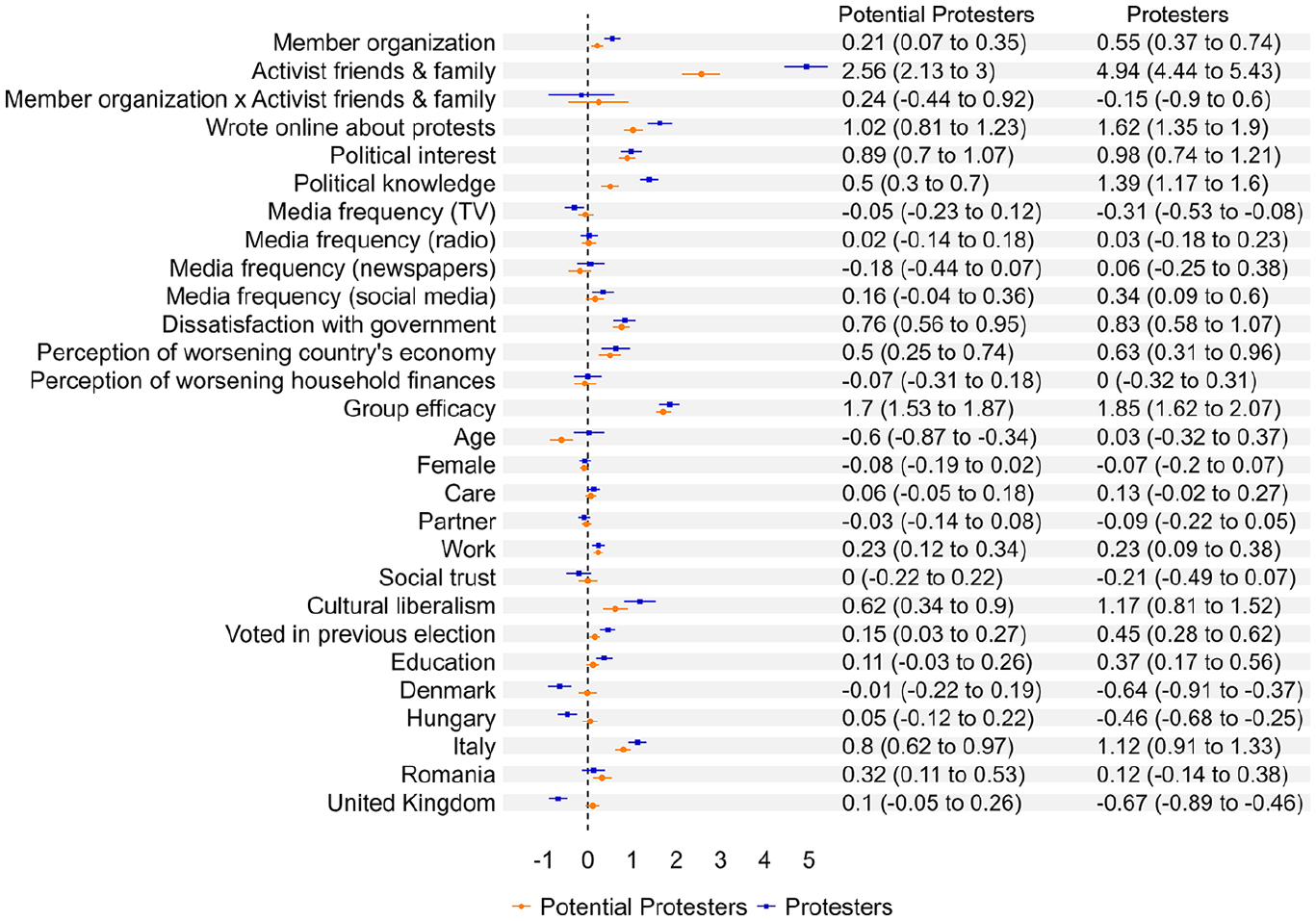
Multinomial Logistic Regression (Reference Category: Non-Participation).
First, we explore the relation between network embeddedness and the likelihood of being an actual as well as a potential protester, as opposed to a non-protester. We follow the advice of Brambor et al. (2006) on interpreting interaction models. They argue that “[s]cholars should refrain from interpreting the constitutive elements of interaction terms as unconditional or average effects” (Brambor et al., 2006: 71). Instead, these authors suggest that the coefficients of constitutive terms should be interpreted as the effect of the predictor on the outcome variable when the other term of the interaction is 0. These coefficients, they contend, lend themselves to complex interpretations and it is therefore best to analyze them through dedicated interaction plots (Brambor et al., 2006: 74–76). Consequently, while we briefly discuss the regression results presented in Figure 1, we focus our interpretation on the interaction plots displayed in Figures 2 and 3.
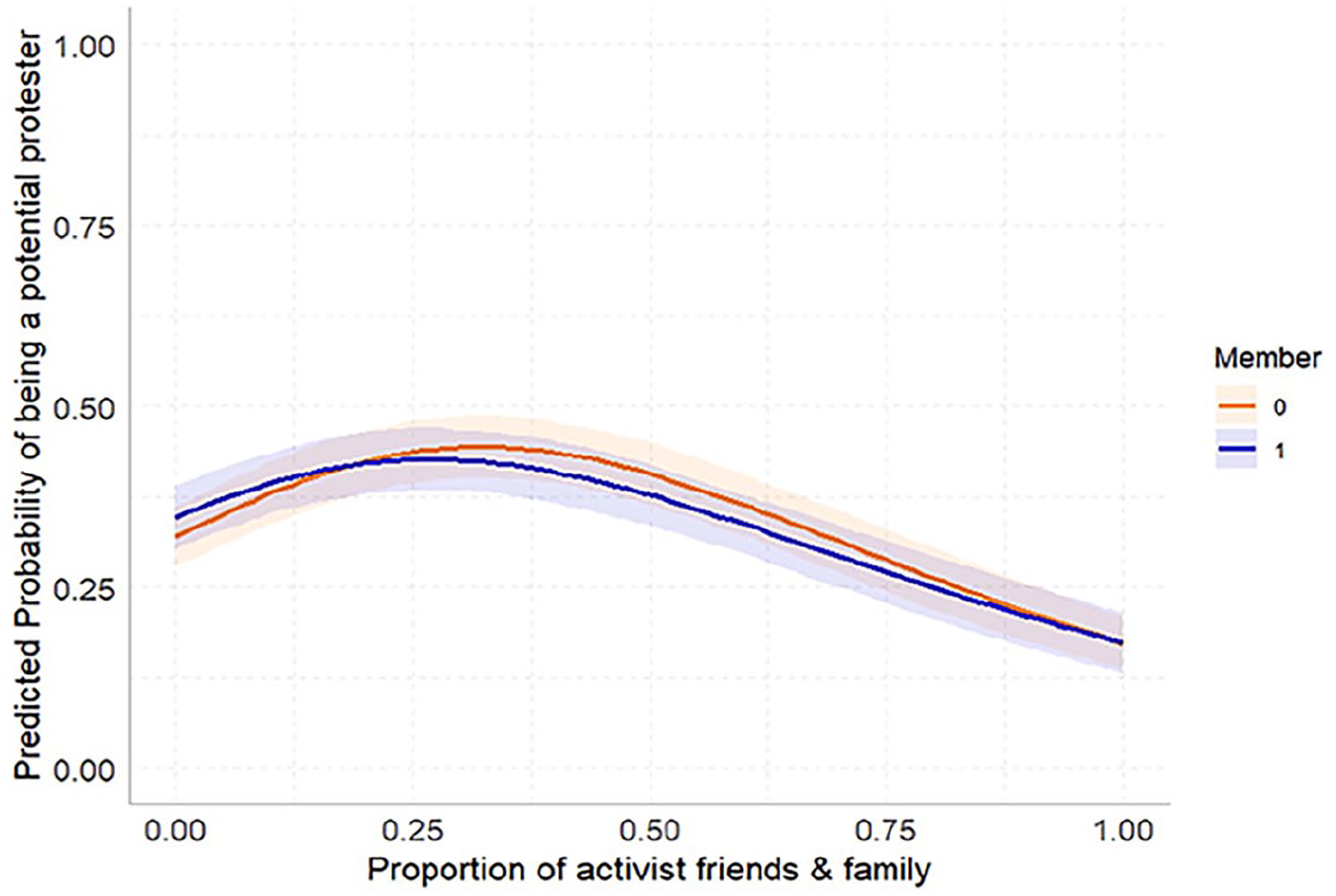
Interaction Effect of Organizational Membership and Activist Friends and Family on the Predicted Probability of Being a Potential Protester, as Opposed to a Non-Protester (Multinomial Logistic Regression Model—Figure 1).
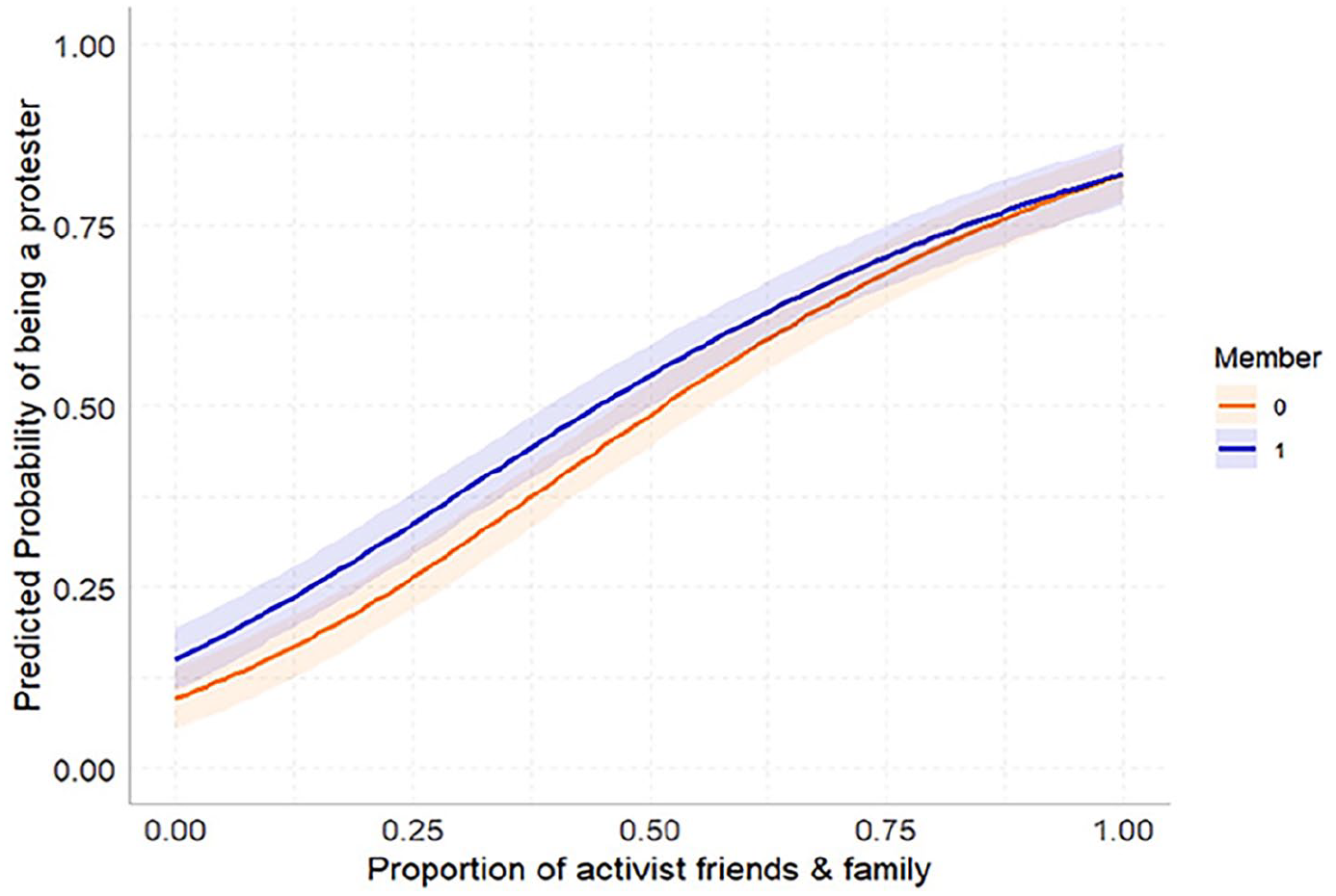
Interaction Effect of Organizational Membership and Activist Friends and Family on the Predicted Probability of Being a Protester, as Opposed to a Non-Protester (Multinomial Logistic Regression Model—Figure 1).
Figure 1 shows a positive relation between being a member of a social movement organization and the probability that somebody is a potential or an actual protester, in instances in which individuals have no activist contacts among friends or family. Moreover, it also displays a positive association between the proportion of friends and family contacts in activist circles and the probability of being a potential or an actual protester, in cases where individuals are not members of a social movement organization. In addition, the interaction between organizational membership and personal contacts is not significant for the likelihood of being either a potential or an actual protestor. Further exploring these relations through the interaction plots in Figures 2 and 3, we note that the conclusions derived from the results reported in Figure 1 should be contextualized, particularly for the case of potential protesters. Figure 2 indicates that organizational membership has no statistically significant effect on being a potential protester, as opposed to a non-protester.
The effect of activist friends and family on potential participation should likewise be further nuanced. Informal networks of activist contacts do not have a significant effect for organizational members. For non-members, having some informal activist contacts as opposed to none increases the probability of being a potential protester. While keeping in mind the low incidence of respondents who said that “most” or “all” of their friends and family were involved in activist circles, as evidenced by the summary statistics in Table 2, one substantive interpretation of this finding would be that having a few activist friends and family members, as opposed to having none, can boost one’s motivation to participate in protests, albeit without it always culminating in action. Yet, once somebody reaches a certain level of network embeddedness, through friends and family, these connections become particularly effective on the behavioral level of the gradient, while the motivation to participate stabilizes.
As far as the effect that network embeddedness has on the predicted probability of being an actual protester (Figure 3), we observe a greater probability of being a protester for members than for non-members, which decreases as one has a greater proportion of friends and family in activist circles. Moreover, Figure 3 reveals a noticeable positive effect of friends and family networks on the probability of being an actual protester.
Second, engaging in online communication about protests is positively associated with being a potential and an actual protester, respectively. The likelihood of being a potential or an actual participant is higher for people writing about protests on social media, as compared to non-participants. Third, we note that both political interest and knowledge increase the likelihood of being a potential as well as an actual protester, as opposed to a non-participant. Furthermore, media consumption seems to have some significant effect on the likelihood of being an actual as opposed to a non-participant. The frequency of TV consumption for political news is negatively associated with being a protester. Conversely, regular social media usage for obtaining information about politics is positively related to the likelihood of being an actual protester, as opposed to a non-participant.
Fourth, we see that some grievances have a relation to the likelihood of being both an actual and a potential protester. On the one hand, sociotropic grievances—a negative perception of the state of the country—are positively associated with the probability of being an actual as well as a potential protester. Being dissatisfied with the government, as well as having a perception of a worsening economy are positively related to the likelihood of being both an actual and a potential protester. On the other hand, the egotropic grievance included in our model—that is, having a negative perception of the state of one’s finances—does not seem to have a significant effect on differentiating potential and actual participants from non-participants.
Fifth, perceptions of group efficacy differentiate potential and actual participants from non-participants. Believing that protests can influence the situation in the country is positively associated with the likelihood of being both a potential and an actual protester, in our models. Sixth, biographical availability does not seem to make a significant difference in distinguishing potential and actual protesters from non-participants. Age has a significant effect on one’s likelihood of being a potential participant—younger individuals are more likely to be part of this group—but it shows no significant effect for actual protesters. 4 Furthermore, more hours of work are associated both with being a potential and an actual protester, as opposed to a non-participant. The rest of the predictors associated with biographical availability do not show a significant effect.
Finally, in relation to differences among countries, we see that living in Denmark, Hungary, and the United Kingdom is negatively associated with being a protester, as compared to Germany, the reference category. Living in Romania is correlated with a greater likelihood of being a potential protester. Furthermore, living in Italy increases the likelihood of being both a potential and an actual protester. Finally, our results are very similar across countries. While we include all country models and a discussion of them in the online Appendix, we note here that there is no instance in which a variable in a country model has a statistically significant effect going in the opposite direction to a statistically significant effect in the cross-country model.
We now turn our focus to the differences between actual and potential protesters. Figure 4 presents the results of a binary logistic regression model in which we restricted our observations to actual (coded as “1” in the outcome variable) and potential (coded as “0” in the outcome variable) participants.
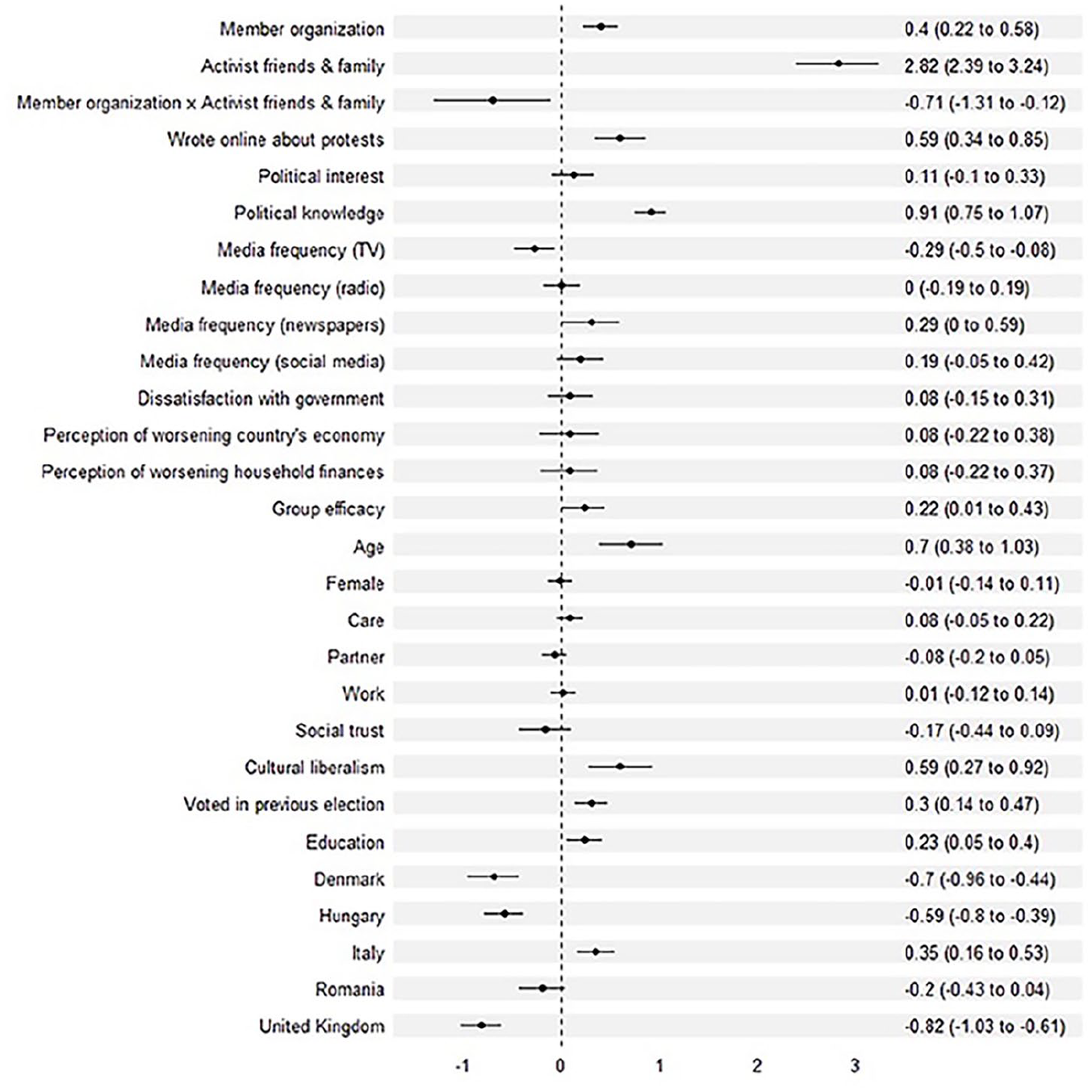
Binary Logistic Regression (DV: Actual Participation; Reference Category: Potential Participation).
First, as with the previous model, we use separate plots to display the effects of network embeddedness and the interaction between the two types of networks we distinguish in the article (Figures 4 and 5). We observe that actual participants stand out from potential ones with respect to their network embeddedness. Being a member of a social movement organization, as well as the proportion of friends and family members who are connected to activist circles are positively associated with protest participation. As with the previous model, having activist friends and family has the strongest relation to protest participation, among all of the predictors. We also see that the interaction between being a member of a social movement organization and the proportion of friends and family members who are connected to activist circles displays a negative and statistically significant coefficient.
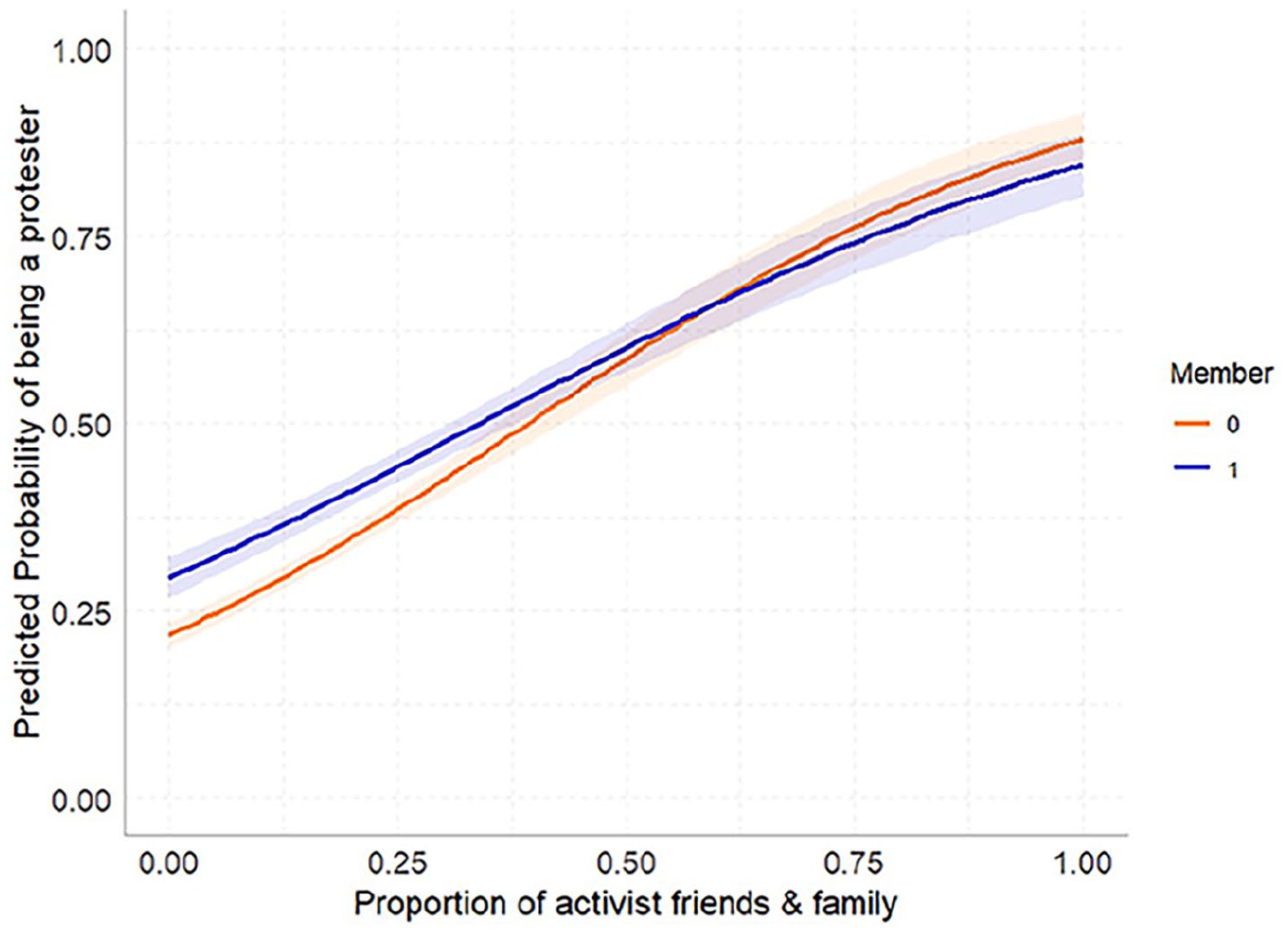
Interaction Effect of Organizational Membership and Activist Friends and Family on the Predicted Probability to be a Protester, as Opposed to a Potential Protester (Binary Logistic Regression Model—Figure 4).
Unpicking this result, Figure 5 shows the effect that the proportion of activist friends and family has on the predicted probabilities of being a protester, as opposed to a potential protester, for organizational members and non-members. As can be observed, when the proportion of friends and family members in activist circles is rather low, being a member of an organization makes a significant and positive difference to the probability of being a protester, as opposed to a potential protester. Once the proportion of friends and family connected to activist circles increases, the difference between organizational members and non-members is not significant anymore. In practical terms, this result highlights the importance of recruitment networks in translating willingness to participate into action. When people do not have many trusted contacts (friends and family members) in activist circles, having formal connections to organizations significantly facilitates channeling motivation into participation. When individuals have trusted contacts in activist circles, their own organizational membership does not make a significant difference to their capacity to convert potential into action.
Second, and returning to the regression results displayed in Figure 4, writing online about protests increases the likelihood of being an actual, as opposed to a potential participant. Third, we turn to exploring the effect of political interest and knowledge on differentiating actual from potential participants. Our regression model shows no significant differences between potential and actual protesters in relation to their interest in politics. However, actual protesters stand out from potential protesters through their greater knowledge of politics. Moreover, protest participants watch TV less frequently and read newspapers more regularly than potential participants. Fourth, the type or intensity of grievances does not seem to make a difference to whether somebody is an actual or a potential protester. Satisfaction with the government, the assessment of the economic situation in the country, or perceptions of the state of one’s household finances do not affect the likelihood of being an actual versus a potential protester.
Fifth, perceptions of group efficacy are positively associated with actual participation, when comparing actual to potential participants. Thinking that protest can influence the situation in the country increases the likelihood of being an actual protester, rather than a potential one. Sixth, with the exception of age, biographical availability does not seem to make a difference to whether somebody is an actual or a potential protester. Being older is positively associated with being an actual, as opposed to a potential protester. 5 Nonetheless, the rest of the predictors for biographical availability—being a woman, in charge of dependents, having a partner, and time dedicated to work—do not distinguish potential from actual participants.
Finally, in relation to the country controls in the models, Figures 1 and 4 show that potential and actual participation are more likely in Italy than in Germany (the reference category). In contrast, people in Denmark, Hungary, and the United Kingdom are less likely to be potential as well as actual protest participants than those in Germany. These findings on protest participation seem to go against the East–West distinctions outlined by earlier research (Acik, 2013; Bernhagen and Marsh, 2007), at least during our observation window. This is because of both differences among Western countries and due to East–West similarities. As with the previous model, our binary logistic regressions exhibit significant consistency across countries. None of the variables in the country models show a statistically significant result that contradicts those found in the cross-country analysis. We report the results of our country models in more detail in the Appendix.
Discussion
Returning to our hypotheses, overall, our data confirm our expectation of a participation gradient. In relation to network embeddedness (H1), we detect that both formal and informal networks have a gradual relationship to participation. In other words, both having contacts in activist circles and being a member of a social movement organization are positively associated with being a potential participant, when compared to a non-participant (Figure 1); and being an actual protester, when compared both to a non-participant and a potential protester (Figure 4). Moreover, once we move past the motivational stage of the gradient, the effect of organizational membership is only significant for people who have few or no friends and family members involved in activist circles (Figure 5). Exploring the interaction effect between organizational membership and having activist friends shows that for potential participants with enough activist friends, organizational membership does not make a significant difference to their protest participation. An explanation for this result may be that once individuals have enough activist contacts in their informal networks, they already have trusted others providing access to information about protest opportunities along with the company to attend a demonstration, regardless of whether they are members of an organization or not.
Moving to H2, we can confirm our expectation of a gradual relationship between online and offline engagement. Having written online about protests is positively associated with being both a potential and an actual protester, when compared to being a non-participant. At the same time, when restricting our analysis to actual and potential protesters, writing online about protests is positively related to protest participation, thereby helping to further distinguish those who may be motivated to participate from those who actually do.
Focusing on H3a, political interest seems to only be related to the motivational stage of the participation gradient but not to the behavioral one. When comparing them to non-participants, both potential and actual protesters seem to display a greater interest in politics. However, political interest does not seem to make a difference when it comes to differentiating potential and actual protesters among themselves. However, political knowledge (H3b) does, as it seems to be related to both stages of the participation gradient. This variable shows a statistically significant association both with being a potential protester, when compared to non-participants, as well as with being an actual protester, when paired both with non-participants and with potential protesters. As to media consumption, TV consumption is negatively associated with actual protest participation, when compared both to non-participants and potential protesters. Moreover, frequency of social media usage for obtaining information about politics is positively related to actual participation, when compared to non-participation, but has no significant impact on differentiating actual from potential protesters. In addition, frequency of newspaper reading is positively associated with being an actual participant, when compared to a potential participant. Yet, none of these three predictors shows a significant association with potential participation. These findings complement and nuance previous studies arguing that frequency of TV consumption is negatively associated with participation, while reading newspapers is positively associated with this phenomenon (Schussman and Soule, 2005).
Turning to the relationship between grievances and the participation gradient (H4), we found an association only on the motivational level. Sociotropic grievances—dissatisfaction with the government and thinking that the state of the country’s economy is worse than 1 year earlier—are associated both with being a potential and an actual protester, as compared to a non-protester, but are not statistically significant when trying to differentiate potential from actual protesters. Egotropic grievances do not seem to have a significant relationship to any level of the participation gradient.
Reflecting on H5, we can confirm the hypothesized gradual relationship between group efficacy and participation. When compared to non-participants, group efficacy is significantly related both to being a potential and an actual protester. Furthermore, group efficacy is also positively associated with actual protest participation, when restricting the comparison to actual and potential protesters. Finally, with the exception of age, we did not find any significant association between participation and biographical availability (H6).
Age is negatively associated with being a potential participant, both when compared to being a non-participant as well as to being a protester. Nonetheless, we did not find any significant relation between age and actual participation. In other words, being younger seems to be associated to the combination of being open to participating in a protest but not having done so yet. In addition, more hours of work are associated with both being a potential participant, when compared to non-participants, as well as to being a protester, when compared to non- and potential participants. While contradicting the expectations based on a biographical availability argument, this gradual relationship between time dedicated to work and protest participation seems to be broadly in line with the civic skills model (Verba et al., 1995). It posits that the skills acquired through work are likely to facilitate political participation, as people with more civic skills are better at processing political information (i.e. the motivational component of the participation gradient), as well as at overcoming the obstacles to actual participation (i.e. the behavioral component of the participation gradient).
Conclusion
Protest is a staple of modern democracy (Meyer and Tarrow, 1998). As an element of the democratic political action repertoire, it transpires outside the institutional framework as the expression of a desire for more immediate social change than what may be available to citizens through electoral political means such as voting (Jakobsen and Listhaug, 2014). As such, scholarship to date has evinced its spread across different regions of the European continent while likewise mapping its ideological fabric (Borbáth and Gessler, 2020). In this article, we sought to grapple with what we see as an attritional process leading to protest participation, specifically in street demonstrations.
Earlier research has shown that only a subgroup among the mobilization potential eventually joins a protest as progressively fewer people move from an agreement with the goals and tactics of a protest to becoming informed and motivated to participate, and then turning that motivation into action (cf. Beyerlein and Hipp, 2006; Klandermans and Oegema, 1987). Despite this seminal proposition and the ample attention afforded to explicating protest participation with innovative methodological instruments such as protester panel studies (Van Laer, 2017; Walgrave and Wouters, 2022) and protest surveys (Giugni and Grasso, 2019), the differential analysis of potential protest participants, non-participants, and actual participants is an area that can benefit from further systematic enquiry. Based on population surveys in six European countries, our treatment circumvents earlier methodological constraints. On that empirical foundation, it advances the joined-up, theoretical understanding of protest participation as an outcome of an attritional process. At the same time, it provides practical insights into mobilization pathways that social movement organizations may facilitate.
Instead of focusing solely on participants, contrasting them only with potential participants (Beyerlein and Hipp, 2006), or potential participants with non-participants (Hunger et al., 2023), our differential approach contributes to the study of what we understand as a participation continuum from non- to actual participation (cf. Van Laer, 2017; Walgrave and Wouters, 2022). First, our data alerted us to the ample possibility, in the six countries, to mobilize substantial tracts of the population prone to participation, out onto the streets. Second, we showed that participation relates to distinct gradients setting apart actual from potential and non-participants. Specifically, of the theoretically pertinent variables, some seem to have a linear gradual relation to participation: they increase the likelihood of being a potential or actual protester as opposed to a non-protester; and, moreover, they raise the likelihood of being an actual rather than a potential protester by a significant margin. Online political participation (writing online about protests), as well as political knowledge, and liberal values fall into this category. This means that these variables relate both to the motivation to take part in protests as well as to the actual behavior.
Third, we noted that other variables have a gradual but partial relation to participation—pointing to what we described as a punctuated gradient, earlier in this article. This is because while they differentiate protesters and potential protesters, together, from non-participants, they do not help distinguish protesters and potential protesters among themselves. Thus, political interest, sociotropic grievances, group efficacy, and being in employment make individuals more likely to be both a potential and an actual protester, as opposed to a non-participant. Informal networks of activist friends and family, moreover, increase the likelihood of participation for both members and non-members of social movement organizations. As for potential participation, this relation is more nuanced. Having some activist contacts—as opposed to having none—increases the likelihood of being a potential participant only for those people who are not members of an organization. While non-members may represent a larger share of the population, this result reinforces the idea of the punctuated participation gradient.
Fourth, age and education likewise evidence a punctuated gradient in that they have a gradual but partial relation to participation. They set apart protesters both from potential protesters and non-participants; and, separately, potential from actual protesters and non-participants. Having a higher level of education makes individuals more likely to be protesters. Age predicts potential participation as opposed to non-participation while older age increases the likelihood that somebody is a participant as opposed to a potential participant. In other words, younger individuals are more likely to be open to participating in protests (cf. Dalton, 2017) but, when it comes to translating that eagerness into action, they are less likely to actually turn up to a demonstration than their older peers. This finding is consistent with Beyerlein and Hipp (2006), suggesting that perhaps they observed a cohort rather than a generational effect.
Fifth, although we cannot test the extent to which these findings relate to macro-structural factors (e.g. to social spending, cf., Grasso and Giugni, 2016: 671), we would postulate a contrast in perceptions captured by these authors—for example, a sense of relative deprivation connected to austerity policies enacted by European governments in the wake of the Great Recession—and perceptions formed against the backdrop of the economic relief policies rolled out following the onset of the COVID-19 pandemic. We see a time-wise comparative analysis as a fruitful avenue for disentangling discrepancies among the correlates of protest participation at these two specific points in time. The combination we found, of perceptual, attitudinal, and biographical variables linked to both potential and actual participation, increases the likelihood of individuals becoming part of the mobilization potential of a demonstration. A panel design could investigate causal links between such variables and participation. Illustratively, taking a longitudinal perspective, one may expect group efficacy to make people more likely to persist in their participation; or at least for them to follow an “abeyance trajectory” (Corrigall-Brown, 2012: 26) whereby they remain engaged over a longer period even though they may also reduce or temporarily discontinue their involvement during that same period.
In sum, our results enrich extant scholarship through the documentation of what we have termed a punctuated participation gradient underpinned only by a combination of social and political variables and separate patterns that allow for pair-wise distinctions between non-, potential, and actual participants. A limitation of our study derives from the fact that we favored robustness and sample size over a more granular understanding of how the observed relations might vary across different types of protest, like strikes, riots, or boycotts. In addition, while conditions for intended and actual participation might differ for an anti-immigration protest event as opposed to, for example, an environmental protest—as they touch upon a different set of political grievances, draw on disparate understandings of democracy, or pose different levels of cost and/or risk to individuals—our focus has been on more general relationships between theoretically salient variables and a gradual differentiation of protest participation. In our turn, we have expanded the current appreciation of protest participation as an attritional process (cf. Beyerlein and Hipp, 2006; Klandermans and Oegema, 1987). The clustering of variables around actual, potential, and non-participation invites further research into intervening factors in the lead-up to the protest behavior. That analysis can be extended with datasets that include a larger number of countries and multilevel analyses (Bryan and Jenkins, 2016).
Such work may involve closer scrutiny of friendships to discern first, how they combine with other factors to differentially enable potential and then actual participation (e.g. they galvanize emotions conducive to participation, nurture and sustain one’s motivation to participate, cf. Gundelach and Toubøl, 2019; Van Laer, 2017); second, to probe the extent to which they enable participants to maintain active engagement (cf. Passy and Monsch, 2014), for instance, through social media; and, third, to test whether the type of protest mediates the relation that friendship has to both motivation and behavior. Finally, and as it stands, our differential treatment can already serve to inform mobilization strategies by social movement organizations that, for example, maximize the likelihood of reaching especially young potential participants through friendship networks and do so with communication that amplifies their aggravation with how the country—including the economy—is run.
Supplemental Material
sj-docx-1-psx-10.1177_00323217241297905 – Supplemental material for Actual, Potential, and Non-Participants: Advancing the Differential Analysis of Protest Participation
Supplemental material, sj-docx-1-psx-10.1177_00323217241297905 for Actual, Potential, and Non-Participants: Advancing the Differential Analysis of Protest Participation by Dan Mercea, Felipe G. Santos and Matthias Hoffmann in Political Studies
Footnotes
Declaration of Conflicting Interests
The author(s) declared no potential conflicts of interest with respect to the research, authorship, and/or publication of this article.
Funding
The author(s) disclosed receipt of the following financial support for the research, authorship, and/or publication of this article: The authors wrote this article while in receipt of funding from the Volkswagen Foundation (grant no. 98144) and from the European Union—NextgenerationEU—and the Romanian Government, under the National Recovery and Resilience Plan for Romania, contract no. 760038/23.05.2023, cod PNRR-C9-I8-CF204/29.11.2022, disbursed by the Romanian Ministry of Research, Innovation and Digitalization, within Component 9, Investment I8.

Supplemental Material
Additional Supplementary Information may be found with the online version of this article.
Contents Survey questions used to construct model variables. Descriptive statistics by country. Table 1: Summary statistics, per country. Missing data. Table 2: Observations with missing data in at least one item, per country. Table 3: Missing data, per variable. Analyses without multiple imputation. Figure 1: Multinomial logistic regression (DV: protest participation, reference category: non-participation), excluding observations with missing data. Figure 2: Binary logistic regression (DV: actual participation, reference category: potential participation), excluding observations with missing data. Models excluding respondents below 30. Figure 3: Multinomial logistic regression (DV: protest participation, reference category: non-participation), excluding respondents above 30 years old. Figure 4: Binary logistic regression (DV: actual participation, reference category: potential participation), excluding respondents above 30 years old. Country-level regressions. Figure 5: Multinomial regression for Denmark (DV: protest participation, reference category: non-participation). Figure 6: Multinomial regression for Germany (DV: protest participation, reference category: non-participation). Figure 7: Multinomial regression for Hungary (DV: protest participation, reference category: non-participation). Figure 8: Multinomial regression for Italy (DV: protest participation, reference category: non-participation). Figure 9: Multinomial regression for Romania (DV: protest participation, reference category: non-participation). Figure 10: Multinomial regression for the United Kingdom (DV: protest participation, reference category: non-participation). Table 4: Comparison of the cross-country and country-specific multinomial logistic regression models. Figure 11: Binomial regression for Denmark (DV: actual participation, reference category: potential participation). Figure 12: Binomial regression for Germany (DV: actual participation, reference category: potential participation). Figure 13: Binomial regression for Hungary (DV: actual participation, reference category: potential participation). Figure 14: Binomial regression for Italy (DV: actual participation, reference category: potential participation). Figure 15: Binomial regression for Romania (DV: actual participation, reference category: potential participation). Figure 16: Binomial regression for the United Kingdom (DV: actual participation, reference category: potential participation). Table 5: Comparison of the cross-country and country-specific multinomial logistic regression models.
Notes
Author Biographies
References
Supplementary Material
Please find the following supplemental material available below.
For Open Access articles published under a Creative Commons License, all supplemental material carries the same license as the article it is associated with.
For non-Open Access articles published, all supplemental material carries a non-exclusive license, and permission requests for re-use of supplemental material or any part of supplemental material shall be sent directly to the copyright owner as specified in the copyright notice associated with the article.
