




Abstract
British attitudes to ‘Europe’ have been long characterised as ‘reluctant’. This article uses a range of qualitative and quantitative sources to describe and explain an anomalous period in which Britons were highly ‘enthusiastic Europeans’. This ‘Europhoria’ is interpreted using an expanded ‘calculation, cues, and community’ theoretical framework, including: (1) calculations driven mainly by anticipation of the ‘1992’ single market launch and ‘social chapter’ and trust engendered by unrealised negative predictions raised during the 1975 referendum; (2) proactive domestic European policy leading to harmonious, influential, insider status; (3) benchmarking of comparable, better performing European economies and (4) newfound belief that Europe was Britain’s most important international community. ‘Europhoria’ interplayed with a sense of European community and geopolitical possibilities stimulated by the fall of the Berlin Wall and unusually ‘European’ cultural trends in media, sports and arts. The reversal of these factors – in some cases at pan-European level – explains the British return to Euroscepticism thereafter. These findings have profound theoretical implications for public attitudes to Europe and historical understandings of Britain and Europe.
Keywords
Just think for a moment what a prospect that is. A single market without barriers – visible or invisible – giving you direct and unhindered access to the purchasing power of over 300 million of the world’s wealthiest and most prosperous people. Bigger than Japan. Bigger than the United States. On your doorstep . . . It’s not a dream. It’s not a vision. It’s not some bureaucrat’s plan. It’s for real. And it’s only five years away’ – Margaret Thatcher, alongside Jacques Delors, 16 April 1988, addressing the Europe Open for Business launch event. Britain is slowly adapting to being more ‘European’. The Channel Tunnel . . . will tie our offshore islands to the Continent through what is tellingly described as a ‘fixed link’. We take it for granted that British foreign policy is increasingly coordinated with that of the other Eleven . . . Our businessmen commute as naturally to Amsterdam or Copenhagen as to Swindon and Liverpool. EEC mergers loom – The Times, 30 January 1989. This column is prepared to own up that it voted ‘No’ in the 1975 referendum on whether Britain should stay in the European Community . . . To be sure, British withdrawal from the EC is a mere fantasy now – The Guardian, 11 December 1989. As the actual event of German unification unfolds on the world’s TV screens, many observers view the spectacle as a precursor . . . of enlarged clout for [Europe] as a whole. Only a couple years ago, the continent suffered from what some called ‘Eurosclerosis’. Now, ‘Europhoria’ has overtaken the 12 present members of the European Community. They exude confidence that ‘the decade of Europe’ is underway – The Washington Post, 5 July 1990.
Introduction
Britain’s relationship with ‘Europe’ has long been described in overwhelmingly negative terms: at elite level, an ‘awkward partner’, and, at popular level, composed of ‘reluctant Europeans’. Typically, in late 2015, The Economist dedicated its cover to ‘The Reluctant European’ and a nine-article special report variously described British attitudes to Europe as ‘natural ambivalence’, ‘always [having] been rather half-hearted’ and ‘a transactional business’, with ‘deep . . . opposition ’ whereas for other members ‘the project has always been a matter of the heart’ (The Economist, 2015). Academic uses of the term are numerous, framing British Euroscepticism as unique, constant and precluding any pro-Europeanism beyond instrumentalism fuelled by post-imperial desperation (Appendix 1). Indeed, well-documented moments of the relationship – the UK’s initial dismissal of the project, repeated rejected applications, rebates, opt-outs, vetoes, vocal challenges from media and statespersons and finally a dramatic popular and governmental rejection of membership altogether – support this characterisation.
While this account is compelling, it is incomplete. Indeed, there was a time when British citizens were overwhelmingly united in seeing a bright European future as the focus of their ambitions for their country and, in many cases, themselves. Similarly, British governments took the lead in deepening the European project with profound, lasting consequences for both the United Kingdom and ‘Europe’. From roughly the mid-1980s until the early 1990s, rather than being an ‘awkward partner’ of ‘reluctant Europeans’, the United Kingdom could better be described as Europe’s primary ‘proactive partner’ composed of ‘enthusiastic Europeans’ keen for many aspects of deeper integration, owing to the elision of an unusual set of circumstances. This period can be labelled with a portmanteau used by media in the United Kingdom, Europe and beyond to describe the contemporary political, economic and cultural sentiment of the time: Europhoria! (e.g. Lagerfeld, 1990).
The article aims to both describe and explain Europhoria. It utilises, contributes to and tests theories of attitudes to European integration with quantitative and qualitative data sources from a comparative perspective – both top-down and bottom-up – that also factors in the changing nature of the European project itself. However, unlike most studies, it takes a cross-temporal approach to doing so, offering fresh insights into the event-driven nature of attitudes to Europe and beyond. This approach also contributes to several sub-fields of contemporary history through the prism of public attitudes: the breakdown of the post-war consensus, the founding of both the single market and the European Union, and a period of global transition as the Cold War ended. Similarly, explaining British Europhoria is of theoretical interest for the science of attitudinal formation with its myriad sociological, economic and psychological determinants. Finally, it is of substantive importance for those seeking to understand why political unions gain and lose support.
The Case: Enthusiastic Europeans
According to the Eurobarometer, net belief that European membership is a good, rather than bad, thing has always been lower in the United Kingdom than across the rest of the European Union on average (Figure 1). However, Britons have not always been substantively Eurosceptic. Nor, moreover, have British attitudes been constant. In 1980, Britons had a net belief that membership of the then-EEC was a good thing of −0.26 percentage points. By March 1992, the same figure was 42 percentage points, higher than in several other countries (for country trends, see Figure A2).
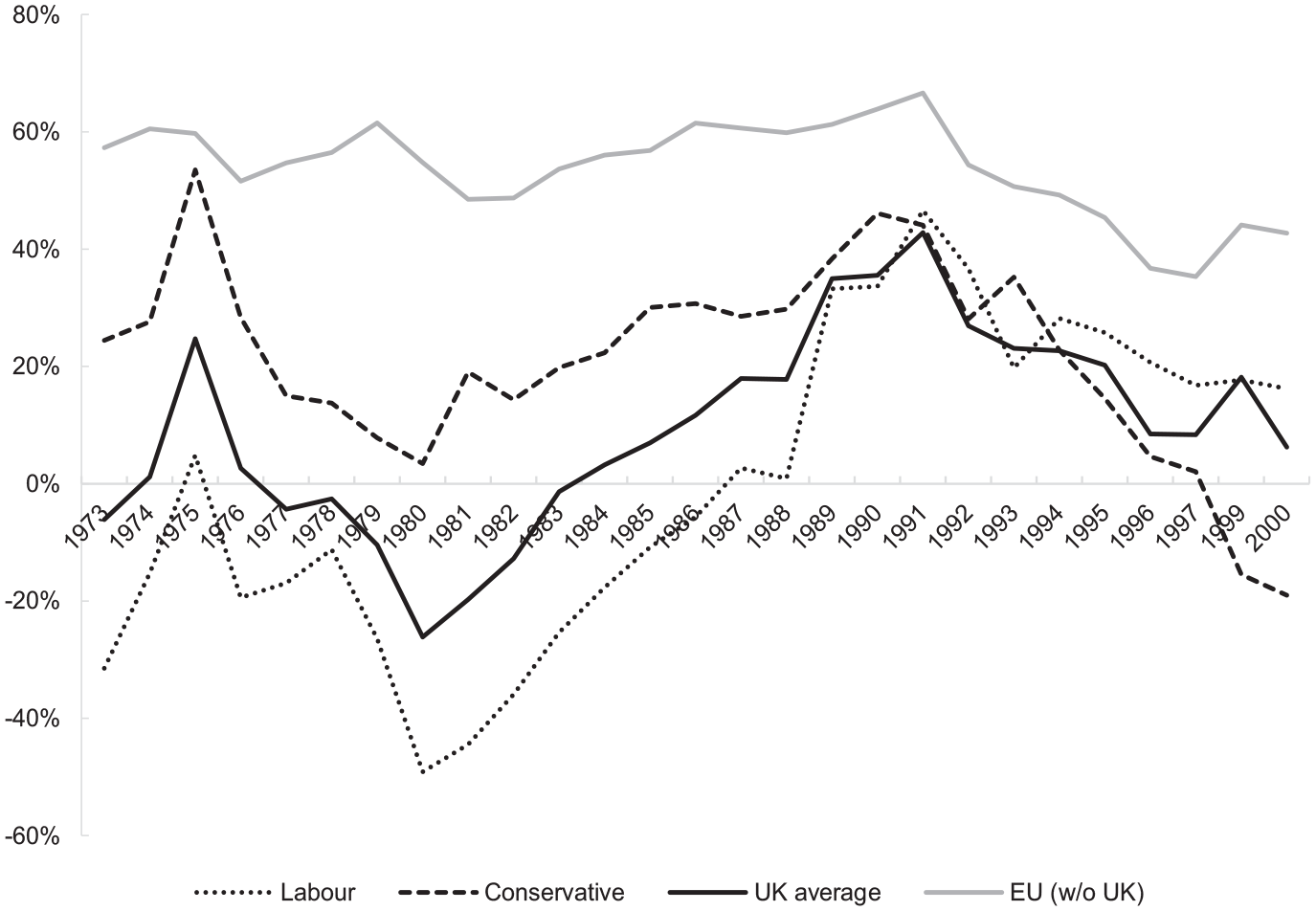
British and European Net Belief That EU ‘Membership Is a Good Thing’ Rather Than ‘Bad Thing’, 1973–2000 (Yearly Averages, Also by Conservative and Labour Voter).
Similarly, first, Mori polling on a hypothetical membership referendum showed overwhelming support for ‘stay in’ anomalously between 1988 and 1992 (see Figure A2). Second, Britons expressed overwhelming support for ‘the unification of Western Europe’ between 1985 and 1992 – in every year but one 50% more were for rather than against and the proportion of Britons ‘very much for’ was higher than several other countries (Eurobarometer, Figure A3). Finally, third, Britons were split about whether British links to the European Community should be closer or about the same, with only a tiny minority favouring less close links – notably the case across all age, gender, class, educational level and regional groups (British Social Attitudes, 1991, Table A1). As such, although we should not overstate the positivity, it was clearly both exceptional across time and broad across societal groups. How can we explain this seemingly anomalous and counterintuitive data?
Theories of Attitudes to European Integration
Early works explaining individual variation in support for European integration identified several – since repeatedly validated – factors including age, class, cognitive skills, income, occupation, partisanship, political values and support for the domestic government (Gabel, 1998; Hobolt, 2014). Hooghe and Marks’s classic work (2005; see also Hobolt and de Vries, 2016) proposed and tested a three-factor combined model of ‘calculation, community, and cues’, showing that feeling European (‘community’) has a larger effect than economic calculations and that Eurosceptic elites cue Euroscepticism in those not feeling European. Works thereafter have confirmed the mixed and small effects of economic calculation (e.g. Garry and Tilley, 2015). ‘Community’ has received the most unambiguous support (Dennison et al., 2020, 2021; Hewstone, 1986) notwithstanding concerns regarding endogeneity between its typical operationalisation – European identity – and support for the EU (Carl et al., 2019; Hobolt and de Vries, 2016). Cueing by politicians has been shown to be primarily effective in explaining variation between countries though this finding is liable to reverse-causality while media cueing has been shown to have modest effects (Gabel and Scheve, 2007; Steenbergen et al., 2007). Partially related to cues, perhaps the most important addition to Hooghe and Marks’ (2005) three factors is that of ‘benchmarking’, whereby the worse one’s country seems to be doing politically and economically, the more positively one views European integration (Hobolt and de Vries, 2016; Sánchez-Cuenca, 2000). Hobolt and de Vries (2016) lament the lack of understanding of exactly what citizens benchmark against – neighbouring countries, trading partners, the EU average or otherwise – and the lack of consideration of the increasingly multidimensional nature of attitudes to European integration. As such, De Vries (2018) expanded benchmarking to include the process of Brexit as a benchmark.
Most studies of attitudes to Europe have focussed on individual or cross-country variation and thus overlook the causes of over time variation and changes in the object of such attitudes – the EU – either as a constitutional construct with changing powers or a political body subject to evaluations (Dennison, 2023: 41; though, e.g. McLaren, 2005: 157). That said, Hooghe and Marks (2009) argue that post-1992 integration transformed public opinion from a ‘permissive consensus’ to a ‘constraining dissensus’ Die across the EU. Moreover, rather than over time change being uniformly distributed, distinct aspects of changing integration interact with distinct national histories and rationales for integration on a national basis (Diez-Medrano, 2003). Personal and national ‘calculations’ have been conceptualised primarily in economic terms and not considered non-economic issues, such as environmental protection, labour rights and foreign affairs and defence (Amato et al., 2019) or broader non-cognitive, emotional forms of calculation (see Dennison, 2024, for review). Finally, factors explaining attitudes to Europe have been operationalised with broad or conceptually distant variable (such as ‘types of capitalism’ and education-level used to measure ‘calculations’ and left-right self-placement to measure cueing), an approach criticised as ineffective at explaining complex historical processes (Kousser, 1984; Olsen, 2004). Second, attitudes to Europe have been measured along single dimensions of affect and so not considered qualitatively distinct emotions beyond simple positivity and negativity, despite attitudes having inseparable emotive and cognitive components (Clifford, 2019).
Britain and Europe
The broad theoretical factors of the ‘calculation, community, cues’ framework and benchmarking approaches can thus be expanded as outlined above and by incorporating the changing nature of European integration and Britain’s specific experience therein. Doing so bridges the divide between recent historical scholarship on Britain and Europe around the time of its entry to the EEC until the early 1980s (Aqui, 2020; Moss and Clarke, 2021; Saunders, 2018; Velkar, 2020) and the political science literature providing longer-term explanations for Brexit (Carl et al., 2019; Dennison and Geddes, 2018; Roe-Crines and Heppell, 2020). It also speaks to existing literature explaining particularly British public opinion to European integration over time (e.g. Clements, 2009, 2010).
First, the ‘calculations’ of personal and national contemporaneous economic instrumentalism can be expanded to include: (1) retrospective calculations (the UK’s 1975 membership referendum campaign acting as a benchmark, see De Vries, 2018); (2) prospective calculations of integration following the Single European Act and Jacques Delors’ ‘1992’ plan (Cowles, 1995) and prospective enlargement following the fall of the Berlin Wall (Smith, 2009); (3) qualitatively distinct emotional forms of affect; (4) non-economic calculations and (5) ‘benchmarking’ calculations vis other member states’ performance (Delanty, 2018). Second, ‘cues’ can be deconstructed to include: (6) the changing nature of Europe; (7) Britain’s and its government’s positions therein (on British government official information campaigns on Europe, see Smedley, 2021); (8) the European Commission (Mitchell, 2012) and, more studied, (9) parties and (10) media. Third, ‘community’ can include (11) European vis exclusive national identity; (12) the relative importance of alternative international relationships as communities (in the UK’s case, Winston Churchill’s three concentric ‘majestic circles’ of the Commonwealth, the Anglo-American relationship and Europe) and (13) cultural expressions of a European identity in media, the arts and sport (Snow, 2001; doing so answers the call to write ‘Europe’ into Britain’s cultural history, Becker and Fuhg, 2021).
Methodology and Data
This article is concerned with multiple causal dynamics eliding within and affecting a single case over time. Thus, process tracing is an appropriate method. It offers robust, systematised analysis of both quantitative and qualitative data to describe and explain processes over time, adding leverage over purely quantitative studies based on abstract averaged relationships that make up the bulk of the extant literature on attitudes to European integration (Mahoney, 2012). Process tracing depends on identifying ‘diagnostic evidence’ using conceptual frameworks, recurring empirical regularities and theory. Because it needs to compare multiple potential causal processes to explain an outcome, process tracing is particularly reliant on ‘intensive description that should be a foundation of process tracing’ (Collier, 2011: 824) so that causality can be reasonably inferred by demonstration of covariance with the dependent variable and elimination of alternatives (Bennet and Checkel, 2014). Processes should be traced over time in a consistent manner. The reason that a time period beyond 1988–1992 is examined is for the purposes of explanation. To only describe the period being explained would make comparison impossible and would constitute the error of “selecting on the dependent variable”. Instead, to explain the anomalous period 1988–1992, it is necessary to consider how other periods of time – before and after – were different (or not) and consider theoretically why these observed differences are likely to be explanatory. As such, the conclusions in the article are arrived at by comparing how trends in data from a wide variety of sources varied over time (and where possible, country) both before, during and after “Europhoria” in a manner typical of process tracing. The combined causal ‘process’ is described in the conclusion, in Figure 11 and in Table A2.
This will be done both over time and between countries within each of three time periods: 1983–1987; 1988–1992 and 1992–1997. These time periods are selected along the following lines: 1988–1992 is selected for the reasons given in ‘The Case’ section above; the preceding and succeeding comparative periods of 1983–1987 and 1992–1997 are collectively book-ended by general elections: the 1983 general election – at which EEC membership was debated and the Conservative’s emphatic victory lead to an ambitious European policy – and the 1997 general election – after which British attitudes were largely stable until ‘Brexit’. All that said, most time series are presented to their longest possible extent, in many cases the full extent of British membership, and analysed in the text. Eurobarometer trends are used for comparative time series; national polling and manifesto data are used for British time series (and some one-off polls where applicable), while relevant policies, speeches, newspaper articles, commentary and cultural artefacts qualitatively measure processes. The expanded theoretical factors as outlined in above and classified in Table A2 are underlined and in italics throughout.
1983–1987: The Background to Europhoria
[P]eople are coming to see the Community as at best irrelevant, and at worst obstructive . . . The revolutionary British suggestion is that the Community should establish a common market. This does not currently exist . . . a host of new policies and new initiatives, some public but many more private, would become viable’. – British Foreign and Commonwealth Minister Geoffrey Howe (Howe, 1984: 187, 190). This is a good deal for Britain. It also means that the way is now clear to get our refund for last year, and to press ahead with the development of the Community’ – Margaret Thatcher, 26 June 1984, following Fontainebleau Summit.
1983 saw a range of books and articles published to commemorate and reflect on Britain’s ten years of membership (Young, 1993: 147). In January, The Times ran a week-long series of op-eds by British and world leaders – some pro- and some anti-European – that are notable for, first, the similarity of arguments to those used in the 1975 referendum and, second, the near unanimous verdict that British membership thus far had been rancorous and disappointing (The Times, 1983; see Appendix 2). Public attitudes to Europe became increasingly negative in the five years following the 1975 referendum (Figure A3). Thereafter, temporary resolutions to the British Budgetary Question (BBQ) and ongoing integration gridlock saw only the slightest trend towards positivity by the British public (Figure 1). By contrast, perceptions across the other eight members remained stable and far more positive. As such, while the years 1976–1986 were ‘a decade of stagnation in the integration process’ as a whole, the volatility of British attitudes suggests causes peculiar to Britain (Eichenberg and Dalton, 1993: 507).
That said, as shown in Figure 2, the extent to which Britons saw the ‘Common Market’ as one of the most important issues affecting their country declined significantly from around 15% at the 1979 election to around 5% at the following 1983 election, robbing the issue of its power to motivate behaviour (Dennison, 2019). Meanwhile, as shown in Table 1, the extent to which each
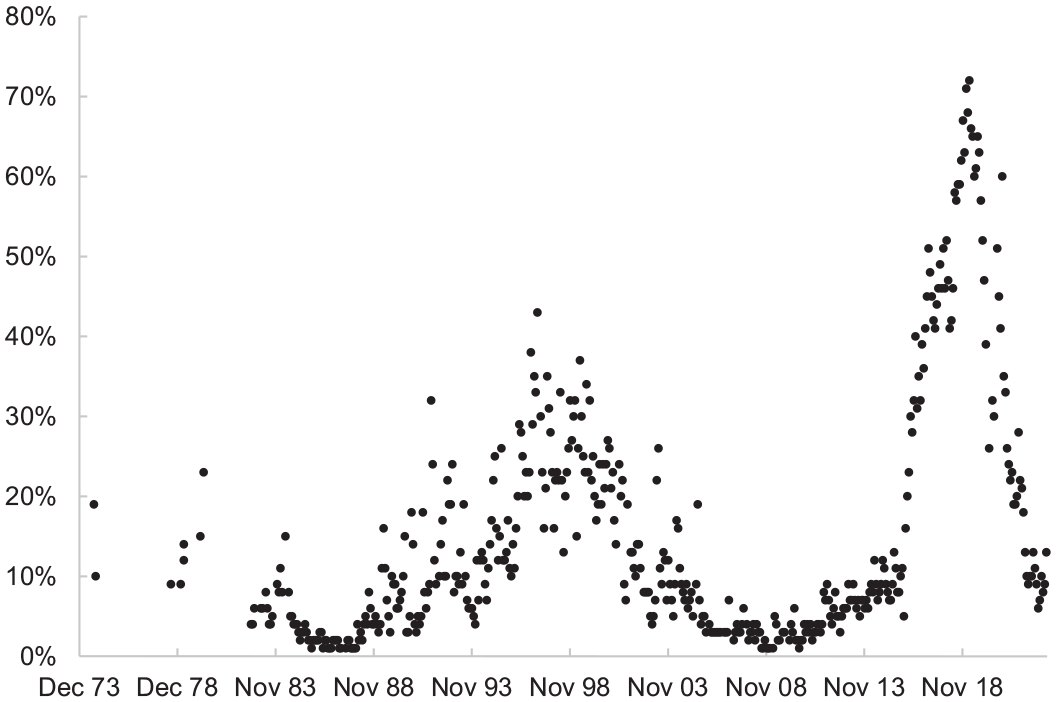
Public Issue Salience, Percentage of Britons Answering ‘Common Market’ as One the Most Important Issues Affecting Britain.
Party Cues, Conservative and Labour Party Manifesto Emphasis on Positive and Negative Aspects of Europe, 1970–2016.
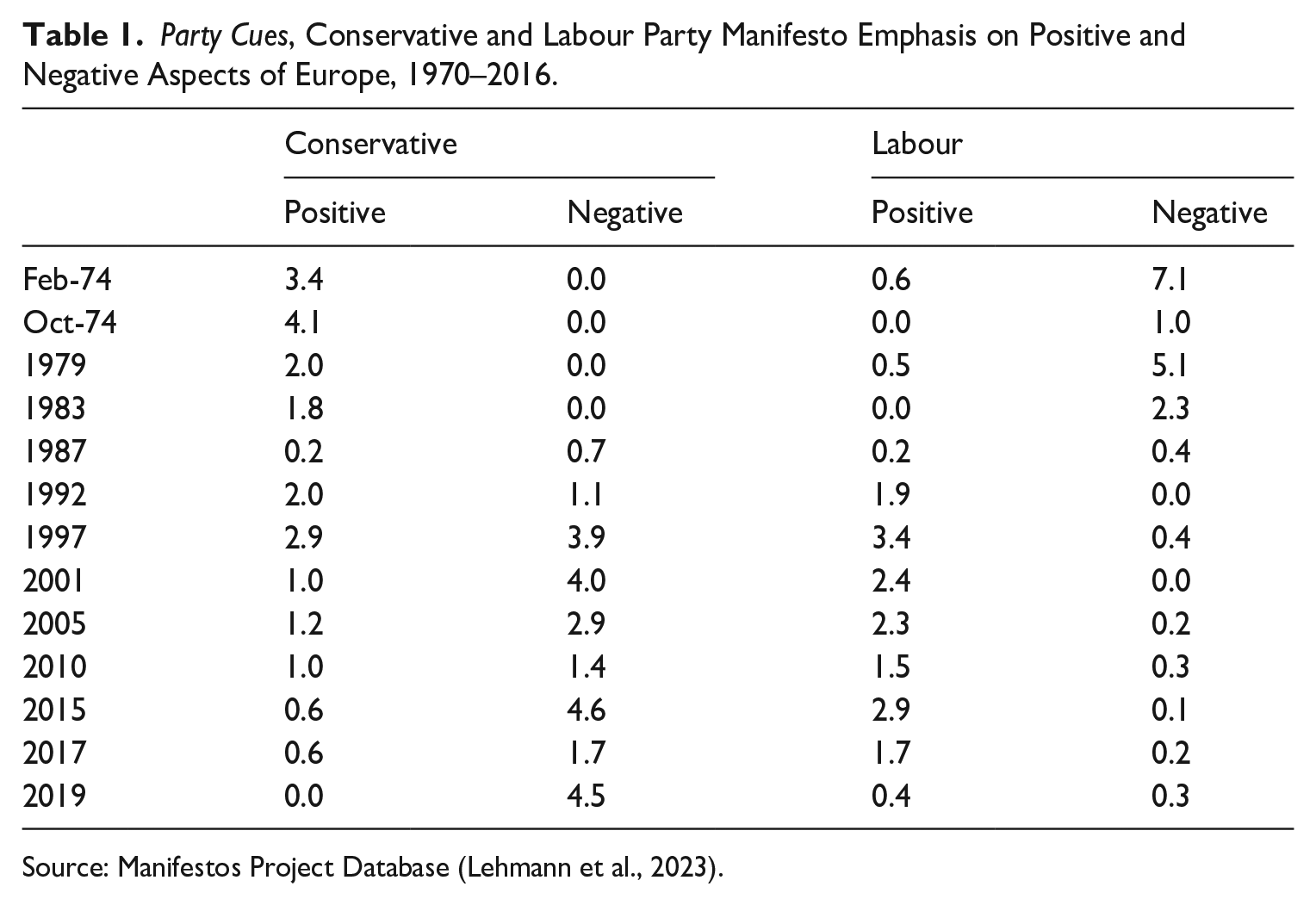
Source: Manifestos Project Database (Lehmann et al., 2023).
Although voters in 1983 retained negative
Retrospective Calculations of European Membership in the Terms of the 1975 Referendum Campaign.
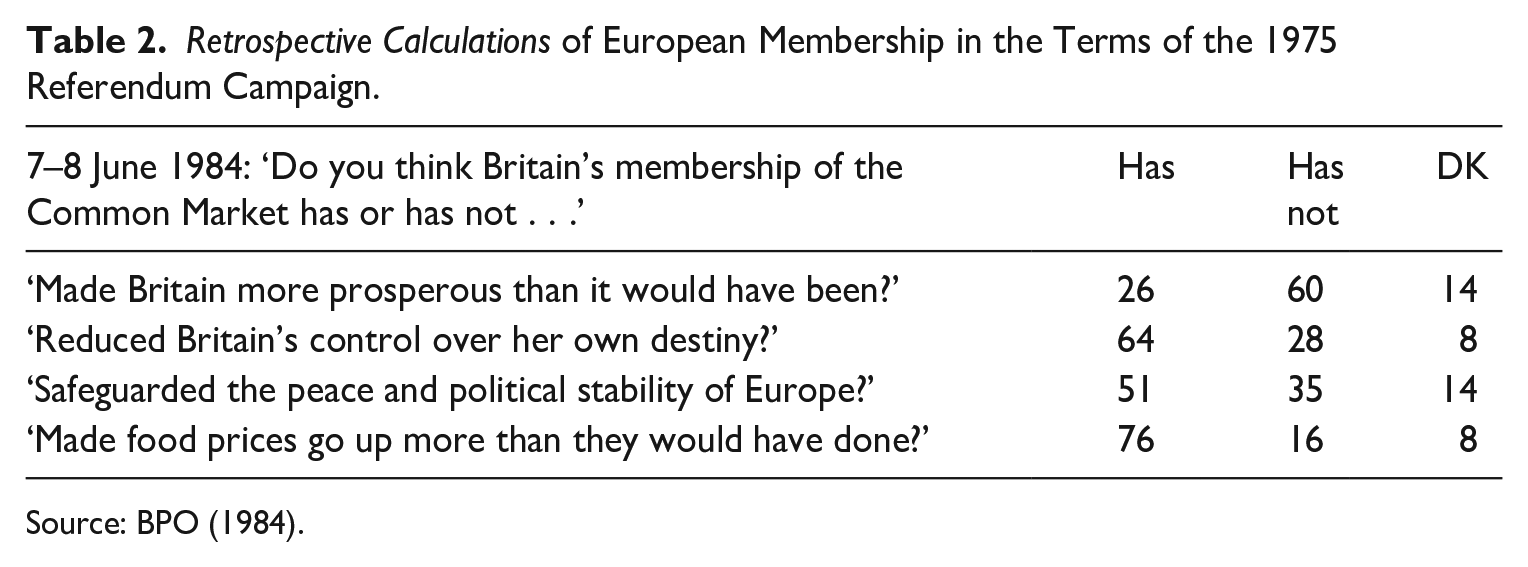
Source: BPO (1984).
In 1984, the Eurobarometer showed that slightly more Britons thought that EC membership was a good thing than thought it was a bad thing for the first time since 1976 (Figure 3).
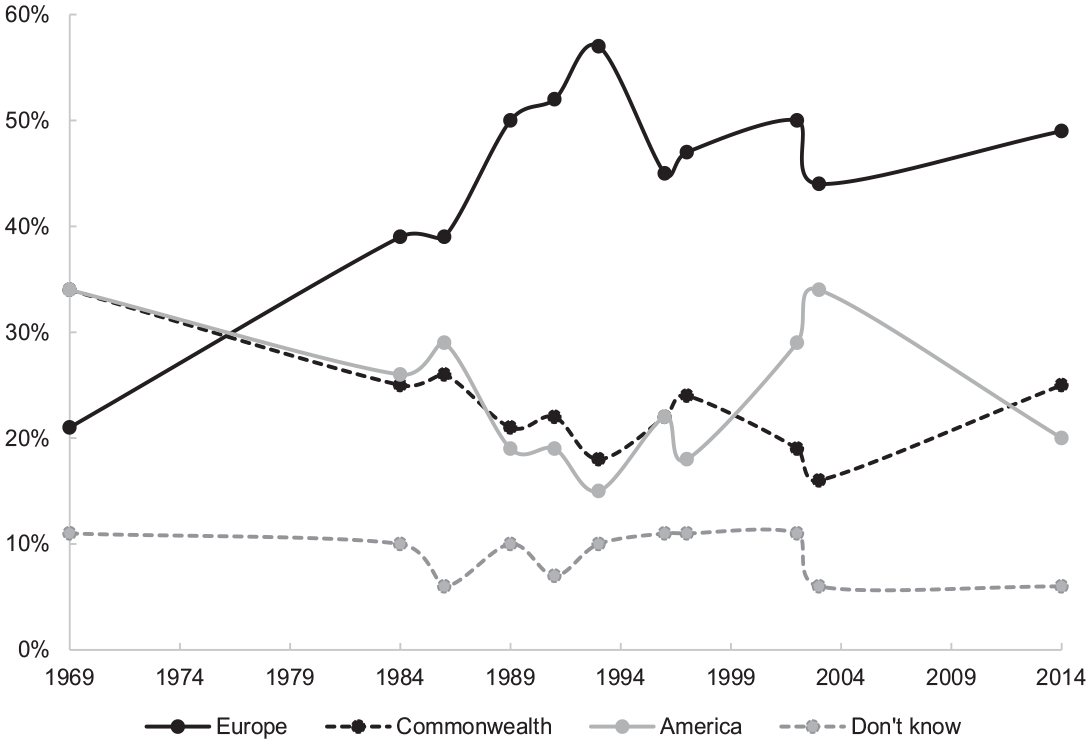
‘Which of These – Europe, the Commonwealth, or America – Is the Most Important to Britain?’.
Later that June, at the Fontainebleau European Council, Thatcher secured a British rebate, ending the British Budget Question. Immediately, Thatcher circulated her ‘Europe, the future’ (HMG, 1984) paper to fellow EEC Heads of Government. ‘Europe, the future’ outlined a radical vision and call for action: the creation of a new Europe dynamised through a single internal market, empowered through common defence, foreign, environmental, research and developmental policies, governed through the Council and united through the active development of a common identity among citizens. That spring, Foreign Secretary Geoffrey Howe had also publicly outlined a similar vision, arguing that following the recent general election result ‘the debate about whether we should be in or out is over’ (Howe, 1984: 187).
More fundamentally than the resolution of the BBQ and the 1983 general election victory, this unprecedented British governmental proactivity can be explained partially by international
Second, although British attitudes had not become more favourable to Europe since joining, they had come to see it as their most important international
The following year, 1985, saw a series of Council meetings to draw up a timetable for major changes to
However, by 1986,
A September 1987 poll on membership showed an eight point lead for ‘stay in’ over ‘get out’ – the largest since the aftermath of the 1975 referendum (Figure A2). That it was the first Mori poll on the question since June 1984 underlines how much of a non-issue Europe was at this point. Between 1985 and early 1988, the ‘Common Market’ was deemed as an unimportant issue to Britons (Figure 2). At no general election before or after was less of the Conservative and Labour manifestos dedicated to Europe than that of June 1987 with the latter party taking on a quiet and ambivalent stance to the project after their 1983 drubbing and the in-fighting that followed (Table 1). Indeed, although 1986 had seen public opinion on whether membership was a good thing continued its long positive rally since the nadir of 1980 – a rally driven, at least since 1984, by those planning on voting Labour – 1987 saw stability (Figure 1). In late 1987, however, retrospective calculations regarding the benefits of memberships for the first time were net positive in the United Kingdom (Figure 4).
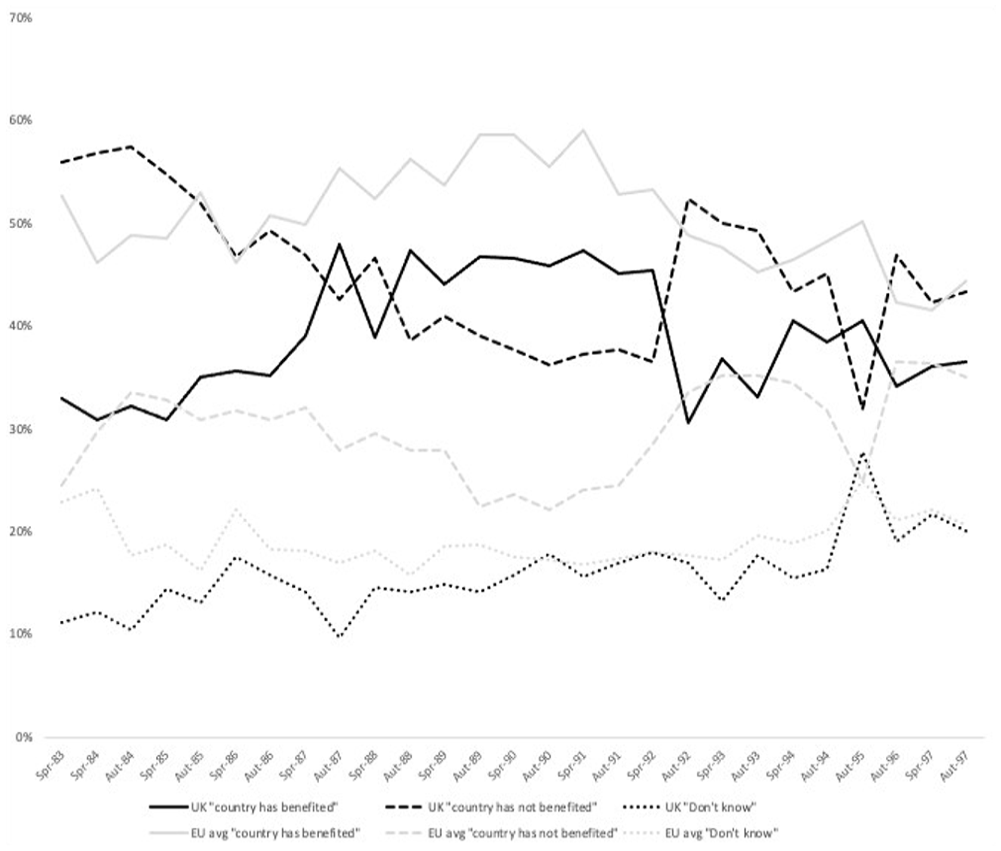
Retrospective Calculations of the Effects of Membership in the United Kingdom and Across the European Union.
1988-1992: Europhoria!
As recently as 1985 there was the widespread impression that Europe was going nowhere fast. The Community had no real achievement except the limited one of the European Monetary System, and the public associated it with an endless and sterile internal budgetary dispute. Then came the Single European Act, and ‘1992’ – Boris Johnson, Daily Telegraph, 17 April, 1989. [Entering the Exchange Rate Mechanism] could help bring down the British rate of inflation . . . it would indeed be a disaster if Mrs Thatcher’s desire to play de Gaulle left Britain on the sidelines as the superpower of the next century, the United States of Europe, came into being – Daily Mail, ‘1992: Why it has to be all or nothing’, 2 August 1988. ‘I got it wrong’ – Trade Union Congress president Clive Jenkins on his opposition to EEC membership in the 1975 referendum, 8 September 1988. Not long ago, it was fashionable to diagnose Eurosclerosis. Now we have something like Europhoria . . . People in Europe feel a fresh start is being made . . . At last, 30 years after the European Community was founded . . . The idea of European integration is gaining momentum – The American Banker, ‘Is there a place for Americans in post-1992 Europe?’, 3 February 1989.
1988 saw a rapid uptick in British pro-Europeanism, from an 18 percentage point net positive belief that membership was a good thing to 34 percentage points in 1989 and from 0 percentage points to 33 for Labour voters. An additional smaller rally would see positivity peak at an overwhelming 46 percentage points in 1991 (see also Figure A2). Less overwhelmingly, positive retrospective evaluations quickly spiked up to a large plurality in the mid-1980s but stayed stubbornly stable there until 1992 failing to rise with other attitudes, while negative retrospective evaluations continued their long fall from the early 1980s (Figure 4).
Prospectively, in 1987 – and to a larger extent in 1988 – there was widespread popular support for various proposals for
Support for Various Proposals for European Integration.
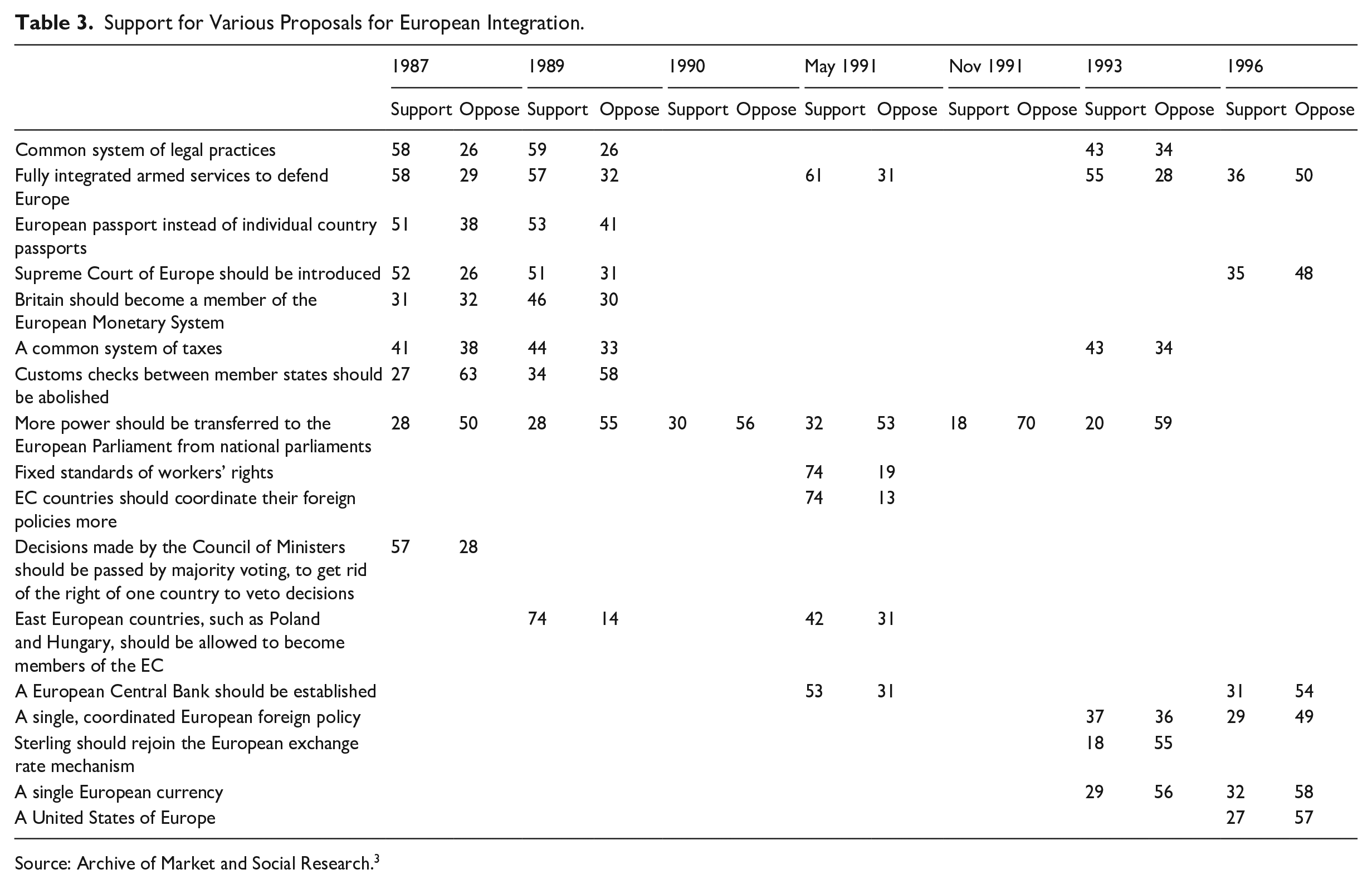
Source: Archive of Market and Social Research. 3
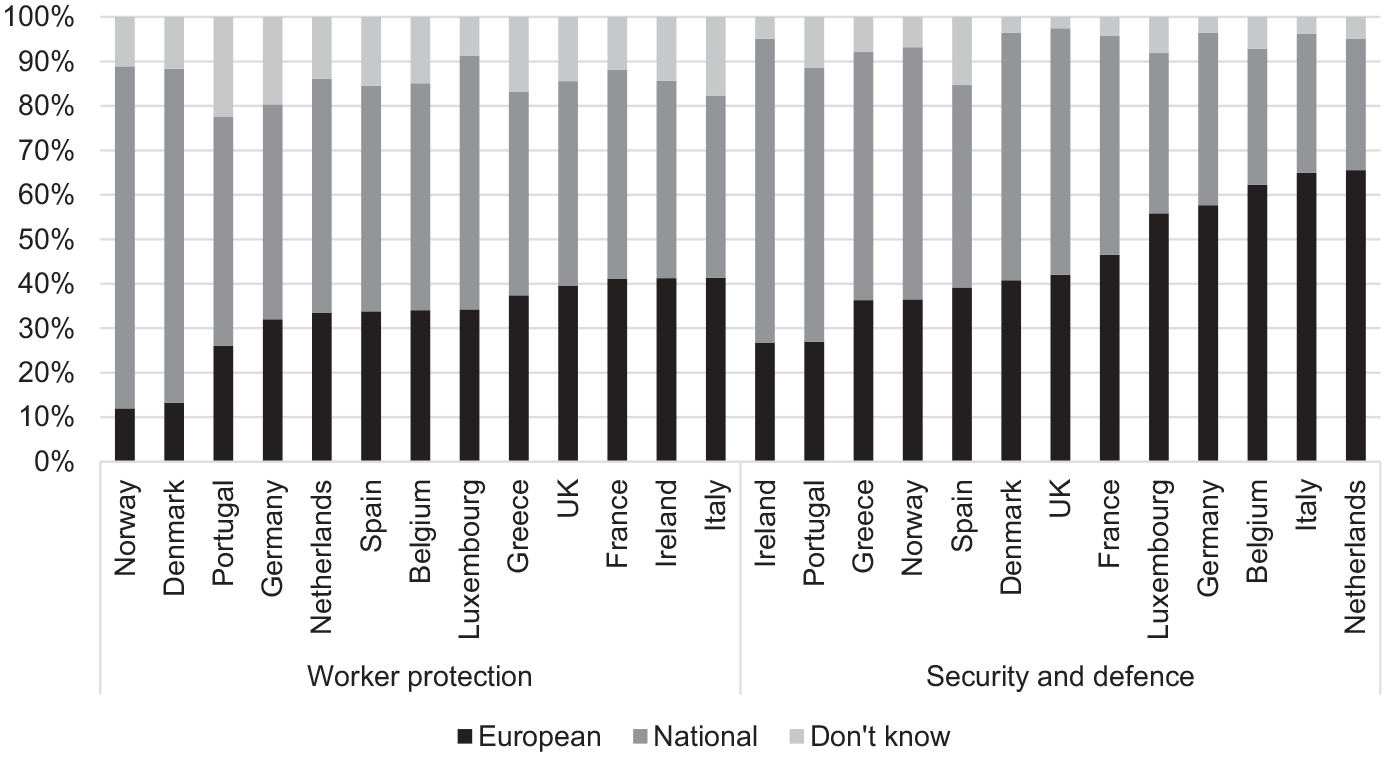
Support for Single European Policy on Workers Protection and Security and Defence.
Britons’
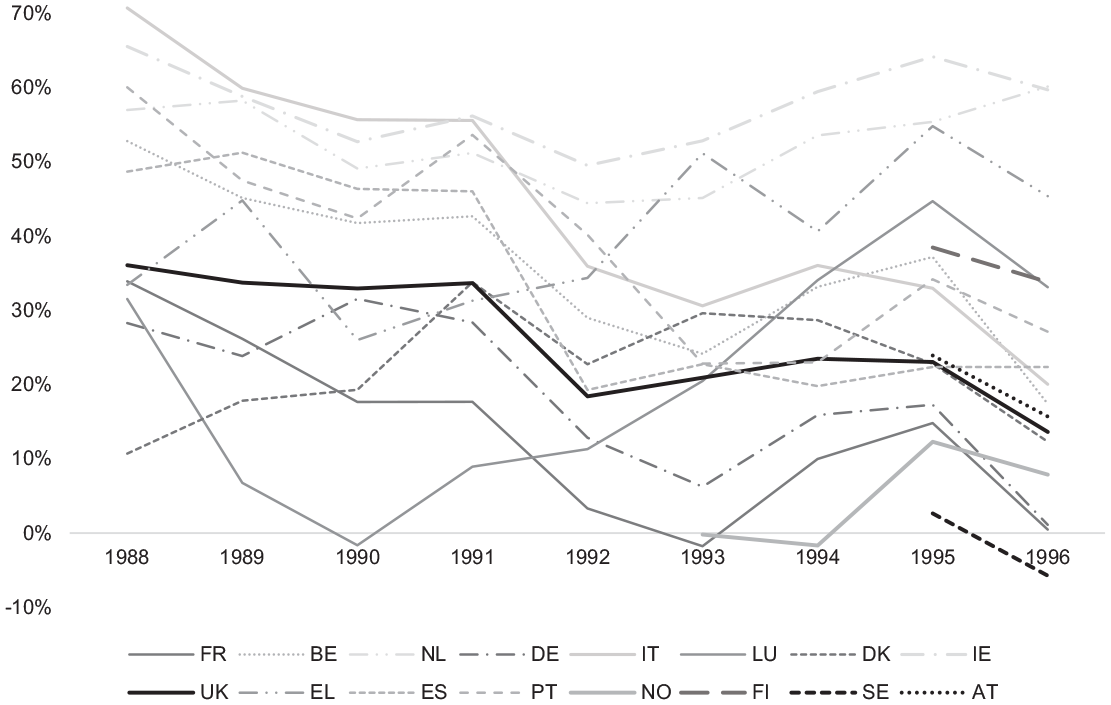
Hope Minus Fear as Emotional Reactions to the Single Market, by Country 1988–1996.
Simultaneously, the United Kingdom was falling behind its high-growth European peers, informing
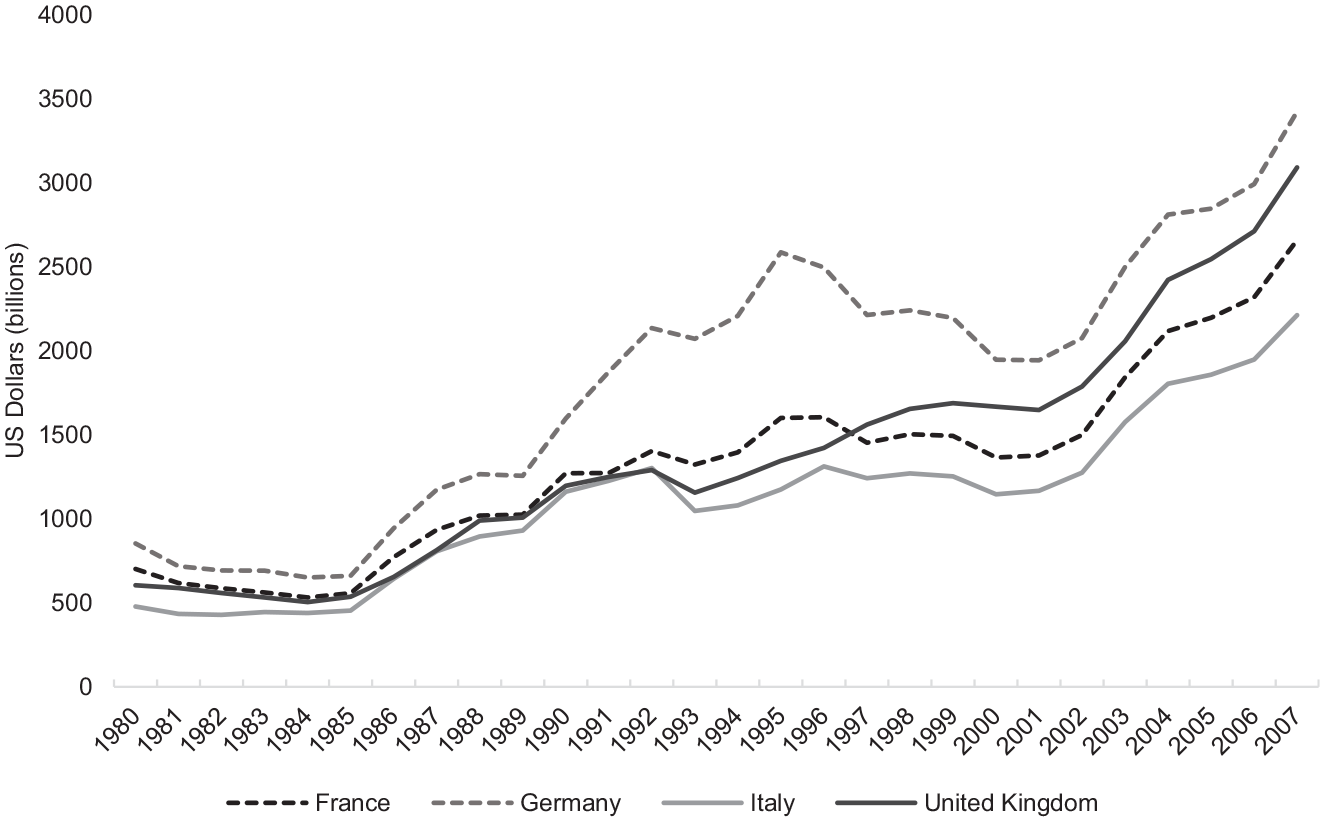
International Benchmarking. GDP, Current Prices, by Major EU Economy, 1980–2007.
Although much as has been made of the
Tellingly, in April 1989, future pro-Brexit Prime Minister Boris Johnson contributed to the Daily Telegraph’s ‘Countdown to 1992’ series by describing the ‘Bruges Group’ as ‘grouches’, ‘super-nationalists’ and ‘people with a prejudice against anything that sounds vaguely foreign’, characterising the ‘Bruges Speech’ as having only ‘a bit of scepticism from Mrs Thatcher about peripheral aspects of the 1992 programme’. However, he also warned that ‘powers of hype have allowed it [“1992”] to become a sacred cow’ and that the pro-marketeers must drop their ‘oppressive idealism . . . [i]f they want to win the argument – and it is they who must’. 15 One July 1990 poll showed that a plurality of the electorate and Conservative voters and a majority of Labour voters agreed that ‘Britain should become a member of the Exchange Rate Mechanism before the end of the year’, which it did in October (BPO, 1990a).
The improved Conservative poll ratings after Thatcher’s November 1990 removal by pro-Europeans within her cabinet seemingly ended the Europe debate and changed the role of the
Like the ‘Bruges Speech’, in terms of
During this period, ‘Europe’ was rapidly increasingly seen as a more far important
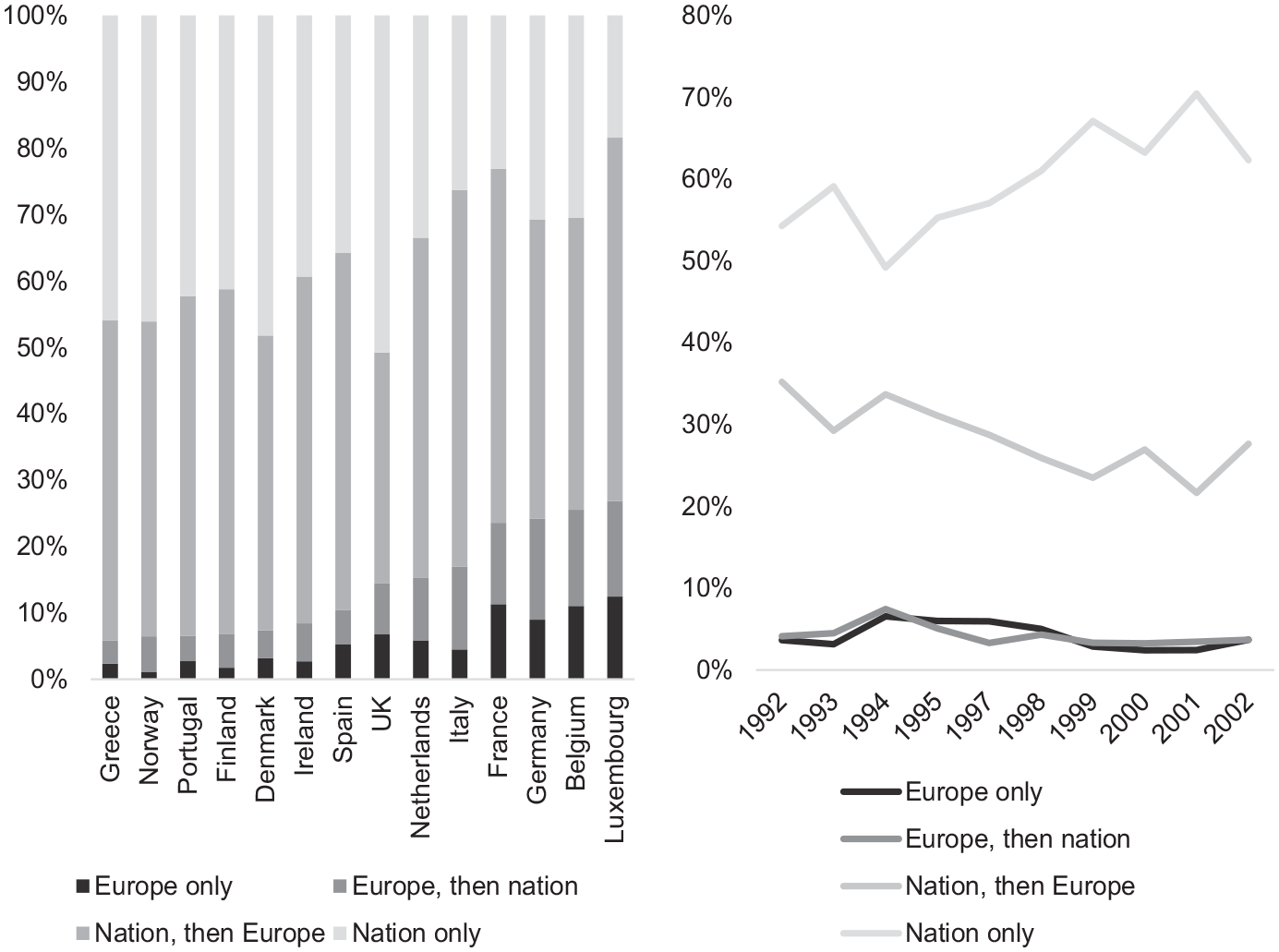
Feeling European (Left, 1994 by Country; Right, United Kingdom 1992–2002).
This high-water mark of European identity saw an unprecedented production of British
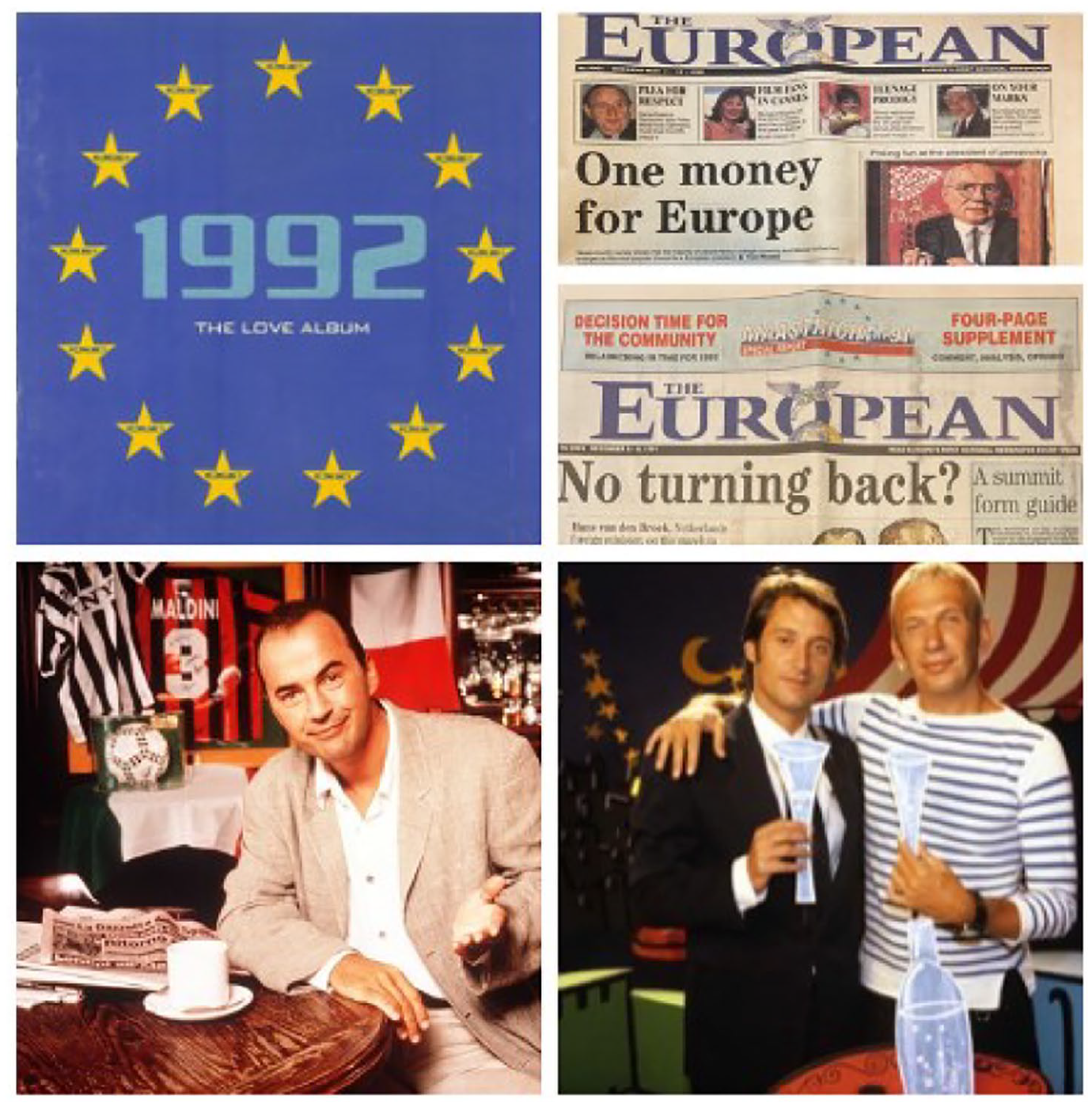
Cultural Artefacts of Europhoria. Clockwise, Starting Top-Left: UK no. 1 Album ‘1992: The Love Album’; ‘The European’ Weekly Newspaper vo1. 1 and 83; ‘Eurotrash’ Promotional Still; ‘Gazetta Football Italia’ Promotional Still.
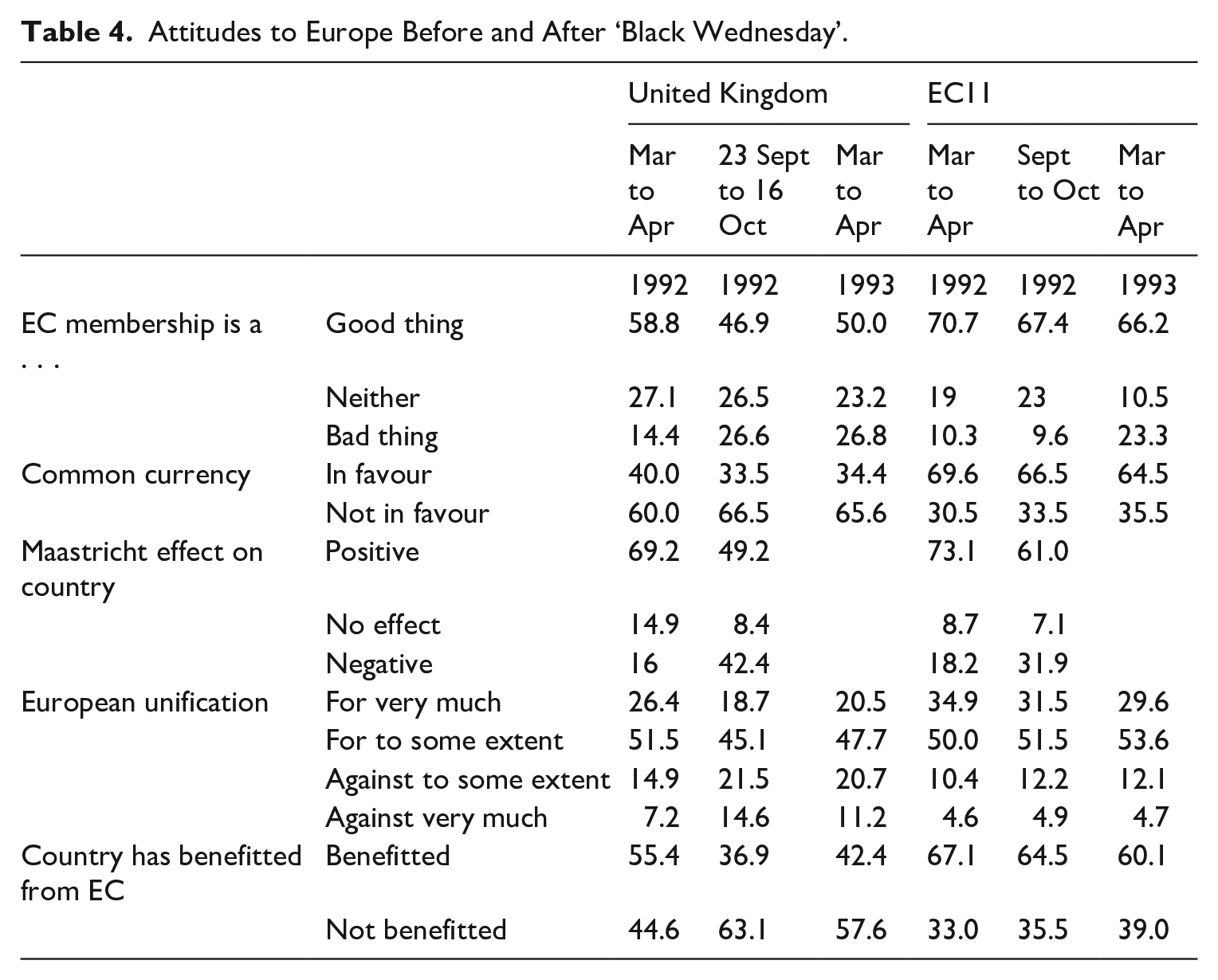
Attitudes to Europe Before and After ‘Black Wednesday’.
1992–1997: After Europhoria
First it was Eurosclerosis . . . Then, Europhoria . . . Now this week’s EC summit in the Dutch city of Maastricht suggests that the 33-year-old Community has entered a more difficult stage. Call it Eurorealism. – Newsweek, ‘All together now – sort of’, 16 December 1991. Until last week, Britain seemed to have decided that its future lay wholeheartedly with Europe . . . Before the currency mayhem and France’s wafer-thin Oui to Maastricht – The Economist, ‘Time to Choose?’, 26 September 1992. A year later, it is hard to find anybody in Britain . . . who admits that they ever supported sterling’s membership of the ERM . . . Britain’s first year outside the ERM has left the economy healthier than the rest of Europe, and healthier than it might have been. – The Economist, ‘Whitewash Wednesday’, 18 September, 1993. While the federalists hurl their energies into organising a single European currency, as the pièce de résistance of European integration, the single market . . . lies unfinished, and littered with hidden barriers. – The Daily Telegraph, ‘Single but not fancy free’, 17 February 1996.
After the 1992 general election, British attitudes to European integration spent the rest of the 1990s becoming increasingly negative. The likelihood that this resulted from
This is not to say that uniquely British events did not matter, but more that following initial shocks they tended to be absorbed into broader trends. The effects of Britain’s chaotic and damaging exit from the Exchange Rate Mechanism, ‘Black Wednesday’, on 16 September 1992 were a sudden and marked increase in Euroscepticism across various metrics (Table 4, Figure 3 on
Indeed, other member states – both at elite and popular levels – saw major resistance to at least some degree of the Maastricht Treaty and, particularly, the single currency, even across countries such as Germany and those in southern Europe that remained highly supportive of the project. One commentary argued that the decline in public favourability was because of the treaty itself: ‘complex, obtuse, in parts unreadable, with little thought for how it would “play in Peoria” and apparently no consideration for the adoption process to ensure its passage, ignoring its impact on public opinion . . . [which] was mismanaged to the point of neglect’. 25 Commission favourability dropped across the newly fashioned EU at a similar rate to in Britain. Feeling ‘national only’, as opposed to European, rose in Britain and across the EU up until 1997, thereafter diverging as other Europeans refound their Europeanness presumably as a result of single currency membership (Schmitt et al., 2008).
However, there were important differences, the importance of which would emerge later. The extraordinarily high public salience of ‘Europe’ in 1992 and then from 1994 onwards (Figure 2) reflects two things. First, domestically, the passage of Maastricht and later the debate over the single currency gradually led to the transformation of Conservative party politics. Conservative MPs initially hailed Maastricht as triumph: ‘the handful of anti-federalist MPs on both sides who dared try to spoil the party staged for Mr Major in a crowded House of Commons, were overwhelmed by the tide of Tory relief and delight at what ministers were busy portraying as a victory.
26
Similarly, in terms of media cues, the Daily Mail celebrated the Maastricht Treaty ‘in shaping an ever-closer European union’ and still contemplated joining the Single Currency (Young, 1999: 434). However, the party’s membership increasingly sided with Thatcher’s wing of the party – marginalised as a threat to British centrality in Europe throughout ‘Europhoria’ – and eventually became ascendant following the 1997 election defeat (Liddle, 2014: 15). Second, the
Perhaps most profoundly, the highly similar trends in Britain and across the continent were enough to damage pro-Europeanism’s status as the majority position only in Britain. In Figure 10, we can see how Black Wednesday converted British ambivalence about Maastricht into opposition overnight. Moreover, as Figure 4 and Table 4 show, the event instantly put
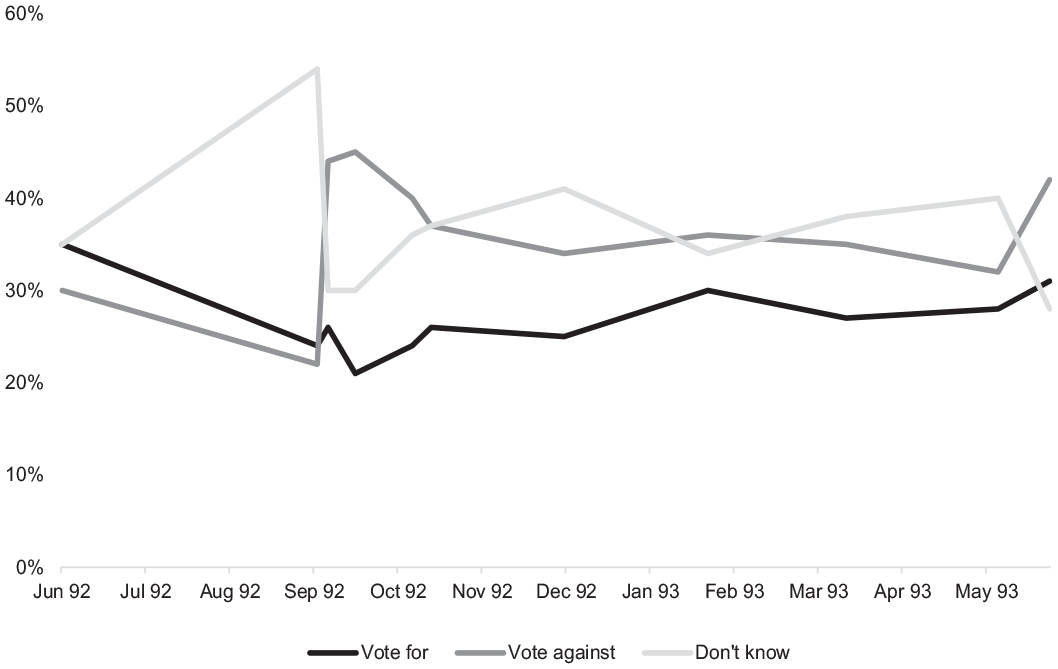
How Would You Vote in a Referendum on the Maastricht Treaty?
This is not to say that Britons had lost all of their Europhoria; support for joining the Social Chapter – as happened after 1997 – was high and support for Eastern enlargement – as happened in 2004 – was higher in Britain than many western European members. Indeed, polling in November 1994 showed both support for ‘closer European links’, a single currency and eastern enlargement to be higher in Britain than Germany – though support for European Parliamentary oversight of a European Central Bank was far considerably higher in the latter (BPO, 1994). Indeed, two of the major
Whereas Britain still saw its main
Conclusion and Discussion
What caused British ‘Europhoria’, the anomalous period of broad British popular enthusiasm for European integration? This article used process tracing of a range of quantitative and qualitative sources and comparison of numerous attitudes to European integration over time and cross-sectionally by country and group. In doing so, a range of causal factors are considered (see summary of variation of each factor in Table A2). More fundamentally, it uncovered the complex and overlapping causal pathways, shown in Figure 11.
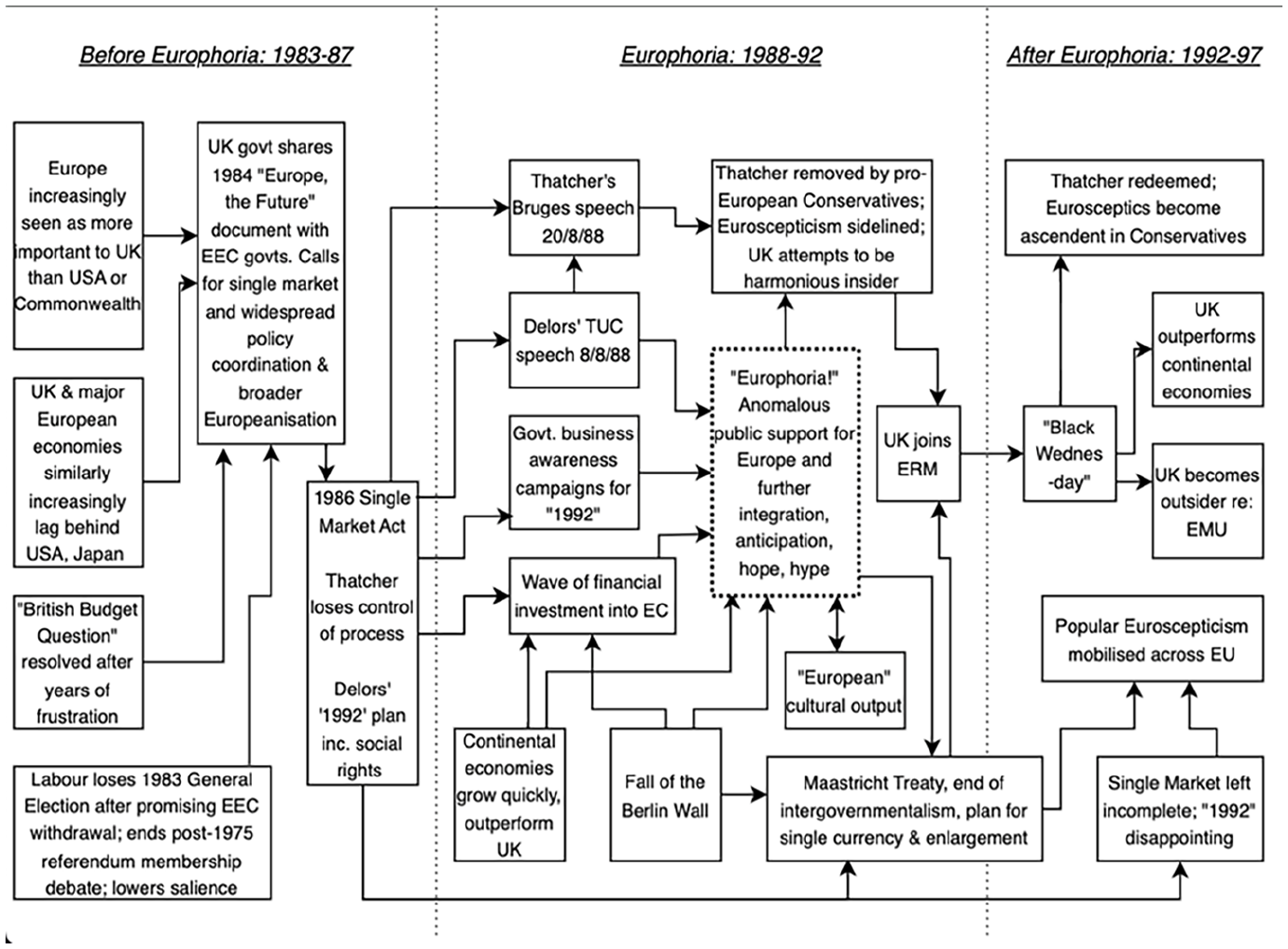
Process Leading to and From ‘Europhoria’.
Initially, the radical proposals by the British government for ‘Europe, the Future’ in 1984 were caused by: (1) recognition that Europe was by then more important to Britain than America or the Commonwealth (i.e. ‘community’); (2) common stagnation across major European economies in contrast to elsewhere in the world (‘benchmarking’); (3) despite negative retrospective evaluations, post-1980 moves towards resolution of the British budget question, leading to lower public salience and a belief that Britain had a better deal (‘calculations’) and (4) Labour’s 1983 election loss delegitimising their electoral offer of withdrawal, ending the debate over membership and framing of Europe in the terms of the 1975 referendum (‘cues’). Subsequently, Britain’s proposals for reform immediately made its membership appear constructive and led to the central cause of Europhoria: the Single Market Act and ‘1992’ plan, which had multiple effects. Immediately it re-associated Europe with prospection and positive emotion, namely anticipation and hope over a wide range of possible forms of integration and a well-publicised wave of financial investment into Europe, reinforced by the post-Berlin Wall promise of eastern European markets (‘calculations’). Delors’ 1988 TUC speech and addition of a social component led to Labour support for the Community (‘cues’). Il Sorpasso aided the impression that the European socio-economic model was superior and that ‘laggard’ Britain should ape it (‘benchmaking’).
There is no evidence that Thatcher’s Bruges speech thereafter had an initial effect; conversely, it led to her removal in 1990, further marginalising Euroscepticism and making Britain seem an even more central and harmonious member (‘cues’). These events created a strong European identity, reinforced by Europeanising cultural forces in sports, arts and media (‘community’). Thereafter, Maastricht caused a widespread turn towards Euroscepticism across Europe that, particularly initially, was stronger in Britain due to its September 1992 exit from the Exchange Rate Mechanism, which: redeemed Thatcher’s marginalised Eurosceptic wing (‘cues’); led to faster economic growth than in the rest of Europe (‘benchmarking’); made Britain’s relationship fractious again and in the long-term made it a policy outsider (‘cues’).
Theoretically, we can see that several operationalisations of ‘calculations, community, and cues’ and ‘benchmarking’ operate differentially over time. First, benchmarking can be internal and regarding other member states – both for the better and worse – but also external relative to other markets. Cues affect attitudes far more via the perceived harmony of European relations, centrality within the Community and popular policy changes to European integration than via domestic politician, party, media cueing or government information campaigns. Calculations are shown to be multifaceted, with prospective hope overriding retrospective negativity, and often regarding multiple, non-economic issues. Finally, ‘community’ goes beyond feeling European to, on the one hand, the relative importance of various international relationships – for Britain: Europe, the Commonwealth and Anglo-America – and, on the other hand, cultural manifestation of European identity.
Overall, this article contributes to the political science literature by explaining why public opinion to European integration has changed over time beyond ‘permissive consensus’ and ‘constraining dissensus’ and to the historical literature by describing the period of ‘Britain and Europe’ after tumultuous 1970s and early 1980s and before the lead up to the 2016 referendum. Future research should build on this work by expanding its explanatory framework further, by providing additional tests of the above variables either in distinct contexts – in Britain and other member states, and regarding other unions – or with further evidence, and by validating each of the mechanisms with more robust testing.
Supplemental Material
sj-docx-1-psx-10.1177_00323217241266032 – Supplemental material for Europhoria! Explaining Britain’s Pro-European Moment, 1988–1992
Supplemental material, sj-docx-1-psx-10.1177_00323217241266032 for Europhoria! Explaining Britain’s Pro-European Moment, 1988–1992 by James Dennison in Political Studies
Footnotes
Acknowledgements
I would like to thank Dr. Lindsay Aqui for early discussions about this project.
Declaration of Conflicting Interests
The author(s) declared no potential conflicts of interest with respect to the research, authorship and/or publication of this article.
Funding
The author(s) disclosed receipt of the following financial support for the research, authorship and/or publication of this article: This work was supported by the Leverhulme Trust (grant number ECF-2021-342).

Supplemental Material
Additional Supplementary Information may be found with the online version of this article.
Appendix 1: selected uses of “Reluctant Europeans” Figure A1: Net belief that EU “membership is a good thing” rather than “bad thing”, 1973-2001 by country (yearly averages) Figure A2: Mori polling on a hypothetical British referendum on European membership Figure A3: Support for European unification by country, 1990 Table A1: Preferences towards Britain’s role within the European Community in 1991 Table A2: Summary of findings by factor Appendix 2: Times Ten Years in Europe series
Notes
Author Biography
References
Supplementary Material
Please find the following supplemental material available below.
For Open Access articles published under a Creative Commons License, all supplemental material carries the same license as the article it is associated with.
For non-Open Access articles published, all supplemental material carries a non-exclusive license, and permission requests for re-use of supplemental material or any part of supplemental material shall be sent directly to the copyright owner as specified in the copyright notice associated with the article.
