




Abstract
We know that populism influences turnout and vote choice. Yet, we know surprisingly little about how populism drives broader participation patterns. In this study, we argue that populist citizens are more likely to participate in politics beyond the electoral arena because they hold specific political grievances. Extant literature highlights the multidimensionality of participation but remains ambiguous about how many or what dimensions it entails. We rely on an unprecedented 16-item participation battery from a comparative survey in nine European countries to design distinct theoretical and empirical lenses through which to examine the relationship between populist attitudes and political participation. The former relies on operationalisations from the literature that are confirmed by confirmatory factor analysis, while the latter relies on latent class analysis. Both frameworks return similar results, highlighting that populist citizens are effectively more likely to participate across the board, regardless of the form or classification of political participation.
Introduction
Democracies have seen various forms of political dissatisfaction ebb and flow through time, ranging from dynamics of de- and realignment in the late twentieth century to populist expressions in various recent elections in, among others, France, Greece, Italy and the United States of America. Even more, dissatisfaction with different societal actors and institutions has become a regular feature of democratic politics, far beyond the electoral arena. Citizens participate and express their discontent through civil disobedience (e.g. Extinction Rebellion), social movements (e.g. Black Lives Matter), advocacy initiatives (e.g. Greenpeace), direct democratic tools (e.g. Brexit referendum), hacktivism (e.g. Anonymous), various forms of consumer behaviour (e.g. Oxfam), political violence (e.g. the Capitol attack), and many more. It is, therefore, not uncommon to argue that contemporary politics operates ‘in a time of discontent’ (Jacobs, 2018).
The public discourse often attributes this discontent to populism. Hence, populist actors are seen as ‘agents of discontent’ (Van Kessel, 2015). By taking on this role, populist actors have not only broken through in most contemporary democracies, but they have also comfortably settled across Europe. An extensive literature has most notably investigated traditional expressions of discontent, like voting behaviour or partisan support for populist actors (Akkerman et al., 2014, 2017; Marcos-Marne et al., 2020; Rooduijn, 2018; Van Hauwaert and van Kessel, 2018), or even – more specifically – positive partisanship towards populist parties and negative partisanship towards mainstream parties (Bjånesøy, 2023; Meléndez and Rovira Kaltwasser, 2019, 2021; Rovira Kaltwasser et al., 2024; Wegscheider et al., 2023).
Yet, considering how political participation has expanded its scope throughout the past decades, the crucial question of whether populism inspires participation beyond the electoral arena remains only rudimentarily studied. For example, scholars have investigated whether populist citizens are more likely to participate in elections (Anduiza et al., 2019; Zaslove et al., 2021) and whether the presence of populist parties increased turnout (Huber and Ruth, 2017; Leininger and Meijers, 2021). Complementing this, some studies have examined how populist citizens engage in non-electoral forms of political participation (Ardag et al., 2020; Pirro and Portos, 2020). What unites most of these studies is that their scope remains incredibly focused, at times even limited.
Our study adds to this theoretical and empirical literature by specifically asking to what extent (if at all) populist attitudes explain a wide range of individual decisions to participate in politics beyond the electoral arena. We argue that populist citizens are more likely to participate in politics because their negative sentiments towards the existing elite serve as political grievances that mobilise them. In addition, we anticipate that populist citizens are particularly more likely to participate in non-institutionalised forms of political participation because these forms bypass the conventional political channels that are typically understood as support for the current political system.
To test these arguments, we use cross-sectional survey data from nine European countries and rely on an unprecedented 16 participation items to examine our argument. We proceed with two complementary approaches: First, we draw from the literature and use a four-folded classification of participation that is subsequently supported by a confirmatory factor analysis. Second, we explore various participation profiles among citizens using latent class analysis. These respective theory- and data-driven approaches allow us to investigate how populist attitudes relate to participation.
Our main contributions are threefold. First, we provide insights into the multidimensionality of political participation patterns. While previous studies have investigated how populist attitudes might relate to specific forms of political behaviour, we provide a framework to understand the relationship between populist attitudes and political participation more generally. Second, we show that populist citizens not only participate outside the electoral arena but that they also display stronger preferences for non-institutionalised forms of participation. Finally, we combine data- and theory-driven approaches to map the complex patterns of individuals’ political participation. Both approaches paint a similar overall picture, namely that populist citizens are more willing to participate in politics than non-populist citizens. We unpack this in what follows.
Going Beyond Elections: Political Participation
Turnout has been declining in democracies across the world for many decades (Kriesi et al., 2008). Even more, scholars refer to ‘parties without partisans’ and the decline of party mobilisation when discussing the apparent and substantial turnout declines in various European countries (Dalton and Wattenberg, 2002). While this might paint a particularly poor and depressing picture of the current state of European democracies, especially if we consider that turnout is a common indicator of democratic health (Lijphart, 1997), it is worth looking at citizens’ involvement in politics beyond just the electoral arena. After all, casting a vote is but one way in which today’s critical citizens express their opinions, pursue their goals and participate in politics. Dalton and Welzel (2014) described this, in part, as the shift from allegiant to assertive citizens. Therefore, if we want to talk about actual ‘participation in politics’, we need to capture what happens beyond the ballot box.
It is worth bringing some conceptual clarity by correctly and accurately describing what we understand by political participation, namely ‘[a set of] action[s] by ordinary citizens directed toward influencing some political outcomes’ (Brady, 1999: 737; Teorell et al., 2007). Initial literature on political participation focuses extensively on political action in the context of representative democracy, which could influence governmental activity through a wide variety of participatory acts (Verba et al., 1978; Verba and Nie, 1972). Yet, in their foundational work, Barnes and Kaase (1979) not only analyse legal and legitimate acts ‘within the system’ (Verba and Nie, 1972: 3) but explicitly include different forms of protest as part of political participation.
Since the 1960s, we can see a diversification of the types of political activities and a lot of new modes of political participation were added to citizens’ political action repertoires (Dalton, 2008). This is even more the case since the Internet opened new and less costly forms of political engagement (Gibson et al., 2005; Oser et al., 2013). Thus, observing a decrease in electoral and more institutionalised forms of participation, in essence, does not mean that citizens are necessarily less engaged but, rather, could indicate that citizens may have changed how they participate. After all, different forms of participation are, to some extent, communicating vessels as most citizens operate on limited resources.
This kind of diversification of political participation goes hand in hand with the consideration of political participation as a multi-dimensional phenomenon (Verba et al., 1978; Verba and Nie, 1972). While scholars agree that the different dimensions are intertwined and they typically restrict themselves to two dimensions, they show much less agreement on the composition of these dimensions. Initially, scholars distinguished between conventional and unconventional forms of political participation (Barnes and Kaase, 1979; Verba and Nie, 1972), but this was quickly proven too restrictive and even inaccurate, considering that numerous unconventional forms of participation have gradually become more ‘mainstream’ as a result of the institutionalisation of politics and the spread of participation (Dalton, 1996; Dalton and Wattenberg, 2002).
Most commonly, researchers distinguish between institutional and non-institutional forms of political participation (Klingemann and Fuchs, 1998; Vráblíková, 2014). Institutional participation forms typically encompass activities related to and organised by the immediate political process (e.g. attending a political meeting). They are typically related to the electoral process but remain qualitatively and intrinsically different from electoral participation (Verba et al., 1995). In contrast, non-institutional forms of participation are typically more elite challenging and neither provided by nor embedded in the political process (e.g. demonstrations).
While this remains the most common operationalisation of participation, there remain many alternative ones (both in name and content). 1 Most of them inductively draw from (large-scale) empirical studies that are not always able to capture the full range and scope of a complex and multi-dimensional phenomenon like political participation. Concretely, we find numerous accounts of participation – theoretical and empirical – that are shaped by the survey items they have available for analysis, rather than being able to examine the full range of participation. At best, this leaves important aspects of participation un(der)explored, but – more problematically – this may bias our understanding of contemporary participation.
We propose to remedy this by examining participation’s dimensionality both empirically and theoretically. On one hand, we theoretically explore the dimensionality of no less than 16 survey items that tap into political participation. On the other hand, we do this empirically by exploring citizens’ participatory profiles in the data. We believe this distinction is important, as contemporary democracy studies teach us that top-down theoretical conceptualisations are not always the same as more bottom-up citizen-driven understandings of a concept (Wegscheider et al., 2023). We discuss such an analytical framework in more detail below.
Explaining Political Participation: Existing Scholarship
The literature identifies various factors that can explain different forms of participation. These tend to fall into one of two paradigms: The civic voluntarism model (resource mobilisation) or grievance theory. The former argues there is a positive relationship between access to resources and the level (and forms) of political participation (Schlozman et al., 1999; Verba et al., 1995). Individuals with more cognitive abilities and social (civic) skills are bound to use these resources and be more active participants in politics. Correspondingly, a lack of resources constrains citizens and their possibilities of participation.
The latter paradigm, grievance theory, generally posits that any form of personal dissatisfaction with important aspects of life, or so-called grievances, stimulates political participation, particularly its more protest-oriented forms (van Stekelenburg and Klandermans, 2013; Wilkes, 2004). In line with this, classic literature argues that relative deprivation plays an important role in motivating such protest (Kitschelt, 1986; Klandermans et al., 2008; van der Meer et al., 2009). This refers to the discrepancy between (a) individuals’ expectations regarding what they believe they are entitled to (particularly regarding material goods and resources), based on either their past or future situation, and (b) the extent to which individuals believe they can meet (obtain) and keep these expectations (Gurr, 1970). The larger the discrepancy between what ‘ought to be’ and what ‘is’, the more dissatisfied individuals usually are and the higher levels of perceived injustice – and subsequently relative deprivation – will be. According to Gurr (1970), this can have a wide variety of underlying causes, like declining economic or social progress, social injustice, failing community values or belief systems, or the incapacity of government.
Explaining political participation: Populist attitudes as grievances
These grievances typically motivate people to rebel or mobilise against those whom they perceive as responsible. At the foundation of this association lies a scapegoating or frustration-aggression mechanism (Miller, 1941): The elites become the primary scapegoats for any societal frustrations certain individuals might have. In turn, such frustrations are often a direct consequence of relative deprivation.
Recent literature underlines that populism and populist attitudes – here understood in ideational terms – can serve as such a mobilising tool in two ways. 2 On one hand, we know from classic scholarship that dissatisfied individuals are more motivated to stand against those whom they perceive as responsible (Welch, 1977). In line with this, recent experimental research finds that populist citizens are dissatisfied democrats, whose latent populist attitudes become activated through failures of representation and the corresponding frustration (Busby et al., 2019; Hawkins et al., 2020). Populists primarily attribute blame and responsibility for this frustration to the elite
On the other hand, populist citizens suffer from structural dissatisfaction and relative deprivation in democratic terms. They experience a democratic deficit, meaning they perceive differences between what democracy is and what it should be (Rovira Kaltwasser and Van Hauwaert 2020). In turn, this feeling of unfairness may contribute to an understanding of democracy that is different from how less populist citizens understand democracy and subsequently motivate them to participate in ways that more closely align with their understanding of democracy. For example, populist citizens tend to blame elites and traditional institutions for a lack of responsiveness, so they might be more prone to participatory forms that focus on the deliberative aspects of democracy (Zaslove et al., 2021).
Drawing from those arguments, and in line with grievance theory, we posit that populist attitudes will positively contribute to political participation. While extant research already shows that populist attitudes mobilise voters in the electoral arena and stimulate populist party support (Van Hauwaert and van Kessel, 2018; but, see Zaslove et al., 2021), we theorise an additional mobilising effect of populist attitudes as grievances that goes beyond the electoral arena (see also, Ardag et al., 2020). Not only is the shift from electoral to non-electoral politics a defining feature of politics (Dalton and Welzel, 2014), but it stands to reason this shift is more prominent for populist citizens. After all, electoral participation would mean an active choice to engage with the ‘system’ and the political actors that have let them down and contributed – if not, directly led to – their dissatisfaction with and disenfranchisement from politics. Rather than contribute to this, populist citizens (and those supporting populist parties) turn to mobilisation tools beyond the electoral arena (Pirro and Portos, 2020).
Explaining different forms of political participation
Initial studies suggest that populist attitudes may trigger different forms of participation, i.e. they have a differentiated effect across participatory forms. In this regard, one notable distinction that can – and perhaps should – be made when examining the effect of populist attitudes is that between institutionalised and non-institutionalised forms of participation. After all, non-institutionalised participation forms, such as protests, are usually seen as ‘elite-challenging actions’ (Inglehart and Catterberg, 2002: 300). These participatory forms provide citizens with a way to circumvent conventional political channels and, at the same time, send a signal to political elites that their legitimacy may be in question. So, grievances in the form of social and economic strain, anomie and social breakdown help individuals to engage in collective behaviour (action) and challenge the political system, particularly using alternative, or more protest-oriented, modes of participation (Alvarez et al., 2017; van Stekelenburg and Klandermans, 2013; Wilkes, 2004).
Similarly, Barnes and Kaase (1979) write that any form of conventional participation that individuals opt for expresses support for the existing political order. Hence, if individuals seek to politically engage but, at the same time, do not want to support the political system, the authors expect them to engage in ‘unconventional’ forms of participation. Levi and Stoker (2000) contend that individuals with low levels of political trust are likely to abandon participation in elite-directed forms and instead choose to engage in elite-challenging forms of participation. Today, this theorisation would largely correspond to some of the less institutionalised forms of participation, or political disengagement more generally.
Because populist attitudes postulate a much stronger negative sentiment towards core actors of representative democracy, however, we expect to find that higher levels of populist attitudes are associated with a higher likelihood to engage in non-institutionalised participation as opposed to institutionalised participation. In other words, we posit that those individuals with higher populist attitudes prefer forms of political participation that are typically not provided for by the political system itself and often thought of as differential forms of protest. We can make a similar argument related to online forms of participation. After all, these may be seen as the more modern and technological forms of protest or non-institutionalised politics.
Research Strategy
We tested our expectations using a cross-national survey (N = 18,368) fielded in 2015 across nine European countries: France, Germany, Greece, Italy, Poland, Spain, Sweden, Switzerland and the United Kingdom. 3 While these countries are not a random or representative selection of democracies, they provide us with sufficiently diverse contexts to examine the extent to which our expectations hold. They cover a wide variety of countries and different cultures, yet, have all experienced populism to a certain extent, whether it is through a recent increase (e.g. Germany, Spain), a more extended period of presence (e.g. France and Italy) or intermittent (resurging) successes (e.g. Sweden). Furthermore, the dataset includes a selection of countries with a wide range of non-electoral participatory traditions.
Dependent Variables: Modelling Political Participation
Most surveys looking to gauge political participation ask respondents whether they have engaged in a specific form of political participation within the past 12 months (0 = no; 1 = yes). 4 These surveys typically include a handful of such items. Our comparative dataset includes no less than 16 such items (see Table 1), making our analysis of political participation’s dimensionality the most comprehensive one to date. Existing participation studies tend to be much more restricted in their scope, either focusing on specific dimensions (de Moor, 2017; Ejrnæs, 2017; Gibson et al., 2005; Marien et al., 2010) or a very limited number of participation items (Anduiza et al., 2019; Ardag et al., 2020).
Items to Measure Different Types of Participation.
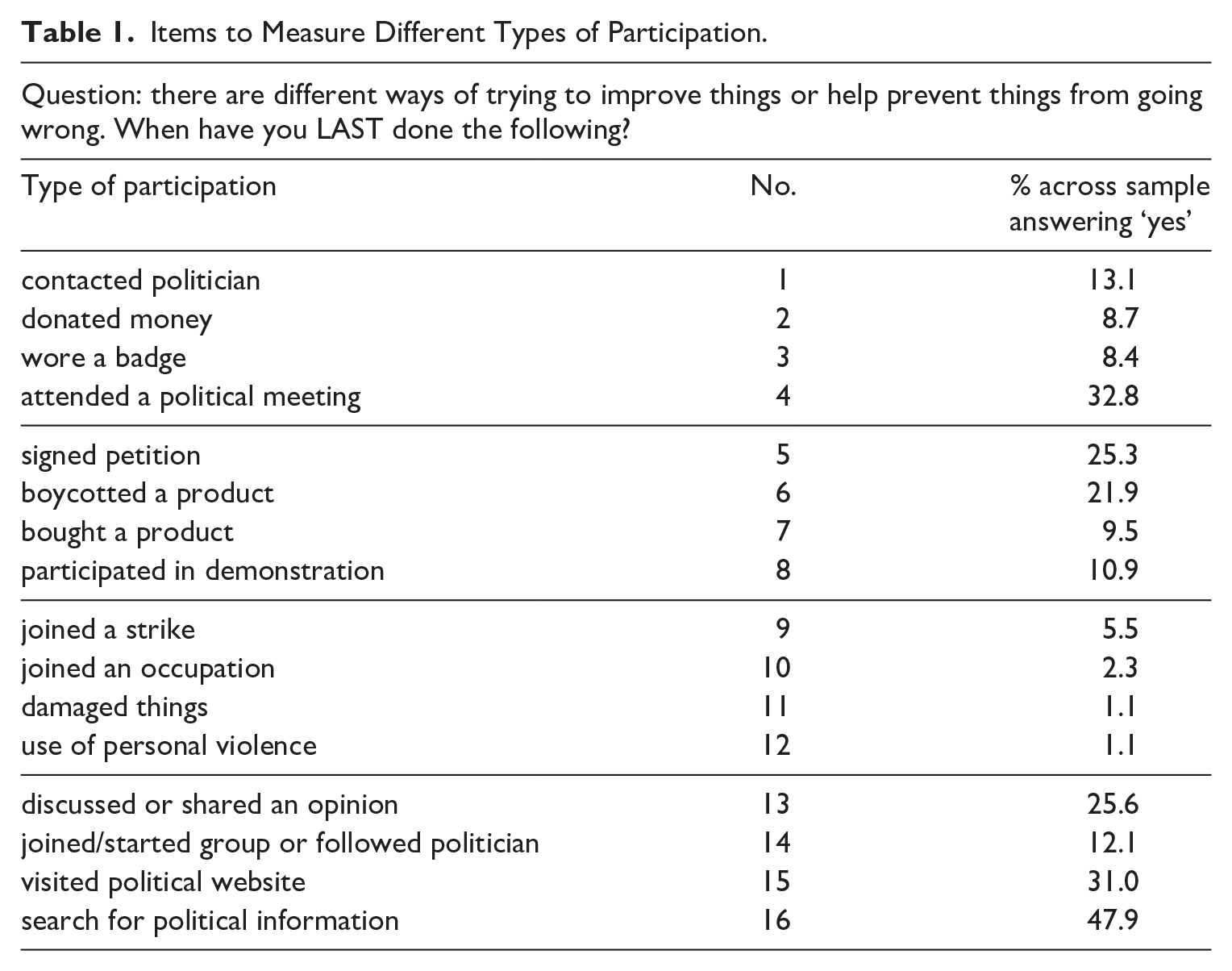
As we highlighted before, it is important to fully explore and account for the dimensionality within these 16 items, simply because participation is a multi-dimensional concept. Therefore, considering these items as indicators of a single construct (e.g. Pirro and Portos, 2020; Vráblíková, 2014) would not align with classic theory (Verba et al., 1978; Verba and Nie, 1972) or the more detailed empirical analysis that follows below.
With that in mind, and in a novel analytical strategy in this field, we combine a theory- and data-driven approach to examine the dimensionality of these 16 items. Utilising both approaches in conjunction allows for a more comprehensive understanding of theoretically guided and empirically valid forms of participation. We avoid that the findings are entirely driven by either theoretical considerations on how to aggregate the data, or empirical patterns in the data that do not match theoretical considerations. To accurately reflect this, we provide two separate empirical sections and reflect on both in an overarching discussion.
Dimensionality of Participation: Theory-Driven Approach
The theory-driven approach draws from existing studies in the field and categorises forms of participation in a relatively top-down manner. Specifically, we categorise participation following Verba et al. (1978), thereby accounting for the original conjecture that political participation is a latent (continuous) variable constructed from several individual activities. Verba and Nie (1972) already highlighted this latent construct is multi-dimensional. Yet, despite extensive scholarship, there is little consensus about how many dimensions exist and how we can classify participation. Drawing from the literature, we could nonetheless anticipate four theoretical groups: (1) institutionalised participation, (2) non-institutionalised participation, (3) direct action, and (4) online participation.
As is common in today’s literature on political participation, we can clearly identify institutional participation, which includes contacting a politician, donating money, wearing a badge and attending a political meeting (Barnes and Kaase, 1979; Kern et al., 2015; Marien et al., 2010; Oser and Hooghe, 2018). We usually distinguish this from non-institutionalised forms of participation, but it is here that we notice an additional qualification that is not often highlighted in the literature. Namely, we can distinguish between some of the more traditional non-institutional forms of participation and more active or system-challenging forms of non-institutional participation, or – what we label – direct action. The former includes signing a petition, boycotting, buycotting and attending a demonstration. The latter includes occupying, damaging things, striking and political violence. While direct action stands out conceptually, Table 1 already highlighted that only a minority of respondents participated in these latter forms. Finally, and quite unsurprisingly, we can conceptually distinguish online participation.
We confirm this anticipated structure using factor analysis (see Section B of the Supplementary Materials). Results suggest that the four items within a theoretical group each load on one underlying construct. Empirically, we take the sum of a dimension’s four items to obtain a variable that ranges from zero (no participation in this dimension) to four (participating in all forms of participation in this group). We use the resulting count variable as a dependent variable in subsequent regression analyses. 5
Dimensionality of Participation: Data-Driven Approach
As a complementary road to explore the dimensionality of participation, we take a more data-driven approach. We might, after all, wonder whether citizens perceive participation in the same way it is laid out by our theoretical results or whether they limit themselves to one or the other form of participation. Eventually, it could be that certain participation activities across theoretical categories go hand-in-hand, but this is something that needs to be studied.
A data-driven approach, therefore, examines participatory patterns in the data from a more bottom-up approach. Specifically, we rely on latent class analysis (LCA) to categorise the set of political participation items. As a reminder, each participation item is a dichotomous variable that indicates whether an individual participated in that form in the last year or not. The LCA allows us to uncover different classes of participation, i.e. combinations of participation forms. Contrary to the theory-driven approach, it allows us to capture which participation profiles exist. For example, it is plausible that some citizens are particularly likely to participate in online and certain offline forms of participation, or vice versa. This technique is relatively novel in political science, but has been applied to political participation in the past (Alvarez et al., 2017; Bertsou and Caramani, 2020; Oser et al., 2013).
In principle, the underlying rationale of LCA is similar to other dimension-reducing techniques, such as factor analysis. Such methods seek to identify latent constructs based on several indicators. They, however, differ in their approach to the data: Factor analysis scrutinises correlations between indicators, whereas LCA investigates the similarity of response patterns. Two key factors are used to inform the fit of different LCA models: Goodness-of-fit statistics and researcher judgement (Weller et al., 2020). Hence, we proceed in a stepwise process that first scrutinises three fit indices and subsequently compares this classification with a qualitative assessment of the suggested groups.
For our specific study, this stepwise process renders us to suggest four classes as the optimal solution. Empirical fit measures, such as the AIC, BIC and Lo-Mendell-Rubin ad-hoc adjusted likelihood test all suggest that four groups are ideal. We observe the lowest AIC and BIC measures for four groups, while comparing the Lo-Mendell-Rubin test suggests that four groups outperform three but five do not outperform four groups (see Table C.1 in the Supplementary Materials). This matches our qualitative assessment. Compared to four groups, the additional class in the five-group solution only accounts for less than one per cent of respondents. Furthermore, the additional class is of limited theoretical meaning. We visualise results from the LCA with four classes in Figure 1.
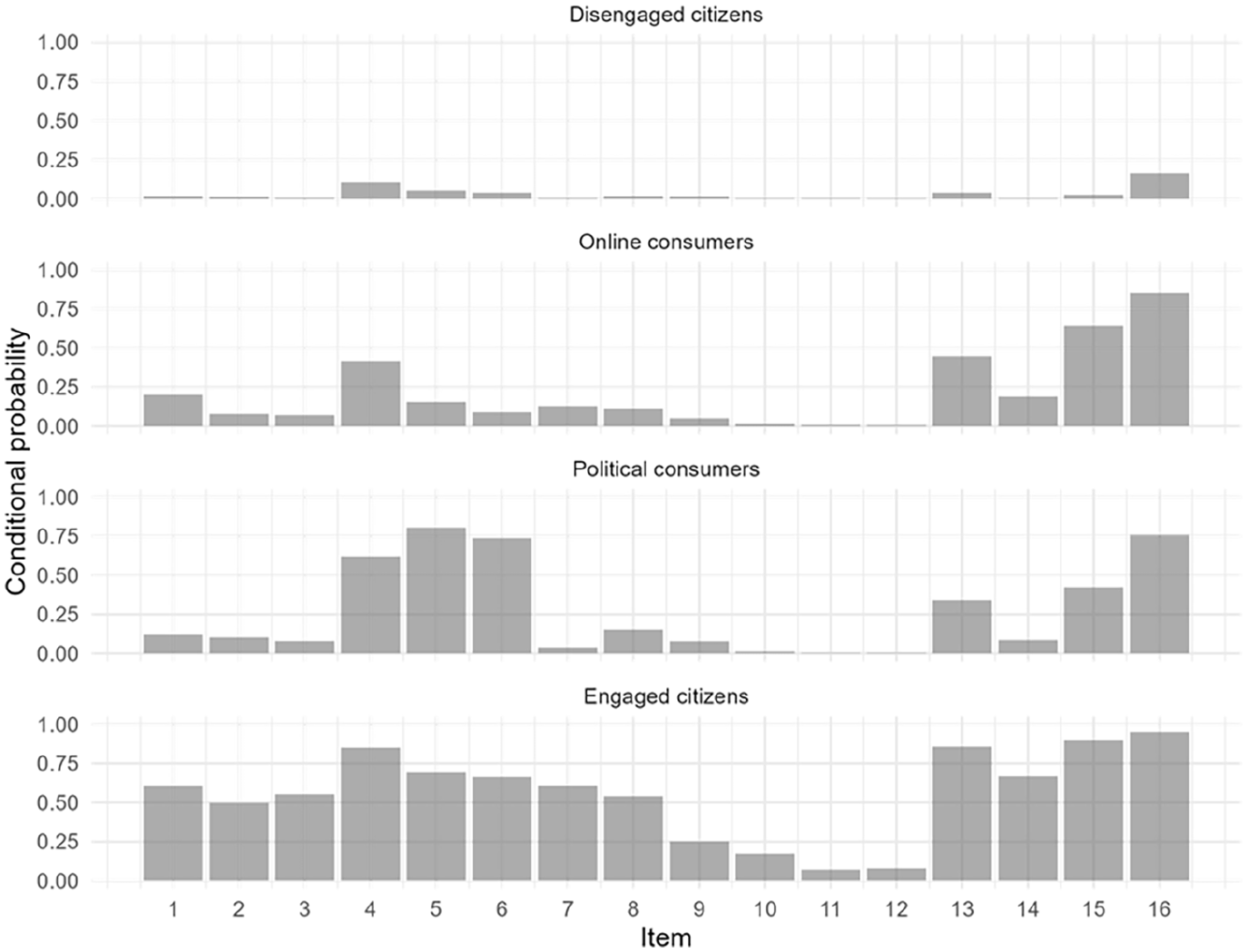
Different Forms of Participation: Results From a LCA.
Let us briefly interpret Figure 1. By far the greatest group (approximately 48% of respondents) are those who seemingly never participate in politics. We label them ‘Disengaged citizens’ (top panel in Figure 1). Apart from this group, we notice that all other participatory profiles share an increased likelihood of participating in politics through online forms. The second most frequent group (about 25% of respondents) are individuals who mainly (and only) participate online. We refer to them as ‘Online consumers’ (second panel in Figure 1). These individuals mostly discuss and share their opinion on politics on social network sites (item 13), visited the website of a party of politician (item 15) and searched for information about politics online (item 16). They are also more likely to have attended political meetings in the past (item 4).
Third, we observe a group of individuals (approximately 17% of respondents) who are more likely to participate in political meetings (item 4), sign petitions and boycott products (items 5 and 6), but otherwise mostly rely on online forms of participation (namely items 13, 15 and 16). We call these individuals ‘Political consumers’ (third panel in Figure 1). Finally, the last group is active and likely to participate across the board but, like other profiles, remains unlikely to engage in forms of direct action (items 9 to 12). Even more, in line with Table 1, the LCA suggest that direct action is largely absent from political behaviour throughout our sample. This final group is in the end fairly small (approximately 11% of respondents) and we refer to them as ‘Engaged citizens’ (bottom panel in Figure 1).
Explanatory Variable: Populist Attitudes
We rely on the eight items listed in Table 2 to operationalise populist attitudes. The items derive from the original Hawkins and Riding (2010) scale, which was subsequently updated by Akkerman et al. (2014) and Van Hauwaert and van Kessel (2018). We estimate a latent scale through confirmatory factor analysis (cross-country Cronbach’s alpha = 0.88), which substantively resembles scaling efforts drawing from item response theory (Van Hauwaert et al., 2018, 2020) and the Goertz approach (2006) outlined in Wuttke et al. (2020).
Question Wording for Populist Items.
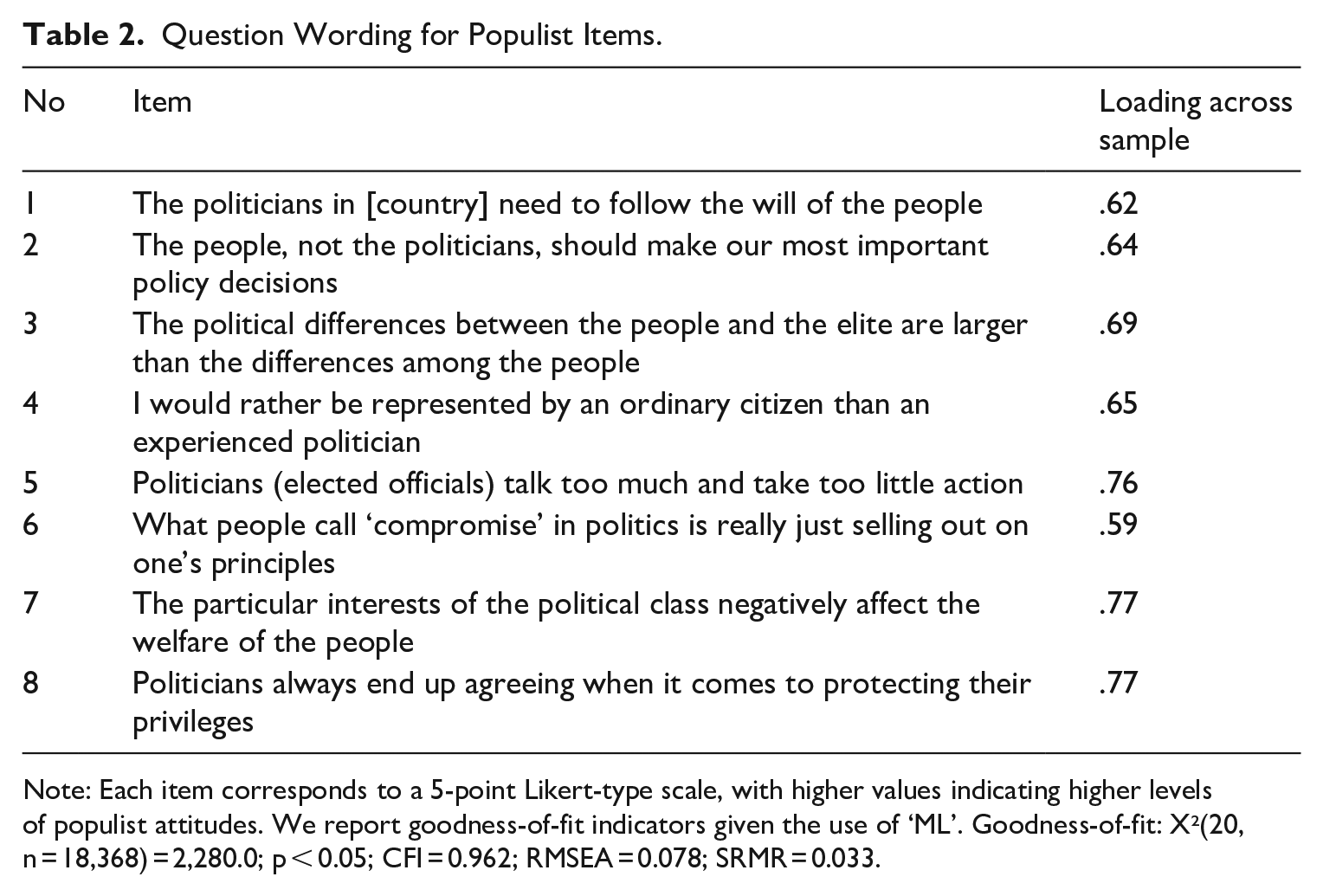
Note: Each item corresponds to a 5-point Likert-type scale, with higher values indicating higher levels of populist attitudes. We report goodness-of-fit indicators given the use of ‘ML’. Goodness-of-fit: X²(20, n = 18,368) = 2,280.0; p < 0.05; CFI = 0.962; RMSEA = 0.078; SRMR = 0.033.
Methods
We rely on two separate methodological choices to examine how populist attitudes affect theory- and data-driven operationalisations of political participation.
First, to assess the four theory-driven groups, we use negative binomial models (Hilbe, 2011). As mentioned above, we add up all items within a group. Hence, our dependent variable is limited in range and constrained to be no smaller than zero and no larger than four. Furthermore, the distribution shows that the data is Poisson distributed, which violates the assumption of a normally distributed variable required to estimate regular OLS models. We choose negative binomial models over Poisson models because tests reveal over-dispersion of the dependent variable in all countries (Gardner et al., 1995).
Second, to assess the four data-driven classes, we use a multinomial logistic regression. Here, the dependent variable is the class that each respondent belongs to. The overall technique models the log odds of the nominal outcome variables, i.e. the membership in the four different classes of participation, as a linear combination of the predictor variables. We follow the literature and estimate predictors of group membership simultaneously for all classes (Weller et al., 2020). We use ‘Disengaged citizens’ as our reference category.
Throughout all subsequent analyses, we additionally adjust our models for variables that are potentially related to either populist attitudes or political participation. Specifically, we include indicators for political interest, ideological self-placement, democratic satisfaction, political trust and socio-demographics (age, education, gender). 6 While LCA does not allow us to include country-fixed effects, we replicate all our analyses by country (see sections E and F in the Supplementary Materials). This gauges the robustness of our findings and confirms that case selection is not driving our results,
Results: Different Forms of Participation and the Role of Populist Attitudes
With a clear picture of political participation’s dimensionality from both a theoretical- and data-driven perspective, we now examine to what extent populist attitudes affect the different forms of participation. Does populism help us understand non-electoral participation and, if so, how?
First, we use the theoretically derived dimensions of participation as our dependent variables in separate regressions. Table 3 shows that an increase in populist attitudes is associated with more participation in all four theoretical dimensions of political participation. Thus, in line with our expectations, populist citizens are systematically more likely to participate in institutional, non-institutional, direct action and online forms of political participation. Differently put, populist attitudes can serve as (political) grievances and mobilise citizens, rather than deter them from politics, at least beyond the electoral arena. This is in line with recent findings in the literature (Pirro and Portos, 2020) and allows us to substantiate claims of a relationship between populism and different dimensions of non-electoral participation with more confidence.
Regression Results – Theory-Driven Approach.
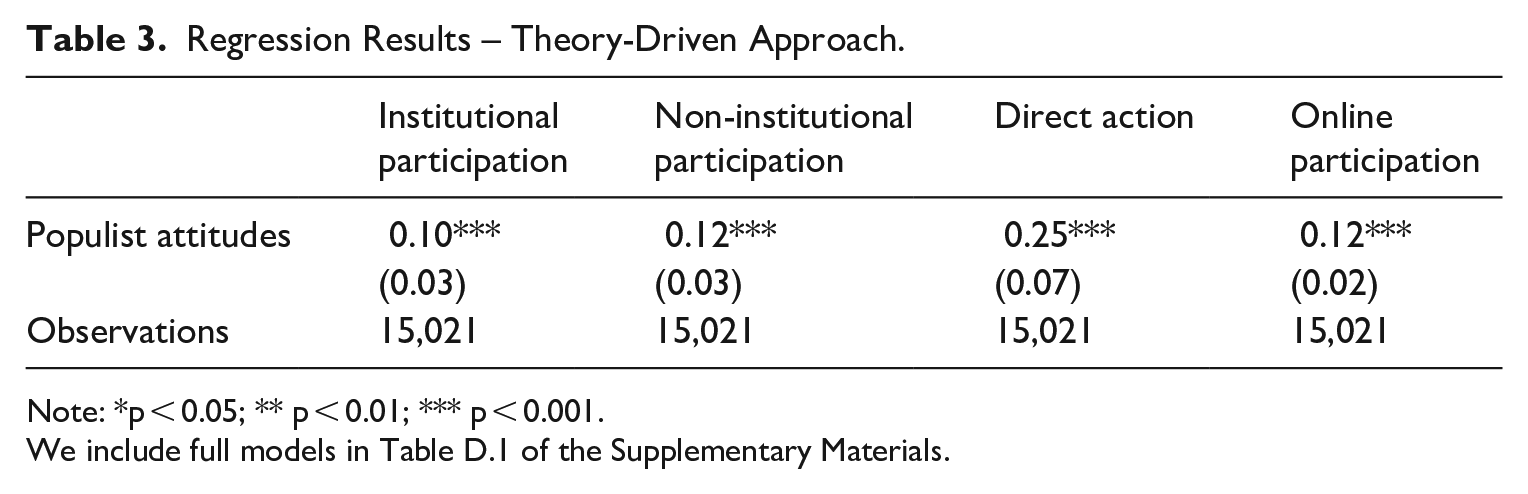
p < 0.05; ** p < 0.01; *** p < 0.001.
We include full models in Table D.1 of the Supplementary Materials.
The results related to institutional forms of participation are perhaps surprising, seeing how we theorised that populist citizens might be less prone to engage in elite-reinforcing forms of participation. Yet, it appears populist attitudes mobilise across the board, not just alongside certain dimensions. This would be in line with the broader grievance theory, which holds that grievances (whatever their nature may be) stimulate political engagement. It further refutes the popular claim that populist citizens might be politically unengaged or apathic.
The question we must then ask is whether we find similar results if we use a more data-driven operationalisation of political participation. To do so, we use the LCA estimations as dependent variables. Table 4 summarises the findings of the corresponding multinomial logistic regression, using disengaged citizens as the reference category. It shows us that individuals with higher levels of populist attitudes are more likely to have an active participatory profile, rather than be disengaged from politics. So, populist attitudes clearly relate positively to different classes of participation. Even more, populists are particularly more likely to be part of the engaged group (p < 0.05) and, thus, participate in any and all forms, rather than just a specific one.
Regression Results – Data-Driven Approach.
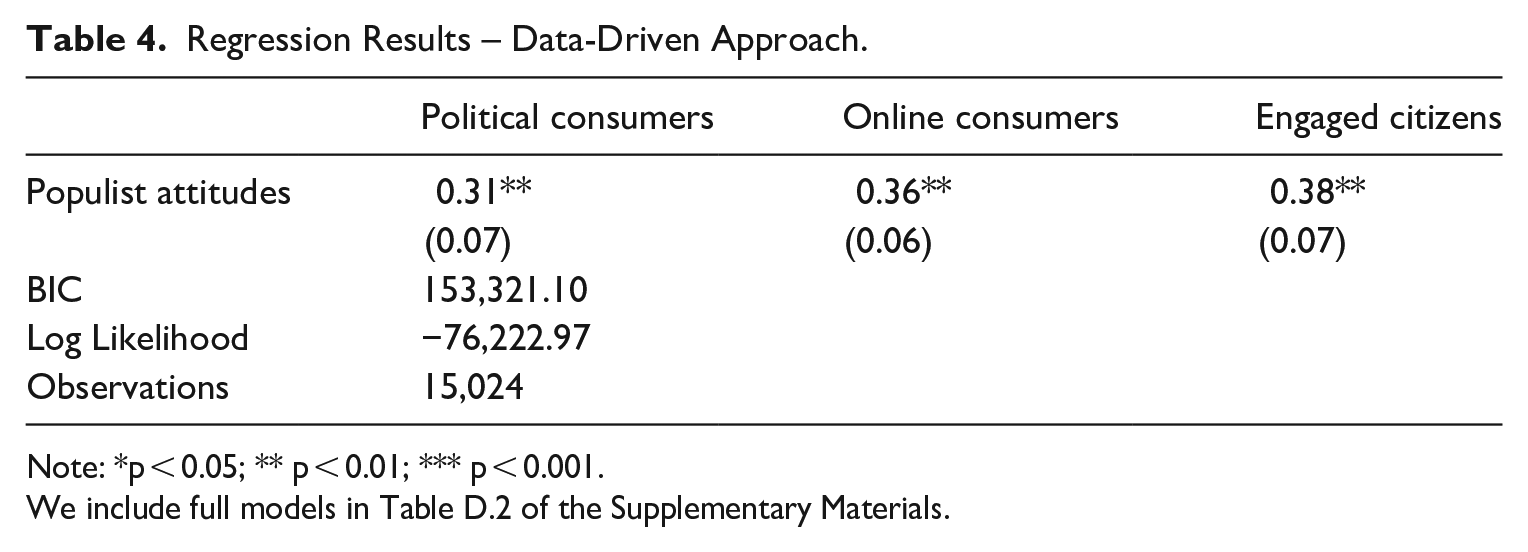
p < 0.05; ** p < 0.01; *** p < 0.001.
We include full models in Table D.2 of the Supplementary Materials.
The results from both approaches bring forward a similar, more holistic baseline. They suggest that populists are more likely to participate in politics – regardless of the form or class of political participation. In and of itself, this is an important finding. It further contradicts some existing accounts that populists might be political couch potatoes or that they are averse to political action (Ardag et al., 2020; Webb, 2013). It actually confirms that populists are politically active and engaged citizens. While we already knew that populist attitudes strengthen support for populist forces at election time (e.g. Van Hauwaert and Van Kessel, 2018), we now also have empirical evidence that populist attitudes have the key potential to bring people into the political arena. Acting as (political) grievances, populist attitudes can rally citizens both within and beyond the electoral arena.
Altogether, this novel two-folded analytical approach provides a cross-validated, comprehensive and manifold picture of citizens’ political participation and the role of populist attitudes. Drawing from these general comparative findings, we can now wonder to what extent our results also hold for individual forms of participation and within individual countries. In other words, to what extent do we observe item- or country-specific effects in the relationship between populist attitudes and participation? The following section explores these questions.
Exploring Country- and Item-Specific Effects of Populist Attitudes
In this section, we delve deeper into the underlying mechanisms in two ways. First, we regress each participation item individually to better understand whether there is substantial variation in populist attitudes’ predictive power within each dimension of participation. Second, we redo our data- and theory-driven analyses for each country separately to examine if we observe different effects of populist attitudes on participation between countries.
To start with the former, Figure 2 plots the populist attitudes coefficients for each of the individual items of participation. Since each variable is dichotomous (0 = no participation; 1 = participation), we rely on logistic regression models. We find that populist attitudes are a strong and consistent predictor of most individual forms of participation. This is an important observation, as it argues directly against Anduiza et al.’s (2019) assumption that populist attitudes are not motivators for any other items than signing a petition (item 4) and political discussion on social media (item 13). If we go beyond assumption and conjecture, and actually empirically examine the relationship of populist attitudes with the individual participation items, we do not find evidence that populist citizens are more likely to contact a politician (item 1), donate money to political causes (item 2) or buy a product (item 6).
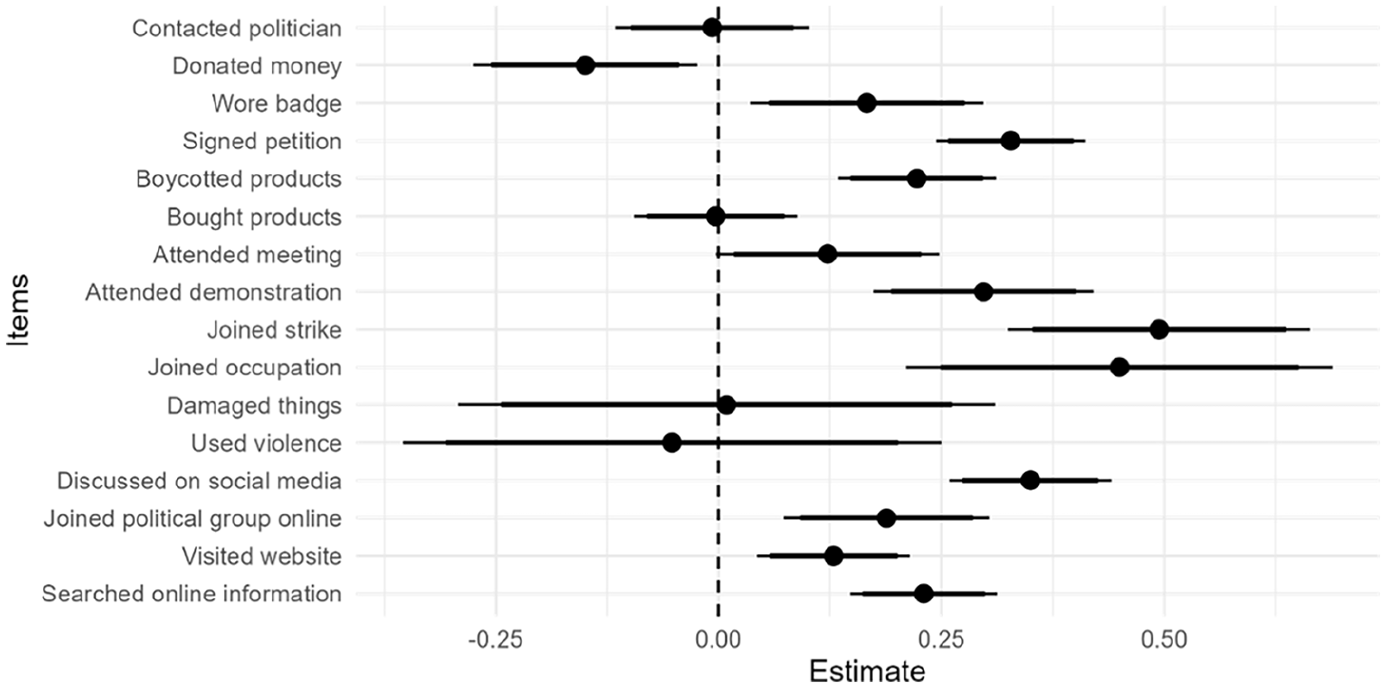
The Effect of Populist Attitudes, by Item of Participation.
The non-significant results for items 11 (damage things) and 12 (use personal violence) are interesting since the point estimates are of substantial size but the estimate is surrounded by considerable uncertainty. This is likely the result of the low absolute numbers of respondents that use these means of participation (the same is true for items 9 and 10; join a strike and occupation). This is something we already highlighted in Table 1. Nonetheless, the general pattern remains, populist citizens tend to be more likely to participate in politics in a wide variety of ways.
As the effect of populist attitudes appears relatively homogeneous across most participation items, the question remains whether the same is true when we compare across countries. We, therefore, replicate our comparative design, relying on both a theory- and data-driven approach, but disaggregate our estimations by country. This allows us to examine some of the potential country-specificities and identify divergences from the comparative pattern. Using both approaches within each country, we find the same dimensions of participation from our cross-national analysis (see Sections E and F of the Supplementary Materials). We then use the theory- and data-driven operationalisations of participation as dependent variables to examine the role of populist attitudes within each country. We harmonise the results in Figures 3 and 4, respectively, by plotting the populist attitudes point estimates of the corresponding regressions.
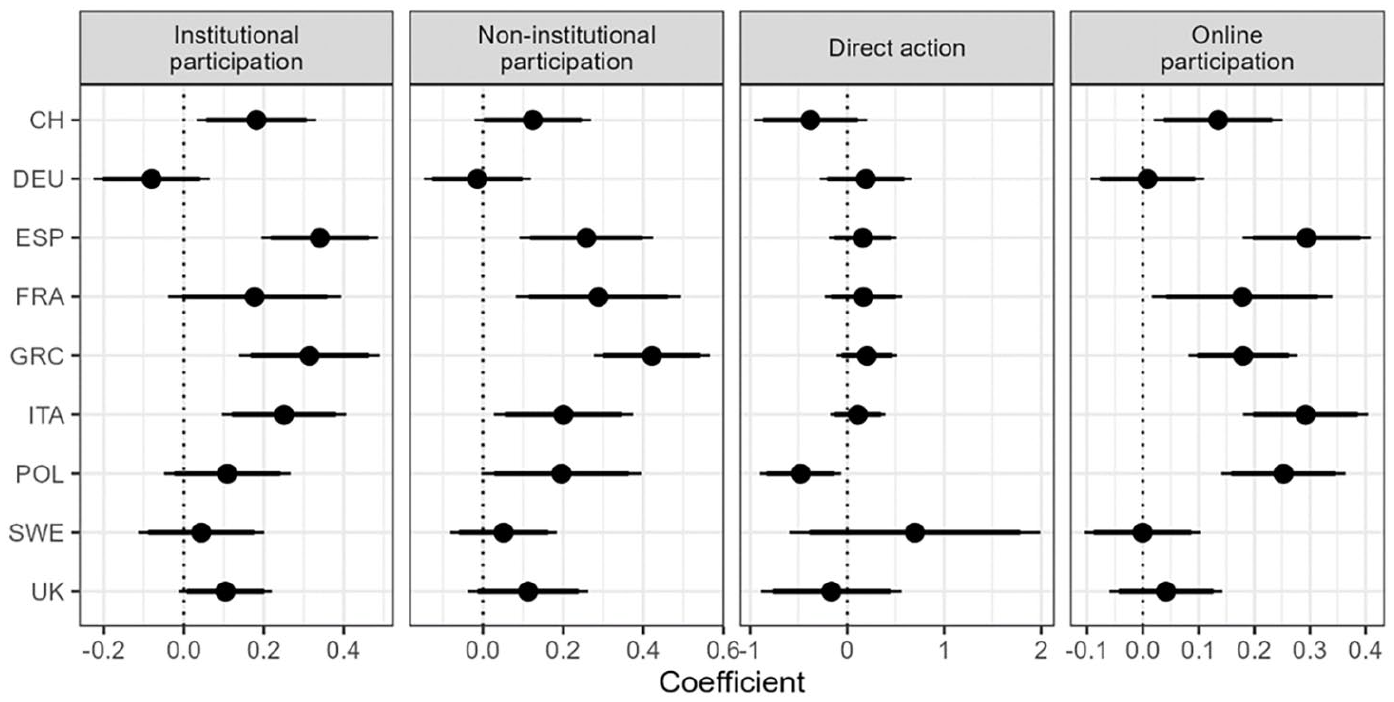
The Effect of Populist Attitudes, Theoretical Approach by Country.
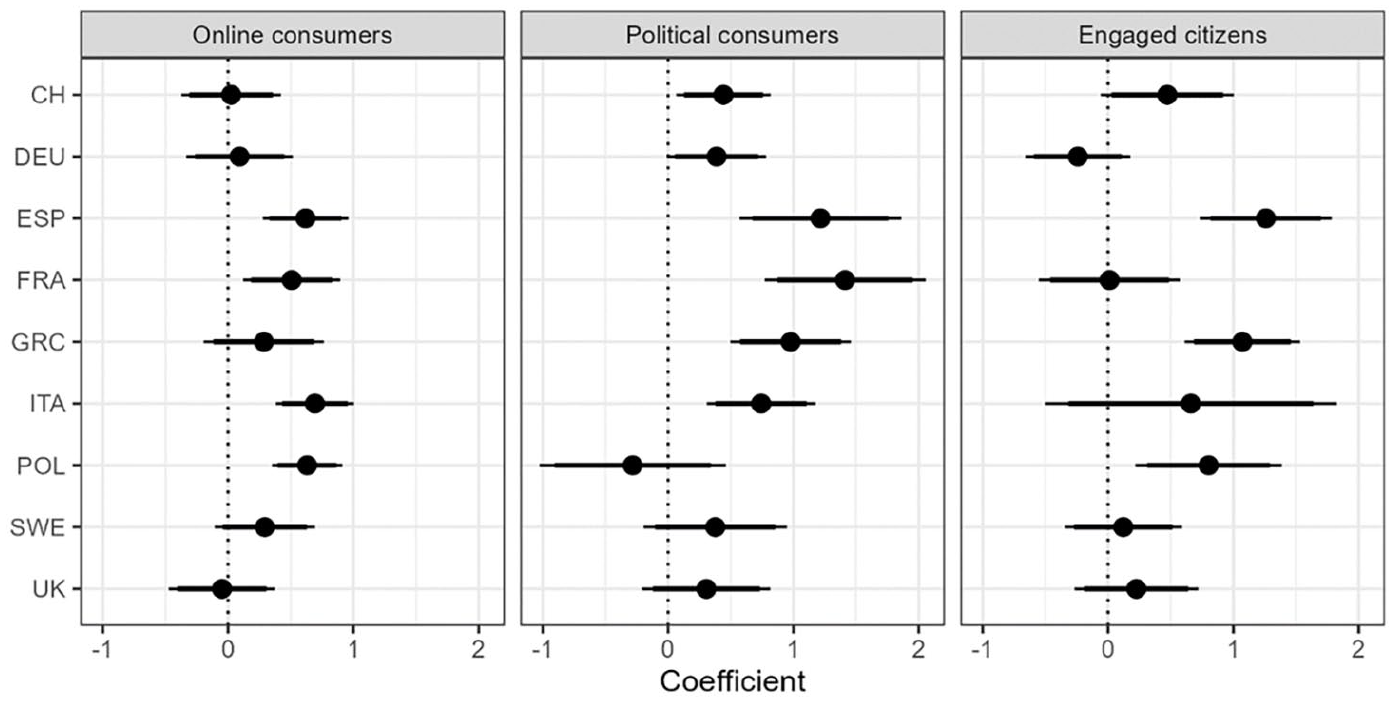
The Effect of Populist Attitudes, Data-Driven Approach by Country.
Both data- and theory-driven approaches return similar results, indicating at least some robustness between them. We, therefore, conclude with relative confidence. Starting with the theoretical approach, we show that populist citizens are more likely to participate in institutionalised, non-institutionalised and online forms of participation in all countries but Germany and Sweden. The observation regarding Germany is in line with recent research by Trüdinger and Bächtiger (2023), who find no relationship between effective direct participation and populist attitudes in Germany and argue this might be related to ideology, rather than populist attitudes per se. In Sweden, our results are much closer to the conventional levels of significance, so we are more careful interpreting them either way.
For direct action, we find a more mixed pattern. Interestingly, populist attitudes decrease the probability of direct action in Poland, which is likely a function of the growing popularity of PiS – a populist party – at the time of the survey. In contrast, we find positive estimates in most other cases, but they do not reach conventional levels of significance. This may hint towards a more context-specific participation behaviour in the realm of direct action and populism’s limited explanatory value.
The data-driven approach in Figure 4 shows that populist citizens are more likely to participate online in four out of nine countries (first panel). While the pattern remains somewhat scattered, all coefficients are positive and further substantiate our overall assessment of the positive relationship between populist attitudes and online participation. This is something we find confirmed throughout the cross-national sample, both when looking at the dimensions of participation (see Tables 3 and 4) and the items individually (see Figure 2), as well as most of the country-specific samples when using the theory-driven approach (see Figure 3).
Highlighting this positive relationship even more are the observations for political consumers (middle panel). In essence, populist citizens are more likely to participate in this category compared to disengaged citizens in all countries except Poland; the evidence for Sweden and the United Kingdom is tentative. Thus, the relationship between populist attitudes and this form of participation seems to be quite independent of the context (see Figure 4) but might be more related to the specific form of participation. After all, populist attitudes have a positive effect on attending a political meeting (item 4) and signing a petition (item 5) but not necessarily on boycotting a product (item 6) (see Figure 2).
Finally, when it comes to engaged citizens compared to disengaged citizens (last panel), we observe a positive and non-trivial coefficient in most countries. However, it is only statistically significant at the 90% level in four out of nine cases. This suggests that populist attitudes tend to mobilise those who are quite keen to participate across the board and have perhaps fewer preferences regarding how they do so (although Figure 1 shows they do so less using direct action). In Germany and Poland, however, populist attitudes simply do not appear to mobilise even highly engaged citizens.
Taken together, our item- and country-specific findings largely align with our main comparative findings and suggest that populist citizens are generally more likely to engage in non-electoral forms of participation, and this is regardless of how we account for the dimensionality of participation. At the same time, we must recognise that – unsurprisingly – there is some variation in the effect populist attitudes has across individual items and countries.
Discussion and Conclusion
Between the Trump tenure, the populist turn of British politics, the governing coalition of the Five Star Movement and the Lega in Italy, the recent rise of Chega and Vox in the Iberian peninsula and the FPÖ’s participation in the Austrian government, to name just a few recent events, we are once again reminded that populism constitutes a persistent – perhaps even permanent – feature of politics, regardless of context. Recent studies have begun to investigate the influence of populist sentiments on vote choice and political support in efforts to fully understand the success of those claiming to speak on behalf of ‘the people’. The majority of these studies, however, have focused on political participation in the electoral arena or at election time. Yet, the political participation literature extensively documents the importance of non-electoral participation. At the nexus between populism and non-electoral participation, this study sets out to investigate the role of populist attitudes in fostering contemporary political participation and favouring certain forms over others.
We provide a two-folded analytical framework to examine this question. By combining a theory- and data-driven approach to the operationalisation of participation’s multidimensionality, we gain unique and detailed insights into its relationship with populist attitudes. The former largely relies on extant literature, combined with the use of factor analysis. The latter uses the more novel LCA to ‘profile’ participatory behaviour. As a foundation for these analyses, we rely on a unique 16-item participation battery from a large-scale survey in nine European countries.
Overall, our main takeaway is that populist citizens are more likely to participate in politics, regardless of the form, type or operationalisation of participation. That is, populist attitudes serve as a sort of political grievance that mobilises citizens into politics. Both theory- and data-driven insights largely cross-validate each other, giving our main findings additional validity. Altogether, this provides further insights into the profile and behaviour of the populist citizen. It even helps us get rid of some common, yet incorrect assumptions about them. Much like we were quickly able to reject the misunderstanding that populist citizens are by default authoritarians, recent research (including this study) also clearly highlights that populist citizens are simply not ‘political couch potatoes’ who remain disengaged from the political arena (broadly defined). It may even be quite the opposite. Populist citizens are active participants in politics who may simply (yet explicitly) choose to go beyond the electoral arena to express their opinion and show their interest in politics.
Building on these general findings, we used our analytical framework to provide some more detailed insights into the relationship between populist attitudes and individual participatory forms, on one hand, and country-specific relationships between populist attitudes and participation. While it is natural that observations become less harmonised once we deconstruct a cross-national comparative framework, we find important levels of consistency. Even when looking at individual items and within countries, by and large, we find that populist attitudes positively relate to participation. The exceptions are not to the extent that they take away anything from the overall finding. It becomes even more clear that populist attitudes serve as political grievances with political motivation and mobilisation potential.
The findings of this study provide important insights into how populist sentiments (can) relate to political participation. Future research can build on these findings to develop contextual arguments that may explain, for instance, when populist attitudes not only contribute to the choice of the political participation form but also, the frequency. Due to the structure of the available data, we only analysed one point in time. It is possible that populist sentiments may vary over time for individuals, as they become activated by supply-side actors or events, leading to different patterns of political participation over time. In short, while we provide an important first step in this larger debate, much remains to be uncovered. Considering the seemingly stable presence of populism across European politics and the continued challenges to get people to engage in politics, we believe this must become an important part of the discipline’s future research agenda.
Supplemental Material
sj-docx-1-psx-10.1177_00323217241266028 – Supplemental material for Dimensions of Participation and Populism in Times of Discontent: A Theory- and Data-Driven Approach
Supplemental material, sj-docx-1-psx-10.1177_00323217241266028 for Dimensions of Participation and Populism in Times of Discontent: A Theory- and Data-Driven Approach by Robert A Huber and Steven M Van Hauwaert in Political Studies
Footnotes
Acknowledgements
Previous versions of this article were presented at the ECPR Joint Sessions in Pisa (2016). We thank all participants for their comments and Kirk Hawkins and Takis Pappas for organising a fruitful and intellectually stimulating workshop. We also thank Ryan Carlin, Carsten Wegscheider, Andrej Zaslove and especially Lisa Zanotti for their valuable comments along the way. We are particularly grateful to Christian H. Schimpf for his extensive contributions to previous versions of this manuscript.
Declaration of Conflicting Interests
The author(s) declared no potential conflicts of interest with respect to the research, authorship and/or publication of this article.
Funding
The author(s) received no financial support for the research, authorship and/or publication of this article.

Supplemental Material
Additional Supplementary Information may be found with the online version of this article.
A. Descriptive statistics. Table A.1. Descriptive statistics. Table A.2. Sociodemographics by country. B. Additional information on the theoretical approaches. Figure B1. Structural equation model replicating the theory-driven approach. Table B1. Regression table for structural equation model replicating the theory-driven approach. C. Additional information on data-driven approach. Table C.1. Goodness of fit scores for the different LCA classes. D. Regression tables. Table D.1. Full Regression Results for the Theoretical Approach. Table D.2. Full Regression Results for the Empirical Approach. E. Additional information on the theoretical approach per country. Table E.1. Regression Results for the Theoretical Approach in France. Table E.2. Regression Results for the Theoretical Approach in Germany. Table E.3. Regression Results for the Theoretical Approach in Greece. Table E.4. Regression Results for the Theoretical Approach in Italy. Table E.5. Regression Results for the Theoretical Approach in Poland. Table E.6. Regression Results for the Theoretical Approach in Spain. Table E.7. Regression Results for the Theoretical Approach in Sweden. Table E.8. Regression Results for the Theoretical Approach in Switzerland. Table E.9. Regression Results for the Theoretical Approach in the United Kingdom. F. Additional information on the empirical approach per country. Figure F.1. Different forms of participation in France. Table F.1. Regression Results for the Empirical Approach in France. Figure F.2. Different forms of participation in Germany. Table F.2. Regression Results for the Empirical Approach in Germany. Figure F.3. Different forms of participation in Greece. Table F.3. Regression Results for the Empirical Approach in Greece. Figure F.4. Different forms of participation in Italy. Table F.4 Regression Results for the Empirical Approach in Italy. Figure F.5. Different forms of participation in Poland. Table F.5. Regression Results for the Empirical Approach in Poland. Figure F.6. Different forms of participation in Spain. Table F.6. Regression Results for the Empirical Approach in Spain. Figure F.7. Different forms of participation in Sweden. Table F.7. Regression Results for the Empirical Approach in Sweden. Figure F.8. Different forms of participation in Switzerland. Table F.8. Regression Results for the Empirical Approach in Switzerland. Figure F.9. Different forms of participation in the United Kingdom. Table F.9. Regression Results for the Empirical Approach in the United Kingdom.
Notes
Author Biographies
References
Supplementary Material
Please find the following supplemental material available below.
For Open Access articles published under a Creative Commons License, all supplemental material carries the same license as the article it is associated with.
For non-Open Access articles published, all supplemental material carries a non-exclusive license, and permission requests for re-use of supplemental material or any part of supplemental material shall be sent directly to the copyright owner as specified in the copyright notice associated with the article.
