




Abstract
We explore the characteristics of politicians that make them trusted by citizens, fielding conjoint survey experiments in seven democracies. Studies regularly indicate that competence and integrity are key attributes in the perceived trustworthiness of politicians, but we show that displaying authenticity is also important. Authenticity is about being true to oneself, and in the political context this requires politicians to appear unlike typical politicians and more like ordinary people. We find that some attributes associated with authenticity are as important as competence and integrity, and they appear to be especially important to citizens with lower levels of generalized political trust. These findings suggest that considerations of politicians being ‘in touch with ordinary people’ can matter just as much as more traditional judgements of their honesty and ability to produce outcomes. This has implications for our understanding of political leadership as well as for trust-building strategies.
There are good reasons for a politician to want to be trusted. Being seen as trustworthy is a ‘great benefit’ for a politician, providing ‘more leeway to govern effectively’ (Hetherington, 1998: 803), facilitating citizens’ compliance with laws (Marien and Hooghe, 2011), increasing support for government policies (Hetherington, 2005) and promoting participation in the political process (Devine, 2024; Valgarðsson et al., 2022). In particular, the experience of COVID-19 highlighted the importance of political trust for outcomes such as adhering to public health guidelines and accepting vaccinations (Bollyky et al., 2022; Jennings et al., 2021; Weinberg, 2022; Weinberger et al., 2020). From a more self-interested perspective, perceived trustworthiness also helps to explain voters’ preferences between different candidates (e.g. Bishin et al., 2006; Garzia, 2011; Norrander, 1986). This issue is even more pertinent if we believe that we are living in a ‘cynical age’ (Citrin and Stoker, 2018) or even an ‘age of distrust’ (Rosanvallon, 2008) and would like to rebuild citizens’ trust in politicians. The question driving this study is: what makes politicians more (or less) trustworthy in the eyes of citizens?
In this article, we explore this question in two ways: first, we develop the theoretical framework of the drivers of politicians’ perceived trustworthiness, by integrating the concept of political authenticity into the more standard framework of prior studies within political science. The traditional framework primarily focused on two main attributes: competence–associated with skill, effectiveness and getting things done – and integrity – associated with honesty, being true to one’s principles and moral standards (Brown et al., 1998; Garzia, 2011; Miller et al., 1986; Pancer et al., 1999). But the recent literature has also highlighted the (potentially growing) importance of authenticity in shaping trust in politicians (Luebke, 2021; Stiers et al., 2021; Valgarðsson et al., 2021; Weinberg, 2023; Whittle et al., 2021), without systematically incorporating that quality into a broader framework of politicians’ trustworthiness. In short, our framework suggests that people want politicians who are both able (referring to competence) and honestly willing (integrity) to act in their interest; but they also want to be able to relate to them as ‘ordinary people’ rather than as scripted politicians (authenticity).
Based on a detailed analysis of letters and diaries written about politics by UK citizens in the immediate post-war period (1945–1950) and the early twenty-first century (2001–2015), Clarke et al. (2018: 208) concluded that: ‘The expectation that politicians be “human” appears to have developed from a relatively minor and undemanding expectation that politicians be genial, warm, and sympathetic to a relatively major and more demanding expectation that politicians be “normal” in a variety of ways and situations and especially “in touch” with the “real” lives of “ordinary” people’.
Instead of wanting ‘superhuman’ (Weber, 1947: 358) leaders, citizens appear to increasingly expect politicians to ‘be an “ordinary” person they can identify with’ (Whittle et al., 2021: 142) – ‘just like us’ – and in today’s media landscape, many politicians thus strive to be ‘everyday celebrity politicians’ (Wood et al., 2016). Harking back to earlier conceptions of politicians as either an ‘everyman’ or a ‘superman’ (Sullivan et al., 1990), it would seem that citizens’ expectations have increasingly leaned towards the former. Guided by these insights, we argue that analyses of politicians’ perceived trustworthiness should incorporate those attributes which signal to citizens that politicians are acting like their authentic self, coming across as real people rather than as trained, stilted political characters. Note that this conception does not rely on the politician in question actually being ‘ordinary’ or true to themselves, rather that they somehow manage to build an image among citizens where the latter come to feel that they can relate to them as real, ordinary people (Luebke, 2021; Wood et al., 2016). While people might reasonably refer to this expectation by different names, we use the concept authenticity here: the original meaning of that term refers to being ‘real’ and ‘true to yourself’ in some important sense (Jones, 2016; Luebke, 2021; Stiers et al., 2021), but in the political context, it has been used to more specifically describe the public perception of politicians as ordinary people, as opposed to professional politicians (Luebke, 2021; Valgarðsson et al., 2021; Whittle et al., 2021).
Our second major contribution is empirical: we explore the role of competence, integrity, and authenticity in driving trust in politicians using a pre-registered conjoint survey experiment fielded in nationally representative surveys of citizens in seven democracies: Argentina, Brazil, Croatia, France, Germany, India and Spain. We use this method because our intention is to identify the causal effect of politicians’ attributes on citizens’ trust judgements, instead of just expressed preferences or cross-sectional associations, and conjoint experiments are an ideal method for causal identification of how citizens make judgements when discriminating between alternatives with multiple features, as in the real world (Hainmueller et al., 2014). In our experiments, we include the hallmark attributes of competence and integrity, but we also develop other attributes intended to capture our notion of authenticity. We include several (although by no means all) other relevant characteristics, such as their balancing of principle versus pragmatism (see Medvic, 2013), leadership style, career background and gender. We also follow the findings by Valgarðsson et al. (2021) by exploring how these preferences differ between citizens with higher or lower levels of generalized political trust, speaking more directly to the relevance of authenticity for rebuilding political trust. Finally, since authenticity has been related to the rise of populism (Enli and Rosenberg, 2018; Fieschi, 2019), we also explore whether those expectations are related to support for strong leaders.
Our primary findings suggest that the classic qualities of competence and integrity have strong effects on citizens’ trust in politicians, but attributes associated with authenticity also have strong effects: in particular, politicians seeming to be ‘in touch with everyday life and ordinary people like yourself’ (which might evoke notions of understanding and representation as well as authenticity) appears to be as important as them having ‘a reputation for handling their duties well’ (associated with competence) and meaning what they say (associated with discursive integrity). Authenticity (and discursive integrity) also appears to be more important for distrustful, as well as for female and more left-wing, respondents, whereas competence appears to be more important for trusting respondents. These drivers have a robust and consistent effect across our diverse set of countries and demographic divides such as those related to age, gender and left- and right-wing political leanings. This finding has direct relevance not only for individual politicians seeking to be trusted by voters but also for the more fundamental democratic project of rebuilding citizens’ general trust in politicians (e.g. Brezzi et al., 2021; Dalton, 2004; Mauk, 2020).
What Makes a Trustworthy Politician?
We follow classic political science literature in defining political trust as the belief that the object of trust (a political actor or institution) ‘would produce preferred outcomes even if left untended’ (Gamson, 1968: 54), with Easton (1975: 447) elaborating it as citizens feeling that ‘their own interests would be attended to’ even if they could not enforce it. This focus on interests was formulated even more explicitly by Hardin (2006: 16–17), who defined trust merely as ‘encapsulated interest’: you trust someone in a given context if you believe that they have a significant enough vested interest in collaborating with you. Hardin (2004: 8) thus rather bluntly stated that there was no ‘aura of morality or of deep psychological commitments’ in trust. This conception is also in line with treatments of the term in experimental studies, which measure trust as the extent to which participants act under the apparent assumption that other participants will act in the former’s interests in ‘trust games’ (Johnson and Mislin, 2011).
However, others have highlighted that people’s trust judgements are not only based on their rational evaluations of shared interests but also on people’s general disposition to trust others (‘A trusts’), which may have been socialized over a long period (Devine and Valgarðsson, 2023; Easton, 1975; Uslaner, 2018). Nevertheless, the standard political science model of ‘trust as evaluation’ (‘A trusts B’ and perhaps ‘A trusts B to do X’) is both broadly accepted and supported by studies which suggest a relationship between (perceived or objective) government performance and political trust (Goubin and Hooghe, 2020; van der Meer and Hakhverdian, 2017; Van der Meer and Ouattara, 2019). Thus, trust judgements are likely shaped, at least at the margins, by the perceived trustworthiness of the trustee. Personality, affect, emotion, bounded rationality and (social or psychological) identification do feature in these trust judgements (McAllister, 1995; Mondak et al., 2017; Theiss-Morse and Barton, 2017), but given the above, it is also reasonable to expect that evaluations of actual object trustworthiness also play an important role in driving trust.
But what then drives this perceived trustworthiness of politicians? Within political science, the primary emphasis has been on two pillars of trustworthiness: competence and integrity (Bittner, 2011; Garzia, 2011; Miller et al., 1986; Pancer et al., 1999). Competence (or ‘ability’) is associated with the capacity to influence outcomes, handle tasks effectively and successfully reach stated objectives (Green and Jennings, 2017) and with qualities such as intelligence, knowledge, experience, working hard and being level-headed, skilful and professional (Bittner, 2011; Brown et al., 1998; Miller et al., 1986; Pancer et al., 1999). Integrity is a less straightforward concept. It has been most consistently associated with the terms ‘honest’ and ‘sincere’, keeping promises and telling the truth (Brown et al., 1998; Grimmelikhuijsen and Knies, 2017; Miller et al., 1986; Pancer et al., 1999; Valgarðsson et al., 2021). It was originally also associated with being ‘moral’ and ‘principled’ more generally (Kinder, 1983, 1986; Mcfall, 1987), but that association appears less consistently (Miller et al., 1986; Pancer et al., 1999). Although Mayer et al. (1995: 719) defined integrity as adhering ‘to a set of principles that the trustor finds acceptable’, Grimmelikhuijsen and Knies (2017) left that element out when developing their framework, instead measuring integrity as being sincere, honest and keeping commitments.
Studies in other fields have expanded this binary framework. In particular, work in organizational studies has suggested that trustworthiness consists of three dimensions: competence, integrity and benevolence (CBI) – with the latter defined as ‘the extent to which a trustee is believed to want to do good to the trustor, aside from an egocentric profit motive’ (Mayer et al., 1995: 718) or that they ‘care about the welfare of the public and to be motivated to act in the public interest’ (Grimmelikhuijsen and Knies, 2017: 587; see also Hamm et al., 2019). Meanwhile, studies in social psychology speak of competence and warmth as the two ‘universal dimensions of social cognition’ (Fiske et al., 2007), where the latter refers to the intentions of the trustee and has been measured by how ‘compassionate’ they are and whether they ‘care about people like you’ (Laustsen and Bor, 2017: 99). As such, both warmth and benevolence refer to the trustee’s intentions, but warmth also appears to have a more decidedly affective dimension to it. In a comprehensive review of existing measures, Bittner (2011: 44) opted to include integrity and warmth-related qualities such as ‘cares’, ‘compassionate’ and ‘kind’ under the label ‘character’.
We believe it is most useful to retain focus on ‘honesty’ as the core meaning of integrity, leaving other potentially important aspects of candidates’ character and morality to separate concepts. Aside from its dominance in previous studies within political science, honesty has direct relevance to the conception of trust as the belief that someone will act in your interest: where competence refers to them being able to act in your interest, integrity then refers to them being willing to; sincere in their stated intentions and likely to uphold their commitments. We follow Allen and Birch (2015) in distinguishing between ‘financial integrity’ and ‘discursive integrity’: the former describes adhering to (financial) rules and regulations, and the latter refers to truth-telling. In this conception, integrity thus has at least two important elements: in one sense, it simply refers to meaning what you say, keeping promises and accurately reflecting your views and intentions. In another, it refers to the opposite of being corrupt, that is, sincerely being in politics to serve the public interest rather than your own and thus not abusing political office for personal or private gain (Murtin et al., 2018).
Our conception of integrity thus comes quite close to the concepts of warmth and benevolence discussed above: we would argue that, at least in the political context, honesty and truth-telling likely entail good intentions as well, as it is hard to imagine a politician that does not claim to be working in the public interest in at least some sense. Empirically, studies employing the CBI framework in the political context have found that the latent factors captured by measures of the latter two concepts are very high and a two-factor solution which combines the two only has a slightly lower fit than a three-factor solution (Grimmelikhuijsen and Knies, 2017: 594; Hamm et al., 2019: 8). Nevertheless, good motivations may well be separated from honesty at least at a conceptual level, and other measures (especially outside the political context) might discover a stronger empirical distinction between the two; in a broader sense, it is certainly possible to have malevolent intentions and be entirely honest about those malevolent intentions.
Similarly, other extensions of the framework are certainly feasible: previous work on ‘charisma’ refers to a variety of less tangible attributes (including being ‘good-looking’) that enable leaders to form an emotional relationship with citizens and inspire their faith in them (Miller et al., 1986; Van Der Brug and Mughan, 2007) and is defined in one review as ‘values-based, symbolic, and emotion-laden leader signaling’ (Antonakis et al., 2016: 304). Again, this partly refers to more affective qualities that may be related to perceived ‘warmth’ as well. We do not deny the potential importance of any of these qualities, but in this study, we build upon the most traditional and parsimonious framework within political science, that of competence and integrity, with a focus on another quality that has not received enough attention in that literature: political authenticity.
Bringing Authenticity Into Focus
The concept of authenticity has a long history, with roots in the Greek term ‘auto-hentes’ – meaning to make or create oneself (Kearney, 1994: 54) – and the preoccupation of Greek philosophers with knowing and expressing our true selves (Sutton, 2020). The concept has since featured in multiple fields of science and society, but studies in psychology have gradually converged on a conception where authenticity refers to the tri-fold consistency between individuals’ actual experience (‘the true self’, e.g. emotions and deep cognition), their conscious awareness of those experiences (as opposed to ‘self-alienation’) and their outward behaviour and emotional expression (Wood et al., 2008). In short, authentic people are those whose private and public personas are the same. This conception has some overlap with the concept of integrity, as both are associated with a type of honesty, but authenticity is more about consistency of personality than about commitment to the truth or to keeping promises (Jones, 2016).
So, what does this mean in the context of politics? To be sure, politicians face constant pressures to behave or express themselves in ways that may garner them support and success among voters (and other politicians). The political landscape entails various unique incentives: electoral competition, media coverage, the social media environment, intra-party and inter-party coalition-building, policy-making processes and political strategizing all create incentives for politicians to behave and express themselves in ways that may well not be consistent with their inner-most personas. Even a person of strong moral integrity may reasonably bow to those pressures at least in part, sacrificing complete candour and authenticity for popular support and the opportunity to achieve aims of electoral and policy success that they value highly. Political philosophers refer to this as ‘the problem of dirty hands’ in political activity (Walzer, 1973).
In this respect, it appears that democratic politics has, in recent decades, seen two broad developments that are in tension. On one hand, Clarke et al. (2018) discuss in detail how the nature of interaction between politicians has shifted in recent decades towards a more controlled, media-filtered and managed style of communication and political performance: politicians are increasingly constantly scrutinized through social media and 24-hour news cycles which can force them to ‘perform’ politics every hour of the day if they wish to reach their political objectives. At the same time, citizens appear to have developed a growing distaste for ‘the political class’ (Allen, 2018), politicians who appear to be performing rather than being themselves. Such politicians are increasingly perceived as scripted, disingenuous and polished (Wood et al., 2016), coming across as ‘fake’, distant from the ‘common folk’, stilted and even hypocritical (Jones, 2016; Kenny et al., 2021; Stiers et al., 2021). In particular, citizens increasingly dislike styles of political rhetoric and behaviour that are seen as typical for politicians: evading questions, stage-managing and soundbites (Clarke et al., 2018: 253). In times when citizens in developed democracies have become more ‘post-materialist’ and sceptical of authority and hierarchy (Dalton, 1984; Inglehart, 2018), it seems that they increasingly expect politicians to be ‘like them’ rather than ‘above them’ (Garzia, 2011; Rahn et al., 1990).
In this literature, the term ‘authenticity’ has been used to describe the former perception and expectation that politicians come across as ordinary people rather than as typical politicians (Luebke, 2021: 644; Wahl-Jorgensen, 2019: 70; Whittle et al., 2021: 142; Wood et al., 2016: 581–582). As such, the concept has a particular meaning in the political sphere that is different from the original, core meaning of authenticity: politicians may well be considered authentic without, in fact, being true to themselves in any meaningful sense. The perception of political authenticity is often, ironically, cultivated through strategic performances and marketing campaigns that portray the politician as an ordinary person, even though they may well in fact be privileged, strange or both (Enli, 2015; Enli and Rosenberg, 2018; Wood et al., 2016: 595). What is important is the perception that the politician is not just another politician but an ordinary person who is true to themself in their public behaviour (this can be the difference between awkwardly eating a bacon sandwich and confidently drinking a pint of beer). In this conception, authenticity refers not just to perceived ordinariness in general but especially as contrasted with the ‘scripted’ qualities often associated with typical politicians (Allen, 2018; Clarke et al., 2018; Jones, 2016; Wood et al., 2016).
Taking that approach, Valgarðsson et al. (2021) suggest that an ‘authenticity gap’ may be opening up in modern democracies: one where politicians increasingly need to ‘perform’ to survive in conventional politics, at the same time as citizens increasingly dislike political performance. Their study of citizens and elites in the UK found that prioritizing the qualities of being ‘in touch with ordinary people’ and ‘understanding everyday life’ formed a separate underlying factor of expectations, along with two other factors reflecting competence and integrity, and that this was also related to less emphasis on politicians being ‘clever’, ‘dressing well’, and having ‘presentable looks and voice’; qualities likely associated with typical politicians. In addition, their findings suggested that citizens with lower levels of political trust were more likely to prioritize these ‘authenticity’ qualities, speaking to the public’s apparently growing distaste for traditional political performance (Valgarðsson et al., 2021). This distaste has also been related to the rise of populist political leaders, who portray themselves as political outsiders who shun conventional political norms and ‘political correctness’, being ‘one of the people’ and not part of the establishment (Enli and Rosenberg, 2018; Luebke, 2021; Pillow et al., 2018; Stiers et al., 2021). Politicians such as Trump, Duterte and Bolsonaro arguably come across as being themselves, ‘telling it like it is’ and claiming to represent the common folk against a corrupt elite (e.g. Akkerman et al., 2014; Hahl et al., 2018; Mudde, 2013; Stiers et al., 2021). In a different way, but likely indicative of the same trend, ‘everyday celebrity politicians’ (Wood et al., 2016) such as Boris Johnson, Alexandria Ocasio-Cortez and Bernie Sanders have (by intent or fortune) cultivated an image of relatable ‘normality’; whether by addressing the media awkwardly with scruffy hair, sharing videos of their pets on social media, or attending important events wearing fluffy woollen mittens (AP News, 2021).
Some recent studies share our goal of bringing authenticity into focus, but conceptions and measures differ somewhat. Stiers et al. (2021) have developed measures of authenticity perceptions through several features: the public knowing where the politician stands, that the politician won’t change their opinion just to get votes, that the politician is not afraid to ‘speak out’; says what they mean; gives ‘the straight stuff’ and behaves the same in public as in private (see also Kenny et al., 2021). We do agree that these features are likely, at least empirically, to be taken as cues for authenticity as we conceive it: as discussed above, typical politicians are often perceived as being scripted and stilted, vague in their rhetoric and pandering to voters instead of following their genuine convictions (Allen, 2018; Clarke et al., 2018). As such, the opposites of those qualities may often be taken as cues of authenticity, understood as ordinariness in contrast with those ‘unordinary’ qualities of typical politicians. We do not adopt these features as our definition of authenticity, but we agree that they may well be valid measures of authenticity perceptions.
Returning to the standard framework of politicians’ trustworthiness, where competence and integrity refer to the trustee’s perceived ability and honest willingness to serve the truster’s interests, respectively, authenticity has a unique standing (although the three may overlap to some extent). Coming across as ordinary might signal to the truster that the politician shares their interest because they are a normal person like them, not an out-of-touch and isolated member of the political class. This might then serve as a signal of their honest intentions – considered an aspect of integrity here but as benevolence in other work. It could also indicate factual knowledge about the public’s circumstances – which could be considered an aspect of competence. However, we would argue that there is likely another reason why citizens might value authenticity: they might simply dislike the qualities associated with typical politicians and tend to like and psychologically identify with politicians who come across as ordinary people. Unsurprisingly, previous studies have suggested that whether you ‘like’ someone plays into whether you trust them, at least partly independent of any considerations of their competence or integrity (Laustsen and Bor, 2017; Theiss-Morse and Barton, 2017).
In our analysis, we will proceed to test the independent roles of qualities associated with competence, integrity, authenticity and other factors in shaping people’s trust in politicians and explore how these expectations might be related. Importantly, we are not aware of any existing experimental study of the effects of authenticity on citizens’ trust in politicians. Based on the above discussion, we posit three pre-registered 1 hypotheses and proceed to test them using a conjoint survey experiment. First, we expect that authenticity matters:
H1: Attributes associated with authenticity will have a significant effect on respondents’ evaluations of the trustworthiness of politicians.
Second, in line with cross-sectional evidence (Valgarðsson et al., 2021), we expect that citizens with lower levels of political trust value authenticity more:
H2: Attributes associated with authenticity will have a stronger effect on evaluations of the trustworthiness of politicians for respondents with lower levels of general political trust.
Finally, because authenticity demands have been related to the growing success of populist politicians (Enli and Rosenberg, 2018; Fieschi, 2019; Lacatus and Meibauer, 2022) and even authoritarian ‘strong leaders’ such as Trump, Duterte and Bolsonaro, we expect citizens who value authenticity more to be more sympathetic to such leadership styles:
H3: Attributes associated with authenticity will have a stronger effect on evaluations of the trustworthiness of politicians for respondents who are more likely to favour strong leaders.
Research Design
To test the role of authenticity and other qualities in determining citizens’ trust in politicians, we fielded pre-registered conjoint survey experiments in seven countries: Germany, France, Spain, Croatia, Argentina, Brazil and India. The surveys were conducted in September and October 2021 by YouGov in all countries except Brazil and India (where they were conducted by NetQuest), on a nationally representative sample of at least 1000 adults. 2 Each survey also included additional questions on related topics, as well as demographic information.
As in conventional conjoint experiments, respondents were presented with a brief description, which we document below, which indicated that their task was to choose the politician they trusted more. After being presented with the paired profiles, they were faced with a forced choice between Politician ‘A’ or ‘B’. There was no other option given (such as ‘don’t know’, ‘skip’ or ‘none’). Respondents were shown two profiles of a ‘politician’ side-by-side, with 13 attributes (variables) and a maximum of 4 levels (values), showing that this number of attributes is well within bounds for achieving valid results. The experiment was repeated four times, meaning respondents made a total of 4 binary choices between a total of 8 profiles. The levels for each attribute were varied at random, and attribute order was randomized to cancel out order effects. 3 In all cases, respondents were not informed that this was an experiment and did not know what attribute levels were possible aside from those they saw.
The conjoint experiment includes attributes intended to tap into ‘authenticity’, as defined above, as well as other attributes and levels which have been found in previous research to be important for trust judgements of politicians. These are presented in full in Table 1, and screenshots depicting examples of their presentation to respondents in the surveys can be found in Online Appendix D. Reflecting the discussion above, we define political authenticity as coming across as an ordinary person rather than a typical politician, often by employing various rhetorical and behavioural devices that are seen as contrary to political convention. We field three measures intended to capture these elements: first, the extent to which the politician is ‘in touch [or out of touch] with everyday life and ordinary people like yourself’; second, the extent to which the politician ‘comes across as different from [or much like] other politicians’; and third, the extent to which the politician seems to answer questions directly or evade them. The first measure is adopted directly from Valgarðsson et al. (2021), combining their first two attributes, which formed a factor of expectations separate from competence and integrity, and is intended to reflect how much like ordinary people the politician is. 4 The second measure is new but is intended to reflect the flip-side of our core definition of authenticity: how unlike typical politicians they are. Thus, these first two measures derive directly from our definition of authenticity. The third is an indirect measure of a type of political rhetoric commonly associated with typical politicians (Clarke et al., 2018: 114) which can be construed as a cue for authenticity; in line with similar measures of authenticity in previous studies (e.g. giving ‘the straight stuff’) (Kenny et al., 2021; Stiers et al., 2021).
Attributes and Levels in the Conjoint Experiment and Our General Expectations for Their Effects.
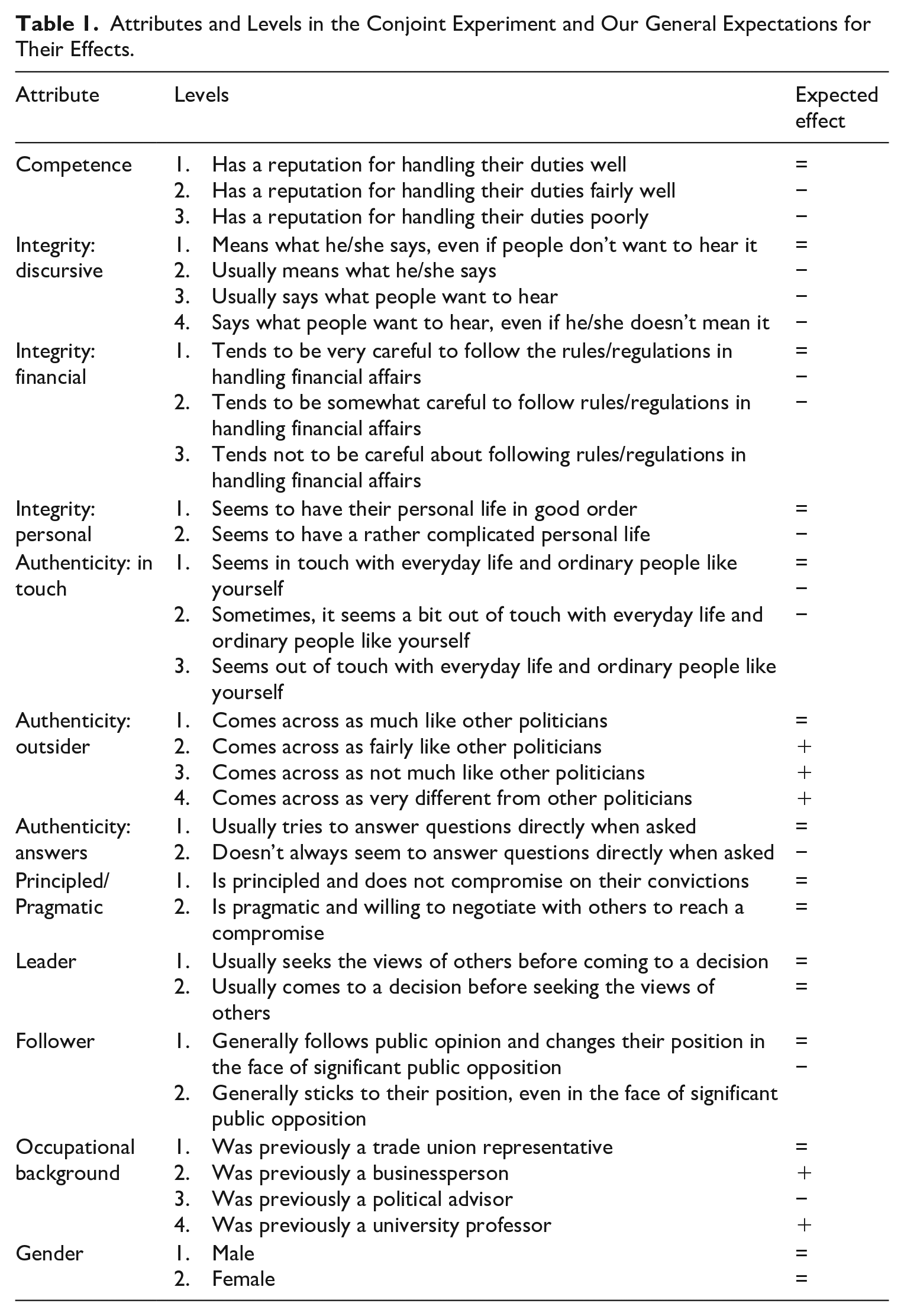
In addition, building on the above review of the literature, we include measures of both discursive and financial integrity: politicians meaning what they say and being careful to follow the rules/regulations in handling financial affairs, respectively. As part of a wider project, and in order to provide a more realistic profile of the hypothetical politicians, the conjoint experiments also included several attributes less directly relevant to the framework tested here: first, whether the politician appeared to have their personal life in ‘good order’; a reference to potential scandals in personal affairs, a consideration that has not been explored in many empirical studies (but see Sarmiento-Mirwaldt et al., 2014). Second, attributes relating to Medvic’s (2013) concept of an ‘expectations trap’ were included: whether the politician is more principled or pragmatic and the extent to which they lead or follow others. 5 Finally, the attributes indicate the politicians’ gender and occupational background. In Table 1, we list our general expectations for each attribute, where ‘+’ denotes an expected positive effect, ‘–’ denotes an expected negative effect, and ‘=’ means that the level is either the baseline level for that attribute in our analysis or that we do not have a particular expectation regarding that attribute. However, our expectations for attributes other than competence, integrity and authenticity are primarily exploratory.
In order to test our hypotheses, we will analyse to what extent the propensity to express trust in politician A or B can be predicted by the levels they were assigned on each attribute. We will do this using the standard analysis techniques for conjoint experiments used in political science, introduced by Hainmueller et al. (2014) (see also Bansak et al., 2021). We present the effects of each attribute in terms of marginal means (MMs), derived from regression coefficients from models with clustered standard errors by the respondent (as each respondent completed the task several times). These are equivalent to average marginal component effects (AMCEs), which we also report in text, but MMs have the advantage of being able to assess the effects of all levels (without a baseline) and more intuitively compare effects between attributes (Leeper et al., 2020). These will be included without any covariates to test H1, about the effects of the three authenticity attributes, and in exploratory analyses of the effects of other attributes.
To test H2 and H3, we use interactions and subgroup analyses to see if the effects of the three authenticity attributes differ significantly depending on responses to questions fielded in the survey about generalized political trust (reported confidence in the national parliament, national government and political parties), and about support for strong political leaders. 6 For our main measure of trust, we create a trust scale based on factor predictions from agreement to the three confidence questions. 7 We use the scale for interactions and produce conjoint plots based on a simplified categorical measure, which takes terciles of the scale, defining the first tercile as ‘lower trust’ and the third as ‘higher trust’. In Online Appendix B, we also present subgroup plots for each trust measure. We detail the wording for each of these measures in Online Appendix C.
The size and scope of our sample are advantageous for our analysis. A multi-country conjoint experiment is a relative novelty in the literature, with most exceptions covering countries in a single global region (e.g. Jeannet et al., 2021). In contrast, our sample includes several large and geopolitically important countries from Europe and Latin America as well as India, the world’s most populous democracy. In addition, our sample contains a diverse selection of ‘most different’ democracies on several features of relevance to our study: they represent countries at different stages of economic development and democratic trajectory, as well as different cultural value profiles and political trust levels. It includes affluent countries where liberal democracy is consolidated and self-expressive values are prominent (France and Germany) as well as younger democracies and less affluent countries where democracy is under threat: as of 2021, Brazil and India rank in the top 10 ‘autocratising’ countries in the world (Boese et al., 2022). Table 2 illustrates this by listing each country’s rank in the World Bank’s (2022) list of countries’ (and territories’) GDP per capita, their placement on the Inglehart-Welzel World Cultural Map (World Values Survey, 2022), their political trust levels recorded in the most recent wave of the World Values Survey (World Values Survey, 2020) and their ranking in the Freedom House list as of 2023.
Countries in Our Sample by GDP, Inglehart-Welzel World Cultural Region and Trust in Government.
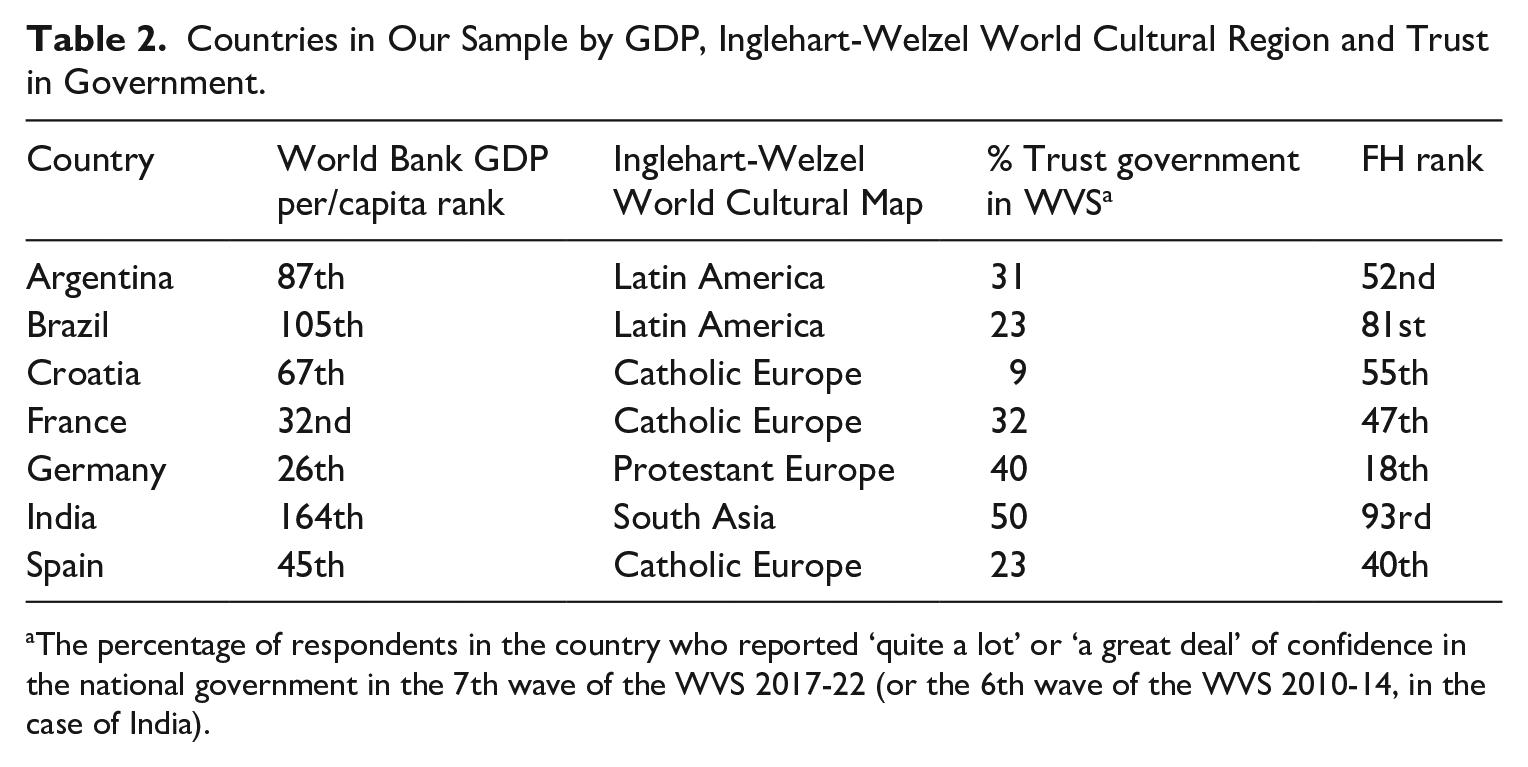
The percentage of respondents in the country who reported ‘quite a lot’ or ‘a great deal’ of confidence in the national government in the 7th wave of the WVS 2017-22 (or the 6th wave of the WVS 2010-14, in the case of India).
These features are particularly relevant for our purposes because, as argued in the previous section, citizens’ expectations of authenticity might be related to post-materialist values, which in turn relate to affluence in the country and political trust levels have been found to be related to those expectations as well. Thus, our findings provide for a strict test of our hypotheses in most different contexts, as well as for a valuable opportunity to explore differences in findings across these contexts.
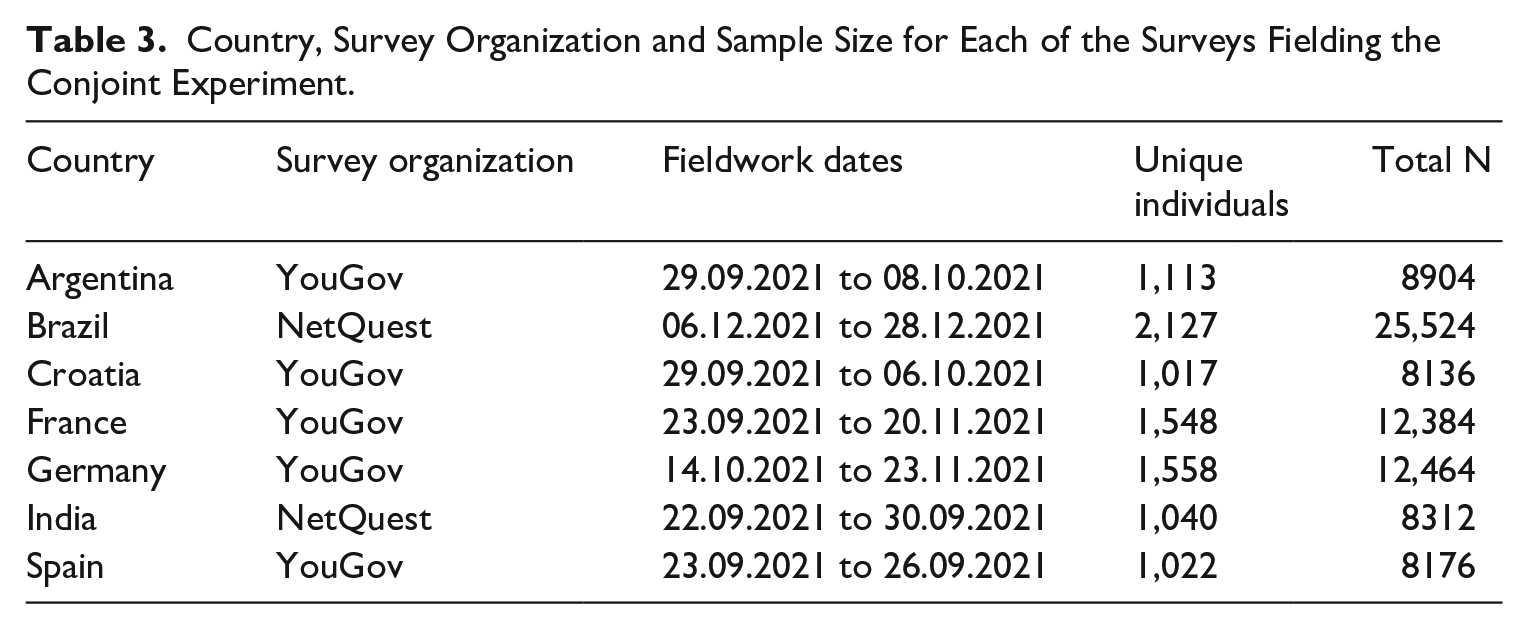
Table 3 presents the overall sample size and the number of observations included in the conjoint analysis (each comparison a respondent makes comprises two observations in the dataset, and respondents made six comparisons in Brazil and four in the other countries) by country. In our analysis, we weight observations so that each country has the same impact on the overall results regardless of these differences in sample sizes.
Country, Survey Organization and Sample Size for Each of the Surveys Fielding the Conjoint Experiment.
As part of further exploratory analyses, we explore differences in results between countries, in particular whether authenticity has a stronger effect in some (e.g. more affluent) countries in our sample than in others. In Online Appendix A, we report robustness checks (including checking for potential carry-over effects, profile effects and attribute order effects) and results by other subgroups: respondents’ gender, age, education (completed university or not), income (in three categories) and self-reported left/right ideology (on a scale from 1 to 10, except in Brazil where it ranged from 0 to 10).
Results
We begin our analysis by presenting the MMs for the effects of each level of each attribute on the likelihood of respondents trusting the (hypothetical) politician. Figure 1 shows that most attributes play statistically significant roles in respondents’ trust judgements (p < 0.05), although their substantive sizes may be more informative since these are based on a total of 83,900 comparisons (observations) made by 9425 respondents, resulting in a high degree of statistical power.
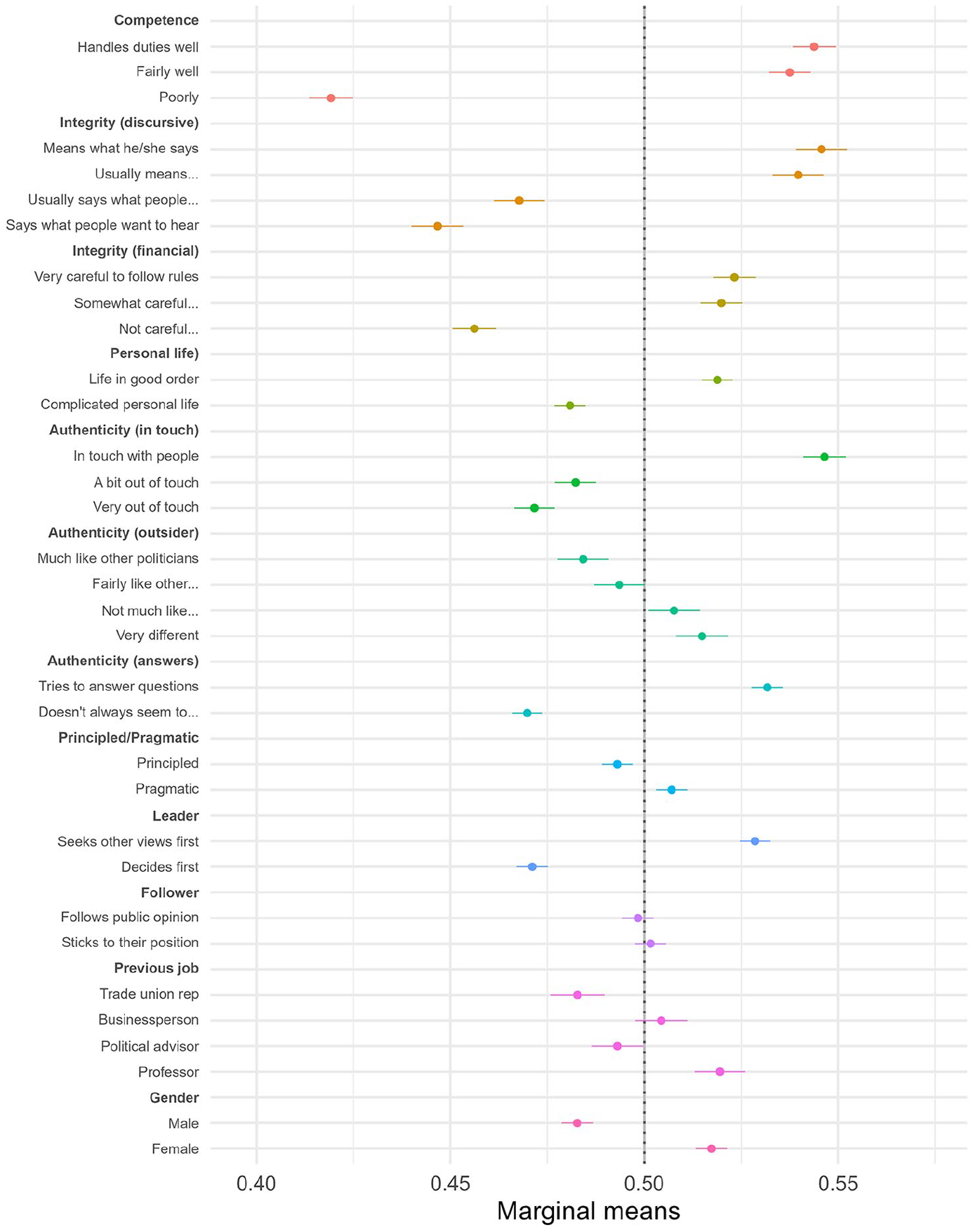
Marginal Means for the Choice of Politicians (in Terms of ‘Trusting’ Them) by Attribute Levels.
Perhaps unsurprisingly, the strongest effect of all is for politicians who are said to have ‘a reputation for handling their duties poorly’: other things (attribute levels) equal, only about 42% of respondents chose politicians with that attribute level, whereas about 54% chose politicians described as more competent; the difference in AMCEs (directly translatable to and from MMs) between these groups is about 12 percentage points (95% confidence interval (CI): 11.3–13.3). We next turn to the importance of the integrity attributes, where a lack of both discursive and financial integrity carries a 5 percentage points (p.p.) penalty for perceived trustworthiness, but having strong discursive integrity has a stronger positive effect than financial integrity; the AMCE between the highest and lowest levels of discursive integrity is 9 p.p. (95% CI: 8.2–10.3) but 6.9 p.p. for financial integrity (95% CI: 5.9–7.8).
However, on par with these traditional pillars of leader attributes is the first attribute intended to measure authenticity: politicians who seem in touch with everyday life and ordinary people are trusted as much as those who mean what they say and handle their duties well. This is as important as any attribute level except incompetence, providing support for our first hypothesis (the AMCE difference between the highest and lowest levels of this attribute is 7.6 percentage points, 95% CI: 6.7–8.5). Notably, not all of our measures of authenticity matter equally. The effects of coming across as being ‘very different from other politicians’ are significant but perhaps smaller than we might have expected (about a 3 p.p. AMCE difference), whereas ‘answering questions directly’ has a larger effect (about 6.2 p.p. AMCE difference). Of course, in all cases, we cannot say for certain to what extent these particular attributes tap into the underlying constructs of competence, integrity and authenticity and to what extent they might tap into other considerations, meaning that comparing effect sizes between different attributes and inferring to a comparison of the underlying constructs should be done with care.
Other attributes have weaker but still statistically significant effects. These are less relevant to the theoretical framework in this study, but it is interesting to note that descriptions of the politicians’ ‘personal life’ do have a significant effect and that respondents tend to trust leaders who seek views before coming to a decision, compared to those who do the reverse. However, pragmatic politicians are only marginally preferred to principled ones, and whether they change their position in the face of significant public opposition or stick to it appears to have no effect on the whole, whereas respondents overall trust (hypothetical) female politicians over male ones and appear to trust university professors but distrust trade union representatives.
To test our second and third hypotheses, we start with a categorical comparison of MMs across groups of respondents defined by their levels of political support (H2) and support for strong leaders (H3), before turning to a more systematic comparison of attribute effects by respondent characteristics. As shown in Figure 2, respondents low in political trust are slightly more likely to express trust in politicians who are ‘in touch with people’, and less prone to trust ‘very out of touch’ politicians. Since comparing confidence interval is not a formal test of difference between these coefficients (which are from separate models, one for each sub-sample of respondents), we confirm this with linear regression analysis on the whole sample, which shows a statistically significant (p < 0.05) interaction between the trust scale variable and prioritizing the first authenticity attribute. 8 For the second authenticity attribute, high trust respondents are fairly unconcerned about whether politicians are authentic ‘outsiders’, different to other politicians, while this has significant effects for low trusters (the interaction between the two is also significant in a regression model, at p < 0.01). There appear to be similar substantive differences on the third authenticity attribute (‘answering questions’), although these are not statistically significant at the 95% level in an interaction test (p = 0.06). Overall, H2 thus receives fairly strong support here. On the ‘discursive integrity’ attribute, there are also substantial and statistically significant (p < 0.001) differences; distrusters place more emphasis on whether politicians ‘mean what they say’ (as opposed to ‘saying what people want to hear’) than trusters do. Interestingly, the reverse is true for competence: those who have higher trust are more likely to prioritize this attribute (p < 0.001). In Online Appendix B, we present sub-group comparisons by each individual measure of political trust, which suggests that they are generally clearer for the measures of trust in parliament and political parties than for trust in government.
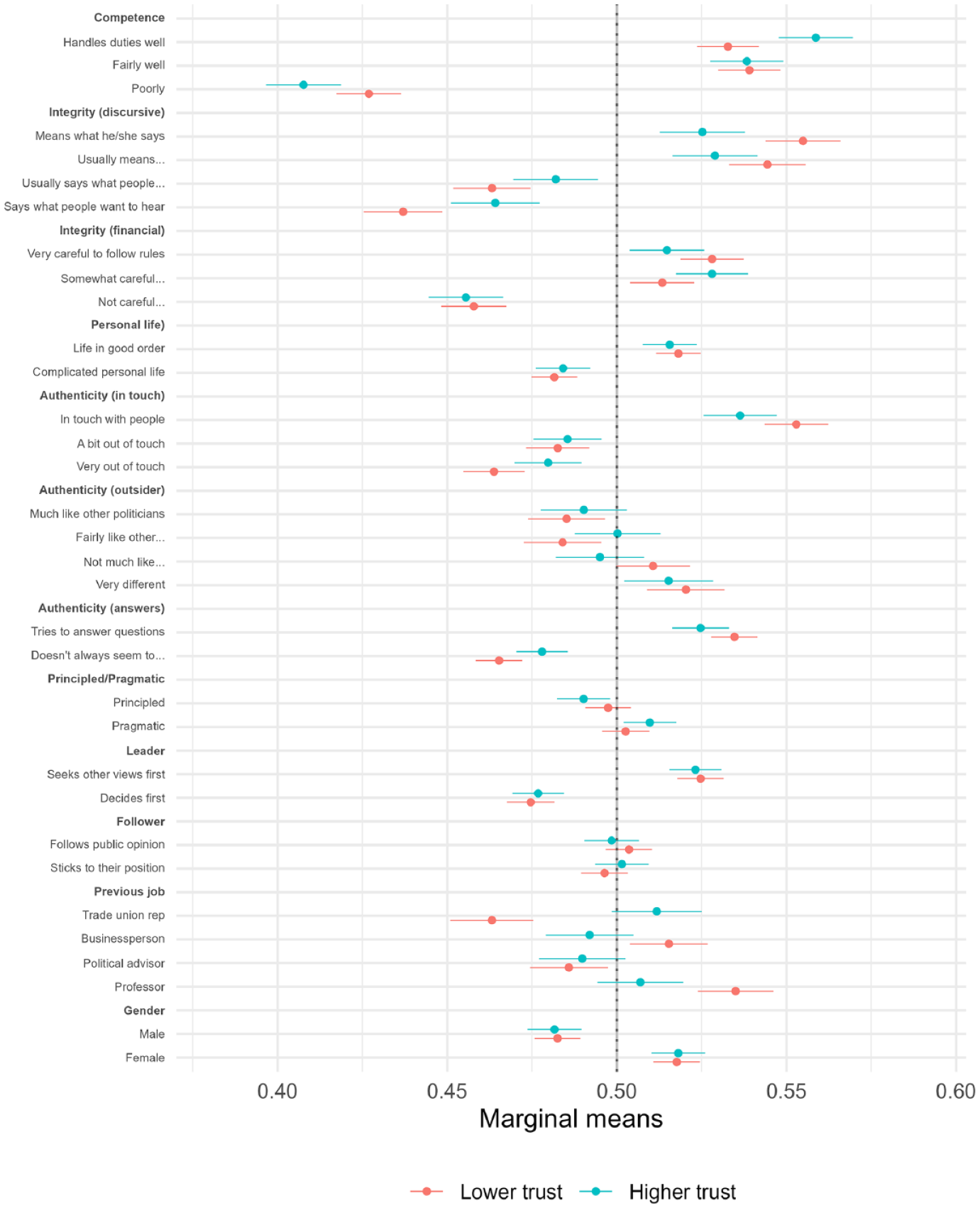
Marginal Means for the Choice of Politicians by Attribute Levels, High and Low Trusters.
By contrast, H3 receives no support here, with no statistical difference in the effects of authenticity between those who agreed and those who disagreed with a statement about democracy needing stronger leaders who are not restrained by politics or government. Support for strong leaders did, however, moderate the effects of ‘personal integrity’. As shown in Figure 3, those who favour strong leaders were less likely to trust politicians with a ‘complicated personal life’.
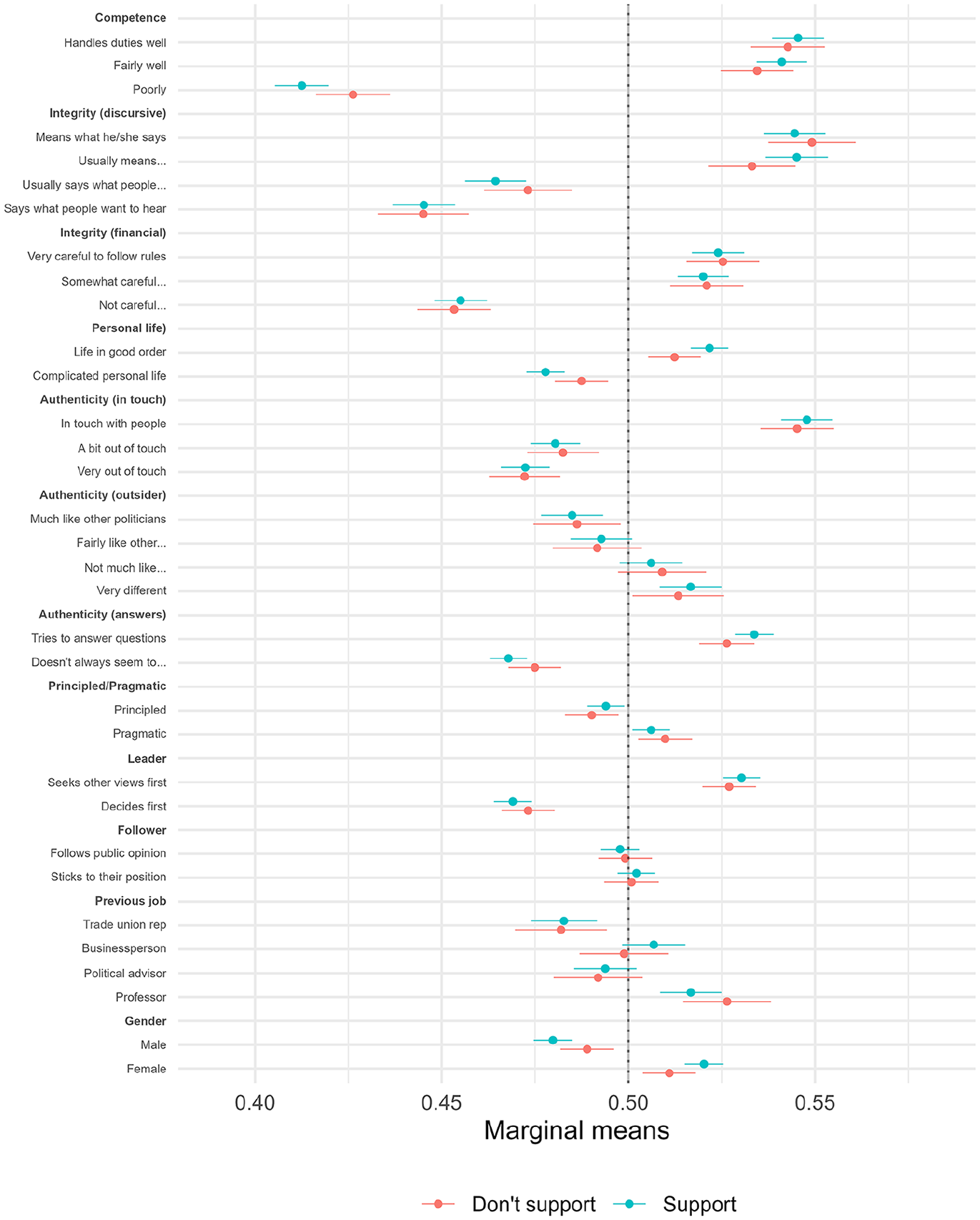
Marginal Means for the Choice of Politicians by Attribute Levels, by Support for Strong Leaders.
For a more systematic overview of these sub-group differences, we run multiple separate regression models where each respondents’ trust choice is the dependent variable and the independent variables are each politician attribute (except for previous occupation, which we recode into dummy variables) transformed into a scalar variable ranging from 0 to 1, where the attribute value indicating the ‘least’ extent of that attribute (e.g. ‘has a reputation for handling their duties poorly’) takes the value 0, the value at the other end (e.g. ‘has a reputation for handling their duties well’) takes the value 1 and the other attributes levels are evenly spaced in that range. 9 We first run a baseline model including all attributes (presented in the first column of Table 4) and then separately add an interaction term for each attribute interacted with each of the respondent characteristics that we include in this study: their political trust (again using the factor variable created from three items), support for a ‘strong leader’, gender, age, income (in three categories), education (whether they have completed university) and left-right ideology. All these variables are also standardized to range from 0 to 1 so that we can compare the coefficient sizes across characteristics as well as attributes. Note that each of these interaction terms comes from a separate regression model, as those in the same column: our intention is to explore whether some attributes matter more or less for respondents with certain characteristics per se, so we do not want to control for the potential importance of related attributes to respondents with those same characteristics. Table 4 presents the results from these separate regression models.
Total Effects of Different Attributes on Trust Choice in Conjoint Survey Experiments: Main Effects and Interactions With Respondent Characteristics.
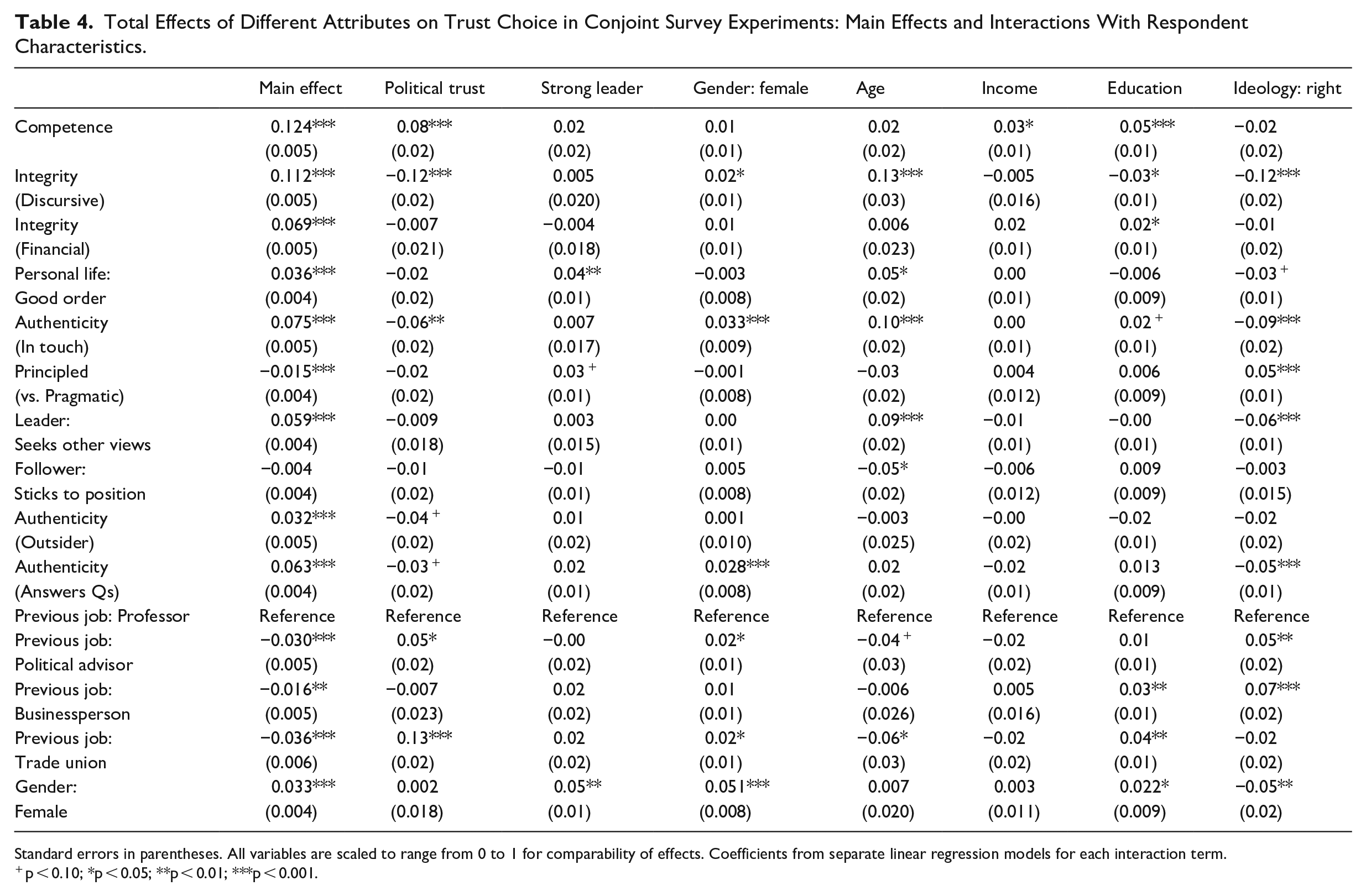
Standard errors in parentheses. All variables are scaled to range from 0 to 1 for comparability of effects. Coefficients from separate linear regression models for each interaction term.
p < 0.10; *p < 0.05; **p < 0.01; ***p < 0.001.
The results generally confirm that our authenticity attributes matter more for respondents with lower levels of generalized political trust, but we do not find the same for respondents who support stronger leaders. Interestingly, we see that low trusters are also less prone to trust trade union representatives and political advisers (arguably groups that are associated with traditional politics) as compared with university professors. Many other interesting patterns are revealed: politicians meaning what they say, being in touch with ordinary people and answering questions directly all have a stronger effect on the trust of female respondents than male respondents; the former two and sticking to their decision (as opposed to following public opinion) matter more to older respondents; competence matters more to respondents with higher trust, higher income and university education (which may perhaps create a feedback loop where those respondents choose politicians who more competently serve their interests, further increasing their trust). Competence and financial integrity also matter more to respondents with university education than those without it, and the priorities of right-wing respondents differ from left-wing respondents in many ways – with discursive integrity, two authenticity attributes (being in touch and answering questions), pragmatism and seeking other views (instead of deciding first) mattering more to left-wing.
The results presented in Table 4 also allow us to explore to what extent our attributes tap into the constructs that they are intended to measure: we would expect attributes that are intended to measure similar qualities to be related to respondent characteristics in similar ways. In this respect, we see that the three authenticity attributes and the discursive integrity attribute (which, as we discussed above, has close connotations with the concept of authenticity in most of the literature) all appear to matter more for respondents with lower levels of trust (although some only at the 90% confidence level) and three of those four also matter more for female respondents and for left-wing respondents. Nevertheless, there are also some inconsistencies: politicians coming across as ‘very different from other politicians’, our other main measure of authenticity, only has a significantly different effect for the first of these groups and being ‘in touch’ matters more for older and more educated respondents whereas the other attributes do not. Thus, our three authenticity (and discursive integrity) measures appear to be related, but the ‘in touch’ attribute may also be tapping into other considerations.
In addition to our core analysis, we exploit our diverse cross-national sample to conduct exploratory analysis into country variations in the role of authenticity. It would be reasonable to expect attributes to have different effects across countries. More specific to authenticity, we have suggested that demands for that quality in politicians may be elevated in more affluent countries that also tend to be higher in post-material, expressive values. Figure 4 plots the effects by country for our main attributes of interest: competence, integrity and authenticity (a version of the figure with all attributes is presented in Online Appendix B). In relation to authenticity, the clearest evidence emerges for the ‘in touch’ attribute. The positive effect of being ‘in touch’ on trusting politicians and the negative effect of being ‘very out of touch’ are significantly larger in the two most affluent countries in our sample – Germany and France – compared to the other countries, although they remain significant elsewhere. Less clear patterns were found for the ‘outsider’ and ‘answers questions’ attributes, however, and for most other attributes which seem to have remarkably consistent effects across countries. The only clear exceptions are that competence appears to matter more, and other attributes less, in India than in other countries, whereas personal integrity matters more in Brazil than in other countries. Finally, in Online Appendix B, we conduct robustness checks for potential differences by attribute order, carry-over effects, and profile effects: none of these change any of the inferences drawn here.
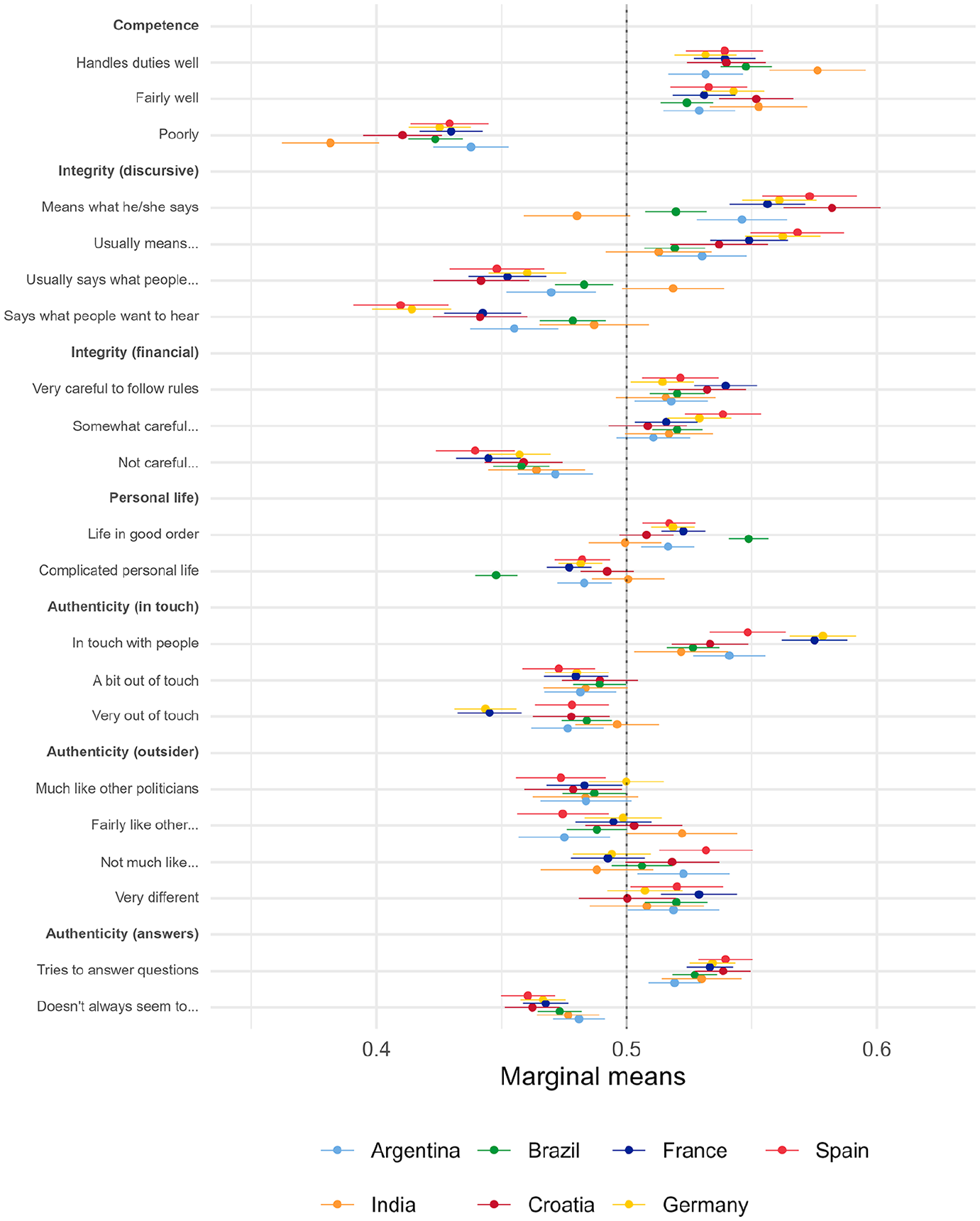
Marginal Means for the Choice of Politicians by Attribute Levels, by Country.
Conclusion
Political scientists have long been concerned with what it is about politicians that inspires or depresses citizens’ trust in them. Despite this, existing knowledge of what qualities make politicians seem trustworthy has thus far been almost exclusively observational, and largely based on theoretical insights devised many decades ago (Garzia, 2011; Kinder et al., 1980; Miller et al., 1986). In this study, we have argued that while more traditional perceptions of politicians’ ability (competence) and willingness (integrity) to serve the public interest are important, other attributes should be brought into focus as well. In particular, we advocate a focus on political authenticity, which in our conception is about coming across as an ordinary person rather than a typical politician, referring to citizens’ apparently growing expectations that politicians appear more ‘human’ and less ‘scripted’ (Clarke et al., 2018).
In this study, we have provided causal evidence to bear on this question by fielding conjoint survey experiments in seven democracies across three continents. Our findings suggest that authenticity should be considered a major determinant of citizens’ trust in politicians, alongside the more conventional attributes of competence and integrity. When politicians were described as seeming ‘in touch with everyday life and ordinary people like yourself’, this increased the likelihood of respondents trusting them about as much as any other attribute that we explored, trumped only by the negative effects of ‘handling their duties poorly’. The trust advantage – that is the difference in AMCEs for our outcome of trust choice – of hypothetical politicians being described as most out of touch and most in touch was 7.6 percentage points, compared with 12 p.p. for whether they had a reputation for handling their duties well or poorly, 9 p.p. for ‘meaning what they say’ instead of ‘saying what people want to hear’ and 6 p.p. for being ‘very careful’ (as opposed to not careful) to follow financial rules. Our two other authenticity attributes also had significant effects: those described as ‘usually trying to answer questions directly when asked’ had a 6.2 p.p. advantage over those who didn’t ‘always seem to’ and those who ‘come across as very different from other politicians’ had a 3 p.p. advantage over those who came across as ‘much like other politicians’.
In line with observational findings from previous studies (Valgarðsson et al., 2021), our findings also suggest that citizens with lower levels of generalized political trust prioritized all of these authenticity attributes significantly more than the more trusting, while the latter tend to prioritize competence more. However, contrary to our expectations, we found no differences between respondents who supported or opposed a statement about democracy needing stronger leaders, perhaps suggesting that populist leaders are not the only ones who might inspire citizens’ trust by exhibiting more authentic qualities. In addition, we found that lower levels of political trust also prioritized ‘meaning what they say’ (discursive integrity) significantly more, and female and left-wing respondents were also significantly more likely to prioritize most of these attributes.
These findings come with important caveats, since we cannot be sure of which underlying constructs our measures are in fact tapping into. Perhaps most importantly, seeming ‘in touch’ with ordinary people may well carry connotations not only of the politicians being ordinary themselves but also of understanding, benevolence and/or symbolic representation (see, e.g. Bailer et al., 2022; Saward, 2010), and these connotations are likely to explain at least part of the strong effects uncovered here. Similarly, our other core measure of authenticity (coming across as different from other politicians) had a weaker effect, and distrusters were the only group significantly more likely to prioritize it. Nevertheless, our third measure (answering questions directly, which in our conception is a signal rather than a defining feature of authenticity) also had strong effects and was prioritized by the same groups as the first authenticity measure, indicating that at least those two are tapping into similar expectations. Similarly, had we included measures of other expectations such as representation, benevolence (Grimmelikhuijsen and Knies, 2017) or warmth (Laustsen and Bor, 2017), these may well have had important effects and perhaps soaked up some of the effects of our measures of authenticity.
Future research would do well to unpack those potential overlaps between related constructs and different measures of those constructs, determining more systematically and comprehensively which features are most important for perceived trustworthiness. In this study, we have advanced that endeavour with a focus on authenticity, demonstrating that at least our three measures of that concept all matter for people’s trust in politicians, and they matter more for those with lower levels of political trust. Future studies could also work to ensure the external validity of these findings, for example by running similar experiments in other countries, including politicians’ partisanship or policy views, presenting more comprehensive accounts of real-world or hypothetical politicians, and including other measures of authenticity as well as benevolence, warmth, representation and/or other potentially important qualities. Finally, further research could more directly address the conceptual-measurement debate by directly asking respondents to what extent these attributes – or hypothetical politicians with those features – reflect authenticity and to what extent they reflect other expectations.
Regardless of these caveats, our findings do suggest that authenticity plays an important role in citizens’ perceptions of politicians’ trustworthiness in diverse cultural and economic contexts. At the very least, the quality of seeming ‘in touch with ordinary people and everyday life’ and its importance for people’s trust in politicians should be studied further; what exactly it means, why people with lower trust prioritize it more, and how politicians might be able to meet those expectations and potentially rebuild trust in politics. As such, our findings can help explain why citizens trust some politicians and not others, and shed light on how politicians might inspire more trust, in a supposed ‘age of distrust’ in politics (Dalton, 2004; Foa et al., 2020; Rosanvallon, 2008). For instance, politicians could make a more concerted effort to understand ordinary people and everyday life in their community, to listen to their concerns and realities and reflect these more in their rhetoric and behaviour. They might also consider whether they come across as ‘typical politicians’, such as by not answering questions directly and coming across as scripted and stage-managed, and come to understand that such manoeuvres that may seem like the best political strategy might come at the cost of eroding the public’s trust in them – and perhaps in politics in general. In some cases, authenticity perceptions might be cultivated simply by abandoning strategic performances, while in others, it may require adopting a performance of ordinariness. Of course, calculated performances of authenticity sound somewhat paradoxical, since the point of authenticity is that politicians come across as simply being themselves, not just behaving strategically to reach political aims, but what appears to matter is the perception that they are more like ordinary people and less like scripted politicians, answering questions directly and saying what they mean instead of what is politically expedient. More broadly, it appears that increased authenticity in politics might be one important aspect of the ongoing effort (see, e.g. OECD, 2022) to rebuild political trust in modern democracies. This is compounded by our finding that citizens with lower levels of generalized political trust value authenticity even more than others: authenticity might be especially important in reaching out to them.
Supplemental Material
sj-docx-1-psx-10.1177_00323217241261180 – Supplemental material for The Good Politician: Competence, Integrity and Authenticity in Seven Democracies
Supplemental material, sj-docx-1-psx-10.1177_00323217241261180 for The Good Politician: Competence, Integrity and Authenticity in Seven Democracies by Viktor Valgarðsson, Will Jennings, Gerry Stoker, Lawrence McKay, Daniel Devine and Nick Clarke in Political Studies
Footnotes
Declaration of conflicting interests
The author(s) declared no potential conflicts of interest with respect to the research, authorship and/or publication of this article.
Funding
The author(s) disclosed receipt of the following financial support for the research, authorship and/or publication of this article: Research Funding support was provided by ESRC research award ES/S009809/1 and by an Early Career Fellowship provided by the Leverhulme Trust (grant no: ECF-2022-795).

Supplemental Material
Additional Supplementary Information may be found in the online version of this article.
Appendix A – Robustness checks Figure A1. Effects of attributes by whether the chosen politician was in profile A or profile B Figure A2. Effects of attributes by the iteration number of the choice (whether it was the first, second, third or fourth comparison that respondents made in the survey) – Excluding Brazil (see below) Figure A3. Effects of attributes by the iteration number of the choice in Brazil – where there were six iterations Figure A4. Effects of attributes by the order that the attributes appeared in the profiles (which was randomized in all countries except India) – results for profiles where the Competence, Discursive Integrity and Authenticity I attribute appear first Appendix B – Subgroup analysis Figures B1-B3. Effects of attributes over three different trust measures (collapsed for main analysis in the article) Figure B4. Full results by country Figure B5. Effects of attributes for male and female respondents Figure B6. Effects of attributes by age group of respondents Figure B7. Effects of attributes by respondents’ education level Figure B8. Effects of attributes by respondents’ income level Figure B9. Effects of attributes by respondents’ self-reported left/right ideology Appendix C – Survey questionnaire Appendix D – Presentation of conjoint choice in surveys: an example from YouGov survey in the United Kingdom
Notes
Author Biographies
References
Supplementary Material
Please find the following supplemental material available below.
For Open Access articles published under a Creative Commons License, all supplemental material carries the same license as the article it is associated with.
For non-Open Access articles published, all supplemental material carries a non-exclusive license, and permission requests for re-use of supplemental material or any part of supplemental material shall be sent directly to the copyright owner as specified in the copyright notice associated with the article.
