




Abstract
Weber and Habermas have inspired many academic studies. However, the ideas of those two thinkers have not previously been brought together in an international deliberative context. This article allows the ideas of Weber to meet and interact with those of Habermas while studying deliberative quality at an international level. The study is applied to the International Maritime Organisation’s deliberations. Through the content analysis of 1175 speeches, the article arrives at significant results demonstrating the importance of bureaucratic quality for the deliberative performance of the International Maritime Organisation’s member states. The speeches are coded using an amended version of the discourse quality index coding scheme. An amended version of the discourse quality index is developed to make it more useful for an international institutional context. Following the coding process, the quantitative analysis and interview findings demonstrate that meritocratic recruitment and permanent representation both matter for the deliberative performance of the International Maritime Organisation’s member states.
Keywords
Introduction
International organisations (IOs) are known to be the main forum where states gather to deliberate on international issues and take decisions. Within the International Relations (IR) literature, some studies have highlighted the importance of deliberation and the benefits it could bring to international decision-making (Beste, 2013; Carpini et al., 2004; Milewicz and Goodin, 2018; Steffek, 2003). The interest in deliberation particularly grew as the IR discipline experienced a ‘deliberative turn’ (Chambers, 2003: 313). Indeed, starting from the 1990s, a new approach to international cooperation was born that emphasised the important role of communicative interactions for understanding international diplomacy (Holzscheiter, 2014: 146). Consequently, a number of deliberative democratic theorists adjusted their focus from the national to the international level (Chambers, 2003: 313). Earliest attempts at applying the deliberative democratic framework to IR have been presented in the works of Risse (2000), Müller (2001), Lose (2001) and Dryzek (2006).
With the growing need to evaluate the ‘level’ of deliberation or the extent to which it varies, politics research entered the terrain of ‘deliberative quality’ with the works of Steiner et al. (2004) being the seminal work that measures deliberative quality in a parliamentary context and introduces an instrument for doing so: the discourse quality index (DQI). Deliberative quality here is understood as the extent to which a speech act meets the deliberative requirements envisioned by Jürgen Habermas in his philosophical deliberative model (Steiner et al., 2004: 5). A number of studies have thereafter analysed deliberative quality in different contexts (e.g. Himmelroos, 2017; Kuhar and Petrovčič, 2017; Pedrini, 2014; Ugarriza and Nussio, 2016). However, at the international level, hardly any studies have done so; only Lord and Tamvaki (2013) have studied deliberative quality at the European Union (EU), but no other studies have gone beyond that. Indeed, beyond the EU level, no studies exist that have aimed at identifying the determinants of variation in deliberative quality at an international level. This is problematic as it is important to know which features are conducive to higher quality deliberations at an IO level given the importance of deliberation for enhancing the legitimacy and quality of decisions taken internationally (Milewicz and Goodin, 2018; Steffek, 2003). Thus, a wide and a significant gap clearly exists in the literature which is what this study aims to fill.
Moreover, it remains unknown what are the determinants of deliberative quality between state delegates within IOs. In other words, what is it that makes one state delegation a better deliberator than another one? Answering this question is significant since ‘state’ features have not previously been recognised in the literature as potential determinants for deliberative quality despite the centrality of the ‘state’ in intergovernmental organisations. Scholars of IR would find the engagement with this issue important especially when deliberation holds great potential for improving global governance and enhancing the decision-making process as state delegates arrive at carefully deliberated solutions.
At the same time, within the context of international deliberations, a large gap exists in studying the effect of Weberian bureaucracy on deliberative quality. The consequences of Weberian bureaucracy have not previously been analysed at the international level, despite the existence of lively debates on its consequences at the national level. Indeed, at the national level, some studies have focussed on its effect on issues, such as economic growth, poverty reduction, corruption prevention, attitudes of civil servants and national governance in areas, such as climate (Evans and Rauch, 1999; Henderson et al., 2007; Schuster et al., 2020; Suzuki and Hur, 2020). However, at the international institutional level, Weberian bureaucracy has been neglected. This article fills in this gap and is the first to consider national bureaucratic performance as a factor that can influence deliberative quality within international institutions. If it does, it would mean that the influence of a state’s bureaucratic organisation is not confined to national borders.
Two characteristic features of Weberian bureaucracy are the focus of this article; meritocratic recruitment and permanence of representation. The expected effects that meritocratic recruitment and permanence of office will have on deliberative performance are positive. Starting with meritocratic recruitment, which essentially means employing workers based on their ‘technical qualifications’ (Weber, 1947: 333) and skills rather than connections or ‘luck’ (Suzuki and Hur, 2021: 2), this principle is expected to be associated with higher deliberative quality. This is mainly because employees recruited based on skills are expected to be more competent in participating in international discussions compared with employees employed based on things, such as personal or political connections. Indeed, the fact that such employees have been appointed based on their technical competence means that they will likely be better able to participate in the international discussions that also require technical competence for making high-quality interventions in the debates. Significantly, two existing studies include hints that the quality of delegation may impact their participation in international deliberations 1 (Deitelhoff, 2009; Oyejide, 2000). As such, having a skilled and technically competent bureaucracy is expected to result in higher deliberative quality internationally.
As for permanence of representation, a principle based on Weber’s (1947: 334; Evans and Rauch, 1999: 751–752) emphasis on the durability of bureaucratic positions which constitute a ‘career’, this principle is also expected to be associated with higher deliberative quality, owing to the expertise and specialisation gained with having permanent presence within IOs. Having a permanent representative stationed at the headquarters of an IOs means that that this representative will likely be more informed about how this organisation works in practice and will therefore be better positioned to comment on the different agenda items during its international deliberations. The permanence of position also reflects how a given bureaucracy is ‘merit’-driven rather than politics-driven where the former is characterised by permanently employing suitable staff and leaving them long enough to perform their job tasks, rather than moving them around frequently depending on things, such as their political affiliation (Cooper, 2020: 313). Having expert-driven bureaucracies will thus likely be associated with stronger deliberative quality compared with politics-driven bureaucracies, given the expertise and experience that will likely be reflected in the speeches of an employee coming from the former, compared with the latter.
The two features of meritocratic recruitment and permanence of representation serve as the independent variables in this study’s analysis. The effects of Weberian bureaucracy are studied here from an international deliberative perspective, with the deliberative performance of several member states in a prominent IO, the International Maritime Organisation (IMO), serving as the dependent variable in this study. The IMO is the United Nation’s specialised agency regulating international shipping. Significantly, international shipping is responsible for the transportation of 90% of world trade (International Chamber of Shipping, 2019). The IMO is therefore a pivotal IO whose work is vital for the international economy and for simply enabling humankind to engage in world trade.
The deliberative performance of the member states is captured from the coding of 1175 speeches using an amended version of the DQI coding scheme, whose original version was first developed by Steiner et al. (2004) and was theoretically based on Habermas’ (1984, 1987, 1990) deliberative theoretical framework. In addition to the quantitative analysis, the paper also makes use of interview findings with member state and non-governmental organisation (NGO) delegates at the IMO where they also discuss those two Weberian features in relation to the IMO deliberations. 2 With the focus on the interaction between bureaucratic performance and deliberative performance, this article essentially enables the ideas of Max Weber to meet and interact with those of Jürgen Habermas in an international deliberative context.
Through enabling the interaction of two theoretical bodies, the paper fills in the above-mentioned gaps in the IR and IO literatures and makes significant contributions to them. Filling in those gaps would complement existing studies on international bureaucracies, that take the form of studying the effects of international secretariats operating within IOs (Hensell, 2016; Kanninen and Piiparinen, 2014; Liese et al., 2021). It would also complement existing studies on the national effects of Weberian bureaucracy by highlighting the far-reaching effects of this mode of organisation at the inter-state level. Moreover, studying the interaction between national bureaucratic features and deliberative quality at the international level would have significant policy implications for the member states participating in the deliberations of IOs. Indeed, in the case that bureaucratic quality is consequential for how well a state deliberates in IOs, member states would find it wise to strengthen their bureaucracies, so that, they are able to play an active role in the international decision-making process that is largely shaped by their deliberative interactions.
The article is structured as follows: the ‘Theories and Hypotheses’ section starts by outlining the theoretical backgrounds relating to Habermas’ theory of communicative action (TCA) and Weber’s theoretical ideas on bureaucracy before presenting and explaining the two hypotheses guiding this study. The ‘The DQI and Its Amended Version’ section then focusses on the DQI. It starts by discussing the strengths and weaknesses of the original DQI and then explains the coding process of the speeches using the amended version of the DQI. The ‘Methodology’ section provides more detail on the methodology of this study. The section shows how the codes were combined to measure deliberative quality, and then moves to stating the variables used in the regression analyses for testing the hypotheses. The ‘Statistical Results’ section then presents the regression results, while the ‘Discussion of Results’ section discusses them. The interview findings with the IMO delegates are then presented in the ‘From the Voices of the Delegates’ section. Significantly, the results demonstrate that meritocracy and permanent presence matter for deliberative quality. In short, having good offices functioning well within a state, as well as having permanent representation outside a state (at IOs) enables such a state to have a better deliberative performance than those states compromising such features.
Theories and Hypotheses
Habermas and the TCA
Jürgen Habermas’ TCA serves as the foundation for much of the theorising on deliberative interactions. At the heart of Habermas’ (1984: 18) theory is the act of argumentation where participants contest validity claims and aim to arrive at sound and convincing arguments. All this argumentation should take place within a shared background among the participants, in what he calls the common ‘lifeworld’. Habermas (1987: 131) puts special emphasis on this concept as he explains that it ‘forms the indirect context of what is said, discussed and addressed in a situation’.
The strength of Habermas’ TCA is that it carefully provides the preliminary conditions enabling the realisation of rational discourse among participants. He describes them as conditions for achieving the ‘ideal speech situation’ and they include: ‘freedom of access, equal right to participate, truthfulness on the part of the participants [and] absence of coercion in taking positions’ (Habermas, 1993: 56). Moreover, the participants would have to show respect for their counterparts and adopt this respectful attitude prior to and during the communications (Habermas, 1993: 66–67).
Participation is a central condition in the ‘ideal speech situation’. Habermas (1990: 89) clarifies that the potential participants in a deliberative discussion should be ‘all subjects without exception who have the capacity to participate’. More importantly, it is not enough that participants be physically present in a meeting. In fact, they should have equal opportunities to participate, enshrined in a rule that ‘guarantees all participants’ the chance to contribute to argumentation and put forth an argument (Habermas, 1990: 89).
Furthermore, Habermas (1990: 88–89) strongly stresses that communication should rule out both internal and external coercion, for the only force that is allowed is ‘the force of the better argument’. Indeed, he emphasises that a valid agreement is the one that is not imposed or brought about through the manipulation of the participants using external pressure. In short, the agreement needs to arise through the ‘generation of convictions’, which can be empirically analysed through the affirmative positions taken by the participants (Habermas, 1990: 134).
Thus, after reviewing Habermas’ theory, it is clear that he offers a clear and attractive account of how different actors united by a desire to take a decision on an issue can arrive at positive results; free from the use of power and manipulation. It is specifically those ideas that have provided the greatest inspiration for many deliberative theorists who then engaged with Habermas’ ideas while adding their own analysis of deliberative interactions (Fishkin, 1991: 37–38; Gutmann and Thompson, 2004: 3–5; Steenbergen et al., 2003: 21; Thompson, 2008: 501–504). The DQI (discussed in the ‘The DQI and Its Amended Version’ section) has also been designed based on Habermas’ TCA, with its indicators following on from Habermas’ theory.
Weber’s Bureaucracy
Moving to Weber’s (1947: 333) thought, here the German thinker theorises that staff within a bureaucracy should be organised according to certain criteria, such as being ‘organized in a clearly defined hierarchy of offices’ and being ‘personally free and subject to authority only with respect to their impersonal official obligations’. The importance of meritocratic recruitment becomes clear when Weber (1947: 333) writes that ‘candidates are selected on the basis of technical qualifications’ that are made evident through ‘examination’ or ‘diplomas certifying technical training, or both’. Thus, the importance of having technically competent staff, whose competence for the position is shown through their skills and qualifications, is a key feature of Weber’s theorisation on the structure of a bureaucracy.
The idea that the employment should be made on a permanent basis, rather than a short-term or a temporary one is made evident twice in Weber’s writing; first, when Weber discusses termination of employments and second, when he talks about promotion. With regards to the former, Weber (1947: 333–334) writes that ‘only under certain circumstances does the employing authority [. . .] have a right to terminate the appointment, but the official is always free to resign’. As for the latter, Weber (1947: 334) writes that office of the appointed staff member ‘constitutes a career’ and progressing through this career via promotion is conditional upon ‘seniority’ or ‘achievement, or both’. Thus, when both criterions are taken into account, it becomes clear that Weber promotes stability in employment and ultimately permanent employment. The centrality of meritocracy and permanence of employment in Weber’s theorising has been identified in some studies that have emphasised the importance of those principles in their analysis (Evans and Rauch, 1999; Suzuki and Hur, 2021: 879). For example, Evans and Rauch’s (1999: 751) well-known study focusses on ‘meritocratic recruitment’ and ‘a predictable career ladder’ when analysing the effect of Weberian bureaucracy on economic growth.
In addition to the above, Weber’s (1947: 333–334) bureaucracy encompasses other principles, such as having office ‘treated as the sole, or at least the primary, occupation of the incumbent’ and having it also ‘filled by a free contractual relationship’. Together, Weber’s principles ultimately depict the bureaucratic structure as a machine, with each individual within this machine acting as a cog inside it and having a specific function (Hensell, 2016: 1489). According to Weber, this model of organisation is highly recommended given the benefits it would bring with its implementation. Indeed, as Kanninen and Piiparinen (2014: 48) explain: According to Weber, the adoption of the bureaucratic form of administration is a rational choice on the part of policy-makers because of its efficiency and superiority in comparison to alternative forms of administration. Bureaucracies are superior in precision, reliability, stability, efficiency, the stringency of discipline, application to all kinds of administrative tasks and access to specialised and technical knowledge.
Thus, like Habermas, Weber offers very interesting theoretical ideas constituted of certain criteria that if implemented, they have the potential to bring significant benefits. The benefits in the case of the former would involve improving deliberative interactions and generating successful agreements, while in the case of the latter, they would mean improved bureaucratic output and efficiency. Now, the two theoretical schools have been discussed, it is logical to ask: when countries interact internationally, how does the variation in their bureaucratic quality translate internationally into their deliberations?
Two Hypotheses
To identify whether the quality of a state’s bureaucracy determines its deliberative performance in international meetings, this study tests two hypotheses suggesting that there exists a relationship between bureaucratic quality and deliberative quality. The idea behind the propositions is that countries with a stronger, more skilled bureaucracy are likely to be better deliberators than states with weaker bureaucracies. ‘Better deliberators’ means here that they will be able to provide better justifications and engage actively in the discussions as envisioned in Habermas’ TCA. The DQI, and particularly the amended version used in this study, is composed of two justification indicators, a reciprocity indicator (encompassing respect) and other indicators that are in line with Habermas’ TCA and suitable for an IO context. The argument this paper makes is that a country with a strong bureaucracy is likely to have competent civil servants that support their delegations abroad. Their competence would be reflected in the justifications they provide for their proposals, the respectful references they make to other participants in the meetings, and the deliberative behaviour 3 they exhibit through, for example, the proposals and documents they submit.
Significantly, the results from this hypothesis would complement existing studies on ‘international’ bureaucratic power, such as Liese et al.’s (2021) research on the expert authority of international bureaucracies (IOs’ secretariats) and the variation in the recognition of this authority among national ministries. The results would highlight whether one can also say that ‘national’ bureaucratic power is authoritative during deliberation, and thus a key determinant of deliberative quality. The findings relating to the quality of national bureaucracies will thus be particularly relevant for the literature drawing the link between public administration and IR (e.g. Busch et al., 2022; Busch and Liese, 2017; Ege and Bauer, 2013). This study will therefore hypothesise that:
Second, states having permanent representation at the IMO will likely be better deliberators than those with non-permanent missions. This is mainly because having permanent presence will increase the skills and knowledge of permanent representatives, which will likely make them better speakers than those who visit the IMO temporarily and are thus not as familiar with the way it works, its discussions or the other participants in the meeting. Indeed, a permanent representative will likely be more knowledgeable of the issues under discussion and have already developed a network composed of the frequent attendants from other delegations. As such, when the deliberations take place, permanent representatives will therefore be more able to justify their demands, reference the proposals of other participants and indicate instances of shifting their position when convinced. Thus, it will be hypothesised that:
The DQI and Its Amended Version
This study develops an amended version of the DQI to measure the deliberative quality of the member states’ speeches in the IMO. However, before explaining the components of the amended coding scheme, it is important to note the strengths and weaknesses of the original DQI developed by Steiner et al. (2004).
The Original DQI
The DQI is a quantitative coding scheme that belongs to the content analysis family of techniques for analysing deliberative discussions. It was designed by Steiner et al. (2004: 1, 5) to empirically measure ‘the quality of deliberation’ following Habermas’ deliberative model that has been inspirational for deliberative studies worldwide. In constructing the index, the authors explain how they ‘broke down the [Habermasian] model into its key elements, such as broad participation, justification of arguments, references to the common good, respect for the arguments of others, and willingness to change one’s preferences’ (Steiner et al., 2004: 5). It was those elements that were then taken to form the indicators constituting the DQI. Significantly, Steiner et al. (2004: 5) note the existence of disagreement between deliberative theorists with regards to ‘what exactly constitutes deliberation’. Indeed, one alternative approach is to define deliberative quality in terms of enhancing levels of intersubjective consistency in reasons (Niemeyer et al., 2024) or achieving epistemic or normative meta-consensus (Dryzek and Niemeyer, 2006). However, Steiner et al. (2004) clarify that their DQI and their approach to deliberative quality is consistent with Habermas’ deliberative ideas which remain influential for many deliberative studies and contemporary debates.
The rationale behind the design of the DQI is to capture the determinants and effects of deliberation through subsequent regression analyses. It is important to clarify that the DQI is only a measure of deliberative quality, and therefore, it is a tool that then enables researchers to use it in their analysis of the determinants or effects of deliberative quality. In this study, the focus is on its determinants in the context of inter-state discussions. The DQI takes speech as its unit of analysis and each sentence concerning a demand is then ‘coded for its discourse quality’ (Steiner et al., 2004: 55). Following the coding of a speech, the results from a number of indicators can be combined to form a scale that can then perform as an overall measure of discourse quality (Steiner et al., 2004: 60). One of the key characteristics of the DQI is that it was designed according to Habermas’ TCA and thus there is a strong theoretical-fit between the components of the Index and the theory of deliberative democracy. The DQI has five components for measuring deliberative quality: participation, level of justification (whether participants provide justifications for their demands), content of justification (whether the speaker includes the interest of other parties in their speech), respect, and constructive politics (measuring whether speakers are fixed to their position or provide alternative/mediating proposals) (Steiner et al., 2004: 56–61).
Strengths and Weaknesses
An initial glance at the DQI shows that it is quite an attractive coding scheme. It allows one to code all relevant components of a speech to capture its deliberative quality, while at the same time adopting a Habermasian theoretical framework. Significantly, the coding scheme can be used in different contexts and can be applied to analyse deliberation within a single debate or across many (Steenbergen et al., 2003: 44). It thus offers great flexibility in terms of its application. It is important to highlight here some key benefits as well as some potential drawbacks in using the DQI.
Starting with its strengths, the DQI manages to translate many of the theoretical foundations of the deliberation theory into a user-friendly empirical coding scheme. Although the ‘truthfulness’ aspect of the ideal speech situation is not captured, the DQI still manages to capture most of Habermas’ theoretical principles into an elegant coding scheme. Indeed, Habermas (2005: 389) himself praises the DQI when he writes: ‘I admire the inventive introduction of a Discourse Quality Index for capturing essential features of proper deliberation’. Thus, this confirms the fact that the DQI is strongly connected to the core of Habermas’ theory, serving as a ‘bridge between political theory and empirical scholarship’ (Himmelroos, 2017: 8; Steiner et al., 2004: 53).
Moreover, another benefit of the DQI is that it has become widely used among scholars who have sought to capture the deliberative quality of several national parliaments as well as the EU’s European Parliament (Bächtiger and Hangartner, 2010: 618–619; Kuhar and Petrovčič, 2017: 7–8; Lord and Tamvaki, 2013: 38–40; Pedrini, 2014: 272–3). Thus, the DQI has become the most utilised deliberative coding scheme, especially when compared with other coding schemes (Graham and Witschge, 2003; Holzinger, 2004; Stromer-Galley, 2007). Perhaps, some of the reasons that make the DQI such a favourite coding scheme among scholars are due to the relative simplicity of its coding categories and its high reliability scores that increase the confidence in its application (Steiner et al., 2004: 61–73).
Nonetheless, despite the above benefits, there are some limitations involved in using this coding scheme. On closer inspection, the DQI is more suited for measuring deliberation in parliamentary contexts rather than in international arenas. For example, the interruptions that are used as an indicator for equal rights in participation are more applicable within parliamentary chambers where MPs can interrupt a speaker to prove their point. Nonetheless, within IOs, this practice of interruptions rarely occurs since participation is highly structured where delegates speak in turns. Similarly, the respect indicators are more tailored to national parliaments rather than international institutions. Indeed, the chances of having disrespectful behaviour especially towards other participants are very small in most IOs. The IMO member-state delegations are composed of diplomats and maritime professionals who understand that they are representing their country and thus disrespectful behaviour is rare in their interactions. Thus, applying the DQI to an IO would require some revisions to remove its parliamentary focus.
Some blind spots in the DQI have also been noted by deliberative theorists, including DQI authors themselves. For example, Bächtiger et al. (2022: 85) rightly point out that interruptions are insufficient at capturing equality, other forms of communication, such as story-telling are not captured in the DQI, and that the respect dimension does not directly ‘capture interactivity or reflexivity’. These blind spots are important as they provide the impetus for amending and updating the DQI where appropriate. Significantly, some deliberative theorists have indeed amended the original DQI to address those blind spots. For example, Gerber (2015: 115) includes an indicator for capturing ‘consideration’ (based on the respect for counter-arguments indicator) as she makes the distinction between ‘equality of participation’ and ‘equality of consideration’, with the latter being designed to capture the extent to which participants are recognised as equal discussants in deliberation. Other scholars have also amended the DQI by adding a story-telling dimension to their coding scheme (e.g. Pedrini, 2014). The story-telling indicator is particularly useful in citizen-based contexts where personal experiences can inform deliberation (Steiner, 2012: 271).
Significantly, a number of scholars have also amended the DQI, but for varying reasons. For example, Himmelroos (2017: 8) amends the original DQI to make it better suited for the ‘particular demands of citizen deliberation’. He also adds a reciprocity indicator that is used to measure how participants react to other opinions. Kuhar and Petrovčič (2017: 7) amend the DQI to operationalise ‘further specific individual dimensions of deliberation’ not present in the original coding scheme. Moreover, while expanding the original DQI to further reflect the ‘ideal speech situation’, Ugarriza and Nussio (2016: 154) include an amendment to the DQI in the form of an indicator named ‘the force of the better argument’, which resembles the ‘constructive politics’ dimension of the original DQI. This addition to the DQI seems better than the original ‘constructive politics’ dimension since it accounts for the possibility of changing position without necessarily providing alternative proposals. This amendment was also made in Steiner’s (2012) version of the DQI designed for deliberative experiments with ordinary citizens.
Overall, the DQI has had a significant impact on the literature and has inspired many studies to empirically test the theoretical principles of deliberation. Nonetheless, the original DQI has been noted to have certain limitations or ‘blind spots’, hence the changes and updates made to it in some studies. In this study, the original DQI will also be amended to make it better suited for measuring deliberation within an international, and particularly an IO context. The original DQI was designed for a national parliamentary context that is unfortunately quite different from an international institutional one where deliberation is imbedded in a different context which then impacts how deliberation takes place. For example, submitting documents to committees is a practice contributing to the deliberations and the deliberative quality of the submitting states. However, this is not captured by the original coding scheme. All changes made to the original DQI are explained below.
The Amended Version of the DQI
Level of Justification
It is important to note that in Steiner et al.’s (2004: 57) study, the scholars had an indicator for a qualified justification and another for sophisticated justification. Their sophisticated justification was designed for instances when speakers provide at least two complete justifications. Thus, it is the number of justifications that differentiates the ‘qualified’ justification category from the ‘sophisticated’ one. Nonetheless, it is not quite clear why the number of justifications given is an indicator of sophistication. Indeed, a speaker that gives two or more justifications is not necessarily more sophisticated than a speaker that gives one qualified justified. For this reason, the qualified and sophisticated categories are combined into one category here called ‘complete’ justification.
The amended ‘level of justification’ indicator therefore includes the following codes:
Level of justification:
0: No justification
1: inferior justification
2: Complete justification
Content of Justification
The content of the justification dimension is slightly amended to make it suitable for an IO context. The main aim of this component of the DQI is to ‘capture whether appeals are made in terms of narrow group interests, in terms of the common good, or in terms of both’ (Steiner et al., 2004: 58).
Significantly, Steiner et al. treat the codes here as not mutually exclusive, whereby more than one code can be granted per speech. Nonetheless, they clarify that if a neutral code is given ‘no other code is logically possible’ (Steiner et al., 2004: 173). However, in this study, one code is ultimately assigned to each speech. Now, there is an issue here whereby a state may naturally wish to relate a specific topic first to its own national context, and then to all other states. To resolve this issue, it would be best to assign a specific ‘mid-point’ code for such situations that is the same as that for neutral speeches.
Content of justification:
0: Justification in terms of the speaker’s country
1: Neutral or mid-point
2: Justification in terms of the common good, made using international terminology
Reciprocity
The reciprocity dimension that has been added to the DQI in previous studies is actually a good companion to the respect dimension previously mentioned (Himmelroos, 2017: 25; Ugarriza and Nussio, 2016: 154). The strength of the reciprocity dimension is that it also includes a focus on counter-arguments. However, instead of taking quite a narrow focus relating to just respectfulness towards opposing views, the reciprocity dimension takes a broader approach to assess the important interactive aspect involved in discussing different proposals. Thus, a reciprocity indicator is added to this version of the DQI whose coding categories are as follows:
Reciprocity:
0: No reference to documents or statements.
1: Reference present: A participant references a statement or document presented by other participants
2: A participant considers counter-arguments in his or her speech for comparative or evaluative purposes.
Indications of Shifts
The final component of the original DQI was concerned with whether participants sit on their position or propose alternative proposals. As noted earlier, this ‘constructive politics’ dimension is better replaced with a ‘force of better argument’ indicator that captures more effectively this important principle of Habermas’ TCA. This indicator bears some similarity to the ‘force of the better argument’ indicators developed by Steiner (2012: 271) and Ugarriza and Nussio (2016: 154). Nonetheless, it differs in the fact that it recognises that cases of compromises may occur alongside cases of genuine belief in the value of another participant’s position. The latter should therefore be given a higher code.
With this in mind, the categories for this DQI indicator are as follows:
Indications of shifts:
0: A participant expresses unwillingness to change position/ sits on position.
1: A participant indicates willingness to change position, but without referencing the discussions as the justification.
2: A participant expresses willingness to change position, while justifying this change in terms of the arguments heard during the discussion.
Deliberative Behaviour
This study also includes a new indicator that has not been previously included in the DQI. The indicator is named ‘deliberative behaviour’. This indicator has been partly inspired from other studies that also seek to measure deliberation. In their study on online deliberations, Ziegele et al. (2018: 1423) explain that ‘asking genuine questions and providing relevant additional knowledge is most commonly seen as ‘deliberative’ behaviour that increases the quality of online discussions’ especially since it increases cognitive involvement during discussions. On the other hand, in their study of deliberation among clinical professionals, Jellema et al. (2017: 284) emphasise the importance of answering questions since ‘a lack of responses may indicate insufficient critical engagement between participants’.
Ziegele et al. (2018) also highlight how bringing new information to the table is likely to increase deliberative quality. Thinking about how this practice could be translated in IOs brings the attention to proposals and document submissions prior to deliberative discussions (Fleuß et al., 2018: 17). Delegates also make proposals during the debate itself. Such speakers bringing new information to the table should therefore receive a code for contributing to deliberative quality. With all the above in mind, the final indicator for this study’s DQI is as follows:
Deliberative behaviour:
0: No evidence of questions, answers or proposal-giving
1: Asks a question
2: Answers a question/provides a proposal on the spot
3: Provides a proposal in a document/submits a document.
Second Coding
To ensure the reliability of the amended coding scheme, a second coder was invited to code a sample of the speeches early on in the study, so that, inter-coder reliability scores can be calculated for this version of the DQI. 4 The justification for second coding is provided in Steiner et al.’s (2004: 67) study where they show how their DQI is a reliable measure given the high inter-coder agreement that they achieved in their study. After conducting some measures of reliability, such as the ratio of coding agreement (RCA), the scholars noted that they achieved strong reliability scores. For example, their RCA was 91.5%, meaning that the two coders agreed 91.5% of the time (Steiner et al., 2004: 68). Steiner et al. (2004: 68) also calculated Cohen’s kappa ‘which judges inter-coder reliability relative to the agreement in coding decisions that one would expect by chance’. 5 They further calculated Spearman’s rank correlation and reported Cronbach’s alpha as a further measure of reliability (Steiner et al., 2004: 68–69). Table 1 shows the second-coding results of this study.
Second-Coding Results for the DQI’s Amended Version.
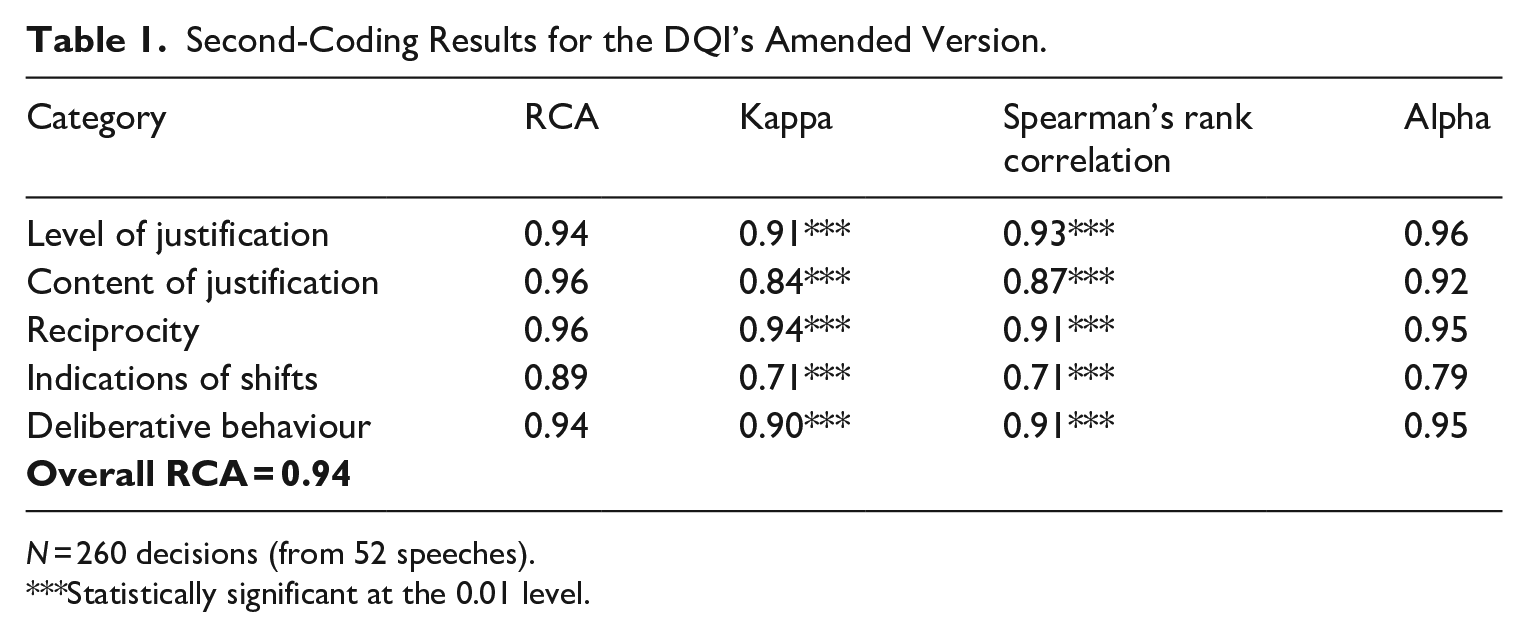
N = 260 decisions (from 52 speeches).
Statistically significant at the 0.01 level.
The RCA for this study is 94%, which indicates that the amended DQI coding scheme is a reliable measure of deliberative quality. The RCA values for the individual DQI categories are high and so are their Kappa values. Spearman’s rank correlation results are also strong, and this is also reflected in the strength of the alpha values, which further adds support to the reliability of the amended DQI, emphasising its suitability for coding the IMO speeches in this study.
Methodology
Unit of Analysis and the Debate Level
During the coding stage, the unit of analysis is the individual speech. The individual speech is the most basic unit of analysis and has been treated as such in Steiner et al.’s (2004: 55) study and in studies that follow in its footsteps (Maia et al., 2017: 10; Pedrini, 2014: 272). Nonetheless, the unit of analysis in this study changes during the analysis of the speeches at the debate level. Here, the focus is on the DQI scores of the member states at each debate.
The debate level scores for the member states per debate are calculated as follows: a state takes the highest value from each DQI indicator per debate, so that, a state who had the following DQI sub-component scores (0, 0, 1, 0, 1) for its first speech and then (2, 0, 1, 1, 0) for its second speech in the same debates (if it spoke more than once), would then ultimately have this configuration for its DQI score at the debate level: 2, 0, 1, 1, 1.
The justification for moving to a debate level of analysis has been provided by some scholars for the potential benefits this level can bring. This is best captured when Gerber et al. (2018: 1102) state that: To date, the quality of deliberation had only been checked at the level of individual speeches. But this is problematic: in order to achieve an overall maximum score, every speaker would not only have to justify their demands and arguments thoroughly in every single speech, they would also have to be simultaneously orientated towards the common good and be respectful at all times. Even staunch advocates of deliberation might agree that this is conceptually impossible, ignoring ‘economies of speech’ and the fact that in good conversations, arguments are not repeated all the time. Therefore, we have applied a holistic approach which analyses the overall deliberative performance of each speaker in an entire discussion.
Thus, some scholars recommend this level as they see it as more appropriate than the raw level. This is mainly because one cannot expect participants to be deliberative across all DQI components in every single speech. In this study, the quantitative analyses are conducted at the debate level.
A great advantage of the DQI is that it allows researchers to conduct regression analyses for testing hypotheses relating to the determinants of deliberative quality. Previous studies have used the DQI specifically because it allows the production of regression tables capable of producing significant results (Kuhar and Petrovčič, 2017: 10; Pedrini, 2014: 277). To identify whether bureaucratic quality is a determinant of deliberative quality and test the hypotheses of this study, ordinary least squares (OLS) regression analyses are conducted on the DQI results gathered from coding the speeches. The DQI results serve as the dependent variable, while potential determinants of deliberative quality serve as the independent variables. To see whether the DQI components can be combined into one index, or more than one, a factor analysis is conducted on the speeches, the results of which are presented shortly. The data sources for the dependent variable (deliberative quality scores of the member states) and the independent variables are presented below.
Speeches From the Selected IMO Meetings
In terms of the types of IMO meetings analysed, the focus is on the committee meetings of the IMO as opposed to the meetings in other IMO bodies, such as the assembly and the sub-committees. This is mainly because the committees are the ‘policy-making’ arenas of the IMO where most of the inter-state deliberations take place (IMO, 2016: 51). Studying only deliberative interactions of the sub-committees or the assembly would not be providing the whole ‘deliberative’ picture as the former are largely technical bodies while the latter occurs infrequently to discuss issues, such as the budget and the work programme of the IMO. With regards to the type of committees analysed, the focus is on the Maritime Safety Committee (MSC). The MSC is the most important committee at the IMO where countries extensively discuss maritime-, safety- and security-related issues. The speeches of two complete MSC sessions are coded in this study: the MSC’s 100th session and the MSC’s 97th session. To increase the sample size, other debates from other MSC sessions are included. The rest of the speeches analysed come from debates at the Ship Design and Construction (SDC) sub-committee and the IMO assembly, all of which occurred during a very similar time range between 2016 and 2018. 6 In total, 30 debates have been coded, with 24 debates coming from the MSC, three debates coming from the SDC and the other three coming from the assembly.
Case Selection and Generalisability
The analysed speeches come from the deliberations taking place in the IMO. The IMO is a very suitable case as there is already evidence from few studies in the literature that it follows a deliberative logic in its deliberations. For example, Schuda’s (1991: 1015–1045) study reveals the centrality of deliberation and argumentation in the IMO’s Legal committee when he explores the creation of a draft convention on compensatory measures in cases of shipping accidents. Significantly, his analysis reveals that discussions within the committee take the structure of debates where one delegation proposes an argument that is then supported or refuted by counter-arguments. Similarly, Gaskell’s (2003: 170–171), who was himself an NGO representative at the IMO, alerts us that we should not suppose ‘that the size of a state, geographically or geopolitically, reflects its influence within the Legal ’Committee’. This is because smaller states, such as Vanuatu, Malta and Yemen, ‘may have a great influence within negotiations’ (Gaskell, 2003: 171). Thus, both Schuda’s and Gaskell’s study already hint that the IMO’s debates follow a deliberative logic not influenced by the geo-political weight of the member states.
As for the absence of coercion during discussion, existing research shows no traces of anything resembling coercion within the IMO committees, even when it comes to controversial topics. Indeed, studies on the Marine Environment Protection Committee (MEPC) show that some difficult topics relating to cutting greenhouse gas (GHG) emissions from ships can take ‘years of discussion’ in cases where states are unable to agree on certain decisions (Miola et al., 2011: 5492). Thus, the idea of using coercion to force states to change position is likely absent in the IMO.
The signs so far indicate that this IO is a suitable platform for hosting Habermas’ and Weber’s ideas. In addition to being a fertile ground for deliberation, the IMO is also a generalisable case as its membership is almost universal. Today, the IMO has 175 member states and three associate members. Its membership is therefore almost exhaustive since almost all countries are IMO members. This is highly beneficial for this study as it enables the analysis to be conducted on a large number of states; in this study, almost 100 states (97 states) with varying characteristics, including their bureaucratic size and permanence of delegation, where included in the analysis.
Along with its near-universal membership, the findings from this IMO study are generalisable because, like many IOs, the IMO is part of the UN family. Thus, its findings are comparable with future findings relating to those IOs. Second, the way the IMO is designed is very similar to how other IOs are designed. Indeed, having institutional bodies like committees, sub-committees, and an assembly hosting deliberations and having international delegates sent to them is very common across IOs as it is the typical way inter-state discussions take place within IOs. Thus, similarities can easily be drawn between the IMO and any other IO with a similar institutional set-up.
Data Sources for the Independent and Control Variables
Meritocratic Appointment and Permanent Representation
To measure bureaucratic quality, particularly the extent of meritocratic recruitment, Varieties of Democracy’s (V-Dem, 2021) ‘Criteria for appointment decisions in the state administration’ is used. This measure is particularly interested in the extent to which ‘appointment decisions in the state administration [are] based on personal and political connections, as opposed to skills and merit’ (V-Dem, 2021). It is measured on a scale from 0 to 4 with 4 being the best score indicating that appointments in country’s administration are based on merit rather than connections. For the permanent representation variable, the information for this independent variable is gathered from the ‘list of participants’ provided by the IMO (e.g. MSC 100/INF.1., 2018; MSC97/INF.1., 2016). The IMO publishes the names of attendants in each delegation including their job titles in those lists. For delegations including a permanent representative, the dummy variable is coded as 1.
Control Variables
The study also includes a number of control variables in the OLS regressions which may also be associated with deliberative quality. Cognisant that other state-related characteristics may be associated with deliberative quality, a state’s hard power capabilities, national deliberative performance and the level of development are all controlled for. Hard power is measured through the most widely used indicator of national capability; the Composite Index of National Capability (CINC) (COW, 2018; Singer et al., 1972: 19–48), while the level of development is measured through the Human Development Index (HDI) (United Nations Development Programme, 2018). To capture national deliberative performance, the ‘deliberative component’ index and ‘electoral democracy’ index are both used (Coppedge et al., 2016), in addition to the World Press Freedom (WPF) index (RSF, 2018), with the latter serving as an indicator of public sphere openness. The ’deliberative component’ index is included to control for the possible argument that countries with more deliberative political elites are more deliberative internationally.
Other state features related specifically to the IMO, such as the average size of a country’s delegation and its membership years in this organisation, are also controlled for. An ‘official language in IMO’ variable is also included to control for state delegate’s knowledge of one of the UN’s six languages (English, French, Spanish, Arabic, Russian and Chinese), which are translated instantly during the committee and assembly deliberations through the language channels accessible by headphones. Moreover, given that the integration of a state into the maritime world may also influence its deliberative performance, the study controls for three maritime-related features captured through the Liner Shipping Connectivity Index (LSCI) (UNCTAD, 2018), fleet ownership (UNCTAD, 2018), and LSCI divided by gross domestic product (GDP), 7 with the latter serving as an indicator of stakes or vulnerability and intensity of interests in maritime regulation. Finally, the institutional body hosting the discussions 8 as well as the gender 9 of state delegates are also controlled for.
Factor Analysis
To see whether the DQI components can be combined into one index, a factor analysis was conducted. Factor analysis is a useful tool for generating indices out of constitutive indicators and has been applied in politics research for combining ‘multiple survey items’ (Ansolabehere et al., 2008: 218). Factor analysis has also been used specifically with deliberation in Himmelroos’ (2017) study on ‘deliberative mini-publics’. His analysis found that his indicators loaded on two different dimensions rather than on a single one. He therefore conducted his regression analyses on two separate DQI indicators, one for deliberative output relating to ‘the quality of contributions’ (composed of content and level of justification) and the other for deliberative uptake relating to the quality of ‘considerations’ (composed of reciprocity and respect) (Himmelroos, 2017: 9). The additive indices were generated by adding their constitutive components and dividing by their totals to get a value between 0 and 1 (Himmelroos, 2017, appendix B).
Significantly, the factor analysis conducted for this study also had the DQI components loading on two dimensions and not on one. The results are displayed in Table 2.
Factor Analysis for Member States Speeches at the Debate Level.
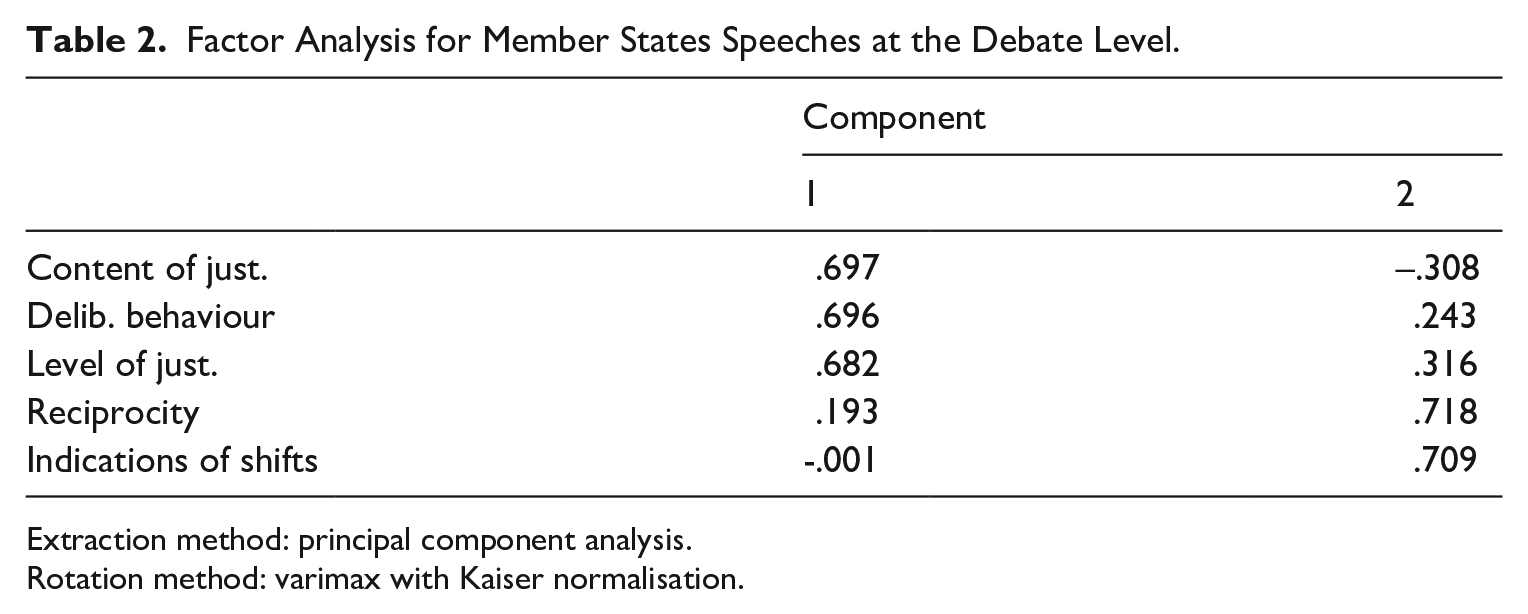
Extraction method: principal component analysis.
Rotation method: varimax with Kaiser normalisation.
As shown above, the first dimension that can be treated as an index consists of the ‘content of justification’, ‘deliberative behaviour’ and ‘level of justification’ indicators, while the second dimension is composed of ‘reciprocity’ and ‘indications of shifts’. Significantly, there is a common thread that connects the components of each indicator. On one hand, ‘deliberative behaviour’ as well as ‘level’ and ‘content of justification’ are all composed of deliberative actions (DAs) that a speaker may engage in. Indeed, all three components involve doing DAs; giving reasons, speaking in terms of the common good and engaging in questions, answers or proposal giving.
On the other hand, ‘reciprocity’ and ‘indications of shifts’ are both essentially reactive in that they measure how the participants interact and respond to the other speakers. For example, ‘reciprocity’ involves referencing other speakers or their documents, which involve reacting to what others have said or provided. Similarly, the ‘indications of shifts’ component relates to how other speakers are willing to change positions during the discussions, which naturally occurs in reaction to what they have heard. Thus, both of those indicators can be grouped under the title ‘Deliberative Reaction’ (DR). Table 3 summarises the components and aggregation of the two indices.
Deliberative Action and Deliberative Reaction Components.
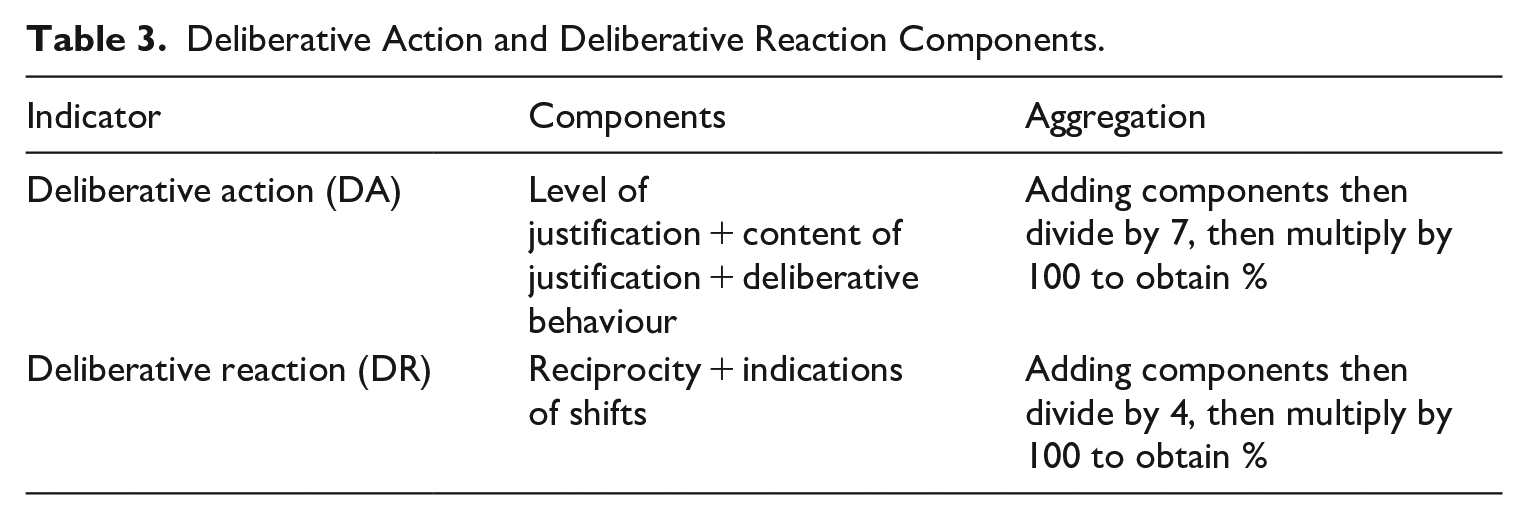
The third column in Table 3 shows how the DA and DR indices are calculated. As shown here, the component scores are averaged and then multiplied by 100 to arrive at percentage scores. An alternative method could have been the calculation of ‘factor scores’ for DA and DR indices based on the weightings of the factor loadings. However, as DiStefano et al. (2009: 3) note, ‘to simply weight items based on factor loadings might not result in a significant improvement over the previous methods’, such as sum scores. In fact, the sum scores methods, such as the averaging method, have a number of advantages, such as being easier to interpret and enabling ‘comparisons across factors when there are differing numbers of items per factor’ (DiStefano et al., 2009: 2). Thus, in this study, the average scores were used.
Statistical Results
Before presenting the regression analysis results, it is useful to show some descriptive statistics relating to the DA and DR indices. Table 4 shows the descriptive statistics for the member states’ speeches.
DA and DR Descriptive Statistics for the Member States at the Debate Level.
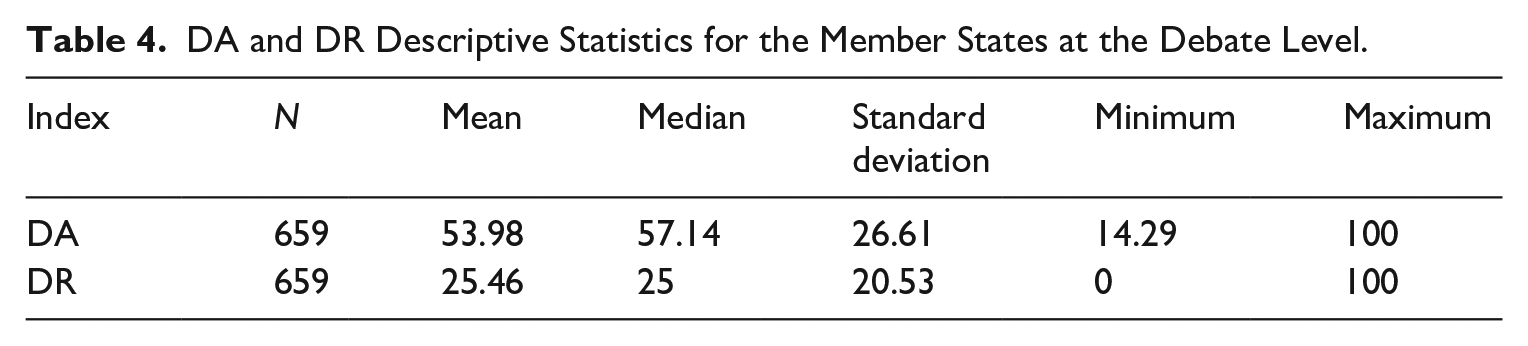
Looking at those descriptive values, it is clear that the DR scores are lower than the DA scores. Thus, the IMO member states perform better when it comes to giving proposals and providing justifications in comparison with changing positions and referencing others. Indeed, it seems that engaging in reactive behaviour is much harder than the provision of well-reasoned justifications and proposals. Now, the key features of the samples have been described, it is time to analyse the regression results relating to the hypotheses.
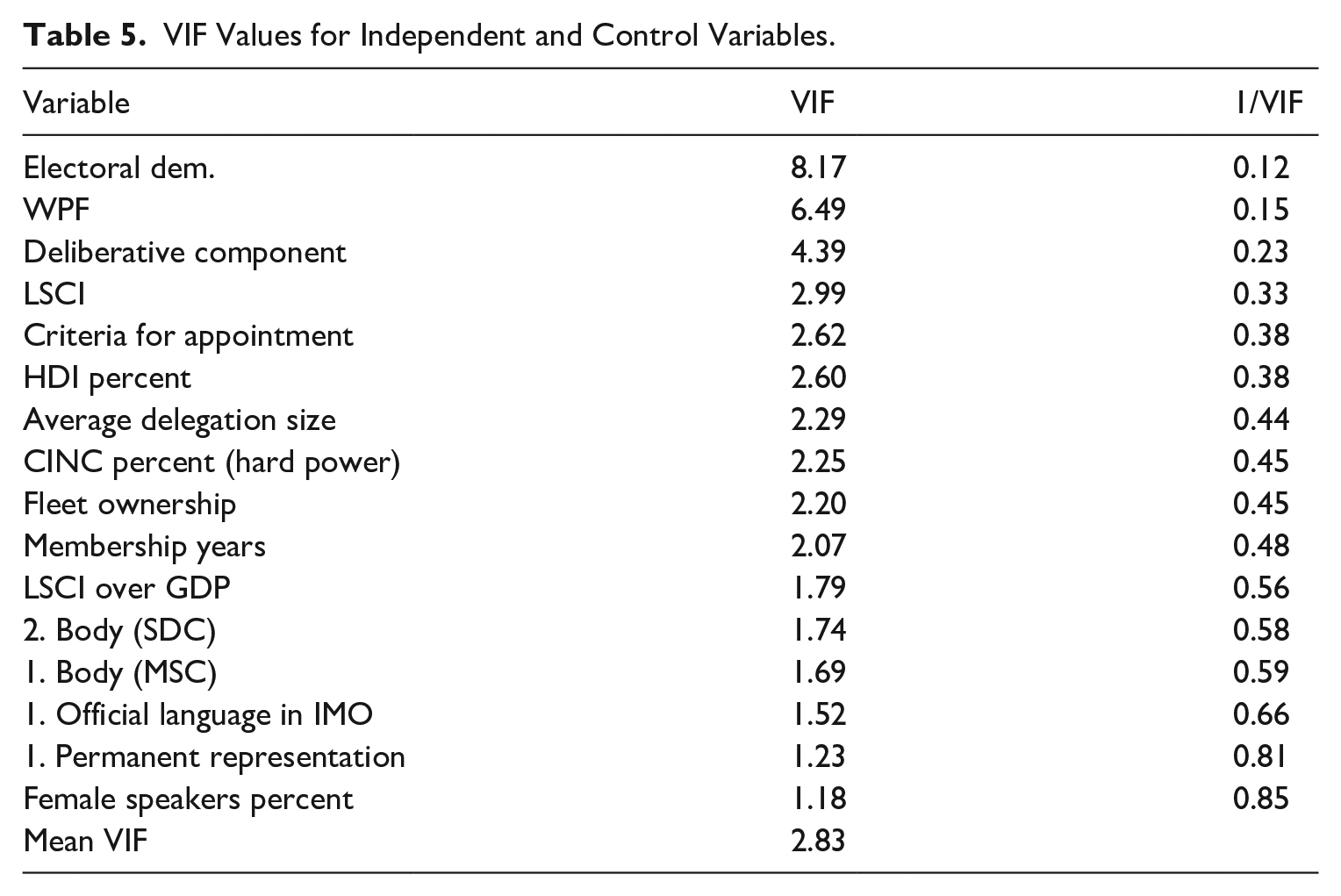
The study also conducted multicollinearity checks which confirmed that it was possible to include all the above independent and control variables in the same regression model as their VIF values did not exceed the ‘10’ threshold value for multicollinearity, as shown in Table 5.
VIF Values for Independent and Control Variables.
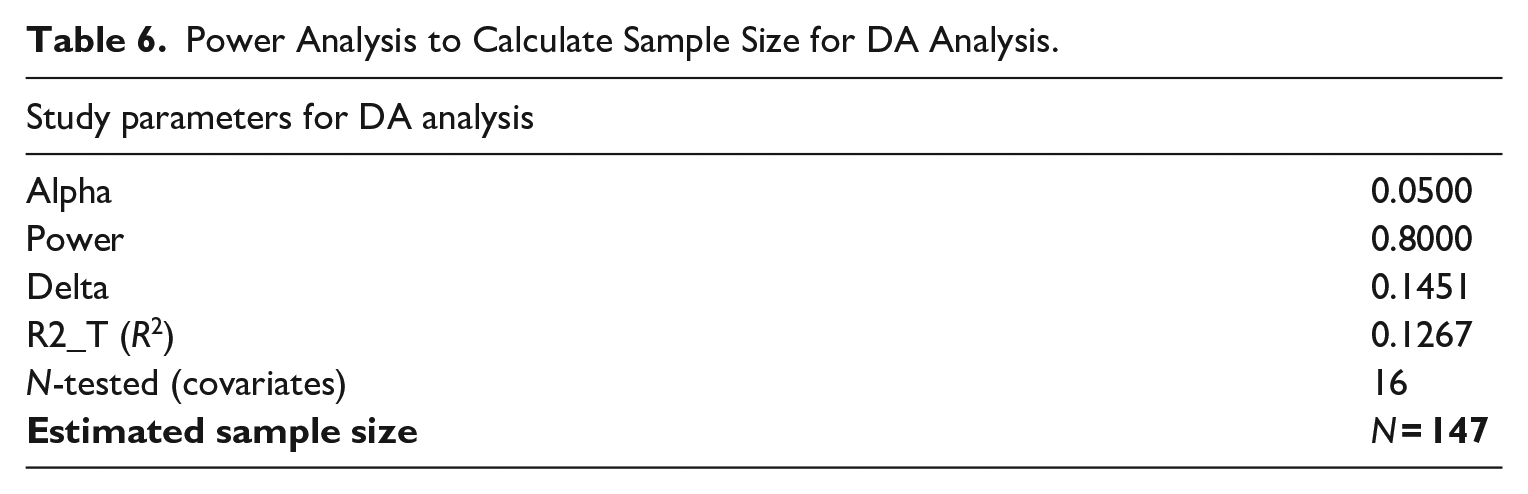
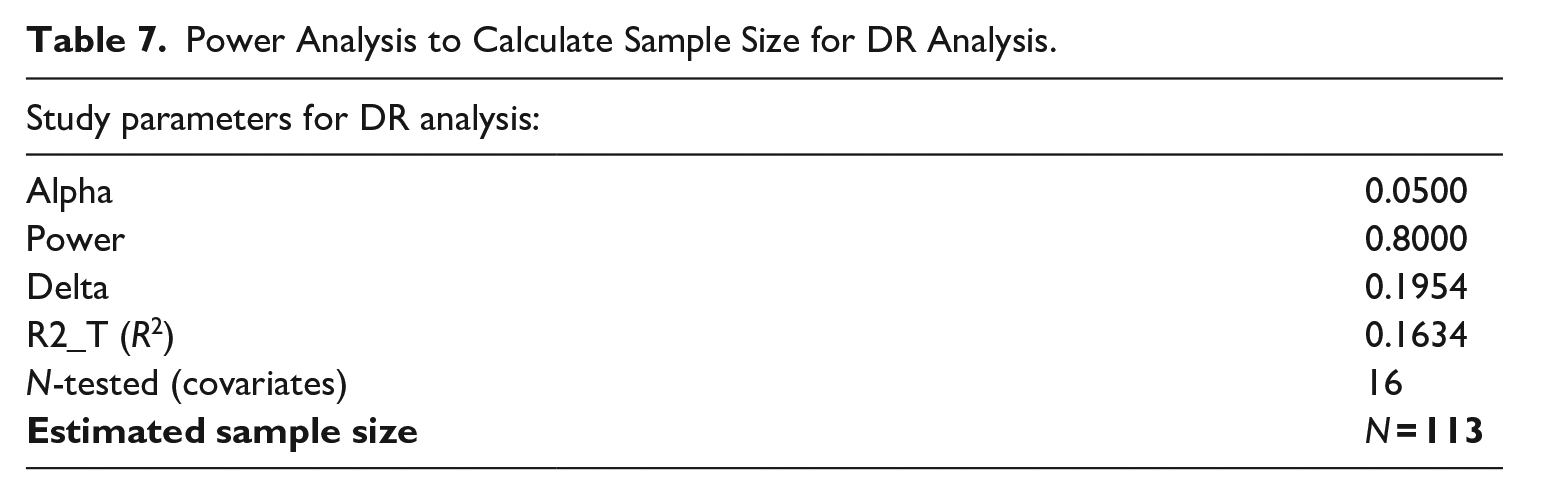
A power analysis was also conducted to check whether the sample size is large enough for conducting the regression analyses. As shown in Tables 6 and 7, the power analysis for both dependent variables demonstrated that the 659 sample size is more than enough as it is much larger than the 147 and 113 estimated sample sizes for the DA and DR analyses, respectively.
Power Analysis to Calculate Sample Size for DA Analysis.
Power Analysis to Calculate Sample Size for DR Analysis.
Discussion of Results
The results in model 1 in Table 8 give strong support for both hypotheses. There is indeed a statistically significant association between bureaucratic quality and countries’ DA scores, as well as an association between permanent representation and DA performance. For example, an increase in a country’s ‘criteria for appointment’ score by 1 unit (on a scale from 0 to 4) is expected to raise its DA score by more than 7% (significant at the p < 0.05 level). Similarly, including a permanent representative on a country’s delegation is expected to raise its DA score by 5.4% (with p < 0.05). Thus, having a robust bureaucracy reflects well on a country internationally and means that it increases its capacity to be an active participant in international deliberations, capable of providing strong justifications and engaging in deliberative behaviour during discussions.
Regression Results.
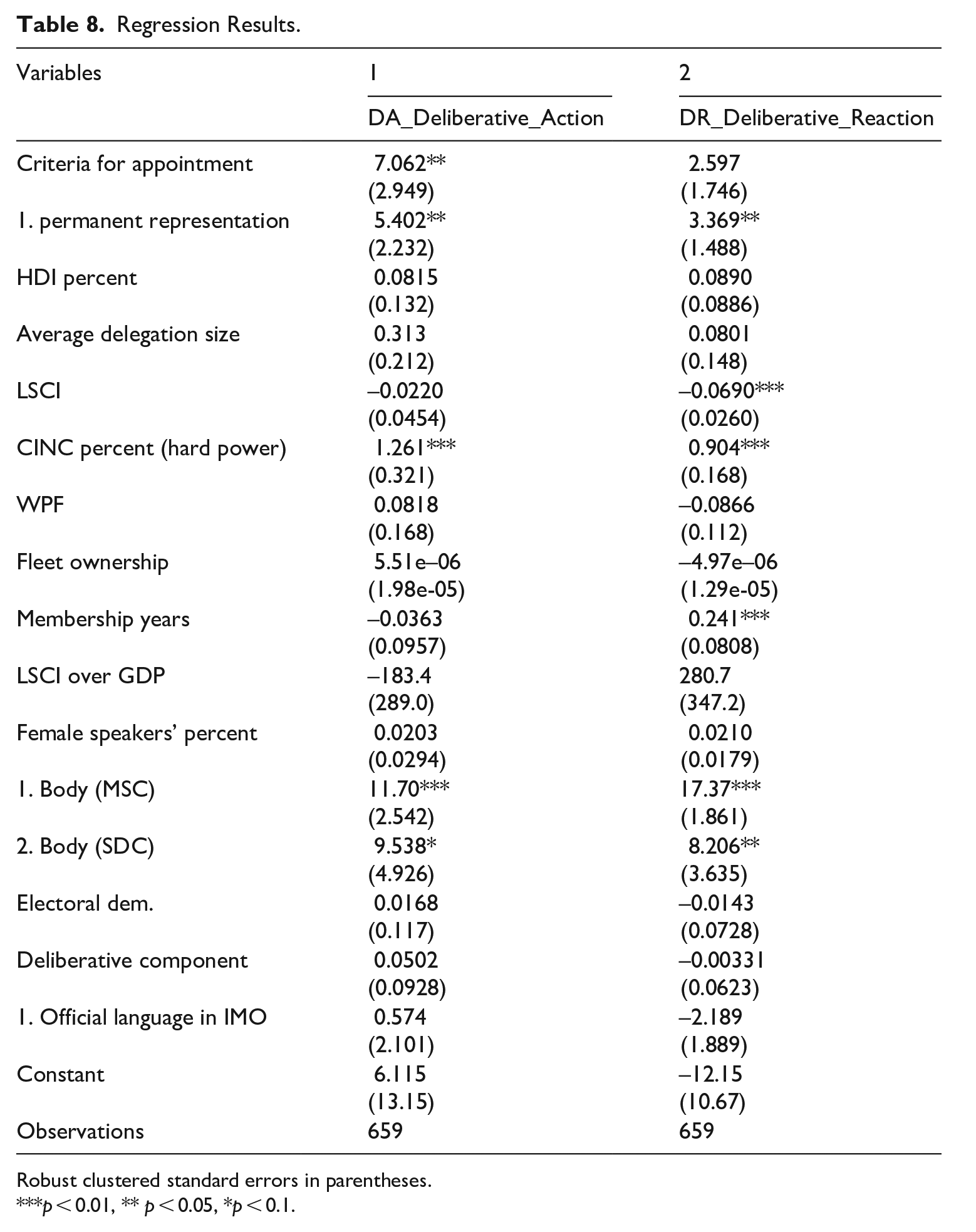
Robust clustered standard errors in parentheses.
p < 0.01, ** p < 0.05, *p < 0.1.
The DR debate level results also support the association between permanent representation and deliberative quality, as shown in model 2 of Table 8. Indeed, the presence of a permanent representative on a state’s delegation is expected to increase its DR score by more than 3.3% (with p < 0.05). However, the bureaucratic quality indicator, despite having a positive regression coefficient, did not reach levels of statistical significance here. The statistical significance of the permanent representation variable here is likely due to the increased network and knowledge of other participants that permanent representation enables. Indeed, permanent representatives will most likely be aware of their counterparts and this will make them more likely to engage in reciprocity and possibly indicate changes in position.
The results here are particularly significant as they demonstrate that deliberative quality does indeed vary by ‘state’ characteristics, and not just by certain institutional or actor-related characteristics as is commonly hypothesised in the literature (see, e.g. Bächtiger and Hangartner, 2010; Kuhar and Petrovčič, 2017; Lord and Tamvaki, 2013; Pedrini, 2014; Steiner et al., 2004). Indeed, much of the theorising on the determinants of deliberative quality in the literature has occurred at a parliamentary level with the focus being almost exclusively on the institutional determinants of deliberative quality. To the extent that other types of determinants are considered, this exercise is usually quite limited to considering the influence of certain characteristics of the speakers or the issues under discussion. The fact that a state’s bureaucratic quality and permanent representation matter reveals that state characteristics do indeed influence how they speak at international fora. States should therefore pay attention to how their bureaucracy functions as this is consequential for how they communicate internationally.
From the Voices of the Delegates
Significantly, during a number of interviews conducted with IMO delegates, their responses indicated that deliberative performance is indeed related to bureaucratic quality. For example, a member-state delegate emphasised the importance of having delegates with ‘a technical background’ comprising the delegations at the IMO especially because if they don’t have a shipping background, it would be ‘very difficult [for them] to engage’ in the discussions (Int. C11). While speaking, he questioned how delegates recruited from ministries not related to shipping would be able to cover the matters under discussion. The importance of permanent representation was evident when the delegate commented on how as ‘a permanent representative’ to the IMO, and an expert qualified in the maritime field, he has never faced any linguistic difficulties, such as understanding abbreviations; a challenge he noted other delegates can have. Thus, this delegate’s response indicates that bureaucratic quality, whether one is considering meritocratic recruitment or permanent representation, matters for deliberative interactions during international meetings. The importance of technical competence was also stressed in another interview, this time with an NGO representative at the IMO. During the interview, the delegate stated that a representative needs ‘to have a certain education level and ‘a good background’ (Int. N2). He then added that: You’ve gotta be knowledgeable about your subject and if you don’t know your subject, you’re gonna be quickly found out. If you are just there as a political appointee who knows nothing about the subject, you might be very good at liaising, and so on, and that will help you a long way, but you do need to have that technical competence in there as well (Int. N2).
Clearly, this delegate’s response effectively demonstrates the importance of having skilled delegates appointed to such meetings, while at the same time highlighting that merely having a political appointee would not be sufficient at effectively fulfilling this role, despite the networking skills such an appointee may have. The response of this delegate adds further importance to meritocratic appointments.
The importance of permanent representation similarly featured in other interviews with IMO delegates whose responses further indicate that this variable is significant for deliberations. For example, the way permanence of representation acts as ‘a very good tool [. . .] for fostering relations’ between states, and the way it facilitates access to the discussions ‘at all times’ were two significant things mentioned that highlighted the importance of this variable to the IMO deliberations (Int. C2; C5). Moreover, a member-state delegate noted that ‘where you do have permanent reps who are based in London, they do have a slight advantage’, in how permanent representatives from different delegations ‘generally know each other’ (Int. C3). The importance of permanent representation for deliberation becomes further evident when the delegate states how: ‘a lot of deliberations, it’s not what you know, it’s who you know and the networking behind the scenes is very important’. Nonetheless, the importance of technical competence still features in his response when he says how ‘talking sense either technically or procedurally’ is useful for ‘building up respect’ towards a delegate, which would then encourage others to ‘want to work together’ with such a delegate (Int. C3). Thus, this interviewee’s response not only demonstrates that permanent representation is important but that it also goes hand in hand with having a suitable level of knowledge of the technical and procedural environment of the IMO.
Conclusion
In conclusion, this study has allowed the ideas of Max Weber to meet and interact with those of Jürgen Habermas in the context of international deliberations. Max Weber’s influential ideas on bureaucratic composition and Habermas’ ideas on deliberation have long inspired scholars in different fields, but it was only through this study that the thoughts of both authors were able to be simultaneously studied in an international deliberative context. Significantly, this encounter produced significant results. Indeed, statistically significant results were obtained here for the two hypotheses proposing a relationship between bureaucratic quality and deliberative quality. Starting with meritocratic appointment, the results supported that a bureaucracy composed of skilled appointees rather than politically well-connected appointees is highly relevant for explaining deliberative performance internationally, particularly when focussing on DA. Thus, member states seeking to improve their deliberative performance in IOs should start by improving the way their offices are administered internally; recruiting based on talent and skills is their ticket to improving their deliberative skills in international meetings.
Second, the results suggest that it matters to have permanent representation in the IMO rather than being represented solely by new or temporary delegates. Permanent delegates sent to the IMO’s headquarters will be much more skilled at speaking at the IMO because their frequent interactions at this international institution, made possible by their ‘permanent’ appointment, will have trained them into deliberating more effectively than new delegates. Even in cases when a permanent representative finishes his or her post to hand it over to another delegate, it is highly likely that the expertise gained will be passed forward from the exiting representative to the new one. Thus, having a permanent mission at the IMO does matter from a deliberative perspective and adds further support to the bureaucratic hypotheses; an office abroad that is also supported by competent offices ‘back home’ will both work together to strengthen the deliberative performance of their state during international meetings. Significantly, the interview findings provided further support for both hypotheses as the IMO delegates emphasised the importance of technical competence and permanent representation in enhancing a state’s deliberative performance.
This article has made a number of contributions. Theoretically, it applied Weber’s thought to an International deliberative level and developed two original hypotheses that placed the spotlight on bureaucratic quality and its influence on international deliberations. Methodologically, the article made significant contributions by developing an amended version of the DQI that is useful for application to an international context. Finally, the article also made significant empirical contributions through coding over a 1000 member-state speeches made at the IMO and then arriving at statistically significant results that reveal the importance of bureaucratic quality for deliberative quality. Practically, it is hoped that the findings will inspire policymakers worldwide to take particular care with bureaucratic appointments and to ensure that whenever possible, they make use of the chance to have permanent representation in international fora. That way, their deliberative performance will be enhanced, and they will ultimately be able to make the most out of international deliberations.
Footnotes
Acknowledgements
I am very grateful to Professor Mathias Koenig-Archibugi for his insightful comments on earlier versions of this paper. I would also like to thank the anonymous reviewers for their thoughtful comments.
Declaration of Conflicting Interests
The author(s) declared no potential conflicts of interest with respect to the research, authorship and/or publication of this article.
Funding
The author(s) received no financial support for the research, authorship and/or publication of this article.
