




Abstract
Why would a politician ever want to be blamed? Under what contextual conditions might blame-seeking behaviour emerge as a rational strategy? What tactics, tools and strategies might they deploy? Where is the empirical evidence of blame-seeking in action and why does it matter? These are the questions this article engages with as it challenges the long-standing ‘self-evident truth’ within political science that blame-is-bad. We argue that a new ‘blame game’ has emerged in which blame generation is deployed not solely to taint opponents but also to demonstrate the blame-seeker’s willingness to challenge convention, break the rules, or side with the marginalized. In a broader context characterized by democratic dissatisfaction, anti-political sentiment and affective polarization, we suggest that blame-seeking assumes a powerful symbolic and performative dimension. Antagonizing certain sections of society and then harnessing the backlash provides a powerful political strategy which challenges traditional scholarly assumptions about credit and blame existing in a zero-sum relationship. We illustrate these arguments using the case of Boris Johnson’s rise to the British premiership. A focus on blame-seeking, we suggest, expands our understanding of what politicians say and do to achieve their goals in polarized political contexts.
Introduction
From Machiavelli’s advice that ‘princes should delegate to others the enactment of unpopular measures and keep in their own hands the distribution of favours’, through to Walter Bagehot’s (1873
The ‘danger of self-evident truths’, as Elinor Ostrom (2000) suggested, is that they are not always true. The central argument of this article is that the dominant ‘blame-is-bad’ thesis does not always hold and that there are conditions and situations when ‘blame-is-good’. Moreover, it is suggested that blame-theoretic analyses have generally adopted the problematic assumption that credit and blame exist in a zero-sum relationship where one element is gained at the expense of the other. What the research presented in this article illustrates is the more complex co-existence of credit and blame in contemporary politics. In societies increasingly characterized by ‘us/them’ boundaries, a politician can secure credit and praise from one section of society precisely because they engaged in behaviour that was defined as blameworthy by other sections. A focus on blame-seeking reveals how the ‘strategic toolkit’ for politicians in the twenty-first century is far broader when it comes to ‘tactics and tools’ than has generally been recognized. When analyses look beyond institutional relationships and towards changing cultural dynamics, a logic of blame-seeking emerges which confounds and expands how ‘blame games’ (Hinterleitner, 2020; Hood, 2011) have traditionally been conceptualized and studied.
The seminal texts in this field do provide some acknowledgement that the dominant ‘blame-is-bad’ thesis is not infallible. ‘The claim here’, Kent Weaver (1986) notes in his influential analysis of the politics of blame-avoidance, ‘is not that all politicians and bureaucrats – or even most of them – are pure blame avoiders all of the time [emphasis added]’. In ‘The Risk Game and the Blame Game’, Christopher Hood (2002: 21) argues that there are situations when ‘politicians apparently prefer the chance of claiming credit to avoiding blame’. And yet their analyses are founded on the belief that the incentives for avoiding blame are increasing due to changing cultural conditions. They are also founded on the implicit assumption that politicians and the public can be viewed as largely homogeneous entities which, in turn, facilitates the creation of choice grids, nested game scenarios and the sequential modelling of ‘staged retreats’ which possibly reflected late twentieth-century socio-political dynamics. ‘Revisiting this literature in the third decade of the twenty-first century’, Yair Amitai and Raanan Sulitzanu-Kenan (2024) note, ‘offers new opportunities to evaluate the applicability of these theories and their boundary conditions, given some important changes in the nature of political behaviour that occurred across this time span’. The central argument of this article is that the ‘boundary conditions’ have indeed changed to the extent that blame-seeking behaviours have emerged, meaning that dominant assumptions and long-standing analytical models must evolve and adapt to reflect this changed political landscape. To substantiate this argument, this article engages with three research questions:
RQ1. Why would a politician want to engage in blame-seeking?
RQ2. How would a politician go about blame-seeking in terms of tactics and tools?
RQ3. Where has a politician clearly engaged in blame-seeking behaviour?
These three questions frame the structure of this article, with a fourth concluding section exploring the broader relevance and implications of this article’s argument concerning the politics of blame-seeking.
RQ1. The Logic of Blame-Seeking and Cultural Conditions
Why would a politician ever want to be blamed? The ‘blame-is-bad’ thesis is based on the assumption that politicians are loss averse, that is they are acutely aware of developments that may threaten their goals, which can range from vote-, office- and policy-seeking to reputation and legacy building. Moreover, and related, the ‘blame-is-bad’ thesis assumes that politicians are well aware of the negativity bias of citizens – that is people’s propensity to pay more attention to negative information than positive information (Weaver, 1986). The existence of an intense negativity bias in society means that blame for reprehensible political behaviour or bad policy outcomes is likely to be amplified and remembered, while credit for acceptable behaviour and good outcomes is likely to be limited and short-lived. Taken together, these assumptions imply that politicians generally prefer avoiding blame over claiming credit in order to safeguard their political goals (what Hood (2002) called the ‘minimax strategy’). The rational politician, from this perspective, aims to be what Weaver (1986) described as ‘Teflon coated’, or immune to goal-threatening blame. While this core thesis has led to the identification of a range of anticipatory and reactive blame-avoidance strategies (see Dimova et al., 2024; Hinterleitner and Sager, 2017; Leong and Howlett, 2017), the assumption that blame-avoidance is a rational response in almost all controversial situations has rarely been questioned. This, in turn, has precluded a systematic analysis of why (i.e. logic) and when (i.e. conditions) a rational politician might seek to become a ‘blame magnet’.
The central argument of this section is that the traditional logic of blame-avoidance is only rational in contexts where the public forms a relatively homogeneous social grouping and a broadly stable median voter construct can be identified. In such a context, the advantages of blame-avoidance are relatively clear, as there will always emerge a consensus in society as to whether a specific action, statement, or policy outcome is ‘blameworthy’ or not. Antagonizing established norms, shared conventions and ‘rules of the game’ or taking policy positions far from median voters therefore is unlikely to create opportunities for credit-claiming as there are no significant peripheral social groupings that would be appreciative of such behaviour. The logic of blame-avoidance, we suggest, shifts in situations of greater social fragmentation, in general, and high levels of anti-political sentiment, in particular. In polarized democracies where significant sections of society feel ‘left behind’ or ‘peripheral’, blame-seeking becomes a rational strategy: There is something to ‘play-up for’ in the sense of a significant community who are likely to credit ‘rule breakers’ (see Hahl et al., 2018). This is an argument that resonates with James Tilly’s (2008: 29) analysis of the allocation of credit and blame. Working from a sociological and cultural perspective, Tilly argues that ‘When a sharp ‘us-them’ boundary separates blamer and blamed, the very actions for which A blames B are often actions for which B’s supporters give B credit’. As such, disruptive behaviour creates a form of wedge politics: For one side, it deserves credit and for the other side blame. By adopting disruptive behaviour (bad manners, offending convention, breaking the rules, etc.), the blame-seeker is fulfilling the relational conditions for credit and blame (i.e. blame from the beneficiaries of the existing status quo, credit from those who feel like they exist on the losing side).
The logic of blame-seeking therefore suggests that ‘it can be good to be bad’ in a way that has generally been either dismissed or overlooked by political science and public administration. The socio-political context that makes the logic of blame-seeking attractive is one where many voters view themselves as living in Kahneman and Tversky’s (1984) ‘realm of losses’, in which the continuation of the status quo produces too many unacceptable outcomes for too many people. Such a context, as previous research has shown, is characterized by strong anti-political sentiment that, in turn, erodes the position of previously accepted ‘rules of the game’ and fuels a reappraisal of the boundaries of ‘acceptable’ or ‘appropriate’ behaviours (Hahl et al., 2018). For instance, it is a central finding of recent research on American politics that in divided societies, voters are less critical, if not appreciative, of unconventional and un-democratic behaviour (e.g. Graham and Svolik, 2020; Hahl et al., 2018; Luo and Przeworski, 2019; Miller, 2021). In the context of divided societies, voters therefore are less likely to evaluate politicians on the basis of their competence (e.g. Denham and Dorey, 2018; Heppell and McMeeking, 2021; Stark, 1996) but on the basis of how they position themselves vis-à-vis the actors and structures they have come to despise.
Two cognate seams of scholarship help develop our understanding of the politics of blame-seeking in a context where the assumption of a unified public no longer holds. The first seam explores the emergence and implications of affective polarization (i.e. the tendency of partisans to view political rivals negatively and co-partisans positively). Affective polarization has doubled in the past 40 years in the United States (see Iyengar et al., 2019) and is also an acute and growing feature of European party systems (Reiljan, 2020). In this context, the simplifying logic of the traditional ‘blame-is-bad’ thesis struggles to cope with the fact that there is (1) no generally cohesive or unitary electorate that shares the same values that will (2) hold politicians and political parties to account for observed political behaviour and policy outcomes (i.e. the core implicit assumptions within the blame-avoidance literature). Not only is the public more fragmented with deep ‘us/them’ boundaries but partisans will reject facts, distrust institutions and even discard democratic norms ‘when they serve political opponents, only to support the same ideas once they come from their own political camp’ (Amitai and Sulitzanu-Kenan, 2024). The allocation of blame and credit is therefore increasingly conditioned not by generally agreed-upon rules and understandings of acceptable policy outcomes but by political group membership. This explains Leong and Howlett’s (2017) criticism of how the analysis of blame has traditionally been undertaken within political science and public administration: [B]lame especially should be studied more widely from the view of the public as well as that of the public official, and that both concepts [credit and blame] should be analysed as part of the larger issue of the legitimation of public actions, rather than, as is often the case, solely as an aspect of utilitarian calculations and risk management activities (599) [italics added].
Affective polarization shifts the loci of political debate from policy to identity which, in turn, flows into a second seam of scholarship that informs the study of blame-seeking. In divided societies, blame-seeking provides a way of identifying with a specific and generally disgruntled section of society, which is considered to be the performative essence of populism (Moffitt, 2016). Antagonizing mainstream politics and ‘breaking the rules’ provides a way for populist politicians to harness the ‘cultural backlash’ and to proactively craft a sharp ‘us-them’ boundary (Norris and Inglehart, 2019). Populism blames them (elites, experts, the establishment, etc.) for all society’s ills, while at the same time very often engaging in forms of behaviour that attract criticism, ridicule and revulsion from them (see Hameleers et al., 2023). From a populist perspective, blame-seeking therefore has centrifugal (blaming others) and centripetal (‘blame me’) elements. Populists want to be blamed by the institutions and actors of conventional politics because such behaviour underlines and demonstrates their ‘outsider’, ‘rebel’, strong’, or ‘maverick’ qualities. Populism therefore brings with it a powerful and often performative blame-seeking logic that simply does not fit with the established blame-avoidance assumptions that currently define political science and public administration. ‘Populists play blame games in their own particular way’, Jacobson (2024) notes: [t]hey are generating blame, knowing full well that it is likely to boomerang back on them. They are bold credit claimers . . . even under circumstances where blame is likelier than credit. And when taking blame, they are unlikely to contain the blame by conceding, but rather escalate the conflict, attack the accusers, play innocent and reframe the issue . . . Instead of the staged-retreat hypothesis their blame-taking strategies escalate tensions until events climax (701).
Taken together, while the literature on affective polarization identifies the changed cultural conditions in which blame-seeking emerges as a rational political strategy, the literature on populism identifies the baseline logic of this strategy (i.e. RQ1, above). But neither seam of scholarship has explicitly located their insights against dominant blame-avoidance assumptions as this article does, or identified the tactics and tools through which this approach is operationalised (i.e. RQ2, above). To summarize, blame-seeking behaviour is deliberately designed to provoke a response. It seeks to offend ‘them’ (generating blame, scorn notoriety) while defining ‘us’ (generating credit, praise, affection); it flips the existing notion of blame-avoidance (see Hood, 2002; Pierson, 1996; Weaver, 1986) on its head through a focus on how individuals and parties might attempt to be blamed. Instead of focusing on blame attribution by ‘muckraking’ about others (see Weaver, 2018), the intention here is to become a blame magnet to secure the support and loyalty of those who were already disgruntled, detached or alienated. Identifying and understanding blame-seeking behaviour has been limited by a lack of intellectual cross-fertilization between seams of scholarship and pockets of research. Although there is considerable literature on the blame games that populists play, very little of this work has utilized or even referenced the mainstream blame-theoretic studies or frameworks in political science and public administration (Jacobson, 2024). As such the next section seeks to combine insights in order to identify the tactics and tools through which a blame-seeking strategy might be deployed.
RQ2. The Tactics and Tools of Blame-Seeking
There exists a vast body of work on blame-avoidance behaviours that are generally sub-divided into policy, agency and presentational tactics and anticipatory or reactive tools. While agency strategies seek to shift the risk of being blamed to others by allocating formal responsibility and competencies in ways that allow for blame deflection and blame diffusion, policy strategies aim to (re)design policies so that they are less likely to attract blame. Presentational strategies, for their part, aim to avoid or limit blame by shaping public perceptions (Hood, 2011). What is more, most of these strategies can be applied in consecutive fashion, that is they can be employed in an anticipatory way to reduce the likelihood of blame emergence and if there is blame regardless, they can be employed reactively to reduce and deflect that blame (Hinterleitner and Sager, 2017; see Table 1 for a concise overview).
Blame-Avoidance Strategies: Tactics and Tools.
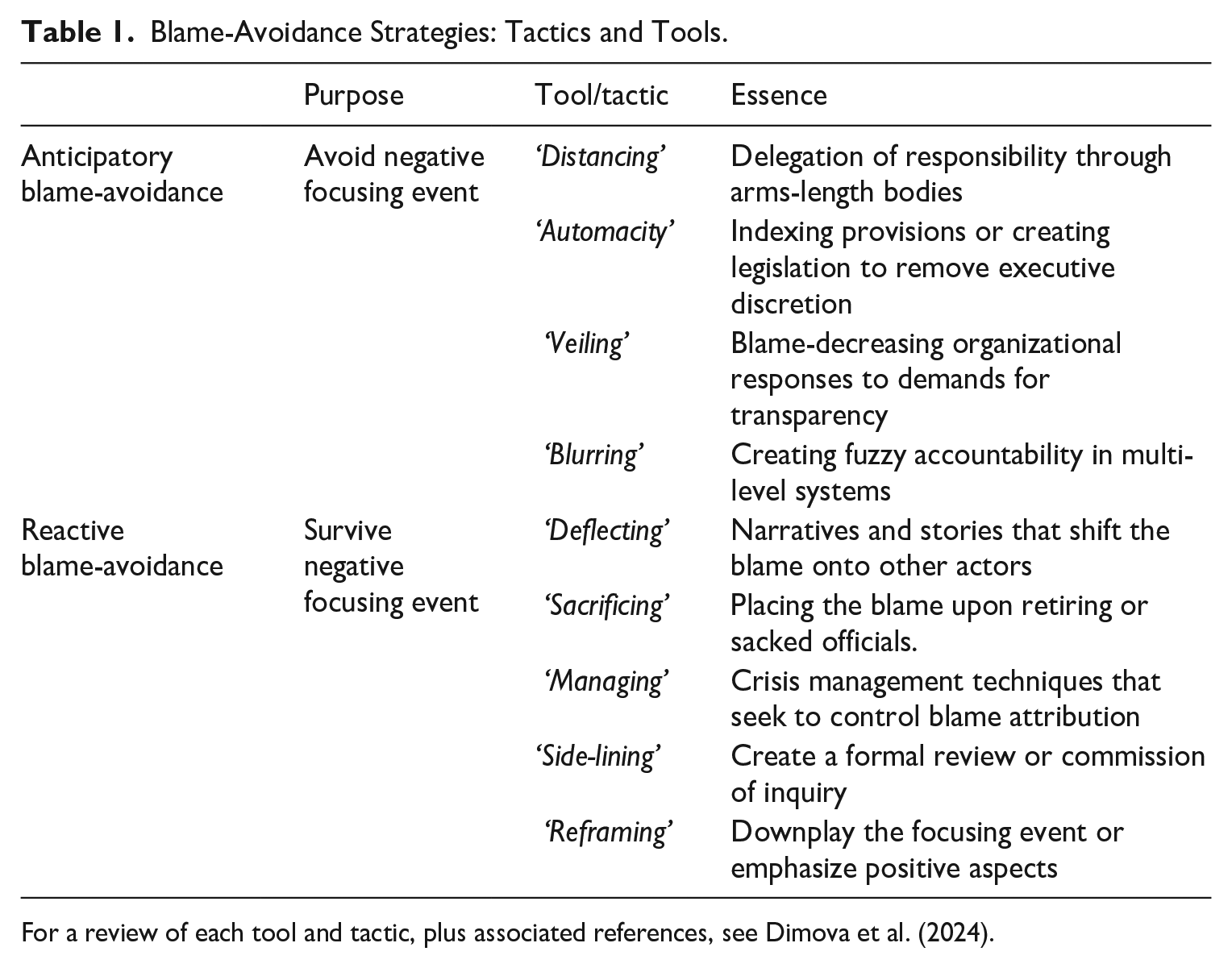
For a review of each tool and tactic, plus associated references, see Dimova et al. (2024).
While there exists a rather comprehensive and consolidated understanding of varieties of blame-avoidance, much less is known about the tactics and tools of blame-seeking. This section addresses this lacuna by providing a novel mirror-image framework that facilitates the empirical analysis of blame-seeking. The dominance of ‘blame-is-bad’ assumptions within political science and public administration means that those seeking to even explore when ‘blame-might-be-good’ are required to ‘range’ (Epstein, 2019) or ‘trespass’ (Hirschman, 1981) beyond those disciplines. The proposed framework is thus based on a wide reading of literature that can provide insights on facets of blame-seeking.
A key reference in this regard is Kelly Matush’s work on ‘harnessing backlash’ in the field of international public diplomacy, which arguably provides the closest existing analysis of a form of blame-seeking. As Matush (2023: 1) notes: alienating the apparent target of an international diplomatic campaign can be a deliberate strategy leaders use to win domestic support [. . .] under certain conditions, a costly backlash from a foreign actor can be a credible signal that the leader shares the domestic audience’s preferences [. . .] leaders can exchange foreign condemnation for an increase in domestic support.
Harnessing backlash is clearly a form of blame-seeking behaviour. It focuses on the ‘us/them’ boundary and sees national leaders offending foreign countries or international organizations in order to align themselves with a very specific domestic audience. The leader’s willingness to pay a cost in terms of foreign criticism (i.e. be blamed) provides a credible signal of allegiance to key domestic audiences (with credit-claiming opportunities). Matush (2023) also describes this strategy as a ‘faux failure’: A diplomatic mission that results in offending the host nation or an international organization is quickly interpreted by some domestic audiences as a failure. However, it is a faux failure because antagonizing international actors and foreign leaders is the intention to gain credit from key domestic audiences. Two examples are Benjamin Netanyahu’s 2015 speech to the US Congress where he infuriated the Obama Administration by opposing a multilateral agreement with Iran and Rodrigo Duterte calling US President Obama a ‘son of a whore’ in 2016. Although Duterte’s comments attracted international condemnation and the cancelling of a presidential visit, it also resonated with a potent strain of anti-US sentiment in the Philippines. Extracting condemnation from one audience generated credit and praise from another. Duterte’s electoral position was strengthened as a result.
There are several important take-away points from Matush’s (2023) analysis for the development of our framework. First, and comparable with existing categorizations of blame-avoidance techniques, blame-seeking can be modelled as a consecutive or two-step strategy. Blame-seekers first act in ways that attract blame from some audiences, and subsequently ‘exploit’ or ‘harness’ that blame by turning it into credit with other audiences. Second, the examples given by Matush (2023) hint at the fact that there are many ways in which political actors can strategically antagonize their (domestic) political rivals. The framework presented in Table 2 thus breaks down strategic antagonism into several anticipatory variants (‘othering’, ‘offending’, ‘obfuscation’, ‘baiting’ and ‘rule breaking’). Moreover, it also disaggregates ‘harnessing backlash’ in terms of reactive blame-seeking by specific methods (i.e. ‘denial’, ‘belligerence’, ‘distraction’, ‘complaining’ and ‘escalation’). The tactics and tools of blame-seeking outlined in Table 2 have been harvested from a range of literature, cultures and contexts. By no means comprehensive, they capture the considerable variety of blame-seeking tactics and tools and – just like Weaver’s (1986) initial categorization of blame-avoidance strategies – can be built-upon, refined and developed by subsequent studies.
Blame-Seeking Strategies: Tactics and Tools.
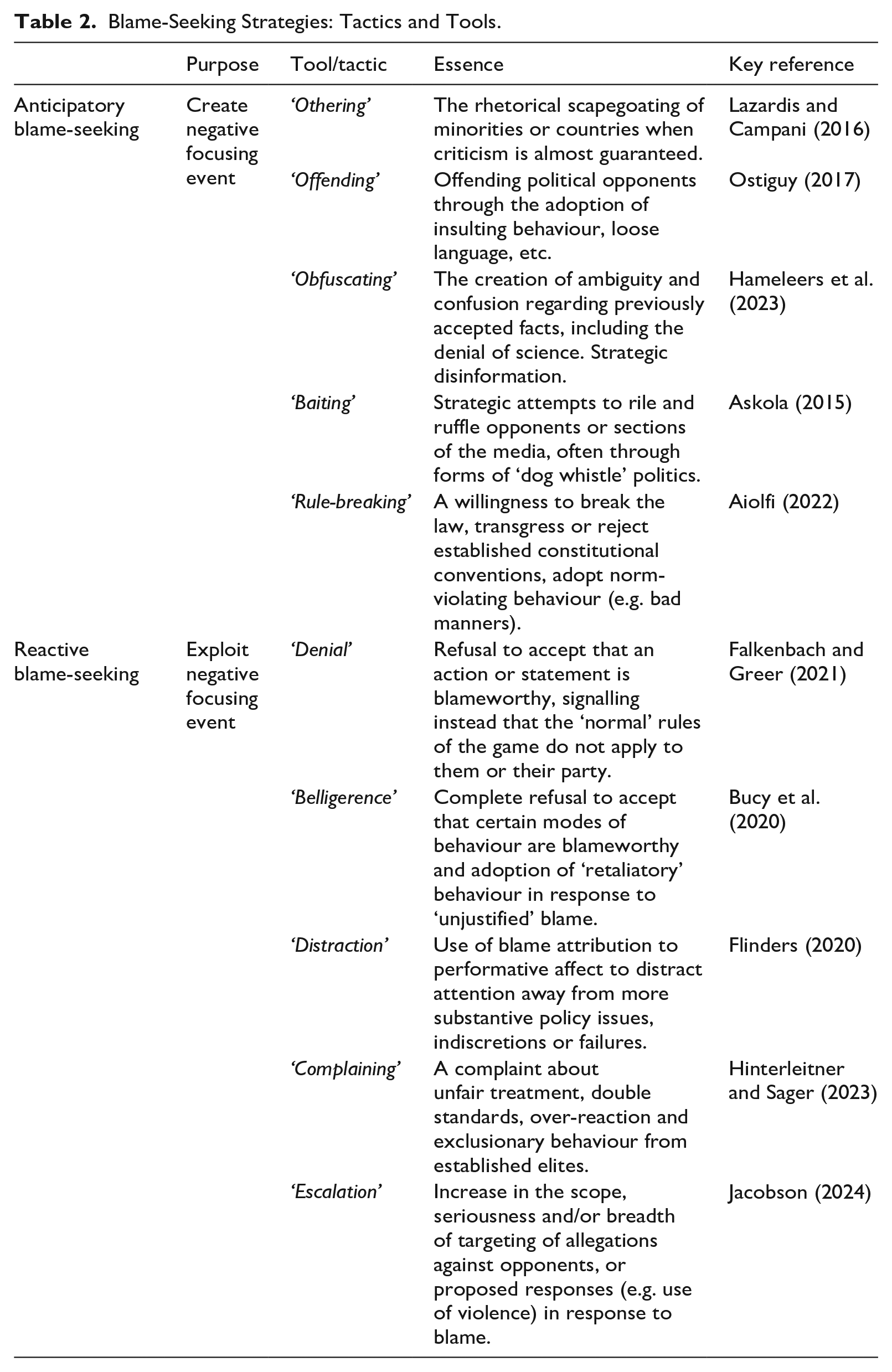
A final important insight from Matush’s (2023: 5) analysis is that blame-seeking is a very risky political strategy that may not work in all situations and thus requires careful crafting and calculation: ‘when engaging in strategic antagonism leaders must calibrate the size of the backlash to balance the international costs against domestic benefits’. This emphasis on blame calibration is true across all tactics and tools described in Table 2 – the benefits of rule-breaking and strategic antagonism must exceed the costs. But making such calculations is problematic primarily because levels of pushback are very hard to predict. For one, the blame coming from those from whom one expects blame might be much stronger than expected – they might not just continue in their opposition, but also devote additional resources and employ more formal sanctions to harming the career of the blame-seeker (Hinterleitner and Sager, 2023). Moreover, a provocative action or statement might alienate more moderate supporters of the blame-seeker and lead to the defection of political allies and collaborators. Blame-seeking may thus initiate a ‘blame backlash’ that is far stronger and politically problematic than ever intended or expected. Finally, it is important to note that like any unconventional behaviour intended to stick out from the political courant normal, blame-seeking risks to suffer from a wear-out effect. A blame-seeker whose supporters got used to their unconventional statements and actions may eventually find themselves faced with the choice of becoming a ‘normal’ politician (and be evaluated as such) or further escalating their behaviour and live with the associated risks. Harking back to RQ1 (above), strategic antagonism is likely to be a preferred strategy and less risky when there are clear and obvious benefits to taking sides when an ‘us/them’ boundary has emerged, and where the ‘policy bandwidth’ needed to satisfy ‘them’ and ‘us’ has become too wide for any politician or party to manage without a risk of rupture. In such a context, blame-seeking is likely to provide leaders with a powerful but under-acknowledged and little-understood tactic for achieving their goals.
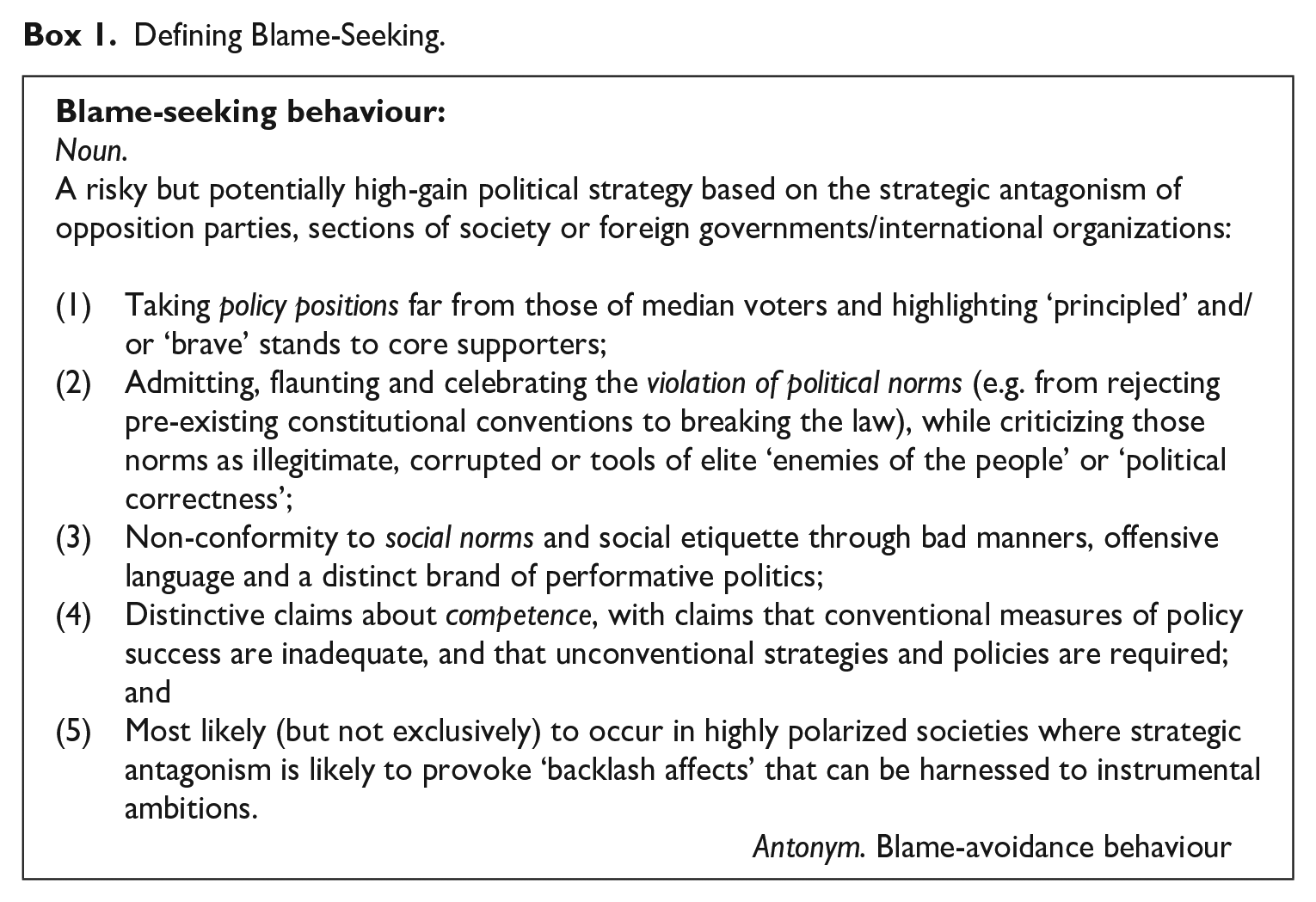
The framework presented in Table 2 facilitates the development of an initial definition of blame-seeking (see Box 1, below). While the framework answers RQ2 (above) by highlighting how blame-seeking can occur, the next section engages with RQ3 by exploring where (why and how) a politician has clearly engaged in blame-seeking behaviour.
Defining Blame-Seeking.
RQ3. Boris Johnson: Bluster, Buffoonery and Blame-Seeking
The previous sections argued that the logic of blame-based calculations has shifted due to the emergence of sharper ‘us/them’ boundaries (i.e. affective polarization), and that the blame games politicians play are therefore increasingly combining traditional methods of blame-avoidance with more novel forms of blame-seeking (RQ1, above). Moreover, we suggested that a focus on strategic antagonism, harnessing backlash and the symbolic representation of anti-system sentiments provide new ways of identifying the tactics and tools through which blame-seeking finds form (RQ2). This section illustrates blame-seeking in action by analysing the political career of former UK Prime Minister Boris Johnson. The central argument of this section is that Johnson’s rise to become Prime Minister was to a far larger extent than has generally been recognized based upon his understanding of the benefits of blame-seeking and a willingness to engage in strategic antagonism. For scholars of executive politics, the insights of blame-seeking provide a way of explaining and understanding how a politician with a reputation for failure, scandal, lying, indiscretion and incompetence succeeded to the highest office.
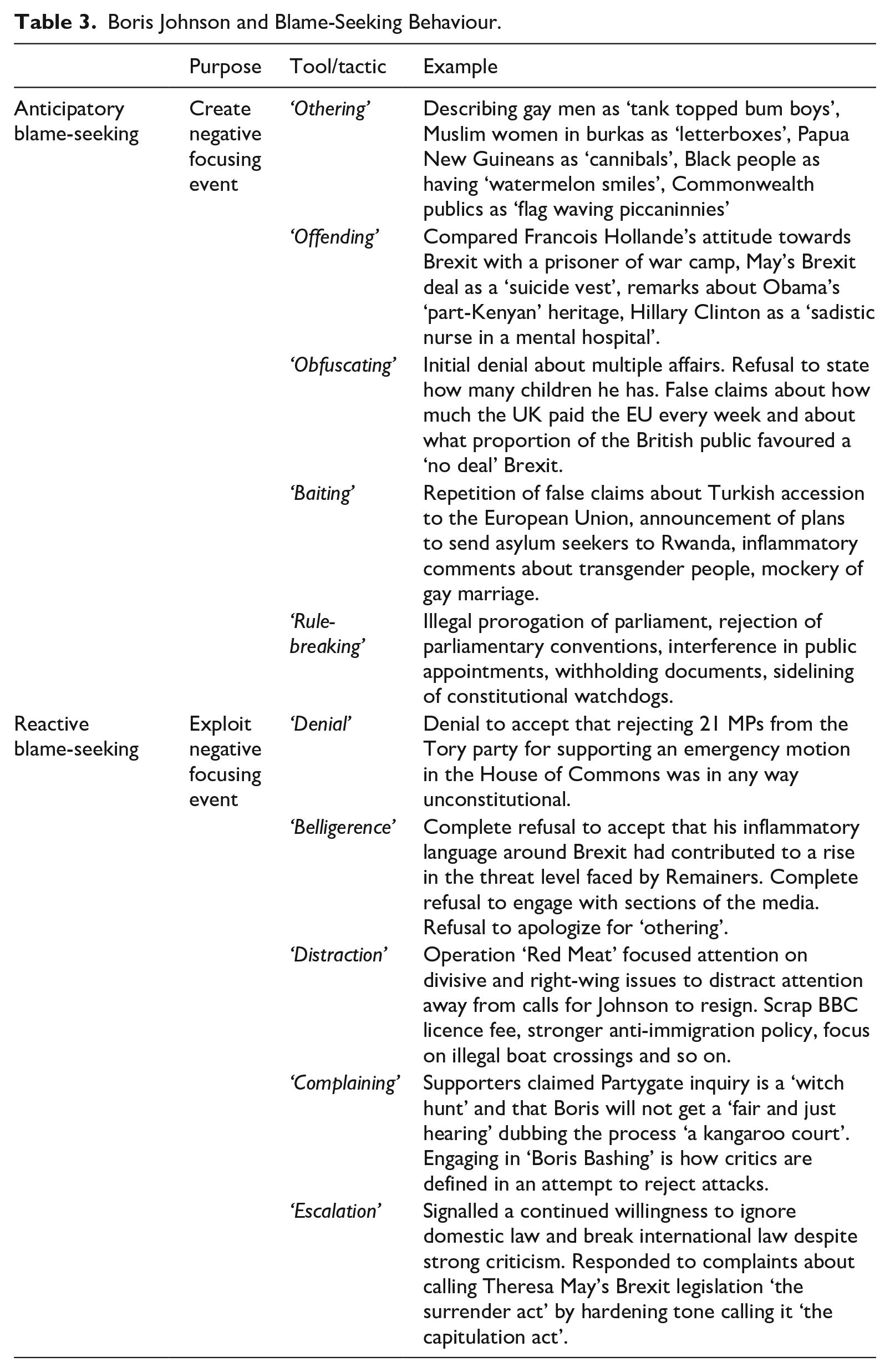
This section draws on an analysis of five biographical accounts of Johnson’s life and career: Sonia Purnell’s (2012) Just Boris; Nigel Cawthorne’s (2015) Blond Ambition: The Rise and Rise of Boris Johnson; Tom Bower’s (2020) Boris Johnson: The Gambler; Andrew Gimson’s (2022) The Rise and Fall of a Troublemaker at No.10 and Sebastian Payne’s (2022) The Fall of Boris Johnson. The analysis is complemented by additional autobiographical content, relevant survey data and cognate academic analyses to produce an original and novel account of the politics of blame-seeking. Table 3 provides a descriptive and audit-based account of how Johnson’s career to date has included the full range of blame-seeking ‘tactics and tools’ (based on Table 2, above). The remainder of this section offers a brief chronological account of three phases of the ‘rise-fall, rise-fall, rise-fall’ of Boris Johnson (BBC, 2016).
Boris Johnson and Blame-Seeking Behaviour.
Phase 1. Learning the Logic: Johnson the Journalist – 1987–1994
The central argument of this sub-section is that it was during Johnson’s time as a full-time journalist that he learned the logic of blame-seeking. Sacked from his first job with The Times for fabricating quotes (and refusing to apologize), Johnson moved to The Telegraph and quickly established a reputation for adopting a highly personalized, politically provocative and often nostalgic style of writing in order to cultivate a following with the paper’s ‘middle England’ readership (i.e. traditional, conservative, middle-class). Blamed by his colleagues for laziness and lying (see Purnell, 2012), Johnson garnered praise and credit from the Telegraph’s editor, Max Hastings, who ‘liked mavericks’ and ‘in 1989 . . . had the idea of causing mischief by sending Boris to be a Brussels correspondent’ (Mair, 2022: 7). Quickly bored with the bureaucracy of European governance, Johnson honed an approach to journalism that was based on a commitment to strategic antagonism. Launching what Oborne (2021) would later label ‘an assault on truth’, Johnson published a series of sensationalist and incendiary stories that resulted in condemnation from one audience (Europhile politicians and bureaucrats) but attracted praise, credit and reward from the paper’s readers and publishers. It was a clear example of blame-seeking (esp. of the ‘obfuscating’ variant) as Johnson created and then promoted a number of ‘Euromyths’ (British sausages were to be banned, bananas straightened, condom sizes standardized, etc.).
The political impact of Johnson’s journalism should not be underestimated. As Foreign Secretary (1989–1995), Douglas Hurd complained to Hastings about Johnson’s lies and exaggeration, and the Foreign Office was forced to establish a rapid rebuttal unit. Prime Minister John Major complained of Johnson’s ‘grenades’, and the former Conservative minister and European Commissioner Chris Patten would later describe Johnson as ‘one of the greatest exponents of fake journalism’ (see Fletcher, 2017). Purnell (2012) credits Johnson’s journalism during this period as playing a major role in the creation of the UK Independence Party (UKIP) in 1993. As his former colleague Tim Walker (2022: 11) notes, ‘[Johnson] was quick to see that there was a good living to be had out of lying about the EU’. ‘Being blamed’ for his journalism by European elites ‘worked’ for Johnson in the sense that the condemnation and criticism he attracted simply enhanced his credibility and status among anti-European elements within British society. ‘I was just chucking these rocks over the garden wall’ Johnson would later admit on the BBC’s Desert Island Disks: and I’d listen to this amazing crash from the greenhouse, next door, over, over in England, as everything I wrote from Brussels was having this amazing, explosive effect on the Tory Party, and it really gave me this, I suppose, rather weird sense of, of power.
With the benefit of hindsight, three elements of this first phase of Johnson’s career are significant. First, it was in journalism that he developed an understanding of strategic antagonism and blame-seeking behaviour. Second, Johnson did not just exploit an increasingly visible ‘us/them’ boundary over Europe but was an active participant in a form of ‘wedge politics’ that sought to proactively inflame division. And third, blame-seeking was not without downsides for Johnson. ‘Boris had become such a pariah among the EU officials’, James Landale noted (Purnell, 2012), ‘that no one would talk to him anymore . . . he had to go’. Promoted to assistant editor and chief political columnist at the Daily Telegraph, Johnson moved back to London in 1994.
Phase 2. Misalignment: Blame Is Generally Bad, 1994–2008
In the context of understanding blame-seeking, the argument of the previous sub-section is that although Johnson is frequently described as the UK’s first ‘celebrity politician’ it may be more accurate to understand him as a journalist-politician who understood the benefits of provocative behaviour, picking-fights and strategic antagonism in order to sell newspapers, secure votes and increase notoriety. The main argument of this section is that although this blame-seeking strategy continued and undoubtedly increased his income and celebrity status throughout this phase, it also brought significant costs when he attempted to move into professional politics. In the decades that spanned the millennium, the cultural context had not reached the point when a sufficiently polarized ‘us/them’ boundary had emerged and, as a result, being a blame magnet in politics was problematic.
This is visible during two specific periods: 1994–2001 when Johnson was still a full-time journalist and 2001–2008 when he became a full-time MP while retaining a number of lucrative journalistic commitments. In the mid-to-late 1990s, Johnson continued to develop his blame-seeking brand of journalism by simply shifting the focus of his strategic antagonism from Europe to topics that were likely to provoke progressive cosmopolitan elites and please right-leaning sections of society. A combination of ‘othering’, ‘offending’, ‘obfuscating’, ‘baiting’ and ‘rule breaking’ saw him describe gay men as ‘tank topped bum boys’, Muslim women who wear burkas as ‘letterboxes’ and Papua New Guineans as ‘cannibals’ – to mention just a few incendiary incidents. Johnson was ‘flaunting of the low’ through an explicitly antagonistic performative style ‘with “the middle finger” defiantly raised’ as Pierre Ostiguy (2017: 84) puts it ‘to the well brought up, the proper, the accepted truths and ways associated with diverse world elites’. Johnson’s appointment as editor of the right-leaning Spectator magazine in 1999 provided a distinctive and highly visible platform for his ‘challenger brand’ with a mixture of laddish masculinity, veiled xenophobia and pointed provocations. But blame-seeking appeared to work. Not only did the Spectator’s circulation increase to record levels, but Johnson was invited to appear on prime-time television shows and write regular columns for popular magazines.
Matush’s (2023) work highlights the risks of backlash effects where the costs of strategic antagonism are less positive and may close-down certain options. This connects to Johnson’s career in the sense that his growing notoriety, dubious reputation and celebrity status–plus the manner in which his journalism had delighted in exacerbating intra-party tensions over Europe–had created serious concerns within the Conservative Party about his credibility and reliability. Elected as MP for Henley in 2001, these concerns proved well-founded as Johnson refused to resign as editor of the Spectator and continued with a host of extra-parliamentary pursuits. His attendance record was poor, his contributions from the floor of the chamber were often overly flippant and therefore poorly received and his role with the Spectator too often meant he was surrounded by controversy and complaints. In 2004, Michael Howard’s attempt to control Johnson and benefit from his public popularity by bringing him into the shadow cabinet backfired within weeks when Johnson managed to offend the city of Liverpool, which was quickly followed by tabloid revelations about his private life.
Three elements of this second phase of Johnson’s career provide blame-seeking insights. First, although blame and credit might exist as antagonistic political elements, they are not trapped in a zero-sum equation. Johnson forged a national following and public popularity irrespective of and possibly because of his blame-seeking and rule-breaking procedure. Second, there are multiple boundaries and multiple ‘them/us’ divides to be managed and manipulated. Johnson navigated a fine line between being ‘in’ the Tory party while remaining outside ‘the herd’, as he would put it in his 2022 resignation speech outside No. 10. Blame from the parliamentary party was often tied to credit and praise from the party faithful, and it is noteworthy that after a highly controversial first term, he was re-elected in 2005 with an increased majority. Finally, very often the cost-benefit analysis does support the general rule that ‘blame-is-bad’ and realizing that his career at Westminster was at an impasse Johnson decided to run for Mayor of London and subsequently left the Commons in 2008.
Phase 3. Changed Cultural Conditions, 2015–2019
As Mayor of London (2008–2015), Johnson continued to develop his celebrity profile, while also constantly causing mischief for the Conservative Party. David Cameron labelled him ‘the greasy pig’ because he caused trouble wherever he went but seemed to take the blame. In fact, it was Johnson’s reputation as ‘bumbling buffoon’ who could not keep out of trouble – complete with unkempt hair and scruffy clothing – that defined him against more conventional politicians. This approach to politics and his reputation as a self-interested agent provocateur had left him politically isolated during his first period in parliament (previous sub-section). The costs of ‘being blamed’ for personal indiscretions and political blunders had outweighed the benefits. The main argument of this sub-section is that during 2015–2019 the cultural conditions in British politics changed and provided Johnson with a more favourable environment for his antagonistic brand of politics. Brexit polarized society in a way that chimed with the logic of blame-seeking (RQ1, above). Deadlock in parliament arguably created a rare ‘window of opportunity’ for an unconventional politician to exploit. Politicians ‘are more likely to engage in strategic antagonism’ Matush (2023: 6) argues ‘during times when there are high domestic benefits to signalling commitment to a constituency’s preferences’. In 2015–2019, Johnson engaged in an explicit campaign of not only aligning himself with growing anti-European sentiment (UKIP winning 2.5m votes in the 2009 European elections) but also with a broader constituency for whom ‘Brexistential angst’ reflected growing anti-system, anti-establishment and anti-political sentiment.
Johnson’s journalistic experience seems to have taught him that strategic antagonism and the blame, ridicule and scorn it could solicit (i.e. the backlash), was an effective way of winning praise, support and credit from those who existed on the other side of the ‘us/them’ boundary. Blame-seeking provided a logical strategy for a populist politician who wanted to underline their ‘outsider’ and ‘maverick’ qualities. Johnson returned to parliament in 2015 and, in February 2016, announced his intention to campaign in favour of Leaving the EU. His high-profile blame-seeking behaviour continued. In April 2016, for example, he published comments about President Obama that even members of his own party branded ‘idiotic’ and ‘deeply offensive’, and in June, he was censured for spreading false data and mistruths on behalf of the ‘Vote Leave’ campaign and was accordingly criticized by members of his own party for lying (see Wilkinson, 2016). In an appointment that was widely interpreted as trying to side-line a troublesome colleague, Theresa May appointed Johnson Foreign Secretary in July 2016. It is sufficient for the purposes of this sub-section to note that his tenure as Foreign Secretary was defined by frequent controversy and the antagonization of foreign leaders. Although blamed by his colleagues for damaging the reputation of the government, his continual ‘bumbling buffoonery’ brought benefits in the sense that he dominated the media, and his popularity grew among large sections of the public who had become disaffected with mainstream politics and politicians. His rejection of rules and increasing reputation for ‘clowning around’ seemed to align with growing anti-system sentiment. This contextual shift was demonstrated in stark terms by the Audit of Political Engagement 2019: [O]pinions of the system of governing are at their lowest point in the 15-year Audit series . . . People are pessimistic about the country’s problems and their possible solution, with sizable numbers willing to entertain radical political changes. Core indicators of political engagement remain stable but, beneath the surface, the strongest feelings of powerlessness and disengagement are intensifying (Hansard Society, 2019: 3) [emphasis added].
Half of respondents believed that the main parties and politicians did not care about people ‘like them’, and nearly two-thirds (63%) thought Britain’s system of government was rigged to advantage the rich and the powerful. Critically, the survey data revealed that over half of those surveyed (54%) agreed with the statement that ‘Britain needs a strong leader willing to break the rules’, and 42% thought that many of the country’s problems could be dealt with more effectively if the government did not have to worry so much about votes in parliament. Other studies uncovered even more radical and threatening levels of affective polarization and anti-system sentiment in the run up to the 2019 general election (see, e.g. Henderson, 2019). Unable to break the parliamentary deadlock over Brexit, May resigned, and on 24 July 2019, Johnson became party leader and Prime Minister. Johnson’s proroguing of parliament, the removal of the whip from 21 Tory MPs (including the Father of the House and 2 former Chancellors of the Exchequer) and generally refusing to abide by constitutional norms and conventions was designed to strategically and symbolically position him on the side of ‘the public’ against ‘them’, the existing establishment elites. They were symbolic and performative acts that were designed to enrage one side of the socio-political ‘us/them’ boundary while engaging with the other.
This insight matters for several reasons. First, it fits with the work of Evans et al. (2023) on ‘Boris Johnson to the Rescue’ and how the Conservatives won the radical right in the 2019 general election. Johnson was essentially a ‘challenger brand’ politician who was co-opted into a mainstream party’s accommodating strategy when it faced the loss of significant votes to the Brexit Party. Johnson’s antagonistic appeal helped the Conservative Party to stem the outflow to the Brexit Party, while also attracting many Leave supporters who had previously voted Labour in 2019. Johnson was able to unify one bloc of a polarized cross-cutting cleavage so that votes were sufficiently concentrated relative to competition. The result was an 80-seat parliamentary majority, the largest Conservative majority since 1987, and 43.6% of the national vote.
Moreover, while it is notoriously difficult to connect election outcomes to the actions and performance of individual politicians, the available public opinion data indeed indicates that Johnson’s blame-seeking behaviour contributed substantively to his electoral success. In this regard, it is particularly striking that the leadership change from May to Johnson led to the Conservatives’ second-highest bounce in party popularity and leadership satisfaction since 1965 – and this despite the fact that at this point they constituted ‘a long-serving party of government seeking re-election on the back of austerity fatigue and the Brexit crisis hardly amounted to the traditional recipe for election success’ (Heppell and McMeeking, 2021: 60). Perhaps even more importantly, Johnson’s election to the party leadership did not only lead to very strong and consistent improvements in party popularity and leadership satisfaction – Johnson also emerged ‘as a highly divisive politician relative to other new leaders of the Conservative Party’, with many voters having a positive opinion of him, a significant share of voters having a negative opinion, and a very low score in terms of voters having no opinion (Heppell and McMeeking, 2021: 60). This antagonistic opinion pattern tightly aligns with Johnson’s long-standing appeal as a divisive politician and his reputation for rule-breaking, strategic antagonism and blame-seeking behaviour.
What is more, the parliamentary stalemate over Brexit was a very rare and highly unconventional moment in British political history which arguably demanded a rare and highly unconventional politician to break the deadlock. Strategically antagonizing any one of a host of actors or groups (Remainers, judges, constitutional experts, etc.) simply created a backlash that was presented by Johnson and those around him as evidence of the existence of an ‘out of touch’ elite, and then harnessed to secure and sustain support from those who felt the existing political system was failing them. Blame-seeking behaviour therefore chimed with a populist signal and in many ways the 2019 general election was ‘not just a Brexit election’ (see Evans et al., 2023: 9; Flinders, 2019) due to the way it was shaped by a variety of long-term shifts in support for the main parties, most of which pre-dated Brexit. The rise (and fall) of Boris Johnson provides, we suggest, an important empirical example of ‘the politics of blame-seeking’. The fact that political science and public administration have focused solely on blame-avoidance is the major knowledge gap this article seeks to draw attention to. Why this matters, and how this brief illustrative case study of ‘Johnsonian blame-seeking’ contributes back to theory provide the focus of the next section.
Conclusion: On Provocation, Outrage and Blame
The previous section drew on a brief case study of Boris Johnson’s rise to the British premiership to demonstrate the logic of blame-seeking and how it links to changed cultural conditions and affective polarization. The aim of this was to illustrate this article’s core thesis on the emergence of tactics and tools of blame-seeking behaviour that challenges the dominant ‘self-evident truth’ within political science and public administration that ‘blame-is-bad’. Paradoxically, being blamed can provide a rational form of credit-claiming behaviour (i.e. an ‘enrage to engage’ approach). The politics of provocation therefore takes on a new significance in the context of polarization, populism and blame-seeking and the aim of this conclusion is to tease out the broader significance of this thesis. It does this through a three-stage process that moves from the micro case-study level back up to macro-level concerns about the future of democracy.
What did the brief review of Boris Johnson’s career add to our broader understanding of the politics of blame? Three insights emerge. First, the ‘blame-is-usually-bad’ thesis is generally true, and the logic of blame-seeking is only likely to bear fruit in exceptional circumstances. Once the context shifts those unconventional qualities that previously sustained public support and propelled an antagonizing politician into office may revert to becoming political liabilities. Johnson may well have been able to ‘get Brexit done’ because of his rule-breaking regime but during COVID, there was no clear ‘us/them’ boundary to be exploited, and Johnson’s personal and professional weaknesses were ultimately exposed and led to his resignation (see Baker and Lelleker, 2022). Hence, blame-seeking may be a strategy that works best in contexts where politicians do not have to bear too much executive responsibility and, probably even more important, do not have to manage severe crises; events during which voters put particular emphasis on the competence of their leaders (Boin et al., 2008). The second insight is that blame-avoidance and blame-seeking behaviours are not ‘all-or-nothing’ approaches but are best seen as parallel patterns of statecraft. Johnson, for example, adopted a ‘blended blame’ approach whereby he would engage in policy, agency and presentational forms of blame-avoidance (sacking officials, abolishing arm’s-length agencies, ‘hugging the experts’, etc.) (see Flinders, 2020) while at the same time engaging in strategic antagonism. The third and final insight is arguably the most case-specific: Johnson’s use of humour, comedy and faux failures as antagonistic tools.
Johnson’s notoriety for ‘jesting’, ‘japing’ and ‘clowning around’ was a strategically calculated political performance that was designed to ‘enrage and engage’ on either side of the ‘us/them’ boundary in equal measure. The unkempt hair, dishevelled clothes and generally confused demeanour were part of a carefully choreographed approach. The ‘Just Joking!’ defence or claims that it was ‘wholly satire’ – as Johnson would often complain when attacked for inappropriate comments (see Forrest, 2019) – is also a powerful way of deflecting the blame back on the critic (overly sensitive, lacking a sense of humour, etc.). The affected accent, ‘Bertie Woosterish’ mannerisms, bumbling manner and so on were all designed to align with a particularly English cultural context. In this sense, the jokes about gay men, Muslim woman, black men and so on plus the history of insulting foreign leaders not only underline Matush’s (2023) thesis on strategic antagonism and harnessing backlash but also the way in which Johnson’s blame-seeking style resonated with a culturally specific and notably nostalgic English consciousness (see Finlayson, 2017; Graham, 2016); just as President Duterte in the Philippines framed his abuse of Obama to chime with pre-existing domestic sentiment.
This flows into two mid-range or meso-level insights. First and foremost, our argument is not that blame-seeking behaviour is a new phenomenon. Prior practitioners include Huey Long of Louisiana in the United States, and a long list of populist and extremist politicians in inter-war Europe – most notoriously, Hitler and Mussolini. But even the most cursory review of international politics suggests that an unusually high degree of political success has recently been enjoyed in established democracies by individual politicians who utilize blame-seeking tactics and tools. From Donald Trump to Jair Bolsonaro through to parties including Austria’s Freedom Party, the Alternative for Germany, the Swedish Democrats, the Italian Lega and so on. These examples clearly link the analysis of blame to the populist signal (qua. Jacobson, 2024) in a novel manner. This (second) leads to a question about the potential benefits of blame-seeking which can be briefly identified in terms of: (1) authenticity (i.e. although controversial, blame-seekers are at least ‘doing what they promised’, ‘saying what they think’, ‘being honest’, etc.); (2) attention (i.e. faux failures, breaking the rules, antagonizing opponents provides a way of dominating and setting the political agenda, especially in an increasingly sensationalist 24/7 media environment) and (3) distraction (i.e. the generation of blame, anger or rage while questioning/rejecting official statistics or scientific data to blur a clear focus on policy outcomes and governmental effectiveness). Donald Trump’s widely reported desire in April 2023 to be handcuffed and led into court in relation to accusations that he paid hush money to an adult film star provides a case in point that reinforces the performative and symbolic benefits of blame-seeking (see Lowell, 2023). The reasoning of the former president for wanting to be handcuffed behind his back and made to do a ‘perp walk’ (i.e. a highly visible and dramatized shaming) was that he wanted to turn the event into a spectacle that would allow him to project defiance in the face of what he portrayed as an unfair prosecution and that it would galvanize his supporters behind him for his 2024 presidential campaign. In essence, Trump sought to be blamed by opposition politicians, liberals and the state so that he could harness the backlash effects such a spectacle would create among his radical-right supporters.
Blame-seeking behaviour therefore exposes a politics of provocation and numerous ‘incentives for outrage’ that have generally been overlooked and under-acknowledged within traditional blame-theoretic political science and public administration. Cultural analyses by contrast display an awareness of ‘affective politics’ that has an increasingly visible emotionality (see Boler and Davis, 2020) that underlines why ‘feelings trump facts’ in the context of blame (Flinders, 2020), and connects to Sandel’s (2020) work on ‘the politics of humiliation’ (see also Dowding, 2020). This argument leads into two macro-political insights, the first relating to inequality and the second to the future of democracy. As levels of social and economic inequality continue to increase then so too is it likely that a larger proportion of the public will exist within what Kahneman and Tversky (1984) call ‘the realm of losses’ where a continuation of the status quo produces unacceptable outcomes for significant sections of the public which, in turn, leads to disillusionment with conventional politics and a questioning of the pre-existing ‘rules of the game’ and assumptions about ‘acceptable’ or ‘appropriate’ behaviours (Hahl et al., 2018). This creates exactly the sort of contextual conditions in which the logic of blame-seeking emerges because in polarized societies there are increasingly few low-risk policy areas where ‘being blamed’ is not to a large extent inevitable. Therefore, a bullish, unconventional and adamantly antagonistic approach is at least likely to secure the strong support of a large minority rather than the indifference or apathetic rejection of the majority.
This has major and obvious implications for the future of democracy, and it is noteworthy that this article’s identification of blame-seeking behaviour comes in the wake of a far broader literature on the ‘crises’, ‘suicide’ or ‘end’ of democracy. What this article has added to the discussion is a critique of existing analyses of blame, and the identification of blame-seeking behaviours that are innately divisive and destructive to the norms and values of democracy. A deeper analysis into the phenomenon is likely to yield important political, institutional, cultural and policy insights, as well as a clearer understanding of its causal antecedents.
Footnotes
Acknowledgements
The authors would like to thank Kent Weaver for his seminal input, which helped us develop the ideas presented in this article.
Declaration of Conflicting Interests
The author(s) declared no potential conflicts of interest with respect to the research, authorship and/or publication of this article.
Funding
The author(s) received no financial support for the research, authorship and/or publication of this article.
