




Abstract
This article investigates the relationship between public funding and the political activities of youth organisations in Europe. By analysing original data from a random sample of about 4500 youth organisations in nine countries generated through a content analysis of organisations’ websites, we examine the extent to which they engage in political activities. The analysis provides evidence for a negative impact of public funding on the engagement of youth organisations in political activities. This suggests that receiving financial resources from state institutions may lead to depoliticisation. Moreover, we also show how the effect of public funding is conditional upon the broader context, suggesting that the question of whether public funding encourages or discourages youth organisations to carry out political activities may be contingent on their broader economic and political environment.
Introduction
Political engagement is fundamental to democratic societies giving voice to citizens and linking public opinion to policy change (Rasmussen and Reher, 2019). Recently, there have been major concerns about declining political participation among the citizens of advanced democracies and rising distrust towards traditional political processes (Giugni and Grasso, 2019b, 2021a). This process is understood to be particularly marked among young people (Grasso, 2016). One of the main ways in which citizens come to participate politically is through political organisations, interest organisations, and lobby groups which mobilise and publicise various political actions and push for different types of political change (Binderkrantz and Pedersen, 2019). Youth organisations are therefore particularly relevant for supporting the democratic participation of young people (Giugni and Grasso, 2020a, 2021b). Moreover, public funding is important, and indeed, sometimes fundamental, for the activism of civil society organisations as the state can be a fundamental source of revenue for them (Rozbicka and Mahrenbach, 2023). While one may think that receiving money from the state is a good thing since it fills the organisations’ pocket supporting their aims (De Bruycker and Hanegraaff, 2024), providing them with crucial resources to carry out their activities, and sometimes being necessary for their very survival, this may in fact mask more complex underlying dynamics of influence which are rather leading to the opposite outcome – depoliticisation. There may be unintended consequences of various sorts which affect on the actions of the organisations themselves. Deradicalisation could be one relevant outcome: organisations that receive money from state institutions are more likely to become less radical (Ostrander et al., 2005; Stroup, 2012). Here we focus on an important negative potential consequence of public funding for youth organisations: depoliticisation. By this we mean that organisations undergo a process whereby they focus less on carrying out political activities, as opposed to other types of activities such as social, economic, or cultural activities, which are often also part of the repertoire of youth and other political organisations (Grasso and Giugni, 2018). In other words, organisations move away from advocacy to focus on other kinds of activities as a result of receiving public money (Clément, 2017).
It is often argued that the involvement of young people in political organisations will renew their bases and allow for the representation of more diverse voices into political debate (Grasso and Giugni, 2022; Grasso and Smith, 2022; Holecz et al., 2022). In turn, this is seen as allowing for the growth and development of more vibrant democracies, that are better geared for responsiveness to all sorts of constituencies including younger age groups that are often unheard and feel left out of the democratic process (Berkhout et al., 2023). However, if receiving governmental funding undermines the very politicisation of these youth organisations, then their possibilities for leading to democratic renewal, contestation of inequalities in representation, and so forth are reduced if not wholly undermined. As a result, it becomes critical to investigate the extent to which governments support or hinder youth political engagement by funding youth organisations in certain contexts. Can public funding support youth organisations for increasing their political activities and therefore broaden youth political engagement and inclusion? Or, rather, is this not necessarily helpful in certain contexts as it may rather lead to a depoliticising effect on youth organisations and therefore end up undermining their potential for renewing democracy and adding vibrancy to the political sphere through the engagement of younger generations? These are the key questions motivating this investigation. By analysing these important issues for democratic politics today, we hope to speak to the broader question of whether and to what extent it may make sense for governments to provide financial support to youth political organisations and, if so, what are the implications of doing so for the organisations themselves and for their potential for spurring youth political engagement, democratic renewal, and mobilisation.
Looking at how public funding might affect youth organisations, specifically their political involvement, is of outmost importance (Bolleyer and Correa, 2022). From the point of view of the state, funding youth-related or youth-led organisations is a way to support them directly and, by doing so, show commitment to supporting younger generations and the political participation of future generations. Providing youth organisations with financial resources sustains the idea that governments should proactively intervene in favour of supporting those who are seen as the future of our democracies. Therefore, state institutions at all levels – local, regional, national, and supranational (most notably, European) – have implemented programmes to provide such support for younger generations’ engagement (EURYKA, 2020b). Concerning the European level, in particular, the European Commission has set up various initiatives and programmes in support of young people, such as it can be seen most notably in the European Youth Strategy for example. Most importantly for the present purpose, governments often provide youth organisations with financial resources. This can be seen at different levels of governance, from the local up to the regional, national, and European. Examining the consequences of such public funding for youth organisations themselves is therefore paramount to understanding its implications and for deciding on the best strategy to reach goals of effectively supporting future generations and allowing young people to organise and engage politically (Endo, 2023).
From the point of view of youth organisations, receiving financial resources from state institutions can be particularly useful insofar as, being non-profit, they do not always have many alternative funding sources such as private donations, membership fees or other revenues from services they provide, money from fundraising activities, and so forth (Giugni and Grasso, 2019a). However, this type of top-down funding may have a dampening effect on youth organisations and undermine their political engagement. In other words, the perverse effect of this could be that that youth organisations become ‘tamed’ through a process of depoliticisation. To be sure, a similar reasoning also applies more generally to civil society organisations, although in this case, there is a higher number of larger and more established organisations which can draw their resources also from other sources. Here, therefore, we are interested in focusing on youth organisations and, importantly, on assessing the impact of funding in this respect, since they are critical for addressing some of the major woes of democracy and engaging and politicising young people for a vibrant public sphere and resolving the ‘democratic paradox’.
To examine the extent to which youth organisations’ carrying out political activities is related to public funding, we contrast political activities to other types of activities such as those of providing services to their beneficiaries or purely internal organisational activities. This is particularly relevant for making sense of the extent to which youth and youth organisations in the public domain are politicised and the extent to which government intervention can promote or depress political engagement of groups of citizens in general and young people in particular. Furthermore, we examine the role of the broader economic and political context and the ways in which it may facilitate public funding. We do so in two ways. On one hand, we wish to ascertain to what extent the politicisation of youth organisations depends directly on the broader economic and political context in which they are located. On the other hand, we look into the interaction between public funding and the broader context by examining whether the impact of public funding on youth organisations’ political activities is conditional upon the broader economic and political conditions.
In the next section, we review the existing literature on public funding of civil society organisations, especially with an eye to its impact on youth organisations. The presentation of the data and methods as well as the presentation and discussion of findings then follow. Our analysis relies on an original dataset of a random sample of about 4500 youth organisations in nine countries which also allows us to take into account the role of the broader economic and political context as a potential factor conditioning the impact of public funding on youth organisations’ political activities.
Youth Organisations and Public Funding
Previous work on the relationship between public funding and civil society, non-governmental or non-profit organisations has found mixed evidence (see Bloodgood and Tremblay-Boire, 2017 for a more detailed discussion). On one hand, research shows that government funding may encourage organisations to engage in political activity (Chaves et al., 2004; Lecy and Van Slyke, 2013; Mahoney, 2008; Mosley, 2011) for a variety of reasons the discussion of which is beyond the scope of this article. A number of studies on the non-profit sector in the US, for example, have found a positive relationship between government funding and non-governmental organization (NGO) advocacy (Bass et al., 2007; Mosley, 2011; Moulton and Eckerd, 2012; Smith and Pekkanen, 2012). Furthermore, research on Europe has found that national government funding does not limit political activity and, in particular, that EU funding has empowering effects on NGOs (Chaves et al., 2004; Císar and Vráblíková, 2013; Greenwood, 2007; Neumayr et al., 2015; Sanchez Salgado, 2014).
However, scholarship suggests that organisations active in different fields such as the nonprofit sector, ethnic minorities, and social justice are less political when they receive public funding (Basok and Ilcan, 2003; Ng, 1996; Smith and Lipsky, 1995; Stasiulis, 1980; see further Clément, 2017). In other words, government funding could dampen advocacy and political activism, not only when it is particularly substantial (Anheier et al., 1997; Child and Gronbjerg, 2007) but also when it represents a smaller share of an organisations’ revenues (Schmid et al., 2008). Bloodgood and Trembley-Boire (2017) suggest that these contradictions can be explained by different operationalisations of advocacy, different definitions of NGOs, and different populations of organisations (especially since most studies focus on the US).
Scholarship on social movements has also examined how public funding may constrain or co-opt movement actors and activism (see Corrigall-Brown, 2016 for a review). From a social movement perspective, public funding may be considered as an aspect pertaining to the political opportunity structures influencing movement organisations and constraining their tactical choices. While political opportunity theorists have traditionally focused on ‘input structures’ such as the degree of openness of the state and the capacity of the state to integrate political demands from challengers (Kriesi, 2004; McAdam, 1996), ‘output structures’ and public policies are also a very important part of what may either facilitate or prevent social movement mobilisation (Kitschelt, 1986; Meyer, 1993). Public funding is a key aspect in this regard.
Our theorising is close to channelling theory (Jenkins, 1998; Jenkins and Eckert, 1986; McCarthy et al., 1991). This theory states that external funding might encourage the creation of organisations, however, at the same time, it channels activism into more structured and less militant forms (Clément, 2017). This may include a process of depoliticisation of the organisations that received the financial support as they would be less inclined to engage in political activities. This is likely to be even more so for activities such as protest, which often targets the state, that is, the very source of part or all of the organisations’ financial resources. In this sense, therefore, funding would likely be expected not to spur but rather to depoliticise youth organisations, thereby pushing them out of activism.
While channelling theory has most often looked at the impact of private funding, research has shown that public funding has a similar channelling effect (Clément, 2017). In this sense, funding civil society organisations – including youth organisations – might be seen as a means of social control, less visible and risky than repression, in particular, of groups deemed more prone to becoming involved in protest activities (Earl, 2004). In this regard, while governments often pay lip service to wanting to spur political activism and particularly the engagement of youth, the focus is rather to spur those types of youth political participation that may grant legitimation. When considered from this perspective, it would seem less likely that governments would aim to support critical contestation from anti-government youth-led movements, for example. However, these too are the heart and soul of vibrant democracies and are necessary to spur healthy democratic debate about how we should organise societies. Therefore, in a world where organisations have to rely more and more on government funding, it may also be that more critical voices come to be suppressed as more politicised youth organisations become marginalised since they would not be as successful in attracting funds to be able to function. In this way, a vibrant democratic sphere cannot solely be reliant on government funding as even with the best intentions this type of context may end up undermining contestation and more radical voices. Ideally, all democratic voices should be allowed to contribute to debates about how society should be organised and without the risk of being silenced on the basis of whether their organisations of reference are able to receive funding or not. A democracy that becomes based on funding runs the risk of becoming particularly unequal, undermining it.
Thus, following institutional channelling theory, we hypothesise a negative effect of public funding on the politicisation of youth organisations, whereby organisations that obtain part or all of their financial resources from public sources will be less politicised, as shown by a lower share of their activities being political instead of social, cultural or other. Why? There might be a variety of reasons for this. Bloodgood and Tremblay-Boire (2017) give two reasons for the dampening effect of government funding on NGO lobbying. First, a threat-based explanation: donors would discipline organisations through implicit or explicit threats to withdraw funding should their activity become too radical. As a result, increased government funding should moderate organisations’ political activity. Second, a self-selection explanation: more politicised organisations are less willing to seek or accept government funding for ideological and strategic reasons. We argue that, by receiving financial support from public sources, youth organisation become in some way ‘tied’ to such funding provided and therefore less inclined to engage in political activities which the donors might see as more ‘threatening’ and not in line with what they think should be expected from the youth organisation and therefore undermining their access to sources of funding. In other words, we suggest dependency as the key mechanism through which public funding leads to a depoliticisation of youth organisations which would feel constrained not to be ‘too political’ for fear of losing their funding and therefore possibly the ability to engage in other activities which young people and others might have become reliant on. Such dependency might take the form of co-optation, which is one way in which the state tries to respond to the challenges mounted by social movements (Gamson, 1990 [1975]), but this is not a necessary path leading to depoliticisation and there could be alternative ones.
In contrast, public funding should have a more positive impact on other types of activities carried out by youth organisations, including social, economic, and cultural activities. These kinds of activities are likely to be seen as less ‘threatening’ for the donors. As a result, organisations that emphasise them are less likely to undergo such a process of depoliticisation. Thus, while public funding has a negative impact on youth organisations’ political activities, it should have a positive effect on other kinds of activities.
The Role of the Broader Context
As a way of taking into account a more complex reality, in addition to testing the hypothesis that public funding leads youth organisations to move away from carrying out political activities in favour of other types of activities, we further explore the extent to which the impact of public funding on youth organisations is conditioned by the broader context. We look both at the economic and political context. We capture the former through economic conditions and the latter through the stability of the political system. We expect these two aspects to have both a direct and an indirect impact on youth organisations’ political activities. However, the rise of grievances linked to deteriorating economic conditions appear in many studies to be – directly or indirectly – linked to political activities and in particular to protest behaviour (Kriesi et al., 2020; Kurer et al., 2019; Portos, 2021). For example, economic growth has been shown to be negatively correlated with individual-level protest participation (Grasso and Giugni, 2016). By the same token, we expect economic wealth to negatively affect on youth organisations’ political activities but not necessarily other types of activities. Similarly, political opportunity theorists have long shown how the political context may influence social movements. In particular, the instability of political alignments often leads to increased political mobilisation by social movements and favours involvement in protest activities (Kriesi et al., 1995; McAdam, 1996; Tarrow, 1989). Based on these insights, we expect youth organisations’ political activities but not necessarily other types of activities to be negatively affected by political stability.
However, we believe that the broader context interacts with public funding, so that its impact on youth organisations’ political activities would vary depending on the state of the economy and the stability of the political system, in other words, of economic and political macrolevel factors. Given the lack of previous research on such macro-meso interactions, here we refrain from advancing specific hypotheses and more modestly advance in an explorative fashion that the impact of public funding on youth organisations’ political activities – and therefore on their potential depoliticisation – will vary depending on the economic and political context. More specifically, we expect such an impact to vary depending on economic wealth (as measured through GDP) and institutional opportunity structures (as measured through political stability).
We may speculatively take an extra step and advance that, while good economic conditions negatively influence the likelihood of youth organisations in general to become involved in political activities, this effect is even more pronounced for those organisations that do not receive public funding. This could be because public funding, although leading to their depoliticisation, mitigates the negative effect of economic downturns on youth organisations. Similarly, we may theorise that while political stability negatively affects the likelihood of youth organisations getting involved in political activities, this effect if even more pronounced for those organisations that do not receive public funding. Once again, this could be since public funding mitigates the negative effect of political stability on youth organisations.
Data and Methods
The data employed in the analyses below were collected in the context of the EU-funded Horizon 2020 project ‘Reinventing Democracy in Europe: Youth Doing Politics in Times of Increasing Inequalities’ (EURYKA) covering nine European countries: Germany, Greece, France, Italy, Poland, Spain, Switzerland, Sweden, and the United Kingdom. One of the key utilities of these data are that they allow us to address aspects related to the meso-level – that is, the organisational dimension of youth politics – by retrieving information on youth-related and youth-led organisations through a content analysis of the organisations’ websites drawing mainly on Action Organisation Analysis. This method uses hubs-retrieved websites to map, sample and code action organisations. An action organisation ‘is a formal or informal group or organisation (e.g., producer–consumer initiatives, cooperatives, self-help groups, non-governmental organisations) engaging in strategic contentious and noncontentious actions in the public sphere with claims on their beneficiaries or participants’ (Kousis et al., 2018: 743).
The method is described in Kousis et al. (2018). It can be divided into the following four main phases (for complete details, see Kousis et al., 2018): (1) identifying the hub-websites of organisations as well as individual websites on the topic at hand through systematic Google searches and related literature; (2) scraping the hubs to identify organisational data, using a publicly accessible hub-website containing links to other sites as the entry point for the analysis; (3) randomising and constructing the sample from the merged lists by applying inclusion criteria such as the type of organisers and activities or the time period of the organisation; (4) training the coders, finalising the codebook, carrying out reliability checks, and coding. This allows to reconstruct the organisational field (goals, activities, constituencies, networks) in order to learn more about the opportunities that civil society organisations may provide for re-imagining democracy and experimenting with new models of representation and participation in decision-making at national and transnational levels. In this way, the process of bringing together the dataset also involved examining which organisations are active in each country; how relevant these organisations are in terms of size, population coverage, territorial density, and so forth, and also their goals, methods, activities, and so on; what networks they have built among each other; how important young people are within the organisations in terms of membership, goals, activities, and identities; and what positive impacts on the reduction of inequalities and the promotion of alternative politics and models of democracy young people can achieve through the organisations.
A youth-related or youth-led organisation (henceforth, youth organisation) is defined as a collective body/unit which organises youth and voices claims in one or various issue fields and forms of activity – as depicted through the organisation’s website. Accordingly, a youth organisation was included in the sample insofar as follows: (1) It focused (through its goals, activities, and/or constituencies) on youth (in general or on specific youth groups) and/or was led by youth; and (2) it had social or political topics, aims, repertoires of actions, in a very broad sense, even if the main goals were cultural or leisure-related (e.g. including sport clubs, culture groups, and groups helping refugees). Therefore, not all the organisations included in the sample are overtly political ones, and the degree of involvement in political activities may vary strongly across organisations.
A sample of about 500 youth organisations in each country was drawn based on an organisational map following the procedure outlined earlier, then merged into a single comparative dataset. The coding of organisations was conducted between 23 June 2019 and 13 January 2020 on the basis of a standardised codebook. The codebook was structured around four main groups of variables: identifying variables, organisational profile, activities and constituency groups, aims and values. A number of variables were included in the present analysis as described below. 1
The different types of activities carried out by youth organisations form the dependent variables of our analysis. We distinguish between seven main types of activities: social, economic, self-organising activities, cultural, religious, and other activities, in addition to political and advocacy-related activities which are the main focus of our analysis. Other activities is a residual category including everything which is not in the other six categories. 2 We show the distributions across countries of all seven types of activities, but retain only the four numerically most important ones (social, economic, and cultural activities, in addition to political and advocacy-related activities) in the regression models. These are all dummy variables coded 1 when a given type of activity was mentioned and 0 when it was not.
Public funding is our main independent variable. This was coded based on a number of funding sources as reported by the organisations’ website. It is a dummy variable coded 1 for organisations receiving public funding (regardless of the political-administrative level) and 0 if they did not. We also created three dummies in the same way, capturing whether the funding comes from the municipality (local government), the state (regional or national government), or the European Union. This allows for carrying out a more detailed and nuanced analysis on the impact of public funding. While a continuous measure of public funding would have been preferable to see whether organisations that receive a larger share of their budget from state institutions are less political than those for which public funding is a smaller part of their budget, finding this more detailed information on websites is hard and may lead to measurement errors. We therefore rely on a more crude but more reliable measure.
Meso-level controls include a variable measuring the organisations’ scope of activities (1 = local, 2 = regional, 3 = national, 4 = supranational) and a variable capturing how young people are involved in the organisation. The latter is a dummy coded 1 when young people lead the organisation (as president, chair, main persons), are actively involved in organising activities, or are regularly engaging in the youth-related activities, and 0 when young people are regularly and directly targeted, passive beneficiaries of activities. 3
Finally, we include two macro-level predictors in the regression analysis: an indicator of economic conditions (GDP per capita in thousands of US dollars) 4 and one referring to institutional opportunity structures (political stability index). 5 Both refer to 2019 so as to have measures of context observed at the time that the coding of organisations’ websites was conducted. These variables allow us to capture country variations in the broader economic and political environment.
Before proceeding with the analysis and presentation of the findings, some words of caution concerning our data are in order. The data used in this article come from a content-analysis of youth organisations’ website. This has a number of potential limitations which should be mentioned (see EURYKA, 2020a for a more detailed discussion). In particular, we cannot claim representativeness as we only capture such organisations and groups that do have a website and, moreover, to the extent that the searched for information was actually present on their website. This may vary from one organisation to the other and also from one country to the other to the extent that the degree of structuration and institutionalisation of the civil society – and, in this case, of youth organisations – varies across countries. As a result, more loosely structured and/or local organisations are probably underrepresented in our sample. More generally, all this may result in biases both across countries and across different types of youth organisations. Yet, we believe that we still have valuable data for allowing us to examine the kind of general questions about the relationship between public funding and youth organisations’ political activities that we address in this article.
Activities of Youth Organisations and Public Funding
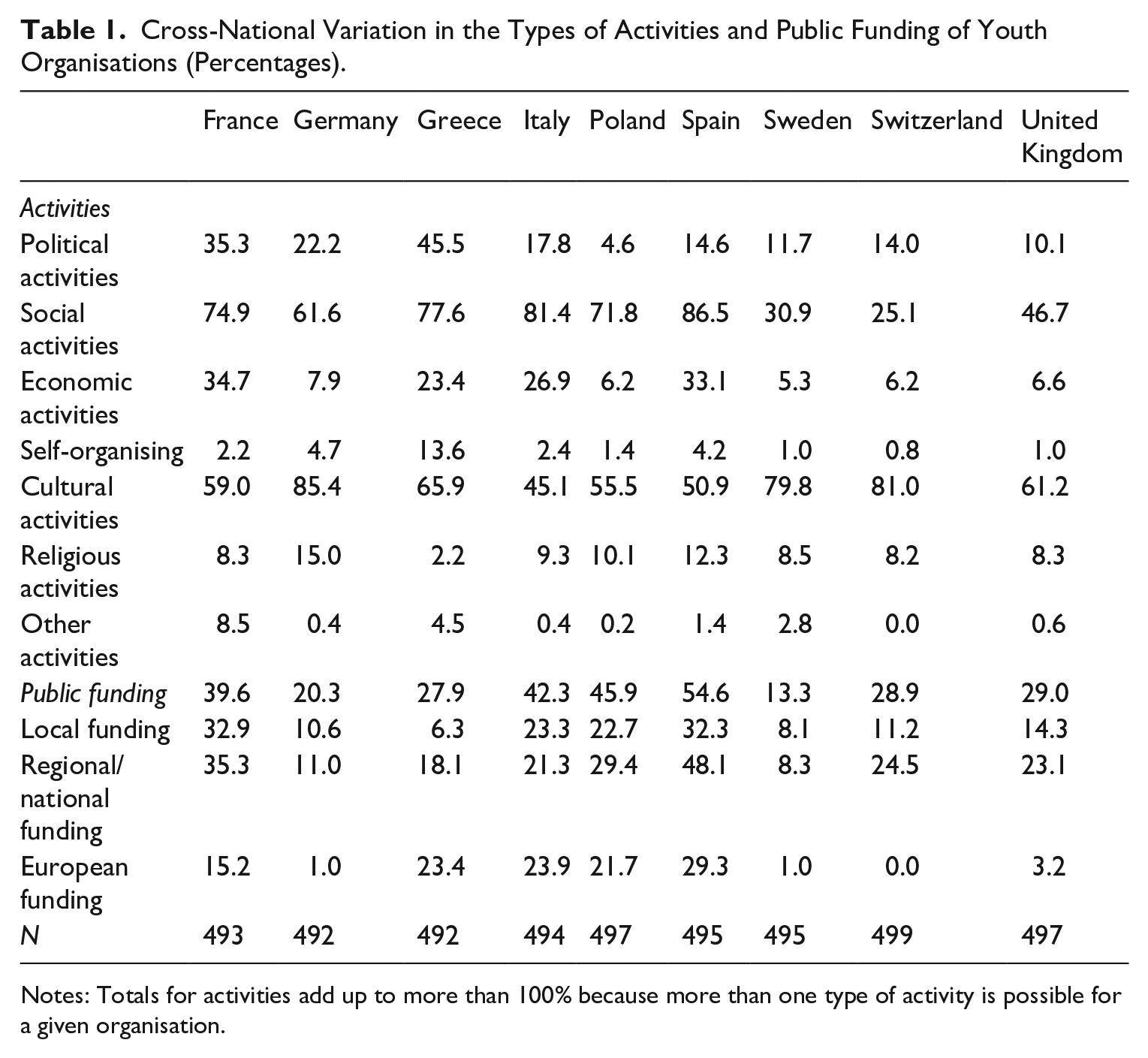
Before we test our key hypothesis about the impact of public funding on the politicisation of youth organisations and how such an impact may interact with the broader economic and political context, we present the results of descriptive analyses about key dependent and independent variables to examine how youth organisations vary in their activities across countries. It should be noted, however, that such descriptive analyses are particularly exposed to the biases discussed earlier. Table 1 shows cross-national variations in the organisations’ types of activities and in the extent of public funding. The first part of the table refers to the seven types of activities. As we can see, there are important variations across the nine countries in the importance that youth organisations give to each kind of activity. At the same time, social and cultural activities largely prevail, albeit not to the same extent in each country. Social activities play an important role in the agenda of youth organisations in most countries: France, Germany, Greece, Italy, Poland, and Spain. In Sweden and Switzerland – and partly also in the UK – however, they are less central. Cultural activities are especially important in Germany, Sweden, and Switzerland, where they amount to 80% or more. In some way, in the latter two countries, the low level of social activities seems in some way to be compensated by a higher share of cultural activities.
Cross-National Variation in the Types of Activities and Public Funding of Youth Organisations (Percentages).
Notes: Totals for activities add up to more than 100% because more than one type of activity is possible for a given organisation.
That social and cultural activities form an important part of the agenda of youth organisations everywhere should not come as a surprise as they include many different things ranging from basic needs and education to arts and sports. Our focus in this article, however, is on political activities. Once again, notable cross-national variations can be observed. Political activities are particularly important in France and Greece, and to some extent also in Germany. In Greece, in particular, nearly half of the youth organisations studied mention this type of activity on their website. In contrast, youth organisations seem to be less politically oriented in the other countries, particularly so in Poland. Below we will dig a bit deeper into the activities by distinguishing between more specific forms of action. Similarly, wide country variations exist for the next category, namely economic activities. They play an important role especially in France and Spain, and to some extent also in Greece and Italy. However, youth organisations appear to give them less priority in the other five countries.
The remaining types of activities seem to play a less central role in the agenda of youth organisations. Self-organising activities are only seldom mentioned, with the partial exception of Greece. Religious activities, however, are relatively sizable, ranging from 8% to 15%. Greece is once again the exception to the general trend here. Variations might be explained by the different role played by confessional youth organisations in each country. Finally, other kinds of activities have some relevance only in France. These mainly relate to the European Volunteering Service (now known as European Solidarity Corps), an international volunteering programme by the European Commission for young people to go to another country to work for a non-profit cause.
The second part of the table shows how public funding of youth organisations – our key independent variable – also varies across countries. The share of youth organisations that receives public funding – whether from local, regional/national, or European institutions – ranges from a high of 55% in Spain to a low of 13% in Sweden. The situation in France, Italy, and Poland is closer to the Spanish one, while that of Germany, Greece, Switzerland, and the UK resembles more the one of Sweden, although public funding is much higher in these countries.
Since our indicator of public funding merges the different levels and also includes funds coming from outside the national context, it is somewhat complex to relate this distribution with the specific, national opportunity structures of the nine countries. If we look more closely to the source of the funding, however, we can see whether regional/national-level funding – as opposed to either local or European funding – displays consistent patterns across countries. Here we can see that local funding of youth organisations is particularly important in France and Spain, a bit less so in Italy and Poland, and still lower in share in the other five countries. Regional/national funding is particularly sizable in Spain, where nearly half of the organisations receive financial resources from the regional or national government, but it is also important in France as it is to some extent in the other countries, with the exception of Germany and Sweden. Finally, European funding plays an important role above all in Spain, but also in Greece, Italy, Poland, and to some extent also in France, while being negligible in Germany, Sweden, Switzerland, and the UK.
In sum, net of the methodological limitations of the data discussed earlier, we observe important cross-national variations in the types of activities of youth organisations but also in the extent of public funding they receive from institutions at various levels. It is not our purpose here to account for those differences, also because there is little theoretical background to rely upon to explain them.
The Impact of Public Funding on the Political Activities of Youth Organisations
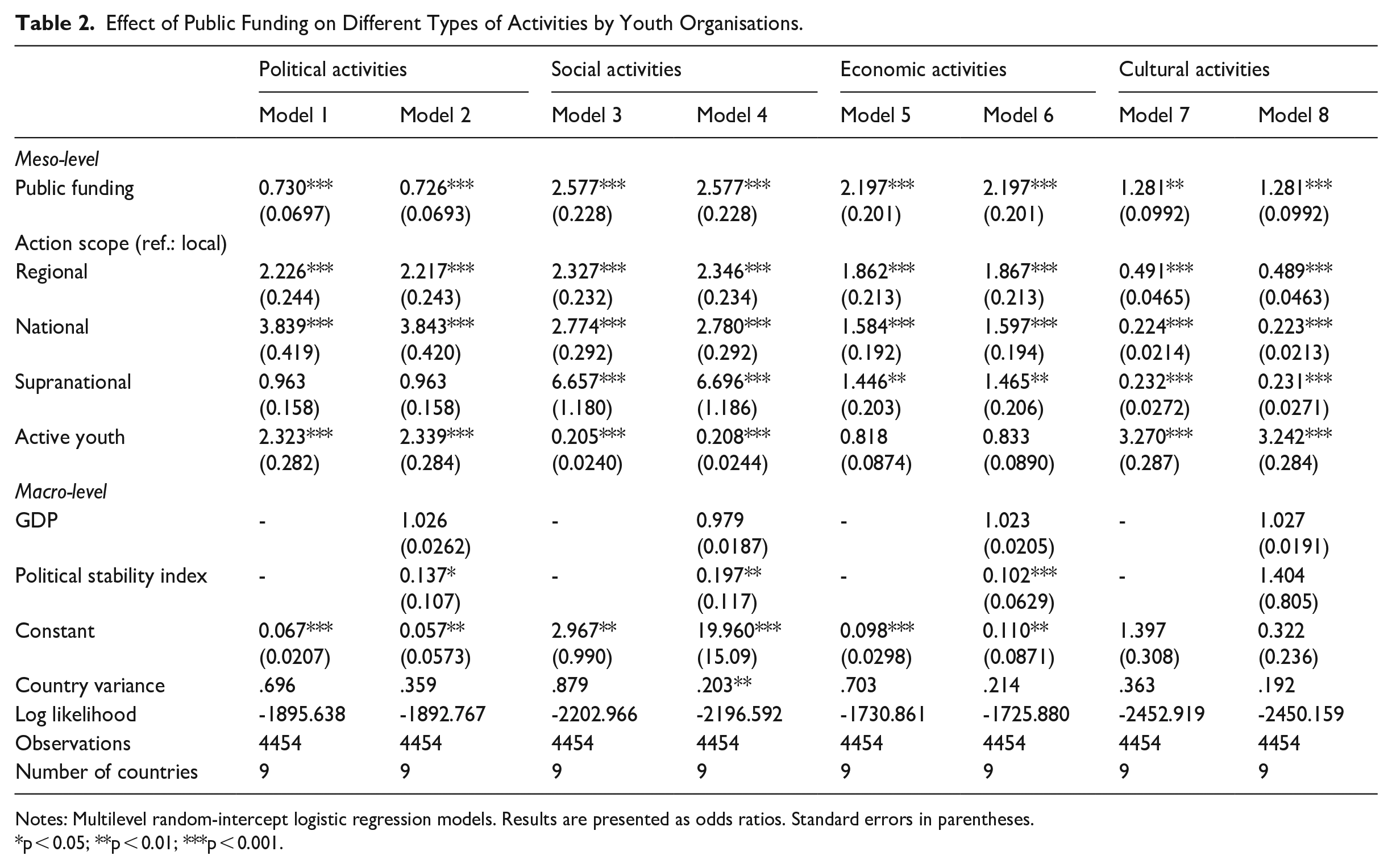
Next, we move to the core of our analysis aimed at testing the impact of public funding on youth organisations, more specifically on their engagement in political activities, as opposed to other kinds of activities, and therefore on their degree of politicisation. Table 2 shows the results of a series of logistic regression models. While our study focuses on political activities, we also examine the effect of public funding on the other three main types of activities carried out by youth organisations: social, economic, and cultural activities. All the models include the two meso-level controls (action scope and active involvement of young people in the organisation) and the two macro-level controls (GDP and the political stability index), in addition to public funding as the main predictor. For each type of activity, we show two models: one with only the meso-level variables and another one which also includes the macro-level variables. We modelled multilevel random-intercept regressions so as to take into account the clustering of observations within countries and allow for including the country-level measures. We show the effects expressed as odds ratios of occurrence of the type of activity at hand.
Effect of Public Funding on Different Types of Activities by Youth Organisations.
Notes: Multilevel random-intercept logistic regression models. Results are presented as odds ratios. Standard errors in parentheses.
p < 0.05; **p < 0.01; ***p < 0.001.
The results are clear and straightforward: youth organisations that receive public funding – regardless of the territorial-administrative level of the source – are significantly less likely to engage in political activities, whereas the opposite effect is observed for the other three types of activities. Indeed, social, economic and cultural activities are all more likely for organisations that receive public funding as compared to those which do not. The effect is larger for social and economic activities. Youth organisations therefore seem more dependent upon financial resources from the government when it comes to carrying out social and economic activities than when they engage in cultural activities. These effects hold once we control for the two macro-level indicators.
We interpret the negative effect of public funding on political activities as the result of the fact that organisations that receive public funding are less politicised. This is likely since if they become too political – which often equates to contrasting state measures – they would lose such support. In contrast, organisations that do not receive public funding are free of the constraints tied to receiving such financial support. This finding is in line with our theoretical argument that stresses dependency as the mechanism leading youth organisations to becoming less politicised. This may lead in the long run to a process of co-optation of youth organisations by the state. Non-political – that is, social, economic, and cultural – activities are not subject to the same constraints. Quite on the contrary, public funding is key for youth organisations to carry out these other kinds of activities, which most often imply costs and therefore require financial resources. This is likely to be all the more the case for those organisations that do not have other sources of funding or do only to a limited extent.
In addition to the impact of public funding, the regression models also show a number of statistically significant effects of the control variables. Both meso-level variables have a significant effect on youth organisations’ activities. In particular, national organisations are more likely to carry out any type of activity as compared to local organisations, except for cultural activities, which are more likely for the latter. In addition, organisations that involve young people in more active roles are more likely to carry out political and cultural activities, but less likely to engage in social and economic ones (the effect for economic activities is significant only at the 10% level, p = .06). These effects hold for all type of activities when controlling for the two macro-conditions. Concerning the latter, the economic conditions, as captured through the GDP, quite plausibly appears to be unrelated to all kinds of activities carried out by youth organisations. Finally, political stability, our proxy measure for salient aspects of political opportunity structures, has a significant and negative effect on social, political, and economic activities but not on cultural activities. Our primary interest concerning the contextual factors lies in examining whether they interact with public funding to account for differences in political and other activities by youth organisations, which we address below.
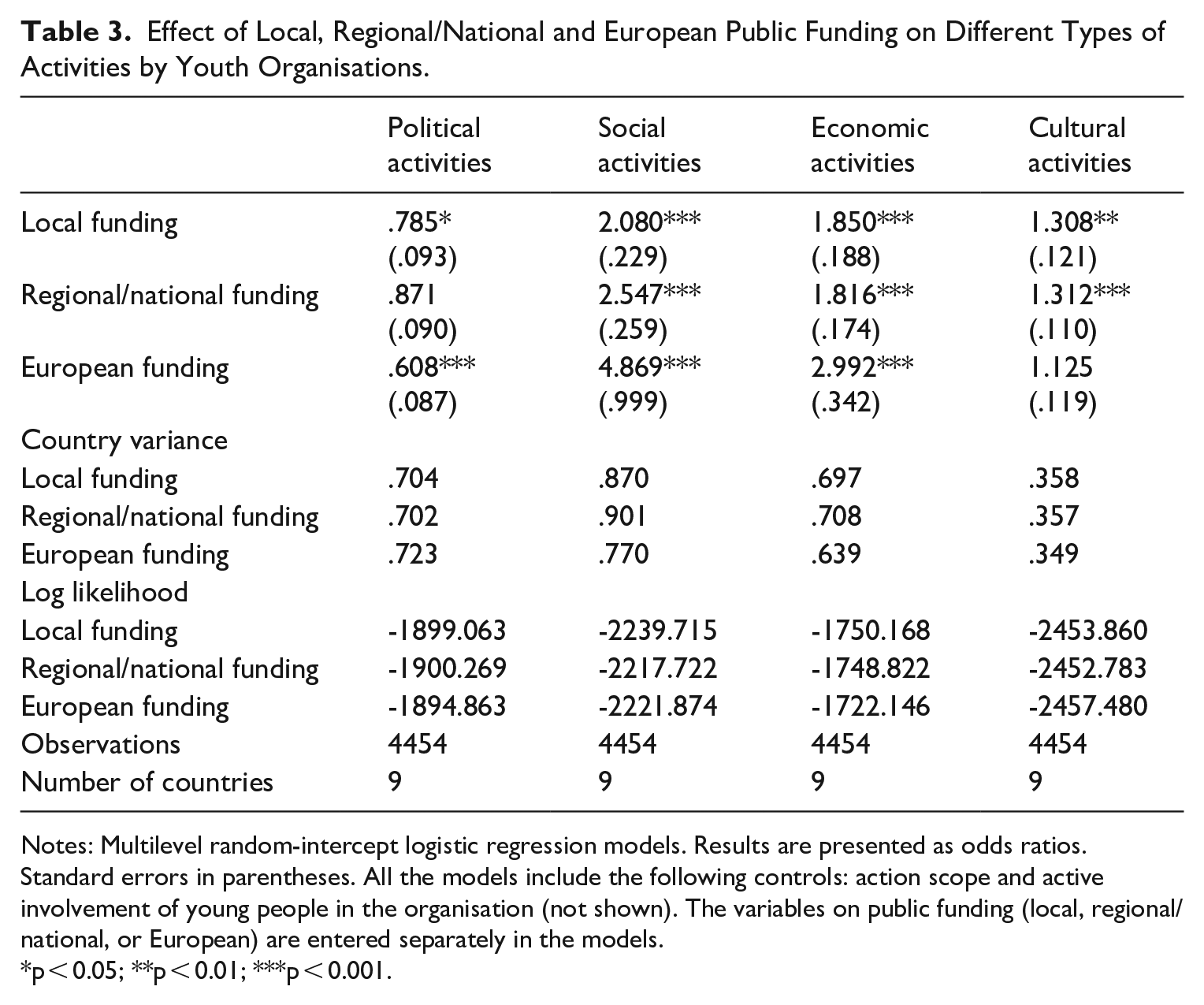
In order to dig deeper into the relationship between public funding and the political activities carried out by youth organisations, Table 3 shows the effects of the three sources of government funding taken separately. In this table, public funding was split across the local, regional/national, and European level. Each level of funding is entered in separate models which also include the two meso-level controls (action scope and active involvement of young people in the organisation). The results are broadly consistent with those obtained so far: across the three levels (local, regional/national, and European), public funding has a negative effect on political activities while it is positively correlated with the other three types of activities. There are only two exceptions, namely the effect of European funding on cultural activities and, most importantly for our present purpose, that of regional/national funding on political activities. These two effects are not statistically significant. Concerning the latter, one reason for the lack of statistical significance of the coefficient could be owing to the fact that the predictor variable merges two different levels (regional and national), whose distinct effects may cancel each other out. Unfortunately, this category is from the original coding and therefore we cannot disentangle here the independent effects. However, although the effect is not statistically significant, it does go in the expected direction, meaning that regional/national public funding negatively influences youth organisations’ engagement in political activities. This notwithstanding, we must acknowledge that political activities are related above all to the local and European funding. It thus appears that political activities are indeed discouraged by public funding, but especially so when the source are either local or European institutions. Concerning the European level, this is in contrast, for example, with the analysis by Bloodgood and Tremblay-Boire (2017) for lobbying, who found that EU funding has little dampening effect compared with regional/national funding. The different dependent variable might explain this pattern as we look at a broader category of political activities embracing lobbying as well as other forms of political engagement. Moreover, their analysis bears on organisations in general, while ours focuses on youth organisations.
Effect of Local, Regional/National and European Public Funding on Different Types of Activities by Youth Organisations.
Notes: Multilevel random-intercept logistic regression models. Results are presented as odds ratios. Standard errors in parentheses. All the models include the following controls: action scope and active involvement of young people in the organisation (not shown). The variables on public funding (local, regional/national, or European) are entered separately in the models.
p < 0.05; **p < 0.01; ***p < 0.001.
The Interaction of Public Funding and the Broader Economic and Political Environment
The final part of our analysis deals with the interaction between public funding and the economic and institutional context. This additional analysis aims to gauge whether the effect of public funding on the political activities of youth organisations is conditional upon the broader economic and political environment. To do so, we ran two multilevel random-intercept logistic regressions where we included an interaction term between public funding and, respectively, GDP and the political stability index. For this analysis, we employ the variable aggregating all three levels. Each model also includes the two meso-level controls.
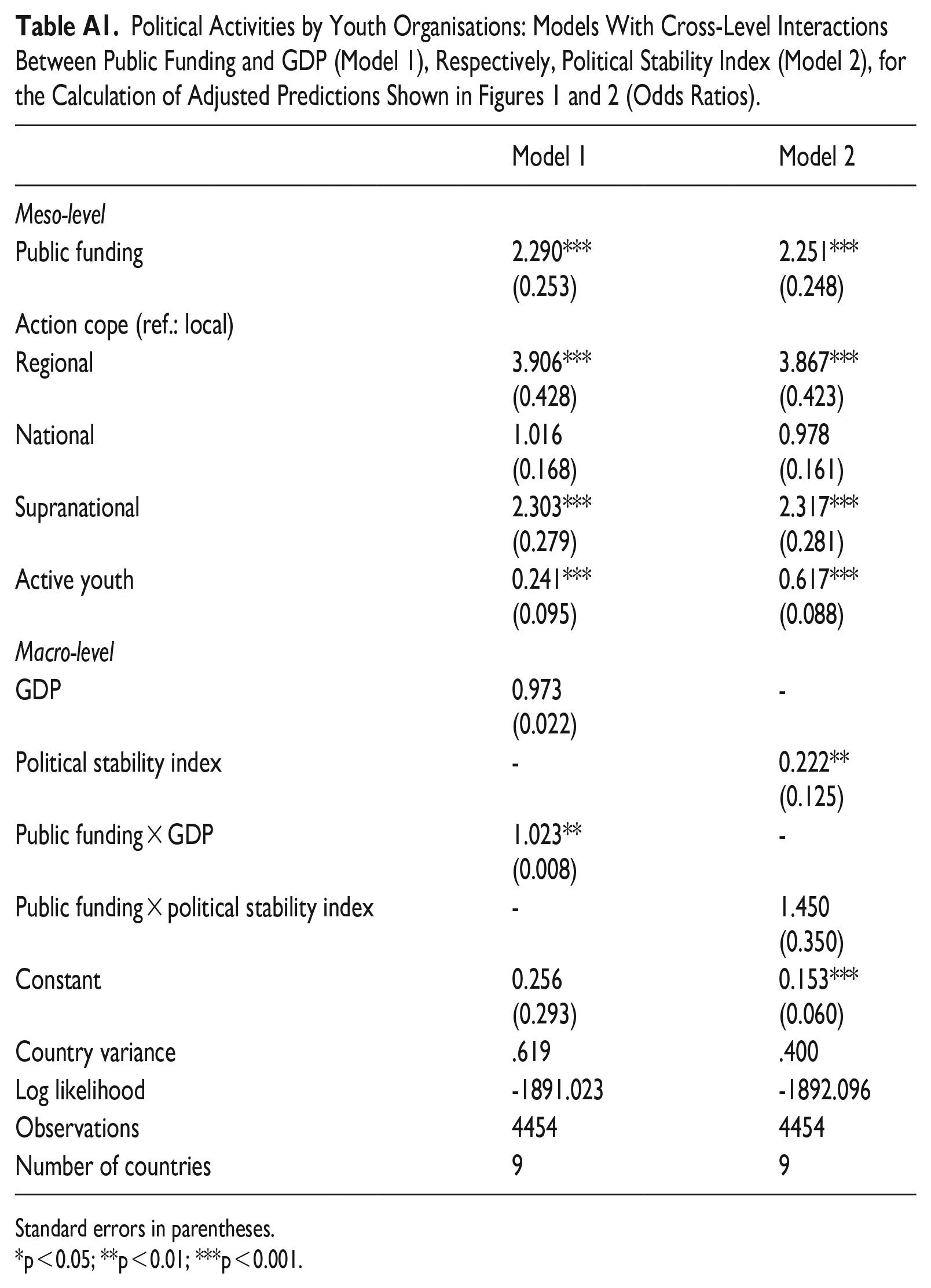
Figures 1 and 2 show in a graphic way the results of this analysis, whereas the full models can be found in Table A1 in the Appendix. Only the interaction with GDP is statistically significant, while the interaction with the political stability index is not significant. Overall, this suggests that the effect of public funding on youth organisations’ political activities is conditional upon the economic macro-conditions. The plots of the cross-level interactions give us a better sense of the direction and extent of such a conditional effect. We show both plots even if, as we said, the interaction term with the macro-political indicator is not statistically significant.
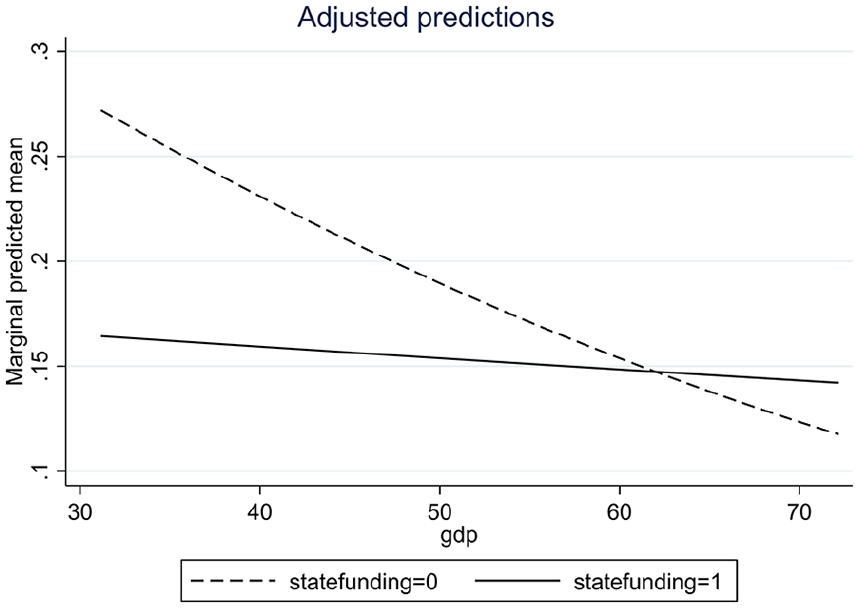
Political Activities by Youth Organisations: Plot of the Cross-Level Interaction Between Public Funding and GDP.
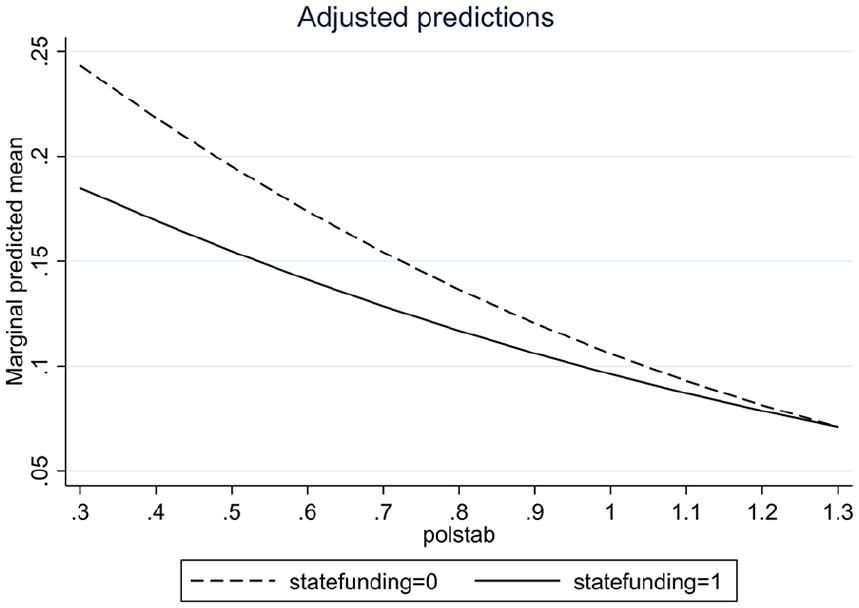
Political Activities by Youth Organisations: Plot of the Cross-Level Interaction Between Public Funding and Political Stability Index.
The first plot (Figure 1) shows the marginal predicted means of having political activities for organisations that receive public funding (continuous line) and for those that do not (dashed line), depending on GDP. In both cases, the likelihood of engaging in political activities decreases when the economic conditions improve, that is, when GDP is higher. However, this seems to be all the more the case for organisations that do not get public funding. In other words, economic conditions negatively influence the likelihood of youth organisations getting involved in political activities and particularly so for those organisations that are not funded by state institutions, whether locally, regionally/nationally, or at the European level. This generates a gap between the two types of organisations under poor economic conditions, whereby non-funded organisations are more politicised than funded ones (left-side of the figure), whereas in more favourable economic conditions both types of organisations display a similar level of political engagement (right-side of the figure). When the economic conditions are at their very best, the relationship between the two is actually reversed: funded organisations are more political than non-funded ones. Broadly speaking, the pattern is one where organisations that do not get public funding are much more active politically under negative economic conditions relative to funded ones, which remain less active even in more negative situations.
The second plot (Figure 2) illustrates the interaction between public funding and the political stability index, our proxy for political opportunity structures. Although the interaction is not statistically significant, it is not too far from an acceptable level of significance (p = .12). Most importantly, the trend is quite similar to the one just described for economic conditions: the likelihood for youth organisations to engage in political activities decreases with more stable political conditions – that is, in more stable political systems – but this is all the more true for those organisations that do not receive any sort of public funding. We observe a gap between the two kinds of organisations under unstable conditions, whereby non-funded organisations are more politicised than funded ones (left-side of the figure), while political stability is stronger this gap disappears (right-side of the figure) and under particularly stable conditions the relationship is actually reversed, with funded organisations being more political than non-funded ones. Here the pattern is similar to that observed for negative economic conditions with respect to the more shaky political context: non-funded organisations are more active in the less stable conditions relative to funded organisations.
The analysis of cross-level interactions therefore suggests, first and foremost, that the effect of public funding is conditional upon the broader economic and political environment. Good economic conditions seem to narrow the gap in the politicisation of youth organisations: under a good economy, both funded and non-funded organisations are equally politically oriented, while under bad economic conditions the latter are more politicised. Similarly, political stability seems to narrow down the politicisation gap as well: in more stable political systems, both funded and non-funded organisations are equally politically oriented, while in less stable systems or in more negative economic conditions, the latter are more politicised. Hence, the pattern is broadly one where non-funded and thus more politicised organisations tend to be more active than those that receive public funding, particularly in more negative economic or political contexts.
With respect to our key question, namely whether public funding has a spurring or a dampening effect on youth organisations, these findings suggest that this question cannot be asked in general, regardless of the organisations’ broader environment. Instead, it depends on certain aspects of their context, such as the economic conditions (captured here by the GDP) or certain features of the political-institutional system (captured here by the political stability index). In other words, the relationship between public funding and the politicisation of youth organisations is not a universal one. Quite on the contrary, the answer could be different depending on the broader economic and political environment.
Conclusion
Engagement through associations is a key way in which young people become politically involved, and youth organisations are often reliant on government funding. This, however, may be seen to undermine politicisation and therefore the very idea of organisations as providing a channel and an arena for young people to become more thoroughly involved in politics and for more equal representation of all types of different ideas to be reflected in democratic debate. As such, in this article, we analysed the relationship between public funding of youth organisations in Europe and their politicisation to understand if they can provide a forum for young people to become politically engaged and for their critical voices to be reflected in democratic debate.
We argued that, when the governments provide financial support to youth organisations, these are less politicised, as seen in a lower importance they give to political activities. We further hypothesised that this effect is conditional upon the organisations’ broader economic and political environment. The latter was operationalised through GDP and the political stability index, respectively. We have shown that there is a negative correlation between public funding and the political engagement of youth organisations: those organisations that received public funding are less likely to carry out political activities as opposed to organisations that do not get public funding. At the same time, however, we have also shown that it is above all from the local and the European levels that there is a negative effect of public funding. In contrast, receiving financial resources from local, regional/national or European state actors leads to an increase in other types of activities – social, economic, cultural, and so on. Finally, we have shown that the effect of public funding on political activities is conditional upon the broader economic and political context and therefore that the question of whether public funding encourages or discourages youth organisations to carry out political activities may obtain different answers contingent upon such a context.
We interpret the negative effect of public funding on the political activities carried out by youth organisations as a possible sign that receiving financial resources from state institutions may lead to their depoliticisation, following a dampening process of ‘taming through support’. This is consistent with previous analyses that show how young people often are depoliticised in the public domain and may be discouraged from engaging in political activities when political elites portray them as alienated and as not very interested in politics (Giugni and Grasso, 2020b). Our findings are relevant also as an important reminder of how the broader political and institutional context – political opportunity structures, to use the terminology of social movement scholars – matter when it comes to the political engagement of young people.
A note of caution on the interpretation of these findings is nevertheless needed. Our interpretation of the findings is that youth organisations become less political since they receive public funding. However, it may also well be that organisations that are already non-political are more likely to get funded. In other words, when choosing grantees, governments select organisations that already engage in fewer political activities. In this vein, for example, more militant social movement organisations rarely receive public funding (Kohl-Arenas, 2014). Furthermore, certain organisations – especially the more radical ones – might be less inclined to accept government funding, witnessing a self-selection process whereby they prefer not to take advantage from those resources in order to avoid co-optation, pre-emption and so on. In other words, more political organisations would not even apply for government funding, while less politicised ones would be more inclined to do so. For example, Leech (2006) as well as Berry and Arons (2003) found that less politically active non-profits seek more state funds and, in turn, organisations receiving more funds engage in less lobbying.
While we speculated that this is due to a ‘taming’ process – once they get funded, organisations become less politicised – we cannot completely rule out other mechanisms, such as the reverse effect that governments tend to fund less politicised organisations. In other words, an alternative explanation is also plausible: organisations that are less politicised than others would be more likely to receive public funding and this effect would likely be self-reinforcing, so these organisations would be even less likely to become engaged in political activities. Unfortunately, cross-sectional data do not allow us to adjudicate between the two rival explanations and exclude reverse causation. To do so, we would need a longitudinal design and data. Bloodgood and Trembley-Boire (2017) found more support for government threat than NGO self-selection to explain the impact of government funding on NGO lobbying expenditure. Our claim that public funding influences the strategic choices of youth organisations rather than the other way around is consistent with their analysis. Future research may try to collect longitudinal data to aim to further explore these issues.
Is the implication of our study that governments should not support youth organisations financially and, conversely, that the latter should not seek public funding? In both cases, it all depends on how much importance one assigns to the political sphere of youth organisations to reach their goals. Is it better to have a strong focus on political activities – including the possibility to carry them out freely and in full autonomy, hence deciding not to accept public funding – or are other activities, such as those providing direct help to youngsters who face difficulties, more useful? The answer to this question, in the end, is a strategic one for youth organisations to resolve and lies beyond the scope of our current investigation. Here we wanted to raise these important questions and bring them to the fore to more modestly contribute to the debate on the impact of public funding for civil society organisations, and in particular, on youth organisations which are critical for democratic renewal and the political engagement of new generations, by showing that receiving public funding, while advantageous in some regards, may also be subject to certain constraints and entails certain risks, most notably that of blunting political action.
Moreover, if the aim of youth organisations is to add vibrancy to the political sphere, contest mainstream views, and push forward progressive, sometimes even radical, agendas for social change such as on the environment and climate change, it may be that governmental funding could undermine these broader goals. Only in situations where public funding is guaranteed, so that youth organisations do not fear the removal of funding on political bases could funding potentially still support the broadening of youth political engagement and therefore provide the bedrock for democratic contestation and more robust and vibrant, egalitarian democratic politics.
Footnotes
Appendix
Political Activities by Youth Organisations: Models With Cross-Level Interactions Between Public Funding and GDP (Model 1), Respectively, Political Stability Index (Model 2), for the Calculation of Adjusted Predictions Shown in Figures 1 and 2 (Odds Ratios).
| Model 1 | Model 2 | |
|---|---|---|
| Meso-level | ||
| Public funding | 2.290***
(0.253) |
2.251***
(0.248) |
| Action cope (ref.: local) | ||
| Regional | 3.906***
(0.428) |
3.867***
(0.423) |
| National | 1.016 (0.168) |
0.978 (0.161) |
| Supranational | 2.303***
(0.279) |
2.317***
(0.281) |
| Active youth | 0.241***
(0.095) |
0.617***
(0.088) |
| Macro-level | ||
| GDP | 0.973 (0.022) |
- |
| Political stability index | - | 0.222**
(0.125) |
| Public funding × GDP | 1.023**
(0.008) |
- |
| Public funding × political stability index | - | 1.450 (0.350) |
| Constant | 0.256 (0.293) |
0.153***
(0.060) |
| Country variance | .619 | .400 |
| Log likelihood | -1891.023 | -1892.096 |
| Observations | 4454 | 4454 |
| Number of countries | 9 | 9 |
Standard errors in parentheses.
p < 0.05; **p < 0.01; ***p < 0.001.
Acknowledgements
The authors are grateful to all the researchers on the project involved in research design, data collection, etc. and all those who provided feedback at presentations as well as the journal editors and the anonymous referees for their useful suggestions. All remaining errors are our own and the usual disclaimers apply.
Authors’ Note
Results presented in this paper have been obtained within the project ‘Reinventing Democracy in Europe: Youth Doing Politics in Times of Increasing Inequalities’ (EURYKA). This project was funded by the European Commission under H2020 (grant agreement no. 727025). The Swiss part of the project was supported by the Swiss State Secretariat for Education, Research and Innovation (SERI) under contract number 16.0103. The views presented do not necessarily reflect those of funders.
Declaration of Conflicting Interests
The author(s) declared no potential conflicts of interest with respect to the research, authorship, and/or publication of this article.
Funding
The author(s) disclosed receipt of the following financial support for the research, authorship, and/or publication of this article: Results presented in this paper have been obtained within the project ‘Reinventing Democracy in Europe: Youth Doing Politics in Times of Increasing Inequalities’ (EURYKA). This project was funded by the European Commission under H2020 (grant agreement no. 727025). The Swiss part of the project was supported by the Swiss State Secretariat for Education, Research and Innovation (SERI) under contract number 16.0103. The views presented do not necessarily reflect those of funders.
