




Abstract
Political protest and citizen participation are important drivers of democratic change. While previous research has identified both micro-level attitudes such as emancipative values and macro-level factors as drivers of protest behavior, we know little about how citizens’ value-driven motivations interact with the political context. We argue that the effect of emancipative values on protest participation depends on both democratic institutions and the capacity of civil society mobilizations. Specifically, we expect the positive effect of emancipative values to be stronger in countries with higher democratic quality and more pro-democratic mass mobilizations, and weaker in countries with more pro-autocratic mass mobilizations. By combining survey and macro data for 88 democratic and autocratic regimes, we find that citizens’ value orientations interact with democratic quality and the prevalence of pro-autocratic mass mobilizations in shaping protest participation. These results contribute to a better understanding of the structural and societal preconditions for democratic change.
Keywords
Introduction
Across the globe, citizens are taking to the streets to engage in political protest—whether to demand more decisive climate action, to object pension cuts, or to voice their doubts about election results (Ortiz et al., 2022). As an unconventional form of political participation, political protest can be considered both conducive and challenging to the functioning of democracy (Klandermans and van Stekelenburg, 2013; Putnam et al., 1994). Some scholars argue that political protest, like conventional types of political participation, makes democratic regimes more accountable and representative (Dalton and Welzel, 2014). Investigating the effects of protest in autocratic contexts, several recent studies identify (non-violent) protest as a driver of democratic change (Alemán and Yang, 2011; Li Donni and Marino, 2020). Others, in contrast, point out the elite-challenging, disruptive aspects of protest and its potential to advance anti-democratic agendas (Markowitz and Peshkova, 2016; Sombatpoonsiri, 2020). Given its double-edged nature, it is crucial to understand what drives citizen participation in political protest.
Regarding these drivers of political protest, previous studies have shown that pro-democratic attitudes are associated with increased participation (Cho, 2015; Cho and Hwang, 2021). Following this motivation-based approach, a growing body of literature considers emancipative values, which emphasize freedom of choice and equality of opportunities, as a driver of political participation (Welzel and Deutsch, 2012). At the same time, another strand of research highlights the costs of political protest as well as the likelihood of success, which are both influenced by political opportunity structures (Jost et al., 2017). Focusing on the macro foundations of protest, researchers in this tradition argue that the political context affects both strategies and the success of social movements (for an overview, see Meyer, 2004). Finally, resource mobilization theory emphasizes people’s capacity to act on shared interests (Pichardo, 1988). In this view, collective action emerges only if social movements have sufficient resources that they can mobilize.
Advancing the scope of previous literature, our theoretical argument and empirical analysis cover not only democratic but also autocratic regimes. While we hold the basic motivations that drive protest participation to be the same in both types of regimes, we expect citizens’ value orientations to interact with the political opportunity structures and civil society resources that vary across contexts. Linking these three literatures, we suggest that political opportunity structures and civil society resources as contextual factors interact with citizens’ motivation to participate, that is, the effect of citizens’ emancipative value orientations is conditional on political opportunity structures and civil society resources.
Our core argument is based on the assumption that political opportunity structures and civil society resources determine which forms of participation are open to citizens interested in advocating pro-democratic goals and how easily they can be mobilized. More specifically, we propose that democratic quality and the extent of mass mobilizations play a crucial role in how emancipative value orientations are translated into collective action. On one hand, the level of democracy determines both the costs and likelihood of success of political protests: In countries with low democratic quality, where protests are violently suppressed, participation in such demonstrations means taking a high risk of being personally harmed, despite or because of having a pro-democratic motivation. In contrast, political protest in high-quality democracies carries less risk. It has a higher probability of success as democratic institutions are more responsive, providing a motivating factor for pro-democratic individuals to engage in political protest.
On the other hand, the prevalence of mass mobilizations indicates the resource mobilization capacity of civil society: a strong civil society is much more likely able to organize mass mobilizations for its members to act on shared interest, whereas weak civil societies typically lack the resources to coordinate collective action. Expanding on previous research, we examine how both the extent and nature of mass mobilization affects how citizens’ motivations relate to political protest. While one factor is whether and how often there is an opportunity to participate in organized mass mobilizations in the first place, the orientation and intent of these demonstrations determine whether or not citizens with a pro-democratic mindset consider participating. We therefore expect the prevalence of pro-democratic mass mobilizations to amplify the effect of emancipative values on protest participation, whereas we hypothesize a dampening effect of pro-autocratic mass mobilizations.
Empirically, we test our propositions by combining survey data from the World Values Survey (WVS) and European Values Study (EVS; 2005–2020; EVS, 2020; Inglehart et al., 2020) with macro data from the Varieties-of-Democracy Project (V-Dem; Coppedge et al., 2021a). Covering 169 samples from 88 countries with over 200,000 respondents, we use multi-level regression modeling and a pseudo differences-in-differences design to examine how emancipative value orientations affect protest behavior across different levels of democracy and according to the prevalence of pro-democratic and pro-autocratic mass mobilizations. Our core finding is that citizens with more emancipative value orientations are indeed more likely to participate in political protest, especially in countries with high levels of democracy. Extensive pro-autocratic mass mobilization, in contrast, weakens the propensity of those with emancipative values to engage in protest activities. In addition to giving us some reason for optimism regarding the resilience of democracy, our findings also support our idea that how citizens’ value orientations affect their decision to participate in political protest is contingent on the political context in which they live.
In the following section, we develop our theoretical argument on how political opportunity structures and civil society resources moderate the relationship between emancipative value orientations and protest behavior. We proceed to describe our data and methodological approach before presenting our results and discussing them in a conclusion.
Three Explanations of Political Protest
Political participation, especially in its institutionalized form, is considered essential for the functioning of democratic regimes as it promotes the responsiveness of elected representatives and thus the inclusion of their needs and demands in the political decision-making process (Putnam et al., 1994). Yet, modernization and the resulting changes in social conditions transformed the patterns of participation, leading to an expansion of protest participation (Dalton, 2022). Given the unconventional and elite-challenging nature of protest, however, it is puzzling whether this type of participation enhances or hinders democratic governance (Inglehart, 1990; Klandermans and van Stekelenburg, 2013). Especially within autocracies, nonviolent protest can lead to political liberation and help topple the autocratic regime (Stephan and Chenoweth, 2008). At the same time, autocratic rulers may also mobilize their subjects to protest in favor of the regime (Hellmeier and Weidmann, 2020), and anti-democratic protests may contribute to the destabilization of democracy and the downfall of democratically elected governments (Bosco and Verney, 2012; Meirowitz and Tucker, 2013).
Given this double-edged nature of political protest, it is crucial to understand what drives citizen participation in this form of political action. To enhance our understanding of this background, we aim to explain protest participation by combining three strands of literature prominent in contemporary social movement analysis (Travaglino, 2014): the human empowerment framework, political opportunity structures, and resource mobilization theory. While the human empowerment framework helps us determine whether citizens are motivated to engage in political protest, political opportunity structures tell us something about the costs for and chances of the protest’s success. Finally, resource mobilization theory indicates citizens’ capacity to translate their preferences into collective action. However, as discussed below, we so far lack an integrated perspective on how these individual, societal, and structural factors interact in explaining political protest.
The Human Empowerment Framework
Originating in the study of political participation, proponents of the human empowerment framework (Welzel et al., 2003) argue that a development-induced value change away from traditional conformity toward (post-)modern emancipative values increases citizens’ motivation to participate politically. Emancipative values, in particular, reflect a “set of orientations emphasizing freedom of choice, equality of opportunities and voice” (Zavadskaya and Welzel, 2015: 1105–1106). As such, emancipative values make citizens place greater emphasis on equal treatment, autonomy, and justice, motivating them to voice their desire for more democratic political structures (Welzel and Deutsch, 2012; Zavadskaya and Welzel, 2015). At the same time, emancipative value orientations are thought to make citizens more critical of the existing democratic status quo, encouraging them to engage in political protest (Li Donni et al., 2021; Welzel, 2013). Both mechanisms thereby advance citizens’ motivation to participate politically.
On the macro level, mass emancipative values have a significant positive effect on the number of nonviolent protest events, yet no effect on the number of violent protest events (Li Donni et al., 2021). Welzel and Deutsch (2012) demonstrate that emancipative values relate to political protest both on the micro and macro level: not only are citizens with more emancipative values more likely to participate in protest, but also protests are more prevalent in countries with higher emancipative values. On the micro level, many studies find emancipative value orientations to positively affect participation in political protest (Dalton et al., 2010; Inglehart, 1990; Inglehart and Welzel, 2005; Welzel, 2013). 1
Political Opportunity Structures
The literature on political opportunity structures takes a different perspective on protest. Its basic premise is that exogenous context factors, so-called “political opportunity structures,” determine social movements’ emergence, development, strategies, and success (Kitschelt, 1986; Meyer, 2004; Meyer and Minkoff, 2004). Most relevant to our argument, one strand of this literature uses political opportunity structures to explain mobilization. Starting from the idea that citizens base their decisions and behavior to at least some extent on the chances of success, Eisinger (1973) argues that the context in which politics takes place either enhances or inhibits citizen participation in the political process as it “impose[s] certain constraints on political activity or open[s] avenues for it” (Eisinger, 1973: 11–12). We can thus conceptualize political opportunity structures as ways in which citizens can influence politics (Nentwich, 2005). The more access points there are for citizens to influence politics and the more opportunities citizens have to participate in public affairs, the more likely it is for social movements to engage in mobilizing activities and for citizens to actually become politically active (Kriesi et al., 1995; Vráblíková, 2014). 2
In any type of political regime, the level of democracy primarily shapes the opportunities for citizens to influence political decisions. The higher democratic quality, the easier it is for citizens to participate in politics, the more representative government becomes, and the more responsive the political system must be to citizens’ demands. For one, democratic quality is inversely linked to repression (Davenport and Armstrong, 2004), which is considered an important aspect of political opportunity structures (Estellés, 2010; Yun, 1997): Participation in political protest becomes much more costly when the state engages in violence against protestors (Opp and Roehl, 1990), and previous research has found repression to deter protest as well as support for protest movements (Chiang, 2021; Tertytchnaya and Lankina, 2020).
At the same time, increasing democratic quality renders election results more representative of citizens’ preferences and accordingly forces governments to become more responsive to citizens’ demands (Dahl, 1989). Lending support to this position, both Dalton et al. (2010) and Marien et al. (2010) find non-institutionalized political participation to increase in more democratic contexts. Studying 18 African democracies and autocracies, Pilati (2011) reports somewhat mixed results for the effect of democraticness on individual protest participation: while there seems to be no effect in Western African countries, protest participation increases with democraticness in both Eastern and Southern African countries. In line with this theory, Zhang et al. (2018) find increased openness to enhance participation in authoritarian China.
Resource Mobilization Theory
A final strand of literature that can contribute to explaining political protest is resource mobilization theory. Research mobilization theory subsumes a larger set of approaches about how social groups mobilize, stressing the technical aspects of social movement formation and understanding mobilization as “the process by which a group secures collective control over the resources needed for collective action” (Jenkins, 1983: 532). In this view, mobilization does not automatically follow from deprivation or grievances, but rather requires a social group to acquire the capacity to act upon their shared interests (Pichardo, 1988). Thus, the core explanatory variable is resources (Zald and McCarthy, 2002). There is little agreement within the literature as to what exactly these resources are, but they are typically conceptualized at the group level rather than considered as individual-level properties (Edwards and Kane, 2014). Most of the literature focuses on organizations as the core resource facilitating collective action, as preexisting group organization is thought to play a crucial role in determining mobilization potential (Edwards and Kane, 2014; Jenkins, 1983; McCarthy and Zald, 2001). 3
On a micro level, the theory explains mobilization through the supply of activist opportunities and posits that civil society organizations “provide such opportunities for activism by structuring collective action” (McCarthy and Zald, 2001: 542). For instance, civil society organizations not only formally register protests but also inform potential participants about the protest, organize travel for non-local participants, and may even provide financial support for participants to attend the protest (Fisher et al., 2005). Macro-level evidence further substantiates the importance of organizations for mobilization and protest: van Dyke et al. (2007) show that the presence of a United Students Against Sweatshops (USAS) chapter significantly increased the likelihood of a US campus seeing student labor protests in 2000–2001, and Martinez (2008) finds protest participation of Latinos in the United States to be more likely in cities with a greater presence of Latino organizations.
Integrating Human Empowerment Framework, Political Opportunity Structures, and Resource Mobilization Theory
While culture determines citizens’ motivation to participate in political protest, political opportunity structures determine the costs and chances of success for such protest, and resource mobilization determines the capacity of citizens to translate their preferences into collective action. Yet, how do emancipative values, political opportunities, and resource mobilization interact in shaping citizens’ participation in political protest? Following Elster (1989), we suggest that individual human action—for example, participation in protest—is the result of two successive filtering operations: First, all constraints an individual faces define their “opportunity set,” that is, all actions consistent with these restraints. In our case, system-level political opportunity structures and resource mobilization would determine this opportunity set. Whether or not political protest is an option and how costly it is to take this option depends heavily on the level of democracy in a given country. The prevalence of mass mobilization arranged by civil society organizations indicates whether or not a society can muster the resources necessary to organize collective action in the form of political protest. Second, among all possible actions within the opportunity set, individuals choose the specific action that best satisfies their own desires. How committed an individual is to emancipative values would then determine whether or not they decide to engage in a particular protest. Or, in the wording of resource mobilization theory, social movements draw on the sentiment pool in the larger society—the group of people who share the sentiment represented by that movement (McCarthy and Zald, 2001)—that is, the people who hold emancipative values.
Combining the three strands of literature, we propose that emancipative values, political opportunity structures, and resource mobilization interact in shaping participation in political protest: the effect of citizens’ emancipative values is conditional on system-level political opportunity structures as well as resource mobilization. On one hand, political opportunity structures in a country determine how costly protest participation is for citizens. In countries with low democratic quality, where protests are violently suppressed, participation in such demonstrations means taking a high risk of being personally harmed, despite or because of having a pro-democratic motivation grounded in emancipative values. In contrast, political protest in high-quality democracies carries less risk and at the same time has a higher probability of success as democratic institutions are more responsive, providing a motivating factor for pro-democratic individuals to engage in political protest. To the best of our knowledge, the only study so far to examine the conditional effects of value orientations on protest, Dalton et al. (2010) hypothesize that post-materialism has a stronger effect on protest in advanced industrial societies than it has in less developed countries as the latter simply have fewer postmaterialists, making it harder to find a like-minded network and encounter a government acceptant of contentious political action. Empirically, their study of 50 democracies and autocracies confirms this proposition and shows postmaterialist values to also have a stronger effect in more democratic countries. Based on these findings as well as our theoretical argument, we expect emancipative value orientations to exert a stronger effect on political protest participation in more democratic contexts.
H1: In contexts with high democratic quality, emancipative value orientations increase the likelihood of protest participation. In contexts with low democratic quality, emancipative value orientations have no effect on the likelihood of protest participation.
In a similar manner, we expect the prevalence of mass mobilizations arranged by civil society organizations, that is, the capacity for resource mobilization, to influence how emancipative value orientations affect protest participation. At this point, we need to distinguish between different types of mass mobilization: after all, not all protests organized by civil society organizations are pro-democratic (Grahn and Lührmann, 2021; Kopecký and Mudde, 2003). For example, civil society organizations were instrumental to both the 2006 and 2014 coups in Thailand by mobilizing to oust democratically elected governments (Lorch, 2021; Sombatpoonsiri, 2020), and in her seminal study, Berman (1997) demonstrates how civil society organizations contributed to undermining the democratic regime in Weimar Germany. Only pro-democratic civil society organizations are likely to organize protests that attract citizens with emancipative value orientations and thus contribute to such protests becoming part of the opportunity set for democratically minded citizens (Vráblíková, 2014). For pro-democratic mass mobilizations, the argument is the same as for democratic quality: In contexts with more pro-democratic mass mobilizations, protest participation is more likely to be part of the opportunity set for democratically minded citizens, and thus emancipative value orientations should have a stronger effect when there are more such opportunities.
H2a: The prevalence of pro-democratic mass mobilizations strengthens the effect of emancipative value orientations on protest participation.
We cannot expect such a simple positive interaction effect for pro-autocratic mass mobilizations. On one hand, as protest participation is determined by at least a certain degree of ideological congruence between the protest goals and the individual’s value orientations (Chan, 2016), citizens who hold emancipative values are likely not willing to participate in protests organized by pro-autocratic civil society organizations. Thus, the prevalence of pro-autocratic mobilization should weaken the effect of emancipative value orientations on protest participation. At the same time, extensive mobilization by pro-autocratic civil society organizations may intimidate and deter democratically minded citizens (Hellmeier and Weidmann, 2020), effectively removing political protest from their opportunity set and again weakening the effect of emancipative value orientations on participation. On the other hand, witnessing pro-autocratic civil society organizations mobilize may also provide extra motivation to participate and trigger counteraction from citizens with strong emancipative values, thereby increasing the effect of emancipative value orientations on protest participation. As Reynolds-Stenson and Earl (2018) demonstrate, counterdemonstrations can become more likely when the original protest is perceived as threatening. More mobilization by pro-autocratic civil society organizations could then result in increased pro-democratic (counter-)mobilization. Yet, we expect such a backlash effect to be present mainly in less repressive contexts, where citizens do not need to fear state repercussions for their political protest (Chiang, 2021; Opp and Roehl, 1990). Overall, we thus expect the de-motivating and deterrence effects of pro-autocratic mobilization to outweigh the backlash effect.
H2b: The prevalence of pro-autocratic mass mobilizations weakens the effect of emancipative value orientations on protest participation.
Data and Measurement
Our empirical analysis combines individual-level survey data on people’s attitudes and protest behavior from the WVS and EVS (2005–2020; EVS, 2020; Inglehart et al., 2020) with macro-level data on democratic quality and mass mobilizations from V-Dem (v11.1; Coppedge et al., 2021a). 4 The data cover a total of 169 samples from 88 countries 5 with more than 200,000 respondents. The quality of democracy varies considerably across these countries: Our data include both very high-quality democracies like the Fenno-Scandic countries and authoritarian countries like China, Turkey, and Thailand.
To measure our dependent variable of protest behavior, we employ an item from the WVS and EVS that asks whether respondents have or would consider attending a peaceful demonstration. While previous research has often used a scale constructed of participation in different forms of protest, we opt for a single-item measurement in order to avoid lumping together forms of protest that require very different levels of effort and commitment from citizens (Grasso and Giugni, 2016; Oser, 2022; Saunders, 2014). Situated between low-effort acts such as the signing of petitions and high-risk acts of political violence, participation in peaceful demonstrations represents a medium-effort form of political protest (Norris et al., 2005). Responses to this survey question are coded on a three-point scale: would never do (0), might do (0.5), have done (1.0). Although this scale is only ordinal, we interpret it as metric for our main analysis. 6 Robustness checks use dichotomized versions of the measure: one which excludes the “might do” answers, one which combines “might do” and “would never do” into a single category, and one which combines “might do” and “have done” into a single category. The WVS/EVS measurement of protest behavior is not ideal as it conflates actual behavior (“have done”) with behavioral intentions (“might do,” “would never do”). In addition, it does not allow us to explore participation in other forms of protest such as political violence and contains no information about the goals of the political protest. Nonetheless, it allows us to study one important form of political protest—peaceful demonstrations—on a globally comparative scale.
We measure our key independent variable of emancipative values following the approach by Welzel (2013). Emancipative values consist of the four sub-dimensions of autonomy, equality, choice, and voice. The sub-dimension of autonomy is based on a list of items on the qualities that children should be encouraged to learn at home. Respondents are asked which five qualities from the list they consider most desirable for children. To measure autonomy, we use whether respondents selected independence and imagination and not obedience as important qualities. In order to measure the sub-dimension of equality, we consider items related to gender equality. Respondents are asked to respond on a four-point scale from “strongly agree” (0) to “strongly disagree” (1.0) about whether they think men make better political leaders than women, whether a college education is more important for a boy than for a girl, and whether men should have more rights to have a job than women when jobs are scarce. To measure the sub-dimension of choice, respondents are asked on a 10-point scale from “never justified” (0) to “always justified” (1.0) whether they think homosexuality, abortion, and divorce are justified. And finally, the sub-dimension of voice is based on whether people would prefer post-material goals for themselves and their country over material goals.
To measure emancipative values, we recoded all variables following Welzel (2013) and conducted a hierarchical principal axis factor analysis as shown in Table 1. The results show four factors that largely follow the theoretical concepts as well as Welzel’s (2013) analysis. We calculate an additive index for each of the four sub-dimensions and combine them into an additive index from low emancipative values (0) to high emancipative values (1.0). 7
Measuring Emancipative Values.
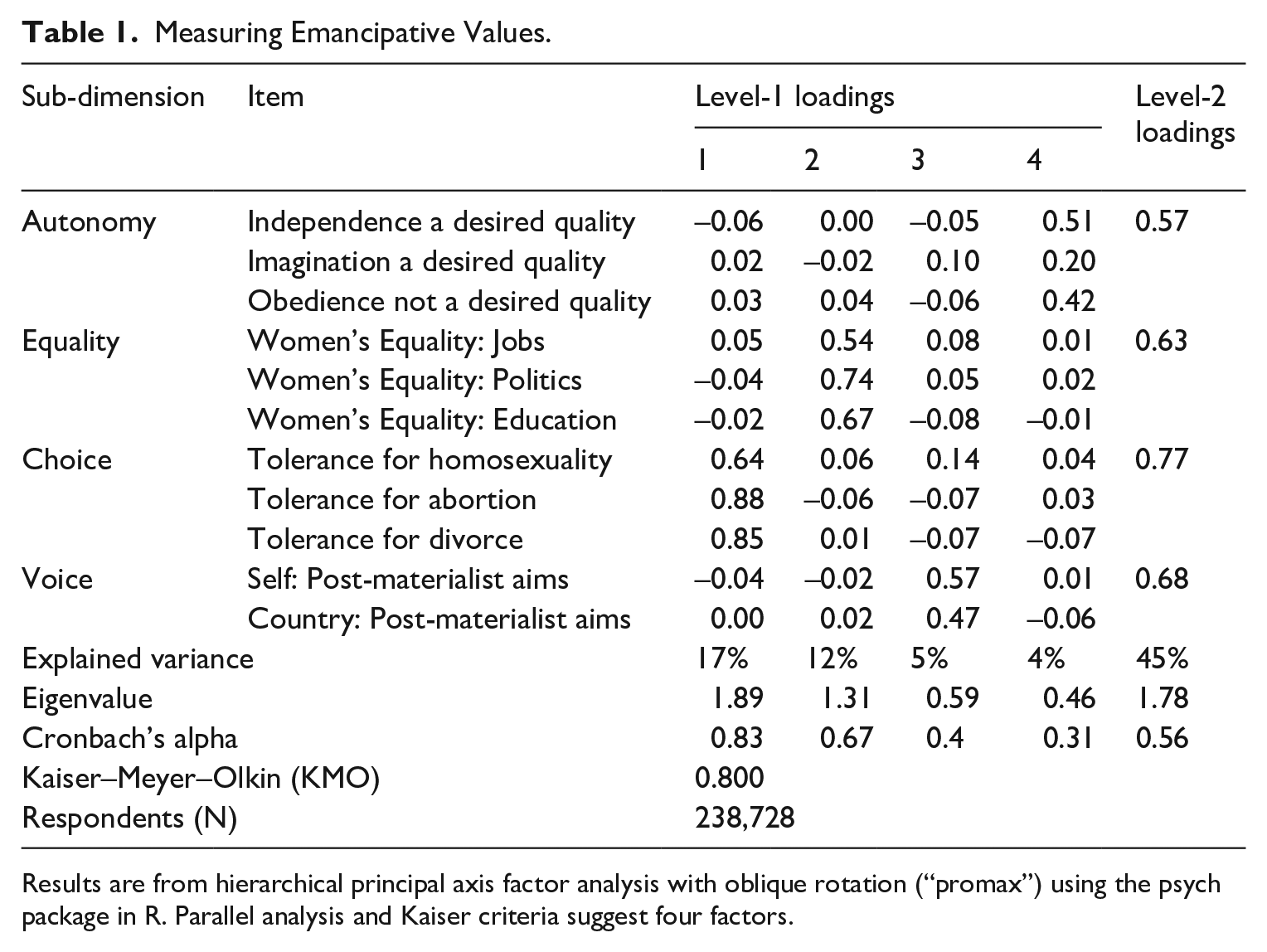
Results are from hierarchical principal axis factor analysis with oblique rotation (“promax”) using the psych package in R. Parallel analysis and Kaiser criteria suggest four factors.
To test whether political opportunity structures and resource mobilization capacity condition the link between emancipative values and political protest, we use macro-level data from V-Dem (Coppedge et al., 2021a). To measure a country’s level of democracy, we employ the Liberal Democracy Index for each country-year sample at the time the survey was conducted. This index measures on a scale from low (0) to high levels (1.0) of liberal democracy how well a country protects “civil liberties, strong rule of law, an independent judiciary, and effective checks and balances” as well as how well the electoral principle of democracy is realized, including universal suffrage, political competition, organizational freedom, electoral fairness, freedom of expression, and independent media (Coppedge et al., 2021b: 43–44). As a robustness check, we employ two binary measures of democratic quality that distinguish either between democracies and autocracies or between liberal democracies and other types of regimes (RoW measure, Lührmann et al., 2018).
For mass mobilizations, we use a yearly index measuring the frequency and size of mass mobilizations within a country (Hellmeier and Bernhard, 2023). This V-Dem measure captures “the mobilization of citizens for mass events such as demonstrations, strikes, and sit-ins” (Coppedge et al., 2021b: 226) and thus provides a useful proxy for the resource mobilization capacity of civil society organizations. V-Dem additionally distinguishes between mass mobilizations with explicitly pro-democratic aims and mass mobilizations with explicitly anti-democratic (pro-autocratic) aims (Coppedge et al., 2021b: 227), allowing us to investigate whether and how the two types of mobilization affect individual-level protest behavior differently.
While our main dependent and independent variables are likely to be interdependent, they are not identical. For example, while liberal democracy provides the institutional structures that ensure or facilitate mobilization, liberal democracy is not a necessary condition for the emergence of particular protest movements. 8 Furthermore, even though there is an overlap between the mass mobilization measure and protest behavior, one is not simply the aggregate of the other as mass mobilization as measured by V-Dem considers the frequency and size of mass events in a given country, not merely the number of people that have taken part in protests. This reflects the conceptual distinction between resource mobilization and protest behavior: While both concepts relate to civic activism, resource mobilization refers to “the process by which a group secures collective control over the resources needed for collective action” (Jenkins, 1983: 532) and thus focuses on the capacity for collective action on the group level. Protest behavior, in contrast, refers to the individual citizen’s participation in a protest event und thus focuses on individual action.
We conduct additional analyses and robustness tests to account for this potential dependence between the variables and address the problem of reverse causality. As explained in detail in the analysis, in addition to a pseudo difference-in-differences design, we use further robustness tests to check the independence of the direct effects and cross-level interactions. Our models control for several alternative individual-level explanations of political protest (Jost et al., 2017; van Stekelenburg and Klandermans, 2013): democratic performance evaluations, membership in associations, 9 political trust, 10 social trust, life satisfaction, political interest, education, income, gender, and age. On the macro level, we further control for a country’s population size (logged), GDP per capita (logged), and GDP growth. 11 In the online appendix, we provide additional descriptive statistics and bivariate analyses.
Results
Our main estimation strategy relies on cross-sectional data. It utilizes individual-level variation in emancipative values and cross-national variation in democratic quality, pro-democratic mobilization, and pro-autocratic mobilization to identify how value orientations and political opportunity structures relate to protest behavior and how they interact in shaping citizens’ participation in political protest. To this end, we estimate several multi-level regression models with individuals nested in country-years, beginning with a random-intercept model to identify the main effects of emancipative value orientations, democratic quality, pro-democratic and pro-autocratic mobilization before moving onto examining the conditioning effects of political opportunity structures and resource mobilization. For the latter, we utilize random-slope models as we expect the effect of individual-level emancipative values to vary between contexts, that is, to be stronger in countries with higher democratic quality (H1) and more pro-democratic mass mobilization (H2a) and weaker in countries with more pro-autocratic mass mobilization (H2b). To further approach the question of causality, in a supplementary analysis, we leverage the fact that some countries in our sample were surveyed at more than one point in time and employ a (pseudo) differences-in-differences design that exploits within-country over-time variation.
Turning to the results, the random-intercept model with only the main effects of our independent variables on protest behavior (Model 1, see Table 2) confirms previous research: citizens with more emancipative values are more likely to engage in political protest. We further find support that the level of democracy positively affects protest behavior. Concerning the main effects of mass mobilizations, our results corroborate the idea that the supply of pro-democratic mass mobilizations increases protest participation among citizens, that is, citizens tend to participate more in protests if there are larger and more frequent pro-democratic mass events. The supply of pro-autocratic mass mobilizations, on the other hand, does not affect citizens’ protest behavior. Overall, the general ideas of all three explanatory approaches seem to hold: Citizens participate more in protest when they hold more emancipative value orientations and when there are more opportunities and more widespread (pro-democratic) protest.
Explaining Protest Behavior.
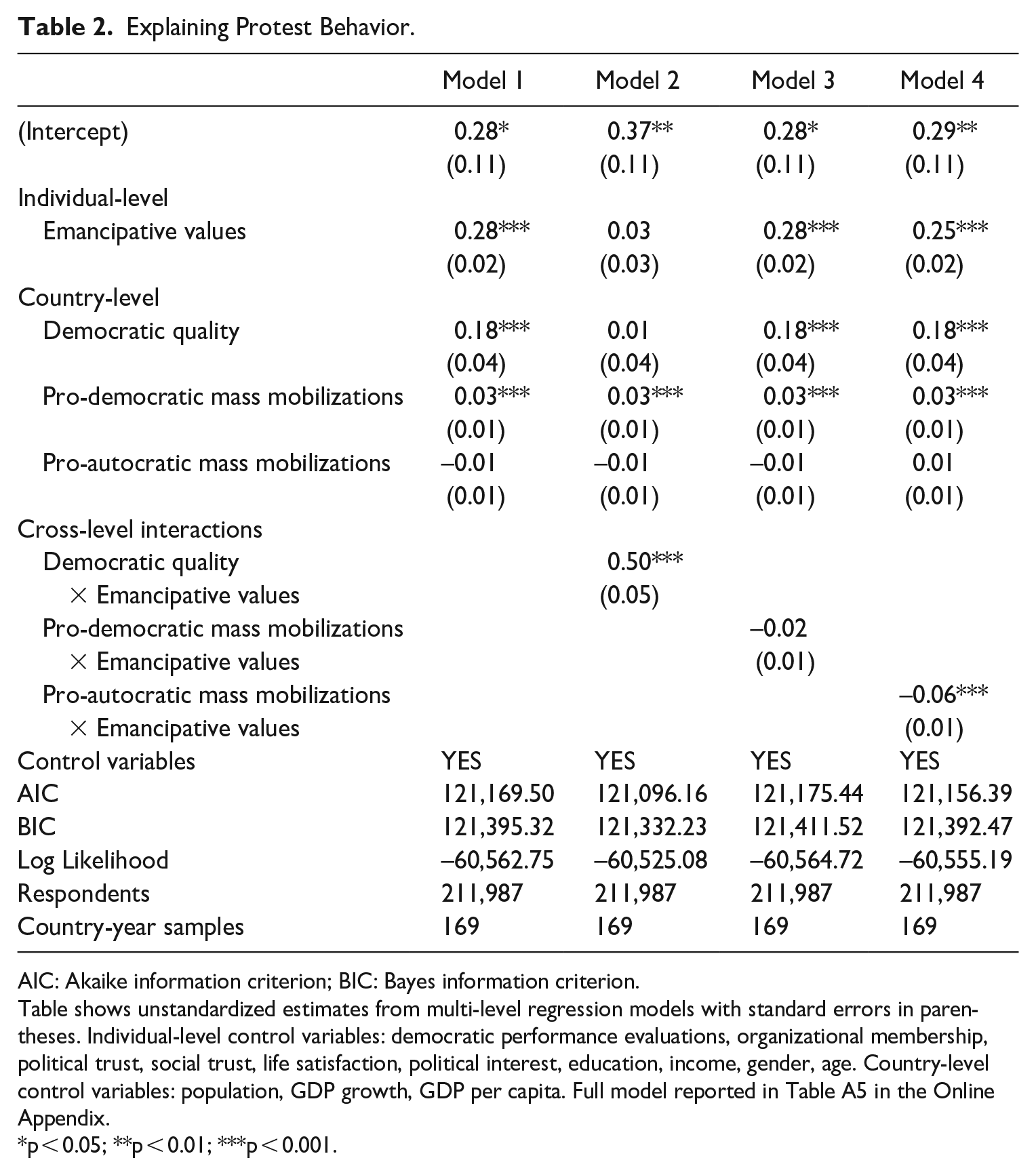
AIC: Akaike information criterion; BIC: Bayes information criterion.
Table shows unstandardized estimates from multi-level regression models with standard errors in parentheses. Individual-level control variables: democratic performance evaluations, organizational membership, political trust, social trust, life satisfaction, political interest, education, income, gender, age. Country-level control variables: population, GDP growth, GDP per capita. Full model reported in Table A5 in the Online Appendix.
p < 0.05; **p < 0.01; ***p < 0.001.
Combining the three approaches, our core theoretical argument expected the effect of emancipative values to be contingent on political opportunity structures and resource mobilization capacity in a given country. Regarding the conditional effect of emancipative values on protest participation, we proposed first that democratic quality matters for how these attitudes translate into individual political action (H1): Building on the idea that political protest first needs to become part of the opportunity set for democratically minded citizens, we argued that the costs of political protest are lower and the chances of success higher in a context of higher democratic quality and consequently hypothesized that the effect of emancipative values is likely to be stronger the more democratic a country is. Model 2 in Table 2 includes the respective cross-level interaction effect of democratic quality and emancipative values in multi-level random-slope models. The interaction term turns out to be both substantial and positive, indicating that the effect of emancipative values on protest behavior increases with democratic quality. Figure 1 plots this conditional effect of emancipative value orientations graphically. It demonstrates that, while the impact of emancipative value orientations on protest behavior is positive in any context, it is miniscule in countries with deficient democratic quality and becomes more and more substantial with increasing democratic quality.
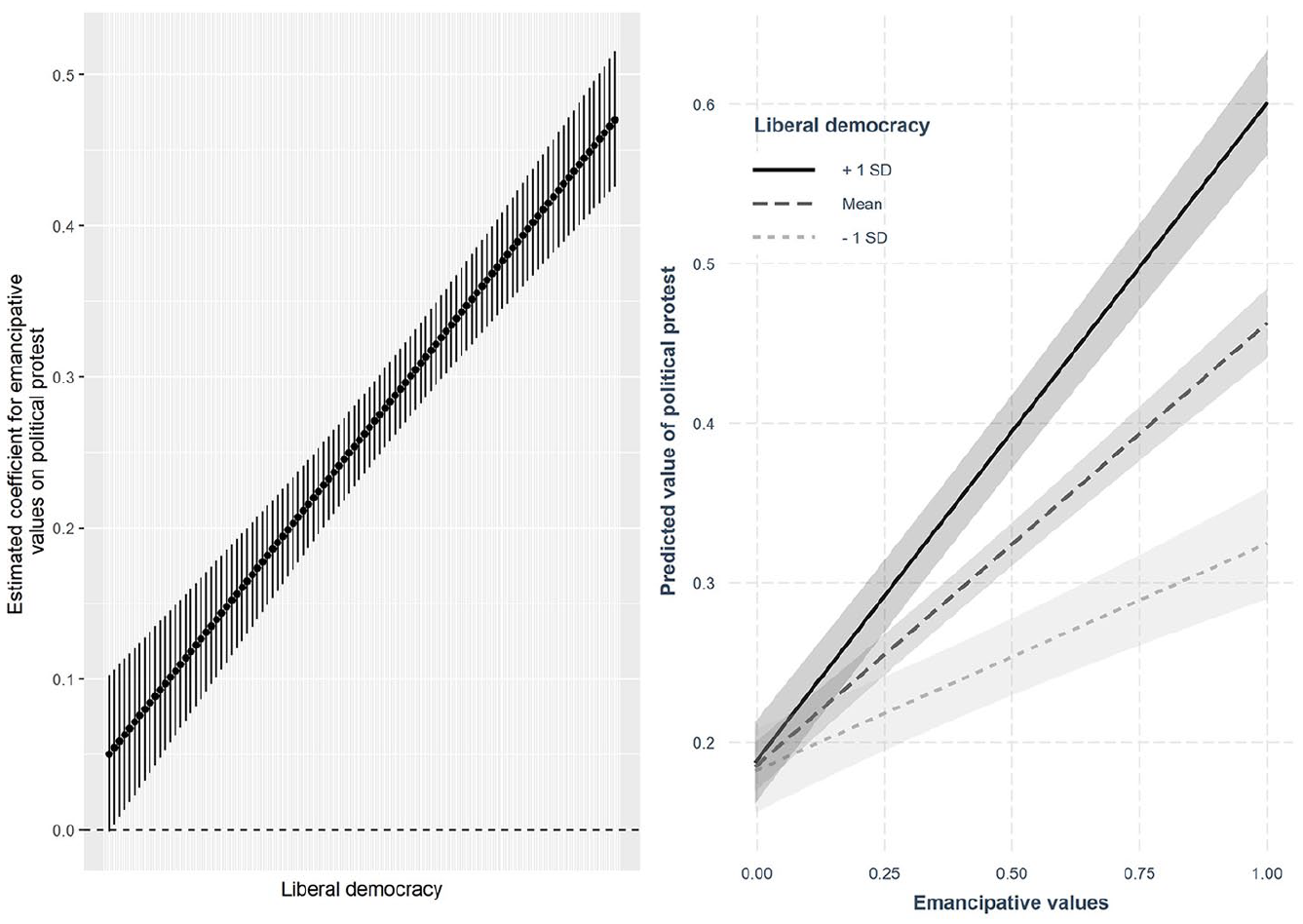
How Democratic Quality Conditions the Effect of Emancipative Values on Protest Behavior.
Following a similar line of argument, we also expected the extent of pro-democratic mass mobilizations to condition how emancipative value orientations affect political protest (H2a). Contrary to our expectations, however, we find no such conditioning effect (Model 3, see Table 2). Emancipative values relate to protest behavior in a similar manner both when pro-democratic mass mobilizations are common and when they are rare. This indicates that the frequency and size of pro-democratic mass mobilization events does not shape the opportunity set of democratically minded citizens, suggesting that the resource mobilization capacity of pro-democratic civil society actors plays a lesser role than the supply of civil liberties and potential responsiveness of the political system.
Finally, Model 4 in Table 2 estimates the interaction between pro-autocratic mass mobilizations and emancipative values. Here, we expected the effect of emancipative values to decrease with rising mobilization due to the de-motivating and deterrence effects of a strong pro-autocratic presence (H2b). Corroborating our conjecture, our analysis finds a significant negative interaction effect between emancipative values and pro-autocratic mass mobilizations. The significant negative coefficient for the interaction term indicates that the positive effect of emancipative values on protest behavior becomes weaker in countries with more frequent and larger pro-autocratic mass mobilization events and hence in contexts where anti-democratic civil society has a higher resource mobilization capacity.
Figure 2 graphically depicts this relationship. It shows that emancipative values have a much stronger effect on protest participation in countries with few pro-autocratic mass mobilizations than in countries where pro-autocratic mass mobilizations are common. Again, these results lend support to our key proposition that the political context determines the opportunity set of citizens: where pro-autocratic mass mobilizations abound, democratically minded citizens might feel less inclined to engage in political protest.
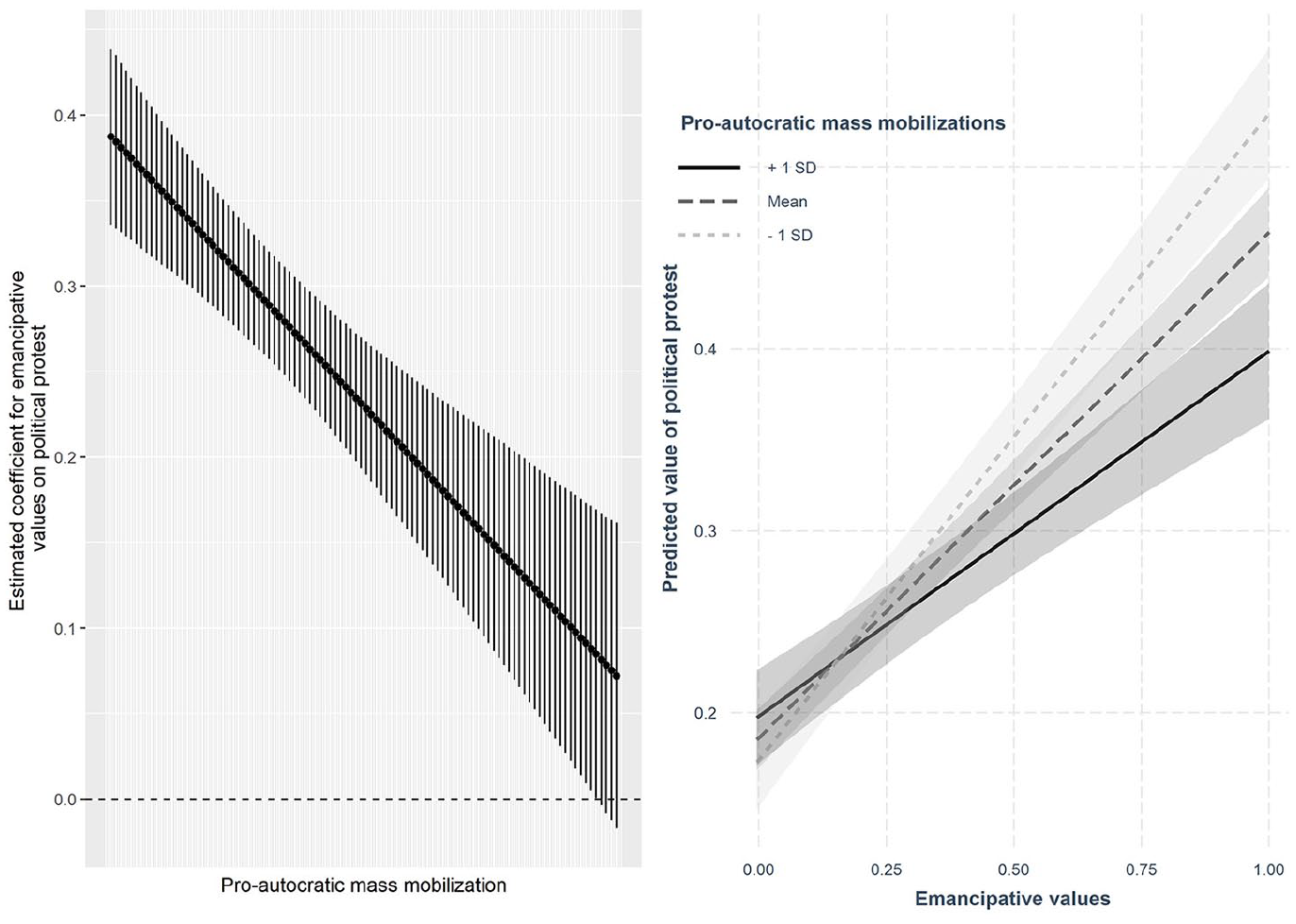
How Pro-Autocratic Mass Mobilizations Condition the Effect of Emancipative Values on Protest Behavior.
To further investigate these conditioning effects and to alleviate concerns about reverse causality, we leverage the fact that some countries in our sample were surveyed at more than one time point and that, for some of these countries, political opportunity structures and resource mobilization capacity varied over time, while they remained stable for others. Although the structure of our data does not allow for a proper difference-in-differences (DiD) design, we can still employ a DiD logic in which we exploit within-country over-time variation in political opportunity structures and resource mobilization capacity by comparing the changes in the coefficient for emancipative values for one group of countries (where macro-level variables changed from one point in time to the next) to changes in this coefficient for another group of countries (where macro-level variables remained stable from one point in time to the next). 12 As not all countries in our sample were surveyed more than once and these macro-level variables vary rather little over time, the results from this “DiD” analysis are hardly generalizable. They can only complement our cross-sectional analysis rather than provide robust evidence for causality. Nonetheless, they provide some indication and further support for our hypotheses: For all three variables (democratic quality, pro-democratic mobilization, pro-autocratic mobilization), we find changes in the coefficient of emancipative value orientations that are consistent with our expectations. In countries where either democratic quality 13 (Supplemental Table A6) or pro-democratic mobilization 14 (Supplemental Table A7) increased between two survey periods, the effect of emancipative values also increased markedly from the first point in time to the next. In the “control group” of countries where none of the context variables changed, 15 in contrast, this coefficient did not change at all. Concurrently, in countries where pro-autocratic mobilization decreased over time, 16 emancipative values also became more important in shaping protest behavior (Supplemental Table A8).
Our results remain robust under various alternative model specifications. For one, we examined whether using binary versions of the dependent variable would change our findings (Supplemental Tables A9–A11). We find two deviations from our main analysis: first, for one of the three binary versions of the dependent variable (combining “might do” and “would never do” into a single category), the extent of pro-autocratic mass mobilization has a significant negative effect (Supplemental Table A10, Model 1). This effect, however, is very weak (odds ratio ≈ 0.9), and not present for the other two binary versions of the dependent variable. Second, Model 3 in Supplemental Tables A9–A11 show a small negative interaction between pro-democratic mass mobilization and emancipative values. Yet, we find no substantial conditionality when following Greene (2010) and examining the interaction graphically rather than based on potentially biased statistical testing (Supplemental Figures A8–A10). Furthermore, we tested whether a threshold model of political opportunity structures would yield different results. To do so, instead of the continuous measure for democratic quality, we employed two binary measures of regime context: one that distinguished between democracies and autocracies and another that distinguished between liberal democracies and other types of regimes. The idea was that either of these binary distinctions could represent a threshold that needs to be crossed for political protest to become a realistic and/or viable option for democratically minded citizens. This does not seem to be the case: for both binary measures, the interaction with emancipative values remains positive and significant, as do almost all other theoretically relevant effects apart from the main effect of democratic quality (Supplemental Tables A12 and A13).
To avoid potential bias introduced by our unbalanced dataset, where some countries are included more than once, we also re-ran our main analyses using only the latest wave of the WVS and EVS survey data (Supplemental Table A14). The results are the same as for the full dataset. We further checked whether using only complete cases for the construction of the emancipative values index rather than imputing missing values. This is not the case: the results are virtually identical to the main analysis (Supplemental Table A15). Finally, we examined whether democratic quality influences the effects of pro-democratic or pro-autocratic mass mobilizations or the respective interaction with emancipative values by including two-way and three-way interactions (Supplemental Table A16). Again, there are no significant differences indicating that the direct effects and cross-level interactions depend on the level of democratic quality. In summary, these additional analyses strengthen the robustness of our results.
Conclusion
When it comes to explaining political protest, three separate strands of argument have emerged from prior research: motivation-based explanations focus on individual-level emancipative values as drivers of political protest; in contrast, the literature on political opportunity structures and resource mobilization theory emphasize exogenous context factors to determine the prospects of mobilization. Linking these three literatures and expanding them by covering both democratic and autocratic regimes, we have argued that citizens’ value orientations and contextual factors interact in shaping protest participation. In particular, we hypothesized emancipative value orientations, democratic quality, and the extent and type of mass mobilizations within a given country to affect participation in political protest. Specifying the interactions between these individual- and context-level factors, we first suggested that emancipative value orientations only increase the likelihood of protest in contexts of reasonably high democratic quality. As far as the extent of mass mobilizations is concerned, we conjectured pro-democratic mass mobilizations to strengthen the effect of emancipative value orientations on protest participation, whereas we expected pro-autocratic mass mobilizations to weaken this effect.
Combining survey data from the WVS and EVS with aggregate data from V-Dem for 88 countries and over 200,000 respondents in 169 country-years, we found support for the idea that citizens’ value orientations, democratic quality, and mass mobilization both affect, as well as interact in determining the likelihood of protest participation. Regarding those interactions, the analysis demonstrates that emancipative value orientations play a larger role in shaping protest participation in countries with a higher level of democratic quality, supporting our argument that democratic quality matters for how citizens’ attitudes translate into political action by determining both the costs and chances of success for political protest. If we focus on the conditioning effect of pro-democratic mass mobilizations, however, this idea does not receive support from the data: the effect of emancipative value orientations appears to be independent of how prevalent pro-democratic mass mobilizations are. On the contrary, the extent of pro-autocratic mass mobilization does condition the effect of emancipative value orientations: as we suggested, emancipative values play a less important role for protest participation in context that see many pro-autocratic mass mobilizations.
In sum, the results lend support to the underlying idea that how citizens’ value orientations affect their decision to participate in political protest is at least to some extent contingent on the political context in which they live. As a first account of how the level of democracy and the extent of pro-democratic and pro-autocratic mass mobilizations interact with emancipative value orientations, they can serve as a vantage point for further theory-building and empirical analyses. For one, others could expand on our theoretical model by disentangling the role of objective political opportunity structures and civil society resources versus citizens’ perceptions of these context factors in shaping citizens’ expectations concerning the costs of protest and its likelihood of success. After all, citizens’ subjective interpretations of the political context are not necessarily homogenous, and prior research has shown that citizens’ perceptions of their country’s level of democracy do not always align with expert assessments and may be influenced by a number of additional factors such as education or conceptions of democracy (Ananda and Bol, 2020; Kruse et al., 2019; Mauk, 2021; Wegscheider and Stark, 2020).
In addition, future studies might tackle the conundrum of measuring political behavior: Our survey-based measure of protest participation cannot distinguish between actual behavior and behavioral intentions. Yet the two are not the same (Fishbein and Ajzen, 1975) and intentions may be shaped by mechanisms different from the ones that govern actual behavior (Fishbein et al., 2003). More work also needs to be done regarding the distinction between different forms of political protest and especially its goals. What drives participation in nonviolent versus violent protests, when are citizens more likely to attend a demonstration on labor rights versus one demanding climate action, and who joins the ranks of anti-democratic populist or xenophobic protestors? While the WVS and EVS data allowed us to study the determinants of (intended) participation in peaceful demonstrations, it contained no information about the goals of these protests or about whether and under which circumstances respondents were willing to participate in other forms of political protest.
Future research should further make use of experimental designs to tackle the issue of reverse causality. While the theoretical approaches we discussed here clearly suggest that emancipative values, political opportunity structures, and resource mobilization affect protest behavior, there are alternative theoretical arguments that suggest the opposite causal direction: that protest or political participation more broadly results in changes in citizens’ value orientations, the political opportunity structures, and/or the extent of resource mobilization (Barber, 1984; Dahl, 1998; Putnam, 2000). While our pseudo difference-in-differences design could at least provide some indication regarding causality, the question of causal direction can only be answered definitively with truly experimental designs.
Despite their limitations, the present findings can give some insights into the mechanisms shaping protest participation. Most importantly, they lend support to the idea that political opportunity structures and the resource mobilization capacity of civil society shape the set of participation opportunities available to citizens, whereas value orientations determine which of the available options citizens choose. On a more general note, they underscore the need to take into account the interactions between individual-level characteristics and the political context when trying to explain political behavior. Our findings further indicate that political protest can indeed serve to make government more accountable without endangering the stability of democracy—at least in countries where the level of democracy is already reasonably high. In countries with very low levels of democracy, protest participation is less connected to emancipative value orientations, and protest may thus not have democracy-enhancing qualities. While this bodes fairly well for the resilience of existing democracies as we can expect citizens to stand up in defense of democracy, protests in autocracies appear to be less clearly driven by pro-democratic aspirations, which makes the prospects for democratic change driven by popular protest appear less promising. Nonetheless, even in the most autocratic contexts, participation in protest is not negatively related to emancipative values, giving reason for at least some optimism.
Supplemental Material
sj-docx-1-psx-10.1177_00323217241247377 – Supplemental material for Capable but Not Empowered? How Emancipative Values Affect Protest Participation Across Different Contexts
Supplemental material, sj-docx-1-psx-10.1177_00323217241247377 for Capable but Not Empowered? How Emancipative Values Affect Protest Participation Across Different Contexts by Carsten Wegscheider and Marlene Mauk in Political Studies
Footnotes
Acknowledgements
Earlier versions of this paper were presented at the German Political Science Association’s (DVPW) 2021 annual meeting, the European Political Science Association’s 2021 annual meeting, and GESIS’ Department of Research on Society research seminar series. We thank participants for their generous and very helpful feedback. We owe a special debt of gratitude to Jennifer Oser for her thorough reading and extensive suggestions for revisions, as well as to Christian Welzel for pointing us in the right direction early on. We would also like to thank Political Studies’ two anonymous reviewers for their insightful comments, which greatly helped improve the article.
Declaration of Conflicting Interests
The author(s) declared no potential conflicts of interest with respect to the research, authorship, and/or publication of this article.
Funding
The author(s) received no financial support for the research, authorship, and/or publication of this article.

Supplemental Material
Additional Supplementary Information may be found with the online version of this article.
Table A1: Measuring membership in associations Table A2: Measuring political trust Table A3: Descriptive statistics Table A4: VIF Values for Full Models in Table A5 Table A5: Full Model on Explaining Protest Behavior Figure A1: Correlation matrix for individual-level variables Figure A2: Correlation matrix for country-level predictors Figure A3: Scatterplot between political protest and liberal democracy Figure A4: Scatterplot between political protest and pro-democratic mass mobilization Figure A5: Scatterplot between political protest and pro-autocratic mass mobilization Figure A6: Scatterplot between liberal democracy and pro-democratic mass mobilization Figure A7: Scatterplot between liberal democracy and pro-autocratic mass mobilization Robustness checks Table A6: Pseudo Diff-in-diff design: Experimental group (democratic quality increased) t1 > t2 versus control group (democratic quality remained stable) t1 > t2 Table A7: Pseudo Diff-in-diff design: Experimental group (pro-democratic mobilization increased) t1 > t2 versus control group (pro-democratic mobilization remained stable) t1 > t2 Table A8: Pseudo Diff-in-diff design: Experimental group (pro-autocratic mobilization decreased) t1 > t2 versus control group (pro-autocratic mobilization remained stable) t1 > t2 Table A9: Robustness checks using binary variable for political protest (excluding “might do”) Figure A8: How pro-democratic mass mobilizations (not) condition the effect of emancipative values on protest behavior (based on Model 3 in Table A9) Table A10: Robustness checks using binary variable for political protest (combining “might do” and “would never do”) Figure A9: How pro-democratic mass mobilizations (not) condition the effect of emancipative values on protest behavior (based on Model 3 in Table A10) Table A11: Robustness checks using binary variable for political protest (combining “might do” and “have done”) Figure A10: How pro-democratic mass mobilizations (not) condition the effect of emancipative values on protest behavior (based on Model 3 in Table A11) Table A12: Robustness checks using binary variable distinguishing between democracies and autocracies Table A13: Robustness checks using binary variable distinguishing between liberal democracies and other regime types Table A14: Robustness checks using only the latest wave of survey data Table A15: Robustness checks using list-wise deletion for emancipative values Table A16: Robustness checks including macro-level interactions
Notes
Author Biographies
References
Supplementary Material
Please find the following supplemental material available below.
For Open Access articles published under a Creative Commons License, all supplemental material carries the same license as the article it is associated with.
For non-Open Access articles published, all supplemental material carries a non-exclusive license, and permission requests for re-use of supplemental material or any part of supplemental material shall be sent directly to the copyright owner as specified in the copyright notice associated with the article.
