




Abstract
In this article, we offer a normative analysis of environmental politics through the lens of civility. First, we explain what civility is by identifying its three key dimensions: civility as politeness, moral civility and justificatory civility. We then examine various instances of environmental politics and activism through the lens of civility, by focusing on the complex intersections between its three dimensions as well as the hierarchical relationship that exists between them, with moral civility taking precedence over justificatory civility and the latter over civility as politeness. This analysis, we argue, can help us to formulate more nuanced judgements about the desirability of different instances of civil and uncivil environmental politics and activism, and to develop educational strategies for preparing policymakers, environmental activists and citizens more generally to be civil participants in environmental politics.
Introduction
The Intergovernmental Panel on Climate Change (IPCC) paints a stark picture of the risks and challenges the world faces because of global warming. Scientists continue to document and analyse how issues related to climate change such as extreme weather events, rising sea levels and mass species extinction will transform the world we live in, and these issues may represent an existential crisis for humanity. 1 There is an urgency for politicians and the public to take action. Nevertheless, issues related to environmental politics 2 often prove contentious to varying degrees as a range of conservation, anti-pollution and climate initiatives take place both inside and outside the confines of institutional politics. Political institutions at their best can provide sites where civil, evidence-based advocacy can take place around climate policy (Guber et al., 2021). However, in recent times, political systems in many countries have come to be characterized by illiberal pathologies, as well as partisan conflict and entrenchment. This is problematic for climate action since factors like extreme ideologies (Forchtner and Lubarda, 2023) and party identification (Mayer and Smith, 2023) can inhibit support for climate policies and shape subsequent political (in)action. Likewise, lobbyists and industry coalitions can obstruct or mislead policymakers and the public while simultaneously ‘advocating inaction’ (Brulle, 2023). Some individual politicians have invited controversy as well, appearing in legislative bodies in provocative ways and challenging norms of civility as they engage with their peers in matters related to the environment. For example, politicians may intentionally link climate science to conspiracism, as when Oklahoma Senator James Inhofe delivered a speech to the US Senate asking whether ‘manmade global warming is the greatest hoax ever perpetrated on the American people’ and characterized environmental activists’ strategies akin to those employed by the Third Reich (Monbiot, 2009). Climate denialists are sometimes portrayed as uncivil. As UK academic, Green Party campaigner and a former spokesperson for Extinction Rebellion Rupert Read stated in a recent post on X (formerly Twitter), ‘[c]limate-denial is an apotheosis of uncivil discourse. It is hate speech. It is deadly. It worships bullshit and lies. It has no place in a civil society’ (Read, 2023).
Instances of environmental politics gone awry, however, are also common outside the halls of government institutions. Climate activist coalitions in the United Kingdom, for example, have staged high-profile contentious actions like throwing tomato soup on the Mona Lisa painting, gluing themselves to other art installations, obstructing motorways or smearing chocolate cake on a waxwork of King Charles (Just Stop Oil, 2023). Anti-logging activists in Australia have staged blockades and other acts of civil resistance to disrupt timber harvesting operations and to protect native forests (Jones, 2022). Many forms of environmental activism are portrayed as uncivil as they ‘don’t conform to ideas of civil disobedience as public, polite and peaceful’ (Jubb and McLaughlin, 2022). And Read’s aforementioned criticism of climate deniers’ incivility could itself be considered an instance of incivility, because of the impolite language and tone it employs.
As these few examples show, issues related to environmental politics are contentious and often characterized by deep disagreement. Importantly, they are often framed in terms of (in)civility. Whether we observe political opponents quarrelling in parliament, a heated exchange between two scientists in the media, or physical confrontations in the street between law enforcement and protestors, allegations of incivility like the ones mentioned are not uncommon. This is not surprising, given the important functional role of civility in contemporary societies. One of civility’s key functions is to allow for and promote a peaceful ‘unmurderous coexistence’ (Bejan, 2017: 166) between individuals who do not agree with one another but still have to live together in the same society (Boyd, 2006: 865). Civility can prove crucial for the ‘containment of conflicts’ (Edyvane, 2017: 348). Yet, as political philosopher Sune Lægaard (2022) points out, civility often presents a ‘paradox’: it is precisely in those contexts and sites where there is the greatest need for civility – that is, because people deeply disagree about one or more issues – that civil interactions are least likely to take place. Environmental politics seems to be one of those contexts, given the profound disagreements that characterize it. This raises the important question of what civility is exactly, as well as whether and how greater civility might be promoted among those engaged in environmental politics. Encouraging more civil interactions in this realm may help overcome some of the divisions and barriers that threaten our ability to effectively address climate challenges, such as public polarization (Badullovich, 2023). However, could incivility itself sometimes not also help promote positive climate action if it calls attention to climate change and pushes for a policy response? And, conversely, could civility sometimes not help hinder climate action if it is strategically employed by certain actors? To answer these kinds of questions and, more generally, to better understand the role of (in)civility in environmental politics, we need to understand how politicians and activists talk about (and act in relation to) environmental issues – that is, how various actors make arguments about, advocate for or justify their aims or policies, and how they behave when they advocate for or against certain forms of climate action like rioting or vandalism. This is important not only to normatively evaluate instances of civility and incivility in the realm of environmental politics but also because, as empirical research in social and political psychology has shown, rational persuasion can be more effective when an agent justifies their actions based on moral arguments their audience endorses (Feinberg and Willer, 2019). This point is especially relevant to our analysis of what we call ‘critical impoliteness’ and ‘critical incivility’.
In order to analyse environmental politics through the lens of civility, we first explain what civility is by identifying its three central dimensions: civility as politeness, moral civility and justificatory civility. We then examine various instances of environmental politics and activism through the lens of civility, by focusing on the complex intersections between its three dimensions as well as the hierarchical relationship that exists between them, with moral civility taking precedence over justificatory civility and the latter over civility as politeness. This analysis will help us to achieve two key goals. First, it will enable us to acquire a more nuanced appreciation of the complex landscape of environmental politics. In particular, it will help us to understand that the same action may sometimes constitute an instance of incivility under one of the civility dimensions while being civil under a different and more important dimension, thus being desirable while still being uncivil in some way; and, conversely, that instances of environmental political action that are superficially civil – for example, because they comply with established norms of etiquette and decorum – may often conceal goals that are uncivil at a more fundamental level. Second, this discussion will help us to formulate more nuanced judgements about the desirability of different instances of civil and uncivil environmental politics and activism. We will conclude by drawing on this multidimensional analysis to suggest some educational strategies for preparing policymakers, environmental activists and citizens more generally to be civil participants in environmental politics.
Before proceeding with our analysis, four points of clarification are required. First, as this introductory section explains, the focus of this article is not solely on justifying uncivil actions and uncivil disobedience in the realm of environmental politics. We are, of course, aware that a number of authors have defended this view. However, their argument is normally that uncivil environmental action can sometimes be justified despite being uncivil (e.g. Malm, 2021; see also Delmas, 2018). Our goal is instead to show that certain instances of environmental action are justified because, while being uncivil in some way, they are civil in some other (more important) way. In this sense, it will be crucial for us to understand what both civility and incivility involve since our analysis is focused on their connection rather than examining either one in isolation. Furthermore, justifying some instances of uncivil environmental action is only one of this article’s goals. Through our civility framework, we also aim to show, for example, when uncivil forms of environmental activism are not justified and, conversely, when civil forms are also not justified (what we call ‘surface-level civility’). The latter aspect is one that has been particularly neglected in the literature. Finally, our focus is not only on civil or uncivil actions but also on civil or uncivil speech, a point that is particularly important when it comes to the justificatory dimension of civility.
Second, and relatedly, our civility framework offers a more systematic means for analysing environmental politics than existing works on (in)civility and/or (un)civil disobedience. To clarify, in this article, we do not aim to criticize or challenge these works per se. Instead, we intend to develop a unified framework in order to show the complex interconnections between them and how they can help us to evaluate environmental politics. For example, Edyvane’s (2020) account of incivility as dissent, Rawls’ (2005) idea of the ‘duty of civility’ and Delmas’ (2018) defence of ‘uncivil disobedience’ can be integrated into a single civility framework in order to formulate nuanced evaluations of civil and uncivil forms of environmental action.
Third, a key premise of our analysis, and one which has implications for the educational policy proposals in the concluding section of the article, is that making these kinds of evaluations requires a capacity for judgement. As Lægaard points out, ‘[c]ivility is a practical ability of individuals to distinguish between different social roles and contexts and to differentiate their behaviour accordingly . . . [which] crucially involves an element of judgment’ (Lægaard, 2010: 94). Different contexts may affect the extent to which abiding by civility norms is desirable or not, and which norms one should abide by can vary by context. As Simone Chambers notes in her review of Teresa Bejan’s (2017) book Mere Civility, violating high-civility standards may be permissible or even desirable ‘in the face of injustice and violence that continually fail to make it onto the public agenda’ (Chambers, 2018: 526), as when the Berrigan brothers poured blood on draft records to signal opposition to the Vietnam War. Yet, Chambers (2018: 526) argues, ‘it would be totally inappropriate for me to pour blood all over the chair of my department if I lost a hiring vote (all things being equal)’.
Fourth, in this article, we do not argue that environmental politics is special compared to political activism focused on other issues such as racial injustice, the war in Ukraine, or the Israeli–Palestinian conflict. These issues may differ in important ways, but we remain agnostic about this point. Instead, we take environmental politics to be an illustration of how our civility framework can be employed to evaluate political activism more broadly, and to demonstrate this framework’s portability and applicability to a variety of contexts and cases.
Understanding Civility
Any analysis of civility, including in the environmental politics context, should begin by acknowledging that civility is not a one-dimensional concept. Indeed, while the theoretical literature on civility is vast and diverse (Bardon et al., 2023; Edyvane, 2017), it is possible to trace different understandings of civility to three fundamental dimensions which, as we will show later on, are often interrelated. 3 Identifying these three dimensions of civility is also crucial for understanding what incivility is, since the latter can be understood as a violation of civility norms.
The first dimension is the idea of ‘civility as politeness’, which involves abiding by social norms of politeness, decorum and etiquette, often tied to specific contexts, roles and identities (Bardon et al., 2023; Bonotti and Zech, 2021). Compliance with politeness norms communicates to others a basic kind of respect and consideration, that is, ‘minimal public deference – a mere forbearance from roughness or unpleasantness’, often in the context of ‘fleeting public encounters’ (Manning, 1976: 13). This can facilitate our cooperation with others by acting as a kind of social ‘lubricant’ (Boyd, 2006). Norms of politeness are numerous and diverse, ranging from those which tell us how we should greet others to those concerning queuing etiquette. They also include norms related to certain ‘habits of speaking and listening’ (Bejan, 2017: 164), for example, those demanding that we do not use offensive language or that we listen to others without interrupting them.
The second and third dimensions of civility, which we refer to as ‘moral civility’ and ‘justificatory civility’, are both instances of what we call ‘civility as public-mindedness’. This type of civility is more demanding than civility as politeness, in a number of ways. For a start, rather than on short-term interpersonal relations its focus is on our long-term relationship with (and commitment to) our political community and its well-being. Edyvane (2017: 345) argues that this kind of civility – which he calls ‘political civility’ – is: bound up with the idea of an association of citizens, and includes cognate ideas of the civic, the civil and the civilian; it concerns one’s status and duties as a member of a political community, as a citizen with certain rights and responsibilities.
Furthermore, and relatedly, civility as public-mindedness demands not merely that we display basic consideration for others – as in the case of civility as politeness – but that we also recognize and respect them as free and equal persons. Finally, it requires that we communicate this deeper kind of respect to them through signals that are different from those that normally characterize polite actions.
In the case of moral civility, we communicate our respect for others as free and equal persons when we refrain from acting (or speaking) in violent (Lai and Lim, 2023; Peterson, 2019; Scheuerman, 2022), discriminatory (Zurn, 2013) or hateful (Waldron, 2012) ways, and when we avoid cruelty and display care for other people’s safety (Milligan, 2013). 4 Each of these ways of acting (or refraining from acting) can communicate respect for others. As Scheuerman (2022: 797) argues, for example, ‘[n]onviolence . . . is essential to civility since activists show “respect to everyone” by refusing to engage in violence or to carry weapons’ (original emphasis). Justificatory civility demands instead that citizens (and politicians, in particular) communicate their respect for others as free and equal persons by providing a public justification for the laws and policies that they advocate and aim to implement. More specifically, it requires that laws and policies be justified based on public reasons, that is, reasons grounded in widely shared moral and political values – for example, basic rights and liberties, equality of opportunity and the common good – and empirical evidence rather than reasons based on sectarian and controversial values, or those relying on flawed empirical data (Rawls, 2005).
Before proceeding with our analysis, we would also like to highlight two crucial points. First, the three dimensions of civility are not equally important in a liberal democratic society. More specifically, since civility as public-mindedness signals a deeper kind of respect than civility as politeness – that is, one that involves viewing and treating others as free and equal persons, rather than merely acknowledging them as co-members of society – it inevitably plays a more fundamental role in sustaining liberal democratic institutions. It should therefore be prioritized over civility as politeness when there is a tension between the two (Bardon et al., 2023). Furthermore, within civility as public-mindedness, moral civility should be prioritized over justificatory civility – that is, if and when infringing upon justificatory civility norms is necessary in order to advance morally civil goals, justificatory incivility may be desirable. For example, Rawls (2005) famously argues that the use of religious reasons by those US abolitionists who considered slavery ‘contrary to God’s law’ (Rawls, 2005: 249) – an instance of justificatory incivility – was not inappropriate. Those abolitionists, he contends: supported political values of freedom and equality for all [a morally civil goal], but . . . given the comprehensive doctrines they held and the doctrines current in their day, it was necessary [for them] to invoke the comprehensive [i.e. non-public] grounds on which those values were widely seen to rest (Rawls 2005: 251).
In other words, it was necessary for them to breach the norms of justificatory civility to advance moral civility.
Second, each of the three dimensions of civility rarely manifests independent of the other two. Indeed each of the three dimensions of civility can be used as a means to a civil or uncivil end, where the end is either justificatory or moral civility (Bardon et al., 2023). 5 And it is indeed at the intersection of the three dimensions that we can best examine the nuances and complexity of civility. In the next two sections, we show how the complex intersection between the three dimensions of civility, as well as their hierarchical ordering, play out in the context of environmental politics, both in the realm of official institutions and in that of activism and protest behaviour.
When Politeness Meets Public-Mindedness
We focus first on the different ways in which civility as politeness and its opposite (i.e. incivility as impoliteness) can intersect with civility as public-mindedness and its uncivil counterparts (i.e. moral and justificatory incivility). More specifically, we identify four scenarios which differ from one another based on whether politeness or impoliteness is being employed to advance or hinder civility as public-mindedness and provide some examples of how these scenarios can manifest in the realm of environmental politics.
Deep Politeness
The first scenario, which we call deep politeness, occurs when civility as politeness is employed to pursue public-minded goals in the sense of either moral or justificatory civility (or both as instances of civility as public-mindedness). We can find several instances of deep politeness in the context of environmental politics.
For example, UK Prime Minister Rishi Sunak was recently criticized for initially ‘snubbing’ (Harvey, 2022) or ‘shunning’ (Smith and Woodcock, 2022) the 2022 COP27 UN climate summit in Egypt due to domestic commitments. This admittedly impolite decision, in tension with established norms of protocol and etiquette in international politics, was criticized not only for undermining the UK’s international reputation but also for shirking responsibilities for joint international action on climate change (a public-minded goal) (Smith and Woodcock, 2022). Sunak’s subsequent reversal of this decision, and his call for immediate climate action, are arguably illustrative of forms of politeness inherent in diplomatic norms, or at least of the politeness necessary to facilitate public-minded cooperation on international goals. By sending a new polite signal Sunak aimed to overcome the closure caused by his initial impolite decision, thus opening up a space for deliberation, public reasoning and joint action on climate change, which are all manifestations of civility as public-mindedness.
Deep politeness can also manifest outside the settings of institutional politics. Environmental activists can engage in relatively polite forms of protest to draw attention to climate issues or advocate for climate action. For example, during World Cleanup Day activists illustrate the unsustainability of current production and consumption habits by picking up litter and sharing evidence of their hauls through social media (Ignacio, 2021). In such cases, we may see activists strongly encourage or emphasize polite, non-violent engagement and communication in order to avoid many of the attrition costs in public perception associated with more aggressive campaigns (Bashir et al., 2013).
These examples show how the politeness dimension of civility can reinforce its public-mindedness counterpart. We are in the presence of deep politeness when polite behaviour aims to advance publicly minded goals – in this case, action on climate change – in a way that communicates to others a basic kind of respect and consideration while also communicating respect for others as free and equal persons. But in what sense is climate action an instance of civility as public-mindedness – and, particularly, of moral civility – communicating respect for others as free and equal? As Zellentin (2015: 494–495) points out: [i]f primary goods are . . . central to developing and enjoying . . . [our] . . . capacities necessary for full, free, and equal citizenship, and if we believe that every human being should have access to full, free, and equal citizenship, then we have a prima facie negative duty not to destroy the necessary preconditions . . . The claim is that if we believe that human beings have a right to democratic self-determination in a system that treats them as free and equal, then we have to accept – as a minimal requirement – the duty not to undermine their ability to develop, exercise, and maintain those capacities necessary for this pursuit. If we knowingly contribute to circumstances where people’s primary goods are predictably seriously threatened, we breach this duty and infringe their right. Contributing to climate change might thus be understood as a breach of duty on our part for knowingly imposing several severe risks regarding people’s primary goods.
This problem is exacerbated by the fact that climate change does not affect everyone in the same way. A growing literature indeed illustrates the disproportionate negative effects of climate change on specific (and often already vulnerable) racial, ethnic, gender and socio-economic groups, as well as on populations that inhabit certain geographical areas (Thomas et al., 2019).
Deep Impoliteness
While deep politeness involves using polite means to achieve public-minded goals, its opposite, that is, deep impoliteness, consists instead of the use of impoliteness to advance non-public-minded goals (in the sense of either moral or justificatory incivility, or both). Like instances of deep politeness, cases of deep impoliteness are also frequent in the realm of environmental politics and can manifest in many different ways, mainly involving politicians or anti-climate activists using rude and offensive language when presenting their climate change denial views. For example, in his years as Treasurer, the former Prime Minister of Australia Scott Morrison violated norms of decorum when he appeared in parliament brandishing a lump of coal. With visible condescension he told his political opponents: ‘[t]his is coal! Don’t be afraid, don’t be scared’. He went on to describe energy policies aimed at reducing fossil fuel consumption as ‘coal-phobia’, a ‘malady’ that ‘afflicts’ the opposition (The Guardian, 2017). Another Australian MP, Craig Kelly, made comments on social media about ‘brainwashed climate cultists’ as he attacked political opponents and engaged with climate science research (Hall, 2020).
Likewise, the former President of the United States Donald Trump often targeted Swedish environmental activist Greta Thunberg with mocking posts on X (formerly Twitter) to belittle her and attack her broader climate policy agenda (Trump, 2019a, 2019b). Acts of impoliteness can also take place in unconventional spaces, as when a libertarian think tank put up a billboard associating climate change advocacy with Ted Kaczynski (aka the Unabomber) (Goldenberg, 2012), who was convicted of murder after a bombing campaign to address technological and environmental threats to society.
Critical Impoliteness
The two scenarios examined so far – that is, deep politeness and deep impoliteness – are relatively unproblematic from both a conceptual and a normative perspective. They both involve a clear congruence between the two main dimensions of (in)civility, with deep politeness arguably always being normatively desirable while deep impoliteness being not. However, sometimes, specific actors involved in environmental politics may need to diverge from the aspirational goals of deep politeness. Grassroots movements that hope to garner attention from government institutions and intergovernmental organizations, for example, may sometimes need to employ impolite means in order to advance their public-minded goals. This scenario, which we call critical impoliteness, suggests that impoliteness is not always undesirable and may in fact sometimes even be morally required. Given the priority that we have assigned to civility as public-mindedness over civility as politeness, renouncing the latter and breaching politeness norms may be necessary in order to advance the former. This argument may especially apply to members of those groups which, as we explained earlier, disproportionately experience the negative effects of climate change, and who may therefore be more inclined (and morally entitled) than others to engage in critically impolite behaviour in order to demand climate action.
Within the realm of official institutional politics, critical impoliteness can manifest when a politician swears, uses rude language or, more generally, violates norms associated with their position or the procedural rules that apply to their setting in order to advance the cause of climate change action. For example, in September 2022, during a parliamentary debate on a climate bill proposed by the Australian Labor government, newly elected independent senator David Pocock used rude language aimed at conservative colleagues who dismissed or questioned the consensus on climate science, referring to their views as ‘bullshit’ (Morton, 2022). Pocock’s impolite remark – which he was subsequently forced to withdraw – was arguably a costly signal that he employed to bring greater attention to the issue, albeit at the cost of causing some closure among the senators he targeted and those sensitive to this breach of decorum. In other, perhaps stronger, instances of critical impoliteness, certain actors may characterize their interlocutors in ways that deliberately stoke tensions and attribute personal blame for specific events. For example, former California Governor Jerry Brown targeted congressional Republicans after an attempted rollback of fuel economy standards, stating: ‘the blood [of people affected by the California wildfires] is on your soul’ (Kopan, 2019). Likewise, in September 2020, during another wildfire crisis affecting the Western United States, Joe Biden chastised then President Donald Trump, calling him ‘a climate arsonist’ (Holden and Strauss, 2020). This kind of confrontational impolite language can, of course, potentially inhibit future cooperation. However, it can simultaneously call attention to climate action, both within and outside official institutional settings.
Indeed, critical impoliteness has often been a tool employed by less powerful actors operating outside formal institutions to call attention to various forms of injustice. This is not surprising. While civility as politeness can facilitate social cooperation, it can also be used by more powerful actors to maintain the status quo and oppress the less powerful, especially minorities and marginalized groups. In this sense, politeness norms can be weaponized to prevent such groups from voicing dissent about established laws, policies and institutions, and to stymie opponents’ influence on decision-making. This is what Teresa Bejan calls the ‘dark side’ of civility, when the latter is ‘irremediably imbricated with . . . a covert demand for conformity that delegitimizes dissent while reinforcing the status quo’ (Bejan, 2017: 9). Impolite behaviour can therefore be considered as a response to structural power asymmetries that prevent members of certain groups from making themselves heard. As Zerilli (2014: 112) points out: [u]ncivil public behavior is symptomatic of a more general democratic deficit of public space in which grievances can legitimately be raised and meaningfully addressed by fellow citizens and their elected representatives. If some citizens are more prone to shout, that may well be because those in power are not listening.
Likewise, Clayton (2010: 3) explains how: [women and] [o]ther groups seeking inclusion in American democracy – African Americans, labor organizers, Native Americans, and gay Americans, among others – have historically faced similar dilemmas; either they could wait patiently for others to press their rights within the existing frameworks of ‘civil behavior’ or they could seek democratic reform themselves by confronting and challenging those frameworks (see also Zamalin, 2022).
6
This is why a number of scholars have advocated for incivility as impoliteness as a way of challenging the status quo through the use of words or actions signalling and contesting various types of injustice – for example, what Edyvane (2020) calls ‘incivility as dissent’ and Delmas (2018) ‘uncivil disobedience’.
In the realm of environmental activism, we can find numerous instances of critical impoliteness, as when climate protesters in the United Kingdom chanted loudly and banged on drums to disrupt events in scenic Cornwall as former Prime Minister Boris Johnson welcomed world leaders to the G7 Summit launch. One activist commented, ‘I’m very sorry if we upset anyone in St Ives or cause an inconvenience, but if anything we should all be upset about the future of this planet’ (Trewhela, 2021). More recently, a flurry of incidents appeared in the news across 2022 and 2023 as protesters perpetrated high-profile incidents targeting priceless works of art on display in museums. Some of the activists took care to ensure they did not permanently damage the art with their vandalism, while others did not (Meyer, 2022).
Surface-Level Politeness
The final scenario that we would like to discuss in this section also involves a tension between civility as politeness and civility as public-mindedness. However, in this case, the two dimensions occupy a reverse order compared to the critical impoliteness scenario, that is, civility as politeness is employed to advance non-public-minded goals. We call this surface-level politeness. Outside the realm of environmental politics and activism, we encounter surface-level politeness, for example, when racist actors strategically employ polite means – for example, speech that complies with norms of etiquette and decorum – to advance a racist political agenda that denies the free and equal status of certain members of society (e.g. Tiso, 2017). But we can also find instances of surface-level politeness among actors operating in the environmental politics context, particularly those who advance anti-climate agendas which they aim to render more appealing to their audiences through overly polite language and behaviour.
Within official institutions, for example, a politician might use polite language or behaviour to present justifications for their opposition to climate change policies which are grounded in false or inaccurate evidence or that advance the sectarian interests of certain groups such as the fossil fuel industry. Politicians can also point to politeness norms to undermine justificatory civility or to silence debate around climate policies. For example, Australia’s former Health Minister Greg Hunt pointed to politeness norms and political decorum when he castigated activists and political opponents for linking devastating bushfires to human-induced climate change (Wroe, 2013).
Instances of surface-level politeness can also be found among actors operating outside official government settings. The academic community, for example, often maintains some degree of decorum, engaging in polite academic debate through research and letters published in scholarly journals. However, we should remain mindful of instances where the veneer of polite exchange may mask efforts to undermine good science (Ball, 2014), advancing arguments based on faulty measurements (Abraham, 2017) and findings that compromise academic integrity in exchange for economic inducements (Readfearn, 2015).
A wide range of organizations and interest groups also exhibit surface-level politeness in their engagement with climate and environmental politics issues. For example, in the United States, the Alliance of Western Energy Consumers, a non-profit organization representing commercial and industrial concerns, authored a polite response to a critical investigative journalism story that detailed their sectarian interests and financial support for a gubernatorial candidate running on a platform hostile to progressive climate policies (Carr and Finklea, 2019).
Instances of surface-level politeness can be particularly troublesome in the context of environmental politics and activism. They can hinder progress on climate legislation, particularly when politeness norms are weaponized by powerful actors in order to silence the critical impoliteness of their interlocutors. Indeed, it is important to note that while critical impoliteness and surface-level politeness are symmetrical in their structure, they are not necessarily symmetrical in their efficacy. Given that the politeness norms employed by surface-level polite actors already enjoy widespread support within society, using them to communicate their views already puts such actors at an advantage over their critically impolite counterparts. This is a point to which we will return in the conclusion, when we outline potential interventions to promote critical impoliteness in educational contexts.
When Moral Civility Meets Justificatory Civility
While the previous section examined instances of congruence and incongruence between civility as politeness and civility as public-mindedness, in this section, we focus on the latter in order to explore the relationship between its two components: justificatory civility and moral civility. We explained earlier that moral civility takes priority over justificatory civility. For this reason, we consider the relationship between the two unidirectional in a normative sense, that is, justificatory civility and incivility as politeness can be employed by different actors to promote or hinder moral civility, but not vice versa.
Deep Civility
We consider deep civility first. This is a scenario in which justificatory civility – that is, appealing to shared political values and to sound empirical evidence – is used to advance morally civil goals. In the context of environmental politics, this kind of scenario manifests every time a politician or an environmental activist appeals to shared political values and empirical evidence to advance various forms of climate action. For example, climate policy negotiations between Australian Greens leader Adam Bandt and the Labor government have brought the issue of new fossil fuel projects front and centre based on Australian scientists’ and experts’ advocacy in an open letter to the Australian Government (Murphy and Morton, 2023). In another example, Tuvalu’s foreign minister Simon Kofe made a theatrical appeal to world leaders at the COP26 by standing knee-deep in the sea to illustrate rising sea levels and the threat of climate inaction to small island states in the Pacific (Reuters, 2021) – a concrete enactment of justificatory civility, so to speak.
Climate activists outside of government can also exhibit deep civility as they pursue morally civil goals while exhibiting justificatory civility. The latter might include drawing on scientific evidence, advocating through legal institutions that operate free from unjust corporate power and influence (Lerner, 2022), facilitating greater fairness in deliberation and participation (Dupuis-Déri, 2021), or engaging in norm-compliant advocacy through civil society organizations or political parties (Scheidel et al., 2020).
Deep Incivility
Conversely, deep incivility occurs when actors employ justificatory incivility to advance morally uncivil goals. For instance, a politician may appeal to the interests of a specific sector of society – for example, the coal industry – rather than to the public interest, in order to oppose climate change policy, thus advancing what is arguably a morally uncivil agenda. As we explained earlier, efforts to advance policies that actively contribute to or fail to tackle climate change constitute instances of moral incivility to the extent that they communicate to those affected by these (in)actions – and especially to members of already vulnerable groups disproportionately affected by climate change – a lack of respect, that is, a failure to recognize them as free and equal persons.
We can find many examples of deep incivility in the realm of environmental politics. For instance, in the sphere of official government institutions, former Australian MP Craig Kelly consistently antagonized other politicians in efforts to undermine proactive climate policies. Mr Kelly also posted numerous provocative statements on social media following the catastrophic bushfires in late 2019 and early 2020, insisting that ‘[b]ushfires have nothing to do with “climate change”’ and inviting people to ‘[b]eware of climate alarmists: Everything they tell you is a lie’ (Cave, 2020). One climate scientist from the Australian National University observed, ‘Craig Kelly is an excellent example of a scientifically illiterate [i.e. justificatorily uncivil] person with a [morally uncivil] public platform’ (Cave, 2020).
Likewise, industry and commercial interests have enlisted politicians and media personalities in various forms of anti-climate lobbying. These lobbying efforts often deny climate change science and consensus and make appeals based on political or business interests. These efforts provide a contrast to polite incivility. While the latter may publicly affirm some aspect of climate consensus, deeply uncivil actors engage in debates only to frustrate or obfuscate facts and scientific consensus. For example, oil companies and petroleum lobby groups have actively obstructed environmental legislation and lied to the US congress (Ambrose, 2021). Some lobby groups have attempted to influence climate scientists directly, providing incentives for and funding particular kinds of research projects (Sheppard, 2010). In the realm of (anti-) environmental activism, other examples of deep incivility might include climate change sceptics who advance conspiracies that are hostile to public reasons and interests and seek to de-emphasize moral civility elements. These sceptics often position themselves in opposition to consensus conceptions of the public good, sometimes introducing anti-Semitic tropes, vilifying global institutions and elites, and framing critics as brainwashed or part of the conspiracy itself. For example, the UN’s Agenda 21 has led to a manufactured conspiracy targeting its Sustainable Development Goals, suggesting that this policy framework is a method for instituting one-world governance, eroding state sovereignty and limiting individual autonomy. This conspiracy has had a real effect on legislation in the United States aimed at fostering sustainable development (Harman, 2015). This deep incivility therefore constitutes a significant obstacle to efforts aimed at generating solutions and policies to address pressing environmental political issues and protecting the public from real harms.
Critical Incivility
We have so far examined scenarios in which there is a congruence between the two sub-dimensions of civility as public-mindedness and their uncivil counterparts, that is, between moral (in)civility and justificatory (in)civility. As in the case of the relationship between impoliteness and public-mindedness, however, many of the more interesting scenarios involve tensions between the two sub-dimensions.
The first of these scenarios, critical incivility, is one in which an actor employs justificatory incivility to advance moral civility. In the realm of environmental politics, this may involve, for example, certain actors such as religious leaders drawing on reasons that appeal to God or religious texts to justify policies that advance climate action and are thus morally civil. For instance, although Pope Francis often frames support for climate action in terms of addressing problems supported by scientific evidence and working towards the common good, he also invokes controversial religious values and suggests that human climate action should be guided by religion and simultaneously contribute to spiritual flourishing, as in his influential Encyclical Letter Laudato Si’ (The Holy Father Francis, 2015). Religious leaders involved in the Jewish Climate Action Network also link climate action to aspects of religious duty (Philips, 2022), as do participants involved in the Green Muslims (n.d.) network.
However, a clarification is required here. Assigning a duty to abide by the constrains of public reason – what Rawls (2005) calls the ‘duty of civility’ – to religious figures like the Pope or Jewish religious leaders would amount to implicitly accepting the strictest (and, many would argue, most controversial) reading of the demands of public reason, in which everyone has absolutely equal duties to justify their actions in public (e.g. non-religious) terms. However, the duty of civility can be seen as most applicable to those who occupy decision-making roles, such as politicians and public officials (Bonotti, 2017). Therefore, our characterization of certain religious figures’ positions on climate action as critically uncivil is most pertinent in cases in which those views are taken up by those who occupy decision-making roles and therefore feed into the policy-making process. One example is provided by the impact that Pope Francis’ aforementioned Encyclical Letter Laudato Si’ has had on climate policy action. Indeed, as pointed out by Ottmar Edenhofer – director of the Potsdam Institute for Climate Impact Research in Germany and co-chair of the UN’s Intergovernmental Panel on Climate Change before the 2015 Conference of Parties (COP) negotiations in Paris – the Pope’s climate teachings particularly influenced the Polish and Latin American COP delegations’ commitment to climate action and, more generally, ‘[t]he Vatican played a significant role in the negotiations for the Paris Agreement [to limit global warming], and as an actor was very helpful’ (Baker, 2023). When religious figures’ climate teachings are taken up by those who are directly involved in climate policy, they can be considered instances of critical incivility where their non-public reasons advance morally civil policies.
Other instances of critical incivility may involve certain actors or movements deliberately using false, inaccurate or exaggerated data about climate change to advance climate action. For example, environmental activist organizations may deliberately use ‘alarmist’ or ‘exaggerated’ claims about climate change to advance morally civil climate action (Gosden, 2014). Conversely, some climate scientists may intentionally underestimate or downplay scientific evidence in ways they believe will be more conducive to reaching consensus around climate action (Jamieson et al., 2019). We believe that these instances of critical incivility are justified. Given that, as we explained earlier, the moral civility dimension of civility as public-mindedness should be prioritized over its justificatory counterpart, it is permissible for environmental activists to violate the latter to promote the former.
Interestingly, however, instances of critical incivility may also involve a tension internal to moral civility. That is, in some cases certain actors may violate norms of moral civility in order to advance moral civility in other ways. For instance, they may resort to violence or other criminal acts – which signal failure to treat others as free and equal persons, and are clearly morally uncivil – in order to advance moral civility along other dimensions. These instances of critical incivility are justifiable only to the extent that it can be plausibly argued that the morally civil goals pursued should take precedence over those that are undermined by the use of morally uncivil tactics and strategies – for example, violent acts – employed to realize them. Outside the realm of environmental politics, for example, some scholars have argued that political rioting may be justified when it aims to achieve such goals as preserving freedom, promoting equality and fighting oppression (Havercroft, 2021; Pasternak, 2018). Likewise, others have argued that political vandalism targeting tainted monuments can be justified when it helps to highlight the injustice those monuments symbolize, for example, when the individuals they commemorate are associated with views that assign an inferior status to members of certain groups (Lai, 2020; Lim, 2020; see also Bardon et al., 2024). In both cases, the goal of promoting moral civility (which involves recognizing others as free and equal) or of redressing moral incivility, is taken to justify morally uncivil violent acts. Assuming, as we explained earlier, that promoting climate action is also an instance of moral civility, then it seems plausible to argue that violent (i.e. morally uncivil) environmental actions might sometimes be justified too. 7
This kind of critical incivility, violating moral civility in some way through (morally civil) climate action, can involve a range of tactics employed by environmental activists that include forms of ecotage or even eco-terrorism, which are always morally uncivil. Instances of ecotage entail the destruction of property or direct action that endanger others, threatening business interests and individual livelihoods. These actions are symbolic and communicative, inviting comparisons to forms of intimidation and violence that can be classified as terrorism. Ecotage might include tree spiking to impede safe forestry operations (Rondeau, 2022), arson targeting construction projects (Ensha, 2009) or attacks against potentially harmful infrastructure like railways or pipelines (Beaumont, 2021; PA Media, 2022). Instances of overt eco-terrorism raise important points for debate regarding the lengths environmental activists might go in attempting to advance policy agendas to address what might be an existential crisis. Individuals and extremist organizations that adopt terrorist tactics – for example, Ted Kaczynski (the Unabomber) or Individualidades Tendiendo a lo Salvaje (Individuals Tending Toward the Wild) – have perpetrated acts that have intentionally caused death and destruction in the service of what many see as noble (morally civil) environmental goals (Richardson, 2018).
While other types of tension between different dimensions of civility, we explained, can be resolved by relying on the hierarchical taxonomy central to our framework – with civility as public-mindedness always taking priority over civility as politeness, and moral civility over justificatory civility – things are more complicated when the tension is internal to moral civility itself. In such cases, it is no longer sufficient for an agent to judge which dimensions of civility are at stake since there is only one such dimension. How, then, can an agent decide how to act? While we do not have the space here to provide a nuanced response to this question, Havercroft’s (2021) response to the question of when political riots are justified seems fitting. Havercroft offers a useful set of 11 criteria to evaluate the justness of political riots. A riot is just if (1) it preserves freedom, (2) it promotes equality, (3) it gives voice to the unheard, (4) it is orderly and self-policed, its goal is to (5) redress violations of fundamental liberal democratic rights and (6) to improve the conditions of society’s most disadvantaged members, (7) its targets are legitimate (e.g. they are responsible for the injustice at stake), (8) the rioters’ actions are proportionate to the contested injustice, (9) the contested law is unjust, (10) the authorities are using riot law to disperse protesters, and (11) redressing the injustice through parliamentary procedures has failed (Havercroft, 2021: 920). As Havercroft explains, ‘[t]hese criteria are not intended to provide a simple check box exercise for assessing a riot. They should instead be used to reflect on the features of individual riots, on a case-by-case basis’ (Havercroft, 2021: 920).
These criteria (or slightly revised versions of them, given the different topic) could be used to assess whether an act of morally uncivil environmental activism, for example, like eco-terrorism or ecotage, is justifiable. One might argue, for example, that these actions normally aim to promote the freedom and equality of members of society (criteria 1 and 2), in the sense that, as we explained earlier, climate change undermines the preconditions for free and equal citizenship; and that they help give voice to the unheard (criterion 3), for example, younger and future generations. However, it is also the case that when they involve violence against people, these actions also violate the free and equal status of some members of society (criteria 1 and 2), and are therefore unjust. Even when they do not involve violence against people, they may still be unjust if, for example, they contribute to further marginalizing members of already disadvantaged groups (criterion 6) or if they jeopardize the livelihoods of non-responsible people (criterion 7). For example, when some members of Extinction Rebellion disrupted London’s public transport network during rush hour in October 2019, they were criticized for particularly affecting working-class commuters and their livelihoods, with several senior figures within the movement also acknowledging the flaws in their action (Lewis, 2019).
It is through this kind of framework that we should also evaluate potential responses to defenders of (violent) uncivil environmental action. Thus, for example, when critics of incivility argue that defending these actions is dangerous because civility sends a ‘signal’ to other members of society, ‘marking them as fully equals’ (Carter, 1998: 11), or ‘presupposes an active and affirmative moral relationship between persons’ (Boyd, 2006: 875), 8 these views cannot simply be accepted as providing decisive arguments against uncivil environmental actions. Instead, they should be factored into the evaluation of those actions conducted through a set of criteria like those provided by Havercroft. During this process of evaluation, it should also be pointed out that civility, when it manifests in the form of surface-level civility, can undermine the free and equal status of others as well – a point that Carter’s and Boyd’s defences of civility (like many other similar accounts in the existing literature) fail to capture.
While this is admittedly a cursory analysis, we hope that it shows the kinds of considerations that should be factored into the evaluation of morally uncivil environmental actions.
Surface-Level Civility
The last scenario that we examine, surface-level civility, involves compliance with the expectations of justificatory civility in order to defend or preserve social and political institutions that are not consistent with moral civility. In the context of far-right politics, for example, certain actors might appeal to liberal values, such as free speech and gender equality, in order to appear acceptable to mainstream society while advancing exclusionary (and therefore morally uncivil) political agendas that target certain minorities (Castelli Gattinara, 2017: 346). Likewise, Stanley (2015: 53) illustrates how certain political actors often engage in what he calls ‘undermining propaganda’, that is, ‘[a] contribution to public discourse that is presented as an embodiment of certain ideals, yet is of a kind that tends to erode those very ideals’. Stanley provides an example with the US Supreme Court decision in Citizens United v. Federal Election Commission (2010), in which the Court’s recognition of corporations’ right to provide political actors with unlimited campaign donations based on the values of free speech and democracy may actually undermine those values.
Interestingly, one way in which political actors who oppose climate action may try to advance their morally uncivil goals in justificatorily civil ways is precisely by appealing to free speech as a shared political value that all citizens in a liberal democracy should be committed to. For example, Donald Kochan, law professor at George Mason University and member of the conservative and libertarian interest group the Federalist Society, has framed opposition to congressional inquiry into energy firms allegedly responsible for anti-climate ‘branding and lobbying’ by invoking freedom of speech and arguing that ‘[t]hese companies are being summoned because they are not the right kind of speakers with the right kind of words about climate change’ and that ‘[s]uch speech favoritism is precisely what the First Amendment was crafted to protect against’ (Kochan, 2021). Along similar lines, a number of energy firms have employed a deliberate strategy which involves defending their actions in free speech terms during climate liability cases (Westervelt, 2022). Arguably, this approach disingenuously appeals to a shared public value like free speech, which is central to public reason – especially in a context such as the US – in order to advance a morally uncivil anti-climate agenda.
Furthermore, as in the case of critical incivility, instances of surface-level civility may also involve a tension internal to moral civility. In this case, certain actors may advance the morally civil goal of climate action in order to promote moral incivility in other ways, as manifested in recent instances of so-called ‘eco-nationalism’ (Cederlöf and Sivaramakrishnan, 2014). Consider, for example, the way in which former President of the French far-right Rassemblement National Marine Le Pen criticized French Green Party National Secretary Emmanuelle Cosse for ‘promoting a profoundly anti-ecological model through the European Union and through the absence of borders’ (Aronoff, 2015); or Hungarian far-right party Mi Hazánk’s accusation against neighbouring Ukraine for dumping waste on the Tisza river and ‘poison[ing] the Hungarian people’ (Lubarda, 2019); or Slovakian far-right Kotleba – People’s Party Our Slovakia’s support for legislation protecting Slovakian forests, accompanied by a criticism of the ‘antisocial practices’ of Roma people who engage in illegal logging to obtain firewood for heating (Lubarda, 2019). In all these examples, far-right political actors are arguably embracing the morally civil goal of climate action in order to advance nationalist, xenophobic and racist political agendas, which are instances of moral incivility.
Conclusion: Educating Citizens to (Un)Civil Environmental Action
The analysis in this article has shown that the civility concept is complex and multifaceted, and that this complexity is reflected in how we should normatively evaluate civil and uncivil behaviour in the context of environmental politics and activism. One point that our analysis highlights in particular is that the same behaviour can sometimes be uncivil in one way and civil in another (often more fundamental) way, and vice versa. Civility and incivility, we explained, can be used as both means and ends. Table 1 provides a summary of our civility framework.
The Civility Framework: The Intersection of Means and Ends
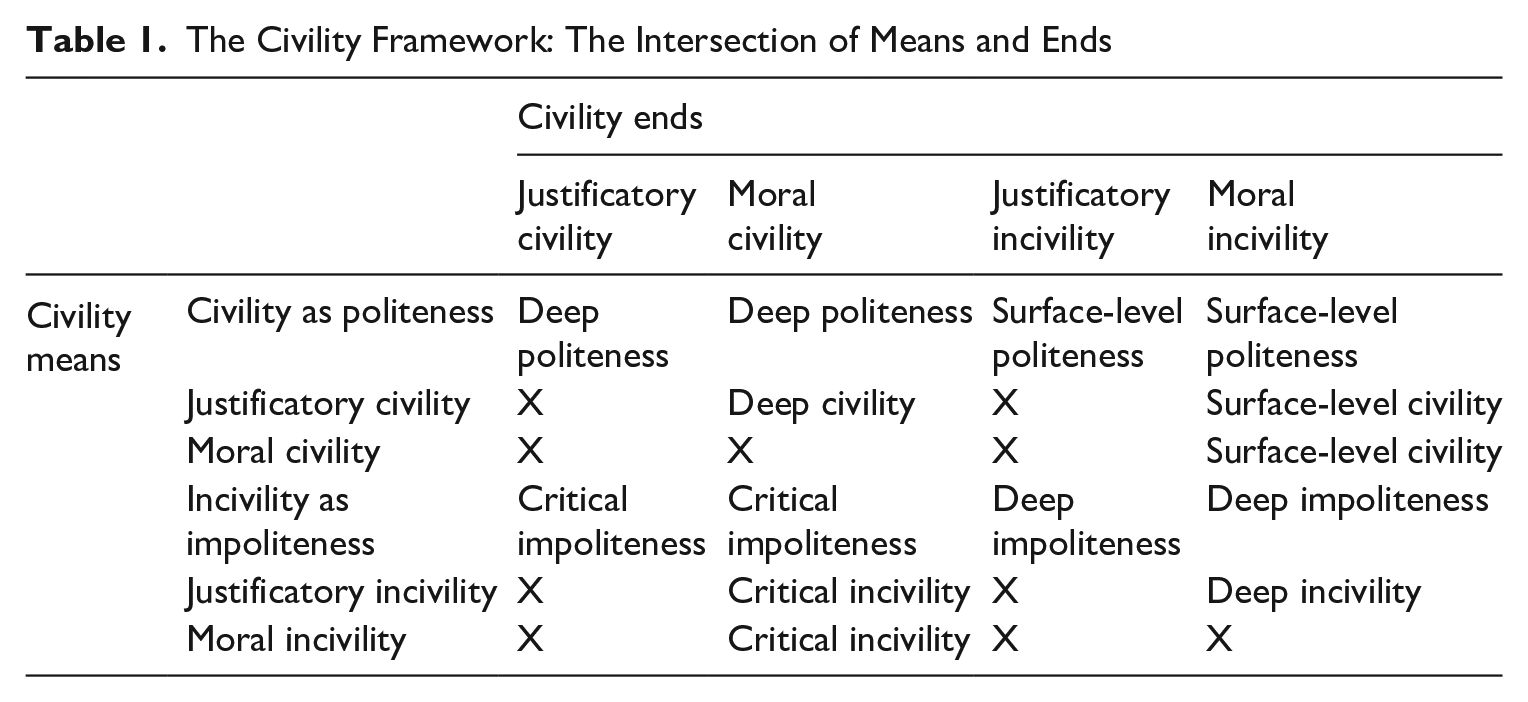
Understanding this complexity, we believe, can help us to formulate more nuanced judgements about the desirability of different instances of civil and uncivil behaviour related to environmental politics and activism. We should be especially careful to not condemn too quickly instances of environmental politics and activism that employ impolite means or which infringe upon the norms of justificatory civility, since their incivility can be instrumental to realizing morally civil goals related to climate action. At the same time, we should also be aware that many actors opposed to climate action may try to advance their goals under a veneer of civility, for example, by strategically using polite behaviour and/or displaying a commitment to justificatory civility.
While we believe that our analysis is valuable precisely because it can help us formulate more nuanced judgements about different instances of civil and uncivil environmental politics and activism, we trust that it can also provide the foundations for educational strategies aimed at preparing citizens to be civil environmental activists, by addressing two significant educational gaps in liberal democracies.
However, there is a need for greater civility education. Given its complexity, civility cannot be considered a ready-made tool that people can easily employ whenever they need it. Not only is there no singular way of being civil; incivility itself can sometimes be the preferred course of action. Therefore, as we explained earlier, deciding whether and when to act civilly or uncivilly requires individual judgement (Lægaard, 2010: 94). Since one of the key goals of education is to create well-informed, respectful and morally responsible citizens, educational settings can be essential sites for pupils to learn this ability and become civil participants in democratic life (Peterson, 2019). However, civic education in most liberal democracies has often focused on such formal topics as government institutions and party politics, paying less attention to civic virtues like civility (Bonotti and Zech, 2023). For example, the Australian Curriculum has been characterized by a gradual erosion of the moral dimensions of civics and citizenship education (Brett, 2022). And even in those countries in which civility has gradually become more central to civics and citizenship education (e.g. Qualifications and Curriculum Authority, 2007; Quigley and Buchanan, 1991), its teaching has remained only a discrete element in the broader curriculum. As Peterson (2019: 53) rightly points out, this approach should be replaced by one in which democratic education is characterized by curriculum that values not only knowledge and skills but also includes deliberative processes that consider a range of perspectives, because ‘in situations where pupils are not given appropriate opportunities for expressing their voices, and where pupils are not exposed to a wide range of other voices, civility is heavily compromised’.
However, environmental and sustainability education has also been nearly absent from school curricula in most societies (Reid et al., 2021). This is problematic because pupils are neither being provided with the necessary knowledge and understanding of climate change nor being taught how to respond to the climate crisis in appropriate ways. According to Reid et al. (2021: 788), this requires a shift towards a broader approach to environmental and sustainability education, cutting across all disciplines and helping pupils develop: knowledge, to understand the environment and its problems from a range of disciplines and fields, including problem-resolution strategies; awareness and sensitivity towards the problems involved in ways that rely on critical cultural literacy and expression as much as scientific modes of knowing; attitudes that develop and relay a set of appropriate values and feelings of concern for the environment; and skills to identify and solve environmental issues that range across collaborative, participatory, decision-making, and action-taking domains.
Others have highlighted the important role educational psychologists can play in environmental and sustainability education, for example, by ‘assisting young people to explore and develop different forms of constructive coping strategies’ (Allen, 2020: 2) and by ‘[facilitating] ways for people to become collaborative and productive agents for adapting to and mitigating the climate crisis, specifically via strategies that promote equitable, just, and democratic local, regional, and global solutions that facilitate well-being for all’ (Lombardi, 2022: 2).
As this brief overview shows, there is therefore a growing call for both civility and environmental education to be more fully embedded in school curricula. It is also important to stress that while it is often those who have the power to shape policy (e.g. political leaders and policymakers) and perpetrate substantial harms to human life who are behaving uncivilly in the most consequential of ways – as our analysis throughout the article has shown – their behaviour is often influenced by ordinary citizens’ expectations. Therefore, providing citizens with civility and environmental education can help to change the standards by which the actions and decisions of those in power are evaluated within a society.
We would like to push this argument further and suggest that civility and environmental education should be combined rather than remain siloed approaches in schools, and that pupils should be educated to civil environmental action. More specifically, given its urgency, the climate crisis should become one of the issues around which civility education is centred, helping pupils to develop the capacity to judge whether, when and how to be civil or uncivil when they participate in climate action, and to evaluate and respond appropriately to others’ (un)civil actions in this realm. This could involve, for example, presenting students with different vignettes corresponding to the eight (in)civility scenarios that we have examined in this article, in order to help them (1) recognize the different dimensions of civility and what each of them involves, (2) understand the different ways in which these dimensions can interrelate and (3) reflect on the motivations and goals that might lead different actors to choose civil or uncivil tactics when engaging in environmental politics and activism. Only in this way, we believe, will it be possible to create citizens who are capable of participating in and critically engaging with the complex and rapidly changing realm of environmental politics and activism.
Footnotes
Acknowledgements
The authors benefitted from feedback provided by numerous colleagues. They are especially grateful to Tom Bailey, Valentina Gentile, Gianfranco Pellegrino and audiences at LUISS Guido Carli and John Cabot University, for helpful comments and discussion. The authors would also like to thank two anonymous reviewers for their insightful and constructive comments on an earlier version of the article.
Declaration of Conflicting Interests
The author(s) declared no potential conflicts of interest with respect to the research, authorship, and/or publication of this article.
Funding
The author(s) disclosed receipt of the following financial support for the research, authorship, and/or publication of this article: This work was supported by a Monash University School of Social Sciences Internal Research Grant 2022 (no grant number available).
