




Abstract
Political parties are crucial in crafting effective national climate policies in democratic states. At the same time, there is a practical and academic debate of whether political parties matter for policy output. This article speaks to this debate by investigating the link between what parties say and what parties do with respect to environmental issues. More concretely, it analyzes whether there is a connection between the degree of environmentalism expressed in parties’ electoral manifestos and national environmental policy output. Theoretically, the article draws on existing research on program-to-policy linkages in general and for environmental issues specifically to argue that saliency of environmentalism in party manifestos shapes more stringent environmental policies. This argument is empirically tested by combining data on policy stringency with data on manifesto contents for 28 countries for the period 1990–2015. The findings corroborate the main hypothesis, which has implications for understanding the overall potential for political parties to structure national environmental politics. The article concludes by sketching broader implications for research on parties’ ability to shape national environmental policy across political systems, and across partisan ideologies.
Keywords
Introduction
The success of the Paris Agreement, adopted at the 21st Conference of the Parties (COP21) to the United Nations Framework Convention on Climate Change in December 2015, depends heavily on national environmental policies. Stringent policies are needed to achieve the commitment of limiting global warming to 2°C (Le Quéré et al., 2019). Political parties have the potential to influence environmental policy outputs and outcomes (Jensen and Spoon, 2011; Leinaweaver and Thomson, 2016). They are key actors in pushing for more stringent environmental policies (Båtstrand, 2014; Carter et al., 2018; Farstad, 2018). There is, however, considerable uncertainty regarding political parties’ potential to influence policy output, which is the topic of the long-standing “do parties matter” debate in political science (Rose, 1984; Schmidt, 1996).
On one hand, parties are responsive to public opinion when formulating their policy positions, and the expectation that parties (when they can) act in accordance with these positions is a central aspect in the responsible party model (McDonald and Budge, 2005; McDonald et al., 2004) and the mandate theory of democracy (Downs, 1957). Political parties’ desire to maximize policy influence as well as, vote and re-election possibilities provides strong incentives for parties to act in accordance with their outlined policy paths (Strøm and Müller, 1999). On the other hand, studies have shown that parties’ responsiveness and room to maneuver vary with the degree of institutional friction, as parties deal with vested interests of other parties, bureaucrats, and various interest groups (Thomson, 2017; Tsebelis, 2002).
Existing research has indicated that there is a relationship between what parties say and what parties do (the so-called “program-to-policy linkage” (Thomson, 2001)). At the European Union (EU) level, pro-environmental governments more frequently propose environmental policies (Leinaweaver and Thomson, 2016) and make better progress toward environmental targets (Jensen and Spoon, 2011). Environmentally concerned governments tend to adopt a greater quantity of environmental policies (Knill et al., 2010), are more likely to ratify international environmental agreements (Schulze, 2014), and are more likely to impose higher environmental tax rates (Ward and Cao, 2012). However, with the exception of Ward and Cao (2012), existing research has a tendency to consider policy output in terms of the quantity of adopted environmental policies or the adoption of specific environmental policies (Knill et al., 2010; Leinaweaver and Thomson, 2016; Schulze, 2014). As a result, partisan influence on the stringency of national environmental policies remains understudied. This can be problematic as the quantity of adopted policies says little about the content of these policies and thus the predominant approach in the literature risks masking variation in policy stringency both across countries and over time.
To address this shortcoming in the existing literature, the aim of this article is to analyze whether there is a link between party environmentalism and environmental policy stringency. To test whether the degree of environmentalism expressed in political parties’ electoral manifestos can be linked to the level of environmental policy stringency across a diverse set of policy instruments, an unbalanced dataset consisting of 28 countries is examined during the period 1990–2015. The analysis controls for various factors highlighted in existing research as possible explanatory factors of environmental policy output. The articles’ main finding is that salient expressions of environmentalism in party manifestos are connected to more stringent environmental policies, a finding which has implications for our understanding of the overall potential of political parties to structure national environmental policy.
The research design in this article is distinct from pervious quantitative analyses of program-to-policy linkages on environmental issues in two main ways. First, the article analyzes policy output in terms of environmental policy stringency which puts the contents of policies, rather than the quantity of implemented policies, center stage. Second, the scope in this article is more extensive compared with previous studies as it focuses on stringency across a wide number of policy instruments across 28 countries over a period of 25 years.
The remainder of this article proceeds as follows. The second section summarizes existing research. The third section discusses the theoretical assumptions of program-policy linkages. The fourth section presents the material and methods used in this article. The fifth section presents the results from the main analysis and discusses their robustness. Finally, the sixth section discusses the results and their implications.
Existing Research
Within the “do parties matter” research, a substantive amount of attention has been devoted to analyzing program-to-policy linkages (Thomson, 2001). Traditionally these linkages have been investigated by looking at how the left–right composition of governments impacts policy output and outcomes, often for specific political issues such as unemployment (Hibbs, 1979), economic policies (Pettersson-Lidbom, 2008), immigration (Akkerman, 2015), or welfare development (Allan and Scruggs, 2004). Some (Brouard et al., 2018; Thomson, 2017) have taken on a more general approach and test the extent to which parties’ matter for policy output across issue areas.
Environmental issues are salient electoral matters and some even argue that they form their own dimension of politics (Hooghe et al., 2002; Rohrschneider, 1993). However, only a limited number of studies explicitly focus on program-to-policy linkages with respect to environmental issues, and fewer still focus explicitly on the link between environmentalism saliency and environmental policy output. Rather, existing research has favored analyses of the environmental policy consequences of parties’ ideological orientations, for instance, connecting left-wing governments to lower emissions levels and better environmental performance (Garmann, 2014; Neumayer, 2003). Others have demonstrated that parties’ ideological stances explain variation in the saliency of parties’ environmentalism (Båtstrand, 2015; Carter, 2013; Facchini et al., 2017; Farstad, 2018). Party ideology has also been linked to national policy output, Lim and Duit (2018) found that stronger welfare states produced more environmental policies, while Schulze (2021) concluded that left-oriented governments produced more hard environmental policies compared with right and center governments.
Previous studies that explicitly analyze the link between party environmentalism and policy output have connected governments’ environmental preferences and national environmental performance (Apostoaie and Maxim, 2017; Wen et al., 2016). Jensen and Spoon (2011) showed that more pro-environment and less ideologically divided governments made better progress toward their emissions targets set by the EU. Schulze (2014) indicated a positive relationship between party environmentalism and the ratification of international agreements. Leinaweaver and Thomson (2016) demonstrated a positive relationship between party environmentalism and proposed environmental policies at the EU level. At a cross-national level, Knill et al. (2010) analyzed the adoption of 40 preselected policies at four specific time points revealing that pro-environmental governments adopted a greater number of policies. In their analysis of policy diffusion of environmental taxes in the Organization for Economic Co-operation and Development (OECD) 1995–2004, Ward and Cao (2012) showed that left–right and environmental positions of legislative medians influenced environmental tax rates.
The present article analyzes the link between environmentalism saliency in party manifestos and environmental policy stringency. In doing so, the article builds, and extends, on the existing research presented in the sections above in three ways. First, the focus on environmentalism infers that it is the salience of environmentalism, not parties’ left–right ideology, which provides the foundation of a program-to-policy linkage. There is a difference between what parties are, in terms of left–right ideological identities, and the stances parties take on various political issues (Finseraas and Vernby, 2011: 616). Therefore, it is theoretically relevant to analyze whether the emphasis awarded to environmental issues in party manifestos can be linked to environmental policy output.
Second, the focus on policy output captures political rather than environmental outcomes and provides an opportunity to better gauge partisan influence on policy output. Moreover, the conceptualization of policy output as policy stringency implies a focus on the contents of policies. This stands in contrast to existing analyses, which have focused on the adoption of specific policies or agreements (e.g. Knill et al., 2010; Leinaweaver and Thomson, 2016; Schulze, 2014). Analyzing the adoption of specific policies or counting the quantity of adopted policies tells us nothing of whether this policy is lax or strict. That is, there may be a divergence between legally recognized (de jure) policies and the actual (de facto) policy content. Conceptualizing policy output as policy stringency thus pays more attention to the contents of environmental policies and presents a distinct empirical approach from which to study program-to-policy linkages.
Third, the present study has a wider scope compared with existing analyses both in terms of the number of countries included and the length of the analysis, spanning 28 countries over 25 years. In addition, by focusing on the stringency of both market- and non-market-based policy instruments the study is able to provide more extensive findings regarding the environmental program-to-policy link than previous studies (e.g. Ward and Cao, 2012) which have mainly considered specific policy instruments.
Theoretical Framework
The following section sets forth the theoretical assumptions behind the expected link between the saliency of environmentalism expressed in party manifestos and policy stringency levels. These assumptions are used to derive the main hypothesis to be tested in the empirical analysis. The saliency of environmentalism is defined as the relative emphasis placed on environmental issues in parties’ manifestos. Correspondingly, a change in issue salience entails placing relatively more or less emphasis on environmental issues. A definition of changes in environmental policy stringency is less straightforward, and this section, therefore, starts with a conceptualization of environmental policy stringency.
Defining Environmental Policy Stringency
Studies of program-to-policy linkages explores the issue of whether political parties’ matter for policy output or not. Policy output refers to the actions of governments in form of policy decisions that communicate political goals and the means to achieve them (Dye, 1972: 2). Changes in policy output can refer to shifts in policy paradigms, 1 which entail a radical change in the overarching political discourse. While such shifts are rare, changes within a paradigm are more frequent, and refer to changes in the policy instruments chosen to achieve specific targets, or to changes in the strictness of these policy instruments (Hall, 1993). The magnitude and direction of these changes is captured either by counting the quantity of policy instruments within an issue area (policy density), or by estimating the strictness or stringency of the instruments (policy intensity) (Knill et al., 2012). This current article conceptualizes policy change as the latter, that is, as changes in the stringency of policy instruments.
Specifically, the focus of this article is environmental policy stringency, which is defined as the strength of the policy instruments that aim at reducing or limiting harmful environmental behavior and outcomes. Policy instruments are the mechanisms that governments use to translate policy goals into tangible actions (Schaffrin et al., 2015: 260). A distinction is often made between market-based and non-market-based instruments. The former includes instruments like taxes, trading schemes, and feed-in tariffs and work by creating incentives for voluntary behavioral changes. For example, a more stringent emissions tax raises the price of emissions and can push firms to increase eco-innovation and move toward less polluting production processes. Non-market-based instruments, operate by imposing mandatory standards or restrictions on the behavior of firms and individuals and include command-and-control instruments, such as emissions standards. Violating the mandatory standards comes with increased financial costs and is meant to deter firms from emitting above a set emissions limit.
An increase in the stringency of a policy instrument entails a higher “cost” imposed on polluting or other environmentally harmful activities (Botta and Koźluk, 2014: 6). For instruments like taxes, an increase in stringency corresponds to an increase in the tax level, while an increase in the stringency of regulatory instruments corresponds to lower emissions limits (Botta and Koźluk, 2014: 14). For instruments that reward environmentally friendly behavior, such as subsidies, increased stringency entails higher levels of subsidies which raises the opportunity costs of pollution (Botta and Koźluk 2014: 14).
The Saliency-to-Stringency Link
While analyses of program-to-policy linkages between parties’ environmentalism and policy output are scarce in existing research, studies of factors that explain variation in environmental policy output are relatively common. This section presents the theoretical assumptions behind the expected program-to-stringency link and outlines the causal mechanisms at play.
Party manifestos represent the collected policy positions of a party and outline a policy agenda to voters (Lutz, 2021: 2). To compete with other parties and provide meaningful choices to voters, parties distinguish themselves by adopting distinct policy positions or by emphasizing and deemphasizing various political issues. The latter is the core of the salience theory of party competition (Budge, 1982; Budge and Farlie, 1983). Salience theory argues that positional differences between parties as a result of political or ideological disagreements will rarely be translated into opposing statements on an issue. Rather such disagreements are seen when analyzing variations in the relative saliency across a range of issues (Budge, 1982: 149; 2001: 82).
It can be expected that parties aim to keep their rhetoric in line with their policy outputs because of a desire to maximize policy influence, votes, and re-election possibilities, or a combination of all three (Strøm and Müller, 1999). Drawing on the concept of “issue ownership,” parties are expected to emphasize those issues that are important to the parties’ own members and core voters. These issues are a party’s raison d’être and represent issues where parties are more likely to be inherently policy-seeking (Wagner and Meyer, 2014: 1020). Issue ownership signals to voters that the party is committed to doing something about these issues and, consequently, parties will pursue policies on their owned issues when they are in a government position (Green and Jennings 2019: 443). One example of this is the significant positive effect green parties in government have had on the advancement of environmental policies (Kayser and Rehmert, 2021).
Political parties can place significant emphasis on issues even if they do not own them. Such behavior is part of issue competition where parties need to be responsive to central issues in the political debate to maximize vote and office-winning possibilities (Adler and Wilkerson, 2012; Petrocik, 1996). Regardless of issue-ownership parties can be expected to pursue policies related to their salient issues because they represent areas where a party’s policy actions will be highly rated by voters. Electoral commitments represent points of reference on which citizens assess the performance of parties throughout an election term (Klingemann et al., 1994; Laver and Garry, 2000). Acting in a manner consistent with the ambitions stated in electoral manifestos on salient issues thus demonstrates a party’s competence, policy efficiency and representative credibility, which enhances a party’s office-winning and reelection possibilities. Incongruence between policy output and electoral commitments can prove costly in terms of voter dissatisfaction and bring the risk of future electoral defeat (Mansergh and Thomson, 2007: 323).
The capacity of government parties to implement their desired policies depends on them having sufficient institutional power to realize them (Brouard et al., 2018; Schmidt, 1996; Thomson, 2017). Single party governments are generally more efficient than coalition governments as they are less constrained by the need to compromise. Having multiple parties in government implies shared policy-making, and while such arrangements provide each coalition party with the opportunity to influence policy, it can also have a constraining effect on policy-making. In coalition governments each member party is a potential veto-player and has the ability to shape government policy output by vetoing policy proposals of other coalition parties. The need to seek consent among other parties before every policy decision slows the rate at which policy changes can occur and reduces the number of substantive changes to the status quo policy (Thomson, 2017; Tsebelis, 2002). More diverse policy positions of parties in government mean more complex decision-making, reduced agenda-setting, and policy enactment capacity of governing parties (Tsebelis, 1995, 1999, 2002).
Notwithstanding the complexity of decision-making in coalition governments, existing research has shown that party manifestos do influence policy outcomes even in proportional representation systems where coalition governments are common (Brouard et al., 2018; Green-Pedersen and Mortensen 2015). Issue saliency is an important predictor of ministerial portfolio allocation (Bäck et al., 2011; Laver and Shepsle, 1996). For policy-seeking parties salient issues reflect a party’s core policy concerns and gaining control over a specific portfolio can be a means to advance the party’s preferred policies (Laver and Schofield, 1990: 183). However, for office-seeking parties, claiming the portfolios on issue areas that are important to voters can be a means to maximize votes (Bäck et al. 2011: 443). The control of a specific portfolio means that voters will hold the party accountable for implementing their pre-election policy promises, thereby providing greater incentives for the party to follow through on them when in government. In line with this, parties have been found to fulfill electoral promises to a greater extent in the areas where they hold a ministerial portfolio (Mansergh and Thomson, 2007: 322). For environmental issues in particular, findings by Bäck et al. (2015) and Tosun (2018) indicates that portfolio allocation matters for environmental policy output.
The party composition of governments is a significant factor in explaining variation in policy choices and policy outputs (Schmidt, 1996: 155). A common argument for party inaction in the environmental policy domain is that certain types of actions are difficult to reconcile with parties’ ideological values (Mccright and Dunlap, 2011: 160). This is because environmental policies typically require some form of market intervention, which may be easier to reconcile for more left-oriented parties. However, parties’ ideological stances in the traditional left–right sense have been argued to be of lesser import for environmental issues (Knill et al., 2010), and even to cut across or be orthogonal to the traditional left/right policy dimension (Dalton, 2009: 164). Instead, parties’ ideology may be of greater importance to the stringency of specific policy instruments than for the overall environmental policy stringency level. Left-oriented parties tend to favor market-based instruments, while right-oriented parties focus on solutions through market mechanisms (Båtstrand, 2014; Schulze, 2021).
To summarize, parties that place significant emphasis on environmental issues in their manifestos can be expected to pursue more stringent environmental policies once they gain office for two main reasons. First, because saliency can signal issue ownership of environmental issues where parties are more likely to be policy-seeking and can be expected to pursue stringent environmental policies to demonstrate their seriousness in dealing with one of their core issues. Second, parties that express salient environmentalism in their manifestos are more likely to be evaluated and held accountable by the electorate on this issue and, thus, have incentives to pursue more stringent environmental policies. In other words:
H1. More salient environmentalism in the manifestos of government parties leads to an increase in environmental policy stringency.
Material and Methods
To test H1, a dataset was compiled by combining Organization for Economic Cooperation and Development (OECD) data on environmental policy stringency with data on the contents of manifestos and governing parties from the Manifesto Research on Political Representation (MARPOR) and the Parliaments and Governments (ParlGov) project databases respectively. This resulted in an unbalanced dataset covering 28 countries 2 1990–2015. The data consist of European and OECD countries with the addition of South Africa, and is coded at the country–year level using data from different sources.
This section first operationalizes the dependent variables used to capture environmental policy stringency, followed by the operationalization of the main independent variable capturing environmentalism saliency. Finally, the section presents a number of control variables.
Environmental Policy Stringency
This article operationalizes environmental policy stringency through the OECD Environmental Policy Stringency Index (EPS) (Botta and Koźluk, 2014). 3 The index concentrates on climate and air policies in key upstream sectors with the underlying assumption that policy stringency on key pollutants and industries gives an approximation of the more general stringency of policies across all areas. The index ranges from 1 (lowest stringency) to 6 (highest stringency) and covers mainly OECD countries between 1990 and 2015 albeit with gaps as the time series of many countries end in 2012.
Three dependent variables are created using the EPS. The first, EPS captures the total stringency level of all measured policy instruments in a country. This EPS indicator is disaggregated to create two variables that capture the stringency of market-based instruments and non-market-based instruments respectively. The second dependent variable MarketEPS measures the stringency of instruments like taxes and feed-in tariffs and captures the stringency of market-based instruments. The third, Non-marketEPS captures the stringency of non-market-based policy instruments such as emissions standards and government R&D expenditures on renewable energy.
The disaggregation of policy stringency into two variables is done to capture the fact that some countries may be more prone to using certain types of policy instruments. The policy instruments governments use have been shown to vary depending on the ideological positions of governments, where left-oriented parties tend to favor non-market-based instruments centering on planning, regulation, and strengthening public control while right-oriented parties tend to prefer market-based instruments like environmental taxes (Båtstrand, 2014). A disaggregation is thus useful as it can reveal variation in the relationship between environmentalism saliency in manifestos and the stringency of instrument types that may be masked by the aggregate EPS.
One issue that arises when operationalizing environmental policy stringency is multi-dimensionality, which occurs because environmental policy covers multiple environmental elements (air, water, ground) as well as various pollutants (CO2, NOx, etc.). Furthermore, multi-dimensionality occurs because the same pollutant can be regulated though multiple policy instruments, and regulations vary between economic sectors, direction (industry/consumer) and location of activity. Another weakness of the EPS is the neglect of procedural and informational instruments as well as the limited inclusion of various environmental policy areas as it overlooks areas such as water, biodiversity, and waste.
The multi-dimensional properties of environmental policy stringency have made cross-national comparisons of policy stringency difficult. Consequently, existing research has pursued a number of different approaches to measure environmental policy stringency. The most common, perhaps, is the single policy change measures, which analyze the adoption or change of a specific policy (e.g. Knill et al., 2010). While focusing on single policy events avoids issues with multi-dimensionality, it does not allow for analysis into variation in policy output over time. Another approach is estimating shadow prices of pollution from production functions, reflecting the fact that environmental policies put an implicit price on pollution, one example of this approach is the work by Althammer and Hille (2016). Shadow pricing, however, is inexact as it relies on subjective assumptions and not actual data. Others have used direct proxies of environmental policies, such as counts of international environmental treaties ratified (Schulze, 2014); however, while such approaches capture policy density, they do not capture policy stringency.
While operationalizing stringency through the EPS comes with a number of disadvantages, it has three main advantages. First, it is based on actual policy data and has broader cross-country and time coverage than other available direct policy measures. Second, policy stringency comes closer to capturing variation in actual policy content compared with analyses of variation in policy quantity. Third, the index captures variation in stringency of both market- and non-market-based instruments.
Figure 1 displays the development of the three operationalizations of EPS in all 28 countries. The figure indicates that policy stringency (overall and disaggregated) tends to increase over time, but with a great deal of variation within and between countries. The average stringency level is relatively low with a score of 1.8 compared with the maximum of 6. Denmark and Germany exhibit the highest levels of stringency with averages around 2.5, while Turkey and South Africa have the lowest levels of stringency at 1 and 0.7 respectively. Non-market-based instruments appear more stringent than market-based instruments, which possibly reflect that non-market-based instruments such as regulatory policies were already in place in the 1990s, while market-based instruments were largely introduced during the analyzed period (Botta and Koźluk, 2014: 27–29).
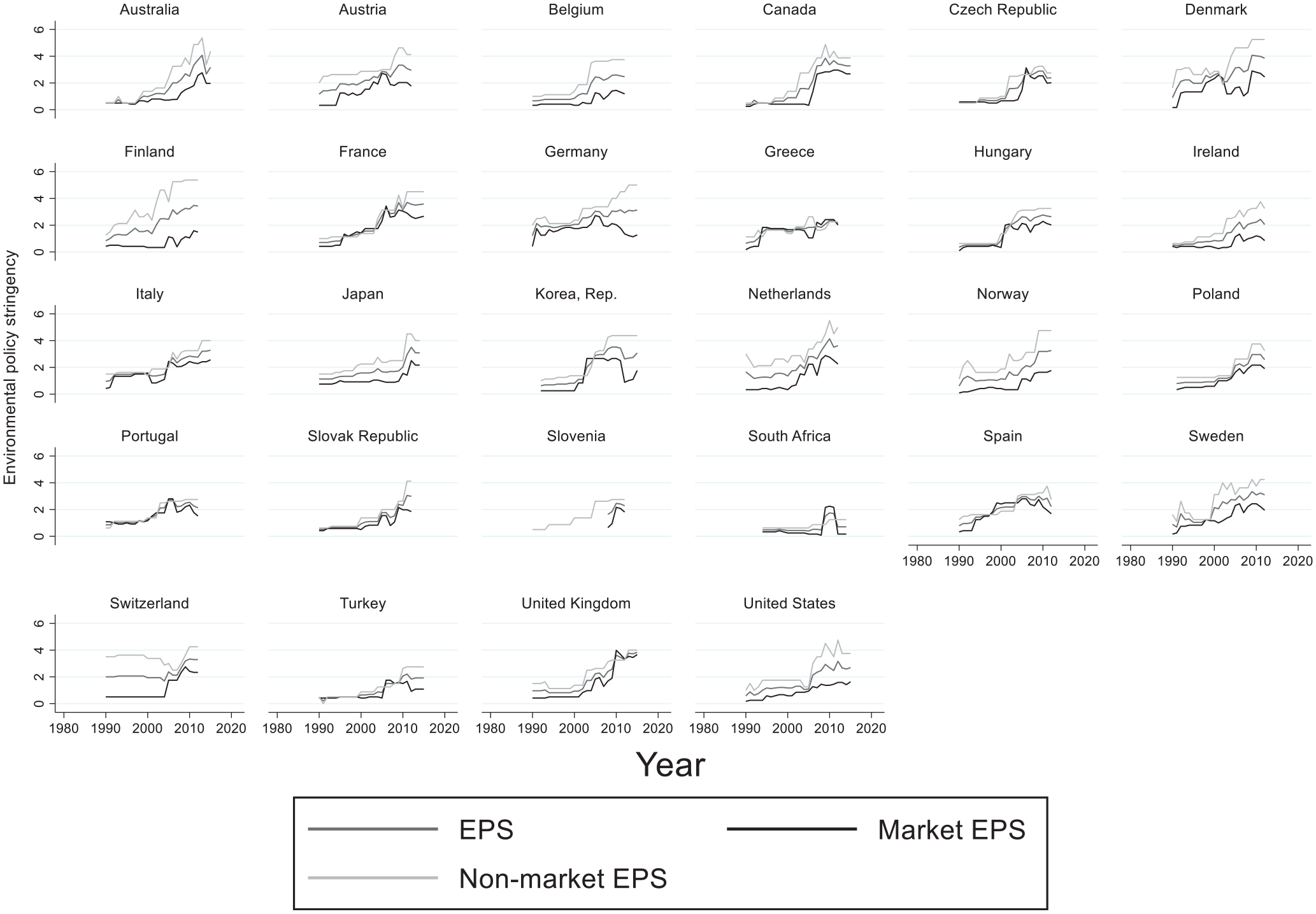
Environmental Policy Stringency Over Time.
Main Independent Variable: Party Environmentalism
To capture the salience of environmentalism among government parties a new dataset was compiled using two existing databases, the MARPOR and the ParlGov database. Data from MARPOR (Volkens et al., 2019) were used to assess the saliency of environmentalism expressed in party manifestos. MARPOR contain data from in-depth quantitative content analysis of the manifestos released by major parties in a country before an election. Sentences are divided into quasi-sentences as a sentence can contain multiple statements, and for each party included in the dataset the MARPOR coding notes the portion of its manifesto devoted to a specific issue area. MARPOR contain one variable that captures the proportion of parties’ manifestos devoted to environmental protection (per501-Environmental Protection), specifically statements asserting the seriousness of environmental problems or suggesting policies to address them. This makes the MARPOR database especially appropriate for program-to-policy analyses as it captures statements that demonstrate concern and intent (Farstad, 2018: 701).
However, MARPOR lacks data on which party that hold a government position in a specific country and year. To this end, I matched the MARPOR data with data on governing parties in different countries using the ParlGov database (Döring and Manow, 2019). The ParlGov database contains data on a larger quantity of parties compared with the MARPOR. This meant that smaller parties, which lacked observations in the MARPOR, were excluded from the final dataset. Four countries, the Republic of Korea, South Africa, Mexico, and the United States, lacked observations in the ParlGov database. In these instances, I manually coded government parties using data from the International Foundation for Electoral Systems (IFES) 4 and subsequently matched it with the MARPOR data.
The variable Environmentalism thus captures the saliency of environmentalism in manifestos of parties that entered into government after an election. A greater relative presence of statements concerning the environment in the manifesto reflects greater salience of environmentalism relative to other issue areas. The variable is weighted by the intra-coalitional seat share distribution in a country in a given year. Since the MARPOR only provides data for election years, each party’s environmentalism values are interpolated from the two closest observations prior to being aggregated to a national average.
Descriptive Mapping
To get a better sense of the relationship between policy stringency and environmentalism, Figure 2 displays the aggregate EPS indicator in relation to the average environmentalism expressed by government parties. On average, the 28 countries devote 2.6% of their manifestos toward environmental issues. Government parties in Sweden express the highest shares of environmentalism, over 4.8%, followed by Greece and France at 4.6% while South Africa display the lowest share devoting only 0.4% to environmental issues followed by Belgium at 1%. 5
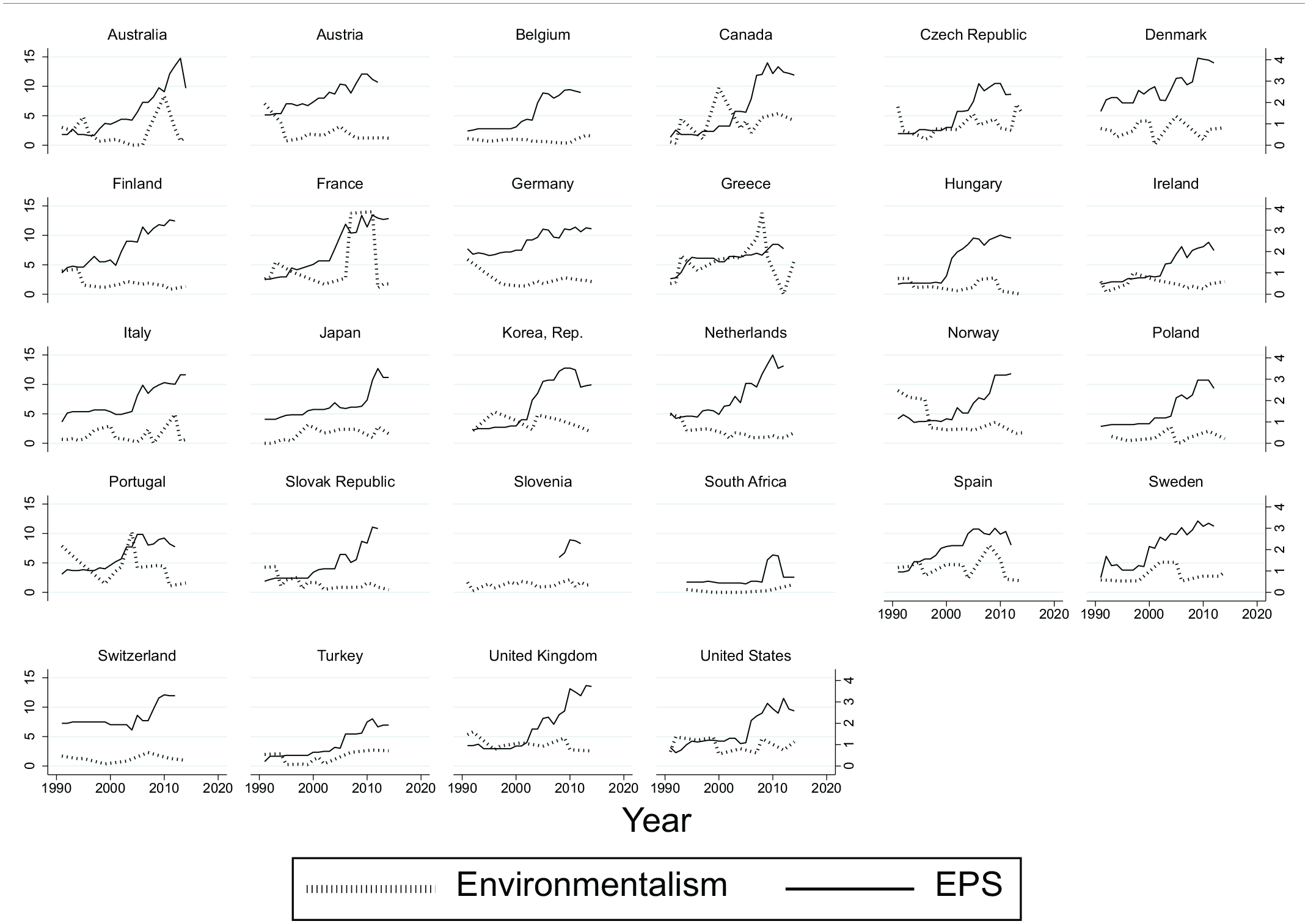
Environmentalism Saliency in Government Parties and Environmental Policy Stringency.
The graph sometimes displays sharp notches, which generally indicates regime changes in the respective countries. In some countries, most notably Sweden, the trend over time is similar on the two indicators, which indicates a correlation between more salient environmentalism and more stringent policies and vice versa. In other countries, a correlation is less clearly discernible and in some there appears to be a divergence between the two indicators, for instance in the UK. Altogether, this motivates the need to empirically test whether there is a link between party environmentalism and policy stringency.
Controls
To enhance internal validity, six control variables are included in the analysis. Existing research has indicated that single-party governments tend to deliver on their electoral promises to a greater extent than coalition governments (Mansergh and Thomson, 2007; Naurin, 2011). To control for the impact of government type the binary variable Coalition is included taking on the value 1 if a country had a coalition government and 0 if it did not. 6 The variable is constructed by counting the number of cabinet parties in a country a given year using the ParlGov database (Döring and Manow, 2019).
Proportional representation systems see a greater need for compromises between parties compared with majoritarian systems, which introduces inertia into the policy process (Norris, 1997). To control for a country’s electoral system the binary variable PR is created using data from International Institute for Democracy and Electoral Assistance. The variable takes on the value 1 if a country has a proportional electoral system and 0 if a country has a mixed or majoritarian electoral system. 7
Existing research indicated that portfolio allocation is an important predictor of policy output, and a green party being allocated the ministry of environment can advance environmentally friendly policies (Bäck et al., 2015). MARPOR data on party families was used to identify occasions where green parties gained a place in government. The allocation of the ministry of environment (or equal) was coded using national information of government composition in these instances. The binary variable Eco takes on the value 1 if a green or environmental party was in charge of the ministry of environment and 0 if the position was held by any other party.
Existing research has suggested a positive link between left-wing parties and more environmentally friendly policy positions (Farstad, 2018; Garmann, 2014). To control for the ideological positions of government parties the variable Left/Right is constructed using data from the MARPOR. 8
Two variables are included to control for the opportunity cost of introducing more stringent policies. First, policy expansion requires reallocation of political resources, and can involve reallocating resources from a party’s core policy platform to environmental protection. Such reallocation can be politically unpopular among a party’s voters and risk deterring parties from prioritizing environmental issues. This is especially notable during episodes of economic downturn, when preferences for policy action in welfare and unemployment issues are increasingly demanded by the public (Abou-Chadi and Kayser, 2017). More stringent environmental policies are, therefore, more likely to be implemented in economically well-off countries and during economic booms (Ladrech and Little, 2019). To control for this, the variable lnGDP/capita is included using data from the OECD, 9 to account for an asymmetrical distribution the natural logarithm of GDP per capita is used. 10
Second, in countries where the dependence on fossil fuels is high the costs of introducing stringent environmental policies may be higher. Politicians have been found to be more reluctant to introduce policies which are potentially costly (e.g. unemployment risks, and loss of voter support (Carter, 2006; Obach, 2002)). The variable Fossilconsumption controls for a country’s dependence on fossil fuels. The variable captures the total fossil fuel energy consumption as a percentage of total energy consumption, using data collected from the World Bank. 11
Model Specification
The article relies on data from 28 countries for the period 1990–2015. With the purpose of addressing potential issues with spurious regression results, the variables’ stationarity was investigated using Fisher panel unit root tests. 12 The results are reported in Appendix Table A2, and indicate that all three dependent variables based on the EPS, the independent variable Environmentalism as well as the two controls lnGDP/capita and Fossilconsumption are stationary in their first differences. The analysis is therefore conducted by estimating random-effects regressions on the first differences of the non-stationary variables. The estimation on first differences means modeling the effect of changes in independent variables on changes in the dependent variable.
The use of random-effects regressions is preferred over the other common panel regression model, fixed effects, for three reasons. First, the graphic overview indicated that the trajectories of policy stringency and environmentalism are different in the different countries, which motivates the need to estimate models with random intercepts. Second, a fixed effects approach effectively removes the effect of time-invariant variables. This is problematic in the context of the present study, since invariant variables that capture institutional characteristics, such as electoral systems, have proven significant for environmental policy development (Thomson, 2017). Third, a Hausman test was conducted on the non-differenced estimates, the test indicated that the difference in coefficients was not systematic and therefore a random-effects model is more efficient.
Equations 1–3 specify the random-effects regression with EPS, MarketEPS and Non-marketEPS as the dependent variables, respectively



where αi (i = 1 . . . n) is the intercept for the whole model and uit is the between-country error term. ɛi is the within-country error term. The intercept for each country is αi + ɛi.
Results
This section first presents the results from the empirical analysis of the link between party environmentalism and environmental policy stringency and concludes with an assessment of their robustness.
Regression Results
Table 1 displays the results from the random-effects regressions. Three models with 1-, 2-, and 3-year lags respectively are estimated for each of the three dependent variables EPS, MarketEPS, and Non-marketEPS. Lags are included to account for the potential delay between entering office and subsequent policy output. A maximum of three lags are estimated to match election cycles. Models 1–3 are estimated using the full EPS indicator as dependent variable, Models 4–6 use the disaggregated dependent variable MarketEPS, and Models 7–9 use Non-marketEPS.
Random-Effects Regressions.
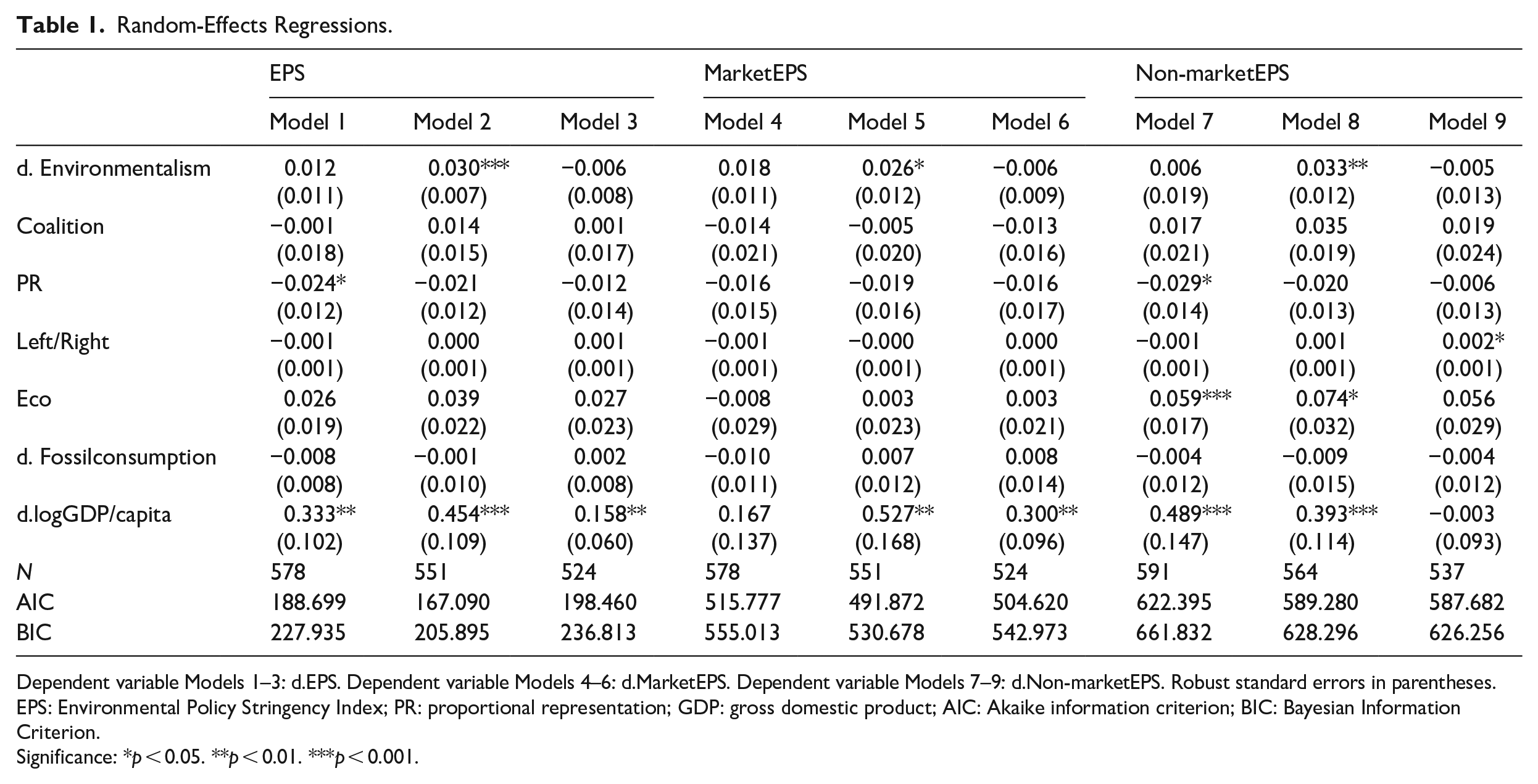
Dependent variable Models 1–3: d.EPS. Dependent variable Models 4–6: d.MarketEPS. Dependent variable Models 7–9: d.Non-marketEPS. Robust standard errors in parentheses. EPS: Environmental Policy Stringency Index; PR: proportional representation; GDP: gross domestic product; AIC: Akaike information criterion; BIC: Bayesian Information Criterion.
Significance: *p < 0.05. **p < 0.01. ***p < 0.001.
Starting with the results from Models 1–3, the estimate for Environmentalism is statistically significant and positive in Model 2 when lagged 2 years. The results thus indicate that an increase in the salience of environmentalism in party manifestos corresponds to an increase in the overall stringency of environmental policies, which is in line with the expectations formulated in the hypothesis.
Models 4–6 estimated the effect of Environmentalism on the stringency of market-based instruments. The estimate for Environmentalism is positive and significant when lagged 2 years (Model 5). This indicates a significant positive effect, which is in line with the main hypothesis.
Models 7–9 estimated the effect of environmentalism on the stringency of non-market-based instruments. The estimate for Environmentalism is significant and positive in Model 8 when all independent variables are lagged 2 years. This suggests that an increase in the salience of environmentalism expressed in manifestos is expected to increase the stringency of non-market-based instruments.
Turning to the control variables, two binary controls were included to capture institutional features, coalition and PR. The estimate for coalition, is insignificant across all nine models, while the estimate for PR (capturing proportional representation) is significant and negative in Models 1 and 7 which are estimated with the aggregate EPS indicator and the non-market-based policy stringency indicator as dependent variables respectively. The results indicate that proportional representation reduces the policy stringency level of non-market-based instruments.
The control for ideological positions of governments Left/Right yields significant positive estimates in Model 9, this provides a weak indication that more right-oriented parties impose more stringent environmental policies. The binary variable Eco which controlled for the effect of having a green party in control of the ministry of environment is significant and positive in the Models 8 and 9 estimated with Non-marketEPS as the dependent variable. The results hint at a positive effect, suggesting that a green party being allocated the ministry of environment portfolio increases the stringency of non-market-based environmental policies
Finally, two variables were added to control for economic factors lnGDP/capita and Fossilconsumption. The estimate for GDP per capita is significant and positive in seven of the nine models. This indicates that environmental policy stringency is expected to increase when GDP per capita increases. The estimate for Fossilconsumption is insignificant across all nine models. The insignificant results suggest that the percentage of a county’s energy consumption from fossil fuels is trivial for changes in policy stringency levels.
The results in Table 1 largely support the main hypothesis, that an increase in the saliency of environmentalism in manifestos increases the environmental policy stringency level. The relationship is significant at 2-year lags, and there is little difference between the aggregated EPS indicator and the disaggregated indicators capturing the stringency of market-based and non-market-based policy instruments.
Robustness Checks
To assess the robustness of the results, a number of additional model specifications were estimated. To begin with, a dummy variable was added to control for the possibility that EU-membership may force countries to adopt more stringent environmental policies. The variable EU takes on the value 1 if a country was a member of the EU in a given year. The results are presented in Appendix Table A3; however, the variable estimate is not significant in any of the nine models.
Next, previous studies have shown that parties in opposition can influence policy output to some extent (Green-Pedersen and Mortensen, 2010; Sulkin, 2005). The link between environmentalism expressed by opposition parties and policy stringency was analyzed using two differently constructed measures of environmentalism. The first, Opposition_Environmentalism, is constructed in a similar fashion as the variable Environmentalism but captures only the saliency of environmentalism of opposition parties. 13 The second, General_environmentalism, is widened to include the presence of statements concerning environmental protection in manifestos of all parties that took part in an election a given year, thus providing a more general measure of environmentalism expressed by the parties in a country. The results from these regressions are presented in Appendix Tables A4 and A5, respectively.
The relationship between opposition parties’ environmentalism and policy stringency remains positive but is only significant in two of the nine models. In the regression models estimated with the general environmentalism variable, the estimate for General_environmentalism is positive and significant in six of the nine models. This strengthens the robustness of a link between environmentalism and policy stringency and suggests that more salient environmentalism, both in general and among government parties specifically, can be connected to increases in the stringency of environmental policies.
Next, one large constraint for parties’ potential to realize their promised policies is the number of veto players present (Tsebelis, 1995, 1999, 2002). To further test the constraining effect of veto players, the variable pol_constraints was included instead of the dummy variables for institutional features, coalition and PR. The variable captures the extent to which a change in the preferences of any one political actor may lead to a change in government policy and is collected from the Political Constraint Index (POLCON) dataset. 14 The variable is an index composed of the number of independent branches of government with veto power over policy change, counting the executive and the presence of an effective lower and upper house in the legislature, the extent of party alignment across branches of government, and the extent of preference heterogeneity within each legislative branch. The index scores range from 0 to 1, with higher scores indicating more political constraint and thus less feasibility of policy change. The regressions are presented in Appendix Table A6 and the estimate for pol_constraints is insignificant in all nine models, which indicate that the level of constraint is not significant for environmental policy stringency.
Finally, models were estimated using the same variables as the regressions in Table 1 but including cubic polynomials to capture the effect of time. The results are displayed in Appendix Table A7 without significant changes to the results in the baseline models in Table 1.
Taken together, the robustness tests suggest that the principal finding of a program-to-policy link between party environmentalism and the stringency of environmental policies is consistent across various model specifications.
Discussion
This article adds new knowledge on program-to-policy linkages for environmental issues in two main ways. First, it operationalizes policy output as stringency level rather than quantity of adopted policies, placing more focus on the contents of environmental policies. Second, it widens the scope both when it comes to included countries and years but also by focusing on stringency across a wide number of policy instruments. This further separates the article from existing research as it allows the article to capture more variation in policy output than previous studies.
The empirical analysis suggests that increases in the saliency of environmentalism, expressed in the manifestos of governing parties, increase the stringency of environmental policies. This finding is in line with the main hypothesis of a positive link between environmentalism saliency and policy stringency. Moreover, the analysis shows that the relationship between party environmentalism and policy stringency hold for both market-based and non-market-based instruments. The saliency-to-stringency link is significant with a 2-year lag, which suggests that governments implement environmental policies relatively early in their incumbency. This is in line with existing research, for example, Strobl et al. (2021) who showed that when elections approach governments are less likely to implement policies that may alienate voters.
Furthermore, this program-to-policy link hold in more general terms where higher environmentalism saliency among a country’s political parties in general can be connected to more stringent environmental policies. This suggests that opposition parties may have some potential to influence policy output, (see also Green-Pedersen and Mortensen, 2010; Sulkin, 2005; Thomson, 2017). Opposition parties can have significant agenda setting power even if they do not formally possess legislative power. If opposition parties are in control of the agenda within the party system, they can force government parties to address issues they find important, especially if these proposals are publicly popular (Green-Pedersen and Mortensen, 2010; Sulkin, 2005). Moreover, it may be that some policies are uncontentious in the sense that they are policies that any government would enact (Thomson, 2017: 529).
General research on program-to-policy linkages has raised concerns that political parties’ ability to influence policy is constrained by institutional settings and party ideology (Mansergh and Thomson, 2007; Naurin, 2011). The current article controlled for these factors and while the inclusion of these factors does not dilute the empirical evidence of a link between environmentalism and policy stringency, three broader implications can be drawn from their effect on variation in environmental policy output.
First, having an electoral system based on proportional representation is connected to lower environmental policy stringency. This finding is consistent with veto player theory (Tsebelis, 1995, 1999, 2002) and arguments of the constraining effect of proportional representation systems on policy outcomes. Parties in proportional representation systems see a greater need to compromise and generally have broader party programs, all of which slow the rate at which policy changes can occur (Brouard et al., 2018; Schmidt, 1996; Thomson, 2017).
Second, portfolio allocation seems to influence the stringency of environmental policies, in line with previous research (Bäck et al., 2015; Mansergh and Thomson, 2007; Tosun, 2018). Having a green party responsible for the ministry of environment has a positive effect on policy stringency for non-market-based instruments. The estimate is, however, not significant for the stringency of market-based instruments. This variation in significance may be a consequence of the generally earlier introduction of non-market-based policy instruments such as emissions standards, which allows for more variation in stringency levels over time.
Third, party ideology, which has featured prominently in existing research, is only weakly connected to the stringency of environmental policies. The empirical results indicated that more right-oriented parties increased the stringency of non-market-based instruments when lagged 3 years. This finding is in line with, for example, Båtstrand (2014), who suggests that party ideology is connected to the use of different types of policy instruments and that right-leaning parties tend to favor non-market-based instruments.
In all, the results are evidence that political parties’ matter for environmental policy output. Parties that express a desire to influence environmental policy also appear to act on this desire, at least to some extent. This has broader implications for understanding parties’ ability to shape national environmental policy under different economic cycles, across political systems, and across different ideologies.
Supplemental Material
sj-docx-1-psx-10.1177_00323217221132072 – Supplemental material for Do Parties Matter for Environmental Policy Stringency? Exploring the Program-to-Policy Link for Environmental Issues in 28 Countries 1990–2015
Supplemental material, sj-docx-1-psx-10.1177_00323217221132072 for Do Parties Matter for Environmental Policy Stringency? Exploring the Program-to-Policy Link for Environmental Issues in 28 Countries 1990–2015 by Sanna Lundquist in Political Studies
Supplemental Material
sj-docx-2-psx-10.1177_00323217221132072 – Supplemental material for Do Parties Matter for Environmental Policy Stringency? Exploring the Program-to-Policy Link for Environmental Issues in 28 Countries 1990–2015
Supplemental material, sj-docx-2-psx-10.1177_00323217221132072 for Do Parties Matter for Environmental Policy Stringency? Exploring the Program-to-Policy Link for Environmental Issues in 28 Countries 1990–2015 by Sanna Lundquist in Political Studies
Footnotes
Acknowledgements
The author is particularly grateful to Andreas Duit and Lisa Dellmuth for excellent advice and assistance during the process of writing the article. The author is furthermore grateful for the insightful and helpful comments of two anonymous reviewers of Political Studies.
Declaration of Conflicting Interests
The author(s) declared no potential conflicts of interest with respect to the research, authorship, and/or publication of this article.
Funding
The author(s) disclosed receipt of the following financial support for the research, authorship, and/or publication of this article: This work was supported by Mistra Geopolitics—Navigating toward a Secure and Sustainable Future, funded by the Swedish Foundation for Strategic Environmental Research (Mistra) under grant number 2016/11 #5.

Supplemental Material
Additional Supplementary Information may be found with the online version of this article.
Content
Figure A1: Frequency of coalition governments. Table A1: Summary statistics. Table A2: Fisher unit root tests. Figure A2: The saliency of political issues. Figure A3: Environmentalism, Opposition Environmentalism and General Environmentalism. Table A3: Random effects regressions of Environmentalism on Environmental policy stringency controlling for EU membership Table A4: Random effects regressions of Opposition Environmentalism on Environmental policy stringency. Table A5: Random effects regressions of General Environmentalism on Environmental policy stringency. Table A6: Random effects regressions with political constraints on Environmental policy stringency. Table A7: Random effects regressions of Environmentalism on Environmental policy stringency with cubic time polynomials.
Notes
Author Biography
References
Supplementary Material
Please find the following supplemental material available below.
For Open Access articles published under a Creative Commons License, all supplemental material carries the same license as the article it is associated with.
For non-Open Access articles published, all supplemental material carries a non-exclusive license, and permission requests for re-use of supplemental material or any part of supplemental material shall be sent directly to the copyright owner as specified in the copyright notice associated with the article.
