




Abstract
This article investigates the relationship between anti-immigration attitudes and political participation in European democracies. Using data from the European Social Survey (2002–2018), we first show that a participation gap between pro- and anti-immigrant citizens exists for all types of political participation, even though the gap in voting is relatively small. The analyses also show that leftist and centrist anti-immigrant citizens participate less than leftist and centrist pro-immigration citizens, whereas their right-leaning counterparts participate almost as much in politics as do right-leaning pro-immigrant citizens. The observed participation gap points to the fact that there is a reservoir of anti-immigrant leftist and centrist citizens potentially waiting to be mobilized in many European countries.
Introduction
Despite the vast literature on political participation and its correlates and causes (e.g. Gallego, 2015) surprisingly little research has been devoted to the relationship between political ideology and political participation. The few studies on the topic have mainly focused on the traditional left–right dimension, which is usually interpreted in socioeconomic terms, and show that self-identified radicals on both sides participate more in politics than more ideologically moderate citizens (e.g. Van der Meer et al., 2009). Less is known about the relationship between other ideological dimensions and political participation. This is the case when it comes to the cultural dimension (Kriesi et al., 2006, 2008), and especially attitudes to immigrants and immigration. This is somewhat surprising given that European politics has become increasingly two-dimensional, and today largely evolves around immigration, and the question “Who is one of us?” (De Wilde et al., 2019; Hooghe and Marks, 2018; Lancaster, 2022a, 2022b). Anti-immigration attitudes are, for example, one of the strongest predictors of support for the populist radical right (Erisen and Vasilopoulou, 2022; Van der Brug et al., 2000) and are strongly associated with opposition to European integration (e.g. Kentmen-Cin and Erisen, 2017). Still, we do not know much about the relationship between anti-immigrant attitudes and political participation.
In this article, we set out to fill this knowledge gap. In doing so, we make three contributions to the literatures on political participation, anti-immigrant attitudes, and anti-immigrant parties. First, we build on previous research that show that fear and anxiety of, and anger toward, immigrants can have different effects on political behavior (at least as measured as voting for the populist radical right, see Erisen and Vasilopoulou, 2022) to develop general expectations about the relationship between anti-immigrant attitudes and political participation. Specifically, we argue that feelings of fear and anxiety are likely to dominate feelings of anger among anti-immigrant citizens, which in turn should reduce their political participation as fear and anxiety tend to lead to withdrawal from politics. This means that demand-side explanations of anti-immigrant party success that only focus on anti-immigrant attitudes, and neglect how such attitudes translate into political activity, provide an incomplete understanding of voters’ behavior.
Second, we argue that we should expect the relationship between anti-immigrant attitudes and political participation to be stronger among leftist and centrist citizens than among rightist citizens, since there is a lack of anti-immigrant parties and anti-immigrant policies among established parties on the left and the center of politics (e.g. Hillen and Steiner, 2020; Van der Brug and Van Spanje, 2009). This makes it more difficult for leftist and centrist anti-immigrant citizens to find political outlets for their anger against immigrants and immigration, which makes it even more likely that fear and anxiety—and political inaction—will prevail in this group. In short, supply-side factors shape how the demand for anti-immigrant policies is channeled into political behavior.
Third, we empirically test the relationship between anti-immigration attitudes—measured both as perceived group threat from immigrants and general opposition to immigration—and different forms of political participation across Europe. In doing so, we distinguish between voting and non-electoral forms of participation, the latter which is in turn grouped into “conventional” (e.g. working for a party and contacting politicians) and “unconventional” (e.g. participating in boycotts and demonstrating) participation. This study is the first to test the relationship between anti-immigrant attitudes and a broad range of different types of political participation, as previous research has only focused on one type of political participation at a time (and then only voting and participation in demonstrations).
The empirical analysis, based on the first nine waves of the European Social Survey (ESS), demonstrates a general negative relationship between anti-immigration attitudes and political participation. Furthermore, we find that leftist and centrist anti-immigrant citizens—regardless of whether they feel threatened by immigrants or oppose immigration—participate less than leftist and centrist pro-immigration citizens in politics, whereas their right-leaning counterparts participate almost as much as do right-leaning pro-immigrant citizens. Consequently, pro-immigrant citizens dominate politics on the left and in the center, whereas on the right anti- and pro-immigrant citizens show similar participation rates. We also find that most of the observed participation gap remains after controlling for socioeconomic factors and authoritarian dispositions that have been shown to correlate both with anti-immigrant sentiments and political participation.
We believe that these findings are important for understanding contemporary democratic politics in Europe. Despite the recent success of populist radical right parties, which usually mobilize voters on an anti-immigration agenda, there still seems to be an untapped reservoir of anti-immigrant leftist and centrist citizens who have not (yet) been politically mobilized. Hitherto, these voters have lacked viable political parties to vote for, as almost all parties that mobilize on an anti-immigration agenda identify as, and/or cooperate with, rightist parties. This might explain why leftist and centrist anti-immigrant citizens abstain from politics to such a high degree, which in turn points to how important supply-side factors are for mobilizing citizens politically. If leftist and centrist political entrepreneurs are successful in mobilizing this group, politics in Europe may in the future become even more negative to immigrants and immigration.
Ideology and Political Participation
The literature on political participation has primarily been concerned with how political participation correlates with, and is affected by, socioeconomic status, such as income and education (e.g. Gallego, 2015; Persson, 2015), and demographic characteristics, such as age, gender, race, and immigration status (e.g. Coffé and Bolzendahl, 2010; De Rooij, 2012; Fisher, 2012; Leighley and Vedlitz, 1999). Socioeconomic status and demographic characteristics are often associated with differences in political ideology. The rich tend to be more conservative on economic issues than the poor (see Arndt, 2020 for an overview of research), and the higher educated are usually more liberal when it comes to moral issues than are the less educated (Stubager, 2008; Thomsen and Olsen, 2017). The fact that the wealthy and the higher educated participate more in politics than the poor and the lower educated potentially risk leading to a participation gap in politics, where economically conservative and morally liberal opinions are heard more often in the political debate than among people in general. This could in turn lead to an increase in political inequality, as government responsiveness becomes tilted toward the most politically active and affluent citizens (Bartels, 2016; Mathisen, 2023; Persson and Sundell, 2023).
However, relatively few studies have directly tested to what extent there is an ideological political participation gap. The studies that have done so have primarily focused on the economic dimension of politics. In a pathbreaking study, focusing on differences in positions on the left-right dimension of politics, Van der Meer et al. (2009) show that ideologically radical citizens participate more in politics (voting, contacting politicians, campaigning, persuading, cooperating, protesting) than political moderates. They also show that left-wing citizens are more prone to participate in activities such as protesting and persuasion but are not more likely to take part in more conventional forms of political activities, such as voting and contacting politicians. The finding that left-wing citizens are more inclined to participate in unconventional political activities, such as protests, is recurring in the literature (e.g. Torcal et al., 2016). Most of the literature points to the conclusion that there is a U-shaped relationship between left-right orientation and political participation, even though the left seems to participate more than the right in protests and other types of non-conventional political activities.
The Cultural Dimension and Political Participation
In the last decades, many scholars have argued that the structure of political conflict and competition has been restructured by a new cleavage in West European democracies. As cultural issues—such as immigration and multiculturalism—have become more salient, the structure of political conflict has become increasingly two-dimensional. In a series of studies, Kriesi and collaborators have argued that this restructuring has its origins in globalization, which has transformed the basis of West European politics by giving rise to a new cultural cleavage along the lines from “integration” to “demarcation” (Grande and Kriesi, 2012: 3; Kriesi et al., 2006, 2008). While the economic dimension came to structure the West European party-systems along the ideological conflict between a socialist and social-democratic left and a conservative/liberal right, mobilization along the more recent cultural dimension is structured along “libertarians” supporting individual freedoms and cultural diversity, and “authoritarians” that value law and order, social hierarchy, and cultural conformity. Importantly, the cultural dimension incorporates intensified conflicts between supporters and opponents of immigration and European integration (Hillen and Steiner, 2020; Kentmen-Cin and Erisen, 2017). These conflicts have, in recent years, come to dominate the cultural dimension (Lancaster, 2022a, 2022b).
Research on how the emerging cultural dimension is related to different kinds of political participation is rather scarce. In a pioneering study based on six countries in the first three rounds of the ESS, Dolezal and Hutter (2012) found the cultural dimension to be more important than the economic dimension in explaining participation in elections and demonstrations. The more people favored cultural liberalism and European integration, and the more they favored generous immigration policies, the more likely they were to participate in politics. Importantly for our purposes, immigration attitudes were found to be the strongest determinant of participation. More recently, Kostelka and Rovny (2019) also found that culturally liberal citizens (e.g. citizens who are positive to immigration and LGBT rights) participate more than culturally conservative citizens in demonstrations.
However, there is still much we do not know about the relationship between anti-immigrant attitudes and political participation. Most previous research has not focused on anti-immigrant attitudes per se, but on authoritarian values in general. This is unfortunate, as the two concepts are only weakly correlated (the Pearson’s correlation between authoritarianism and perceived group threat from immigrants in the ESS is a mere 0.17). The few studies that focus directly on attitudes toward immigrants are by now quite old and usually focus only on a few types of political participation. Hence, there are still many questions to be answered. Is there a general negative relationship between anti-immigrant attitudes and political participation, or is the gap only found for some forms of political participation such as demonstrations? Do all anti-immigrant citizens participate less in politics, or is the participation gap contingent on people’s placement on the economic dimension, such as perceptions of redistribution? In this study, we make a first attempt to fill this lacuna in the research on ideology and political participation.
Expectations About Anti-Immigrant Attitudes and Political Participation
Although research on the relationship between anti-immigrant attitudes and political participation is scarce, there are a few studies that focus on related outcomes that is relevant for understanding the relationship. In a recent article, Erisen and Vasilopoulou (2022) argue that threat perceptions may give rise to both feelings of anger, fear, and anxiety and that it is anger with immigrants rather than fear of them that drives the relationship between anti-immigrant attitudes and support for the populist radical right. Fear and anger have distinct behavioral effects. Fear and anxiety lead people to become risk-averse and compromising, whereas anger makes people more risk-taking and aggressive toward the object of their anger. Populist radical right parties usually take an aggressive and uncompromising stance toward immigrants and immigration that goes along well with anger, rather than the risk-averse and compromising stance that comes with fear and anxiety. Therefore, Erisen and Vasilopoulou (2022) expect only anger against, and not fear and anxiety for, immigrants to increase support for the populist radical right. This is also what they find empirically when studying populist radical right voting.
Voting for the populist radical right can, however, not be equated with political participation in general, or even with voting, as results can be driven by voters choosing other parties over the populist radical right. However, the general gist of the argument can be applied to the relationship between anti-immigrant attitudes and political participation. People who are risk-averse because they fear and are anxious of immigrants and immigration may become politically inactive out of fear of provoking others (though see Brader et al., 2008 who find anxiety of immigrants and immigration to increase the likelihood to sign a petition against immigration). We know, for example, from previous research that social anxiety correlates negatively with self-efficacy (Kaplan et al., 2015), which in turn is negatively correlated with political participation. People who are angry with immigrants and immigration may instead choose to engage themselves in politics to get back at the object of their anger (i.e. immigrants and immigration policy).
Qualitative interviews with populist radical right party members also show that almost all of them hold grievances against outgroups and that they believe that joining their parties is the most effective way to redress those grievances (Ammassari, 2023b). In other words, they are angry and want an outlet for their anger. Thus, we argue that the overall relationship between anti-immigrant attitudes and political participation is likely to be contingent on whether people who feel threatened by immigrants and immigration primarily react by becoming angry or fearful and anxious.
A quick glance at data on anti-immigrant attitudes and populist radical right voting show that the former is much more widespread than the latter, and that changes in the two variables do not always follow each other. In fact, populist radical right voting has increased in many European countries simultaneously as attitudes to immigrants and immigration have been stable, or even have become more positive (e.g. Bartels, 2023: 92–94). This points to the conclusion that anti-immigrant attitudes do not necessarily translate into political action, at least insofar as voting for populist radical right parties is driven by anger over immigration. A possible explanation for this is that the perceived threats from immigration and immigrants that give rise to anti-immigrant attitudes instead trigger fear and anxiety and thus political inaction (or cause people to vote for other parties instead). Indeed, Erisen and Vasilopoulou (2022) find that the public in the Netherlands and Germany is more anxious (M = 2.56) than angry (M = 2.12) with immigrants and immigration (the difference amounts to 0.44 units on a scale that goes from 1 to 4). If this is indicative of overall patterns, anti-immigrant attitudes should be more associated with fear and anxiety, and therefore also with political inaction, rather than with anger and action (i.e. participation).
The supposition that anxiety is a more common response than anger among anti-immigrant citizens may also explain the fact that such citizens tend to be less satisfied with the way democracy work in their countries (Harteveld et al., 2021; Kokkonen and Linde, 2023b) and express lower levels of political trust (McLaren, 2015) than pro-immigrant citizens. The same is true for populist radical right voters, who tend to vote for these parties because of their stance on immigration (Van der Brug et al., 2000). Previous research show that social anxiety not only correlates negatively with satisfaction with democracy but also with trust (Kaplan et al., 2015). Individuals who are satisfied with the way democracy works and trust politicians also turn out to vote to a higher degree than those who are dissatisfied with their democracy and distrustful toward politicians (e.g. Grönlund and Setälä, 2007; Kostelka and Blais, 2018). In all, there is thus ample empirical evidence that points to the conclusion that anti-immigrant attitudes go together with anxiety and low political participation. Hence, we propose the following hypothesis:
H1. There is a general negative relationship between anti-immigrant attitudes and political participation.
The Anti-Immigrant Participation Gap and the Left-Right Dimension of Politics
So far, we have discussed reasons for expecting a general political participation gap between anti- and pro-immigrant citizens. In this section, we will discuss how immigration attitudes are likely to interact with the economic left–right dimension of politics in shaping political participation.
Using placement on the cultural and economic dimensions of politics, scholars sometimes separate between four combinations of policy positions: right-libertarian, right-authoritarian, left-libertarian, and left-authoritarian. Although earlier studies have shown that left-authoritarian views are widespread, very few West European political parties represent these citizens on the cultural dimension, that is, being both economically left and culturally nationalist/authoritarian. This has led to a general left-authoritarian supply deficit in West European politics (Hakhverdian and Schakel, 2022; Hillen and Steiner, 2020; Lefkofridi et al., 2014; Van der Brug and Van Spanje, 2009). This absence of viable political alternatives is likely to have generated political discontent among left-authoritarian citizens. Left-authoritarian citizens also display lower levels of political support and trust, and express stronger support for direct democracy than other groups of citizens (Hakhverdian and Schakel, 2022; Hillen and Steiner, 2020).
Traditional right-wing parties are usually tougher on immigration than traditional left-wing parties (Bale, 2003; Van der Brug and Van Spanje, 2009), and are also perceived in that way by citizens (Thränhardt, 1995). When anti-immigrant radical right populist parties cooperate with traditional parties, they almost always do so with traditional right-wing parties (De Lange, 2012). Thus, angry right-authoritarian citizens do not lack viable political alternatives to the same extent as their angry left-authoritarian compatriots do. They are also more content with politics than the latter. It is not unreasonable to assume this difference to spill over on the two groups’ political engagement, so that fear and anxiety dominate anger even more among leftist anti-immigrant citizens than among their rightist counterparts.
When it comes to conventional political participation, the scarce empirical evidence suggests that authoritarian left-wing individuals are slightly less likely to vote than are other groups. The observed effect is however small. Hillen and Steiner (2020) found a 1.1 percentage points difference compared to other groups. Thus, the supply gap withstanding, authoritarian left-wing individuals still turn out in relatively high numbers to vote. However, we know less about whether they engage in other types of participation, except when it comes to demonstrations, as shown by Dolezal and Hutter (2012). A more general indication is provided by a study based on data from the United States and Europe, which demonstrates that the negative relationship between authoritarian values and political engagement (measured as political participation and political interest) is significantly stronger among individuals placing themselves on the political left than it is on the right side of the ideological spectrum (Federico et al., 2017). However, authoritarian values should not be equated with anti-immigrant attitudes. The correlation between the two measurements is not strong. In the ESS data used here, the correlation is a mere .17 (see Online Supplementary Information for measurement construction). Thus, results in previous research are at best indicative of the relationship between anti-immigrant attitudes and political participation, at the same time, as immigration has become the, without competition, most important political issue for European citizens on the cultural dimension of politics.
Regardless, the lack of viable political alternatives for angry leftist anti-immigrant citizens leads us to expect that the political participation gap between anti- and pro-immigrant individuals (H1) should be more pronounced among left-leaning citizens. Hence, we propose the following hypothesis:
H2. The negative relationship between anti-immigrant attitudes and political participation is stronger among people placing themselves on the political left than among people placing themselves on the political right.
Confounders
Based on what we do know about the characteristics of anti- and pro-immigrant citizens and political participation, in general, there are also other reasons to expect attitudes about immigration and immigrants to be associated with people’s likelihood to participate in politics. Two factors seem particularly important: individual resources and social stigma. These factors may work as confounders for the relationship proposed above.
Individual Resources
It has been demonstrated that attitudes to immigrants correlate with factors that are in turn associated with political participation rates. Most strikingly, exclusionary attitudes (such as anti-immigrant attitudes) are negatively correlated with education in most countries (e.g. Cavaille and Marshall, 2019; Coenders and Scheepers, 2003; Hainmueller and Hiscox, 2007), at the same time as more educated individuals tend to participate more in politics (Persson, 2015). Income is also negatively correlated with anti-immigrant attitudes (e.g. Hainmueller and Hiscox, 2007) and positively correlated with political participation (e.g. Brady et al., 1995). Hence, the socioeconomic composition of anti- and pro-immigrant citizens suggests that the former should participate less in politics than the latter.
Social Stigma
Although there has been a mainstreaming of the populist radical right, much evidence points to the conclusion that anti-immigrant parties and social movements that mobilize on an anti-immigration agenda in Europe still are stigmatized to a higher extent than pro-immigrant parties and movements (Ammassari, 2023a; Bolin et al., 2023; Harteveld et al., 2019, 2021; Harteveld and Ivarsflaten, 2018). Such social stigma may not only deter anti-immigrant citizens from engaging in, and become members of, anti-immigrant parties and movements but may also deter them from participating in politics altogether. This is especially true for more public forms of participation. Demonstrating, petitioning, or contacting a politician for an anti-immigrant cause may seem a daunting task for all but the most dedicated anti-immigrant citizens, especially when considering the potential social consequences. Thus, we argue that it is plausible to assume that such a stigma has a deterring effect on anti-immigrant citizens’ political participation.
Taken together, these “explanatory models,” and the scattered evidence from earlier research on anti-immigrant attitudes and different types of political participation, reinforce us in our belief that anti-immigrant citizens should participate less in politics than pro-immigrant citizens. They also stress the importance of accounting for these confounding factors to understand the relationship between anti-immigrant attitudes and participation in so far as there is such a relationship. In addition, they set scope conditions for when we should expect to find an association between anti-immigrant attitudes and political participation. They can, for example, help us understand whether the relationship should be expected to be constant, or vary, over different types of political participation. A question we now turn to.
Different Types of Political Participation (Scope Conditions)
The first hypothesis concerns itself with the overall association between anti-immigration attitudes and political participation. There are, however, reasons to assume that the strength of the relationship varies across different types of participation based on how demanding and costly they are. Voting demands relatively few resources, while an active party membership comes with a higher cost attached to it. Contacting politicians and participating in demonstrations are also relatively demanding activities. From a resource perspective, it is therefore reasonable to expect the hypothesized gap in political participation between anti- and pro-immigrant citizens to be larger for more demanding activities than for voting in elections (given that anti-immigrant citizens tend to be less educated and have lower income than pro-immigrant citizens).
Voting is a secret act. Party membership is less so, whereas demonstrating, contacting politicians and other public activities are not secret at all. From a stigma perspective, this means that we are likely to see a smaller anti-immigrant gap for voting than for other political activities. The resource model and the stigma model thus largely point to a similar conclusion, leading to the following hypothesis:
H3. The negative relationship between anti-immigrant attitudes and voting is weaker than the relationship between anti-immigrant attitudes and other—more demanding and public—political activities.
But are there political activities for which the two types of factors have different implications? Perhaps relatively effortless public activities as, for example, wearing a badge and signing a petition provide a case. Such activities do not cost much in terms of resources, but they are public, and thus costly from a stigma perspective. If resources are a more important factor than stigma, we should expect a relatively modest gap for such activities, whereas if stigma is a more important factor than resources, it should be relatively large.
Data and Research Design
To investigate the anti-immigration gap in different forms of political participation, we use data from the European Social Survey (rounds 1–9). The ESS is preferable to other cross-national surveys since it has a particularly high response rate, and thus are more likely to include respondents who are uninterested in politics than are other surveys. This is important for our efforts to arrive at reliable measures of political participation rates. To go beyond the scope of earlier studies, we include 29 democratic countries, covering both Western and Eastern Europe. In the analysis, we estimate all models with country and wave fixed effects, and country clustered standard errors.
Dependent Variables
Our main ambition is to examine differences in political participation between anti- and pro-immigrant citizens for a broader range of political activities than the previous research, covering voting, and other conventional forms of participation, as well as more unconventional participation modes (for discussion of the distinction between conventional and unconventional political participation, see De Rooij and Reeskens, 2014; Kaim, 2021; Linssen et al., 2015). We thus use several items to measure political participation. First, we focus on voting, using a question that asks respondents if they voted in the last election in their country. This variable is dichotomous (yes/no), with non-eligible voters handled as missing.
Second, we analyze the relationship between anti-immigrant attitudes and conventional political participation other than voting. This type of participation is measured with an additive index (on a scale from 0 to 4) constructed by four dichotomous items that ask respondents whether they have done any of the following in the last year: Contacted a politician, worked for a party, worked for an organization, and/or worn a political badge (or similar).
Third, unconventional political participation is measured with a similar index (ranging from 0 to 3) constructed by three dichotomous items that ask respondents whether they have done any of the following in the last year: signed a petition, participated in a demonstration, and/or boycotted certain products. We treat both indexes as continuous variables in our models.
Independent Variables
We use two approaches to measuring attitudes toward immigration and immigrants. First, we use three items to construct an index that has been used in earlier studies to tap attitudes to immigrants and immigration (e.g. Harteveld et al., 2021; Kokkonen and Linde, 2023a): (1) “Would you say it is generally bad or good for [country’s] economy that people come to live here from other countries?” (0 = bad, 10 = good), (2) “Would you say that [country’s] cultural life is generally undermined or enriched by people coming to live here from other countries?” (0 = undermined, 10 = enriched), and (3) “Is [country] made a worse or a better place to live by people coming to live here from other countries?” (0 = worse, 10 = better). The index is constructed by simply calculating each respondent’s average on the three items combined. The individual scales have been harmonized so that higher scores denote stronger anti-immigration sentiments. The resulting index varies from 0 to 10 (Cronbach’s Alpha = 0.85) and is a direct measure of perceived group threat. Hence, there is every reason to assume it to be negatively correlated with political participation.
Second, we construct another index, measuring opposition to immigration and immigrants based on three other items: (1) “To what extent do you think [country] should allow many/few immigrants from poorer countries outside Europe to come and live here?” (2) “To what extent do you think [country] should allow many/few immigrants of different race/ethnicity from majority to come and live here?” (3) “To what extent do you think [country] should allow many/few immigrants of same race/ethnicity as majority to come and live here?” The response scale for all items is 1 = Allow many, 2 = Allow some, 3 = Allow a few, 4 = Allow none. The resulting index varies from 1 to 4 with higher values meaning stronger opposition to immigration (Cronbach’s Alpha = 0.87). Since the index measures general opposition to immigration, it should arguably tap both anxiety and anger with immigrants and immigration. Still, we expect it to be negatively associated with political participation given that anxiety seems to trump anger in previous research (see above).
To test hypothesis 2—stating that the expected negative relationship between anti-immigration attitudes and political participation is stronger among leftist people—we interact our indices measuring anti-immigration attitudes with respondents’ self-placed left-right position. Left-right position is measured by a continuous variable that goes from 0 (left) to 10 (right). As a robustness test, we also interact anti-immigration attitudes with perceptions of redistribution, using a variable measuring respondents’ attitudes to reducing income differences, based on a question of whether they agree or disagree that the “government should reduce differences in income levels” (see Van der Brug and Van Spanje, 2009 for a similar approach). The responses are measured on a scale that goes from 1 to 5, where 1 is “agree strongly” and 5 “disagree strongly.”
Control Variables
In the empirical analysis, we start by examining the bivariate relationship between anti-immigrant attitudes and participation. This is our main model of interest, as it shows whether citizens with anti-immigrant attitudes participate less in politics, regardless of why they do so. We then introduce batteries of variables step-by-step to examine whether they change the relationship between anti-immigrant attitudes and political participation. We do so to gauge whether the relationship can be explained by the characteristics of anti- and pro-immigrant respondents, or whether there is something more fundamental to the relationship.
To account for socioeconomic and demographic differences between anti- and pro-immigrant citizens, we control for level of education, perception of household income, employment status, age, gender, and whether respondents are native born or not. In addition, we control for respondents’ level of authoritarianism, as previous research has shown that authoritarians participate less in politics (e.g. Federico et al., 2017; Singh and Dunn, 2015) and we believe that the association between anti-immigrant attitudes and political participation taps on another dimension. Summary statistics for all variables and the precise wordings of the questions they build on can be found in the Online Supplementary Information.
Results
We start by examining whether there is any difference between anti- and pro-immigrant citizens when it comes to voting in elections. For ease of interpretation, we run simple ordinary least squares (OLS) regressions (the results from logit regressions are virtually the same and can be found in Table S1 in the supplementary material). The first model in Table 1 shows a significant negative correlation between anti-immigrant sentiments and the likelihood of having voted.
Anti-Immigration Attitudes and Voting (OLS).
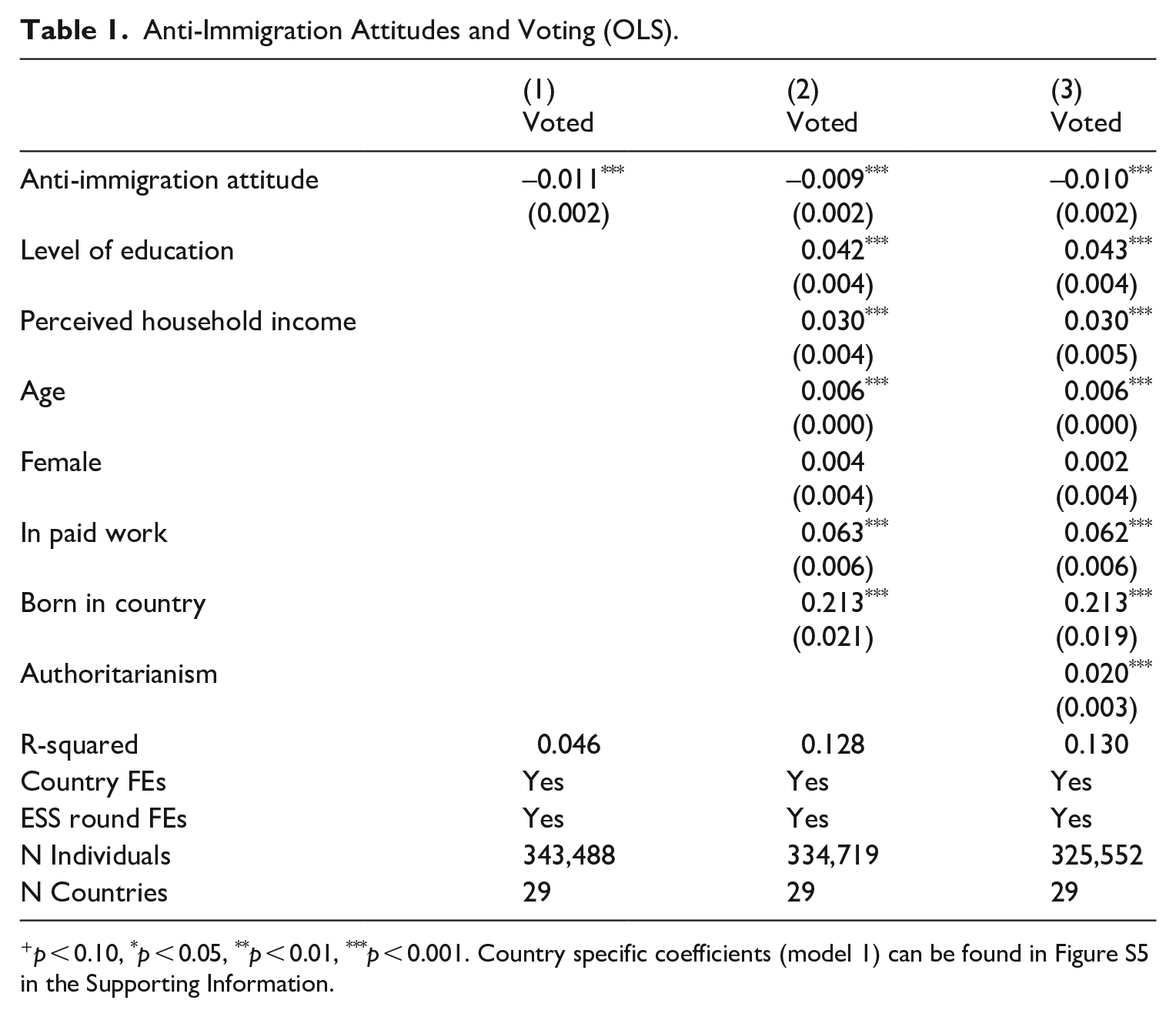
p < 0.10, *p < 0.05, **p < 0.01, ***p < 0.001. Country specific coefficients (model 1) can be found in Figure S5 in the Supporting Information.
A one-unit change in anti-immigrant attitudes (on a scale that goes from 0 to 10) reduces the likelihood of having voted by 1.1 percentage points. The relationship remains essentially unaffected when controlling for socioeconomic factors (model 2). As expected, a higher level of education, positive perceptions of household income, age, being in work, and being born in the country increase the likelihood of voting in elections. The coefficient remains intact when we in model 3 also introduce authoritarian values among the controls. Interestingly, the analysis displays a positive relationship between authoritarian values and the likelihood to participate by voting in elections, that is, the relationship goes in the opposite direction of the relationship between anti-immigrant attitudes and voting. This result stresses the importance of distinguishing between anti-immigrant attitudes and authoritarian values in general.
Turning to the conventional forms of non-electoral political participation, the first model in Table 2 shows a relatively strong negative correlation with anti-immigrant attitudes. The model explains almost 8% of the variation in participation. As was the case also for voting, this relationship is only marginally reduced (approximately 20%) when controlled for socioeconomic factors (model 2). And the coefficient for anti-immigration attitudes remains virtually unchanged when controlling for authoritarianism. It is also interesting to note that authoritarianism displays a negative coefficient, while being positively associated with voting. A possible reason for this is that “authoritarians” are more likely to follow social conventions and norms, such as voting in elections. They have also been shown to participate less in non-electoral forms of participation in previous research (Singh and Dunn, 2015).
Anti-Immigration Attitudes and Conventional Participation (OLS).
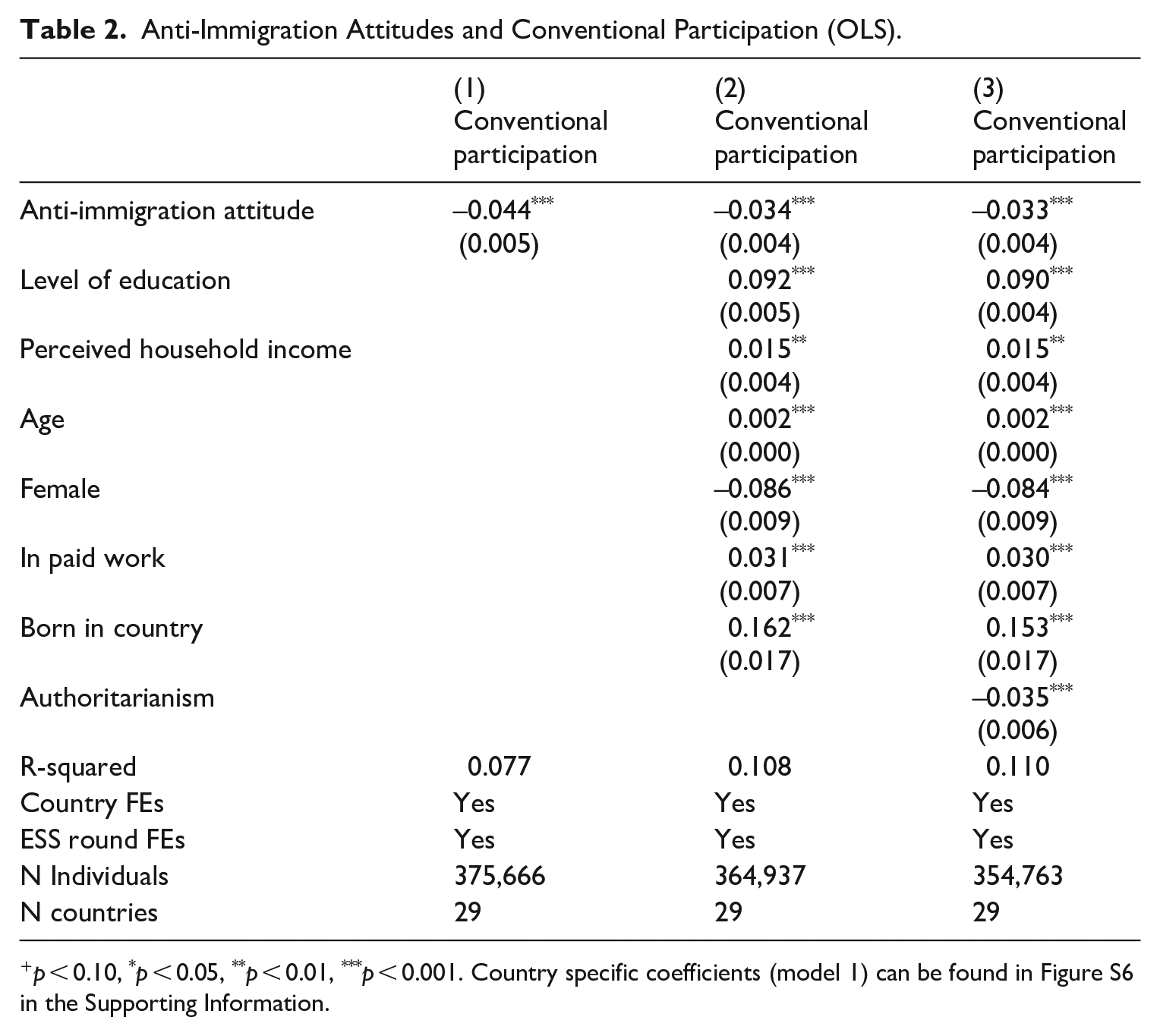
p < 0.10, *p < 0.05, **p < 0.01, ***p < 0.001. Country specific coefficients (model 1) can be found in Figure S6 in the Supporting Information.
Table 3 demonstrates an even stronger negative relationship between anti-immigrant attitudes and our measure of unconventional political participation. This time, anti-immigrant attitudes explain over 12% of the variation in participation. When controlling for socio-demographic factors, the strength of the relationship is only reduced somewhat (model 2).
Anti-Immigration Attitudes and Unconventional Participation (OLS).
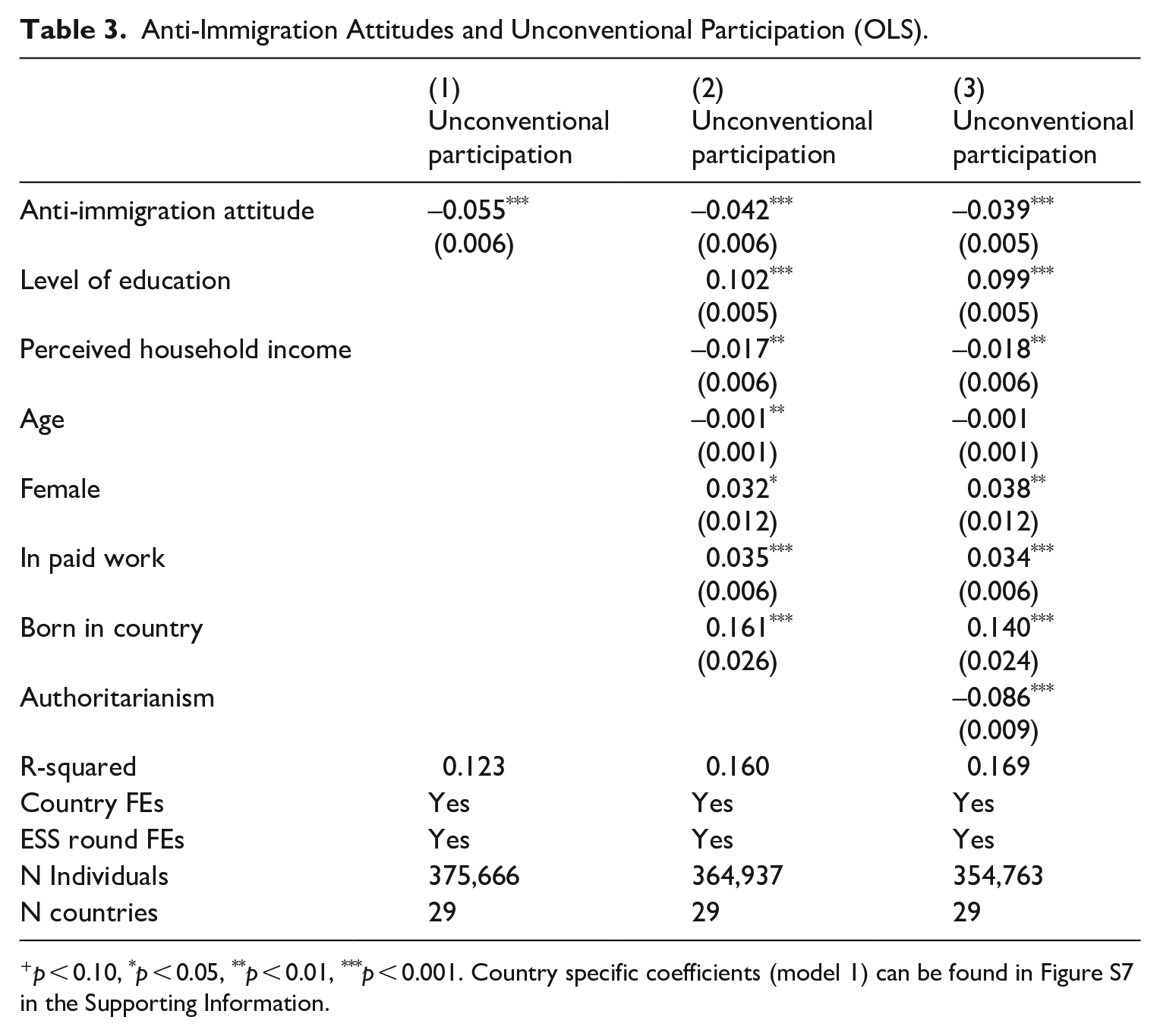
p < 0.10, *p < 0.05, **p < 0.01, ***p < 0.001. Country specific coefficients (model 1) can be found in Figure S7 in the Supporting Information.
Including authoritarianism (model 3) hardly changes the coefficient, even though authoritarianism once again is negatively associated with participation. In short, the analysis clearly demonstrates that people with anti-immigrant attitudes display lower participation rates in all three types of political participation. For ease of interpretation, the main results from these analyses are presented graphically in Figure 1, which displays levels of the different types of participation at different levels of anti-immigration attitudes with 95% confidence intervals, based on the full models in the preceding tables.
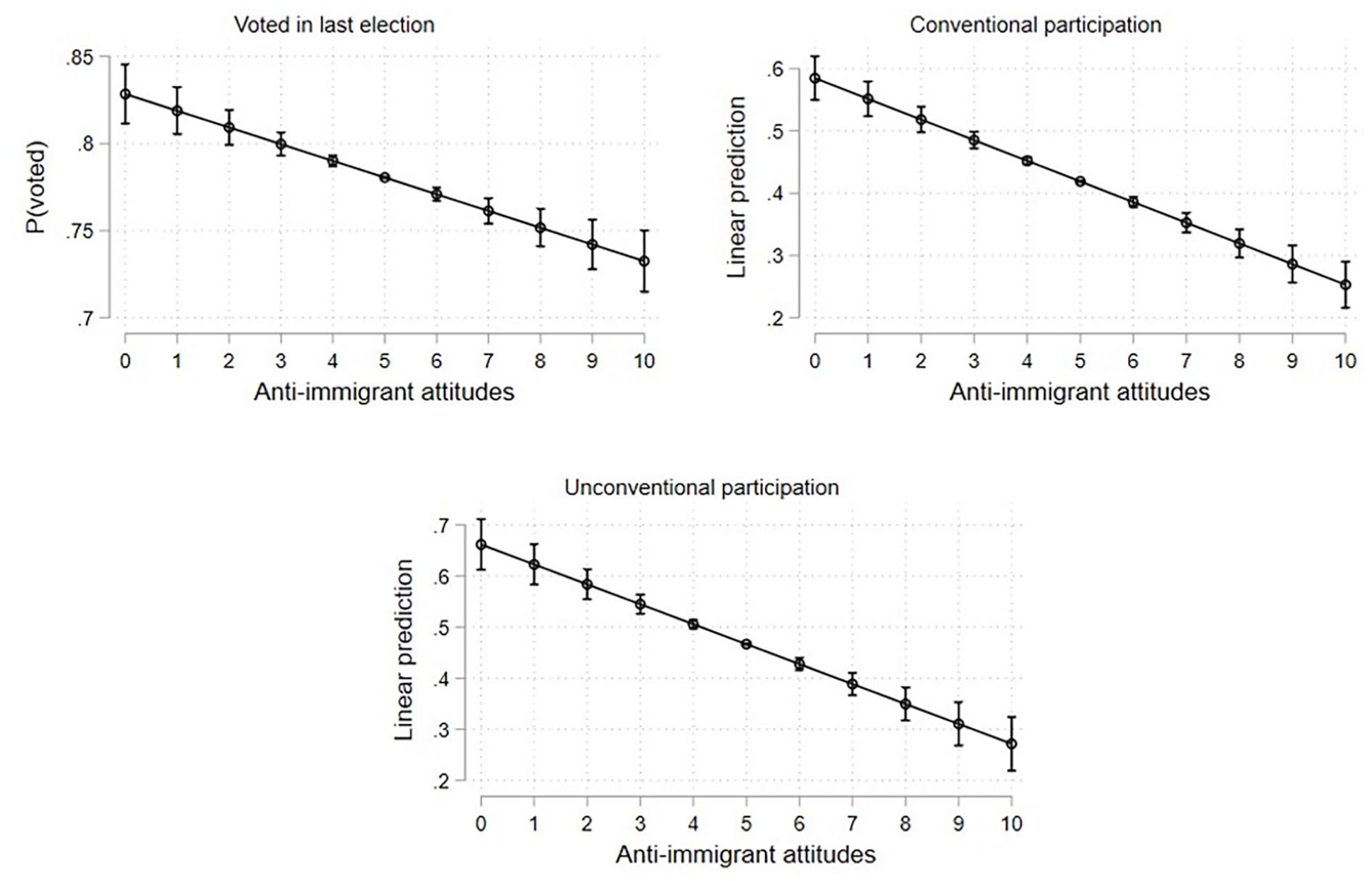
Levels of Participation at Different Levels of Anti-Immigrant Attitudes (With 95% Confidence Intervals).
All in all, the analyses provide strong support for the first hypothesis, that is, a general negative relationship between anti-immigrant attitudes and political participation. It is also confirmed that the negative relationship between anti-immigration attitudes and (the secret act of) voting is substantially weaker than that between anti-immigration attitudes and other more demanding, and public, forms of participation (H3). Moreover, the analyses also demonstrate that this participation gap is not mainly explained by socio-demographic factors or a general disposition of authoritarianism among anti-immigrant citizens.
Results remain identical when running the models with the “opposition to immigration” index instead of the index measuring perceived group threat by immigrants and immigration as the independent variable. This is somewhat surprising as it is not tilted as much to measure fear and anxiety, but potentially leaves more room for anger than the index measuring perceived group threat. The main results from these analyses are presented in Figure S1 in the Supplementary Information.
In the Supplementary Information, we also include three graphs (Figures S5–S7), in which we plot coefficients for the bivariate association between anti-immigrant attitudes and the three types of participation separately for all countries in the dataset. These show significant negative associations for conventional and unconventional participation in all countries, even though the strength of the association varies somewhat, possibly being weaker in Eastern than in Western European countries. For voting, the relationship is negative in most countries, but positive in two (Luxembourg and Greece) and not significant in some. Overall, the patterns we find in our main models are very similar to the ones in individual countries, but there is significant variation between countries in the strength of the association we find that would be interesting to explore in future studies.
The Interplay Between the Anti-Immigrant Attitudes and the Left-Right Dimension
Is the strong relationship between anti-immigrant attitudes and participation a general one, or is it contingent on people’s ideological beliefs, as we suggest in the theory section? To investigate this, we interact the anti-immigration attitudes index with respondent’s self-placement on the left-right scale to examine the association between anti-immigration attitudes and participation for leftist and rightist respondents. The main results are presented in Figure 2. The graphs illustrate the results from the main models, with the full set of control variables. The figure plots the estimated level of participation for different levels of anti-immigration attitudes for respondents that are strongly leftist (–2 standard deviations), centrist (mean), and strongly rightist (+2 standard deviations). The full results of all models can be found in Table S2 in the Supplementary material.
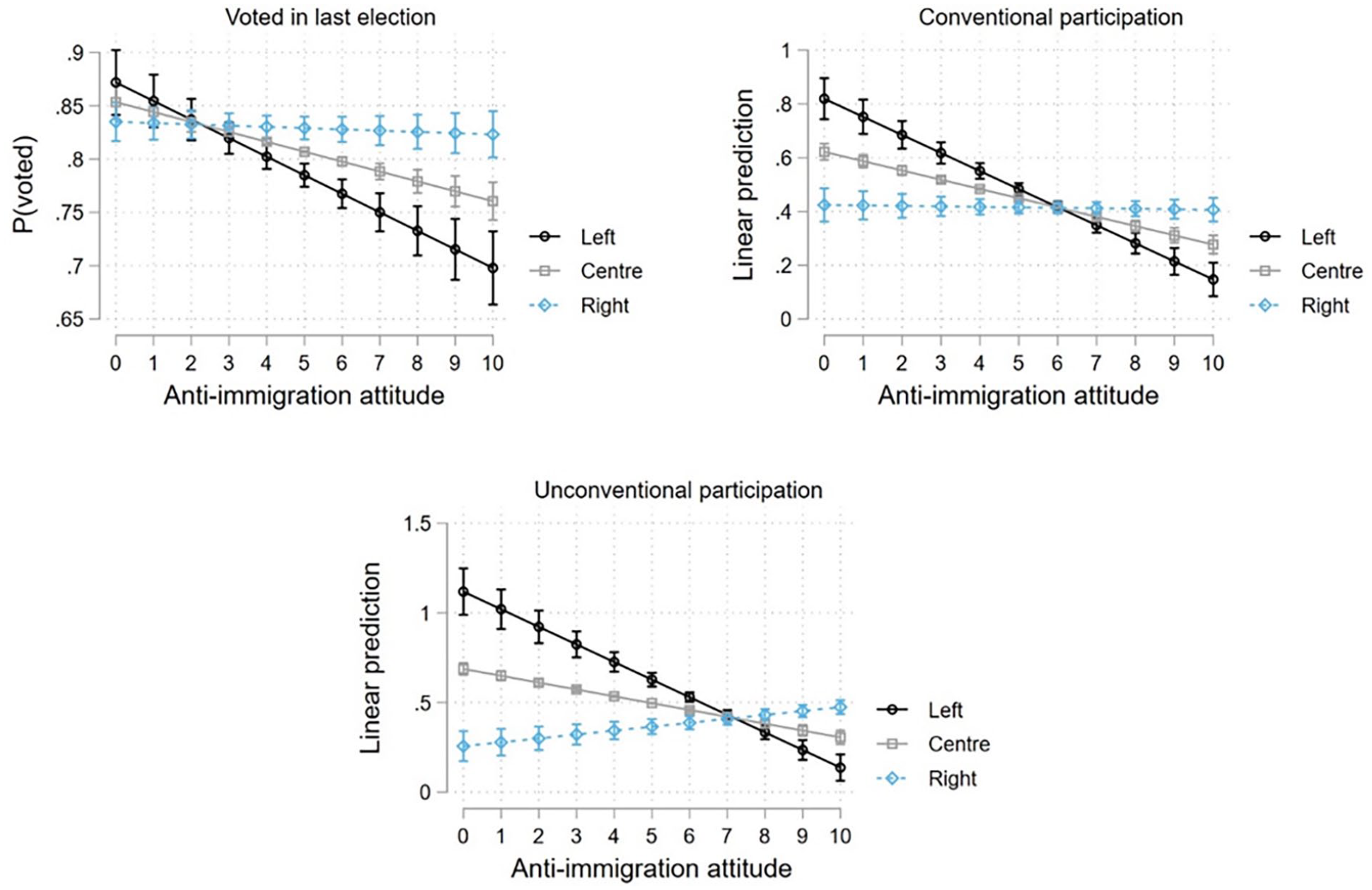
Levels of Participation at Different Levels of Immigration Attitudes by Self-Placement on the Left-Right Scale.
The upper left panel shows that the negative association between anti-immigrant attitudes and voting is clearly more pronounced to the left and the center of the political spectrum. Anti-immigrant respondents placing themselves on the right are not less likely to have voted than pro-immigrant respondents placing themselves on the right. Turning to conventional (the upper right panel) and unconventional political participation (the lower panel), we observe similar patterns, with a strong negative correlation between anti-immigrant attitudes and participation among leftist respondents. Pro-immigrant leftist respondents have participation rates that are eight times the participation rates of anti-immigrant leftist respondents. The association between anti-immigration attitudes and participation among rightist respondents is not negative, and in the case of unconventional participation even positive (with the most anti-immigrant respondents participating twice as much as the most pro-immigrant respondents).
In short, the anti-immigrant participation gap is clearly stronger on the left and at the center of the political spectrum. On the right of the spectrum, the gap is even reversed for unconventional participation. The same results are found when using the alternative index of opposition to immigration as the independent variable (see Figure S2 in the Supplementary materials). All in all, the results provide strong support for H2.
When re-running the same models using attitudes to reducing income differences instead of self-placement on the left-right scale to measure the economic left-right dimension of politics, the differences in how anti-immigrant attitudes is associated with political participation among leftist and rightist respondents are reduced. But the associations are still stronger among leftist respondents, and especially so for unconventional participation. The number of respondents who disagree that the government should reduce differences in income levels is, however, very low (about 12%), and other more direct measurements that are more normally distributed might thus yield more pronounced differences. The results of this analysis are shown in Table S3 and Figure S3 in the Supplementary materials. In the Supplementary materials, we also interact our second index of anti-immigrant attitudes with attitudes to redistribution with similar results (see Figure S4).
Discussion and Conclusions
In this study, we have demonstrated the existence of a quite substantial political participation gap between pro- and anti-immigrant citizens in Europe. Citizens harboring anti-immigrant attitudes display lower levels of all types of political participation, even though the gap in voting is non-existent among rightist citizens. This participation gap is most pronounced among citizens placing themselves on the left and at the center of the political spectrum.
Our findings are in one way surprising, given the recent finding that anti-immigrant citizens feel stronger about immigration and are more prone to see the issue as personally and nationally important (Kustov, 2023). If it were the perceived importance of the immigration issue that drove people to participate in politics, we would expect the opposite pattern to the one we find. For some reason, it seems like the importance anti-immigrant citizens ascribe to the immigration issue is manly accompanied by the passivizing feelings of fear and anxiety rather than the activating feeling of anger. Thus, the perceived importance of the immigration issue among anti-immigrant citizens has not been enough to mobilize them politically, or at least not to the extent that one might expect given Kustov’s (2023) findings. However, it is possible that anti-immigrant citizens would have participated even less than they do if they had not cared so much as they do about immigration.
Our findings are more in line with recent research that has demonstrated that the shortage of political alternatives and representation for “left authoritarians” has resulted in lower levels of voting turn out and higher levels of political discontent (Federico et al., 2017; Hakhverdian and Schakel, 2022; Hillen and Steiner, 2020). The last decades’ growth of populist radical right parties has seemingly only come to offer a broader range of political alternatives and increased political representation for right-leaning immigration skeptics. Leftist and centrist anti-immigrant citizens still seem to lack viable opportunities for political participation. This lack of viable political alternatives makes it more difficult for leftist and centrist anti-immigrant citizens to find political outlets for their anger against immigrants and immigration, which increases the likelihood that fear and anxiety—and political inaction—prevail in this group. If our analysis is correct, it confirms those studies that point to supply-side factors as crucial for mobilizing anti-immigrant citizens politically (i.e. Van der Brug and Van Spanje, 2009).
But why are there so few leftist and centrist political entrepreneurs who mobilize on an anti-immigration agenda? A possible explanation is that anti-immigrant attitudes are less common, and therefore more stigmatized, on the left and at the center of the political spectrum: It is tougher to mobilize when your party comrades do not share, and might even detest, your opinions. Feelings of fear and anxiety are, thus, even more likely to dominate over feelings of anger. If we are right, supply-side factors (the number of parties mobilizing on an anti-immigrant platform) are in fact endogenous to demand-side factors (the prevalence of anti-immigrant attitudes). Relatively few anti-immigrant leftist citizens lead to even fewer politically leftist entrepreneurs who dare to mobilize on an anti-immigrant agenda, which in turn depresses participation among leftist citizens even more. Unfortunately, given the observational data at hand, we are unable to dig deeper into potential mechanisms that might explain the gap we have highlighted in this study. This is, however, an important avenue for future research.
Regardless of what the main cause is, the observed gap has implications that are of importance for our understanding of contemporary and future politics in Europe. The existence of an untapped reservoir of primarily leftist anti-immigrant citizens who have not been mobilized for politics suggests that there is a policy space for leftist anti-immigrant political entrepreneurs to exploit if they can trigger their anger. This is not an entirely novel insight (e.g. Van der Brug and Van Spanje, 2009), but our results highlight the substantially lower participation rates among anti-immigrant left-leaning citizens. If they were to become more active in party politics and in contacting politicians, the political climate will likely become more hostile to immigrants and immigration than it is today. This potential scenario should also be seen in the light of recent research demonstrating that people with strong anti-immigrant sentiments tend to be less supportive of democracy and more likely to embrace non-democratic political alternatives (Kokkonen and Linde, 2023b).
If the anti-immigrant citizens who harbor such attitudes become more active in politics, existing parties may radicalize and new, even more radical, parties emerge. Mobilizing politically inactive anti-immigrant citizens might hence affect European politics in more fundamental aspects. One such attempt has recently been seen in Germany, where Bundestag member Sahra Wagenknecht and several other members of the leftist Die Linke left to form a new party (Bündnis Sahra Wagenknecht), which has been described as economically left-wing while being closer to the populist radical right on the cultural dimension. Our findings suggest that it is not unlikely that we will see more of this in the near future.
Supplemental Material
sj-docx-1-psx-10.1177_00323217241241438 – Supplemental material for Anti-Immigrant Attitudes and Political Participation in Europe
Supplemental material, sj-docx-1-psx-10.1177_00323217241241438 for Anti-Immigrant Attitudes and Political Participation in Europe by Andrej Kokkonen and Jonas Linde in Political Studies
Footnotes
Declaration of Conflicting Interests
The author(s) declared no potential conflicts of interest with respect to the research, authorship, and/or publication of this article.
Funding
The author(s) disclosed receipt of the following financial support for the research, authorship, and/or publication of this article: This research was funded by grants from the Research Council of Norway (grant number 275308) and the Swedish Research Council (VR 2018-01468).

Supplemental Material
Additional Supplementary Information may be found with the online version of this article.
Table S1. Anti-immigration attitudes and voting (logistic regression) Figure S1. Levels of participation at different levels of opposition to immigration (with 95% confidence intervals) Table S2. Anti-immigration attitudes and left-right ideology interaction models (OLS) Figure S2. Levels of participation at different levels of opposition to immigration by self-placement on the left-right scale Table S3. Anti-immigration attitudes and redistribution preference interaction models (OLS) Figure S3. Levels of participation at different levels of anti-immigration attitudes by perception of reducing income differences (OLS) Figure S4. Levels of participation at different levels of opposition to immigration by perception of reducing income differences (OLS) Figure S5. Country specific coefficients, voted in last election Figure S6. Country specific coefficients, conventional participation Figure S7. Country specific coefficients, unconventional participation Table S4. Descriptive statistics Wording and coding of variables
Author Biographies
References
Supplementary Material
Please find the following supplemental material available below.
For Open Access articles published under a Creative Commons License, all supplemental material carries the same license as the article it is associated with.
For non-Open Access articles published, all supplemental material carries a non-exclusive license, and permission requests for re-use of supplemental material or any part of supplemental material shall be sent directly to the copyright owner as specified in the copyright notice associated with the article.
