




Abstract
Is generalised trust stable or changeable? The ‘cultural’ theory argues that trust is a relatively fixed personality trait, while the ‘experiential’ theory contends that life experiences can alter trust during adulthood. But these two theories have been tested using a variety of different criteria whose differences have seemingly never been acknowledged explicitly. In this article, I map out these five different criteria, formulating specific hypotheses for each one and test them on a large and representative longitudinal data set from Australia. As expected, both the cultural and experiential theories appear broadly correct: trust is affected by both early-life factors and adult experiences, but the impact of adult experiences is usually transitory. A broad range of adult experiences seem to affect trust, and trust exhibits high rank-order but low mean-level stability. I conclude by suggesting some new directions for the study of generalised trust.
Introduction
Generalised trust – one’s trust in unspecified strangers – is critical for well-functioning states and societies. It spurs economic growth (Fukuyama, 1995; Whiteley, 2000; Zak and Knack, 2001) and is associated with greater confidence in democratic institutions (McAllister, 2014). And as a component of ‘social capital’, it enables the collective action necessary to sustain a ‘civic culture’ (Almond and Verba, 1963) and democracy itself (Putnam, 1993, 1995). How generalised trust is created is therefore of great interest to both researchers and governments. This topic has been the subject of debate over the last two decades, with the ‘cultural’ theory contending that trust is a stable human trait, which is learned early in life and changes little thereafter (Uslaner, 2002) and the ‘experiential’ theory arguing that trust can change throughout one’s life in response to experiences (Dinesen, 2012a). This forms part of a broader conversation about whether attitudes are the result of ‘settled dispositions’ or subject to ‘active updating’ (Kiley and Vaisey 2020; Lersch, 2023).
However, previous research on the cultural–experiential debate has used a variety of different criteria for testing these two theories (e.g. testing whether experiences yield a change in trust versus testing how long that change lasts), and has seemingly never acknowledged the differences between these. Furthermore, when the criteria are applied in isolation, they are not always effective at distinguishing between the two theories. This article, by contrast, is the first study of generalised trust which explicitly maps out and applies all of these distinct criteria at once. This presents a more nuanced and complex picture of generalised trust than in previous studies, and helps to avoid a problem whereby the results of single-criterion tests could be interpreted as consistent with either theory. And in contrast to previous ‘narrow’ (i.e single variable, single criterion) studies of trust, this article takes a ‘broad’ approach, testing a wide range of different variables against five different criteria.
I used a large and representative panel data set consisting of over 24,000 trust observations over seven waves from the Household, Income and Labour Dynamics in Australia survey (HILDA). As expected, there is evidence for both the cultural and experiential theories of trust. Trust is clearly affected by certain adult experiences, particularly being a victim of crime, and the range of experiences that affect trust seems relatively broad. But those changes rarely last beyond one or two survey periods, and cultural and early-life factors remain strong predictors of trust as well. And although trust displays relatively high rank-order stability, it also appears to rise with age, so mean-level stability is much lower. 1 These findings show that questions about change versus stability can lead to different answers depending on the criteria being applied, and therefore also have implications for other areas of political science and international relations. I also present some suggestions for future research on generalised trust.
Two Theories of Generalised Trust
Generalised trust is associated with a range of positive outcomes including economic growth and more robust democracy, which are believed to arise partly because trust reduces transaction costs and facilitates collective action (Fukuyama, 1995; McAllister, 2014; Putnam, 1993, 1995; Whiteley, 2000; Zak and Knack, 2001). Unsurprisingly, trust is correlated with development – the countries which score highest on the UN Human Development Index usually have high levels of generalised trust. Country-level generalised trust is even associated with greater resilience to the COVID-19 pandemic (Lenton et al., 2022). The extent to which generalised trust can be increased is therefore of interest to both researchers and policymakers.
Most treatments of generalised trust sort themselves into one of two camps: the ‘experiential’ camp, which argues that individuals’ trust is malleable and changes in response to life experiences, and the ‘cultural’ camp, which holds that trust is largely fixed early in life and changes little thereafter. The cultural approach is closely associated with the work of Eric Uslaner, who suggested that generalised trust is ‘moralistic’ and forms only one part of a broader worldview, which includes optimism and faith in other people (Uslaner, 2002). 2 For adherents of the cultural school, ‘trusting others is not so much a reflection of your life experiences as of what you were taught when you were young’ (Uslaner, 2002: 112). Trust is a product of one’s early life and upbringing, and is particularly affected by the social context in which one is raised. High levels of inequality, for example, are believed to have a negative effect on trust (Rothstein and Uslaner, 2005), and one’s parents and home environment are also argued to be important (Uslaner, 2002: 77). As Uslaner points out, nurturing parents ‘make children feel good about themselves’, which minimises their fear of interacting with others (Uslaner, 2002: 92). There has been some subsequent evidence in favour of the cultural approach: Stolle and Hooghe (2004) found that generalised trust displayed ‘a large degree of stability over time’, while Dawson (2019) came to a similar conclusion using panel data from the United Kingdom. There have also been numerous cross-sectional studies, which have linked high country-level trust to Protestant religious traditions and more equal income distributions (Delhey and Newton, 2003; Bjørnskov, 2007).
The experiential approach, by contrast, holds that trust is malleable and is updated throughout an individual’s life in response to different experiences (Wu, 2020). This builds on the earlier paradigm of ‘strategic trust’, which emphasised that the decision to extend trust to another person is risky and depends on situation- and person-specific information held by the truster (Hardin, 1992; Levi, 1997). Strategic trust is ‘Bayesian’ and therefore updated in response to prior experiences (Hardin, 1992). While earlier work tended to distinguish between ‘moralistic’ and ‘strategic’ trust (see Uslaner, 2003), it is now more common to speak of the cultural and experiential approaches to trust instead (Wu, 2020: 525). In any case, there is a significant amount of evidence which supports the experiential approach to trust. Glanville and Paxton (2007) showed that trust was linked to certain life experiences, a finding which was later confirmed by Paxton and Glanville (2015) using a laboratory experiment, which showed that individual trust levels changed after experiencing a high- or low-trust context. This aligns with Dinesen’s (2012a, 2012b) finding that migrants update their trust levels after moving to a high-trust country, although Wu’s (2020) results indicate this is not the case for within-country migration in the United States. Job loss is also associated with lower trust (Laurence, 2015), although it is unclear whether being a victim of crime has the same effect (Bauer, 2015). And Putnam (1995, 2000) famously claimed that joining associations raises trust, although the subsequent evidence for this claim is somewhat mixed: Brown et al. (2014) reported that sport participation increases trust, but a panel study by Van Ingen and Bekkers (2015) found no evidence that associational membership had any causal effect.
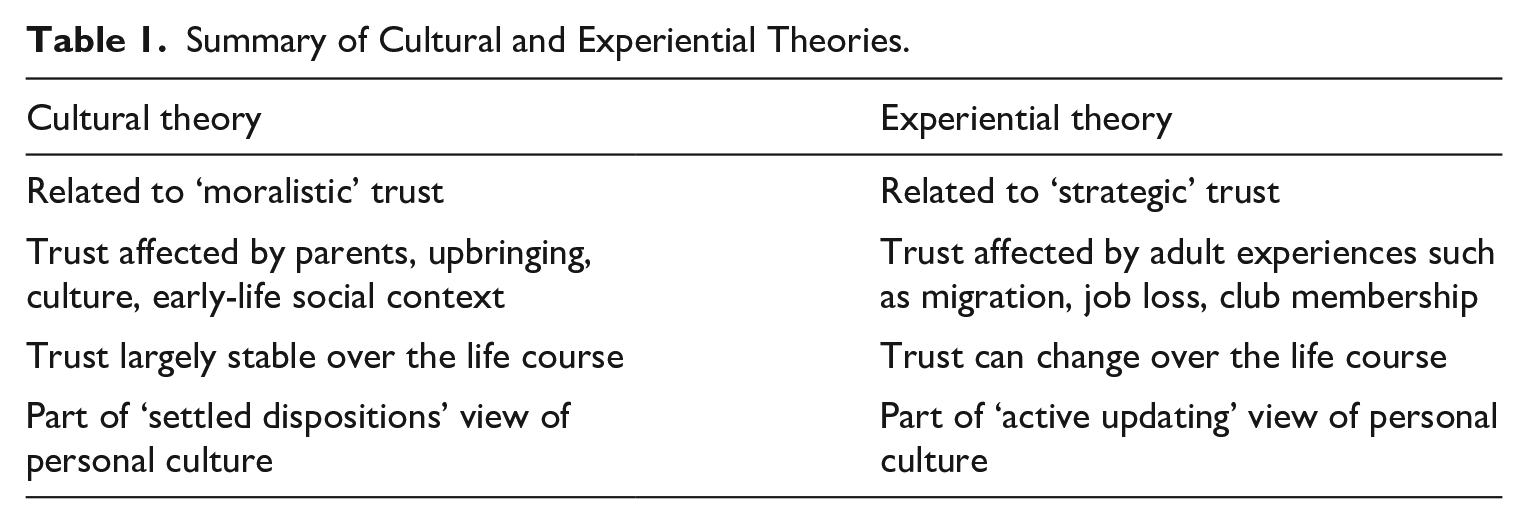
The debate between the ‘cultural’ and ‘experiential’ theories of trust also forms just one part of a broader research programme which seeks to understand the degree of stability or malleability in attitudes, values and behaviours. Studies of political socialisation, for instance, distinguish between ‘persistence’ and ‘lifelong openness’ models, the former of which assumes that political attitudes are formed early in life and largely stable thereafter, while the latter argues that attitudes can change throughout adulthood (Kustov et al., 2021; Sears and Brown, 2013). More broadly, Kiley and Vaisey (2020) examined 183 different attitudes and behaviours (including trust) using US panel data and find that people generally display ‘settled dispositions’ where attitudes change little in adulthood, rather than engaging in ‘active updating’ of attitudes throughout their lives. Conversely, Lersch (2023) found evidence that people do develop persistent changes in their attitudes and behaviours throughout the life course. The cultural and experiential theories of trust could be considered as species of the ‘settled dispositions’ and ‘active updating’ theories of attitude change, respectively. A brief summary of the two theories of trust is shown in Table 1.
Summary of Cultural and Experiential Theories.
Different Criteria, Different Results?
Over the last 20 years, research on generalised trust has almost always adopted the distinction between the cultural and experiential theories (or their predecessors, ‘moralistic’ and ‘strategic’ trust). A typical study of generalised trust will introduce the two approaches, present some empirical results and then conclude that these support either the cultural or experiential theories (see, for example, Bauer, 2015; Dawson, 2019; Dinesen, 2012a; Glanville and Paxton, 2007; Wu, 2020; and many others). 3 However, these studies have actually used a variety of different criteria to test the two theories, and the differences between these criteria are rarely, if ever, acknowledged explicitly. As far as I can tell, there are at least five different criteria which have been used for testing the cultural and experiential theories:
Of course, these criteria are to some extent interlinked. It would be impossible for adult trust changes to show high persistence if trust did not also have adult-life malleability. But in most cases, testing one criterion says little about the expected results of the others. Say generalised trust changes in adulthood were found to have low persistence, as Dawson (2019) reported. This says nothing about specificity, since a broad (or narrow) range of experiences could still affect trust, but the effects rarely last. Nor does it say anything about early-life malleability, which could be high or low and still be consistent with low persistence for adult trust changes. Or perhaps trust were found to have adult-life malleability, such as in the such as in Laurence (2015) who reported that job displacement reduces trust. This tells us nothing about whether other experiences have the same effect (specificity). Nor does it have any implications for early-life malleability, and while Laurence found that the changes were persistent, this was only because he also tested for persistence using panel data. Finally, it also says little about stability, since it could be the case that few people experience job displacement and/or the effect is small and easily offset by other factors, so one’s overall trust level changes little over time. While these five criteria are not fully independent, they are to a large degree orthogonal with each other.
This means that, when taken in isolation, most of these criteria are compatible with both theories. Testing a single criterion is therefore a rather ineffective way of adjudicating the cultural–experiential debate. Take ‘stability’ for instance. Finding that trust is highly stable is usually interpreted as evidence for the cultural theory (Dawson, 2019), but high stability is also perfectly consistent with the experiential theory: it just requires that the kinds of experiences which affect trust are rare (i.e. high ‘specificity’), so that average stability of trust across the entire population remains fairly high. But testing only the stability criterion tells us nothing about specificity, so we have no way of telling whether this is the case. Or consider ‘persistence’: if experiences yield trust changes which persist for many years, this is typically framed as evidence for the experiential theory (Laurence, 2015), but it is of course also consistent with the cultural theory because those persistent changes do not preclude the possibility that one’s original level of trust is also affected by cultural and early-life factors (‘early-life malleability’). It would therefore be preferable to examine early-life malleability alongside persistence.
It is perhaps for this reason that so many studies have concluded that their results are consistent with both theories (Abdelzadeh and Lundberg, 2017; Dinesen, 2013; Moschion and Tabasso, 2014; Uslaner, 2008). When testing only a single criterion, it is easy to fit the results into either theory: Abdelzadeh and Lundberg (2017: 222) tested the ‘stability’ of trust during adolesence, and despite finding a degree of instability, acknowledge that their results ‘do not wholly eliminate the relevance of a cultural perspective’ if trust changes are ‘relatively modest’. Examining a single criterion never seems to be sufficient to reach a firm conclusion: Cary Wu, a proponent of the cultural theory, admits that ‘extreme events and traumatic experiences’ may affect trust even if stability is high (Wu et al., 2022), while Glanville and Paxton (2007: 241) acknowledge that while trust is seemingly affected by experiences, this does not preclude the possibility that people eventually ‘move back toward some baseline propensity to trust’. In both cases, the authors are forced to hedge their bets, acknowledging that their results are more or less consistent with both theories.
The central thrust of this article is that we can better adjudicate the cultural–experiential debate by testing all five criteria at once. No article on trust has done this before – in fact, no previous work seems even to have explicitly acknowledged that these five different criteria exist. This will give us a better picture of which of the cultural or experiential theories better fit the data because it reduces the ability for any individual criterion to be consistent with both theories. If we found high stability but failed to find high specificity, we would be forced to conclude that the stability finding supports the cultural theory (because, as noted above, high stability can only be consistent with the experiential theory if specificity is high). It may also be desirable to take a ‘broad’ approach to generalised trust. Previous work on trust tends to go ‘narrow’, testing the effects of one particular variable against one or two criteria (Bauer, 2015; Dinesen, 2012a, Laurence, 2015; Viitanen 2014). This article, by contrast, takes a ‘broad’ approach, which instead aims to test a broad range of potential determinants of trust against five distinct criteria. This provides an important complement to the ‘narrow’ work outlined above.
Hypotheses
What results can we expect when testing the cultural and experiential theories across these five criteria? Taken all together, previous research on the topic suggests that the cultural and experiential theories are actually both correct to some degree. This proposition was made explicit by Dinesen and Sønderskov (2018), who suggested that ‘trust is shaped by both cultural heritage and contemporary experiential factors’. This would also be consistent with previous research about whether trust is more affected by ‘settled dispositions’ or ‘active updating’. Kiley and Vaisey (2020) found that generalised trust can show change over the life course, but this is relatively minor compared to some other attitudes, particularly those related to religion, health and public spending. And while a subsequent study found that trust is mostly a ‘settled disposition’ (Vaisey and Kiley, 2021), Lersch (2023) reports that trust is in a category of attitudes, which in fact show a relatively high degree of ‘updating’. In this section, I propose five hypotheses, one for each of the criteria described above, which reflect the expectation that both theories are more or less correct and are far from mutually exclusive, as previous research has occasionally implied. 4 First, numerous studies have found evidence for adult-life malleability (Glanville and Paxton, 2007; Laurence, 2015; Paxton and Glanville, 2015), but there is also consistent evidence for early-life malleability (Abdelzadeh and Lundberg, 2017; Uslaner, 2002; Viitanen, 2014). This leads to the first two hypotheses:
H1: At least some adult life experiences have an effect (either transient or long-lasting) on generalised trust levels (adult-life malleability hypothesis).
H2: At least some early-life and cultural factors such as one’s language, ethnicity, location or type of upbringing have an effect on adult generalised trust levels (early-life malleability hypothesis).
H1 says nothing, of course, about the issues of ‘persistence’ or ‘specificity’ – it merely suggests that at least some experiences have at least some effect on trust. Turning to the question of persistence, I expect that the effect of experiences on trust will usually not persist – that is, the effect of adult experiences will usually only be fleeting. This is consistent with most of the few previous studies which have examined persistence (Dawson, 2019; Fairbrother et al., 2022) as well as theories of social attitudes and how they relate to the survey response. As Zaller and Feldman (1992) note, people rarely have clear opinions about social attitudes such as trust, and instead carry a variety of ‘considerations’ about an issue, many of which conflict with each other. Some considerations, which happen to be ‘top-of-head’ at the time, have a disproportionate effect when answering survey questions, but these do not usually stay ‘top-of-head’ forever, and therefore considerations that are ‘accessible at one interview might not be so prominent at the next’ (Zaller and Feldman, 1992: 597). A certain life experience might elevate a certain consideration to top-of-head and thus influence one’s response to the generalised trust question, but over time this consideration will generally lose its salience while others gain salience. This implies the following:
H3: Where adult life experiences affect generalised trust levels, the impact is usually transient (persistence hypothesis).
What about ‘specificity’? Previous research suggests that a wide range of experiences can affect trust, so I expect specificity to be relatively low. There is evidence that job displacement (Laurence, 2015), associational membership (Brown et al., 2014; Putnam, 2000), the birth of a child (Stavrova et al. 2022) and even the COVID-19 pandemic (Wu et al., 2022) can all affect adult trust levels. It is difficult to identify any commonalities between these other than perhaps the sense that they are relatively ‘major’ events. The broad range of trust-affecting events is also consistent with my suggestion above that experiences affect trust by changing one’s ‘top-of-head’ considerations, which subsequently influence the survey response (Zaller and Feldman 1992). It feels intuitively plausible that any kind of major life experience – either positive or negative – has the potential to influence one’s top-of-head considerations and thereby affect trust. Why should this be limited only to certain categories of experience? This is reflected in the hypothesis below:
H4: A relatively wide range of adult life experiences have the ability to affect generalised trust (specificity hypothesis).
As for stability, it depends on whether we consider rank-order stability or mean-level stability, a distinction which, with the partial exception of Bekkers and Dinesen (2016), has eluded existing trust research. Rank-order stability means that the ordering of units is preserved over time: for example, the highest-trust individuals at time t are still the highest-trust individuals at t + 1. This is different to mean-level stability, which is when the mean level of trust (across all units) is preserved over time (Damian et al., 2019). Because generalised trust has repeatedly been shown to increase with age (Clark and Eisenstein, 2013; Kong, 2016; Li and Fung, 2013), it seems unlikely that trust could exhibit mean-level stability, although high rank-order stability remains possible if the experiences that alter trust are relatively rare or if the persistence of the changes is low. I have already specified in H3 that I expect the persistence of the changes to be low, so it follows that trust should be expected to have high rank-order stability. While experiences might temporarily increase a person’s trust ‘rank’ relative to others, low persistence means that those rank-order changes will not be preserved. These expectations are summarised in H5:
H5: Generalised trust will exhibit low mean-level stability but high rank-order stability (stability hypothesis).
In addition to advancing our understanding of generalised trust, this article also makes contributions to the study of political behaviour and political science more broadly. First, the article contributes to the wider research programme on the stability of individual attitudes, such as polarisation or immigration attitudes (Kustov et al., 2021; Levendusky, 2018). By identifying that the ‘malleability’ of an attitude is distinct from the ‘persistence’ of attitude change, which in turn is distinct from the ‘specificity’ of factors that affect that attitude, this article also provides a framework which can apply to other debates in political behaviour. And given the importance of trust for collective action, economic growth and democracy (Fukuyama, 1995; McAllister, 2014; Whiteley, 2000; Zak and Knack, 2001), understanding the determinants of trust is important for scholars and policymakers working on any of those topics. Moreover, finding that trust is highly stable over the life course would reduce concerns about confounding and spuriousness when individual-level trust is being used to explain other outcomes in political science, such as in the studies by Jamal and Nooruddin (2010) and Newton and Zmerli (2011).
Data and Methods
I tested these hypotheses using data from the HILDA survey. HILDA is a panel study that has followed the lives of more than 17,000 Australians each year since 2001 (Watson and Wooden, 2012). Panel data have frequently been used to test the cultural and experiential theories of trust (see Abdelzadeh and Lundberg, 2017; Bauer, 2015; Bekkers, 2012; Dawson, 2019), but most of these panel datasets are quite limited either in their timespans, number of waves or both. Abdelzadeh and Lundberg (2017) used Swedish panel data, but these consisted of only two survey waves 2 years apart. Bekkers (2012) suffered from similar problems – he claimed to find support for the cultural theory, but used only three survey waves spanning a total of 4 years. This makes it nearly impossible to test ‘persistence’ – how long any change in trust is sustained for.
With its large, nationally representative sampling, HILDA offers considerable advantages over previous studies. HILDA asked respondents about their generalised trust in Waves 5, 6, 8, 10, 11, 14 and 18, which span a total of 13 years from 2005 to 2018. The data set used here is therefore, longer running than even Dawson’s (2019) data, which was derived from the British Household Panel Study (BHPS) and consisted of 3700 individuals observed across six waves spanning 10 years (Dawson, 2019: 592) and which represents the previous high-water mark in terms of timespan and number of waves. The use of HILDA data therefore represents a major advantage over previous work and means that this article can observe generalised trust over either more waves, a longer timespan or with a larger sample than any previous study of the cultural and experiential theories of trust. Following Dawson (2019: 592), I included only those individuals who were observed in all seven survey waves. However, models with all respondents – not just those who were observed in all seven waves – are also included in Supplemental Appendix B as a robustness check.
Because we are interested in comparing the effect of time-varying adult experiences against time-invariant factors related to one’s upbringing, I used within–between models in most cases. These are fit as multilevel models and estimated in R using the panelr package (Long, 2020). Within–between models combine the ‘within’ estimator’s strong basis for inference from longitudinal data (Wooldridge, 2009) with the ‘between’ estimator’s ability to account for time-invariant factors, and allow both within and between effects to be estimated in the same model. For this reason, they are generally preferable to both fixed and random effects panel models (Bell et al., 2019). The models in Figure 3 use random effects panel models; their ability to account for between-unit effects has been shown to improve model flexibility even allowing for some degree of bias (Bell et al., 2019; Clark and Linzer, 2015). 5 This is especially the case when the number of observations per unit is low, as is the case with the HILDA data (Clark and Linzer, 2015: 407). I also included random effects models as robustness checks in Supplemental Appendix C.
The question of which specific adult experiences or early-life factors may alter trust is not the main focus of this article. Instead, I picked a small sample of factors which previous evidence suggests are likely to impact trust, and then used these to apply the five criteria introduced above. Adult experiences tested include: marriage and separation (Lindström, 2012; Rowthorn, 1999; Viitanen, 2014), as well as being promoted, experiencing major financial improvement’ and being fired. Wu et al. (2022) discuss at length how higher socioeconomic status leads individuals to express greater trust in others because, among other things, their greater economic resources raise their tolerance for risk. Conversely, Laurence (2015) shows that job displacement is linked to lower trust. Being a victim of crime also seems like a strong candidate to affect trust. While Bauer (2015) found no consistent effect of victimisation on trust, other studies have found that traumatic negative experiences can at least lower institutional trust (Thoresen et al., 2018), and being a victim of crime may undermine one’s notion of the benevolence of the universe and of other people which lies at the heart of generalised trust. This is also likely to be the case for people who experience the death of a spouse or child. Finally, trust has been found to increase after the birth of a child (Stavrova et al., 2022), and a long-standing line of research suggests that being a member of a club or association is also linked to higher trust (Brown et al., 2014; Putnam, 2000). With the exception of the last of these, each experience is measured using HILDA data which ask respondents whether that experience has happened to them in the previous 12 months.
To test the early-life factors, I included an additional selection of variables, which are likely to reflect differences in a person’s upbringing, cultural background and early-life environment. Ethnic minority status has been found to affect trust (Alesina and La Ferrara, 2002) and is related to cultural factors such as whether someone was born in Australia, whether English is their first language and whether they are of Aboriginal or Torres Strait Islander heritage. The respondent’s upbringing and home environment is also likely to be affected by whether their parents divorced or separated at any time prior to their first HILDA interview; this too has been shown to affect trust (Viitanen, 2014). The location where a person grew up may also matter – being from a rural area has previously been shown to increase trust (Buzasi, 2015), so I included variables for the respondent’s state of residence and the type of area (major city, rural area, and so on) where they live. Since only about 1.5% of Australians move interstate each year (Australian Government, Centre for Population, 2020: 2), their state of residence will usually also be the state in which they grew up.
I also included controls for the usual suite of demographic characteristics: age, sex, education and income, as well as the socioeconomic decile of the area where the respondent currently lives. Age is measured in years but standardised in the panel models, while income is taken as household income and also standardised. Education reflects the respondent’s highest level of education and is measured on a 0 to 6 ordinal scale where 0 means ‘Year 11 or below’ and 6 means ‘Masters or doctorate’. The dependent variable, generalised trust, is operationalised with two items, both of which are measured on an ordinal scale ranging from 1 (strongly disagree) to 7 (strongly agree). First, there is the standard question asking respondents whether they believe ‘most people can be trusted’. Second, there is an item that asks respondents whether they believe ‘most people would try to take advantage of you if they got a chance’. This is another common measurement of generalised trust (Reeskens and Hooghe, 2008), and in this case a lower score indicates higher trust. Descriptive statistics for all variables are in Supplemental Appendix A.
Results
I present the results in a series of coefficient plots and discuss the implications of these for each of the five hypotheses. This begins with Figure 1, which reports the results of two within–between models using almost all variables described in the section ‘Data and methods’. One model uses the ‘most people can be trusted’ measure of generalised trust, while the other uses the ‘people would take advantage’ measure. The coefficients for ‘Aboriginal or Torres Strait Islander’ and ‘English first language’ are obtained from separate models and then added to the figure because their collinearity with ‘Born in Australia’ prevents the model from being identified if they are included. 6 Full regression tables for all models are contained in Supplemental Appendix B. The time-constant ‘cultural’ variables estimated in the ‘between’ part of the model are shown in italics, while the ‘experiential’ and control variables which use the ‘within’ estimator are shown in normal font. 7
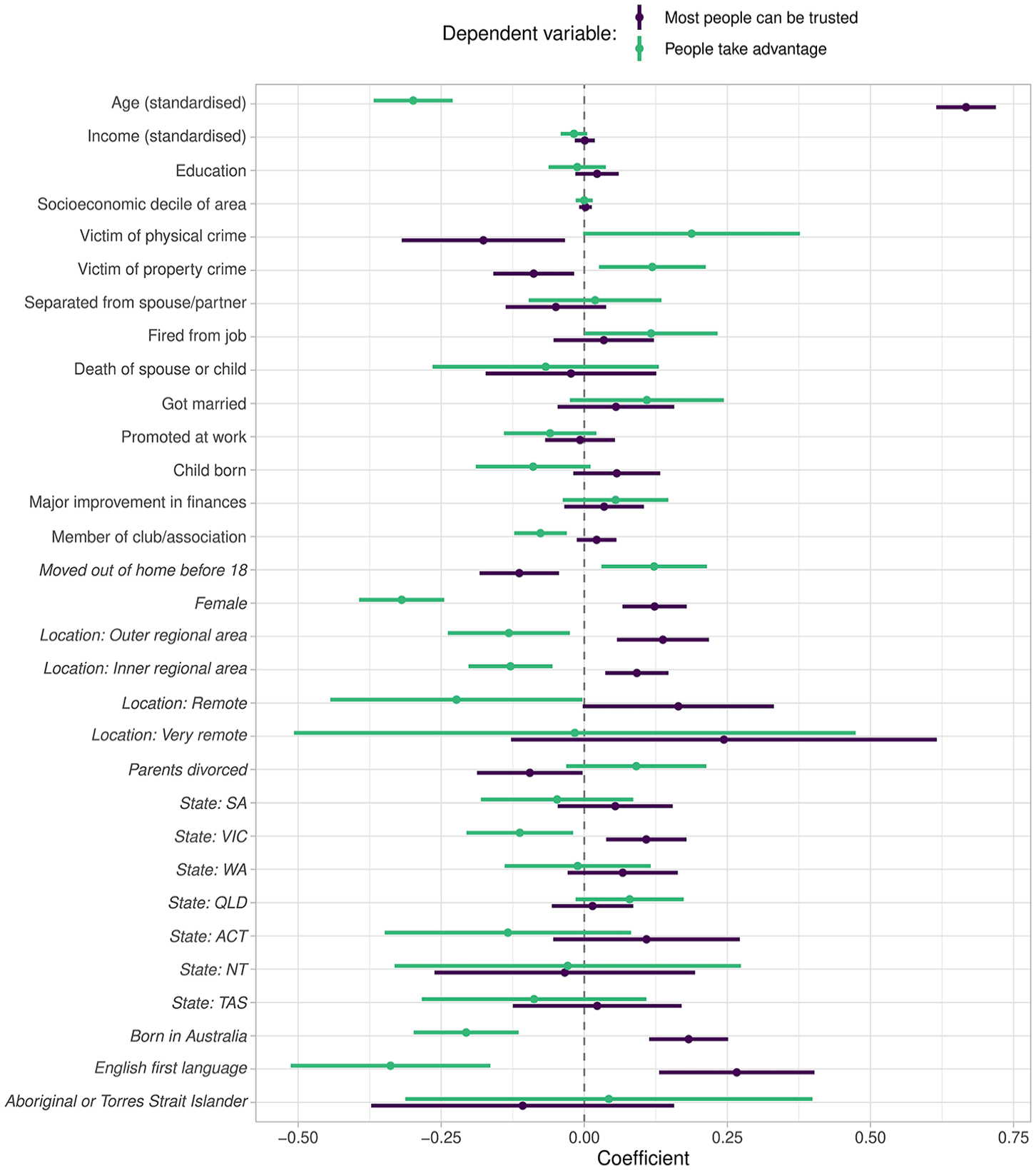
Results of Within–Between Models.
Adult-Life Malleability and Early-Life Malleability
I turned first to the question of adult-life malleability (H1). Can trust be altered by experiences during one’s adult life? The answer appears to be an unequivocal ‘yes’. In Figure 1, having experienced either physical or property crime in the previous 12 months reduces one’s belief that ‘most people can be trusted’, with physical crime having the larger effect. Experiencing property crime was also associated with a greater likelihood of believing that ‘people would take advantage of you if they got a chance’. As noted above, a higher score on that measure indicates lower trust. Both forms of crime are thus linked to reduced trust, which contradicts Bauer’s (2015) finding that crime had no consistent negative effect on trust. Being fired was associated with an increased belief that ‘people take advantage’, consistent with Laurence (2015), while becoming a member of a club was linked to a reduced belief in this, which is consistent with Putnam (2000) and previous Australian findings from the study by Brown et al. (2014). It seems clear that generalised trust can be affected by adult experiences, which supports H1.
There is also evidence that trust can be affected by early-life experiences (H2). Being born in Australia and having English as one’s first language were linked to higher trust in both models. The exact reasons for this are beyond the scope of this article but it is consistent with earlier work which shows that ethnic majority members tend to report higher generalised trust (Alesina and La Ferrara, 2002), although being Aboriginal or Torres Strait Islander had no statistically significant effect. Moving out of home before the age of 18 also had an effect in both models, which likely reflects the extent to which one was raised in a stable and nurturing environment; children from unstable homes are probably likely to move out at an earlier age. Having divorced parents was linked to reduced belief that ‘most people can be trusted’, confirming Viitanen’s (2014) findings, and if we consider being born female an ‘early-life’ experience, this too was linked to higher trust in both models. Location – both state and type of area – also seems to matter. Victoria is linked to higher trust and being from an inner or outer regional area, as opposed to a major city, is also linked to higher trust. It seems clear that several of these early-life factors do have an impact on generalised trust, which supports H2. Finally, almost all of these findings – both for adult-life and early-life malleability – still hold even after broadening the sample to include all individuals rather than just those who were observed in all seven survey waves. These results are shown in Table A3 in Supplemental Appendix B and confirm that the results are not significantly affected by attrition between waves.
Although Figure 1 is fully consistent with both H1 and H2, it arguably presents a more compelling test of H1. This is because the time-varying experiential factors are tested in the ‘within’ part of the model, which controls for all observed or unobserved time-constant variables, while the time-constant cultural factors are tested using the ‘between’ estimator, which does not control for this (Wooldridge, 2009). That means that H2 is subject to a less rigorous test because there is a possibility that unobserved time-constant factors are acting as confounders. Readers may therefore wish to interpret Figure 1 as somewhat stronger evidence for H1 than H2. Nevertheless, as a robustness check I replicated Figure 1 in Supplemental Appendix C using ‘between’ estimation for both cultural and experiential variables. The results are mostly the same, which strengthens our conviction that the Figure 1 results are not merely a result of an empirical approach that unduly favours the cultural theory. I also noted that any confounding in the ‘between’ estimation is likely to involve factors related to culture and upbringing, which would arguably still serve as evidence for the cultural theory. 8
Persistence
To test the ‘persistence’ hypothesis (H3), I generated a series of within–between models with lagged ‘experience’ variables. The results are displayed in Figure 2 and allow us to see how long the effect of each experience lasts. Each time period was generated using separate models, so the coefficient estimates for t were all taken from one model, those from t + 1 from another model, and so on. All of the time-constant and control variables from Figure 1 were also included in the models, although they are not displayed here. The results indicate that for the most part, the effects of the experiences found above do not persist over time, which supports H3. Consider physical crime, which had the largest effect of any of the experiences identified in Figure 1. In Figure 2, we can see that this effect again – the effect in the ‘most people can be trusted’ model at time t is still negative and significant. However, at t + 1, when we examine trust one wave after the crime occurred, there is no longer any significant effect, nor at t + 2. While a negative effect reappears at t + 3, it disappears again at t + 4 and t + 5. It would be difficult to claim, based on these findings, that physical crime generates a persistent negative effect on trust. The negative effect of property crime is not persistent either, and disappears for both models as soon as we move one wave into the future at t + 1. The same is true for being a member of a club and being fired from one’s job – these effects disappear as soon as we move one wave into the future.
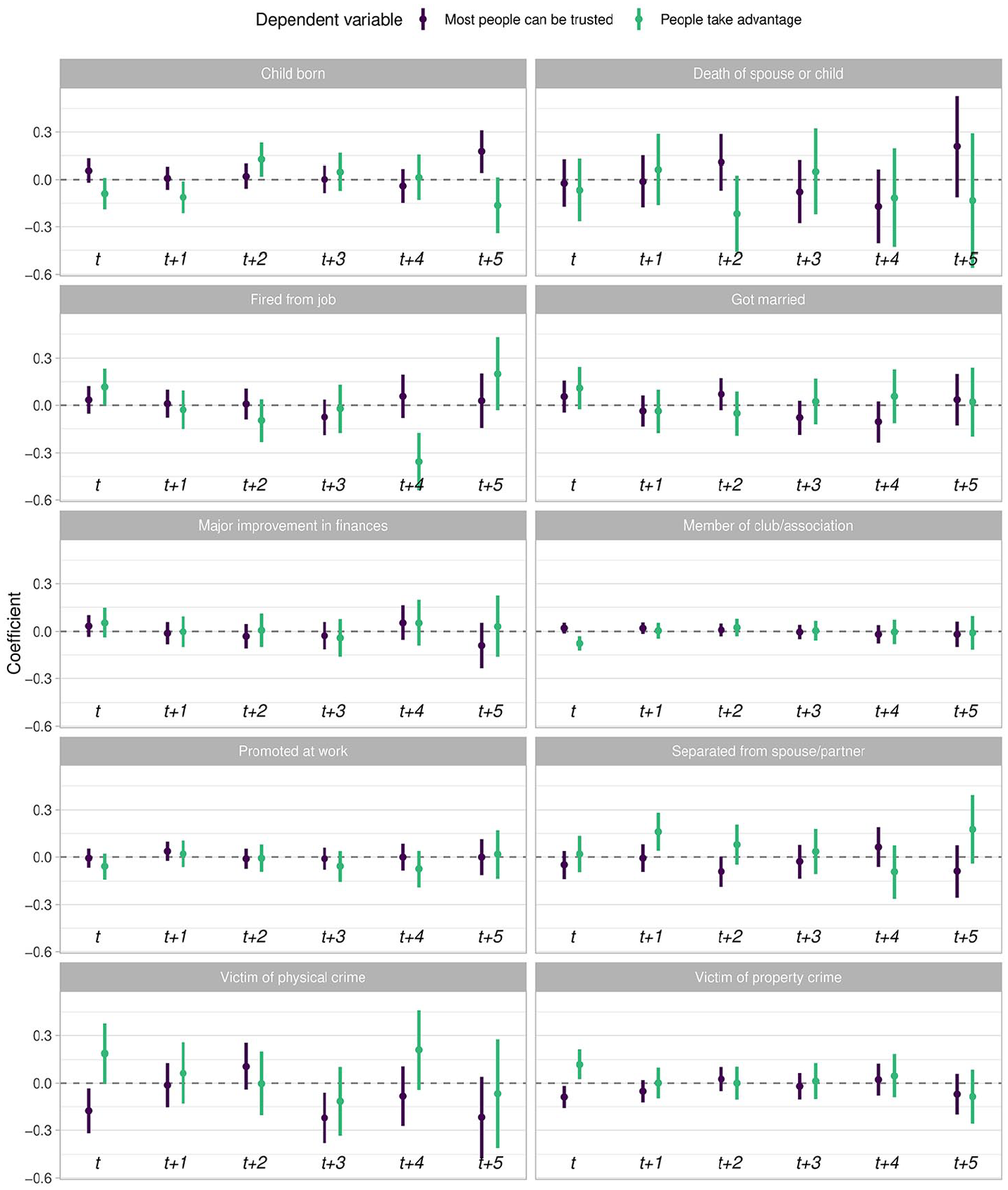
Effect of Experiences on Trust Over Time.
One interesting result from Figure 2 is that some experiences seem to have a ‘delayed’ effect on trust. Getting separated from one’s spouse or partner does not have any effect initially, but by the following wave (t + 1) it is associated with lower trust in the ‘take advantage’ model. Similarly, while the birth of a child has no effect initially, by t + 2 it is associated with lower trust in the ‘take advantage’ model. But once again neither of these effects are persistent, and in fact by t + 5 the birth of a child is associated with higher belief that ‘most people can be trusted’. This is consistent with the study by Stavrova et al. (2022) even though the effect takes several waves to appear. The reasons for this trend are unclear but it may reflect changing levels of stress upon parents as the demands of parenting a young child give way to a more hands-off approach with older children. In general, though, the experiences which affected trust in the section ‘Adult-life malleability and early-life malleability’ do not continue to exert an effect in subsequent survey periods, which is consistent with H3.
Specificity
We can test the specificity hypothesis (H4) using the results already presented in Figures 1 and 2. Recall that high specificity means that only very few adult experiences are capable of altering trust, such as the ‘extreme events and traumatic experiences’ referred to by Wu et al. (2022). However, the results presented above seem to indicate that specificity is actually fairly low – a relatively broad range of experiences seem to affect trust. Of the 10 experiences tested, 4 of them had an effect on trust in Figure 1, while 2 others – the birth of a child and getting separated – seem to generate delayed effects in Figure 2. While 10 experiences is perhaps too small a sample to draw conclusions about the exact percentage of experiences that could affect trust, it seems clear that trust-affecting events are not limited to ‘extreme events and traumatic experiences’. On the contrary, a wide range of experiences seem to have this ability. It is also difficult to discern any kind of trend among the experiences that affected trust compared to those that did not. Both negative (crime victimisation, separation, being fired) and positive (club membership, birth of a child) experiences affected trust in Figures 1 and 2, and the experiences that had no effect on trust (marriage, being promoted, death of spouse or child, major financial improvement) also range from very positive to extremely negative. It is commonly claimed that trust is ‘hard to construct but easy to destroy’ (Levi, 1996: 6), but that statement finds little support here: positive experiences seem to increase trust just as readily as negative experiences reduce it. Furthermore, trust-affecting experiences can be connected to crime (both physical and property-related), family (separation and birth of a child), and work (being fired). Specificity, then, appears to be quite low. Lots of different experiences, both positive and negative and spanning different domains of life, all seem to have the ability to affect trust. These results therefore support H4.
Stability
The stability hypothesis (H5) suggested trust would exhibit high rank-order stability but lower mean-level stability. I test rank-order stability by first generating a series of random effects panel models with current trust as the outcome and lagged trust variables as the predictors. 9 If rank-order stability is low, then past trust should be strongly associated with present trust: this would mean that few people are experiencing the kinds of changes in trust that would alter their trust ‘ranking’ relative to others. The results are displayed in Figure 3. Each lagged trust variable was run in a separate model so that the effect of more recent lags would not ‘soak up’ the effect from earlier lags.
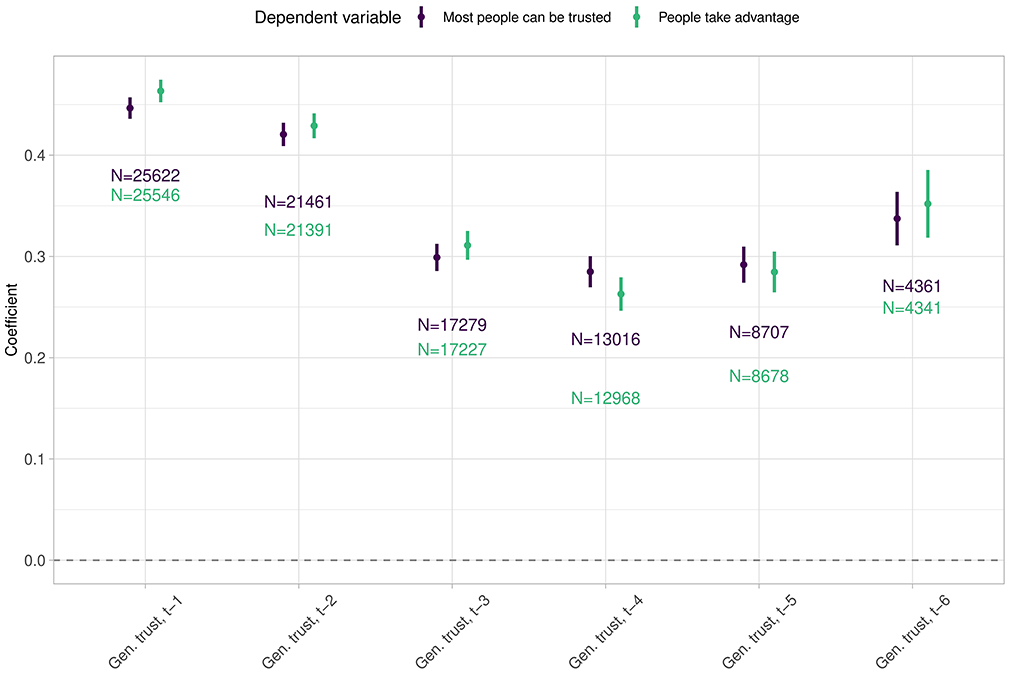
Effect of Previous Trust on Present Trust.
The results in Figure 3 provide strong support for the idea that trust exhibits rank-order stability. Each of the lagged trust variables has a very strong and statistically significant link with generalised trust in the current period. As might be expected, the link gets somewhat weaker as the lagged variable moves further back in time, but the t–6 lagged trust variable still shows a very strong and significant link to current trust. Since that variable essentially represents the association between trust in waves 18 and 5, which took place 6 time periods and 13 years apart, this indicates that a person’s generalised trust is strongly linked to their trust levels more than a decade ago. The size of the coefficients is also quite remarkable. The two trust measures at t–6 shows a coefficient of around 0.35, which is larger than any other predictor shown in Figure 1 or 2 except for age. Although experiences do affect trust, the effect of one’s own previous levels of trust seems to have a much stronger effect. This remained true when limiting the sample to only observations from Wave 18 so that the sample size is held constant across the different lags, which is shown in Supplemental Appendix D.
For a second test of rank-order stability, I used Spearman’s rank correlation coefficient (‘rho’) to determine the degree of rank-order stability between individuals’ trust levels in different survey waves. This follows work in personality psychology which typically uses correlation coefficients to measure the stability of personality traits over time (Damian et al., 2019). The results are presented in Table 2 and show, consistent with Figure 3, that trust is strongly correlated across time and the magnitude of the correlation generally grows stronger as the temporal distance decreases. This strengthens our confidence that generalised trust exhibits substantial rank-order stability over time.
Spearman’s Rank-Order Correlation Coefficients for Trust in Different Waves.
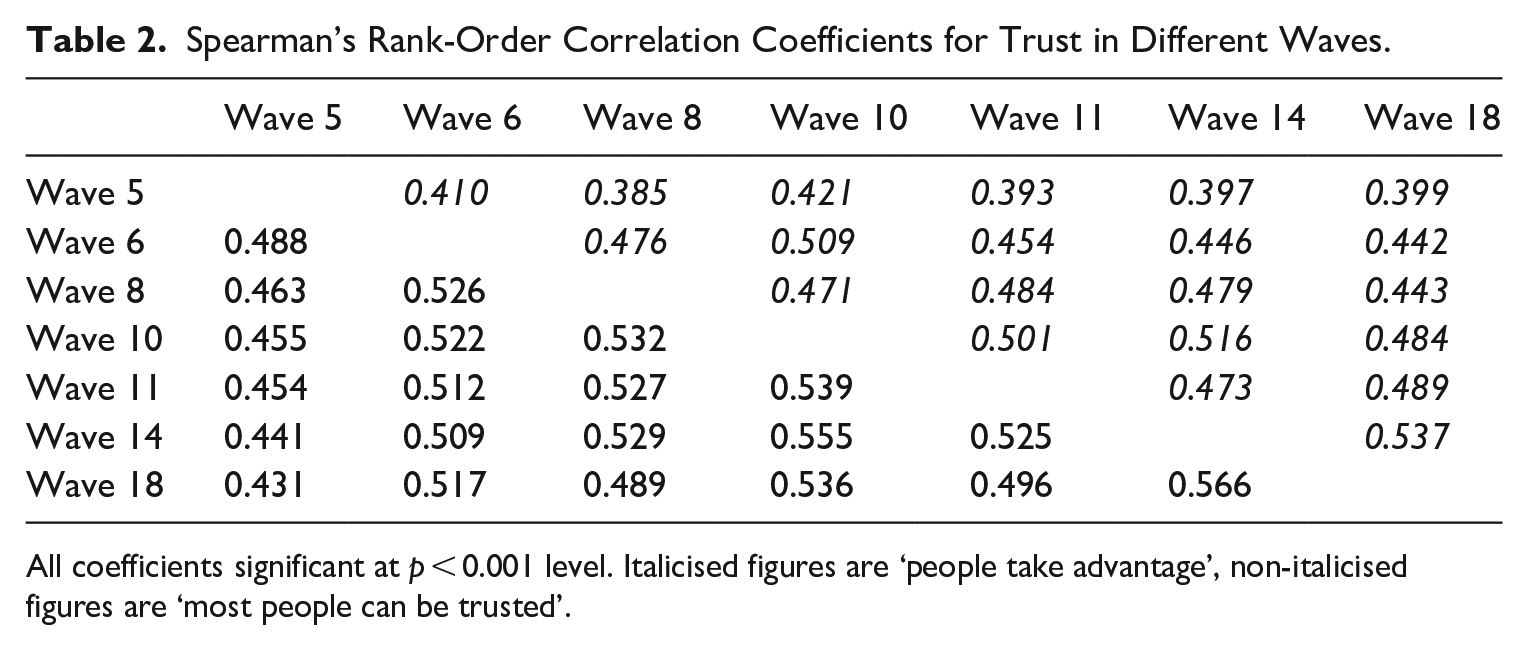
All coefficients significant at p < 0.001 level. Italicised figures are ‘people take advantage’, non-italicised figures are ‘most people can be trusted’.
I also present two tests for mean-level stability. First, we can look once again at Figure 1. In Figure 1 – and in fact every single other model used in this article – age is linked to generalised trust at a high level of statistical significance (p < 0.001). The effect sizes are also relatively large. Older people appear to be more trusting, a finding consistent with several previous studies (Kong, 2016; Li and Fung, 2013), and additional work has demonstrated that this arises partly because of the ageing process itself and is not simply due to cohort or period effects (Clark and Eisenstein, 2013). If this is indeed the case, then it would be difficult to claim that generalised trust exhibits mean-level stability. Trust levels will increase as people age, such that the mean trust score for any cohort will steadily rise over time.
As a second test of mean-level stability, I examined mean trust scores for each wave, limiting the sample to people who were present in all waves. If trust really does increase with age, then each wave should have a higher mean trust score than the last, because each person in the sample is now older. The results (shown in Figure 4) bear this out. It therefore seems clear that mean-level stability is actually quite low: in just the 13 years from Wave 5 to Wave 18, belief that ‘most people can be trusted’ rises monotonically from 4.47 to 5.15 (out of 7), while belief that ‘people take advantage’ is non-monotonic but still decreases from 3.4 to 3.11 over the 13-year period. The overall picture for the stability criterion is therefore mixed. Trust appears to show significant rank-order stability, which is consistent with previous findings by Stolle and Hooghe (2004). On the contrary, trust appears to rise with age which makes it difficult to claim that mean-level stability exists. These results are consistent with H5.
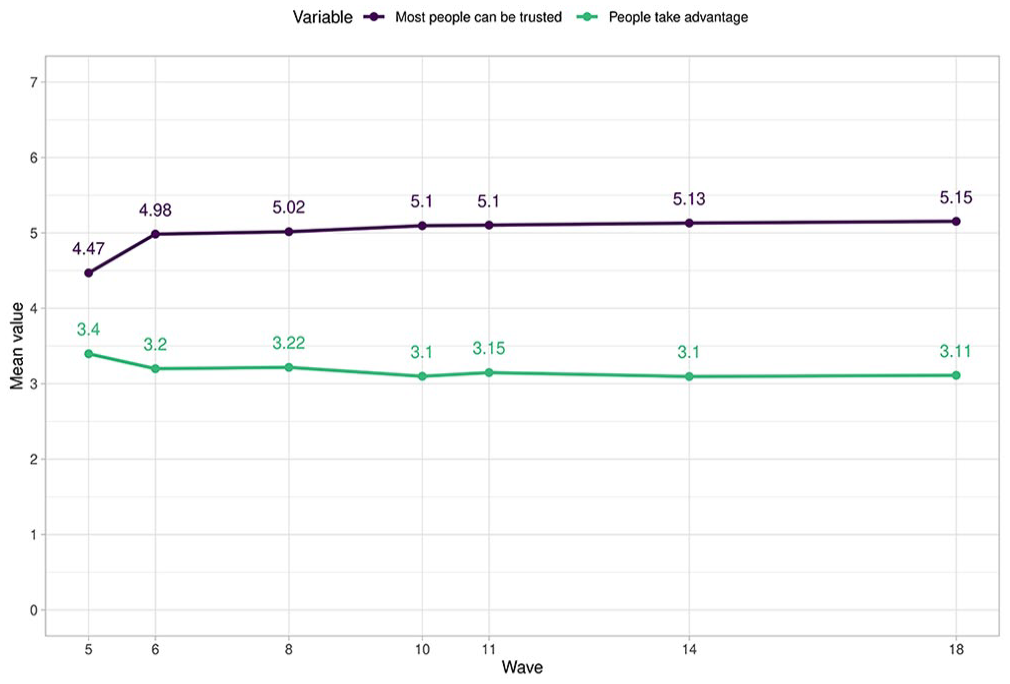
Mean Trust Scores as Panel Increases in Age.
Discussion
Studies of generalised trust typically explain its origins using one of two approaches – the ‘experiential’ theory, which holds that trust is a changeable product of experiences which occur throughout a lifetime, or the ‘cultural’ theory, which argues that it is a stable personality trait determined by factors associated with one’s upbringing. But previous research has tested these theories using a variety of different criteria, which are not necessarily comparable with each other. This article, by contrast, has explicitly identified five of those criteria and proposed specific hypotheses for each of them. The empirical findings mostly align with those hypotheses. Trust is clearly affected by both adult experiences and early-life factors, with being a victim of physical crime generating a particularly strong negative effect, although the risk of confounding in the ‘between’ estimation means that the test for the cultural factors is not as rigorous as for the experiential ones. However, with the possible exception of separation from one’s spouse or partner, the impact of adult experiences does not usually last. A relatively wide range of experiences seem to affect trust, and while trust seems to show a fair degree of rank-order stability, the evidence that it rises with age means that mean-level stability is much lower. Trying to argue that these results support one theory over the other would be difficult, as it would require the elevation of certain criteria for arbitrary reasons. Could we argue, for example, that these findings actually support the cultural theory? After all, the largest coefficient sizes in Figure 1 tended to be from cultural factors. But that would require choosing a specific criterion – for example, early-life malleability – and claiming that this is the ‘correct’ criterion to apply. Such a choice would of course be arbitrary.
Instead, these results seem to confirm the expectation that both theories are broadly correct. This is consistent with previous research which, in combination, has already provided evidence for both theories, while Dinesen and Sønderskov (2018) already suggested that trust is likely shaped by both cultural factors and adult experiences. But this article has taken a particularly novel approach. As noted above, testing only one criterion can lead to ambiguous results: for example, high stability is often argued to be supportive of the cultural theory, but it is also fully consistent with the experiential theory if specificity is high (see section ‘Different criteria, different results?’). But since I tested all five criteria, we can see that specificity is in fact not high, and therefore we are forced to conclude that the finding of high rank-order stability supports the cultural theory. Testing all the criteria at once helps to avoid the kind of ambiguity where a given result can be consistent with either theory. Since we now know that the stability finding acts as evidence specifically for the cultural theory, this (in conjunction with evidence for the experiential theory from elsewhere in the article) supports the conjecture that both theories are correct. This interpretation would also be consistent with work on the ‘active updating’ of individual attitudes: Kiley and Vaisey (2020: 501–504) find that generalised trust shows mild evidence of updating, although nowhere near as much as some other attitudes such as religious attendance and certain political views. This suggests that trust is somewhere in the middle of the pack in terms of stability rather than falling firmly into either an ‘active updating’ or ‘settled dispositions’ model.
This article makes several contributions. First, as noted above, this is the first article to have identified the distinct criteria of ‘adult-life malleability’, ‘early-life malleability’, ‘persistence’, ‘specificity’ and ‘stability’ with regard to generalised trust. It is also the first article to propose and test hypotheses for each of these criteria at once. Previous studies have only tested these criteria in isolation or, at most, two at a time, and testing all five at once gives us a much more well-rounded picture of generalised trust and helps prevent the kind of ambiguity where a finding can be portrayed as consistent with either theory. This article is arguably also one of the ‘broadest’ studies of generalised trust ever conducted. As noted above, most studies of generalised trust go ‘narrow’, testing the impact of one particular type of experience, such as crime (Bauer, 2015) or parenthood (Stavrova et al., 2022), and often examine only one criterion, such as adult-life malleability. This article, by contrast, examines the effect of 10 different experiences on two measures of trust across five criteria, using a very large and long-running panel data set. A ‘broad’ study like this one can hopefully complement the valuable ‘narrow’ work which has already been conducted about generalised trust. Finally, this is also the first study of generalised trust to test both its rank-order and mean-level stability. The idea that trust exhibits high rank-order but low mean-level stability has never, to my knowledge, been tested or even suggested before.
These findings also have broader implications for political science and international relations. As noted above, scholars of political behaviour have shown considerable interest in the changeability of variables such as immigration attitudes (Kustov et al., 2021), affective polarisation (Levendusky, 2018) and voting intentions (Grynberg et al., 2020). But although Levendusky (2018) found that affective polarisation can be reduced by highlighting shared national identity – an example of ‘adult-life malleability’ – it is unclear whether this change will show ‘persistence’, or whether other interventions will have the same effect (‘specificity’). Future studies may therefore benefit from distinguishing between the five criteria introduced in this article. For political science more generally, the finding that adult experiences do not have lasting effects on trust should make us pessimistic about interventions which aim to (for instance) strengthen democracy or improve intergroup relations by raising social trust. And from a methodological standpoint, the lack of persistent effects on trust reduces the risk of confounding when trust is included as a predictor for other outcomes, such as democratic support and confidence (Jamal and Nooruddin, 2010; Newton and Zmerli, 2011)
There are also some limitations. One of these is the possibility that some of the ‘cultural’ variables included in the models above may instead proxy for unobserved adult life experiences. If being born in Australia is linked to higher trust, can we be certain that this is the result of early-life factors rather than subsequent positive experiences as an adult? This seems possible, although I contend that the inclusion of the controls for age, sex, income and education makes it unlikely. For instance, if people not born in Australia are less trusting because of discrimination they experience as an adult, this discrimination is also likely to be reflected in their levels of income or education, leaving little residual effect to be captured by the ‘born in Australia’ variable or the other ‘cultural’ variables. It is also possible that the generalisability of these results might be limited because of the Australian data, although this would of course be the case for any single-country study of generalised trust. For example, the results in Figure 1 suggest that being fired from one’s job reduces trust, but Laurence (2015) highlights that the extent to which job displacement affects trust depends on the degree of ‘work centrality’, that is, the degree to which one’s job forms a core part of their identity. It could be that the effect from being fired merely reflects a high degree of work centrality in Australia, and losing one’s job may have a less pronounced effect in other countries. Another limitation is that differences in group sizes could lead to differential estimation bias across variables: for instance, far fewer people were the victim of physical crime, or experienced the death of a spouse or child, compared to other experiences (see Supplemental Appendix A). This might inflate the standard errors and underestimate the significance levels of those variables. But since there is evidence for adult-life malleability anyway, finding that additional adult experiences are also significant would not change the overall findings of the article.
Because of the large number of experiences and early-life factors and wide range of criteria being tested, these results offer perhaps the clearest indication yet that both the cultural and experiential theories are broadly correct. Future researchers may therefore wish to move beyond the cultural–experiential dichotomy, which at times even implies that the two theories are mutually exclusive (Thomsen et al., 2021). Following the example of personality psychology may be instructive in this case. Twenty years ago, psychologists debated whether personality traits were ‘set like plaster’ early in life, or whether personality is ‘contextual’ and can change during adulthood (Srivastava et al., 2003: 1042), which clearly parallels the current debate about generalised trust. But personality psychology soon dispensed with this dichotomy, seemingly in view of the numerous complexities and ‘inconsistencies’ between different studies of personality change (Costa et al., 2019). Instead, more recent studies of personality change are nuanced, distinguishing between different aspects of personality and different senses of ‘change’. Discussion of the psychology literature by Damian et al. (2019) acknowledges certain life events may change personality – for example, transitioning to one’s first romantic relationship increases extroversion and reduces neuroticism – but also that it remains unclear whether these changes accumulate over time or dissipate as the individual returns to a personality baseline or ‘set point’ (Damian et al., 2019: 676–677). And unlike trust researchers, personality psychologists have devoted considerable effort to untangling the mean-level and rank-order stability of personality traits (Costa et al., 2019; Damian et al., 2019; Roberts et al., 2006). Recent studies of personality no longer attempt to fit their findings neatly into either the ‘plaster’ or ‘contextual’ theories.
We would be wise to follow this lead and develop a more nuanced approach to generalised trust. For instance, instead of simply aiming to prove whether the ‘cultural’ or ‘experiential’ theory is more accurate, it would perhaps be more productive to examine what kinds of experiences might yield trust changes (specificity) or how long these changes last (persistence). We could also look to an alternative model to explain patterns of trust, such as the ‘life course adaption model’ (LCAM), which acknowledges that ‘early life imprinting has an enduring effect’ but also that ‘experiences can move individuals’ personal culture in new directions’ (Lersch, 2023). The fact that trust rises with age means that trust should exhibit long-term trends, even if adult experiences do not appear to cause persistent changes in trust. It seems increasingly clear that both the cultural and experiential theories are broadly correct, but we are still in the early stages of gathering evidence on these more specific questions. For instance, future researchers might wish to determine whether any experiences are capable of yielding a persistent change in trust which is still visible years or decades later. There was little evidence for that in this article, but this does not preclude the possibility that some type of experience not tested here might have such an effect. There is still much to learn about how adult experiences and early-life factors affect generalised trust.
Supplemental Material
sj-docx-1-psx-10.1177_00323217231224971 – Supplemental material for Take Five? Testing the Cultural and Experiential Theories of Generalised Trust Against Five Criteria
Supplemental material, sj-docx-1-psx-10.1177_00323217231224971 for Take Five? Testing the Cultural and Experiential Theories of Generalised Trust Against Five Criteria by Michael Kumove in Political Studies
Footnotes
Acknowledgements
I am grateful to all the attendees at the VIP and EVPOC seminars at NTNU for their feedback and comments, particularly Henning Finseraas, Sina Özdemir, Karin Dyrstad, Charles Butcher, Dilan Gunes and Pieter De Wilde. I also thank the anonymous reviewers whose feedback substantially improved the article.
Declaration of Conflicting Interests
The author(s) declared no potential conflicts of interest with respect to the research, authorship, and/or publication of this article.
Funding
The author(s) disclosed receipt of the following financial support for the research, authorship, and/or publication of this article: This research was supported by funding from the Australian Government Research Training Program and Research Council of Norway.

Supplemental Material
Additional Supplementary Information may be found with the online version of this article.
Table A1: Descriptive Statistics for Ordinal and Continuous Variables. Table A2: Descriptive Statistics for Binary Variables. Table A3: Full Tables for Within–Between Models From Figure 1, Plus Models With all Respondents. Table A4: Full Tables for Models From Figure 2, ‘Most people can be trusted’. Table A5: Full Tables for Models From Figure 2, ‘People take advantage’. Table A6: Full Models for ‘most people can be trusted’ From Figure 3. Table A7: Full Models for ‘people take advantage’ From Figure 3. Figure A1: Random Effects Models. ‘Most people can be trusted’ model n = 4503, N = 29,795. ‘People take advantage’ Model n = 4503, N = 29,746. Italicised coefficients from ‘between’ part of model, non-italicised from ‘within’ part. Figure A2: Effect of Past Trust on Present Trust. N for ‘most people can be trusted’ model = 4361. N for ‘people take advantage’ model n = 4350.
Notes
Author Biography
References
Supplementary Material
Please find the following supplemental material available below.
For Open Access articles published under a Creative Commons License, all supplemental material carries the same license as the article it is associated with.
For non-Open Access articles published, all supplemental material carries a non-exclusive license, and permission requests for re-use of supplemental material or any part of supplemental material shall be sent directly to the copyright owner as specified in the copyright notice associated with the article.
