



Abstract
Activists play a key role in the process of democratic transition and consolidation. How is their activism affected by democratic reforms? We study how local activism in England and Wales responded to the changes in representation introduced by the Great Reform Act of 1832. This reform reduced parliamentary representation in some areas and increased it in others. We exploit exogenous variation in which areas lost and gained representation and measure activism using the number of petitions each area sent to parliament. We find that petitioning increased in areas that gained representation, partly because of greater civil society mobilization, while petitioning fell in areas that lost representation. This shows that pro-democratic reforms can promote political activism, while anti-democratic reforms can decrease it. In the specific case of England and Wales, positive feedback between activism and reform helped make democratization a path-dependent process with the Great Reform Act its critical juncture.
Keywords
Introduction
How do democratic institutions affect political participation? This is important to know when examining the potential consequences of democratic reforms. Consider, for instance, the effect of these reforms on political activism. 1 Political activists often play a key role in the process of democratic transition and consolidation, and are seen as particularly important during and just after a transition, when they can pressure leaders into introducing more ambitious reforms. 2 They can also ensure that democracy survives by helping defeat any threats against it. 3 While the effect of activism on democratization is well documented, whether democratic reforms affect activism remains an open question. 4
Can a democratic reform lead to a deepening of political participation at the mass level? This question is difficult to answer using data from recent democratic transitions: these have simultaneously introduced a large number of changes and have often led to a new government taking office (Huntington, 1991). This makes it difficult to identify the effect of any particular reform. 5 Furthermore, as these transitions produce uniform institutional change within each country, research must rely on variation across countries. This presents a challenge because of the large number of factors that vary at this level of aggregation. In contrast, many of the 19th-century Western European reforms were gradual, introducing only a few elements of democracy at each step of the process (Congleton, 2007, 2011; North, 1990). In many cases, including that of the Great Reform Act of 1832, there was also substantial within-country spatial variation in the reforms.
This article examines how the changes in parliamentary representation introduced by the Great Reform Act affected activism, an important form of political participation. 6 This act was the first of the 19th-century electoral reforms in England and Wales, and is often credited with setting in motion their path-dependent transition to full democracy. Although the franchise dimension of the reform has received considerable attention (e.g., Acemoglu & Robinson, 2000; Ansell & Samuels, 2015; Boix, 2015; Lizzeri & Persico, 2004), this only resulted in a small increase in the number of voters (Fresh, 2024; Salmon, 2009): from around 461 thousand to approximately 643 thousand (Aidt & Franck, 2025). 7 The more significant change was in parliamentary representation, understood as the right of an area to elect a member of parliament (MP). 8 The Great Reform Act increased the representation of heavily populated areas, while areas that had declined in importance lost some or all of their parliamentary representation. The reform was pro-democratic in that it improved the connection between an area’s population size and the amount of representation it had. 9
There are good theoretical reasons to expect that changes in representation will affect activism. Political agency theory shows that an elected representative will be responsive to the concerns of his constituents because this will increase his chances of winning re-election (e.g., Besley, 2007). 10 Furthermore, MPs in 19th-century England often viewed themselves as representing everyone in their constituency, whether enfranchised or not (Schonhardt-Bailey, 2006). 11 In this way, the representative was accountable, motivated by either his goal of gaining and maintaining the support of his constituents (Truex, 2017) or by his perceived duty as an MP. 12 In turn, the political opportunity structure framework (Gleditsch & Ruggeri, 2010; McAdam, 1982; Tarrow, 1989) suggests that individuals will find it worthwhile to engage in activism when there is a representative they can target: the costs are lower (i.e., individuals know who to target) and the expected benefits are higher (i.e., the presence of a representative makes a positive response more likely). From this, it follows that ceteris paribus, residents of areas with representation should have engaged more in activism, while those who lived in areas without representation should have engaged less.
We measure political activism using the number of petitions sent to the House of Commons by residents of each constituency. 13 Petitions were the main formal channel through which disenfranchised individuals could communicate their views to the government, and they were widely used to try to influence policy (Huzzey & Miller, 2020; Knights, 2009; Miller, 2023). 14 Unlike voting, the right to submit a petition was open to all British subjects, whether enfranchised or not. Accordingly, if changes in representation had an effect on political activism, we would expect to see this reflected in the number of petitions sent to parliament. 15 Measuring activism in this way has an additional advantage: all petitions sent to parliament were recorded in the Journal of the House of Commons, and so we have information on the complete universe of petitions that were sent. This helps us avoid the selection problems associated with the use of event catalogs that collect information from news sources.
We estimate difference-in-differences specifications where the treatment group is made up of either borough constituencies that gained representation or constituencies that lost their representation. The control groups are made up of similar constituencies that did not experience these changes. The politicians who designed the reform employed clear thresholds to determine whether an area would gain or lose MPs; these were based on measures of population, number of houses, and taxes paid that pre-dated the reform process. These thresholds allow us to allocate constituencies to treatment and control groups in a way that is plausibly exogenous to petitioning.
Our main finding is that representation and petitioning were complements. Constituencies that gained borough representation for the first time petitioned 48% more than they would have done if they had not gained borough representation. This average treatment effect is statistically significant and large in magnitude. We also find that constituencies that lost all borough representation petitioned 26% less than they would have done if they had not lost all their borough seats. This average treatment effect is again large and statistically significant.
We examine two mechanisms that can help explain the link between representation and petitioning. First, we find that the fall in petitioning that followed the loss of representation was driven by areas where MPs had previously been accountable to local voters. In areas where MPs had been under the control of local elites (patrons), the loss of representation did not affect petitioning. This suggests that petitioning was motivated, at least in part, by the expectation that petitions would influence local MPs, which is consistent with the political opportunity structure framework. Second, the increase in petitioning in areas that gained representation was associated with greater mobilization by civil society and business groups. This is consistent with the idea that representation lowered the relative costs of petitioning, benefiting civil society organizations and other groups that relied heavily on petitions. The article concludes by discussing and ruling out other mechanisms.
Contribution and Related Literature
Democratic Reform and Activism
Our work contributes to a growing empirical literature on how democratic reforms affect protest and activism. Finkel, Gehlbach, and Olsen (2015) show that there was a large increase in disturbances among former serfs following Russia’s Emancipation Reform of 1861. 16 Lacroix (2022) shows that the US Voting Rights Act of 1965 contributed to a reduction in political violence. Degrave, Lopez Peceño, and Rozenas (2023) show that areas of France where a larger fraction of men were enfranchised in 1831 had more local insurgencies after Louis-Napoleon Bonaparte’s 1851 coup d’etat. Our work differs in two important respects. First, it focuses on the role of parliamentary representation and investigates the mechanisms through which it affected activism. 17 Second, it focuses on petitions, which were an institutionalized form of activism. Prior work has mostly focused on non-institutionalized actions like rioting. 18
Our work is related to the large literature on what causes people to participate in activism. In particular, we contribute to the political opportunity structure literature (Gleditsch & Ruggeri, 2010; McAdam, 1982; Tarrow, 1989) by showing evidence that the expected response of MPs, as captured by our measure of accountability, had a significant effect on petitioning. We also show that increases in activism were, in part, driven by the response of civil society, a group that relied heavily on petitioning.
This article is also related to the literature on liberalizing elections (Howard & Roessler, 2006). This literature argues that elections in autocracies can sometimes deliver victory for the opposition and lead to a transition towards democracy. More recent work, including Beaulieu (2014) and Pop-Eleches and Robertson (2015), argues that whether elections lead to democratization or democratic erosion depends on contextual factors. Our contribution is to show that these results generalize beyond elections: increases in parliamentary representation can have a democratizing effect by increasing activism.
Finally, our results suggest that a partial democratic reform may be enough to set in motion a path-dependent process of democratization, with an initial reform promoting the activism that leads to further reforms in the future. This challenges the view, implicit in many existing accounts of democratization (e.g., Acemoglu & Robinson, 2000, 2001, 2006), that only large institutional reforms can have a lasting effect. We also describe a mechanism that can help explain the de Tocqueville paradox that regimes are most vulnerable just after a reform (de Tocqueville, 2011 [1856]; Finkel & Gehlbach, 2018): a reform can lead to an increase in activism, putting pressure on the regime to reform even more. 19
Democratic Backsliding
Our findings suggest that the erosion of some democratic rights can decrease activism, which in turn could make further anti-democratic reforms more likely. Consequently, an initial anti-democratic reform that reduces representation or accountability, for example by capturing elected representatives or gerrymandering electoral districts, could trigger a path-dependent process of democratic backsliding. Within the narrow corridor logic of Acemoglu and Robinson (2019), this would mean that the balance between the state and society breaks down, with the country starting to move towards autocracy. This mechanism can also account for the gradual nature of democratic backsliding (Haggard & Kaufman, 2021; Levitsky & Ziblatt, 2018).
Long 19th Century Reforms
Our study contributes to the growing literature on the consequences of the 19th and early 20th century electoral reforms in Europe (e.g., Berlinski & Dewan, 2011; Berlinski et al., 2014; Cox et al., 2023; Larcinese, 2024; Morgan-Collins, 2023). Most of the work on the Great Reform Act has focused on its enfranchisement dimension, even though in practice the increase in the number of voters was relatively small (Aidt & Franck, 2025; Salmon, 2009). 20 We focus instead on the redistribution of parliamentary seats. This was a more substantial change that, as we show, led to an increase in activism in the constituencies that gained representation. Several scholars have claimed that this activism led to more reform (e.g., Maehl, 1967), suggesting positive feedback between reform and activism. 21 This would make the Great Reform Act a critical juncture that helped set in motion a path-dependent process of democratization.
Petitioning
This article contributes to the growing literature on the role of petitions in different political systems. Carpenter (2016), Carpenter and Brossard (2019), and Nall and Carpenter (2018) show that social movements can use petition drives to recruit and mobilize political coalitions. Carpenter and Schneer (2015) show that the petition drive that followed Andrew Jackson’s removal of public deposits from the Bank of the United States in 1833 helped shape the emergence of the Whig party. Carpenter and Moore (2014) show that the canvassing for antislavery petitions conferred on women skills and contacts that enabled their future activism for other causes, including women’s suffrage (Teele, 2018). In his seminal book on petitions, Carpenter (2021) argues that petitions were instrumental in giving a voice to politically marginalized groups, and shows evidence for this drawn from a variety of settings and time periods. His book also studies how governments respond to petitions, showing that petitions were an instrument through which petitioners helped shape democracy. 22 Goehring & Hanlon (2025) show that petitions influenced MPs to support women's enfranchisement in Britain. In contrast to this work, our contribution is to show that petitioning itself can be shaped by the reform of existing institutions. In this way, our work is closely related to Skorge (2023). He uses a difference-in-differences strategy to show that a move from plurality to proportional representation in Norway decreased gender inequality in voting.
In the context of 19th-century Britain, Knights (2009) emphasizes that voting and petitioning co-existed, while Miller (2023) shows that members of parliament accepted that everyone had the right to representation through the use of petitions. Our results show that this right was exercised to a greater degree when individuals lived in areas with more formal parliamentary representation. Huzzey and Miller (2020) show that petitioning increased in the aftermath of the Great Reform Act. We go further and show that the reforms, in particular the changes in parliamentary representation, had a causal effect on petitioning.
Historical Background
The Great Reform Act
The Great Reform Act of 1832 was the first large reform of the English and Welsh electoral system in several hundred years. 23 Two (main) types of constituencies governed the election of MPs to the House of Commons: county constituencies that together covered the complete territory of England and Wales, and borough constituencies that covered only some of this territory. 24 Although all areas had representation through county MPs, not all areas had representation through borough MPs. 25 The electoral rules at the time, which mostly dated from the Middle Ages, were out of sync with the new economic geography created by the Indutrial Revolution. Some areas with borough representation had lost population and had very few voters left. Meanwhile, the new industrial cities like Manchester, Birmingham, and Leeds, had no borough representation in parliament.
The struggle for parliamentary reform began in the 1790’s and took off after the Peterloo massacre of 1819. In November 1830, Lord Grey of the pro-reform Whig party unexpectedly became prime minister, and with this the reform movement gained considerable momentum. 26 The final version of the Reform Act was passed two years later in 1832. It had two key dimensions. First, it updated the rules that determined who could vote, resulting in a modest increase in the total number of voters from around 462,000 to 643,000. Second, it eliminated 56 small borough constituencies, while giving representation to 42 new borough constituencies that were created in areas that had recently experienced substantial population growth. 27
The initial draft of the Act used population to determine which constituencies would lose or gain seats. This plan proved problematic because the boundaries of many of the small constituencies were uncertain and not recorded appropriately in the 1821 census. In order to avoid the political hijacking of the reform, the government asked the chair of the Boundary Commission, the civil servant Thomas Drummond, to design a rule that would “scientifically” determine the relative importance of each constituency (Robson, 2014). Drummond gave each borough constituency a score based on the number of houses within its boundaries and the assessed taxes paid on those houses in 1831. The 120 constituencies with the lowest scores went into what we call the Drummond list; these were the constituencies at risk of losing their parliamentary seats. The final version of the Act stipulated that the 56 lowest-ranking constituencies on the list would lose all their seats (these constituencies were in what was called Schedule A), the following 30 would lose only one of their two seats (Schedule B), while the remaining 34 would keep both of their seats. Furthermore, 42 areas in England and Wales with a population of more than 10,000 gained borough representation for the first time (Schedules C and D). The size of parliament worked as a soft constraint, meaning that, to a large extent, seats were redistributed rather than created. 28 Spychal (2024)’s detailed analysis shows that the use of the Drummond list minimized the role of politics in the reform: the allocation of boroughs to Schedules A and B was largely based on objective criteria. 29
Petitions
Petitioning was widespread in 19th-century Britain. Petitions were addressed to parliament, and once one arrived, they were recorded and set on a table for MPs to examine (Leys, 1955). 30 Any MP could pick up any petition and use it to start a debate, create publicity around an issue, or as “a stick for use in lobbying, private interviews, press campaigns, etc.” (Fraser, 1961). 31 The number of petitions on a topic and the number of signatures on these petitions were often seen as measures of popular opinion. Sometimes MPs compared the number of signatures on petitions in favor and against a particular bill (Huzzey & Miller, 2020). 32
The consensus in the historiographical literature is that MPs took petitions very seriously. 33 To verify this, we took all the parliamentary debates in 1828 and checked the frequency with which petitions were discussed. We found that at least 29.8% of the words spoken in the Commons in 1828 were linked to debates where petitions were presented or mentioned. Furthermore, on 64% of the days in which parliament sat in 1828, an MP brought up a petition in the course of a debate. Section B of the Supplemental Appendix details these calculations and provides examples of how MPs used petitions.
Most Common Petition Topics.
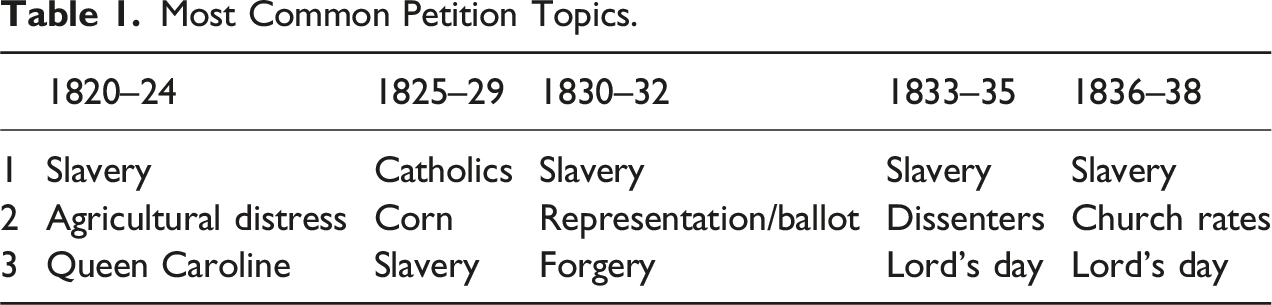
The Great Reform Act did not change the rules governing the petition system. All British subjects could send petitions, irrespective of whether they could vote or lived in a constituency with borough representation. Often more than half of the signatures on a petition came from people who did not have the right to vote (Phillips, 1980). While most petitions were signed by anywhere between 20 and 200 individuals, some attracted more than 100,000 signatures (Fisher, 2009). All except ten borough constituencies sent petitions at some point in the period 1820–38 (see the section on Empirical Strategy), and in most years the number of people who signed petitions exceeded the number of people with the right to vote.
Representation and Petitioning
Why would changes in parliamentary representation affect petitioning? We argue that residents sent petitions because these were often effective and that they were more effective when they came from areas that had borough representation in parliament. From this it follows that changes in borough representation would have led to changes in petitioning.
Political agency theory can explain why elected politicians responded to the demands of enfranchised individuals (e.g., Aidt & Dutta, 2007; Besley, 2007), but there are also good reasons why they may have taken seriously petitions sent by disenfranchised residents. Many MPs in the 1830’s saw themselves as responsible for the interests of their whole community, including both enfranchised and disenfranchised individuals (Schonhardt-Bailey, 2006, Ch. 1). 34 Enfranchised residents could have held MPs accountable for all constituency-related matters, even those primarily affecting the disenfranchised, or for their stance on a national issue. 35 A purely self-interested MP would have viewed all petitions, regardless of who signed them, as informative about issues that could affect their re-election. Furthermore, MPs may not have been able to fully determine whether those who signed a petition were enfranchised, so it could have been optimal for them to take all petitions seriously.
Consistent with the political opportunity structure framework (Gleditsch & Ruggeri, 2010; McAdam, 1982; Tarrow, 1989), the gain of borough representation would have changed the political opportunities of the residents of a constituency. A local MP could use the petitions sent from his constituency to initiate debates in parliament and to advance an agenda (Huzzey & Miller, 2020). This would have created an incentive for his constituents to send petitions. 36 The presence of this MP would also have given a face to parliament, making petition writing feel more personal. Groups and individuals, whether enfranchised or not, could have taken advantage of this opportunity by petitioning more. This leads to our main hypothesis:
(Complements) Gaining representation leads to an increase in petitioning. Losing representation leads to a decrease in petitioning.
The alternative hypotheses are that there was no relationship between representation and petitioning, or that gaining (losing) representation led to a fall (an increase) in petitioning (i.e., they were substitutes). This would have been the case, for example, if residents no longer felt the need to petition because they knew their local MPs would advocate for their views in parliament. 37
Our hypothesis, which builds on the political opportunity structure framework, requires MPs to take seriously the views expressed in the petitions sent from their constituencies. Consequently, the complementarity between representation and petitioning we have hypothesized should only be observed in areas where local MPs were accountable to residents. In other areas, where, for example, MPs were under the control of local elites (patrons), we should not observe this relationship. 38 This motivates our second hypothesis:
(Accountability) Constituencies where MPs were controlled by local elites (patrons) saw no decline in petitioning following a loss in representation.
39
Finally, the logic behind hypothesis 1 is that the presence of a representative in parliament reduces the cost of petitioning, which, in turn, facilitates collective action. This effect should have been larger for groups that, like civil society organizations, relied heavily on petitioning. This motivates our third hypothesis:
(Petition cost) A gain in representation had a
greater
effect on the number of petitions sent by civil society organizations than on those sent by other groups.
For groups that could access parliament in other ways, for example, by using their personal connections to politicians, a change in representation should have had a smaller or no effect on petitioning.
Data
Treatment and Control Groups.
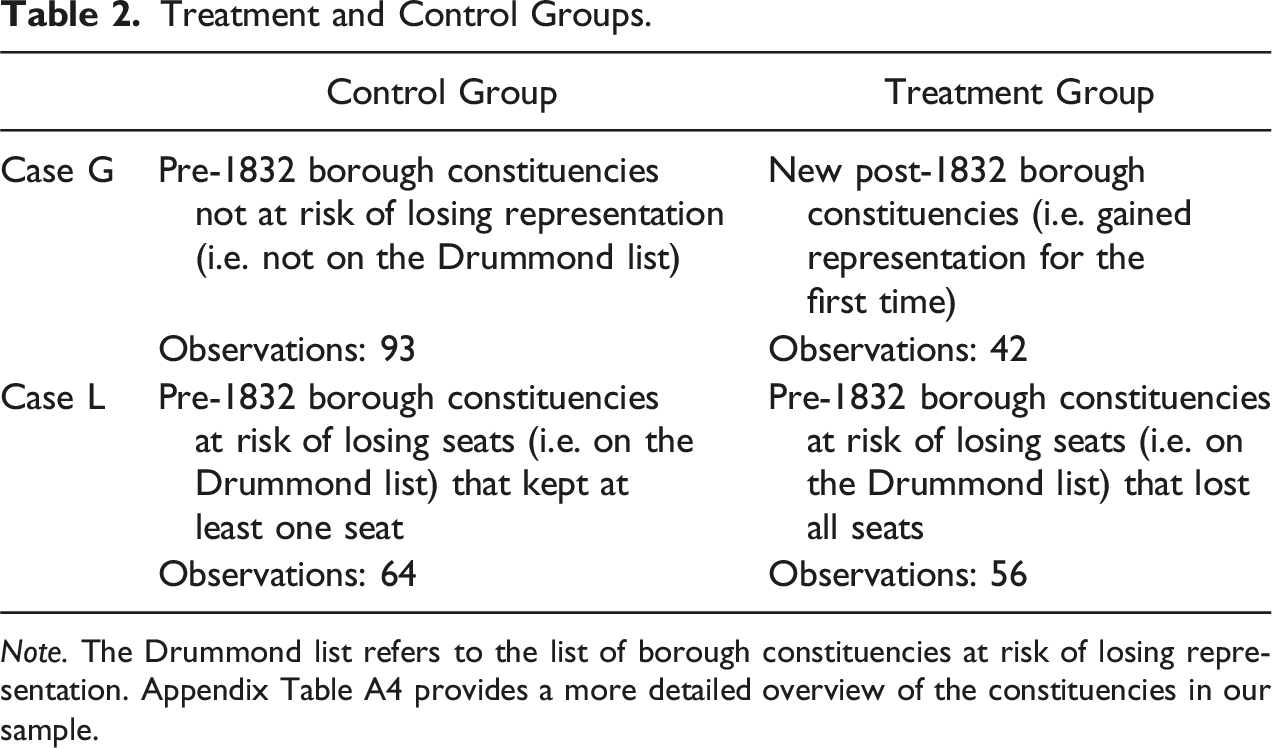
Note. The Drummond list refers to the list of borough constituencies at risk of losing representation. Appendix Table A4 provides a more detailed overview of the constituencies in our sample.
We collected information on all petitions sent to the House of Commons between 1820 and 1838. Our source is the Journal of the House of Commons, and we have over 18,000 petitions originating from the 255 borough constituencies in our sample. For each petition, we recorded its topic, when it was sent, and from where; for about half of the petitions we also have information on who sent them (see Appendix Figure A5). 42 We used the location from which petitions were sent (the town name, etc.) to match petitions to borough constituencies. 43 For a new borough constituency, its pre-reform petitions are all petitions sent from locations that after 1832 would fall within the approximate boundaries of the new borough constituency. For former borough constituencies, we consider all petitions sent from within the pre-abolition boundaries. We aggregated the petitions by year and borough constituency. 44
We also collected data on the size of the electorate in each constituency, local elite capture, and population. 45 Following the Great Reform Act, the median constituency saw a very modest gain of 143 voters, while about 30% of constituencies actually lost voters. Almost all the constituencies that lost their seats had at least some degree of local elite capture (see Appendix Table A2 in supplemental appendix C).
Empirical Strategy
We examine how changes in parliamentary representation affected the number of petitions sent to parliament. Our unit of analysis is the borough constituency i in year t with t = 1820, ….1838. We estimate two different effects. First, in what we call case G, we consider a treatment group consisting of the 42 new constituencies that gained borough representation for the first time. The control group consists of the 93 pre-1832 borough constituencies that kept their seats and were not at risk of losing them (i.e. were not on the Drummond list). The reform gave borough representation to the treatment group because these constituencies had a large population of over 10,000 residents. Fourteen of the new constituencies were large towns that had expanded rapidly during the Industrial Revolution, while five were boroughs in the metropolitan area around London. The rest were relatively large market towns spread across the country.
46
Every constituency in this sample, except one, sent a petition at some point between 1820 and 1838. Panel (a) in Figure 1 shows the average number of petitions sent each year before and after the reform by a constituency in these treatment and control groups. Petitions sent between 1820 and 1838. Note. Case G: panel (a) shows the average number of petitions sent per year per borough before and after the reform for the treatment group (the 42 new constituencies that gained borough representation for the first time) and the control group (the 93 pre-1832 constituencies that kept their borough seats and were not on the Drummond list). Case L: panel (b) shows the average number of petitions sent per year per borough before and after the reform for the treatment group (the 56 constituencies that lost all borough representation) and the control group (the 64 constituencies at risk of losing borough representation, i.e., on the Drummond list, that kept at least one seat).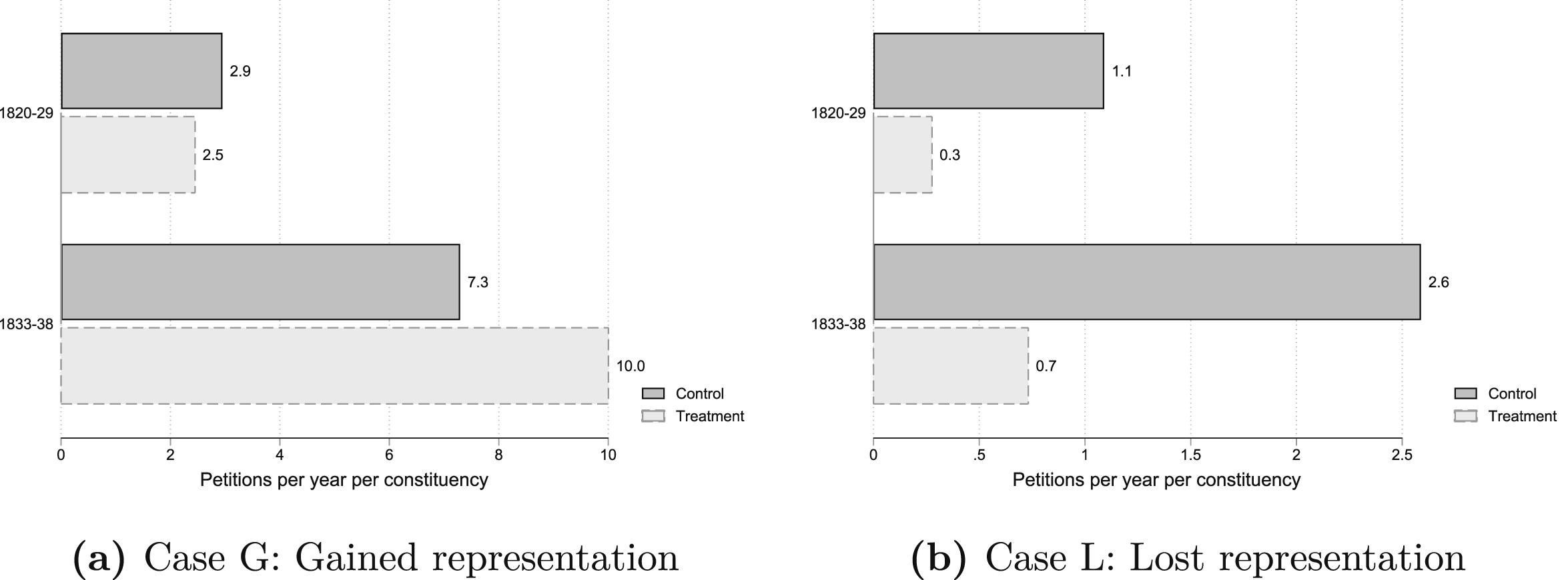
Second, we restrict our sample to constituencies on the Drummond list, i.e. those that were at risk of losing representation. In this case, the treatment group consists of the 56 constituencies that lost all seats, while the control group consists of the 64 constituencies that kept one or both seats. We refer to this as case L, as it focuses on a loss of representation (see Table 2). All 120 constituencies on the Drummond list were small and of little economic importance in 1830 as measured by their number of houses and tax payments. Figure 1, panel (b) shows the average number of petitions sent before and after the reform by a constituency in these treatment and control groups. 47
The Great Reform Act not only changed representation, it also reformed the voting eligibility criteria. As we discussed in the Historical Background section, for the constituencies that kept their borough representation, the change in the number of voters was small on average and negative in about a third of cases. Our view is that these constituency-level changes in the number of voters were too small to have much of an effect on petitioning. Yet, our estimates will still combine the effect of losing or gaining borough representation with the effect of the change in the size of the electorate. 48 We address this compound treatment issue in the Results section.
All areas with more than 10,000 residents and no borough representation gained it for the first time. This clear population cutoff, combined with the desire to keep the number of MPs roughly constant, suggests that other pre-existing characteristics are unlikely to have played a role in determining which areas gained representation. Meanwhile, the Drummond rule ensured that the constituencies that lost seats were chosen on the basis of the pre-existing number of houses within their pre-reform boundaries and past taxes paid on those houses; neither could be easily manipulated. It follows that reverse causality, in the sense that petitioning could have affected the details of the reform, is unlikely to be a serious concern. The reform dominated British politics in the years between 1830 and 1832, and many of the petitions sent during this time were related to this issue. We therefore exclude the years 1830–32 from our analysis: our pre-treatment period is 1820–29 and our post-treatment period is 1833–38. 49
Results
Our core specification is
The Main Difference-In-Differences Results.
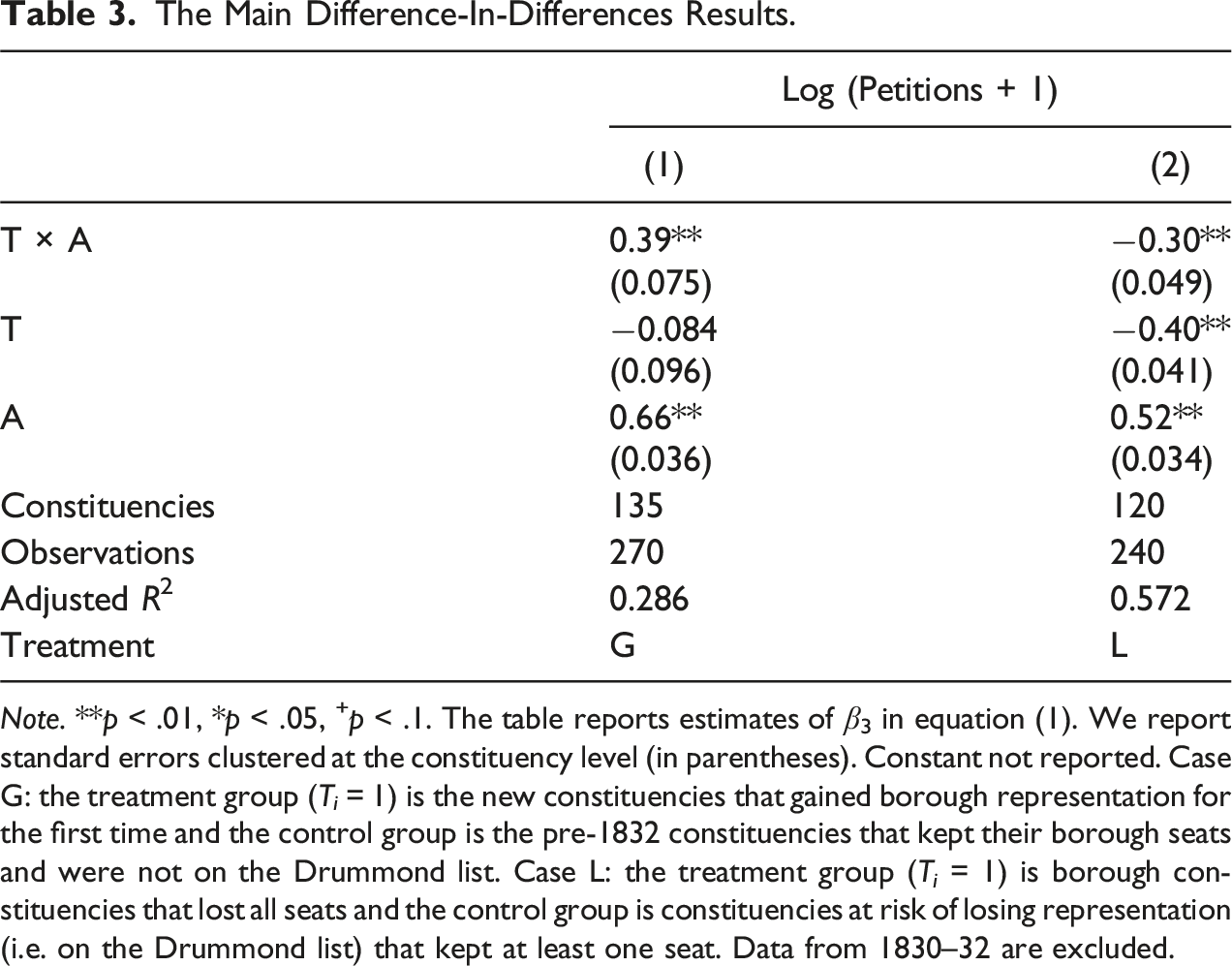
Note. **p < .01, *p < .05, +p < .1. The table reports estimates of β3 in equation (1). We report standard errors clustered at the constituency level (in parentheses). Constant not reported. Case G: the treatment group (T i = 1) is the new constituencies that gained borough representation for the first time and the control group is the pre-1832 constituencies that kept their borough seats and were not on the Drummond list. Case L: the treatment group (T i = 1) is borough constituencies that lost all seats and the control group is constituencies at risk of losing representation (i.e. on the Drummond list) that kept at least one seat. Data from 1830–32 are excluded.
The difference-in-differences design produces causal estimates when the treatment and control groups follow parallel trends. Whether they do is ultimately an assumption, but we check whether this assumption is plausible by investigating whether the pre-treatment trends appear to be parallel. Figure 2 plots (log) petitions for the treatment and control groups. For case G, the pre-treatment trends are very similar for the two groups, particularly after 1825, and the sample is balanced. For case L, the control group exhibits more volatility than the treatment group, but the trends are roughly parallel. The constituencies in the treatment group petitioned more, and so the sample is not balanced, an issue we address later in this section. Parallel trends plots. Note. See the notes to Table 3 for a description of cases G and L.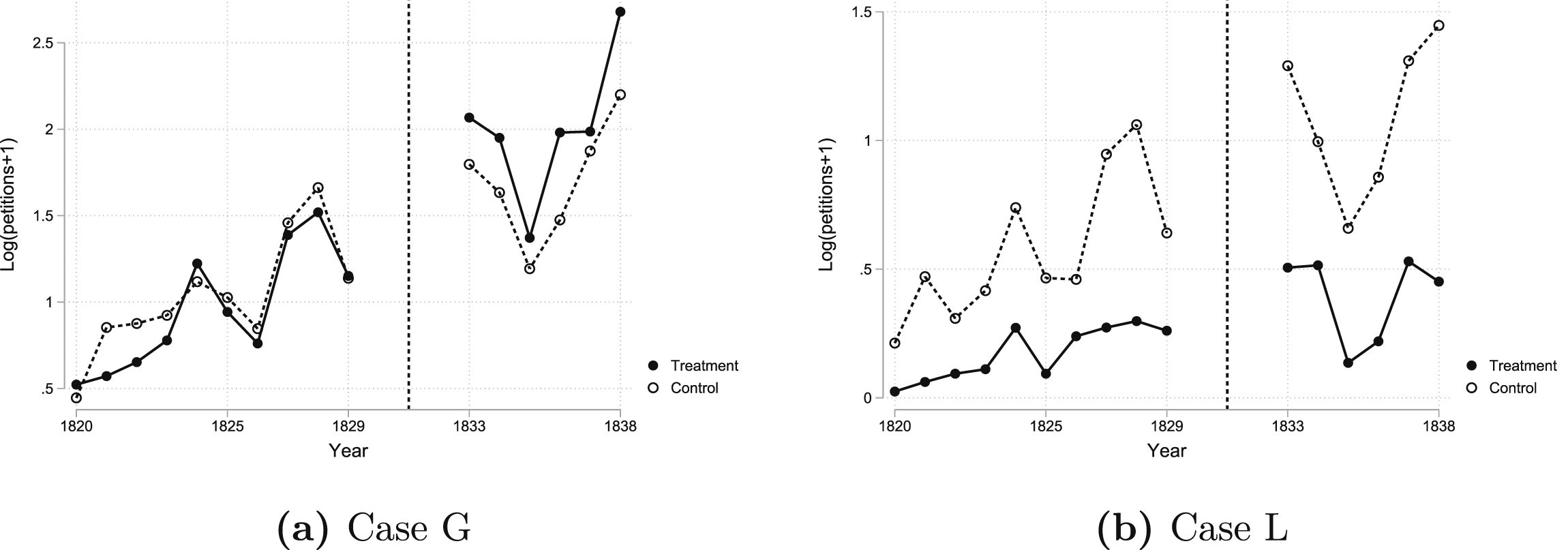
We can use the time series information in our data to carry out an event study implementation that interacts the treatment dummy T
i
with the year dummies before and after the reform. Figure 3 shows the estimated coefficients on these interactions. The plot for case G shows no evidence of divergent trends prior to treatment. In case L, there is some evidence that the trends diverge prior to treatment. Event study coefficients. Note. See the notes to Table 3 for a description of cases G and L. The estimated coefficients are for the interactions between the treatment dummy (T
i
) and year dummies (A
t
). We use the year before the treatment (1829) as the base year. We report the estimated coefficients for the interactions with 95% confidence intervals (based on standard errors clustered at the constituency level).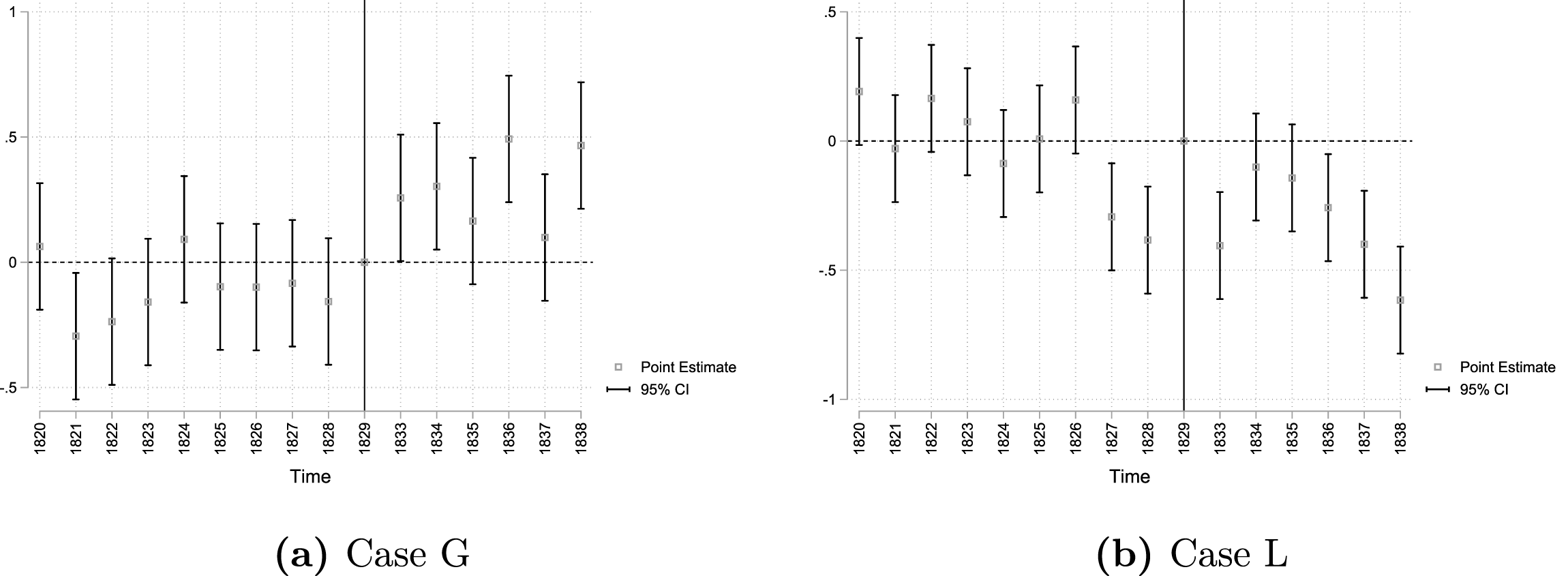
We now turn to two methods that can help address the unbalanced nature of the sample we use for case L and the fact that its trends are not parallel. (Although the sample in case G is balanced and exhibits parallel trends, we report the results for this case too.) First, we estimate a specification that fully exploits the time variation in the data. This allows us to include county- or constituency-specific time trends, helping make the common trends assumption more tenable. Our specification is
Difference-In-Differences Estimates: Time Series Specifications With Time Trends.
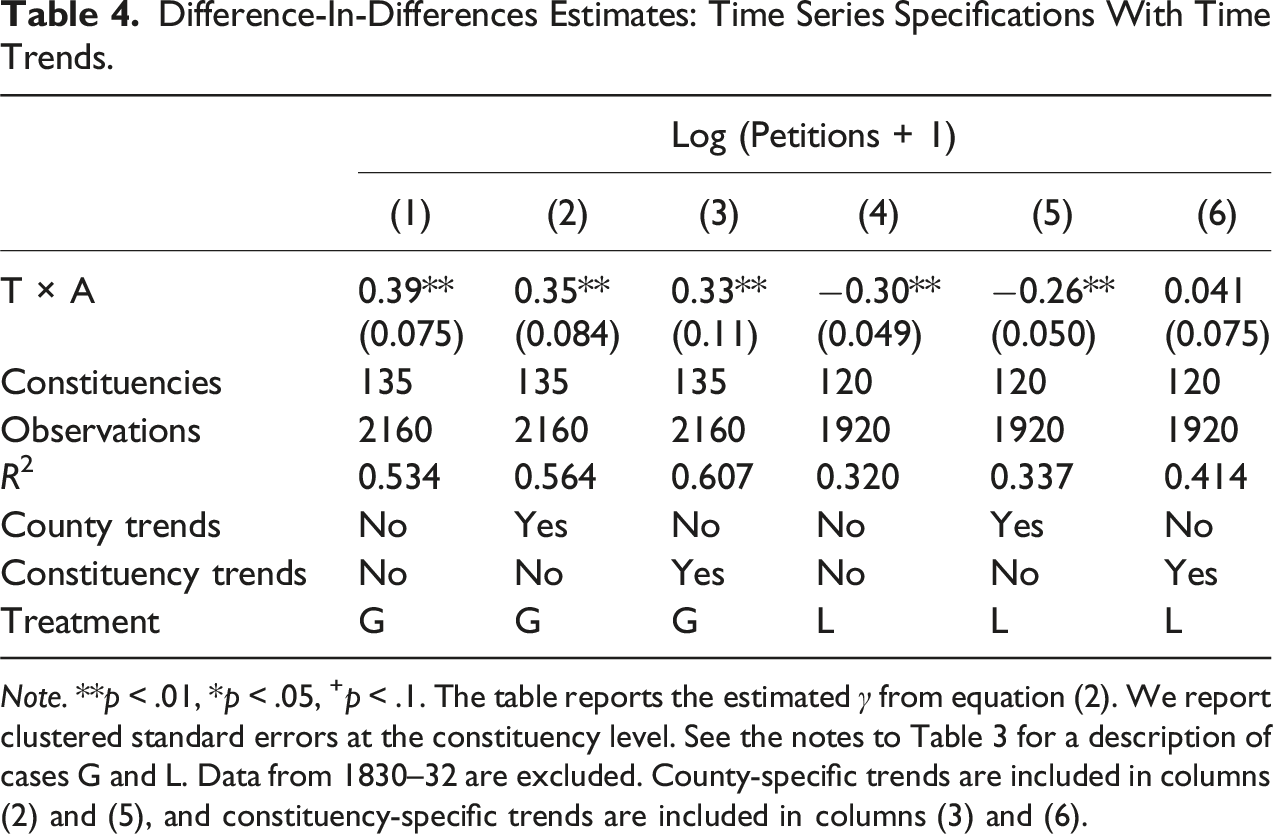
Note. **p < .01, *p < .05, +p < .1. The table reports the estimated γ from equation (2). We report clustered standard errors at the constituency level. See the notes to Table 3 for a description of cases G and L. Data from 1830–32 are excluded. County-specific trends are included in columns (2) and (5), and constituency-specific trends are included in columns (3) and (6).
We therefore adopt a second strategy to address the issue of non-parallel trends in case L: the use of the synthetic control method recently developed by Hazlett and Xu (2018).
53
This method weighs the pre-treatment outcomes for the control group so that they match as closely as possible the pre-treatment outcomes for the treatment group. The method estimates event study coefficients and we exclude the years 1830–32 from the estimation. Figure 4 reports the results. The plots on the left-hand side show the synthetic counterfactual values (in the dashed lines) and the actual values (in the solid lines). In both cases the plots confirm the estimated effect: a gain in borough representation leads to an increase in petitioning (case G), while the loss of borough representation leads to a decrease in petitioning (case L). The plots on the right-hand side show the size of the treatment effect. Prior to treatment, we see horizontal lines because of the way the synthetic control is constructed. In the post period, we can clearly see the size of the treatment effect, with the 95% confidence intervals in gray. In both cases, the estimated average treatment effect on the treated (ATT) is statistically significant (reported with p-values below the figures in panels (b) and (d)). The results from the synthetic control method confirm the presence of large and significant treatment effects. Synthetic control results. Note. See the notes to Table 3 for a description of cases G and L. The years 1830–32 are dropped. The first post-treatment year is 1833. The bars labeled Ntr on the figures on the right-hand side show the number of constituencies in the treatment group.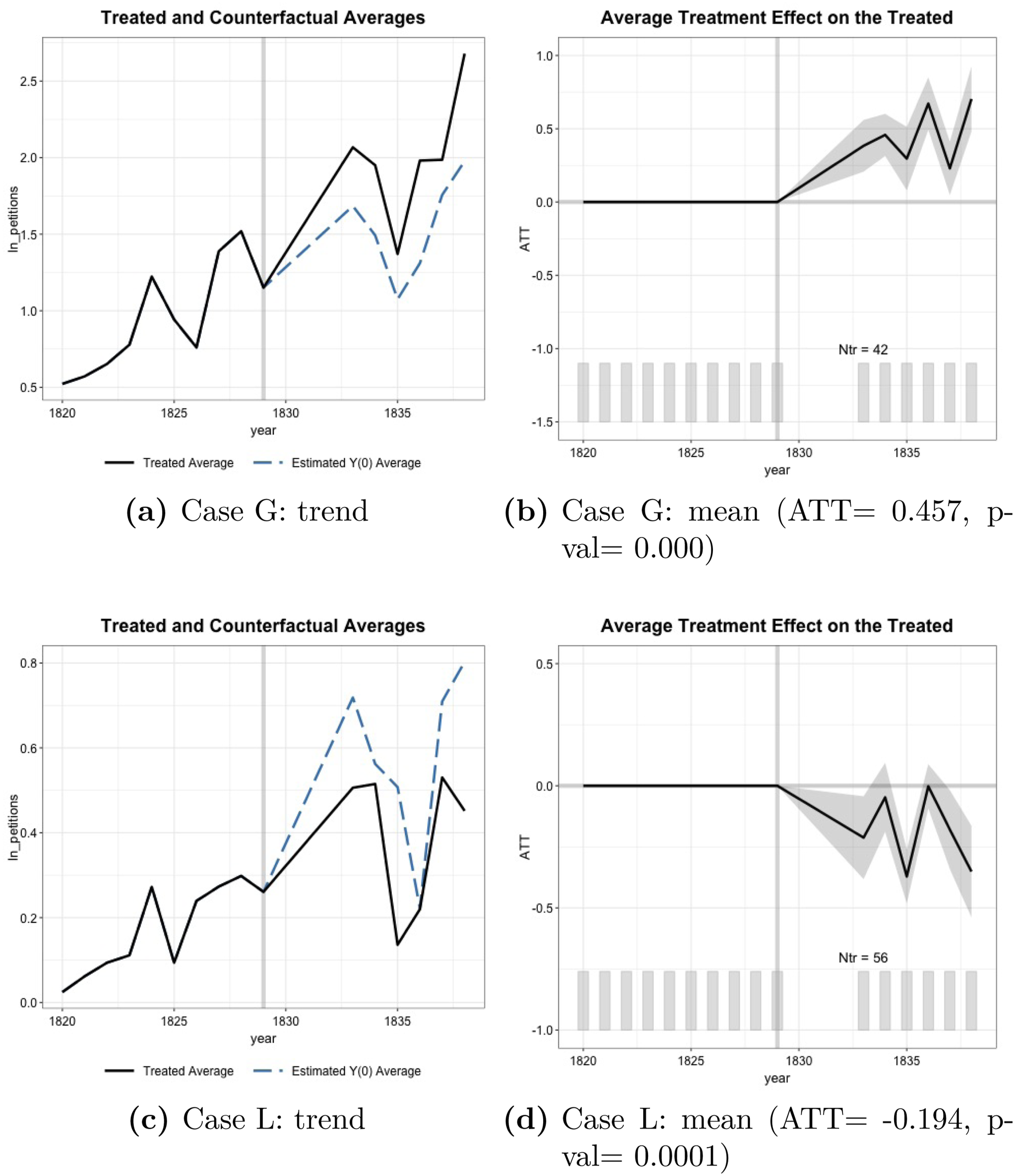
The Effect of the Change in the Suffrage Rules
The Great Reform Act changed both the voting qualification rules and the distribution of parliamentary borough seats across geographical areas. This raises the concern that our estimates may be capturing the compound effect of both of these changes. We conduct two tests to examine the extent to which the change in the number voters affected petitioning.
Compound Treatment: Change in the Suffrage vs. Change in Representation.
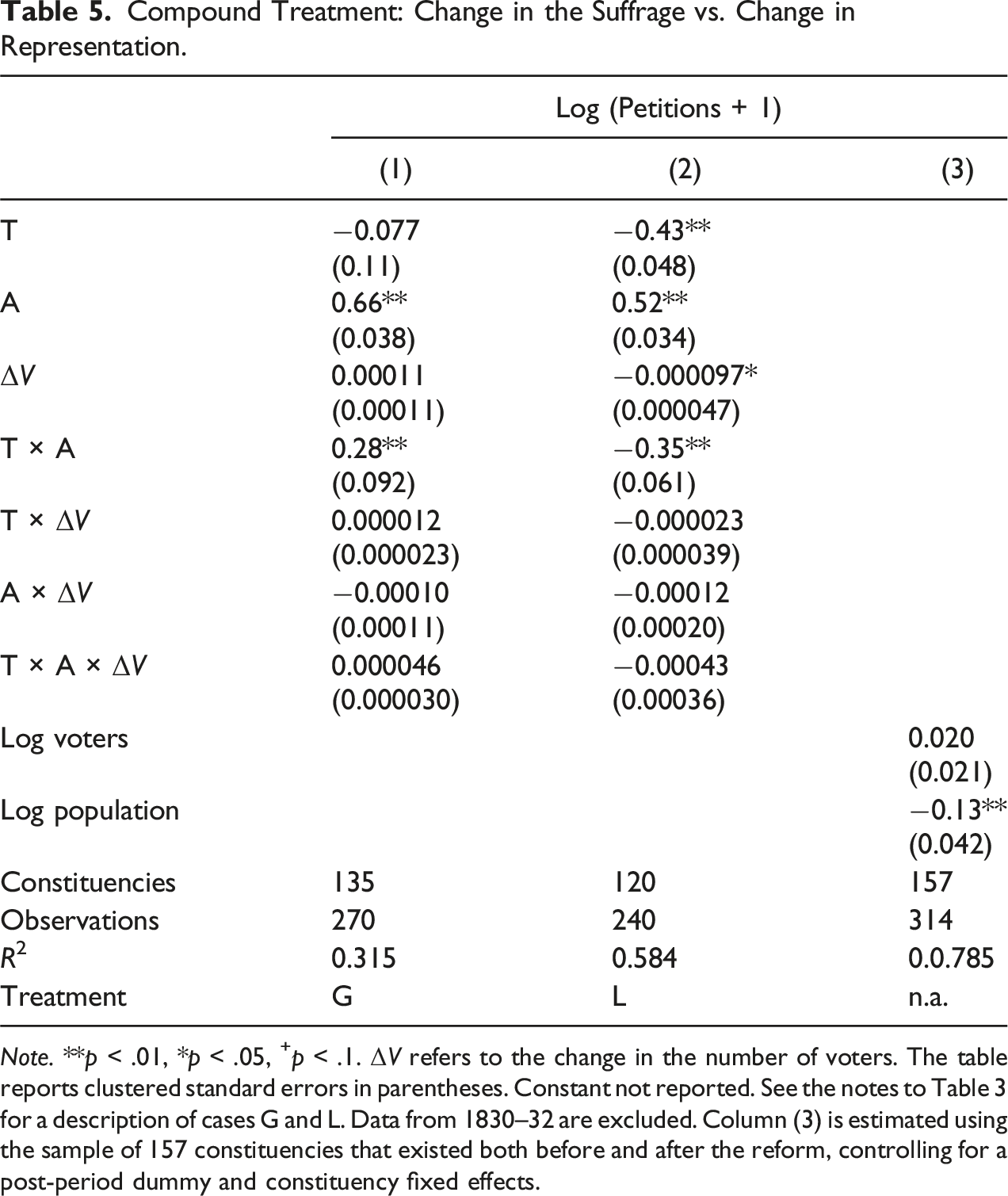
Note. **p < .01, *p < .05, +p < .1. ΔV refers to the change in the number of voters. The table reports clustered standard errors in parentheses. Constant not reported. See the notes to Table 3 for a description of cases G and L. Data from 1830–32 are excluded. Column (3) is estimated using the sample of 157 constituencies that existed both before and after the reform, controlling for a post-period dummy and constituency fixed effects.
Second, column (3) reports results for a regression where the outcome remains log petitions but the main explanatory variable is the log number of voters in each of the 157 constituencies that existed in both periods. We control for log population and include a period dummy and constituency fixed effects. This shows that there is no correlation between the number of voters and the number of petitions. These results support the claim that the difference-in-differences estimates from the main specifications capture the effect of changes in borough representation. 56
Alternative Measures of Activism
So far we have focused on petitions as our measure of local activism. Petitions were a key element in the repertoire of activist groups (Huzzey & Miller, 2020), and we observe the full universe of petitions sent to parliament. Accordingly, we avoid the measurement error associated with the use of event catalogs collected from news sources. Yet, petitions were only one element in the repertoire, and activism could manifest itself in other forms. We now examine how changes in representation affected both peaceful and violent protests.
We do this by using the data Tilly (1995) and Horn and Tilly (1988) collected from newspaper reports and assembled into a large dataset of popular protest for the period 1828–34. We geo-referenced these data and matched them to the constituencies in which they happened. 57 In order to have sufficient observations for the estimation, we aggregate the different types of protest. For case G, we divide protests into peaceful and violent events, where violent protests include riots and violent demonstrations and peaceful protests include orderly demonstrations, public meetings, and gatherings. For case L, there are only a handful of violent protest events recorded, and we therefore focus on peaceful protests. For each type of protest, we record the number of events and the approximate average number of participants. Despite the large measurement error associated with these data, they enable us to investigate whether representation affected the broader repertoire of activism. 58 In contrast to petitions, which reflect activism exercised through an institutional channel, the protest events in the Horn and Tilly (1988) dataset were largely non-institutional.
Figure 5 reports estimated ATEs from equation (1) for cases G and L, where the outcome variable is different measures of public protest constructed from the Tilly data. The point estimates for β3 are positive for case G and negative for case L. The effects are not precisely estimated and only statistically significant in a few cases, all related to peaceful protest. This suggests that representation not only triggered more petitioning, but also encouraged other forms of peaceful activism. It appears to have had little effect on violent protest.
59
Difference-in-differences estimates using Tilly’s public protest data. Note. The figure reports estimates of β3 and 90% confidence intervals from a version of equation (1) where the outcome variable is public protest, measured by either the (log of) the number of people involved or the number of events. For case G, we report the estimates for violent and peaceful protest separately; for case L, we report the results for peaceful protest along with the results for all protest events. Data for 1830–32 are excluded. See the notes to Table 3 for a description of cases G and L. Appendix Table A8 reports the full results.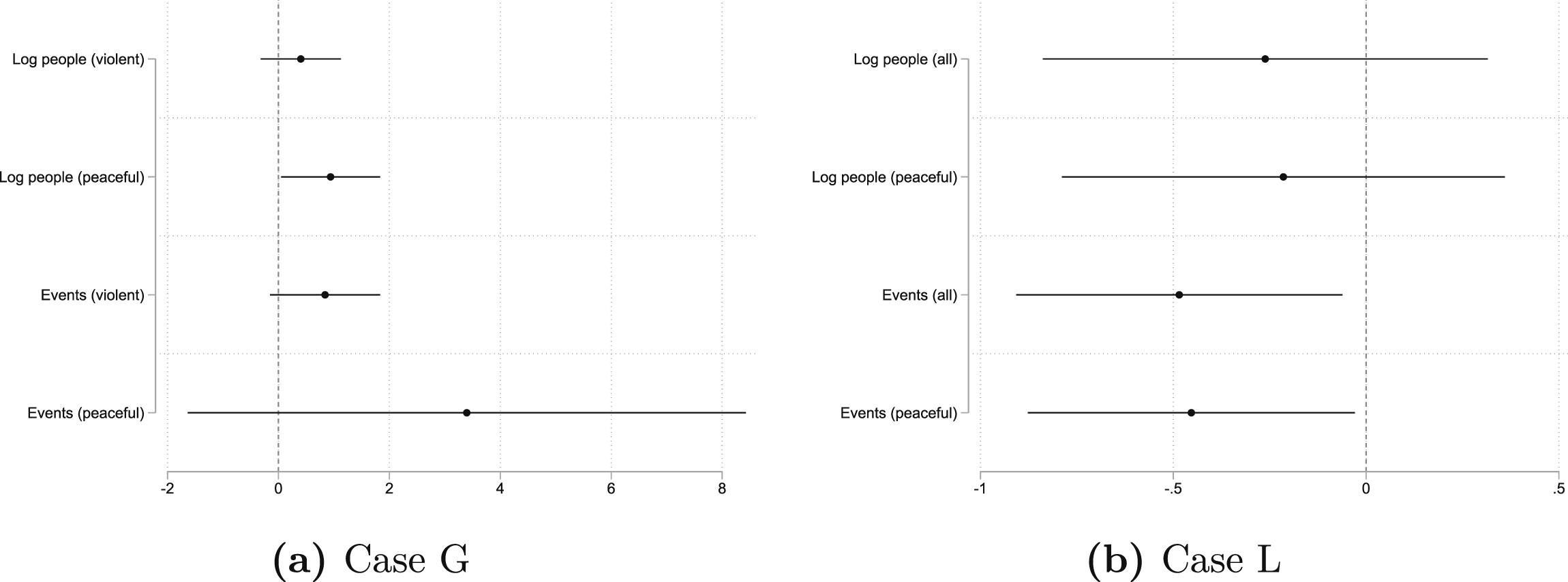
Robustness Checks
We have conducted a number of robustness checks. We briefly summarize the results here; the full results are reported in the supplemental appendix.
Alternative Specifications of the Outcome Variable
Our main specification uses a logarithmic transformation of the petition count as the outcome variable to reduce the skewness in the data. Chen and Roth (2023) show that when the outcome variable is of the form log (x + a) and the treatment affects the extensive margin (in our case, whether a constituency starts or stops petitioning), the ATE in percentages is not invariant to the scaling of the data. Chen and Roth (2023) suggest two different ways to approach this problem. First, in cases with count data like ours, one solution is to use the Poisson QMLE estimator. This model identifies the average proportional treatment effect on the treated, and the identification assumption is different. Second, we bound the problem by investigating the sensitivity of the ATE in percentages to variations around the value given in the log specification to observations with a value of 0. This involves recoding the data as y = log(Y) for Y >0 and y = −x for Y = 0 and then estimating the ATE for different values of x (from zero to some chosen value). If the estimates are not too different, then the extensive margin problem is not a serious concern. Appendix F in the supplemental appendix shows the results produced by these methods. Case G is robust to both approaches and, if anything, the estimated effect is larger (54%–68%) than the 48% reported in Table 3. Case L is not robust to the use of the Poisson estimator (the estimate is insignificant), but the ATE estimates are fairly insensitive to the coding of the extensive margin (the average treatment effect is between −34% and −24% compared to the baseline estimate of −26%). An alternative to the non-linear transformations is to use the absolute number of petitions as the outcome variable. Appendix Table A10, columns (5) and (6), reports the results for this, and in both cases they are qualitatively similar to the main results.
Petitions in 1830–32
We have excluded the years 1830–32 from the analysis. An alternative is to keep the reform years, but to drop all petitions related to parliamentary reform. Appendix Table A11, columns (1) and (2) report the results for this sample. They are similar to those reported in Table 3. Columns (3) and (4) of the table report the results for a specification estimated using all petitions sent in 1820–38. The results, again, change very little.
Restricting the Post-Treatment Period
In the main specification, the post-treatment period runs from 1833 to 1838. Parliamentary rules were changed in 1835 so that MPs could no longer use a petition to start a debate. Petitions could still be used in debates that had been started in other ways (Leys, 1955). To rule out the possibility that our estimates just reflect the effect of this change, Appendix Table A11, columns (1) and (2) report results for regressions where the post-treatment period is restricted to 1833–34. This makes little difference to the size and significance of our estimates.
Flexible Controls for Population
Our main specification does not control for population. While the constituency fixed effects eliminate cross-sectional differences in the size of constituencies, population dynamics could have induced differential time trends. One may also be concerned that population growth could have mechanically resulted in more petitions. Appendix Table A11, columns (3) to (6) report results that control for (log) population and (log) population squared. 60 This makes no substantial difference to our main results or our robustness checks.
Alternative Treatment and Control Groups
We consider a variation of case G where the control group only includes the constituencies in the original control group that had more than 10,000 residents in 1831. We use 10,000 because this was the population cutoff used to determine which areas would gain borough representation. The new control group therefore includes all pre-1832 constituencies that were not on the Drummond list and had over 10,000 residents. The results are reported in Appendix Table A12, column (1). The new estimated ATE is 0.30. This estimate is statistically significant, although smaller than that reported in Table 3, column (1).
A variation on case L exploits the fact that some of the constituencies that were singled out to lose representation in Schedules A or B of the original bill presented in March 1831 were not on the final schedules included in the bill that received Royal assent in June 1832. As before, our treatment group is the Schedule A constituencies that actually lost all seats. Our new control group is the Schedule B constituencies (i.e., those that kept one seat) plus those constituencies that in the March 1831 draft were on Schedules A or B, but were ultimately not included in these schedules and so lost no seats. Appendix Table A12, column (2) reports the results. The estimated ATE is −0.28, which is similar to that reported in Table 3.
The Role of Accountability
We hypothesized that accountability could have mediated the effect of the reform: the loss of borough representation may have decreased petitioning only in constituencies where local MPs were accountable to residents (hypothesis 2). An accountable MP who took petitions seriously would have provided local residents with a strong incentive to write and send petitions. In this case, the loss of borough representation would have resulted in less petitioning. In contrast, in constituencies where MPs were not accountable, for example, because they were under the control of the local elite or some other patron, residents would have been less motivated to send petitions. Accordingly, in this case, the loss of borough representation would have had little effect on petitioning.
We examine the importance of accountability in case L. 61 We include a triple interaction between the ATE and a measure of the extent to which a constituency’s MPs were controlled by a patron before the reform. Many seats were controlled by aristocrats or local businessmen who in essence appointed the local MP, making him accountable to them. We construct a dummy variable patronage that equals zero when there was little or no patron control in the constituency and 1 when there was full patron control. 62 Given that the ATE from Table 3 is negative for case L, hypothesis 2 implies that the triple interaction will be positive.
Patronage.
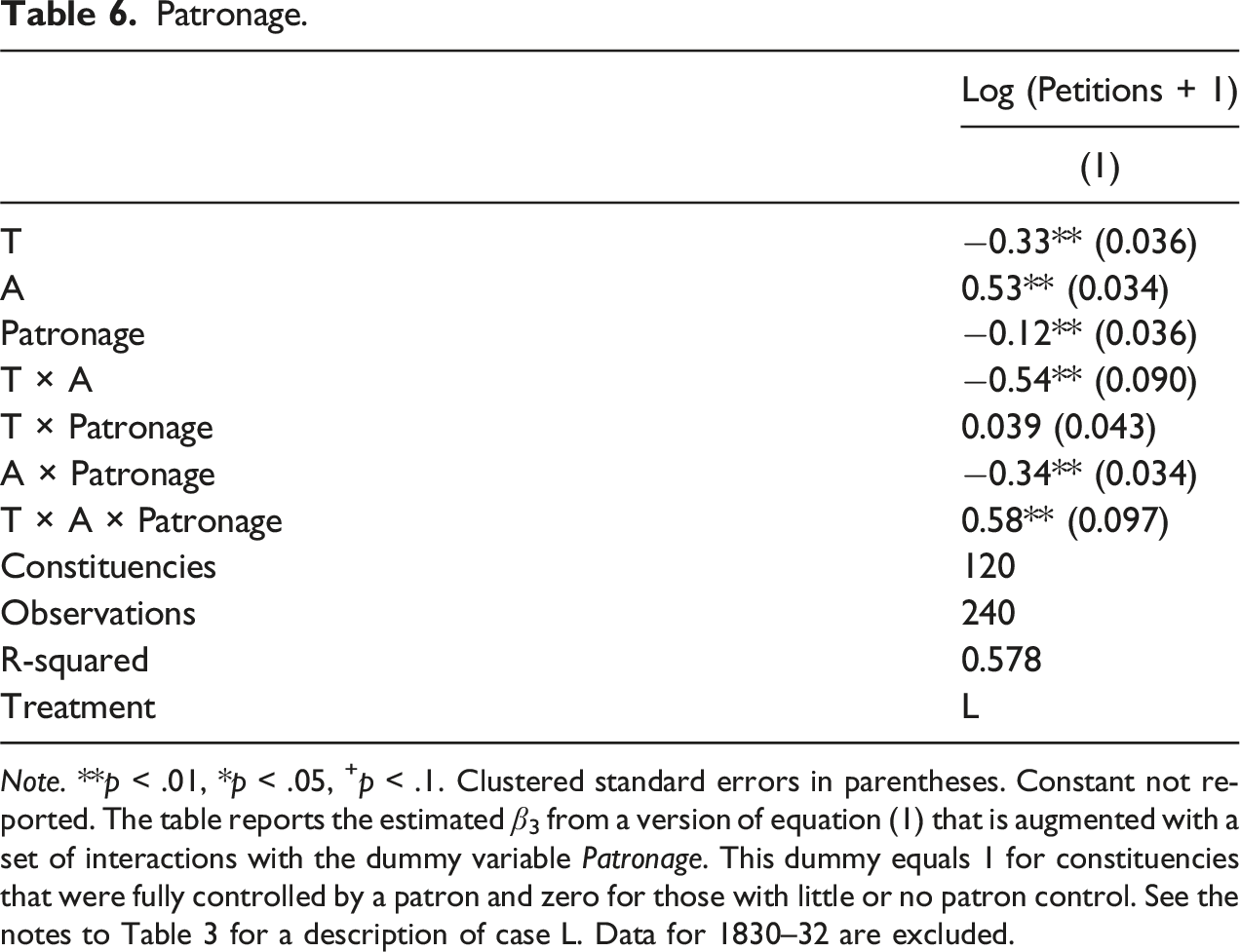
Note. **p < .01, *p < .05, +p < .1. Clustered standard errors in parentheses. Constant not reported. The table reports the estimated β3 from a version of equation (1) that is augmented with a set of interactions with the dummy variable Patronage. This dummy equals 1 for constituencies that were fully controlled by a patron and zero for those with little or no patron control. See the notes to Table 3 for a description of case L. Data for 1830–32 are excluded.
The Petitioners
We use information on who sent petitions to examine whether particular groups were behind the changes we have documented. We divide senders into five groups: civil society, business, individuals, religious organizations, and local government bodies. Figure 6 reports the estimated ATEs for case G from equation (1), where the outcome is the number of log petitions sent by each of the five groups.
63
Civil society groups (societies) petitioned significantly more after their area gained borough representation. This is consistent with hypothesis 3 that representation reduces the cost of petitioning. Meanwhile, there was a small and insignificant reduction in petitioning from religious organizations, a significant increase in petitioning by business groups, and a small and insignificant increase in petitioning by local government bodies and by individuals. The ATE by sender type. Note. The figure displays the estimates of ATE along with 95 % confidence intervals from equation (1) for case G, for different types of senders. Appendix Table A13 reports the full results and its note includes the precise definitions of the different groups.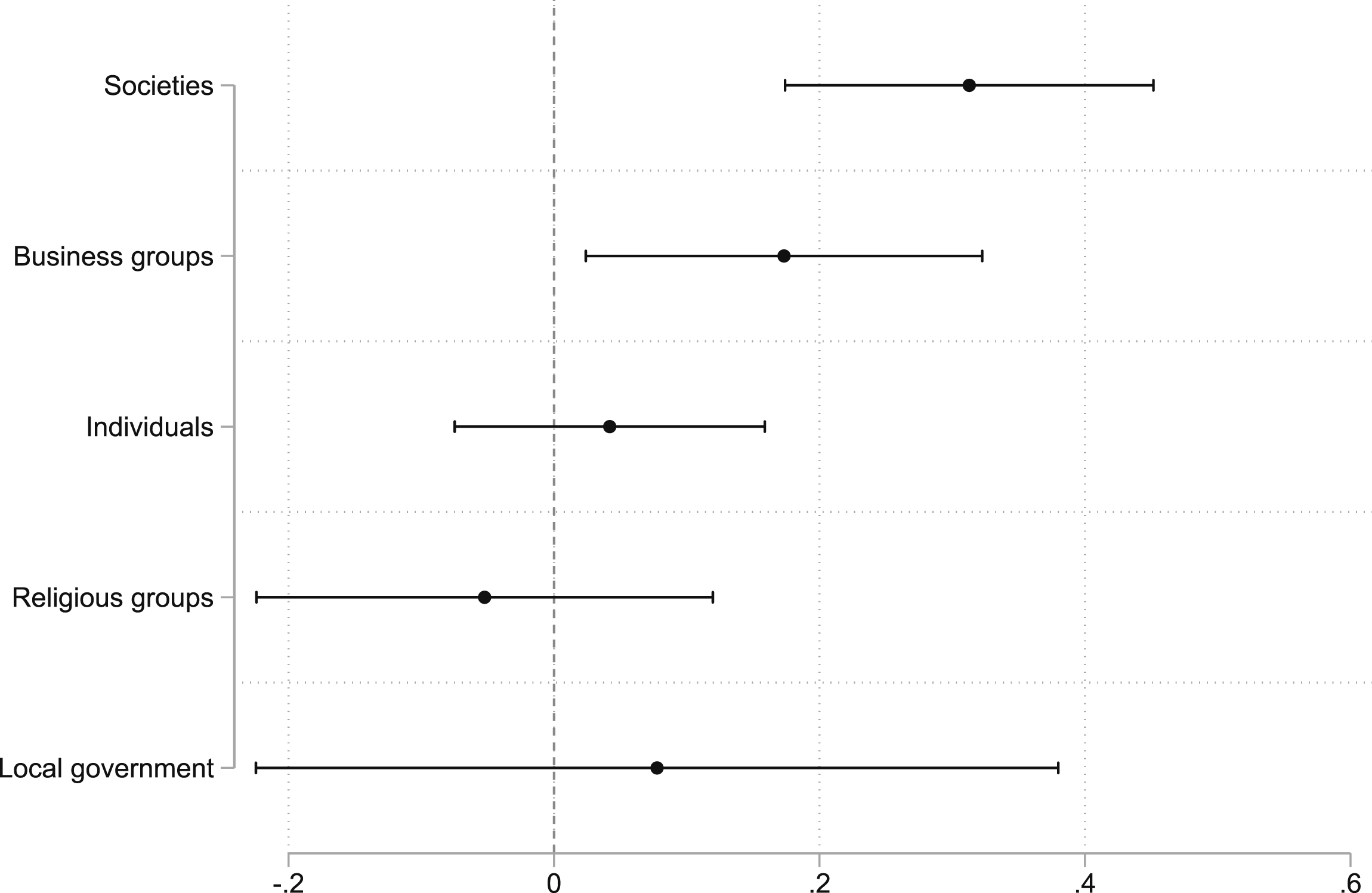
Discussion and Concluding Remarks
This article shows that constituencies that lost borough representation as a result of the Great Reform Act in 1832 saw a fall in petitioning, while those that gained borough representation saw an increase in petitioning. This is consistent with our main hypothesis that representation and petitioning were complements. These results imply that democratic reforms, in this case the granting of borough representation to areas that previously did not have it, can lead to increased activism as measured by the number of petitions sent to parliament. These results contribute to a growing literature that documents how democratic reforms affect activism and protest (Degrave, Lopez Peceño, and Rozenas 2023; Finkel, Gehlbach, and Olsen 2015; Lacroix, 2022).
When focusing on the constituencies that lost seats, the fall in petitioning was driven by constituencies where the MPs were accountable to residents. This supports the hypothesis that accountability helps explain the complementarity between representation and petitioning. This contributes to the literature on the political opportunity structure framework (Gleditsch & Ruggeri, 2010; McAdam, 1982; Tarrow, 1989) by showing that the expected response of MPs had a significant effect on petitioning. Furthermore, we show that the positive effect of representation was larger for civil societies, groups with limited access to other forms of influence.
The relationship we document is not produced by either (i) increases in petitioning following the perceived success of the petitions calling for parliamentary reform, or by (ii) the disappointment of subjects who wished for a more comprehensive reform and responded by petitioning more. The first of these accounts would imply that areas that lost representation, having seen the effectiveness of the petitions sent by other areas, would have increased their petitioning. But we find that they did the opposite. In the second of these accounts, the disappointment would have been greater in areas that lost representation, hence these areas should have seen a larger increase in petitions. But again, this is the opposite of what we find.
Our findings show how a small reform may set in motion a process that leads to more reform in the future. In particular, reforms that improve representation can increase activism, which in turn creates pressure from below for more reform. This can explain the de Tocqueville paradox that non-democratic regimes are more vulnerable right after they have reformed (de Tocqueville, 2011 [1856]; Finkel & Gehlbach, 2018). It is also consistent with the view in the historiographical literature that the Great Reform Act was important because it facilitated future reforms (Maehl, 1967). Our findings help justify the view that the Great Reform Act was a critical juncture that set in motion a path-dependent process of democratization. This is consistent with Tilly (1995, p. 288)’s assessment: “The conflicts and changes of 1828–1834 cemented in place a claim-making repertoire of meetings, marches, petition drives – as compared to their predecessors, visibly cosmopolitan, autonomous, and modular. They produced an unprecedented mobilization of workers that carried over into Chartism and national trade union movements.”
Several open questions remain. First, we know that both enfranchised and disenfranchised individuals signed petitions, but we do not know how the behavior of each group was affected by the changes in representation. However, the existing qualitative evidence makes us confident that our results are not driven by the behavioral response of the enfranchised. For example, Phillips (1980) documents that it was common for more than half of a petition’s signatures to come from disenfranchised individuals. And although an individual could submit a private petition, most petitions were signed by between 20 and 200 individuals, with some collecting over 100,000 signatures (Fisher 2009). Second, while we have outlined a number of possible reasons for why disenfranchised individuals may have signed petitions, we do not have the data to explore these theoretical links in more detail. Nevertheless, our historical case provides us with useful variation that allows for an identification strategy that would not be workable in other contexts. It also enables us to reassess the importance of the Great Reform Act, allowing us to conclude that its central role in the historiography of Britain is fully justified.
Supplemental Material
Supplemental Material - Can Democratic Reforms Promote Political Activism? Evidence From the Great Reform Act of 1832
Supplemental Material for Can Democratic Reforms Promote Political Activism? Evidence From the Great Reform Act of 1832 by Toke S. Aidt, Gabriel Leon-Ablan in Comparative Political Studies.
Footnotes
Acknowledgments
We would like to thank Andrew Blick, Federica Carugati, Roger Congleton, Emiliano Grossman, Shaun Hargreaves Heap, Colin Jennings, Finn Klebe, Jean Lacroix, Eric Melander, Paul Le Derff, Gerard Padro-i-Miquel, Ruben Ruiz Rufino, Daniel Schiffman and John Wallis for valuable comments. We are grateful for excellent feedback from seminar audiences in Aarhus, Bath, Birmingham, Manchester, UCL, Warwick and Yale, and conference audiences in Barcelona, DULBEA, EPSA, Silvaplana and SIOE. We thank Lukasz Krebel and Charlotte Ellis for outstanding research assistance. We are grateful to Chris Tilly who kindly helped us track down a copy of the complete database (constructed by Takeshi Wada) with all Charles Tilly’s data on contentious gatherings in Britain, including the information needed to geo-reference the events.
Declaration of Conflicting Interests
The authors declared no potential conflicts of interest with respect to the research, authorship, and/or publication of this article.
Funding
The authors received no financial support for the research, authorship, and/or publication of this article.

Data Availability Statement
Replication materials and codes in the CPS Dataverse (Aidt & Leon-Ablan, 2025).
Supplemental Material
Supplemental material for this article is available online.
Notes
Author Biographies
References
Supplementary Material
Please find the following supplemental material available below.
For Open Access articles published under a Creative Commons License, all supplemental material carries the same license as the article it is associated with.
For non-Open Access articles published, all supplemental material carries a non-exclusive license, and permission requests for re-use of supplemental material or any part of supplemental material shall be sent directly to the copyright owner as specified in the copyright notice associated with the article.
