




Abstract
Despite the influence of stigmatization on vote choices, little attention has been given to the impact of social stigma on voters’ selection of voting procedures. To bridge this gap, our study focuses on Sweden, where the open-display ballot system at polling stations potentially compromises vote secrecy. Using survey data from the Swedish National Election Studies in 2014 and 2018, we examine the relationship between citizens’ voting procedure choices and their support for a highly stigmatized radical right party, the Sweden Democrats. Our findings reveal that voters of the Sweden Democrats are more inclined to vote in advance, particularly in districts with low general party support, indicating a high level of stigma. We argue that advance voting can be seen as a strategy to safeguard vote secrecy when voting for stigmatized parties within an institutional context featuring public displays of ballots. In addition, our research sheds light on the importance of electoral integrity in maintaining the confidentiality of voters’ choices.
Keywords
Introduction
Across many European countries, radical right parties (RRP) are generally disliked by large segments of society. Previous research suggests that parties of the radical right often suffer from a stigmatization effect among voters (e.g., Bolin et al., 2023; Harteveld et al., 2017; Valentim, 2022); in other words, it is less socially acceptable to support them compared to other parties. While many RRPs have a long history of representation in parliaments, neither other parties nor voters consider them just another party. The stigma surrounding these parties is rooted in mainstream parties’ ostracization (Akkerman and Rooduijn, 2015) and anti-prejudice norms among voters (Blinder et al., 2013), which can influence voters’ choices. When casting a vote, a voter does not necessarily base their vote decisions solely on personal interest, may it be ideology or social identification, but also on their perceived preference among others (Harteveld et al., 2019). An individual vote choice is thus equally a social choice, where norms and social expectations serve as a guiding light: “Is this a socially acceptable choice?” (Harteveld et al., 2017). A party that is highly disliked in public opinion can thus have supporters that abstain from voting for them even though it would be their firsthand preference (Van der Brug et al., 2000).
There are strong reasons to believe that the impact of social stigma on vote choices is not only driven by internalized norms but also by anticipated social pressure that increases if vote secrecy is compromised or perceived to be so. In consolidated democracies, constitutions and declarations universally recognize vote secrecy as one of the most critical elements for free and fair elections (Elklit and Maley, 2019). The secret ballot is, first and foremost, maintained through electoral administrative laws and the organization of polling stations. Sweden makes an interesting case in this respect, since it has openly placed voting ballots at polling stations. Instead of having single ballots where the voter indicates which party he or she votes for, there are separate ballots for each party. A Swedish voter is also forced to choose party ballots in public, which has been criticized for potentially revealing vote secrecy (SOU, 2021: 7).
Understanding the effects of stigma on voters’ choices of voting procedure is crucial for gaining insights into the integrity of elections. While research on electoral integrity has predominantly focused on formal institutional aspects, such as legal frameworks, considering the impact of informal institutions like stigma enables a more comprehensive understanding of the factors that influence electoral processes. Electoral integrity, which involves conducting elections fairly, transparently, and in accordance with democratic principles, plays a vital role in upholding public trust and the legitimacy of elected governments. When electoral integrity is compromised, it can result in reduced citizen participation, heightened political polarization, erosion of democratic norms, and even legitimacy crises. Thus, safeguarding electoral integrity is essential for maintaining a healthy and robust democratic system (Norris, 2014).
Previous research has provided ample evidence on how the stigmatization of a party affects vote choices, but so far there has been little discussion on whether a social stigma can also affect voters’ choice of voting procedure. There has also been no investigation into how different contextual factors can mitigate the strength of the stigma effect. We, therefore, aim to explore these aspects by studying voting in Sweden, where voters can either vote at the polling station on Election Day or in advance. There are no theoretical reasons to expect that the results would not apply to radical right voters in other countries where the voting procedures allow for early voting and the vote secrecy might be compromised. Our hypothesis states that if individuals’ planning to vote for a stigmatized party find it more comfortable to avoid choosing ballots beside neighbors on the crowded Election Day by voting in advance, driven by the influence of social desirability bias (Chung and Monroe, 2003). They thereby evade being exposed to the social pressure the stigmatized party is associated with. We also hypothesize that this is more likely to be the case if the voter lives in an area with limited support for the party, in contrast to if he or she lives in a neighborhood where the support is more pronounced. This is because individuals tend to form an impression of the distribution of acceptable and unacceptable opinions in their social environment. If an individual disagrees with the prevailing opinion, he or she will also be less inclined to express his or her views (Noelle-Neumann, 1974).
To determine if this is the case, we use a pooled dataset from the Swedish National Election Studies 2014 and 2018 in our main analysis. We test our hypotheses in several steps using logistic regression models with voting mode as the dependent variable. In the case of Sweden, the stigmatized party is the Sweden Democrats (SD). We find that supporters of the SD are, on average, significantly more likely to vote in advance compared to other parties’ voters. We also find that this effect is moderated by the aggregated support for the party across electoral districts. This implies that the weaker the support is for the SD at the local level, the higher the stigma effect for the party. Taken together, we find a reduced likelihood to vote in advance for SD voters when they vote in districts where the party is more popular.
The Stigma of Voting for RRP
The field of elections studies is a well-trodden path, and from several decades of research, we know a lot about how social identification, group loyalty, issue positions, and ideology affect political behavior in general and electoral choice in particular (Achen and Bartels, 2016; Campbell, 1980). It is also a well-known fact that political activities and voting decisions are seldom made in isolation. Electoral decisions are influenced and affected by a voter’s social environment, where certain opinions, beliefs, and attitudes are considered more “correct” than others (Festinger, 1957; Noelle-Neumann, 1974). Having a socially informed perspective is equally important when voting on issues and policies. A voter takes cues not only from parties, interest groups, or representatives but also from prior election results and opinion polls (Oleskog Tryggvason, 2021), the broader society in general, and personal contacts (Zuckerman, 2005).
The social context has been found to be particularly important for explaining votes for populist RRP, where social stigma constitutes a strong signal. A social stigma is generally defined as “an attribute that is deeply discrediting” (Harteveld et al., 2017). From a voter perspective, “a party experiences stigma if it is regarded as unacceptable in the social context in which this voter lives.” (Harteveld et al., 2019). The level of stigma will, however, vary between different subgroups in society for a given party. Nevertheless, the stigma is often constructed at the level of the polity, and the populist RRP are a well-documented example, where many of them are treated as pariahs or political outsiders (Van der Brug et al., 2000; Van Spanje and Van der Brug, 2007). Consequently, it is generally less socially acceptable to support these parties, especially populist RRP, without reputational protection (Ivarsflaten, 2006).
For many voters, the presence of a social stigma functions as a social norm, deterring them from voting for the stigmatized party (Harteveld et al., 2017). This norm is an extension of another strong social norm—that one does not discriminate against people on the basis of ethnicity, sexuality, or religion; a norm that populist RRP, implicitly or explicitly, are challenging (Ivarsflaten et al., 2010). The underlying assumption is that voters generate and update their political opinions continuously, and the stigmatization of a party can thus prevent voters from considering such a party, although they might agree with the party’s policies.
In a large-N study conducted by Harteveld et al. (2017), it was demonstrated that parties with a social stigma (operationalized as parties that were disliked by a large share of the voters) systematically discourage voters in general and female voters in particular who agree with their policies, even under control for socioeconomic background and ideology (see also Ekholm, 2022). It has also been shown that political messages are evaluated differently if the sender is a stigmatized political party compared to a mainstream party (Bolin et al., 2023). From a voter perspective, previous election results combined with information from regularly conducted opinion polls make an important cue toward how socially acceptable a vote for the radical right is on a general level (Oleskog Tryggvason, 2021). At the local level, information from friends, families, workplaces, and the media gives guidance (Oscarsson and Holmberg, 2016). For instance, we know that the social sanctions for expressing stigmatized opinions are weaker if the person does so in an environment where others hold the same opinions (Bursztyn et al., 2020; Glynn et al., 1997). The impact of social stigma on vote choice is thus also—along the lines of the spiral of silence—contingent on the social context in which a voter lives (Harteveld et al., 2019; Krumpal, 2013; Noelle-Neumann, 1974).
Ostracization by mainstream parties constitutes one important source of stigmatization as it sends a strong signal to the electorate, but a social stigma might also occur due to extremist policy positions, at the same time as ostracization does not necessarily need to be a function of the degree of policy extremism (Akkerman and Rooduijn, 2015; Van Spanje, 2010). Nevertheless, despite the fact that a stigmatized party becomes de-radicalized or that ostracization among mainstream parties reduces, the stigma might, from a voter perspective still be encircling the party for a long time (Ekholm, 2022; Van Spanje and Azrout, 2019). With this said, ample evidence of increasing vote shares for many ostracized RRPs across Europe clearly shows that not all voters are put off by the stigmatization of a party (Van Spanje and Weber, 2019). However, even those who do vote for RRPs seem to constrain their opinions due to stigma effects. Voters of RRP’s tend to position themselves more at the ideological extreme if the party enters parliament and thereby is considered more legitimate (Bischof and Wagner, 2019), which clearly indicates a social desirability bias in opinions among radical right voters (cf. Krumpal, 2013).
Even though the stigma might turn into an internalized social norm, social pressure can still be expected to have a strong impact on the voting act. We argue that the electoral decision also depends on the physical situation and to what extent a voter perceives the voting process as a procedure done in secrecy or an act under social pressure. For instance, a study by Valentim (2022) shows how stigmatized parties in Spain get fewer votes when vote secrecy is not upheld. In addition, in a variety of different European opinion polls conducted over the years, it has been shown that support for RRPs systematically varies depending on the survey mode, that is, whether it is a face-to-face, telephone interview, or an online survey (Bos et al., 2018; Dahlberg and Persson, 2014; Krumpal, 2013; Valentim, 2021). Hence, more “anonymous” modes of data collection yield higher support, something that speaks in favor of the revealed secrecy hypothesis. The potential of social pressure is, of course, greater in a context where the vote is cast in public (Valentim, 2022). Such a situation could lead to what Kuran (1987) calls preference falsification, that is, when the preference declared by the voter in public differs from what is expressed in a secret ballot.
As mentioned, Sweden constitutes an interesting example in this context. Since voting ballots were publicly displayed at the polling stations in Swedish elections up until after 2018, a voter was forced to go to the polling station on Election Day and openly choose party ballots or to vote in advance, where the risk of being seen by neighbors is reduced, that is, the bystander effect. The latter could therefore be an option for voters who otherwise could be pressured into preference falsification, where “the strength of the bystander effect will depend on the subjective probability of negative sanctions as a result of the bystander overhearing [or in this case overseeing] the sensitive information” (Krumpal, 2013). By investigating the stigma effect on voters’ choice of voting procedure in Sweden, we are extending the findings of Valentim (2022) in another electoral setting and for another party family.
If our theoretical assumptions are correct, we should expect a higher degree of advance voting among Sweden Democrat supporters in general, but even more so in voting districts where the general support for the party is low and the social pressure following the stigmatization is high. Hence, our hypotheses are:
H1: Sweden Democrat voters are more likely to vote in advance than other voters.
H2: Sweden Democrat voters residing in districts where the support for the party is low are more likely to vote in advance than other Sweden Democrats voters.
The SD
The SD has had an unbroken record of electoral successes since its founding in 1988, and it has been represented in the Swedish national parliament since the election of 2010. The party was founded by individuals connected to various far-right organizations, including white supremacist, anti-democratic, and Nazi groups. Although three decades have passed, this legacy explains its high degree of stigmatization in Swedish public debate in comparison to many other RRP (Rydgren and Tyrberg, 2020). Despite the party’s electoral successes, it is reckoned as a pariah party among Swedish voters in general (Oscarsson and Holmberg, 2016). 1
Even if Vestin (2020) finds that the party over time has become less disliked, the SD was still, in 2018, the worst-considered party by 55% of the respondents in the national election study (Oscarsson et al., 2021). Even after the election 2022 when SD became the second largest party, the party remains highly disliked in large parts of the electorate (Andersson et al., 2023). The disapproval is further a phenomenon found both among a majority of Swedish voters and among party leaders. The mainstream parties in the Swedish parliament have for many years distanced themselves from the SD and tried to prevent them from acquiring policy influence (Loxbo and Bolin, 2016). Although the SD has de-radicalized over the years (Widfeldt, 2014), the party is thus highly disliked and stigmatized in public opinion (Loxbo and Bolin, 2016), and the mainstream parties have excluded them by a cordon sanitaire until after the election in 2018 (Backlund, 2020; Ekholm, 2022; Jylhä et al., 2019).
Vote Secrecy and Elections—The Case of Sweden
In Sweden, elections to the national parliament (the Riksdag), as well as regional and local elections, are held on the same day in September every fourth year. Each person entitled to vote belongs to one, and only one, electoral district, and each district has a polling station that is open on Election Day. The Swedish system for advance voting is generous and dates back to the early 1940s. Back then, eligible voters who were hindered from visiting their local polling station on Election Day could request to vote absentee (Dahlberg et al., 2008). Since then, the opportunities to vote in advance have exceedingly expanded. From the election in 1970 onwards, citizens need no formal justification to vote in advance, and advance voting has become increasingly popular among Swedish voters over the last decades (see Figure 1). In the 2006 election, the accessibility for advance voting increased even further when the responsibility for carrying out all practicalities of the advance voting system was transferred from the national to the local level. This increased the availability to vote at libraries, local county offices, shopping malls, and similar public places (Dahlberg et al., 2008). Under current election laws (Election Act, 2005: 837), Swedish voters can vote in advance up to 18 days before election day (§10:2). It is not possible for the voters to mail in their ballots: one needs to visit a polling station in order to vote unless there are any particular circumstances. 2 In the 2018 general election, the proportion of advance votes reached its highest level so far, with 44.6%, as shown in Figure 1.
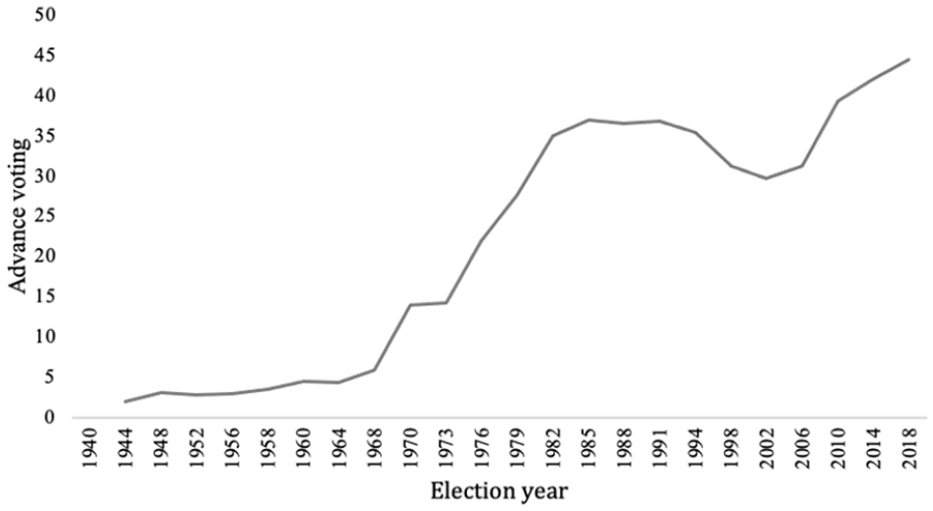
Advance voting in Sweden, 1944-2018.
Thereby, a Swedish voter has the choice between voting on Election Day at the polling station in their own electoral district or voting in advance. In the 2018 parliamentary election, the districts included, on average 1248 eligible voters. There are some very small districts with only a few hundred individuals and some large districts with close to 2400 individuals. However, 89% of the districts consist of between 800 and 1800 individuals. In other words, going to the polling station to cast a vote on election day will for many entail the prospect of running into some neighbors who potentially might oversee the selection of the publicly displayed party ballots.
Up until the 2018 election, as part of the election procedure, Swedish voters had to pick ballots from an open stand at the polling station, unless they could get a hold of a ballot beforehand (many parties send out their ballots to some of the households). 3 The ballots are party-specific and piled next to each other. The concurrent elections—with elections held on the same day at local, regional, and national levels—make the logistics of the ballots tedious, especially since there are both blank ballots and ballots for preferential voting. Even though only 8 million people were entitled to vote in the Swedish 2018 elections, 673 million (!) ballots were printed and distributed. The main critique of the Swedish ballot system has, however, been related to the public display of ballots for voters to choose from, since it violates international standards on electoral processes and the integrity of elections (Elklit and Maley, 2019). The widely cited Declaration on Criteria for Free and Fair Elections states that the “right to vote in secret is absolute and shall not be restricted in any manner whatsoever” (cited from Elklit and Maley, 2019). Two dimensions encircle the benefit of the secret ballot. First, it makes it possible for voters to keep their decisions private, thereby preventing sanctions from the surrounding society. Second, it makes it impossible for the voter to prove how he or she has voted, which prevents vote-buying (Rokkan, 1961). The secret ballot is thus perceived as a requirement for true personal autonomy (Dahl, 2008). The regular placement of ballots in Sweden has either been in a stand or on a table of public display located at the polling station without further cover or protection.
That the public display of ballots could influence voting behavior has been indicated by a Swedish Commission of Inquiry investigating the electoral process (SOU, 2021: 7), which carried out a field experiment related to the Swedish ballot system. In the field experiments, participants were randomly assigned to groups and asked to cast a ballot in different settings. Those who voted in a setting that resembled a real election with publicly displayed ballots reported to a lesser degree that they felt they could cast a ballot in secrecy compared to those who voted in a setting where they could pick a ballot behind a screen (Esaiasson et al., 2023; Teorell et al., 2020). 4
One approach to minimize social interactions when voting is to take advantage of Sweden’s generous opportunities to vote in advance. This gives the voter the opportunity to vote at a polling place in a different area than their local neighborhood and at a time when the polling place is less crowded.
Data and Method
To test the hypothesized stigma effect on voting for the SD, we use the Swedish National Election Studies 2014 and 2018. In these parliamentary elections, ballots were placed on public display, and the SD was excluded by a cordon sanitaire. The Swedish National Election Studies (SNES) are designed as short-term campaign panels with pre- and post-election surveys. The survey is based on a probability sample of the Swedish population entitled to vote and of age between 18 and 85. The data collection is conducted by Gothenburg University in association with Statistics Sweden.
In the main analysis, we use a pooled dataset based on the election surveys in 2014 and 2018. In addition, we have included observations from the European Parliament election survey 2014, also collected by SNES, that likewise includes questions regarding the voting procedure and party choice from the national election that same year. This gives us a sample of 2271 individuals with a response rate of 56% in 2014 and a sample of 6548 individuals with a response rate of 46% in 2018.
Information on the election results at different administrative levels is based on official election results published by the Swedish Election Authority. This data includes information about the different political parties,’ including the SD, vote shares in the election districts, which is the lowest possible level of aggregation (they amount to 5837 districts in 2014 and 6004 in 2018). The data is further weighted against the official election results in each election. In addition, the analysis includes fixed effects for each survey year and clustered robust standard errors.
Operationalizations
Our dependent variable concerns the respondents’ voting mode. In the dataset, respondents are asked whether they voted on Election Day or in advance. The question is coded as a binary variable where one equals voting in advance. In turn, the main independent variable support for the SD can be assessed in various ways, such as (a) pre-election support (best party), (b) pre-election vote intention, and (c) post-election party choice. In our main analysis, we have opted for post-election party choice since it includes the highest number of observations, but results from the alternative operationalizations (best party and vote intention) can be found in Online Appendix (Tables A3 and A4).
We further control for several variables that could influence both the support for the SD and the choice of voting mode. We include demographic control variables that have been shown to relate to the choice of voting procedure: gender, place of residence, occupation, age, and educational attainment. Gender is operationalized as a dummy variable where one equals woman. In turn, place of residence includes four categories, with the countryside is used as the reference category. Age ranges between 18 and 85 years of age, and occupation is divided into (self-assessed) blue-collar workers and white-collar workers. We also inquire about the previous occupation of unemployed and retired individuals. Finally, education is treated as a dummy variable where 1 corresponds to having a degree from, or studying at, a university. Descriptive statistics for the included variables can be found in Online Appendix (Tables A1 and A2).
Analytical Strategy
The dependent variable in our analysis is, as mentioned, the voting mode. We operationalize the stigma effect as the interaction between voting for the SD and the support for the party in the voter’s electoral district. The probability for advance voting among Sweden Democrats-sympathizers is expected to be lower in districts where many other voters also sympathize with the party. The stigma of voting for the SD is therefore expected to be negatively correlated with the level of party support in the voter’s district. Furthermore, the stronger the stigma, ceteris paribus, the higher we expect the probability for advance voting to be.
The analysis is conducted using logistic regression models with individual-level survey data and an aggregated variable concerning the support for the SD in the voter’s electoral district. An alternative strategy would be to apply a hierarchical multilevel model. However, the dataset does not include an ID variable for the respondents’ electoral district but solely the aggregated variables concerning the parties’ relative success in the voters’ (very small) electoral district. An ID for the electoral districts is not provided to ensure the respondents’ anonymity. In addition, several districts consist of just one or a few respondents, which could make the estimations through a multilevel model unreliable (McNeish and Stapleton, 2016).
We do, however, create an ID variable for the electoral districts and run a multilevel logistic regression as a robustness test. The ID is constructed based on the unique values of support for the different parties in the electoral district. Using this ID variable for the electoral districts, we cannot pool the data from the different election surveys. Still, the results are in line with those of our logistic regression and are presented in Online Appendix (Table A9). 5 In addition, we incorporate control variables at the municipality level to consider potential contextual factors that could influence the results beyond the observed “stigma effect.” These control variables encompass population size (obtained from Statistics Sweden) and unemployment levels (obtained from the Swedish Public Employment Agency).
Our strategy to estimate the stigma effect is based on two stages. First, we present descriptive statistics that highlight the imbalance in voting mode across the political parties. Thereafter, we examine the stigma effect on the voting mode. The logistic analysis is based on three models. In the first model, we assess the probability of voting in advance by being a Sweden Democrat voter. Second, we include the interaction term, and in the next step, the control variables are included.
Results
Table 1 provides evidence of Sweden Democrat voters having a higher probability of voting in advance in the general elections of both 2014 and 2018. Among Election Day voters in 2018, only 15.1% voted for the party. The corresponding share among advance voters was 20.0%. Also in the 2014 election, the SD had about six percentage points higher support among advance voters compared to Election Days voters. The party accordingly has the highest difference between advance voters and Election Day voters in both elections. The decrease in advance voters in 2018 could be attributed to the increased support for the SD. The party increased its electoral support by five percentage points, in line with hypothesis 2.
Party support among election day voters and advance voters, 2014 and 2018 (percent, percentage difference).
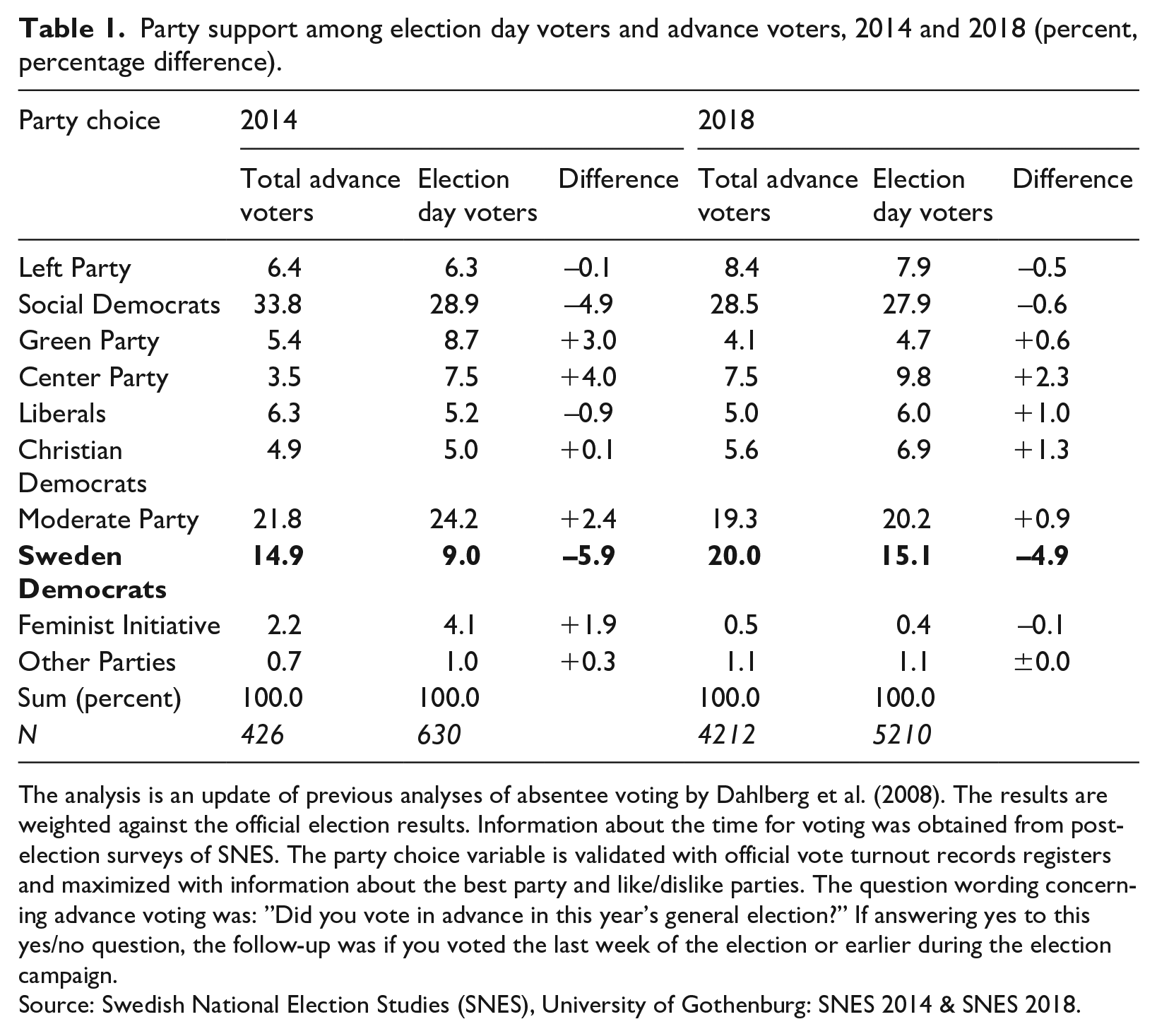
The analysis is an update of previous analyses of absentee voting by Dahlberg et al. (2008). The results are weighted against the official election results. Information about the time for voting was obtained from post-election surveys of SNES. The party choice variable is validated with official vote turnout records registers and maximized with information about the best party and like/dislike parties. The question wording concerning advance voting was: ”Did you vote in advance in this year’s general election?” If answering yes to this yes/no question, the follow-up was if you voted the last week of the election or earlier during the election campaign.
Source: Swedish National Election Studies (SNES), University of Gothenburg: SNES 2014 & SNES 2018.
If there is a social stigma effect on the choice of voting procedure, we expect the probability of early voting to be higher among voters with a strong preference for the SD because they want to avoid picking ballots in crowded polling stations on election day. If so, the social stigma would be stronger in areas and places where there are few other sympathizers as opposed to in areas where it is less controversial to be a sympathizer of the party. Thus, the proportion of SD-sympathizers in a voter’s district is expected to moderate the effect of being an SD-sympathizer and the tendency to vote in advance.
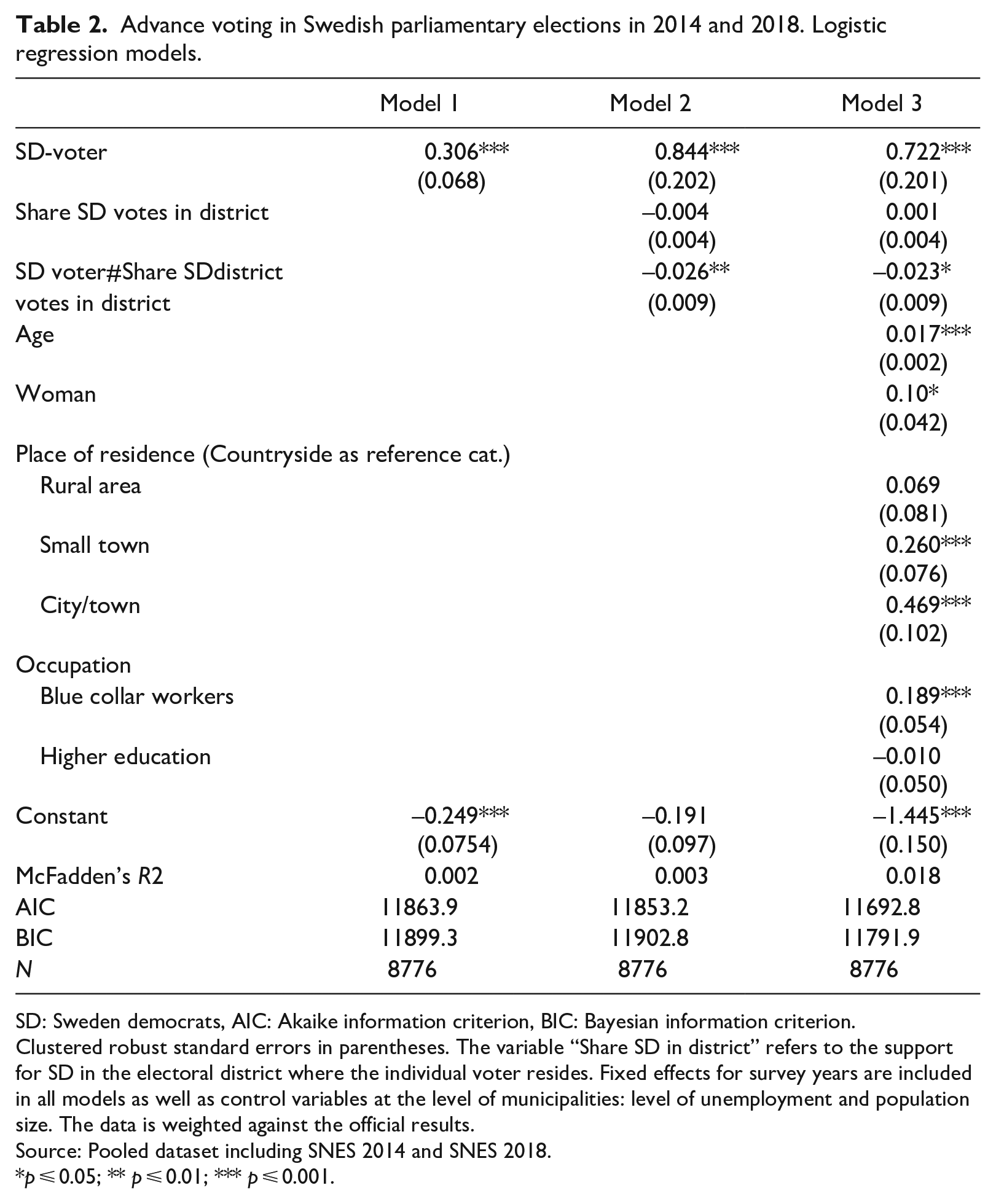
In Table 2, we report the results from our main specifications of the logistic regression models. The results from the first model, which solely includes the focal relationship between being a Sweden Democrat voter and voting mode, confirm that voters of the party are more likely to vote in advance, in line with our descriptive findings. In Model 2, the interaction term between being a Sweden Democrat voter and support for the party in the voter’s electoral district is included. The results demonstrate a statistically significant interaction effect between SD support and the share of SD votes in the district on the probability of voting in advance (−0.026**). There is thus an elevated tendency to avoid voting at polling stations during Election Day among SD voters in general, but less so among SD voters who live in electoral districts where the average support for the SD is high. 6 In Model 3, we include the additional control variables, which reduce the strength of the interaction term marginally (from −0.026** to −0.023*) but it remains statistically significant. 7
Advance voting in Swedish parliamentary elections in 2014 and 2018. Logistic regression models.
SD: Sweden democrats, AIC: Akaike information criterion, BIC: Bayesian information criterion.
Clustered robust standard errors in parentheses. The variable “Share SD in district” refers to the support for SD in the electoral district where the individual voter resides. Fixed effects for survey years are included in all models as well as control variables at the level of municipalities: level of unemployment and population size. The data is weighted against the official results.
Source: Pooled dataset including SNES 2014 and SNES 2018.
p ⩽ 0.05; ** p ⩽ 0.01; *** p ⩽ 0.001.
The estimated coefficients are easier to interpret in terms of predicted probabilities. Based on Model 3, in a district where only five percent vote for the SD, the predicted probability of voting in advance for an SD voter is 0.57, while it is 0.41 for other voters. In less stigmatized areas, where 30% of the voters support the SD, there are no significant differences in the predicted probabilities of voting in advance between SD voters and other voters.
The expectation that those who voter for stigmatized parties tend to avoid crowded polling stations on Election Day, therefore, gains empirical support. In our analysis, we find that Sweden Democrat supporters are more prone to vote in advance, which confirms our first hypothesis. The probability of voting in advance among Sweden Democrat voters is also higher in districts with less support for the party and vice versa. 8 These results align with the idea of a stigma effect, that is, that the perception of other people’s negative view of a party impacts the choice of voting procedure. 9 This finding lends empirical support to our second hypothesis. The results are robust when controlling for socio-demographic factors that we from previous research know can affect the probability to vote in advance. 10
The probability of voting in advance among SD voters across districts with varying support for the party is visualized in Figure 2. The cut-point is reached when the aggregated support for the party passes over 20% at the electoral district level. It should be mentioned that the interaction effect does not seem to be entirely linear in terms of predicted probabilities (see Hainmueller et al., 2019). The main difference across electoral districts with different shares of Sweden Democratic votes is between constituencies with low proportions of Sweden Democrat voters versus medium- and high shares of sympathizers (see Figures A1 and A2 in Online Appendix). Hence, it is in the most highly stigmatized contexts that we find the largest share of Sweden Democrat voters voting in advance and less so in more Sweden Democrat-leaning districts.
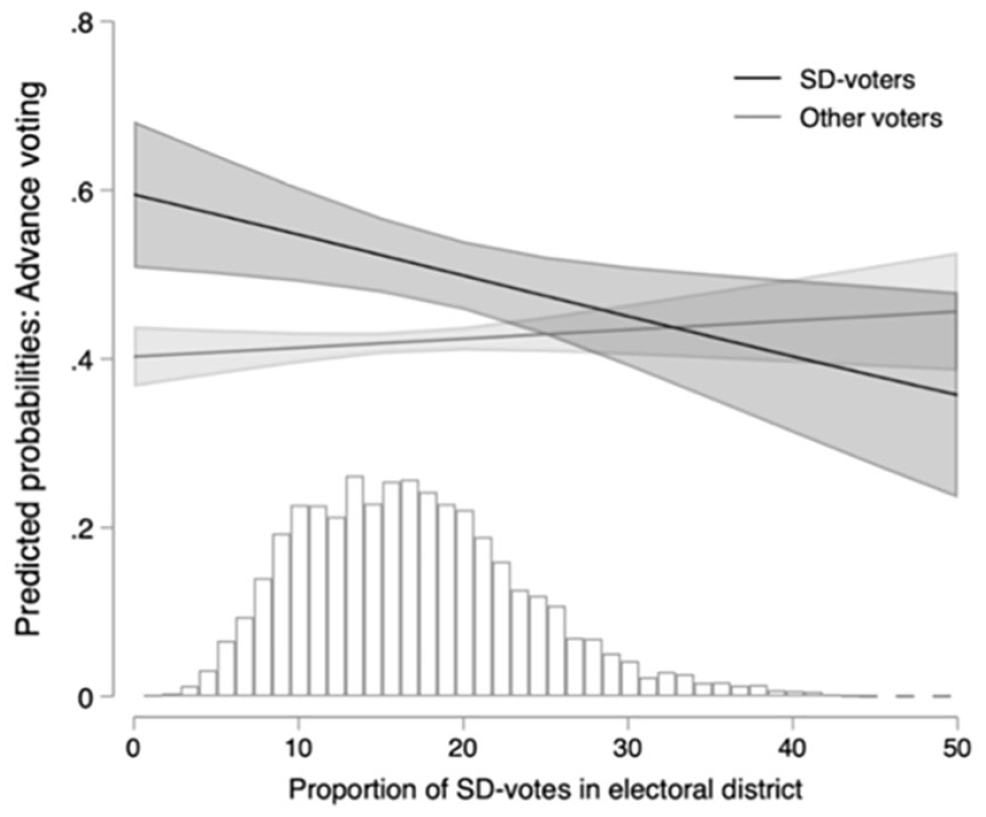
Advance voting in Swedish parliamentary elections among Sweden Democrats and other voters.
Robustness Checks
In Online Appendix, we present a set of auxiliary analyses and robustness checks. We present estimates of a similar model using another data source, the Swedish public service television’s exit polls (VALU), which do not change our main conclusions (see Table A6). Furthermore, our results also hold up when using two alternative operationalizations of supporting SD: considering SD the best party and intending to vote for SD in the election (see Tables A3 and A4). In addition, the significant negative interaction term remains when running the data in a logistic multilevel model (Table A9).
To further strengthen our findings, we replicated the analysis with the other political parties represented in the Swedish parliament. We changed both the aggregated variable of the parties’ support in the electoral districts and interacted it with the individual level support for the specific party. By not only comparing Sweden Democratic voters with all other voters, but to the parties from which they generally originate, that is, the Alliance parties (cf. Jylhä et al., 2019), we get an even more direct test of whether it actually is the social stigma that drives the effect. None of the other parties had a significant interaction term between their support on the local level and their probability to vote in advance in this “placebo analysis,” as Table 3 demonstrates. This result is in line with our theoretical understanding of a stigma effect associated with RRP.
Advance voting in Swedish parliamentary elections in 2014 and 2018. Logistic regression models, all parties.
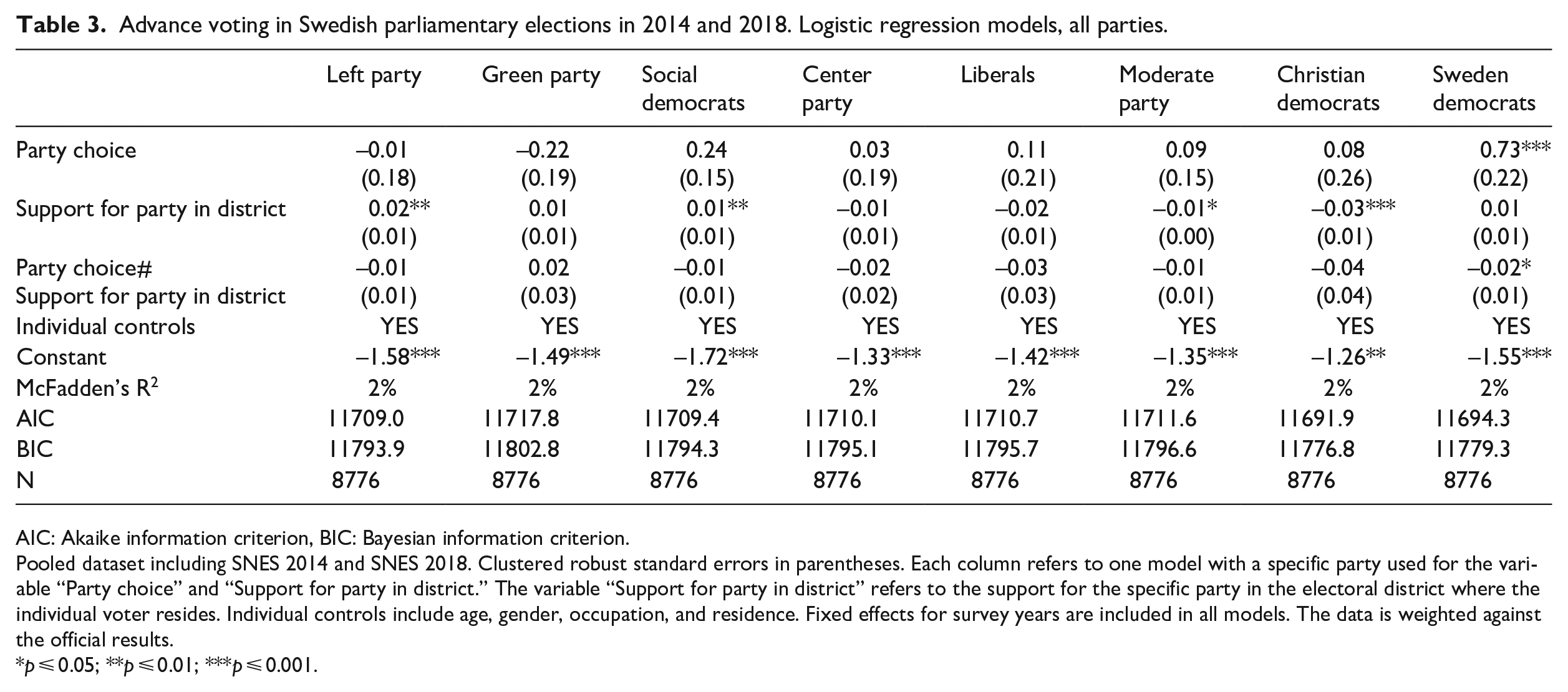
AIC: Akaike information criterion, BIC: Bayesian information criterion.
Pooled dataset including SNES 2014 and SNES 2018. Clustered robust standard errors in parentheses. Each column refers to one model with a specific party used for the variable “Party choice” and “Support for party in district.” The variable “Support for party in district” refers to the support for the specific party in the electoral district where the individual voter resides. Individual controls include age, gender, occupation, and residence. Fixed effects for survey years are included in all models. The data is weighted against the official results.
p ⩽ 0.05; **p ⩽ 0.01; ***p ⩽ 0.001.
In sum, these results provide important insights into how stigma effects from RRP are associated with electoral behavior. The stigma associated with the parties does not only impact which parties are considered viable voting options, but also seemingly impacts how voters act during the election. In turn, this stigma effect is mitigated when the general support for the party increases.
Conclusions
In this study, we find support for our two hypotheses of a social stigma effect on the choice of voting procedure. Sweden Democratic voters are more likely to vote in advance compared to other voters, and we find support for social stigma as an explanation. In districts with little support for the SD, a supposed stigmatized context for SD sympathizers, their voters are more likely to vote in advance instead of on Election Day. These findings shed light on how the social context impacts stigma effects, in line with observations from previous studies (e.g., Bursztyn et al., 2020; Harteveld et al., 2019; Zuckerman, 2005). They further highlight how stigma effects related to RRP interact with the voting context. The study thus complements findings of differences in voting strategies of radical right voters in other countries (e.g. Valentim, 2021). Hence, even though “cordon sanitaire” formed by the Swedish mainstream parties against the SD is not so common, it is likely that the results travel to other countries where early voting is available.
Our study further stresses the importance of enclosing the vote secrecy. If the vote secrecy is not upheld, electoral behaviors are clearly affected. These results reflect those of Valentim (2022), who found that stigma effects in Spain seem to make voters more likely to vote in private. In contrast to earlier studies, however, our study shed light on how the stigma effect on the choice of voting procedures varies depending on the general support for the party in the voters’ neighborhood. In addition to showing that there are political consequences when vote choices are perceived as less acceptable in the eyes of others, our study further demonstrates that a radical right party with an increasingly growing political influence, and that has had parliamentary representation, can remain stigmatized. Thus, the local level seemingly constitutes a more important reference point for voters of stigmatized parties than the national level. Even if the support for SD is relatively high in the national election, the electoral district still shapes the stigma perceptions. Future studies should test the hypothesis of a social stigma effect by examining if the political behavior of voters’ changes when their party of choice becomes less stigmatized by mainstream parties.
Still, there are limitations to our study. It could be argued that the overall higher probability of advance voting among SD voters could have occurred because of an unsuccessful election campaign during the time close to the election. If so, it could explain why the party had weaker support among Election Day voters. That would, however, not explain why the likelihood of voting in advance varies with the support for the SD in the district where the voter resides. It could further be hypothesized that the stigma effect could be even more substantial than suggested in this study; individuals who are uncomfortable admitting they support the party could be expected to be less likely to participate in election surveys and also be less likely to express their actual preferences if they do accept to participate in a survey due to social desirability bias.
Despite potential weaknesses, the empirical findings of this study are robust over different operationalizations, model estimations, and data sources. We do find that SD sympathizers on average have a higher probability to vote in advance and we also find that this effect is moderated by the share of votes for the party at the district level. The largest share of advance voters among SD voters is found in districts where the party has little support, which could therefore be seen as a context where the social acceptance for voting for the party is low due to the stigmatization.
From a democratic point of view, the result of this study could, on one hand, be seen as discouraging. If a perceived social pressure can predict the preferred choice of voting procedure, it is a serious underperformance of the electoral administration. A person’s right to vote in secret is absolute and shall not be restricted in any way (Elklit and Maley, 2019). Still, on the other hand, there are seemingly ways to mitigate the democratic weaknesses of such an electoral system. Implementing generous opportunities to vote in advance could be a strategy to enclose the vote secrecy and avoid social pressure in a setting with public displays of ballots.
Supplemental Material
sj-docx-1-psx-10.1177_00323217231216305 – Supplemental material for The Voter Next Door: Stigma Effects on Advance Voting for Radical Right Parties
Supplemental material, sj-docx-1-psx-10.1177_00323217231216305 for The Voter Next Door: Stigma Effects on Advance Voting for Radical Right Parties by Hilma Lindskog, Stefan Dahlberg, Richard Öhrvall and Henrik Oscarsson in Political Studies
Footnotes
Acknowledgements
We would like to thank Richard Karlsson for providing invaluable assistance in the initial stages of data management for this study. In addition, thanks also due to the seminar participants at Center for Local Government Studies, Linköping University, and at the GEPOP seminar at University of Gothenburg. We would also like to thank the editors and anonymous reviewers for their very helpful comments and suggestions.
Data Availability Statement
Data from exit polls are collected by the Swedish Television Public Broadcasting Company (SVT) and freely available open-access data ( ). The data from the Swedish National Election Study 2014 was collected by Statistics Sweden and approved by the agency’s own ethical board. The Swedish National Election Study 2018 was approved by the Regional Ethics Board in Sweden.
Declaration of Conflicting Interests
The author(s) declared no potential conflicts of interest with respect to the research, authorship, and/or publication of this article.
Funding
The author(s) received no financial support for the research, authorship, and/or publication of this article.
Permission to Reproduce Material from Other Sources
We do not need permission since we only use open, or upcoming open, sources.
Supplemental Material
Additional Supplementary Information may be found with the online version of this article. Table A1. Summary statistics of core variables. Table A2. Proportion of Election day voters and advance voters among supporters for the Sweden Democrats (Percent). Table A3. Advance voting in Swedish parliamentary elections 2014 and 2018. Logistic regression models: SD as best party. Table A4. Advance voting in Swedish parliamentary elections 2014 and 2018. Logistic regression models: Intention to vote for the Sweden Democrats. Table A5. Advance voting among Sweden democrats in Swedish parliamentary elections in 2014 and 2018. Logistic regression models, unweighted models. Table A6. Logistic regression models of advance voting in Swedish parliamentary elections in 2014 and 2018. Table A7. Advance voting among Sweden Democrats in the Swedish parliamentary election 2018. Table A8. Advance voting among Swedish democrats in the Swedish parliamentary election 2014. Logistic regression models, 2014. Table A9. Logistic multilevel models of advance voting in the Swedish parliamentary election 2018. Figure A1. Diagnostics: linearity of interaction terms. Figure A2. Diagnostics: Marginal effects at low, medium, and high values of the moderator
Notes
Author biographies
References
Supplementary Material
Please find the following supplemental material available below.
For Open Access articles published under a Creative Commons License, all supplemental material carries the same license as the article it is associated with.
For non-Open Access articles published, all supplemental material carries a non-exclusive license, and permission requests for re-use of supplemental material or any part of supplemental material shall be sent directly to the copyright owner as specified in the copyright notice associated with the article.
