




Abstract
While a large literature interrogates the causes and consequences of declining political trust in democracies, considerably less work has considered the everyday leadership strategies that might arrest this trend. I tackle this gap as I ask: what can politicians do to build trust? Going beyond the performance perspective current in political science, I suggest that all politicians can build trust by (1) increasing occasions for political contact and (2) utilising authentic political communication. These arguments are developed out of interviews with national politicians in five democracies (N = 51) and tested empirically with observational and experimental survey data gathered from a longitudinal sample of the UK public (N = 705). Attesting to academic work on the contact hypothesis and ‘authentic trust’, as well as the testimony of politicians themselves, these analyses suggest that both strategies carry appraisive potential. These findings contribute conceptually and practically to our understanding of both trust and leadership in politics.
Introduction
‘I think that probably the only way that we can rebuild trust between politicians and the general public is by integrity, honesty, by being exemplary in the way in which you carry out your duties. And, of course, being tremendously honest, open and above everything, being really transparent about what you’re doing, what you aim to do, what your views are’.
Recent decades have seen a worrying decline in the public’s trust in democratic politics and politicians around the world. In 2022, the Edelman Trust Barometer reported a ‘collapse of trust in democracies’ (Edelman, 2022: 19) with countries like the United States, Germany and the United Kingdom all existing in a state of ‘default’ distrust. Government leaders and politicians were ranked the lowest among nine groups of societal leaders in the 2022 barometer and an average of 66% of people, surveyed across 27 nations, expressed concerns that their political leaders were purposely trying to mislead them (Edelman, 2022). This trust deficit raises significant concerns about the viability of legitimate governance and policy making as well as the sustainability of long-held democratic norms (Citrin and Stoker, 2018; Norris, 2022; Norris and Inglehart, 2019; Slemrod and Bakija, 2004; Tyler, 1998). Yet despite such a voluminous literature on the meaning of political trust, its causes and its consequences, there is far less work on possible remedies for the current malaise and, specifically, the everyday practices that politicians might employ to build trust or repair it where deficits already exist.
Where thinking in political science has been solutions-focused, it has tended to denude individual politicians of agency by, instead, focusing on the diffuse impact of stronger government performance and policy outputs (e.g. Haugsgjerd and Kumlin, 2020; Van Erkel and Van der Meer, 2016), or the symbolic competence of those in the most senior offices of state (e.g. Green and Jennings, 2017). This instrumentalist school of thought or so-called ‘performance perspective’ argues that citizens offer or withdraw political trust in response to the performance of governments on key tasks such as economic growth, health, education, security, law enforcement, transportation and even waste management (e.g. Dalton, 2004; Easton, 1975; Yang and Holzer, 2006). Admittedly, this thesis is intuitive: fluctuations in political trust reflect people’s satisfaction with a government’s policy performance, which in turn spills over into diffuse evaluations of politicians as a class or even the procedural qualities of political systems and institutions.
In contrast, parallel research in leadership studies, management, and the organisational sciences has demonstrated that leaders at all levels can make a difference by giving their followers the ‘good reasons’ or warrants to trust in them above and beyond transactional incentives or institutional outputs (e.g. Asencio and Mujkic, 2016; Fledderus, 2015; Kharouf et al., 2014). In their meta-analysis of 185 studies on trust and leadership in business and organisational management, Legood et al. (2021: 5–6) find strong links between managers’ leadership style and the trust of their colleagues and employees. In particular, business leaders are able to instil trust by providing autonomy and resource (i.e. ‘empowering’ leadership), by showing behavioural integrity (i.e. ‘ethical’ leadership), and by evidencing and acting upon a moral responsibility to the success of an identifiable community (i.e. ‘servant’ leadership).
These are leadership styles that politicians might also usefully employ and, in this respect, I use this article to argue that politicians at all levels – local or national, backbench or ministerial – are akin to every other public servant or private sector manager who seeks to build trust in a leadership role. They need to be mindful of showing citizens that they are not only competent, but also consistent, benevolent, reliable, relatable, that their morals align with common values, and that they have integrity in their relations with others (above all, their electors). In sum, politicians must signal trustworthiness to those they govern in spite of government performance. This matters because, as Bews and Rossouw (2002: 378) put it: [. . .] trust refers to the act of trusting or not trusting, [but] trustworthiness entails an evaluation of those criteria that constitute trust and consequently, influences both the direction and intensity of any decision to act in a trusting manner.
In this article, therefore, the acts of demonstrating trustworthiness and building trust are taken hand in hand.
Yet what exactly this might constitute in such an atypical occupation as elected politics remains unclear. To tackle this gap, I take a novel approach – both methodologically and substantively – by starting with politicians’ own understanding of trustworthy leadership and using their insider perspectives as a launchpad for testing two personal trust-building strategies that they deem to be effective: political contact and authentic political communication. While existing research on the performance perspective builds upon the thoughts and feelings of citizens, this emic approach provides an alternative and equally valuable starting point: that is, the normative and practical significance of particular behaviours and practices relevant for trust building as they are understood by the people who engage in doing politics daily. Alongside strong and responsive policy performance, politicians interviewed in five different national settings mentioned the power of personal interaction as a way to defuse public antipathy as well as the constructive effects of authentic political rhetoric based on partial promises and honest accounts of failure. While political contact may improve the tenor and accuracy of trust judgements about politicians, authentic rhetoric may build a more resilient type of trust that allows for the possibility that some ‘betrayals’ can occur without automatically or detrimentally impacting public perceptions of a politician’s trustworthiness.
In what follows, I start by introducing the qualitative data set of interviews conducted with politicians (Study 1) and outline their self-reported strategies for building trust in political office. I then use their responses to provide a thick description of political contact and authentic rhetoric as two personal strategies that are available to all politicians and which have, in turn, been largely overlooked in political science. Taking these strategies in turn (‘Strategy 1’ and ‘Strategy 2’), I then seek to ground politicians’ own ideas in existing academic literature on contact and authentic leadership. In doing so, I formulate theory-based hypotheses for further empirical testing. Using longitudinal survey data and survey experiments administered to citizens in one low-trust country, the United Kingdom, I subsequently show that each of these strategies has the potential to arrest losses of political trust and affect meaningful change for individual politicians’ relationships with their electors (Study 2). These findings offer a glimmer of hope for those in and out of office who are deflated by an otherwise bleak political landscape.
Study 1: Qualitative Insights on Trust Building in Politics
Data and Headline Findings
Although politicians are often identified as the object of political trust, they have been largely absent from the academic conversation about how to repair or build it. In this article, I challenge this norm for the first time by presenting qualitative insights from in-depth semi-structured interviews conducted with a diverse sample of 51 national politicians. The sample includes Members of Parliament (MPs) in the United Kingdom (6), Canada (16), South Africa (6), Australia (6), New Zealand (3), Peers in the United Kingdom’s House of Lords (7), and elected politicians from each of the United Kingdom’s devolved parliaments in Wales (2), Scotland (3) and Northern Ireland (2). Participants opted in to complete an interview after taking part in a larger survey study of trust and governance in each of these comparative democracies, which were chosen as ‘most different’ cases because they have all experienced crises of political trust in spite of institutional and cultural differences (see Weinberg, 2023).
While preserving anonymity, Online Appendix A summarises the demographic characteristics and career statistics of each interviewee. Reflecting the current composition of their respective legislatures, 75% of interviewees were men and only 31% were under the age of 50. Participants represented a range of political parties on the ideological Left and Right, including those in and out of government in their respective countries, as well as diverse careers spanning less than 1 year in office through to more than 20 years. Of the 51 politicians interviewed, 16 represented marginal seats or held insecure party list positions, while more than 50% had held a frontbench position in their party over the course of their careers. All participants provided informed consent prior to completion of these interviews in accordance with ethical approval granted by The University of Sheffield (Ref. 033126). The interviews were carried out in February and March 2021, and each one lasted between 30 and 90 minutes.
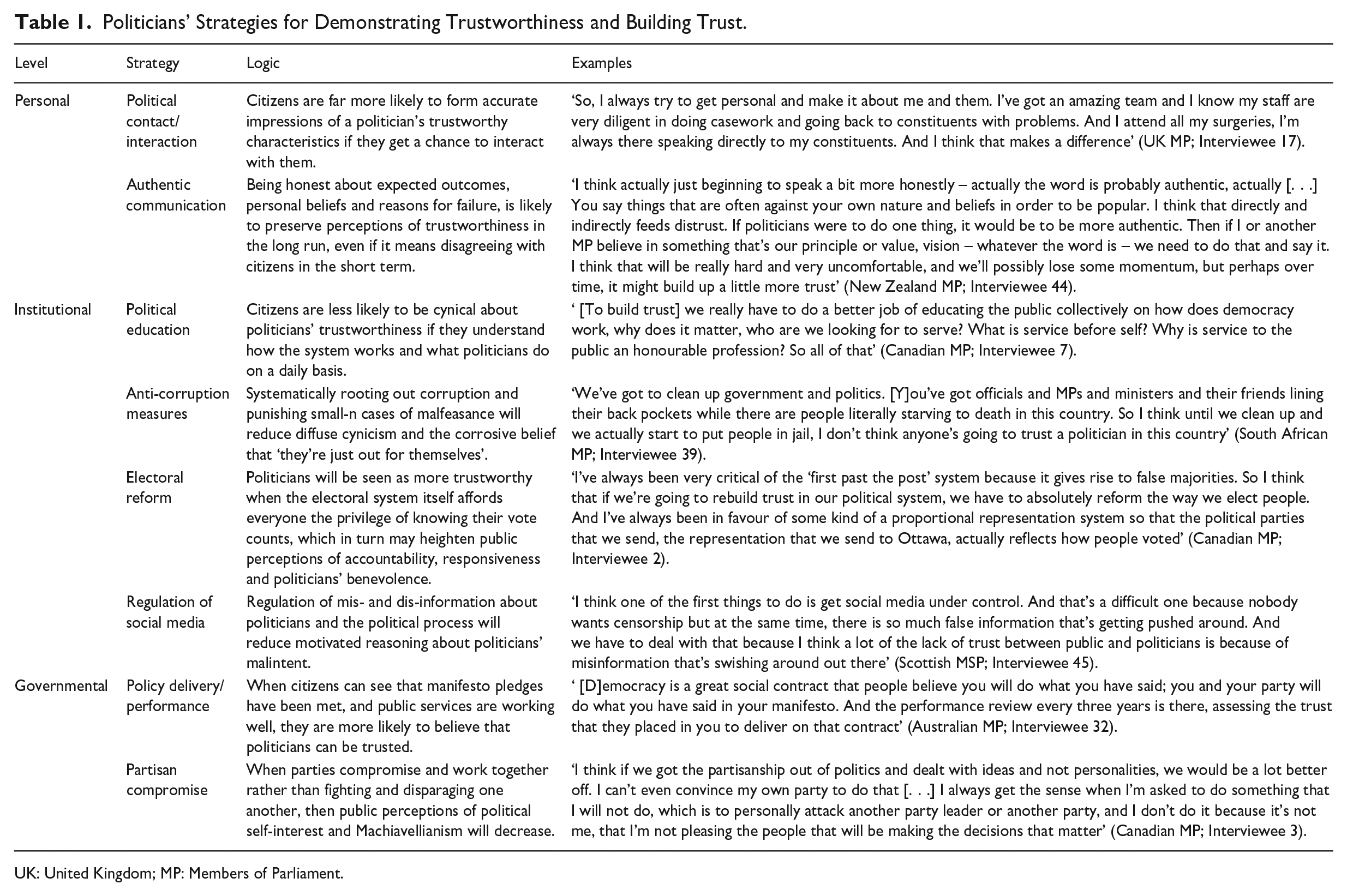
These interviews were purposefully inductive with the aim of acquiring a relevant yet previously overlooked perspective on the central research question guiding this article: what can politicians do to build and sustain trust? To achieve this, I extract responses to one particular question asked of each politician: ‘What do you think can be done to build political trust?’ Participants’ responses were thematically coded for evidence of specific trust-building strategies and those relating to politicians’ personal behaviours were then used as a starting point for targeted engagement with relevant academic literature and subsequent deductive tests of complementary hypotheses (see Study 2). Trust-building strategies were only included in the thematic analysis if they were mentioned by at least five participants from at least two different countries or legislatures, thus ensuring a degree of inter-participant corroboration. In total, this deconstruction of politicians’ responses highlighted eight strategies operating at three levels of responsibility: personal, institutional, and governmental (Table 1).
Politicians’ Strategies for Demonstrating Trustworthiness and Building Trust.
UK: United Kingdom; MP: Members of Parliament.
Personal strategies are actions that all politicians can enact in their daily professional lives such as cultivating moments for civic interaction or altering communicative practices. Institutional strategies relate to large-scale systematic reforms to political processes or services such as elections, regulation of social media and tighter anti-corruption measures. And finally, governmental strategies are actions or outcomes that depend on the collective decisions of party leaderships and governments, not individual politicians. In these interviews, politicians talked of instrumental governmental strategies, such as strong policy delivery, as well as softer changes to political conduct, such as greater inter-party cooperation and compromise. Some strategies were more prevalent in particular countries. For example, anti-corruption measures were most often mentioned by South African MPs, while electoral reform was pushed most strongly by Canadian MPs. In contrast, personal strategies and government performance were touched upon by interviewees in all five countries.
A Thick Description of Political Contact and Authentic Communication
I narrow my focus here to the two personal trust-building strategies advocated by participants, specifically political contact and authentic rhetoric, because (a) these are leadership choices available to all politicians, and (b) they have received little, if any, attention as trust-building strategies in academic research in political science where the focus has been almost exclusively on government performance. The first of these strategies was mentioned by just over 50% of interviewees and most responses focused on the affective ties that are forged between politicians and citizens in moments of political contact. As one Australian politician surmised: I think it helps to build trust if [voters] personally know you. Naturally, human nature is that you trust people more so if you know them or have spoken to them. ‘I’ve met that guy, he’s all right. He’s okay’. That kind of thing (Interviewee 34).
Other interviewees stressed the importance of physical contact as a way to exhibit benevolent characteristics to citizens who do not agree with them ideologically. In this respect, interviewees believed that constructive intergroup contact with naturally distrustful out-partisans, non-voters or sceptical in-partisans might break down psychological generalisations about their trustworthiness (or lack thereof) even in the presence of intractable social, cultural or political differences. One New Zealand MP put it this way: I think the more people see a politician in the flesh, the more people will feel comfortable that he/she does have their interests at heart and is trying their best and therefore is worthy of some degree of trust [. . .] notwithstanding that on any given issue they might not agree with the conclusions reached or that they think more should be done, further, faster etc (Interviewee 43).
Offering a classically Bayesian understanding of trust and political contact, interviewees belied a belief that public judgements about their trustworthiness would improve in a positive direction proportionate to the public’s experience of said interaction. In this respect, interviewees also talked of political contact as being more effective when politicians engaged in detail with a constituent and, where possible, in a personalised way. One UK MP reflected: Obviously, you need to respond to constituents by doing lots of casework, but doing it in a timely sort of fashion and giving proper responses rather than flippant responses. So making sure that you show them respect, even when you disagree with them, giving a thoughtful response to them, honest, considered, even if you disagree with it (Interviewee 17).
Similarly, politicians recognised that political contact is most effective at building trust where it is dialogic and structured around reciprocal goals. Reflecting on the need to do this in a context where it was not currently self-evident, one South African MP commented: We need mechanisms that build social cohesion and that strengthen the social compact. [Our President] will address the media, he’ll tell them what’s going on, and then it’s like mic drop and his people take him away. As a result, people don’t feel like the politicians answer to them. So we need greater mechanisms for engagement between politicians and civil society. And I think that we need to embark on a project of real nation building that brings politicians and the public together in a mutual problem-solving exercise. South African MP (Interviewee 38).
As interviewees moved beyond the frequency of political contact per se and focused on the substance of interactive moments, they also started to elaborate on a second personal trust-building strategy: authentic political communication. In many instances, the two were talked about in sequence – authentic rhetoric being a feature of successful political contact. For example, interviewees stressed the importance of articulating pledges and anticipated outcomes in a way that acknowledges political risk. As one Canadian MP (Interviewee 3) put it, ‘[t]he key thing is not setting expectations to a level that you can’t achieve’. Interviewees highlighted the potential benefits of more realistic agenda setting and blunt conversations. Bemoaning the inauthentic leadership of then Prime Minister Boris Johnson, one ex-MP in the United Kingdom’s second chamber explained: I think the single most important thing is being honest with people about the choices that politicians are facing. But if you’ve got a Prime Minister who basically says, ‘yeah, you can have that’, which Boris does, then you’re saying that you can have your cake and eat it. But the trouble is you can’t have your cake and eat it. And until you are open with people about what they will get and what they can expect, you will not retain their trust in my view (Interviewee 28).
The same logic of partial promises and managed expectations resonated in the words of politicians at multiple tiers of governance. One member of the Welsh Sennedd was quick to argue: We’re in an election at the moment and I’ve already done a few hustings. I’ve been at pains to say to people that it’s easy to promise things if you don’t expect to have to deliver them. We are trying very hard to promise things that we will be able to deliver and that, that matters (Interviewee 49).
If partial promises were advocated as a way to stymie future losses of trust and trustworthiness, then politicians also promoted authentic communication in moments of ‘betrayal’. Here, the key to authentic leadership for interviewees relied on their ability to aid appropriate causal attribution in moments of failure by accepting that a betrayal of trust had occurred and, where appropriate, articulating the truthful reasons why it had occurred, rather than engaging in partisan or otherwise obfuscating blame avoidance behaviours. In the words of one senior UK MP: We have to somehow get back to a recognition that you cannot say whatever is expedient, that you have to say what is honest, as far as you can. You have to be as straight as you can be when things go wrong. And I’ve found actually it’s easier over 37 years now (Interviewee 21).
Putting the same sentiment rather more directly, one Canadian MP (Interviewee 8) noted: ‘[n]othing is more corrosive of trust than realising that somebody’s bullshitted you, and especially for their own self-aggrandisement or their own self-interest’. Rather than party-political mudslinging when things go wrong, interviewees pushed for a more complex and conditional form of political leadership, which has the potential to be more durable and, ultimately, more sustainable as the basis for an ongoing social contract between politicians and the public they serve. The same Canadian MP elaborated: Politicians have to say look, I know you feel ripped off. But here’s why we’re doing this, and here’s the reason we changed tack. You may not like it, and I want to hear from you and get your views in that case. But this is why we did it, and why I think it’s unavoidable or why it’s going to be OK (Interviewee 8).
These interviews provide a unique and original starting point for thinking about the everyday leadership strategies that politicians might use to demonstrate their trustworthiness in democratic office. I now turn to relevant streams of academic research on trust repair, leadership, and intergroup relations in order to distil and develop these specific ideas about political contact and authentic communication in more detail.
Strategy 1 Theory: The Case for Contact
The palliative effects of intergroup contact are widely hailed in social psychology as ‘one of the most important psychological interventions to promote social change’ (McKeown and Dixon, 2017: 2; see also Dovidio et al., 2003). The so-called ‘contact hypothesis’ dates back to Gordon Allport’s (1954) seminal text, The Nature of Prejudice, which linked desegregation policies in the United States to changes in prejudicial attitudes towards black communities. Allport’s (1954: 9) book triggered decades of research into when, why and how intergroup contact might diminish prejudice, which he defined as ‘an antipathy based upon a faulty and inflexible generalisation toward a group as a whole, or toward an individual because he is a member of that group’. In 2006, Pettigrew and Tropp’s influential review of the existing literature on intergroup contact found more than 500 published studies dating from the 1940s to the year 2000 and including more than 250,000 participants from 38 different countries. Their meta-analysis includes studies of prejudice against racial and ethnic groups (roughly 50% of the sample) as well as prejudice against mentally and physically disabled groups, different age cohorts, LGBTQ+ groups, and competing partisans. Based on negative correlations between contact and prejudice in 94% of their sample, Pettigrew and Tropp (2006: 751) declared ‘[t]here is little need to demonstrate further contact’s general ability to lessen prejudice’ (see also Paluck et al., 2019: 152).
While it would be strongly remiss to equate racial or ethnic prejudice with distrust in politicians, Allport’s broad definition of prejudice has parallels with the problems underpinning contemporary political trust insofar as personalised trust judgements about politicians are increasingly informed by automatic negative generalisations about the kind of person who might enter politics (e.g. Clarke et al., 2018; Stoker et al., 2016). Studies of intergroup contact that specifically take trust as their dependent variable also find positive results in settings as diverse as Italian schools, where contact improved trust in immigrants (Vezzali et al., 2012), and conflict zones like Northern Ireland, where contact tempered distrust of sectarian outgroups (Tam et al., 2009). It makes intuitive sense, then, to expect that the moderating effects of the contact hypothesis might extend to public trust in politicians. Put another way, contact between politicians and the public may well facilitate more considered cognitive evaluations of politicians’ trustworthy characteristics and in turn build affective bonds that encourage trusting attitudes and behaviours. This exercise in what Sartori (1970) eloquently coined ‘conceptual travelling’ provides strong theoretical support for the thoughts and experiences of politicians themselves (see earlier section).
The principles of the contact hypothesis are also resonant in the existing academic literature on trust repair. According to Dirks et al. (2009), trust researchers have shown the merits of multiple repair strategies that can be classified under three mechanisms: attributional (e.g. Tomlinson and Mayer, 2009), social-equilibrium (e.g. Ren and Gray, 2009) and structural (e.g. Gillespie and Siebert, 2018). Attributional mechanisms revolve around tactics that aim to shape or reshape a trustor’s cognitive evaluations; the social-equilibrium mechanism includes tactics aimed at establishing or re-establishing mutual expectations and shared norms between trustor and trustee; and the structural mechanism encompasses tactics that change or re-set the external conditions of trust-based relationships in a way that reduces risk for the trustor. Political contact might be understood as spanning all three of these mechanistic categories. It is, first and foremost, an attributional tactic insofar as politicians can use contact to mould public perceptions of their trustworthiness without a third-party filter (e.g. the modern 24-hour news media). It is also a social-equilibrium mechanism insofar as contact gives politicians the opportunity to explain why promises may have been abandoned or policies may have failed, and in turn to re-establish the parameters of what they can deliver for citizens (i.e. the ‘rules of engagement’; see ‘Strategy 2’). Finally, political contact might be understood as a structural mechanism where it is instituted regularly and thus facilitates an ongoing dialogue that increases the accountability function of principal-agent relations. In this way, contact may be seen as an informal institution or norm that can be incorporated into a country’s democratic apparatus.
Despite the depth of cross-disciplinary research on the contact hypothesis as well as trust repair tactics, there has been surprisingly little empirical research on the potential for positive experiences of political contact to affect public views of politicians or political institutions and, specifically, their political trust. Traditionally, studies of political contact have tended to focus more on (a) which citizens contact their representatives and why, with special attention paid to descriptive characteristics such as gender, education and social capital (Rosenstone and Hansen, 1993; Verba et al., 1978), and (b) the disconnect between politicians’ representative styles and citizens’ representative preferences (Bengtsson and Wass, 2010; Vivyan and Wagner, 2015). More recently, scholars have investigated politicians’ use of new online communications, including their websites (Jackson and Lilleker, 2011), blogs (Davis, 2009), emails (Vaccari, 2014) and social media (Tromble, 2018). However, these studies tend to categorise politicians’ communicative behaviour without assessing the received impact on public audiences.
An extremely small handful of empirical studies have attempted to do this and provide instructive insights that complement interviewees’ earlier reflections. These particular projects show, for example, that interactivity between citizens and politicians can precipitate increased political efficacy (Tedesco, 2006) and participation (Kleinnijenhuis et al., 2001) as well as improved impression formation during political campaigns (Clarke et al., 2017; Sundar et al., 2003). One study by Nikki Soo et al. (2020) used survey experiments to test the effect of hypothetical contact situations on citizens’ satisfaction with MPs’ communication practices as well as citizens’ future engagement with politics. Soo et al. (2020: 18) find that personalised communications can significantly improve citizens’ evaluations of political contact and moderately improve their likelihood of re-engaging with the politician again in the future. These effects hold regardless of whether the hypothetical contact took place physically or virtually and in spite of the substantive policy topic that framed each scenario. It is possible, then, that the contact hypothesis has much more to give us in terms of understanding how politicians might take proactive everyday steps to improve the current trust deficit in representative democracies.
Strategy 2 Theory: Authentic Political Communication
The very notion of authenticity has itself become more common in political commentary in recent years as the tenor of politics in some of the world’s largest and oldest democracies has taken a populist turn. Indeed, some scholars have gone so far as to argue that ‘winning the battle for hearts and minds increasingly means winning the battle for authenticity’ (Wahl-Jorgensen, 2019: 71). In the United States, the 2016 election that elevated Donald Trump to the White House was repeatedly referred to as ‘the authenticity election’. 1 And in the United Kingdom, the 2017 General Election revolved around the relative [in]authenticity of Theresa May and Jeremy Corbyn (see Whittle, 2021).
The academic and journalistic interpretation of authentic political leadership draws heavily from positive psychology and organisational science, and in doing so assumes that authenticity denotes either a fidelity to some sort of ‘true’ or ‘moral’ inner self (e.g. Caza and Jackson, 2011; Luthans and Avolio, 2003) or alternatively an impression of ordinariness in looks, speech, and action (e.g. Valgarðsson et al., 2021). These interpretations of authenticity are highly contestable and socially constructed conceptions of the term, which in turn undermine its utility as a blueprint for political leadership aimed at conveying trustworthiness. On one hand, politics demands a great deal of emotional labour from those who take up the task of representing (see Kempster et al., 2019; Weinberg, 2020) and, in most cases, this emotion work cleaves politicians from their self-identity as a necessary condition of performing a public service job effectively. Put simply, they cannot always be themselves or outwardly display the emotions they are feeling. On the other hand, the idea of being ‘normal’ or ‘ordinary’ is so subjective that politicians who strive for this type of authenticity are likely to please some people, offend others, and in all cases appear contrived. We already know, for example, that politicians are not like ‘most people’ in either their personalities (e.g. Scott and Medeiros, 2019) or their social, cultural and economic background (e.g. Allen, 2018; Clarke et al., 2018).
With this in mind, interviewees’ ideas about authentic political communication beget a different understanding of authentic leadership that makes sense, I suggest, when working back from the goal of achieving authentic trust among the public. Having used moments of political contact to communicate the good reasons as to why they are deserving of the public’s trust (i.e. their trustworthiness), politicians must also temper the positive expectations inherent in trust-based relationships to account for the messy and contingent nature of politics. In other words, they must forge a type of political trust with the public that, by willingness and necessity, confronts the possibility of distrust. Solomon and Flores (2003: 92) neatly articulate this concept of authentic trust in their 2003 book Building Trust: All trust involves vulnerability and risk, and nothing would count as trust if there were no possibility of betrayal. But whereas simple trust is devoid of distrust, and blind trust denies the very possibility of distrust, authentic trust is articulated in such a way that it must recognize the possibilities for betrayal and disappointment. It has taken into account the arguments for distrust, but has nevertheless resolved itself on the side of trust. Authentic trust is thus complex, and it is anything but naïve.
The idea of authentic trust translates neatly into the world of politics insofar as it rests on negotiation, collaboration and dialogue, and it builds a mutual understanding that betrayal in the trusting relationship is probable, that betrayal is manageable, and that some betrayals are irretrievable and indicative of a lack of trustworthiness while others are contingent and may actually enrich trust-based relationships between governor and governed. To achieve authentic trust, the everyday leadership of politicians also needs to be more ‘authentic’ – constituting generalisable communicative and behavioural strategies that incorporate transparent contingent thinking. Interviewees currently holding political office highlighted two such strategies (see Study 1): partial promises and honest explanations of failure.
Using partial promises, and thus accepting the chance of failure up front, ‘authentic’ politicians introduce a level of transparency into the trustor–trustee relationship that arguably makes them appear more, not less, trustworthy. Partial promises reduce the psychological gap between what is promised and what is deliverable or possible in a hypothetical future, and therefore, authentic leadership based on such communicative practices also openly addresses the level of vulnerability shouldered by the trustor and depoliticises prior expectations of harm. Partial promises thus help to invite expressions of trust by showcasing the trustee’s trustworthiness (especially their integrity), but they also build resilience in the trustor–trustee relationship that reduces the chance of trust falling, or distrust rising, in the event of failure.
Where failure does occur and politicians break promises or only partially fulfil them, authentic trust pushes citizens to ask ‘why?’ before updating their trust judgements. Answering a similar question in the abstract, Ravi Ramamurti (2003) argues that governments may justifiably renege on promises in situations where economic uncertainty presents unanticipated scenarios or (anticipated) low-probability scenarios with extreme negative consequences. In such situations, politicians renege on promises in a way that begets a breach of simple trust between them and the public, but the change of direction does not necessarily reflect the active intentions or untrustworthiness of the politicians involved. Authentic trust, in contrast, anticipates the possibility that contingent promises may be betrayed and encourages citizens to engage in a more circumspect process of causal attribution. As Tomlinson and Mayer (2009) suggest, trust may actually survive a betrayal – or at least return to pre-betrayal levels – where causal attribution for negative outcomes falls on external factors (as in Ramamurti’s example) as opposed to a trustee’s ability, benevolence or integrity. Where the reasons for betrayal are beyond a politician’s control, and the politician can aid accurate casual attribution, then perceptions of their trustworthiness may be sustained. If the reasons for betrayal are within the actor’s control (e.g. lying, incompetence, or insincerity) or they attempt to leverage failure for personal gain, then the actor’s perceived trustworthiness remains more likely to be downgraded regardless of the nature of the original promise.
Study 2: A Quantitative Test of Trust Building in Politics
Method
Participants
Quantitative survey data are used here to test to efficacy of both political contact and authentic rhetoric as trust building strategies that individual politicians might employ. A nationally representative sample of the UK public was surveyed in April 2020 (N = 1200) and then again in December 2021 (N = 705, attrition rate = 40%). All participants were recruited using Prolific Academic as part of a larger study of trust and governance during the COVID-19 pandemic (see Weinberg, 2023). The longitudinal sample was 51% male, 49% female; 30% were over the age of 60% and 11% were under the age of 30; 12% self-identified as Black, Asian or Minority Ethnic; 56% held a Bachelor’s degree; 35% voted for the Labour Party, 32% voted for the Conservative Party and 10% did not vote; and the sample had a mean ideology score of 4.54 on a Left–Right scale of 0–10. Following interviews with politicians in early 2021 (see Study 1), items relating to political contact were fielded in wave two alongside a survey experiment testing the impact of authentic rhetoric on public trust in a hypothetical political candidate. The project received ethical approval from The University of Sheffield (Ref. 033900).
The United Kingdom as a Case Study
The United Kingdom is an apposite case study for two reasons. On one hand, it counts among those established democracies that have been facing a real crisis of political trust. Using an index of 37 survey questions, asked 295 times over the period between 1944 and 2016, Jennings et al. (2017) show that there has been a substantial loss in both diffuse and specific support for incumbent politicians, governments and political institutions and processes (see also Clarke et al., 2017, 2018; Edelman, 2022). On the other hand, the British political system has been developed in a way that enables close links and ongoing communication between representatives and their constituents (Dobson, 2014: 171). Not only are individual representatives elected to ‘speak for’ specific geographical constituencies (averaging 72,000 citizens), but they are able to draw parliamentary allowances to fund communications with their constituents such as postage, telephone calls, newsletter printing and website development. Most MPs also have public social media profiles, attend local and national events, and hold constituency surgeries in dedicated offices every Friday (see Auel and Umit, 2018). Politicians in the United Kingdom do, then, face a serious challenge vis-à-vis [re-]building trust with their electors, but the potential demand and resources to facilitate political contact and authentic communication are extensive.
Timing of Data Collection
The data collected for this article were gathered during the global COVID-19 pandemic. Although the COVID-19 pandemic drastically reduced the possibility for physical interaction between MPs and citizens for some of the period between waves one and two of data collection, it also triggered a surge in other forms of direct contact such as email and an increase in physical contact when it was legally permissible (e.g. Halliday, 2021). This increase in contact and communication was resonant in the testimony of politicians interviewed in 2021: My caseload has quadrupled. We were bumping along, about 250 cases a month–that is someone who contacts me by phone, letter or email, or I speak to them in the street or whatever, or at a surgery session. As soon as we went into partial lockdown in April 2020, that shot up to 650, and it reached a peak of 1,251 in July 2020. And it’s still running at over 800 now (UK MP; Interviewee 18).
At the same time, ongoing polling of the UK public during the pandemic pointed to a sharp decline in satisfaction with government performance and an equally negative turn in rates of political trust after an initial rally-round-the-flag effect (for a discussion, see Davies et al., 2021). These factors combined to create a relatively unique moment when (a) political trust was highly labile, (b) rates of contact and communication between politicians and the public were increasing, and (c) policy satisfaction was down among all groups of voters. As such, the pandemic provided a significant opportunity to test the effects of political contact on trust over and above the performance perspective.
Measures: Strategy 1 (Trust and Political Contact)
In both waves of the research design, participants completed a 24-item battery of political trust (henceforth PTB-24). The PTB-24 was designed a priori to capture cognitive, affective and behavioural-intentional judgements of politicians’ trustworthiness, which in turn tap the latent concepts of trust, distrust and mistrust. The PTB-24 contains 12 items measuring cognitive judgements (four each for ability, benevolence and integrity with two in each case measuring trust and two measuring distrust); six items measuring affective judgements (three each for trust and distrust); and six items measuring behavioural-intentional judgements (three each for trust and mistrust). Participants responded to each item on a 7-point Likert-type scale running from ‘Strongly disagree’ to ‘Strongly agree’. Exemplar items include the following:
Politicians distort the facts to make policies look good (Cognitive Distrust).
You feel hopeful that politicians can improve people’s lives, including yours (Affective Trust).
You monitor the behaviour of politicians closely (Behavioural-Intentional Mistrust).
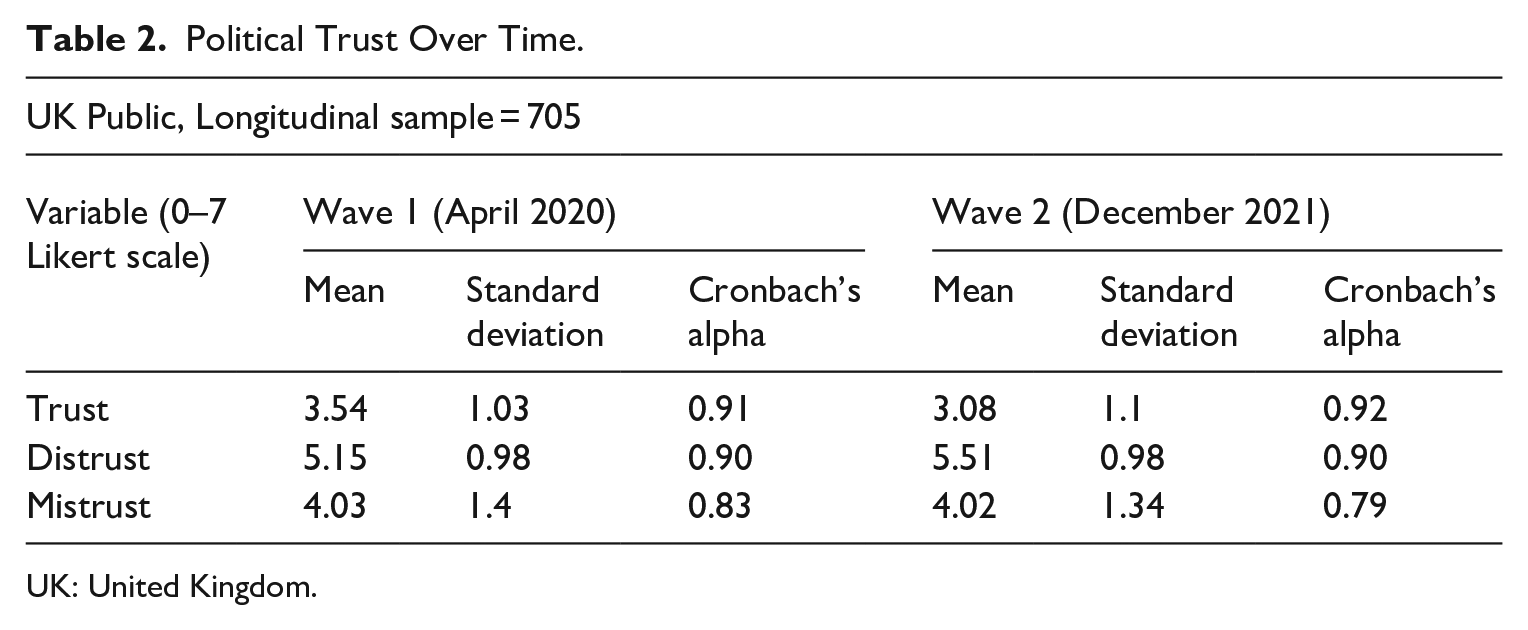
Items were presented in randomised order between participants to counter order effects and survey fatigue. Confirmatory factor analysis of a three-factor model suggests a strong fit in Wave 1 (χ2 = 917.45, df = 249, CFI = .94, RMSEA = .05, SRMR = .04) and Wave 2 (χ2 = 454.59, df = 276, CFI = .92, RMSEA = .03, SRMR = .05). 2 The full survey battery is available in Online Appendix B. Although the focus of this article is trust and trust repair as opposed to distrust or mistrust (on the distinction, see Jennings et al., 2021), Table 2 provides descriptive statistics and Cronbach’s alpha scores for all three latent variables across both time points. In line with previous research on political trust in the United Kingdom during the COVID-19 pandemic, participants became less positive, more cynical, and equally sceptical about their national politicians during this time of crisis (see also Davies et al., 2021).
Political Trust Over Time.
UK: United Kingdom.
After completing the PTB-24 for the second time, participants were asked to report their satisfaction with the UK Government’s handling of the COVID-19 pandemic as well as all examples of political contact that they had experienced over the prior 20 months. Policy satisfaction was measured on a 5-point Likert-type scale running from ‘Not satisfied at all’ to ‘Completely satisfied’. Only 34% of participants expressed any level of positive evaluation. To assess experiences of political contact, participants were given seven different options that ranged by form (physical, virtual or proxy) and intensity (personal or impersonal). 3 Although classic studies of the contact hypothesis define intergroup contact as ‘actual face-to-face interaction between members of clearly defined groups’ (Pettigrew and Tropp, 2006: 754; see also Paluck et al., 2019), modern political contact is just as likely or more likely to occur as digitally mediated dialogue between political leaders and their followers. As Soo et al. (2020) argue, the medium by which contact occurs should make only a minimal difference to the positive benefits accrued to citizens so long as the contact is personalised and engaged. Thus, face-to-face contact might be a gold standard, but I anticipate that similar yet diluted effects [on political trust] might also occur for other forms of direct one-to-one contact such as emails or social media messaging. If the fundamental assumptions of the contact thesis hold, then I expect:
Hypothesis 1: Where citizens experienced political contact during the COVID-19 pandemic, their evaluations of politicians’ trustworthiness will have remained more positive than those who did not.
Hypothesis 2: The positive effects of political contact on evaluations of politicians’ trustworthiness will be stronger for direct personal interactions.
In more than a year and a half between sampling, just 5% of participants had met with a politician in person, either on their doorstep, at a constituency office, or in another public or private setting (i.e. personal physical contact). In contrast, 16% of participants had interacted directly with a politician over email (i.e. personal virtual contact), 80% had watched a politician being interviewed or making a speech on television (i.e. impersonal virtual contact) and 53% had received generic literature from candidates and incumbents through the post (i.e. impersonal proxy contact). Less than 1% of participants had attended a public event to hear a politician speak (i.e. impersonal physical contact). Some 9% of participants reported no experience of political contact whatsoever over the preceding 20 months and less than 50% selected more than one option. These figures suggest that most people are engaging in distal and impersonal forms of political contact through modern telecommunication technologies, which allow them to hear and see politicians in real time. The proportion of people who are actually interacting with their representatives, or doing so across multiple media, remains a distinct minority.
Measures: Strategy 2 (Trust and Authentic Political Communication)
Having set up a theoretical link between authentic political communication, built on partial promises and honest acknowledgements of failure, and political trust, I test it using a survey experiment fielded to members of the UK public in wave two of this project. In this particular experiment, participants were presented with a series of written vignettes that described a moment of contact with a hypothetical political candidate and the candidate’s subsequent behaviour in office. Participants were randomly allocated in equal proportions to two treatment conditions at each stage of the experiment. In Stage 1, survey treatments manipulated the style of economic policy promises (partial vs standard) that the candidate made to the participant during a public gathering at a local town hall. In Stage 2, survey treatments manipulated the causal attribution of fault in the candidate’s explanation of why these promises were subsequently broken (intrinsic vs extrinsic) after the candidate had been elected and taken up a ministerial post in the treasury. The vignettes are presented in full in Online Appendix C.
Participants were asked to rate the candidate’s trustworthiness at two points in the experiment: once after reading vignettes for Stage 1 (i.e. ‘the promise’) and again after reading vignettes for Stage 2 (i.e. ‘the renege’). Specifically, participants scored candidate X’s competence, integrity and benevolence on three 11-point scales. Acknowledging that trust can also be reflected in emotional ties, participants reported their affect for candidate X as a single valence on a classic feeling thermometer (‘Very cold’ to ‘Very warm’, 0–100). And finally, participants declared their likelihood of voting for candidate X on a 5-point Likert-type scale (‘extremely unlikely’ to ‘extremely likely’). This nested 2 × 2 design is capable of tracking within-person change and comparing this change between participants. 4 If the theoretical assumptions made in this article hold, then the experiment should show:
Hypothesis 3: Politicians who make partial promises (crudely of the type if X, then I will do Y) will be viewed as more trustworthy than politicians who make standard promises (crudely of the type I will do Y).
Hypothesis 4: Politicians who make partial promises and then break those promises due to appropriate external circumstances will remain trustworthy.
In contrast to observational data, experimental designs like this one afford more control over the inclusion or exclusion of confounding factors and seek to emulate realistic experiences while maintaining strong internal and external validity (see Atzmüller and Steiner, 2010; Ludwick and Zeller, 2001). In this case, the candidate’s promises in the experiment were inspired by real-life manifesto pledges made by the Conservative Government in the 2019 General Election, which were then subsequently dropped. Although candidate X’s party affiliation is withheld in the experiment to reduce motivated reasoning, participants were asked a series of follow-up questions to test their knowledge of these promises. Interestingly, just 51% recognised that the promises had been made in real life and 50% recognised that all three promises had also been broken in real life. Inferential analyses of the dependent variables (i.e. candidate X’s trustworthiness) control for these questions as well as participant’s own voting record and their ex ante political trust at the time of data collection (measured on the PTB-24).
Analysis
Strategy 1: Political Contact
While most people downgraded their trust judgements of politicians during the COVID-19 pandemic (see Table 2), this drop in political trust was most pronounced among participants who reported no political contact in the intervening period between April 2020 and December 2021 (Figure 1). At the same time, participants who had physically met and spoken to politicians during that time experienced the smallest drop in political trust, followed by those who engaged in an email exchange with a politician. The confidence interval for the first of these statistics also crosses zero, which raises the possibility that these citizens did not experience any loss of political trust during the COVID-19 pandemic. Although the number of participants in some of the contact categories is too small to draw conclusive generalisations, and some participants do straddle multiple categories, the descriptive trends in the data point towards the benefits of contact for political trust and especially so where that contact is personal (i.e. indicative support for Hypotheses 1 and 2).
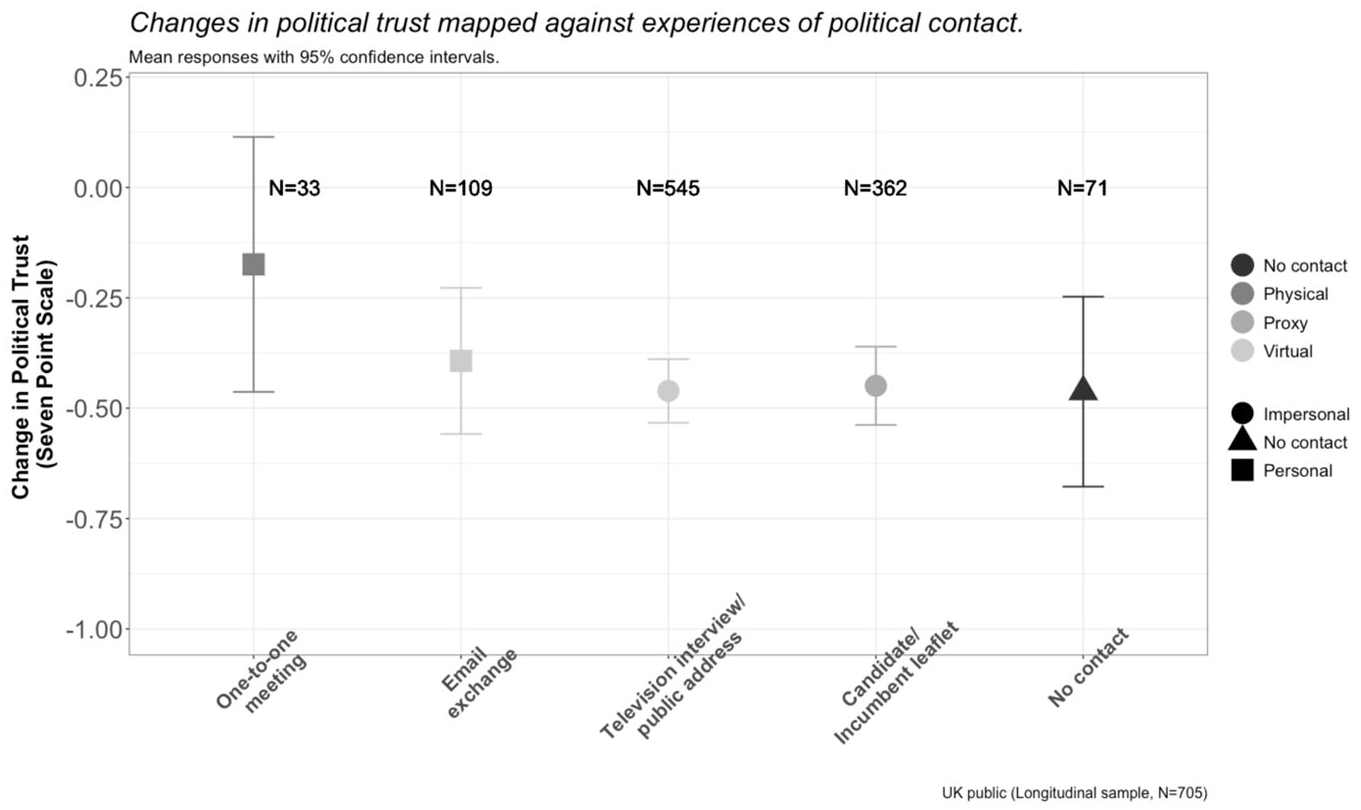
Categories of Political Contact and Changes in Political Trust Over Time.
It is possible to better isolate the implied causality in this data by accounting for (a) the number of participants who engaged in multiple types of contact, and (b) participants’ satisfaction with government performance during the COVID-19 pandemic (which was a strong negative predictor of trust in the United Kingdom during the crisis, for example, Davies et al., 2021). I start by creating a weighted sum score for participants’ contact experiences. Personal physical interactions are weighted the most (five points) in line with existing theoretical work discussed earlier in this article, and proxy forms of contact are weighted the least (one point). Participants’ points are then summed together to create an individual total on a 15-point scale (mean = 3.05, SD = 2.21).
Controlling for performance satisfaction as well as participants’ age, sex and ethnicity in an ordinary least squares (OLS) multiple regression, I find a moderate positive correlation between participants’ political contact score and changes in their levels of political trust between April 2020 and December 2021 (Figure 2 and Online Appendix D). Put simply, the more that people experience political contact, and preferably direct personal contact at that, the less likely they are to lose trust in politicians over time and, in this particular case, during a protracted period of crisis when satisfaction with government performance was already detrimentally low. In support of the arguments put forward in the opening of this article, these findings suggest that the performance perspective and the contact hypothesis may offer distinct yet complementary insights for politicians who want to engage in trust building with their electors.
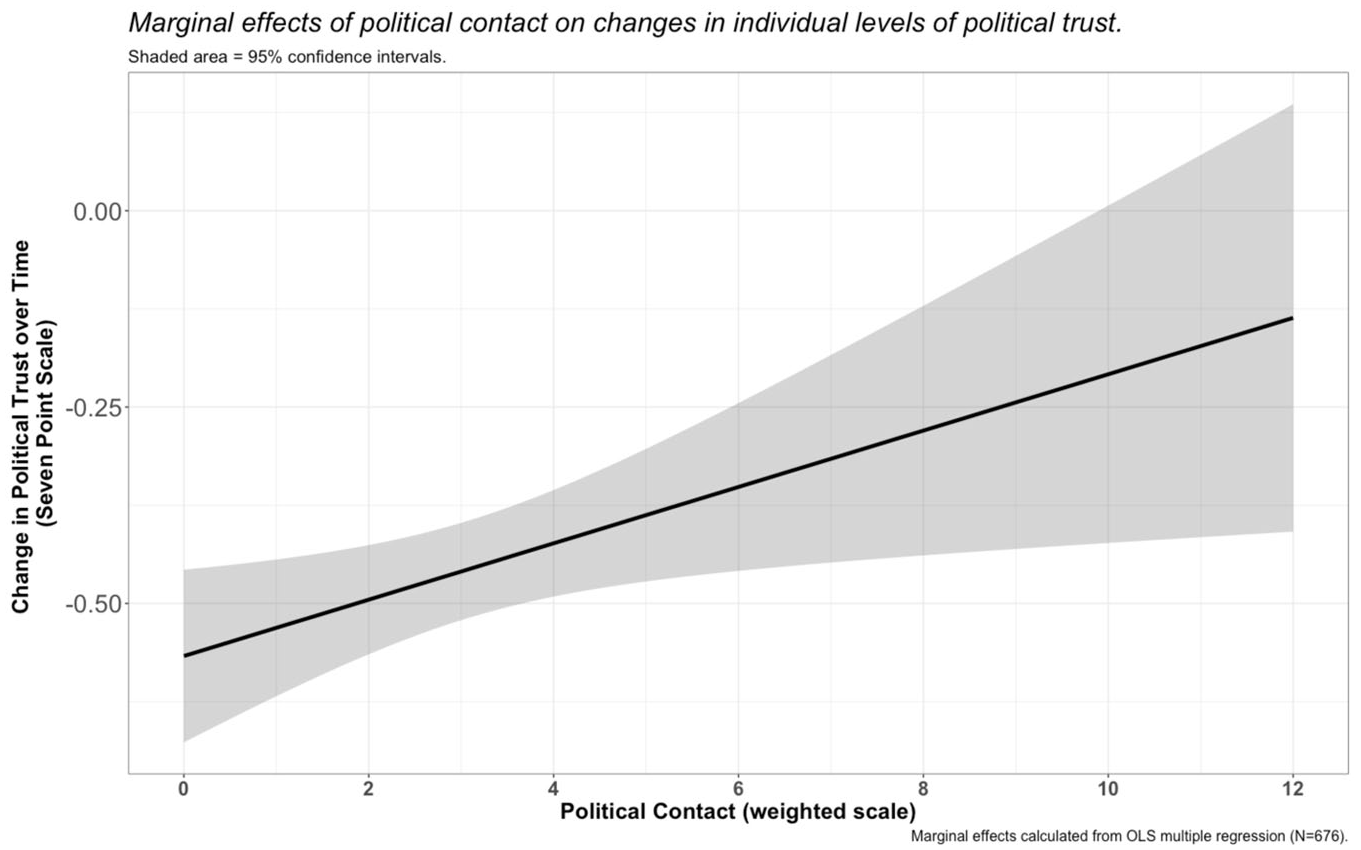
The Impact of Political Contact Upon Changes to People’s Political Trust.
Strategy 2: Authentic Political Communication
I start by testing Hypothesis 3 that politicians will be perceived as more trustworthy if they make partial rather than standard promises. After working through Stage 1 of the experiment, ‘the promise’, participants were asked to rate candidate X’s trustworthiness. The results of these mid-stage trust judgements are reported in Figures 3–5. Contra to expectations, candidate X was not seen as any more trustworthy among participants who received partial promises. The difference between participants’ cognitive and affective trust judgements across the two treatment conditions is statistically insignificant. In terms of participants’ behavioural-intentional trust judgements, measured here as voting intent, participants were actually slightly more likely to vote for candidate X if they gave standard promises.
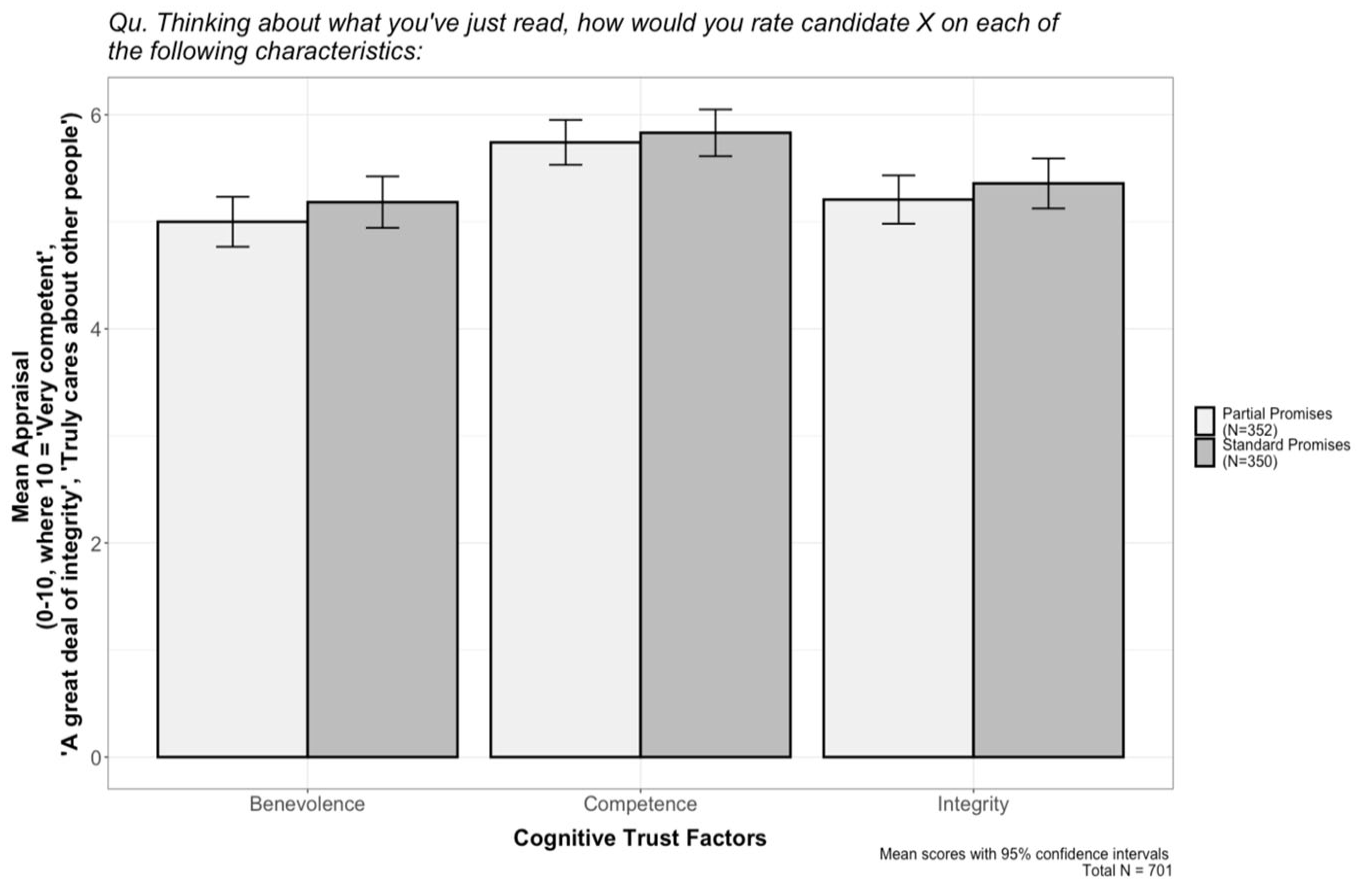
Cognitive Trust Judgements of Candidate X After Stage 1 (i.e. ‘The Promise’).
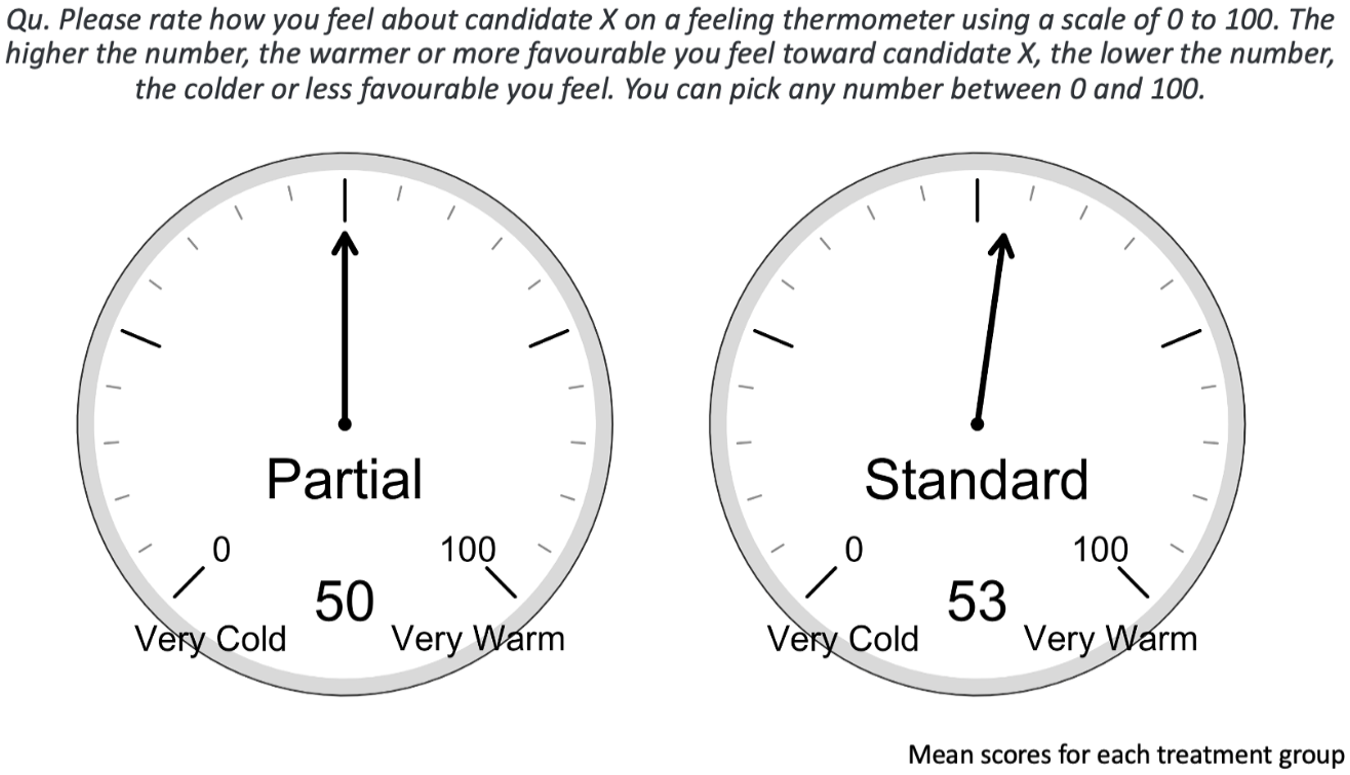
Affective Trust Judgements of Candidate X After Stage 1 (i.e. ‘The Promise’).
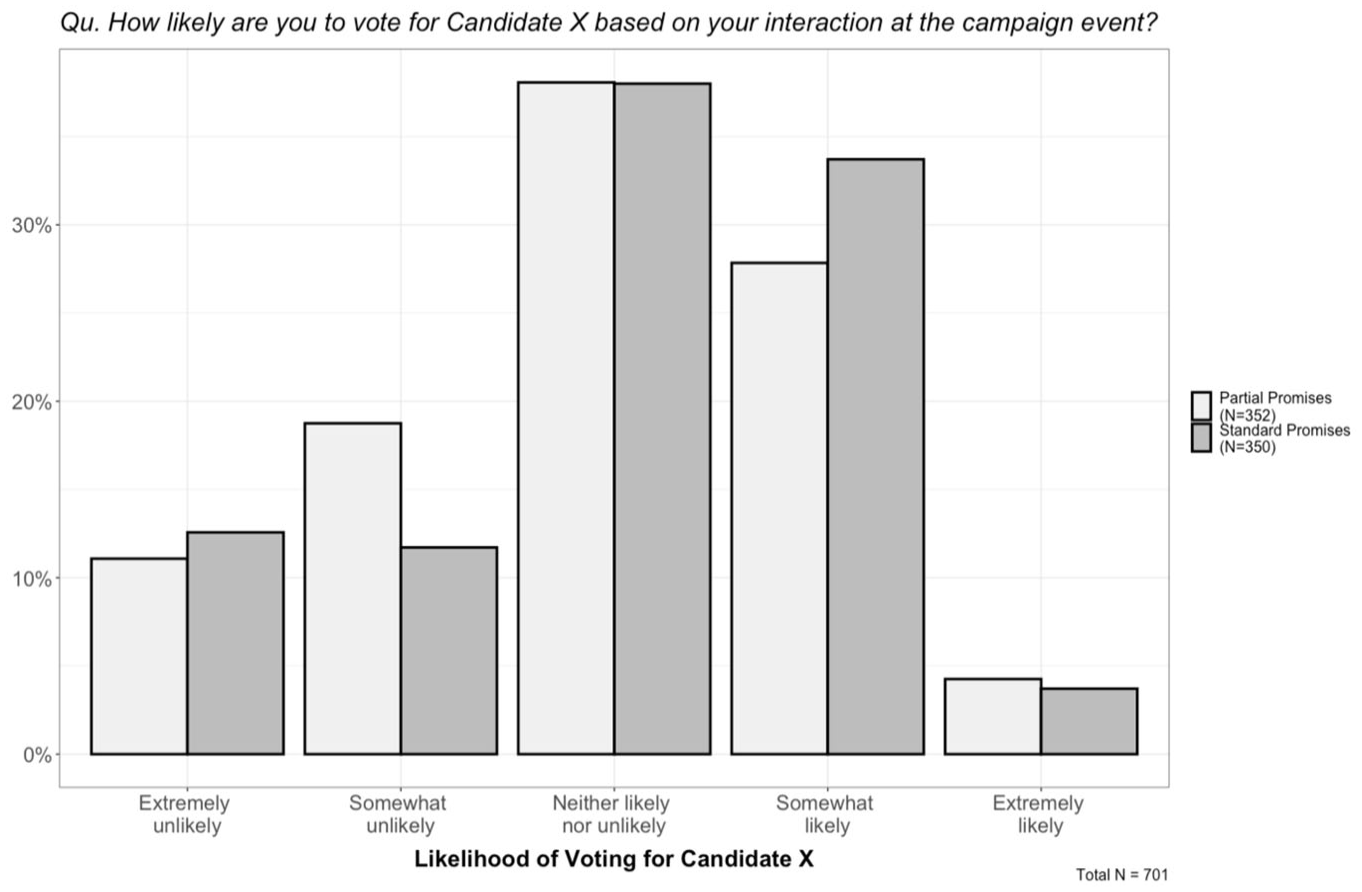
Behavioural-Intentional Trust Judgements of Candidate X After Stage 1 (i.e. ‘The Promise’).
These results suggest that partial promises achieve very little, if anything, when it comes to altering public trust in politicians at the point of contact when promises are made. However, the primary appraisive potential of authentic rhetoric lies in a hypothetical future when trust is breached. Put another way, partial promises may not make a politician any more trustworthy in the present, but they may sustain levels of trust and trustworthiness in the eventuality that policies fail or promises are broken.
To evaluate this claim, and thus Hypothesis 4, participants were asked to complete identical assessments of candidate X after Stage 2 of the experiment. The difference between their responses at Stage 1 and Stage 2 was calculated to create a change score for each of their trust judgements about candidate X. By this point in the experiment, participants had also been randomly assigned to two further treatment conditions in which the candidate had reneged on their promises and engaged in causal attribution using either extrinsic or intrinsic excuses. In one treatment, candidate X explained that their promises had become untenable due to specific implications arising from a public health emergency (as per the COVID-19 pandemic that participants had just experienced). In the other treatment, candidate X attempted to shift responsibility to a prior administration, reframe the consequences of prior policy commitments and emphasise the collective decision-making that informed the change in policy (as per classic blame avoidance behaviours; Hood, 2010).
I analyse the relationship between my treatment conditions and participants’ change scores for each set of trust judgements using a series of OLS and Ordinal Logistic Regression regression models. These models allow me to control for a number of relevant external confounds, including participants’ partisanship, their satisfaction with the government’s performance during COVID-19, their ex ante political trust in politicians, and whether or not they were aware that candidate X’s promises were inspired by real life. The full results are provided in Online Appendix E and predicted effects for the treatment conditions are reported in Figures 6 and 7. Although candidate X was seen as less trustworthy after reneging on their policy commitments in all treatment conditions, the relative size of these changes suggests moderate support for Hypothesis 3 and Hypothesis 4.
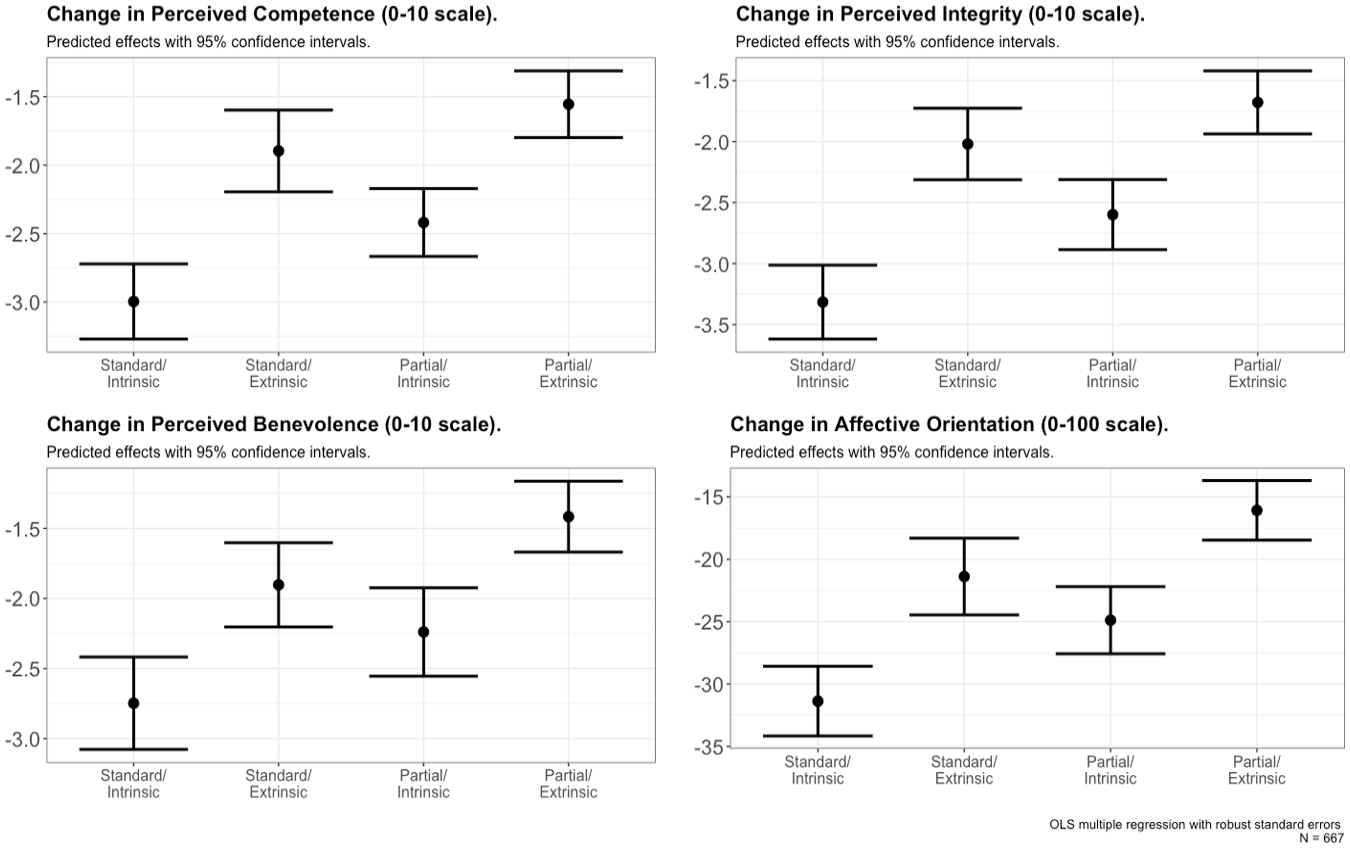
Predicted Effects of Treatment Conditions on Participants’ Cognitive and Affective Trust Judgements About Candidate X.
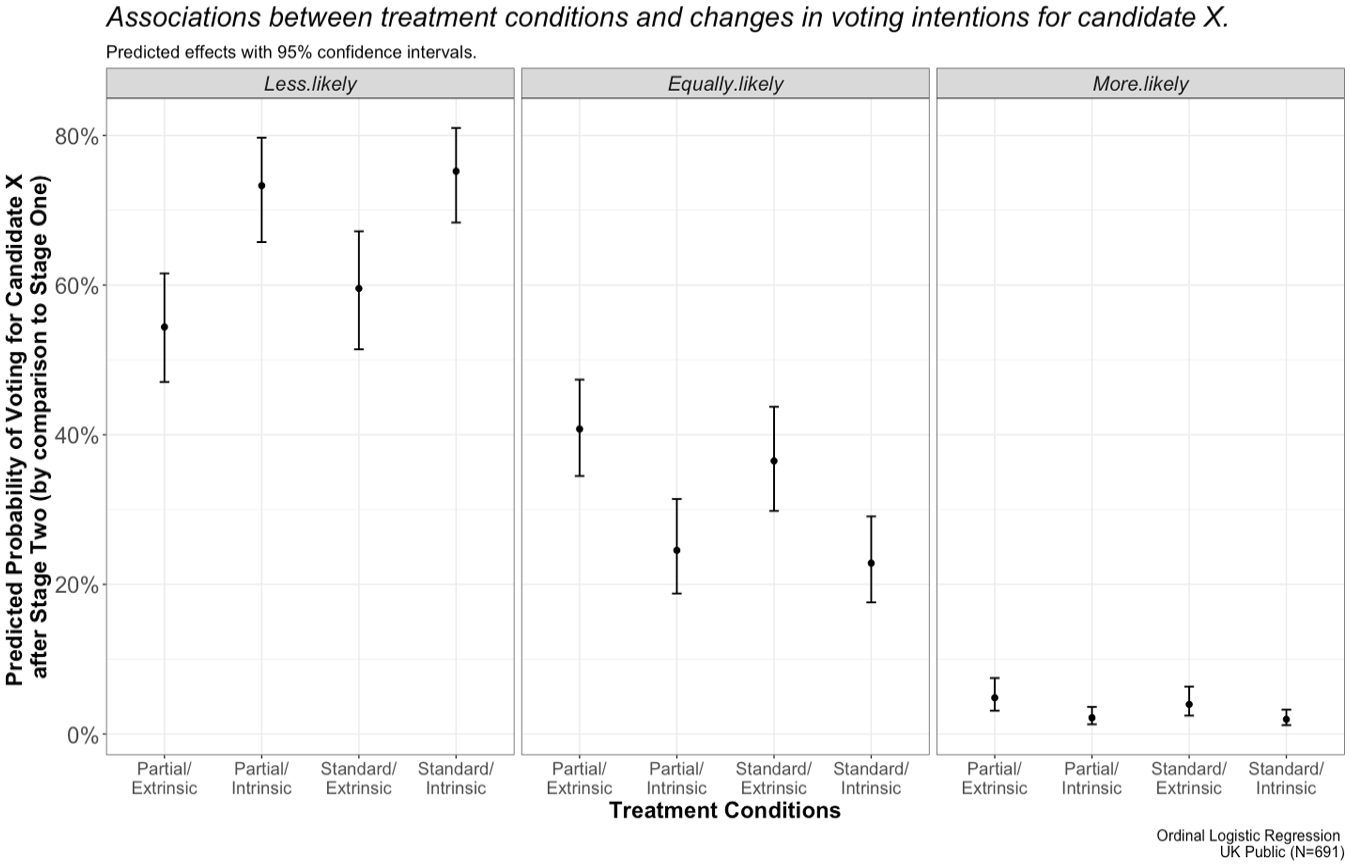
Predicted Effects of Treatment Conditions on Participants’ Behavioural-Intentional Trust Judgements of Candidate X.
After accounting for salient control variables, partial promises matched with explanations of betrayal based on extrinsic fault predicted the smallest drop in participants’ cognitive and affective appraisals of candidate X’s trustworthiness. The opposite is true of standard promises matched with explanations based on intrinsic fault, which predicted almost twice as much of a drop in participants’ cognitive and affective trust judgements. It also seems that honest explanations of betrayal based on extrinsic fault can mitigate a decline in certain indicators of trust even after a politician has made standard promises. When it came to updating their voting preferences (behavioural-intentional trust judgements), participants in this treatment condition remained just as likely to vote for candidate X as those who received partial promises and explanations of betrayal based on extrinsic fault. Participants in both treatment conditions were 15%–20% less likely to downgrade their voting intentions than participants in the other two treatment conditions.
Discussion and Conclusion
While existing thinking in political science has tended to focus almost exclusively on policy outputs and macro-government performance as the antidote to falling political trust, this ‘performance perspective’ privileges the agency of national governments without any commensurate consideration of the everyday practices that all politicians might use to build, repair or sustain the trust of their electors. Asked what can be done about this situation, or more precisely what they can do about this situation, politicians from eight different legislatures in five different countries focused not only on policy performance, but also personal interaction and authentic communication. Developing these ideas with reference to relevant tracts of academic scholarship as well as original survey data collected in the United Kingdom, I test these proposals for the first time and find merit in each. As per the contact hypothesis, I find that the loss of trust seen among most UK citizens during the COVID-19 pandemic was significantly dampened among those who experienced personal contact with politicians during that same time period. And as per revised notions of authentic leadership and ‘authentic trust’, I find that partial promises and honest explanations of betrayal based on extrinsic circumstances may combine to mitigate a loss of trust in experimental scenarios. Given that it may not always be possible to improve government performance or avoid government failure, this is a noteworthy contribution.
It is important to stress, however, that political contact and authentic communication are not a panacea to the current trust deficit in liberal democracies. Indeed, some contact researchers have been quick to stress the dangers associated with negative contact experiences, which can be particularly consequential for the attitudes and re-engagement of the low power/high dependence partner in any dyad (see Barlow et al., 2012). This caveat also highlights one of the limitations of the observational data presented in this article insofar as they tell us little about the actual dynamics and content of political contact experienced by participants. In his seminal studies of the contact hypothesis, Allport was sceptical of ‘mere contact’ and set forth particular conditions that should be sought to maximise its remedial effects. Specifically, Allport (1954: 281) argued for equal status contact between the two groups involved, institutional support mechanisms to frame said contact and goal-oriented experiences that fostered [the perception of] common interests (see also Paluck et al., 2019: 152). To clarify the added value of the contact hypothesis in politics, more concerted thought is now needed to create the methodological apparatus for testing these conditions and, in turn, analysing the intersectional relativity of contact experiences and associated trust-based outcomes.
Alongside more detailed research into the nature of contact experiences, the findings presented in this article should now push politicians and academics alike to consider whether a new modus operandi of everyday leadership in politics, based on regular contact and authentic communication, is actually practicable and achievable at scale. In this respect, there is an urgent need to challenge dominant logics of modern democratic governance – theories of New Public Management in particular – which have drastically limited the scale and frequency of opportunities for politicians to engage directly in honest, open and goal-oriented political debate with citizens (on this ‘missing link’, see Edelenbos et al., 2017). For similar reasons, Eva Sørensen (2020: 133) has argued that modern representatives need to be ‘institution-makers’ as well as ‘institution-takers’. Where traditional political institutions have failed to connect politicians with citizens, Sørensen (2020: 55) suggests that ‘[e]merging forms of interactive democracy that bring politicians and citizens together in digital or face-to-face dialogue about political views, ideas, and interests, and their application to different contexts, can potentially make political representation more robust’. Focusing on political trust as opposed to policy responsiveness, the findings presented here support Sørensen’s core message and, in doing so, pose a challenge to contemporary politicians who want to build trust among their electors. By forging their own mechanisms for direct personalised contact and altering their communicative style, politicians may heighten the saliency of authentic trust and increase the accuracy of citizens’ judgements about their trustworthiness.
This challenge comes with obvious risks and constraints. On one hand, individual politicians engaging in new forms of contact and authentic rhetoric may risk alienating themselves from increasingly centralised party systems with tightly controlled and professionalised polling, marketing, advertising and public relations. Yet given the positive correlation found between elite perceptions of being distrusted and electoral risk-taking (see Weinberg, 2022), those most in need of rebuilding trust with voters may be those who are also most likely to step out of line and take up the challenge. On the other hand, politicians may simply feel too constrained by, or fearful of, the established media environment and its commercial logics of simplification, polarisation and personalisation, which simultaneously limit politicians’ ability to communicate with citizens ‘authentically’ and distort citizens’ trust judgements of politicians (see Clarke et al., 2017). In addition to creativity, therefore, it will take concerted courage to open up new spaces for political contact and alter the rules of modern political communication. This may not be possible or even desirable for some politicians and especially those in senior party positions who are working within short electoral cycles, rely heavily on a leader-centric party brand, and have, themselves, become wed to choreographed press conferences, pre-prepared television debates, and social media vox pops. In this respect, more research is now needed to establish when, why and how a large number of politicians in different electoral and cultural contexts might equally employ personal trust-building strategies and, in turn, support one another to do so.
Supplemental Material
sj-docx-1-psx-10.1177_00323217231185706 – Supplemental material for Building Trust in Political Office: Testing the Efficacy of Political Contact and Authentic Communication
Supplemental material, sj-docx-1-psx-10.1177_00323217231185706 for Building Trust in Political Office: Testing the Efficacy of Political Contact and Authentic Communication by James Weinberg in Political Studies
Supplemental Material
sj-docx-2-psx-10.1177_00323217231185706 – Supplemental material for Building Trust in Political Office: Testing the Efficacy of Political Contact and Authentic Communication
Supplemental material, sj-docx-2-psx-10.1177_00323217231185706 for Building Trust in Political Office: Testing the Efficacy of Political Contact and Authentic Communication by James Weinberg in Political Studies
Supplemental Material
sj-docx-3-psx-10.1177_00323217231185706 – Supplemental material for Building Trust in Political Office: Testing the Efficacy of Political Contact and Authentic Communication
Supplemental material, sj-docx-3-psx-10.1177_00323217231185706 for Building Trust in Political Office: Testing the Efficacy of Political Contact and Authentic Communication by James Weinberg in Political Studies
Supplemental Material
sj-docx-4-psx-10.1177_00323217231185706 – Supplemental material for Building Trust in Political Office: Testing the Efficacy of Political Contact and Authentic Communication
Supplemental material, sj-docx-4-psx-10.1177_00323217231185706 for Building Trust in Political Office: Testing the Efficacy of Political Contact and Authentic Communication by James Weinberg in Political Studies
Supplemental Material
sj-docx-5-psx-10.1177_00323217231185706 – Supplemental material for Building Trust in Political Office: Testing the Efficacy of Political Contact and Authentic Communication
Supplemental material, sj-docx-5-psx-10.1177_00323217231185706 for Building Trust in Political Office: Testing the Efficacy of Political Contact and Authentic Communication by James Weinberg in Political Studies
Footnotes
Acknowledgements
I would like to thank members of the International Society for Political Psychology, Dr Stefanie Reher in particular, for their comments on an early version of this paper. I would also like to thank Professor Kate Dommett for her incredibly useful feedback on the central ideas in the paper as well as the presentation of the findings.
Data
Statistical data files and replication code will be made available upon request.
Declaration of conflicting interests
The author declared no potential conflicts of interest with respect to the research, authorship, and/or publication of this article.
Funding
The author disclosed receipt of the following financial support for the research, authorship, and/or publication of this article: This research was funded by the Leverhulme Trust (ECF-2019-023).

Supplemental Material
Additional Supplementary Information may be found with the online version of this article.
Contents
Appendix A. Profile of Interviewees (ordered by nation).
Appendix B. 24-item survey battery of political trust, distrust and mistrust (PTB-24). Whether an item taps latent trust, distrust or mistrust is indicated in brackets at the end of each item.
Appendix C. Survey vignettes – Stage 1 and Stage 2.
Appendix D. Linear regression of changes in participants’ political trust over time.
Appendix E. Regression analysis of survey experiments.
Notes
Author biography
References
Supplementary Material
Please find the following supplemental material available below.
For Open Access articles published under a Creative Commons License, all supplemental material carries the same license as the article it is associated with.
For non-Open Access articles published, all supplemental material carries a non-exclusive license, and permission requests for re-use of supplemental material or any part of supplemental material shall be sent directly to the copyright owner as specified in the copyright notice associated with the article.
