




Abstract
Environmental non-governmental organisations stood out during the 2016 European Union referendum campaign. Despite clear reputational and regulatory risks, they participated in this fraught political debate in sharp contrast to other civil society sectors. This challenges common assumptions that material concerns, and ultimately survival, prevail in campaigning choices. We argue that campaigning choices reflect commitments to values that underpin these organisations’ raison d’être. Drawing on a pragmatist view of organisations, we analyse how external (media, regulatory) and internal (competence, governance processes) pressures shaped the campaigning choices of nine UK environmental organisations. We find that most environmental non-governmental organisations chose to engage, some even officially registering for Remain. Those active at the European Union level were most likely to engage – but also most open to criticism. Overall, environmental non-governmental organisations struggled to adapt their usual expertise-based, elite-focused campaigning style to the referendum which raises questions for civil society’s ability to speak for Europe, and contribute to controversial democratic debates, beyond the United Kingdom.
Introduction
The growing complexity of problems faced by modern democracies has strengthened both calls for greater contributions of civil society organisations to democratic societies – and for renewed analysis of these contributions (Urbinati and Warren, 2008). For Warren (2001), the significance of associations – as organisations created to achieve a collective purpose – is threefold: they are schools of democracy for individuals becoming more accomplished citizens; they organise collective action and support the emergence of new issues within the political system at the institutional level; and they contribute to the formation of public opinion and judgement in the public spheres.
The organisation of a referendum on the UK membership of the European Union (EU) strikingly illustrates these two latter aspects. EU membership was a divisive issue for the wider electorate, the media and political parties, and thus for membership associations. Furthermore, the very legitimacy of non-governmental organisations (NGOs), especially that of UK charities, to contribute to the public spheres became openly disputed by the Leave camp at a time when a revised regulatory framework further constrained their ability to conduct political advocacy. But there was a notable and sizable exception to the silence observed from the UK NGO sector during the 2016 referendum (Parks, 2018; Taylor, 2016): the environmental movement. One of the oldest and largest sectors of UK civil society, it became widely involved in the 2016 campaign, although far from uniformly.
In this article, we aim to elucidate the puzzling choice made by key environmental non-governmental organizations (ENGOs) to enter this fraught political arena. We investigate both why and how only some ENGOs campaigned. This case offers a rare opportunity to study the behaviour of interest groups outside of day-to-day policy-making, in a context where they faced an issue both highly salient and divisive; two features conventionally assumed to deter their mobilisation (Kollman, 1998). It is also telling of the often-contradictory expectations put on civil society organisations in modern democracies – such as being neutral or speaking truth to power – and the challenges they face when standing up for the environment or the added value of international cooperation.
Mainstream UK ENGOs shared the view that the EU membership had, overall, been positive for the UK environment. Due to their long-standing engagement with the EU, and their large membership equating millions of potential voters, 1 they had both the knowledge and the capacity to make a positive case for Europe. Because such organisations seek public support to gain exposure and material resources when advocating for collective goals, they nevertheless faced a dilemma: securing their long-term policy goals required putting their public image at risk.
Following Andrews and Edwards (2004), we consider these NGOs as ‘advocacy organisations’ to bridge theoretical insights on interest groups and social movement organisations. 2 Our empirical case challenges an influential assumption in both these bodies of literature: that organisational survival is a prime objective (McCarthy and Zald, 1977) prioritised over lobbying choices, stated aims or ideological coherence (Fraussen, 2014). The decision to devote some of their limited time and resources to a referendum campaign riddled with uncertainty, with little prospect of shaping the final results, contradicts the agenda-setting logics conventionally expected within interest groups (Halpin et al., 2018). To explain this paradoxical behaviour, we argue with Philip Selznick (2011 [1957]: 102) that organisational survival goes beyond mere material aspects and consists in maintaining values crucial to staff and members that have come to characterise the organisation’s ‘distinctive aims, methods and role in the community’.
The 2016 referendum was a critical and definitional moment for ENGOs in that respect, which justifies paying attention to the organisational logics involved in campaigning choices, in addition to strategic considerations related to their constituencies. Indeed, organisations representing sectional interests or a wider cause must tackle and balance the expectations of their constituencies, their members, as well as actors within their environment such as peer organisations, decision-makers, the general public or the media (Berkhout, 2013). These expectations are potentially contradictory, fuelling internal value conflicts about what organisations should do. Following Selznick’s (2011 [1957]) pragmatist view on organisations, we contend that their decisions are shaped by internal forces – their members’ diverging preferences and the force of habits – interacting with external pressures from their environment. It is through studying their choices and practices that we can determine their actual value commitments.
This article considers UK ENGOs (in)action during the 2016 referendum campaign. Section ‘Conceptualising the Choice to Campaign: Internal Logics and External Pressures’ sets out our theoretical expectations, and conceptualises how external and internal pressures may have constrained ENGOs’ choices. Section ‘Responding to External Pressures’ discusses the external pressures that materialised before and during the referendum campaign to highlight how ENGOs campaigning choices differ during the same timeline. Section ‘How Internal Pressures Mediated External Constraints’ then interrogates these differing choices by drawing on distinct organisational characteristics and processes that differentiate the part played by ENGOs in the referendum campaign. Finally, the conclusion returns to the roles that advocacy organisations can play in debates on European integration, and in democratic societies more generally. The article draws on a series of 12 elite interviews with UK ENGO staff (conducted in the summer of 2017) and a documentary analysis of campaign material (from both official and smaller campaigns) and press coverage of the campaign.
Conceptualising the Choice to Campaign: Internal Logics and External Pressures
The 2016 referendum challenged UK ENGOs: after having long distanced UK campaigning from EU advocacy, the referendum campaign brought these two facets of their work together. It further meant engaging in a highly political campaign going against their long-standing strategy of neutrality. This challenge was compounded by the rules governing their engagement in political campaigns which had recently become more constraining. They consequently faced a major dilemma: were they willing to risk their public image (and support) to prevent a development likely to weaken UK environmental policy? To study this dilemma, we will address two distinct research questions.
RQ1. First, why did some UK ENGOs decide to engage with the EU referendum debates while others opted out?
RQ2. Second, for those that chose to get involved, what explains the specific campaigning choices made in terms of public position (openly calling for Remain or not) and its timing?
To address these questions, we adopt a pragmatist framework (Berny, 2013), which considers the interplay of internal and external pressures on ENGOs’ campaigning choices. This internal/external distinction is useful to account for the diverse expectations of ENGOs’ audiences (their members as well as external constituencies and broader publics).
Accommodating Audiences’ Expectations in a Pragmatist Perspective
Following Selznick’s (2011 [1957]) pragmatist view, we contend that choices regarding advocacy organisations’ maintenance go beyond dependency relationships with different constituencies. These latter are shaped by internal forces – their members’ diverging preferences and the force of habits – interacting with external pressures from their environment.
This view diverges from the proponents of resource dependence theory and new institutionalism who assume that organisational survival depends respectively on the support of key constituencies (Beyers and Kerremans, 2007) or the conformity of organisations’ behaviour with field-level logics (Rao et al., 2000). While organisational properties are usually recognised as an independent variable of lobbying strategies (Halpin et al., 2018; Hollman, 2018), along with the characteristics of the issue involved and the institutional context (Eising et al., 2017), we consider instead that the actual and perceived constraints related to the characteristics of both the issue and institutional context are mediated by organisational logics.
Selznick (2011 [1957]) made the distinction between internal and external pressures to shed light on the internal processes involved in organisational choices and trajectory. Internal pressures refer to the factions trying to push for different values within organisations and related to their respective goals and activities. Because some internal tensions also reflect society-level changes, they may be conducive to the adaptation of the organisation to its environment. External pressures encompass the publics either targeted by its activities or sharing its goals and that come to value its work. They also include the components of the external environment that the organisation needs or must tackle to achieve its mission. Applied to ENGOs, internal pressures include the different participants to their activities: elected officials, staff, activists and individual members. External pressures refer to the different audiences ENGOs interact to get support for their self-maintenance and to achieve policy goals. Furthermore, ENGOs also encounter opponents and by-stander publics whose expectations of what the organisation should or should not do may impact its survival.
Selznick’s terminology reflects the diversity of action, objectives and identities that advocacy organisations have to accommodate, including ENGOs. Members’ benefits reflect the large array of motivations to join or support their activities. The protection of the countryside is the most popular cause in Britain, with long-established nature protection organisations relying on 100,000s of supporters (Rootes, 2011). Access to natural spaces or educational activities is part of the associational life of the National Trust or the Royal Society for the Protection of Birds (RSPB). All members are not necessarily aware of or interested in the extent of their political advocacy or the fact that they administrate EU Agriculture policy funds in some of their estates. In contrast, for the organisations that emerged since the 1970, such as Friends of the Earth (FOE) and Greenpeace, initially more radical in terms of claims and modes of action (Rootes, 2011), the campaigning activities are more explicitly their raison d’être.
Whether originating from the first or second wave of environmentalism (nature conservation versus ecology), these ENGOs have increasingly come to rely on expertise when engaging with external audiences. This trend, observable across the UK NGO sector, goes in hand with public communication and growing media contacts that have contributed to significant fundraising efforts which both boosts and relies on their public image (Hilton et al., 2013). Expertise has proven crucial in both inside and outside lobbying strategies respectively targeting primarily decision-makers or the general public (Kollman, 1998). ENGOs have each developed a different mix of outside/inside lobbying strategies. For instance, the RSPB has used both while Greenpeace UK is better known for confrontational modes of action, such as boycott and direct actions which exemplify outside lobbying strategies.
Critically, this inside lobbying characterises ENGOs’ long-standing engagement with the EU. Indeed, while participating in or even supporting the creation of several European networks (Berny, 2016), they had also long avoided EU policy issues in the United Kingdom, keeping their UK and EU campaigns separate. This long-lasting reluctance to publicise efforts at the EU level in UK campaigns reflects the difficulties domestic membership organisations face when attempting to promote EU-related activities with their constituencies (Berny, 2013; Johansson et al., 2018; Parks, 2015). The partial disconnection between national and EU public debates, a competitive media environment and the EU multi-institutions and multi-actors’ decision-making hamper their efforts, especially for civil society organisations (Koopmans, 2007). However, UK ENGOs’ reluctance to engage with European matters was not simply due to complex European processes. UK ENGOs have built their reputation on a strategy of expertise. But in order for their expertise to be recognised, especially in the context of the United Kingdom where political activity by charities is frowned upon, their expertise has to be perceived as neutral. As European topics became politically toxic over time in the United Kingdom (Copeland and Copsey, 2017), ENGOs became gradually more cautious about what to communicate to external publics and their membership, as we shall see below.
Participating in the referendum meant engaging with an issue, EU membership, which had gradually become very uncomfortable for UK ENGOs. It also questioned their usual ways of doing when it came to EU topics. In this regard, one additional added value of a pragmatist perspective on organisations is the focus on contingent events or decisions that shape organisational trajectories as well as external and internal pressures. The pragmatist postulate of the ‘inventivity of the present’ in social action, in contrast from rational choice and normative explanations of social action (Joas, 1993), is especially relevant to study organisations’ decisions facing uncertainty. Although organisational logics depend on practices and values stabilised over time, they are also shaped by organisations’ course of action and often its unexpected consequences. In other words, campaigning decisions cannot only be deduced from contextual constraints, past decisions or formal properties of the structure: contingency and agency also matter. Considering the interplay between external pressures and internal processes over time offers thus an opportunity to explain both campaigning choices and their timing.
Making Sense of Constraints on UK ENGOs’ Campaigning Choices
For our analysis, we have chosen to focus on a small subset of pressures (see Figure 1), drawing on the literature on interest groups to identify what may have limited UK ENGOs’ ability to take part or, at least, shape their campaigning choices. This selection, detailed below, operationalises the concept of internal/external pressures to guide our empirical analysis and observe how organisational logics played over time.
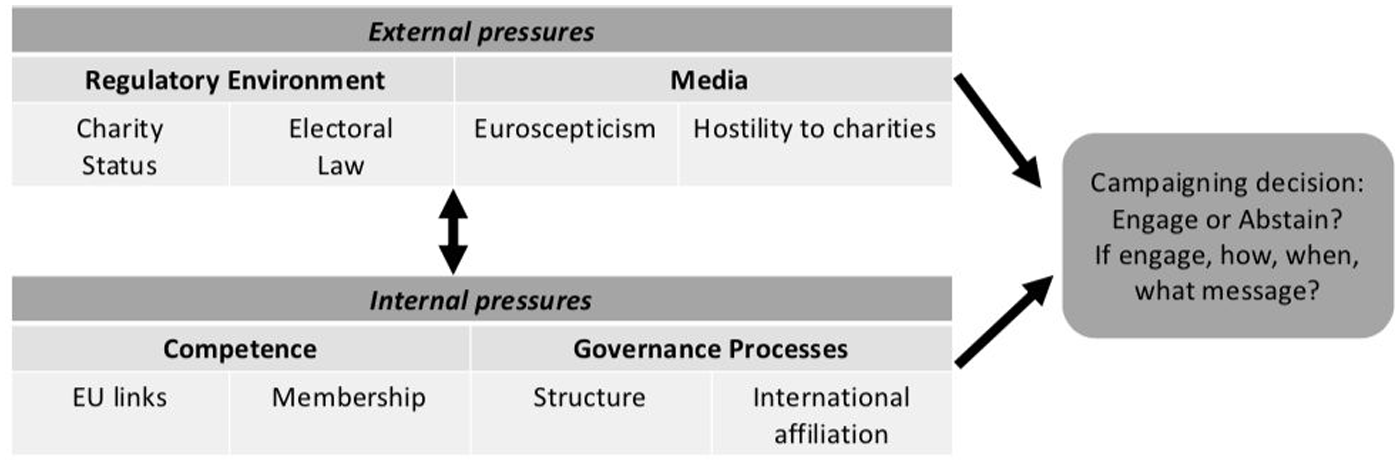
Pressures on ENGOs’ Campaigning Decisions.
For external pressures, we chose to focus on both the UK regulatory context (charity regulator and Lobbying Act) and the media’s attitude to both charities and Europe. We are expecting all four forms of external pressures to deter most UK ENGOs from participating in the referendum as it would risk undermining their public image.
For internal pressures, we are considering both conventional organisational characteristics (whether an organisation is federal or no, what size and shape its membership takes) and characteristics that are especially relevant here: whether organisations are branches of a wider international organisation or UK-only, and what links they have had with the EU.
We are expecting international organisation branches to give less importance to UK-specific matters such as the referendum, whereas UK ENGOs with continued strong links with Europe (both in terms of lobbying and funding) will be more likely to want to engage. Finally, we expect conventional organisational characteristics to shape the timing and framing of campaigning choices, with organisations with federal structure and/or large membership expected to take longer, and not openly call for Remain.
External Pressures
Organisations have to comply with regulatory frameworks and expectations within their institutional environment to survive (Beyers and Kerremans, 2007; Rao et al., 2000). Decision-makers and the media constitute two distinct institutional spheres essential in the development and strategies of advocacy organisations. In the specific context of the EU referendum which divided members of the government, political parties and citizens alike, two immediate external demands were explicitly weighing on their action: the new rules channelling the political work of charities and the hostility of part of the press towards the EU.
UK lawmakers have traditionally ‘adopted constraining legislation with limited considerations of possibly intrusive effects on civil society actors’ (Bolleyer, 2018: 306). To this day, ‘any political activity that a charity undertakes must be subsidiary to and in furtherance of a primary charitable purpose’ (Dunn, 2008: 54). In its guidance on political activities, the charity regulator, the Charity Commission for England and Wales (2008), warns that ‘there is not always a clear demarcation between campaigning and political activity’. This guidance puts the onus on charities’ trustees to verify a priori if political campaigning furthers their charitable objectives and to consider potential impacts on its public image, including for stakeholders and donors.
Recent rule changes further constrained charities’ political work. In the mid-2010s, the use of aggressive fundraising tactics by charities and growing disquiet in government to policy criticism from charities fuelled popular, media and political distrust in the sector (Morris, 2016). This culminated in the Lobbying Act of 2014 which requires charities to register with the Electoral Commission as non-party campaigners if their spending during an election period goes beyond a certain threshold. Charities, including prominent ENGOs, opposed the act, claiming this ‘gagging Act’ would have a chilling effect on their ability to campaign.
In addition, from the 1990s onward, it became difficult to appear neutral on Europe – and much easier to simply not talk about it in the United Kingdom. What Copeland and Copsey (2017: 724) argued for politicians can be extended to civil society: ‘Indifference to the EU is safer than being perceived as a Europhile by the electorate’. Speaking on Europe courted negative reaction from Eurosceptic media and Eurosceptic members. For years, UK ENGOs had been disengaging from the EU. This ranged from either drastically reducing how much communicating on Europe was made to members (RSPB) to leaving the European Environmental Bureau (EEB), the federation representing national environmental organisations in Brussels since 1974 (both Countryside Charity, formerly the Campaign to Protect Rural England (CPRE) and The Wildlife Trusts (TWTs)). When some UK ENGOs (such as FOE or the RSPB) began talking about Europe, again it was from a highly critical perspective, in response to the apparent deregulatory turn at the EU level in the 2010s (Gravey and Jordan, 2020).
Internal Pressures
In addition, we expect internal pressures to be critical in explaining campaigning choices, especially organisations’ competence and their internal governance processes. ENGOs have built up their activities and skills in the long run when engaging with decision-makers (Daugbjerg et al., 2018) but also with more diverse audiences. In a pragmatist perspective, this implies that this diversity in activities has come to define organisations’ commitment to objectives valued by different constituencies. Their role is thus not being only shaped by their ‘policy capacities’ linked to their resources and skills (Halpin et al., 2018) but also by a ‘competence’: a distinct set of activities and ways of doing (Selznick, 2011 [1957]), in other words what organisations can do and are expected to do. Former experiences in advocacy are constitutive of both the will and capacity to take a public stance in the EU referendum campaign. This stance will be explored in relations with the ENGOs’ EU-related past activities and their individual membership.
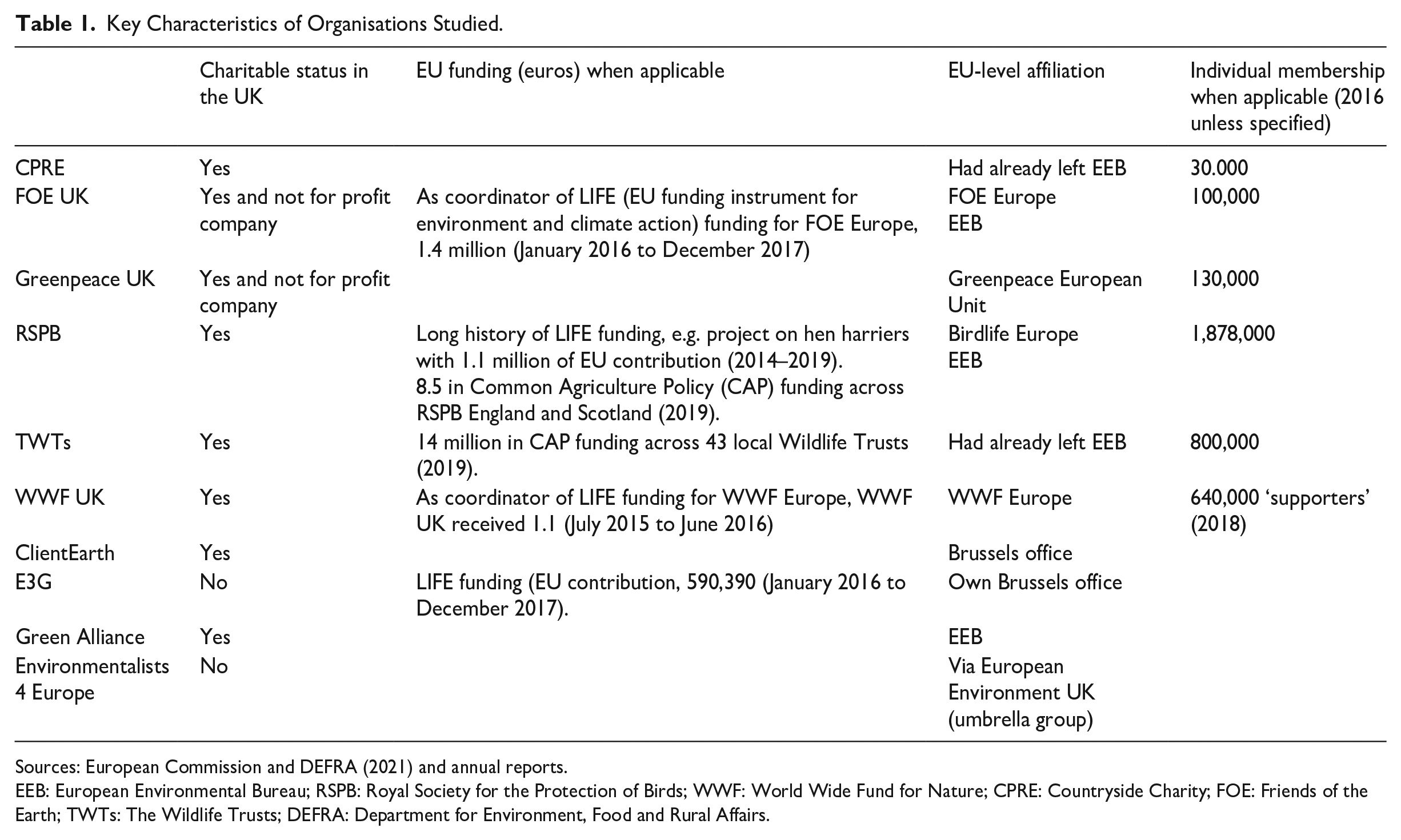
First, as regards Europe, UK ENGOs under study display different forms of engagement (lobbying, including through their NGO network in Brussels, litigation against the United Kingdom or participation in EU funding programmes) (see Table 1). They also had presumably material concerns related to the EU funding possibilities. Second, the capacity of ENGOs to undertake a public campaign in a referendum campaign is closely linked to advocacy activities in relation or not to their own membership. ENGOs with a membership are prone to more diverse campaigning activities, while ENGOs without membership may have no choice but to resort to insiders’ strategies. Conversely, ENGOs accustomed to public campaigns have a public image to protect. In brief, these organisations did not all face the same risks in terms of public image and could not deploy the same array of competences in a referendum context.
Key Characteristics of Organisations Studied.
Sources: European Commission and DEFRA (2021) and annual reports.
EEB: European Environmental Bureau; RSPB: Royal Society for the Protection of Birds; WWF: World Wide Fund for Nature; CPRE: Countryside Charity; FOE: Friends of the Earth; TWTs: The Wildlife Trusts; DEFRA: Department for Environment, Food and Rural Affairs.
Internal governance processes can be apprehended through organisations’ structure and formal rules of decision-making. For Hollman (2018), organisations face a trade-off between reactivity and efficiency. A federal structure is likely to be less reactive when trying to reach a common position across its membership. Conversely, a top-down structure where the staff implement the priorities decided on top may come to a decision more quickly but at the expense of the membership’s expectations. Internal pressures can also manifest at another level within international NGO networks. The more hierarchical ones shape the agenda of their member organisations. For instance, the national offices of the World Wide Fund for Nature (WWF) and Greenpeace have to follow a number of policy priorities decided at the international level. Accordingly, they both cannot exceed a given ceiling in their campaigning spending focusing on domestic politics.
Methods and Data
We conducted fieldwork building on three complementary data-gathering approaches. First, we collated news coverage of the environment during the EU referendum campaign by using Google Alerts during the EU referendum campaign (with key words ‘EU referendum’ AND ‘Environment’) and was subsequently supplemented by a Nexis Lexis search (key words ‘EU referendum’ OR Brexit AND ‘environment’). This allowed us to collect both evidence of UK politicians and UK ENGOs raising environmental issues during the campaign. Second, we collated campaigning material and supporting research – by think tanks, ENGOs, the official campaigns – to analyse whether and how they addressed environmental issues. Third, we conducted a series of 12 in-depth, semi-structured interviews with campaigners within the broader UK environmental movement (from a sample of organisations which followed a variety of strategies) to discuss the campaigning choices and strategies of their respective organisations. All proved at one point active on EU policy issues, by undertaking lobbying or supporting EU legislation or funding programmes.
Table 1 reflects the diversity of the nine ENGOs part of the study. It includes seven organisations relying on membership fees or individual donors (FOE England Wales and Northern Ireland, the RSPB, TWTs, WWF UK; the CPRE, Greenpeace UK, ClientEarth), one think tank (E3G), and an umbrella organisation for ENGOs (Green Alliance). We also included the ad hoc and more informal coalition created for the referundum by former high-profile environmental activists as part of subgroup of the European Movement (Environmentalists for Europe (E4E)).
These data were subsequently analysed with a pragmatist framework, combining a study of external and internal pressures, which structure our empirical analysis.
Responding to External Pressures
ENGOs faced a persisting uncertainty regarding the timing of the referendum as well as its regulatory context. The promise that David Cameron, then UK Prime Minister, made in 2013 was contingent on a Tory majority in the 2015 General Election – which polls at that time deemed unlikely. The referendum was initially to be held by the end of 2017. But instead, once PM again, Cameron opted to speed up the timing, hoping to build on the momentum of his surprising electoral victory. The referendum date was announced in late February 2016 with the official regulated campaign time starting on 15 April ahead of the 23 June poll date. The Charity Commission for England and Wales (2016) published its guidelines for charities on campaigning in the referendum in March
Gathering Evidence (Summer 2015 to Early 2016)
ENGOs were surprised by the shortened timeline but they were not unprepared. Many groups had submitted evidence to the 2010–2015 UK Coalition government’s effort to draw a review of UK–EU balance of competences in the spring of 2013: ClientEarth, FOE, Green Alliance, Greenpeace, Northern Ireland Environment Link, RSPB, TWTs and WWF among others (HM Government, 2014). As the 2015 Conservative victory confirmed a referendum would take place, ENGOs started gathering, and updating previous evidence. FOE immediately commissioned an academic report, published in early summer (Burns, 2015, an update from Burns’ 2013 report for FOE), while TWTs, WWF and RSPB commissioned a follow-up study of the report that the Institute for European Environmental Policy (IEEP) think tank had published in August 2013 after the Balance of Competence exercise. In parallel, the different organisations were also commissioning or producing in-house reports.
This overabundance of evidence was a response to the need to tailor evidence to each organisation to provide information for the board to approve (or not) campaigning choices (IT5). It aimed at anticipating ENGOs’ regulatory constraints, especially from the Charity Commission, by giving boards a solid evidence base for their decision, and arm themselves against negative media coverage. With a shorter timeline and delays in the IEEP report’s publication (2016), TWTs decided to commission consultants to produce wildlife-specific reports with a quick turnaround as well as ask a former chair to investigate what Brexit would mean for its individual trusts (IT5). Additional evidence on specific themes – such as Energy and Climate Change – was produced during the campaign to inform the broader public debate (E3G and Green Alliance, 2016).
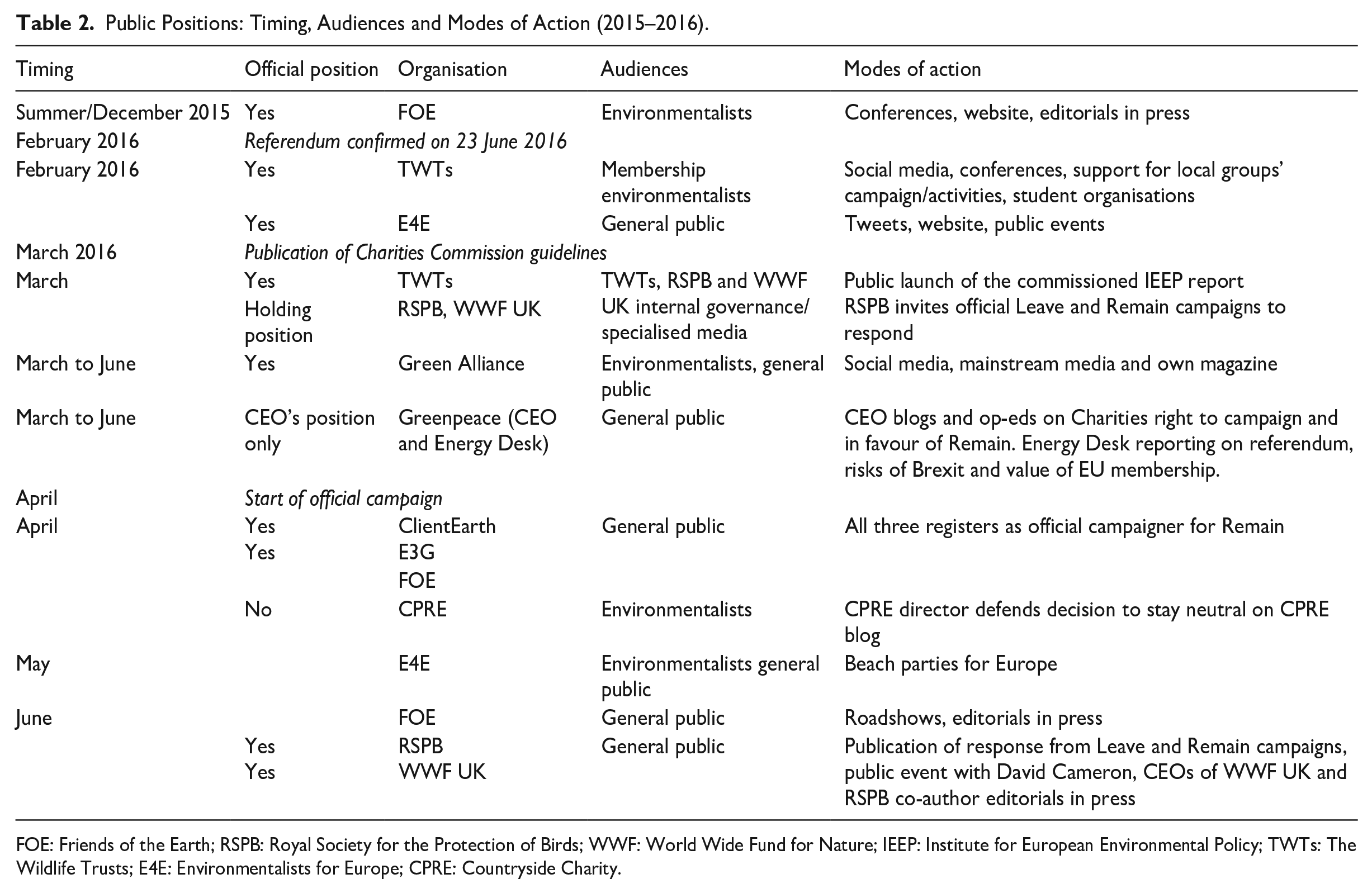
Fear of a regulatory and media backlash shaped the discussions on strategies that were regularly held by the Green Alliance. This organisation, dedicated to environmental lobbying in London, initiated the topic in its ‘White Paper Dinners’ that bring together ENGOs’ CEOs. By late 2015, the dinners had turned into a ‘cyclical talking shop’ where ‘some of the bigger organisations say[ing] we should do something and at some point, we should talk to our board. But not really advancing’ (IT7). This created tensions between groups and frustrations within the broader environmental movement (‘nobody was taking a leadership role’ IT3). From these meetings, ‘it became clear that some were happy to go faster than others’ (ibid.). In the end, most ENGOs would adopt a similar narrative of ‘Remain is better for the UK’s environment’ based on the evidence gathered, including by the IEEP (2016). But this occurred at markedly different times (cf. Table 2).
Public Positions: Timing, Audiences and Modes of Action (2015–2016).
FOE: Friends of the Earth; RSPB: Royal Society for the Protection of Birds; WWF: World Wide Fund for Nature; IEEP: Institute for European Environmental Policy; TWTs: The Wildlife Trusts; E4E: Environmentalists for Europe; CPRE: Countryside Charity.
Diverging Strategic Choices
The reluctance of the ENGOs to act, alone or together, can be traced back to their previous experiences of dealing with an increasingly constraining regulatory framework. Greenpeace and FOE had been particularly active in fighting the growing regulatory constraints under the Coalition government, leading the charge against the 2014 Lobbying Act. Both had also set up a second legal entity (limited companies) without charitable status as an alternative campaigning vehicle in light of regulatory change. Others had been targeted under the new rules. The Countryside Alliance and You Forgot the Birds (a group backed by the grouse-shooting industry) lodged formal complaints in front of the Charity Commission against the RSPB in 2014. Even if the Charity Commission cleared the RSPB on both counts, this led to a deep distrust of the ‘broken (. . .) politicised’ regulator (IT7) which made environmental charities particularly cautious:
The Charity Commission was being very punitive to charities (. . .) it should be called the anti-Charity Commission. IT3
This distrust deepened in 2016. The Charity Commission published its guidance for Charity conduct on 7 March, only 5 weeks before the start of the official campaign. For months, ENGOs had thus to ‘second guess’ what the guidance would require (IT8). Ensuring clear ‘governance cover’ implied the commissioning of a strong evidence base and clear process for (in some cases repeated) board approval (IT8). Yet even though ENGOs attempted to go above and beyond what their regulator would expect, they found themselves challenged: its guidance was leaked 3 days before publication to the Telegraph (Riley Smith, 2016). By the time they received the referendum-specific guidance, environmental charities were on the cover of the Leave-supporting newspaper ‘EU referendum: Britain’s biggest environmental charities using public cash to call for In vote’.
This article was only the first hit piece against environmental groups, and charities more broadly in Leave-supporting media. While early articles targeted use of public money for political purposes (e.g. in the Daily Mail, Sculthorpe, 2016), the focus shifted later to charities’ close ties to the EU. When the WWF and RSPB chief executives adopted their final position in the referendum, asking the public to #thinkenvironment and vote ‘Remain for nature’, the Telegraph retaliated by arguing that ‘It might not have been irrelevant for them to admit that the bodies they run are so close to the EU that they are almost part of it’ (Booker, 2016).
These two threats – first, to be found lacking by their regulator, second to be vilified by the press – deterred many charities across all sectors from getting involved:
In that week [of 7th March] a lot of charities boards took the decision not to get involved in the referendum. Many groups were so scared, and rightly scared. IT7
Thus, our interviewees reported struggling to build cross-sectoral coalitions, with Green Alliance in particular trying to get the ‘development sector out’ but most organisations refusing as ‘they didn’t want to put their head above the parapet’ (IT7). In this context and despite its importance in the campaign (‘£350 million a week for the NHS’ Brexit slogan), the health charity sector remained silent. The chief executive of National Voices, the leading coalition of health and care charities in England, spoke of ‘self-censorship’ (Taylor, 2016).
The organisations which decided to engage in the EU referendum despite the Charity Commission guidance faced further regulatory hurdles this time with the Lobbying Act and the Electoral Commission. If registering with the Electoral Commission, they could spend more than 10,000 pounds during the regulated campaigning period and try to influence the outcome of the vote. But this created two issues. First, for ENGOs such as Greenpeace, which had campaigned against the Lobbying Act, registering would mean belatedly accepting the Act which they still deeply opposed. Campaigning with no registration would mean the risk of a hefty fine, as the £30,000 fine one incurred by Greenpeace for campaigning during the 2015 election (Taylor, 2017). Second, registering during the referendum required clearly stating which side they wanted to campaign for, Remain or Leave. This went further than the heavily nuanced and narrowly focused calls of ‘Remain for Nature’ chosen by many organisations – as illustrated by the TWTs’ position they were ‘not telling people how to vote’ (IT5). It risked fuelling accusations that charities were engaged in political activity hereby going further than many groups were comfortable with– ‘in principle and in practice (. . .) we do not think is useful for us to be registering expenditure because (. . .) we are not political and therefore our actions should always be non-political’ (IT8).
As ENGOs, despite agreeing on the importance of the issue, were failing to agree on coordinated action, a few people, led by Barbara Young and Stanley Johnson (who both had past experience in leading major ENGOs and had long been active in the environmental movement) decided to sidestep pre-existing groupings and create a specific group to campaign: E4E. It was set up in February 2016 as an affiliate of the European Movement UK, with a steering group composed of environmental leaders, including past and current ENGOs’ CEOs. This ad hoc coalition aimed to facilitate collective action by overcoming regulatory constraints weighing on advocacy organisations:
An organisation which could draw on the analytical resources and expertise of the charities, but wouldn’t be identified as being those charities and was simply there for the purposes of campaigning to get the environmental case heard during the campaign. IT3.
In the end, only three ENGOs registered with the Electoral Commission (out of 123 registrations for the 2016 campaign). Only ClientEarth registered as a charity. FOE, E3G as well as the broader group the European Movement (thus E4E) all registered as companies (Electoral Commission, 2016). For registered groups, regulatory constraints continued, notably in stifling collaboration with the official Remain campaign. Expenditure for events and activities jointly organised with the official campaign would automatically be added to that campaign expenditure, which limited its capacity to change tactics and reallocate funding already planned months in advance (IT6).
Given the constraining UK regulations on political campaigning by charities and the possibility of negative coverage from a part of the press, we expected ENGOs, especially charities, to be wary of undermining their public image by participating in the EU referendum campaign. What we found is a tiered level of engagement. ENGOs’ fears proved accurate with intimidation from the anti-Europe medias and hostility from the Charity Commission. Only one group (CPRE) out of the nine studied stayed fully neutral. Three registered with the Electoral Commission. This broad engagement, and in some cases, actual campaigning, makes the environmental sector an outlier in UK charities. The next section, analysing the internal constraints for action, investigates why and how some ENGOs persisted in engaging in the campaign, shedding new light on their campaigning choices.
How Internal Pressures Mediated External Constraints
Our analytical framework isolates two organisational factors which may mediate external constraints (see Figure 1). First, ENGOs’ competence, covering both their previous dealings and knowledge of EU affairs and the structure of their membership (i.e. how they engage with a large group of potential voters). Second, ENGOs’ internal processes shaped by decision-making (centralised or not) and whether they are UK branches of international networks, thus less likely to engage in domestic political debates.
EU Links and Reasons for Campaigning
Crossing the two dimensions of EU-related activities and membership offers a first basis for comparison of campaigning choices. The Leave-supporting press accused ENGOs of having a vested interest in EU membership (see e.g. Hannan, 2016), in reference to a relationship which is indeed crucial for their activities but to varying degrees and aspects.
UK ENGOs won several key lobbying battles at home, thanks to their EU engagement (Berny, 2016). They have a long history with European ENGOs’ networks in Brussels and most had a European affiliation in 2016 (see Table 1). They displayed different levels of commitment to these networks, respectively, as a taker or a shaper of the Brussels-based networks’ initiatives. FOE and the RSPB have long offered leadership in their networks, providing capacity-building and initiating several joint actions. For WWF UK, this was more recent. Conversely, years before the referendum, both CPRE and TWTs had stopped participating in the EEB.
EU funding represents a material incentive which is more significant for nature protection organisations (TWTs, the National Trust and the RSPB). Charities managing land are each recipient of large amounts of EU funding under the Common Agricultural Policy. Yet these sums remained a very small proportion of their annual incomes. They represented in 2019 respectively 1.5% of the National Trust 634 million pounds income and 6% of the RSPB 142 million pounds income (National Trust, 2020; RSPB, 2019). The EU environmental funding, LIFE, is much less generous, but UK ENGOs have both been recipients and collaborators in many LIFE projects (see Table 1).
Critically, UK ENGOs’ relationships with the EU were much more complex than simple questions of funding, as they all had to deal with EU legislation in the United Kingdom when delivering environmental actions. They had long been aware of the UK public antipathy towards Europe, and, for those which remained major players in European-wide environmental networks such as RSPB or FOE, they were also dealing with the lacklustre environmental credentials of the European Commission, under both Barroso and Juncker (‘the European Union, essentially allowed itself to be portrayed as being anti-environment, at a time where (. . .) you could argue, objectively, that the environmental movement needed the European Union’ IT8). Thus, UK ENGOs were frequently leading campaigns at the EU level highly critical of EU action which ‘gave [ENGOs] some credibility because [they] haven’t been cheerleaders for everything the EU has done’ (IT6). This also meant that they were ‘not necessarily that keen to promote the role of European Union helping to save UK wildlife’ to their respective membership (IT8), failing to educate their members and supporters about the role of the EU in shaping the UK environment.
The (Dis)advantages of a Massive Membership
All ENGOs targeted primarily their membership, sometimes in association with the broader general public (cf. Table 2). But they needed to communicate on Europe in a context where all were indiscriminately attacked by the Leave press.
Membership ENGOs have varying numbers of members or supporters and different relations to them. RSPB, TWTs and the WWF could each boast of large member numbers (1.8 million; 800,000; and approximately 640,000, respectively) compared to Greenpeace, FOE and CPRE (Table 1). Besides, the nature protection organisations, such as the RSPB, CPRE, WWF and TWTs, are traditionally less prone to the adversarial stances taken by Greenpeace and FOE in their public campaigns, as their members chose to join for wider range of interest related to nature. For instance, ‘WWF’s members are moved by animals and we do not connect with them on political issues’ (IT11).
Finally, while there is a certain overlap in membership (e.g. half of the TWTs members are also RSPB members) as well as political differences in who joins the different groups. While RSPB and TWTs members are more rural and conservative (although less conservative for TWTs), Greenpeace, WWF and FOE members tended to be more urban and favour remain (IT1). These differences were likely to deter the nature protection organisations from taking a clear stance in favour for Remain, especially with an adversarial leave press. The divisions between Leave and Remain cutting across the UK political parties were also cutting across the ENGOs membership, from ‘a substantial Leave group within the Greenpeace supporting network’ (IT12) to local TWTs: ‘All these people who I’ve known for years, and who were really committed to wildlife were hugely split, about the referendum, about the European question’ (IT3).
This created two different challenges for ENGOs in using their membership to campaign. The target audience would have been ‘people who are inclined to vote Leave and for whom environment issues are enough to swing them’ (IT12). But could ENGOs with a small membership reach this group in any sufficient number to matter? And would groups with larger membership be willing to risk upsetting members (and thus funding stream) by making a strong case for Remain directly to them (some perceived ‘an actual toxic risk of losing members if they were to take a stance during the campaign’ IT1)? During the spring of 2016, the increasing salience of issues of immigration and economics in the campaign exacerbated these dilemmas. For ENGOs, this meant that ‘the space for the sort of things that we would have wanted to advance in the sort of broader media and political environment was shrinking’ (IT12).
Not surprisingly, think tanks (such as E3G) or organisations such as the Green Alliance that are not dependent on individual membership overtly campaigned for Remain. While the Green Alliance choose ‘to speak to the powerful’ (IT7) following well-established advocacy practices, E3G targeted interested audiences, young people and environmentalists. E4E by definition was not engaging the position of the ENGOs present on its steering committee and could thus communicate to a larger audience.
Internal Governance Process – Or How Campaigning Decisions Were Made
These critical campaigning choices were in the hand of each ENGO’s internal decision-making processes. Here, we expected that the affiliation or not to an international network with common priorities and the federal/centralised nature of the organisation would shape the decision to take action and its timing. Across the organisations studied, the two at the opposite side of the local/international spectrum did the least. CPRE which remained neutral exists only in England, while Greenpeace’s CEOs wrote few op-eds but the organisation did not decide to campaign. Conversely, FOE UK was central to ENGOs’ evidence base building since 2013. Thus, whether ENGOs were local or international does not appear to have been a determinant.
The picture is also unclear for centralised versus federal structures. As discussed above, all charities had to operate in a situation where their boards mattered more (‘Charities that in the past would have made their minds up about what to do about a particular issue perhaps without going to their board all went to their boards on this one’ IT3). FOE, Green Alliance and TWTs came first to an official position, despite their difference in structure. On one hand, FOE, and even more so Green Alliance, relies on the initiatives of the staff. For Green Alliance, which is principally a forum for ENGOs, taking a position was obvious: ‘Brexit was a number 1 priority easily signed by the board’ (IT7). In the summer of 2015, FOE was the first to adopt a clear position in favour of Remain, with an additional board sign-off to agree campaign choices (such as registering with electoral Commission) in January 2016. The process did not involve the relatively autonomous 170 or so local groups. On the other hand, the most decentralised organisations, TWTs (47 trusts) adopted a position in February 2016, months before WWF UK or RSPB. The staff in London and some activists in local TWTs turned its decentralised nature in a strength: willing trusts could campaign on a common position with material prepared by the staff in London (Remain is better for nature) but trusts could also choose (as with the Scottish Wildlife Trust) to remain neutral.
Finally, despite the centralised character of the RSPB and WWF, internal discussions were longer than expected. The RSPB puts it on the agenda early on, but discussions about the referendum lasted until December to ensure a ‘proper governance cover’. Risk avoidance was favoured in a context of uncertainty, triggering ‘a lot of emotion’ among board members (IT8). There was also a prolonged engagement between the 2 ENGOs and 10 Downing Street behind the scenes. In early June 2016, David Cameron visited an RSPB nature reserve where he asserted the importance of the EU legislation, including the Nature Directives, for the UK environment. This visit marked an unusual coming together of EU and UK campaigns for the RSPB as well as a profound policy change for Cameron: RSPB was, together with its Birdlife Europe partners, still spearheading the highly visible Nature Alert campaign against the revision of the Nature Directives in 2015 at the EU level (a revision initiated in part by the previous Cameron-led coalition government) (Gravey and Jordan, 2020). The same day, both RSPB and WWF finally came out with a public position to ‘think environment’ and that on balance, staying in the EU would be better for the UK environment. Although the length and outcome of the WWF internal process was similar to the RSPB’s, the importance given to EU matters was not as significant, making the value of engaging in the EU referendum less evident for WWF UK.
The timing and internal lobbying to push a Brexit agenda in Greenpeace offers here an interesting comparison. The policy staff of Greenpeace in charge of policy monitoring was convinced that the issue was crucial, in contrast with the rest of the staff, younger and campaigning on international problems. The engagement with the referendum remained thus limited to interventions of Greenpeace CEO – who stood up in the press when ENGOs were attacked under the Charity regulation – and by Greenpeace Energydesk (now Unearthed, Greenpeace’s news and investigation platform) that enjoyed a relative autonomy and became a natural ally for Remainers.
Conclusion
ENGOs’ choice to make the case for Europe threw them into an uphill battle exposing them to potential damage in terms of public support and material resources (financial sanctions). Such decisions challenge common assumptions on campaigning choices: not only was the likelihood of success poor but also the risk to alienate parts of their memberships (Halpin et al., 2018), as well as the media and the general public (Berkhout, 2013), was high. The few months leading to the referendum represented a critical and thus defining sequence for the values these organisations stood for and their raison d’être, beyond mere material maintenance concerns. Their campaign choices highlight profound challenges both for ENGOs themselves, and their contributions as well as, more broadly, from civil society organisations, to a modern democracy such as the United Kingdom.
In this article, we asked why did they nevertheless get involved and how did they get involved? To address both questions, we conceptualised the institutional context (regulatory and media) and organisational logics (competence and governance processes) as external and internal pressures that materialised in the course of the referendum campaign, and showed how they interplayed in individual ENGOs’ campaign decisions and their timing. All ENGOs – indeed all civil society organisations – faced similar high media and regulatory pressures. In preparing for external attacks and demands to justify their position, ENGOs built a wealth of expertise that fuelled an intense internal debate and led to a shared conclusion within the movement: the EU overall had been good for the environment, speaking up for Europe was the right, if not smart thing to do. This set ENGOs apart from the rest of UK civil society, which overall abstained. Internal pressures help explain different campaigning choices. Thus, the three groups most active in advocacy at the EU level (FOE, RSPB and WWF) all took part – while CPRE which had divested from the EEB did not. But competence and internal pressures do not explain these choices fully. First, characteristics such as a large membership were both a blessing – in that more voters could be directly influenced – and a curse, as ENGOs had to balance doing ‘the right thing’ with potentially losing members. Here FOE, despite clamours for Lexit, came out early and strongly, while RSPB and WWF with their hundreds of thousands of members held back and prevaricated. What our case shows is the importance of individual choices in how these pressures, both internal and external, were navigated, the margins of manoeuvre, and indeed of innovation, that actors had, and to what extent they were supported internally to see their plans through. Hence, one of the earlier groups to move was TWTs – despite its limited links with the EU and despite its decentralised nature, which we expected to slow decision-making. TWTs developed targeted briefings for each trust, and innovated in leaving the decision to campaign, or not, to each trust, fostering deliberation within its membership.
Beyond their differences, ENGOs’ campaigns during the 2016 referendum shared three characteristics symptomatic of the difficulties they faced: they almost exclusively relied on expertise to address their members and the general public, they navigated a reputational risk that increased over time and had to deal with the long-standing absence of a positive portrayal of EU membership.
The use of expertise but also of nuanced arguments aimed to limit damages to their reputation and keep their membership on board. While it worked well in convincing the sector internally, this choice became problematic in a campaign where expertise was resented (see Gove’s famous tirade, ‘this country has had too much of experts’ in June 2016). ENGOs ‘didn’t expect the anti-expertise debate’ (IT2) nor planned for it. This had two direct consequences. First, it hampered ENGOs’ ability to respond to much blunter, and less fact-based arguments from the other side. ‘Making emotional arguments is harder sometimes than actually just being right, and especially when you put so much stock in being right’ (IT6). Second, and stemming from the first, many groups favoured a media strategy best summarised as ‘grownups know best’ where they hoped their expertise would be heard, favouring speaking to high-brow programmes such as BBC Radio 4’s Today Programme compared to the much less elitist Good Morning Britain (IT7).
The choice of conservatism and cautiousness in addressing reputational risks meant that the different groups intent on participating did so at different paces, to various degrees and in dispersed order. WWF and RSPB eventually adopted TWT’s position of ‘Remain for nature’ 4 months later (June v. February 2016), while concerns about appearing non-political meant neither of these very large organisations actually registered to campaign officially for Remain. This fostered tensions within and between groups. Furthermore, while cautious messaging reduced regulatory risk, it did not reduce reputational risk: Leave-supporting media did not differentiate between ENGOs, accusing them all of campaigning for Remain, of using public funds to do so and of being dependent on EU funds (Booker, 2016; Hannan, 2016).
Although their long-standing resort to expertise to engage with EU issues had strategic shortcomings, it nevertheless entitled them to speak for the environment and make the argument in the public space. Their campaigning choices confirm the centrality of expertise for advocacy organisations standing for those with ‘little or no voice’ (Urbinati and Warren, 2008: 404). For Halpin (2010), the democratic credentials of organisations advocating for causes such as the environment do not rest on representative claims but on epistemic claims, whether scientific, emotional or experiential. The legitimacy of these ‘self-authorized representatives’ requires in return external accountability (Urbinati and Warren, 2008: 403). This requires that the publics they target are ultimately judging their reputation and their conformity to their social mission, thanks to public rules ensuring the transparency of funding and functioning (Halpin, 2010). These latter aspects were crucially at stake during a referendum campaign where the conditions for a public debate were far from being met. The sequence was marked by the massive and unprecedented use of social media to circulate fake news, becoming an illustration of the polarisation of citizens’ political attitudes (Edwards, 2021).
Our case allows us to revisit Warren’s (2001) three ‘democratic effects’ of civil society. First, developmental as voluntary associations foster civic virtues and different skills including by collecting information for internal use; second, institutional as they represent their constituencies’ concerns in connection with public decision-making; and third, in terms of public sphere how they encourage deliberation and contribution to the formation of public judgement.
In terms of public spheres, the new rules and late publication resulted in effectively ‘shrinking’ the civic space (Dupuy et al., 2021) for the non-profits that were expected to, in the words of former Civil Society Minister Brooks Newmark, ‘stick to their knitting’ – thus putting emphasis on service provision rather than advocacy (Morris, 2016). ENGOs also had to endure intimidation from the Leave press, including from newspapers that campaigning organisations such as Greenpeace were used to work with. Interestingly, they were not attacked because they expressed their views publicly, but on the basis of serving first their organisational interest, while they experienced the opposite situation. They were repeatedly dismissed as part of an establishment prone to defend a situation of economic rent built on sectoral EU policies. When it comes to their mediation with institutional politics, their unprecedented attempt to weigh in on parts of the electorate did not however upset their members’ expectations of what their respective organisation should do. Several internal reports as well as feedback on social networks showed that overall, their members and supporters understood and endorsed the fact that they took part in the referendum to speak for the environment in the United Kingdom. It was all the more critical that the Leave camp hardly engaged with environmental issues, apart from farming minister and Leave campaigner George Eustice. Finally, in terms of individual developmental effects, UK ENGOs realised that they had not sufficiently communicated on the benefits of European cooperation 20 years ago, during the golden age of EU environmental policy, which prevented them from effectively opposing the long-standing Eurosceptic narrative of freedom and control. The importance of the EU in domestic environmental legislation was taken for granted. In this regard, UK ENGOs do not differ from most domestic advocacy organisations involved in EU matters whose strategies closely follow the EU policy agenda. Their 2016 experience illustrates the usefulness of giving positive examples of EU action on aspects people could easily relate to:
There were lots of discussions around what our content on our website looks like. And most of it was quite boring with titles like ‘what has the EU done for beaches?’, ‘what has the EU done for bees?’ But it was actually some of our most popular content on our website because it was just the things that people started to google. IT6
Face-to-face engagements in FOE or TWT’s public events proved also useful to foster internal debates.
While much has been written on the behaviour of parties, official campaigns and citizens’ perceptions since the Brexit vote, shedding light on the civil society organisations tells us much about the present challenges faced by voluntary associations to fulfil democratic functions in a context of Euroscepticism and growing polarisation elsewhere (Marks et al., 2021). The overall experience of the 2016 EU referendum campaign was bruising for the UK environment sector where it was perceived as a collective failure to be engaged together and early enough (Miller et al., 2017).
The EU referendum was however a critical moment conducive to important developments when it comes to both institutional and public sphere effects. The vote to leave the EU was a wake-up call, as high-profile ENGOs have come together since 2017 in the Greener UK coalition. Organisations as different as Greenpeace and CPRE and that remained distant from the referendum campaign are now part of this collective lobbying effort to protect environmental standards in the legislative process of taking back control. The legislative process triggered by Brexit has become the main priority of the leading British ENGOs (Abbot and Lee, 2021) regardless of their scope of action or political advocacy style. Finally, the nature protection organisations have become more proactive and vocal to resist restrictions or intimidation aimed at their campaigning efforts, as exemplified by the RSPB’s 2022 campaign ‘attack on nature’ (Laville, 2022). The story of the Brexit referendum reflects the increasing phenomenon of shrinking civic spaces (Dupuy et al., 2021). The analysis presented here shows the added value of combining both strategic and normative considerations when it comes to voluntary associations’ advocacy for public goods.
Footnotes
Acknowledgements
This article would not have been possible without the ENGOs’ staff the authors interviewed and the community of scholars in Brexit & Environment which supported their work. They would further like to thank the anonymous reviewers and editors for their insightful comments which made this a stronger article.
Declaration of Conflicting Interests
The author(s) declared no potential conflicts of interest with respect to the research, authorship and/or publication of this article.
Funding
The author(s) disclosed receipt of the following financial support for the research, authorship and/or publication of this article: Viviane Gravey’s contribution to this article was supported by the ESRC [ES/R00028X/1].
