




Abstract
We combine two dominant approaches to studying how issues influence elections: one that emphasizes parties’ issue positions, and the other parties’ issue ownership. Research from the latter approach shows that voters ascribe greater economic competence to right-wing parties. Based on this finding, we argue that parties enhance their economic issue ownership when voters perceive them shifting to the right. In the following step, we show that perceived rightward shifts of parties also lead to subsequent increases in electoral support. We analyze economic ownership survey data and election outcomes in 15 democracies over the period 1986–2015 that supports the expectations that parties’ perceived rightward shifts result in increases in economic ownership and subsequent vote shares. We also show that the right-shift vote gains are strongest during recessions when voters prioritize parties’ economic competence.
Extensive empirical research analyzes parties’ issue ownership of domains such as the economy, crime, immigration, and education and how this influences election outcomes and party competition (e.g. Budge and Farlie, 1983; Carlin et al., 2022; Ceron and Greene, 2019; Green and Hobolt, 2008; Petrocik, 1996; Seeberg, 2017, 2020). There is also a long tradition that evaluates how parties’ issue positions affect voting and elections (e.g. Dow, 2001, 2011; Downs, 1957; Enelow and Hinich, 1984; Spoon, 2011; Spoon and Klüver, 2020). However, we lack insights into how parties’ policy positions influence their issue ownership, that is, the issue domains that voters ascribe to parties as “owning,” and the implications for parties’ positional strategies and election outcomes (but see, for example, Green and Jennings, 2017; Lefevere et al., 2017; Seeberg, 2017, 2020).
We combine research on parties’ issue ownership and their issue positions to consider how shifts in parties’ perceived positions affect their ownership of the economy and, through this, their popular support. Building on research by Seeberg (2017) showing that right-wing parties tend to own issue competence on the economy, we argue for a right-shift economic ownership effect that parties enhance their economic issue ownership when voters perceive them shifting their positions rightwards and for a related right-shift vote gain effect that parties’ economic ownership gains from perceived right-shifts enhance their electoral support. Moreover, because voters prioritize economic competence during recessions, we argue for an economic conditioning effect that parties’ vote gains from perceived right-shifts increase as economic conditions decline.
We report empirical analyses across 15 Western democracies that substantiate our theoretical arguments. These findings have implications for parties’ election strategies and political representation. First, our conclusion that all types of parties—in particular right and left-wing parties—gain when voters perceive them shifting rightwards, particularly during recessions, poses a strategic dilemma for left-wing parties. Presumably, many left-wing elites will resist moderating their policies because this violates their core convictions, so our arguments and findings connect with Kitschelt’s (1999) research on the electoral tradeoff that European social democratic parties confront (see also Schleiter et al., 2021). By contrast, right-wing parties’ elites may embrace the opportunity to strengthen their right-wing image by promoting more conservative policies, thereby moving closer to their sincere policy views and maximizing their election prospects.
Second, our findings highlight that voters respond to their perceptions of party ideologies rather than to exogenous measures such as those based on codings of parties’ election manifestos. This is why our analyses emphasize party positions as perceived by voters. We demonstrate that voter perceptions of party Left-Right shifts do not reliably track shifts in parties’ policy rhetoric in their manifestos. Moreover, parties’ manifesto-based shifts have no detectable effects on their economic issue ownership or election outcomes. By contrast, voters’ perceptions of party shifts exert the strong effects described above. Voters react to what they perceive.
Third, our arguments and empirical findings run counter to the conventional wisdom about the electoral effects of party policy shifts, particularly as filtered through the spatial model of elections popularized by Anthony Downs (1957). The most famous strategic dynamic associated with the Downsian model is that left- or right-wing parties (candidates), particularly those contesting two-party elections, benefit from policy moderation in situations where there are many centrist voters—which, as we document below, is the case in most Western democracies. The alternative expectation, associated with the “core voter” strategy, is that parties gain by appealing on policy to the (typically radical) base of their partisan constituency to maximize turnout among these core supporters (Ezrow et al., 2011; Kitschelt, 1988; see also Ibenskas and Polk, 2021). Our findings imply that both types of conventional wisdom are half-right: We find that all parties gain from shifting their policy images farther to the right, that is, left-wing parties gain votes from moderating their policy images toward the center of public opinion, while right-wing parties gain from radicalizing their images. Ours is the first study to argue for and empirically substantiate this dynamic.
Fourth, our economic conditioning finding that parties gain the most from perceived rightward shifts during recessions when economic competence is most salient contributes to the political economy literature that analyzes how parties’ incentives to adjust their economic policies respond to economic conditions (e.g. Hellwig, 2012) and to the public salience of economic issues (e.g. Abou-Chadi et al., 2020). In particular, we show that parties’ electoral incentives to shift their policy images rightwards are strongest during recessions.
Beyond the substantive importance of our findings, our study illustrates the benefits of combining the spatial perspective on party positions with the issue ownership approach. While these two approaches are—with the important exceptions of Banda (2016), Green and Jennings (2017), Seeberg (2017, 2020), De Sio and Weber (2014), Walgrave et al. (2012) and Lefevere et al. (2017)—often applied separately, 1 we also show that they complement each other to produce insights that neither approach provides by itself: namely that on the important issue of the economy, parties’ economic issue ownership is endogenous to their perceived issue positions, which has important implications for party positional strategies and election outcomes.
Parties’ Policy Shifts, Economic Issue Ownership, and Elections
How Parties’ Perceived Positions Affect Economic Issue Ownership and Electoral Support
Our central expectation is underpinned by how parties’ perceived positions influence their issue ownership. When voters perceive parties shifting to the left or right, it potentially enhances parties’ ownership of economic issues and, through this, their election support. We note that this expectation is not obvious because previous theoretical work does not provide a guide as to how citizens “should” weigh different facets of economic management. 2 Fortunately, Seeberg (2017) has completed a cross-national empirical study that systematically analyzes whether left- or right-wing parties own the overall issue of managing the economy by analyzing national election survey data on economic issue ownership from 136 elections in 17 Western democracies between 1990 and 2014. He reports a clear pattern that right-of-center parties tend to own the economy more than leftist parties (Seeberg 2017: Figures 1–2: 483–84). Furthermore, Seeberg reports that popular majorities most trusted a right-wing party to handle the economy in 15 of the 17 countries in his study; that the Swiss public was evenly divided between the right and the left; and only the American public ascribed majority economic ownership to the left. 3 Seeberg also reports fluctuations in left-right economic issue ownership across time, that is, parties’ economic competence images are fluid, not fixed. We return to this point below.
We extrapolate Seeberg’s cross-sectional finding that the right is more trusted on the economy, to argue for the temporal implication that parties will increase their ownership of the economy over time when voters perceive them shifting their positions rightward, that is, in the ideological direction to which popular majorities ascribe overall economic competence:
H1 (the Economic Issue Ownership Hypothesis). Parties’ public images for economic competence improve when the public perceives them shifting their positions to the right, all else equal.
The economic issue ownership hypothesis (H1) above is interesting because alternative considerations point in conflicting directions. The intuitive logic underlying H1 is that as parties—including left-wing parties—are perceived as shifting to more right-wing (less left-wing) positions, voters will perceive these parties having more points of similarity with parties from right-wing families (i.e. Conservative, Christian Democratic, and Liberal families). And, this perception may prompt some voters to ascribe more of the attributes associated with right-wing party families, including economic issue ownership, to those parties they perceive as shifting right. On the contrary, a left-wing or Social Democratic party’s perceived right-shift may merely prompt voters to perceive the party as less dissimilar to members of right-wing party families, rather than as truly similar. Hence, it is an open question how much perceived right-shifts enhance leftist parties’ perceived economic competence. 4
Given extensive research (discussed earlier) showing that voters value economic competence, the economic issue ownership hypothesis (H1) has the following implication for party support:
H2 (the Right-shift Vote Gains Hypothesis). Parties increase their electoral support when voters perceive them shifting to the right, all else equal.
The right-shift vote gains hypothesis (H2) departs from previous empirical research inspired by the spatial model of elections, first, by positing an effect of party Left-Right shifts independent of the distribution of voters’ ideological positions. Previous studies typically analyze the electoral effects of party shifts relative to voters’ ideal points, emphasizing the effects of party positioning relative to the median voter position. Thus, Ezrow (2005), Karreth et al. (2013), Bawn and Somer-Topcu (2012), and Benedetto et al. (2020) all report cross-national empirical analyses of how parties’ vote shares change as their Left-Right positions shift closer to or farther away from the median voter position, finding mixed evidence about the electoral benefits of ideological moderation. 5 Given the empirical pattern that the median voter’s Left-Right position is invariably moderate in Western publics (see Figure S1 in the Online Appendix), these studies cannot detect the electoral effects we posit: for if ideological moderation gains votes, then left-wing parties benefit from shifting to the right (toward the centrist median voter position) but right-wing parties benefit from shifting to the left (also toward the median). Second, H2 pertains to the electoral effects of parties’ shifts as perceived by voters, whereas some of the empirical studies summarized above—along with Abou-Chadi and Wagner’s (2019) innovative analysis of the electoral effects of leftist parties’ policy shifts—analyze party position changes as delineated in their election manifestos. As we discuss below, voters infer party positions (and position shifts) from a variety of sources, including governing coalition arrangements, media reports of parties’ public interactions, party leaders’ gender, and governing parties’ policy outputs, so that there is only a weak connection between voters’ perceptions and party policy shifts as stated in their manifestos (Adams et al., 2011).
While H2 posits that parties gain votes when the public perceives them shifting to the right, all else equal, all else may not be equal. Lindvall (2014) argues that right-wing parties perform well in the short term during economic crises. 6 A straightforward explanation for this expectation is that citizens shift to the right during economic downturns (e.g. Alt, 1979). In particular, there is empirical evidence that the economy becomes more salient when economic conditions deteriorate (Bevan and Jennings, 2019; Hellwig, 2001; Singer, 2011). Furthermore, the performance voting literature establishes that voters primarily base their choices on issues they find salient (e.g. Green-Pedersen, 2007). These studies suggest that parties gain more votes from an image of economic competence when the public finds the economy more salient. These considerations prompt our third hypothesis:
H3 (the Economic Conditioning Hypothesis). The more economic conditions decline, the more parties enhance their vote shares when the public perceives them shifting their positions to the right.
The economic conditioning hypothesis (H3) is important because it can help parse out the causal explanation underlying the right-shift vote gains hypothesis (H2). Our theoretical expectation for H2 is that parties’ perceived rightward shifts enhance their economic issue ownership and, through this, their popular support. Hence, finding empirical support for H3 will substantiate the theoretical expectation that parties’ vote gains from perceived right-shifts are driven by their enhanced economic competence images.
Empirical Test of the Economic Issue Ownership Hypothesis
We first evaluate the economic issue ownership hypothesis (H1) that parties’ reputations for economic competence improve when the public perceives them shifting right. Our data on parties’ economic issue ownership are from Seeberg (2017), who collected citizen responses from 136 National Election Studies in 17 countries. In these surveys, respondents choose one party that “is best at solving (or dealing with) an issue,” which Seeberg used to compute the proportion of respondents in each survey who ascribed economic issue ownership to each party in the system. 7
It is less clear how to measure the perceived Left-Right party shifts that underpin our hypotheses. Seeberg’s (2017) finding of the right’s economic ownership pertains to right-wing ideology broadly defined. He classified right-wing parties as those belonging to the conservative, Christian Democratic, liberal, radical right, and agrarian party families. While the first three family groups tend to present clearly right-wing economic policies, the latter two are broadly associated with non-economic dimensions (the radical right with immigration and populism, and agrarian parties with agricultural issues). Thus, we cannot distinguish which facets of a party’s “rightness” confer the economic ownership advantages we posit, particularly since citizens may view some issues that are not exclusively economic, such as environmental regulation, immigration, and crime, through an economic frame (see, for example, McDonald and Budge, 2005).
In practice, we lack sufficient cross-national and longitudinal data on citizens’ perceptions of parties’ economic positions to empirically analyze perceived shifts in parties’ specific economic policies. We do, however, have abundant data on survey respondents’ party placements on the overall Left-Right dimension. To the extent this broader dimension drives citizens’ economic competence evaluations, this is the appropriate data for our study. And to the extent the causal processes we posit pertain primarily to economic Left-Right policy, empirical studies consistently show that economic policies constitute a prominent component of overall Left-Right ideology in Western democracies. The connection between Left-Right ideology and its economic dimension is also supported by the strong correlation, for every European party system in our data set, between the parties’ overall Left-Right ideological positions and their positions on social welfare spending versus taxes, as perceived by political experts from the Chapel Hill Expert Survey (CHES) data from 2006, 2010, and 2014 (the years for which the taxes-versus-spending question was available). 8
Based on the above considerations, we empirically evaluate our hypotheses based on citizens’ overall Left-Right party placements. (Table S3 in the Online Appendix reports robustness checks omitting niche parties that are primarily identified with non-economic policy dimensions, which support the same substantive conclusions we report below.) To the extent this broad ideological scale does not perfectly capture the facets of “Leftness” and “Rightness” that drive the economic competence evaluations we analyze, this should weaken empirical support for our hypotheses.
To construct our measure of citizens’ perceived party Left-Right shifts, we rely on the common module of the Comparative Study of Electoral Systems (CSES) voter surveys (Giebler et al., 2016), which asks respondents to place each party in their country on a 0–10 scale, where higher numbers denote more right-wing party placements 9 , supplemented by earlier national election surveys from Denmark, Sweden, Spain, Germany, and the Netherlands. We analyzed all cases for which we had overlapping measures of parties’ perceived ideologies from the CSES and their issue ownership from Seeberg’s (2017) data set. Table 1 reports the set of countries, parties, and election years in these analyses.
Countries and Parties Included in the Economic Issue Ownership Analyses.
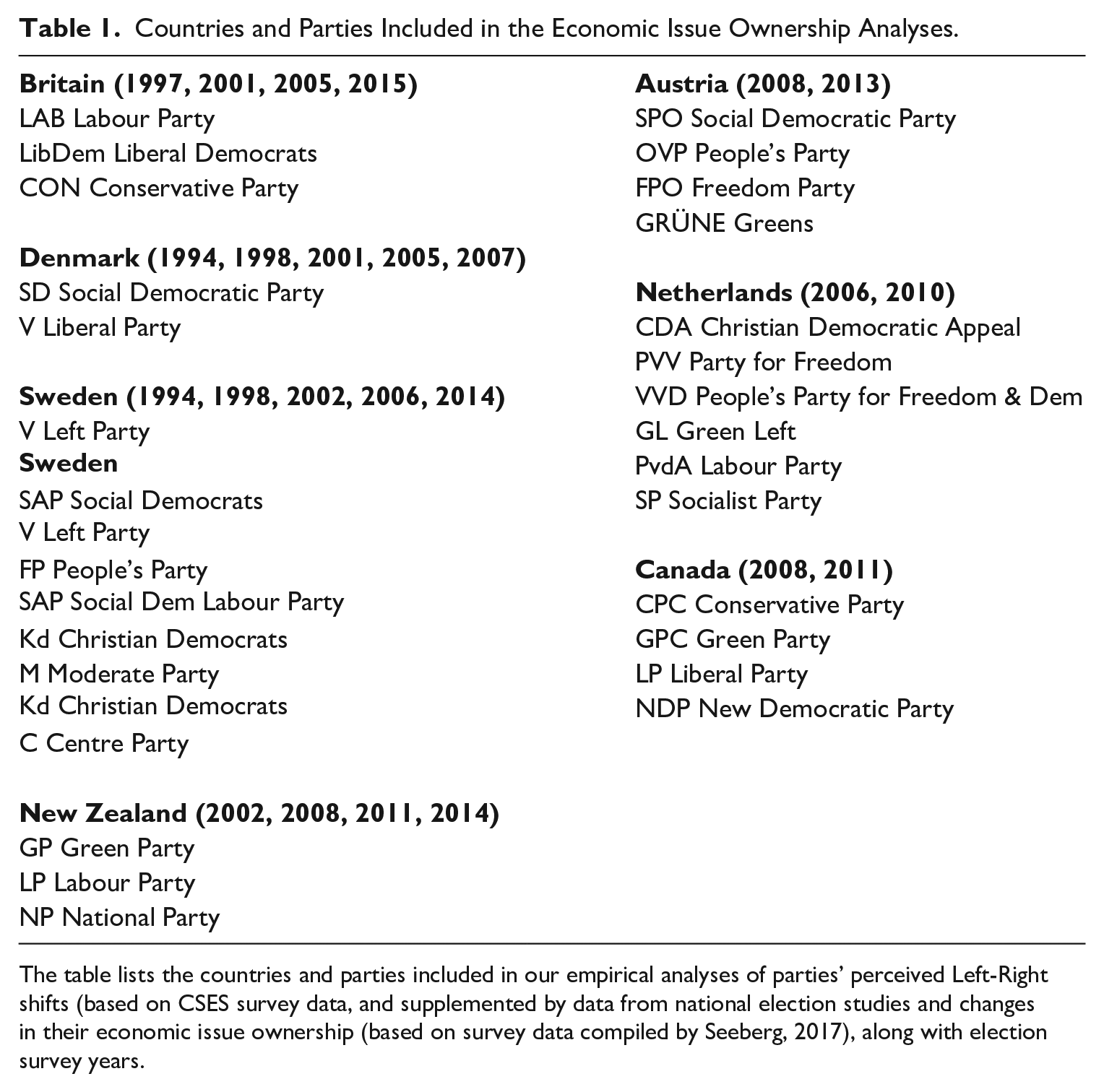
The table lists the countries and parties included in our empirical analyses of parties’ perceived Left-Right shifts (based on CSES survey data, and supplemented by data from national election studies and changes in their economic issue ownership (based on survey data compiled by Seeberg, 2017), along with election survey years.
To evaluate the economic issue ownership hypothesis, we constructed measures of temporal changes in parties’ issue ownership and voter perceptions of their Left-Right positions. Our dependent variable is [party j’s economic issue ownership change (t)], defined as the difference between the percentage of respondents who ascribed economic issue ownership to party j in the current election survey at time t versus j’s economic issue ownership percentage in the previous election survey at (t – 1). Positive values denote economic ownership gains; negative values denote losses. Our key independent variable is [party j’s perceived Left-Right shift (t)], defined as the difference between the survey respondents’ mean placement of party j at time t and their mean placement of j at (t – 1), for which positive values denote perceived right-shifts and negative values denote leftward shifts. The standard deviation of the [party j’s economic issue ownership change (t)] variable is 14.7%, indicating that parties’ economic issue ownership varies significantly over time. By contrast, the mean (–0.05) and standard deviation (0.39) of the [party j’s perceived Left-Right shift (t)] variable are small, which supports previous findings that parties’ Left-Right images are stable (e.g. Dalton and McAllister, 2015).
Columns 1–4 in Table 2 report parameter estimates for model specifications that estimate changes in parties’ economic issue ownership as a function of changes in their perceived Left-Right positions. We report estimates for four models: a basic model that regresses changes in parties’ economic issue ownership against changes in their perceived Left-Right position (column 1); a lagged issue ownership model that additionally controls for the party’s issue ownership at the previous election survey (column 2); an economic effects model, described below, that controls for changes in national economic conditions and parties’ governing status (column 3); and a model that additionally controls for country fixed effects (column 4). The standard errors are clustered on parties.
The Relationship between Parties’ Perceived Left-Right Shifts and Changes in Their Economic Issue Ownership (N = 59).
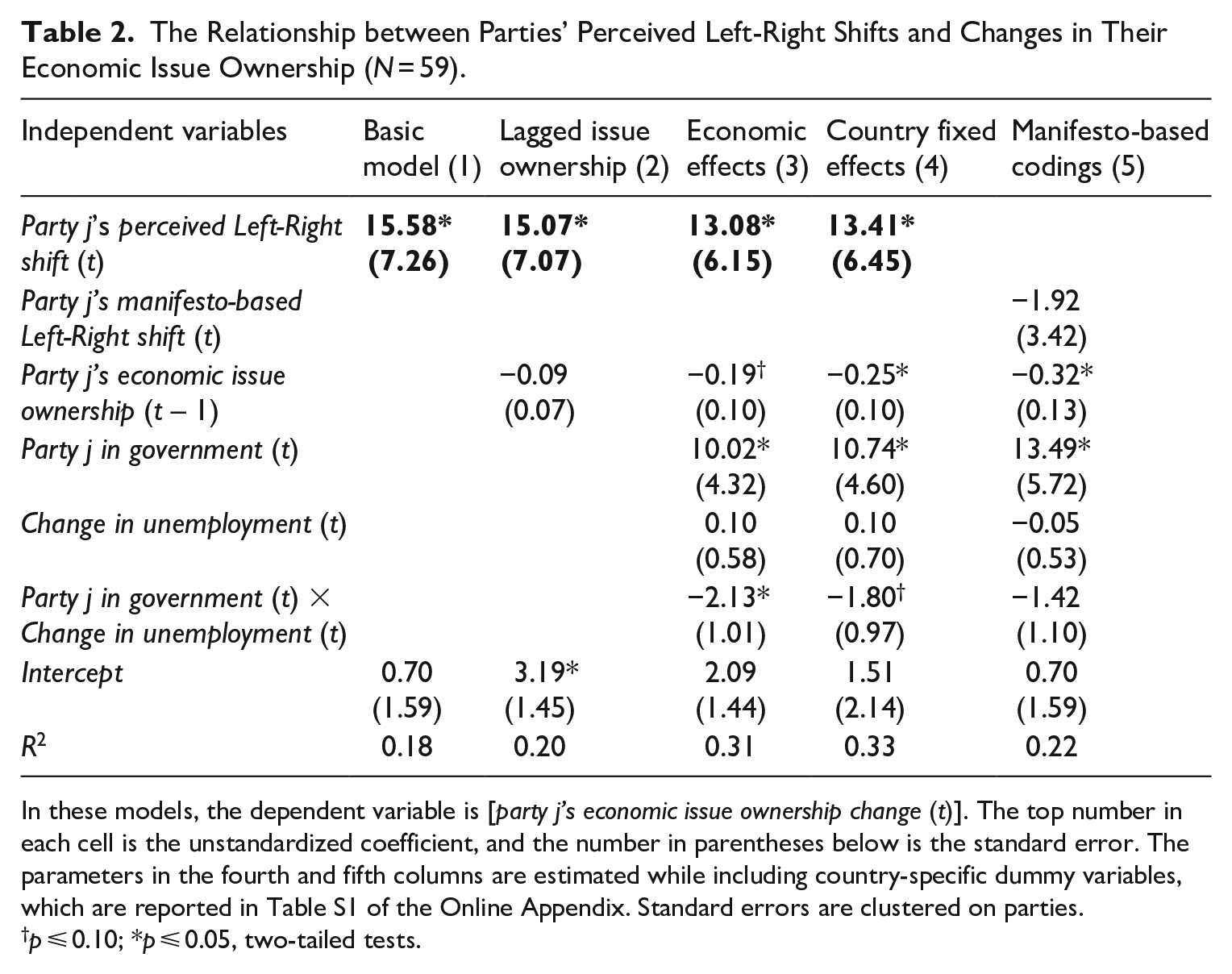
In these models, the dependent variable is [party j’s economic issue ownership change (t)]. The top number in each cell is the unstandardized coefficient, and the number in parentheses below is the standard error. The parameters in the fourth and fifth columns are estimated while including country-specific dummy variables, which are reported in Table S1 of the Online Appendix. Standard errors are clustered on parties.
p ⩽ 0.10; *p ⩽ 0.05, two-tailed tests.
The economic issue ownership hypothesis (H1) implies that this coefficient on the [party j’s perceived Left-Right shift (t)] variable should be positive, that is, that parties increase their issue ownership when the electorate perceives them shifting right. The parameter estimates on this variable support H1 and are substantial: For the basic model (column 1), for which the estimate on the [party j’s perceived Left-Right shift (t)] variable is +15.6, a one standard deviation shift to the right in a party’s mean perceived position (i.e. an 0.39 rightward shift along the 0–10 Left-Right scale) increases the predicted percentage of the public that rates the party as most competent to manage the economy by about 6 percentage points, all else equal.
The models in columns 3–4 of Table 2 include additional controls to capture the effects of economic conditions—measured as the change in unemployment since the last election—the party’s governing status, and the interaction of these variables (sections S1 and S2 in the Online Appendix report robustness checks by including country fixed effects (S1) and by using the change in the GDP growth rate as the measure of economic change (S2), which support the same substantive conclusions we report below). We estimate, consistent with previous research (Clarke et al., 2009), that governing is associated with a strong party image for economic competence (all else equal), that is, the estimate on the [Party j in government (t)] variable is positive and significant (p < 0.05) in both models. However, this effect is conditioned by changes in economic conditions since the last election: the estimate on the [Party j in government (t) × change in unemployment (t)] variable is negative and significant in both models, denoting that governing parties tend to lose economic issue ownership as unemployment rises. This interactive effect is consistent with the economic voting literature, which finds that governing parties’ support declines with recessions (e.g. Powell and Whitten, 1993). We also find evidence of regression toward the mean in parties’ economic issue ownership, in that the coefficient estimate on the party’s lagged ownership is negative and significant in the country fixed-effects model (column 4). This negative coefficient, coupled with the positive country-specific intercepts (reported in Table S1 in the Online Appendix), implies that parties with unusually strong (weak) lagged images for economic competence tend to experience reputational declines (gains).
Finally, to demonstrate that citizens respond to their perceptions of party Left-Right shifts rather than to exogenous party shift measures, column 5 reports parameter estimates for a model that replaces the perceived party shift variable with a measure based on the Comparative Manifesto Project (CMP) codings (Volkens et al., 2014). The CMP codes the Left-Right tones of parties’ election manifestos based on a 56-category scheme to derive an overall right-left score (RILE) on a scale ranging from –100 (far left) to +100 (far right), which we have recalibrated to a 0–10 scale that matches our CSES-based measure of parties’ perceived positions. 10 This variable, labeled [party j’s manifesto-based Left-Right shift (t)], is the difference between the party’s RILE score in the current election survey and the previous survey. The coefficient estimate on this variable is near zero and insignificant. This is not surprising given that the correlation between the values of the [party j’s manifesto-based Left-Right shift (t)] variable and the [party j’s perceived Left-Right shift (t)] variable is –0.06, that is, party Left-Right shifts as presented in their election manifestos do not correlate with public perceptions of these shifts (see also Adams et al., 2019). This disconnect may reflect citizens’ inattention to party manifestos, that media reports on manifestos may be incomplete or distorted, or that citizens consider additional factors beyond manifestos, including party elites’ speeches and interviews, along with parties’ concrete policy outputs when they govern. Be that as it may, these results highlight that citizens react to the party positions they perceive, rather than to exogenous, objective measures of these positions.
Empirical Analyses of the Electoral Effects of Perceived Party Shifts
Because the right-shift vote gains hypothesis (H2) and the economic conditioning hypothesis (H3) concern the electoral effects of parties’ perceived Left-Right shifts, our dependent variable in these analyses is [party j’s vote share change (t)], defined as the difference between party j’s vote share at the current election at time t and its vote at the previous election at (t – 1). Positive values denote vote gains; negative values indicate losses.
Our key independent variables are [party j’s perceived Left-Right shift (t)]; [change in unemployment (t)], which is our measure of changes in economic conditions; 11 and the interaction of these variables. We first estimate a basic specification that regresses parties’ vote share changes against these independent variables
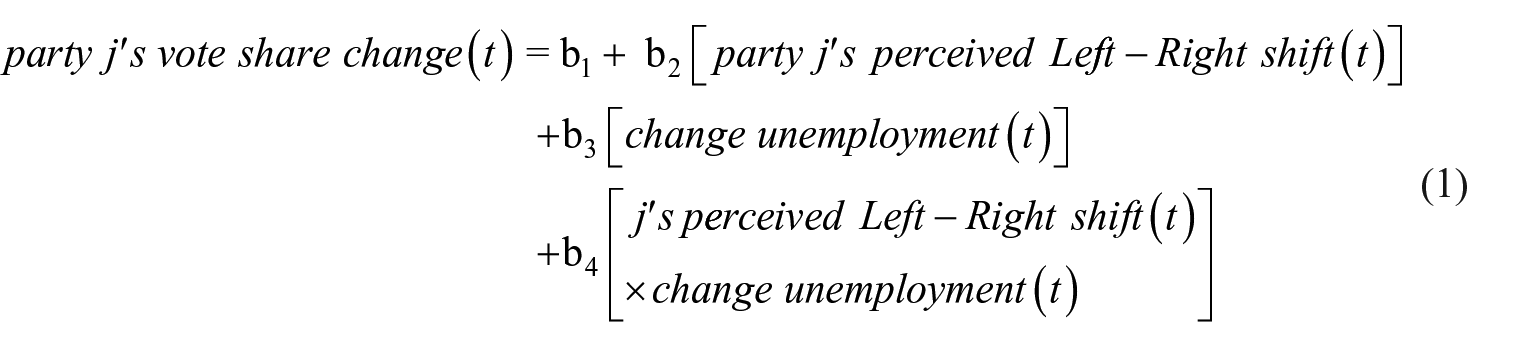
The predicted electoral effects of parties’ perceived Left-Right shifts are given by the sum of the coefficients on the [party j’s perceived Left-Right shift (t)] variable and on the interacted variable [j’s perceived Left-Right shift (t) × change unemployment (t)]. The coefficient on the [party j’s perceived Left-Right shift (t)] variable is the predicted effect of the party’s perceived shift when unemployment has been stable since the last election, that is, when [change unemployment (t)] = 0. The coefficient on the interaction [j’s perceived Left-Right shift (t) × change unemployment (t)] captures how these effects vary in response to changing economic conditions. The right-shift vote gains hypothesis (H2) implies a positive coefficient on the [j’s perceived Left-Right shift (t)] variable, denoting that parties tend to gain votes when they are perceived shifting right, all else equal. The economic conditioning hypothesis (H3) implies a positive coefficient on the interaction [j’s perceived Left-Right shift (t) × change unemployment (t)], denoting that the more economic conditions decline, that is, the more unemployment rises, the more parties gain votes from perceived right-shifts. (Below, we report robustness checks where our economic change measure is based on GDP rather than unemployment, where we additionally control for rival parties’ perceived Left-Right shifts, and the lagged effects of perceived party shifts.)
Because our dependent variable is now constructed from party vote share data as opposed to survey data on economic issue ownership—which is less widely available—we can expand our empirical analyses beyond the limited set of cases (N = 59) we analyzed to evaluate the economic issue ownership hypothesis (H1). We have 209 cases of parties’ perceived Left-Right shifts, for all of which we can construct party vote change values. Table S4 in the Online Appendix lists the countries and election surveys in these analyses and the relevant parties. Table 3 reports descriptive statistics for our dependent and independent variables, which show that the standard deviation of the [party j’s vote share change (t)] variable is over 5 percentage points, denoting considerable volatility in party support over time. It is these variations we seek to explain.
Descriptive Statistics.
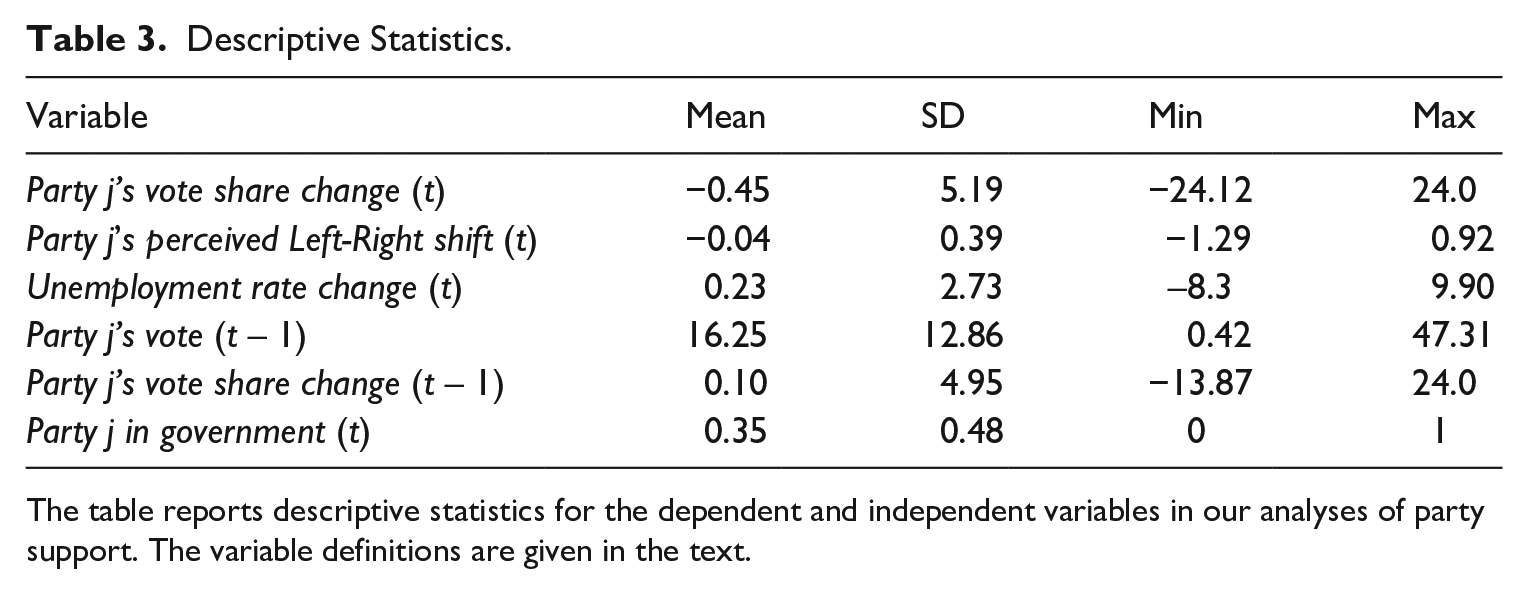
The table reports descriptive statistics for the dependent and independent variables in our analyses of party support. The variable definitions are given in the text.
Columns 1–3 in Table 4 report parameter estimates for various model specifications that estimate party vote share changes as a function of changes in parties’ perceived Left-Right positions, changes in unemployment, and the interaction of these variables. We report estimates for three models: the basic model given by equation 1 above (column 1); a lagged party vote share model that additionally controls for parties’ lagged vote shares, which is designed to control for possible regression to the mean in party support; and a governing status model, discussed in more detail below, that controls for parties’ governing status and for voters’ tendencies to hold the government responsible for the economy (column 3). (Column 4 reports results for an alternative model, discussed below, using codings of the parties’ election manifestos.) The standard errors are clustered on parties.
The Relationship between Parties’ Perceived Left-Right Shifts, Unemployment, and Party Vote Share Changes.
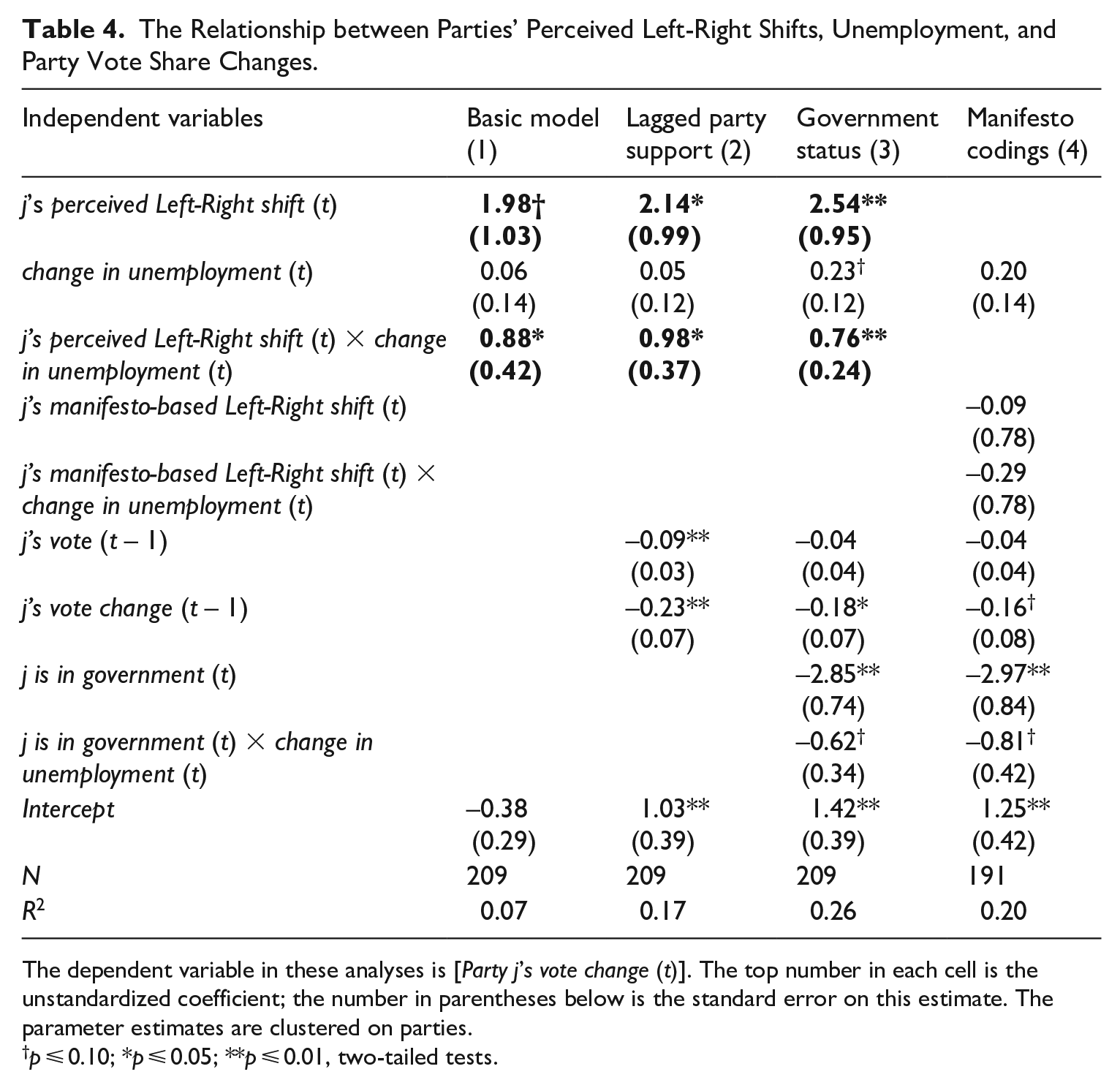
The dependent variable in these analyses is [Party j’s vote change (t)]. The top number in each cell is the unstandardized coefficient; the number in parentheses below is the standard error on this estimate. The parameter estimates are clustered on parties.
p ⩽ 0.10; *p ⩽ 0.05; **p ⩽ 0.01, two-tailed tests.
The parameter estimates support our hypotheses. We estimate consistently positive and significant coefficients on the [j’s perceived Left-Right shift (t)] variable, denoting that parties gain votes when they are perceived shifting right, which supports the right-shift vote gains hypothesis (H2), and on the interaction [j’s perceived Left-Right shift (t) × change unemployment (t)], denoting that the more economic conditions decline, the more parties gain from perceived right-shifts, which supports the economic conditioning hypothesis (H3).
To unpack the substantive significance of our parameters, consider the estimates for the government status model in column 3 of Table 4, the most fully specified of our models, which controls for parties’ past election support, their governing status, changes in economic conditions, and for the interaction between governing status and economic condition changes. The coefficient +2.54 on the [j’s perceived Left-Right shift (t)] variable (p < 0.01) denotes that when unemployment has been stable since the last election, that is, when [change unemployment (t)] = 0, a party whose perceived position has shifted right by one unit on the 0–10 Left-Right scale is predicted to improve its vote share by about 2.5 percentage points, compared to a party whose perceived position is unchanged. This implies that a one standard deviation shift to the right in a party’s mean perceived position (i.e. a 0.39-unit perceived rightward shift on the 0–10 Left-Right scale) increases the party’s predicted vote share by about 1 percentage point (2.54×0.39), all else equal.
The coefficient +0.76 on the [j’s perceived Left-Right shift (t) × change unemployment (t)] variable (p < 0.01) for the governing status model (column 3) denotes how the electoral benefits of parties’ perceived right-shifts increase as unemployment rises. The coefficient implies that for each percentage point increase in unemployment since the last election, a party whose perceived position has shifted right by one unit is predicted to improve its vote share by an additional 0.76 percentage points, compared to the predicted effect when unemployment has been stable. This implies that when the unemployment rate has increased by one standard deviation of the values in our data set (i.e. a 2.73 percentage point increase), then a one-unit perceived rightward shift increases a party’s predicted vote share by close to 5 percentage points, nearly double the expected gain when unemployment has been stable. This illustrates the logic underlying the economic conditioning hypothesis (H3) that when the economy deteriorates, the electoral salience of parties’ economic competence reputations increases.
Figure 1 illustrates our findings by displaying the predicted marginal electoral effects of parties’ perceived Left-Right shifts (the vertical axis) as a function of the change in unemployment since the previous election (the horizontal axis) for the parameter estimates reported in column 3 of Table 4 (the dashed lines denote 90% confidence intervals). The estimated marginal effects are plotted for all values of unemployment changes in our data set, ranging from –8.3% to 9.9%. Consistent with the economic conditioning hypothesis (H3), the predicted electoral benefits of a party’s perceived rightward shift increase as unemployment rises. Consistent with the right-shift vote gains hypothesis, this predicted gain is significantly positive, provided unemployment has not declined by more than 1% since the last election, a range that covers about 60% of the values in our data set. As discussed above, this effect helps substantiate our posited theoretical expectation: parties’ vote gains from perceived rightward shifts are driven by their enhanced image of economic competence, not from more general reputational effects related to political pragmatism or sincerity (Fernandez-Vazquez, 2019; Johns and Kölln, 2020). When unemployment has increased by 3% (about one standard deviation above the mean value in our data set), the predicted marginal effect of rightward perceived party shifts is over 4 percentage points, that is, a party whose perceived position has shifted right by one unit on the 0–10 scale is predicted to improve its vote by over four points, compared to one whose perceived position has not changed, while a party whose perceived position has shifted 0.39 units rightward (one standard deviation) is predicted to improve its vote share by about 1.6%.
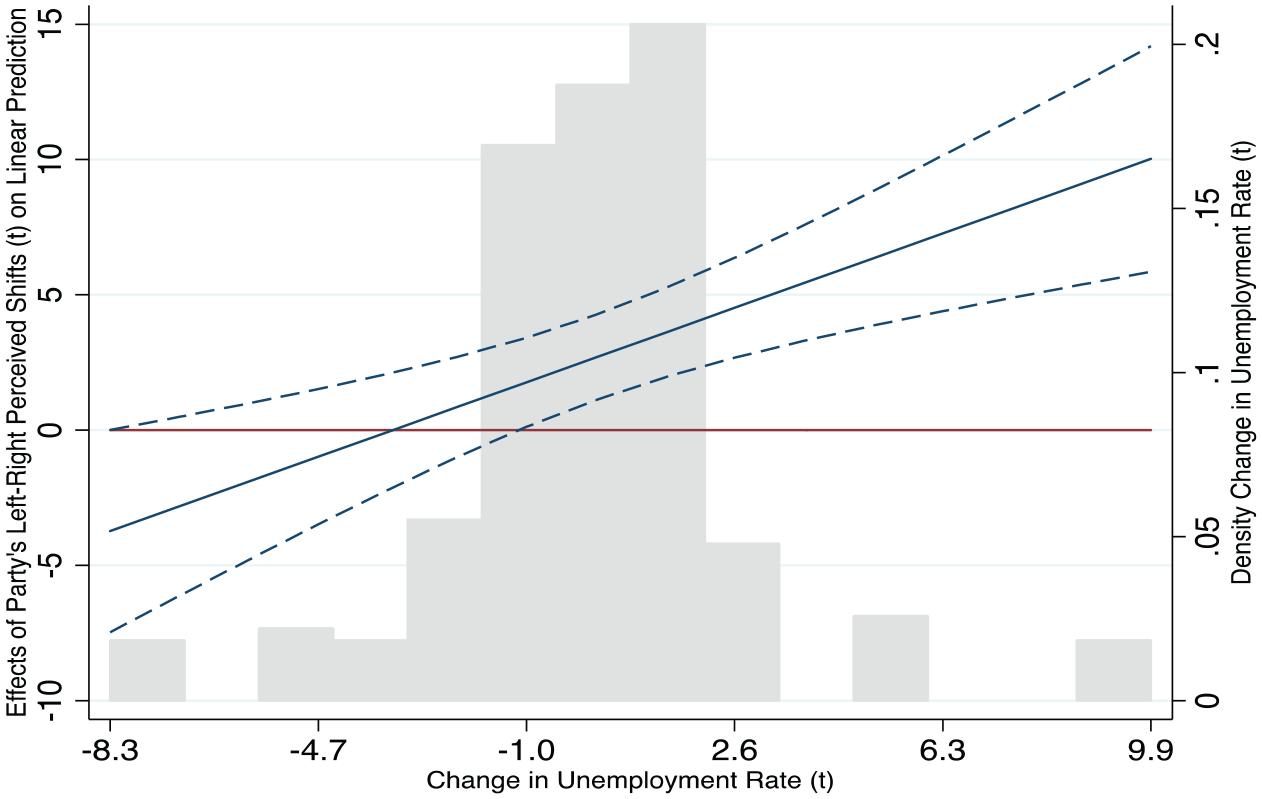
The Marginal Electoral Effects of Parties’ Perceived Left-Right Shifts.
The models in columns 2–3 of Table 4 include additional controls to capture effects relating to parties’ lagged support, the party’s governing status, and voters’ tendencies to hold governing parties accountable for economic conditions. The coefficients for the lagged party support model (column 2) provide evidence of regression toward the mean in parties’ vote shares, in that the estimates on the party’s lagged vote share and its lagged vote gains are both negative and significant. These negative coefficients imply that parties with larger lagged vote shares and parties that gained votes at the previous election tend to lose votes at the current election. The estimates for the government status model (column 3) show that, consistent with extensive previous research on the “penalty of governance” (Paldam, 1991), governing parties tend to suffer vote share declines compared to opposition parties, that is, the coefficient on the [party j is in government (t)] variable is negative and significant, and that these predicted losses become more severe as the economy deteriorates, that is, the coefficient on the interacted variable [j is in government (t) × change unemployment (t)] is also negative and significant.
To further grasp the electoral effects of parties’ perceived right-shifts, consider a party j that governs during a sharp economic recession, in which the unemployment rate has increased by 5 percentage points since the previous election. (Note that while this represents a sharp economic downturn, some Organisation for Economic Co-operation and Development (OECD) countries suffered even larger unemployment spikes during the global economic recession). If j’s perceived Left-Right position has not changed since the last election, the parameters on the government status model (column 3 in Table 4) imply that the governing party j is predicted to suffer a vote share loss of nearly 5 percentage points at the current election (all else equal), which reflects both the standard “penalty of governance” and the fact that citizens punish governments for economic recessions (e.g. Powell and Whitten, 1993). Yet, if party j has shifted its perceived position one unit to the right on the 0–10 Left-Right scale since the last election, then the predicted vote gains from this perceived shift (roughly 6 percentage points) are sufficient to counteract the steep electoral penalty governing parties typically suffer during recessions. And if j’s perceived position has shifted even one-half unit to the right (which slightly exceeds a one standard deviation increase based on the distribution of values in our data set), the predicted vote benefit from this shift, about 3 percentage points, will mitigate much of the predicted 5 percentage point vote share loss party j would otherwise be expected to suffer from governing during a recession. Thus, the effects we estimate are substantively important, certainly enough to profoundly alter the outcomes of national elections.
Finally, the parameter estimates on the manifesto codings model (column 4 in Table 4), in which we re-estimate the parameters of the government statusmsub> model using an exogenous party position measure based on the CMP Left-Right manifesto codings, show no evidence that parties’ vote shares respond to rhetorical changes in their manifestos: 12 The coefficient on the [party j’s manifesto-based Left-Right shift (t)] variable is near zero and insignificant, as is the coefficient on the interaction between this and the [change in unemployment (t)] variables. These estimates highlight again that citizens react to the party positions they perceive, rather than to exogenous measures of these positions. This implies that parties cannot expect to gain votes by simply asserting a more right-wing policy orientation in their manifesto: They will likely need additional steps to convince the public that their policies have truly changed, which we discuss in the conclusion.
Robustness Checks
We performed several robustness checks in the Online Appendix to substantiate our conclusions. First, we re-estimated the models reported in Table 4 above while controlling for country fixed effects (S5). Next, we re-estimated these models while omitting one country at a time from our data set (S6). We then re-estimated our models using the change in the GDP growth rate as our measure of changes in economic conditions (as opposed to the change in the unemployment variable we analyze in the main text) (S7). Next, we re-estimated our models on the set of mainstream parties in our data set, who compete meaningfully over the economic policy dimension (S8). We then estimated models that additionally controlled for possible electoral effects of shifts in voters’ own Left-Right positions, for lagged effects of parties’ perceived Left-Right positions (e.g. Karreth et al., 2013; Lindvall, 2014), and for the effects of rival parties’ perceived Left-Right shifts. All of these analyses continued to support our substantive conclusions.
Next, we re-estimated our models separately on the set of governing parties in our data set and then on the set of all opposition parties (S9). We estimated somewhat stronger electoral effects for governing parties’ perceived Left-Right shifts than for opposition parties (although these differences were only marginally statistically significant). S9 discusses possible causal processes that explain these differences.
We also include a set of empirical analyses with additional control variables. In section 10 of the Online Appendix, we control for shifts in public opinion to account for the possibility that vote shares are influenced by general rightward or leftward public opinion shifts. To address the possibility that lagged parties’ positions influence their current vote shares, analyses in S11 accordingly control for the electoral effects of parties’ lagged perceived positions. S12 provides analyses that control for the electoral effects of rival parties’ perceived Left-Right shifts, which is an additional factor that potentially influences a focal party’s vote share.
Section S13 presents the results for a mediation analysis between perceptions of party positions, parties’ issue ownership, and electoral performance (S13), and section S14 reports results for models that include interaction variables between the main independent variables with a dummy variable for left parties to evaluate whether there are differences between left and right parties (S14.1), as well as a separate set of analyses for left and right parties (S14.2). Section S13 results show strong indirect effects of perceptions on electoral performance via issue ownership, and section S14 results provide evidence that estimated differences between left and right parties for the vote share analyses are insignificant. The latter finding supports our conclusions that all parties, regardless of their party family, benefit from being perceived as moving to the right. Finally, section S15 tests whether party shifts affect their vote shares or whether parties’ vote shares influence their policy shifts. The bivariate model estimates that are reported support the finding that the relationship is from lagged parties’ perceived Left-Right shifts to current vote share changes, rather than vice versa.
Conclusion and Discussion
The two dominant approaches for analyzing how issues affect elections, which focus on parties’ issue positions and their issue ownership, have evolved largely independently of each other. 13 We combine these approaches to argue for a right-shift economic ownership hypothesis that parties enhance their economic issue ownership when voters perceive them shifting right; for a right-shift vote gains hypothesis that parties’ economic ownership gains from perceived right-shifts enhance their electoral support; and for an economic conditioning hypothesis that the right-shift vote gain effect is strongest during recessions when voters prioritize parties’ economic competence. We empirically analyze survey data on economic ownership, parties’ perceived Left-Right positions, and election outcomes in 15 democracies between 1986 and 2015 that substantiate our hypotheses. We also show that these effects are substantively significant, in that realistic changes in parties’ Left-Right images significantly affect their economic issue ownership and vote shares.
Our findings apply to the effects of citizens’ perceptions of parties’ Left-Right shifts, not to exogenous, manifesto-based party shifts measures: We show that manifesto-based shift measures do not correlate strongly with voter perceptions, nor do they influence parties’ economic competence reputations, nor election outcomes. We emphasize again that this non-finding on party manifesto effects does not call into question citizens’ political capacities, nor the possibility of meaningful mass-elite linkages. A vibrant literature analyzes the many informational sources citizens employ to infer party policy positions (and position shifts) beyond manifestos, including governing coalition arrangements (e.g. Falcó-Gimeno, Fernandez-Vazquez, 2019; Fortunato and Stevenson, 2013); governing parties’ actual policy outputs (Adams et al., 2020); party leaders’ genders (O’Brien, 2019); and media reports of inter-party cooperation and conflict (e.g. Lee et al., 2018). Our arguments and empirical findings reinforce that voters react to what they perceive, which highlights the importance of continued research on how citizens form their perceptions of party positions (e.g. Fernandez-Vazquez, 2014, 2019; Klüver and Spoon, 2020; Spoon and Klüver, 2017).
Our finding that voters reward parties for perceived right-shifts poses a strategic dilemma for left-wing parties’ elites, whose core convictions may make them resist taking actions that moderate their party’s leftist image. This dilemma may be most acute for leftist governing parties since recent research concludes that citizens estimate governing parties’ ideologies from their actual policy outputs while discounting their rhetoric (Bernardi and Adams, 2019). This suggests that to burnish their image of economic competence, left-wing governments may feel pressure to implement economic austerity policies that have real-world consequences, and which leftist elites find repugnant. At the same time, leftist parties’ strategic dilemmas may be mitigated to the extent they prioritize objectives other than pure vote-maximization, such as entering the governing coalition and implementing their sincerely-held policy preferences (see, e.g. Strom, 1990). Such alternative objectives may motivate leftist parties to maintain their existing policy positions (or even shift farther left). Gingrich and Häusermann (2015) argue that Social Democratic parties may also shift left to appeal to segments of the middle class that support the welfare state. They correspondingly document a steady shift for Social Democratic parties toward greater support for welfare expansion across many European democracies since the 1970s. Moreover, leftist parties’ strategic option of moderating their policies may be circumscribed by internal opposition from their core constituencies such as labor unions (see Abou-Chadi and Wagner, 2019).
In follow-up research, we hope to more fully parse out the potential explanations that underpin our findings. In particular, while our arguments are premised on citizens ascribing economic competence to more right-wing parties, we are uncertain which aspects of a party’s “rightness” confer this reputational advantage, that is, whether this pertains to party policies on strictly economic issues such as taxes and monetary policies, trade policy, and government intervention in the economy or whether it also encompasses issues such as environmental protection, immigration, crime, and education that can be viewed through both economic and non-economic frames (De Vries et al., 2013; Gidron, 2022). In addition, we hope to analyze the “boundary conditions” for which our posited effects actually hold in practice. Our empirical analyses substantiate that over the range of observed cases in our data set, parties enhance their economic competence images—and through this, their electoral support—when their perceived positions shift rightwards. Yet, real-world parties cannot shift rightwards indefinitely, or at least they do not in practice. We strongly suspect that there is a limit beyond which parties’ perceived right-shifts no longer enhance their economic issue ownership. What our empirical analyses show is that over the range of perceived party shifts that we actually observe, parties tend to benefit from rightward shifts, especially during economic recessions. It is also possible that an increase in parties’ economic ownership is not because they are perceived to be moving toward the right, but instead that voters believe that the parties are already gaining more ownership in the economy, and then they perceive these parties to be moving toward the right. Future studies should evaluate whether perceptions of positions cause perceptions of ownership; ownership perceptions influence position perceptions; or whether there are relative weights to these (possibly reciprocal) influences. 14
Finally, it would be interesting to analyze historical cases that do not fit our theory, to understand additional factors that drive parties’ support beyond their reputations for economic competence. In this regard, one of the biggest “outliers” in our study is the British Liberal Democrats, who governed in coalition with the Conservatives between 2010 and 2015 and saw their perceived position shift sharply to the right across this period, but who nonetheless suffered dramatic vote losses in the 2015 General Election. The conventional wisdom about this result (Cowley and Kavanagh, 2016) is that, contrary to our argument that perceived right-shifts enhance parties’ support, the Liberal Democrats lost votes precisely because they were perceived as having shifted sharply to the right, thereby “capitulating” to their coalition partners the Conservatives, and betraying the more leftist policy agenda that they had previously espoused in opposition, and that their core supporters expected. This pattern fits with research by Tomz and Van Houweling (2016), who find that experimental subjects infer that politicians who reverse their previously-espoused policy positions are unprincipled. We suspect that such character-based judgments define a “boundary condition” for our arguments and findings that parties benefit when they are perceived as shifting to the right. Analyzing such cases may also help us reconcile our substantive conclusions, based on analyses of voters’ perceived party shifts, with findings from other empirical studies of measured changes in parties’ manifesto-based policy positions, which at times report substantive conclusions that differ from ours (see, for example, Abou-Chadi and Wagner, 2019). Do these different conclusions arise because voters’ perceived party policy shifts misalign with parties’ policy rhetoric in these crucial cases, and if so, does careful substantive study of these cases suggest that voters’ perceptions were mistaken, or, alternatively, that voters appropriately considered a range of relevant information beyond the parties’ manifesto-based policy statements? Such analyses will provide further insights into the relationship between party policy behavior, voter perceptions, party issue ownership, and election outcomes.
Supplemental Material
sj-docx-1-psx-10.1177_00323217231178979 – Supplemental material for Why Parties Gain Votes When the Public Perceives Them Shifting to the Right
Supplemental material, sj-docx-1-psx-10.1177_00323217231178979 for Why Parties Gain Votes When the Public Perceives Them Shifting to the Right by James Adams, Luca Bernardi, Lawrence Ezrow and Zeynep Somer-Topcu in Political Studies
Footnotes
Acknowledgements
Each author contributed to the paper equally. We thank Henrik Seeberg for sharing his data on economic issue ownership with us and Tim Hellwig, Maurits Meijers, Christopher Williams, and Stefanie Reher for their feedback on our research.
Declaration of Conflicting Interests
The author(s) declared no potential conflicts of interest with respect to the research, authorship, and/or publication of this article.
Funding
The author(s) received no financial support for the research, authorship, and/or publication of this article.

Supplementary Information
Additional Supplementary Information may be found with the online version of this article.
Contents
Table S1. Parties’ Perceived Left-Right Shifts and Changes in Their Economic Issue Ownership: Country-Specific Intercepts Displayed (N = 59).
Table S2. Parties’ Perceived Left-Right Shifts and Changes in Their Economic Issue Ownership: Change in GDP Growth (N = 59).
Table S3. Parties’ Perceived Left-Right Shifts and Changes in Their Economic Issue Ownership: Analyses of Mainstream Parties (N = 53).
Section S4: Information on the Cases and the Distributions of Self-Placements.
Table S4: Countries and Parties Included in the Analyses of Party Vote Share Changes.
Figure S1. Distribution of Citizens’ Left-Right Self-Placements in Western Publics, from Wave 4 of the Comparative Study of Electoral Systems.
Robustness Checks on the Relationship between Parties’ Perceived Left-Right Shifts and Changes in Their Vote Shares.
Table S5. The Relationship between Parties’ Perceived Left-Right Shifts, Unemployment, and Party Vote Share Changes: Country Fixed-Effects Models.
Table S6. Analyses of the Right-Shift Vote Gain Effect and Economic Recessions Effect, Omitting One Country at a Time.
Table S7. The Relationship between Parties’ Perceived Left-Right Shifts, GDP Growth, and Party Vote Share Changes.
Table S8. The Relationship between Parties’ Perceived Left-Right Shifts, Unemployment, and Party Vote Share Changes: Analyses of Mainstream Parties.
Table S9. Parties’ Perceived Left-Right Shifts, Unemployment, and Party Vote Share Changes: Analyses of Governing versus Opposition Parties.
Table S10. The Relationship between Parties’ Perceived Left-Right Shifts and Their Vote Share Changes: Controlling for Public Opinion Shifts.
Table S11. Analyses that Control for the Electoral Effects of Parties’ Lagged Perceived Positions.
Table S12. Analyses that Control for the Electoral Effects of Rival Parties’ Perceived Left-Right Shifts.
Table S13. Significance Testing of Indirect Effect of Issue Ownership (N = 41).
Table S14. Parties’ Perceived Left-Right Shifts, Unemployment, and Vote Share Changes: Analyses of Right-Wing versus Left-Wing Parties.
Table S15. The Relationship between Parties’ Perceived Left-Right Shifts and Their Vote Share Changes: Endogeneity.
Notes
Author Biographies
References
Supplementary Material
Please find the following supplemental material available below.
For Open Access articles published under a Creative Commons License, all supplemental material carries the same license as the article it is associated with.
For non-Open Access articles published, all supplemental material carries a non-exclusive license, and permission requests for re-use of supplemental material or any part of supplemental material shall be sent directly to the copyright owner as specified in the copyright notice associated with the article.
