




Abstract
Public administration is the largest part of the democratic state and a key consideration in understanding its legitimacy. Despite this, democratic theory is notoriously quiet about public administration. One exception is deliberative systems theories, which have recognized the importance of public administration and attempted to incorporate it within their orbit. This article examines how deliberative systems approaches have represented (a) the actors and institutions of public administration, (b) its mode of coordination, (c) its key legitimacy functions, (d) its legitimacy relationships, and (e) the possibilities for deliberative intervention. It argues that constructing public administration through the pre-existing conceptual categories of deliberative democracy, largely developed to explain the legitimacy of law-making, has led to some significant omissions and misunderstandings. The article redresses these issues by providing an expanded conceptualization of public administration, connected to the core concerns of deliberative and other democratic theories with democratic legitimacy and democratic reform.
Public administration constitutes the largest part of the democratic state. It is where citizens most commonly encounter political power, with public administrators confronting citizens as the face of the laws they have collectively given to themselves (Mansbridge, 2017). Accordingly, it is impossible to understand the legitimacy of modern democratic systems without an appreciation of the role of public administration. Moreover, both in the policy center and at street-level, public administrators operate with space for discretion that enables them to wield significant public power (Bertelli, 2021; Lipsky, 1980). Public administration is therefore a prospective object for democratization (Boswell, 2016; Bua and Bussu, 2021; Nabatchi, 2010), with potential for democratic transformation “as dramatic and important as the rise of mass, electoral democracy in the nineteenth century” (Warren, 2009: 10). For these reasons democratic theory requires a conception of public administration. Despite this, the politics–administration distinction has meant democratic theory is notoriously quiet about public administration (Ansell et al., 2021; Boswell, 2016; Peters et al., 2022; Warren, 2017).
One exception is deliberative systems approaches, which have recognized the importance of public administration and attempted to incorporate it within their orbit (see Bächtiger and Parkinson, 2019; Curato et al., 2019; Dryzek, 2010; Mansbridge, 2017; Mansbridge et al., 2012; Neblo, 2015; Parkinson, 2006). Deliberative democracy is arguably the dominant strand of contemporary democratic theory, counting among its adherents many of the most influential political theorists and political scientists of the last decades, such as John Rawls, Jurgen Habermas, Jane Mansbridge, and John Dryzek. Deliberative systems approaches are currently the vanguard of deliberative democratic theory. Since the production of competing systems approaches from these major figures (in particular: Dryzek, 2009; Mansbridge et al., 2012), most theoretical discussions and empirical research in deliberative democracy are conducted in relation to deliberative systems approaches. Deliberative systems approaches are thus an important development in democratic theory and the one that has most explicitly pointed toward public administration as a relevant concern. Accordingly, it is important to examine how they represent public administration.
This article takes up that task. It challenges the proposition that deliberative democratic precepts can be straightforwardly applied to understanding public administration (see Boswell and Corbett, 2017), arguing that the application of the pre-existing conceptual apparatus of deliberative democracy, largely developed as a normative theory of legitimate law-making, to the new domain of public administration results in a series of significant omissions and misunderstandings. This critique runs counter to the most prominent critiques of deliberative systems approaches, which argue deliberative systems theory strays too far from the deliberative ideal (see Ebeling and Wolkenstein, 2018; Elstub et al., 2016; Owen and Smith, 2015). Their argument is that, caught between the imperatives of the deontological ideal of deliberation and the diversity and complexity of real democratic practice, deliberative systems approaches sacrifice the ideal for the real. This article suggests that, contrariwise, deliberative systems approaches construct public administration so that it is consonant with the ideal, often departing from standard interpretations of how public administration operates.
The article attempts to better connect public administration scholarship and deliberative systems theory. Part 1 provides some necessary context by describing the development of deliberative systems theory and how it adapted earlier theories of deliberative democracy. Part 2 then examines the current representations of public administration within deliberative systems approaches on five dimensions: (a) the actors and institutions of public administration, (b) its mode of coordination, (c) its key legitimacy functions, (d) its legitimacy relationships, and (e) the possibilities for deliberative intervention. Each section first problematizes the current representation within deliberative systems approaches, then uses public administration scholarship to articulate a new understanding. Finally, Part 3 draws out the implications for conceptions of the deliberative system, alongside what Bächtiger and Parkinson (2019) have called the summative and additive objectives of deliberative systems approaches—that is, to understand the deliberative quality of the democratic system and its relation to democratic legitimacy, and to intervene in the democratic system to increase deliberative capacity.
From Deliberative Democracy to Deliberative System
Deliberative democracy began as a normative theory of political legitimacy. The early canonical texts were all predominantly concerned with how the polis can arrive at laws and regulations that are normatively binding upon its members (Bohman and Rehg, 1997; Cohen, 2006; Habermas, 1996). Deliberative democrats argued that rule-making through majoritarian aggregation of pre-political interests was not sufficient to legitimate collectively binding decisions, instead proposing that political decisions are normatively legitimate “if and only if they could be the object of a free and reasoned agreement among equals” (Cohen, 2006: 162). The shift, driven by dissatisfaction with liberal and minimalist accounts of democracy (Bohman, 1998; Dryzek, 2000), was therefore to see laws and political systems as deriving their normative legitimacy not from public votes but from public reason. The constituent relationships for understanding this legitimating force of public reason are twofold: “government’s relation to its citizens and their relation to one another” (Rawls, 1997: 766) or within the “public sphere” and between the “public sphere” and “administrative power” (Habermas, 1996).
Deliberative systems approaches take up this same normative project. The “functions” (Mansbridge et al., 2012), “deliberative capacity” (Dryzek, 2009), or “normative criteria” (Neblo, 2015) upon which political systems are to be judged mirror the concerns for inclusion, equality and mutual respect stipulated in earlier articulations of the deliberative ideal. Jane Mansbridge et al., in what has been called the deliberative systems manifesto (Owen and Smith, 2015), outline three functions, which they call epistemic, ethical, and democratic, arguing, “the successful realization of all three of these functions promotes the legitimacy of democratic decision-making by ensuring reasonably sound decisions in the context of mutual respect among citizens and an inclusive process of collective choice” (Mansbridge et al., 2012: 12). Similarly, John Dryzek’s (2009, 2010) three elements of deliberative capacity are concerned with whether systems can support deliberation that is authentic (reflective, noncoercive, and reciprocal), inclusive (represents all relevant discourses), and consequential (impacts on collective decisions or social outcomes). The normative functions of deliberative systems thus remain closely wedded to initial conceptions of the deliberative ideal.
Deliberative systems approaches also persist with the two constituent legitimacy relationships of early deliberative democrats: communication between citizens and between citizens and government. They almost universally adopt the distinction between public sphere and administrative power of Jürgen Habermas’ (1996) early deliberative systems theory as the principal relationship for understanding the legitimacy of the deliberative system. This is most apparent in the prominence of the relationship between state and civil society in Michael Neblo’s (2015: 18) diagram of the deliberative system, but Dryzek (2009) also employs similar concepts of “public space” and “empowered space” as the key sites of the system. There is, then, much continuity between early work on deliberative democracy as a theory of political legitimacy and more recent deliberative systems approaches. Nevertheless, there are two important ways the deliberative systems approach has developed this normative project.
The first development is a shift in the normative understanding of deliberation. The most influential early theorists of deliberative democracy conceived it in deontological terms; as a purely procedural ideal (see Cohen, 2006; Habermas, 1996, 1997), Joshua Cohen’s (2006: 161–162) canonical account of this procedural ideal can be summarized as: deliberation is free; deliberation is reasoned; deliberators are formally and substantively equal; and deliberation aims to arrive at rationally motivated consensus. Deliberative systems accounts break with this deontological conception of deliberation as practice in favor of a set of deliberative standards upon which the whole or part of a political system can be judged. This break goes right back to Mansbridge’s (1999: 224) origination of the systems turn; she says, “the criterion for good deliberation should not be that every interaction in the system exhibit mutual respect, consistency, acknowledgement, open mindedness, and moral economy, but that the larger system reflect those goals.” A fundamental implication of this new idea of deliberation as a “summative quality” (Bächtiger and Parkinson, 2019), rather than as a practice, is many deliberative systems accounts now view acts that violate the deliberative procedural ideal as contributors to a healthy deliberative system when they promote deliberative ends, and instances of procedurally ideal deliberation as suspect if they undercut these ends (see Curato et al., 2019; Dryzek, 2010; Elstub et al., 2016, 2018; Mansbridge et al., 2012; Neblo, 2015; Parkinson, 2006). For deliberative democrats, legitimacy can now therefore be conferred through deliberation as practice or by promoting deliberative ends, with most deliberative systems theorists prioritizing the latter.
The second important development is the expansion of the deliberative ideal to new territory, which stems directly from conceiving deliberation as the summative quality of a system comprised of multiple interacting parts. The deontological conception of deliberation as practice trained focus on communicative practice within discrete venues, particularly whether existing spaces (like parliaments) or specially created spaces (like mini-publics) lived up to the ideal. Deliberative systems approaches are instead a self-conscious return to the Habermasian preoccupation with flows of communicative power between different spaces (see Curato et al., 2019; Elstub et al., 2016; Mansbridge et al., 2012). The deliberative system consists of a variety of interacting spaces/venues/arenas in need of mapping and measuring to understand how their total territory realizes a set of deliberative standards (e.g. Bächtiger and Parkinson, 2019; Curato et al., 2019; Dryzek, 2009; Mansbridge et al., 2012; Neblo, 2015). The territory can encompass “all governmental and non-governmental institutions, including governance networks and the informal friendship networks that link individuals and groups discursively on matters of common concern” (Mansbridge et al., 2012: 8). This is where public administration enters the scene, as one of the new sites frequently invoked in deliberative systems accounts (e.g. Bächtiger and Parkinson, 2019; Curato et al., 2019; Dryzek, 2010; Mansbridge et al., 2012; Neblo, 2015; Parkinson, 2006). The approach is intended to give a more realistic portrait of how deliberation legitimates democratic decisions than the previous focus on deliberation in discrete venues. Nevertheless, we may ask how far conceptual categories articulated as a theory of legitimacy for political decision-making—arguably a theory of legislative politics—are appropriate for assessing the legitimacy of the full gamut of governmental and nongovernmental institutions. The next section explores this in relation to public administration.
Locating Public Administration
Deliberative systems approaches should be credited for recognizing public administration is relevant for democratic legitimacy. Excepting the participatory democratic concern with the long march through all the political, administrative, and economic institutions of a society, democratic theory has tended to have a blind spot for public administration. It has often adhered to a politics–administration distinction, whereby administration is conceived as the neutral process of implementation that takes places after democratic decision-making is completed. Deliberative democracy scholarship, at first, slipped into this same distinction (Boswell, 2016), yet deliberative systems approaches have universally included administration as a relevant concern. Nevertheless, there are few attempts to extensively explore what this inclusion means. On the map of the deliberative system public administration remains a border territory, for most a foreign allusion, which only a few intrepid explorers have visited (notably: Boswell, 2016; Boswell and Corbett, 2017; Doberstein, 2020; Dryzek, 2010; Mendonça, 2016; Nabatchi, 2010; Parkinson, 2006). This has meant deliberative systems incorporation of public administration has largely proceeded in terms of the conceptual categories elaborated in the previous section of this article. Even the most nuanced of commentators have claimed that deliberative norms such as justification, publicity, and inclusiveness in relation to citizens can be unproblematically extended to public administration (Boswell and Corbett, 2017; Nabatchi, 2010). But can the conceptual categories of a normative theory developed in relation to processes more associated with legislative politics simply be transferred to new objects? Is, for example, the relationship to the public the key one for understanding the legitimacy of public administration? This part of the article explores such questions along five dimensions. The first two sections, on (a) actors and institutions and (b) mode of coordination, are intended to conceptualize public administration in its own terms. The following three sections, on (c) legitimacy functions, (d) legitimacy relationships, and (e) deliberative interventions, then attempt to relate public administration to the two key concerns of deliberative systems theory: understanding how the sum of activities within a political system realizes the deliberative functions necessary for democratic legitimacy, and understanding the productive avenues for intervention to introduce more deliberation into the political system.
Actors and Institutions
The conceptualization of public administration as a particular component of a deliberative system is hindered by the high level of abstraction adopted by the most prominent articulations of the deliberate system. Specifications of the components comprising a deliberative system operate with expansive conceptual categories. It is common to divide the system into two encompassing categories of: center and periphery (Habermas, 1996), empowered space and public space (Dryzek, 2009), and state and civil society (Neblo, 2015). This elision of all the different institutions of government into a universal category of center, empowered space, or state means that public administration is not conceptualized as a separate object of concern from the legislative process. It suggests there are no relevant functional differences between the administrative and the legislative. This is a substantial departure from standard interpretations of liberal democratic governance, which take the functional distinction between legislative, executive, and judiciary as a central and important facet of a democratic system.
It is not only for institutions that this dynamic is in play. Mansbridge et al. (2012: 13–17), for instance, extensively discuss the role of “experts” in the deliberative system. This presumably includes administrators, but it is never specified exactly who the term is referring to. To propose that there is a proper role for experts in the deliberative system is to imply that a homogeneous category of “experts” exists in a democracy. But this is a fiction. There is instead only a range of disparate figures—civil servants, academics, private consultants, politically appointed advisers, interest groups, citizens—among which expertise is distributed. Despite their common possession of expertise, each sits in a different relation to the policy process, entailing different deliberative relationships, governed by different behavioral norms. Understanding these differentiations—between the legislative and the administrative, between civil servants and political advisers—is an important consideration for a theory intended to explain the functional distribution of deliberation across the democratic system. However, the elisions contained in encompassing categories such as “center” and “experts” obliterate long-standing functional differences between different democratic actors and institutions.
The first step in incorporating public administration into deliberative systems theory is to unravel these expansive categories and articulate public administration as a specific component of the system with its own particular legitimacy functions and relationships. Without this conceptualization it is impossible to provide an assessment of where deliberation is lacking and adding more would be beneficial, or a summation of the activity within administrative spaces to assess whether it realizes deliberative functions. This task is thus essential to understanding the role of deliberation in legitimating administrative action in either the additive or summative senses. Doberstein (2020) makes a useful intervention in this regard by distinguishing between what he calls “procedural arenas” and “mandated arenas.” Both are empowered spaces, but whereas the decision-making powers of procedural arenas are legitimated through election, those of mandated arenas are legitimated through their connection to the procedural arena that delegated their power and the outcomes they deliver.
It is also important to note that public administration is itself variegated—comprised of different types of administrative institutions. These distinctions often entail distinct deliberative relationships, and there is evidence that different types of administrator are acutely aware of the different audiences that they have to appeal to (Boon et al., 2020). We can draw some schematic distinctions between (a) government departments, (b) administrative agencies (most closely resembling Doberstein’s mandated arenas), and (c) service delivery organizations.
Government departments normally have strong ties to the elected government, for example, being led by an elected minister, which constitutes their indirect link to the public. Accordingly, their outreach activities are oriented to communicating with key stakeholder groups to gather expertise to inform policy, rather than legitimating their democratic authority to make policy. Administrative agencies by design have weaker ties to elected government and a more public profile—sometimes even operating fully independently from government. In such cases, citizen deliberation has been adopted to legitimate policy-making and address perceived deficits in democratic authorization (Dean et al., 2020). Managers of public services and the street-level bureaucrats who deliver them also operate with substantial space for discretion, since the kinds of everyday actions they take are rarely the subject of the broad-brush agendas that are legitimated through elections. These spaces of discretion, along with the constant contact with the communities they serve, make them places where deliberation can flourish—as in the community policing forums documented by Fung (2004)—although these activities are likely to be more action-oriented and service-user-focused than those of administrative agencies. Here then we have three kinds of administrative space, each with different relationships to public and politicians that condition how deliberation may facilitate their democratic legitimacy.
Mode of Coordination
How are these various administrative actors and institutions coordinated? Detailed treatments of public administration by deliberative systems theorists have been characterized by a particular form of synecdoche in relation to its mode of coordination: they treat public administration as if it is synonymous with network governance. Dryzek (2010: 6) gives governance networks a prominent place in his conception of deliberative governance. Boswell and Corbett’s (2017: 627) article on deliberative bureaucracy claims network governance is the “overwhelming orthodoxy” in contemporary public administration. Similarly, Nabatchi’s (2010: 377) application of deliberative democracy to public administration stems from “recent shifts to network and collaborative governance structures.” Network governance is the notion that public outcomes are now formulated and delivered through diffuse constellations of state and non-state actors, based around relationships of horizontality rather than hierarchy, and persuasion rather than coercion (Rhodes, 2007; Sørensen and Torfing, 2005). It is attractive to deliberative democrats for these very reasons. As Dryzek (2010: 124–125) argues, deliberative democratic principles are particularly applicable to networks because “Networks are polycentric, and their medium of coordination is language . . . to exert influence, an actor has to persuade others in the network.”
Though there has undoubtedly been a rise of network governance thinking in the field of public administration in recent years, the idea that it has become the orthodoxy is highly contestable. There have always been a number of doubters of public administration’s supposed inexorable march toward governance through decentered networks. This now includes Deliberative Policy Analysis scholars, who recently abandoned their earlier focus on networks and have framed their turn toward complex systems as a move away from networks (Bartels et al., 2020: 297). Even Rhodes (2007), one of the originators of the network governance paradigm, admits that public administration is not equivalent to governance networks. Moreover, it has been argued that the digital era has created pressures to reverse the trend of fragmentation and agencification of public bureaucracies in favor of reintegration and re-governmentalization (Dunleavy et al., 2006). Networks remain just one mode of administration and they are by no means the predominant one. The current orthodoxy in public administration, rather than trumpeting the triumph of networks, is arguably that public administration will continue to be a complex mixture of networks, hierarchical bureaucracy, and (quasi-)markets (Hood, 1998; Rhodes, 2007; Torfing and Triantafillou, 2013).
The focus on networks has in many ways been productive for deliberative systems approaches. It has enabled deliberative theory to go beyond the over-simplified politics–administration distinction, highlighted by Boswell (2016), and conceptualize administration as a political space, one in need of new avenues for citizen deliberation to influence policy implementation and delivery (Boswell, 2016; Doberstein, 2020; Nabatchi, 2010). It has also produced some nuanced accounts of how networks can function as deliberative systems (e.g. Dryzek, 2010: 6; Hendriks, 2008; Knops, 2016). Nevertheless, the assumption that networks are the predominate mode of coordination in contemporary democratic systems has created conceptual difficulties. This assumption is ingrained in deliberative systems approaches to such an extent that it can be difficult to separate the concepts of “system” and “network”; for example, Mansbridge et al. (2012: 10) appear to view the system as “a map of nodes.” 1 This is perhaps part of the story of the aforementioned elision between distinct actors and institutions. If politicians, bureaucrats, corporations, nongovernmental organizations (NGOs), and citizens are all simply interchangeable nodes in a decentered network, then there is no imperative to define the function of each independently since functions can be seamlessly transposed between different nodes. The greater issue is, however, that if deliberative systems are comprised of hierarchies, markets, and networks, they cannot be fully grasped through a theory that only incorporates one of these modes of coordination.
The omissions created in treating a variegated governance system as if it is predominantly a governance network are more apparent when examining a specific example. Deliberative systems theorists often select the UK National Health Service (NHS) as their example of a governance network (see Boswell and Corbett, 2017; Dryzek, 2010: ch. 6; Hendriks et al., 2020: ch. 5). While it is undoubtedly true the NHS is in one sense a network of institutions producing public outcomes, to conceive of it solely as a network is to ignore that it is also a collection of hierarchical bureaucracies, many of which operate as actors in a quasi-market. The NHS operates more through relations of bureaucratic command and quasi-market contract than it does through networks of persuasion. This points to a conceit of the network governance literature, which often implies networks are an alternative to bureaucracies, when in reality many of the collective actors in a network—the administrative agencies, corporations, and NGOS—are constituted as hierarchical bureaucracies. Whether the NHS is conceived as networked, bureaucratic, or marketized therefore partly depends on the point of focus: whether it is the coordination between organizations or within them. To analyze the NHS as a deliberative system by conceiving it as a network cannot fully describe its deliberativeness. It constrains analysis, only considering the relevant interactions between actors and not the way those actors’ internal constitution affects these interactions. The same argument can be applied to the other objects of deliberative systems analysis, such as national polities, which again could be conceived as networks, though only by obscuring other modes of coordination, and is particularly acute if single bureaucratic organizations like schools, universities, and hospitals are to be understood as deliberative systems (as suggested by Mansbridge et al., 2012). To fully understand public administration as a deliberative system, or how public administration forms part of a broader deliberative system, requires a break from the tight association of system and networks.
To incorporate public administration as it is currently coordinated, through a mixture of hierarchies, markets, and networks, deliberative systems approaches need to have something to say about bureaucracies and markets. This may simply be to argue for the normative desirability of their replacement with deliberatively coordinated networks. The literature tends toward this direction, with bureaucracy being conceived as incommensurable with deliberative democratic ideals (Boswell and Corbett, 2017) and a long-standing view that the forum is an opposed alternative to the market (Elster, 1997). These divisions have, however, been a little overplayed. It is possible for hierarchical bureaucracies to be more open to deliberative influence from outside their ranks, as well as more internally coordinated through deliberation rather than brute command, without them abandoning their chains of accountability to become full-fledged, decentered networks. How far bureaucracies are coordinated through deliberation should be a key question in understanding how deliberative a political system is. Moreover, this picture of more open, more deliberative bureaucracies is more realistic than the assumption that public administration has already shifted/or will soon shift to a predominantly networked mode of coordination.
Similarly, there are more points of connection between deliberative systems theory and proponents of social market approaches to public administration than might be expected if we view the market and the forum as opposites. The more nuanced advocates of quasi-markets in health and education proposed that giving service-users the power to exit services creates an incentive for the service to actively listen to them, particularly for more marginalized groups in society, whose voices have historically been ignored by middle-class professionals (Le Grand, 2003, 2008). Though voice is conceived here in a more individualized fashion than the collective will-formation that deliberative democrats are primarily concerned with, there are resonances with deliberative systems approaches’ focus on inclusion and the capacity for non-deliberative practices, such as exit, to promote deliberative functions, like active listening and mutual understanding. Moving away from the assumption that public administration is already/should be conducted through networks to the notion that deliberative systems approaches should interrogate public administration’s coordination through networks, hierarchies, and markets could therefore have three benefits: a more realistic picture of how deliberatively public administration currently operates, a deeper understanding of where and how more deliberation could be introduced to this system, and new thinking about how non-deliberative practices may foster deliberation or deliberative ends.
Legitimacy Functions
The administrative apparatus of the state primarily has to render a complex social reality legible for intervention, intervene with public goods and services, and manage, monitor, and evaluate them. Its capacity to perform these tasks is the bedrock upon which its own legitimacy is founded as well as public administration’s key contribution to legitimating the broader political system. This pervades both the Orthodox Public Administration tradition in which bureaucracy is valued primarily for its capacity to ensure effective public interventions through the application of scientific and technical expertise and the New Public Management tradition in which public agencies are valued according to their entrepreneurial efficiency in providing public goods (Hood, 1998; Stout, 2017). This common conception of the legitimacy of public administration as rooted in its effectiveness and efficiency sets up an important tension with the legitimacy functions articulated by deliberative systems approaches, which describe a normative ideal of collective will-formation and decision-making processes. It makes the extension of deliberative democracy’s process concerns, such as norms of justification and inclusiveness, to assess the legitimacy of public administration more complicated than the deliberative systems literature suggests.
The difficulty of applying the functions of the deliberative system to public administration is evident from the fact that deliberative systems theorists often use additional functions when writing for a public administration audience. Archon Fung (2015), for example, uses “effectiveness” to analyze the success of participatory governance initiatives. Effectiveness is about capability for solving substantive problems, “providing education, caring for the indigent, creating security, and providing public goods and services” (Fung, 2015: 517). This may appear to mirror the “epistemic” function he outlines in the deliberative systems manifesto with Mansbridge et al. (2012). Indeed, the epistemic function—focused on whether decisions are informed by all relevant considerations—has some relation to effectiveness. Decisions of high epistemic quality likely lead to effectiveness. Nonetheless, focusing on the epistemic shifts the gaze in a different direction to a focus on effectiveness. The former is concerned with the quality of inputs into decision-making processes, while the latter is concerned with the outcomes of intervention. Efficiency is also an outcome-related function. Whereas effectiveness examines the quality of the outcomes, efficiency is concerned with the rate of conversion of inputs into outcomes.
Public administration is not commonly justified in terms of the inherent normative desirability of its process, but in terms of the pragmatic benefits of its form of organization for the efficient production of effective outcomes. Bureaucratic hierarchy in particular is rarely justified as a normatively desirable form of organization in democratic societies, but instead as a necessary means for the efficient management of social and technical complexity. It is important to stress here that the suggestion is not that effectiveness and efficiency are apolitical legitimacy functions that somehow float above politics and process. How they are interpreted—what counts as effective and efficient in specific contexts—is undoubtedly a political matter. However, this does not change the fact that the legitimacy of public administration will be judged against the contextually relevant standards of effectiveness and efficiency, and that this may be in tension with deliberative process values such as inclusion and justification. We find this tension in practice with the adoption of deliberative processes into public administration—for example, how the adoption of a deliberative Citizens’ Council into the appraisal of medical technologies in the UK led to public outcry about the speed at which new treatments were made available (Syrett, 2006). Since deliberative systems approaches say nothing about these pragmatic legitimacy functions, they are missing important considerations for analyzing what state administration does and whether it is legitimate. This highlights the problem of developing a conception of system legitimacy based only on an understanding of normative ideals of collective will-formation and decision-making. In their current form, deliberative systems approaches can provide an assessment of whether public administration is operating deliberatively, but by ignoring effectiveness and efficiency, they can only provide a partial account of both its legitimacy and its role in legitimating the broader political system.
Legitimacy Relationships
The preoccupation with the relationship to the citizen as the constituent one for understanding legitimacy also cannot be straightforwardly applied to administration. There is a growing literature that examines the “public encounters” between citizens and administrators and what it means for the democratic character of the state (e.g. Bartels, 2013; Dean, 2017; Michener, 2018; Stout and Love, 2017), nevertheless; unlike the politician, the administrator is not in a direct legitimacy relationship with the public. Public administrators have to be understood as implicated in a web of legitimacy relationships, with this web shifting depending on the kind of administrative actor/institution; government departments, arms-length agencies, or street-level bureaucrats.
For civil servants in government departments the constituent legitimacy relationship is traditionally conceived as administrator-representative rather than administrator-citizen. One orthodox understanding of this relationship—particularly in Westminster political systems like Australia, Canada, New Zealand, and the UK—is the Whitehall Public Service Bargain. The terms of the bargain are that administrators give up their public profile and partisanship in favor of loyalty to the elected government of the day, and in exchange for permanence in office (Hood and Lodge, 2006). Politicians operate in public, while administrators remain in the shadows. This relationship is also justified in deliberative terms: it enables open and honest exchange between politicians and administrators on politically sensitive matters. When administrators become entangled in public debate it creates perceptions of partisanship, compromising “the commitment to non-partisan impartiality that is the defining feature of permanent bureaucracies in the Westminster tradition,” as well as the frankness of advice that the administration provides to the legislature (Grube, 2014: 426). There are thus significant tensions between the norms of bureaucratic anonymity and political neutrality that characterize the Public Service Bargain and the norm of publicity that is so important to deliberative systems approaches, and which envisages administrators as continually engaged in open, public deliberation with all manner of stakeholders. Administrators who regularly engage in open, public deliberation may be viewed as illegitimately encroaching on the territory of the elected government, with significant ramifications for the politician–administrator relationship.
The legitimacy relationships of administrative agencies are not so tightly bound to the elected government and usually not characterized by the same impetus toward public anonymity. Heads of administrative agencies sometimes have a public profile that rivals that of the corresponding elected minister. Nevertheless, it would be problematic to portray them as in a simple and direct legitimacy relationship with the public. The very intention of creating arms-length administrative agencies is to distance their policy functions from the influence of the elected representatives of the people, insulating policy from political pressure. So it cannot be that the legitimacy of administrative agencies is fundamentally based on their responsiveness to the public. Instead, these agencies draw legitimacy from claims to technocratic competence. Their primary legitimacy relationship is thus their relationship with the relevant community of practice. It is more troubling for the legitimacy of a central banker to resist an overwhelming consensus among economists that interest rates should be lowered than to resist the same demand from the public. This is because the community of practice is the arbiter of technocratic competence.
Street-level bureaucrats—like teachers, police officers, and medical professionals—also have their unique web of legitimacy relationships. They must be similarly attentive to the demands of their own community of practice, which evaluates and regulates their actions, deciding on cases of malpractice. They are also likely to occupy a specific location in a hierarchical chain of command, characterized by management practices that attempt to shape their action in particular directions. As such, although their regular contact with the public offers potential for deliberation, what can be discussed and how responsive they can be are constrained by accountability to management and accountability to the expectations of their community of practice.
The citizen–public administrator relationship is undoubtedly important for understanding the legitimacy of public administration. Public administrators would certainly see themselves as obligated to pursue the public interest. However, they do not sit in the simple relation to citizens that politicians do, where legitimacy is drawn directly from being a representative of the people. If public administrators are to deliberate directly with citizens, then this could cause frictions within these other relationships—to politicians, management, and communities of practice. This does not preclude more deliberation between public administrators and citizens. The challenge from deliberative systems theory joins that of a number of other perspectives that critique the idea of the public administrator as neutral functionary, including New Public Management, Critical Theory, and participatory governance (see Bartels, 2013). Empirical research demonstrates even administrators in central government departments are increasingly forced out from the shadows onto the public stage by polarized politics and a 24-hour media landscape (Grube, 2014, 2019). Administrators involved in, increasingly common, open government programs and citizen participation initiatives also struggle to reconcile these activities with an ingrained self-identity and organizational culture that define professional integrity and competence in terms of neutral technocratic expertise (Dean, 2016: ch.5). There is a need for new thinking.
Deliberative systems approaches are potentially well-placed to contribute to these debates. After all, at least some of the conflict is between competing deliberative relationships, for instance: how far, if at all, should the closed, anonymous deliberations between politicians and administrators be prioritized over administrators’ participation in open, public deliberations on policy implementation? Nevertheless, this requires a recognition of the complex web of legitimacy relationships that public administrators inhabit. Existing proposals of deliberative systems theorists for strengthening the relationship between citizens and administrators either ignore or play down the way that this may disrupt the other important relationships discussed above (e.g. Boswell, 2016; Boswell and Corbett, 2017; Curato et al., 2019; Mansbridge et al., 2012). This focus on one particular legitimacy relationship within the deliberative system therefore prevents existing approaches from properly articulating the complexity of deliberative relationships within the democratic system and how their interaction is central to assessing legitimacy.
Deliberative Interventions
The tendency of deliberative systems theory to view public administration through the lens of politics and the subsequent focus on the administrator–citizen relationship has blunted deliberative democracy’s critical edge toward administration. This is somewhat surprising given the preoccupation of Habermas’ (1996) influential account with administration colonizing the lifeworld where communicative power is generated. This reflected long-standing concerns in public administration scholarship since the nineteenth century about the “administrative state”—the over-mighty bureaucracy that dominates all the other institutions of democracy—and which remains a common theme of far-right discourse today (see Roberts, 2020). There are a range of theoretical traditions that challenge the idea public administrators always behave as public-spirited altruists—from Public Choice Theory, which views administrators as maximizers of their own budgets and prestige, to Marxist Theory, which sees the state in capitalist society as the defender of bourgeois class interests. Yet, proposals for public administrators’ role in the deliberative system tend to gloss over the darker side of public administration in one of two ways.
The first proposal views administrators as part of the solution to a dysfunctional and unresponsive politics. Administrators act on behalf of citizens to provide a check on strategic action in the political process; they can “make up for the shortcomings of decision-making inputs through feedback loops across the deliberative system” (Curato et al., 2019: 113); or they “may, first of all, push forward the reasons of weaker actors that cannot make themselves present throughout the system” (Mendonça, 2016: 180). It is certainly true that public administrators can perform these tasks—Mendonça’s positive impression, for instance, is drawn from his observations of Brazilian civil servants. It is, however, questionable to prescribe these roles to administrators as part of a normative conception of a deliberative system. The development of democracy is integrally related to the development of political means to constrain arbitrary administrative power (Rosanvallon, 2008). Politics is meant to provide a necessary check on the totalizing power of administration. Even if they were to be constrained by public deliberation, administrators would still have softer accountability relationships to the public than elected representatives. Moreover, it is a recurrent finding of public administration scholarship that, on the whole, administrators do a poorer job of looking after weaker citizens than more affluent ones. Such proposals therefore invert without explanation the traditional conception of the political–administrative relationship. Public administrators regularly having to check politicians on behalf of citizens should not be viewed as a normal part of a healthy deliberative system, but as a symptom of deep dysfunction within the political arena.
The second proposal is concerned with establishing more deliberative accountability between administrators and citizens to address genuine problems of public administration, such as the epistemic necessity for administrators to hear from affected communities (Mansbridge, 2017) or the unaccountable discretional power that can be wielded in processes of implementation (Boswell, 2016; Boswell and Corbett, 2017). These are problems where deliberative accountability may provide a solution, but only if public administrators are good faith deliberators. Mansbridge (2017: 22) explicitly states this in her proposals for a recursively representative administration, with the caveat that recursive representation is appropriate when “the civil service is already honest, competent, and acting in the overall directions that the public desires.” However, a recurrent feature of policy disasters is that public administrators refused to listen or to deliberate (see Dunleavy, 1995). Participatory-deliberative initiatives also often founder when public administrators feel challenged and remove their support (Dean et al., 2020; Stewart, 2016).
This issue is further complicated by the fact that an administration perceived as an open and responsive deliberator by one part of the public (usually the affluent part) may be seen as an overbearing oppressor by another part of the public (usually the marginalized part). Disabled people’s movements, for example, have to continually fight for recognition to have their voices heard by public administrators, who wield significant power over their lives, in ways that the able-bodied can hardly imagine (see Beresford, 2016). Affluent communities have a very different perspective to poor communities on the amenability of the police to reasons. Marginalized groups will likely respond to invitations to engage in forms of deliberative accountability in light of their previous experiences. They may reasonably conclude, “Well why should we go in and say this, because they’re not going to listen to us or take us seriously anyway” (“Carly,” quoted in Dean, 2019: 181). This echoes Holdo’s (2020) call to decenter deliberative systems approaches so as to appreciate the diversity of experiences, particularly the experiences of structurally excluded groups, and not reduce them to a single dominant narrative. Although he made this observation primarily in relation to policy discourses, its logic extends to governance questions. What to do then when, as is often the case, public administrators are not good faith deliberators?
Deliberative systems approaches’ openness to the potential deliberation-promoting effects of non-deliberative practices provides several solutions. Long-standing proposals from participatory democrats for redistributing decision power (Arnstein, 1969), from the agonistic perspective for involving citizens in counter-governance initiatives like oversight (Dean, 2018), and from market-oriented reformers to equip service-users with the power to exit (Le Grand, 2008), all have the potential to pressure public administrators to listen and deliberate, as can “uninvited” participation like protest and subversive service-use (Stewart, 2016). This resonates with Owen and Smith’s (2015: 228) contention that non-deliberative practices may enable a deliberative stance, although in this case it is power-holders rather than citizens who enter into “a relation to others as equals engaged in the mutual exchange of reasons oriented as if to reaching a shared practical judgment.” Mansbridge (2017: 22) recognizes the capacity of citizen power to compel administrators to listen; however, she sees this as “instrumental to the goal of communication, not a legitimating feature of the system itself.” Yet, in the eyes of marginalized communities, it may be the opposite—the presence of citizen power may be the necessary legitimating factor to signal deliberation would be worthwhile. There is a risk in deliberative systems approaches’ focus on the deliberative effects of other democratic practices that the independent legitimating force of these practices gets lost. Inclusively distributed empowerments are essential to the legitimacy of a democratic system (Warren, 2017), whether they promote deliberation or not. Further work that explores the ways that forms of citizen power may provide teeth for new forms of deliberative accountability between citizens and administrators, particularly in the event that administrators do not want to deliberate, is key to ensuring that new initiatives for downstream deliberation (Boswell, 2016) result in accountability to all.
Revisiting Deliberative Systems Theory
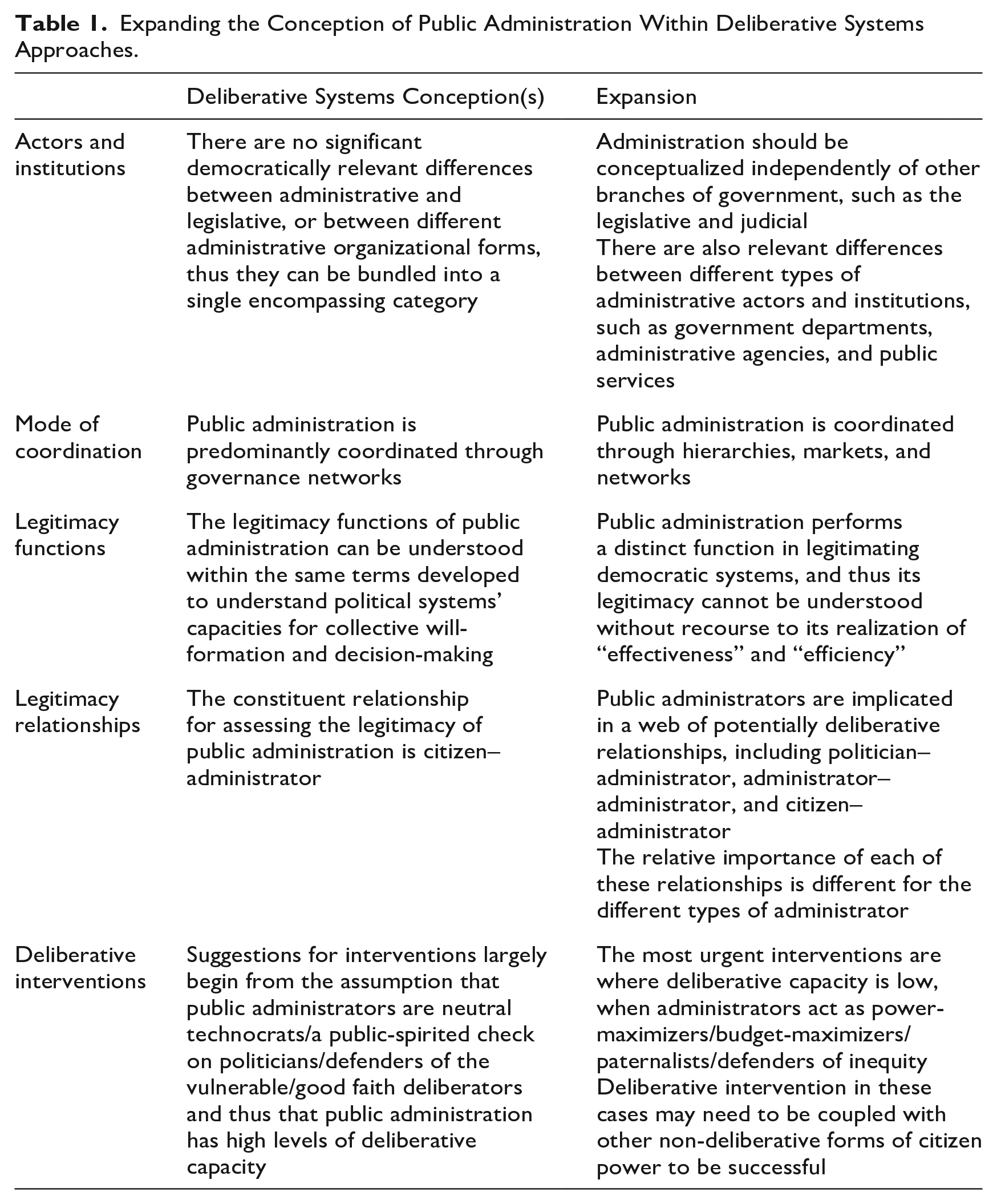
The preceding five sections of this article describe the representations of public administration within deliberative systems theory, problematize these representations, and show how they need to be expanded to incorporate insights from public administration scholarship (summarized in Table 1), but what are the overarching implications for our conceptualization of the deliberative system? Moreover, why are these expansions necessary to better focus the additive project to build deliberation into a system and the summative project to assess the deliberative quality of a system?
Expanding the Conception of Public Administration Within Deliberative Systems Approaches.
The expanded theorization of public administration primarily highlights a need to refine the level of abstraction of the conceptual apparatus of deliberative systems approaches in order to appreciate the functional complexity of real political systems. The conceptual map of the deliberative system is currently akin to the view of Earth from space—we can parse the continents and the oceans, but not what proceeds therein. This was apparent in the elision of all the institutions of the state into a single category, like “center” or “empowered space” that allowed the application of the legitimacy functions and relationships of legislative politics to be applied unquestioningly to public administration. This issue is unlikely to be specific to public administration. It will surface whenever deliberative systems approaches are deployed to understand parts of the democratic system they have under-theorized, for example: like public administration, the judiciary has a more complex legitimacy relationship to the people than legislatures. The parsimony of a conceptual framework with minimal categories undoubtedly has advantages. The aim of a conceptual map is not to recreate Jose Luis Borges’ satirical “Map of the Empire whose size was that of the Empire.” Abstraction is also necessary to achieve deliberative systems theorists’ aim of producing a framework that can be flexibly applied to a variety of different systems and at different levels of governance, rather than simply redescribing the structure of the liberal democratic state. Nevertheless, there are several levels of abstraction between the 1:1 map and the view from space.
The discussion of public administration demonstrates that finding the right level of abstraction requires zooming in on some dimensions, while adopting a more varifocal lens on others. Zooming in on actors and institutions revealed that, rather than empowered space, there are varieties of empowered spaces, with different characteristic means of legitimization. This becomes immediately apparent in applying deliberative systems approaches to the administrative—seen, for instance, in Doberstein’s (2020) need to divide empowered space into “procedural arenas” and “mandated arenas” in order to understand Canadian healthcare governance. This article takes the distinction further by illustrating the variety of administrative actors—government departments, administrative agencies, and service delivery organizations—whose power to act politically is legitimized through different types of claims. It highlights the importance of understanding the unique functional roles that different actors play in deliberative systems, rather than treating actors as largely interchangeable (Dean et al., 2019).
The variable lens is required to ensure that the architectonic of the conceptual framework is not implicitly formulated in the terms of the legislative. This became most apparent concerning the legitimacy relationships dimension. The discussion of the web of legitimacy relationships that characterize public administration, where the relationship to the public is not always the primary one, gave the lie to the assumption that the constituent legitimacy relationship of the legislative can be applied to the entire political system. Deliberative systems approaches rightly identify that the relations between parts of the system are key to understanding its legitimacy, but conceive the relations too narrowly. Therefore, instead of building the conceptual framework upon the primacy of the relationship between empowered space and public space (Dryzek, 2009), center and periphery (Habermas, 1996), or state and civil society (Neblo, 2015), deliberative systems approaches should begin from a more flexible concern with constituent legitimacy relationships, allowing the specific relationship(s) to vary between different types of empowered spaces.
These conceptual shifts have some profound implications for the additive and summative projects. They point to three important considerations for making summative judgments about the deliberativeness of a democratic (sub)system. The first consideration relates to the zooming in on empowered space, which shows that for large-scale systems, like national polities, interactions within and between different empowered spaces are just as important as those between public space and empowered space for judging whether the system is operating deliberatively. It is damaging for a democracy when the relationships between legislative and administrative fail to reach a threshold of deliberative quality, and this should be factored into any assessment of the deliberativeness of the system.
The second consideration relates to the recognition of specificity in the functional roles of different actors and institutions and how they are legitimized. This is where the variable lens comes in: summing the deliberativeness of different subsystems means adapting the point of focus according to context. Capturing the deliberativeness of central banks, regulatory agencies, and hospitals requires recognizing the specificities of their respective deliberative systems, how they differ from parliaments, as well as from each other.
The third consideration pertains to Holdo’s (2020) call to decenter deliberative systems. The deliberativeness of a political (sub)system is not an objective quality; it will be perceived differently from different subjective perspectives. Increasing communication between citizens and administrators can, for example, produce forms of “asymmetric citizenship” that improve responsiveness to advantaged groups at the expense of disadvantaged groups (González and Mayka, 2023). Summative assessments of deliberative quality thus require a multi-perspectival approach. Together these three considerations would help furnish more complete assessments of deliberative quality; however, they make the process of arriving at such judgments more complex to operationalize.
The discussion of public administration opens three new directions for the additive project of deliberative intervention into democratic systems, each focused on fostering deliberative capacity where it is lowest. First, decentering our understanding of the deliberative capacity of administrators suggests a redirection of attempts to introduce more citizen deliberation. Deliberative systems approaches grew out of a dissatisfaction with deliberative democracy’s growing preoccupation with deliberative mini-publics, which attempt to create ideal deliberation between a representative group of citizens (Parkinson, 2006). Nonetheless, better connecting citizens and institutions remains a core goal and deliberative mini-publics remain the primary intervention. The recognition that not all social groups receive equal regard from administrators suggests two means of refocusing this agenda. The first, already discussed above, is to combine opportunities for deliberation with empowerments that enable marginalized groups to ensure they are listened to. The second is to prioritize participatory formats that specifically attempt to build deliberative relationships between administrators and marginalized groups—for example, instead of organizing a representative deliberative mini-public, organizing a Poverty Truth Commission that aims to establish deep engagement between those living in poverty and those who make and deliver the policies that address them.
The two other new directions for intervention both result from the recognition that democratic systems consist of a complex web of potentially more or less deliberative relationships. This highlighted two avenues for intervention in public administration beyond the current focus on citizen deliberation: within administrative spaces and between political and administrative spaces. These often severely lack deliberative quality. To take the UK as an example, several cabinet ministers have recently been under investigation for bullying civil servants, and, following a Prime Ministerial press conference, a civil servant broke protocol to tweet from the official UK Civil Service account “Can you imagine having to work with these truth twisters?” These are stark signals of a breakdown in the deliberative basis of the politician–administrator relationship, which needs redressing. Deliberative interventions would be similarly valuable within public administration. Boswell’s (2016) insight that deliberation is needed to address biases in policy produced through the discretionary power wielded over implementation may have been formulated in reference to governance networks, but it applies equally well to hierarchies and markets. It is perhaps even more acute for bureaucratic hierarchies, whose tighter internal coordination makes it easier for leadership to ignore criticisms or contradictory opinions and cover-up failures; all recurrent features of policy disasters. These largely neglected interventions to increase deliberation between politicians and administrators and within bureaucratic hierarchies could thus have substantial benefits for democratic systems.
Conclusion
This article has brought deliberative systems theory into conversation with public administration theory through an in-depth examination of the ways deliberative systems approaches represent public administration and its role in the deliberative system. It has argued that applying conceptual categories primarily developed to understand the legitimacy of legislative politics results in some significant omissions and distortions about what public administration is, its contributions to the legitimacy of the democratic system, and how it could be more deliberative. Alongside this, it employed public administration scholarship to articulate an alternative understanding of public administration connected to the core concerns of deliberative democrats, drawing out the implications for our conceptual understanding of the deliberative system and for pursuing both prominent objectives of deliberative systems approaches: the additive project (to increase the amount of deliberation occurring in the system) and the summative project (to assess how far the political system realizes a set of deliberative standards). It argued this endeavor is necessary to ensure that deliberative systems theory is a theory of the entire democratic system and not a theory of legislative politics inappropriately applied to the whole system. It showed greater attention to deliberation within political–administrative relations and relations between administrators would provide more robust assessments of the deliberativeness of a democratic system and open relatively neglected avenues for interventions to increase deliberative capacity where it is lowest. The approach could be further enriched through its extension to other important democratic institutions, for instance by scholars of the judiciary.
Though the focus has been on deliberative systems theory, rendering an account of public administration in relation to questions of democratic legitimacy is also useful for reconnecting public administration scholarship with theoretical and empirical scholarship on democracy more broadly, something currently seeing renewed interest (see Ansell et al., 2021; Bertelli, 2021; Peters et al., 2022; Warren, 2017). Just as judgments of deliberative quality should pay more attention to politician–administrator relationships, so could measures of democratic quality, since this relationship is a key determinant of whether citizens are subject to arbitrary administrative power. Similarly, greater attention to the concerns of/insights from public administration scholarship could provide new perspectives for democratizing the state. More than a decade after Warren’s (2009) call for governance-driven democratization, administrative spaces still offer a frontier for democratic innovations.
Footnotes
Declaration of Conflicting Interests
The author(s) declared no potential conflicts of interest with respect to the research, authorship, and/or publication of this article.
Funding
The author(s) received no financial support for the research, authorship, and/or publication of this article.
