




Abstract
Deliberative mini-publics are increasingly used to try to tackle public discontent with the functioning of democracy. However, the ability of mini-publics to increase perceptions of legitimate decision-making among citizens at large remains unclear, given especially that existing studies have not considered the potentially damaging effects of mini-public recommendations not being followed. We designed, pre-registered, and ran a survey experiment in Ireland to test the effects of mini-publics on legitimacy perceptions conditional on whether or not their non-binding policy recommendations are honored (N = 1309). We find that mini-publics increase legitimacy perceptions among the broader citizenry; however, these beneficial effects are largely limited to situations in which their recommendations are honored. Additional results suggest that it makes no difference whether mini-public recommendations are overturned by elected representatives or by citizens in a referendum. Finally, we find that the legitimacy-enhancing effects of participatory processes are driven by citizens with low political trust.
Keywords
Introduction
Deliberative theories of democracy have increasingly caught the interest of activists, policy-makers, and political scientists. One of the most prominent proposals by deliberative democrats are mini-publics, sometimes also referred to as citizens’ assemblies or citizens’ conventions. The broad idea behind mini-publics is to enable a randomly selected group ranging from around 20 to several hundred ordinary citizens to deliberate on socio-political issues after having heard from experts about the implications of different policy directions (Curato et al., 2021). 1 Mini-publics are seen as an answer to several worrying trends including reduced electoral engagement, decreasing civility in political discourse, and, more generally, declining political legitimacy (Caluwaerts and Reuchamps, 2018; Dryzek et al., 2019; Thompson, 2008). Accordingly, experimentation with mini-publics has increased in recent years, including in Belgium (e.g. G1000), France (e.g. Citizens Convention for Climate), Ireland (e.g. Irish Citizens’ Assembly), and the United Kingdom (e.g. Climate Assembly). However, the extent to which mini-publics are able to deliver on their promises remains unclear. While the last two decades have seen the emergence of an increasingly sophisticated empirical literature on mini-publics, almost all existing research has focused on the small number of people who actually participate in mini-publics. Therefore, a key open question is how the broader citizenry reacts to the introduction of mini-publics (van der Does and Jacquet, 2021).
In this article, we present new experimental evidence on the potential of mini-publics to strengthen legitimacy perceptions among citizens at large. More specifically, we focus on the potential of mini-publics to strengthen perceptions of fair decision-making and the willingness to accept political decisions. Procedural fairness perceptions and decision acceptance are widely considered key elements of legitimacy perceptions and they can contribute to broader, system-level perceptions of state legitimacy (Tyler, 2006). We focus on the acceptance of negative political decisions—that is, decisions that go against citizens’ political preferences—because decision winners are likely to perceive decision processes as fair and accept decision outcomes irrespective of how the decision comes about (Esaiasson et al., 2019).
Political theorists have long suggested that mini-publics are likely to increase perceptions of legitimate decision-making among citizens at large (Cohen, 1989; Goodin and Dryzek, 2006). However, only a small number of studies have assessed this claim empirically, and the existing evidence remains inconsistent (Devillers et al., 2021; Werner and Marien, 2022). Moreover, existing empirical work has studied mini-publics in isolation while ignoring the institutional context in which they necessarily have to operate (Beauvais and Warren, 2019; Chambers, 2009; Lafont, 2020). Mini-publics are typically envisaged as an advisory complement to established democratic procedures, which raises the question how citizens will react if another democratic body, such as parliament, decides not to honor a mini-public recommendation.
To shed causal light on this question, we designed, pre-registered, and fielded a scenario experiment in the Republic of Ireland. The design of our experiment builds on a small body of literature that has used randomized descriptions of fictitious political decision-making processes to compare the effects of decision-making by elected representatives and by citizens in a referendum (e.g. Arnesen, 2017; Christensen et al., 2020; Esaiasson et al., 2012, 2019; Towfigh et al., 2016; see Werner and Muradova, 2022, for a broader discussion of scenario experiments). We go beyond these studies and vary whether, prior to the final decision, a mini-public deliberates on the issue at stake. Furthermore, we vary whether or not the mini-public’s policy recommendation is subsequently adopted. In keeping with prior studies, we also vary how the final decision on the policy issue is made—by elected representatives or by citizens in a referendum. Consistent with our interest in the acceptance of negative decisions, subjects always end up losing in our experiment, that is, the final decision is always counter to their previously stated policy preference. Overall, this design allows us to investigate the effects of mini-publics depending on whether or not their policy recommendations are honored. In addition, we can study the interplay of mini-publics with conventional forms of democratic decision-making, that is, whether the effects of mini-publics change depending on whether the final decision is made by elected representatives or by citizens in a referendum.
Our results suggest that citizens at large perceive a decision-making process as fairer and are more willing to accept a negative decision if a mini-public is involved in the process; however, these beneficial effects are largely limited to situations in which mini-public recommendations are honored. At the same time, we find that legitimacy perceptions increase considerably if the final decision is made by referendum instead of parliament; yet, whether the final decision is made by parliament or by referendum does not change the effects of mini-publics. Finally, we find that the legitimacy-generating effects of mini-publics and, to a lesser extent, referendums are driven by citizens with low political trust whereas opinion strength and perceptions of policy importance do not moderate the effects of mini-publics and referendums.
Formation of Legitimacy Perceptions
A perception that decision processes are legitimate is vital for democratic stability and social cooperation (Tyler, 2006). Existing research suggests that legitimacy perceptions can emerge in two main ways. First, individuals are likely to think of a process as fair and accept a decision if they agree with the decision outcome (Christensen et al., 2020; Esaiasson et al., 2019). 2 Accordingly, the surest way to increase legitimacy perceptions is to maximize the number of decision winners. Decision procedures are relevant from this perspective because some procedures are more responsive to citizen demands compared with others. For example, referendums increase the probability that political decisions reflect the median voter position, especially if they have high turnout (Leemann and Wasserfallen, 2016). In addition, procedures may increase the number of decision winners by causing opinion change. For example, it has been suggested that policy recommendations made by mini-publics may act as a heuristic that citizens use to determine their policy preferences (Boulianne, 2018; Suiter et al., 2020).
However, even if decision procedures are chosen which maximize the number of decision winners, large numbers of citizens inevitably have to live under rules to which they are opposed. Constant unanimity is not feasible, even in small polities. One way to ensure compliance with unwanted rules is through selective punishments or rewards, but such strategies can be costly and morally questionable. Procedural fairness theory suggests an attractive alternative (Lind and Tyler, 1988; Thibaut and Walker, 1975). According to procedural fairness theory, fairness constitutes a universal social norm and value. Therefore, people who experience a decision-making process are expected to assess the fairness of the procedures that have led to the decision. If individuals conclude that a process was fair, they become likely to perceive a moral obligation to accept the decision outcome, even if it is against their preferences. Therefore, fair procedures can, at least in part, compensate for the effects of losing and ensure compliance with unwanted rules.
Mini-Publics and Legitimacy Perceptions
Building on insights from procedural fairness theory, empirical political scientists have increasingly started to ask which political decision procedures are most likely to be perceived as fair and generate the highest levels of decision acceptance. A key conclusion of these studies is that citizens value voice in political decision-making, especially when they lose (Christensen et al., 2020; De Blok and Kumlin, 2022; Merkley et al., 2019). In particular, there is increasing evidence that referendums, which provide voters with the opportunity to directly influence policy decisions, tend to substantially increase legitimacy perceptions relative to decision-making by elected representatives (Esaiasson et al., 2012; Marien and Kern, 2018; Olken, 2010; Towfigh et al., 2016). Another recent study suggests that discussion venues, such as public hearings, can increase legitimacy perceptions (Jäske, 2019). In this study, we extend the focus to another way of involving citizens directly in political decision-making: deliberative mini-publics.
Mini-publics have been argued to lead to higher fairness perceptions and decision acceptance for several reasons. First, the participants in mini-publics are randomly selected citizens (Curato et al., 2021). Similar to referendums, mini-publics can therefore magnify the voice of ordinary citizens. Furthermore, random selection ensures that all initial points of view in a society are represented in the policy-making process (Dryzek et al., 2019; Neblo et al., 2010). Finally, deliberative democrats point to another, in their view, even more important reason why mini-publics are likely to generate high legitimacy perceptions: mini-publics do not merely aggregate public opinion, but they enable considered judgments (Cohen, 1989; Fishkin and Mansbridge, 2017; also cf. Collins, 2021). Mini-publics can magnify the voice of ordinary citizens, but in a way that is more evidence-based and reflects all sides to a policy argument. Therefore, mini-publics have been argued to not only satisfy public demand for representation, but also public demand for informed and objective policy-making.
However, the extent to which mini-publics can actually increase legitimacy perceptions remains unclear. While the normative value of sortition as a mechanism of representation has been extensively debated (Gastil and Wright, 2019), our empirical knowledge regarding how citizens think about and react to sortition remains more limited. Random selection may give all citizens an equal chance of participating in democratic decision-making. Yet, only a small minority will actually participate and, contrary to elections, there is no formal representative relationship or accountability mechanism. The limited existing empirical evidence suggests that citizens tend to think of mini-publics as a useful complement to existing representative institutions (Jacquet, 2019) and that they tend to see mini-public participants as more “like themselves” (i.e. more descriptively representative) compared with elected representatives (Pow et al., 2020). At the same time, though, existing evidence also suggests that public support for sortition remains mixed in both Belgium (Jacquet et al., 2022) and Northern Ireland (Pow, 2021). More generally, it remains unclear to what extent citizens see a process as legitimate from which they are almost certainly excluded and have no control over.
Another important open question concerns the potential pitfalls that could result from the integration of mini-publics with existing democratic processes (Beauvais and Warren, 2019; Curato and Böker, 2016). Mini-publics can be designed to perform a variety of functions, including deliberation on existing policy proposals, the concretization of broad policy ideas, and the development of entirely new policy proposals (Courant, 2021a). However, irrespective of their exact function, mini-publics are expected to deliver recommendations on what policies should or should not be adopted and, critically, according to almost all conceptions these recommendations are non-binding (Goodin and Dryzek, 2006; Lafont, 2020). 3 Therefore, another democratic body necessarily has to make the final decision, which has led to widespread concerns about decision-makers cherry-picking mini-public recommendations that fit their own agenda while disregarding others (Font et al., 2018).
Concerns about mini-public recommendations not being honored are not merely theoretical. For example, a whopping 53% of the recommendations made by the recent French Citizens Convention for Climate were rejected by the French government while another 37% were watered down or otherwise modified (Courant, 2021b). Another well-known example is British Columbia, where a mini-public’s proposal to overhaul the electoral system was subsequently defeated in a provincial referendum. Finally, as is well-known, mini-publics paved the way for the decriminalization of abortion and legalization of same sex marriage in Ireland; however, other proposals made by Irish mini-publics, such as that Ireland introduces a fixed-term parliament, have not been acted upon (Farrell et al., 2019).
If mini-public recommendations are not honored, this inevitably means that there will be citizens who had their policy preferences supported by a citizen body, but nevertheless have to live under rules they disagree with. Are citizens likely to think of the democratic process as fair even when mini-public recommendations are ignored? Are they willing to accept negative decisions even if a representative group of citizens has recommended a different course after careful deliberation? If not, is it possible to mitigate perceptions of democratic illegitimacy? For example, would it be advantageous if citizens themselves decided on mini-public recommendations instead of politicians?
Answers to these questions can only be provided by systematic empirical research. Yet, most existing empirical studies of mini-publics have focused on their participants. These studies have led to important insights, including that citizens have a surprisingly high willingness (Neblo et al., 2010) and robust capability (Gerber et al., 2018) to participate in complex deliberations on policy matters. Furthermore, participation in mini-publics has been shown to lead to more informed political judgments and policy preferences that are less affected by motivated reasoning (e.g. Esterling et al., 2021; Grönlund et al., 2015; Muradova, 2021). Most directly relevant to this study, existing evidence also suggests that deliberative events can foster a feeling among participants that their views are taken seriously and fairly represented, which in turn increases political trust (e.g. Boulianne, 2019; Grönlund et al., 2010). However, few empirical studies have considered to what extent these beneficial effects scale up to citizens at large. Among the small number of exceptions ranges a recent study by Werner and Marien (2022), which presented evidence from scenario experiments suggesting that Dutch citizens are more likely to regard both positive and negative decision outcomes as fair if a mini-public was involved (also cf. Boulianne, 2018 but see Devillers et al., 2021). Furthermore, in Werner and Marien’s experimental set-up, the final decision is always made by parliament and the mini-public recommendations are always followed. Therefore, it remains unclear whether the effects they were able to measure extend to situations in which mini-public recommendations are overturned; and it also remains unclear whether the effects of mini-publics change depending on whether the final decision is made by elected representatives or by citizens in a referendum. Overall, there is a need for more empirical evidence on the relationship between mini-publics and the legitimacy perceptions of citizens at large.
Expectations
We proceed to outline our theoretical expectations regarding the effects of mini-publics on the legitimacy perceptions of citizens at large, here defined as evaluations of the fairness of political decision processes and the acceptance of political decisions. Moving beyond the existing literature, we consider (1) whether the effects of mini-publics depend on whether or not their recommendations are honored; (2) the interplay of mini-publics with two established forms of political decision-making: decision-making by elected representatives and referendums; and (3) what kind of citizens are most likely to change their process evaluations depending on the involvement of ordinary citizens in political decision-making. Throughout, we focus on decision losers because decision winners are likely to think of a process as fair and are willing to accept decisions irrespective of the decision process.
First, we expect that the involvement of a mini-public in political decision-making can, at least in principle, increase perceptions of fair decision-making and the acceptance of negative decisions. While the extent to which citizens accept sortition as a mechanism for representation remains unclear, there is considerable evidence that opportunities for voice tend to increase legitimacy perceptions in the political sphere (e.g. Christensen et al., 2020; De Blok and Kumlin, 2022; Esaiasson et al., 2012) and beyond (Skitka et al., 2003). Citizens may also value that mini-publics provide space for detailed consideration of political issues by citizens with diverse political leanings, thus enabling more considered judgments (Cohen, 1989; Fishkin and Mansbridge, 2017).
However, we argue that the legitimacy-generating potential of mini-publics depends on whether or not their non-binding recommendations are honored. While people may value voice even if it remains without influence (cf. Tyler, 2000), the beneficial effects of voice are likely decreased if voice remains without influence (Morrell, 1999; Ulbig, 2008; but see Arnesen, 2017). When decision-makers decline to follow or are unresponsive to a mini-public recommendation, this may create ambiguity about the legitimacy of the process. Decision losers, in particular, are likely to become critical of decision processes when their preferences were initially supported by a randomly selected group of citizens who carefully deliberated on the issue. This leads to the following two hypotheses:
H1. The involvement of deliberative mini-publics in political decision-making processes increases procedural fairness perceptions and the acceptance of negative political decisions among citizens at large.
H2. However, these beneficial effects are partly or even fully undermined when the policy recommendations of mini-publics are not honored.
Another crucial determinant of citizens’ legitimacy perceptions is how the final policy decisions are made. In keeping with existing research (e.g. Esaiasson et al., 2012; Olken, 2010), we expect that referendums increase legitimacy perceptions relative to decision-making by elected representatives because they allow ordinary citizens to directly influence the direction of policy. This leads to our third hypothesis:
H3. Referendums increase citizens’ procedural fairness perceptions and the acceptance of negative political decisions.
Next, we consider whether the effects of mini-publics are likely to change depending on whether the final decision is made by elected representatives or by referendum. While mini-publics and referendums both involve citizens, they do so in different ways. Mini-publics enable citizen input based on extended deliberation among a randomly selected set of citizens. Referendums, however, give all eligible citizens a chance to influence the final decision on a policy proposal. Therefore, we expect that the effects of mini-publics and referendums on legitimacy perceptions are, at a minimum, additive. In fact, we suggest that it can be advantageous if mini-publics are followed by a referendum, specifically in a scenario when mini-public recommendations end up being overturned. If political elites decide not to honor a mini-public recommendation, this could give rise to a perception that ordinary citizens are not taken seriously by the authorities. By contrast, if citizens as a whole decide not to follow a recommendation made by a subset of citizens, a perception that citizens are ignored is less likely to emerge.
H4. (a) The beneficial effects of mini-public involvement are especially likely to be undermined when it is elected politicians who decide not to honor their recommendations, as opposed to citizens in a referendum. (b) By contrast, when the recommendations of mini-publics are honored, their effects on procedural fairness and the acceptance of negative political decisions do not depend on how the final decision was made.
Finally, existing evidence suggests that support for both mini-publics (Goldberg and Bächtiger, 2022) and referendums (Schuck and de Vreese, 2015) varies significantly across different strata of societies. Yet, most existing work on the effects of mini-publics and referendums on legitimacy perceptions has assumed that people think of democratic innovations in similar ways. We relax this assumption and consider whether opportunities for direct citizen involvement are more important to some citizens compared with others.
First, we suggest that citizens with different levels of political trust are likely to differ in their assessments of democratic innovations. More specifically, we expect that citizens who do not feel well-represented by politicians and, as a result, have low political trust, are likely to have a stronger preference for decision processes that bypass elected representatives and give more power to ordinary citizens. By contrast, direct citizen involvement should matter less to citizens who feel that the existing representative system represents them well and, consequently, have high political trust (Bedock and Pilet, 2021; Goldberg and Bächtiger, 2022). Therefore, we expect that whether or not a mini-public is involved in the decision process and also whether or not the final decision is made by referendum will have stronger effects among citizens with low political trust. Moreover, we expect that citizens with low political trust react more strongly when mini-public recommendations are not honored, especially when it is elected representatives who overturn them.
Second, following Towfigh et al. (2016) we expect that the extent of citizen involvement matters more, or even only, to citizens who think of the policy issue at stake as important. If decisions are of little consequence to citizens, they are less likely to care about the decision outcome and the decision procedure. However, if the perceived stakes are high, procedures are likely to become more important to citizens, especially when they end up losing. Therefore, whether or not a mini-public is involved, whether or not its recommendation is honored, and how the final decision is made should matter more to citizens who think of the issue at stake as important.
Finally, based on similar reasoning, we expect that the effects of mini-publics and referendums are moderated by opinion strength. When citizens do not have a strong opinion on an issue because they can see both sides of an argument or are otherwise unsure, they are less likely to care about decision outcomes and, therefore, also decision procedures. By contrast, procedures are much more likely to be important to citizens with strong policy preferences, especially when they lose.
H5. The above hypotheses apply especially (a) among citizens with low political trust, (b) among citizens who think of the issue at stake as important, and (c) among citizens who have a strong opinion on the issue at stake.
Research Design
To test our hypotheses, we conducted a web-based scenario experiment in which subjects were asked to read and rate a fictitious political decision-making process dealing with the introduction of a new policy. Scenario experiments are well-suited to study the macro effects of deliberative processes as they combine the internal validity of laboratory experiments with the external validity of surveys (Werner and Muradova, 2022). Consistent with our interest in decision losers, the final decision on the proposed policy in the scenario experiment was always counter to their preferences. The experimental manipulation took the form of a 3 × 2 full factorial design (see Figure 1). First, we varied whether a mini-public was involved in the decision-making process and, if yes, whether the mini-public made a recommendation in line or against subjects’ policy preference. Because the final decision is always counter to subjects’ policy preference, this allows us to separate the effects of a mini-public whose recommendation is honored and a mini-public whose recommendation is not honored. The second treatment dimension varied whether the final decision on the policy proposal was made by parliament or by referendum. This allows us to establish the average effect of letting all citizens decide on a policy as opposed to decision-making by elected representatives. In addition, we can study the interplay of mini-publics with established forms of democratic decision-making. We assess the effects of our treatments using a battery of items measuring subjects’ evaluations of the fairness of the decision procedure and their willingness to accept the negative final decision. We pre-registered our design and empirical analysis with AsPredicted (#53606) before we started the data collection. 4 Minor departures from the pre-analysis plan are reported in Section 1 of the Supplementary Material. The vignette, outcome questions, and other survey materials can be found in Section 2 of the Supplementary Material.
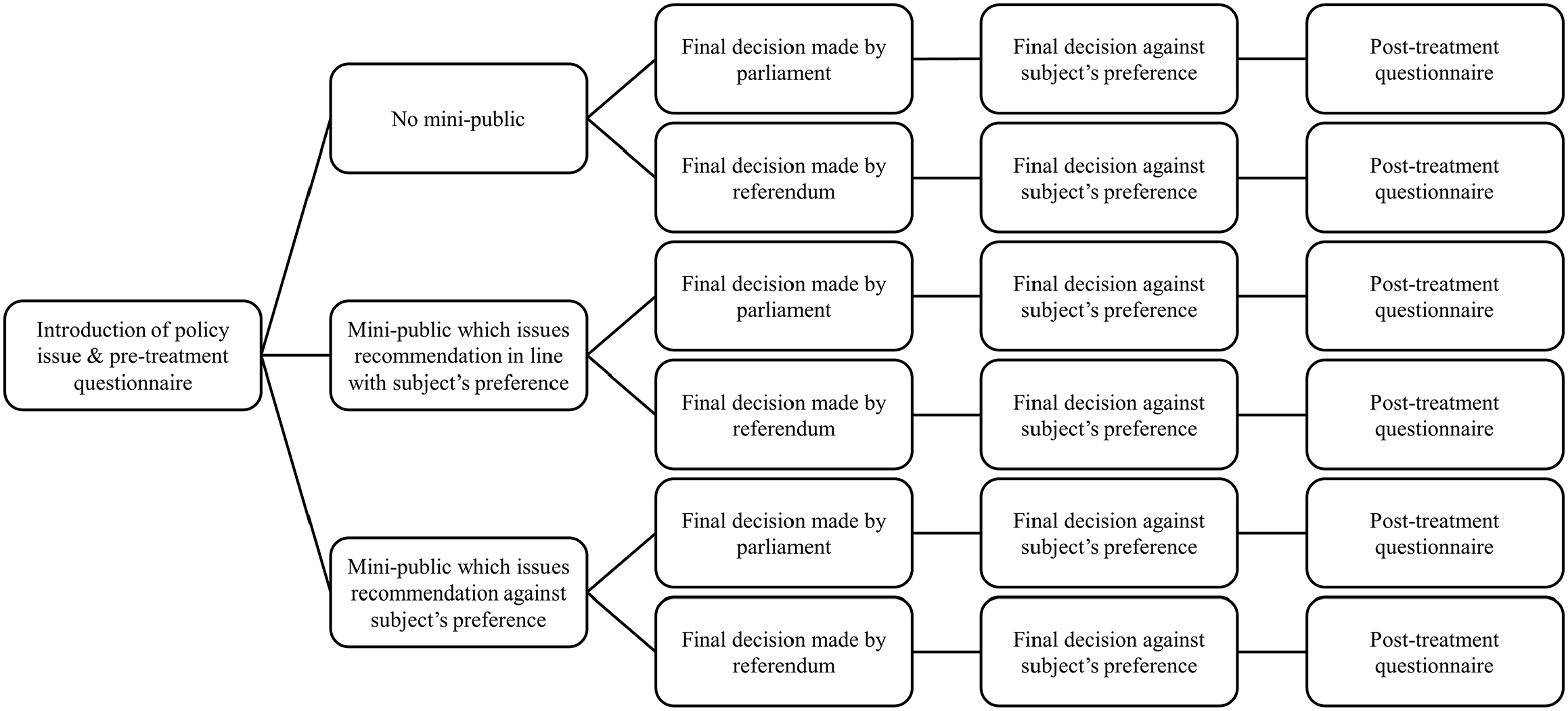
Experimental Design.
Location
Citizens frequently learn about political developments by reading (e.g. newspapers, magazines, or Internet media). Thus, a scenario experiment in which subjects read about a fictitious political decision-making process mimics how citizens learn about political decision-making in the real world. However, prior research suggests that behavior observed in scenario experiments is only likely to generalize to the real world if subjects have pre-existing familiarity with the concepts alluded to in the experiment (Schmuckler, 2001). Due to this, we decided to conduct our experiment in Ireland.
While most countries have experience with parliamentary decision-making, referendums and especially mini-publics remain less common. What is more, where mini-publics have been conducted, these tended to have limited public visibility and were frequently organized not by the state, but by researchers or democracy activists (Setälä, 2011). Ireland is different due to its recent experience with no less than five state-mandated mini-publics: the Constitutional Convention (2012–2014), the Irish Citizens’ Assembly (2016–2018), the Citizens’ Assembly on Gender Equality (2020–2021), and two ongoing mini-publics, the Citizens’ Assembly on Biodiversity Loss (2022–) and the Dublin Citizens’ Assembly (2022–). Critically, mini-publics in Ireland have been tasked with deliberation on highly salient political issues including abortion, same-sex marriage, environmental policy, and various institutional questions; and their proceedings have been widely discussed in public media (Farrell et al., 2019). As a result, Ireland is in the unusual situation that a majority of its voters have basic familiarity with the concept of a mini-public. According to a recent survey, around two thirds of Irish voters have previously heard of the Irish Citizens’ Assembly (i.e. the mini-public that was organized between 2016 and 2018) and around half could also correctly identify core characteristics of mini-publics, such as that participants are randomly selected (Elkink et al., 2020). At the same time, Ireland is a representative democracy that frequently holds referendums (a total of 19 since the turn of the millennium), so our subjects can also be expected to be familiar with both parliamentary decision-making and referendums. Finally, while some of the recommendations made by Irish mini-publics subsequently became law (e.g. a proposal to de-criminalize abortion), others did not (e.g. the previously mentioned proposal for a fixed-term parliament). The partial adoption of earlier mini-public recommendations should increase the perceived realism of our vignettes, in which mini-public recommendations can be honored or not honored.
Sample
Our sample contains 1309 Irish citizens aged 18 years or older. 5 Subjects were recruited online by Lucid between December 2020 and January 2021 and received a small compensation for their participation. We used quotas to achieve a sample that is similar to the Irish adult population in terms of gender and region of residence. We also stratified on age, but Lucid was unable to completely fill the quota for citizens aged 65 or older. In addition, sample descriptives suggest that our sample under-represents citizens with low education, low political interest, and right-wing electoral preferences (see Section 3 of the Supplementary Material). Still, our sample includes substantial numbers of subjects from all age groups, subjects with both low and high education and political interest, and subjects with different political leanings. Existing research suggests that demographically diverse Internet samples are able to replicate experimental results from nationally representative samples even if they are not probability based (Berinsky et al., 2012; Coppock and McClellan, 2019).
A possible concern with self-administered surveys are respondents who do not pay attention to questions and treatments (Berinsky et al., 2014). Therefore, we do not include the following in our sample: (1) subjects who did not correctly answer an attention check that instructed participants to choose a specific response option, (2) subjects who failed a simple language comprehension check, and (3) speeders, defined as subjects who rushed through the survey in less than a third of average time. Due to our interest in the acceptance of political decisions that go against citizens’ policy preference, we in addition drop a total of 26 subjects who despite repeated queries did not state a preference on the policy issue at stake (see below).
Scenario
After completing a pre-treatment questionnaire including demographics and general political attitudes, subjects were given a preamble explaining that they would read a text describing a scenario about a political decision-making process and subsequently be asked to indicate their beliefs about that process. Next, subjects were introduced to the policy matter at stake: the introduction of a universal basic income scheme. Subjects were told that the Irish government would pay every adult €200 per week under the proposed scheme to cover essential living costs while children would receive a smaller amount (€30). Subjects were also informed that the basic income scheme would replace most other welfare benefits and that the scheme would be paid for by increasing taxes. The question whether existing welfare systems should be replaced with universal basic income schemes has been debated extensively in Europe in recent years, including in Ireland where proposals similar to the one described by us have been made by both a center-right (Fianna Fáil) and a leftist (Green Party) party. 6 The high saliency of the issue at stake should increase the perceived realism of our vignette. At the same time, the question whether Ireland should introduce a basic income scheme has never been debated by a mini-public, nor has it been voted on in the Irish parliament or in a referendum. Therefore, the scenario remains fictitious and different decision procedures and outcomes should appear plausible to our subjects. Finally, according to a recent representative survey, Irish citizens are about equally split on the issue, with 55% of the electorate favoring the introduction of a basic income scheme and 45% being opposed (European Social Survey, 2016). 7 This should increase the plausibility of different decision outcomes.
After learning about the issue at stake, subjects were asked whether they agree that Ireland should introduce the basic income scheme. Subjects could provide their answers on a 4-point Likert-type scale ranging from “completely disagree” to “completely agree” that also included a “don’t know” option. Due to our interest in the acceptance of negative political decisions, we need to drop subjects who did not state a policy preference. If subjects indicated “don’t know,” we therefore prompted the policy preference a second time, using the same response options in addition to a “really don’t know” option. The second prompt significantly increased position-taking: while 92 subjects did not indicate a policy preference when first asked, this number reduced to 26 subjects after the second prompt.
The existing literature is clear that it is important to raise the saliency of decision procedures in procedural fairness experiments (van den Bos, 2001). Therefore, we next asked subjects to consider that the decision on the policy proposal could be referred to a mini-public before the final decision is made. To increase concept recognition, we used the term “citizens” assembly’ when referring to a mini-public (i.e. the term most commonly used in Ireland); and we also reminded subjects about the basic features of a mini-public, including that participants are randomly selected, that they are given the opportunity to deliberate on the issue at length after hearing from experts, and ultimately have to make a recommendation on whether the policy should be introduced. This process is similar to how real-life mini-publics have been involved in political decision-making in Ireland (Courant, 2021a; Farrell et al., 2019). Finally, we told subjects that the final decision could be made by elected representatives in the Irish parliament or by citizens in a referendum.
After reading about the different possible decision procedures, subjects were asked to imagine that a political decision was made on the policy proposal. To increase the experiment’s perceived realism, subjects were told that the pros and cons of the proposal were widely debated in the media. Next, subjects proceeded to the randomly assigned treatments. First, we varied whether a mini-public was involved in the process and, if yes, the nature of its policy recommendation. More specifically, a third of the subjects was told that no mini-public was involved in the decision; another third that a mini-public was involved and that it ended up issuing a recommendation in line with the subject’s previously stated policy preference; and the final third that a mini-public was involved and that it recommended against their policy preference. Second, we varied how the final decision was made, with half of the subjects being told that the final decision was made by parliament, while the other half was told that the final decision was made by referendum. Finally, all subjects were told that the final decision came out against their policy preference.
Outcomes
We assess the effects of our treatments on (1) subjects’ evaluations of the fairness of the decision procedure and (2) their willingness to accept the (negative) final decision. Procedural fairness perceptions were measured with three questions (e.g. “How fair do you think matters were when the decision was taken?”). Decision acceptance was measured with two questions (e.g. “How willing are you to accept the decision?”). All question wordings were adapted from prior studies (Esaiasson et al., 2019). Subjects could provide their responses on scales ranging from 0 to 10. We combine the different questions to two cumulative rating scales. Both the procedural fairness (H = 0.85; α = 0.94) and the decision acceptance scale (H = 0.78; α = 0.87) constitute strong unidimensional Mokken scales and have high scale reliability (see Section 4 of the Supplementary Material). To facilitate interpretation, we normalize both dependent variables so that they range from 0 to 10. Table 1 shows descriptive statistics.
Descriptive Statistics for Outcome Variables.

Results
Average Effects
In a first step, we investigate the average effects of deliberative mini-publics and referendums on citizens’ evaluation of the fairness of decision processes and their willingness to accept a negative political decision. The results are shown in Models 1 and 4 in Table 2. Both models are estimated with linear regression and include two binary independent variables that respectively measure whether or not the decision-making process involved a mini-public and whether the final decision was made by parliament or by referendum. Consistent with H1, we find that the involvement of a mini-public increases perceptions of fair decision-making by 0.7 points, or 27% of a standard deviation (p < 0.001). Furthermore, we find that the involvement of a mini-public leads to a somewhat smaller increase in the willingness to accept a negative decision of around 0.4 points, or 14% of a standard deviation (p < 0.05). While these are notable effects, our results suggest that the average effect of mini-public involvement is substantially smaller when compared with the effect of a referendum. Lending support to our H3, we find that our subjects rated a decision-making process as around 1.5 points fairer (p < 0.001) and were around 1.1 points more likely to accept a negative decision outcome (p < 0.001) if the final decision was made by referendum as opposed to parliament. These strong effects are consistent with previous research (e.g. Esaiasson et al., 2012) and respectively represent increases of 57% and 45% of a standard deviation.
Effects of Deliberative Mini-Publics on Legitimacy Perceptions of Decision Losers.
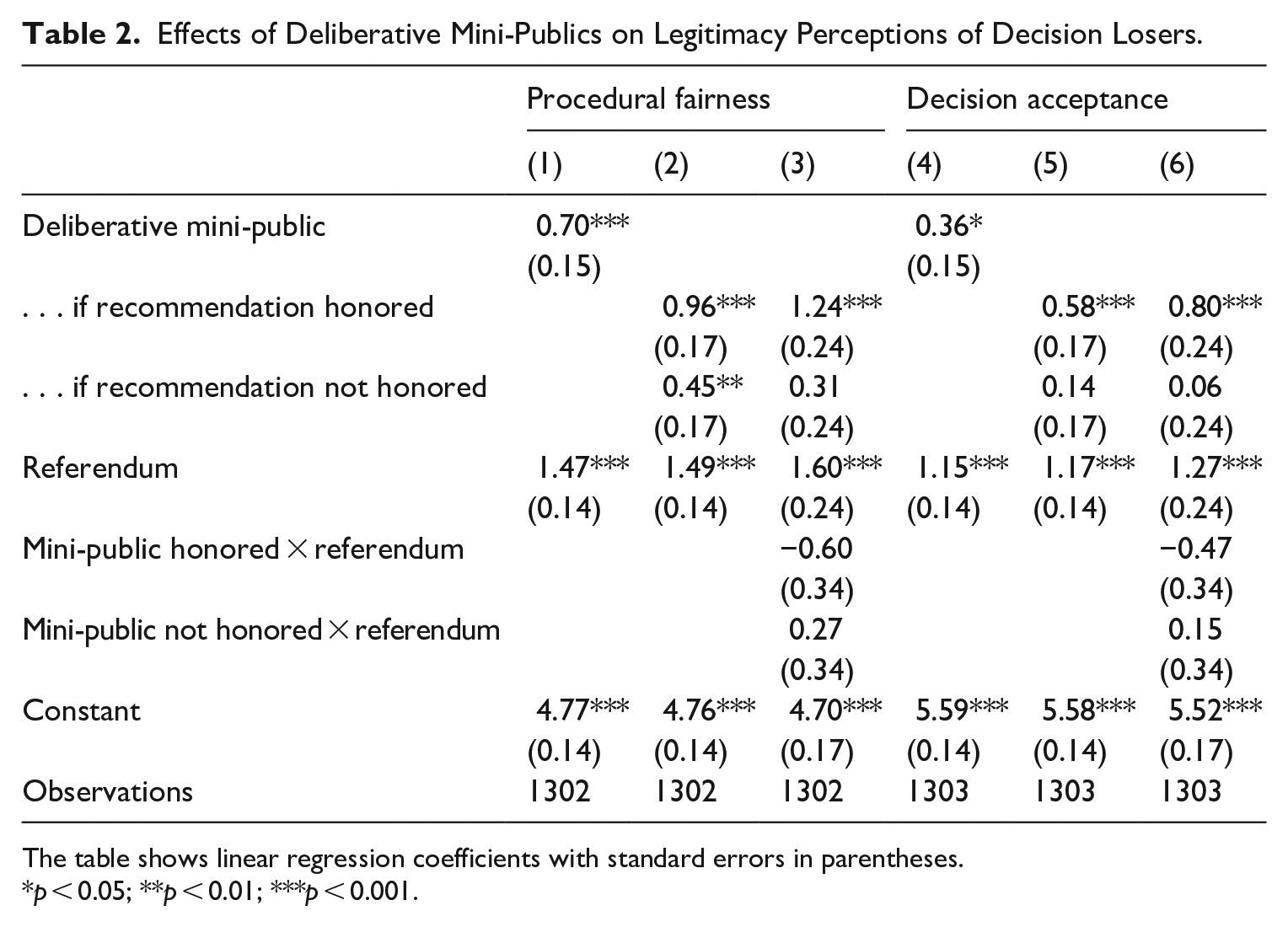
The table shows linear regression coefficients with standard errors in parentheses.
p < 0.05; **p < 0.01; ***p < 0.001.
Honoring of Mini-Public Recommendations
We now begin to unpack the effects of mini-public involvement. In a first step, we distinguish between (1) a scenario in which the recommendation made by the mini-public is honored in the final decision and (2) a scenario in which it is not honored. Consistent with H2, the results suggest that mini-publics have substantially larger effects when their recommendations are honored and smaller or even no effects when their recommendations are not honored (see Models 2 and 5 in Table 2). More specifically, we find that the involvement of a mini-public increases procedural fairness perceptions by almost one point if its policy recommendation is subsequently honored, or 37% of a standard deviation (p < 0.001). 8 Similarly, we find that the acceptance of a negative political decision increases by almost 0.6 points if the mini-public recommendation is honored, or 22% of a standard deviation (p < 0.001). By contrast, the involvement of a mini-public increases procedural fairness perceptions by just 0.5 points, or 17% of a standard deviation (p < 0.01), if its recommendation is subsequently overturned, and does not have any statistically significant effect on the acceptance of the final decision. 9
Overall, these results suggest that the beneficial consequences of mini-publics are largely limited to situations in which their policy recommendations are subsequently adopted. That said, it is worth noting that whether or not the final decision is made by referendum continues to have stronger effects even when compared with a mini-public whose recommendation is honored. Possible reasons include that citizen involvement is more important when it comes to the making of final policy decisions and that citizens tend to see a procedure that gives voice to all citizens as fairer than a procedure that gives voice to a sortition-based citizen body.
Interplay With Final Decision Mode
Next, we consider the interplay of mini-publics with established forms of political decision-making. To do so, we interact our two binary indicators for whether a mini-public was involved in the process whose recommendation was/was not honored with our binary indicator for whether the final decision was made by referendum or by parliament. The regression output is shown in Models 3 and 6 in Table 2. Figure 2 visualizes the results.
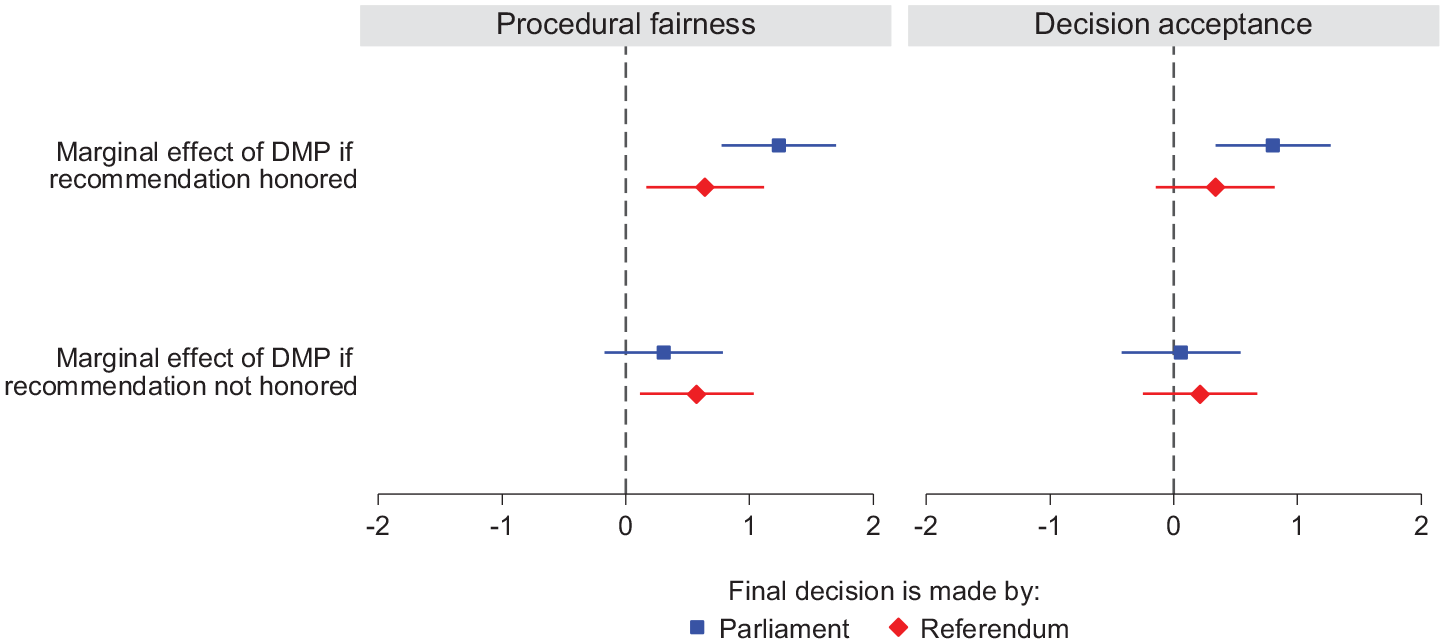
Effects of Mini-Public Involvement on Legitimacy Perceptions Depending on Final Decision Mode.
In line with expectations, the point estimates suggest that in a scenario where the policy recommendation of a mini-public is subsequently overturned, legitimacy perceptions are somewhat higher if a referendum is held. However, the differences are small and clearly miss conventional levels of statistical significance (p = 0.43 and 0.65, respectively), leading us to reject H4a. In fact, if anything the final decision mode makes a larger difference when the recommendations of mini-publics are honored, with the point estimates showing somewhat larger increases in legitimacy perceptions if the final decision is made by elected representatives. Consistent with H4b, these differences are not, however, statistically significant (p = 0.08 and 0.17, respectively). Overall, these results suggest that mini-public involvement has the same effects irrespective of how the final decision is made.
To summarize the results thus far, we find that the involvement of a mini-public in political decision-making processes can substantially increase perceptions of fair decision-making and the willingness to accept unfavorable decision outcomes. However, these beneficial effects are largely limited to situations in which the recommendations of mini-publics are honored. Still, we find no indications that mini-publics would harm legitimacy perceptions if their recommendations are overturned, and that applies even when politicians decide to overturn them. At the same time, we find that referendums consistently lead to strong increases in legitimacy perceptions. This suggests that the highest legitimacy perceptions can be achieved when mini-publics are combined with referendums, though the very highest levels can only be achieved when mini-public recommendations are subsequently adopted (see Figure 3).
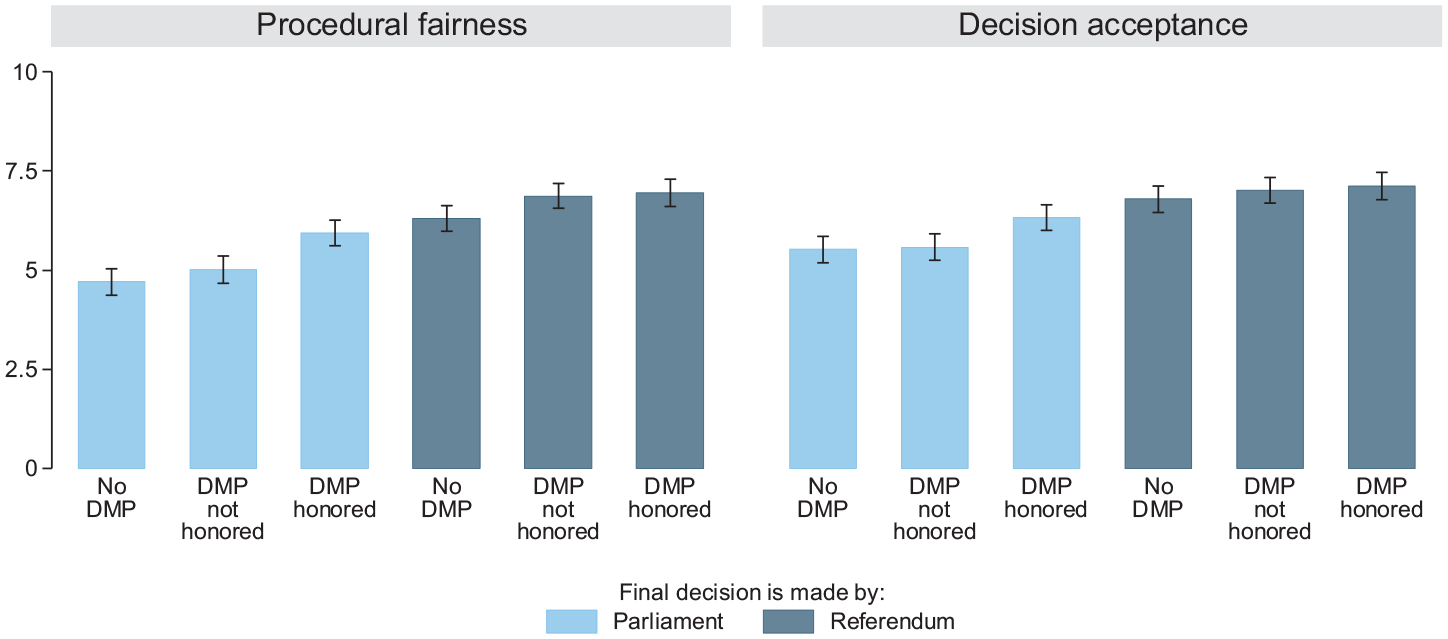
Mean Procedural Fairness and Decision Acceptance Scores Across Experimental Conditions.
Sub-Group Results
Do participatory decision procedures affect some individuals more strongly than others? To investigate our expectations regarding individual-level causal heterogeneity, we re-estimate all models reported above using split samples. First, we compare subjects with low and high political trust, defined respectively as subjects who indicated a score of 5 or lower/6 or higher when asked about the extent to which they trust politicians on a scale from 0 to 10. Second, we compare subjects who thought of the policy issue at stake (i.e. the introduction of a basic income scheme) as important versus not important, respectively defined as subjects who gave a score of 6 or higher/5 or lower on an importance scale ranging from 0 to 10. Finally, we compare subjects with strong and weak opinions on the issue at stake. We consider subjects to have a strong opinion if they completely agreed or completely disagreed that Ireland should introduce the basic income scheme; and to have a weak opinion if they only tended to agree or tended to disagree with the introduction of the basic income scheme. As a general note of caution, it is important to note that statistical power decreases in sub-group analyses and that the sub-group results should therefore be interpreted with care (Rothwell, 2005).
Figure 4 visualizes the most important results. The complete set of results are contained in Section 5 of the Supplementary Material. We find support for H5a, which suggested that the relationship between direct citizen involvement and legitimacy perceptions is moderated by political trust. The differences are especially stark in the case of mini-publics. On one hand, mini-public involvement and whether or not the mini-public recommendation is honored make a large difference to citizens with low political trust. On the other hand, citizens with high political trust rate a process as equally fair and are equally likely to accept a negative decision independently of whether a mini-public is involved or not. Notably, this conclusion applies even when the mini-public recommendation is honored, suggesting that mini-publics are entirely inconsequential for the legitimacy perceptions of individuals with high political trust.
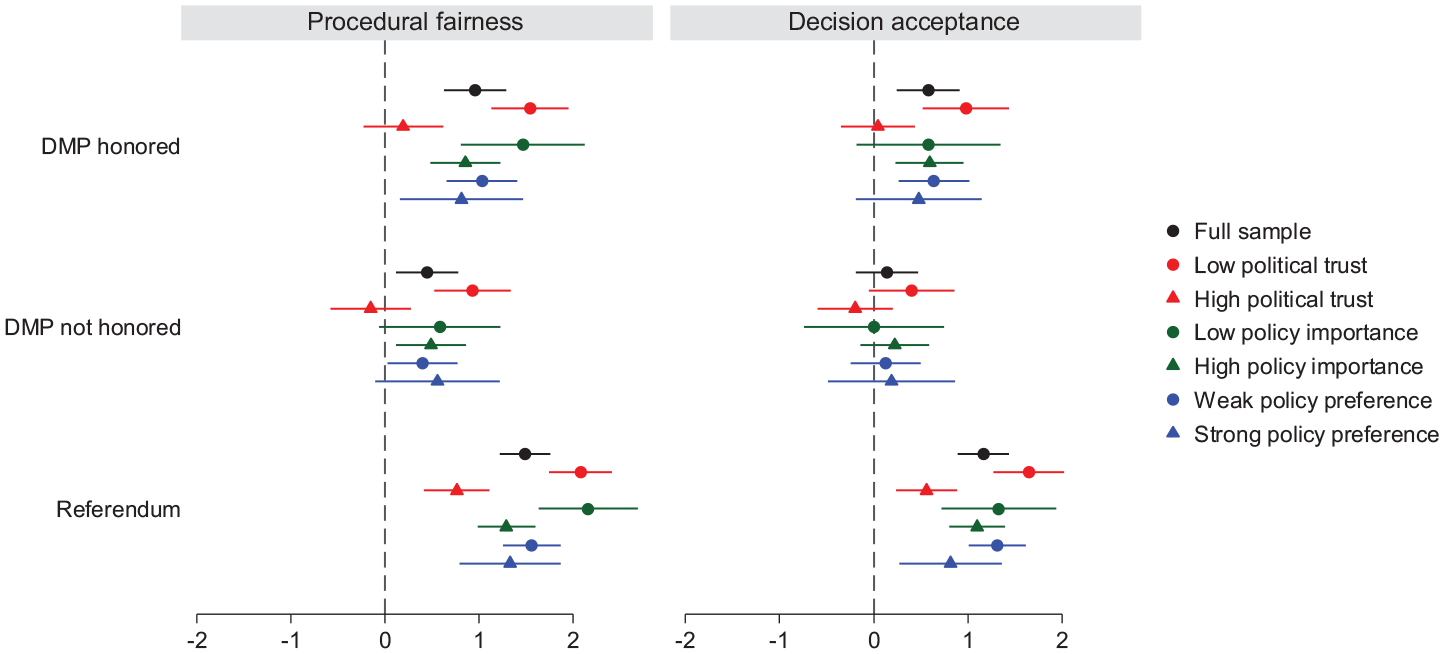
Selected Sub-Group Results.
Consistent with H5a, we also find that whether the final decision is made by referendum makes a larger difference to citizens with low political trust. However, unlike in the case of mini-publics, the legitimacy perceptions of individuals with high political trust also receive a small boost when the final decision is made by citizens in referendum. Finally, analogously to the full sample, we find no evidence to suggest that the effects of mini-publics are conditional on the way the final decision is made in both the low and high political trust samples (see Models 3, 6, 9, and 12 in Table S4). Overall, these results suggest that direct citizen involvement matters more strongly and, in the case of mini-publics, even exclusively to citizens with low levels of trust in politicians. This is an encouraging finding, given that it is citizens with low political trust who tend to be the least satisfied with existing democratic processes.
Meanwhile, we find no evidence to support our two remaining sub-group hypotheses (H5b and H5c). Whereas we expected that direct citizen involvement matters more to citizens who think of an issue as important, our results suggest that mini-publics and referendums affect the legitimacy perceptions of citizens who think of issues as relatively important and those who do not about equally. In fact, if anything we find slightly larger effects among subjects who thought of the issue as relatively unimportant. This directly contradicts results from an earlier study, which found that referendums increase decision acceptance only among citizens who think of an issue as important (Towfigh et al., 2016). Possible reasons include that we study a different issue and country context or issues with statistical power, though it is worth mentioning that another recent study also found no clear effects of issue importance (Goldberg and Bächtiger, 2022). Finally, we find that the effects of mini-public involvement and referendums are similar among individuals with weak and strong preferences on the policy at stake. Notably, in some models we find statistically significant evidence that the holding of a referendum dampens the effect of mini-public involvement on legitimacy perceptions, which directly contradicts our expectations.
Robustness Checks
We report several robustness checks in Section 6 of the Supplementary Material. First, we re-estimate all models while controlling for subjects’ age, gender, education, political interest, voting preferences, political trust, and satisfaction with democracy. The results remain similar. 10 Second, we re-estimate the sub-group analyses using alternative cut-offs for the identification of subjects with high versus low political trust and subjects who did versus subjects who did not think of the policy issue at stake as important. The results are again similar. Third, we re-estimate all models while restricting the sample to subjects who indicated that they had previously heard of the Irish Citizens’ Assembly. 11 Doing so should increase pre-existing levels of familiarity with the concept of a mini-public and, therefore, ecological validity. A little more than 60% of our subjects indicated that they had previously heard of the Irish Citizens’ Assembly, which is similar to the share reported in an earlier representative voter survey (Elkink et al., 2020). The substantial conclusions remain unchanged. 12
Fourth, we restrict the analysis to subjects who correctly answered a series of manipulation and memory questions assessing treatment intake. Even though we dropped speeders and subjects who failed pre-treatment attention and comprehension checks, our sample includes a substantial number of subjects who could not correctly recall the decision process and/or outcome post-treatment. For example, 22% of subjects could not correctly recall whether or not a deliberative mini-public was involved in the decision process after answering the outcome questions, and 34% of subjects exposed to a mini-public condition could not correctly recall the mini-public’s policy recommendation. Furthermore, 27% incorrectly answered a question on whether the final decision was made by parliament or by referendum, and 40% could not correctly recall the final decision outcome. Reassuringly, though, the substantial conclusions remain similar when we restrict the analysis to the approximately 40% of subjects who could recall the exact decision process and outcome. 13
Fifth, we re-estimate all models while including the approximately 200 subjects who failed the language comprehension check, sped through the questionnaire in less than a third of average time, or both. While the effect sizes decrease somewhat, all substantive conclusions remain the same. We cannot report results including subjects who failed the pre-treatment attention check because these subjects were screened out before they could proceed to the experiment.
Finally, we address the potential concern that some of our results could be driven by outcome favorability. Existing evidence suggests that some citizens update their policy views after hearing about mini-public recommendations, and similar effects could apply to other forms of direct citizen involvement, such as referendums (Boulianne, 2018). Therefore, a potential concern is that subjects exposed to a mini-public recommendation or referendum outcome that is counter to their initial policy preference updated their policy preference and came to see the process as legitimate not because of procedural aspects but because they ultimately saw themselves as decision winners. To counter this concern, we investigate the rate of preference change across experimental conditions. Reassuringly, we find that subjects from all six experimental conditions were equally likely to change their opinion on the basic income scheme.
Conclusion
Experimentation with deliberative mini-publics has surged in recent years, often linked with high hopes that the addition of mini-publics to established democratic processes would help to tackle public discontent and increase perceptions of democratic legitimacy. The results of this study lend partial support to such hopes. In line with an earlier study (Werner and Marien, 2022), we found that the involvement of a mini-public in democratic decision-making can increase perceptions of fair decision-making and the acceptance of negative political decisions. However, an important qualification suggested by our study is that the beneficial effects of mini-publics are largely limited to situations in which the non-binding recommendations of mini-publics are honored, a finding that applied even when the decision to overturn a mini-public recommendation was made by referendum.
At the same time, we found no indications that mini-publics would hamper the legitimacy perceptions of decision losers when their recommendations are overturned. Furthermore, our results suggest that referendums and mini-publics are complementary in the sense that the highest gains in perceived legitimacy result when policy issues are first referred to a mini-public and its recommendations are subsequently confirmed in a referendum. An important qualification is our finding that the introduction of a referendum improves legitimacy perceptions to a larger extent than the introduction of a mini-public. Given the substantial costs associated with the organization of mini-publics, this raises the question whether mini-publics are good value-for-money. While the effect of a mini-public on legitimacy perceptions may be more limited (and conditional) compared with the effect of a referendum, there are other potential benefits that could make mini-publics valuable including increases in citizens’ ability to make considered political judgments and, more generally, improvements in the quality of public debate (Landemore, 2018; McKay, 2020). Finally, we found that the legitimacy-enhancing effects of mini-publics and, to a lesser extent, referendums are driven by citizens with low political trust. This suggests that mini-publics and referendums are able to increase fairness perceptions and decision acceptance precisely among those citizens who are most skeptical about the functioning of current democracies.
Of course, all research has limitations, and this study is no exception. First, while scenario experiments enable highly internally valid causal inferences, their artificiality remains a concern. To maximize perceived realism, we chose to conduct our experiment in Ireland, a country with extensive experience with mini-publics. Nevertheless, replication studies using observational data from real-world cases are necessary to increase confidence in our findings. Second, questions of generalizability remain, given that our experiment involved a decision on a single policy issue in a single country. Here, it is important to mention a parallel study by van Dijk and Lefevere (2022), which similarly to us used a scenario experiment to understand the implications of mini-public recommendations not being followed, but unlike our study was situated in Belgium and framed around a different political issue (transportation policy). Despite these differences, both studies indicate that the beneficial effects of mini-publics are largely limited to situations in which the non-binding recommendations of mini-publics are honored, thus increasing confidence that our findings travel to different country contexts and issue areas.
Third, our experimental set-up simplified reality in various ways. In practice, mini-publics often deliberate on complex policy issues and frequently make not just one recommendation, but several. Therefore, an important question that our design cannot address is what happens if some but not other recommendations of mini-publics are adopted. An initial answer to this question is provided by van Dijk and Lefevere (2022), who found that the effect of mini-public involvement on legitimacy perceptions reduces more strongly when two out of two recommendations are not honored instead of just one out of two. Still, more evidence is needed to better understand the relationship between mini-publics and legitimacy perceptions. For example, neither our study nor that of van Dijk and Lefevere can answer the question what happens when mini-public recommendations are partially implemented but not fully; or when mini-public recommendations receive no response at all by the authorities. Furthermore, existing work including the present study limited the role of mini-publics to deliberation on a pre-existing policy proposal. Therefore, future research should consider to what extent mini-publics can increase legitimacy perceptions if they are used in a different way, such as the drawing up of entirely new policy proposals. Finally, no existing study can answer how citizens would react if mini-public recommendations were repeatedly ignored over time. While our findings suggest that the beneficial effects of mini-public involvement largely disappear when one of their recommendations is not honored, we did not find that the overturning of a mini-public recommendation negatively affects legitimacy perceptions. However, there could be a backlash effect if mini-public recommendations were repeatedly overturned.
As this discussion has made clear, more work needs to be done in order to more fully understand the potential of mini-publics to increase perceptions of legitimate decision-making among citizens at large. In our view, the results of this study provide ample justification to embark on this exercise. Concerns about waning democratic legitimacy are widespread, and the results of our study suggest that the addition of mini-publics to the existing democratic mix could help to increase legitimacy perceptions and social cooperation. Given the rising interest in mini-publics among democracy activists and policy-makers, the identification of the conditions under which mini-publics are best-placed to fulfill their potential should be a pressing concern for social scientists.
Supplemental Material
sj-pdf-1-psx-10.1177_00323217221137444 – Supplemental material for Scaling Up? Unpacking the Effect of Deliberative Mini-Publics on Legitimacy Perceptions
Supplemental material, sj-pdf-1-psx-10.1177_00323217221137444 for Scaling Up? Unpacking the Effect of Deliberative Mini-Publics on Legitimacy Perceptions by Micha Germann, Sofie Marien and Lala Muradova in Political Studies
Footnotes
Acknowledgements
The authors would like to thank Camille Bedock, Andrea Felicetti, Anja Giudici, David Farrell, Diana Mutz, Jamie Pow, Jane Suiter, Hannah Werner, and two anonymous reviewers for valuable comments. An earlier version of this paper was presented at the 2021 ECPR General Conference. This study was approved by the University of Bath’s Social Science Research Ethics Committee (S20-072).

Declaration of Conflicting Interests
The author(s) declared no potential conflicts of interest with respect to the research, authorship, and/or publication of this article.
Funding
The author(s) disclosed receipt of the following financial support for the research, authorship, and/or publication of this article: This project has received funding from the European Research Council under the European Union’s Horizon 2020 research and innovation program (grant agreement No 759736) as well as the British Academy (SRG20\200260).
Supplemental Material
Additional Supplementary Information may be found with the online version of this article. Departures from the Pre-Analysis Plan. Survey Materials. Sample Descriptives. Table S1: Sample descriptives and population reference figures. Scaling Analysis. Table S2: Scaling analysis—procedural fairness perceptions. Table S3: Scaling analysis—decision acceptance. Sub-Group Analysis. Table S4: Effects of deliberative mini-publics and referendums depending on level of political trust. Table S5: Effects of deliberative mini-publics and referendums depending on level of perceived importance of policy issue at stake. Table S6: Effects of deliberative mini-publics and referendums depending on strength of policy preference. Robustness Checks. Table S7: Main models including covariates. Figure S1: Selected sub-group results with covariates included. Table S8: Complete set of sub-group results with covariates included [political trust]. Table S9: Complete set of sub-group results with covariates included [issue importance]. Table S10: Complete set of sub-group results with covariates included [preference strength]. Figure S2: Alternative threshold in split sample models (5 instead of 6). Figure S3: Alternative threshold in split sample models (7 instead of 6). Table S11: Complete set of sub-group results with threshold = 5 [political trust]. Table S12: Complete set of sub-group results with threshold = 5 [issue importance]. Table S13: Complete set of sub-group results with threshold = 7 [political trust]. Table S14: Complete set of sub-group results with threshold = 7 [issue importance]. Table S15: Main models when subjects who have not previously heard of the Irish Citizens' Assembly are dropped. Table S16: Main results when only subjects are included who correctly answered all memory check questions. Table S17: Main results when speeders and subjects who failed the language comprehension check are included. Figure S4: Selected sub-group results when speeders and subjects who failed the language comprehension check are included. Table S18: Complete set of sub-group results when speeders and subjects who failed the language comprehension check are included [political trust]. Table S19: Complete set of sub-group results when speeders and subjects who failed the language comprehension check are included [issue importance]. Table S20: Complete set of sub-group results when speeders and subjects who failed the language comprehension check are included [preference strength]. Table S21: Assessing whether the probability of opinion change varies across experimental conditions.
Notes
Author Biographies
References
Supplementary Material
Please find the following supplemental material available below.
For Open Access articles published under a Creative Commons License, all supplemental material carries the same license as the article it is associated with.
For non-Open Access articles published, all supplemental material carries a non-exclusive license, and permission requests for re-use of supplemental material or any part of supplemental material shall be sent directly to the copyright owner as specified in the copyright notice associated with the article.
