




Abstract
This article examines whether political professionalization causes attitudinal incongruence within political parties. In this first of a kind study, the internal opinion structure of five Belgian political parties based in Flanders is analysed by comparing the political attitudes of staffers and party members. The analysis combines original survey data collected among the staff of five Belgian political parties based in Flanders (N = 560) and survey data collected among their party members by the MAPP project (N = 10,022). The results demonstrate that staffers are mostly congruent with party members, with a few remarkable exceptions. As anticipated by my reinterpretation of cleavage theory, incongruences are more prevalent among mainstream parties and mostly appear on issues concerning globalization. This cosmopolitan bias among staffers is primarily driven by an educational and generational divide with party members.
Introduction
Political parties since the 1960s have hired a growing number of paid professionals to compensate for the decline in party activism (Katz and Mair, 1993; Panebianco, 1988). This political professionalization has led to the emergence of a new unelected elite: professional staff. Although their increased presence in parties’ central and public offices is relatively well-documented (Katz and Mair, 2002; Kölln, 2015; Krouwel, 2012), staffers remain chronically under-researched (Webb and Keith, 2017). This is especially surprising as evidence of their impact on politics is growing (Laube et al., 2020; Montgomery and Nyhan, 2017). As unelected professionals, they influence how parties put their ideology into practice. Parliamentary aides draft legislation (Busby and Belkacem, 2013; Pegan, 2017) and assist members of parliament (MPs) in controlling the actions of government. Ministerial advisors coordinate with coalition partners (Maley, 2011) and oversee policy implementation by civil servants (Askim et al., 2017). In parties’ central offices, political marketeers craft strategic communication outputs to boost their electoral fortunes (Tenscher et al., 2015).
Influential party models suggest that the dominance of elected elites and their professional advisors within contemporary parties comes at the expense of a ‘marginalized’ membership base (Katz and Mair, 1995; Panebianco, 1988). This raises the important question whether the political views of party members are accurately represented among the staffers who put party policies into practice. If staffers are ‘out of touch’ with rank-and-file members, this hollows out parties’ representative function. Such an ideological mismatch between the party on the ground (members) and the daily practice at political offices (staffers) can cause dissatisfaction among volunteers (de Vet et al., 2019; Van Haute and Carty, 2012) and obscure a party’s ideological profile among the electorate (Greene and Haber, 2015). If staffers share the political views of rank-and-file members, however, their advice can be important for keeping elected elites in touch with the membership base.
To assess the degree of congruence between staffers and party members, this article compares their political attitudes in five Flemish (Belgian) parties. First, I assess to what extent staffers and party members from the same parties are congruent (RQ1). Second, I investigate whether incongruences are more prevalent among specific parties or policy domains (RQ2). The empirical analysis relies on a pooled dataset, combining original data collected among political staffers (N = 560; Moens, 2021a) with secondary data on party members collected from the MAPP project (N = 10,022; Van Haute et al., 2018; Van Haute and Wauters, 2019). The attitudes of both groups are compared on seven salient issues: income redistribution, market intervention, criminal justice, reproductive rights, environmentalism, European Union (EU) membership, and migrant integration.
This innovative article breaks new empirical and theoretical grounds. Empirically, staffers’ political attitudes and their implications for intra-party politics are analysed for the first time. Moreover, this analysis covers a broad range of issues, allowing for a fine-grained comparison between parties and policy domains. Theoretically, the article introduces new insights to the study of parties’ internal opinion structure by drawing from literature on professionalization (Panebianco, 1988) and cleavage theory (Hooghe and Marks, 2018). In doing so, I aim to expand the study of parties’ internal opinion structure beyond its traditional, one-sided focus on parties’ internal hierarchy. Rather than approaching subgroups like staffers and party members as monoliths, this article examines whether the ideological diversity among members is equally present among staffers. For this reason, the analysis not only focuses on central tendencies (e.g. mean positions) but also compares the distribution of attitudes among both groups to illustrate their internal heterogeneity. Furthermore, the distinction between staffers and party members is put into a broader perspective by showing the impact of generational and educational differences on parties’ ideological heterogeneity.
The results demonstrate the complex, multi-facetted nature of parties’ internal opinion structure. On a general level, the political attitudes of staffers and party members are relatively congruent. However, staffers position themselves more progressive or cosmopolitan within specific parties and policy domains. This gap is particularly striking for issues concerning globalization (EU membership, migrant integration) and disproportionally affects traditional, long-established parties. Although these incongruences are primarily driven by educational and generational gaps, the contrasts between staffers and party members persist after controlling for these socio-demographic factors.
This article proceeds as follows. First, I argue why the political attitudes of staffers should be included as an integral part of parties’ internal opinion structure. The theory section reflects on potential incongruences by drawing arguments from May’s (1973) seminal work, as well as existing literature on professionalization (Panebianco, 1988) and cleavage theory (Hooghe and Marks, 2018). In the methods section, I explain the process of data collection for both surveys used in this study and introduce the seven policy statements that were analysed and address my operationalization of attitudinal congruence. After presenting the results, I reflect on the implications for the study of parties’ internal opinion structure and the impact of professionalization on parties’ ideological coherence.
Staffers’ Political Impact
The increased presence of staffers in contemporary politics embodies the transformation from volunteer-driven mass party organizations to professionalized, capital-intensive politics (Katz and Mair, 1995; Panebianco, 1988). Empirical studies have demonstrated how increasing staff size (Kölln, 2015; Krouwel, 2012) has coincided with dwindling party membership figures (Van Biezen and Poguntke, 2014). According to cartel party theory, the accumulation of resources by elected elites (including staff) has marginalized the party on the ground, comprised mainly of voluntary activists (Katz and Mair, 2002). In a similar vein, it is generally acknowledged that the priorities of staff-driven organizations differ from those dominated by volunteers (Bolleyer and Correa, 2020). Despite the professionalization of party organizations and the emergence of parties with strikingly different membership models (Mazzoleni and Voerman, 2017; Vittori, 2020), most parties follow the so-called ‘subscriber democracy model’ where paying members get a formal say in internal decision-making (Poguntke et al., 2016).
Despite a universal acknowledgement of their growing importance, the position of staffers within this organizational set-up has not been considered by previous studies of parties’ internal opinion structure (Kitschelt, 1989; May, 1973; Narud and Skare, 1999; Norris, 1995; Van Holsteyn et al., 2015). In this article, staffers are defined as individuals with remunerated, unelected positions who work in party offices, parliamentary party groups, or ministerial offices. This broadly defined population includes a diverse set of employees, ranging from administrative clerks to spin doctors and policy wonks. Based on the typology developed by Moens (2021a), I distinguish between six types of staff (see Online Supplemental Appendix A). First, policy experts play a pivotal role during government negotiations, draft legislation and flesh out specific policy proposals (Pittoors et al., 2017). Moreover, they often prepare the election manifesto that get discussed and approved at party congresses. In coalition governments, they are an integral part of the deliberation between coalition partners and they coordinate with civil servants for policy implementation (Askim et al., 2017; Gouglas et al., 2015; Maley, 2011). Second, political assistants prepare the activities of MPs, who voice the preferences of their constituents during parliamentary debates and introduce legislation drafted by staffers (Busby and Belkacem, 2013; Wolfs and De Winter, 2017). To ensure that staffers act on their behalf during all of these activities, elected elites in parliamentary democracies prefer to recruit. Third, communication experts have a direct impact on the framing and salience of political issues towards voters (Sabag Ben-Porat and Lehman-Wilzig, 2020; Tenscher et al., 2015). Fourth, administration and support staff provide operational services to guests, personnel and elected elites. Fifth, party organizers manage the relationship between central offices and the party on the ground (Katz and Mair, 2002) by supporting local office-holders, candidates and party members (Super, 2009). Finally, managers coordinate with elected elites and monitor subordinate staffers to ensure that the political machine runs smoothly.
I argue that the political attitudes of these staffers matter because they are closely involved in political representation and decision-making. Although elected elites are formally responsible for their personnel, studies have shown that staffers have a significant impact on political practices. Laube et al. (2020) demonstrate how staffers’ informal contributions to policy formulation are actively ‘invisibilized’ to ‘uphold the legitimacy’ of formal representation by elected elites. Empirical studies in the US context demonstrate how staffers have a measurable impact on various fronts. First, Montgomery and Nyhan (2017) show that staffers directly affect the productivity and voting behaviour of representatives by analysing the consequences of staff exchanges between members of Congress. Second, the descriptive representation of women (Johannes, 1984; Rosenthal and Bell, 2003) and Latinos (Wilson, 2013) among staff increases the substantive representation these particular demographic groups. In a similar vein, Landgrave and Weller (2020) have demonstrated that the involvement of staffers in constituency services significantly reduces discrimination against racial minority constituents. Even the work of administrative staff has a political dimension because they shape the access of outsiders to elected elites (Salisbury and Shepsle, 1981) and a considerable portion claims to have some political influence (Karlsen and Saglie, 2017; Moens, 2021b). To ensure that staffers act on their behalf during all of these activities, elected elites in parliamentary democracies prefer to recruit their staff among party members (Moens, 2021a).
Staffers and Congruence
This article introduces a new perspective on parties’ internal opinion structure by considering the often overlooked population of staffers. As existing studies of parties’ internal opinion structure pay little attention to staffers, I build on insights from the professionalization literature (Panebianco, 1988) and cleavage theory (Hooghe and Marks, 2018) to theorize whether their attitudes might resemble those of party members. Based on three separate theoretical traditions, I develop three alternative hypotheses of how the attitudes of staffers and party members might compare to each another. While the classic view of Michels (1915) and May (1973) assumes congruence between staffers and activists, the rationales behind professionalization theory (Panebianco, 1988) and cleavage theory (Hooghe and Marks, 2018) suggest different types of incongruences between both groups. By approaching parties’ internal ideological diversity from this new angle, this article aims to contribute to a ‘more open study of the opinion structures of parties’ (Van Holsteyn et al., 2015). 1
From the classic perspective, staffers are expected to share the attitudes of party members because they are loyal activists. In his discussion of ‘party bureaucrats’, Michels (1915) described how staffers’ party identification is ‘complete’ as they ‘confound’ the interests of the party with their own personal interests (Michels, 1915: 138). Similarly, May (1973: 149) stressed the activist origins of paid staffers in his seminal work on parties’ internal opinion structure. Indeed, empirical research on political staffers in European countries suggests that this might be the case as the vast majority of staffers are highly committed activists (Karlsen and Saglie, 2017; Moens, 2021a; Webb and Fisher, 2003). Recruiting staffers among the membership base has several advantages for elected elites, including the fact that party members generally are unlikely to deviate from a party’s ideological principles. As staffers are entrusted with tasks that directly affect political representation, appointing party members to these paid positions ensures that they will share the party’s political objectives (Moens, 2021b). Due to staffers’ involvement with the party on the ground, Karlsen and Saglie (2017) argue that their presence even helps to keep elected elites aligned with the preferences of the membership base: ‘Their attachment to the grassroots organisation, as indicated by their local political offices, may also prevent employees from becoming uncritical yea-sayers for the leadership’ (Karlsen and Saglie, 2017: 17–18). From this perspective, staffers can be considered as true party soldiers who share the political attitudes of party members:
H1. Congruence thesis: staffers and party members have similar political attitudes.
From the perspective of political professionalization, staffers are expected to have more centrists’ attitudes than party members because they have different interests. Influential party models such as the electoral-professional party (Panebianco, 1988), the cartel party (Katz and Mair, 1995) or the business firm party (Hopkin and Paolucci, 1999) draw a sharp contrast between the political involvement of staffers and party members. As activists volunteer for a party during their spare time out of dedication to its policies, they are not economically affected by a party’s performance in office. In contrast, staffers’ relationship to politics is an economical transaction; they deliver a range of services in exchange for remuneration (Katz and Mair, 2009). Paraphrasing Weber, party members ‘live for’ politics whereas staffers and elected elites ‘live off’ politics (Weber, 1921). If a party’s loses parliamentary seats or drops out of government, both elected elites and staffers are at risk of losing their position. As a result, staffers’ ‘needs and concerns for status, security, and even their attitudes towards policies’ (Schlesinger, 1984: 394) become part of a party’s considerations.
The causal mechanism behind staffers’ centrist attitudes is based on two types of incentives: electoral and institutional. I argue that the same incentives apply to elected elites and political staffers. First, electoral competition stimulates elites to maximize support among centrist voters. This electoral incentive is a self-reinforcing mechanism: electoral competition favours ideologically moderate elites, who then focus on the median voter to ensure re-election. While Kirchheimer (1966) coined this process of centripetal competition as a key element of the catchall party, Panebianco (1988) discussed its organizational implications as a key feature of his electoral-professional party. Influenced by these seminal party models, conventional wisdom among party scholars stipulates that staffers are an a-political, office-oriented party stratum. ‘Professionalization takes place both in the central office-which becomes a professional campaign organization-and at the parliamentary party-which will depoliticize into a policymaking bureaucracy’ (Krouwel, 2012: 244). Second, participation in elected office produces more moderate elites due to inter-party cooperation. During their time in elected office, leaders engage in deal-making with political opponents. Especially in multi-party systems with coalition governments, elites need to forge compromises to get policies implemented. More often than not, the details of such deals are negotiated between staffers and their peers in other parties (Maley, 2011). If this process of institutional socialization moderates the views of elected elites, it should equally affect staffers. As a result, staffers from all parties are expected to consistently have more centrist attitudes than party members.
H2. Moderate elite thesis: staffers have more centrist political attitudes than party members.
From the perspective of cleavage theory, staffers in mainstream parties are expected to have more cosmopolitan attitudes than party members because they are relatively young and highly educated. Importantly, recent studies have shown that parties’ internal opinion structure follows different patterns for different types of issues (Bäckersten, 2021; Gaasendam et al., 2020; Wager et al., 2021). More specifically, elites seem to be more progressive when it comes to social values and globalization (Wager et al., 2021). Drawing inspiration from Gaasendam et al. (2020), I argue that cleavage theory can be applied to parties’ internal opinion structure to identify the specific parties and issues where such disagreements are likely to occur. This theoretical argument builds on Hooghe and Marks’ (2018) work on the emerging transnational cleavage. Hooghe and Marks (2018) argue that the GAL/TAN (Green Alternative Libertarian/Traditional Authoritarian Nationalist) dimension is transforming the European political landscape. Fuelled by globalization, a ‘new cultural divide’ (Bornschier, 2010) between universalist and particularist values is increasingly dominating political competition. While most existing research within this framework has focused on electoral politics (Abou-Chadi and Wagner, 2019; Oesch and Rennwald, 2018), Gaasendam et al. (2020) applied cleavage theory to intra-party congruence by demonstrating a mismatch between universalistic elites and particularistic voters and members of the Flemish social democrats. Hence, this divide not only affects competition between parties, but also creates internal tensions.
This process fuels disagreement within long-established traditional parties because they originated before the emergence of the transnational cleavage (Hooghe and Marks, 2018). Building on the seminal work of Lipset and Rokkan (1967), Hooghe and Marks (2018) argue that the chronological sequence of cleavage and party formation is key to understanding differences between parties. Traditional party families were formed after the cleavages described by Lipset and Rokkan (1967) were established. Hence, these parties arose as the political expression of pre-existing, entrenched collective identities (e.g. socialism as political expression of the working class). Of course, the formation of these traditional parties predates the more recent emergence of the transnational cleavage. As a result, the transnational cleavage cuts right across the support base of traditional mainstream parties, creating sharp internal tensions (Hooghe and Marks, 2018).). I argue that internal disagreements on this newly emerging transnational cleavage can translate into incongruences between staffers and party members because particular socio-demographic groups are overrepresented among staffers. In particular, age and level of education are important predictors: older, less-educated voters disproportionally lean towards particularist positions (Hobolt, 2016; Oesch and Rennwald, 2018). At the same time, staffers are known to be substantially younger and higher educated than party members (Webb and Fisher, 2003). In contrast to mainstream parties with a moderate position on this dimension, the emerging cleavage does not divide new challenger parties (greens, radical right) because they represent more extreme positions on this dimension. For this reason, the third and last hypothesis expects incongruences within mainstream parties from long-established traditional party families.
H3. Cultural divide thesis: staffers from mainstream parties have more cosmopolitan attitudes than party members.
Data and Method
The dataset covers five Belgian parties based in Flanders, including the Greens, Social Democrats, Christian Democrats, Liberals and Flemish Nationalists. Both the membership bases and staff of these parties vary considerably in size (Table 1). Moreover, the five parties largely reflect the diversity of the Flemish ideological spectrum, with the exception of the radical right party, 2 which refused cooperation.
Overview of Cases.
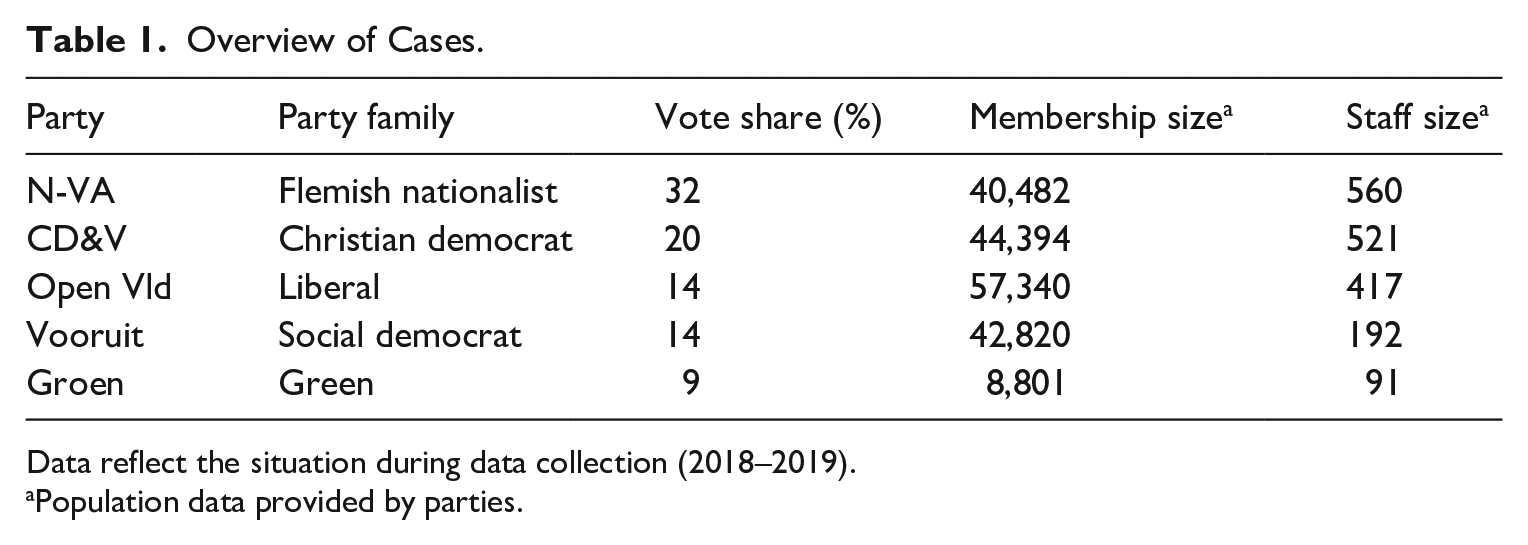
Data reflect the situation during data collection (2018–2019).
Population data provided by parties.
The empirical analysis is based on a combination of two sources: 3 the existing MAPP dataset on party members (Van Haute et al., 2018) and an original dataset on political staffers (Moens, 2021a). MAPP data were collected through an online survey between November 2017 and August 2018. Invitations were sent to 193,837 registered party members with an e-mail address. The response rate was 5%, or 10,022 respondents. To compensate sampling errors, post-stratification weighting was applied based on population data on sex and age (weighting factors range from 0.64 to 4.74). As this response rate is rather low, we should keep in mind that those who participated in the survey might be more active within the party than the average party member. Staff data were collected through an online survey between November 2018 and March 2019. An e-mail invitation was sent to 1,781 staffers, followed up by an additional reminder to participate in the project. The response rate was 31%, or 560 responses. Post-stratification weights were calculated based on population data on the number of staffers within each party, party face and age category (weighting factors range from 0.63 to 1.37).
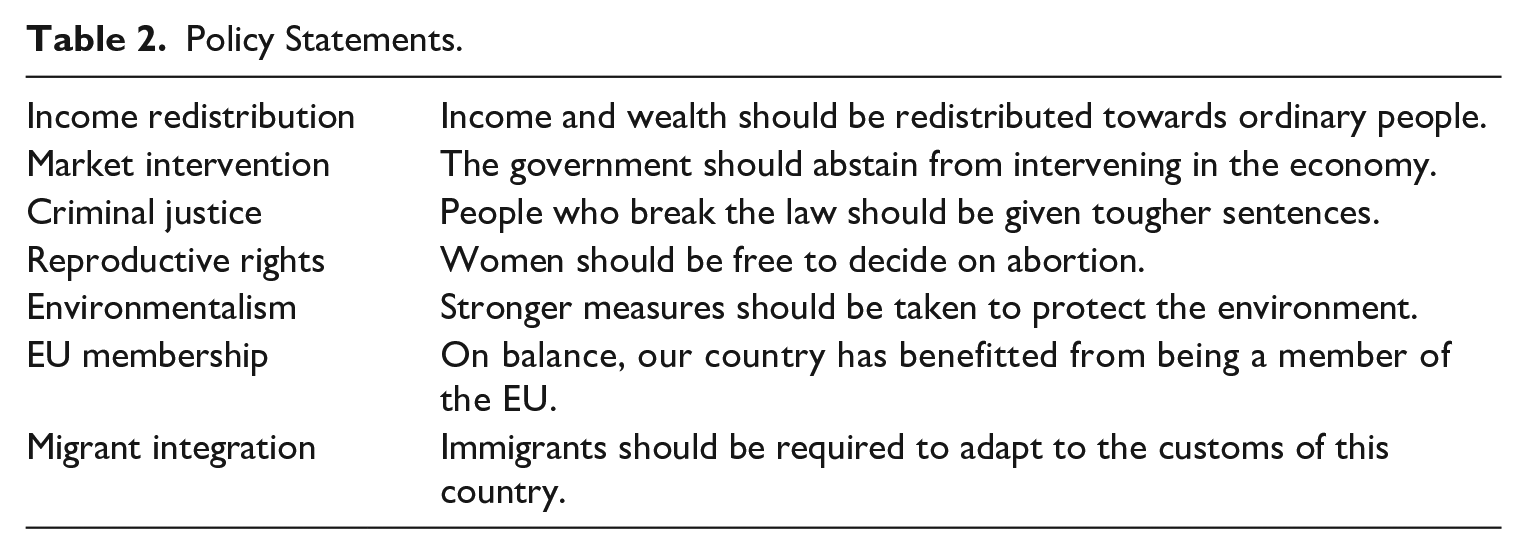
Existing studies of parties’ internal opinion structure have examined ideological positions on left-right scales (Kitschelt, 1989; Narud and Skare, 1999) as well as political attitudes on specific issues (Bäckersten, 2021; Norris, 1995; Wager et al., 2021). This article focuses on attitudinal congruence between staffers and party members by comparing their attitudes on seven policy statements, including income redistribution, market intervention, criminal justice, reproductive rights, environmentalism, European Union (EU) membership, and migrant integration (Table 2). These salient issues were selected to reflect the diversity of the Belgian political landscape, covering traditional socioeconomic cleavages (Lipset and Rokkan, 1967), social values (Inglehart, 1977) and globalization (Hooghe and Marks, 2018). Responses were structured on a 5-point Likert-type scale (1 = strongly agree, 2 = agree, 3 = neither agree nor disagree, 4 = disagree, 5 = strongly disagree). Within each party, the evaluation of these policy statements by party members and staffers will be compared to measure their attitudinal congruence.
Policy Statements.
The empirical analysis will capture the different aspects of attitudinal congruence in three steps. First, I will examine the many-to-many relationship (Golder and Stramski, 2010) between staffers and party members by comparing the distribution of both groups on the seven attitudinal scales. The overlap between staffers and party members will be calculated for each party on each policy domain by measuring the ‘common area under the curve’ (Andeweg, 2011) between ‘two empirical probability distribution functions (PDF)’ (Louwerse and Andeweg, 2020: 283). By calculating the total sum of the overlapping areas between staffers and party members for each response category (totally disagree to totally agree), this approach generates a value between 0% (no congruence) and 100% (perfect congruence). To clarify these ‘common areas under the curve’
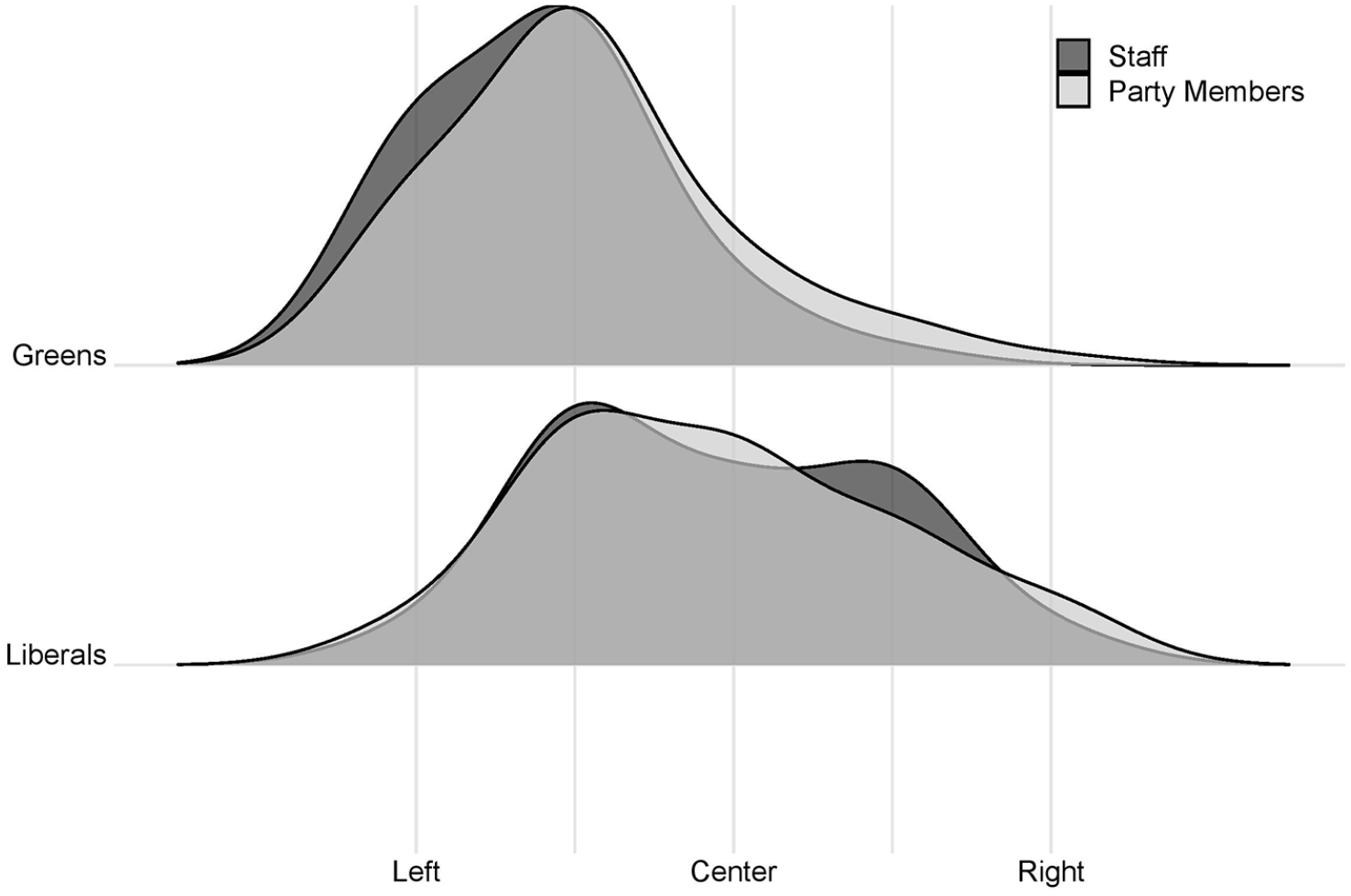
Examples of Congruence on Market Intervention.
To analyse the direction of potential incongruences between staffers and party members, the second step focuses on their average positions. Through a series of pairwise means comparisons, this method identifies the particular policy domains and parties where attitudes diverge significantly and shows the direction of such divergences (e.g. staffers being more progressive). To facilitate interpretation, values were recoded so that lower values correspond to leftist, progressive or cosmopolitan positions and vice versa. For this approach, I have drawn inspiration from the work of Gaasendam et al. (2020), who studied attitudinal and ideological congruence among Flemish social democrats.
In the third and last step, I examine whether the observed incongruences between staffers and party members persist. if generational and educational differences are taken into account. For each of the seven policy domains, an ordinary least squares (OLS) regression model is estimated with age (18–35, 36–50, or 50+), education (no higher education, higher non-college, or college) and relationship to the party (member or staffer) as the independent variables. To simplify the interpretation of the models, respondents’ positions were recoded so that values range between 1 (most rightist/conservative/particularist position) and 5 (most leftist/progressive/ cosmopolitan position). Importantly, the models account for party affiliation as both staffers and party members are clustered into political parties that unite people with similar attitudes. For this reason, party affiliation is included as a control variable and standard errors were clustered by party. Finally, sex was added to control for the potentially diverging preferences among male and female respondents (e.g. reproductive rights).
Results
To assess the overlap between the attitudes of staffers and party members (RQ1), I examine the similarities between both groups for seven separate policy domains (income redistribution, market intervention, criminal justice, reproductive rights, environmentalism, EU membership, and migrant integration). For each policy domain, the attitudes of staffers and party members within each party are compared mathematically (Table 3) and visually (Figures 1 and 2; Online Supplemental Appendix B). The mathematical analysis shows that staffers and party members mostly take similar positions. The attitudinal overlap ranges between 97% (Greens on environmentalism) and 60% (Christian democrats on migrant integration), rarely dropping below 75% (Table 3). However, the overlap is considerably lower for particular parties and policy domains. More specifically, congruence is lower in traditional parties (Christian democrats, liberals, social democrats) and migrant integration clearly presents the most divisive issue.
Attitudinal Overlap Between Staffers and Members.
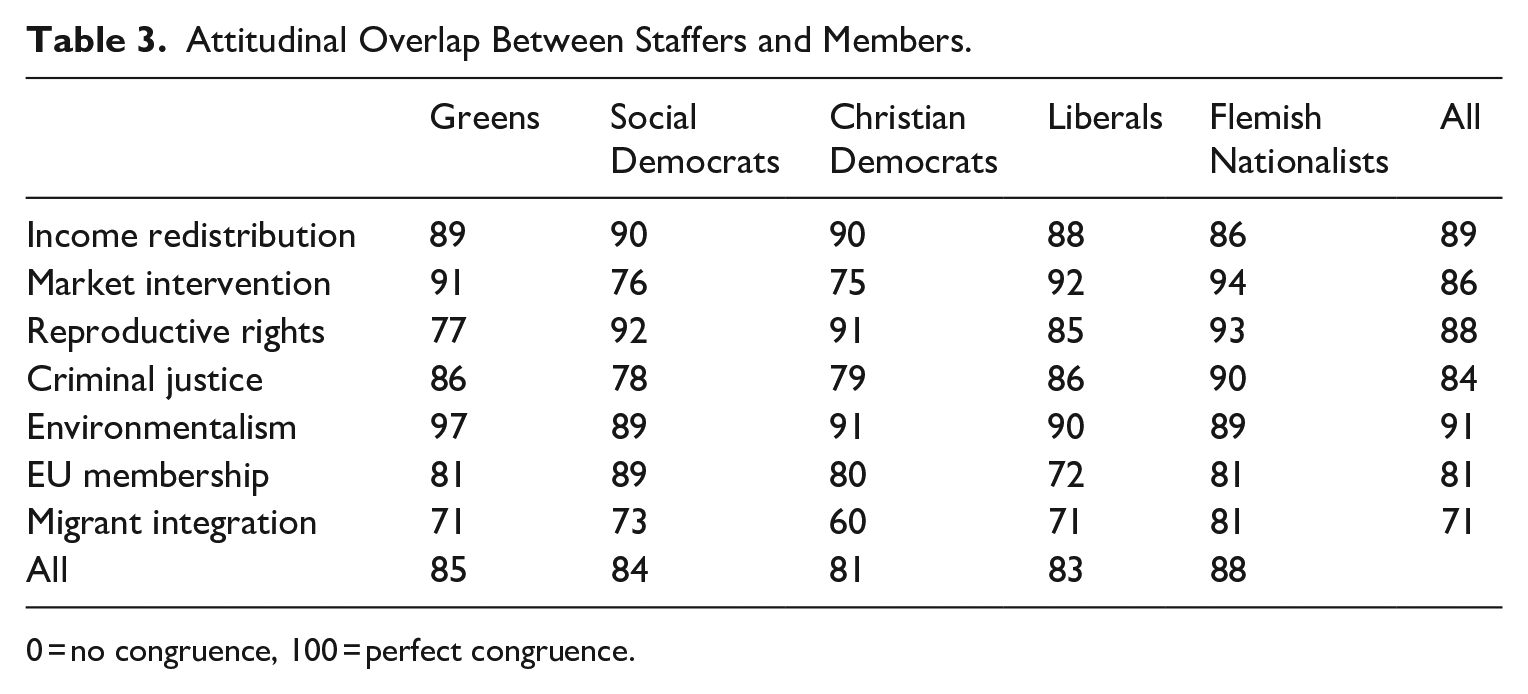
0 = no congruence, 100 = perfect congruence.
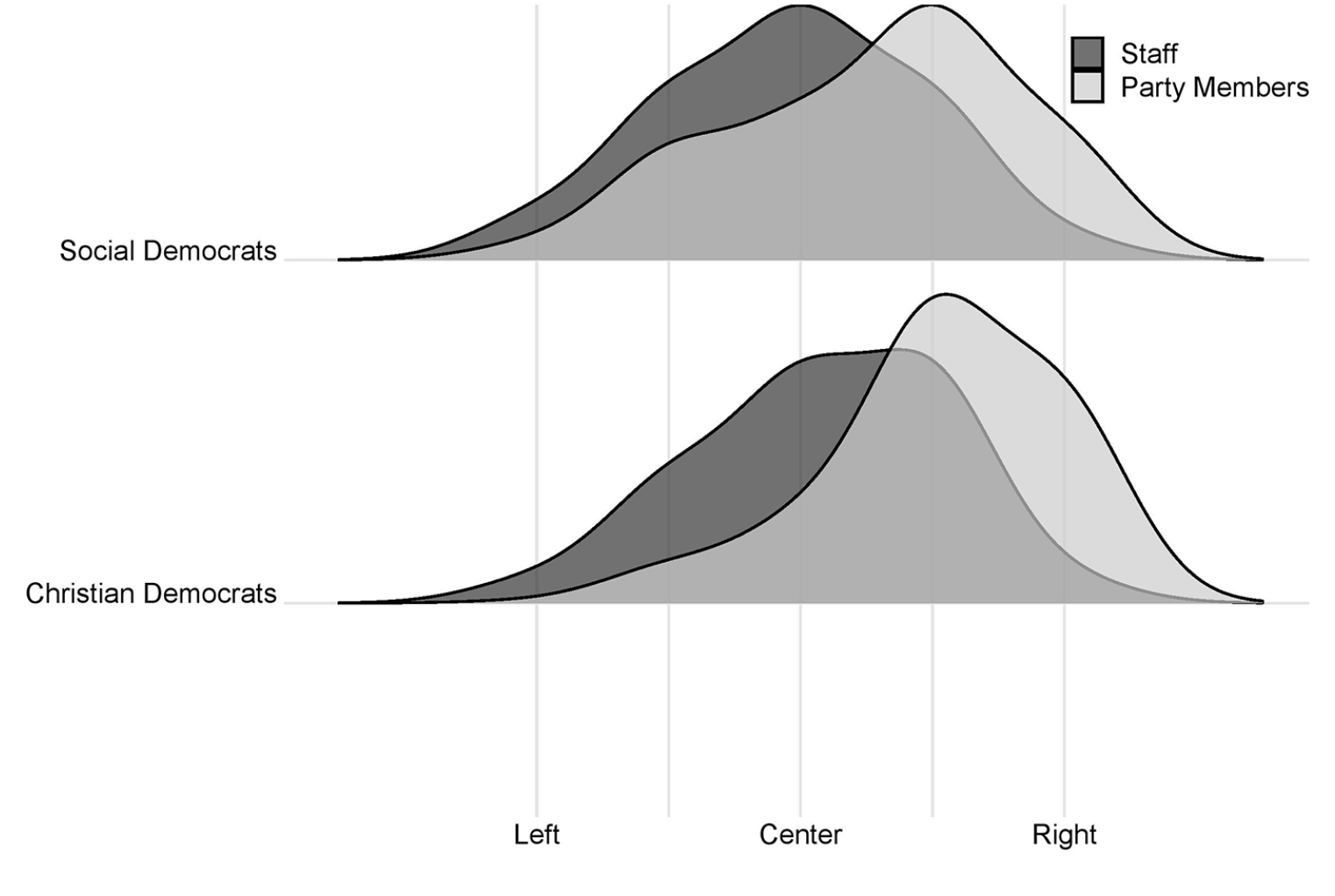
Examples of Congruence on Migrant Integration.
To illustrate the differences between congruence and internal (dis)agreement, Figures 1 and 2 show several typical examples of how the attitudes of staffers and members can be related. Closer examination of these plots demonstrates two important points. Figure 1 demonstrates how congruence is attainable without internal agreement. Congruence just means that the distribution of attitudes among staffers and members is similar. However, internal agreement is only attained when attitudes cluster around the same position. For example, the greens are relatively unanimous in their support for market intervention (agreement) and the distribution of attitudes of staffers and members is very similar (congruence = 91%). In contrast, the liberal party contains both supporters and opponents of market intervention (disagreement). Nonetheless, congruence between staffers and members is high (92%) because both wings are represented equally among staffers and party members. Figure 2 shows how a lower degree of congruence can be the outcome of either diverging positions or the result of more pronounced support for a position. For example, social democratic staffers cluster around the centre on migration while most members prefer a closed position on this issue (diverging position). In contrast, the slight lean towards the right among Christian democratic staffers is significantly more outspoken among members (similar position).
What specific direction do these incongruences take (RQ2)? A pairwise comparison of the mean positions of both groups demonstrates that staffers consistently position themselves to the left of party members (Table 4). This pattern is most notable among traditional party families and for issues concerning globalization. Staffers are significantly more permissive on migrant integration than party members in all parties included in the analysis. This contrast is most striking among Christian democrats and liberals: the distance between staffers and party members covers approximately 25% of the maximum distance. Similarly, European integration reflects the more cosmopolitan views of staffers: support for European integration is significantly stronger among staffers than among party members in all but two parties (greens, social democrats). The attitudes of staffers and members are the most congruent on classic socioeconomic issues (market intervention, income redistribution). Support for income redistribution is equal among staffers and members within all parties. On the question of market intervention, however, both social democratic and Christian democratic staffers are significantly more interventionist than party members. On socio-cultural issues (reproductive rights, criminal justice), results are comparable. Only Christian democratic staffers consistently position themselves more progressive than party members on these policy domains.
Pairwise Comparison of Mean Positions.
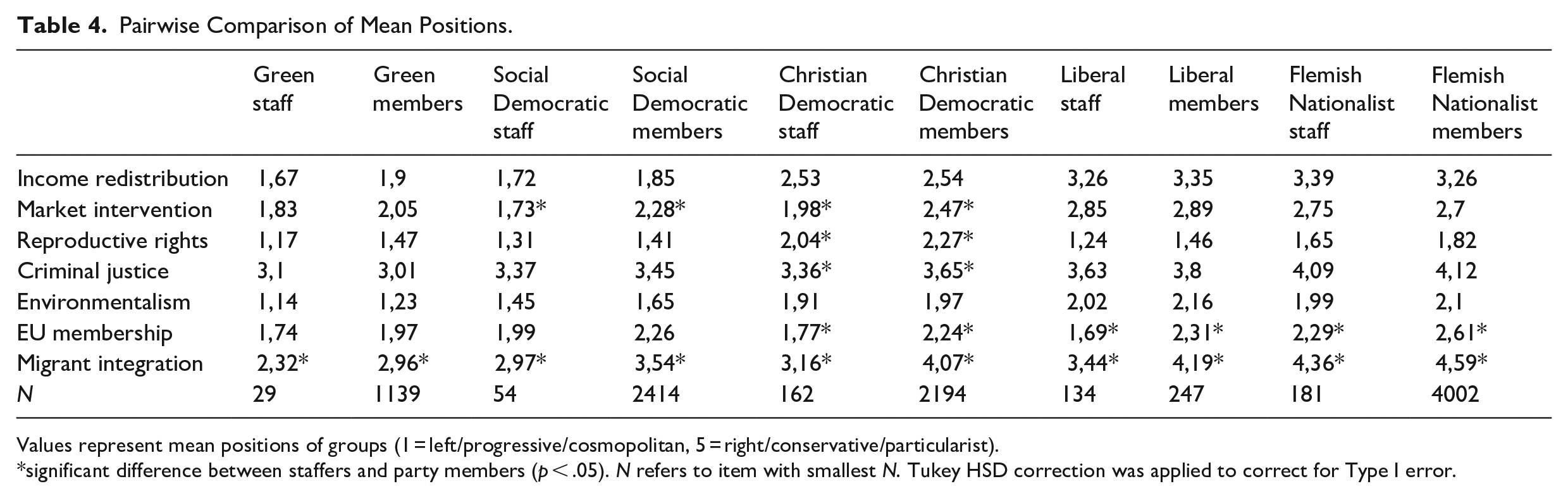
Values represent mean positions of groups (1 = left/progressive/cosmopolitan, 5 = right/conservative/particularist).
significant difference between staffers and party members (p < .05). N refers to item with smallest N. Tukey HSD correction was applied to correct for Type I error.
Importantly, the observed incongruences should not be overestimated. The mean positions of staffers and members of the same party are never at the opposite side of the political spectrum. Even on the most divisive issues, incongruences are limited to how strongly they lean towards the left or right side of the scale. By no means can staffers be portrayed as a cohesive group of cosmopolitan leftists. Their attitudes largely reflect party competition in general, clustering into three (left centre and right blocks) or two groups (a left and right block), on most issues (Table 4). In short, staffers roughly align with members but lean towards the more progressive and cosmopolitan wing of their party.
Should these descriptive incongruences between staffers and members be considered genuine disagreements? To evaluate whether the contrasts between their attitudes are indeed substantial, seven multiple OLS regressions were estimated explaining which respondents hold more progressive/cosmopolitan positions (Table 5). As such, the models test the robustness of the descriptive findings by introducing other key factors to explain a person’s political attitudes (party affiliation, age, education, sex). Not surprisingly, party affiliation by far has the strongest impact on the attitudes of staffers and party members. In all but one model (EU membership), party-related estimates consistently exceed both socio-demographic factors (age, education, sex) and the difference between staffers and party members. More surprisingly, the models indicate that socio-demographic factors are the main drivers of intra-party disagreement. On most issues, generational and educational differences are more consequential than the contrast between staffers and members. Nonetheless, staffers do remain significantly more progressive/cosmopolitan on several issues after controlling for party affiliation and socio-demographic. While the strongest effect can be observed on migrant integration, staffers are also more progressive than party members on reproductive rights, environmentalism and income redistribution. Surprisingly, staffers are more repressive on criminal justice. Although this contrast does not occur descriptively (Table 4), it does arise once the strong educational differences between both groups are controlled for (Table 5).
Explaining Progressive/Cosmopolitan Positions among Party Members and Staffers.
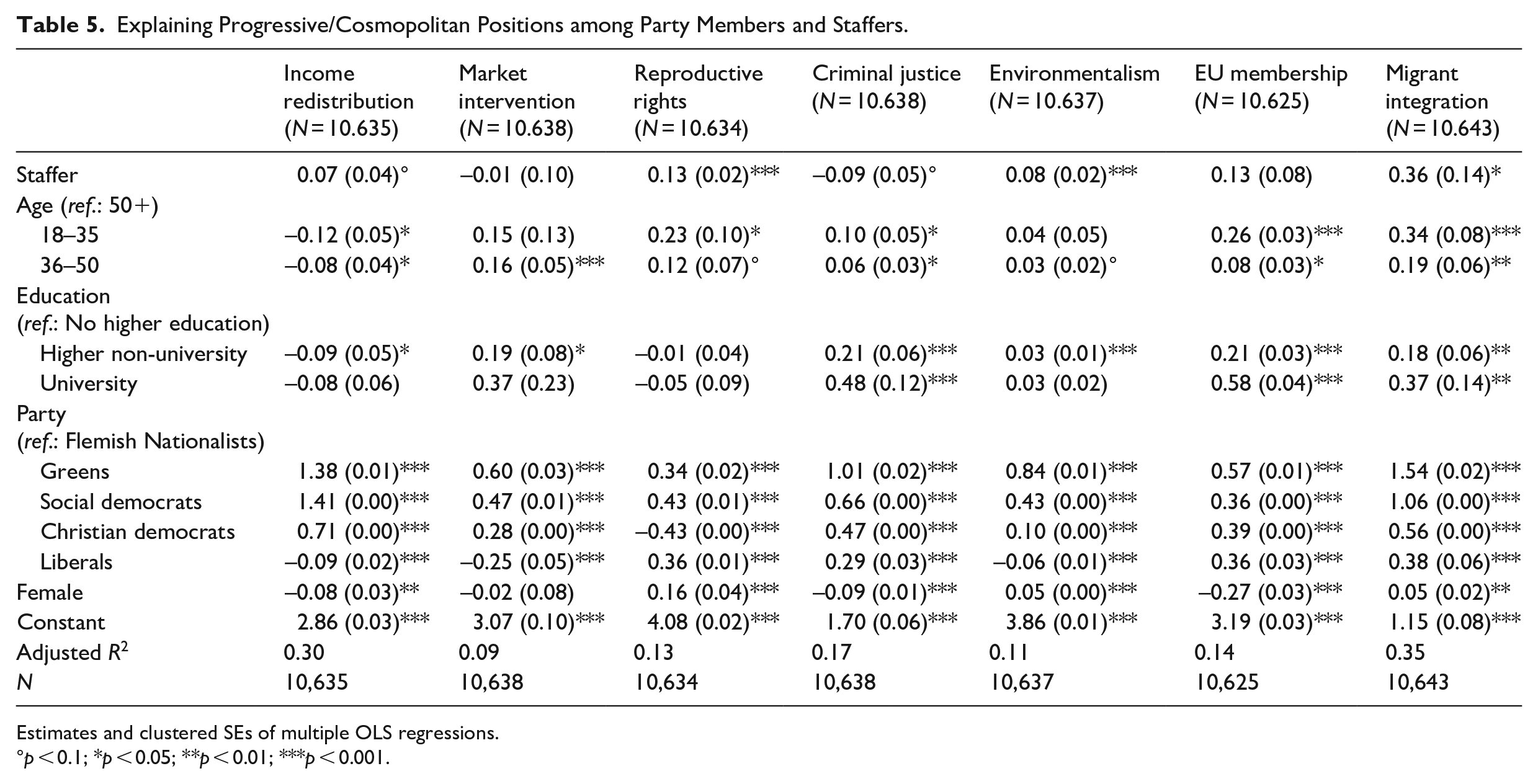
Estimates and clustered SEs of multiple OLS regressions.
°p < 0.1; *p < 0.05; **p < 0.01; ***p < 0.001.
The results demonstrate that the attitudes of staffers and members are mostly congruent. Regardless of the method applied to assess congruence between both groups, political attitudes are convincingly coherent in most parties. The strong impact of party affiliation partially supports the congruence thesis (H1). Despite their different relationship to political parties, the attitudes of staffers and members do not diverge consistently in all cases. However, they are no perfect match either. Incongruence follows a distinct pattern: some parties and policy domains are clearly more prone to disagreements. Attitudinal mismatches between staffers and members are more prevalent in mainstream parties and on issues concerning globalization. When such incongruences occur, staffers position themselves more progressive or cosmopolitan than members. This observation aligns with the cultural divide thesis (H3), which stated that staffers are more cosmopolitan than party members on issues concerning globalization. In contrast, the results offer little support for the moderate elite thesis (H2), which expected staffers to be more moderate than members.
I argue that cleavage theory can expand the study of intra-party congruence beyond May’s (1973) classic hierarchical approach. Most importantly, it offers an alternative explanation for how and why the attitudes of staffers and party members diverge. First, the cultural divide thesis accurately predicts that mainstream parties are more divided and that issues of globalization are more divisive. Second, the impact of educational and generational differences nuances the apparent attitudinal contrasts between staffers and members. In fact, the models show that attitudinal incongruence between staffers and party members is primarily driven by staffers’ comparatively higher level of education and their younger age. In this sense, the positions of staffers amplify pre-existing cleavages between different types of party members (young vs old, lower vs higher educated). In contrast, the main cleavage on environmentalism lies between staffers and party members. However, the attitudinal overlap on environmentalism is so high that this can hardly be considered a substantial disagreement (Table 3).
Conclusion
The professionalization of politics has led to the emergence of a new unelected elite: professional staff. While their increased presence in parties’ central and public offices is relatively well-documented (Katz and Mair, 2002; Kölln, 2015; Krouwel, 2012), this unelected elite remains chronically under-researched (Webb and Keith, 2017). In spite of their daily involvement in politics, their political attitudes have never before been considered. This is especially surprising as evidence of their impact on politics is growing (Laube et al., 2020; Montgomery and Nyhan, 2017). For the first time, this innovative article examined parties’ internal opinion structure by comparing their attitudes to those of party members. The empirical analysis relied on a pooled dataset of five Flemish parties combining pre-existing data on 10,022 party members (Van Haute and Wauters, 2019) with original data on 560 staffers (Moens, 2021a). Covering a broad range of salient issues, this in-depth study examined how staffers and members think about income redistribution, market intervention, criminal justice, reproductive rights, environmentalism, EU membership and migrant integration.
Congruence between staffers and party members has important implications for parties’ representative function. It is often assumed that the rise of political staffers has come at the expense of rank-and-file members, whose internal position has been marginalized due to cartelization (Katz and Mair, 2002). Arguably, the most far-reaching consequences of this alienation between political elites and grassroots party members would concern their political views. For this reason, this article examines whether the political attitudes of party members are shared by staffers. The results show that Flemish political staffers are not of touch with grassroots party members: congruence between both groups is generally high. Although parties often cover a sizable range of the ideological spectrum, this diversity of opinions is equally reflected among staffers and party members in most cases. The attitudinal overlap between both groups rarely drops below 75%. These observations are in line with existing literature on staffers’ party ties, which has shown that parties prefer to recruit loyal party members for paid staff positions (Karlsen and Saglie, 2017; Moens, 2021a; Webb and Fisher, 2003). Importantly, professionalization has not created a detached elite of unelected advisors with little connection to the party grassroots.
Yet, despite the high degree of congruence between staffers and party members, their political attitudes do not match perfectly. In some instances, staffers disproportionately lean towards the more progressive or cosmopolitan wing of their party. This systematic, cosmopolitan bias follows a distinct pattern, as it mostly occurs in mainstream parties and often concerns globalization. I argue that cleavage theory explains why mainstream parties are more divided and why globalization is so divisive. According to Hooghe and Marks (2018), mainstream parties are divided on globalization because they were founded long before the emergence of the transnational cleavage. As the increasingly dominant ‘cultural divide’ between universalists and particularists sets in motion a process of realignment, this new cleavage cuts right across the support base of long-established parties. In contrast, challenger parties (greens, radical right) hold unambiguous positions on globalization because they entered political competition during the emergence of the transnational cleavage. However, the progressive bias of staffers goes beyond the expectations of cleavage theory. While cleavage theory anticipates disagreement on globalization in mainstream parties, staffers are also more cosmopolitan than members in newer parties (greens on migrant integration, Flemish nationalists on EU membership). Moreover, Christian democratic staffers are also more progressive than members on more classic policy domains (market intervention, reproductive rights, criminal justice). This is especially notable for CD&V, as it self-identifies as a political formation that transcends cleavages.
While this limited progressive bias among staffers is real, it mostly follows generational and educational divides within parties. In line with earlier observations among voters (Hobolt, 2016; Oesch and Rennwald, 2018), the analysis demonstrates that education and age are key determinants for explaining an individual’s position on the transnational cleavage. When it comes to their political attitudes, party members with a university degree have more in common with highly educated staffers than with lower educated fellow members. This alternative explanation for incongruence puts the apparent division between staffers and members into perspective. Rather than creating a genuine internal cleavage between professionals and volunteers, professionalization amplifies existing disagreements because staffers are often young and highly educated. That being said, it is striking that the more progressive/cosmopolitan attitudes of staffers persist after controlling for the educational and generational gap with party members. Future research could examine whether this can be explained by staffers’ distinct occupational background, another central determinant of political attitudes (Oesch and Rennwald, 2018).
Of course, the observations in this article remain limited to the Flemish case. As a historically divided society, even internal disagreements along traditional cleavages (e.g. Christian democrats) are not especially surprising. Furthermore, the strong politicization of immigration since the emergence of the radical right in the 1990s (Dancygier and Margalit, 2020) could have supercharged the divisiveness of this issue within Flemish parties. However, Belgium shares both of these characteristics with plenty other European nations. For this reason, I am confident that similar patterns can be expected in other European parliamentary democracies with established party systems.
The findings signal that professionalization has potential real-world implications for party cohesion. For now, professionalization is not the main driver of intra-party disagreement. Rising tensions between groups of supporters with contrasting generational and educational backgrounds are a more likely source of internal conflicts. Yet, parties should be mindful that staffers do not reflect the views of the party on the ground – even when the vast majority of them are recruited among a party’s membership base. As parties will likely continue selecting young and highly educated members for staff positions, educational and generational divides could indeed crystallize along party strata in the future. This risk is especially pressing in traditional mass membership parties with older, lower educated memberships that will keep shrinking for the foreseeable future.
Supplemental Material
sj-docx-1-psx-10.1177_00323217221102700 – Supplemental material for Are Political Staffers out of Touch with Grassroots Party Members? Assessing Congruence between Professionals and Volunteers
Supplemental material, sj-docx-1-psx-10.1177_00323217221102700 for Are Political Staffers out of Touch with Grassroots Party Members? Assessing Congruence between Professionals and Volunteers by Pieter Moens in Political Studies
Footnotes
Acknowledgements
The author thanks Benjamin de Vet, Bram Wauters, Nicolas Bouteca, Nicolas Van de Voorde, Heath Pickering, Brittany Anlar and the participants of the 2020 virtual Party Politics workshop for their helpful comments. All remaining errors are his own.
Declaration of Conflicting Interests
The author(s) declared no potential conflicts of interest with respect to the research, authorship and/or publication of this article.
Funding
The author(s) received no financial support for the research, authorship and/or publication of this article.

Supplementary Information
Additional supplementary information may be found with the online version of this article.
Contents
A. Population Descriptives.
Table A.1. Staffers’ Tasks.
Figure A.1. Staffers’ Tasks.
B. Congruence.
Income Redistribution.
Market Intervention.
Reproductive Rights.
Criminal Justice.
Environmentalism.
EU Membership.
Migrant Integration.
C. Socio-Demographic Data.
D. Regression Models.
Notes
Author Biography
References
Supplementary Material
Please find the following supplemental material available below.
For Open Access articles published under a Creative Commons License, all supplemental material carries the same license as the article it is associated with.
For non-Open Access articles published, all supplemental material carries a non-exclusive license, and permission requests for re-use of supplemental material or any part of supplemental material shall be sent directly to the copyright owner as specified in the copyright notice associated with the article.
