




Abstract
In Latin America, deep social inequalities coexist with persistent, high-level criminal violence. Facing competing needs and budget constraints, citizens in the region have to prioritize among different policy choices. We analyze how perceptions of insecurity and crime victimization shape attitudes toward budgetary priorities in social and security policies. Our analysis relies on original data from Mexico and Brazil, two countries exhibiting increased violence at the national level, albeit with important regional variation. We find that exposure to crime takes its toll on citizens’ policy priorities. In both Mexico and Brazil, citizens who feel insecure seem to prioritize public expenditure on the police over social investment policies. Victims of criminal violence are, however, mostly indifferent as to budgetary allocations across the security and social policy fields, suggesting that their spending priorities might diverge from these two spheres of government action or give rise to policy indifference.
Keywords
Introduction
How do voters allocate scarce resources and form policy priorities when confronted with multiple competing needs? Although policymakers tend to dilute budget constraints and like to offer broad policy solutions, they distinguish themselves in the political arena with different policy priorities so that adjudicating between policies is a dilemma that citizens often face when casting their vote. Each option on the ballot may imply sacrificing some policy priority, at least to some extent. 1 The literature on policy preferences, however, has been limited in its ability to analyze such ongoing prioritization at the individual level (Häusermann et al., 2019) and has been mainly focused on general economic priorities (Castorena and Zechmeister, 2017; Singer, 2011). In contrast, the literature on government expenditure has widely documented the tensions that public authorities face when confronted with budget constraints and rising and competing needs (Apostolakis, 1992; Dabelko and McCormick, 1977; Gifford, 2006; Rivera and Zárate-Tenorio, 2016).
Across developing countries, particularly in Latin America, economic turmoil is frequent and social inequalities are severe. Against this backdrop, in many of these countries, criminal violence remains one of the most pressing social problems. Economic disparities affect the demand on both the welfare state and the institutional capacity to confront crime. First, growing economic vulnerability might foster demand for redistribution (Carnes and Mares, 2014) and discontent with income inequality (Cramer and Kaufman, 2011). Second, although rising crime and insecurity are often intertwined with unemployment and economic inequality (Enamorado et al., 2016; Fajnzylber et al., 1998), criminal violence in the region has generated a demand for iron-fist policies (Holland, 2013; Visconti, 2020), simultaneously diffusing the demand for broader welfare policies that could potentially address the economic roots of criminal activity (Altamirano et al., 2020).
In this article, we study policy priorities formed by different welfare and security preferences. We are interested in how criminal violence shapes policy priorities at the individual level. Limited budgets often preclude simultaneous spending increases on preemptive, protective, and punitive policies. Citizens might have to choose between physical and social security when forming policy preferences which may affect their vote choices at election time.
Following previous studies, we differentiate the distinct attitudinal effects of perceptions of insecurity and victimization experiences (Altamirano et al., 2020). We expect perceptions of insecurity to be associated with a higher emphasis on security policies, such as the expansion of policing activities when asked which policies to prioritize. The evidence on the effects of victimization, however, is mixed, and, therefore, we consider three competing hypotheses. First, victims may prioritize social investment and preemptive public policies, such as education and health care. Second, victims’ response might be to prefer to allocate more resources to police forces and punitive actions. Finally, victims may desire, above all, justice—which no single public policy can easily deliver. Their spending priorities might therefore diverge far from security and preemptive policies. Alternatively, victimization might foster a feeling of inefficacy and generate policy indifference. In these last two scenarios, for victims of crime, politics might become secondary.
Our analysis exploits the geographic variation of violence at the subnational level across two Latin American countries that have exhibited high levels of criminal violence: Mexico and Brazil, where we study subnational cases with average levels of violence. We use novel survey data to examine individual preferences over spending priorities across four public policy fields: policing, education, health care, and pensions.
Overall, we find that perceptions of insecurity and personal experience of crime take their toll on citizens’ policy priorities. Feeling insecure in one’s neighborhood because of criminal violence is positively associated with spending more on the police, which corroborates recent findings from the literature of an increasing taste for punitiveness the more citizens are confronted with violence. Importantly though, our analysis of policy priorities reveals that insecure citizens in both Mexico and Brazil seem to prioritize public expenditure on the police over social policies. Victims of criminal violence, however, are mostly indifferent as to the allocation of budget between security and social policy fields. This suggests that confronted with a clear budgetary choice between policing and social investments or social consumption (e.g. pensions), victims might not find their priorities addressed. Alternatively, victimization might lead to policy indifference—a worrisome interpretation, given crime victims’ legitimate need for public solutions and policy support.
On Policy Preferences and Priorities
Individual preferences over a given policy area are not formed independently from considerations over other policy realms. Citizens tend to emphasize specific issues comparatively according to the clarity of their ideological stances (Castorena and Zechmeister, 2017). Also, voters face multidimensional choice scenarios and give more weight to certain issues than others depending on their personal perceived effects (Bizer and Krosnick, 2001; Singer, 2011). Previous studies have shown that citizens’ emphasis on specific issues has tangible consequences, as governments also prioritize policy areas considering public attitudes (Jones and Baumgartner, 2005). Therefore, the mechanisms leading citizens to emphasize specific policy issues remain a relevant question across different contexts.
The Political Economy of Social Policy Preferences
A vast literature has analyzed individual policy preferences over redistribution and social protection. Political economists have thoroughly examined the conditions under which voters are willing to expand or contract the welfare state. 2 In the majority of studies within this line of research, however, political economists analyze welfare preferences in isolation, without necessarily considering citizens’ possible priorities or constraints they may face, knowing resources are scarce. Public policies generally come as a bundle. Policymakers usually have to cut back on one policy area to expand another. They rarely retrench policies in isolation. To finance campaign promises or much-needed reform, such as the expansion of old-age insurance, cuts must be implemented. The question is how citizens respond when directly confronted with policy prioritizing. In certain contexts, the calculus is between enhancing benefits at the cost of taxation (or public debt) so that citizens might be willing to accept tax increases or higher debt in exchange for the expansion of social protection programs (Brooks and Ulriksen, 2019; Busemeyer and Garritzmann, 2017).
Welfare-state scholars have only recently started to unpack priorities among policy options in Europe, looking at individual preferences for pension retrenchment (Häusermann et al., 2019), as well as the willingness to expand education or family allowances at the cost of cutbacks in unemployment insurance or pension benefits (Neimanns et al., 2018). In the case of developing countries, it is important to note that the most viable policy options do not include debt increases, higher taxes, or the expansion of the tax base (Bastiaens and Rudra, 2018; Wibbels, 2006). Policy priorities, therefore, need to be carefully considered and planned. A sense of trade-off and the need to prioritize some policies over others may thus exist, in particular, in nascent democracies with unstable economies facing budget constraints and multiple development challenges, including crime and violence (Williams, 2019).
Prioritizing among Security, Social Investment, and Insurance Policies
Given growing insecurity across the Latin American region, political scientists have examined individual preferences over security policies. Specifically, these works have focused on support for radical measures to combat delinquency—so-called mano dura or iron-fist policies. 3 Voters’ ideological orientation appears to shape mano dura approaches to crime (Holland, 2013). Victimization experiences have been shown to increase the likelihood of supporting iron-fist measures, such as allowing state repression (Visconti, 2020). In Mexican states that are permeated by organized crime, citizens are more supportive of punitive justice and express more anger the higher the level of violence they are confronted with (García-Ponce et al., 2019). This trend is also observable in other high-crime contexts, such as South Africa (Brooks and Ulriksen, 2019). The research reveals an increasing demand for more punitive policies in contexts where violence is omnipresent and organized crime undermines state institutions. However, this emerging literature is limited in its exploration of possible parallel policy priorities, particularly in a region where social and physical security needs are likely to be competing with each other.
Criminologists, in contrast, have undertaken extensive work assessing public support for punitive versus rehabilitative policies for offenders (Baker et al., 2015; Cohen et al., 2006; Nagin et al., 2006) though with a focus on offenders and youth delinquents rather than social policy in general. Preemptive policies encompass better healthcare provision and public schooling, reducing youth unemployment. They are compatible with a social investment perspective in welfare policy that seeks to generate educational and employment opportunities to better prepare people to address life-course contingencies and shocks (Hemerijck, 2017). Therefore, these policies might have positive externalities in terms of crime control by reducing incentives to participate in illegal activities. Although the nexus between welfare and penal policies has long been recognized (Garland, 2017), only recently have scholars begun to address the connection—or, at times, tension—between punitive and social policies (Guetzkow, 2020). Improving investments in public education can reduce youth violence and incarceration (Lochner and Moretti, 2004). Alternatively, the state can resort to harsher penal policies. Previous studies suggest that punitive measures might be perceived as a competing option to welfare policies in tackling insecurity and social unrest (Hinton, 2016).
Of course, not all policies are automatically mutually exclusive. However, in developing countries, public budgets are resource-constrained, and simultaneous budget expansion in multiple policy fields is simply not feasible. Recognizing the gaps across fields and disciplines in the social sciences that have examined policy preferences, we offer an analysis of policy priorities across welfare and security preferences. We focus on individual policy preferences for the expansion of the police, the pension system—a classic welfare policy which is generally classified as social consumption/insurance, and which lacks any clear-cut implications for crime—and social investment policies that offer a preemptive function on crime, such as health care and basic education.
Perceptions of Insecurity, Victimization, and Policy Preferences
Recent research has shown that the effects of violence on policy preferences are not generalizable or straightforward. Both victimization and perceptions of insecurity have been widely associated with decreased support for democracy and democratic institutions (Blanco, 2013; Carreras, 2013; Fernandez and Kuenzi, 2010; Hiskey et al., 2020) and a growing taste for punitiveness (García-Ponce et al., 2019; Visconti, 2020) and militarization (Flores-Macías and Zarkin, 2021; Pérez, 2011). However, victimization and perceptions of insecurity have differentiated effects on social policy preferences in Latin America (Altamirano et al., 2020). While victims seek to address their most immediate social security needs—derived from their experience with crime—through a larger welfare state, non-victims with rising perceptions of insecurity prefer to reduce the redistributive role of the state. The negative association between perceptions of insecurity and preferences for redistribution is consistent with work by criminologists, who find that a heightened sense of crime risk decreases support for social policies with a crime-prevention element, such as investment in skills, education, and employment (Baker et al., 2015; Cohen et al., 2006). Moreover, perceived insecurity reduces citizens’ willingness to be taxed (Flores-Macías and Sánchez-Talanquer, 2020). But these works are limited by their lack of empirical instruments to take into account budget constraints and the ensuing dependent relationship between public policies. As Brooks and Ulriksen (2019) illustrate, the implications of criminal violence on redistributive preferences vary when respondents are reminded of the costs that redistribution or social policies entail.
What is the logic behind such contrasting effects of perceptions of insecurity? How can we reconcile higher demand for the expansion of security forces with a refusal to expand the welfare state? From political science to criminology, there is an overarching consensus that distorted media depictions of delinquency have resulted in both a growing fear of crime and consequent support for punitive policies (Baker et al., 2015; Krause, 2014). Altamirano et al. (2020) further argue that, as a result of the growing institutional distrust that crime generates when the state is unable to fulfill its most basic function of security provision, those that are most fearful are likely to also be skeptical of the efficacy of the state in other policy areas and will therefore oppose the expansion of the welfare state. Preemptive social policies, such as education and health care, or classical consumption policy, such as improved pensions, are then deferred in favor of security, which is likely to be this group’s most immediate concern. 4 We, therefore, propose the following hypotheses. When confronted with a budgetary trade-off between social policies and policing (where non-allocation is not an option):
H1.a. Individuals with high perceptions of insecurity are more likely to prioritize public spending allocation to security forces than those perceiving their environment as more secure.
H1.b. Individuals with high perceptions of insecurity are less likely to prioritize public spending allocation to preemptive social policy or social consumption policy programs than those perceiving their environment as more secure.
As noted above, victimization experiences have also been associated with an increasing demand for punitive policy approaches to crime. Experiencing violence nurtures anger and a desire for state action and, if the state is not capable, the urge to take the law into one’s own hands. By comparison with war victims, crime victims seem to be more supportive of the state’s provision of security than social policy (Berens and Karim, 2020). At the same time, Altamirano et al. (2020) find that, as victims face mounting costs from their direct experience of crime—from diminished income to new health issues—they demand that the state takes on a more active role in addressing such social security needs. But victims might also become more supportive of social policies that go beyond their personal needs, such as expanding primary and secondary education as a solution to fight future crime and reduce the likelihood of victimization for their loved ones in the long run. The war-victimization literature tells us that victims have been positively associated with increased pro-sociality and a heightened sense of social cohesion (Blattman, 2009; Voors et al., 2012). Victimization experience, especially when highly violent and thus akin to war experience (Berens and Karim, 2020), might therefore awake sociotropic concerns and increase demand for preemptive and rehabilitative policies. But, so far, we do not know whether crime victims also prioritize health care at the cost of security and justice.
Firsthand insights from in-depth fieldwork by sociologists and anthropologists have revealed that, when directly and explicitly prompted on what they require from the state and what are their most immediate policy priorities, victims, above all, demand justice (Robledo-Silvestre, 2015). And among those whose relatives have disappeared at the hands of organized crime or the armed forces, “a principal concern is the search for the disappeared, not the guilty” (Robledo-Silvestre, 2018: 171). To put it differently, although victims have new social needs and would expect criminals to be punished, their most immediate priorities may lie far from the welfare state or the security forces. Thus, while individuals might be more likely to support a certain policy in and of itself when they consider that improvements in a given policy will come at the expense of other specific policies, they express neutrality or even opposition, depending on their stance toward those other policies.
Given these contrasting views and policy demands by victims, we propose three alternative hypotheses:
H2.a. When confronted with a budgetary trade-off between social policies and policing, victims of crime are more likely to prioritize public spending on security forces than non-victims.
H2.b. When confronted with a budgetary trade-off between social policies and policing, victims of crime are more likely to prioritize public spending on preemptive social policy programs such as health care and education than non-victims.
H2.c. When confronted with a budgetary trade-off between social policies and policing, victims of crime are indifferent to the expansion of the state’s spheres of action.
Empirical Setup
We conducted a survey of 1400 individuals aged 18 or above in the Mexican federal states Puebla and Querétaro (700 interviews per state) during November 2018 and a survey of 1008 individuals aged 18 or above in Sao Paulo State, Brazil in July 2019. Brazil and Mexico have similar values on the intentional homicide rate (29.07 per 100,000 in Mexico, 27.38 in Brazil: World Bank, 2020). However, regional variation in violence levels is high in both countries. Sao Paulo in Brazil is a state with average levels of violence, as are Puebla and Querétaro in Mexico. We focus on contexts of average levels of violence exposure rather than high-profile crime settings to study representative cases of violent crime in the developing world. Studying two country cases allows us to test the external validity of our argument.
Although states with high levels of violence were excluded from case selection for ethical considerations to ensure the safety of our enumerators, this research design implies a stricter test for our argument. If we find that even in states with below-average levels of violence personal calculations of insecurity and consequent preferences play a role, it is likely that such effects will be even greater in more violent contexts. 5 Moreover, by covering both Brazil and Mexico, our study encompasses different scenarios of criminal violence. While organized crime is present in both countries, criminal organizations have established relatively less predatory criminal governance regimes in Brazil, particularly in Sao Paulo, where Primeiro Comando da Capital (PCC) has established significant social controls (Lessing, 2021). In contrast, in Mexico, organized crime’s attempts to establish criminal governance regimes have been highly violent (Trejo and Ley, 2020), including the cases we examine here, where criminal groups have attempted to gain control over natural resources, such as oil in the state of Puebla (InsightCrime, 2010).
In Mexico, we drew a random sample at the subnational level in two states. 6 The survey is representative of the standard sociodemographic dimensions, and we use survey weights. We used census information to create Primary Sampling Units (PSU), from which we randomly selected Secondary Sampling Units. 7 We chose Puebla and Querétaro for their nationally representative gross domestic product (GDP) level and their relatively lower levels of criminal activity, both enabling us to field our survey and providing a strict test for our argument, as noted above. 8
In Brazil, we surveyed a representative random sample at the subnational level (Sao Paulo State), asking identical questions. 9 We used probability-proportional-to-size-sampling. Municipalities were randomly selected based on census information on the gender and age of the respondents. To ensure data quality, we made use of extensive quality-control mechanisms (see Online Appendix, Sections A–D for detailed information on both surveys). 10
Dependent Variable: Policy Priorities
Our dependent variable (DV) addresses the respondents’ policy priorities in the context of limited budgets. While conventional studies on social policy preferences ask respondents about their support for spending on, for example, pensions or health care, or, even more generally, an increase in redistribution (for the Latin American context, see Carnes and Mares, 2014), they fail to confront citizens with the complexity of public policymaking. But a recent turn toward better understanding policy priorities and trade-offs has seen some scholars make use of conjoint analysis (Häusermann et al., 2019); others confront respondents with a concrete scenario of, for example, increased spending in education accompanied by a cut in unemployment insurance and ask how much they support such a combination (Busemeyer and Garritzmann, 2017; Neimanns et al., 2018). However, there is as yet no standard way of measuring policy priorities.
We follow Ares et al. (2019), who operationalize welfare policy priorities in a public opinion survey in eight advanced democracies with a 100-point distribution question.
11
We asked our respondents: Now, imagine that you have a total budget of 100 points to distribute among the pension system, public security (mainly more police), health services, and primary and secondary education. Taking into account which you personally consider to need more budget or to be in need of less, how would you distribute the 100 points?
12
The 100 points had to be distributed across these four policy fields, with respondents free to allocate 100 to one field and zero to the rest (such an extreme distribution only occurred once in the PQMex Survey and twice in the SPSBrazil Survey). In cases where the respondent distributed more or less than 100 points, the enumerator received a warning message from the software (Survey-to-go) and reminded the respondent that the points had to add up to 100. Figure 1 displays the points distribution by policy field from the two surveys.
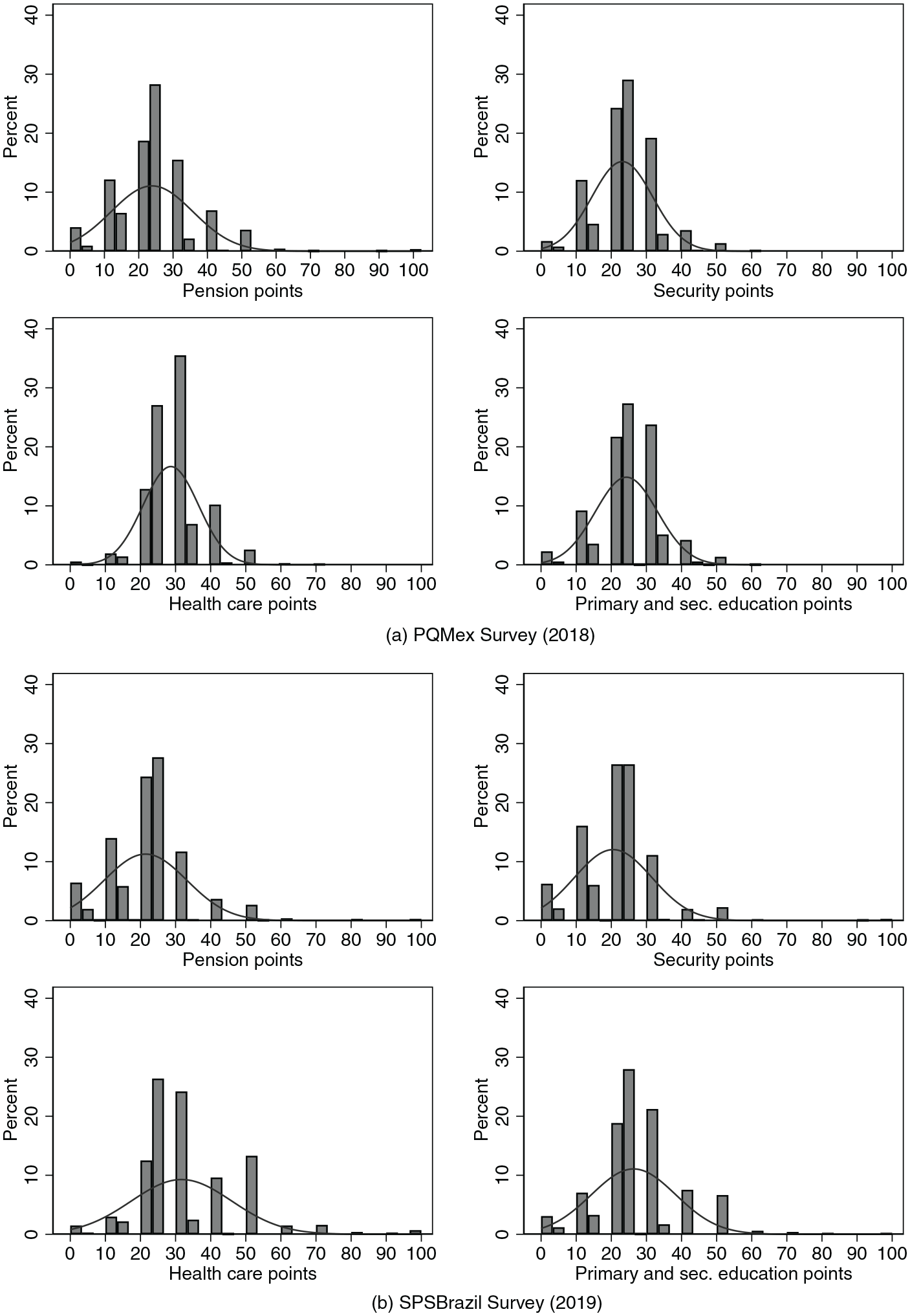
Overview of Points Distribution Across Four Public Policy Fields.
Asking the respondent to distribute a fixed number of points among policy fields mimics the scenario of budgetary decision-making in a context where taking on debt is not feasible—a realistic scenario for many developing economies (Wibbels, 2006). We emphasize the egotropic nature of the task, explicitly asking the respondent to allocate the points according to his or her personal policy preference. This task does not require policy expertise from the respondent, nor does it expect respondents to act as policymakers. 13 We focus on major social policies—pension, health care, and education—and security policy, with the latter referring to “mainly more police.” 14 As DVs, we measure the respondent’s point allocation, which yields four DVs. We report estimation results with the simple number of points (0–100) allocated to each policy in our main models. To analyze the extent to which a given policy is prioritized over the other three options, we create an alternative indicator called “priority.” For example, in the case of security, we subtract the points allocated to the other policy fields from those allocated to security to create a security priority variable. 15
Furthermore, asking respondents to allocate 100 points across policy fields simulates budgetary constraints: if the respondent wants to prioritize spending in one policy field, that entails cuts to another policy field. Thus, the points distribution question is a more powerful indicator of priorities than the standard survey items on welfare policy preferences, which cannot map this interdependency. 16
Crime Victimization and Perceptions of Insecurity
To measure crime victimization, we asked respondents in both surveys whether they had been a victim of a crime in the past 12 months. The response option is dichotomous. In Sao Paulo State, 14.6% of survey respondents indicated they had experienced crime. In Mexico, 27.2% of the sample identified as crime victims. In Brazil, we also asked follow-up questions on the type of crime the respondent experienced and on family victimization (for robustness tests, see Table K in the Online Appendix). To measure perceptions of insecurity, we relied on a standard measure, which asks respondents how secure or insecure they feel in the neighborhood. The response scale ranges from 1 (very secure) to 4 (very insecure). Aware that crime victimization might sensitize individuals on the issue of crime or raise anxiety and fearfulness, we control for the compound effect of victimization and insecurity perception. It should be noted, however, that insecurity does not automatically accompany victimization, and there is a lot of regional variation. In Sao Paulo, 39.5% of crime victims feel very insecure; in Puebla and Querétaro, only 16.4%. Nevertheless, insecurity and crime victimization are significantly positively correlated (ρ = 0.302Mex, ρ = 0.222Bra). 17
Crime victimization and perceptions of insecurity are not randomly distributed in society but are correlated with sociodemographic variables such as gender and income. However, these correlations are far from perfect. Both victimization and feeling insecure are widespread in Latin American countries affected by criminal violence and cut across class lines. Young males are particularly likely to become victims of crime, but they rarely express a proportionate perception of insecurity. 18
Model and Control Variables
As our DVs are point distributions on a scale from 0 to 100, we use ordinary least squares regression analysis. We use clustered standard errors at the municipality level for the Brazilian sample (for the Mexican sample, we use the svy option in Stata) to factor in the variation in violence exposure at the very local level. We also use survey weights for the Mexican sample; the Brazilian survey is a quota sample.
As control variables, we hold constant the respondent’s gender (female), age, level of education, and marital status (married/cohabiting). We also factor in the respondent’s employment situation (unemployed, homemaker, retired, student, disabled; employed is the reference category) because employed workers tend to have different social policy preferences from the unemployed or non-employed such as retirees (see Iversen and Goplerud, 2018). Residence in an urban locality (rural is the reference category) is held constant as well since the need for policing might be higher in urban areas where population density is high, and crime is more preponderant. We employ information on household income, as wealthier citizens might be more willing to allocate budget to more regressive social protection options, such as pensions, rather than health care and education, or to favor expenditure on security to protect their private property (Rueda and Stegmueller, 2016). Moreover, income can work as a buffer for social policy needs that wealthier citizens can also buy at the market. As many households also receive remittances from relatives in the US, we add an additional control for this income source (having a relative in the US as a dummy variable).
In addition, party identity (PAN supporter in Mexico; P.T. supporter in Brazil; reference category is another party I.D.) is controlled for through a dummy variable because policy priorities might also be associated with party platforms. 19 Finally, as institutional trust is an important moderating variable, which might affect individuals’ assessment of policy capacity, we add a control for corruption perception (scaled 1–4) as a proxy for institutional trust. For the Mexican survey, we also add a control for the state to hold constant the regional variation between Puebla and Querétaro. Descriptive statistics are shown in the Online Appendix, Tables A and B.
Results
First, we present the analysis for the Mexican case. Estimation results on the raw distribution of policy points from ordinary least squares (OLS) regression by policy field are reported in Table 1. Model 2 shows that confronted with a budgetary need to prioritize, individuals who feel insecure in their neighborhoods are more likely to allocate more public resources to security measures, especially increasing the size of the police force. This decision comes at the expense of other policy alternatives. Those who feel insecure tend to be indifferent regarding health care (M3) but are more likely to allocate resources to education compared with those who feel very safe (M4). The latter effect is significant at the 5% level, but confidence intervals overlap when moving from safe to unsafe (Figure 2). Spending on pensions, the social insurance alternative, is the least attractive option for individuals who feel insecure (M1), which may reflect a prioritization of short-term policy measures related to physical security over uncertain long-term benefits in the form of old-age pensions (see Figure 2).
OLS Regression on Points Distribution: Puebla and Querétaro.
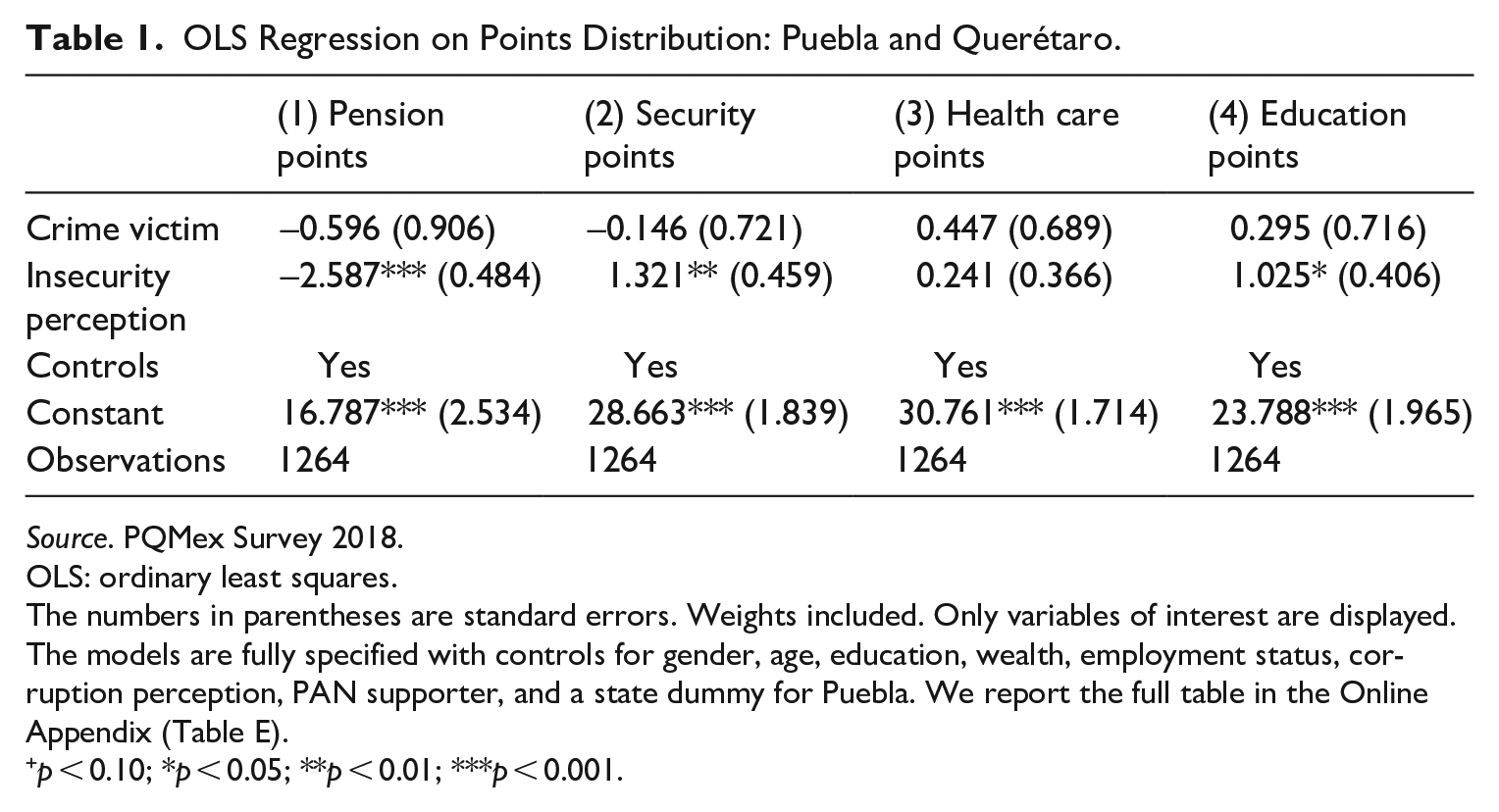
Source. PQMex Survey 2018.
OLS: ordinary least squares.
The numbers in parentheses are standard errors. Weights included. Only variables of interest are displayed. The models are fully specified with controls for gender, age, education, wealth, employment status, corruption perception, PAN supporter, and a state dummy for Puebla. We report the full table in the Online Appendix (Table E).
p < 0.10; *p < 0.05; **p < 0.01; ***p < 0.001.
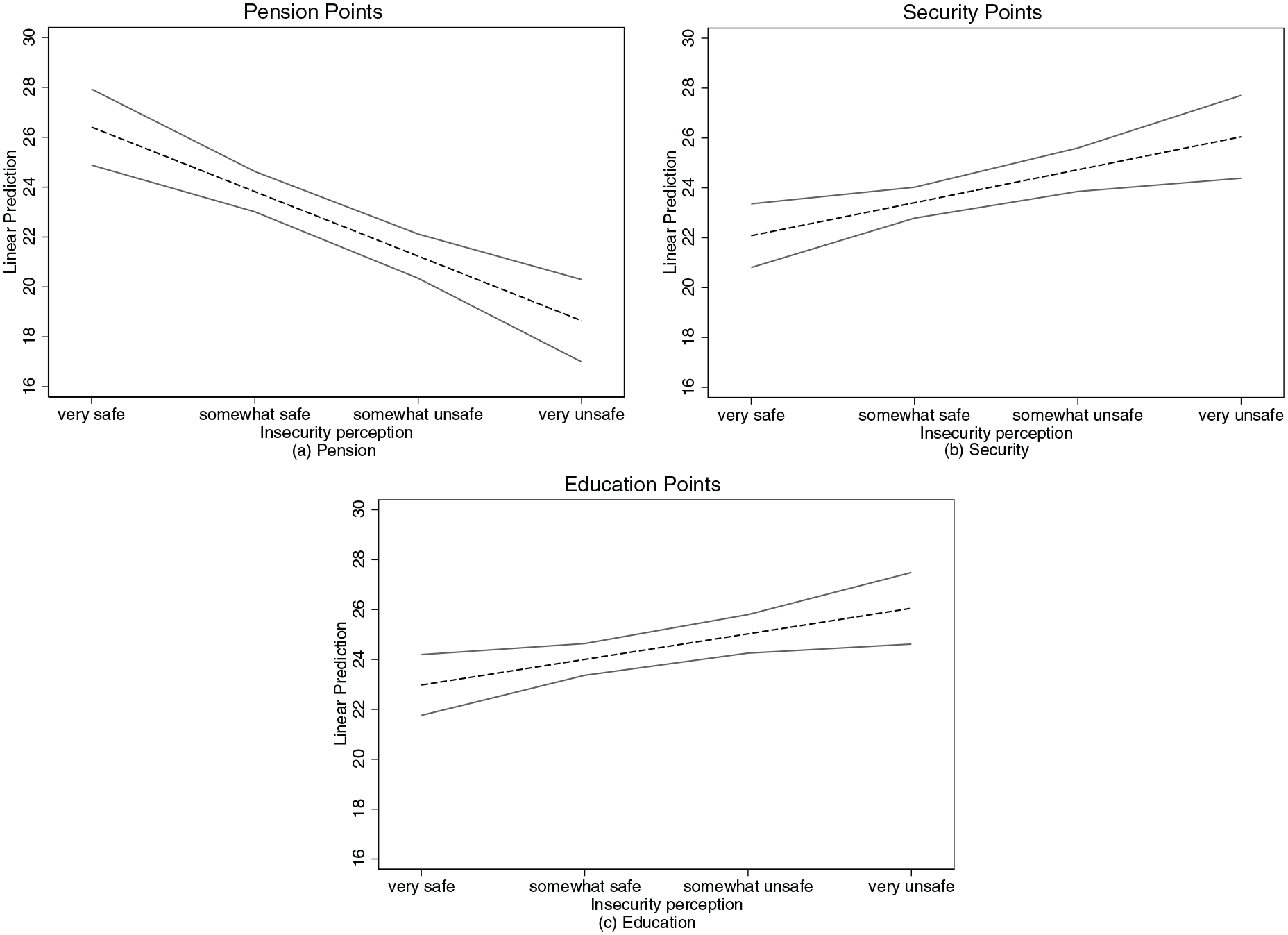
Linear Prediction on Policy Priority (PQMex Survey).
Taken together, the results for Mexico provide support for Hypothesis H1.a, which anticipated a positive relationship between perceptions of insecurity and favoring increased spending on security forces. In contrast, however, our results do not corroborate either H2.a or H2.b. Crime victims express indifference among policy alternatives when confronted with a budgetary need to prioritize. In line with H2.c, our findings suggest that victims do not prioritize clearly between the welfare and security spheres of action.
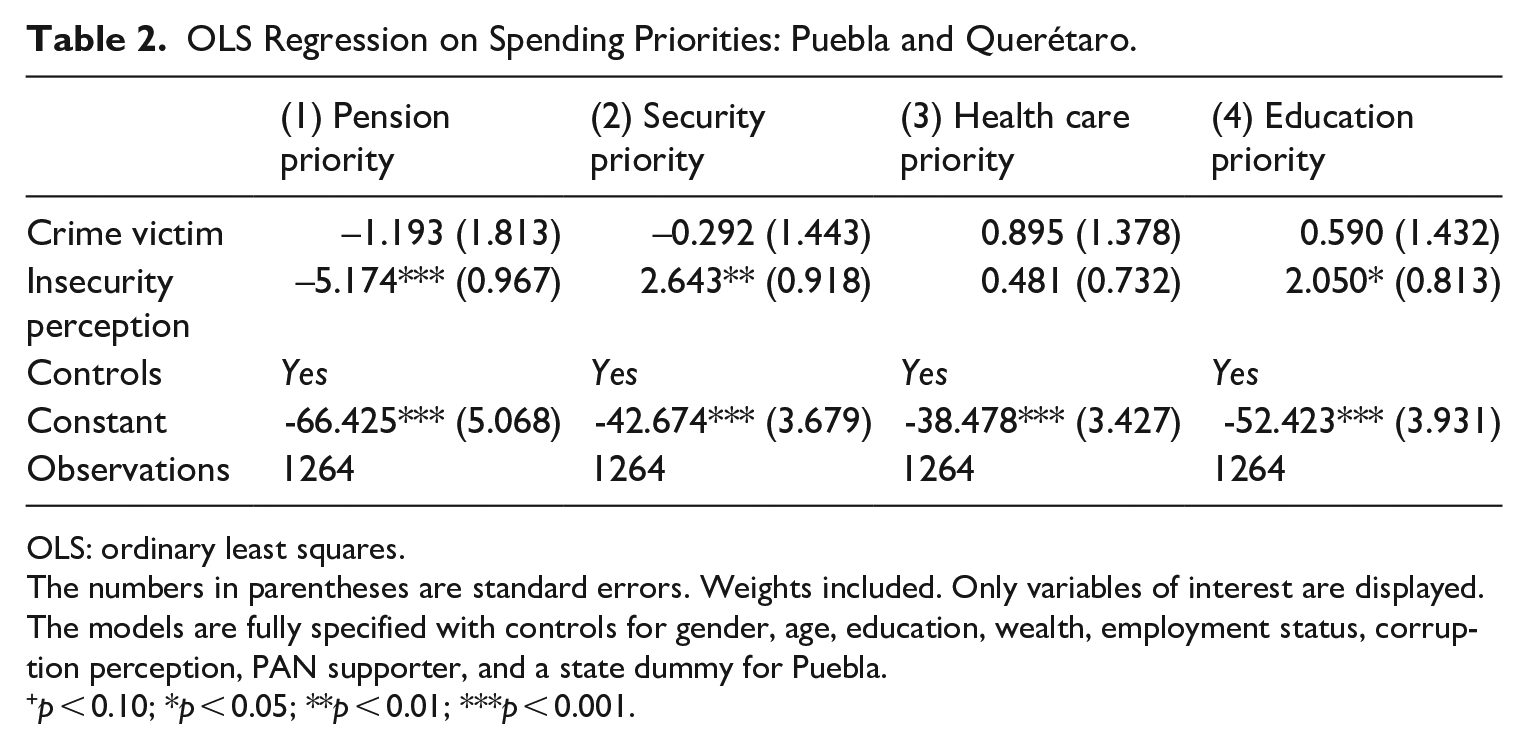
We also use the alternative operationalization of our DVs and estimate the effects of perceptions of insecurity and victimization in Mexico on a policy priority indicator for each policy. Table 2 shows the results. Like the findings presented above, those respondents who feel more insecure tend to prioritize security over other policy options, in line with Hypothesis H1.a. The findings in the Mexican sample suggest that insecurity perceptions lead citizens to weigh security more strongly.
OLS Regression on Spending Priorities: Puebla and Querétaro.
OLS: ordinary least squares.
The numbers in parentheses are standard errors. Weights included. Only variables of interest are displayed. The models are fully specified with controls for gender, age, education, wealth, employment status, corruption perception, PAN supporter, and a state dummy for Puebla.
p < 0.10; *p < 0.05; **p < 0.01; ***p < 0.001.
Perceptions of insecurity raise support for education as a priority and reduce willingness to allocate points to pensions (Table 2). The effect of perceived insecurity regarding education, albeit smaller compared with security policies, indicates that insecure citizens in Puebla and Queretaro also favor social investment and preemptive policies, possibly reflecting public perceptions of education as a path to prevent crime. It is important to contextualize this finding. The Mexican winning candidate in 2018, Andrés Manuel López Obrador, insisted on addressing the root causes of insecurity, such as poverty, and emphasized the importance of social programs as critical tools to reduce violence (Márquez Blas, 2020). 20 Given this electoral platform’s popularity and the timing of our survey, this message might have contributed to shaping public perceptions regarding education and its link to crime. 21 Again, we do not detect a prioritization among victims, which corroborates the previous result with the first operationalization of our DVs.
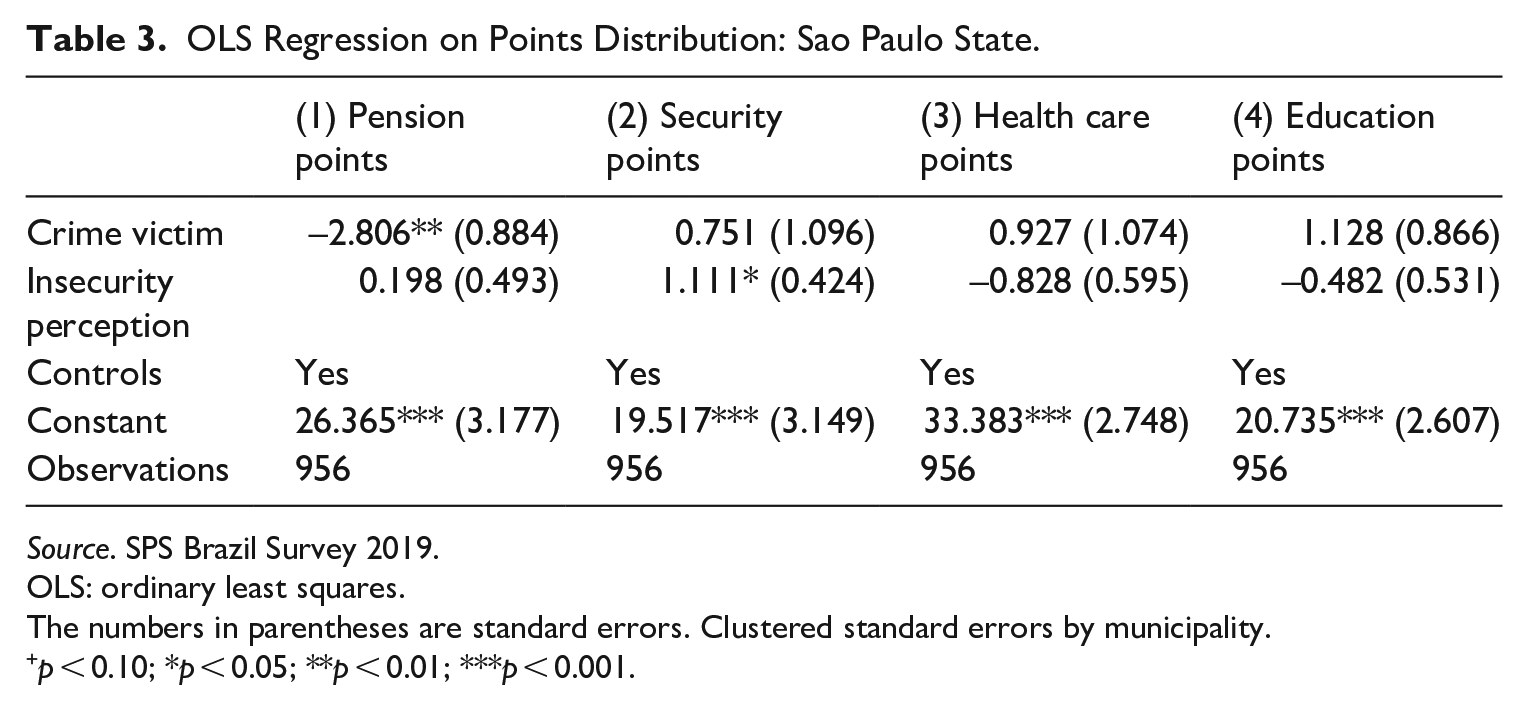
Moving to the estimations for the Brazilian sample, the measure capturing prioritization of pension, security, health, and education vis-à-vis the rest of the policy options is reported in Table 3. Again, when comparing allocation to security forces to that assigned to the rest of the policy options, people with increased perceptions of insecurity are more likely to choose the security priority package (see Figure 3). In contrast, we only detect an effect for crime victims regarding pensions, which is the significantly less-prioritized policy field. The low priority of the pension policy item suggests that victims’ preferences might revolve around short- and mid-term needs, probably derived from their direct experiences with crime (Altamirano et al., 2020). In addition, pensions’ uncertain benefits and low replacement rates might drive victims’ preferences toward prioritizing other fields above the pension system.
OLS Regression on Points Distribution: Sao Paulo State.
Source. SPS Brazil Survey 2019.
OLS: ordinary least squares.
The numbers in parentheses are standard errors. Clustered standard errors by municipality.
p < 0.10; *p < 0.05; **p < 0.01; ***p < 0.001.
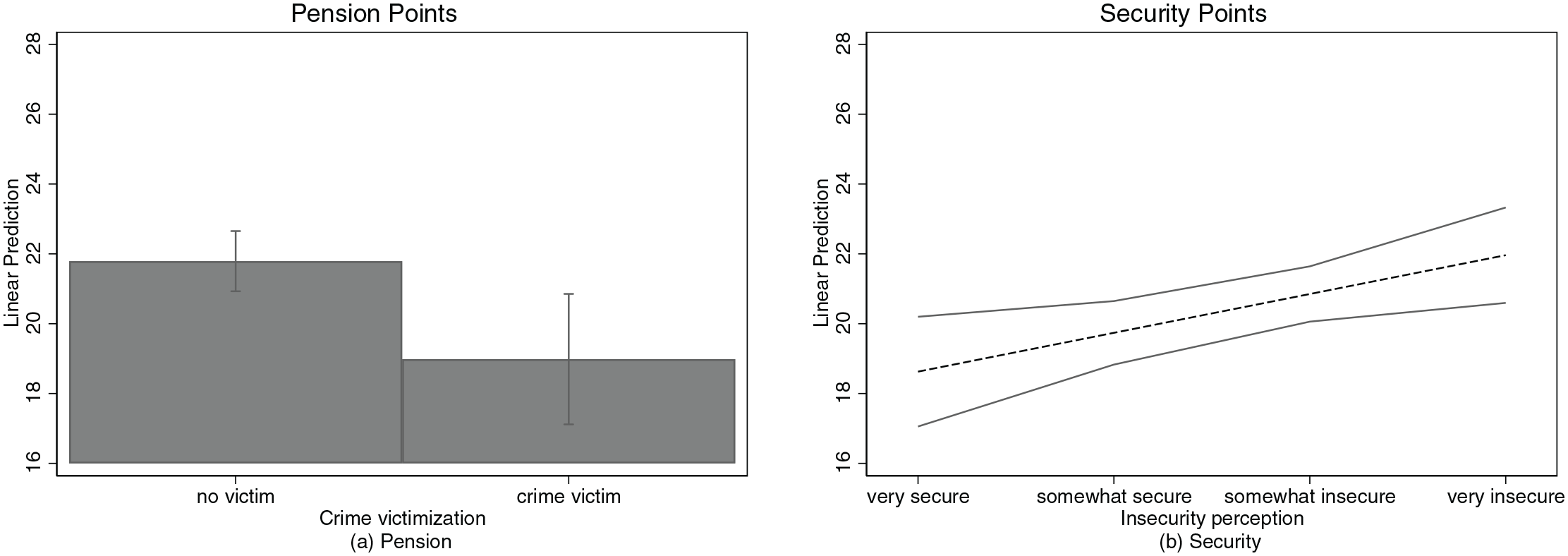
Linear Prediction on Policy Priority (SPSBrazil Survey).
While insecurity perception drives preferences to cut on pensions in Mexico, it is actual victimization that is associated with retrenchment preferences for pensions in Brazil. Further research is needed to disentangle these varying effects, which might reflect sectoral particularities and policy differences across contexts. In Mexico, the pension system is highly fragmented, and even for formal workers, the replacement rate might be low (Villareal and Macías, 2020). In this context, insecure Mexican citizens seem more likely to prioritize security spending over uncertain retirement benefits, while victims remain indifferent. In Brazil, the pension system integrates contributory, semi-contributory, and non-contributory components and has a relatively high coverage (World Bank and International Labour Organization (ILO), 2016). The system has been under financial stress over the past decades, and in 2019, a significant pension reform was approved by the Senate (Wilson Center, 2019). This could have contributed to shaping policy prioritization at the time of the survey in Sao Paulo. Future studies should assess the relationship between experiences with crime and policy preferences under the new pension scheme. 22
Finally, the lack of an effect for the other policy fields might suggest that a budgetary need to prioritize between security and welfare as viable sets of policy options does not capture the complexity of victims’ experiences and that their priorities might be more related to the quest for justice and reparation after a traumatic event.
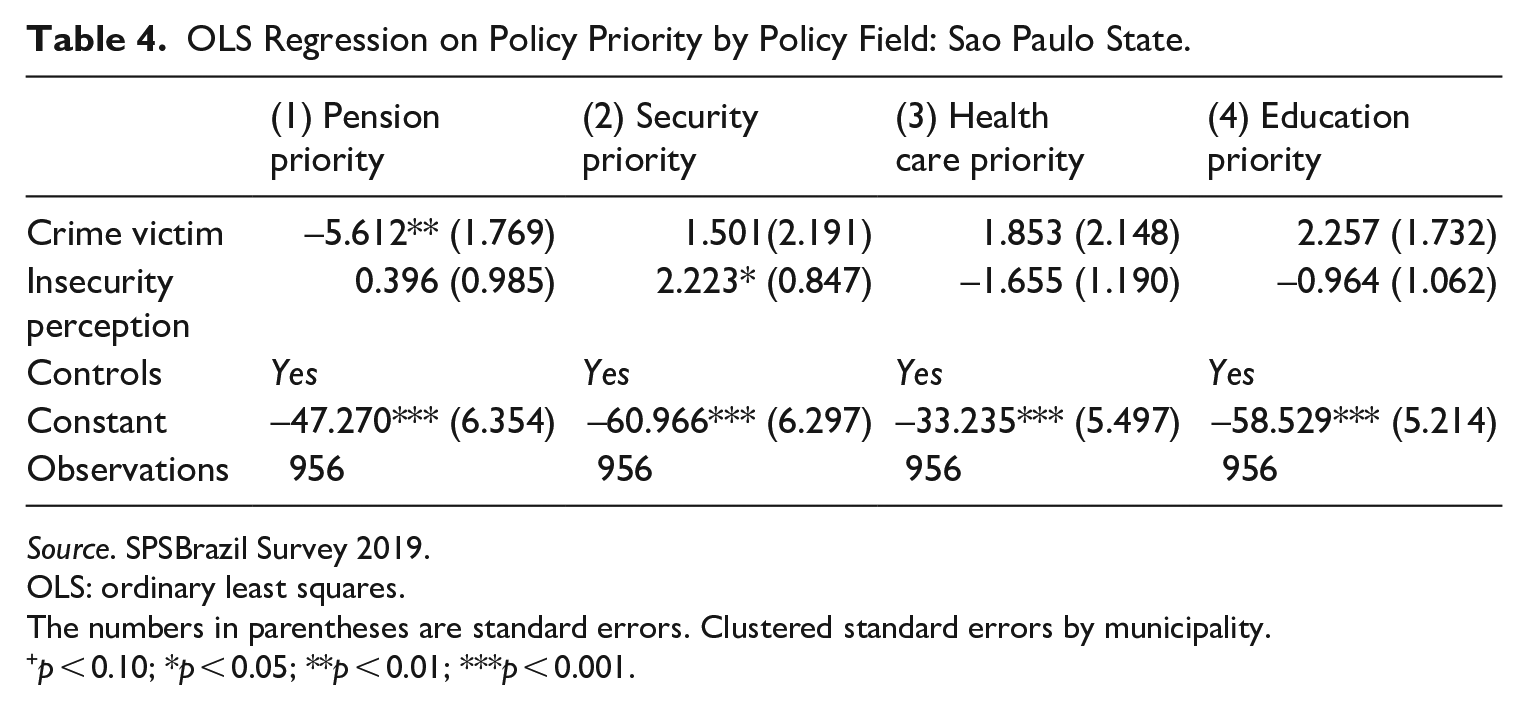
Using the alternative operationalization of our DVs, the policy priority indicator corroborates the findings based on the raw distributions of points: victims of crime are significantly less eager to prioritize pension policy, whereas those who feel insecure place more weight on security policy (Table 4).
OLS Regression on Policy Priority by Policy Field: Sao Paulo State.
Source. SPSBrazil Survey 2019.
OLS: ordinary least squares.
The numbers in parentheses are standard errors. Clustered standard errors by municipality.
p < 0.10; *p < 0.05; **p < 0.01; ***p < 0.001.
Sensitivity Tests
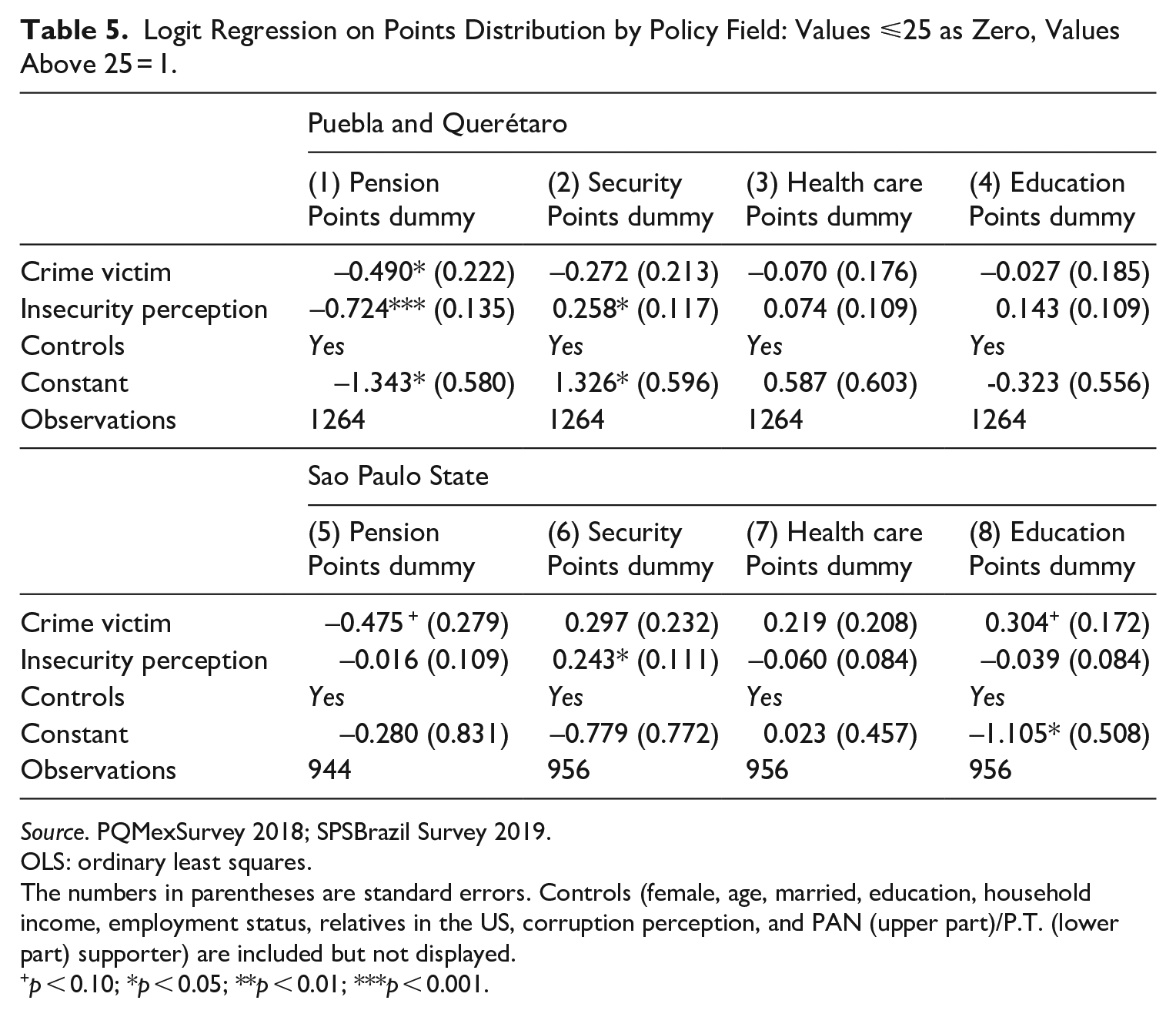
Using alternative-model and variable specifications, we investigate the robustness of our findings. We estimate logistic models based on a dichotomous DV specification, as a linear functional form might oversimplify the distribution. Given that 100 divided by four policy fields yields 25, we consider that choosing such value may well reflect indifference between the policies. Respondents who distribute 25 points on one policy field tend to allocate a similar amount to all four policies (19% of respondents allocated 25/25/25/25 in Mexico and 23% in Brazil), which suggests an equal priority/indifference. 23 Values below 25 signal a lower priority, advantaging one of the other policy fields. We, therefore, code an equal points distribution of 25 and any value below 25 as 0 and points above 25 as 1. The dummy variable thus switches from 0 to 1 once the respondent intends to prioritize this policy field over others. 24 Mexican crime victims seem to be less likely to prioritize pension expansion when this means cuts in other areas (see M1, Table 5). The results for perceptions of insecurity remain robust for both samples: those who feel very unsafe are less likely to prioritize pensions (Mexican case) and more likely to support security expenditure at the cost of other policies (both cases). For the case of Sao Paulo State, models still show a significant negative coefficient for crime victims regarding prioritizing pension expenditures (M5), although now only at the 10% level of significance. In the dichotomous specification, we also identify prioritizing education expansion at the expense of other fields among victims of crime (see M8, Table 5).
Logit Regression on Points Distribution by Policy Field: Values ⩽25 as Zero, Values Above 25 = 1.
Source. PQMexSurvey 2018; SPSBrazil Survey 2019.
OLS: ordinary least squares.
The numbers in parentheses are standard errors. Controls (female, age, married, education, household income, employment status, relatives in the US, corruption perception, and PAN (upper part)/P.T. (lower part) supporter) are included but not displayed.
p < 0.10; *p < 0.05; **p < 0.01; ***p < 0.001.
Next, we recode the points distribution by policy field into a categorical variable (-1 for points below 25, 0 for 25 points, and 1 for points above 25) and estimate ordered logit models. Our main findings are corroborated. Mexicans who feel unsafe give significantly less support to prioritizing pensions; instead, they direct their budget to security policy (see Online Appendix, Table L). Estimation results are negative and significant for Brazilian crime victims regarding pension policy and positive and significant for education.
Crime victimization might also foster political withdrawal or apathy (Berens and Dallendörfer, 2019; Macmillan, 2001). As indicated above, allocating 25 points to each policy area illustrates a preference for an equal distribution or indifference between policy areas. It signals that the respondent does not want to either prioritize or downgrade any policy field in relation to the other options. To further test H2.c, we create a measure which equals 1 when the respondent allocates 25 points to a policy field and 0 for all other values. Interestingly, we find that Mexican crime victims are indeed much more likely to be indifferent between the policy areas of health care, education, and security (see M2–4, Table 6). This pattern is, however, not observable in Brazil. Here, neither crime victimization nor perceptions of insecurity significantly influence policy indifference. 25
Logit Regression: Policy Indifference as Dependent Variable.
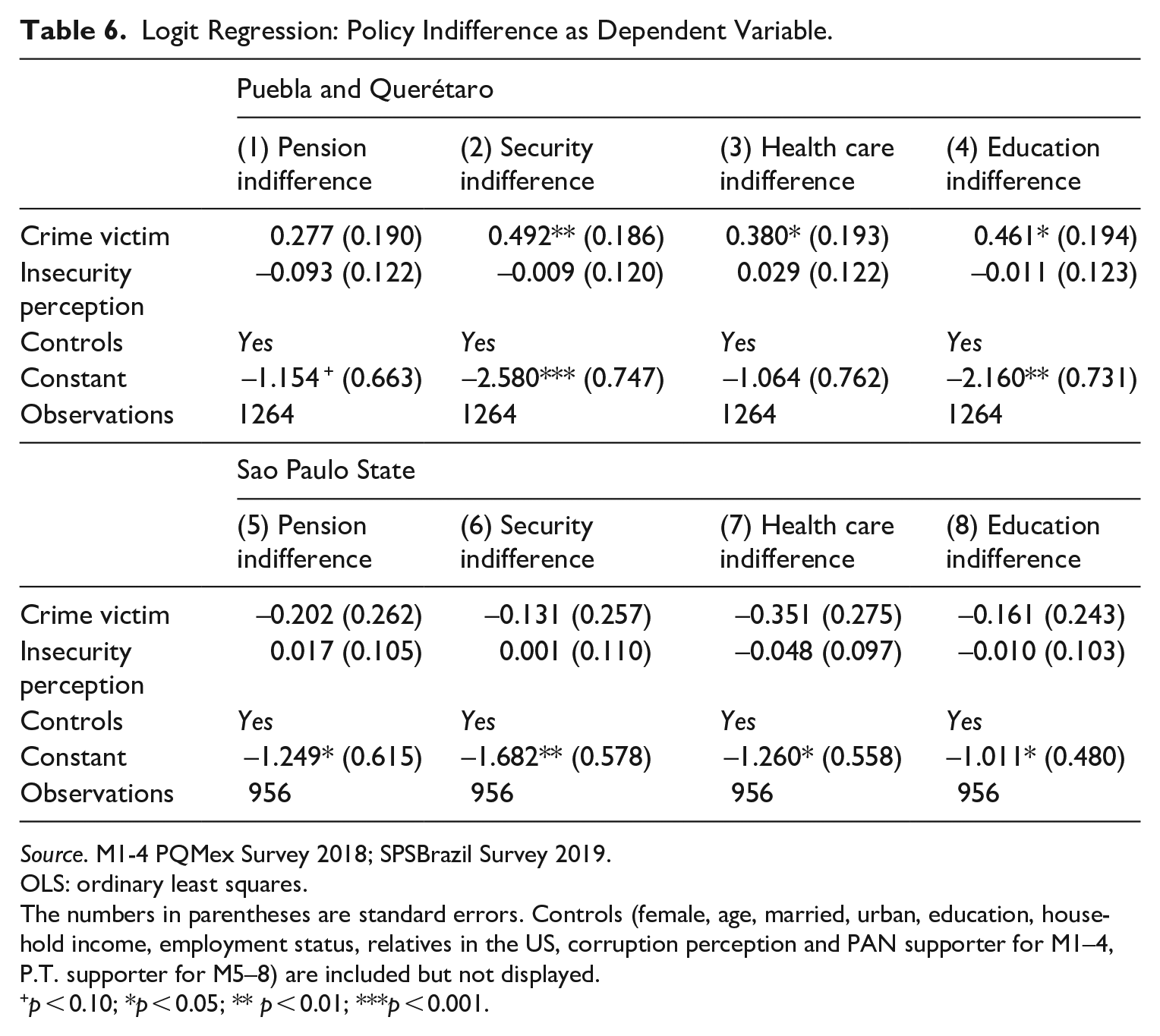
Source. M1-4 PQMex Survey 2018; SPSBrazil Survey 2019.
OLS: ordinary least squares.
The numbers in parentheses are standard errors. Controls (female, age, married, urban, education, household income, employment status, relatives in the US, corruption perception and PAN supporter for M1–4, P.T. supporter for M5–8) are included but not displayed.
p < 0.10; *p < 0.05; ** p < 0.01; ***p < 0.001.
To summarize, our analysis revealed that both crime victimization and feeling unsafe in one’s neighborhood affect people’s preferences as to which public policies should be prioritized through funding compared with a fixed set of other policy alternatives. When offered the choice of prioritizing all four policy fields equally or promoting some policies at the expense of others, we found that victims of crime favor downgrading pension policy in both Mexico (though only with the dichotomous specification) and Brazil rejecting both H2.a and H2.b. Perceived high levels of insecurity raise the priority of funding security policy in both cases, corroborating H1.a, and, to some extent, also promoting education at the expense of pension policy among Brazilians, moderately supporting H1.b. Ultimately, crime victimization creates simultaneous needs across policy fields, nurtures policy indifference, or shifts demand to other policy areas such as justice—which was not part of our choice set—lending support to our H2.c. Interestingly though, this significant increase in “non-prioritizing” is only visible among Mexican victims of crime. Further research is therefore needed to unpack the determinants of public policy needs among victims of crime across different types of violent contexts. Importantly, we find that confronted with a choice scenario, crime victims do not automatically prioritize security, in contrast to the literature, which finds a heightened taste for punitiveness and mano dura in victims (García-Ponce et al., 2019; Visconti, 2020).
Conclusion
Public opinion research on policy preferences is a vast field. Scholars often study policy areas in isolation, asking respondents about their attitude to greater public spending on, for example, pensions or schools or to redistribution in general. However, a growing set of studies suggests that individuals do not form their policy preferences irrespective of other policy areas. On the contrary, they face multiple-choice scenarios and give more weight to specific issues depending on their perceived effects (Bizer and Krosnick, 2001; Singer, 2011). Recent works on social policy attitudes have only started to consider how citizens form preferences when asked to choose among policy fields (see Häusermann et al., 2019; Neimanns et al., 2018). In this article, we explore how citizens exposed to crime choose between different policy alternatives. We argue that to understand the link between experiences with criminal violence and policy priorities, it is crucial to consider victimization and perceptions of insecurity as separate phenomena and to segment across policy areas regarding security, social investment, and insurance.
Our results confirm the differentiated political effects of perceptions of insecurity and of victimization that recent research has revealed across a wide set of political outcomes while at the same time expanding the growing scholarly debate on the policy implications of violence. Three sets of findings and implications are particularly worth highlighting. First, while the literature has found growing political activism among victims of crime (Bateson, 2012) when confronted with policy choices, victims seem to find it more difficult to formulate priorities. Victims’ indifference toward the state seems to reinforce the view that victimization is far from an isolated act; instead, victims may begin a continuous cycle of resistance to criminals and the state (Moncada, 2019). Although direct encounters with crime generate new needs in victims (Altamirano et al., 2020), when they have to prioritize, their most important considerations, perhaps, are truth and justice, which are likely to be a long way from anything that security forces or the welfare state can achieve. Alternatively, crime victimization might also go together with greater policy indifference or equal simultaneous needs, as respondents in Puebla and Querétaro indicated. Our evidence relating to victims, therefore, is a call to continue reflecting on what criminal victimization means and represents, to avoid oversimplifying such a complex and life-changing experience.
A second element to emphasize is the prioritization of security among those perceiving higher risks, largely disregarding social security policies and thus endangering the welfare state, particularly given that perceptions of insecurity are more widespread than actual crime victimization. This finding confirms research showing that perceptions of insecurity not only boost economically conservative candidates and diminish demand for welfare policies (Altamirano et al., 2020) but can also encourage punitive approaches that have been largely ineffective in actually reducing crime (Flores-Macías and Zarkin, 2021). These responses, ironically, may make both social and physical security less achievable for citizens of these regions.
Finally, it is crucial to highlight that in many developing countries, welfare systems are notoriously underfinanced, and policymakers have yet to build strong coalitions to implement wider policy reform and expand public expenditure (Holland and Schneider, 2017). Understanding citizens’ policy priorities, which may translate into concrete vote choices at election time, is, therefore, vital for policymakers and political parties. If exposure to violence can reshape such sensitive support coalitions, the impact of criminal activity on the policymaking process is palpable beyond the dimension of security.
Supplemental Material
sj-pdf-1-psx-10.1177_00323217221096559 – Supplemental material for Security or Social Spending? Perceptions of Insecurity, Victimization, and Policy Priorities in Mexico and Brazil
Supplemental material, sj-pdf-1-psx-10.1177_00323217221096559 for Security or Social Spending? Perceptions of Insecurity, Victimization, and Policy Priorities in Mexico and Brazil by Melina Altamirano, Sarah Berens and Sandra Ley in Political Studies
Footnotes
Acknowledgements
The authors thank Franziska Deeg and Facundo Salles Kobilanski for research assistance with the collection of the survey data. Previous versions of this paper were presented at the Politics of Crime Control and Social Protection Workshop at the University of Cologne in 2020, a GTAL seminar in 2021, and MPSA 2021. The authors are grateful to Ana Arjona, Daniel Brinks, Sarah Brooks, Candelaria Garay, Lucas González, Alisha Holland, Ana Isabel López García, Juan Pablo Luna, Barry Maydom, Gerardo Munck, María Paula Saffon, Peter Starke, Giancarlo Visconti, Georg Wenzelburger, and two anonymous reviewers for valuable feedback and comments.
Declaration of Conflicting Interests
The author(s) declared no potential conflicts of interest with respect to the research, authorship, and/or publication of this article.
Funding
The author(s) disclosed receipt of the following financial support for the research, authorship, and/or publication of this article: The project is funded by the Deutsche Forschungsgemeinschaft (DFG, German Research Foundation)—Project number 374666841—SFB 1342.

Supplementary Information
Additional Supplementary Information may be found with the online version of this article.
Figure A: Overview of policy priority distribution on four public policy fields, PQMex Survey (2018).
Figure B: Overview of policy priority distribution on four public policy, SPSBrazil Survey (2020).
Table A: Descriptive Statistics: Puebla & Queretaro Survey.
Table B: Descriptive Statistics: Sao Paulo State Survey.
Table C: Original item wording.
Table D: Cross-Table: Covariates of Victimization.
Table E: OLS regression on points distribution: Puebla & Queretaro (Full Table).
Table F: OLS regression on support for pension, health care and education spending expansion (standard survey items): Puebla and Queretaro.
Table G: OLS regression on points distribution: Interactions: Puebla and Queretaro.
Table H: OLS regression on points distribution: Sao Paulo State (Full Table).
Table I: OLS regression on support for pension, health care and education spending expansion (standard survey items): Sao Paulo State.
Table J: OLS regression on points distribution: Interactions: SPSBrazil Survey 2019.
Table K: OLS regression on policy priority: Family Victimization: Sao Paulo State.
Table L: Ordered logit regression on points distribution by policy: values < 25 = −1, 25 = 0, values >25 = 1.
Table S1: Descriptive Statistics, overall sample PQMex Survey.
Table S2: Descriptive Statistics LAPOP 2018 Mexico.
Table S3: Descriptive Statistics, overall sample SPSBrazil Survey.
Table S4: Descriptive Statistics LAPOP 2018 Brazil.
Table S5: OLS regression on points distribution by policy with alternative coding of DVs (25 as 0, values <25 as negative values): Puebla and Queretaro.
Table S6: OLS regression on spending priority with alternative coding of DVs (25 as 0, values < 25 as negative values): Puebla & Queretaro.
Table S7: OLS regression on points distribution by policy with alternative coding of DVs (25 as 0, values <25 as negative values): Sao Paulo State.
Table S8: OLS regression on spending priorities with alternative coding of DVs (25 as 0, values <25 as negative values): Sao Paulo State.
Table S9: OLS regression on points distribution: Interaction with income: Puebla & Queretaro.
Table S10: OLS regression on points distribution: Interaction with income: Sao Paulo State.
Table S11: Logit regression on points distribution: Indifference to ALL four policies as one Puebla & Queretaro.
Table S12: Logit regression on points distribution: Indifference to ALL four policies as one Sao Paulo State.
Notes
Author Biographies
References
Supplementary Material
Please find the following supplemental material available below.
For Open Access articles published under a Creative Commons License, all supplemental material carries the same license as the article it is associated with.
For non-Open Access articles published, all supplemental material carries a non-exclusive license, and permission requests for re-use of supplemental material or any part of supplemental material shall be sent directly to the copyright owner as specified in the copyright notice associated with the article.
