




Abstract
Multiple voices warn about an analytical deadlock in the field of populism studies mainly due to an excess of description and a lack of contextualisation. Reflecting on the current responses to this impasse, this study presents a framework for contextualising populism and seeks to enrich and expand the potential of populism research. The main argument of this article is that a more dynamic and interactive analytical framework is necessary to show the contingent and fragile nature of populist discourses and complement existing research. To illustrate this approach, the case of Podemos is analysed to show how the populist discourse varies over time for the same populist actor and to what extent this variation responds to contextual pressures. The study concludes that the contingent nature of populism can be related to two main conditions: the variable power over discourse of populist mobilisation and the normative pressures within the political sphere.
Introduction
In the last decades, populism studies have proved to be a dynamic and prolific field, stimulating research in sociology, political science, political communication, social psychology and organisational studies. The minimal approach, dominant in the field, conceives populism as a discourse, thin ideology or communication repertoire that opposes the people and the elites (Hawkins and Rovira Kaltwasser, 2017; Laclau, 2005; Stavrakakis and Katsambekis, 2019). Notwithstanding this definitional consensus on a minimal definition, there are still vibrant discussions about the main orientations and methodologies in populism studies. Multiple voices share a plea to expand the analytical orientation that currently dominates the field. Rooduijn (2019: 367) claims that populism ‘remains too detached from adjacent literatures’, while Mudde and Rovira Kaltwasser (2018: 1668) propose ‘to explore new avenues of research with the aim of producing new and better knowledge’. In the same vein, De Cleen and Glynos (2021: 12) argue that populism studies need a ‘broadening [of] the analysis to include how populism relates to other dimensions (nationalism, socialism, conservatism, etc.) and to the wider political, cultural, economic and social context’.
Building on these considerations, this article aims to expand the field of populism studies by contextualising populism, exploring the relationship between discourse and power. As observed by several scholars, the core of the analytical impasse of populism is a problem of decontextualisation. Populism research has primarily focussed on descriptive aspects of the phenomenon, producing an endless inventory of populist parties, movements, leaders, attitudes and beliefs (see, for instance, the PopuList, 2019). There is an overemphasis on the internal aspects of the phenomenon, ignoring external interactive and constitutive dimensions that may serve to clarify the very nature of populism. This ‘populism-centred’ approach reinforces a conception of populism as a self-evident and self-sufficient event or thing (e.g. the parties identified as stable populist actors). This article contends that this perspective overlooks the blurred and contingent nature of populism and undermines the ability to fully capture populist politics and the life cycle of populism.
As an alternative, this article presents a contextualisation of populism, focussing on the contingency of and changes in the populist discourse and relying on the approach to power and discourse proposed by Carstensen and Schmidt (2016). This type of contextualisation, which embeds populism into broader political processes, may offer new positive insights about the relevance of populist politics. Furthermore, it is well equipped to explain the rapid transformation of populist discourses in the contemporary political landscape.
The article is structured as follows: first, it focusses on the main aspects and reasons that explain the analytical deadlock in populism studies and the responses provided so far in the field. This is not the first attempt to contextualise populism; therefore, there is a review of the previous analytical endeavours exploring the context of populism. In a second step, the particular proposal to contextualise populism is presented and discussed under the light of the main assumptions in the populism literature. The next section illustrates how this proposal can be applied to the case of populist parties. The empirical illustration concentrates on Podemos, a left-wing populist party in Spain. The final section considers to what extent this contextualisation and its empirical application offer convincing solutions to the main challenges of populism studies.
The Impasse of Populism Studies
Numerous voices call for a change in populism research, to expand its boundaries and the relevance of its findings (De Cleen and Glynos, 2021; Olivas Osuna, 2020; Rooduijn, 2019). Proposals generally suggest changing the main orientations of the research agenda (objects of study, relation with adjacent fields). At the same time, major proponents of the minimal definition of populism, which is predominant in the field, warn about a possible return to fragmentation and the proliferation of ad hoc concepts of populism (Mudde and Rovira Kaltwasser, 2018). The latter authors correctly note the benefits of a definitional consensus, even when there are diverse interpretations of what exactly is the nucleus of such a definition.
Based on this minimal approach, populism is assumed to be an ideational or discursive phenomenon characterised by an opposition between the people and the elites and the claim to represent popular sovereignty. Whereas some scholars still consider populism as a thin ideology (Mudde and Rovira Kaltwasser, 2018), others refer to discourse (Stavrakakis and Katsambekis, 2019). There is increasing criticism of the choice of ideology as the conceptual genus of populism. This aspect will not be elaborated on, but the interested reader is referred to the work of Paris Aslanidis (2015), or Giorgos Katsambekis (2020) for a detailed discussion (see also Kim, 2021). There are strong arguments in these works against the conceptualisation of populism as an ideology (even ‘thin’) which are mainly based on the lack of ideological consistency of populism and the problematic clause of thinness. As a result of these disputes (and also the emphasis on moralism of thin ideology approaches), the minimal understanding of populism cannot be described as a unitary approach but composed of at least two distinct traditions: the ideational (or thin-ideological: Mudde, 2004) and the discursive approach (based on the seminal work of Laclau (2005; Laclau and Mouffe, 2001). These two traditions share the common defence of a minimal definition and the interest in ideas or discourse as the core of populist politics but diverge in their conceptual elaborations and empirical orientations.
Even with these disputes, the consensus around a minimal definition of populism has in recent times facilitated insightful comparative research on the topic. Studies on European and American populism demonstrate how populist manifestations operate at the level of discourse (De Cleen and Stavrakakis, 2017; Kioupkiolis and Pérez, 2018), at the level of strategy (Weyland, 2001) and at the level of attitudes and values (Kefford et al., 2021; Marcos-Marne, 2020). This cumulative and comparative spirit is worth preserving, especially when compared to the ‘dark times’ of populism, when the concept was no more than an epiphenomenon of other economic and social processes (see De Cleen and Glynos, 2021: 3). Notwithstanding the benefits of this comparative-oriented minimal approach, it has led to an excess of description and a certain analytical deadlock in the field of populism studies (Meijers and Zaslove, 2021; Rooduijn, 2019). As De Cleen and Glynos (2021) rightly observe, the consistency and comparability of the concept of populism have been achieved at the cost of complex and context-bound exploration of its political processes (populist politics). Dean and Maiguashca (2020) similarly argue that the ideational and discursive approaches to populism go hand in hand with methodological reductionism, quantifying the rhetorical or moralistic manifestations of populism. To put it simply, the main deficit of the minimal approach to populism is its limited political and theoretical relevance. Descriptions and comparisons of the rhetoric of political parties or other political actors frequently overlook the impact or the context of these processes. As De la Torre and Mazzoleni (2019: 89) observe when referring to the ideational approach of Cas Mudde, it ‘has been often adopted in analysing party manifestos, without paying any attention whatsoever to its reception by followers’.
This analytical shortcoming has led to two main responses. One concentrates on the definitional refinement of the concept of populism, while the other strives to preserve current conceptual parsimony and, at the same time, invites to enrich the field with new research avenues. Within the first response, some scholars have considered that starting from scratch is the necessary step for populism studies to be reoriented (Dean and Maiguashca, 2020; Olivas Osuna, 2020). They offer new conceptualisations of populism that promise to better capture the populist phenomenon. These contributions are worth considering and are usually based on a multidimensional definition, that is, an expanded non-minimal definition of populism (Olivas Osuna, 2020). This allows for a more complex delineation of the multifaceted character of populism although it may lead on some occasions away from comparability standards. The exploration of multiple dimensions and ramifications of the populist phenomenon is positive although it should not necessarily imply a rejection of the minimal approach. Empirical dimensions such as authoritarian leadership are certainly relevant features that can be considered in the study of populism but including them as necessary aspects of the phenomenon may restrict the range of cases under study, and overlook relevant populist movements (see Mudde and Rovira Kaltwasser, 2017: 19–20).
The other position considers that the main problem of populism studies is not its conceptual definition. By contrast, it claims that a minimal definition is a great step forward in the study of populism, especially due to its suitability for comparative research (De Cleen and Glynos, 2021; Mudde and Rovira Kaltwasser, 2018). Following this second position, this article argues that it is important to be aware of the evolutionary and cumulative character of populism studies and avoid endless regression to definitional discussions. This is not to deny the complexity of the phenomenon and its various manifestations and dimensions but to propose a common point of departure for further and more detailed explorations of populism. Of course, these empirical analyses can potentially entail conceptual implications about the core features of populism and a dynamic field of study must be always responsive to these developments. However, this study contends that the most urgent tasks ahead in populism studies are primarily related to research practices rather than to conceptual refinements.
The common denominator of populism under its minimal definition is hence a good starting point although insufficient if it merely yields descriptive and relatively irrelevant accounts of the phenomenon. A minimal definition allows us to identify and compare populist manifestations in distant contexts such as the discourse of Modi in India or Pablo Iglesias in Spain. However, this minimal account does not tell us so much about what De Cleen and Glynos (2021) call ‘populist politics’ (how political actors actually intervene in political or policy processes and what their conditions and effects are). In other words, if the context of populism is not explored, the contribution of populism studies to social and political sciences will not be worth much. In line with this, major proponents of the ideational and discursive approaches have explored new research avenues to counter this ‘populism centrism’ (i.e. the proliferation of descriptions, classifications and comparisons of populist ideas or discourses).
Studying the Context of Populism
Three main research directions can be identified in regard to the contextualisation of populism: one concentrates on the macrostructural conditions that favour or constrain populism (Kriesi and Pappas, 2015; Rooduijn and Burgoon, 2018); another explores how populism impacts democratic institutions or governance mechanisms (Abts and Rummens, 2007; Urbinati, 2019); and the third, which has strongly emerged in recent times, turns to the demand side, analysing the role of citizens in the dynamics of populism (Akkerman et al., 2014; Rico et al., 2017).
The focus on the macrostructural conditions has a long tradition in the study of populism. Some varieties of this approach have been criticised for adopting a determinist position in explaining populism and neglecting its own logics and internal developments. Explanations of populism have moved between the economic anxiety thesis and the cultural backlash thesis. The first thesis presents economic insecurity as the main driver of populist vote and support, and therefore of the emergence of populist parties. The second thesis explains the rise of populism as a reaction against multiculturalism. In most research, cultural and economic dimensions are seen as intertwined and reinforcing each other. For instance, economic insecurity may serve as a driver to have a negative perception of cultural issues such as immigration (Inglehart and Norris, 2017). This type of explanation of populism derives from long-standing literature on the effects of globalisation, which allegedly creates a new integration/demarcation divide between ‘winners’ and ‘losers’ of globalisation (Kriesi et al., 2006). One of the weak points of this approach derives from the limitations of the particular focus on the integration–demarcation divide and the increasing concern with immigration issues. This limits the explanatory power of this thesis to supporters and voters of anti-immigration parties, which in any case exhausts the diversity of populist parties (see Mudde and Rovira Kaltwasser, 2018: 1674; Roch, 2021). Connected with this last point, this approach generally fails to explain the internal and subjective logics of populism (see Rooduijn et al., 2019 for a critique) and serves rather as a general explanation for the vote for radical right or fringe parties.
The second strand of research aims to contextualise populism relying on the big questions of political science, with a particular focus on the relation between populism and liberal democracy (Mudde and Rovira Kaltwasser, 2013; Urbinati, 2019) or discerning whether populism opposes or supports the European Union (EU) and European integration (Pirro et al., 2018; Roch, 2021). This approach has been heavily influenced by normative debates about the quality of liberal democracy – its possible improvements and threats (Mudde and Rovira Kaltwasser, 2013; see also Müller, 2016). The dominant view portrays populism in opposition to liberal democracy (Abts and Rumens, 2007; Caramani, 2017; Gaus et al., 2020; Müller, 2016), while other scholars argue that the relationship between democracy and populism cannot be determined a priori but should be subjected to empirical analysis on a case-by-case basis (Harmsen, 2010; Stavrakakis and Katsambekis, 2019). Among the risks of the first position is the reinforcement of the view of populism as a ‘black box’ with a permanent essence and fixed effects on democracy or the EU. This can be the case if the diversity and fluctuation of populist actors is overlooked in the interest of making general evaluations on the effects of populism on democracy (see Abts and Rumens, 2007 or Müller, 2016; and Harmsen, 2010; or Roch, 2021 for a critique). Several mediating factors may disturb such a fixed effect: the thick ideological stances of the actors, the political alliances in a specific context, the degree of populism, etc.
Finally, the most prominent line of research expanding the field of populism studies concentrates on the demand side and, particularly, on citizens’ populist attitudes (Akkerman et al., 2014; Kefford et al., 2021; Rico et al., 2017). According to Rovira Kaltwasser and Van Hauwaert (2020: 2), to have populist attitudes mean ‘to hold a set of beliefs about the political world, characterised by seeing politics in Manichean terms, i.e., as a struggle between “the pure people” and “the corrupt establishment”’. One of the most frequent methodological approaches is to measure the opinions and positions of citizens via surveys to provide evidence on the predictive power of populist attitudes for a populist vote (Akkerman et al., 2014; Marcos-Marne, 2020; Van Hauwaert and Van Kessel, 2018). For instance, Marcos-Marne (2020) or Van Hauwaert and Van Kessel (2018) seek to identify significant correlations between populist attitudes and populist vote, although they find that such relation is mediated by left-right positioning (Marcos-Marne, 2020: 3). It can be debatable, however, the existence of a causal linkage between populist attitudes and populism. This is to assume that populism can be disaggregated as the sum of populist attitudes in a given polity. By contrast, this article argues that the core drivers of populism and its fluctuations are to be found in the interactive conversation between populist leaders and the public. This is a point that has already been noted by other scholars and is included in recent research on populist attitudes, which tries to reconsider the mediators between attitudes and the populist phenomenon more carefully. In this line of argument, Hawkins et al., (2020) wisely note that populist attitudes need to be activated in specific contexts and it is not possible to infer a general causal pattern from attitudes to populism. Likewise, recent elaborations also challenge this causal linkage by arguing that populist attitudes research frequently ‘overlook[s] the potential effect of populism’s communicative, performative and discursive appeal’ (Kefford et al., 2021: 3).
Hence, the exploration of populist attitudes is indeed an interesting and productive research avenue although it should be complemented with more complex and context-bound causal models to explain populism and the fluctuation of populist discourse. This article departs from the idea that the contextualisation of populism would be more fruitful if certain central assumptions in populism research are abandoned. The contingent nature of populist discourse must be taken seriously if we actually want to grasp how populism emerges, is transformed and declines. In the following section, this article proposes a contextualisation that leads to the analysis of the interactive constitution of discourse and its diffusion.
Discursive Contextualisation: Discourse and Mobilisation
The three types of contextualisation presented above reinforce research that focusses on stability and the identification and classification of populist actors. However, given that populism is generally defined as a set of ideas or discourse which is contingent and variable over time, it is reasonable to expect that contextualisation can explain this central feature of populism. In doing so, this work relies on two distinct premises. First, this article conceives populism as a singular discursive phenomenon with its own nature, and it must be studied as such, with all necessary implications. Most scholars refer to discourse or ideas (Hawkins and Rovira Kaltwasser, 2017) in defining populism, but they often operationalise the latter in their research practices as an individual attribute, stable and isolated. This is especially the case of thin ideology approaches which focus on party or actor classifications to measure the degree of populism on the supply side (see Abts and Rummens, 2007; the PopuList, 2019 or Mudde, 2007). By contrast, as will be shown below, recent scholarship on ideas and discourse concentrates on the continued interaction of various actors to capture the generation and diffusion of particular discourses. Second, this article departs from the premise that populism cannot be reduced to the mere aggregation of opinions or attitudes but is primarily a collective action process whereby collective identity is created and transformed. This creative and transformative potential can only be captured if social processes, social events, and the corresponding mechanisms are identified.
The existing populism literature has also taken into account the construction of collective identity, especially departing from the seminal work of Ernesto Laclau (2005; Laclau and Mouffe, 2001). Laclau claims that populist discourse is an instrument to articulate social demands; that is, populism as an ideational ensemble serves to embody and unify dispersed social demands that have to do with public protest and public unrest. The political discourse of representatives at the party level is not a mere collection of the demands of the represented but actively participates in the construction of these demands (Laclau, 2005: 161–162). This approach has been also reflected in recent works from Moffitt and the communication approach (see the work with Kefford et al., 2021, or the volume edited by Ostiguy et al., 2020). However, a central question in most Laclauian empirical analyses of populism remains: Where do such demands come from? Are they always there? Are they created or co-created? and How do they vary over time?
If discourse is to be taken seriously, several dimensions in its production and strategic dissemination should be evaluated. Following the approach to power and discourse of Carstensen and Schmidt (2016), it is necessary to consider the variable power over discourse of particular actors (see also Fairclough, 2003, 2013); Social and political actors have different degrees of power to produce and disseminate discourse, depending on their economic, cultural and social resources, and their position in the social and political field. It can be expected, therefore, that the power over discourse defines the capacity of actors to establish a particular populist discourse. In relation to populism, the empowerment of social actors takes on special relevance in the form of mobilisation and empowerment of ‘the people’. Bottom-up processes of massive mobilisation and protest are typical manifestations of the ‘power of the people’ and, accordingly, tend to produce lemmas such as ‘Wir sind das Volk’ (We are the people; PEGIDA (Patriotic Europeans Against the Islamisation of the Occident) movement) and ‘We are the 99 percent’ (anti-austerity mobilisations and Occupy Wall Street). These are populist movements that can be defined as ‘non-institutional collective mobilization(s) along a catch-all political platform of grievances that divides society between an overwhelming majority of “pure people” and a “corrupt elite”’ (Aslanidis, 2017: 3). This article hypothesises that the strong presence of populist movements may incentivise the presence and diffusion of the populist discourse in the political sphere. In the terms of discourse-oriented scholars, this is related to ‘the populist moment’ or in the words of Katsambekis (2020: 4) the ‘momentary enactments of the people towards an emancipatory and egalitarian orientation [that] can pose a challenge to a given institutional order’. This is a matter of power over discourse of those actors that can name ‘legitimately’ the people and open the ground for the restructuring of political representation.
Hence, there is an interaction and mutual influence between populist movements and political discourse. Political discourse at the party-system level can revitalise, channel or ignore the public discourse propelled by populist movements, and what takes place is an interaction between these two levels (political discourse and populist movements). This indicates the relevance of focussing on the interactive conversation and contingent discursive construction produced between politicians and the public discourse of populist movements. There is an excess of attention in populism research to only one side of the conversation (excessive analysis of party manifestos and speeches), and the role of the public and, especially, populist movements is often ignored (see Dean and Maiguashca, 2020: 10). As Aslanidis (2017: 2) notes, ‘party system populism occasionally emerges as a corollary of its bottom-up incarnation, a correlation that political scientists often overlook’. Conversely, this study seeks to combine the agency of populist movements and the ‘top-down’ agency of party leaders, expanding a line of research that, although existent, has not been central in populism studies (see the works of Jansen, 2011 or Roberts, 2015). This ensures that the whole process of circulation of populist discourse is captured.
Constraining and Facilitating the Populist Discourse
This article proposes conceiving the relationship between the public, its demands, and the populist discourse in terms of pressures reflected on the production and dissemination of discourse. It relies on the elaboration of Carstensen and Schmidt (2016) on power over/through/in discourse. Turning to the first dimension, collective actors involved in popular protest and the expression of demands may become prominent actors in the public sphere with power over discourse, that is, with the ability to produce and circulate specific discourses. Political actors (i.e. political parties) and social actors are not separated but they communicate and mutually transform their public agendas through discursive interaction. In the literature on social movements, this is something generally assumed, at least since the ground-breaking work of Goldstone (2003), but it is not clearly included in the populism research agenda yet (see Roberts, 2015 or Aslanidis, 2017 for some exceptions). This article expects, therefore, that the populist discourse at the party level responds to waves of protest and prominent collective actors expressing demands in the public sphere.
In these protest movements, a particular definition and problematisation of the people and the elites and their interrelations are at stake and mobilised, potentially creating a collective identity in line with these definitions. As theorised by Aslanidis (2017) but also from the broader perspective of social movement studies, populist movements may impact party systems in different ways: it can lead to the creation of a new party, to the overlapping of populist movements with existing political parties, or to the appropriation or transfer of the populist identity. Since this article is concerned with the fluctuation of the populist discourse, not with the rise of new parties, the last two ways are especially relevant. In this vein, a party may absorb cadres from the populist movement or demands and discourses operating therein. Also, even when there is no political affinity between parties and movements, the populist collective identity produced by mobilisation can be appropriated. Following Laclau (2005), the populist collective identity functions as a floating signifier that can be adopted by a political actor. What is relevant at this point is that the existence of populist movements with power over discourse paves the way for further discursive appropriations or diffusion across the political sphere.
Although this power over discourse of populist movements can capture some dynamics of deployment and diffusion of populist discourse in the political sphere, it does not exhaust the complexity of its fluctuations. It is certainly insufficient to capture the intra-party reflexive dynamics that also shape the fluctuation of populist discourses. Actors within a political party are not merely representatives of a political line. They have their own agency and critically reflect on the strategic steps that the party should follow. This is manifested in the power through discourse that they can release, that is, the ability of political actors to mobilise their own agenda (Carstensen and Schmidt, 2016). Political leaders situate themselves in a changing political field and design new tactics to circulate their political discourse. In regard to the fluctuations of the populist discourse, this article expects a contingent ability of a party to influence the political discourse and set the populist divide at the centre. This ultimately depends on the interaction between the capacity of (populist) actors to reorder the political discourse and the reaction of mainstream parties.
A last analytical dimension is crucial to entirely capture how actors mobilise the populist discourse in political settings. They do not merely seek to mobilise their own agenda, but also respond to the power in discourse, that is, the sedimented meanings that are established in certain communicative settings. The organisational milieu of institutional politics is endowed with norms and logics of interaction between the dominant and outsider actors and coalitions of actors (Sabatier, 1988). Two main mechanisms can be identified in operationalising power in discourse. First, normative pressures from dominant actors delegitimising the positions of the populist actor. The antagonistic and outsider role that populist actors often adopt can lead to their marginalisation in the political sphere and inability to successfully negotiate or participate in the internal dynamics of institutional politics. Certain ‘norms of appropriateness’ can be used to discredit actors with a populist discourse (Saurugger, 2013: 893; see DiMaggio and Powell, 1983). Moreover, actors can also be persuaded to change their positions. In the case of political actors, a short-term thin learning and a possible long-term thick learning are expected. Downplaying alternative views by a populist actor, or (partially) reproducing dominant positions, can be seen as a strategic response to adapt and survive in a hostile environment (Radaelli, 2008: 244). In discursive terms, this would imply the re-emergence of the logic of difference (Laclau, 2005) with several particularisms referring to policy areas and the decline of the logic of equivalence (subsuming all particularisms under the populist divide).
These two mechanisms are often responsible for the internal struggles and the repositioning of party leaderships within political organisations. Therefore, to capture the potential and the fluctuations of a populist discourse we must account for the power over discourse pressures and the transformation of the power through discourse of the party leadership. In the next sections, this three-dimensional approach will be illustrated through the analysis of a typical case of left-wing populism: the party Podemos in Spain.
Data and Methodological Strategy
To measure and compare variation in the degree of populism, this article relies on a corpus of speeches and manifestos of the political party Podemos, which are divided into three – Podemos subcorpora_1, Podemos subcorpora_2 and Podemos subcorpora_3 – to correspond to different stages in the evolution of the party. The speeches and manifestos were issued by the party Podemos for the period 2013–2017 and corresponded to the 2014 European Parliament elections, regional elections in 2015, and the general election in 2016 (see Table 1). Party speeches were delivered by the main representatives of the party – the party leaders. The speakers were selected based on their positions in the party, and they varied across the three stages analysed according to changes in party leadership. The speeches of party leaders were used to communicate directly to supporters; thus, this genre is especially suitable for analysing the populist discourse. The three stages analysed are named (1) ‘Party in the making’, (2) ‘Running for elections’ (3) and ‘Party in opposition’. As shown in Table 1, the different time periods are identified based on the evolution of the party and the critical events of such evolution.
Speeches, Manifestos, and Time Periods for the Party Podemos.
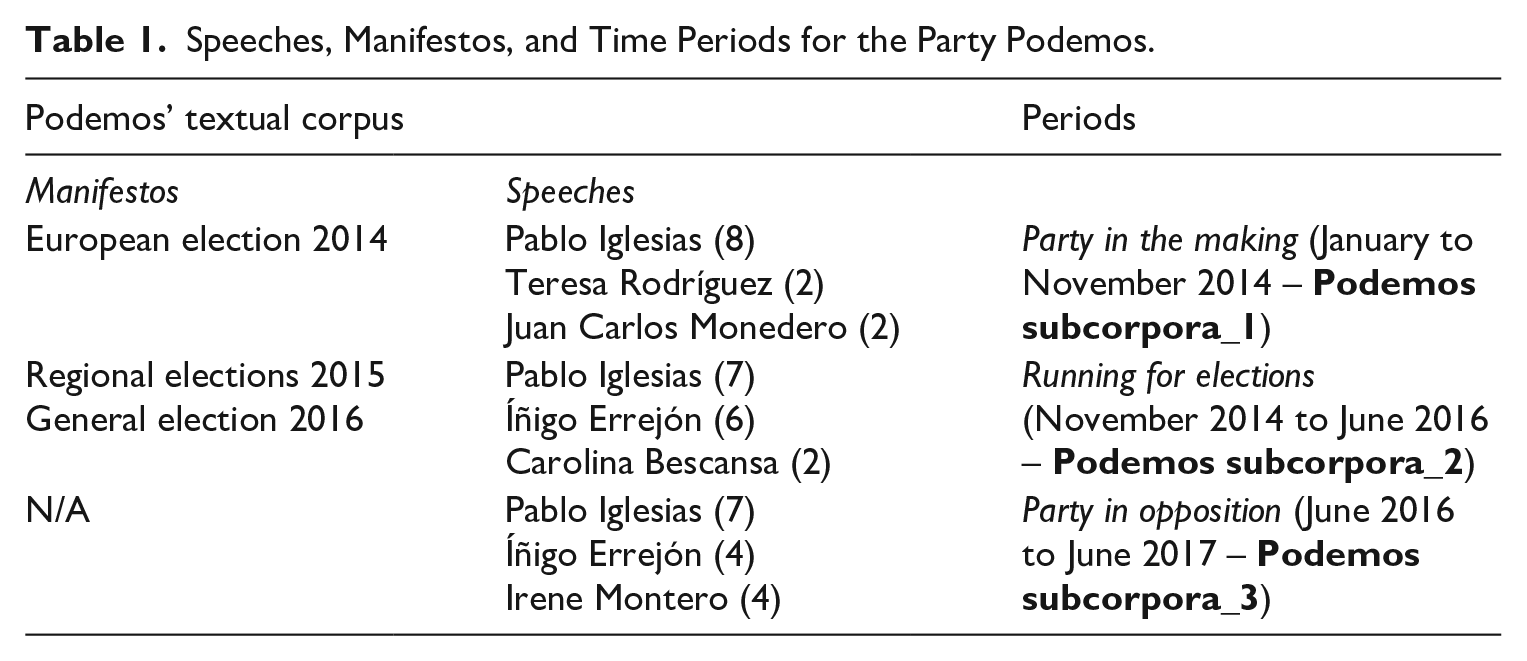
The analysis focusses on the variation of the antagonism between the people and the elites (antagonism index) and people centrism. The software WordSmith 7.1 (Scott, 2016) is used to compute the data, which facilitates computer-assisted points of entry into the texts and makes it easy to compute frequencies and collocations in the textual corpus. Collocations are semantic indicators that are useful for identifying patterns of relationships between different words in a large textual corpus. They are words surrounding a signifier or node word (in this case signifiers referring to ‘the people’) that provide the latter with a particular meaning (Louw, 1993: 157). Collocation analysis also serves to identify points of reference to manually explore the concordance lines (sequential analysis) on the WordSmith programme. The frequency lists facilitate the identification of nodal points and their variation over time. The antagonism index is calculated by measuring the relative frequency with which ‘the people’ is constructed in antagonism to ‘the elites’. The WordSmith software facilitates this computation, as it can yield all concordance lines in a given corpus in which the signifiers referring to ‘the people’ appear. On this basis, it is possible to quantify the degree of antagonism of the populist discourse. The second part of the analysis is focussed on the contextual exploration of social protest and the changes in power through discourse of the party leadership as conditions for the fluctuation of the populist discourse and its degree of antagonism.
Populist Discourse and Populist Mobilisation in the Case of Podemos
In January 2014, a group of intellectuals and left-wing activists presented the ‘political platform’ Podemos at the Teatro del Barrio in Madrid. The subsequent rise of the political party Podemos (even polling first in the first months of 2015 1 ) was marked by previous anti-austerity mobilisations in Spain. In particular, Podemos was preceded by the 15 May Movement (15-M) in 2011 and subsequent protests over the high unemployment rates and austerity measures implemented in the country (Castells, 2018: 335; Della Porta et al., 2017: 221). The huge 15-M mobilisation politicised the socioeconomic conditions of the popular sectors in Spain, especially of the young population. It was built on an increasing distrust of the political class and general dissatisfaction with the economic situation after the financial crisis (Lobera, 2015: 99). There was ample support to the 15-M protests and demands after the occupations of the squares. The demands of the movement touched on several topics but generally depicted a clear antagonism between the people (la gente) and the political and economic elites. In fact, one of the most emblematic claims was ‘somos el 99%’ (we are the 99%), which in the manifesto of the movement read: ‘We are normal people, we are like you’ (see Lobera, 2015). Based on this discursive repertoire, some scholars analysed this movement as a populist mobilisation, among them one of the future leaders of Podemos, Iñigo Errejón (2011).
The Power over Discourse of Populist Mobilisations
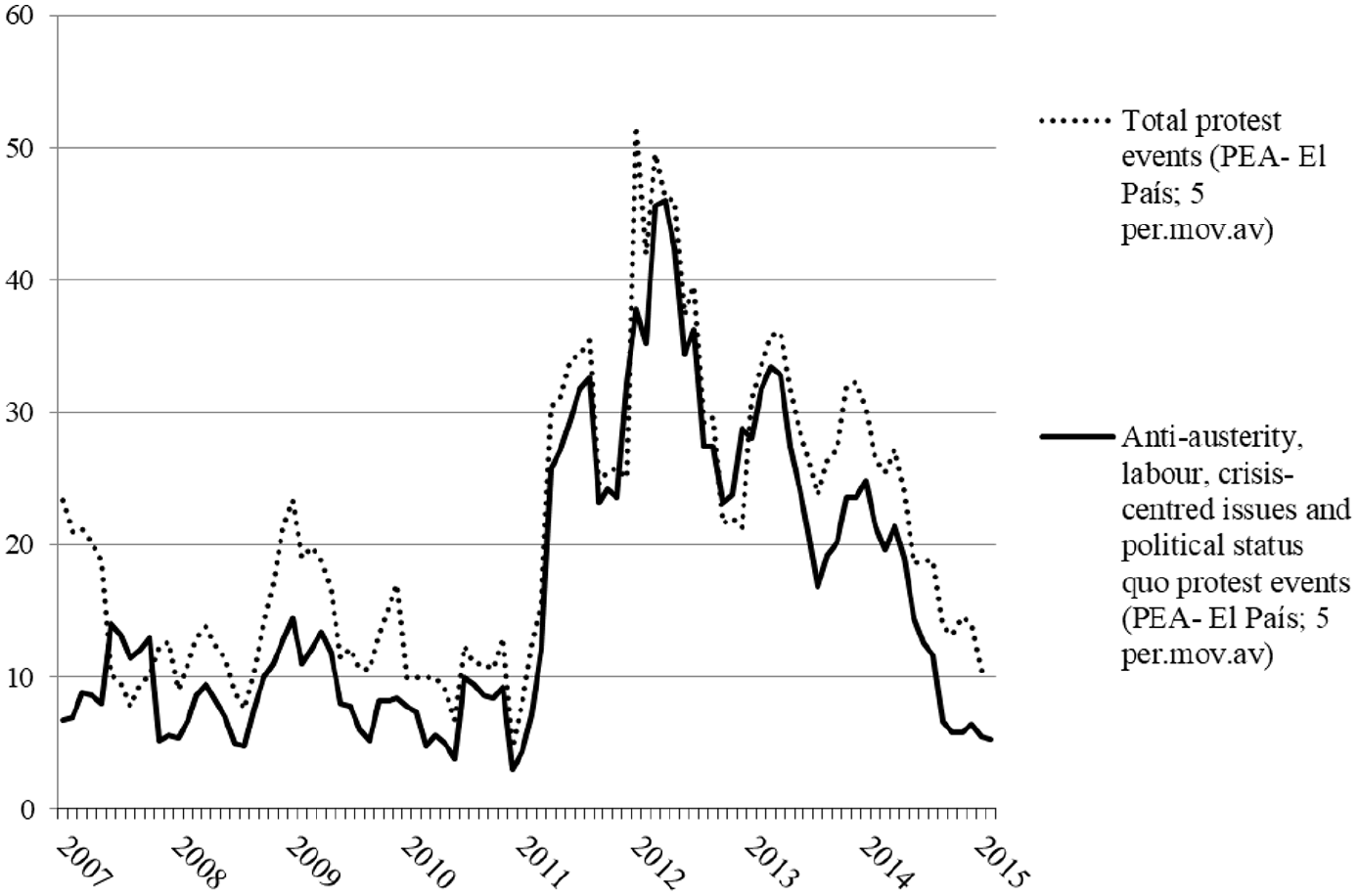
The 15-M Movement also had consequences for the level of mobilisation of the Spanish population. As research on the topic shows, the indignados mobilisation was followed by a general increase in popular protest in Spain. When people left the squares in August 2011, the activist energy was relocated to the local level, and the people focussed on ‘more specific and localized conflicts in their neighbo[u]rhoods’ (Saltzman, 2019: 220). General political mobilisations but also specific sectoral demonstrations revolving around topics such as education or the health care system (the so-called mareas) spread in Spain. Calvo and Garciamarín (2016) collected data from the Centro de Investigaciones Sociológicas (CIS) about the participation of individuals in protest events. The data show a consistent increase in this participation between 2010 and 2013, in which more than 21 percent of Spaniards admit to have taken part in some of these events. Portos (2021) draws similar conclusions after using the Protests Event Analysis methodology to collect data published in printed media. Late 2013 and 2014 were the start of the decline in social protest (García Agustín and Briziarelli, 2018: 5). Several indicators show the exhaustion and decline of movement-based repertoire of expression and action (meetings, assemblies, demonstrations and direct actions of protest) (see Calvo and Garciamarín, 2016; Portos, 2021) (Figure 1).
Evolution of protest in Spain. Extracted from Portos (2021: 71).
The party Podemos was launched in this political context of declining popular protest and impasse (García Agustín and Briziarelli, 2018). The impasse had to do with the inability to catalyse and express political dissatisfaction and the grievances elaborated during the cycle of popular protest. In such a context, the initial discourse of Podemos resonated with the claims of the popular mobilisation and, to a certain extent, reinforced each other. The energy of social mobilisation was transferred to ‘conventional or institutional’ action. The presentation of the party Podemos was followed by the creation of hundreds of circles (local assemblies of the party) and the ample support of the public opinion, especially after the success in the May 2014 European elections (see Castells, 2018; Rodriguez, 2016). As several scholars have noted, the initial goal of the party was to catalyse the power over discourse of these social movement’s actors to erupt into the political landscape. This was successful, at least during the first stage. The party was at the centre of all mediatised political debates, and all political actors were obliged to react to the emergence of Podemos. Podemos enjoyed a high power through discourse, able to introduce a clear antagonistic divide between the people and the elites.
The following excerpt illustrates this antagonism during the first stage of the party (January to November 2014): It’s not a problem of the left and the right, no matter how much he and I are on the left. It is a problem of a caste of brazen people [slang*: golfos] and a majority of citizens (Iglesias, 2014; emphasis added).
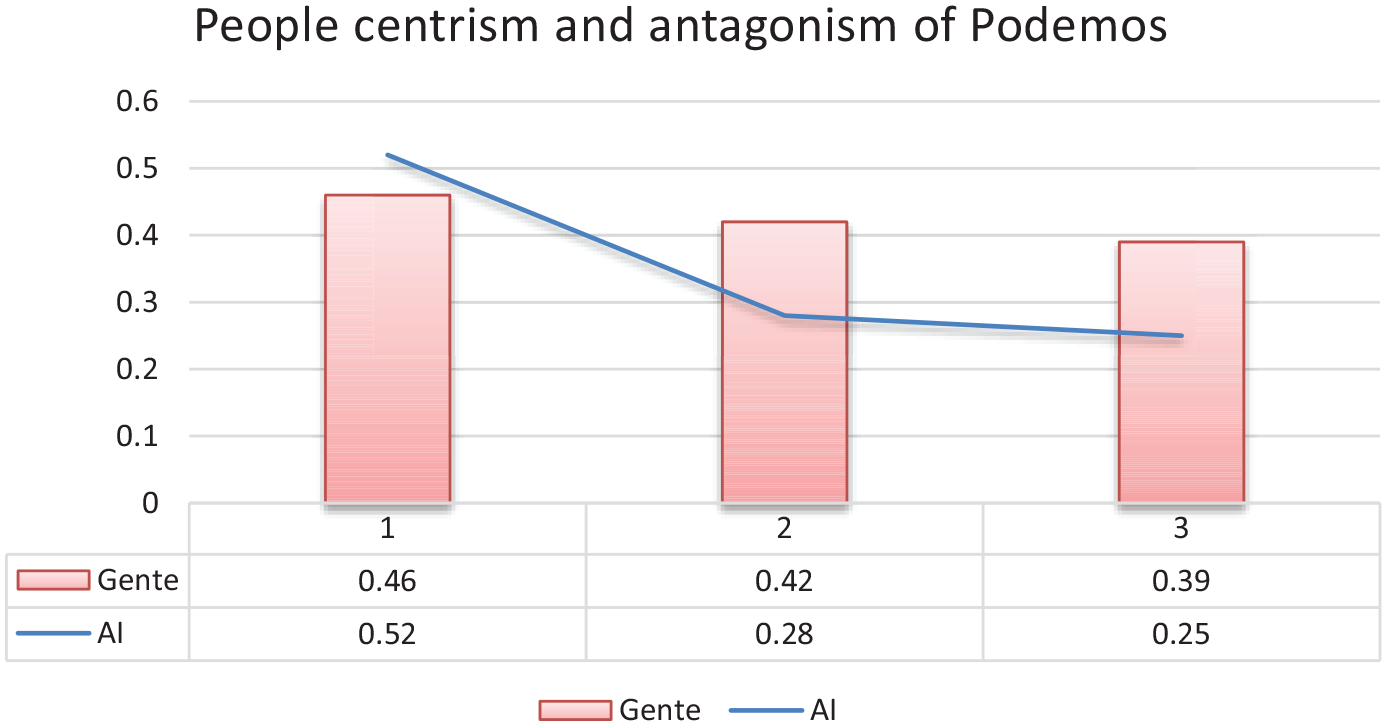
During the first period, the party was antagonised with a clearly defined and closed group of politicians and economic elites. In the Podemos subcorpora_1, the word gente is the most frequent noun (360, 0.46), as shown below in Figure 2, and represents one of the nodal points in the discourse of the party. There are, however, less prominent nouns referring also to ‘the people’, especially personas (person/s; 86, 0.11) and ciudadanos (citizen/s; 70, 0.09). The terms españoles or pueblo (also potential signifiers for ‘the people’) are marginal in the overall corpus and the former is not used to refer to the people as political subject. In accordance with the main goal of this study, the analysis concentrates on the primary signifier used by the party to refer to ‘the people’ (gente) to map the fluctuations of the antagonism and people-centrism of its political discourse.
People centrism and the Antagonism Index (AI) in Podemos’ three stages.
Turning to anti-elitism, the people are recurrently constructed during this stage in opposition to the elites, as indicated by an antagonism index of 0.52. As explained above, this means that more than half of the times the signifier gente is used as the popular identity in antagonism with the elites. Therefore, the antagonism was central to constructing the political and the popular identity during the first stage.
The Decline of Populism and the Power in Discourse of the Political Sphere
The exploration of the corpus shows that the strong antagonism exhibited during the first stage by Podemos decreased and stabilised during the second and third stages (see Figure 2). The second stage started after the first Congress of Podemos (November 2014), during which the primary goal to win the next December 2015 general election in Spain was set. During this stage (December 2014 to June 2016), the word gente (538, 0.42%) continues to be the most frequent signifier when alluding to ‘the people’, although its salience decreases slightly from 0.46% to 0.42%.
In comparison to the previous stage, the antagonism index decreases from 0.52 to 0.28. This indicates that ‘the people’ (gente) was constructed as a central nodal point of the discourse of Podemos but not necessarily constituted as antagonistic in relation to the elites, at least not to the same extent as during the first stage. This suggests a greater ‘demoticism’, in the terms of March (2017: 284), which implies closeness to the ordinary people and a lesser relevance of the pure antagonistic logic articulating the popular identity (populism in a strict sense). What is also noticeable is the absence of moralistic classifications of ‘the elites’ as ‘brazen’, bad people, or thieves. Rather, ‘the elites’ are defined exclusively in socio-economic and political terms, as those at the top of the social structure. Since this second stage, the party adopted some changes in its discourse and in the radical antagonism to the position of the political elites. For instance, the EU ceased to be integrated as an element within the populist divide (the southern people against the EU) and tended to be represented as a more diverse and policy-based institutional complex. In the following excerpt, Podemos self-defines as pro-European and in defence of one Europe prioritising prosperity, as well as social and human rights: To defend social rights, public services, sovereignty and an idea of Europe associated with prosperity. I say this very clearly: either they take the hand of the pro-Europeans who understand that Europe without prosperity, without human rights, without civil rights, without social rights is not sustainable, or they will have to negotiate with Marine Le Pen (Iglesias, 2015).
Podemos was forced to position itself regarding specific policy issues and to soften or downplay some demands. The power in discourse of institutional politics, that is, the hegemonic forms of representation of politics and the political clearly influenced the party and constrained its ability to set the agenda.
Finally, the third stage of the party shows an even more clear softening of the antagonistic discourse of Podemos. The emblematic signifier gente loses saliency during this stage but continues to be the most frequent word form (253; 0.39). Moreover, the antagonistic construction of ‘the people’ is less central in this period, with an antagonism index of only 0.25 – three points lower than that of the previous stage. The term ‘the people’ is represented through an appraisal or positive evaluation but is not necessarily connected to antagonism towards the elites: Decent people, humble people, working people left us another legacy, left us a legacy made up of rights, left us a legacy made up of a social agreement, made up of guarantees, made up of the right to have the chance to try and that if you fell, they wouldn’t turn their backs on you (Errejón, 2016).
As shown above, the initial disruptive populist discourse of the first stage of Podemos was anchored in the power over discourse of social protest actors. This power over discourse, however, declined at the social level, as social protest and mobilisation abruptly dropped between 2015 and 2016. But it was not only the power (or lack of power) over discourse of social actors that influenced the populist discourse of Podemos; the party’s populist discourse was also dependent on the strategic action of the party leaders. The combination of the decline in populist mobilisation and the power in discourse that shaped the new discursive repertoire of the party produced a new context for the production and dissemination of populist discourse (power through discourse).
The party leadership assumed a change of the context in which Pablo Iglesias, drawing on Gramsci, defined as a ‘war of position’, instead of a ‘war of manoeuvre’ (see García Agustín and Briziarelli, 2018: 7). This was a defensive strategy that called for adaptation to the existing political environment and resistance in major disputes but flexibility in minor political issues. Among the minor issues, the ‘populist identity’ of the party – seeking transversality across all sectors composing ‘the people’ – turned into a more defined leftist identity, as several scholars have already noted (Kioupkiolis and Pérez, 2018; Mazzolini and Borriello, 2021). The emblematic moment was the creation of a coalition between Podemos and the United Left (Izquierda Unida) in May 2016, which gave rise to Unidos Podemos (later Unidas Podemos) aiming to win the June 2016 general election. There was also a softening of the antagonistic strategy regarding the centre left Partido Socialista Obrero Español (PSOE) since the second stage of Podemos. Instead of distancing the party from classic social democracy, the leader of Podemos, Pablo Iglesias, clarified that the main goal was to ‘tak[e] the space of social democracy’ (Iglesias, 2016). This implied to assume a different, more collaborative role with the PSOE, which finally materialised in a government coalition in January 2020. Thus, normative pressures and thin learning processes (downplaying some controversial issues such as the party’s position in regard to the EU or the universal basic income) also contributed to the decline of the populist discourse.
Parallel to this repositioning of the party orientation, the party leadership also changed. Iñigo Errejón, responsible for translating Laclau’s theory of populism for the political strategy of the party and one of the party’s most important leaders, was gradually relegated to a secondary position. The culmination of the internal struggle between Iglesias and Errejón took place in February 2017, when in the second Citizen Assembly of the party Iglesias was backed by the militancy. In this Citizen Assembly, Errejón presented an alternative political project to Iglesias’ and lost. He finally left the party in January 2019.
Discussion and Concluding Remarks
This article shows how populism operates by responding to changing conditions in the social and political spheres. It is hoped that the article would be crucial to revitalising populism research and provide a response to the numerous calls for a critical appraisal of current and mainstream research in populism studies. Criticism of populism research has suggested that the field needs to contextualise populism and links it to adjacent literature. After revision of the current responses to the populism analytical impasse, this article presents an alternative form of contextualisation of populism as a discourse. The main argument claims that, although the current types of contextualisation offer relevant analytical proposals, they are still anchored in misguided assumptions about populism as well as in a limiting methodological individualism. These types of contextualisation generally depict populism as a thing or attribute possessed by the actors or individuals and with a certain permanent essence. Populism is understood as a stable feature to configure solid political identities and, therefore, it favours the categorisation and classification of political parties as populist.
If, however, we take discourse seriously, research must account for its context-bound production and dissemination. The research presented here advances assumptions that conceive populism as an interactive and communicative process and identifies two main pressures that affect the fluctuation of the populist discourse. First, how the variable power over discourse of social actors channelled through social protest and social mobilisation may affect the prominence and salience of the populist discourse at the political level. Second, how political actors respond also to pressures anchored in the discursive order of the political sphere, which this article calls power in discourse, following the elaboration of Carstensen and Schmidt (2016).
The illustration presented of the case of the party Podemos indicates that a discursive perspective is suitable for capturing the contingent nature of populism. This approach can be seen as complementary to other types of contextualisation of populism that use different theoretical lenses and focus on the capacity of populism to be sedimented in identities or attitudes. It is also possible, however, to capture the contingency of populism using different methods (longitudinal analyses of values or attitudes). What this article claims is that a theoretically informed analysis of the context is crucial for identifying accurately the constitutive processes of populism. This article’s approach is a way to combine a discursive analysis of populism with a theoretically informed analysis of its context. The detailed examination presented in this article of how the populist discourse is facilitated or constrained by the power over discourse (or lack thereof) of social protest organisations and the normative pressures of the political sphere has demonstrated to be a fertile ground for further explorations.
The results in the case of Podemos show the operation of two contextual pressures, one facilitating the populist discourse (populist mobilisation, the increasing power over discourse of populist collective actors) and the other constraining it (the power in discourse of institutional politics). The potential of the first pressure to stimulate populist discourse decreased in mid-late 2014 and, especially, in 2015. In the years 2015 and 2016, mechanisms of emulation and thick learning took place in the organisational environment of institutional politics between Podemos and other parties. The traditional left (Izquierda Unida) merged into Podemos, transferring cadres, frames, and positions to the political repertoire of the party. Furthermore, there was an adversarial thin learning from the centre-left party PSOE, which was reflected in the position and rhetoric of Podemos. These pressures help to explain the decline of the populist discourse of Podemos and its fluctuations more generally.
This article argues that capturing the contingency of populist discourse has important implications for the relevance and potential of populism research. Populism research generally ignores how populist discourse penetrates unconventional political actors and tends to focus excessively on the ‘usual suspects’ and their alleged populist (stable) identity. On the one hand, Approaches portraying populism as a stable ‘black box’ – both as an effect of cultural or socioeconomic processes and as a cause of de-/democratisation – are unable to capture these shifts in populist discourse. Ultimately, these macrostructural perspectives overestimate the role of populism in politics and overstretch the term to refer to multiple actors and events such as radical right-wing parties, radical left parties, authoritarianism or democratisation. This blurs the actual boundaries of the populist phenomenon that correspond to a specific discursive and identity transformation process that is context-dependent and highly volatile. On the other hand, Attitudes research fails to understand the strategic shifts of political actors as well as the collective actor pressures related to the variable power over discourse at a given moment. This research hardly grasps shifts in the discursive patterns of populism since these patterns are primarily explained at the level of collective action and the relation between power and discourse. Attitudes research is nonetheless useful for providing a snapshot of the public opinion of citizens at a given moment but not well equipped to provide a fruitful contextualisation that explains the logic of populism.
Hence, the results of this article call for a reconsideration of the research agenda in populism studies in light of this alternative approach to contextualisation. Arguably, populism research must not be focussed primarily on identifying a family of pure populist parties but on analysing different discursive articulations (allegedly populist) in a given socio-political context with its fluctuations. This, at least, is a line of research that should be revitalised if the aim is to fully grasp and anticipate the logic of populism as well as its (limited) impact in broader politics. This analytical approach can be certainly fruitful for similar cases of left-wing populism in other European countries. For instance, the Greek party Syriza transformed its discourse during the anti-austerity mobilisations in the country and some analysts suggest that there was a transition from a sector or class-based discourse to a more people-elites antagonistic discourse (see Stavrakakis and Katsambekis, 2014). The fluctuations of the populist discourse of Syriza could be also tentatively explained by the constraints founded in institutional politics. Turning to right-wing populism, this analytical approach also seems to be promising. For instance, existing research indicates a transition of the German party Alternative für Deutschland towards a more populist discourse since the PEGIDA mobilisations in 2015 (see Roch, 2021). Further research must empirically substantiate whether the two mediators of the populist discourse presented in this article are indeed valid for explaining the fluctuation of the populist discourse in other right-wing and left-wing populist parties.
Footnotes
Declaration of Conflicting Interests
The author(s) declared no potential conflicts of interest with respect to the research, authorship and/or publication of this article.
Funding
The author(s) received no financial support for the research, authorship and/or publication of this article.
