




Abstract
In televised election debates, politicians confront each other side-by-side to publicly debate their political viewpoints. As a result, these debates have the potential to promote reflective reasoning in citizens. However, concerns are voiced regularly about politicians’ increasing use of one-liners, slogans, and empty phrases, and decreasing use of elaborate and thoughtful argumentation, which may lower the debates’ reflection-promoting potential. Despite concerns, systematic empirical evidence testing whether reflection-promoting speech is declining is extremely scarce. This study contributes to filling this gap by (1) identifying four reflection-promoting speech components, that is, provision of justifications, substantive information, accessible communication, and engagement with others’ perspectives and (2) conducting a longitudinal quantitative content analysis (1985–2019) of Belgian election debates through the lens of their reflection-promoting potential. The results of all studied speech components point in the same direction: reflection-promoting speech in election debates has not declined, showing that allegations surrounding debates should be considered with caution.
Televised election debates are an important platform to inform and engage the public during election times (Benoit et al., 2003). In this mediated venue, politicians directly confront each other and discuss their political visions side-by-side in front of the public. As a result, election debates have the potential to promote more reflective reasoning among citizens (Coleman, 2020). Weighing and integrating different political arguments and perspectives (i.e. reflective reasoning) can make citizens more immune to elite and media manipulation, heighten the epistemic value of political opinions, and increase the legitimacy of political decisions (Bächtiger and Parkinson, 2019; Colombo, 2018). It is, however, unclear whether televised debates live up to this reflection-promoting potential.
Despite their promising format, there is widespread concern about the quality of today’s election debates (Annenberg Debate Reform Working Group, 2015; Coleman, 2020; Kaal, 2014). In particular, debates have been dismissed as entertaining media spectacles that put form above substance and expose citizens to rhetorical manipulation through the use of one-liners, empty statements, simplistic argumentation, and false information (Coleman, 2020; Lengle and Lambert, 1994). Exposure to this type of speech can prevent reflection, since it decreases citizens’ argument repertoire to reason with and reflect upon, as well as the accuracy and sophistication of their attitudes (Amsalem, 2019; Luskin et al., 2002; Valentino et al., 2001; Van der Wurff et al., 2016). It discourages active critical thinking and stimulates a passive citizenry, making unreflective decisions based on limited or even false information (Coleman, 2020).
Not only the alleged lack of reflection-promoting speech causes concerns, but also its potential decrease (Coleman, 2000; McIntyre, 2018; Slayden and Whillock, 1998; Wyss et al., 2015). This is connected to several trends in Western democracies, particularly the mediatization of politics, the increasing (political) importance of social media, and the growing success of populism (Esser and Strömbäck, 2014; Mazzoleni, 2014; Ott, 2017). Concerns about the impact of these trends on the manner in which politicians communicate in general can be transferred to the more specific genre of election debates (Kaal, 2014). Despite worries and allegations, there is little empirical evidence that systematically assesses the evolution of communication in election debates, and particularly the evolution of reflection-promoting speech. Therefore, we lack insights into the actual validity of the concerns surrounding declining debate quality.
In this study, we analyze reflection-promoting speech in a dataset of 4146 speech acts in 24 Belgian election debates, aired between 1985 and 2019. These 35 years cover the period of increased mediatization, social media use, and populist success that characterize several Western democracies. Although one in-depth case study does not allow to draw cross-national conclusions, the results could provide an indication of communication patterns in Western societies that experienced similar trends (Esser and Strömbäck, 2014; Rooduijn et al., 2019).
We theoretically identify and empirically study four reflection-promoting speech components, all linked to the normative theory of deliberative democracy. Three components tap into classic “first-generation” or rationality-focused deliberative ideals that can induce reflection: (i) politicians’ use of justifications; (ii) their engagement with others’ perspectives; and (iii) the substantive information value of their claims (Bächtiger et al., 2018). “Second-generation” forms of deliberative speech move beyond purely rational ideals and emphasize the importance of elements like emotions and storytelling in making political speech accessible and inclusive for all groups in society (Bächtiger et al., 2018: 3; Maia et al., 2020; Mansbridge, 1999). The fourth component thus encompasses (iv) the accessibility of politicians’ language for the larger public.
Over time, we expect a decline for the rational-speech components and a rise for the accessibility component. We anticipate politicians across the entire political spectrum to make less use of the rational-speech components over time, stimulated by trends of increasing mediatization, increasing importance of the social media environment, and growing success of populists and their communication style. Contrastingly, we expect that precisely these trends increased politicians’ use of accessible language over time. Yet, contrary to expectations, we find no substantial decline (or increase) in any of the reflection-promoting speech components over the past 35 years. This finding affirms the importance of validating often-heard concerns of long-term declines in debate quality.
Our contribution is threefold. First, we approach election debates in a novel way by studying them through the lens of their reflection-promoting potential. In doing so, we look beyond a mere focus on rationality, by also including accessibility. Second, we advance the literature by conducting a systematic empirical analysis on data that covers more than three decades of debates, testing if the widespread concerns about decreasing debate quality are warranted. Third, by conducting the analysis in Belgium, we further strengthen and broaden knowledge about election debates across contexts. Most studies on election debates are performed in the United States, yet these debates also play a key role in many other countries (Juárez-Gámiz et al., 2020). Through these contributions, we operate across disciplines and connect deliberative democracy and political communication in the electoral context. As such, we aim to provide relevant insights for a broad audience of political scientists.
The Reflection-Promoting Potential of Televised Election Debates
Normative (deliberative) accounts on the role of election debates in democracy argue that these debates could play an important role in prompting reflective reasoning among citizens (Coleman, 2020; Turkenburg, in press). In line with Muradova (2021a), reflective reasoning is defined here as a thinking process in which citizens contemplate, ponder, and weigh different perspectives and arguments to determine what they want and why they want it. In such a thinking process, citizens consider and integrate a diversity of viewpoints, including those that they do not agree with, thereby arriving at more reflective political judgments (Dewey, 1933; Goodin, 2003). This reflective thinking moves beyond a purely rational analysis of reasons, but is also affective, personal, and active, with citizens viewing arguments and beliefs in relation to their own and others’ personal situation, norms, and values (Arceneaux and Vander Wielen, 2017; Muradova, 2021a).
Reflective reasoning is widely considered an ideal to aspire to (Dewey, 1933; Dryzek, 2010; Goodin, 2003) and is considered central to the concept of deliberation: “The only condition for authentic deliberation is then the requirement that communication induce reflection upon preferences in non-coercive fashion” (Dryzek, 2000: 1–2). 1 A reflective citizenry is less likely to take shortcuts while reasoning and is less easily manipulated, leading to epistemically better and more legitimate political opinions and decisions (Bächtiger and Parkinson, 2019; Colombo, 2018). This allows to move away from “echo chamber” thinking and partisan motivated reasoning, which could reduce political polarization (Arceneaux and Vander Wielen, 2017; Brader and Tucker, 2018). Moreover, reflective, as opposed to unreflective, opinions are more in line with one’s interests and therefore a better reflection of one’s true attitudes (Luskin et al., 2002). This enables representatives to pursue policies that correspond better with citizens’ true preferences (Dahl, 1956; Muradova, 2021b). However, most citizens do not automatically weigh pros, cons, and opposite opinions, since it is often easier to go with already-existing viewpoints (Slothuus and De Vreese, 2010), or a choice inspired by heuristics and shortcuts (Colombo, 2018; Kahneman, 2011).
Televised election debates could play a role in spurring such reflective reasoning in citizens. They are a key event during elections, indicated by the generally high viewership numbers (Juárez-Gámiz et al., 2020). Two or more political leaders confront each other to present their policy stances and convince voters. Whereas most types of campaign communication are one-sided, election debates allow voters to directly compare politicians side-by-side, as they are discussing the same topics at the same time. Previous research shows that after watching debates, viewers have increased issue knowledge and are better-informed about the different candidates’ positions and personalities (Benoit et al., 2003; Van der Meer et al., 2016).
Providing different perspectives and information is one step toward a more reflective citizenry. Yet, to arrive at reflective judgments, voters ideally do more than passively take in information: they actively get to work with it. Coleman (2020: 9) has argued that it is precisely the confronting and entertaining format of election debates that entices voters to engage and reflect: “[w]hen people watch political leaders debating, they do not simply gape gormlessly, but agree, disagree, argue, post messages, read comments, make voting decisions and sometimes even change their mind.” Moreover, it is shown that after watching debates, citizens are better able to formulate their opinion (Benoit et al., 2003). In sum, televised election debates have the potential to promote reflective reasoning.
Despite this potential, televised debates have been criticized to be merely for show, to only consist of politicians trying to “score points” with hollow phrases, and for being reduced to empty discussions characterized by one-liners, slogans, and deceptive statements (Coleman, 2000; Jamieson and Birdsell, 1988; McKinney and Carlin, 2004; Walzer, 2007; Zarefsky, 1992). When citizens are exposed to such empty and misleading statements, they do not get full, balanced information on political issues, which decreases the availability of arguments and perspectives to reflect upon (Amsalem, 2019; Valentino et al., 2001; Van der Wurff et al., 2016). Therefore, election debates do not only have the potential to promote reflective reasoning but also to discourage it. More specifically, the way politicians communicate in these debates is key to promote or prevent reflection among citizens.
Hence, it is important to identify reflection-promoting communication or speech components and, accordingly, gather empirical evidence on these components in election debates. Empirical research studying election debates through this lens remains very scarce (but see Cho and Choy, 2011; Davidson et al., 2017; Marien et al., 2020). A noteworthy exception is the content analysis of election debates by Davidson et al. (2017), who explicitly link their findings to the debates’ reflection-promoting potential. They conclude that election debates can promote reflection among citizens, and that their potential especially lies in a combination of rational and more emotionality-based speech components.
Reflection-Promoting Speech Components in Televised Election Debates
Building on deliberative democratic theory and on theoretical accounts that argue that election debates could stimulate reflective reasoning among citizens (Coleman, 2020; Turkenburg, in press), we identify four speech components that have the potential to lead to a more reflection-promoting debate. 2
Justification Component
Political debates are characterized by an exchange of policy standpoints. When politicians justify those standpoints, they provide a reason or rationale to explain their position to the citizenry (Chambers, 2010). In particular, a justification entails logically telling why a certain standpoint or decision is good or desirable and why one should (not) be in favor of it (Steenbergen et al., 2003). As such, when presented with well-justified standpoints in televised election debates, the audience does not only learn what a politician stands for, but also for what reasons. This could play a vital role in helping citizens to arrive at more reflective judgments. In effect, justifications serve as central pieces of information that promote the weighing of and reflecting on different reasons for a certain standpoint (Bächtiger and Parkinson, 2019; Muradova, 2021a). Citizens’ exposure to politicians’ rationales thus extends their argument repertoire, which they can then use and weigh to form their own opinion (Cappella et al., 2002; Van der Wurff et al., 2016).
Perspectives Component
Election debates do not only present politicians with the opportunity to showcase their own merits, standpoints, and rationales but also allow them to engage with their opponents’ weaknesses and refute attacks they receive (Benoit, 2017). This further increases the reflection-promoting potential of debates: parties do not only “publiciz[e] the reasons that ground the parties’ positions, but also [get] the parties to engage with the positions and the reasons of their adversaries in a way that informs citizens about the facts, the issues, and the options on hand” (Leydet, 2015: 236). Such cross-cutting exposure, where politicians both present their own views and explain how they are (in)compatible with the views of others, can increase internal reflection (Schneider and Weinmann, 2021). Citizens get more information and ammunition to form their opinion and are prompted to challenge their existing ideas, learn about new viewpoints, and put themselves in someone else’s shoes (Druckman and Nelson, 2003; Muradova, 2021b; Mutz, 2006). In sum, when politicians engage with multiple perspectives in debates, viewers’ ability to properly weigh all their alternatives increases, enabling them to arrive at more reflective judgments.
Information Component
The provision of relevant and falsifiable information in debates may also foster reflective reasoning. Relevant information entails the provision of political (e.g. policy-related) information, relevant for voters to form their political opinions. Falsifiable information entails politicians’ expression of contestable validity claims which people can check and refute if necessary, rather than unsubstantiated, shallow statements that lack in content and truth (Esterling, 2011; Habermas, 1984). Citizens’ exposure to relevant and falsifiable information encourages them to consider different arguments and reflect upon their previously held views (Muradova, 2021a). Conversely, when politicians engage in empty chit-chat and produce irrelevant blurbs and shallow statements, citizens may tune-out, or base their political opinions on speculations and heuristics (Lau and Redlawsk, 2001). This could, in turn, lead to the formation of unreflective opinions (Brader and Tucker, 2018; Goodin and Niemeyer, 2003).
Accessibility Component
Accessibility, as here understood, concerns politicians’ use of concrete, comprehensible, and vivid language; it relates to how information is conveyed. This is an important addition to the previous components, which are mainly rooted in rational deliberative accounts of political discourse (Bächtiger et al., 2018). Importantly, the communication in the debates also needs to be accessible to ensure that citizens can actively reflect upon it (Muradova et al., 2020). Put differently, a debate that spurs reflection does not consist solely of extensive argumentation and substantive information, but is also comprehensible, compelling and tangible for all groups in society. This relates to the argument that high rational-discourse standards can disadvantage marginalized groups in society because they have fewer resources to engage in complex political talk (Sanders, 1997; Young, 2002). More personal or emotional communication, like storytelling, can engage voters, especially those who are less used to formal discussions (Dryzek et al., 2019).
In this study, the accessibility component is divided into two sub-components. The first is language comprehensibility, which refers to politicians’ use of understandable language (Schoonvelde et al., 2019) and concrete language. Concreteness refers to the imaginability of concepts and makes concepts and communication more comprehensible, tangible, and memorable (Kearney, 1994; Sadoski et al., 2000). The second sub-component is vivid language: emotionally interesting, imagery provoking, and proximate in a literal or figurative way. Vivid language is more likely to grab viewers’ attention and to excite and speak to their imagination (Nisbett and Ross, 1980: 45). In the context of election debates, we conceptualize this as the vivid presentation of information by use of illustrations, anecdotes, and figurative language. Previous research has found that such accessible communication “can help to engage people in political debates, especially those who are politically unengaged and unresponsive to more conventional coverage of political and social issues” (Maia, 2018: 353).
In sum, these four speech components contribute to the potential of debates to promote reflective reasoning among citizens watching the debates. They add to citizens’ argument repertoire, present different ways to think about issues, offer relevant and falsifiable information, and make the language understandable and engaging for everyone. The components are not mutually exclusive: a statement can, for instance, be both a justification and include substantive information. Furthermore, the debates cannot be interpreted as either “good” or “bad” for promoting reflection. Rather, the reflection-promoting potential of debates can be seen as a continuum where each component can contribute to more reflection.
A Decline in Reflection-Promoting Speech in Televised Election Debates?
Despite televised election debates’ reflection-promoting potential, prevailing criticism and concern suggest that debates do not live up to this potential and that it is even in decline (Kaal, 2014). Yet, little systematic empirical evidence has been gathered about the actual state of the debates and whether and how they have changed over time. Longitudinal studies about trends in the quality of political debate are limited, especially in connection to reflection. There are some exceptions, but these studies mainly look at different contexts (e.g. inside the United States, outside of election debate context), and study a limited number of components that could induce reflection among citizens. For instance, there is evidence of a decline in cognitive complexity of Swiss parliamentary debates, which links to justifications and engagement with others’ perspectives (Wyss et al., 2015); that politicians’ statements are increasingly shortened in campaign reporting (Farnsworth and Lichter, 2004; Reinemann and Wilke, 2007); that the use of strategic frames in debates is increasing, connected to concerns of manipulation (Bastien, 2020); and, linking to falsifiability and complexity, that the use of scientific language is declining for economic discourse (but not overall) in US presidential debates (Gorton and Diels, 2011). The present study adds to this research by analyzing the evolution of four different reflection-promoting speech components in the Western European context, where little longitudinal research on election debates has been conducted so far.
Since the 1980s, several societal trends have taken place in Western democracies that can be connected to decreasing reflection-promoting potential of election debates: increasing mediatization of politics, growing importance of social media, and rising success of populism. 3
First, the increasing mediatization of politics can be connected to a decrease in reflection-promoting speech in televised debates. From the 1990s onward, the media landscape has become increasingly fragmented, commercialized, and competitive. This provides media consumers with a growing number of channels and programs to choose from, which spurs media to operate in accordance with so-called media logic, because it proves effective in the battle for viewers’ attention (Brants and Van Praag, 2006). In this logic, entertainment is paramount. This strongly affects the way in which political content is presented, leaving little room for elaborate discussions and more for elements that discourage reflective reasoning, such as appealing one-liners, soundbites and conspicuous messages (Altheide, 2004). Moreover, politicians have learned that adapting their communication to media logic benefits them as well: it attracts media and consequently also voters’ attention (Esser and Strömbäck, 2014).
Second, since the beginning of the twenty-first century, this fight for attention has extended beyond the television screen, with the emergence and rising importance of social media to spread political content (Brants and Van Praag, 2017). Channels such as Facebook, Instagram, and Twitter operate via specific features that privilege—again—simplistic, short, and misleading statements because they are easily picked up and shared (McIntyre, 2018; Ott, 2017). Today, the public conversation about election debates extends to this social media realm (Juárez-Gámiz et al., 2020). Consequently, politicians are triggered to heighten their visibility on these platforms and encouraged to behave in such a way that they will be a hot topic on social media, both during and after the debate.
Third, since the nineties, populist politicians’ success has been rising throughout Western democracies (Rooduijn et al., 2019). Consequently, they have been increasingly present in election debates. Populists generally believe that there is one homogeneous will of the people, and therefore, criticize the discussion character inherent to political decision-making (Mudde, 2004; Urbinati, 1998). As a result, populists use a communication style that is characterized by simplistic reasoning and language, and little engagement with opinions that differ from their own (Marien et al., 2020; Wyss et al., 2015). The success of populists and their communication style does not go unnoticed by mainstream politicians, who tend to copy this style at the cost of substance, truth and textual sophistication (Benoit et al., 2019; Bossetta, 2017; Marien et al., 2020).
All in all, these trends have potentially stimulated politicians to increasingly go for short, snappy messages, lowering the reflection-promoting potential of election debates over time. This leads to the formulation of the first general hypothesis:
H1. Politicians’ use of reflection-promoting speech in televised election debates has declined between 1985 and 2019.
When zooming in on the different components, we expect a different evolution for the three rational-discourse components versus the accessibility component. First, we expect a decline in the prevalence of justifications, based on concerns about a lack of in-depth, elaborate justifications in (mediated) political communication (Coleman, 2000). Second, since there is less time for in-depth talk about policy and more urge to produce quick statements, little room is left for engaging with the standpoints of opponents. The success of populist politicians, who are not inclined to engage much with other perspectives, could stimulate this further. Hence, we expect a decline in the engagement with other perspectives. Third, the need to be entertaining and make an impression with one-liners and soundbites is expected to have increased politically irrelevant statements and decreased falsifiable information and technical details about policy. Combined with general concerns about the spread of misinformation, we hypothesize a decline in substantive information. In sum, the following hypotheses are formulated for the first three components:
H2a. Politicians’ use of justifications in televised election debates has declined between 1985 and 2019.
H2b. Politicians’ engagement with different perspectives in televised election debates has declined between 1985 and 2019.
H2c. Politicians’ provision of substantive information in televised election debates has declined between 1985 and 2019.
Last, more mediatization, social media and populism are precisely the developments that are expected to have led to more accessible language in election debates. The strong focus on entertainment due to media logic and the features of social media that discourage complex, lengthy talk are expected to have inspired politicians to use more appealing, vivid language to engage and attract the public’s attention (Barnett, 1998; Ott, 2017). Moreover, populists tend to use a less complex and sophisticated communication style, making politics more accessible and understandable for everyone (Aalberg et al., 2017). The popularity of populists and their communication style are therefore also expected to have increased language accessibility in the debates. This leads to the last hypothesis:
H2d. Politicians’ use of accessible language in televised election debates has increased between 1985 and 2019.
Method
Data and Case
We collected an original dataset of televised election debates broadcasted in the Dutch-speaking part of Belgium (Flanders), 4 based on the following criteria:
-Aired by one of the two main broadcasters: public broadcaster VRT or commercial broadcaster VTM.
-Broadcasted in the week before the national and/or regional election(s). 5
-Included at least two political leaders debating politics.
-Moderated by at least one moderator.
We collected all debates that met these criteria and were accessible online or in the archives of the two broadcasters. This resulted in a dataset of 24 election debates broadcasted from 1985 to 2019. This sample is close to a perfect representation of the population of election debates broadcasted in Flanders over the past 35 years. For an overview and more details on each debate, see Online Appendix A.
The Belgian case and the 1985–2019 time period are well suited to test the hypotheses. First, the societal trends (i.e. increasing mediatization, social media importance, populist success) that are expected to influence the evolution of the reflection-promoting components are present in Belgium (Rooduijn et al., 2019; Tankovska, 2021; Van Aelst, 2014). Second, this period is wide enough to cover the time before, during, and after the emergence of these trends. In particular, mediatization started in the 1990s after the emergence of the commercial broadcaster VTM in 1989 and increased during the subsequent decades (Van Aelst, 2014); Belgians’ usage of social media has been rising over the past decade, also for getting politically informed and engaged (Tankovska, 2021); and the success of the main radical right-wing populist party Vlaams Belang started and kept increasing during the 1990s and 2000s. Its success showed a decline between 2009 and 2014 but is largely increasing again since then (Goovaerts et al., 2020; Pauwels, 2011).
Analyzing one country case in-depth by collecting nearly all its election debates, rather than focusing on smaller samples across different countries, allows us to draw strong longitudinal claims for one case but also means we should be careful with drawing cross-national conclusions. Recognizing this, we also note that several other Western democracies experienced increases in the mediatization of politics (Esser and Strömbäck, 2014); the importance of social media and dual-screening during election debates (Juárez-Gámiz et al., 2020; Trilling, 2015); and the success of populist parties (Rooduijn et al., 2019). Hence, the results of this study could provide an indication of the communication patterns in countries that experienced similar societal trends.
Operationalization
In election debates, politicians take turns by responding to each other or the moderator. A total of 4146 turns were identified (i.e. units of analysis; see also Steenbergen et al., 2003) and the reflection-promoting speech components were quantitatively coded in each turn. Each reflection-promoting speech component consists of several indicators that were coded (see Figure 1). Examples for each indicator, taken from the election debates, are provided in Online Appendix B. Principal component analyses were conducted for each component and confirm that the different indicators of each component tap into one underlying concept (Online Appendix C).
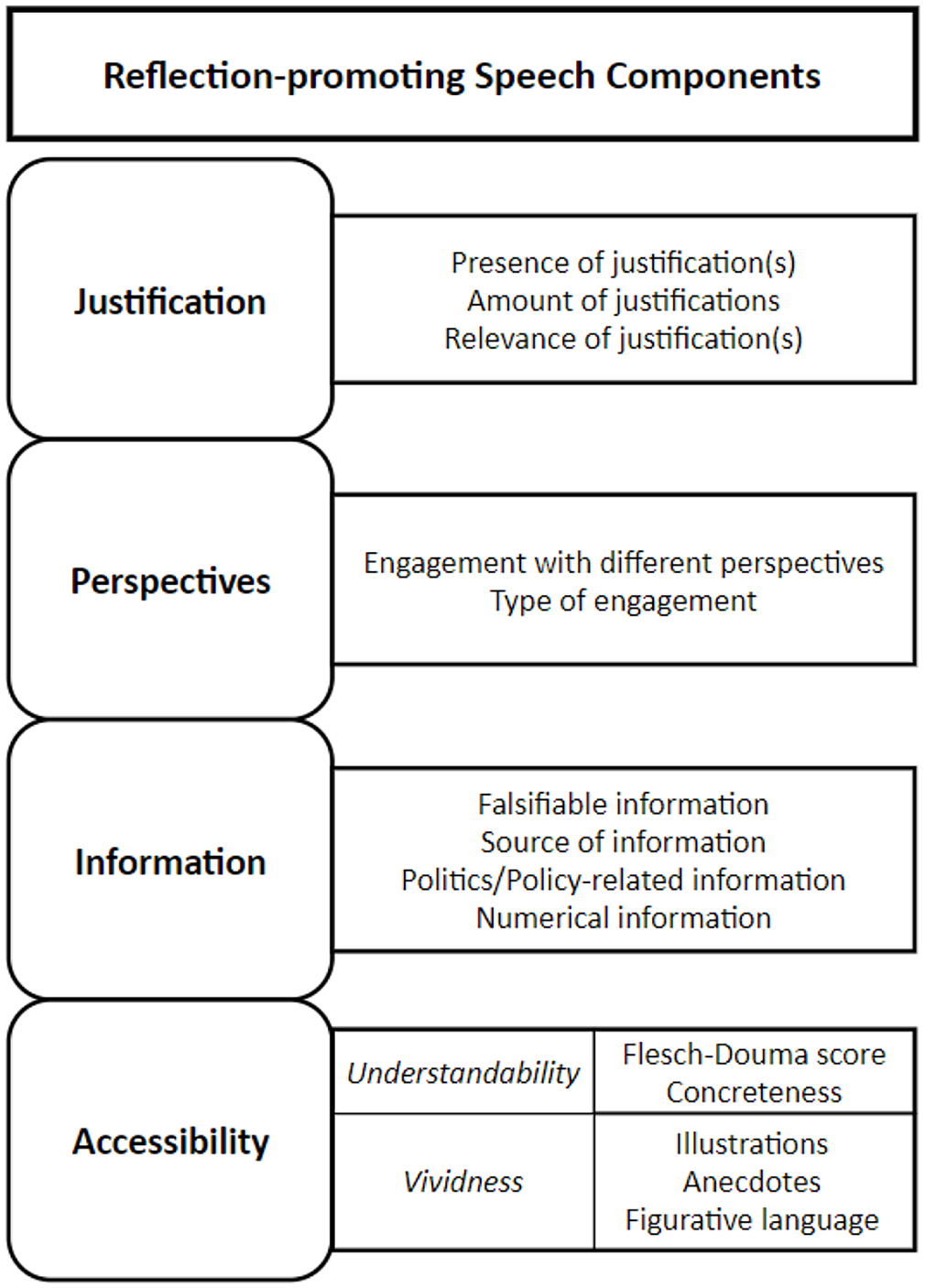
Operationalization of the Reflection-Promoting Speech Components.
The
The
The
The
To assess inter-coder reliability, a random sample of six debates (20% of turns) was coded by a second coder. The scores for all manually coded indicators are well above common thresholds for satisfactory reliability. All percentage agreements vary between 88% and 99.5%, indicating substantial to almost perfect agreement. All Cohen’s kappa values, which corrects for similar coding by chance, vary between 0.673 and 0.881, indicating moderate to substantial agreement (Online Appendix E).
Analysis
To test the hypotheses, indexes are created for the separate components, as well as a general index that comprises the four speech components. Each component has an equal weight in the general index 7 (see Online Appendix F for the construction of the indexes). A principal component analysis shows that the four components form one coherent set (Online Appendix C). To analyze the results, trend lines are presented for the general index (H1) and the separate component indexes (H2a-d). Trend lines are also displayed for the different indicators, to show an even more detailed picture. Regression analyses are conducted to include information about effect sizes. Because the dataset is a close-to-perfect representation of the population of election debates in Belgium, we focus particularly on the explained variance and interpret (significant) p values with caution as they might overestimate the effect, especially when the explained variance is small.
Results
Figure 2 displays the trend line of the general index for the combined mean scores of the reflection-promoting speech components over the past 35 years. There is a difference of 0.20 points on a 0–4 scale between the first and last measuring point (M1985 = 1.41; M2019 = 1.21). The overall mean for the 35 year period is 1.29 (SD = 0.118). There are some small ups and downs in between these two time points, but there is no general systematic increase or decrease to detect over time, which is confirmed by an OLS regression analysis (Table 1; B = −0.001; p = 0.348; R2= 0.000). Based on this, H1 is not supported: there is no decline detected in the overall use of reflection-promoting speech in election debates between 1985 and 2019.
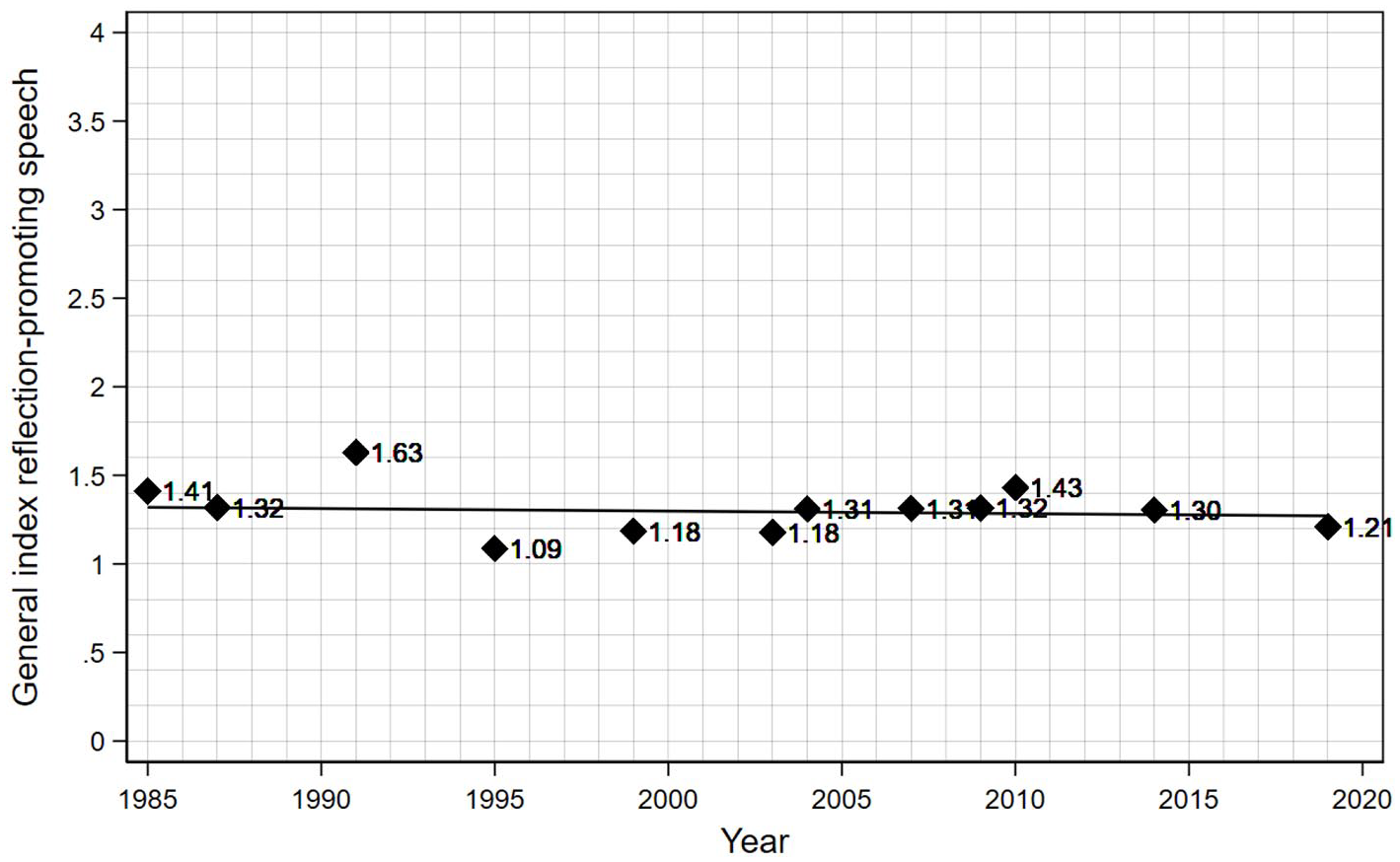
General Index of Reflection-Promoting Speech Components.
Results for General Index and Separate Reflection-Promoting Components.
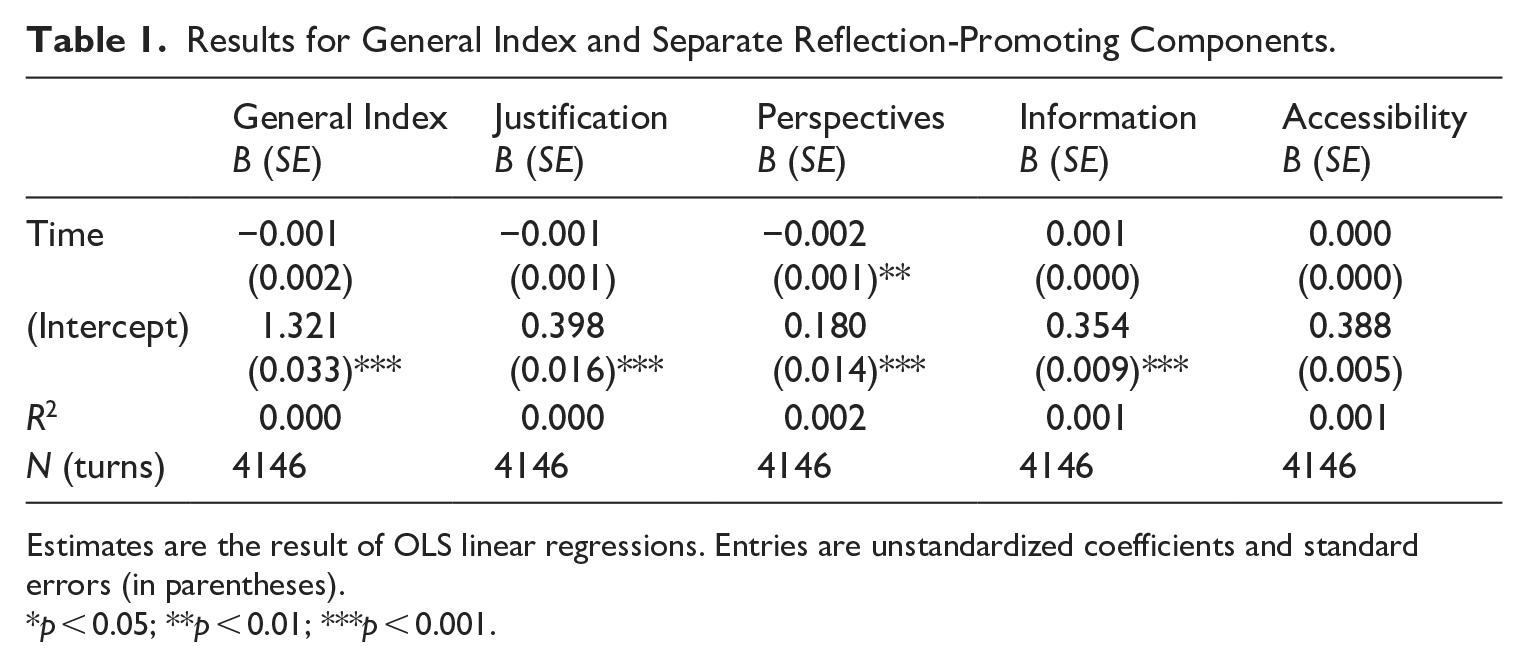
Estimates are the result of OLS linear regressions. Entries are unstandardized coefficients and standard errors (in parentheses).
p < 0.05; **p < 0.01; ***p < 0.001.
Notwithstanding the absence of a downward or upward trend, the data do show small ups and downs around the mean of 1.29, with the largest difference in scores between two subsequent election years: a maximum mean score of 1.63 in 1991 and a minimum score of 1.09 in 1995 (for an overview of descriptive statistics per election year, see Online Appendix G). Interestingly, this indicates that contextual factors influence the use of reflection-promoting speech at certain points in time and that it does not take decades to see gradual changes. The leap in 1995 may particularly be explained by the fact that populist politicians participated in the debates for the first time. 8 Moreover, in 1995 commercial broadcaster VTM organized its first election debate, which could have stimulated the public broadcaster VRT to compete with VTM in the newly emerged battle for viewers (Brants and Van Praag, 2006). 9
Next, Figure 3 presents the evolution for each reflection-promoting speech component separately. Looking at Figure 3(a) and (b), we observe a slight downward trend for the Justification component and the perspectives component. Yet, the regression analysis 10 for the relationship between time and the justification component shows that the model explains virtually no variance and that the relationship is non-significant (B = −0.001; p = 0.221; R2 = 0.000). For the perspectives component as well, the model explains only an extremely small amount of variance, even though the relationship is significant (B = −0.002; p = 0.010; R2 = 0.002; Table 1). Because of this low explained variance, H2a and H2b are not supported. For the information component, a modest increasing trend is observed (Figure 3(c)). This contradicts the expectations for this component (H2c), but a regression analysis again shows that the effect is very small and only marginally significant (B = 0.001; p = 0.093; R2= 0.001). In sum, H2c is not supported. For the accessibility component, an increasing trend was expected but not found (H2d). The effect is extremely small and only marginally significant (Figure 3(d); B = 0.000; p = 0.092; R2 = 0.001). Therefore, H2d is not supported.
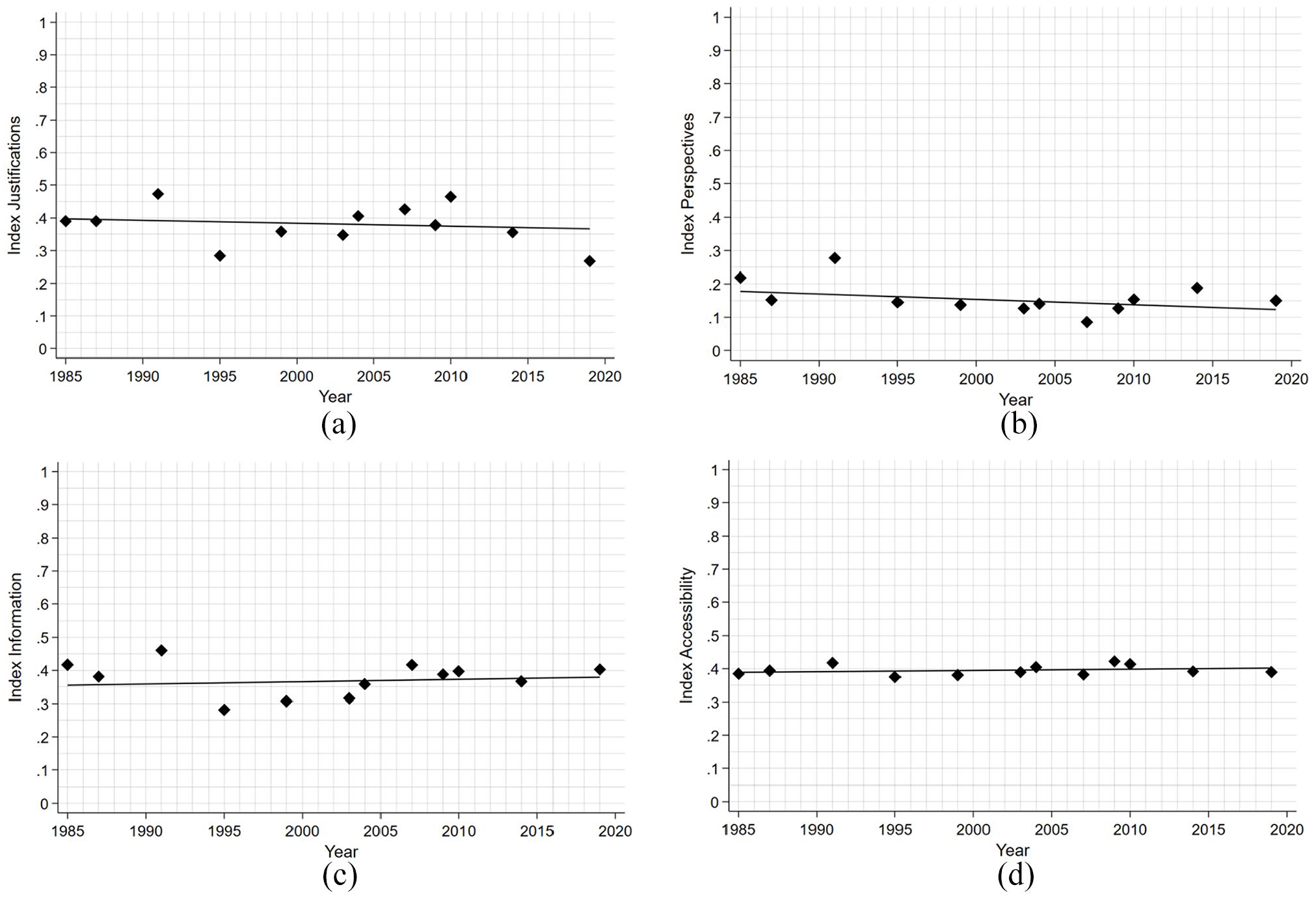
Mean Scores for Separate Reflection-Promoting Speech Components: (a) Justification Component; (b) Perspectives Component; (c) Information Component; (d) Accessibility Component.
Since all trend lines display only limited changes over time and effect sizes are small, we do not find empirical evidence for the often assumed and expected decreases in the different reflection-promoting speech components over the past 35 years. While there is no clear decrease, the separate time points of the perspectives component, and particularly the justifications and information components, show ups and downs over the years. This indicates that rather than an overall decline, these components are influenced more by contextual factors explaining their descend and surge at particular points in time. We do not observe this fluctuating pattern for the accessibility component.
The trend lines furthermore provide interesting insights regarding the prevalence of the different components in the debates. We observe that the justification component (M = 0.381; SD = 0.412), information component (M = 0.359; SD = 0.237) and accessibility component (M = 0.396; SD = 0.126) all hover around similar mean values of 0.36–0.40 on the 0–1 scales. For the perspectives component, the mean score is considerably lower (M = 0.148; SD = 0.351). An explanation for this may be that different perspectives are already presented by the different politicians in the debate, so explicit mention of one’s opponent viewpoints is likely to be lower on the debating politician’s priority list, as compared with the provision of justifications, information and accessible language to inform and persuade potential voters. Furthermore, talking about one’s own points may persuade citizens more than engaging with other participants’ talking points. For a detailed overview of descriptive statistics of each component, see Online Appendix G.
As a final step, time trends of each component’s indicators are presented in Figure 4 to offer even more in-depth insights (see Online Appendix G and H for descriptive statistics and regression analyses). Regarding the justification component, no decrease over time is observed for the presence and relevance of justifications (Figure 4(a)). This is confirmed by logistic regression analyses (ORpresence = 1.001; p = 0.811; ORrelevance = 0.999; p = 0.801). Figure 4(a) does show a downward trend in the number of justifications over time. This is confirmed by a logistic regression (OR = 0.984; p = 0.000), indicating that with every unit increase in time, the odds of more than one justification being provided decrease by a factor of 0.016 (or 1.6%, a small effect). Figure 4(a) shows that the decline can particularly be attributed to a sudden decrease in justifications after 1995: the number of justifications drops in 1995, as compared with the years before. After 1995, the quantity of justifications remains at a similar level and fluctuates around a lower baseline.
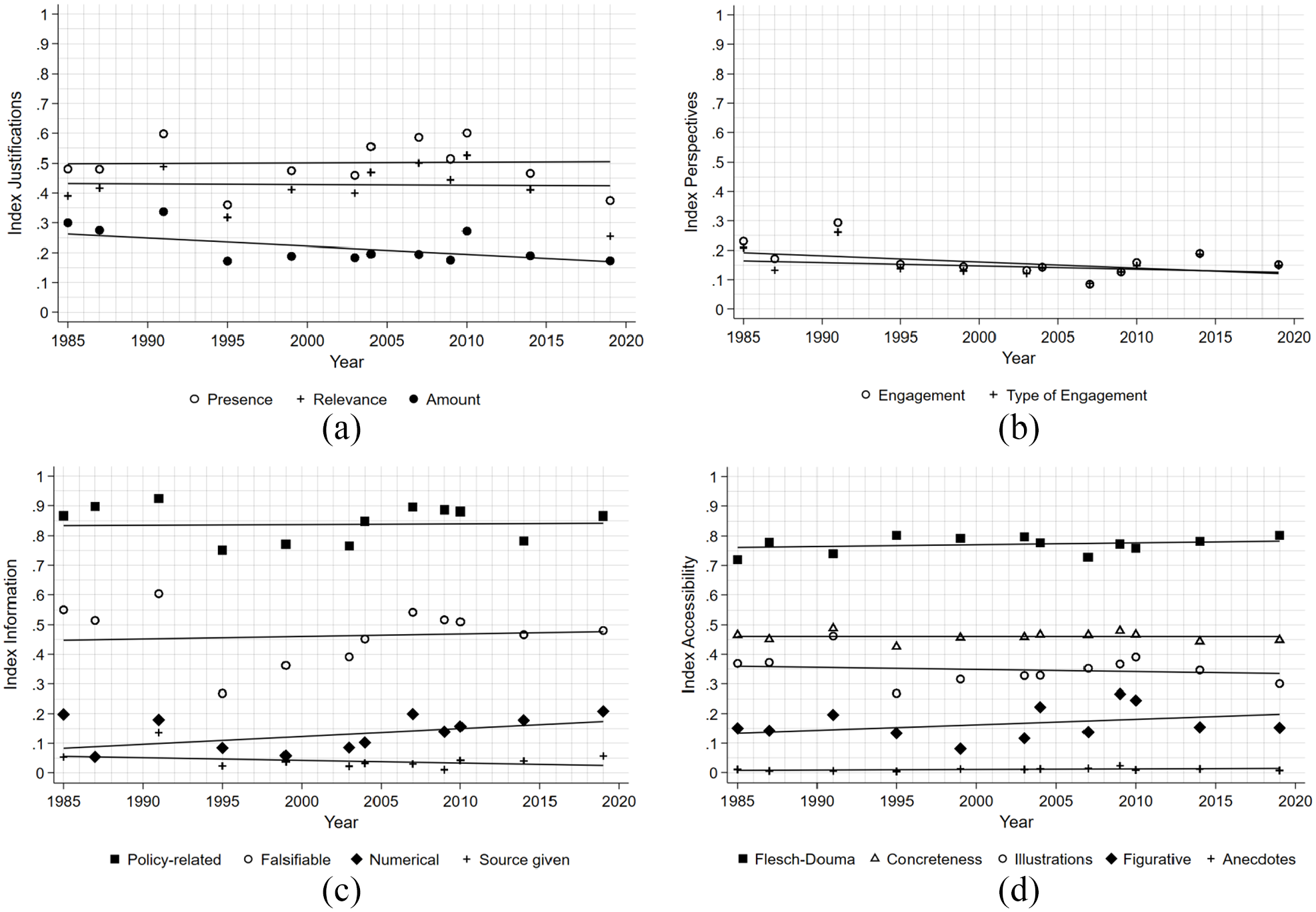
Mean Scores for Separate Reflection-Promoting Speech Indicators Over Time: (a) Justification Indicators; (b) Perspectives Indicators; (c) Information Indicators; (d) Accessibility Indicators.
Figure 4(b) presents a small downward trend for both indicators of the perspectives component. This is confirmed by logistic regression analysis: both indicators decrease slightly over time (ORpresence = 0.984; p = 0.001; ORnon-neutral = 0.991; p = 0.069). Again, odds ratios indicate that the effects are very small.
Figure 4(c), presenting the information indicators, shows that the trend lines for relevant and falsifiable information do not show a downward or upward trend, which is also confirmed by the logistic regression analyses (ORrelevance = 1.002; p = 0.727; ORfalsifiable = 1.003; p = 0.338). Regarding politicians’ references to the source where information can be checked, a small downward trend is observed, which is confirmed by a logistic regression but again the effect is very small (OR = 0.977; p = 0.009). Last, the slight upward trend detected in politicians’ use of numerical information is very small as well (OR = 1.024; p = 0.000).
Figure 4(d) displays the indicators of the accessibility component. The first indicator of language comprehensibility (i.e. the Flesch-Douma measurement) shows a fairly stable pattern over time. While a regression analysis shows a significant positive effect, it is extremely small (B = 0.001; p = 0.044; R2 = 0.001). Language concreteness, the second indicator of language comprehensibility, shows a stable pattern over time, which is also confirmed by regression analysis (B = −0.000; p = 0.962; R2 = 0.000). Next, for language vividness, politicians’ use of illustrations and anecdotes is also stable over time, which is observed in Figure 4(d) and confirmed by logistic regression analyses (ORillustrations = 0.997; p = 0.394; ORanecdotes = 1.018; p = 0.302). Finally, a small rise is detected in politicians’ use of figurative language (e.g. metaphors and analogies), but the effect is again very small (OR = 1.014; p = 0.005).
With regard to the prevalence of the different indicators, we find strong differences depending on the indicator under study. There are some interesting findings to emphasize. First, Figure 4(b) shows that both indicators of the perspectives component follow similar time patterns. While the perspectives component scores are low, this indicates that when a politician does engage with a different perspective, they generally attach a positive or negative judgment to it which increases the information value of the politician’s statement. Second, some indicators are highly prevalent in the debates. For instance, the information politicians provide is mostly policy-related. Moreover, language comprehensibility is high: politicians’ language is generally “fairly easy” to understand (Online Appendix D). Anecdotes are, in contrast, almost completely absent. Last, most indicators show noteworthy ups and downs over time, again indicating that contextual variables play an important role and influence short-term changes in the reflection-promoting speech components in election debates.
Discussion and Conclusion
It has been argued theoretically that televised election debates have the potential to promote reflective reasoning among citizens (Coleman, 2020). Concerns have been raised repeatedly, however, about the low and declining quality of political communication in general and election debates more specifically, which could prevent citizens to arrive at reflective judgments (Dryzek et al., 2019; Kaal, 2014). Yet, longitudinal research on this is scarce, especially outside the US context. In this study, we put these allegations to an empirical test, by first identifying a framework of four reflection-promoting speech components, and subsequently conducting a systematic, longitudinal analysis of reflection-promoting speech in election debates in the Western European context of Belgium (1985–2019).
Contrary to concerns and theoretical arguments, we did not find the expected decline (nor a rise) in the prevalence of three rational-speech components (justifications, perspectives and information). Therefore, allegations about the deteriorating quality of election debates should be asserted with caution. Moreover, we looked beyond rationality and expected the language in the debates to have become more accessible over time. Interestingly, a rise (nor a decline) was detected.
Notwithstanding the absence of strong declining or rising trends, we observed (slight) ups and downs over time. This fluctuating pattern indicates that the prevalence of reflection-promoting speech at certain points in time is context-dependent. We therefore encourage future research to study the influence of contextual factors, such as the topic under discussion (e.g. polarizing issues), or the format of the debate (e.g. number of politicians debating each other). Moreover, the findings show that the more specific the level of analysis, the less stable the trend lines, and the stronger the ups and downs over time. On one hand, this shows that detailed analyses are useful to map what happens for different specific indicators and can provide detailed insights. On the other hand, it is also important to zoom out and not make strong generalizations to overall debate quality based on singular discourse characteristics. As such, this study contributes precisely by combining and studying a multitude of reflection-promoting speech components and indicators together, to make an assessment of the debates’ overall reflection-promoting potential.
Notably, this study also shows that debates should not all too swiftly be disregarded as nondeliberative events that harm democracy (see also Wessler and Schultz, 2007). Although mediated debates may not be the most likely place to find the highest instances of reflection-promoting speech (certainly not on all components), this study empirically supports the theoretical claim that election debates have reflection-promoting potential (Coleman, 2020). Most of the turns in the debates were understandable and policy-related, and nearly half of the turns included at least one justification and falsifiable statement. As a consequence, it may not be political debates in the media where worries about low and declining debate quality come from; they may even have a role to play in strengthening democracy. This signals the importance of perpetuating scholarly efforts that investigate the roots of existing concerns about political discourse. Therefore, we encourage future studies to examine reflection-promoting (or preventing) discourse in other venues, such as the news media or social media discussions (e.g. Farnsworth and Lichter, 2004; Ott, 2017). By covering politics in increasingly simplistic ways, the news media may, for instance, feed the concern and impression that politics became less reflection-promoting overall.
This study is not without limitations, leaving some compelling paths for future research. First, the theorized societal trends did not impact the use of reflection-promoting speech over time as expected and contextual factors at certain points in time matter more. Following our argument that several Western democracies are characterized by these trends, also in other countries a clear decline or rise in reflection-promoting speech may not occur, and different contextual elements may matter more. We encourage future research to conduct cross-national longitudinal research across a wide range of countries (e.g. with or without increasing polarization, majoritarian vs multi-party systems) to gain a deeper cross-national understanding of evolutions in reflection-promoting speech. Second, criticism is also regularly voiced in the academic and public debate about politicians’ disrespectful statements in televised debates (e.g. Mutz and Reeves, 2005). Although the framework used here includes engagement with other perspectives, which can be connected to respect (Bächtiger and Parkinson, 2019; Gutmann and Thompson, 1996), we did not study more language-style respect forms, generally referred to as (in)civility. High prevalence of uncivil attacks could distract the public from the substantive content and may, therefore, also decrease the debates’ reflection-promoting potential, which is something future research could look into. Third, the presented framework is not exhaustive and has limitations. For instance, truthfulness could not feasibly be included. Furthermore, all components entail verbal or spoken expressions by politicians in the debates, while non-verbal elements can also promote (or prevent) reflective reasoning among citizens (Mendonça et al., 2020). We thus encourage future studies to extend and further improve the framework presented here.
Finally, we recognize that the indicators and components identified as reflection-promoting might also be deployed strategically by politicians, which potentially hampers reflective reasoning. Most notably, falsifiable information and accessible language may be used to sneak misleading, false or simplistic information into the debates and public realm. The debate context controls for this to a certain degree (compared with, for example, political speeches or social media). Participants and moderators can immediately point to and challenge lies and overly simplistic solutions, thereby perhaps spurring the audience to actually reflect more. Yet, more research is needed that studies the actual truthfulness and strategic use of falsifiable and accessible claims, which type of politicians may strategically use such speech elements more (e.g. populists vs non-populists), the degree to which debate participants challenge misleading information, and the effects all of this has on citizens’ reasoning patterns.
To conclude, this study has built on previous work to theorize about and empirically study reflection-promoting speech in election debates. We encourage future work to expand this research agenda and further examine and map reflection-promoting speech, its effects, and the intricacies of the different components, in other contexts and countries. That way, we can move beyond assumptions of low debate quality and gather more systematic and empirical evidence about political communication that promotes or prevents reflection among citizens.
Supplemental Material
sj-docx-1-psx-10.1177_00323217221090102 – Supplemental material for Food for Thought: A Longitudinal Investigation of Reflection-Promoting Speech in Televised Election Debates (1985–2019)
Supplemental material, sj-docx-1-psx-10.1177_00323217221090102 for Food for Thought: A Longitudinal Investigation of Reflection-Promoting Speech in Televised Election Debates (1985–2019) by Emma Turkenburg and Ine Goovaerts in Political Studies
Footnotes
Acknowledgements
We thank the anonymous reviewers for their valuable comments and suggestions. Previous drafts of this paper were virtually presented at the ECPR General Conference 2020; the Dutch-Belgian Politicologenetmaal 2020; the “Belgium: State of the Federation” conference 2020; a Research Colloquium of the Argumentation and Rhetoric Group (University of Amsterdam); the 2021 ICA Annual Conference; and the 2021 NextGDC Symposium. We thank all discussants and participants for their insightful comments and helpful feedback. We also extend gratitude to our colleagues from KU Leuven’s Democratic Innovations and Legitimacy Research Group, as well as to André Bächtiger and Jenny de Fine Licht for their valuable input and the constructive discussions. We thank Wilbert Spooren and Erwin Komen for their help with and advice on the automated coding of concreteness. Finally, we are grateful to our former research assistants for their aid and effort in transcribing the debates.
Declaration of Conflicting Interests
The author(s) declared no potential conflicts of interest with respect to the research, authorship, and/or publication of this article.
Funding
The author(s) disclosed receipt of the following financial support for the research, authorship, and/or publication of this article: This work was supported by the FWO Research Foundation Flanders under Grant no. G068417N, and Internal Funds KU Leuven under Grant no. C14/17/022.

Data Availability Statement
Supplemental Material
Supplemental material for this article is available online.
Notes
Author Biographies
References
Supplementary Material
Please find the following supplemental material available below.
For Open Access articles published under a Creative Commons License, all supplemental material carries the same license as the article it is associated with.
For non-Open Access articles published, all supplemental material carries a non-exclusive license, and permission requests for re-use of supplemental material or any part of supplemental material shall be sent directly to the copyright owner as specified in the copyright notice associated with the article.
