




Abstract
The UK parliament of 2017–2019 had to decide what form of Brexit, if any, it would accept in the government’s negotiations with the EU over a withdrawal agreement. Despite a large majority of MPs having supported Remain in the 2016 referendum, with most opposed to a ‘hard’ Brexit of looser ties between the UK and the EU, all attempts to pass a ‘soft’ Brexit failed. The final withdrawal agreement reflected a hard Brexit that was closer to the preferences of a 28-strong group of Eurosceptic Conservative MPs than to those of any other party or faction in a 650-seat parliament. This article identifies the two-party system for government as a crucial variable in explaining this unexpected outcome. Governments seek majorities from among their own MPs rather than relying on the uncertain support of the opposition. This not only makes party cohesion vital, but also creates leverage for organised factions to hold sway.
The European Union Referendum Act 2015 required the government to hold a referendum on the UK’s membership of the EU by late-2017. The pre-legislative nature of the referendum meant that, although the UK’s decision to leave the EU was taken in 2016, the terms of exit would be settled by the government in consultation with the EU. That set the scene for a struggle between Leavers and Remainers in the UK parliament over what type of deal to seek from the EU. The hung parliament of 2017–2019 contained (1) a large minority of pro-Remain opposition MPs seeking a second referendum; (2) a smaller minority of mainly Conservative ‘hard’ Brexiteers; and (3) loyalist government MPs and pragmatic opposition MPs prepared to settle for a ‘soft’ Brexit, where the UK would leave the EU but retain strong ties (Bale, 2020; Lynch, 2020; Russell, 2021; Whitaker, 2020). Such settings are usually ripe for a middle-ground compromise, given the lack of support for more polarised options. Yet parliament repeatedly rejected various forms of soft Brexit, such as former prime minister, Theresa May’s, negotiated Brexit deal, a customs-union or continued single-market membership (Rutter and Menon, 2020). Instead, a rival Brexit deal, negotiated by May’s successor, Boris Johnson, was notably ‘harder’ and endorsed by parliament. How can this outcome be explained?
Existing research has detailed the chaotic events and institutional manoeuvres that characterised the failed attempts by May’s government to pass its negotiated withdrawal agreement (Russell, 2021). Both major and most minor parties took decisions that reduced the possibility of soft Brexit (Rutter and Menon, 2020). This article does not contest these arguments, but takes the explanation back one stage to the structure of the political system and its location on the executives-parties dimension (Lijphart, 2012), which determines how different intra- and/or inter-party preferences are resolved into government policy. In Britain’s majoritarian democracy, power is institutionally concentrated and usually exercised by single-party governments (Powell, 2000). This incentivises leaders to maintain party cohesion and factions to exploit that fact to secure policy gains.
This article argues that the UK’s legislative party system, premised on the alternation of single-party Conservative and Labour governments, played a decisive role in both constraining and permitting policy outcomes. More specifically, the incentives for intra- and inter-party competition associated with two-partism helped to foreclose a softer Brexit. On one hand, governments in two-party systems have strong incentives to seek majorities exclusively from among their own MPs and avoid cross-party compromises. Doing so maintains their distinctive electoral offering, excludes other parties and helps preserve both major parties’ alternating duopoly on power. On the other hand, factions within governing parties can be incentivised to withhold their support and attempt to shift policy towards their own preferred points. These incentives are always in tension because major parties in two-party systems are ‘broad churches’ with considerable preference heterogeneity among their MPs. These incentives were acutely in tension in the 2017–2019 parliament, partly because of the range of preferences over Brexit within the governing Conservative Party and partly because the Conservatives governed as a minority. Yet, it was not the absence of a majority per se that prevented May’s government passing its Brexit deal; it was the relative size of the hard-Brexit Tory faction, which enabled it to achieve its goal. This article uses a spatial model to show how.
The article makes four contributions. First, it adds to the literature on Brexit, one of the major events in post-war UK politics. The process of securing Brexit has attracted considerable comment, whether the referendum, the UK–EU negotiations, or the parliamentary and legal struggle (Aidt et al., 2021; Clarke et al., 2017; Matthews, 2017; Russell, 2021; Weale, 2017). Second, the article contributes to the understanding of UK executive–legislative relations more broadly (Benedetto and Hix, 2007; Cox, 1987; King, 1976; Russell and Cowley, 2018; Tsebelis, 2002). The Westminster system is easily caricatured as one in which the government dominates parliament. The hung parliament of 2017 challenged that interpretation, but more fundamentally, so did the weakened internal cohesion of the governing party (Russell, 2021; see Cowley, 2005; Lynch and Whitaker, 2013; Norton, 1975). Third, the article illuminates the role of factions within legislative parties (Ceron, 2019; Rose, 1964). Finally, the article treats the legislative party system (Aldrich, 2011; Dewan and Spirling, 2011; Kam, 2014; Saalfeld and Strøm, 2014) as a causal factor in the Brexit deal. A different party system would likely have produced a different outcome.
Legislative Party Systems
The power of the median actor in voting bodies is well-known in political science (Black, 1958). Although most famously applied to elections via the median-voter theorem (Downs, 1957), the power of the median holds in legislatures. The median legislator is the MP who would have equal numbers of legislators standing either side if all legislators were aligned left to right along a single ideological dimension. The preferred position of the median legislator would defeat all others in pairwise votes (Döring, 2001; Laver and Schofield, 1990).
Deploying the concept of the median actor in legislatures is complicated by the existence of parties and party systems. Parties are groups of legislators that seek to adopt a single agreed position in legislative votes (Aldrich, 2011). A party’s policy position is rarely identical to the preferences of all its individual legislators, particularly in ‘broad church’ parties, which cover a wide range of preferences. This means legislative policy outcomes may not reflect the preferences of the median legislator but the collective position of the median party. Assuming parties are internally cohesive, the median party has leverage in the legislature. Even without a majority, it can play off parties to its left and right to achieve its preferred outcomes (Laver and Schofield, 1990).
Party systems are patterns of interaction among parties, whose principal focus is the quest to form or influence governments (Mair, 1997; Sartori, 1976). Two-party systems, typically based on plurality voting, are zero-sum contests to form single-party governments. These usually possess majorities, but the presence of small ‘third’ parties sometimes results in hung parliaments and minority administrations. In multi-party systems based on proportional representation, coalitions are the norm, with government policy the result of inter-party bargaining (Duverger, 1964; Ware, 1996).
Figure 1 depicts various party systems on a left–right spectrum. Each party’s individual legislators are assumed to be evenly spaced from left to right, with the size of each party box indicating its legislative strength. The median legislator (M) is always in Party B. Five policy options (V-Z) are presented, with X being the preference of M. Figure 1(a) shows a no-party system, where all legislators are independents. This is a committee-type scenario where M’s preference, X, defeats all others and is the only stable outcome. Figure 1(b) shows a two-party system, the post-war norm in Britain, with Party B enjoying a legislative majority over Party A. When one party has an absolute majority, by definition, it controls the median legislator. However, while M is centrist, there is no guarantee that Party B as a whole will be. Three of the five policies, X, Y and Z, fall within the range of preferences of B’s legislators. Which one the party adopts will reflect an internal decision. It might be the preference of B’s own median (Y) or perhaps centrists could persuade it to adopt X. If the party is cohesive and the leader adopts Z, this would be the outcome, as Party A could not defeat it.
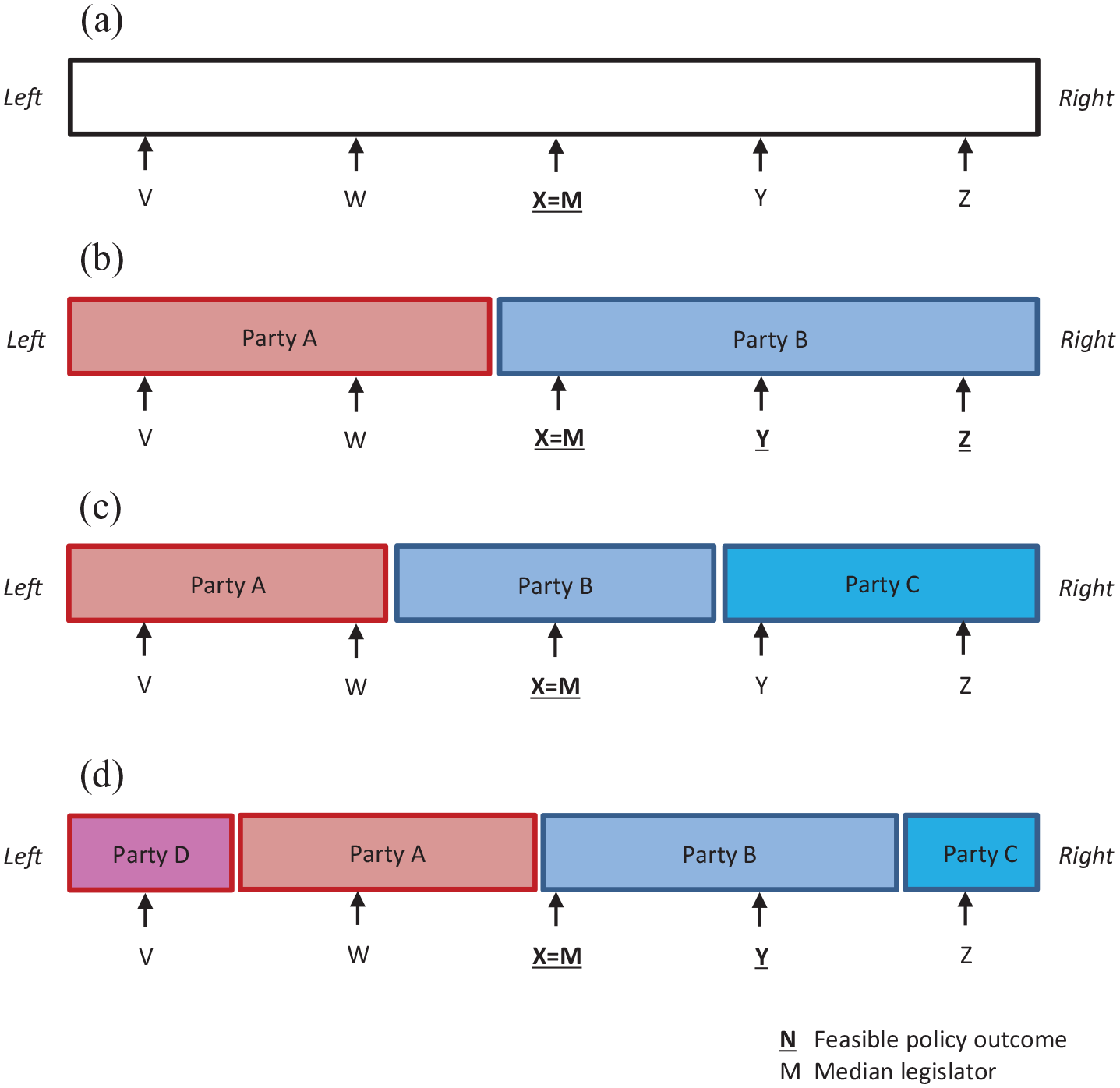
Five Policy Options Under Different Party Systems: (a) No-Party System, (b) Two-Party System, (c) Multi-Party System (1) and (d) Multi-Party System (2).
Different policy outcomes can arise in multi-party systems. A system of three evenly sized parties is shown in Figure 1(c), where Party B controls M. Despite not possessing a majority, Party B has great leverage to negotiate an outcome close to its preference at X because it has the choice of dealing (and forming coalitions) with either Party A or C. Indeed, X is the only feasible policy because Party A would join B in voting for it over Y and Z, while Party C prefers it to V and W. Such scenarios are unusual in the UK, although the three-party system of the 1920s was a rare example.
Figure 1(d) shows a four-party system of the type seen in consensus democracies (Lijphart, 2012). Party B is the median but the range of its legislators’ preferences cover X and Y. Once Party B has chosen between X and Y, the rejected option is unavailable to the other parties, provided that B remains internally united. Whether it chooses X or Y, either is preferred by parties A and D to Party C’s preference, Z, while C in turn prefers either X or Y to both V and W.
Feasible policy outcomes are limited to the preference of the median legislator in a no-party system but expand in number under a system of cohesive parties. These options are maximised under two-partism because the median party’s legislators cover a wider ideological range than under multi-partism. Electoral competition imposes costs on non-centrist positions under two-partism (Downs, 1957). But when elections are far off, governments enjoy partial protection from public opinion. They may implement policies reflecting their MPs’ preferences in the expectation they will lose salience by the next election. That may have little effect in a multi-party system, where the median party is likely centrist, but under two-partism, each party’s centre of ideological gravity is usually non-centrist. Consequently, government policy in majoritarian democracies is further from the median voter’s preferences than in consensus democracies (Powell, 2000).
Party Cohesion in Two-Party Systems
The assumption above was that legislative parties are cohesive. That means they are united teams of politicians who collectively decide policies and support them in legislative votes. It is a reasonable first approximation of two-party systems in parliamentary democracies, where cohesion is strong for self-interested and normative reasons (Bowler et al., 1999; Kam, 2014; King, 1976).
Legislative two-partism produces a government-versus-opposition model (Dewan and Spirling, 2011). A majority governing party can pass its policies relying on its own MPs while disregarding the opposition party. The support of the latter cannot be relied on. The opposition’s role is to oppose the government, setting out a rival programme and offering itself as a government-in-waiting. That function is undermined if it helps pass government legislation.
Party cohesion must be worked at because major parties’ MPs cover a wide ideological range (Figure 1(b)). When governing parties seek policies that are opposed by many of their own MPs, dissent and division weaken their internal cohesion (Kam, 2014). Divided parties look ineffective and struggle to win elections. Leaders have various tools to enforce discipline, the principal one being the party whip, whereby MPs formally belong to their party’s parliamentary group. Without the whip, MPs cannot run for election as members of their party. Since most voters vote for parties, losing the whip could damage a politician’s career (Saalfeld and Strøm, 2014).
Leaders can use patronage to incentivise compliant behaviour by MPs. Ambitious politicians desire to be promoted to senior ranks, such as the cabinet. That is more likely for those who show loyalty (Benedetto and Hix, 2007). On the front bench, collective responsibility requires them to vote with their party, constituting its ‘payroll vote’. If they wish to oppose their party’s line, they are expected to resign their front-bench position, as many would do so over Brexit.
Rejecting the party line is more attractive for MPs whose preferences are distant from their party’s settled position (Benedetto and Hix, 2007). Before voting against their parties, they would need to weigh the risk of losing the whip. They may decide there is safety in numbers, with large numbers of MPs unlikely to lose the whip simultaneously. Sub-groups of like-minded MPs that coordinate their activities are factions (Ceron, 2019; Rose, 1964).
Parties are sites of internal conflict. MPs have preferences over their leaders, as the latter have power over policy and disperse patronage, particularly they are when prime minister (Dowding, 2013). Leaders in turn may decide to balance different factions in the (shadow) cabinet. MPs use these positions and resources to influence party policy, which all members are expected to support (Bowler et al., 1999). Under two-partism, they determine government policy. Under multi-partism, internal struggles are merely the first stage of bargaining, with inter-party coalition negotiations to follow (Laver and Schofield, 1990; Ware, 1996). The government–opposition model of two-partism prioritises internal governing-party politics in policy-making. Under multi-partism, inter-party bargaining is key. Government–opposition relations are less clear-cut, with opposition parties potentially able to attract support from governing parties to form new coalitions.
Factions in Two-Party Systems
Intra-party factions characterise most parties but are particularly likely under two-partism because each major party covers a wide ideological range. A centre-right party will contain moderates but also radical rightists, as the latter have nowhere else to go. In a multi-party system with proportional representation, radical rightists could form their own party, whose legislative strength reflected its electoral appeal. A radical-right party in a two-party system operating under plurality rule would be wiped out, but not before splitting the right-wing vote and potentially handing victory to the left.
An organised and determined intra-party faction could exploit two-party competition to secure policy gains. Figure 2(a) replicates the two-party scenario in Figure 1(b). The difference is that the governing party, B, contains a sub-group of legislators (Faction B1) who are preference-outliers but whose votes are essential for the government’s legislative majority. Assume the faction prefers policy B1 while the leadership of Party B prefers B0. The faction could seek to shift policy closer to its own preference, B0′, by threatening to vote with the opposition against the government, as Conservative Maastricht rebels did in the 1990s (Lynch and Whitaker, 2013). Given their ideological distance, Party A and Faction B1 could not agree on a new policy but they could form a ‘bipolar’ blocking coalition (Figure 2(b)). That would prevent the government from changing the status-quo policy (Russell, 2021; Russell and Cowley, 2018).
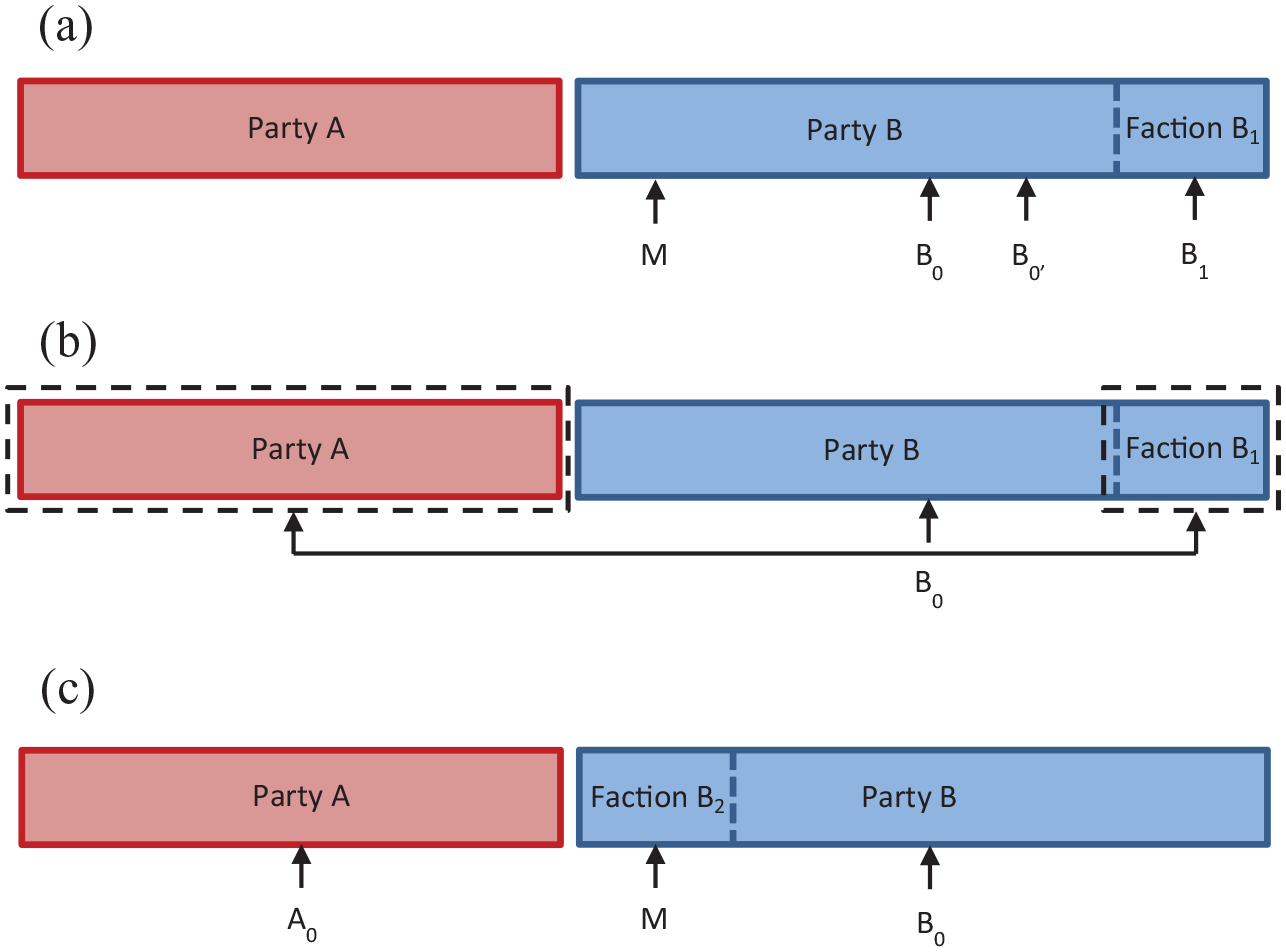
Intra-Party Factional Power in a Two-Party System: (a) Radical Faction in the Governing Party, (b) Blocking Legislative Coalition and (c) Centrist Faction in the Governing Party .
Government leaders could try to erode the faction’s bargaining power by persuading enough of its individual members to support the government. If the faction is cohesive and ideologically compact, it will be harder for government leaders to break its power. The leverage of Faction B1 is enabled by the government’s unwillingness to seek support from Party A.
If Party A can see that siding with Faction B1 will shift policy further to the right, it may abstain rather than oppose the government. However, there are circumstances in which it might take the risk. If Party A believed the government was unwilling to compromise with Faction B1, for example, because of the electoral costs of a non-centrist policy, then voting with B1 would preserve the status-quo policy.
A different situation is depicted in Figure 2(c), where the governing party contains a centrist faction, B2. Given that this faction includes M, it appears to be in a strong bargaining position with its own party leaders, who have set policy at B0. If Faction B2 threatened to ally with Party A (preference A0), it could vote down government legislation. An example would be Liberal anti-Home Rulers voting with the Tories to defeat Gladstone’s first Home Rule Bill in 1886.
Faction B2 might want to shift policy towards M. That would be the expected outcome in a multi-party system, where B2 was a separate party. But under two-partism, the government’s control of the legislative agenda would enable the prime minister to withdraw the legislation. Faction B2 could not pass legislation of its own in alliance with Party A unless it split from B and formed a new party or its members joined A. More likely is that Faction B2 would lobby its own party to change policy.
Cross-Party Alliances
Cross-party alliances under two-partism can block legislative outcomes but could they be deployed to pass bills? Figure 3(a) shows the governing Party B seeking to shift policy to M but constrained by some of its own right-leaning legislators. One solution could be to construct a cross-party alliance with legislators in Party A to create a new majority for a policy at M (indicated by the dashed box).
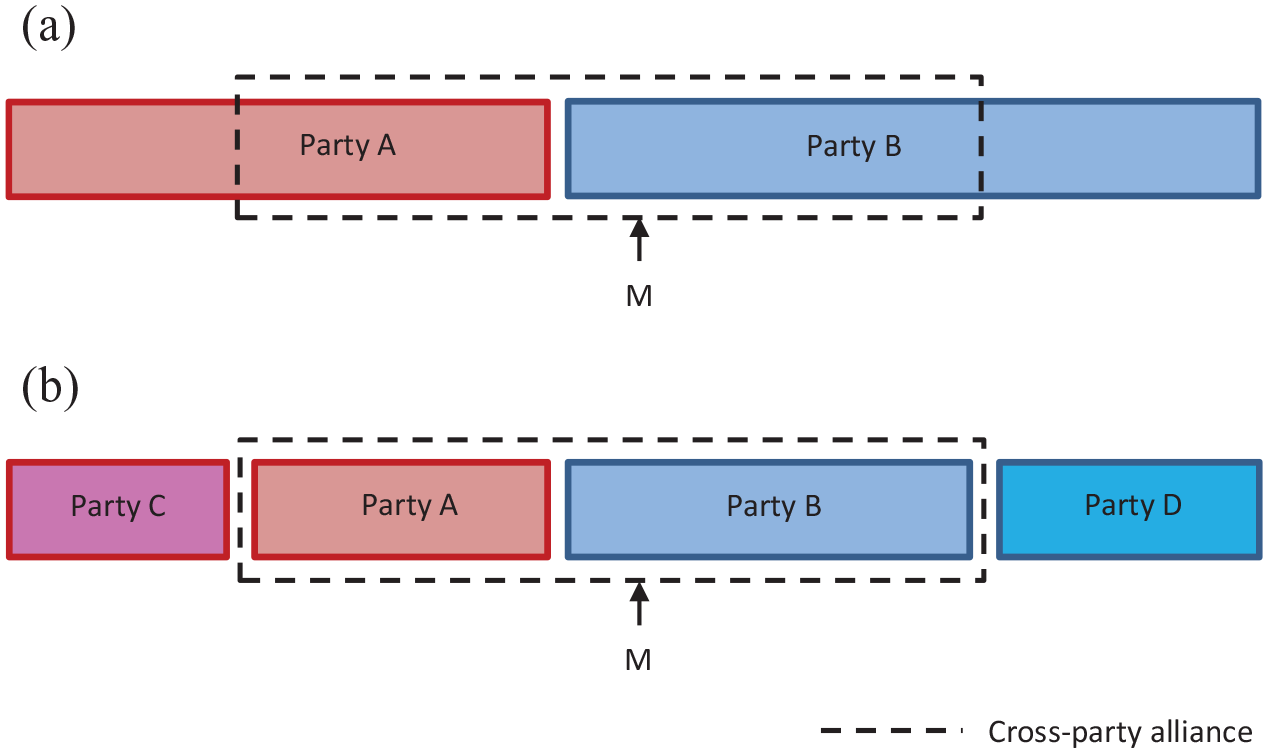
Centrist Cross-Party Alliances: (a) Two-Party System and (b) Multi-Party System.
The problem is that it splits both parties, undermining their cohesion, making it hard to control MPs and likely requiring new alliances for subsequent votes. Internal divisions could also cause electoral damage. Thus, cross-party alliances are rare in two-party systems, with cohesion and discipline paramount. Labour common marketeers’ support for the Heath government on European Economic Community membership in 1971 is a rare example. But Robert Peel splitting the Conservatives over free trade in the 1840s and paving the way for Liberal domination has long provided a cautionary tale (McLean, 2001).
Centrist cross-party compromises are easier to achieve under multi-partism. In Figure 3(b), the right-leaning parties, B and D, together possess a legislative majority. However, if B preferred a majority coalition with the centre-left Party A, the two parties would find it easier to compromise on policy at M. Each party covers a narrower ideological range of opinion than under two-partism. In Figure 3(b), the ideological range of the cross-party alliance (the dashed box) is identical to that in Figure 3(a) but neither party is split in 3(b) whereas both are in 3(a). Multi-party systems offer greater opportunities for cross-party compromise because, first, it is required (no party has a majority) and second it is less damaging to party cohesion than under two-partism (narrower range of preferences).
British Parties, Factions and Brexit Preferences
The theoretical insights of the previous section provide a framework to understand the parliamentary struggle to pass the UK’s withdrawal agreement with the EU in 2019. Other factors were certainly significant, notably the two-level game between the UK government and parliament, and the UK government and the EU (Russell, 2021). However, these are beyond the scope of this article. This section introduces the main party and factional actors.
Britain’s political system embodies majoritarian democracy (King, 2007; Powell, 2000). Typical of such states, Britain has a broadly two-party system in which single-party majority government has followed 18 of the 21 post-war general elections (Bartle, 2021; Quinn, 2013; Ware, 1996). One of the rare exceptions was the hung parliament of 2017–2019.
The Conservative prime minister, Theresa May, called an early election in 2017 to increase her party’s slim majority and achieve a Brexit settlement. However, a poor campaign saw the Tories lose their majority, although they remained the largest party (Allen and Bartle, 2018). May formed a minority government buttressed by a confidence-and-supply deal (including support on Brexit bills) with Northern Ireland’s Democratic Unionist Party (DUP). That gave the government a majority of four seats, but in reality it was 11 because Sinn Féin’s MPs do not take their seats in the Commons (Hayward, 2020). In 2017, almost 90% of MPs were Conservative or Labour, and while other parties had some influence, they tended to split along left–right and pro-/anti-Brexit lines (Bale, 2020; Lynch, 2020; Russell, 2021; Whitaker, 2020). Numerous MPs would subsequently switch parties, join new ones or become independents at a higher rate than usual, primarily related to Brexit but also reflecting Labour’s factional conflicts (Table 1). The distribution of party strength, however, conceals differing Brexit preferences inside the major parties. These are now set out.
Legislative Seats in the 2017–2019 UK Parliament.
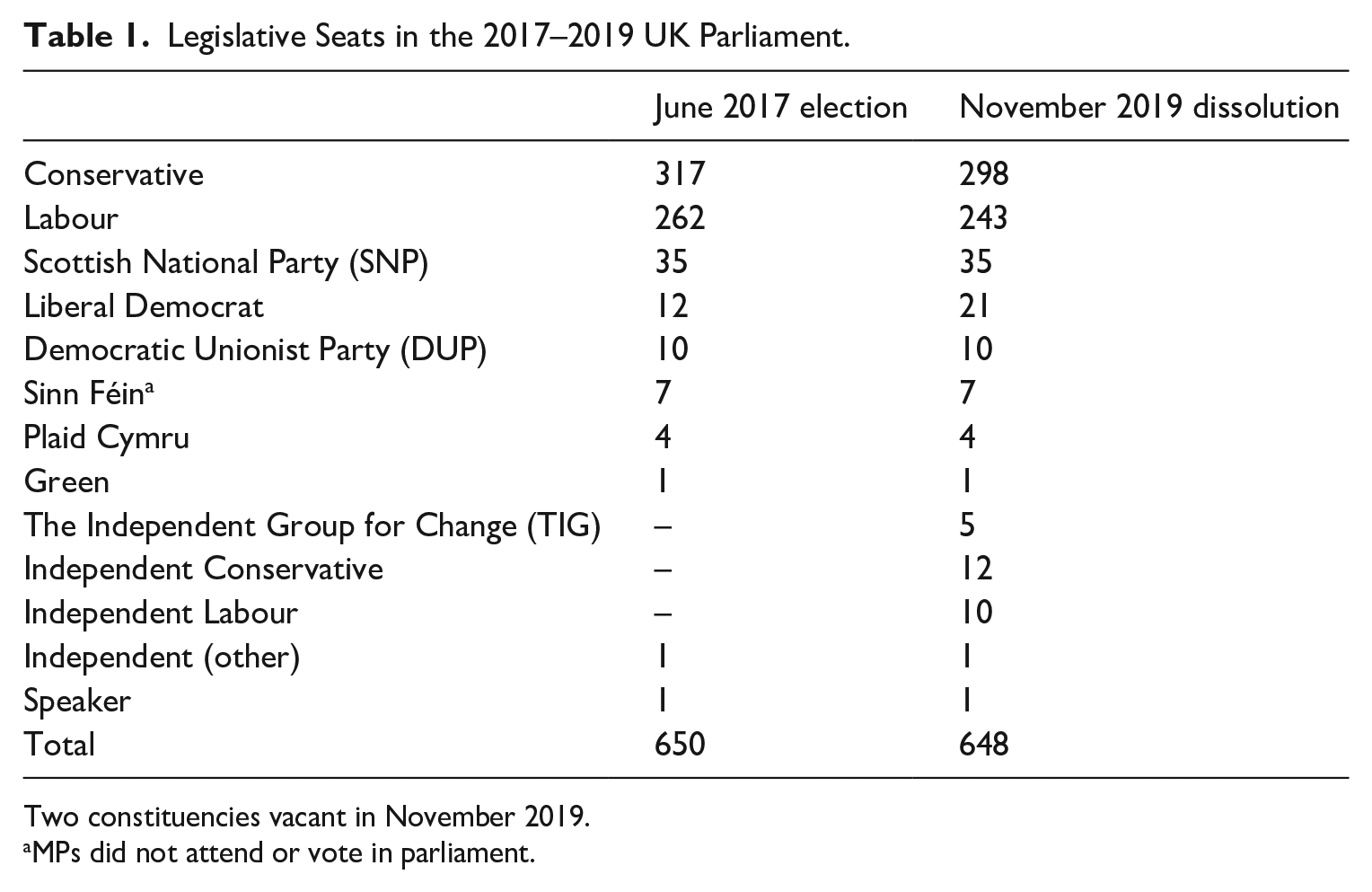
Two constituencies vacant in November 2019.
MPs did not attend or vote in parliament.
Brexit Preferences of May’s Government
Under two-partism, internal politics in the governing party is the primary determinant of policy outcomes, with the prime minister playing a pivotal role (Dowding, 2013). The first task, therefore, is to recount the Brexit policy of May’s Conservative government.
On becoming prime minister in 2016, May inherited a parliamentary party split between a majority of Remainers, some lukewarm, and a large minority of Leavers, often more ideologically committed and mainly on the backbenches. May was a Remainer but insisted that ‘Brexit means Brexit’, as a way of assuring Brexiteers that she could be trusted to deliver on the referendum (Brusenbauch Meislova, 2019). She formed a cabinet containing some prominent Brexiteers, such as the foreign secretary and leading Leave campaigner, Boris Johnson, but there was a majority of Remainers, including the chancellor, Philip Hammond, and home secretary, Amber Rudd. May’s cabinet became a site of seemingly permanent conflict over Brexit (Quinn, 2021).
May interpreted the referendum result narrowly as a demand to reduce immigration, in contrast to Brexiteers, who believed it was about sovereignty. Her preferred Brexit entailed leaving the EU’s single market, which entrenched the free movement of people across the bloc, while limiting the impact on UK–EU trade. Initially, May entertained a ‘harder’ Brexit, as in her Lancaster House speech of January 2017, but her view softened considerably after she lost her majority (Allen, 2018). Her subsequent ‘Chequers plan’ of July 2018 sought a zero-tariff customs deal with the EU based on a common rulebook, although the suspicion was that it would mean following EU rules (Scullion, 2020). ‘Chequers’ sought a middle position between cabinet Remainers and Brexiteers, although it prompted the first in a series of resignations by Brexiteers, including Johnson (Quinn, 2021).
‘Chequers’ was the government’s opening bid to the EU over a withdrawal agreement. However, during the talks, it was greatly diluted and the first withdrawal agreement (WA1) negotiated with the EU in December 2018 envisaged a moderately ‘soft’ Brexit (sparking the resignation of the pro-Leave Brexit secretary, Dominic Raab). It set out details of the UK’s departure from the EU, including citizens’ rights, financial payments and a controversial ‘Northern Ireland protocol’ (NIP). The latter contained a ‘backstop’ to come into force if the UK and the EU failed to negotiate a future free-trade agreement (FTA). Northern Ireland would continue to follow some single-market rules to avoid a customs border with the Republic of Ireland. The entire UK would remain in a customs union with the EU until an FTA was agreed. WA1 was legally binding, while an accompanying non-binding Political Declaration (PD1) set out a framework for future relations (Russell, 2021).
During the 2017–2019 parliament, an array of Brexit preferences emerged, some based on WA1 and others rejecting it (Figure 4). They ranged from remaining in the EU via a second referendum to the hardest, no-deal Brexit, with softer Brexits in between. WA1-PD1 was a variation of the latter, albeit harder than a customs union and a so-called ‘common market 2.0’ that would also keep the UK in the single market. Given the EU’s initial insistence that it would not renegotiate WA1, it was assumed softer Brexits would entail keeping WA1 and changing PD1. 1
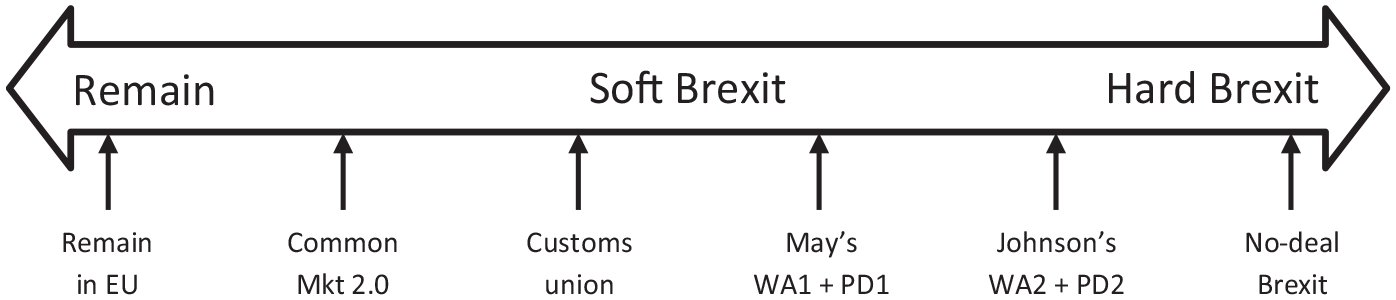
Possible Brexit Outcomes.
The government had previously agreed, under pressure from MPs, to put any negotiated deal to a Commons vote (Russell, 2021). This so-called ‘meaningful vote’ would be on an amendable motion, permitting different outcomes. All parties had to adopt positions on WA1. The government sought a conventional legislative majority for WA1 based on Conservative (and DUP) MPs. However, the Tories were deeply divided, with separate pro-EU and pro-Brexit factions opposing WA1. The government could marshal its ‘payroll vote’ of over 100 Conservative frontbenchers and a similar number of loyalist backbenchers (Lynch, 2020). Beyond that, it had to convert internal opponents.
The European Research Group
The European Research Group (ERG) was a loose faction of pro-Leave Conservative MPs who sought a hard Brexit, including potentially no-deal. It was an outlier faction, like B1 in Figure 2(a). The ERG opposed WA1 from the start. It tried but failed to remove May as Tory leader in an internal no-confidence vote shortly after WA1 was published in December 2018. The ERG expressed strong opposition to the backstop and insisted on its removal, but indicated it could accept the rest of WA1. As a faction, the ERG sought to adopt common positions and ran its own whipping operation, although unlike a party, it could not offer patronage incentives. The ERG and the broader grouping of hard-Brexit Tories numbered 80–100 MPs but they were not fully cohesive, with a hard core of 25 supporters surrounded by an outer ring of occasional sympathisers that included Boris Johnson (Lynch, 2020; Scullion, 2020). The hung parliament of 2017, like the narrow Tory majority of 2015, increased the ERG’s leverage, as the government needed almost every Conservative and DUP vote to avoid relying on the opposition.
Pro-EU Conservative Rebels
A pro-EU Conservative rebel faction of 20–25 MPs supported either softer forms of Brexit, such as a customs union, or remaining in the EU. This group resembled the centrist Faction B2 in Figure 2(c). The rebels were backbenchers, including Dominic Grieve and Oliver Letwin. However, senior cabinet ministers such as Hammond, Rudd and David Gauke sympathised with them, though were constrained from expressing it by collective responsibility (Lynch, 2020). Instead, these ministers pressured May in cabinet to soften her Brexit policy.
DUP
The DUP supported a hard Brexit, including potentially no-deal (Hayward, 2020). However, its priority was to ensure Northern Ireland’s position in the UK was not compromised. It strongly opposed the backstop because it would treat the province differently from Great Britain, potentially leaving it under de facto joint sovereignty with the EU.
Labour Party
Labour MPs were overwhelmingly Remainers, but after the referendum, diverging views emerged, and the party would adopt an ambiguous Brexit policy. The main cleavage was between a majority favouring a second referendum – what they called a ‘people’s vote’ (PV) – and an opposing minority. PVers included most Labour MPs for pro-Remain metropolitan seats and most party activists. Anti-PV MPs preferred a soft Brexit. Many represented working-class ‘red-wall’ seats in the Midlands and North that voted Leave and could be lost if Labour supported a second referendum (Goes, 2020; Whitaker, 2020). A third of Labour voters were Leavers, though only 10 Labour MPs backed ‘Leave’ in the referendum. Labour’s leader, Jeremy Corbyn, was a long-standing left-wing opponent of EU membership but shifted position under pressure and supported ‘Remain’ in the 2016 referendum.
Reflecting the logic of two-partism, Labour sought a position it could unite around (Menon and Wager, 2019). First, the party agreed on the necessity of avoiding the economic costs of no-deal. Second, Labour had ‘six tests’ for deciding whether to support a Brexit deal, including that it delivered the ‘exact same benefits’ the UK had in the single market and customs union. Third, Labour promised to negotiate its own deal based on a customs union if it came to power. Finally, it demanded a ‘public vote’, a deliberately vague term that primarily meant a general election. Labour’s Brexit policy was thus strategic in nature, focusing on short-term outcomes on which there was internal consensus while postponing conflict in areas of disagreement.
The difficulty of passing the ‘six tests’ justified opposition to any deal negotiated by the government, avoiding a split between pro- and anti-PVers over soft Brexit. It reflected the opposition’s preference to defeat the government. Labour’s customs-union policy was a holding position: PVers could vote for it but insist it was put to a referendum, with ‘Remain’ on the ballot. Anti-PVers could support it but without a referendum. All sides called for a ‘public vote’, but PVers maintained that, if an election were not possible, a referendum was an alternative.
Other Pro-Remain Parties
Most of the smaller parties were pro-EU and favoured a second referendum. These included the Liberal Democrats, the solitary Green MP and The Independent Group for Change (TIG), a splinter group of eight Labour and three Tory MPs, formed in early 2019. All refused to accept soft Brexit. The Scottish National Party (SNP) and Plaid Cymru also supported remaining in the EU (Bale, 2020).
The Defeat of May’s Withdrawal Agreement
The theoretical approach sketched earlier is now applied to the parliamentary struggle over the withdrawal agreement. Figure 5 presents Commons votes on WA1 in the format of party blocks. The blocks are aligned left to right from Remain to hard Brexit (see also Figure 4). Each party’s MPs covered a range of Brexit preferences but for simplicity, parties do not overlap. The two Tory factions are indicated by dashed lines within the Conservative block. Figure 5(a) depicts the situation during the first ‘meaningful vote’ (MV1). The government’s WA1-PD1 policy is positioned at D1, and the dashed outer box indicates its attempted legislative mobilisation of Conservative and DUP MPs.
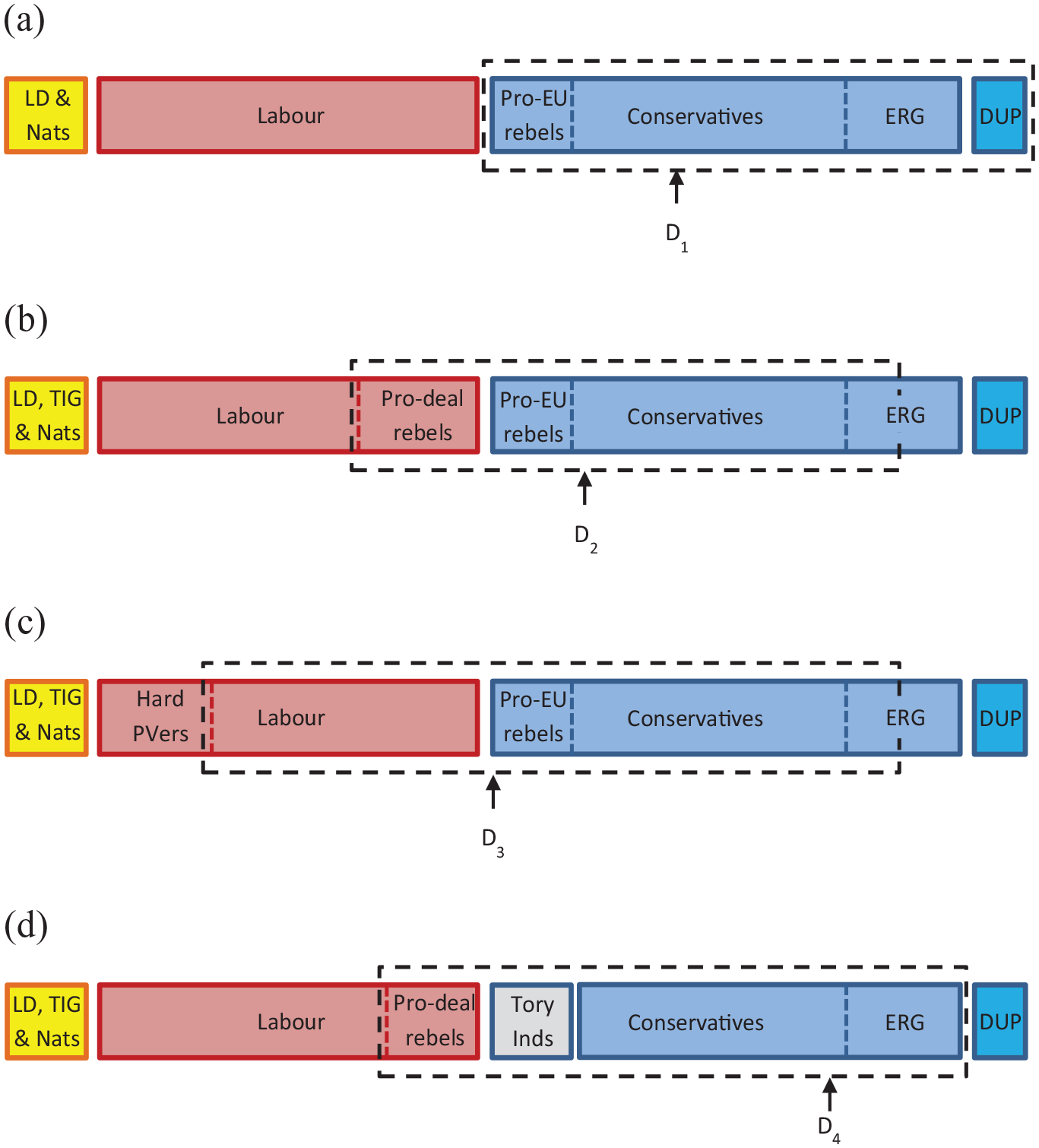
Legislative Mobilisation for Withdrawal Agreements: (a) May’s First Failed Legislative Mobilisation for WA1 (MV1 and MV2), (b) May’s Second Failed Legislative Mobilisation for WA1 (MV3), (c) May’s Third Failed Legislative Mobilisation for WA1 (Cross-Party Talks) and (d) Johnson’s Legislative Mobilisation for WA2 (Second Reading).
The government’s strategy for MV1 was conventional in the British party system: build a majority from among Conservative (and DUP) MPs. Given the hostility of the two Tory factions, this required a party-management operation to pressurise rebel MPs to back the government, primarily through persuasion. The government claimed a worse outcome would emerge if WA1 were defeated, that is, no-deal Brexit for the pro-EU rebels, or a second referendum for the ERG – although these messages clearly contradicted each other (Scullion, 2020). The DUP had to be converted to the backstop.
The strategy of the ERG and the DUP was to resist these overtures and seek a ‘bipolar’ blocking coalition with the opposition to defeat WA1 (Figure 2(b)). Their belief was that only a parliamentary rejection of WA1 would demonstrate the credibility needed to force the EU to renegotiate the deal and remove the backstop. ERG strategists assumed that the opposition parties would vote against WA1, but a second referendum could not be forced through by a Conservative government amid internal hostility. A Labour government could not be formed before an election because removing May’s government would require the support of pro-EU Tories in a confidence vote, which they would likely refuse. For the ERG, that left a new withdrawal agreement minus the backstop. Achieving this would require replacing May with a hard-Brexit leader and cabinet (Scullion, 2020).
For opposition Remainers who wanted to stop Brexit altogether, there were insufficient votes for a second referendum ahead of MV1. Their best option was to close off all avenues to Brexit before presenting a second referendum as a deadlock breaker. That would first entail voting down WA1. If they succeeded, they could repeat the EU’s frequent assertion that no alternative deal was available. If they could pass legislation to prevent no-deal by default, enough MPs preferring soft Brexit might come round to seeing a second referendum as the only solution (Rutter and Menon, 2020).
This was a straightforward calculation for the pro-Remain Liberal Democrats and nationalist parties. It was different for Labour. Most Labour PVers would insist on opposing WA1 – abstaining would hand victory to the government. But red-wall Labour MPs faced a dilemma. WA1 would give them the soft Brexit they preferred but voting for it would split their party. Toeing the leadership line of voting against WA1 to force an election would maintain Labour’s unity and hold out the prospect of a softer Brexit later. The same dilemma confronted pro-EU Tory rebels.
May’s First Failed Legislative Mobilisation
When MV1 was held in January 2019, Conservative factions and opposition parties followed the strategies described above (Figure 6). A blocking coalition of opposition parties, pro-EU Tory rebels and hard Brexiteers routed the government 432–202, a historic defeat of 230 votes (Aidt et al., 2021). Fully 118 Conservative MPs voted against their own government, whose support was reduced to the ‘payroll vote’ and loyalists. The Tory rebels were overwhelmingly Leavers seeking a harder Brexit (80–90). The DUP also voted against. The government was opposed by 40% of the MPs it had sought to mobilise (Figure 5(a)). The opposition parties maintained almost complete cohesion in voting against, securing their principal goals of remaining internally united and defeating the government.
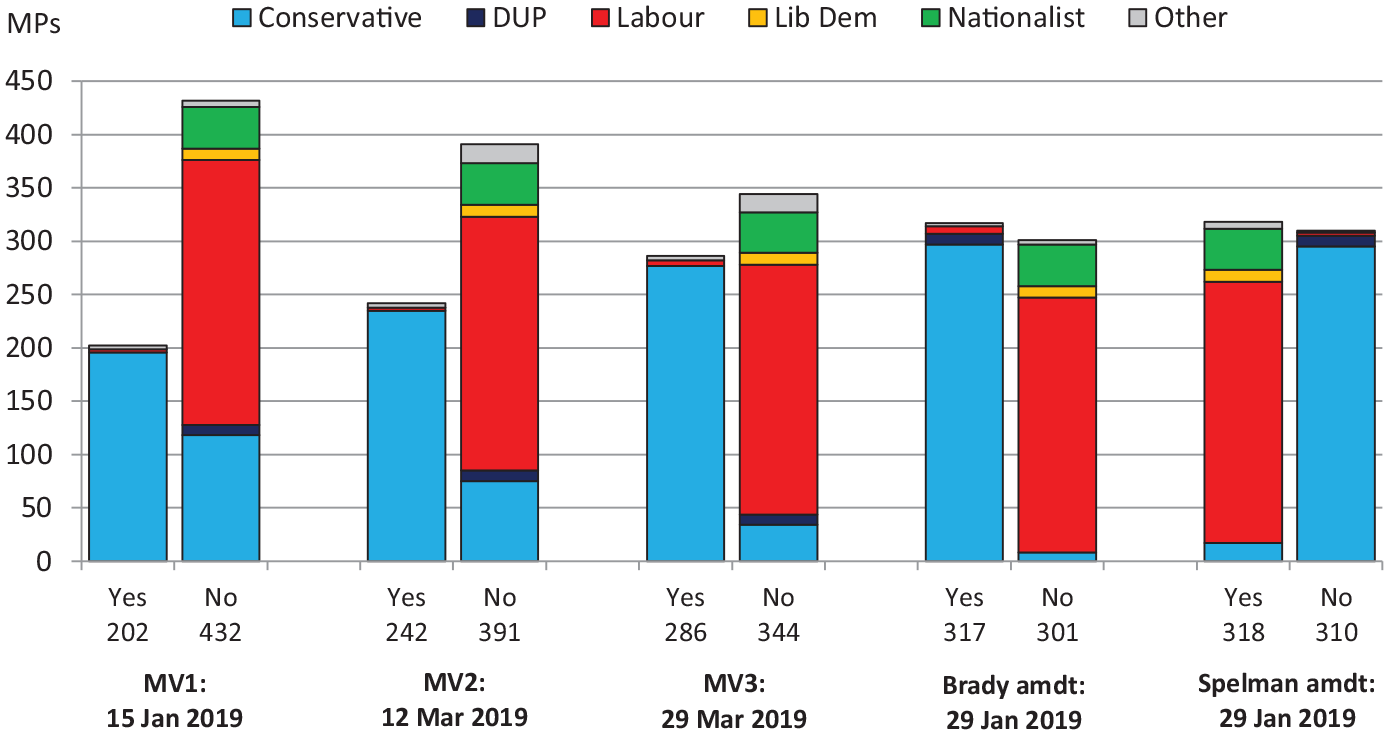
Parliamentary Votes on May’s Withdrawal Agreement.
The government’s initial response was to try again at mobilising a Conservative–DUP legislative coalition. Since securing the support of the ERG and the DUP would require removing the Irish backstop from WA1 and thereby ‘harden’ Brexit, May endorsed the ‘Brady amendment’, a backbench Tory plan to seek unspecified ‘alternative arrangements to avoid a hard border’ in Ireland. The amendment passed 317–301, with ERG and DUP support, the only substantive Brexit policy to secure a parliamentary majority under May’s premiership (Figure 6). However, the government was defeated 318–310 on the ‘Spelman amendment’ ruling out no-deal. These votes illustrated that a Conservative–DUP majority (as in Figure 5(a)) could potentially be mobilised for a harder deal than WA1 – contrary to the expectations of the median-legislator theorem – but that the opposition and pro-EU Tories could block no-deal (see Figure 2(c)).
May’s hopes for a Conservative–DUP legislative mobilisation were ended by the EU’s refusal to renegotiate the backstop. Consequently, when an unchanged WA1 was put to the Commons in a second ‘meaningful vote’ (MV2) in March, the government was again heavily defeated, 391–242 (Figure 6). Its whipping operation reduced the number of Tory rebels to 75 (mainly ERG) plus 10 DUP MPs, but that still meant it had failed to mobilise over a quarter of the combined Conservative–DUP vote (Figure 5(a)). These splits contrasted with the opposition parties remaining almost solid, as pro- and anti-PVers prioritised defeating the government. By now, however, eight pro-PV Labour MPs and three pro-EU Conservatives had left their parties to form TIG to campaign for a second referendum (Allen, 2021).
May’s Second Failed Legislative Mobilisation
The government’s attempted legislative mobilisation in MV1-MV2 was the conventional one in the UK party system. But the resistance of the ERG and DUP led May to seek a new coalition in advance of a planned MV3. After securing an extension of Article 50 to prolong the ratification period, the government pivoted to red-wall Labour MPs who might be amenable to a softer Brexit. It offered concessions on workers’ rights and environmental protections, which would be written into the deal’s Political Declaration (Scullion, 2020). This new coalition sought to mobilise the ‘payroll vote’ and Conservative backbench loyalists, pro-EU Tories and soft-Brexit Labour MPs (Figure 5(b)). The concessions to Labour MPs softened the deal, shifting it to D2. To persuade her internal critics to vote for WA1, May even promised to step down as prime minister if the deal were passed.
Such strategies are high-risk because they break with the logic of two-partism in which majorities are built from within the governing party. May accepted a split in the Conservative Party and attempted to encourage one in the Labour Party. She was resisted by Labour’s leadership, which sought to maintain internal unity by urging potential rebels to continue rejecting a ‘Tory Brexit’ and to bring down the government instead. Labour MPs also had to consider potential disciplinary action if they voted for WA1, including deselection by anti-Brexit activists in their local parties (Rogers, 2019).
The new legislative coalition failed to mobilise and a blocking coalition prevailed in MV3, which the government lost 344–286 (Figure 6). Opposing the government from its own side were 34 Conservatives plus the DUP. The former consisted of six pro-EU rebels and a hard core of 28 ERG MPs, nicknamed ‘Spartans’ by their supporters (Scullion, 2020). Tory rebels were squeezed, with many Brexiteers, including Johnson, Raab and the ERG chair, Jacob Rees-Mogg, switching from opposing the government in MV2 to supporting it in MV3 for fear of losing Brexit. But it was clear the ERG could not be squeezed further.
May’s Third Failed Legislative Mobilisation
Despite its defeat in MV3, the government persisted with its new strategy of seeking a cross-party alliance. After a failed attempt to use ‘indicative votes’ (IVs) among MPs to identify a Brexit solution (see below), May sought formal talks with the Labour leadership to find a compromise, rather than just appealing to red-wall potential rebels as in MV3. This would represent a legislative mobilisation of Brexit ‘moderates’ across the party divide and would likely soften Brexit in the direction of Labour’s preferred customs union (D3 in Figure 5(c)).
The weakness of such cross-party agreements under two-partism is that they risk splitting the main parties (Figure 3(a)). The talks quickly faltered, with Labour not seriously engaging. Despite WA1 being close to a customs union, compromise was difficult because Labour’s customs-union policy was a strategic preference to preserve party unity. Labour PVers really wanted a second referendum. Some offered to vote for WA1 provided it came with a ‘confirmatory’ referendum attached. Out of desperation, May agreed to consider it, but that proved too much for her MPs. Party managers signalled they could change the Conservative leadership selection rules to facilitate a challenge to May in the summer of 2019, earlier than the existing rules permitted (Scullion, 2020). Subsequently, May announced her post-dated resignation on the night of the European parliamentary elections. The Conservatives slumped to 8.8%, suffering huge losses to Nigel Farage’s new Brexit Party.
Johnson’s Withdrawal Agreement
Changing the prime minister provides an opportunity to reset government policy and strategy. The election of Boris Johnson as May’s replacement in July 2019 signalled the abandonment of soft Brexit and cross-party alliances. Instead, there would be a quest to mobilise the Tory/DUP bloc for a harder Brexit. This would entail renegotiating the withdrawal agreement to remove the backstop, and if that were not possible, Johnson pledged to pursue no-deal. To achieve internal Conservative unity, Johnson undertook an extensive cabinet reshuffle, putting hard Brexiteers in most important roles (Lynch, 2020). He sacked leading Remainers to prevent the cabinet continuing as a site of factional conflict. He also made it clear that no one could stand as a Conservative candidate unless they signed up to his policy. Ending factionalism was essential for this legislative mobilisation. This required firm control by the prime minister and his chief adviser, Dominic Cummings.
To counteract this pivot to hard Brexit, Remainer MPs sought to close off no-deal, as it was Johnson’s principal negotiating leverage over the EU. Favourable procedural rulings by the Commons Speaker, John Bercow, enabled them to pass the backbench ‘Benn Act’, which compelled the government to seek an Article 50 extension if a deal were not agreed in time. Johnson withdrew the whip from 21 Conservative MPs who supported these manoeuvres. He united remaining Tory and DUP MPs against the measure, but the opposition and Conservative independents were solidly for it (Figure 7). Johnson attempted to call an early election to escape this constraint but was prevented after the two-thirds majority required by the Fixed-Term Parliaments Act was not met, as Labour abstained. A government decision to prorogue parliament to run down the negotiating clock was overturned in the courts (Russell, 2021).
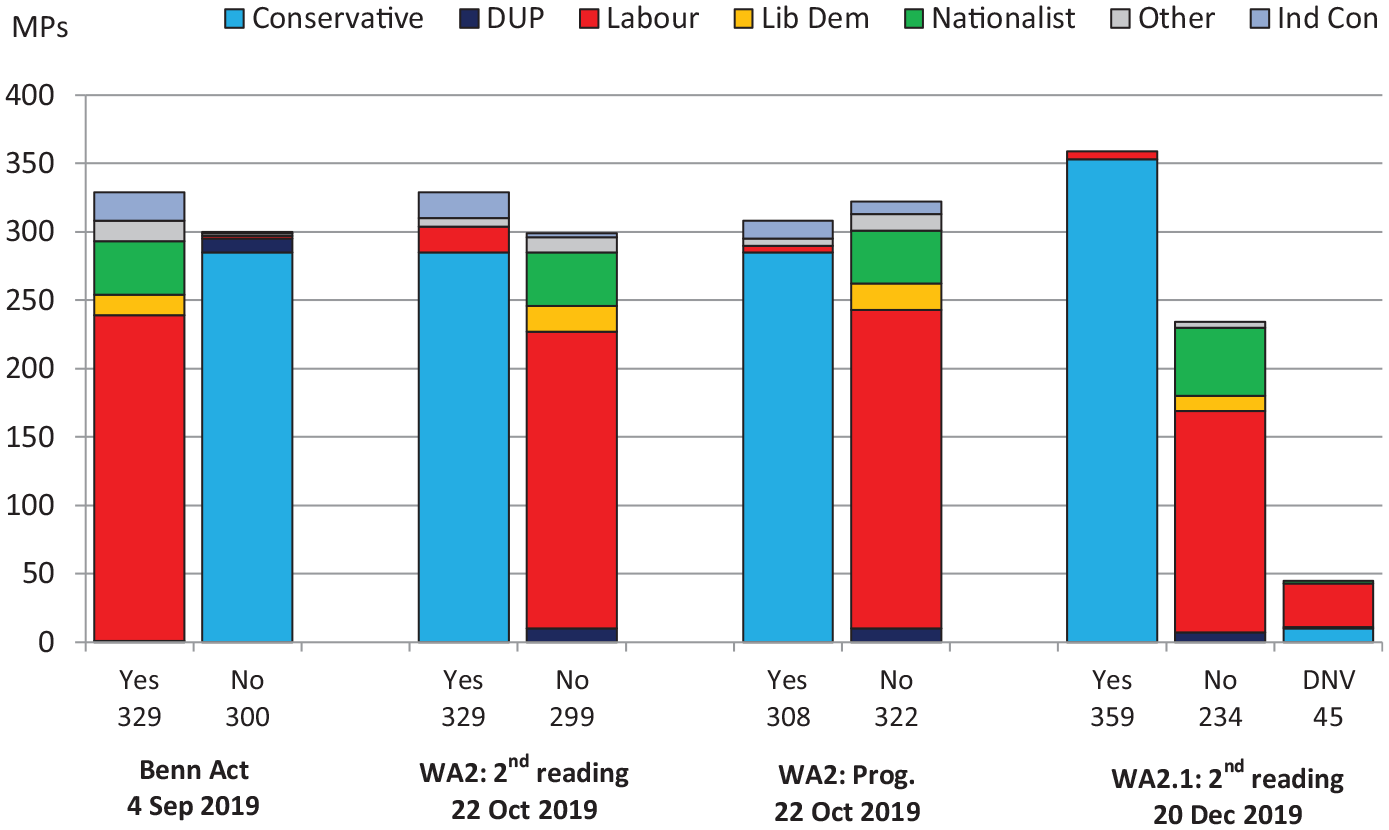
Parliamentary Votes on Johnson’s Withdrawal Agreement.
Johnson’s resolve nevertheless convinced the EU that there was sufficient danger of no-deal to justify reopening negotiations. A new withdrawal agreement (WA2) replaced the backstop in the NIP with a dual customs system stipulating checks on goods between the province and Great Britain. The UK as a whole would no longer remain in a customs union with the EU in the event of failing to agree a trade deal. References to level-playing-field rules were switched to a new non-binding political declaration (PD2). WA2-PD2 was a significantly harder Brexit than May’s deal (in relation to Great Britain), indicated as D4 in Figure 5(d). The ERG reluctantly supported it on the basis that it was either this deal or endless delays. However, the DUP opposed WA2, arguing that the NIP weakened the UK (Hayward, 2020; Murray, 2019).
Labour’s Brexit policy also shifted under the weight of internal pressure from PVers (Rutter and Menon, 2020). The party had suffered losses to pro-Remain parties in the European parliament elections and to the Liberal Democrats in national opinion polls. Under duress from his shadow cabinet and keen to avoid defections by pro-PVers, Corbyn agreed to call for a referendum on any Brexit deal, although he insisted he would personally remain neutral (Goes, 2020: 86). Its effect, however, was to encourage some Labour anti-PVers to shift to supporting WA2.
As procedural manoeuvres by Remainers compelled the government to pull plans for MV4, it brought forward a withdrawal agreement bill, with MPs voting directly on the legislation (Russell, 2021). The Commons supported Johnson’s WA2 bill 329–299 on its second reading. It had unanimous backing from Conservative MPs, and support from 19 Tory independents seeking to rebuild bridges, and 19 Labour MPs. But Johnson’s accelerated 3-day timetable to push the bill through parliament was defeated 322–308 (Figure 7).
Johnson’s legislative mobilisation entailed uniting the Conservative (and Tory independent) vote, while relying on Labour rebels (Figure 5(d)). At first glance, a majority of 30 on the second reading showed the government did not need the DUP. However, the second reading approved only the bill’s general principles; it could still be amended in committee or at report stage. The government suspected the rebels wanted to amend it towards soft Brexit or attach a confirmatory referendum. Either would cost the support of the ERG on the bill’s third reading (Quinn, 2021).
The vote on the programme motion was a ‘sincerity test’ to establish which supporters of WA2 were genuine. Only five Labour MPs and five Labour independents voted for the programme motion, as did 12 Tory independents. The DUP’s opposition was decisive: with their support, it would have passed. The programme motion was defeated by a blocking coalition of opposition parties and the DUP. The only path to a Brexit deal in the 2017–2019 parliament lay, as the Brady amendment showed, through a united Conservative–DUP legislative bloc, which was impossible with the NIP.
That left two other options. The first was to replace the government with one formed by the opposition to pursue a second referendum. But this foundered on the unwillingness of the Liberal Democrats, TIG, Tory independents and many Labour MPs to let Corbyn become prime minister (Bale, 2020; Russell, 2021). It also foundered on arithmetic. Any such government’s majority would have been wafer-thin, dependent on anti-PV Labour MPs and inherently unstable. It would have struggled to survive long enough to pass the legislation for a referendum.
The second option was an election to break the deadlock. Remainers opposed an election while no-deal was a possibility, but once WA2 passed its second reading, the calculation changed for some. The Liberal Democrats and SNP feared that WA2 could ultimately become law, and even if it were softened later, their strong preference was to stop Brexit altogether. Only an election could now achieve that, and they supported a bill to circumvent the Fixed-Term Parliaments Act to bring about an early poll (Rutter and Menon, 2020). The election in December 2019 saw the Conservatives returned to power with a majority of 80 seats. The WA2 bill was passed by parliament with a majority of 125, and the UK left the EU in January 2020 (Figure 7).
The determination of PVers to hold out for a second referendum was an essential facilitating factor for hard Brexit. Had they pivoted towards soft Brexit, Labour would no longer have been divided. It could have abstained in the meaningful votes, ensuring that WA1 passed. Conversely, had Labour’s leadership adopted a pro-PV position from the start, it is more probable that a decisive group of anti-PV Labour rebels would have broken rank and voted for WA1 to avoid fighting an election on a pledge to hold a second referendum. Ultimately, the failure to pass WA2 led to precisely that.
The Failure to Achieve Soft Brexit
The failure to achieve a parliamentary majority for soft Brexit presents a puzzle for explanations of policy outcomes based on the logic of spatial competition. Such models underscore the leverage of the median actor. That appeared to motivate May’s progressive softening of WA1, as she shifted towards a cross-party coalition of parliamentary support (from D1 to D2 to D3 in Figure 5(a)–(c)). Yet a compromise failed to emerge, as all proposals were either defeated or fell during negotiations (Rutter and Menon, 2020).
Soft Brexit failed because of the two-party system for government and its incentivising of internal cohesion. There were two potential ways to mobilise a majority for soft Brexit but both were defeated because of intra-party splits. The first option was for May to rally the Conservative Party and its DUP ally for WA1, which represented the conventional way of building legislative majorities under two-partism. May attempted to do that in MV1-MV2 but foundered on the factional opposition of the ERG, which together with the DUP, formed a blocking coalition with the opposition.
Even had the government gathered enough opposition support to win MV3, it would have faced a monumental task in navigating the legislation through parliament. It would have confronted entrenched opposition from the ERG and DUP. Crucially, it would have struggled to retain ongoing support from Labour MPs who backed it in MV3 because they would have effectively needed to become a support party. Internal Labour pressure would have made this untenable.
The second option for a soft Brexit was for the government to seek a cross-party deal with Labour. May attempted this approach, but again it failed. Labour’s delicate internal balance between pro- and anti-PVers would have been destroyed, as the former would have rejected a deal without a second referendum attached. Conservative hostility to a second referendum ruled that out. In these circumstances, attempting a soft Brexit would have internally split both main parties, destroying their cohesion and their effectiveness as governments or governments-in-waiting (Figure 3(a)).
As if to emphasise the party system’s constraints, an attempt to circumvent them also failed. Remainer MPs secured two series of non-binding ‘indicative votes’ (IVs) in the Commons either side of MV3 to identify a compromise. IVs gave MPs a chance to break free of the party system and vote sincerely, rather than strategically. In theory, this would be a ‘no-party system’, with the outcome decided by the median MP (Figure 1(a)). The cabinet would abstain, and Conservative MPs officially enjoyed a free vote. But Labour whipped its MPs to support soft-Brexit options (customs union and common market 2.0) and a second-referendum, though not on revoking Article 50 to avoid no-deal.
All of the options were defeated. An unofficial Conservative whipping operation to reject soft Brexit and a second referendum ensured that the highest Tory breakaway, for a customs union, was only 36-strong (just 14 supported a second referendum). Labour MPs voted solidly for a customs union but the anti-Brexit Liberal Democrats and SNP did not. Meanwhile, 40 Labour MPs failed to support a second referendum. IVs barely loosened the party-system constraints. 2
Labour unintentionally helped to deliver a hard Brexit. Abstaining in MV1-MV3 or engaging seriously in cross-party talks would have produced a soft Brexit. But most Labour MPs wanted to stop Brexit altogether, and if it were to go ahead, they were determined to hang ‘a damaging Tory Brexit’ round the neck of the government. Yet, the turmoil in the Conservative Party over WA1 strongly indicates that it would have suffered an historic split had the deal passed (Quinn, 2021).
The central figure in Labour’s Brexit strategy was Corbyn (Menon and Wager, 2019). His Euroscepticism greatly constrained Labour’s PVers. Under a pro-PV leader, such as the shadow Brexit secretary, Keir Starmer, Labour may have pivoted to a second referendum much earlier. That would have made it more likely that an anti-PV rebel faction would have supported the government in the MVs. But Corbyn’s customs-union policy held pro- and anti-PVers together in opposition to WA1. In turn, that delivered the votes the ERG needed for a blocking coalition. By the time Corbyn reluctantly switched to a second referendum, WA1 had been renounced by Johnson’s government.
Options for a soft Brexit under Johnson were reduced by the negotiation of a new deal. Soft-Brexit amendments to WA2 were forestalled when the bill was withdrawn. Some Remainers considered leaving a powerless government in place indefinitely, exposing it to the ire of voters for Brexit delays, until it conceded a second referendum. But as the election demonstrated, pro-Leave voters blamed the opposition, not Johnson, for the delays.
The chances of a soft Brexit would have been greater in a German-style multi-party system, where cross-party compromises are routine. If the centre-right party (B) in Figure 3(b) preferred soft Brexit, it would not need to win over hard Brexiteers in Party D but could look to moderates in Party A. ‘Radicals’ on both flanks (C and D) could be side-lined. Had Labour been two separate entities, a liberal-metropolitan pro-PV party and a ‘red-wall’ party preferring a soft Brexit, the latter could have allied with May in the MVs. There would have been no need to maintain unity with the PVers.
In contrast, two-partism produces parties with greater ideological heterogeneity, making them vulnerable to divisions when cross-party compromise is sought. Labour’s determination to maintain internal unity and to seek to defeat the government left it unwilling to strike a deal. That gave the ERG a veto over soft Brexit, which it possessed as a major-party faction under two-partism but could not have wielded as a separate party under multi-partism against a moderate coalition. Its leverage was created by the fact that its core membership was larger than the government’s (DUP-enhanced) majority. Only a landslide Conservative victory in 2017 – as wrongly predicted by pundits – would have allowed May to bypass the ERG (Scullion, 2020). The final Brexit outcome, while not the ERG’s ideal policy, was closer to its preference than to any other actor’s, a remarkable achievement for an outlier faction that boiled down to 28 MPs in a 650-seat parliament.
Conclusion
The key finding of this article is that legislative party systems play a vital role in structuring policy outcomes. This had decisive consequences for Brexit but is of more general significance. Legislative parties aggregate their members’ preferences, but party systems structure the interaction of parties in the quest to form governments (Mair, 1997; Sartori, 1976). Different systems produce different outcomes, whether in terms of governments or policies. If the same chamber of individual legislators were allocated among parties in a two-party system, they would form different governments and likely pass different policies than if they were allocated to parties in a German-style multi-party system (Figure 3). The absence of the latter configuration of party interaction hindered the chances of a soft Brexit, as cross-party alliances were disincentivised.
Another major lesson to emerge was the crucial role of factions in two-party systems. The governing party in particular must unite its ideologically heterogeneous legislators behind a single position. That can empower factions to shift policy in their direction by forming blocking coalitions with the opposition, as the ERG did to prevent soft Brexit. The success of the ERG has encouraged the formation of imitators in the Conservative Party: the China Research Group, the Northern Research Group (red-wall Tories) and the Covid Recovery Group all seek to influence policy. At the same time, changes in the UK party system have arguably made governments more vulnerable to factions. The rise of the SNP has undermined some features of two-partism, making smaller parliamentary majorities more likely. Although the 2019 election returned a large majority for the Conservatives, its three predecessors resulted in one coalition, one single-party government with a small majority and one minority government. If large majorities remain the exception, factionalism may become a more prominent feature of policy outcomes.
Finally, this article demonstrates the importance of opposition strategy in two-party systems. Governing-party factions are empowered if the opposition joins blocking coalitions. If the opposition abstains, these factions are rendered ineffective. Opposition abstention in the MVs would have delivered May’s Brexit deal and avoided Johnson’s harder Brexit. But it was PVers’ determination to secure a second referendum and Labour’s quest to maintain internal unity that produced continued opposition to WA1. Without the votes in parliament for a referendum, the road was clear for hard Brexit.
Footnotes
Acknowledgements
The authors thank Andrew Hindmoor and two anonymous referees for their extremely helpful comments on earlier versions of this paper.
Declaration of Conflicting Interests
The author(s) declared no potential conflicts of interest with respect to the research, authorship and/or publication of this article.
Funding
The author(s) received no financial support for the research, authorship and/or publication of this article.
