




Abstract
This article analyses the fallout between the United Kingdom and the European Union regarding the Northern Ireland Protocol. The Northern Ireland Protocol was agreed between the United Kingdom and the European Union to ensure frictionless trade on the Island of Ireland and created a customs border between Great Britain and Northern Ireland. Opposition to this new trading arrangement soon emerged following the end of the transition period of the United Kingdom’s departure from the European Union (January 2021). We adopt a mixed-method approach of content analysis (narrativisation and framing) and a critical analysis of the articulation of discourses through texts and speeches from the UK right-wing media and Conservative politicians. The analysis finds that despite the Government of Boris Johnson agreeing to the Northern Ireland Protocol, both the Conservative Party and the right-wing media blamed the European Union for the backlash against it, as they attempted to apply pressure on Brussels for a renegotiation.
Keywords
Introduction
The Protocol on Ireland and Northern Ireland (NI) or the Northern Ireland Protocol (NIP) for short came into effect on 1 January 2021 and sets out NI’s post-Brexit relationship with the European Union (EU) and Great Britain (GB). It aims to prevent reintroducing a hard border between the Republic of Ireland and NI. In contrast to GB, the NIP requires NI to remain subject to EU customs and EU Single Market rules for goods, keeping NI de facto ‘in the EU’ and creating a border in the Irish Sea between GB and NI (Jerzewska, 2022). The NIP was agreed between the United Kingdom and the EU during the Brexit negotiations at the end of 2019 and rearranged as a new package of measures in February 2023 (Murray and Robb, 2023). The NIP contains an emergency clause, Article 16, which permits the United Kingdom or the EU to take safeguard measures if its application leads to serious economic, societal or environmental difficulties that are liable to persist. Any measures must be limited to what is strictly necessary to remedy the situation, with priority given to measures that least disturb the functioning of the Protocol (HM Government, 2022). The universal understanding is that the reintroduction of a physical border on the Island of Ireland would infringe on the terms of the 1998 Good Friday Agreement (GFA) (Connolly, 2019), which after decades of conflict and sectarian violence, signalled the prospect of peace by creating a post-sovereignist multi-level governance order (McCall, 2021; Nagle, 2018; O’Leary, 2019). 1 The NIP is inextricably linked to NI’s convoluted political and historical context, to which Brexit adds a very recent further layering of complexity (Murray and Rice, 2021). The constitutional, ideological, and political significance of a new border between NI and GB should not be underestimated (Armstrong et al., 2019; Murphy, 2022; O’Leary, 2018). The GFA was crafted and understood in the context of shared UK and Irish membership of the EU. Meanwhile, the European dimension to the NI peace talks, as well as the EU’s soft power, are recognised as being important components of the post-conflict era (Hayward and Murphy, 2012; Lagana, 2023; Meehan, 2006). Within this context, Brexit has prompted a profound reconsideration of the United Kingdom’s existing territorial and political set-up, as well as challenging its national identity by introducing a new bipartisan cleavage and provoking the re-emergence of frictions in the peripheries where, in the 2016 Brexit referendum, the Remain vote was majoritarian (McEwen and Murphy, 2022). This has been particularly critical in NI where the partial removal of the EU’s scaffolding has produced political and constitutional consequences for the stability of the NI Assembly (Hayward and Komarova, 2022; Kelly and Tannam, 2023a; Murphy and Evershed, 2021; Tonge, 2022).
The ‘imposed Brexit’ has stirred a potentially destabilising effect on the territorial integrity of the United Kingdom (Hayward and Komarova, 2022; Murphy, 2021). Remarkably, during the referendum campaign, at the UK level there was little discussion of the potential ‘NI issue’. In addition, the UK Government paid little attention to how Brexit would affect NI until it was deep into its negotiation with the EU. By contrast, the Irish Government and the EU came from different starting points and arrived at the negotiating table more prepared (Buono, 2022; McCrudden, 2022). The UK Government’s approach to the issue reflects a historic arms-length approach to governing and engaging with NI. The NIP highlights the complex short- and long-term implications of the United Kingdom’s decision to leave the EU. In many respects, it is a paradigmatic microcosm of the ‘Brexit dilemma’, and a prism through which to analyse the unfolding and unprecedented political, constitutional, and diplomatic processes that structure and restructure British politics through an ideological and national-identitarian discourse. While, on the one hand, the NIP plays out against a backdrop of both Irish Nationalism and Unionism and the very recent memory of ‘the Troubles’, on the other, the ‘recaptured sovereignty’ entangled with the Brexit ideology openly clashes with the post-sovereign content of the GFA and the governance of NI. Although tensions between the two parties in NI did not cease after 1998, Brexit has interrupted a cycle of normalisation in NI’s historically contested politics, pausing a progression of reconciliation based upon an understanding of post-sovereign arrangements, which appear to be incompatible with the conception of national sovereignty underpinning the pro-Brexit discourse.
The existing debate on the NIP, as well as the impact of Brexit on NI, is extensive (in addition to the already cited works, Cochrane, 2020; Doyle, 2021; Godefroidt et al., 2023; Gormley-Heenan and Aughey, 2017; Larik, 2023; McGuinness and Bergin, 2020). Early studies focused on themes within the referendum campaign in England compared to NI, highlighting that while for the rest of the United Kingdom (particularly England and Wales), one of the key themes was ‘taking back control’, in NI the debate was more confined to local political concerns and the historical ethnonational divide (McCann and Hainsworth, 2017; Murphy, 2016). A further set of studies have reflected on the long-term perspectives and potential prospects for Irish reunification (Colfer and Diamond, 2022; Diamond and Colfer, 2023; Ferriter, 2019; Garry et al., 2020; Laffan, 2018; O’Leary, 2021; Todd, 2021) and on the future of UK/Ireland relations (Hix, 2018; Kelly and Tannam, 2023b; Murphy, 2019; O’Brennan, 2019). This abundant corpus of research has essentially utilised an Irish/Northern Irish point of departure and often overlooked the British/English debate. The hiatus is even more apparent if we consider scholarship on the media, as well as that found within the public sphere.
This article addresses the gap within the literature by examining the tensions and contradictions in the discourse surrounding Brexit and the NIP. It does so by focusing on the construction and recontextualisation of the NIP within the English/UK discourse as Conservative-led Governments attempted to navigate the contradictions of ‘taking back control’ by shifting blame and responsibility for NI’s status and trading relationships with both the United Kingdom and the EU onto the EU. Our approach is guided by the fecund hybridisation in the critical analysis of discourse narrativisation and framing theory. Narrativisation refers to the process of constructing and reproducing a story from events (Forchtner, 2021b). Framing theory explores how these stories are organised and presented to influence interpretations and organise meanings (Roslyng and Dindler, 2023). Blending these theoretical frameworks creates a richer and more nuanced approach to discourse, enhancing analytical depth and offering a multifaceted examination not evident when using either framework in isolation. This approach to critical discourse analysis highlights the resemioticisation of discourses, wherein meanings are recontextualised and reorganised. By focusing on resemioticisation, we aim to understand not only the repositioning of arguments and ideas but also how power dynamics operate and how meanings are controlled, manipulated, and transformed within new horizontal discursive orderings and ideological shifts (Krzyżanowski, 2016).
We draw from the recent ‘discursive turn’ in policy-making analysis (Fawcett et al., 2017) and focus on key interventions by politicians, as well as newspaper reporting in the right-wing media. While the instrumental role played by the print media in the construction of British Euroscepticism discourse is uncontested (e.g. Copeland and Copsey, 2018; Daddow, 2012; Jackson et al., 2016; Rawlinson, 2019), the scholarship has recently emphasised the interplay between discursive strategies by policy actors (Kettell and Kerr, 2022) and the bolstering cycle rearranged by the media that act (deliberately or unintentionally) as a political echo-chamber (Carpentier and De Cleen, 2007; Phelan, 2018; Van Gorp, 2007). In this regard, newspaper reporting and official key interventions by policy actors are mutually reinforcing and are where narratives are constructed and the resemioticisation of discursive frames occurs.
We adopt a mixed-method approach of content analysis (narrativisation and framing) and a critical analysis of the articulation of discourses through texts and speeches (Filardo Llamas and Boyd, 2018), focusing on how the two modes of enactment interact and reinforce each other. We interrogate the ongoing reordering of the Brexit ideology within right-wing discourse through the lens of mobilising narratives and framing of the NIP, and the related process of recontextualisation and resemioticisation of the Brexit discourse. We proceed as follows: in the second section, we provide an overview of the NIP in the context of British politics from 2020 to 2023; in the third section, we outline our dataset, timeframe, and methodology; in the following sections, we present the results of our analysis and, finally, we conclude with some reflections on our findings.
From ‘devolve and forget’ to the Windsor Framework: A brief history of the NIP
As the process of devolution across the United Kingdom gathered pace in the late 1990s, the GFA was arguably the most ambitious aspect of it. As noted by Nagle (2018), the GFA froze without completely resolving NI’s ‘culture war’ and instead, by reinscribing the historical sectarian politics as an organising logic of governance via a system of power-sharing at the executive level. After an initial wave of enthusiasm, the complex intergovernmental institutional structure conceived to administrate North–South Irish relations, as well as East–West UK/Irish republic relations, struggled to be fully implemented and, in Westminster, was overshadowed by a more vocal Scottish independence movement (Murphy and Evershed, 2021). As a consequence, the issue of governing NI slipped off the Westminster political agenda with a British attitude of ‘devolve and forget’, which could be traced back to the phase of direct rule from Westminster (Andrews, 2021). While at the UK/English level, the issue of the border between the North and the South of Ireland was absent from the 2016 referendum, the referendum result in NI was 56% in favour of remaining within the EU (Godefroidt et al., 2023). Two-thirds of Unionists voted to leave, while almost 90% of Nationalists voted to remain within the EU (Garry, 2017). Concerns surrounding the potentially damaging consequences of Brexit for NI did not surface in the UK/English political debate until the collapse of NI’s devolved government and the subsequent Stormont Assembly election (2 March 2017). 2 First, Theresa May’s Government committed itself to leaving the Customs Union (Lancaster House Speech, January 2017), followed by a decision to dissolve Parliament and call for a General Election (June 2017). The ballots failed to return a Conservative majority and May’s Government remained in power only with the support of NI’s Democratic Unionist Party (DUP). The confidence and supply agreement included a generous financial package which served, on the one hand, to entrench perceptions in NI that Brexit was a functional reassertion of British sovereignty and, on the other, it strongly emphasised the continuity with the ‘devolve and forget’ strategy (Evershed, 2021).
During May’s second Government, the United Kingdom continued to negotiate the Withdrawal Agreement and the issue of NI took centre stage. The ‘Irish border backstop’ as it was informally referred to (formally the Northern Ireland Protocol, NIP) was proposed in December 2017 and finalised in November 2018. To prevent a hard border between the North and South of Ireland, the backstop required NI to remain in the EU’s Single Market. To ensure frictionless trade between NI and GB, the United Kingdom would maintain regulatory alignment with the EU, remaining within the Customs Union until alternative arrangements could be made. The onus of finding such arrangements was to be on the United Kingdom but final approval from the EU was required. Within the governing Conservative Party, there were concerns the United Kingdom would remain ‘trapped’ within the EU’s Customs Union, not least because there are no easy solutions to the post-Brexit status of NI. By early 2019, Parliament had three times rejected May’s negotiated Withdrawal Agreement – NIP included. The political reality of delivering the near-impossible – that is, ‘taking back control’, maintaining the status quo in NI, and maintaining the territorial integrity of the United Kingdom – created significant divisions within May’s second government and she was forced to resign in May 2019. In October 2019, Boris Johnson’s Government proposed a revision of the NIP which established a ‘front stop’ (instead of a backstop) and presented a complex scenario: NI was to receive a special status within the United Kingdom by both remaining within the United Kingdom’s customs territory, as well as the EU’s Internal Market by applying the Union Custom’s Code that de facto kept the region aligned with the EU. The arrangements result in a customs border between GB and NI, with the territorial integrity of the United Kingdom regarded as a price worth paying to ‘take back control’. There are real tensions at the heart of the NIP, which reflect the complex nature of the issues it sought to address and are the basis upon which the NIP has been interpreted by all parties in many different and conflicting ways (McCrudden, 2022). The NIP has significant consequences for NI within the United Kingdom, as any deviation within GB from the rules of the EU’s Internal Market for goods results in checks imposed on them moving from GB into NI. It also includes Article 16, which permits the United Kingdom or the EU to introduce safeguarding measures if the application of the NIP leads to serious economic, societal or environmental damages that are likely to persist (HM Government, 2022).
The United Kingdom officially left the EU on 31 January 2020 and the Withdrawal Agreement – including the second version of the NIP – became law, albeit there was a transition period for implementation until 1 January 2021. During the transition period, the UK Government (2020) acknowledged there would be some checks and controls on goods moving between GB and NI, but this corresponded with the COVID-19 pandemic and the issue became less of a priority in Westminster. In October 2020, the European Commission began infringement proceedings with the United Kingdom for its tabled ‘United Kingdom Internal Market Bill’ which would violate the NIP by allowing UK authorities to disregard certain aspects. On 1 January 2021, the NIP came into force. Still, relations between the United Kingdom and the EU further deteriorated during the rollout of the vaccination programme when in January 2021, the EU threatened to trigger Article 16 to prevent the export of COVID-19 vaccinations to the United Kingdom (cf. Copeland and Maccaferri, 2023). In March 2021, the EU again gave the United Kingdom formal notice of legal action following its continued extension of grace periods, and by April 2021, anti-protocol protests had started in NI (BBC, 14/4/2021). The ‘expedient’ nature of the Protocol to ‘get Brexit done’ (Egan and Webber, 2023: 8) quickly unravelled as the realities of the UK Government’s commitments became more apparent. Lord Frost, then Chief negotiator of Task Force Europe and from 1 March 2021 Minister of State, was unequivocal that the United Kingdom intended to seek an alternative to the NIP; meanwhile, the EU had always made it clear that it would not renegotiate.
Throughout the remainder of 2021 and the first half of 2022, tensions between the two sides continued, albeit they reached their pinnacle in June 2022 when Foreign Secretary, Liz Truss, responded to the situation by publishing the NIP Bill, which would disapply core parts of the NIP, including the role of the European Court of Justice. The EU responded with legal action against the United Kingdom ‘for breaking international law’. Following the collapse of the second Johnson Government, and the brief Government of Liz Truss (from 6 September to 25 October 2022), a resolution to the situation finally emerged in February 2023 in the form of the Windsor Framework. In this document, the new PM Rishi Sunak and the EU agreed to ‘fix’ the NIP in a new regulatory framework which does not end the application of EU law in NI but does reduce some of its scope (Reland, 2023). According to Murray and Robb (2023: 21), the Framework mitigates some of the most pressing difficulties and demonstrates that the United Kingdom and EU ‘have jointly accepted the invidious consequences of using NI as leverage in redrawing their post-Brexit relationship’.
Dataset, timeframe, and methodology
Our analyses use two sources of primary data to interrogate the right-wing political discourse surrounding the NIP. The first is the speeches and thereby interventions made by key individuals in Government who were responsible for relations between the United Kingdom and the EU. These include Lord David Frost, Liz Truss, and Rishi Sunak. To this set of interventions, we have added the article that the then PM Boris Johnson published in the Belfast Telegraph (15 May 2022) to support the proposed renegotiation of the NIP presented by his Foreign Minister Liz Truss. Frost is a former diplomat and political advisor who was chief negotiator for exiting the EU (24 July 2019–31 January 2020) and head of the subsequent Task Force Europe – a body created for the post-Brexit trade talks – from 31 January 2020 until his resignation in December 2021 over the Government’s failure to seize the benefits of Brexit (Frost, 2021). Between March 2021 and his resignation, Frost also served as Minister of State at the Cabinet Office. Following Frost’s resignation, the responsibility for Task Force Europe became that of the Foreign Secretary, Liz Truss. Finally, PM Rishi Sunak became personally engaged in delivering the revised NIP agreement and was at the forefront of the Windsor Framework, with the then Foreign Secretary, James Cleverly, taking a more backseat role.
The second piece of primary data concerns the reporting of events within the media, specifically the right-wing print media. The symbiotic relationship between British politics and the media is well-documented (Copeland and Copsey, 2017; Daddow, 2012; Jackson et al., 2016; Rawlinson, 2019), whereby the media not only has the potential to set the political agenda but also remains the central arena through which politicians navigate and negotiate the politicisation of a crisis or a blame game. In particular, politicians not only use the media to tell stories, but they are also arenas in which such stories are recontextualised by their locating within a historical political discourse which both constructs and reconstructs the present and the future (Hansson, 2018, 2019). The media therefore provide feedback loops through which politicians also take their cues. In the context of the United Kingdom’s relationship with the EU, the right-wing print media has been a key driver of Eurosceptic discourse with circulation figures significantly out-numbering more left-wing, pro-EU papers (cf. Copeland and Copsey, 2018; Daddow, 2012). 3
To adequately capture newspaper reporting, we included the five main right-wing newspapers, and their Sunday editions, within our dataset. From the tabloids these included the Daily Mail (and the Mail on Sunday), the Sun (and the Sun on Sunday), and the Express (the Express on Sunday), and from the broadsheets, these included the Telegraph (The Sunday Telegraph) and the Times (The Sunday Times). To gain a representative sample of newspaper reporting, we searched the news agency database, Factiva, which provides access to the newspaper articles (as well as other media sources). We searched for the following terms present within either the headline or lead paragraph for five time periods: NIP or Irish border or Article 16 or Northern Ireland Protocol Bill or Windsor framework. Further details of the periods and the number of articles within the dataset can be found in Table 1. We identified the five different time periods in the context of key events within the NIP issue when events or actions by key individuals resulted in considerable attention being received and reported within the media. Inevitably, the five time periods are of different lengths, but this does not undermine the analysis nor its findings given that the focus of the research is how the UK Government/media discursively constructed and reconstructed blame and responsibility around the issue, rather than comparing one time period to another.
Timeframe and dataset analysed.
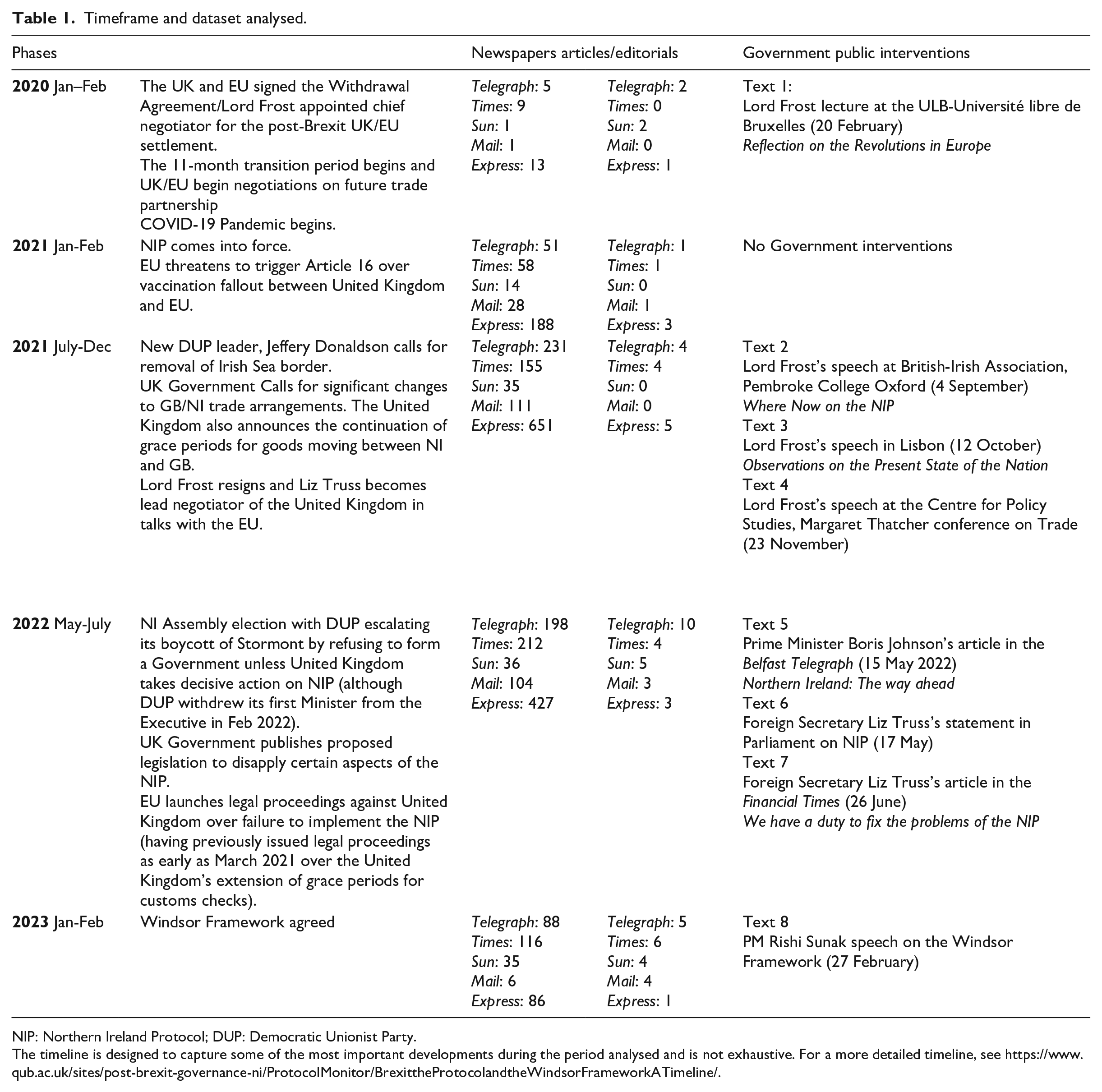
NIP: Northern Ireland Protocol; DUP: Democratic Unionist Party.
The timeline is designed to capture some of the most important developments during the period analysed and is not exhaustive. For a more detailed timeline, see https://www.qub.ac.uk/sites/post-brexit-governance-ni/ProtocolMonitor/BrexittheProtocolandtheWindsorFrameworkATimeline/.
Methodology
The first step of our study has been a close reading of the dataset to identify the main narratives concerning the NIP. We centred our analysis on how narratives have been activated and circumscribed and, by taking into consideration the circular link between policy actors’ interventions and the newspapers, we focused on how narratives have remained central over the five temporal phases selected. By connecting events causally, and not just chronologically, narratives perform as ‘branching points’ composing what through repetition will become a distinctive and coherent plot, with a beginning and an end. The progression fundamentally confers meanings to ‘simple events’, operating as a discursive channel whose function is to simplify and reorganise the complexity of the political (Forchtner, 2021a). This has a particularly relevant significance for the convoluted issue of NI vis-à-vis Brexit, in which the clash between different interpretations of the meaning of Brexit overlayed different narratives of Northern Ireland’s history and politics. Given the uniqueness of the event, the identification of the main narratives within the dataset was done inductively. This required several complete readings of the dataset to establish the main narratives. The narratives were identified by focusing on the main events and actors involved, the emplotment and how emotive language was used to evoke feelings and emotions to tell the story of events (van Hulst et al., 2024). Once the main narratives were identified, a second stage of our analyses involved re-analysing the dataset to code the frequency of the narratives which captures their variation overtime (Table 2).
Overview of the frequency of narratives and frames.
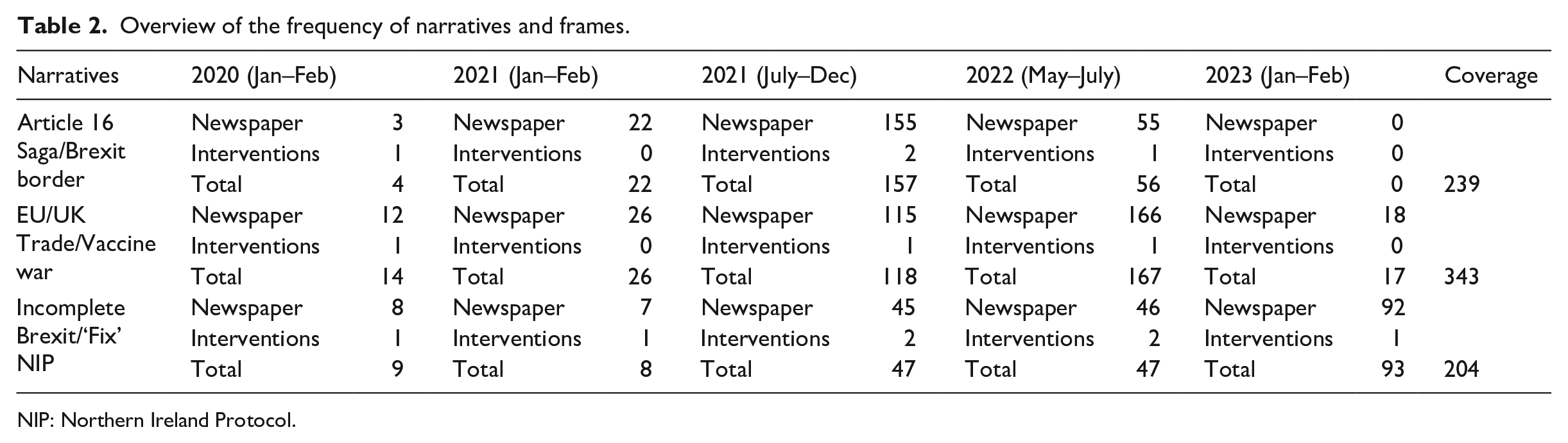
NIP: Northern Ireland Protocol.
The final stage of our analysis identifies the main frames and discursive constructs resulting from the interaction between the narratives surrounding the NIP. While narrative analysis focuses on the role of storytelling in interpreting and organising events, settings, and characters to create cohesive narratives, in contrast, framing analysis examines how certain aspects of reality are intentionally or tacitly highlighted or obscured in communication, thus influencing which voices and perspectives are legitimised or excluded, thereby making sense of complex political realities (Van Hulst et al., 2024). In line with Roslying and Dindler (2023), we contend that both framing and discourse are processes concerning the construction of meanings, whose outcomes contribute to the recontextualisation of social reality. While narratives enable us to analyse how the press and political actors intervened in the day-to-day shaping of the discourse surrounding the NIP, a framing and related discourse-oriented analysis further delves deeper into understanding the new nexus resulting from the reordering and repackaging of semantic and discursive shifts. Broadly speaking, a frame refers to a central organising idea that defines to an audience what is important in a debate (Ruzza and Pejovic, 2019: 436). Frames involve choices about ‘selection and salience’ (Entman, 1993: 52); they define problems, diagnose causes, make moral judgements, and suggest remedies to problems (Djerf-Pierre et al., 2013: 964). The frames were identified by focusing on the discursive layering created by the NIP, which suggest either explicitly or implicitly who is to blame. Further interrogating the discourse within the frames enables the identification of the politics of the processes of recontextualisation of the ‘NIP’ and the resemioticisation of Brexit.
Analysis
Narratives
Our analysis has identified three main narratives: (1) the ‘Article 16 Saga’, (2) the EU/UK ‘wars’, and (3) the incomplete Brexit/the need to fix NIP.
The ‘Article 16 Saga’: United Kingdom persistently threatens to trigger Article 16
This narrative centred on the possibility of invoking Article 16, which allows either party to undertake unilateral safeguarding measures if the Protocol leads to ‘serious economic, societal or environmental difficulties that are liable to persist, or to diversion of trade’. This narrative was presented as factual reporting and justified as an unavoidable consequence of the EU’s bureaucratic institutional nature. This particular narrative illustrates the symbiotic relationship between the interventions of political actors and the media, with the amplification of the threats made by the then Foreign Secretary Liz Truss in 2022. In particular, both the Daily Express and, to a lesser extent, the Telegraph, played a central role in the narrativisation of Article 16, by openly embarking on a campaign to support the Government and to push for the triggering of the clause (see Table 1). Presented by Lord Frost in his lecture at the Free University of Brussels (Text 1 2020) and mostly absent from the debate on the NIP in 2020, the narrativisation of Article 16 occupied the centre stage in 2021 (177 articles in total for both phases) and 2022 (55 articles). Lord Frost’s interventions maintained a diplomatic guise, though he explicitly affirmed that ‘the threshold for triggering Article 16 has been met’ (Text 2 2021) and justified it as a condition to ‘safeguard peace and prosperity’ (Text 3 2021). Interventions by Liz Truss (Texts 6 and 7 2022) and Boris Johnson’s article (Text 5) further fuelled the narrative and openly blamed the EU for the impasse on the Protocol, thereby charging the ‘NIP issue’ with a further discursive layer. Illustrating the NIP Bill for the British public in the Financial Times, Truss associated the triggering of Article 16 with ‘the duty of [. . .] the sovereign government in NI’ (Text 7). The conservative press wholly engaged with this narrativisation with the Daily Express and the Telegraph reporting on Lord Frost’s interventions (especially Text 1 and 2 in 2021), and an incremental number of editorials dedicated to Article 16 (0 in 2020, 5 in 2021, 7 in 2022) politicising the issue.
The turning point within the narrativisation was the rollout of the vaccine programme and the short-lived decision by the EU to invoke Article 16 to prevent COVID-19 vaccines from potentially coming to the United Kingdom via NI. The episode was described as a ‘total diplomatic disaster’ (Express 18/2/2021) that exposed the ‘nationalistic approach and the EU’s hypocrisy’ (Daily Telegraph 1/2/2021; 27/2/2021), and ‘set the precedent’ (Daily Mail 30/1/2021) which the United Kingdom must follow (Daily Telegraph 30/1/2021; Express 22/2/2021) because it was ‘forced to do it’ and therefore had no alternative (Express 1/11/2021, 3/11/2021). The triviality of the language, especially in the case of the Express, distinctly marks the discursive sequence: ‘The day bullies of Brussels went mad’ (Daily Mail 30/1/2021); ‘They still don’t get it!’ (Express 14/2/2021); ‘Go to Hell, Emmanuel! Boris urged to play EU at own game and trigger Article 16’ (Express 22/2/2021); ‘the EU using NI as a political weapon [. . .] over stubborn Brexit battle’ (Express 23/11/2021; also 23/7/2021; 15/11/2021).
The reiteration of the narrative persisted in the third phase analysed (155 articles in July–December 2021) and in 2022 interacted with the EU/UK trade ‘war’ narrative (see the section below). Employing military metaphors as a discursive strategy to represent the challenges during a crisis is a well-documented practice and has been largely exercised by the press and policy actors during the pandemic crisis (Blankshain et al., 2023). Strengthened by this contextual discourse, the invoking of Article 16 turns out to be ‘the nuclear option’ (Express 25/7/2021, 31/7/2021, 3/11/2021; The Telegraph 24/7/2021, 7/11/2021, 22/12/2021) to be used as the only defence possible against the EU (The Daily Telegraph 30/9/2021) to ‘Kill the deal!’ (Express 18/9/2021), ‘save Brexit’ (The Sun 15/5/2022) and ‘stop the EU tearing UK apart’ (Express 10/6/2022). Claims that NI was subject to a sort of ‘EU vassalage’ were linguistic hyperboles that must be contextualised as serving as a rhetorical device for traditional anti-Europeanism and pro-Unionism within the Tory Party. Yet, in the triangulation of NI’s troubled politics and history, the EU, and Brexit, the tensions between Brexit as a sovereignty discourse mixed up with the history of NI and the role played by the EU in ‘solving it’ resulted in a process of recontextualisation, as shown by the Express’ style of reporting, and best captured by the Sun’s claim that: ‘If Brexit results in the break-up of the UK, then Brexit will have failed’ (The Sun 15/5/2022).
Understandably, the ‘Article 16 Saga’ disappeared from the coverage of the Windsor Framework (fifth phase analysed). Rishi Sunak’s Government was in a better position to grasp the opportunity to co-operate with the EU and the new package of measures was presented as the tool that has ‘fixed’ the NIP. According to our dataset, Article 16 was not mentioned in the coverage of the Windsor Framework.
‘EU/UK wars’: ‘Trade’ war or ‘red-tape’ war (‘sausages’ war + ‘beer’ wars); ‘vaccine’ war
The second narrative centred on the tensions relating to the application of new trade rules between the EU and the United Kingdom. Although the specific term ‘war’ has never been used explicitly by policy actors’, the rhetoric and the contextualisation engaged with an equivalent setting. Quoting Edmund Burke’s 1790 pamphlet Reflection on the Revolution in France, Frost paralleled the philosopher’s critique of the 1789 revolt, considered too abstract to appreciate the complexities of human nature, with the EU’s institutions which have become ‘from a partnership agreement in trade to an object of reverence’ (Text 1 2020). A topos of English Euroscepticism (Spiering, 2015) and even quoted out of context (Catterall, 2020), Burke’s connection allows Lord Frost to relocate the centre of the NIP’s narrativisation from the terrain of trade relations and negotiations to the realm of national-cultural identity and state sovereignty. Frost continued to emphasise this narrative at the height of EU/UK trade tensions in October 2021. Citing Burke again, but this time from his 1769 pamphlet sympathetic to the American Revolution, at a speech given in Lisbon (12 October 2021), Frost implied that the EU intended to manipulate the Protocol to develop ‘its own aspirations for NI as if it were a member state’. According to Frost, in an ironic repositioning and reimagination of history, the United Kingdom wanted what the American rebels wanted in the 18th century. In the context of the EU’s behaviour, a post-Brexit British Government aimed ‘to get back to normal’ and ‘to prevent a difference of opinion from festering into rancorous and incurable hostility’ (Text 3). Frost’s speech was given extensive coverage in the media, especially in the Express and in The Times. Frost continued to intervene in the NIP debate well after leaving Government roles in December 2021 (The Times, The Daily Express, The Daily Mail 6/6/2022), and quoting Burke once more (Frost, 2023).
The ‘EU/UK wars’ is the most repeated narrative in our dataset, being at the centre for both 2021 (141 articles of which 5 editorials) and 2022 (166 articles of which 8 editorials). By implying broader aspects such as international solidarity and cooperation, the ‘vaccine war’, and the related blame game between the EU and the United Kingdom, the episode supposedly exposed the ‘true face of the EU’ (The Sunday Times 7/2/2021; also, The Daily Telegraph 1/2/2021), with the regional organisation being a ‘bully’ and ‘vindictive’ (The Telegraph 30/1/2021; 31/1/2021; also The Daily Express 15/11/2021, 22/7/2021), ‘malevolent’ (The Daily Express 24/7/2021) and ‘imperialistic’ (The Sunday Telegraph 4/7/2021; 14/2/2023). It was, therefore, the EU that was to blame and regarded as the real ‘threat for peace’ (The Sunday Times 12/6/2022; The Sun 17/5/2022; The Sunday Telegraph 7/11/2022) by ‘summoning up old tribes’ (The Times 18/5/2022), while the United Kingdom only aspired to be treated and respected as a ‘sovereign and independent country’ (The Daily Express 21/5/2022). ‘Even Hilary Benn, the Obi-Wan Kenobi of Remain – wrote The Times – conceded that the EU was being impossible’ (18/5/2022). Different to the ‘vaccine war’, the reporting on the ‘trade war’ concentrated mostly on the micro- or macro-economic aspects of the NIP and their negative impact on the regional and national economy (the ‘fishing war’, the ‘sausage war’, the ‘beer war’, the ‘pet war’, the ‘Horizon 2020 war’), whose fault, unsurprisingly, was the EU and was interpreted as Brussels’ ‘revenge’ for Brexit (The Sun 9/5/2022; The Daily Express 16/5/2022; The Times 20/5/2022) and as a ‘last-ditch rejoiner plot’ (The Daily Express 25/5/2022). The collapse of the Stormont Government and subsequent Assembly elections in 2022 further heightened the publicity surrounding the NIP and promoted interventions denouncing the gravity of the situation in NI by US Speaker in the House of Representatives Nancy Pelosi and President Joe Biden. In part, these events changed the context and imposed a cautiousness with the potential issue of violence and Irish unification. The Sun (21/5/2022) and The Times (9/6/2022, 12/6/2022) called for an end to the escalation of the crisis. On the other hand, according to the Daily Express (08/05/2022), ‘The Irish Government went to the EU and started using the threat of IRA bombs’, while The Times was concerned about the potential spread of political unrest to other parts of the Union (4/7/2022). The reverberation of the narratives over different critical junctures are not simple binary ones, but they interlock and simultaneously recontextualise events and meanings by evolving into discursive constructs and signifiers to become part of a dynamic process of resemioticisation. As a consequence, through the narrativisation of the NIP as a ‘war’ between the EU and the United Kingdom, the Protocol came to coincide with a new battle of the revived ‘Brexit war’ (The Sun 14/6/2022; The Daily Express 30/6/2022).
The incomplete Brexit/the need to fix NIP
Closely entangled with the ‘wars narrative’, the recount of the incomplete Brexit vis-à-vis the NIP is the third narrative. This narrative centred on the fact that the NIP represents an impediment to an effective implementation of Brexit and, therefore, must be ‘fixed’. In this narrative, the NIP is included within a broader recounting of unfinished and curtailed ‘Brexit opportunities’. Renegotiating and reforming the NIP was the principal objective of all of nine Lord Frost’s interventions, and ‘fixing it’ was the explicit purpose in the 2022 Bill proposed by Liz Truss with the very same label: ‘We have a duty to fix the NI Protocol’ (Text 7). Finally, in the words of PM Sunak, the NIP was reorganised and the Government ‘fixe[d] the practical problems’ (Text 8). ‘Fixing the NIP’ had emerged as a trope in 2021 (The Sunday Telegraph 7/2/2021; The Daily Express 4/3/2021; The Times 11/6/2021; The Daily Mail 16/6/2021); noticeably and in contrast to the previous two narratives, it originated in the press and was adopted as a new signifier by political actors.
This narrative, however, could not have been enacted without the conjoined construct of ‘the incomplete Brexit’ which simultaneously indicated the prodrome and paramount reason to pursue ‘fixing the NIP’. As early as February 2020, the NIP was depicted as the cause that prevented the ‘British Government from truthfully claiming that the UK has taken back control of its borders’ (The Daily Telegraph 18/2/2020), while in 2021, at the end of the third juncture and still with no potential solution for the NIP, the risk was that Brexit could be ‘watered down to meaningless’ (The Daily Express 15/12/2021). The dyad ‘incomplete Brexit/fixing the Protocol’ is the most continuous of the three narratives in our dataset. Interventions by political actors and press reporting revolved around this dyad by reinforcing and bolstering the narrative throughout the five critical junctures. The register and the tone remained constant in all phases; the portfolio of expressions ranged from ‘this is why we left’ to ‘we voted to be out – fully’ and eventually to considering the NIP as ‘Brexit betrayal’ (The Daily Express 15, 17 and 19/11/2021; The Daily Telegraph 10/5/2022; The Mail on Sunday 15/1/2023). During the Parliamentary debate for both May’s and Johnson’s Withdrawal Agreements, analogies with the Second World War had been amply abused (Leggett, 2020). According to Este (2019) and also confirming our analysis (see previous section), between 2018 and 2019, Hansard records display sharp increases in the use of words evoking a scenario in which the United Kingdom is metaphorically at ‘war with the EU’ such as ‘traitors’, ‘surrender’, and ‘betrayal’. This polarisation combined and compounded a broad discourse of ‘Brexit betrayal’ in whose context the need to ‘fix the NIP’ narrative played out and coexisted. While the tensions over the NIP were resolved and in theory came to an end with the agreement of the Windsor Framework, the continued narrativisation of an ‘incomplete’ Brexit remained an exploitable ‘opening political narrative’ enacting a new discursive layer. This is evident in the fifth phase analysed: when ‘fixing NIP’ and resolving the various ‘border wars’ appeared realistic, the scope moved away from the Protocol itself to the demand ‘to fully deliver the benefits of the UK leaving the EU’ (The Daily Express 14/2/2023) and ‘to unlock immediate economic benefits’ (The Times 10/2/2023).
Frames and discourse
According to our analysis, two dialectical frames mirror the narrativisation of the NIP: (1) the idea that thanks to the bold decision to leave the EU, the United Kingdom was regaining, or maintaining, the status of a global power; and (2), the specular imaginary of the EU as an illiberal, authoritarian and imperialistic state. Frames and discursive constructions share an interactional focus on discursive devices. Our discourse analysis has then targeted the discursive networks surrounding ‘truth’ claims about NIP vis-à-vis Brexit and has explored the competition among discourses for the construction of political meaning (Miller, 2020). At the textual level, discourse and frames intersected in their attention to legitimising strategies.
In light of this and through the lens of the NIP, Brexit therefore assumed a more charged content to signify the only possible ‘truthfully’ democratic act to reclaim the British political tradition and history, examples of which we present below. Both framing processes symbiotically combined and played upon a highly structured conception of sovereignty and nativism as the imperative values of British politics, as well as established Tory anti-Europeanism. While these trends are challenges to the dominant model of liberal democracy shared by most of the Western political systems (Krzyżanowski et al., 2023; Norris and Inglehart, 2019) and have pivoted the Brexit discourse since the 2016 referendum, the complexity of both NI’s identity politics and post-Brexit governance in handling the re-emergence of the ‘border issue’ has exacerbated the gap between opposed and, ultimately, irreconciled discourses. In addition, it is important to remember that the NIP was agreed by the UK Government and, being part of Johnson’s ‘deal’, it was also presented, although implicitly, as a successful outcome. Presumably, the Government either did not fully understand the consequences of its decision or interpreted the aspects of the Withdrawal Agreement, including the NIP, very differently from the EU. This ambiguity has further confounded the discursive context and melded with the ongoing process of political and ideological reworking of Brexit. Within this context, the interplay between the highly charged vocabulary put to use, especially for the ‘Article 16’ and ‘UK/EU wars’ narratives, and the rhythm of the NIP’s storytelling conjoined and constructed a discourse in which the ‘now-liberated’ United Kingdom was constantly opposed to the ‘bureaucratic and antidemocratic EU’ (examples 1 and 2). While the opposition between the United Kingdom and ‘the Continent’ is certainly not a new discursive topic, on the contrary, the novelty now resides in the role of global leadership that the United Kingdom assumed to play (examples 1 and 3; see also Daddow, 2019).
Example 1
Almost every country in Europe is ‘trapped’ inside the eurozone [. . .]. Brexit will give countries in the EU inspiration to follow [. . .]. Britain didn’t dislike the EU more than most other countries in Europe, but we could leave it because we were out of the zone and hence the risks of leaving were not so great (The Daily Express 1/2/2021).
Example 2
The obvious word to describe the EU’s set-up [. . .] is bureaucracy. It’s a bit like a civil service without a government. It has a Parliament but it’s essentially a façade; it doesn’t sign things or choose who governs Europe (The Daily Express 7/2/2021).
Example 3
Brussels should ask itself whether it is ultimately willing to sacrifice the political unity of the West at a time of global crisis for the sake of a dispute that concerns only a tiny proportion of EU trade (The Times 11/5/2022).
The EU was not only ‘a declining empire of red tape’ (The Daily Telegraph 10/5/2022) and a ‘bureaucratic autocracy’ (The Daily Express 6/8/2021), but by imposing a ‘foreign court’ (i.e. the European Court of Justice), it showed its real ‘colonialist’ intentions (examples 4 and 5) to undermine the UK’s national integrity (example 6) and ‘to annex’ the region (examples 7 and 8). The NIP therefore became the ultimate confirmation and expression of how the UK’s decision to leave the EU was perfectly justified (example 8).
Example 4
EU colonialism [is] the biggest present travesty of political rights affecting NI. [. . .] EU colonialism is one of the biggest rights issues facing NI today (The Daily Express 18/2/2022).
Example 5
The EU’s imperial court hates UK independence [. . .]. There is only one way through this mess. Brussels and its institutions must be brought to recognise that no sovereign and independent state can possibly tolerate [. . .] a part of its territory being effectively a colony subject to foreign courts and foreign laws (The Daily Telegraph 14/2/2023).
Example 6
The Protocol set the legal framework for the capture of NI [. . .]. The only proper answer to the EU’s attack on our sovereignty is to ensure there are no Spanish or EU troops on Gibraltar and to ditch the NIP (The Daily Telegraph 21/7/2021).
Example 7
When EU negotiators war-gamed the NI border, ruthlessly squeezing as much tension from a bloodstained, fragile peace agreement as possible, two successive leaders of the free world forgot about the Special Relationship and painted the UK as terrorism enablers simply for seeking to protect its territory from annexation by an embittered, emboldened Brussel (The Daily Telegraph 30/1/2021).
Example 8
NI is only beginning to know how it feels to be annexed (The Daily Express 11/2/2021).
The escalation of the war in Ukraine and the prompt British support against the Russian invasion was the final occasion to recontextualise the NIP as a new signifier for Brexit. Here the two faces of the framing construct – the UK as a global leader vs the anti-democratic EU – conjoined into a completely recontextualised ‘idea’ of Brexit:
Example 9
The Protocol divides the territory of a single nation, the UK. In this respect – though luckily not in scale or violence – it resembles the dispute over Ukraine. The EU plays the role of Russia; NI is the Donbas region (The Daily Telegraph 14/6/2022).
Example 10
By deploying Brexit freedoms to protect our Nordic friends, Boris has shown he’s a far better European than any of his snide continental critics. Boris Johnson signed security pacts with both Sweden and Finland that bind us to come to their aid should Putin turn on them as he has Ukraine. [. . .] Indeed, if anything illustrated the wisdom of our decision to vote for Brexit, it has been the re-emergence in recent months of the UK as a global leader (The Daily Mail 14/5/2022).
Identifying whether these shifts represent the first discursive movements towards a broader recontextualisation of Brexit as an ‘invention of tradition’ is not the scope of this article. 4 The NIP’s narrativisation is only one segment at the micro level of a wider process of discursive shifts towards a ‘normalisation’ of the Brexit discourse and its ideological contents (Krzyżanowski, 2020) whose avenues for further research this article aims to suggest. Certainly, Lord Frost’s emphatical attempt to link the result of the 2016 referendum to Burke’s conceptual architectures attests to the hierarchical persistence of a Westminster-centred perspective and the ongoing idealisation of an unrealistic English liberalism, a process which has been undergoing since Thatcher’s conservatism (Freeman, 2021).
Conclusion
Analysing the tensions and fallout between the United Kingdom and the EU on the NIP provides a fascinating insight into the construction and recontextualisation of the issue throughout right-wing political discourse, understood not just as that emanating from politicians, but that which also exists within the print media. This draws from the conceptualisation of the symbiotic relationship between politics and the right-wing media as the central political arena in which the UK-EU relationship domestically plays out via the interplay of discursive strategies between different political actors and media outlets. In many respects, the effect of this process is a reworked semioticisation of Brexit within the context of the Tory-oriented public opinion, although such reworking may be a temporary process. The Withdrawal Agreement and the legal provisions it entailed, including the status of NI, were agreed to and thereby signed by the Government of Boris Johnson. Against this backdrop it is hard to accept anything other than the idea of some political manoeuvring by the Conservative-led Governments on the matter: either the United Kingdom did not fully understand its commitments; assumed they would not need to be honoured; or, believed the complexities of the trading arrangements for NI would be accepted by the people of NI, without any real attempt to consult them on the issue. Regardless of the reasons for signing the Withdrawal Agreement, Conservative-led Governments decided to play politics with a discursive strategy that blamed the EU for the outcome. By shifting the blame to the EU, a strategy that has its origins in UK Euroscepticism and attempts to blame domestic political failures on a ‘foreign’ entity, not only was the UK Government applying pressure on the EU to renegotiate the Withdrawal Agreement, but it was also attempting to continue to reinforce Euroscepticism among the British electorate. The success of Brexit was therefore directly correlated to the ability of the EU to enable such complex trading arrangements to continue, rather than it being the responsibility of the UK Government.
The UK Government’s strategy of playing politics ultimately paid off, as the Withdrawal Agreement was renegotiated to more flexible arrangements, albeit there is no frictionless trade between GB and NI as a result. Nevertheless, the historical continuities of the discursive construction of Euroscepticism remain firmly embedded within right-wing politics. The nationalistic overtures of Euroscepticism also reveal the uncomfortable ironies of its discursive construction. In referring to the EU as an ‘empire’ and ‘colonial’, the coercion, control, and atrocities of British colonialism are conveniently ignored. Colonialism is therefore something that Britain can do to others, but not the other way around. Notwithstanding the extent to which the Withdrawal Agreement, a legally binding document signed and negotiated between the United Kingdom and the EU is colonial. A final consideration relates to the central importance of the right-wing media in the continuation of the discourse surrounding Brexit and the United Kingdom’s relationship with the EU. Not only did the right-wing media fail to interrogate the realities of the Withdrawal Agreement by questioning the role played by the UK Government, but it actively constructed the narration of the problem by blaming the EU and amplifying the misinformation spread by key members of the Government. Meanwhile, the signing of the Windsor Framework also broadly corresponded with opinion polls revealing that a majority of individuals did not believe Brexit had been a success. Nevertheless, understanding the reasons as to why the public fails to believe Brexit has been a success is complicated but the evidence presented here suggests a continued distortion of the truth regarding the consequences of Brexit.
