




Abstract
Scholars have identified a host of individual-level and contextual factors associated with variation in people’s attitudes toward immigrants. In this article, we argue that individual traits that are conducive to a positive or negative attitude toward immigrants tend to be more strongly connected to attitudes the larger the share of people with similar traits in the individual’s immediate living environment. This is because interacting with like-minded people is likely to strengthen one’s pre-existing views. We test this reasoning using data on more than 3000 individuals nested within more than 100 neighborhoods in the city of Turku, Finland. We find that the attitudes of young adults tend to be more positive the more people with characteristics predicting a positive attitude there are in their neighborhood, while their attitudes tend to be more negative the more people there are with a low level of education, a strong predictor of negative attitudes.
Introduction
In this study, we investigate the sources of variation in people’s attitudes toward immigration using neighborhood-level data from a single city in Finland. Our primary interest lies in the ways in which individual- and neighborhood-level attributes interact in explaining individuals’ attitudes. We are concerned that residential segregation gives rise to pockets of like-minded people whose attitudes become more aligned, which, in turn, leads to increased polarization at the level of society as a whole. Immigration has become a significant political topic across Western democracies (Castles and Miller, 2013; Eberl et al., 2018). Recent evidence suggests that immigration attitudes may have affected electoral results and the outcomes of referenda in various countries, notable examples being the 2016 Brexit referendum in the United Kingdom (UK) and the 2016 US presidential election (Goodwin and Milazzo, 2017; Reny et al., 2019).
Although the situation has changed somewhat during the last several decades, immigration to Finland has been relatively modest by international standards (Jaakkola, 2009). This does not mean that immigration as a policy area has lacked importance. For example, when the populist right-wing Finns Party won its first major electoral victory in the 2011 parliamentary elections, the party’s campaign centered heavily on an anti-immigration discourse and demands for stricter immigration policies (Välimäki, 2012). The party won 39 seats in total, which made it the third largest party in the 200-seat Parliament. During the 2010s, immigration became an even more pronounced part of the political agenda and a mainstay of election campaigns (Grönlund and Wass, 2016).
In recent decades, immigration has also become a significant topic in academic research. Attitudes toward minorities, for example, immigrants, have received much attention in the social sciences (Hainmueller and Hopkins, 2014). Regarding the effects of individual-level characteristics on immigration attitudes, numerous recurring results have emerged. In particular, researchers have found that women, younger adults and those with higher education tend to have relatively positive attitudes toward immigration, while men, older adults and those with lower education tend to have negative attitudes (Clawson and Oxley, 2012; Hainmueller and Hopkins, 2014; Hello et al., 2006; Scheepers et al., 2002). However, we have reason to believe that the empirical connections between these individual-level attributes and attitudes are, in part, driven by the fact that people often live among like-minded people sharing similar worldviews. This creates “echo chambers” where people strengthen each other’s attitudes.
Regarding the effects of the living environment on attitudes, studies have largely focused on ethnic diversity when seeking to explain the attitudes of the majority. This has led to two influential but contrasting theories: the contact and threat theories. In this article, our aim is to broaden the understanding of how the living environment influences attitudes toward immigrants. Following Walks (2006; see also Bishop, 2008), we hypothesize that residential segregation (Gottdiener and Hutchinson, 2011), whether based on ethnicity, age, language, or education, produces polarization of opinion across different parts of a city. We have reason to believe that this polarization happens because of in-group consolidation (see Sunstein, 2009), that is, by being in contact with like-minded people. When shared worldviews, similar policy preferences and common attitudes meet, residential segregation can lead to the segregation of opinions, that is, to the creation of clusters or “pockets” of individuals with similar attitudes.
This study provides new insight into how attitude polarization and opinion segregation develop in different parts of the same urban area. Using data from a large number of neighborhoods in a single city, we examine how the living environment affects people’s views and attitudes through in-group consolidation. Young age, high education, and—importantly in the Finnish context—belonging to the Swedish-speaking minority have been identified as strong predictors of positive attitudes toward immigration. We hypothesize that living in an environment where a large proportion of the population shares these characteristics strengthens the effects that these attributes have at the level of the individual. We contribute to two separate, but often linked, theoretical debates. First, this analysis contributes to the literature on how the living environment shapes attitudes toward minorities. Second, we address the debate concerning spatial polarization of opinions in increasingly homogeneous communities created by deepening residential segregation.
There is some disagreement among scholars about the mechanisms linking residential segregation to spatial attitude polarization or even to ideological divides within countries. Although part of the dispute is due to different interpretations of statistics and election results (see, for example, Glaeser and Ward, 2006), some have pointed out the shortage of longitudinal data analyses. This makes identifying causal mechanisms difficult. For example, Maxwell (2019) claims that differences between observed immigration attitudes of urban and rural population are more due to compositional effects, caused by deep demographic divides, rather than contextual effects. Elsewhere, in a study utilizing longitudinal data, Maxwell (2020, 2081–2082) finds that even though the contextual effect exists, it only has limited influence on attitudes toward immigrants.
In addition, it is often pointed out that the scale of analysis, which is usually carried out at the county, electoral district or metropolitan level, is too large to comprehensively examine opinion polarization within residential areas, as well as segregation of opinion between them, and called for analyses carried out at a smaller scale (see, for example, Abrams and Fiorina, 2012). We make use of a dataset that combines individual-level survey data on attitudes toward immigrants (n = 3173) and neighborhood-level register data, collected from more than 100 neighborhoods in the city of Turku, Finland, in the spring of 2012. The fact that the individuals in these data are nested within a large number of geographically small units in a single city makes the data especially suitable for analyzing opinion segregation and attitude differences. Importantly, the data allow us to draw more valid conclusions than county, electoral district or metropolitan level data that many previous studies have used (Goldman and Hopkins, 2020; Gravelle, 2016; Taylor, 1998). While our data are cross-sectional and do not allow conclusions about causality, we are able to make an exceptionally detailed investigation into the association between residential segregation and immigration attitudes.
We find that although the associations that the education level and belonging to the language minority have with attitudes do not seem to vary among neighborhoods, the relationship between age and attitudes does. In particular, young adults living in neighborhoods with a large population share of young adults, highly educated people and Swedish speakers tend to have more positive immigration attitudes than young adults in other parts of the city do.
Theory and Hypotheses
Attitudes toward Immigrants
Many individual-level characteristics have been found to be major explanatory factors for the majority’s attitudes toward immigrants. First, numerous studies (Hagendoorn and Nekuee, 1999; Hjerm, 2009; Jaakkola, 2009; Pettigrew and Tropp, 2006; Pichler, 2010; Scheepers et al., 2002) have shown that high education, especially a university degree, is a powerful predictor of pro-immigration attitudes. Even though this finding can be due to the abstract nature of the questions presented to the respondents (Jackman, 1978) or higher social desirability and self-monitoring among people who are more educated (An, 2015), it is evident that those with higher education levels are, at least in general, more open to ethnic minorities than people who are less educated. Often, the exact mechanisms that bring about the correlation between the education level and attitudes have been unspecified in previous research. Still, higher education levels, especially having a university degree, have been linked to, for example, high levels of tolerance and social trust, holding egalitarian values and relatively limited exposure to labor market competition from immigrants, among others (Lancee and Sarrasin, 2015).
Another key individual factor in explaining attitudes toward immigration is age. Studies have shown that young adults tend to be more tolerant of immigration and are more open to personal and closer contact with immigrants than older adults are (see, for example, Clawson and Oxley, 2012; Pettigrew and Tropp, 2006; Pichler, 2010). It has also been suggested that intergroup contact is easier for those members of the majority who are more open to changes, such as students (Pettigrew and Tropp, 2006: 764).
Although these findings regarding the influence of a person’s education level and age are very consistent, immigration attitudes are influenced not only by individuals’ sociodemographic characteristics but also by contextual factors, of which perhaps the most extensively studied is inter-ethnic contact. There are two influential views on the relationship between inter-ethnic contact and attitudes. The first is the so-called contact theory. According to Allport (1954; see also Pettigrew and Tropp, 2006; Rydgren, 2008), local intergroup contact can reduce prejudice and ethnic conflict, but only if the contact is meaningful, frequent and close, and the parties have equal status and hold common goals. Therefore, the size of outgroup in one’s living environment, which is often seen as a measure of the probability of intergroup interaction (see, for example, Lieberson, 1981; Martinovic, 2013), has become important in explaining attitudes toward immigration.
There is also another way in which the local outgroup and its size can influence people’s sentiments, emphasized by the so-called threat theory. According to theories of intergroup threat, more ethnic diversity in a neighborhood can, at least in the short term, increase prejudiced attitudes due to competition for scarce resources (Hopkins et al., 2014; Key, 1949; Oliver and Mendelberg, 2000) or because of a decreased sense of safety (Homola and Tavits, 2017) and diminish intergroup trust and willingness to cooperate (Stolle et al., 2008).
Residential Segregation and the Neighborhood Effect
According to several studies (see Cox, 1969; Miller, 1977; Müller et al., 2018; Walks, 2006), most people are selective of their neighborhood; preferring to live in areas that are populated by others like themselves, whether ethnically, economically, or socially. People’s choice of residence is affected by their life situation, values, and personal preferences regarding pastime, but also by economic circumstances, such as education, occupation, and income. Therefore, people tend to end up living in areas dominated by people with similar backgrounds, life situations, and other characteristics. This results in residential segregation; the overrepresentation of some demographic groups in certain residential areas accompanied by the underrepresentation of other groups (see, for example, Gottdiener and Hutchinson, 2011; Rasinkangas, 2013: 32; Semyonov and Glikman, 2009: 694). This occurs at several linked levels. For example, economic, social, and ethnic segregation overlap in many cases (Young, 2000).
In part, residential segregation follows from people’s own preferences and in this respect, is a voluntary phenomenon. However, residential segregation is caused not only by people’s preferences and life situations, but also by structural and pervasive discrimination. For example, Müller et al. (2018) find that people are ethnically selective when choosing a neighborhood to move into. The majority population has a tendency to avoid ethnically heterogeneous neighborhoods, while the most likely newcomers to these areas are immigrants. As a result, many immigrant groups do not share a living environment with the wealthiest segments of the majority population (Semyonov and Glikman, 2009). Residential segregation leads to, among other things, uneven development in infrastructure, unequal access to job markets and education, concentrated poverty, accumulation and reproduction of social inequalities and problems, and even increased violence and other forms of crime (Müller et al., 2018; Sampson et al., 2002). This links ethnic segregation to economic and social segregation (Young, 2000: 198–200).
The neighborhood is a constant source of social stimulus (Cox, 1969; Huckfeldt, 1979). Due to residential segregation, people tend to live among and interact with people with similar life situations, backgrounds, and even attitudes and world views as themselves. At the same time, the living environment offers social networks, common experiences concerning local events and sometimes, skewed, spatially concentrated information (Huckfeldt, 1979; Walks, 2006). It has been found that the living environment influences political opinions, party preferences, voting behavior, and other forms of political participation (Gravelle, 2016; Huckfeldt, 1979; Pattie and Johnston, 2000; Walks, 2004). It has also been suggested that residential segregation can produce spatially defined polarization of opinions and party identification, therefore creating political segregation (Bishop, 2008; Gravelle, 2016; Walks, 2006).
Even though analyses have been in part restricted by data (see Maxwell, 2020), the neighborhood can influence people’s attitudes and preferences through several intertwined processes, which are all related to the intake and circulation of spatially concentrated information (Books and Prysby, 1991; see also Pattie and Johnston, 2016; Walks, 2006). First, people gain information through (1) personal observation and experiences. As people go about their daily lives, they naturally monitor the everyday happenings in their living environment and observe any changes or developments that take place. Second, people engage in (2) informal interpersonal interaction with neighbors, family members and others living nearby. Interpersonal interaction can also be (3) organizationally based and structured, taking place in voluntary associations, for example, clubs and sport teams, but also in religious communities, schools, kindergartens, and so on. Such organizations usually have spatially defined membership or attendance. Finally, people obtain local information and political cues (4) from the media, both traditional and social. For example, many newspapers with spatially defined circulation report frequently on local happenings. Today, social media, moreover, offer many more opportunities to follow local news, and even rumors, and participate in different kinds of events. Many neighborhoods or even single apartment buildings and organizations with spatially concentrated membership have their own social media channels, where people can share their experiences, worries and opinions about the local area.
Although this list of processes is not exhaustive, it is evident that the living environment, especially if it is notably homogeneous, can work through several channels to strengthen one’s existing opinions and prejudices, amplify or dampen party identification and political preferences, and encourage certain forms of thinking and action while discouraging others (Gravelle, 2016; Pattie and Johnston, 2000, 2016); living in a certain area can be an important factor in determining one’s personal identity and a way to communicate something to others, whether it be wealth, values, lifestyle choice, or other things. This way, the neighborhood effect also contributes to the formation of shared in-group biases and common identities among those living in the same area. In these kinds of situations, the opinions and attitudes of the majority may polarize (Pattie and Johnston, 2000, 2016); that is, together, residents end up holding more extreme views than they would in isolation from each other (Sunstein, 2009). Furthermore, if segregation of opinions deepens, it can lead to the formation of “pockets of likeminded citizens” (see Bishop, 2008: 40).
Hypotheses
In what follows, we investigate how the living environment influences attitudes toward immigrants through in-group consolidation. By this, we mean that people tend to affiliate with people like themselves (see, for example, Mutz, 2006), and being in contact with shared views while lacking contact with different positions strengthens their existing views and beliefs (Schkade et al., 2010; Sunstein, 2009). We present five hypotheses about how living in neighborhoods with other people with similar characteristics affects individuals’ attitudes toward immigrants and immigration. Specifically, we expect that the effects of individual-level characteristics on attitudes depend on the characteristics of other people living in the neighborhood, so that the effects of individual-level characteristics predicting positive attitudes are stronger the more there are people who have such characteristics. Conversely, we expect that the effects of characteristics predicting negative attitudes are stronger the more there are people who share characteristics predicting negative attitudes.
Because young age (Pettigrew and Tropp, 2006; Pichler, 2010) has been observed to be among the most consistent predictors of positive attitudes toward immigrants, we expect that young adults are more positive than older adults toward immigrants and immigration. Analogously, we expect that the oldest individuals tend to have the most negative attitudes toward immigration. In line with previous studies (Pettigrew and Tropp, 2006), we expect that highly educated individuals are more positive than less educated individuals about immigration. We also expect that low education levels are associated with negative attitudes. Finally, we expect Swedish-speakers to be more positive about immigrants than Finnish-speakers (Jaakkola, 1989, 2009). Based on these expectations derived from previous research, we formulate the following hypotheses in which characteristics predicting a positive attitude mean young age, high education and speaking Swedish as one’s native language, and characteristics predicting a negative attitude mean old age and low education.
H1. The positive effect of young age on attitudes is stronger the larger the share of people in the neighborhood with characteristics predicting a positive attitude.
H2. The positive effect of high education on attitudes is stronger the larger the share of people in the neighborhood with characteristics predicting a positive attitude.
H3. The positive effect of being a Swedish-speaker on attitudes is stronger the larger the share of people in the neighborhood with characteristics predicting a positive attitude.
H4. The negative effect of old age on attitudes is stronger the larger the share of people in the neighborhood with characteristics predicting a negative attitude.
H5. The negative effect of low education on attitudes is stronger the larger the share of people in the neighborhood with characteristics predicting a negative attitude.
Research Design
Data
We use survey and register data collected from a single municipality, the city of Turku, Finland, which enables comparison of neighborhoods at the sub-municipal level. These data also allow us to account for differences between areas in a relatively fine-grained manner without resorting to, for example, a dichotomist division between urban and sub-urban environments (see Walks, 2013).
The survey data we use originate from a research project on deliberative democracy whose main purpose was to measure group polarization in political deliberation. These data are available at the Finnish Social Science Data Archive (Grönlund, 2014). The project organized an experiment in which a large group of citizens gathered to discuss immigration and immigration policy. As part of the recruitment process for the experiment, a random sample of citizens was surveyed on their attitudes toward immigration.
The recruitment survey (T1) was mailed out to a simple random sample of 12,000 adults in the Turku region in early 2012. T1 was fairly short, consisting of 11 questions whose aim was to measure respondents’ attitudes toward immigration, three questions about the respondents’ preferred social distance to immigrants (which we omit here) and a small set of questions about basic socioeconomic background factors (year of birth, education level, and gender). Of the selected sample, 39% (n = 4681) responded to the survey. Of these respondents, 3350 lived in Turku. In addition to their responses to the survey questions, we know the respondents’ native language (Finnish, Swedish, or “other,” that is, a non-domestic language) and the neighborhood in which they lived at the time of the survey. In this study, we consider only those respondents whose native language was either Finnish or Swedish. This is because the backgrounds of the speakers of “other” languages can vary substantially, but we do not know how. For example, it is possible that some were born in Finland, while others came to the country as refugees or for work-related reasons. This leaves a sample of 3208 Turku residents. Our final sample consists of 3173 full observations. The register data we use pertain to various socioeconomic characteristics of the neighborhoods. The register data were collected by Statistics Finland in 2012, and the municipal administration of Turku provided the data to the researchers. For the purposes of the analysis, the survey data for individuals’ attitudes and characteristics were combined with the register data for municipal sub-areas.
Dependent Variable
The dependent variable is an index variable based on 9 of the 11 items pertaining to issues related to immigration in Finland. In the recruitment survey, questions 1–3 were presented on a scale from 0 to 10. Questions 4–11 were presented on a scale with four values: strongly disagree, disagree, agree, and strongly agree. Each item was first recoded on a scale from zero to one (and reversed if needed), where one indicates the most positive attitude toward immigration. All 11 items loaded on a single factor (using principal components analysis), but to ensure the coherence of the index, we included only those with a correlation larger than 0.65. The resulting measure of attitude toward immigration is the sum of the rescaled responses to the nine questions (we do not apply weighting by factor loadings). Thus, the measure varies between zero and nine; larger values indicate more positive attitudes. The questions used in the construction of the index are listed in Table 1.
Components of the Attitude Index.

Independent Variables
The most important individual-level independent variables are age, education level, and native language. We measure age by subtracting the respondent’s year of birth from 2012 (the year in which the survey was conducted).
For education level, we use two dichotomous variables: high education and low education. The original background variable measuring the respondents’ level of education had eight categories and we recoded it into these two variables for the purposes of this study. We did this because the differences between the original categories were small in terms of years of education (e.g. bachelor’s vs master’s degree), while we are specifically interested in those that clearly have either a low or a high level of education. Moreover, the original variable was constructed so that we cannot treat it as continuous. High education equals one if the respondent has completed at least the lowest level of tertiary education, and zero otherwise. This translates to a total of 14 years of education or more. Low education equals one if the respondent has completed primary or vocational education, that is, at most 12 years of education but did not pass the matriculation examination. In between the categories, there are respondents who are likely very heterogeneous in terms of their professional status and future educational prospects, and thus, we are unable to form clear expectations about their attitudes. Those who have neither high nor low education can be, for example, university students but also people who started working in the industrial or service sectors after they passed the matriculation examination.
We measure language using a dichotomous variable whose value is one if the respondent is Swedish-speaking, and zero otherwise. We expect that Swedish-speakers have more positive attitudes toward immigration than Finnish-speakers (see Jaakkola, 1989, 2009).
In addition to these individual-level variables, we control the effect of gender. Previous studies (Hainmueller and Hopkins, 2014; Hjerm, 2009) have shown that women tend to be more positive about immigration than men. We use a dichotomous variable whose value is one if the respondent is female and zero otherwise.
Age, education level, native language and gender, and the respondent’s neighborhood, constitute an exhaustive set of individual-level background variables available to us. There are other individual-level background variables, such as occupation, employment status, and party affiliation, that based on existing research are associated with immigration attitudes. However, these variables were not included in the survey, and thus, we cannot include them in the analysis. Caution must be exercised when interpreting the results because the variables that we do include can capture effects of variables that we have been forced to exclude. For example, in the 2011 parliamentary election, the Finns Party—that has a strong anti-immigration faction—was more popular among men than women (Borg, 2011); the statistical association between gender and attitudes can, in part, reflect the association between party affiliation and attitudes. The Finns Party is also popular among those whose level of income and education is relatively low, which may contribute to the associations that those variables appear to have. We cannot rule out the possibility that the connections those variables have with immigration attitudes are indirect, transmitted by party affiliation, rather than direct.
We use several variables to capture differences between neighborhoods. For the age structure, the variables are the (1) share of young adults (aged between 15 and 29 years) 1 and the (2) share of older adults (aged above 65 years). For education level, we use (3) the share of people older than 15 years of age with a college degree or higher (share of people with high education) and (4) the share of people older than 15 years of age with a vocational degree or lower (share of people with low education). We also measure the (5) share of Swedish-speakers in the neighborhood.
To control for the size of the population with a foreign background, we include the (5) share of speakers of non-native languages in the neighborhood, where “non-native” refers to languages other than Finnish and Swedish. 2 The variable is intended to measure the effect that the number of immigrants residing in the local environment has on attitudes. It helps us address major debates surrounding contextual explanatory theories of immigration attitudes, namely, the contact and threat theories, but it also measures the probability of intergroup contact (Lieberson, 1981; Martinovic, 2013). In Turku, most people live in ethnically quite homogeneous neighborhoods (Statistics Finland, 2012). The share of speakers of non-native languages as their native language was 5.6% in 2012. However, although there are some neighborhoods with less than 1.0% of the population speaking a non-native language, in the most multicultural neighborhood around 40% of the population spoke a non-native language in 2012.
We include two central indicators of socioeconomic segregation between neighborhoods. The variables are the (6) average income (in thousands of euros) of people older than 15 years of age and the (7) unemployment rate. We also consider the (8) share of students when testing the robustness of the results.
Descriptive statistics are presented in Table 2. The means of the dichotomous variables can be interpreted as the shares of respondents who have high or low education, speak Swedish as their primary language, or are female. The descriptive statistics of the neighborhood-level variables indicate that there is notable variation among neighborhoods in the context-level variables. The variation must be considered in the context of a Nordic welfare state. For example, there are no “no-go zones” or fenced residential areas for the rich, and independent of the neighborhood, virtually all children go to public school. However, we can believe that a Turku resident’s chances of encountering in their everyday life young or highly educated people, for instance, are likely to depend on the neighborhood where the individual lives. Bivariate correlations between variables are reported in the Supplemental Online Appendix.
Descriptive Statistics.

Methods
The dependent variable is measured at the individual level, and the independent variables are measured at the level of the individual and at the level of the neighborhood. We have reason to expect that the dependent variable varies from one neighborhood to another, and we are interested in interactions between variables measured at different levels. Therefore, we use multilevel regression modeling (Hox, 2010). In the analyses, each individual is nested within one neighborhood, and thanks to the large number of neighborhoods, we are able to overcome a common restrictive factor in multilevel modeling, the small number of units at the higher level. The most important models in the study involve interaction terms whose interpretation is often cumbersome. To delve into the substantive implications of interactions, we plot the predicted values of the outcome variable as a function of key independent variables. All interactions involving an individual- and a neighborhood-level variable contain a random slope for the individual-level variable (Heisig and Schaeffer, 2019).
To avoid collinearity problems, we do not include high education and low education in the same model. The same applies to two pairs of neighborhood-level variables, share of young adults and share of older adults, and share of highly educated people and share of people with low education. Instead, we estimate two sets of models, one with variables we expect to predict positive attitudes and one with variables we expect to predict negative attitudes. This modeling choice is dictated, first, by the fact that we do not have a continuous variable with which we could appropriately capture the effects of different education levels and second, by the fact that we are theoretically interested in the effects that the extremes of the local age distribution have.
Results
Table 3 reports the results when the effects of education are considered in terms of high education and the age structure of the neighborhood in terms of the share of young adults. Model I suggests that the individual-level variables are associated with attitudes in the expected ways. Older adults tend to have more negative attitudes than younger adults do, while highly educated people, Swedish-speakers and women tend to have relatively positive attitudes. For the neighborhood-level variables, people’s attitudes tend to be the more positive the more there are young adults and highly educated people. Somewhat surprisingly, attitudes also tend to be more positive the higher the unemployment rate. The share of speakers of non-native languages is negatively associated with immigration attitudes, in line with the threat hypothesis. The share of Swedish-speakers and the average income level of the neighborhood have no statistically significant effects on attitudes.
Regression Results with Attitude toward Immigration as the Dependent Variable: Positive Education and Age Distribution Variables.

Standard errors in parentheses.
p < 0.10; *p < 0.05; **p < 0.01, ***p < 0.001.
An important question is whether the effects of the individual-level variables vary across neighborhoods. A series of random slope models pointed to the conclusion that age is the only variable whose association with attitudes varies. The estimated variances of the regression coefficients of high and low education, language, and gender turned out to be almost exactly zero or clearly lack statistical significance, leaving us with no variance that we should try to explain with neighborhood-level variables. As the detailed results of the random coefficient models carry little additional information, they are not shown here but are reported in the Supplemental Online Appendix. However, we can conclude that we fail to find support for hypotheses 2, 3, and 5. 3
Model II in Table 3 tests the expectation that the attitudes of young adults are more positive the larger the share of young adults in the neighborhood. Therefore, the model contains an interaction term composed of age and the share of young adults. The coefficient on the interaction term has a negative sign and is statistically significant. The fact that the coefficient on age lacks statistical significance implies that when the share of young adults is extremely low, there is no discernible association between age and attitudes (see Brambor et al., 2006). Together with the negatively signed interaction term and the positively signed coefficient on the share of young adults, the results can be interpreted that as the share of young adults grows, their attitudes tend to become more positive, while the attitudes of older adults become increasingly divergent from those of younger adults. Thus, we find partial support for hypothesis 1. We will shortly illustrate the implications of this and other findings by discussing the predicted values of the attitude index for two age groups in different situations.
Models III and IV in Table 3 test the expectations that the association between age and attitudes depends on the shares of highly educated people and Swedish-speakers, respectively. The interaction terms are statistically significant and negatively signed, which gives rise to an interpretation that is analogous to that concerning the interaction between age and the share of young adults. Younger adults tend to have more positive attitudes the more there are highly educated people or Swedish-speakers in their immediate environments. The attitudes of older adults, in turn, tend to be more divergent from those of younger adults the larger the population share of highly educated people or Swedish-speakers, implying that the older a person is, the less his or her attitudes depend on these neighborhood characteristics. The results support hypothesis 1.
Table 4 shows the results of hierarchical models when we use “negative” predictors, that is, low education and the share of older adults. According to Model V, having a low education is clearly associated with relatively negative immigration attitudes, as is living in a neighborhood where the share of people with low education is large. The share of older adults, however, has no discernible effect on attitudes. Although the effects of language and gender are the same as in the models reported in Table 3, age loses its statistical significance, suggesting that its effect is somehow connected to the relationship between low education and attitudes.
Regression Results with Attitude Toward Immigration as the Dependent Variable: Negative Education and Age Distribution Variables.

Standard errors in parentheses.
p < 0.10; *p < 0.05; **p < 0.01; ***p < 0.001.
Model VI in Table 4 tests the expectation that the effect of age depends on the share of older adults. However, the interaction term is not statistically significant, and thus, we find no evidence that the share of older adults conditions the effect of age on attitudes. Finally, model VII tests the expectation that the relationship between age and attitudes depends on the share of people with low education. The negative signs on the constituent terms of the interaction (age and the share of people with low education) together with the positively signed coefficient on the interaction term suggest that when the share of people with low education is very low, older adults tend to have more negative attitudes than younger adults do. However, that difference should become smaller as the share of people with low education grows, as the attitudes of younger adults are more strongly dependent on the environment. Based on the regression coefficients alone, whether hypothesis 4 receives any support remains open and requires a more detailed look into predicted values.
We found four interactions between age and neighborhood-level variables, but based on the regression coefficients, we can formulate only very abstract interpretations of their implications. The sloping lines in Figure 1 show the predicted values of the dependent variable for two age groups, 25- and 60-year-olds, as a function of four neighborhood-level variables (together with the boundaries of the 95% confidence interval). The ages were chosen for illustrative purposes. If the difference between the chosen ages were smaller (or larger), the curves would be closer to (or further apart from) each other whenever they do not intersect. In other words, Figure 1 illustrates what the value of the attitude index is expected to be in two age groups in various situations. It does not show conditional effects (see, for example, Brambor et al., 2006) whose interpretation (what kind of a change is expected to happen in the attitude index when the variable “age” changes by one unit) is somewhat less straightforward; marginal-effect plots showing the estimated conditional effects are, however, provided in the Supplemental Online Appendix. The histograms included in Figure 1 show how the observations are distributed across the values of the variable on the horizontal axis.
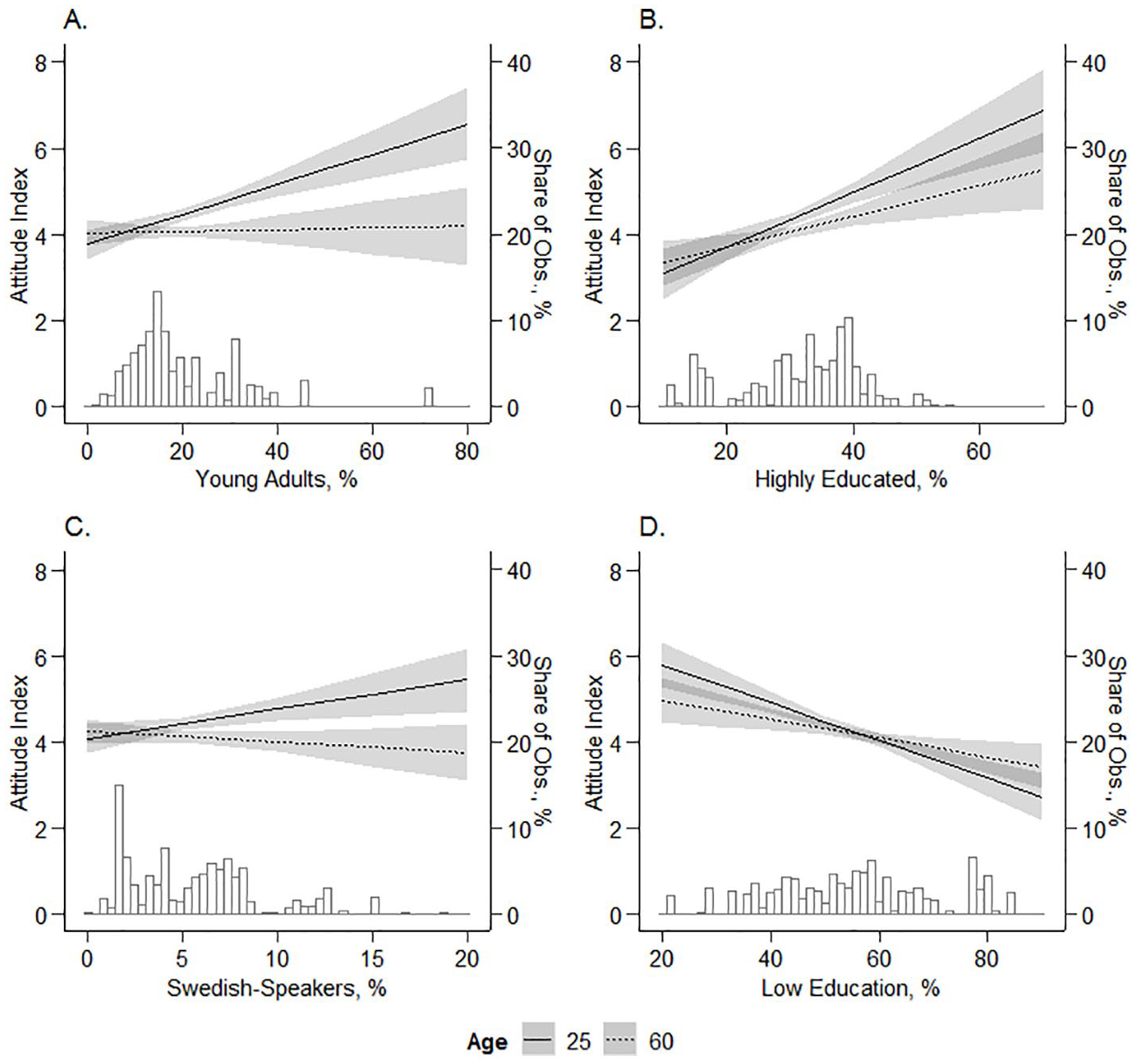
Predicted Values of the Attitude Index for Two Age Groups.
Figure 1 shows, first, how the attitudes of 25-year-olds tend to be the more positive the larger the population share of young adults in the neighborhood (based on model II in Table 3). The attitudes of 60-year-olds, in contrast, tend to remain unaffected by the share of young adults. Consequently, the difference in the attitudes of the age groups tends to be at its largest when the share of young adults is large. Second, Figure 1 illustrates how attitudes depend on the share of highly educated people (cf. model III in Table 3). Again, it is the younger age group whose attitudes are more strongly affected by the share of highly educated people. The attitudes of the older age group also tend to become more positive when the share of highly educated people grows, but not as much as younger adults’ attitudes. Third, young adults’ attitudes tend to be the more positive the larger the share of Swedish-speakers in the neighborhood (cf. model IV in Table 3), whereas the attitudes of older adults remain largely unaffected. Finally, Figure 1 illustrates the predicted attitudes of two age groups as a function of the share of people with low education (cf. model VII in Table 4). Again, the attitudes of young adults tend to be more strongly affected by the share of low-educated people in the neighborhood. However, young adults tend to have even more negative attitudes than older adults when the share of low-educated people is very large. When that share is small, the relationship between age and attitudes follows the conventional pattern in which younger adults are more positive toward immigration.
Robustness
Detailed results from a series of robustness tests are reported in the Supplemental Online Appendix, and we provide a summary of the main findings. First, it might be reasonable to argue that the interactions we find simply reflect differences in basic socioeconomic features of the neighborhoods or differences in the population share of people with a foreign background. For example, neighborhoods with a high share of Swedish-speakers tend to have somewhat higher income levels and lower unemployment rates, as do neighborhoods with large shares of highly educated people. However, age turned out to interact with none of these variables.
Second, the large student population of the city implies that the interactions may be driven by the prevalence of students in specific areas, especially in neighborhoods that surround the campuses of institutions of higher education. In such areas, the inhabitants tend to be relatively young and on their way to a high level of education, and in this sense, fit the profile of people with positive attitudes. We address this possibility in two ways. First, we add the share of students as a neighborhood-level independent variable. Second, we exclude all individuals living in neighborhoods with the highest shares of students. Either way, the interactions between age, the shares of high- and low-educated people, and the share of Swedish-speakers retain their signs and remain statistically significant.
Summary
In sum, the results suggest that although the effects of education, native language, and gender do not vary across neighborhoods systematically, the relationship between age and attitudes does. This pertains especially to the attitudes of young adults, in line with hypothesis 1. Whereas the attitudes of older adults do not seem to depend on the characteristics of the living environment, the attitudes of younger adults tend to be more positive, the more those people have in their immediate environments people who tend to have positive attitudes toward immigration: other young adults, highly educated people, and Swedish-speakers. Conversely, the attitudes of young adults tend to be more negative the more there are people with relatively low education in the neighborhood, low education being a clear predictor of negative attitudes at the level of the individual. These phenomena do not seem to be driven by the most obvious indicators of socioeconomic segregation, the average level of income and the unemployment rate, or by the share of foreign-language speakers, which approximates the size of the population with a foreign background.
Conclusion
In this article, we theoretically and empirically connected residential segregation of the majority population with their attitudes concerning immigrants. We contend that although the size of the minority living nearby has effects on the majority’s immigration attitudes (see, for example, Pettigrew and Tropp, 2006; Rydgren, 2008; Stolle et al., 2008), concentrating mainly on this one factor can give a somewhat limited view on how the living environment influences people’s views. Instead, we focus on in-group consolidation. This means being in contact with people holding similar positions and views, while lacking contact with contrasting opinions, in neighborhoods that due to residential segregation act as “pockets of likeminded citizens” (see Bishop, 2008: 40).
To test the hypotheses regarding the effect of neighborhood on attitudes toward immigrants, we utilized survey and register data collected from the city of Turku in 2012. The analysis showed that as in many other studies (Clawson and Oxley, 2012; Hainmueller and Hopkins, 2014; Hello et al., 2006; Pichler, 2010), young age, higher education, and female gender are strong individual-level predictors of pro-immigration attitudes alongside a locally important predictor, belonging to the Swedish-speaking minority. Regarding the size of the immigrant population living nearby, we found no conclusive evidence for either the threat or contact theories, although the relationship between the size of the immigrant population and the majority’s attitudes toward immigration was found to be negative. Nonetheless, attitudes varied between different neighborhoods. Therefore, as Gravelle (2016) pointed out, there seems to be more to context than acting just as a proxy for intergroup contact or as a measure of the economic challenge posed by immigrants. Based on the present findings, individual attitudes vary between neighborhoods and this variance is not solely explained by the size of local immigration population nor purely by residents’ individual characteristics.
We also found support for one of the research hypotheses, indicating that polarization does take place within the residential context, but only for a limited group of the majority population. It seems that young adults living in neighborhoods with a substantial youth population are more positive about immigrants than young adults in the city in general. The same is true for young adults who live in neighborhoods with a large proportion of highly educated people or Swedish-speakers. This indicates that a more positive general sentiment regarding immigration in a neighborhood makes young adults more likely to hold pro-immigration views. At the same time, older adults were not as influenced by the composition of their neighborhood population.
The fact that a substantial youth population in an area showed signs of a “pocket of likeminded people,” while we found no confirmation of this effect for a large older population is an interesting finding. It could be that these young adults naturally developed connections with similar people living in the same neighborhoods and interacted with them, and their attitudes became affected by the general sentiment in the area. However, the positive effect of this general attitude diminishes as people become older. It is possible that in these environments, older adults lack contact opportunities with younger adults. In short, the two groups do not share social interaction venues.
This finding regarding in-group consolidation among young adults seems to point to the importance of the so-called formative years. Goldman and Hopkins (2020) suggest that when it comes to attitude formation, it is especially the neighborhood where an individual lives in their youth and adolescence that matters. Therefore, living in an area where the general sentiment of people reflects open-mindedness and liberal views has a strong influence on individuals whose attitudes are more sensitive to those of others, namely, the young, while older adults are not as influenced by their residential context and others living there. Because, however, longitudinal data concerning individual attitudes are not available for this analysis, we cannot rule out other explanations for this finding. For example, it is possible that young people are more selective of their neighborhoods and are even more drawn to neighborhoods with others like themselves. Time spent living in the area could also be a factor here, as Maxwell (2020: 2082) has shown that lifelong residence, which means no exposure to other neighborhoods’ influence, can amplify contextual effects.
Residential segregation can, to some extent, be based on people’s voluntary choice of living area. However, at the same time, it is created and maintained by structural inequality, and even discrimination (Young, 2000). Residential segregation generates a host of economic and social problems, and can lead to uneven or failed urban development (Rasinkangas, 2013; Sampson et al., 2002). We find that residential segregation associates with segregation of opinions. Even though our empirical analysis cannot establish a causal relationship between the neighborhood characteristics and attitude polarization, this finding is in line with findings suggesting that the living environment can influence political opinion, party preferences, and voting behavior (Bhatti and Hansen, 2016; Gravelle, 2016; Huckfeldt, 1979; Pattie and Johnston, 2000, 2016; Walks, 2004). This indicates that by restraining residential segregation, policy makers could also indirectly restrict ideological polarization. Given the cross-sectional nature of our data, we encourage scholars to address the effects of residential segregation on attitudes using longitudinal research designs. This would greatly increase our knowledge about causal mechanisms underlying the associations we have found.
In this article, we set the living environment as the main venue for in-group consolidation. However, interaction among similar and like-minded people also takes place elsewhere, for example, at workplaces, schools, and universities. These environments possess characteristics similar to neighborhoods in terms of information and provide people with political cues, as well as a sense of shared identity. This is something that future research should take into account. Moreover, we did not have access to individual factors that may be relevant, such as employment status, income and party, and ideological affiliation. All would be valuable items to explore regarding group polarization within the residential context in the future.
Supplemental Material
sj-pdf-1-psx-10.1177_0032321721998929 – Supplemental material for Does In-Group Consolidation Polarize Attitudes Toward Immigrants?
Supplemental material, sj-pdf-1-psx-10.1177_0032321721998929 for Does In-Group Consolidation Polarize Attitudes Toward Immigrants? by Mikko Leino and Juha Ylisalo in Political Studies
Footnotes
Acknowledgements
The authors would like to thank the two anonymous reviewers for their insightful observations and their help in improving the article. Also, the authors are grateful to participants of the workshop “Political inclusion and the time span of politics” at the Annual Conference of the Finnish Political Science Association 2020 and at the general research seminar at the political science unit of University of Turku for their helpful comments and suggestions.
Declaration of Conflicting Interests
The author(s) declared no potential conflicts of interest with respect to the research, authorship, and/or publication of this article.
Funding
The author(s) disclosed receipt of the following financial support for the research, authorship, and/or publication of this article: This work was supported by the Strategic Research Council at the Academy of Finland project “Participation in Long-Term Decision-Making” (grant number 312671).

Supplemental Material
Additional supplementary information may be found with the online version of this article.
Table A1. Empty Model. Table A2. Random Slope Models. Table A3. Robustness Tests: Income Level, Unemployment, and the Size of Immigrant Population. Table A4. Robustness Tests: Controlling for the Share of Students. Table A5. Robustness Tests: Excluding the Neighborhoods with Largest Student Populations. Figure A1. The Effect of Age on the Attitude Index. Table A6. Bivariate Pearson Correlations.
Notes
Author Biographies
References
Supplementary Material
Please find the following supplemental material available below.
For Open Access articles published under a Creative Commons License, all supplemental material carries the same license as the article it is associated with.
For non-Open Access articles published, all supplemental material carries a non-exclusive license, and permission requests for re-use of supplemental material or any part of supplemental material shall be sent directly to the copyright owner as specified in the copyright notice associated with the article.
