




Abstract
Socioeconomic resources are important predictors of electoral participation, yet to understand their impact, we argue it is essential to examine the interaction of income dissatisfaction (egocentric dimension) with someone’s view of societal conditions (sociotropic dimension). Drawing on pooled national election surveys, we find that deprivation indeed depresses voting, but more importantly also that there is significant variation among those who experience economic difficulties: those who disconnect their personal misfortune from broader grievances are significantly more likely to abstain (Relative Power Hypothesis), while embedding one’s situation in a context of societal disparities leads to a desire for change and participation levels nearly as high as among the better off (Conflict Hypothesis). Our findings speak to inequality and turnout research but also have direct political implications, as it seems that responsiveness to campaigns focused on distributional injustices hinges on voters’ perception of themselves in relation to society.
Introduction
Democracies entitle their citizens to vote in elections, yet not everyone exercises this right. As a result, a copious literature is devoted to the question of what explains participation and abstention. Voting is widely regarded essential for sustaining democracy, whereas systematic abstention of disadvantaged and lower income groups is inherently problematic for the legitimacy of democratic decision-making in liberal democracies (Brady et al., 1995; Cheibub, 2007; Schumpeter, 2010; Wattenberg, 2002). Yet, what mechanisms lead disadvantaged individuals to become apathetic and abstain from elections and what encourages them to vote? While we answer this research question by addressing puzzling results from Austrian turnout statistics, this article will show that our findings have important general implications.
In Austria, as in many other Western European democracies, turnout is marked by an income gap: participation is generally higher in higher income groups and, at least on average, lower among the poor (Huijsmans et al., 2020; Matsubayashi and Sakaiya, 2021). Despite this gap, turnout rates in Austria tend to be slightly above the average of other EU members, and with a participation rate of nearly 75%, turnout is still relatively high even among the lowest income quintile (Mahler et al., 2014; Schäfer and Schwander, 2019). Political decisions are fundamentally the product of consensus-based bargaining processes in Austria, and participation in elections is perceived as a civic duty, even if there is no general obligation to vote. At the same time, social inequality and distributive justice traditionally play an important role in Austrian election campaigns, are highly salient, and characterized by strong party conflict (Dolezal et al., 2014), including a populist party offering voters dissatisfied with the status quo a protest option and prominently calling for more more “fairness”. Thus, while Austria is widely comparable to its Western European EU neighbors in terms of electoral rules, institutional set-up and electoral participation, it also provides a unique environment that permits disadvantaged citizens to express their concerns at the ballot box.
What the Austrian case illustrates, as we argue here, is that albeit poor economic conditions, or more importantly, perceptions thereof, decrease the likelihood of participation, there is a striking variation in how disadvantaged individuals respond to their financial misfortune. Although relative deprivation generally depresses voting, it requires an individual to disconnect personally experienced injustices (egocentric attitudes) from societal levels of inequality (sociotropic attitudes). Put differently, we argue that a sense of shared suffering from profound injustices at the societal level is what encourages people to cast a ballot in hopes of improving their situation. To be clear, this does not refer to converging patterns in their vote choice: awareness of a problem does imply agreement on how to solve it. However, viewing one’s own situation in a broader context means being aware of socio-political problems and is, in essence, what encourages disadvantaged individuals to voice their concerns and to take part in elections.
To test our theory that views on the fairness of society and levels of inequality moderate the effect of personal experiences of economic injustice on electoral participation, we employ pooled data from the Austrian National Election Study (Kritzinger et al., 2013a, 2016; Wagner et al., 2018) and draw on survey items to model both egocentric and societropic attitudes in interaction. We find robust evidence in support of our hypotheses, which suggests that while socioeconomic disadvantage reduces the average likelihood of voting, the view that society is unfair actually increases the likelihood of voting among disadvantaged citizens. This ultimately leads to a likelihood of participation that is almost equally as high as among voters who are satisfied with their income.
This means that political environments and politicization of redistributive justice indeed provide disadvantaged and dissatisfied individuals with opportunities to express their demand for change. Thus, our findings clearly go beyond the Austrian case and help address a crucial impasse in the literature on turnout in more general: According to a prominent strand focused on inequality and participation, people who feel powerless due to meager financial means are thought to become apathetic and eventually disengage from politics (Lahtinen et al., 2017), which leads to undesired policy output that in turn further decreases the likelihood of participation among the poor (Schäfer et al., 2013; Vehrkamp, 2015). Conflict theory, by contrast, predicts the exact opposite, arguing that shared experiences of injustice and awareness of societal grievances elicit a desire for change and increase the likelihood of voting (e.g. Killian et al., 2008). Although evidence for the so-called “resource model” has been mixed, recent shifts from “objective” measures of wealth to subjective feelings of deprivation seem to corroborate the hypothesis that perceptions of deprivation generally depresses voting (Anderson and Beramendi, 2008; Cicatiello et al., 2015; Jensen and Jespersen, 2017; Schäfer, 2010; Solt, 2008).
However, since much of the resource model research relies on aggregate-level data on income or inequality (Polacko, 2020; Schäfer and Schwander, 2019; Szewczyk and Crowder-Meyer, 2020), the exact psychological mechanisms have remained in the dark. We solve this impasse by showing that whether one or the other mechanism prevails is a function of how individuals see themselves in relation to society. The effect of economic deprivation on participation is more complex than commonly acknowledged and by itself neither elicits apathetic nor conflict-driven behavior.
Finally, our analysis also speaks to the issue of campaign mobilization on existential fears and distributional injustice, and puts emphasis on the fact that responsiveness of voters to such attempts fundamentally hinges on their perception of themselves in relation to society.
In the following, we first present our theoretical argument and show where our approach departs from the existing literature. We then move on to our case description to show what insights we hope to gain from the analysis of the Austrian case for the broader, theoretical debate on turnout. After a brief description of our methodology and operationalization, we present our empirical models and discuss the results. In this way, we contribute not only to the understanding of the Austrian case, but moreover to the literature on both electoral behavior and electoral democracy.
Theoretical Argument: From Resource Endowment to Subjective Feelings of Deprivation
Resource models focusing on socioeconomic factors feature prominently in the turnout literature (Brady et al., 1995; Plutzer, 2002; Verba et al., 1987, 1995). Although voting is not directly expensive, it is not free, as it requires an investment of time, effort, interest, and thus also some economic cost (Sigelman and Berry, 1982). This involves both collecting the relevant information and taking the time to go the polls. Some political activities require more resources in terms of specific skills and knowledge while others necessitate a greater amount of time and financial assets (Carreras and Castañeda-Angarita, 2019; Lijphart, 1997; Lister, 2007). Moreover, making political choices demands cognitive energy, something more easily managed by someone not facing anxiety about economic wellbeing. In fact, the positive effect of education and political knowledge on increasing turnout is well documented (Dalton and Wattenberg, 2002; Jerrin and Macmillian, 2015; Lassen, 2005). Better-off citizens are likely to have more information resources available, may hire people to liberate themselves from daily chores (Campbell, 2002), and possess the means to contribute directly to political campaigns, affording them greater access and influence.
To be sure, resources matter in our understanding of who participates in elections and who does not (Verba et al., 1995). However, as some studies emphasize the insights gleaned from aggregate-level indicators of wealth and deprivation (e.g. Polacko, 2020; Schäfer and Schwander, 2019; Szewczyk and Crowder-Meyer, 2020), other studies suggest that subjective feelings are ultimately better predictors and more likely to shape voters’ decisions (e.g. Bartusevičius and van Leeuwen, 2015; Gallego, 2010; Jensen and Jespersen, 2017; Lahtinen et al., 2017; Rustad, 2016). These findings indicate that the perception of deprivation and feelings of powerlessness matter greatly for whether voters abstain from elections.
We proceed from these insights and argue that dissatisfaction with one’s socioeconomic situation does not just arise from having a small income but also from perceptions of whether or not there are limits to upward mobility and social advancement (Lahtinen et al., 2017). Although both, the absolute levels of wealth and the perception of one’s financial means, are related, they are not the same: individuals’ perceptions do not have to correspond to actual levels of their income, yet they arguably inform their behavior more directly.
Generally, the question of resources is always also a subjective one, based on experiences, expectations, and ideological views. This is especially true for the assessment of inequality. Thus, we reason that different people may have completely different perceptions of income and wealth disparities although they live in the same country or even the same community. Citizens living in areas where the gap between rich and poor is vast and easily visible may assume inequality to be higher than those living in areas where people appear to be enjoying approximately the same living standard. Other important factors shaping perception include news consumption, the work environment, and the peer group, all of which provide cues that individuals may use to gauge their relative levels of wealth and deprivation.
Hypothesis 1: If individuals are dissatisfied with their personal economic situation, they are less likely to vote. (egocentric attitudes)
Individuals’ assessment of their personal socioeconomic conditions (i.e. egocentric attitudes) provides a first cue based on which they either go to the polls or abstain. According to resource model research, systematic abstention from elections among specific (economic) groups leads to a “downward spiral” in which those who should have a desire for more redistribution from rich to poor are left unrepresented (Lahtinen et al., 2017; Schäfer et al., 2013; Vehrkamp, 2015). Studies following this logic problematize the impact of systematic abstention not just on the representation of poorer groups but also on the quality of democracy.
Yet, it is not just the voters’ egocentric assessment of their personal status that plays a role when it comes to participation. Two prominent causal arguments exist in the literature for how dissatisfaction and perceived deprivation relate to participation: Conflict Theory and Relative Power Theory. What both theories share is that resource endowment and perception of deprivation on the personal (i.e. egocentric) level is strongly related to engagement in democratic, political processes. Nevertheless, the relationship between socioeconomic deprivation and abstention is more complex than the deterministic notion that all disadvantaged individuals should behave uniformly. How individuals see themselves in relation to society and how they assess the state of society (i.e, sociotropic attitudes) needs to be taken into account. It is precisely here that the two theoretical strands provide two diametrically opposed arguments and come to different behavioral expectations.
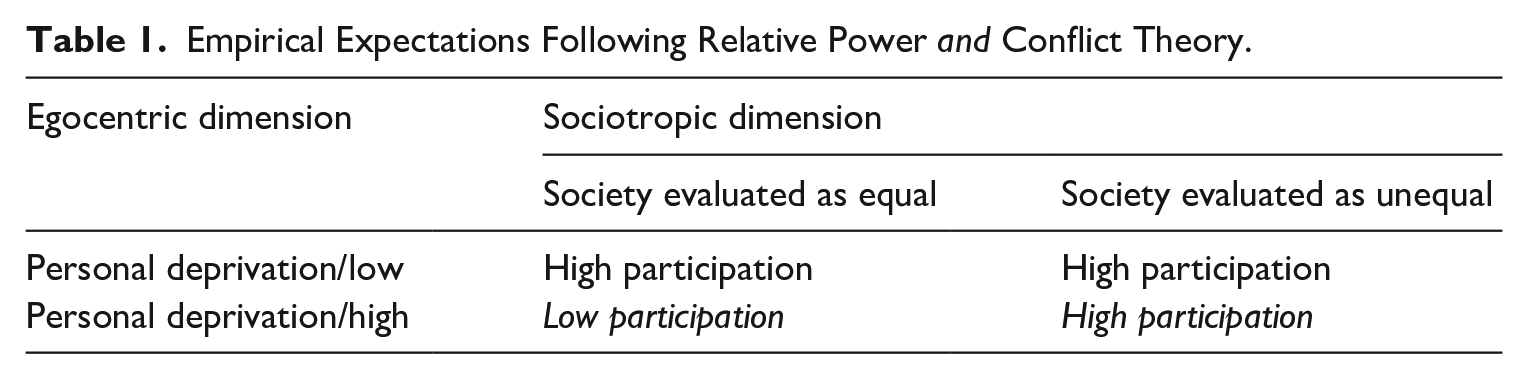
Conflict theory (Meltzer and Richard, 1981) states that perception of deprivation in conjunction with a sense of societal inequality results in greater political participation. Greater awareness of societal grievances fosters a desire for change and increases someone’s propensity to vote. Deprivation here means that one finds oneself in an economic situation of distress, but also feels compelled to express one’s concerns through voting. What prompts citizens to cast their ballot are “sociotropic attitudes,” meaning an awareness of problems and a desire to act in response to deeper socioeconomic issues that not only affect one person, but the whole community. Hence, conflict theorists expect that with rising inequality, the less fortunate will turn out in greater numbers since they perceive their situation as unjustified. This implies that electoral participation may be more than a habit and involves reflection on the part of voters concerning their own situation but also that of society. Based on this interaction of egocentric and sociotropic attitudes, we hypothesize:
Hypothesis 2A
This leads to the question of what happens if someone experiences economic difficulties yet disconnects these from broader, societal problems. Drawing on Relative Power Theory, inequality research stresses that what informs voters’ decisions is not merely their perceived economic situation but rather how they assess their situation relative to that of society. Proponents of this theory posit that those suffering from deprivation feel powerless and do not believe that their political involvement would change anything (Goodin and Dryzek, 1980; Schattschneider, 1960). Thus, in societies where the distance between the rich and the poor is vast, those who belong to the latter will vote less often because they assess their opportunities for influencing politics as minimal. This, however, requires an individual to disconnect his or her own misfortune from societal developments. Unemployment or fears of losing one’s job and social decline elicit feelings of frustration and being left behind (Scott and Acock, 1979); if one cannot take part in society for the sheer cost of it, why participate in elections?
This theoretical argument also dovetails with social-psychological insights, specifically from “system justification theory” (Jost, 2019, 2020). According to this theory, disadvantaged individuals would often act against their own interests (“ego justification”) or the interests of the marginalized group within society that they belong to (“group justification”), seemingly out of internalized values and a feeling that the way the system works is legitimate. This conservative reaction to uncertainty and potential changes to the status quo also is what prevents citizens from turning out, even though from a perspective of utility maximization, we would expect them to hope to improve their living conditions by taking part in elections: “People will defend and justify the social system in response to threat by using stereotypes to differentiate between high- and low-status groups to a greater degree than when there is no threat” (Jost et al., 2004).
Evidence regarding this social-psychological mechanism and specifically the effect of deprivation on electoral participation has resulted in mixed findings and for the most part utilized context-level data, leaving the exact individual-level mechanisms that are at play, in the dark. Still, more recent research (Jensen and Jespersen, 2017; Lahtinen et al., 2017) lends credence to the argument that personal experiences of deprivation lead to apathy and disenchantment with politics. We therefore argue that those individuals who share a feeling of socioeconomic deprivation but differ in their feeling of powerlessness relinquish all hopes for improvement of their personally experienced injustices.
Hypothesis 2B
As diverse as these theoretical approaches connecting resource distribution and participation are, the analysis remains rather inconclusive. Some studies find a negative relationship between deprivation and participation (Anderson and Beramendi, 2008; Bartle et al., 2017; Polacko, 2020; Schäfer and Schwander, 2019; Solt, 2008, 2010; Soss and Jacobs, 2009), others speak of significant effects running in the opposite direction (Isaksson, 2014; Killian et al., 2008; Soci et al., 2014). By proposing and testing the above set of hypotheses (summarized in Table 1), we disentangle two different mechanisms linking socioeconomic deprivation to individual participation in elections and illuminate the conditions under which dissatisfaction causes abstention.
Empirical Expectations Following Relative Power and Conflict Theory.
Case Selection: Electoral Participation in Austria
For our empirical analysis, we draw on the case of Austria, which, as we argue here, is not only well-represented through survey data but also allows us to contribute to a more general, theoretical debate regarding the effects of socio-economic deprivation on electoral participation. Between 2008 and 2017, three national elections were held in Austria: 2008, 2013 and 2017. By pooling election survey data for 2008, 2013, and 2017, we are able to trace effects of socio-economic deprivation in changing environments, while holding other potentially confounding variables at the systemic level constant.
Austria is a rather typical case in terms of turnout when compared to other EU member states, even though with a slight tendency toward higher participation at a relatively stable level: 78.8% in 2008, 74.1% in 2013, and 80.0% in 2017. Thus, Austria was exactly at the median of its EU-15 neighbors (before the 2004 EU-enlargement). In 2013, with a median of 71.4, and 2017, with a median of 75.2, elections in Austria featured even slightly higher turnout rates (see: Armingeon et al., 2019). In short, when it comes to predicting the probability of voting, Austria represents, among Western European democracies, indeed a typical case with a slight trend toward a higher rate of electoral participation. Austria is also comparable to other countries with respect to its electoral rules, since not only most of its EU neighbors, but also the majority of countries worldwide use some form of proportional representation systems. Thus, Austria, as an affluent country, EU member and with its institutional setup, largely conforms to the patterns and characteristics of other Western European democracies.
However, despite these evident parallels, there are also important differences that warrant closer attention and render Austria a crucial case. Austria is well-suited for this study also because its postwar “consensus democracy” was based on an explicit policy of social inclusion and relative equality. This model of public policy has since been pushed back in the context of internationalization in favor of greater economic growth and modernization. Nevertheless, issues such as social inequality and distributive justice still play an important role in Austrian election campaigns, are highly salient and also characterized by strong party polarization (Dolezal et al., 2014). Crucially, the country also boasts a major radical right populist party that has routinely sought to address voters disaffected by the political status quo and their socioeconomic situation, calling for greater “fairness”. As such, it offers people who feel economically deprived a protest option, which, in turn, has compelled competing parties to address social inequality in their own electoral campaigning. Thus, if anywhere, we would expect individuals suffering from meager economic means to vote in Austria, given the high salience of traditional, economic issues, combined with a consociational democratic problem-solving approach (Helms et al., 2019), which also manifests itself in voting behavior (Kritzinger et al., 2013b).
Voting may be an act of “civic duty” but more importantly offers those eligible to vote an opportunity to voice their concerns and choose among the offers made by political parties. Not everyone exercises this right, however. The reason is that being concerned about one’s standards of living and specific problems is one thing, but expressing these concerns by voting, through which one hopes to resolve these problems, is another and requires an entirely different mind-set. The latter requires a general awareness of shared, societal grievances and a sense of belonging to this community. Not being able to participate in social life for the sheer costs of it often reduces this sense of belonging. Yet, when individuals embed their own situation in a broader, social context, they are also more likely to participate in elections.
To be clear, expressing these demands at the ballot box does not equal support for populist or opposition parties but does explain the tendency toward higher turnout in Austria. While “system justification theory” predicts that members of disadvantaged groups will act against their own or their groups’ economic interests out of political conservativism and individualism, Austria provides conditions under which we would expect higher participation also among certain disadvantaged groups out of an awareness of belonging to such groups and a “Lagermentalität” that still is dominant in Austrian politics (Kritzinger et al., 2013b).
Operationalization
Dependent Variable
The Austrian case is especially well represented through survey data. For our analysis, we draw on data retrieved from the Austrian National Election Study (Kritzinger et al., 2013a, 2016; Wagner et al., 2018) for three elections. Collected before and after the respective election years of 2008, 2013, and 2017, the datasets comprise survey questions on a broad range of issues alongside indicators of political participation as well as demographics. This compilation therefore supplies us with a solid basis for an in-depth voter-level analysis. To test for overall effects of our main independent variables on the likelihood of casting a ballot, we pool the respective survey data from 2008, 2013, and 2017.
For our “participation” measure, we use statements by respondents about whether or not they had taken part in the most recent respective national election (i.e. the elections of 2008, 2013, 2017, comprising all national elections for which survey data exist). Although we are conscious of the potential drawbacks of individual-level designs including turnout over-reporting and self-reporting bias (Karp and Brockington, 2005; Selb and Munzert, 2013), individual survey data are still the best evidence available for highlighting particular individual-level mechanisms linking personal attributes to political behavior. Moreover, the items we draw on include a range of response categories, validation questions, that permit different expressions of reluctance toward voting in order to mitigate the problem of over-reporting, such as “Did not vote or could not vote for good reasons,” “I thought about voting, but I did not do so this time,” or “I usually vote, but I did not this time”.
This approach yields self-reported turnout rates of 86.4% (2008), 87.9% (2013), and 91.7% (2017) compared to official turnout rates of 78.8%, 74.9%, and 80.0% respectively, indicating a difference in percentage points of 7.5, 13 and 11.7 for the three years. Due to these deviations that actually stack the odds against our hypotheses and against finding a significant relationship, we weighted our models by the official turnout rates in the respective election years. 1 In order to do so, we added a weight to our regression models as a separate column within the dataset that (proportionally) assigns higher values and hence greater weight to the survey responses of self-reported abstainers in order to compensate for their under-representation.
Independent Variables
As follows from our theoretical discussion, testing the effect of perceived individual socioeconomic resources on the level of egocentric attitudes (Hypothesis 1), requires a measure of subjective perception of one’s economic situation, rather than proxies and absolute measures of wealth (Gallego, 2010; Lahtinen et al., 2017). The survey item by which we measure income dissatisfaction, our main predictor, is formulated identically in the polls for all election years: survey respondents were asked to place themselves on a four-point scale ranging from “get along very well” to “get along with great difficulty” (2008: D023; 2013: SD22; 2017: SD22) on their income, which we draw on as our measure of egocentric attitudes. Analogous to the dependent variable, we recoded these independent variable responses to obtain a binary variable of dissatisfaction: consistently across the different samples, 1 refers to “get along with (great) difficulty,” while 0 refers to “get along (very) well.”
In order to test Hypothesis 2A: Conflict Hypothesis and Hypothesis 2B: Relative Power Hypothesis, we ran models that additionally include an interaction of both the egocentric level (income dissatisfaction) and the sociotropic level (inequality in society as a whole). To tap into individuals’ assessment of society, we rely on the following variables: for 2008, the survey item asks respondents about the importance of “Tax reform to relieve low and middle income” (q44t) as a motive to vote or to have voted for a particular party in the national election. The 2013 election survey includes a measure of agreement with the statement that “Politics should balance differences between large and small incomes” (w1_q16_2). Finally, the 2017 item reads similarly — “Politics must fight social inequality” (w1_q44x1) — and again asks about the level of agreement with this statement.
Although the survey items vary slightly in their phrasing, all tap into the same concept of inequality and socioeconomic conditions at the societal level and, more importantly, all three statements share a strong emphasis on political agency. Furthermore, to ensure comparability, we again recoded all three survey items into binary variables measuring dissatisfaction. To obtain a benchmark, we first only focus on the overall effect of egocentric and sociotropic attitudes on the likelihood of voting before turning to Hypotheses 2A and 2B and the interaction of “Income dissatisfaction” and “Iinequality in society is too high.” To ensure the temporal flow of causality, we selected survey responses for our independent variables, whenever possible, from the pre-election survey waves (for 2008, there is only one wave). Again, we recoded all variables so that 1 denotes dissatisfaction with societal conditions and 0 otherwise. For 2008, a score of 1 means that the issue of “Tax reform to relieve low and middle income” indeed played a “(very) important” role for someone’s vote choice. In 2013 and 2017, a score of 1 denotes agreement (“somewhat agree” or “completely agree”) with the statements that “Politics should balance differences between large and small incomes” and “Politics must fight social inequality,” respectively. 2
In our pooled models (including the national elections 2008, 2013, and 2017), we control for the respective election year. In addition, we control for respondents’ left/right orientation in terms of their self-placement on an 11-point scale, the strength of their ideological conviction (left/right scale recoded), dissatisfaction with democracy, religiosity, educational attainment, age, gender, and residential area.
Crucially, we also control the effect of our main predictors with two additional and powerful variables when it comes to voter participation: “political interest” and “interest in the respective election campaign.” If our main explanatory factors withstand this rigorous test, then this points to high internal validity and that the effect of our explanatory factors are independent of further determinants of participation. For a summary of descriptive statistics regarding our dependent and independent variables, see Table A1 in the Online Appendix.
Discussion of Findings
Testing Hypothesis 1: The Impact of Perceived Socioeconomic Conditions
At the very beginning, we stated that we wanted to test the impact of perceived individual socioeconomic resources (i.e. egocentric attitudes) on participation in elections. As we expect a negative dependence, we need to test in a first step whether citizens who perceive their socioeconomic conditions to be dissatisfying are indeed more likely to abstain (Hypothesis 1). Our main model takes the following form

where our criterion (Y) is coded 0 = abstained and 1 = voted, where the main predictor (Income dissatisfaction) is likewise coded dichotomously, and where Covi indicates our set of controls. We calculate two models with a different setup on the part of the control variables. Only in the second model, we additionally include “political interest” and “interest in election campaign.” Since these are two powerful factors when it comes to explaining participation, we would want to see whether our main predictor of perceived individual socioeconomic resources remains stable or loses its explanatory power after incorporating these powerful alternative explanations.
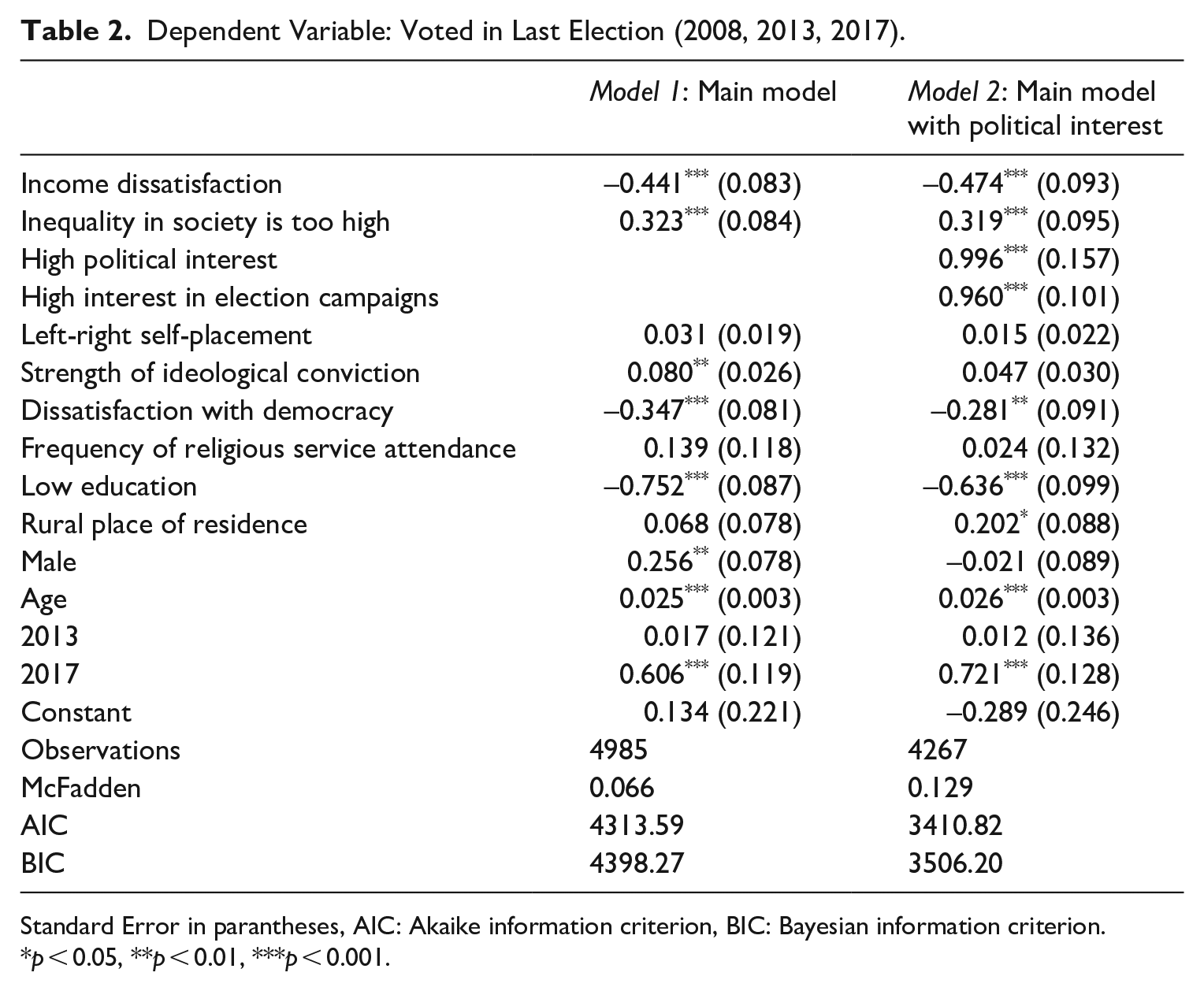
As specified in the above equation, the coefficients for predicting voting from the independent variables shown in Table 2 are in log odds units and the dependent variable is on the logit scale. The estimates indicate the amount of increase in the predicted log odds of voting that would result from a one-unit increase in the predictor while holding all other independent variables constant. 3
Dependent Variable: Voted in Last Election (2008, 2013, 2017).
Standard Error in parantheses, AIC: Akaike information criterion, BIC: Bayesian information criterion.
p < 0.05, **p < 0.01, ***p < 0.001.
In Model 1, the parameter estimate for the main predictor “Income dissatisfaction” is -0.441. This means, moving from 0 to 1, or no dissatisfaction to dissatisfaction with one’s income, we expect a -0.441 decrease in the log odds of the dependent variable “Voted,” holding all other independent variables constant. The negative impact of perceived individual socioeconomic resources on participating in the elections is highly significant.
Yet, what happens if we incorporate the powerful alternative explanations, “Political interest” and “Interest in election campaign” into the model? Table 2 shows the results in the column for Model 2. First, the results indicate that those variables are indeed powerful predictors. AIC and BIC but also the increased McFadden clearly reveal a positive model development. Second, it becomes clear that the main effect of “Income dissatisfaction” with its -0.474 decrease in the log odds of the dependent variable, remains stable and significant, even if these powerful predictors are added to the model. This is a clear sign of the relevance of perceived individual socioeconomic resources for participating in elections. To conclude, our models reveal a robust, negative effect of perceived economic means (i.e. egocentric attitudes) on voting, which conforms to our first hypothesis. Citizens who are dissatisfied with their socioeconomic situation are more likely to abstain.
We can support this outcome by examining the average predicted probabilities of voting based on “Income dissatisfaction” in Model 2. Figure 1 shows that 0.845 would be the average probability of participating in elections if everyone were satisfied with their income. The average probability would be 0.781 if everyone were treated as if dissatisfied with their income. This means that the average marginal effect of a negative perception is -0.064 (i.e. 0.781–0.845). Although this is in line with our Hypothesis 1, it does not yet allow us to conclude that sociotropic attitudes moderate the overall effect of “Income dissatisfaction” (Hypothesis 2A and Hypothesis 2B).
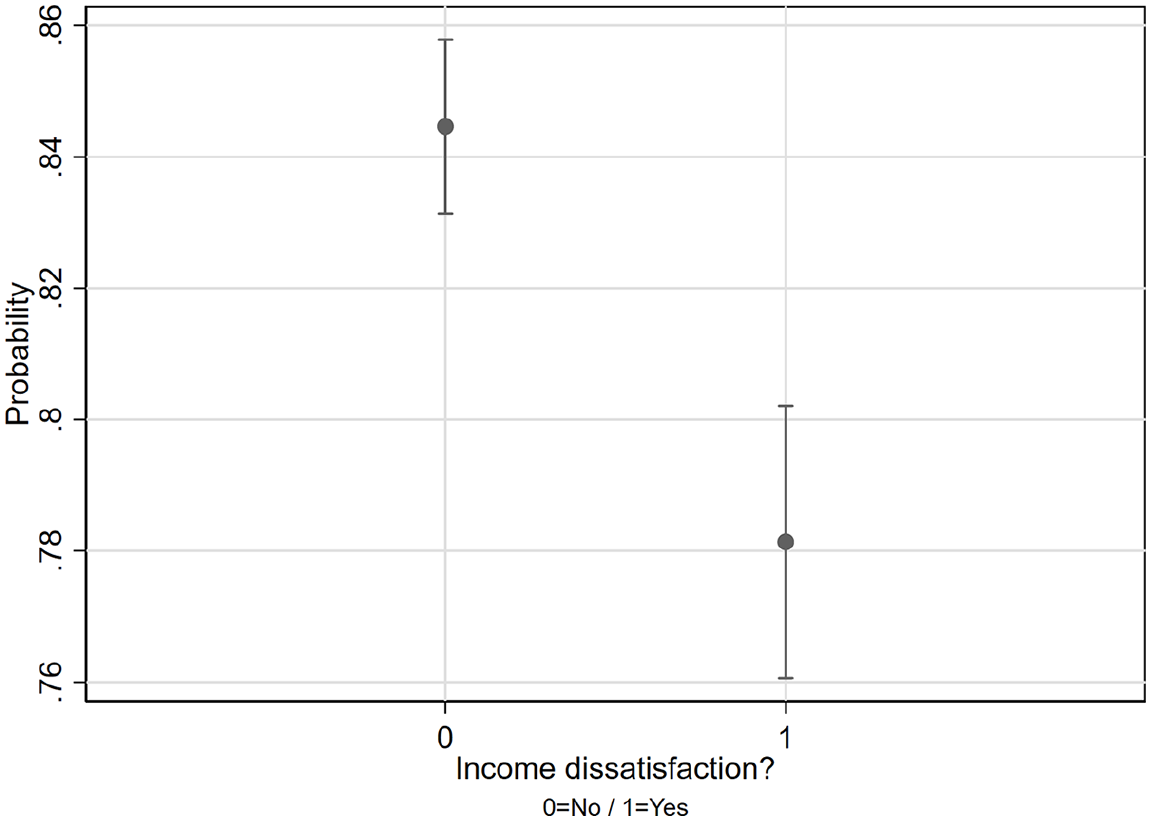
Predicted Probabilities to Cast a Ballot, 95 Percent CIs, National Elections 2008-2013-2017.
Testing Hypotheses 2A and 2B: The Interaction of Perceived Individual and Societal Socioeconomic Conditions
In a first step, we were able to establish that a negative perception of individual resources has a significantly negative effect on voting. Inequality research, however, indicates that disadvantaged voters may in fact not behave uniformly. Conflict theory suggests that socioeconomic disadvantage increases the motivation to vote (Hypothesis 2A). However, Relative Power Theory offers a competing explanation, arguing that perceived socioeconomic disadvantages lead to apathy and consequently to abstention (Hypothesis 2B). To solve this puzzle, we argue that it is crucial to shift the focus to voters’ assessment of societal conditions (sociotropic attitudes) in interaction with their personal experiences. The model we fit takes the form of

where the dependent variable is coded 0 = abstained and 1 = voted, and where the set of control variables stays the same, while only one aspect about the main predictors changes: namely, the interaction effect which results from the multiplication of “Income dissatisfaction” (egocentric attitudes) and “Inequality in society is too high” (sociotrophic attitudes). Again, we run two models (Models 3 and 4) with different setups of alternative explanations, where only the latter includes the variables “Political interest” and “Interest in election campaign.”
We have already been able to show that dissatisfaction with one’s own socioeconomic state is a relevant predictor for turnout (egocentric attitude). Our pooled model of the Austrian national elections 2008, 2013, and 2017 also shows that this effect strongly depends on citizens’ assessment of societal conditions and the perceived need for action to alleviate socioeconomic inequalities (sociotropic attitudes).
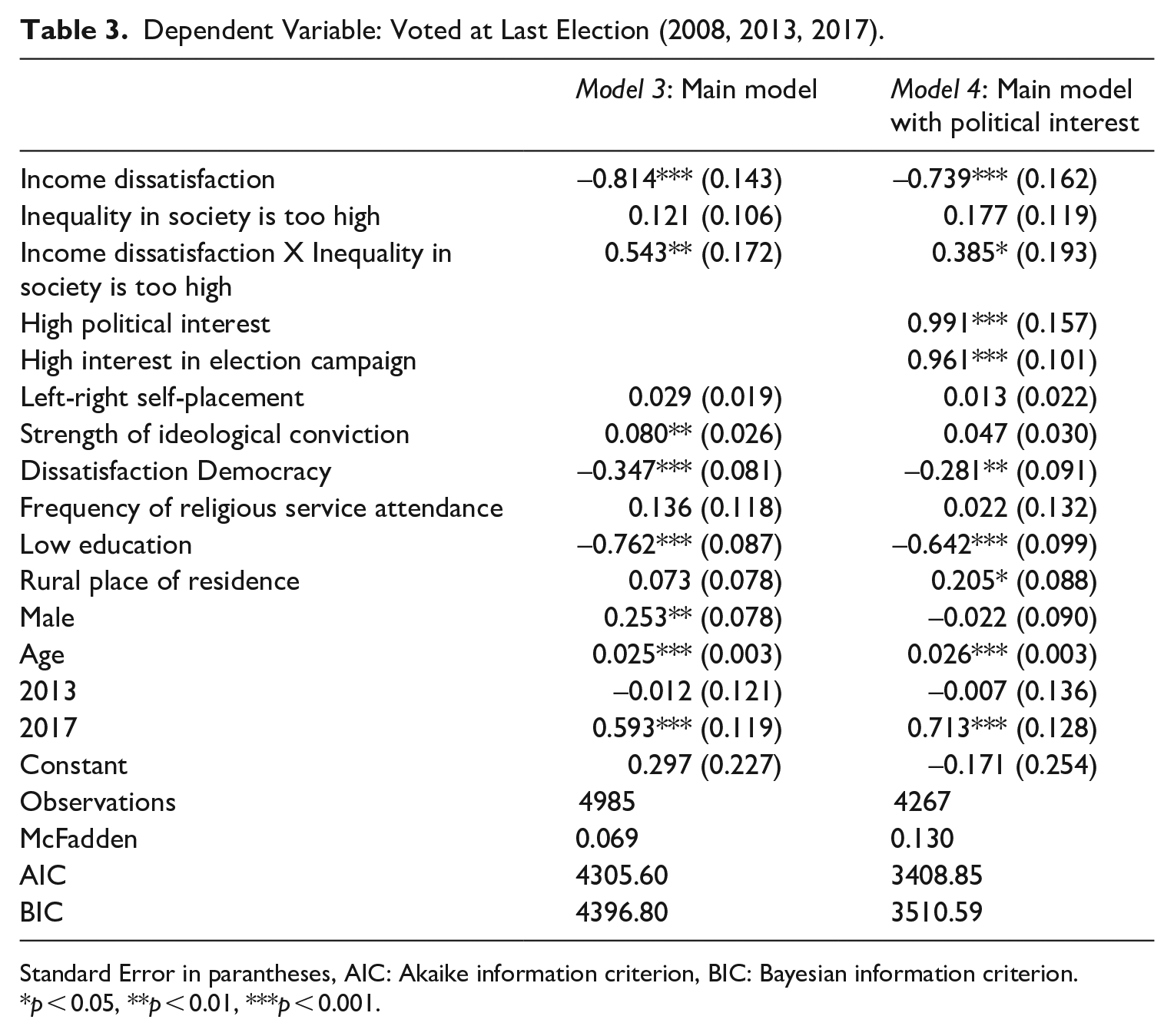
As expected, socioeconomically disadvantaged voters indeed do not behave consistently. That becomes clear from the direction of the interaction term of egocentric and sociotropic attitudes (“Income dissatisfaction” X “Inequality in society is too high”). The interpretation of the coefficient of the main effect of “Income dissatisfaction” is now the difference in log odds of the outcome between the codes 0 and 1 in “Income dissatisfaction” when “Inequality in society is too high” is equal to 0 (see Table A3 in the Online Appendix for odds ratios). By contrast, the main effect of “Inequality in society is too high” results when “Income dissatisfaction” is 0. The coefficient for the interaction is the difference of the effect of “Income dissatisfaction” between the levels 0 and 1 of “Inequality in society is too high.” Thus, in Model 3, moving from level 0 to 1 on the variable “Income dissatisfaction” when the variable “Inequality in society is too high” is equal to 1 yields a coefficient of -0.271 (= -0.814 + 0.543). The effect of moving from level 0 to level 1 in “Income dissatisfaction” when the variable “Inequality in society is too high” is equal to 0 shows a coefficient of -0.814. In other words, the belief that resource allocation in society is unjust reduces the given negative effect of dissatisfaction with one’s own socioeconomic situation on voter participation. Higher income dissatisfaction (egocentric attitudes) yields a greater likelihood of voting under the important condition that voters regard the overall societal situation as dissatisfying. If the desire for change in favor of reducing socioeconomic inequality in society outweighs personal dissatisfaction and frustration, voters are likely to voice their concerns at the ballot box. This is exactly the relationship specified in our Conflict Hypothesis (2A). By contrast, if voters do not consider the level of inequality in society a problem, then this does not reduce the negative effect of income dissatisfaction on voting. This voter group is the only one in our sample that is significantly less likely to vote compared to all others. As such, this captures the expected effect of the Relative Power Hypothesis (2B).
As before, we also included measures of political interest in our models, namely in the column denoting Model 4 (Table 3). Again, interest has a significant and strong effect on voting. AIC and BIC values clearly reveal a positive model development. Both the main effect of “Income dissatisfaction” and the interaction effect remain stable and significant even after adding these powerful predictors to the model. This leads to the result that first, in Model 4, the effect of moving from level 0 to level 1 on “Income dissatisfaction” when “Inequality” is not deemed a problem is equal to -0.739 (egocentric attitudes vs sociotropic attitudes), meaning that it is less pronounced than in Model 3 (-0.814). Second, and with a focus on the interaction term, it becomes clear that the reduction of the negative effect of insufficient personal socioeconomic resources on voting is more inhibited. Moving in Model 4 from level 0 to level 1 on “Income dissatisfaction” when “Inequality” in society is too high is -0.354 (= -0.739 + 0.385), compared to -0.271 in Model 3. Nonetheless, our models provide robust evidence as even after controlling for political interest and other important factors, the interaction term remains significant.
Dependent Variable: Voted at Last Election (2008, 2013, 2017).
Standard Error in parantheses, AIC: Akaike information criterion, BIC: Bayesian information criterion.
p < 0.05, **p < 0.01, ***p < 0.001.
Negative perceptions of one’s financial situation (egocentric attitudes) decrease the probability of voting (Models 1 and 2). Our Models 3 and 4 show that voters who are dissatisfied with their financial situation do not behave consistently. In this group, the view that society is unfair reduces the negative effect of income dissatisfaction and makes voting more likely. However, if voters, who are dissatisfied with their own incomes, consider society as a whole to be fair in terms of resource allocation, the likelihood of voting drops significantly.
Our analyses show that across all election years, we are able to discern a stable and significant effect of the interplay between the assessments on the egocentric and sociotropic level. We stress that this is an important indication for the validity of our measurement and the robustness of our findings. Overall, we conclude that it is not a question of whether socio-economically disadvantages voters cast a ballot, nor of whether the conflict hypothesis (2A) or the relative power hypothesis (2B) applies. Our analysis yields that it is the interaction of egocentric and sociotropic attitudes that explains patterns in individual participation and abstention.
Figure 2 shows the average predicted probabilities of respondents to vote based on Model 4. We focus on the findings for the group of voters who are dissatisfied with their income (Income dissatisfaction = 1). As is discernible, 0.806 would be the average probability of participation if everyone were treated as if they were dissatisfied with their income and had stated that inequality in society is too high. By comparison, the average probability would be 0.717 if everyone were treated as if they were dissatisfied with their income but considered inequality in society as not being too high (egocentric attitudes vs sociotropic attitudes). This results in an average marginal effect of the interaction between egocentric and sociotropic attitudes of 0.088 (= 0.806 – 0.717). In other words, socioeconomically disadvantaged people who say society tends to be unfair are more likely to vote than those who say society is generally fair. The predicted probability of voting is significantly higher for those voters who consider themselves socioeconomically disadvantaged and regard inequality in society as too high. Thus, the view that societal resource allocation is unjust significantly reduces the effect of dissatisfaction with one’s own socioeconomic conditions on voter participation.
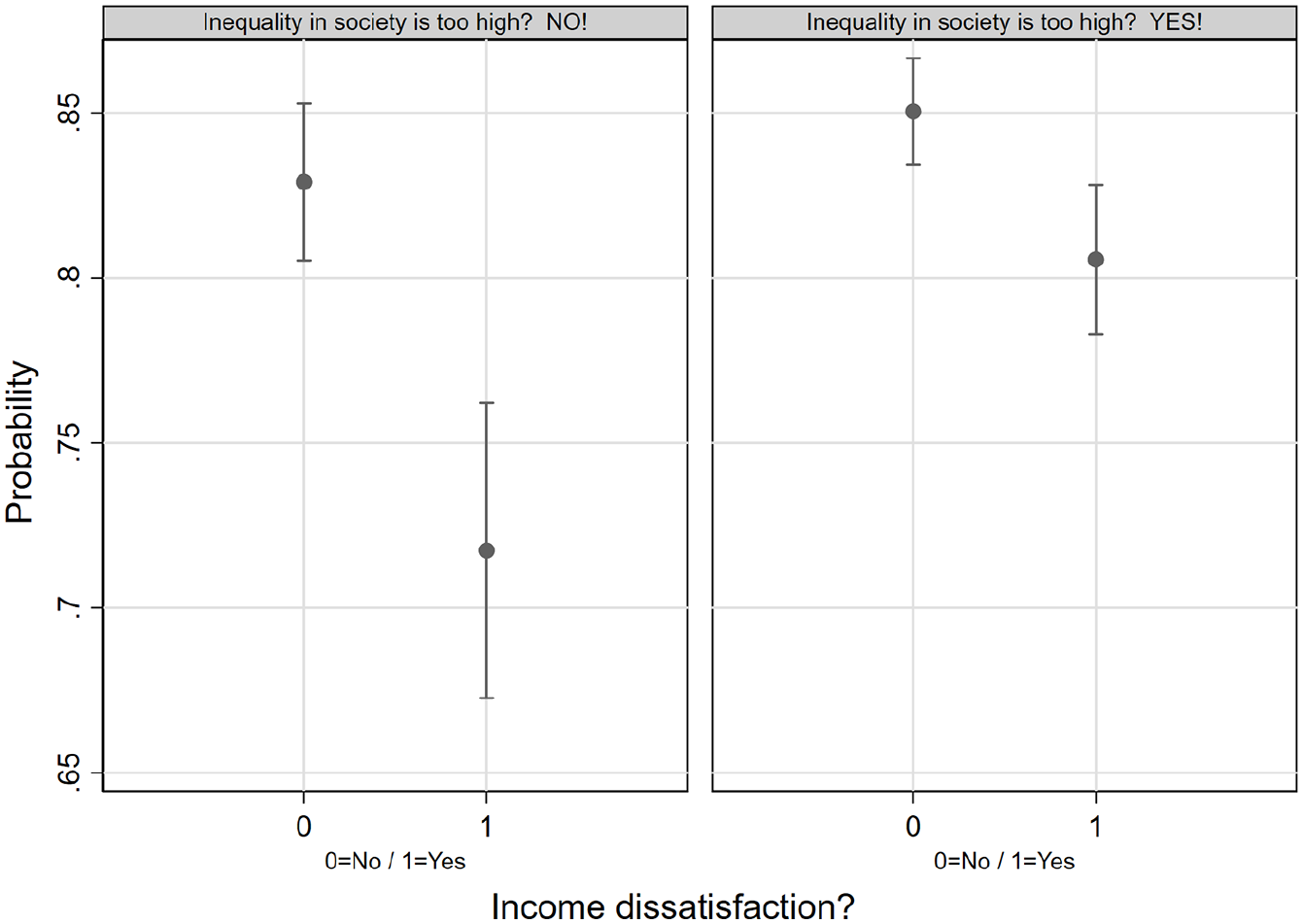
Predicted Probabilities to Cast a Ballot, 95% CIs, National Elections 2008-2013-2017.
Shifting focus to only those individuals who regard society as unfair and state that levels of inequality are too high (sociotropic attitudes), reveals another important finding and still a significant effect of individual income dissatisfaction (egocentric attitudes). Voters who perceive society as unjust but regard themselves in a good situation have a probability of voting of 0.850. Voters who regard society as unjust in the same way, but see are dissatisfied with their personal living standards are in fact less likely to vote – albeit at a still very high level with a probability to turn out of 0.806. This results in an average marginal effect of the interaction between egocentric and sociotrophic attitudes of 0.044 (= 0.850—0.806), meaning that among those voters who judge societal levels of inequality to be too high, the negative effect of income dissatisfaction still reduces the likelihood of voting.
To sum up, being socio-economically disadvantaged and dissatisfied with one’s income, regardless of other views, tends to depress voting. Deprivation is therefore not only an important driver of abstention but also a sufficient condition thereof, as even among individuals who are aware of general societal grievances and embed their own situation in this context, are slightly less likely to turn out. Yet, disadvantaged individuals do not just collectively abstain from elections. Our analysis also reveals robust evidence of a moderating effect of sociotropic views: among the poor, those who share a concern about societal levels of inequality are indeed significantly more likely to vote than others who, for whichever reason, do not share this assessment.
Conclusion
The starting point of this analysis was the question of what causes disadvantaged individuals to vote in elections and what deters people experiencing poor economic conditions from voting. Although aggregate-level research often points to turnout-depressing effects of a lack of resources, it is still unclear what individual-level mechanisms lead to abstention and what elicits feelings that taking part in elections might bring about improvements in one’s living conditions. This is not only an impasse in the literature on turnout but also relates to phenomena such as vote choices that seemingly run counter to someone’s personal or group interests (Jost, 2019; 2020).
Against this backdrop, we approach the question of socioeconomic causes of abstention from a different angle and emphasize in our analysis that there are two central issues to be considered. First, someone’s perception of one’s financial capabilities and economic situation is far more decisive when it comes to actual political behavior, since decisions are taken on the basis of psychological mechanisms and (self-)perception rather than mathematical calculations (Gallego, 2010; Lahtinen et al., 2017). Indeed, those who say they struggle to make ends meet based on their income are less likely to vote than those who are satisfied with their income (Hypothesis 1).
Second, however, we also ask whether economic suffering elicits a desire for change and leads to greater participation (Hypothesis 2A: Conflict Hypothesis) or whether feelings of being left behind and not being able to participate in social life cause frustration and hence lead to an apathy that manifests itself in abstention from elections (Hypothesis 2B: Relative Power Hypothesis).
In our analysis, we argue it is both: individually experienced grievances and a sense of lacking resources (egocentric dimension) combined with perceived societal grievances and inequality (sociotropic dimension) increase participation on the conflict motive (Hypothesis 2A). By contrast, relative deprivation, which we define as the negative evaluation of a person’s individual situation in combination with a positive evaluation of society’s socioeconomic conditions, either leads to apathy or to “system justification” out of a conservative reaction to uncertainty (Jost, 2019; 2020) and depresses voting (Hypothesis 2B). Pooling survey data from the Austrian National Elections Study (Kritzinger et al., 2013a, 2016; Wagner et al., 2018), we find robust evidence in support of all three of our hypotheses. Our results show that for disadvantaged individuals, sociotropic attitudes strongly moderate the effects of socio-economic conditions on voting. People who find themselves in a financially difficult situation but disconnect their own misfortune from any social grievances, become less likely to vote. However, we also find that regardless of someone’s sociotropic views, the perception of socio-economic disadvantage, on average, always leads to a lower probability of voting.
In addition to examining the influence of socio-economic problems on participation behavior, our study expands our knowledge of the causal mechanisms that link them together. Our empirical findings have direct political implications as they suggest that those abstaining from elections fundamentally differ in their opinions from those who attend elections. This links back to the questions underlying our research: what is the role of socioeconomic conditions in an individual’s participation in elections? Our research suggests that apathy is indeed a function of deprivation albeit it requires, all things being equal, an individual to disconnect personal grievances from the state of society. In cases where individuals seem to be thrown back to themselves and cannot link their economic misfortune to a wider societal problem, they are indeed likely to remain politically inactive. Alternatively, those able to connect their condition to a wider societal assessment take a conflict perspective and turn out in hopes for a better future. As such, they are more politically motivated and thus participate.
In conclusion, what this case teaches us is that contradictions observed by the literature in terms of the effect of socio-economic conditions on electoral participation, can be explained by taking into consideration how individual see themselves in relation to society or the system in general. This finding also jibes well with the observation that conservative reactions to uncertainty can lead people to become inactive or even willing to defend a system that is stacked against them (Jost, 2019, 2020). Yet, our findings also challenge other previous research that has for instance suggested that falling behind would motivate people to break out of their social status since they “desire to ‘keep up with the Joneses’” (Killian et al., 2008) and hence participate in greater numbers. The results of the present analysis underscore the importance of paying attention to the complex interaction of how individuals evaluate their own situation in relation to that of society.
Supplemental Material
sj-docx-1-psx-10.1177_00323217211052758 – Supplemental material for Perceived Deprivation and Voter Turnout in Austria: Do Views on Social Inequality Moderate the Deprivation—Abstention Nexus?
Supplemental material, sj-docx-1-psx-10.1177_00323217211052758 for Perceived Deprivation and Voter Turnout in Austria: Do Views on Social Inequality Moderate the Deprivation—Abstention Nexus? by Fabian Habersack, Reinhard Heinisch, Viktoria Jansesberger and Armin Mühlböck in Political Studies
Supplemental Material
sj-txt-1-psx-10.1177_00323217211052758 – Supplemental material for Perceived Deprivation and Voter Turnout in Austria: Do Views on Social Inequality Moderate the Deprivation—Abstention Nexus?
Supplemental material, sj-txt-1-psx-10.1177_00323217211052758 for Perceived Deprivation and Voter Turnout in Austria: Do Views on Social Inequality Moderate the Deprivation—Abstention Nexus? by Fabian Habersack, Reinhard Heinisch, Viktoria Jansesberger and Armin Mühlböck in Political Studies
Footnotes
Acknowledgements
All authors contributed equally to the manuscript. Earlier versions were presented at the University of Salzburg and at the “AUTNES Data Conference” in Vienna. We need to thank Kai Arzheimer and Franz Fallend as well as other participants of these events for their helpful comments. We also need to thank the anonymous reviewers for their remarks, which helped us improve the manuscript. We acknowledge financial support by the European Union’s Horizon 2020 research and innovation program under the grant agreement No. 822337.
Declaration of Conflicting Interests
The author(s) declared no potential conflicts of interest with respect to the research, authorship, and/or publication of this article.
Funding
The author(s) disclosed receipt of the following financial support for the research, authorship, and/or publication of this article: This research is part of the Project “PaCE” and received funding from the European Union’s Horizon 2020 research and innovation program under the grant agreement No. 822337.

Supplementary Information
Additional Supplementary Information may be found with the online version of this article.
Context
Notes
Author Biographies
References
Supplementary Material
Please find the following supplemental material available below.
For Open Access articles published under a Creative Commons License, all supplemental material carries the same license as the article it is associated with.
For non-Open Access articles published, all supplemental material carries a non-exclusive license, and permission requests for re-use of supplemental material or any part of supplemental material shall be sent directly to the copyright owner as specified in the copyright notice associated with the article.
