




Abstract
British and English national identities have long been considered to have porous boundaries whereby English individuals consider the terms more or less interchangeable. However, there is no empirical evidence to demonstrate whether primary feelings of either Britishness or Englishness are highly fluid within-individuals or whether individuals are consistent in their perceptions of their British or English identity. This is especially relevant in the post-Brexit referendum context where national identity is highly correlated with Brexit attitudes. Using panel data, we demonstrate that there is a notable degree of fluidity between identifying as British or English. This is higher than the fluidity between other national identities in the UK as well as more fluid than moving between any partisan or EU referendum identities. Remainers are more fluid than Leavers in their Englishness, whereas they are similar in the fluidity of their Britishness.
Introduction
Cultural issues over identity, particularly national identities, appear to have been an important part of the mix of issues involved in Brexit (Chan et al., 2020). Furthermore, there are strong indications that it is an English, rather than British, identity which is most strongly associated with Brexit support. Before devolution it was argued that the distinction between English and British identities was ‘fuzzy’, the terms being used more or less interchangeably, at least by English people (Cohen, 1994). It was anticipated however that, with devolution in 1998, the distinction might become sharper and that ‘the English lion might be about to roar’ (Curtice and Heath, 2000). Subsequent research (Ford and Sobolewska, 2018; Henderson et al., 2017) suggests that this has indeed happened and that an exclusive sense of Englishness was an important correlate of support for UKIP and for Leave.
However, almost all previous research has been based on cross-sectional surveys and, while clearly demonstrating strong correlations between English national identity and support for Leave, it cannot address causal questions. The scarcity of available panel data whereby respondents are repeatedly asked their preferred national identity has limited such analyses, which as Anderson and McGregor (2016) remark may be due to a tacit assumption that such identities are invariant over time. In this article, we draw on new (post-referendum) panel data to examine the fluidity – that is, the extent of people’s readiness to switch back and forth between different options (Fisher and Swyngedouw, 2002; Heath et al., 1991) 1 – of national identities in the UK in the aftermath of the referendum, and in particular to examine whether the ‘fuzziness’ of the distinction between Englishness and Britishness still holds true, and whether an emerging sense of Englishness is a major driver of continuing support for Brexit or whether instead Englishness simply reflects prior attitudes towards Brexit. Though most literature considers English and British identities to be interchangeable for individuals, we are not aware of any studies that have examined how true this is within-individuals over time. We ask whether individuals constantly opt-in and out of identifying as British rather than English or whether such identities are now distinct and stable. How does the fluidity of these British/English identities compare with the fluidity of other available national identities in the UK? Moreover, in light of Brexit, are we witnessing a hardening of national identities? And what are the political consequences of moving between British and English identities and the causal inter-relationships between these identities and political preferences?
We show that there is a notable degree of fluidity within-individuals between primarily identifying as British or English in subsequent time periods. The level of this fluidity has not hardened or softened during the course of Brexit negotiations and is considerably more fluid than either partisan or EU referendum identities. This latter finding somewhat supports earlier accounts of the fuzziness of the boundary between British and English identities – for which we provide additional empirical evidence using data from 1997 to 2001 – but also differs somewhat as the level of fluidity between these two identities is not high enough for these to be regarded as completely interchangeable. Additional evidence indicates that the causal direction is more likely to run from Brexit preferences 2 to choice of British/English identity rather than the other way round.
Literature
Identity can be conceived in different ways. It may be seen as ‘fundamental and consequential sameness among members of a group or category’ or as a core aspect of selfhood that is ‘deep, basic, abiding, or foundational’ (Brubaker and Cooper, 2000, 7). In this sense, identity is expected to remain stable even in the face of other changes. Alternatively, identity has been described as ‘multiple, unstable, in flux, contingent, fragmented, constructed, negotiated, and so on’ (Brubaker and Cooper, 2000, 11). It is plausible, when understood through this constructionist lens, that identities may once have been stronger when individuals were bound in tradition, but over the course of the twentieth century, have become more fluid and individuals may now draw upon multiple identities that may themselves change rather than having a single core identity (Jamieson and Grundy, 2005: 121). Conceived in this weaker way, different identities may be produced or activated under different circumstances.
When it comes to national identity, such identity has often been assumed to be relatively strong and – given its capacity to be highly emotive – to trump other ‘secondary’ identities (Fenton, 2007: 322). This assumption is however contested. McCrone (2002: 307/308) claims that national identities are not fixed and can change as they are constructed in the processes of everyday life and influenced by the social environment. That is not to say, though, that they are continually changing either, as national identity can be highly salient and stable for long periods of time. Rather, it means that individuals who at one moment claim a certain national identity may at a later time and in a different context instead claim a different one. This aligns with a key assumption that – rather than being profoundly fixed based on an individuals’ decisive early years – all aspects of identity are socially constructed and so even national identity should always be open to challenge and renegotiation (Jamieson, 2002). One sees this when looking at Québec over the past 60 years where qualitative evidence shows that individuals’ national identity may change in response to important events – including relationships with partners, changing patterns of cultural consumption, experiencing discrimination and the fallout from the 1995 referendum – with individuals identifying more as Québécois or Canadian at different points in their lives. The meanings and interpretations of these national identities have also evolved during this period (Giori, 2019).
Among the different national identities in the UK, distinguishing between British and English identity is particularly important given that the great majority of the population live in England. As an identity, Englishness is less inclusive than Britishness. Those who are unambiguously English are less tolerant of immigrant and ethnic minorities, while ethnic minorities themselves are much less likely to take on an English than a British identity (Curtice and Heath, 2000). Englishness has thus been largely reserved for white ‘natives’ (McCrone, 2002). British identity meanwhile is more inclusive and has always had an ‘umbrella’ character incorporating Scottish, Welsh and Northern Irish identities as well as English (Colley, 1992). It has been said to have a fuzzy frontier with its edges ‘historically changing, often vague and, to a degree, malleable’ (Cohen, 1994: 35). In contrast to Englishness, this pan-national and inclusive nature enables ethnic minorities to simultaneously retain their identity as an ethnic minority and as a British national as per Berry’s (1997) acculturation framework.
In practice, English people often failed to comprehend the difference between Englishness and Britishness considering them to be the same (Barnett, 1997: 293). This confusion that existed in the average English person’s mind between the two national identities arguably helped to keep the UK together as it rendered the West Lothian question – on whether, following devolution, MPs from Northern Ireland, Scotland and Wales should be able to vote on matters that affect only England – irrelevant for much of the population (Malcolm in Barnes, 1998, 50–53). Englishness was thus driven underground from political discourse – subsumed into Britishness – so that the fragile balance between the different British territories could be kept (Condor, 1996). However, more recent trends, and especially devolution itself, may ‘have served to undermine the ingrained habit of regarding Englishness and Britishness as labels that could easily be exchanged one for the other’ (Kenny, 2017). We therefore hypothesise the following:
H1: While British and English identities are not completely interchangeable, the fluidity between them remains higher than the fluidity between other pairs of available national identities. 3
As well as these established national identities, the 2016 EU referendum produced the prominent identities of Leavers and Remainers. These are claimed to shape people’s views of the Brexit process and its likely consequences, and to cut across party lines (Hobolt et al., 2021). While this division had not been especially prominent at the beginning of the referendum campaign, the referendum was a moment of ‘awakening’, and these new identities became quickly entrenched (Sobolewska and Ford, 2020). 4 Two years after the event, only 6% of people did not identify with either side compared to approximately 20% of people who did not have a partisan identity, and the strength of these Leaver/Remainer identities has been consistently higher than the strength of political party identities (Evans and Schaffner, 2019; Sobolewska and Ford, 2020). Thus, this is an opportune time not only to formally test whether the boundaries between English and British preferred national identities are as porous as was assumed in the earlier literature – something that has been long overdue – but also to compare the fluidity between these identities with the benchmarks of the fluidity between the newly emerged EU referendum identities as well as more established partisan identities. As we expect the fluidity between British and English identity to be relatively porous and that panel analyses have suggested that the ‘social and emotional intensity of these Brexit identities . . . is far higher than those for parties’ (Evans and Schaffner, 2019: 19), we hypothesise the following:
H2: The fluidity between preferred British and English identity is higher than that seen between both partisan identities and Brexit identities.
Furthermore, there is the question on whether changes in preferred British/English identity are linked to changes in Brexit preferences, or the other way round. In light of Brexit, Englishness has clearly entered into the political spotlight. Writing in the late 1990s, Barnes (1998: 10) remarked that, while there was little immediate danger of a resurgence in English nationalism, there was the probability that politicians or extremists would emerge who would seek to stimulate it. This is what appears to have been achieved with the Brexit movement whereby English national identity was significantly correlated with the Leave vote (Ford and Sobolewska, 2018; Henderson et al., 2017). With opposition towards European integration argued to have laid the foundations for the politicisation of contemporary English nationalism well before suggestions of a Brexit referendum were even taken seriously (Wellings, 2011), the coincidence of a rising salience of Englishness with this expression of anti-European sentiment is theoretically congruent. Empirically, the link is seen by breaking down the Brexit vote by individuals’ national identity. Within England, 54% of English identifiers voted to leave whereas the figure for British identifiers was just 46%. Moreover, looking at the relationship between referendum vote and exclusivity of national identity, 74% of those who felt ‘English but not British’ voted to leave, whereas the figure for those who felt ‘British but not English’ was just 38% (Curtice, 2017). While various reasons have been put forth for this, areas where people tended to identify most strongly as English were where people felt the most politically disillusioned, where restriction of inwards-migration was particularly prioritised and which had been most left-behind economically (Denham, 2019; Kenny, 2017). In this regard, it has been found that areas of the country most exposed to austerity were more likely to vote for UKIP in the 2015 General Election and in turn to vote Leave in 2016 (Fetzer, 2019).
The question of the causal direction between holding an English identity and Brexit preferences is however unclear, given that while the Brexit referendum was itself a product of nationalist mobilisations that pre-date the event, the referendum also facilitated the political expression of these nationalist tendencies (Wellings, 2021). As the studies just discussed rely on aggregate data, they cannot investigate individual-level changes. Thus, in the aftermath of the referendum, to what extent is a feeling of Englishness a driver of Brexit, or is it instead more a reflection of the issues raised by Brexit? If we are correct in supposing that Englishness is a more fluid identity than is a Leaver identity, it seems theoretically plausible that the causal direction will run from the more entrenched Leaver identity to the more fluid English one, rather than the other way round. We therefore hypothesise the following:
H3: The direction of causality is less likely to go from holding an English preferred identity to having a preference for Brexit than from having a preference for Brexit to holding an English preferred identity.
Having outlined the rationale for our study, the article proceeds as follows. In the next section, we detail our dataset, our measures and the methods we use. In the following section, we analyse the overtime fluidity between different national, partisan and EU referendum identities, respectively, within the UK before then examining within England specifically the relationship between switching between English and British preferred identities and switching one’s EU referendum vote intention were another referendum to be held. Finally, we summarise our findings and discuss their implications.
Data and Methods
We use eight waves of panel data collected online through Kantar Public covering the whole of the UK. During collection, special efforts were made to have good samples of ‘hard to reach’ sectors of society (for instance, young Londoners); these individuals received more reminders and a longer time period to respond to the survey invitation. The surveys were fielded in July/August 2017 (wave 1), October/November 2017 (wave 2), February/March 2018 (wave 3), April/May 2018 (wave 4), July/August 2018 (wave 5), November 2018 (wave 6), March/April 2019 (wave 7) and July/August 2019 (wave 8). The first wave had a sample of 5311, the second 3606 and the other waves had approximately 3000 individuals. Each wave contained a combination of individuals who had answered the previous wave(s) as well as fresh respondents to deal with attrition. Table 1 displays the number of individuals that were retained in each subsequent wave and the retention rate. The data performs well when benchmarked with random probability samples such as the British Social Attitudes survey (see Carl, 2017a, Online Appendix A) as well as displaying high consistency with studies based on the British Election Study (BES) (see Carl, 2017b, Online Appendix D). For robustness, we carry out additional analyses using BES panel data (Fieldhouse et al., 2019; Heath et al., 2002) where our measures overlap. This demonstrates broadly similar patterns as are found in our data, with details discussed in the results section.
Panel Sizes and Retention Rate.

Our main measure captures self-categorizations of national identity. There are many ways of eliciting these from offering closed or open categorical options to a range of different scales (Coakley, 2007: 582–583; Sinnott, 2006). We proceed in two steps. First, we ask respondents: ‘Turning now to your national identity which, if any, of the following describes the way you think of yourself? Please choose as many or as few as apply’ and presenting them with a list of eight different national identities. 5 This allows us to capture whether individuals subscribe to multiple national identities. As we are particularly interested in individuals’ primary national identity, for respondents with more than one national identity we then asked, ‘And if you had to choose, which one best describes the way you think of yourself?’. This question has previously been fielded as part of the BES (Heath et al., 2002). 6
Partisan identity is captured with the standard BES question, ‘Generally speaking, do you think of yourself as Labour, Conservative, Liberal Democrat, or what?’. Other options provided were UKIP, the Green Party and the BNP, and in wave 8 we additionally included the Brexit Party and the Independent Group for Change. For respondents in Northern Ireland, Scotland and Wales, each of their main regional parties were included in both the question and the answer categories. 7 To capture Leaver/Remainer identity, we asked ‘Generally speaking, do you think of yourself as a “Brexiteer” or a “Remainer”’. 8 We also use questions on which way respondents voted/if they had not voted which way would they have voted in the 2016 referendum as well as, from the second wave onwards, how individuals would vote if there were another referendum. Brexit identities and Brexit preferences are strongly correlated but, to avoid ambiguity, we always use the term ‘Brexit preferences’ when referring to the measure of how people would vote if there were another referendum.
We focus on analysing the fluidity of our measures in consecutive waves rather than examining the entire time series at once. This has two primary advantages. First, due to individuals moving in and out of the panel, we have very few individuals who answered every wave, and so would run into issues of both power and representativeness. Second, this strategy enables us to see clearly between what points in time any potential change in fluidity that we might find occurs.
As indicators of fluidity, we use symmetrical log odds ratios (SLORs) (Fisher and Swyngedouw, 2002; Heath et al., 1991). Given two options X and Y at time points t1 and t2, we calculate SLORs using the following formula: 9
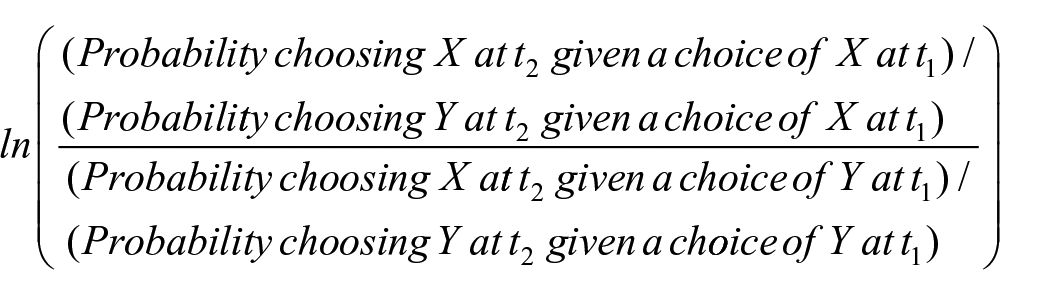
An SLOR of 0 indicates complete interchangeability between the two options. As less switching occurs between the given options, relative to the number of individuals remaining constant, the value of the SLOR increases. Thus, the ratios can be interpreted such that lower values approaching zero indicate greater fluidity, whereas higher values indicate greater stickiness between the two given options. Our analyses use unweighted data as the xttrans Stata command that we use to calculate transition probabilities does not permit weights. However, the demographic composition of our panels is similar across the waves (see Online Appendix A).
We also carry out cross-lagged panel models on the relationship between having an English/British preferred identity and one’s Brexit preferences. 10 Given two variables a and b at time points t1 and t2, such models allow one not only to examine the direct effect of variable a at t1 on a at t2 (as well as the effect of b at t1 on b at t2), but also the lagged effect of variable a at t1 on b at t2 and the effect of variable b at t1 on a at t2. In this way, it allows one to investigate the direction of causality between two given variables measured in two or more panel waves and to adjudicate on the presence of reciprocal or directional influences (Kearney, 2017). Cross-lagged models do not provide as strong evidence of causality as do field experiments or fixed effects panel models, but provide much stronger indications than purely cross-sectional analyses. They have recently been used to examine the relationship between the strength of ethnic group identification and ethnic-group-based relative deprivation in New Zealand (Zubielevitch et al., 2020). As we use two dichotomous variables, we carry out such analysis through generalised structuralised equation models with a Bernoulli distribution and a logit link.
Results
Examining the Fluidity between National, Partisan and EU Referendum Identities
To begin with, we present the SLORs for individuals’ preferred national identity from 2017 to 2019 in Figure 1. The first thing to notice is the relatively high level of fluidity between British and English preferred identities. This consistently oscillates around a value of 3 and indicates that individuals are relatively likely to go back and forth being the two identities, in comparison to the lower levels of fluidity between British and Scottish and between British and Welsh identities. Between wave 1 and 2, for instance, 24% of respondents who had a primary English identity in wave 1 switched to a primary British identity in wave 2 and the figure going in the opposite direction from British to English was 12% (see Online Appendix B). Thus, this appears to be evidence that English and British identities are more likely to be used as substitutes than are British and Scottish or British and Welsh identities. 11 At the same time, the British/English SLORs of around 3 are significantly different from 0.
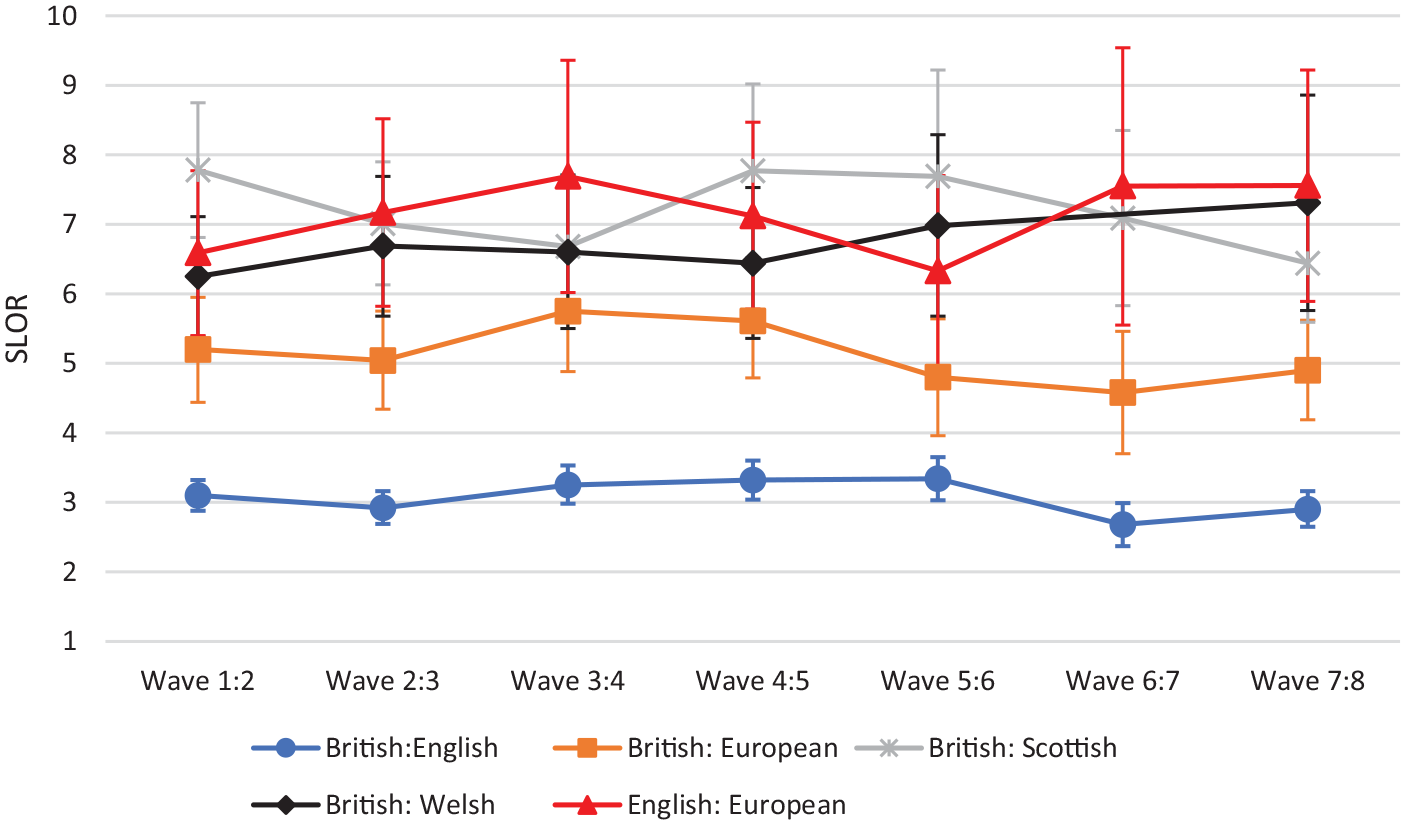
SLORs for National Identity with 95% CI (2017–2019).
Delving into the fluidity between preferred European identities and both preferred English and British identities is also of note. As discussed earlier, Englishness is particularly linked to Euroscepticism and thus one would not expect high levels of fluidity between preferred English and preferred European identities. This is what the data show with the levels of fluidity between English and European preferred identities generally on par to those between British and Scottish identities with SLORs around 7. Moreover, there is consistently higher fluidity between British and European than between English and European preferred identities. This supports the view that feelings of Britishness are more compatible with feelings of Europeanness than are feelings of Englishness. So although we find greater fluidity between Britishness and Englishness than between some of the other pairs of identities, we also find evidence of how Englishness is more closed to Europeanness than is Britishness. 12
A key question is whether the fluidity between these identities is different now compared with two decades previously when the work of Cohen (1994) implied that the fluidity between the two identities meant that they were almost interchangeable. As our national identity question was repeatedly asked in the four-wave 1997–2001 BES panel study, we can investigate this. While some caution must be applied as the gaps between these panels were longer at 1- and 2-year intervals whereby one might expect less internal consistency, it is nevertheless instructive. The SLORs for this period are displayed in Figure 2 (see Online Appendix B for transition probabilities). They suggest that the fluidity between British and English preferred identities used to be greater, revolving around 2 compared with the figure of 3 recorded in the 2017–2019 period. So while still relatively fluid today, our results demonstrate there is now a greater degree of ‘stickiness’. Meanwhile, the fluidity between both English/European preferred identities and Welsh/British preferred identities is almost identical in the BES panel and in our Brexit panel. Although it would seem that the fluidity between British/Scottish preferred identities used to be greater, the evidence is less robust as the confidence intervals for these estimates between 1997 and 2001 do overlap with some of the estimates between 2017 and 2019.
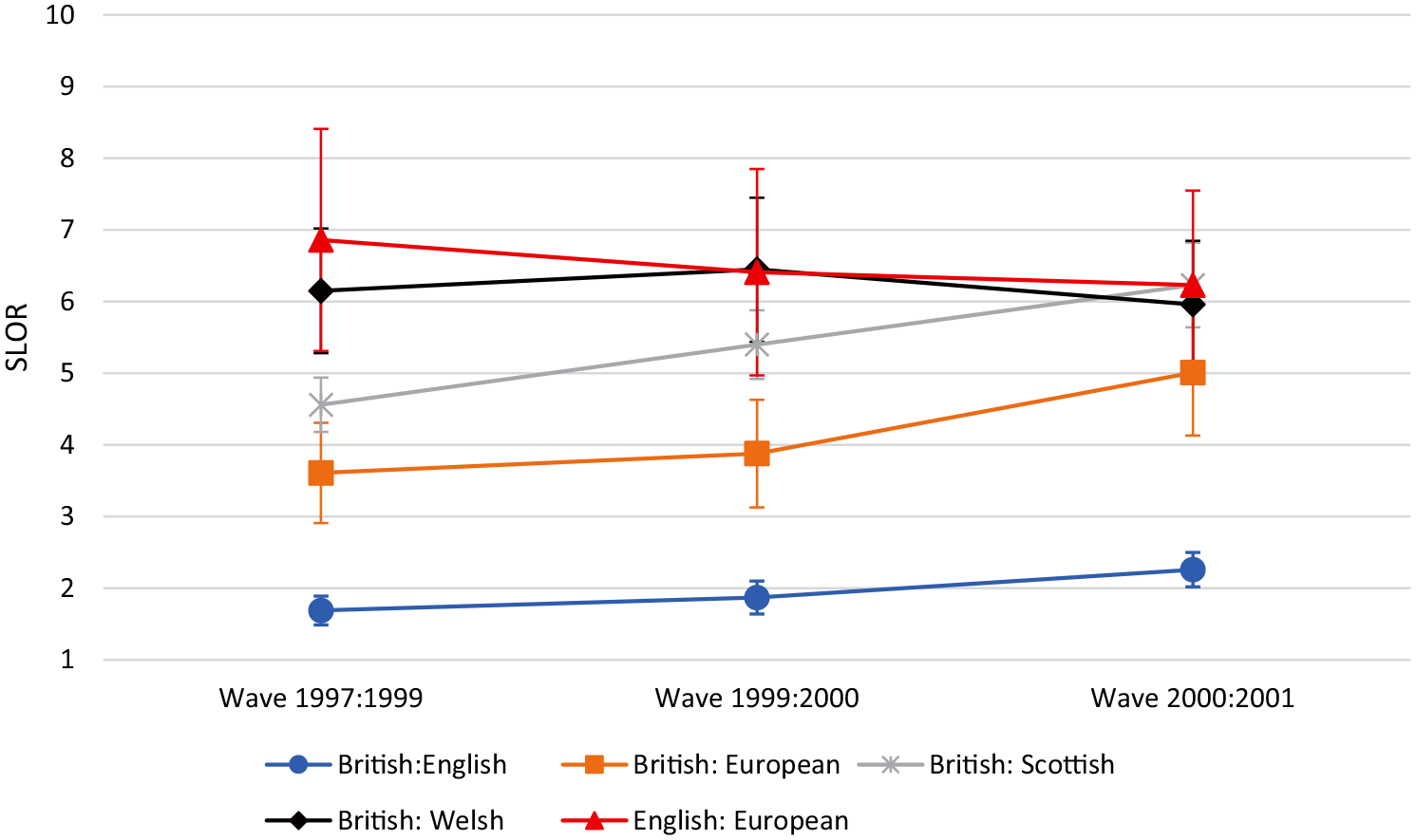
SLORs for National Identity with 95% CI (1997–2001).
Returning to the 2017–2019 data, how do these findings on the movement between national identities compare with switching between different partisan identities? From the theory of proximity, one would expect that the further away two parties are from each other ideologically, the greater the stickiness would be, whereas one would expect greater fluidity when two parties are closer to each other (Fisher and Swyngedouw, 2002).
This is what we generally see in Figure 3. The SLORs between Labour and Conservative identities remain consistently high with values around 8 or even higher. Meanwhile, the SLORs between Labour and Liberal Democrat identities are predominantly lower than those between Labour and Conservative identities, although the Labour/Liberal Democrat ratio decreases notably from 7.2 between waves 4 and 5, to 6.5 and 5.3 between waves 5 and 6 and between waves 6 and 7, respectively. A similar phenomenon occurs for the fluidity between Conservative and UKIP identities. This suggests a pattern of increasing fluidity in later waves as dissatisfaction with the Brexit process increased, although this is largely confined to changes between Labour/Liberal Democrat and between Conservative/UKIP identifiers. And in both cases, this fluidity slightly decreases again between waves 7 and 8. 13 It is also worth noting that Labour, Conservative, Liberal Democrat and UKIP partisans (contained in Online Appendix C for space reasons 14 ) all have similar levels of fluidity between those switching back and forth between having a partisan identity and not having one.
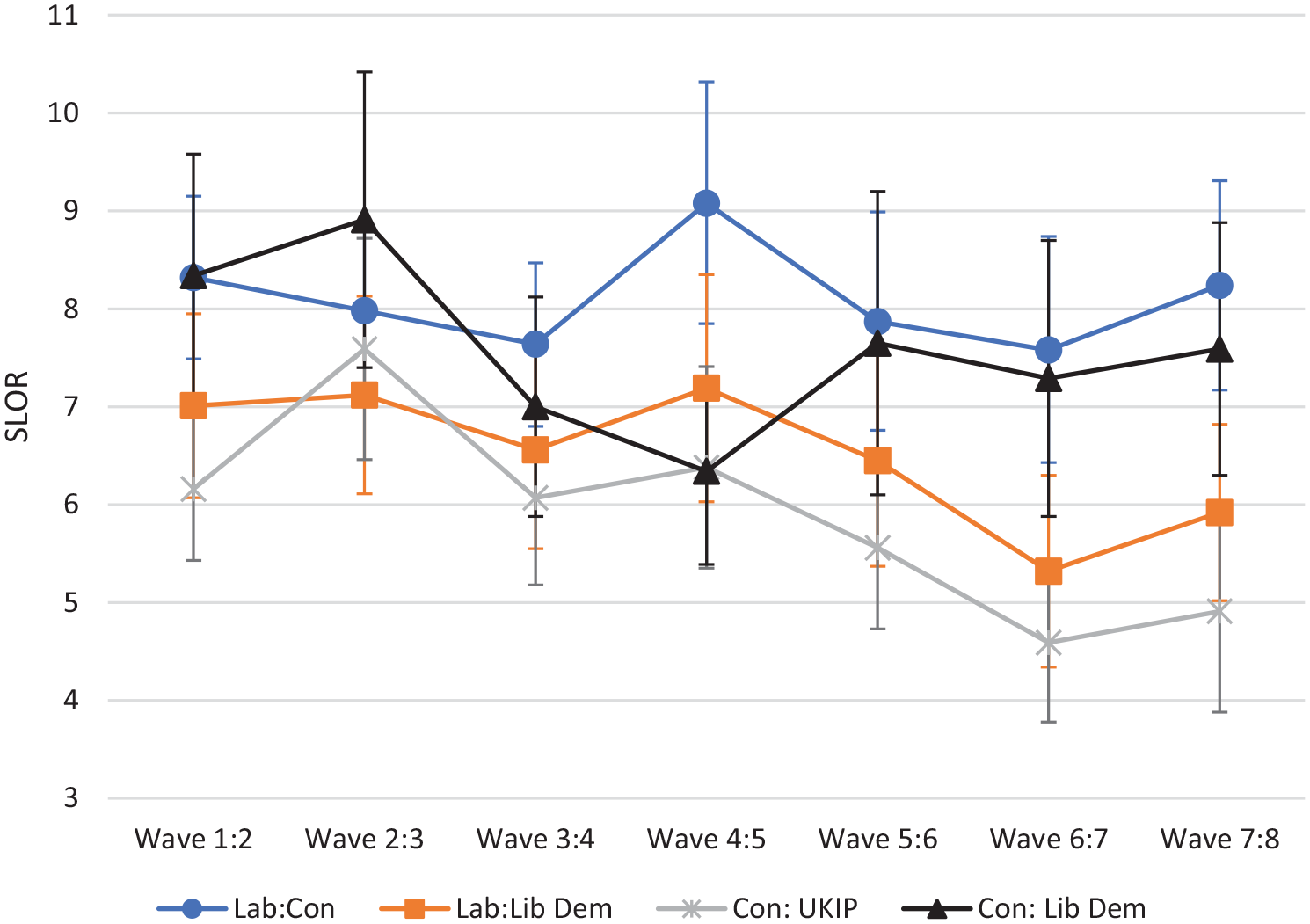
SLORS for Partisanship with 95% CI.
In comparing the fluidity of these partisan identities to the fluidity of national identities, it is quite stark that even the partisan identities that display the greatest fluidity (e.g. Labour/Liberal Democrat or Conservative/UKIP) are much less fluid at all time points than the level of fluidity between British and English preferred identities. This underscores the relative fluidity of the boundary between British and English identities. 15
A comparison can also be made with the fluidity of Brexiteer 16 /Remainer identities. Between each consecutive wave, between 88% and 93% of individuals maintain their identities as either a Brexiteer or a Remainer. This fits in with previous research (Evans and Schaffner, 2019; Hobolt et al., 2021) that suggests that these have become important identities. However, what our SLORs in Figure 4 demonstrate is that the boundary between these two identities – while still relatively sharp – may have become slightly more permeable between the autumn of 2017 and the summer of 2018 before subsequently fluctuating around the same level.17,18 Analysis of the fluidity of Leaver to Remainer identity in the BES over this time period shows similar values of between 6.3 to 7.1 (see Online Appendix D). This both validates the replicability of our findings, as well as supports our assertion of our ‘Brexiteer’ identity being equivalent to the ‘Leaver’ identity used elsewhere in the literature. Thus, this referendum identity is becoming more fluid than the movement between English and European preferred identities and between British and Scottish identities, although remains stickier than the boundaries between the other national identities. Moreover, there is consistently greater fluidity between Brexit and Remain identities than there is between the major partisan identities such as Conservative and Labour. Indeed, it is little different overall from the fluidity between Labour and Liberal Democrat or between Conservative and UKIP partisan identities.
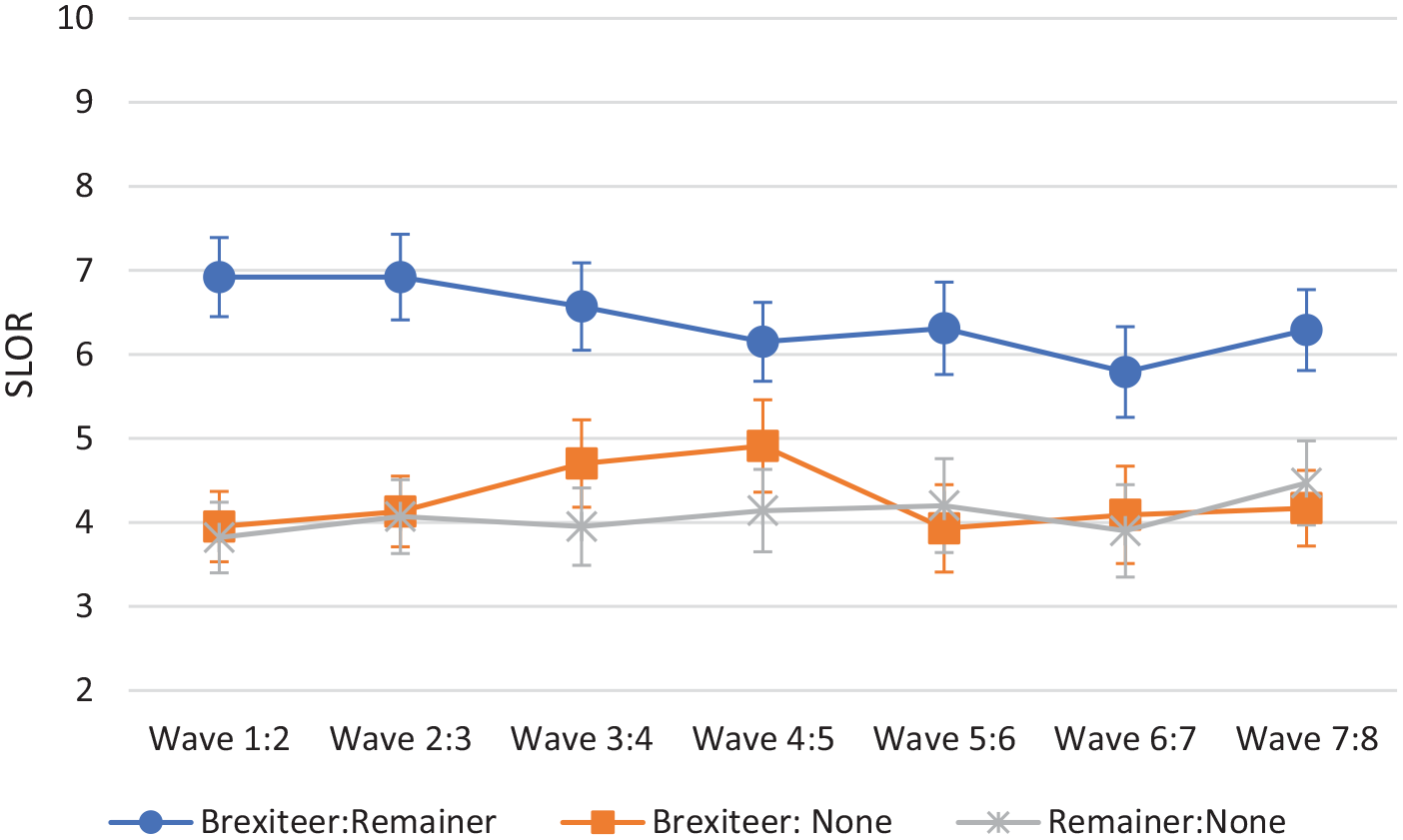
SLORs for EU Referendum Identity with 95% CI.
From this analysis, it is clear that the fluidity between British and English preferred identities is particularly noteworthy in comparison with the fluidity between other political identities. We carry out further analysis on three-wave panel data to enable us to distinguish whether people on average are making meaningful durable changes to their identity or whether they are merely randomly switching due to the interchangeable nature of the identities. For this analysis, we refer to the seminal work of Converse (2006). Converse puts forward the case in his ‘black and white’ model that on a given issue that, while there are individuals whose attitudes are crystallised and unlikely to shift, for the rest response sequences over time are statistically random due to respondents not having meaningful opinions. In such a scenario, the aggregate level change in responses over consecutive time periods should remain the same. Thus, in a three-wave panel, if the aggregate instability between points t1 and t2, between points t2 and t3 and between points t1 and t3 on a measure are the same, then this shows that there is no process of meaningful change in stability occurring among respondents. If meaningful change were to occur, one would expect to see substantial changes in the aggregate levels of change between these time points. Although attrition is lower between two consecutive waves than between three, we consider the analysis of three-wave changes worth undertaking for a full understanding of patterns of change.
In Table 2, we present SLORs for individuals who remained in three consecutive panels. We present these for our main two national identities of interest – preferred Britishness and Englishness – as well as for switching between a Brexit and a Remain identity. We also including SLORs for switching between Labour and both the Conservatives and the Liberal Democrats. In the former, we would expect to see these estimates being sticky throughout, whereas we expect to find greater fluidity in the latter case in our later waves.
Three-wave SLORs.
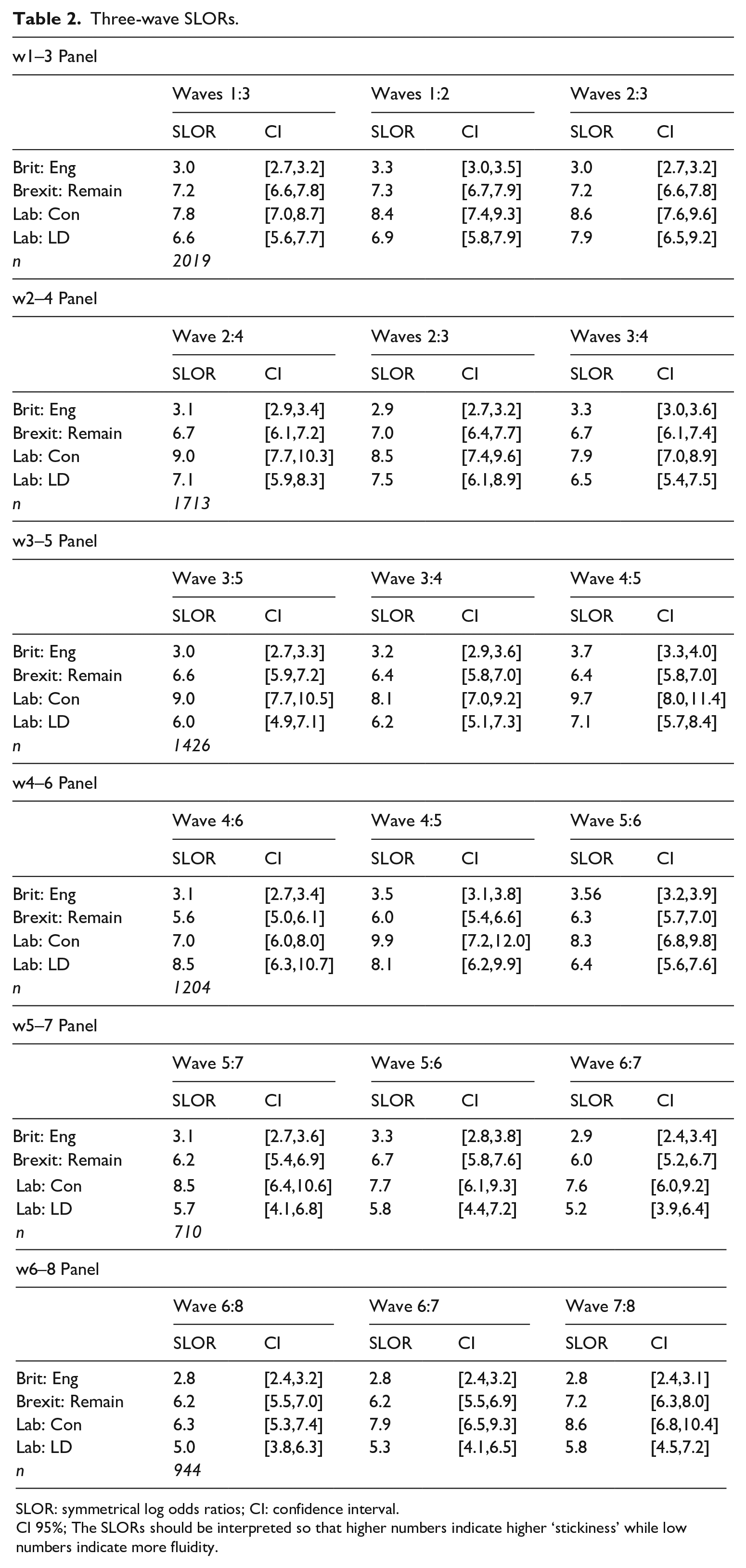
SLOR: symmetrical log odds ratios; CI: confidence interval.
CI 95%; The SLORs should be interpreted so that higher numbers indicate higher ‘stickiness’ while low numbers indicate more fluidity.
Overall, the fluidity between these pairs of identities relative to each other remains similar to what we showed using two consecutive panels. Britishness and Englishness are by far the most fluid. In all waves, with the exception of a slight difference in the wave 3–5 panel, the SLORs for Britishness and Englishness are practically indistinguishable from each other. For the fluidity between having a Labour and a Liberal Democrat identity, it appears to be between waves 5 and 6 where a change is noticeable and this is of a much greater magnitude. While we may have power issues from the smaller sample, we can say that the fluidity between these preferred British and English identities has not been hardening or softening over our time period. 19
National Identity to Brexit Preferences or Brexit Preferences to National Identity?
The SLORs allowed us to examine the relative fluidity between two given identities, but not to say anything about the direction of movement or potential political causes or consequences. We focus on delving into these in this last part of the article.
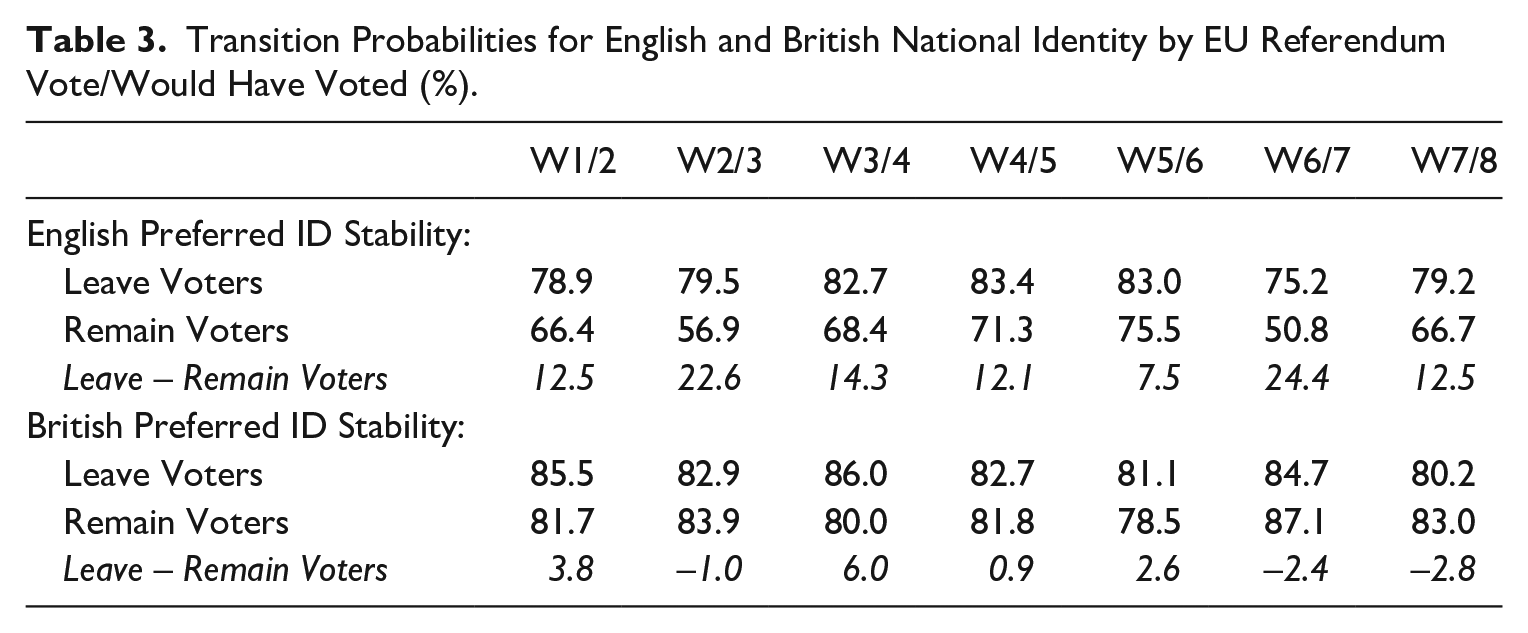
To investigate the direction of movement – and in particular its relationship with Brexit divisions – in Table 3, we present the transition probabilities for retaining one’s English or British preferred identity in subsequent panel waves broken down by how individuals voted in the Brexit referendum/how they would have voted in the referendum if they did not manage to vote. 20 This vote/would have voted variable has been chosen as it stays constant between waves. While we know from cross-sectional data analysis that Brexit voting was higher among English than British identifiers (Curtice, 2017), these results show that one’s Brexit vote is correlated with one’s probability of maintaining an English preferred identity. Those who voted/would have voted Leave have a far greater consistency in retaining their English preferred identity than those who voted/would have voted Remain. In other words, we find more switching away from Englishness among Remainers. The magnitude ranges from 7 to 24 percentage points. However, there is no such variation between Leave and Remain voters in whether they retain their British identity; the difference in the transition probabilities between leave and remain voters in whether they retained their British identity is very small in most consecutive waves and it switches back and forth between being higher for Leave or Remain voters. This may be evidence that Britishness is sufficiently fuzzy and inclusive for both of these groups to maintain British primary identities at similar rates, but is in stark contrast to the pattern seen with Englishness. 21
Transition Probabilities for English and British National Identity by EU Referendum Vote/Would Have Voted (%).
Next, we examine the causal relationship by testing the relationship between changing British/English primary identities and changing referendum vote intentions were another referendum to be held from wave 2 onwards where we have the data (question: ‘If there was another referendum, would you vote the same way?’). For such tests, we limit the analysis to individuals resident within England given that those in other regions are not likely to switch to a primary English identity as well as to address the fact Britishness may have different conceptions in the different constituent nations of the UK (Kiely et al., 2005) and indeed different associations with Brexit preferences (Henderson et al., 2021). What we can learn from this is whether shifting national identities and/or referendum vote intentions have implications for each other.
For this, we carry out cross-lagged panel models using generalised structural equation models with a logit function. As discussed earlier, these enable us to better understand how our two variables of interest influence each other over time (Kearney, 2017). For ease of interpretation and also because we are focused on the binary distinction between preferred British/English identity on the one hand and vote intention for remain/leave on the other hand (Brexit preference), in the subsequent analysis we only keep individuals who primarily identify either as British or English (i.e. dropping individuals with other national identities) and individuals who would vote either Leave/Remain in another referendum (i.e. dropping don’t knows and those who would not vote). We make use of longer time panels of four and three waves, respectively – these have been chosen where we have sufficient sample size to make adequate deductions. In Figure 5, we present the results for individuals who stayed in the sample from waves 2 to 5 and in Figure 6 we present the results for individuals who stayed in the sample from waves 6 to 8. While there may be concerns about the lower sample size, the results are similar when we use three 3 × 3 panel waves – and thus have a greater n – instead (see Online Appendix Figures E1 and E2).
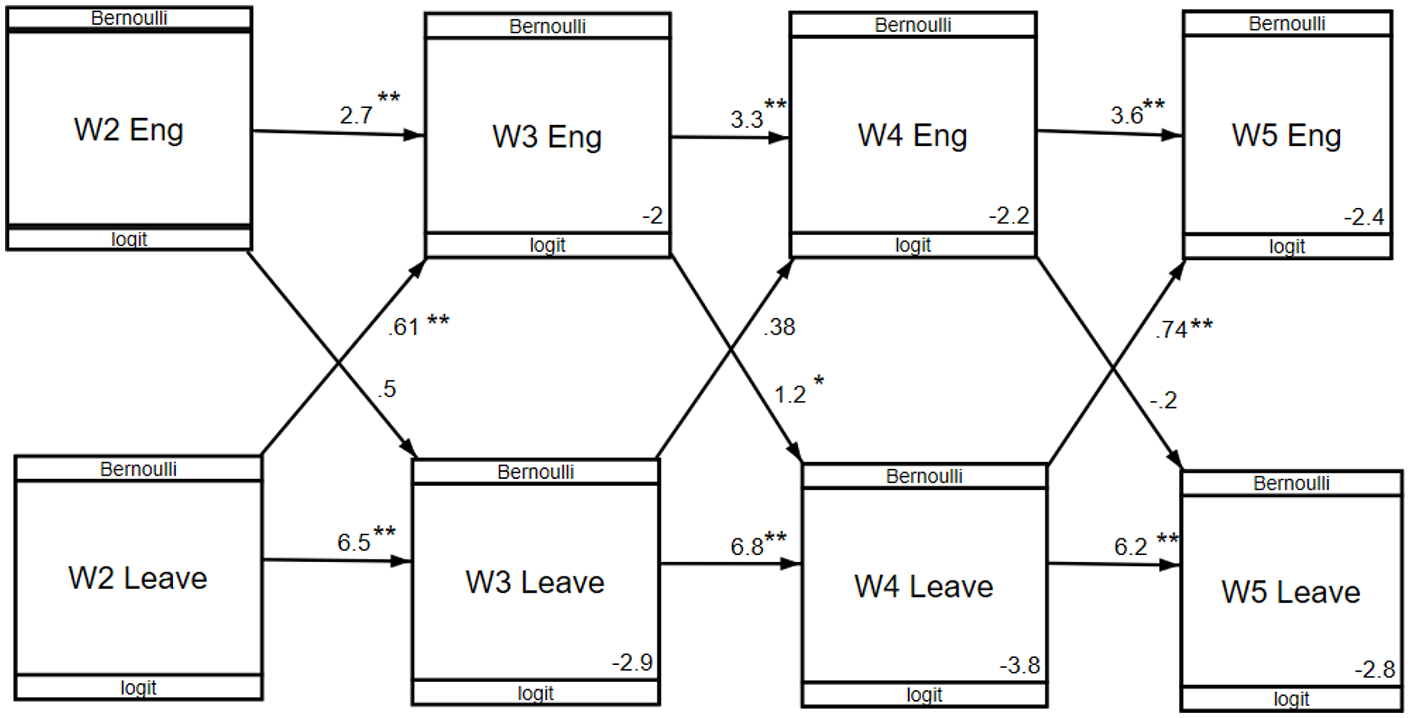
Cross-lagged Model of English (over British) Preferred Identity and Leave (over Remain) Vote Intention between Waves 2 and 5.
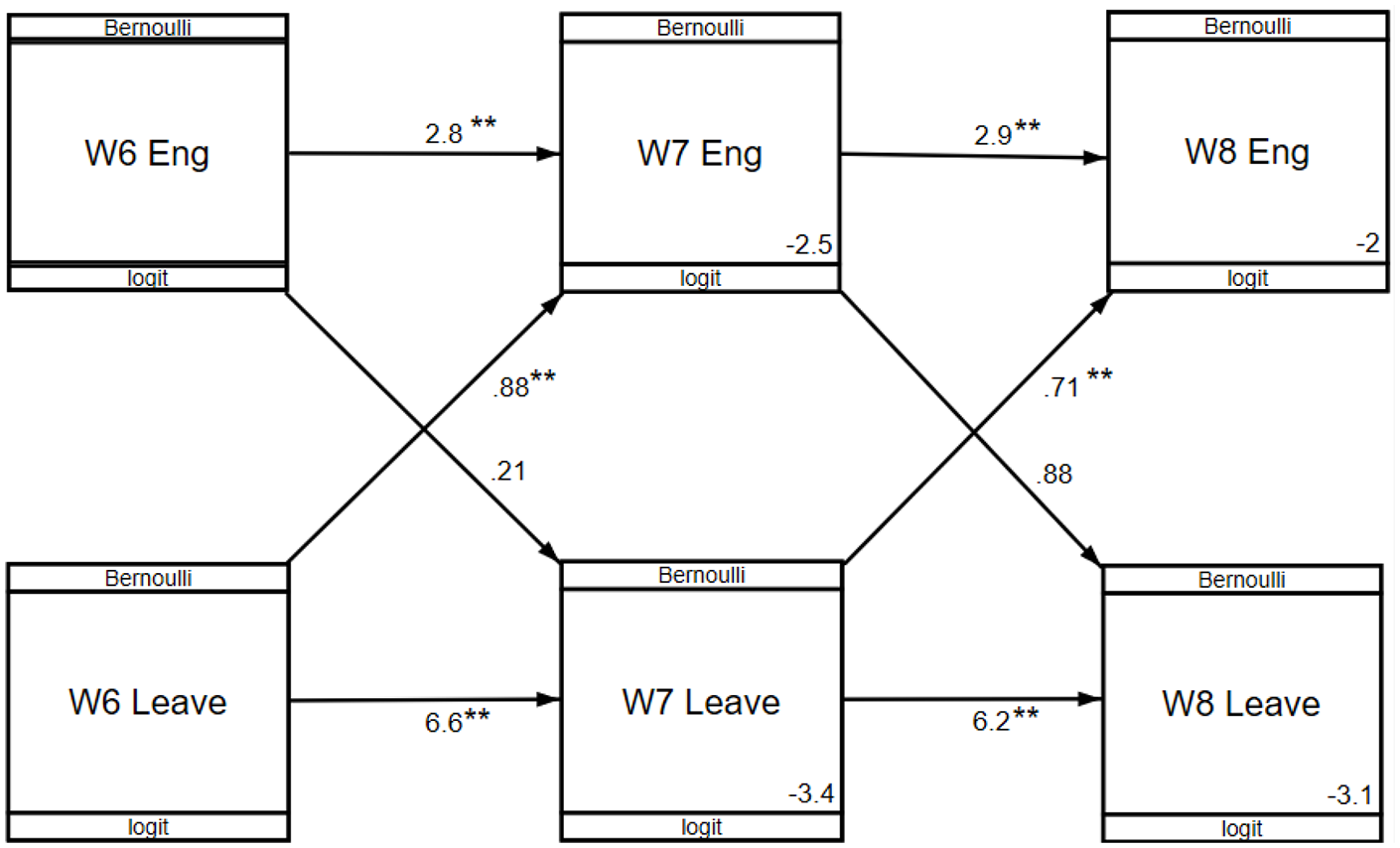
Cross-lagged Model of English (over British) Preferred Identity and Leave (over Remain) Vote Intention between Waves 6 and 8.
Having an English preferred identity in one wave is the strongest predictor of having an English preferred identity in the subsequent wave. Similarly, having a Leave vote intention in one wave is the strongest predictor of having a Leave vote intention in the subsequent wave. The magnitude is far stronger for one’s referendum vote intention (log odds ratios > 6) than it is for one’s preferred national identity (log odds ratios < 4) in line with our earlier findings. In addition, there is little evidence of significant effects of one’s national identity in one wave on referendum vote intention in the following wave (the only exception being between waves 3 and 4). In contrast, having a Leave vote intention in one wave is a significant predictor of having a preferred English identity in the next wave (except between wave 3 and 4). The magnitude of this effect (circa 0.7) is approximately between a fifth and a third of the direct effect of English preferred identity (circa 2.9). This magnitude is often not, however, substantially different from the magnitude of having an English identity to having a Brexit preference in the subsequent wave. While these results, then, are consistent with the hypothesis that causal direction runs from Leave/Remain Brexit choices to English/British preferred national identity rather than the other way round – and hence in line with our H3 – they also do not provide strong enough evidence to be able to assert substantive effects in practice.
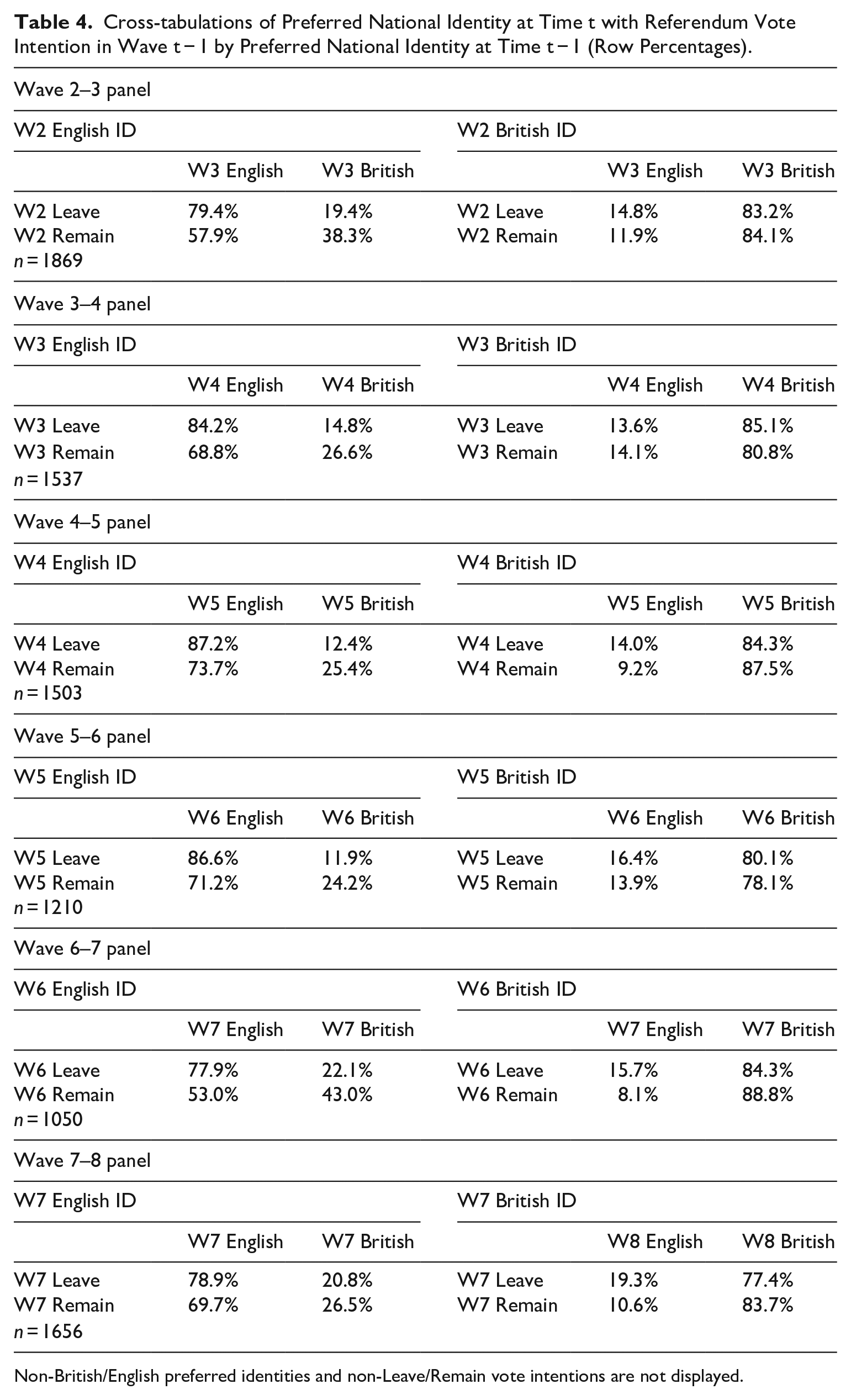
To understand more fully the processes involved and get a better picture of the underlying data that informed these cross-lagged models, we look more closely at the switching patterns. In Table 4, we present tabulations for consecutive panel waves of individuals’ British/English preferred identity at time t2 with their referendum vote intentions at time t1 and expressed for those who had English and British preferred identities separately at time t1. These are again presented only for those resident within England and the row percentages are expressed per the total of those resident within England who remained in consecutive panels.
Cross-tabulations of Preferred National Identity at Time t with Referendum Vote Intention in Wave t − 1 by Preferred National Identity at Time t − 1 (Row Percentages).
Non-British/English preferred identities and non-Leave/Remain vote intentions are not displayed.
Among those with a preferred British identity at time t1, we find no substantial relationship between their t1 Leave/Remain preference and their t2 English/British choice. However, among those with an English identity at time t1, there is a substantial relationship between their t1 Leave/Remain preference and their t2 English/British choice, with Remainers being much less likely than Leavers to maintain an English identity. These results suggest an interaction between a Leave preference and an English identity. Our interpretation of this is that a Remain preference appears to be less compatible with maintaining a preferred English identity.
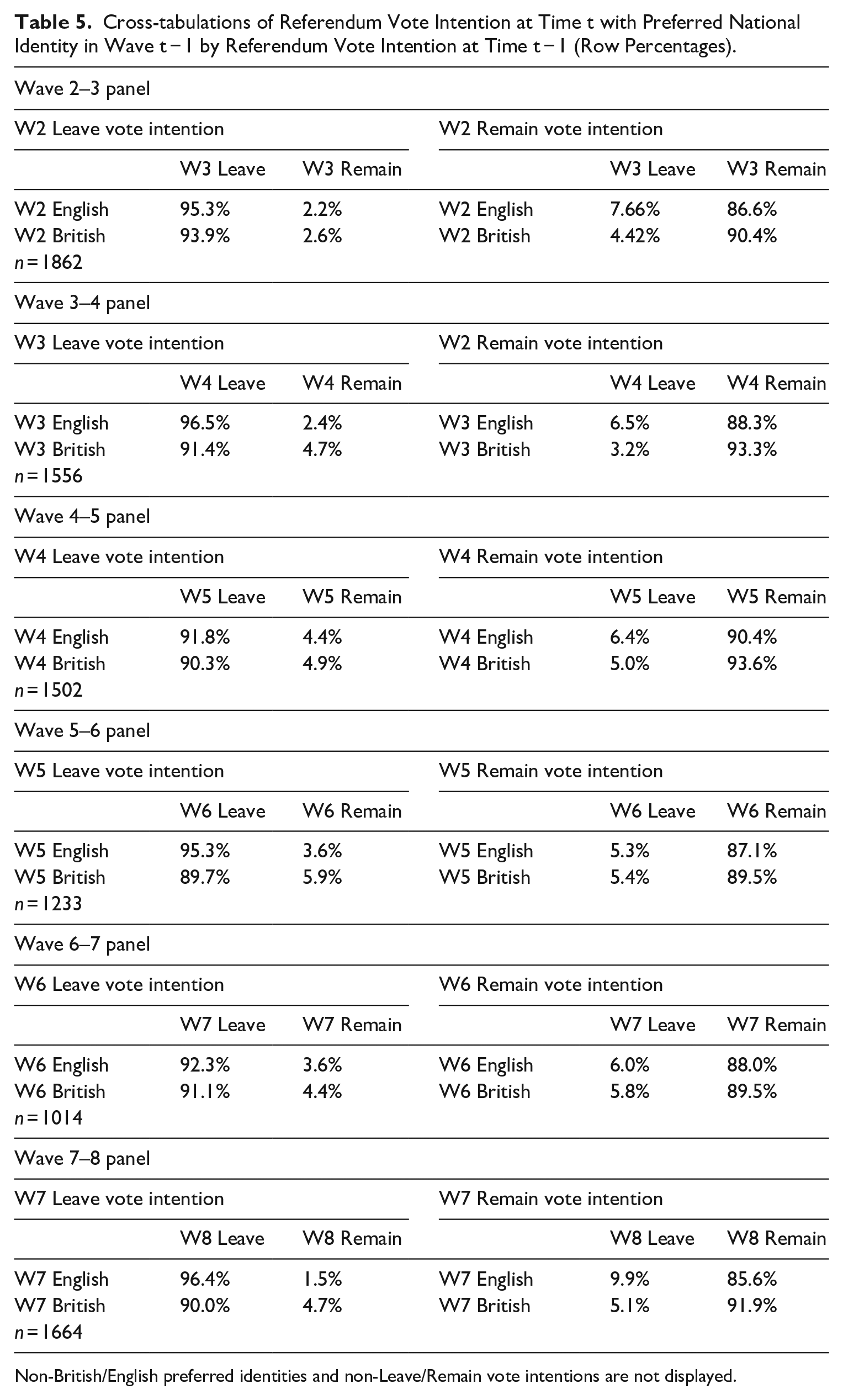
In Table 5, we present tabulations for consecutive panel waves of how individuals would vote in another EU referendum at time t2 with their British/English preferred identity at time t1 and expressed for those who had leave and remain vote intentions separately at time t1. Overall, there is a high level of stickiness in individuals’ intended vote choice. While among individuals with a leave vote intention at time t1, those with an English preferred identity are more likely to maintain a leave vote intention and those with a British preferred identity are more likely to switch to a remain vote intention (and vice versa for those with a remain vote intention at time t1), the magnitudes are quite modest and often quite clearly within the statistical margin of error. Thus, these findings support the non-significant findings from the cross-lagged panel models.
Cross-tabulations of Referendum Vote Intention at Time t with Preferred National Identity in Wave t − 1 by Referendum Vote Intention at Time t − 1 (Row Percentages).
Non-British/English preferred identities and non-Leave/Remain vote intentions are not displayed.
Conclusion
In this article, we demonstrate that English identity is not wholly interchangeable with a British identity, with the two identities being distinctively different in their interchangeability with a European identity. Nevertheless, the boundary between British and English preferred identities does remain relatively fuzzy; there is consistently greater fluidity between these two identities than between any of the other national, partisan or Brexit identities that we have examined. This suggests that a sizable number of individuals continue to see these identities as more or less interchangeable, moving backwards and forwards between them. Moreover, our measures of fluidity show no evidence of this boundary hardening or softening over the course of the Brexit negotiations and our analysis of three-wave consecutive datapoints suggests, as per Converse’s (2006) framework, that movement between preferred British and English identities is generally at random rather than representing meaningful durable identity change.
On the other hand, a comparison of the results from our Brexit panel study and that of the BES panel 20 years earlier suggests that fluidity between British and English identities might well have been ever greater in the earlier period than it is now. In both periods, too, there are some clear differences between British and English identities: the fluidity between British and European is consistently higher than the fluidity between English and European preferred identities. This conforms with previous literature that Britishness is a more cosmopolitan identity and more compatible with Europeanness than Englishness. And, very importantly, the majority of people do maintain their preferred English or British identity between time points.
We have suggested that the case of the English–British switchers is of particular interest in understanding the formation of political views, because of the conjunction between Brexit preferences and English nationalism. In support of this position, we find that individuals with a preferred English identity who would vote Remain if another referendum were to be held are much more fluid in their Englishness in subsequent waves than those who would vote leave. Stability of English identity is also lower as a whole for those who actually voted/would have voted remain. This speaks to somewhat of a dissonance between having a preferred English identity and being on the remain side of the referendum debate, 22 something that individuals unconsciously seek to avoid in order to maintain a consistent belief system and mental framework (see Festinger, 1957).
In terms of the causal relationships between English identity and preferences for Brexit, we hypothesised that, given the greater fluidity of an English than of a Brexit identity, the causal direction was more likely to run from the more entrenched Leaver identity to the more fluid English one than the other way round. Broadly speaking, the cross-lagged analysis is in line with this. This is also consistent with the idea that identities are socially constructed, that we bring our identities into line with our passions and preferences and the identity group is not necessarily the prime mover. However, the results from these cross-lagged models should be treated with caution given the modest magnitudes and potential scope for statistical noise.
We additionally show that partisan identity remained relatively stable from 2017 until the summer of 2018, although thereafter we see a notable increase in the fluidity between Labour and Liberal Democrat partisanship as well as between Conservative and UKIP partisanship. This weakening partisanship anticipated the vote swing from Labour to the Liberal Democrats that would occur in the 2019 European Parliament elections. European Referendum identities may have also become slightly more porous over the initial course of our panel, though this flattened out over the course of the last waves and as a whole remains stable. It is also noteworthy, we think, given the emerging literature on Brexit identities (Hobolt et al., 2021; Kenny, 2020; Schaffner, 2021; Sobolewska and Ford, 2020), to point out that the level of Brexit-Remainer identity switching is a little higher than switching between the two major parties: Labour and Conservative. Taking switching as an indicator of distance, we thus suggest that the older party division between Labour and Conservative is just as stark, if not more so, than the newer Brexit identities. 23 Thus, individuals are more likely to switch to ideologically closer parties when they do change their partisan identities.
Identity can provide a powerful lens through which individuals interpret events around them. Empirically demonstrating for the first time the fluidity of Britishness and Englishness is important as it suggests that – at least for the time being– the blurred boundaries between these two identities that have helped to enable England to be satisfied within the UK continue to hold some sway. Nonetheless, with substantial majorities holding onto their primary Englishness or Britishness over consecutive survey waves, such identities do still offer sufficient stickiness for the differences between them to continue to be considered politically relevant, even if the relative stickiness of identities and hypothetical vote intentions surrounding Brexit suggests that changing one’s preferred national identity is not consequential in this regard despite the correlations between them at the aggregate level. While the lower stability in maintaining preferred English identity for those with a remain vote persuasion is notable, what is particularly striking is that none of our analysis points to a growing sense of English identity over the course of the Brexit negotiations. Our findings thus may provide something of a corrective to recent strong claims about the emergence of English national identity from the shadows of British identity. A process of gradual evolution of English identity is probably under way, but there is still a long way to go before Englishness becomes as distinct an identity as the Scottish or Welsh ones are.
Supplemental Material
sj-docx-1-psx-10.1177_00323217211050001 – Supplemental material for Fuzzy Frontiers? Testing the Fluidity of National, Partisan and Brexit Identities in the Aftermath of the 2016 Referendum
Supplemental material, sj-docx-1-psx-10.1177_00323217211050001 for Fuzzy Frontiers? Testing the Fluidity of National, Partisan and Brexit Identities in the Aftermath of the 2016 Referendum by John Kenny, Anthony Heath and Lindsay Richards in Political Studies
Footnotes
Acknowledgements
We thank our anonymous reviewers who provided valuable feedback that greatly improved the article. An earlier draft was presented at the 2019 Elections, Public Opinion and Parties (EPOP) conference in Glasgow and we are grateful for comments received at this meeting.
Declaration of Conflicting Interests
The author(s) declared no potential conflicts of interest with respect to the research, authorship, and/or publication of this article.
Funding
The author(s) disclosed receipt of the following financial support for the research, authorship, and/or publication of this article: This study was supported by ESRC Brexit Priority Grant ES/R001081/1.

Supplementary Information
Additional Supplementary Information may be found with the online version of this article.
Context
Supplementary Online Appendix
Appendix B1: Transition Tables for Primary National Identity – Overall (Row Percentages):
Appendix B2: Transition Tables for Primary National Identity – Leave Voters/Would Have Voted Leave (Row Percentages):
Appendix B3: Transition Tables for Primary National Identity – Remain Voters/Would Have Voted Remain (Row Percentages):
Appendix B4: Transition Tables for Party Identification (Row Percentages):
Appendix B5: Transition Tables for European Referendum Identity (Row Percentages):
Appendix B6: Transition Probabilities for English and/or British National Identity by EU Referendum Vote/Would have voted (%)
Figure E1: Cross-lagged model of English (over British) Preferred Identity and Leave (over Remain) Vote Intention, Waves 2-4
Figure E2: Cross-lagged model of English (over British) Preferred Identity and Leave (over Remain) Vote Intention, Waves 4-6
Notes
Author Biographies
References
Supplementary Material
Please find the following supplemental material available below.
For Open Access articles published under a Creative Commons License, all supplemental material carries the same license as the article it is associated with.
For non-Open Access articles published, all supplemental material carries a non-exclusive license, and permission requests for re-use of supplemental material or any part of supplemental material shall be sent directly to the copyright owner as specified in the copyright notice associated with the article.
