




Abstract
Political tolerance—the willingness to extend civil rights to political antagonists—is a key democratic norm. We argue that because voters with populist attitudes have an ambiguous relationship with democracy and keep a narrow definition of the people, they are more likely to be politically intolerant. We study the Netherlands, a less likely case to find political intolerance. Using data from a representative household panel survey (n = 1999), we investigate the extent to which populist attitudes translate into general intolerant attitudes and specific intolerance toward political antagonists. Our analyses show that voters with stronger populist attitudes are less supportive of democratic norms, more intolerant of opposing views online, and of specific political opponents. However, they are not explicitly intolerant by limiting individual civil rights or supporting intolerant measures toward political antagonists. These findings show that even in a system engrained with compromise, populist citizens show signs of political intolerance.
Keywords
“Nobody should be allowed to burn the American flag—if they do, there must be consequences—perhaps loss of citizenship or year in jail!”
1
This is what Donald Trump tweeted on 29 November 2016, a few weeks after he was elected as 45th president of the United States. Flag-burning is protected by the First Amendment as a form of symbolic free speech. The tweet seems to have been a response to College students burning the American flag to protest Trump’s election. Revoking the citizenship of—in this case—flag-burners is an example of political intolerance, the unwillingness to extend civil rights and liberties to political adversaries (Nelson et al., 1997; Sullivan et al., 1982). Political tolerance is not Trump’s greatest virtue and the same is said about several other country leaders (Grzymala-Busse, 2019; Levitsky and Ziblatt, 2018). Such erosion of the norm of tolerating political opponents might pose a threat to democratic systems worldwide.
The problem would be even larger if their voters lacked political tolerance. Populist leaders often attract populist voters. Citizens with populist attitudes arguably have an ambiguous relation with key democratic norms and values. On the one hand, these citizens are supportive of referendums and deliberative forms of participation (e.g. Zaslove et al., 2021). On the other hand, they are critical of political representation and most notably anti-pluralist (e.g. Pappas, 2019). Their narrow definition of “the people” includes only their in-group and excludes political opponents as out-groups. This prompts them to be “intolerant of dissent” (Taggart, 2000: 103), which might feed into political intolerance.
Political tolerance has mainly been studied in the United States (Stouffer, 1955; Sullivan et al., 1982), a context typified by extreme majoritarianism. This system is dominated by just two political parties that hardly need one another to deliver their political promises to voters. Both sides can afford to bitterly fight one another, which in the long run may not be conducive to political tolerance. Thus, one would not expect much tolerance—neither from populists nor from other citizens.
In this study, however, we examine a very different case. The Dutch context is characterized by a system permissive of social movements and extreme proportional representation, evidenced by 18 political entities currently represented in Congress. This fragmented landscape may be a more likely case for political tolerance, as parties fight their occasional little battles only to quickly come together to strike political deals—often involving a wide variety of partners. Of the 18 factions in Dutch parliament, four can be considered right-wing populist, 2 and one left-wing populist, 3 together holding 37 of 150 seats. The strongest populist players—PVV, FvD and SP—can be considered anti-elitist and proponents of more direct democracy. In line with their focus on the in-group of the Dutch people, especially the right-wing PVV and FvD are very dismissive of opponents—advocating the abolishment of subsidies for multicultural organizations and the dissolution of public broadcasting. Harsh statements on various out-groups are commonplace, resulting in PVV frontman Geert Wilders being prosecuted for hate speech (Wichgers et al., 2021). Because of their extreme statements and positions, Dutch populists are generally not included in political alliances, as they are in Austria and Italy. Yet, we argue that the likelihood of finding tolerant populists is much larger in this pluralist system than it is in the US context.
Our assessment of to what extent populists are more politically intolerant encompasses two studies. In a first study, we investigate whether populists hold more intolerant attitudes in general, that is, whether they oppose civil rights and democratic norms or condone intolerant online behavior. Yet, to understand to what extent voters are truly intolerant, more specific measures are needed. As one can only be truly tolerant of a group one disagrees with (e.g. Sullivan et al., 1982; Waltzer, 1997), we add a second study to understand to what extent populists tend to extend civil liberties to political antagonists. Taken together, our findings offer a comprehensive picture of the association between citizens’ populist attitudes and their political tolerance—or intolerance.
Political (In)tolerance
Political tolerance is loosely defined as “the willingness to extend civil liberties to groups or individuals one opposes” (based on Nelson et al., 1997; Sullivan et al., 1982). Tolerance or even respect for the opponent is considered by many to be an important democratic norm (Grzymala-Busse, 2019; Levitsky and Ziblatt, 2018), the support for which is central to liberal democracy (Gibson, 1992; Hurwitz and Mondak, 2002). Political tolerance protects the right to express an unpopular opinion, which is crucial not only to guarantee individual autonomy and equal rights, but also for pragmatic reasons, allowing a free marketplace of ideas (Sullivan et al., 1982). Indeed, empirical research has shown that tolerance at the mass level is positively associated with individual freedom (Gibson, 1992) and that it facilitates dissent (Claassen and Gibson, 2019). There is a general understanding, however, that political violence should never be allowed nor tolerated (Nelson et al., 1997; Sullivan et al., 1982). In addition, limits to tolerance are said to be warranted in order to defend democracy itself, or even to defend core democratic principles, such as equality before the law or human dignity (Capoccia, 2013; Kirschner, 2014; Rijpkema, 2018).
There are various approaches to conceptualize political (in)tolerance, the first of which concerns a focus on general attitudes, such as the general support for civil rights and/or liberties (Gibson, 2013). This more abstract and generic support for civil liberties should not be equated to but has been shown to translate into explicit notions of political tolerance (Hurwitz and Mondak, 2002) which rely on the necessary disapproval of the political antagonist (e.g. Sullivan et al., 1982; Waltzer, 1997). Common procedures to study this are the least liked group approach (Sullivan et al., 1979)—and related, the fixed-group approach (Stouffer, 1955; General Social Survey) or the varied fixed-group approach (Crawford and Pilanski, 2013). In these approaches, specific civil liberties, such as the freedom of speech, the right to vote, and the right to demonstrate, are (or are not) extended to a self-picked least liked target group or commonly disliked target groups (e.g. communists or the Ku Klux Klan). In this study, we first look at the abstract support for norms and rights and, in a second step, use an approach similar to the one used by Arceneaux (2019). Here, the willingness to extend civil liberties is targeted at people/groups one disagrees with on a specific contentious political issue. This set-up circumvents having a specific (real-life) target group, which impedes the generalizability of findings to other groups and issues. Moreover, this approach moves away from the tension between having “justified” and “unjustified” intolerant attitudes—that is, limiting civil liberties of groups not accepting the democratic rules of the game—by including hypothetical groups, which can only be discerned on the basis of their opinion.
An abundance of studies has looked into factors explaining political (in)tolerance. First of all, ideology seems to play a role. Some point at ideological asymmetry in political intolerance: conservatives are often found to be more intolerant than liberals (Jost et al., 2003; Lindner and Nosek, 2009), which is also dubbed “the rigidity of the right.” Others discern similar levels of intolerance on the left and right (Brandt et al., 2014; Crawford, 2014; Crawford and Pilanski, 2013), or find political extremists to be more intolerant than moderates (Van Prooijen and Krouwel, 2017)—the so-called “rigidity of the extremes.” Related, attention is drawn to individual-level values, with moral attitudes playing a central role. Individuals with stronger moral attitudes—either an adherence to moral absolutism or moral convictions on specific issues—have a tendency to perceive politics in black and white terms, which has been shown to be a root of political intolerance (Arceneaux, 2019; Ryan, 2014). However, in this article, we focus on two explanations that are closely related to populism: first of all, research has shown that a strong commitment to democratic norms enhances tolerance of the antagonist, while intolerance grows when others are perceived as threatening to society or democracy (Crawford, 2014; Gibson, 2006; Hurwitz and Mondak, 2002; Sullivan and Transue, 1999). In the next section, we lay out that populist voters not only have an ambiguous relationship with specific democratic norms; they are also wary of those posing a threat to the future of the people.
Populism and (In)tolerance
To define populism, we build on the ideational approach (e.g. Mudde and Kaltwasser, 2018), defining populism as a set of ideas claiming that (1) society is divided in two monolithic blocks: the people and the elite, (2) the relation between the (good) people and the (corrupt) elite is antagonistic, and (3) politics should be an expression of the general will, that is, that what the “pure people” want (Mudde, 2004; Zaslove et al., 2021). This populist “set of ideas” can be found at the so-called supply side of populism—for example, in discourse in mass media, party manifestos, and political speeches—but also on the demand side of populism, that is, among voters. Recently, an approach has been forwarded to capture populist attitudes by tapping voters’ support for the three main components of populism: anti-elitism, popular sovereignty, and homogeneity (Akkerman et al., 2014; Schulz et al., 2018; Wüttke et al., 2020). These populist attitudes are not only stronger predictors of populist support than other measures tapping the anti-elitist component of populism—political trust and external political efficacy—they consistently predict the populist radical left-wing and the radical right-wing vote (Akkerman et al., 2014; Geurkink et al., 2020; Van Hauwaert and Van Kessel, 2018). But most importantly, populist attitudes conceptually tap the ideational definition of populism at the individual level: voters with stronger populist attitudes embrace the populist set of ideas more than voters with weaker populist attitudes.
Populist politicians and voters at least in theory have an ambivalent relationship with democracy (Taggart, 2000). On the one hand, populists are considered true democrats (Canovan, 1999): the power of the people lies at the heart of populism and popular sovereignty is central to the thin ideology. This theoretical premise is reflected in empirical data: populist citizens are more supportive of democracy, deliberative forms of participation, and referenda (Zaslove et al., 2021). However, populism is also often coined illiberal at heart due to its anti-pluralist/monist core (e.g. Mudde, 2004; Pappas, 2019): populists “have serious problems with liberal democracy, most notably minority rights, rule of law, and separation of powers” (Mudde and Kaltwasser, 2018: 1670). Indeed, populist citizens are generally less supportive of pluralism (Akkerman et al., 2014; Schulz et al., 2018), unwilling to accept compromises (Plescia and Eberl, 2021), and less likely to protest (Zaslove et al., 2021).
In addition, populists support a Manichean worldview distinguishing between the “good” people and the “evil” elite. This in-group–out-group categorization follows the logic of social identity theory (Bos et al., 2020; Tajfel and Turner, 1986) and underlines the irreconcilability of norms, identities, and interests between the people and the elite. Intra-group homogeneity is emphasized while intergroup differences are exaggerated. Populism asks voters to identify with an in-group, “the people,” and pits them against a well-defined out-group, “the elite,” which is not only responsible for the people’s problems (Hameleers et al., 2017), but also poses a threat to the heartland of the people (Taggart, 2000). In thick populism, that is, populism that is latched onto a full-fletched ideology (Jagers and Walgrave, 2007), the elite are not the only out-group, but all groups not considered part of the people are considered out-groups. These “people” are defined based on the ideology populism is connected to. Generally speaking, for left-wing populists, the people are the working class and out-groups are, for instance, the rich, capitalists, and big companies. For right-wing populists, the native population is the in-group while immigrants and leftists are considered the out-groups. From a theoretical standpoint, this identification process goes hand in hand with anti-identities (Gibson and Gouws, 2000), such as negative partisanship (Meléndez and Kaltwasser, 2019), and not only initiates polarization (Mudde and Kaltwasser, 2018) but is also likely to foster political intolerance (Gibson and Gouws, 2000). In populist practice, this means that as out-groups are not considered part of the people, they are not entitled a voice in the political process (Abts and Rummens, 2007; Jagers and Walgrave, 2007; Rooduijn, 2013), which means one should not necessarily protect their civil rights.
First of all, we investigate the relationship between populist attitudes and general attitudes (related) to political intolerance. An important factor explaining political intolerance is the lack of support for abstract democratic principles. As noted, populists are devoted to monist popular sovereignty and have a problematic relation with liberal democracy. Mudde and Kaltwasser (2018: 1670) put populists’ relationship with representative democracy very clear by stating that “nobody has the right to bypass the popular will.” Instead, populists prefer a “minimal or procedural democracy, defined as popular sovereignty and majority rule.” As a consequence, democratic norms laying out key civil liberties (freedom of the press, and the freedom to criticize the government), the rule of law, the separation of powers, and the protection of minority rights should be less supported by voters with stronger populist attitudes (H1a). But what about the support for civil rights that are directly related to tolerance, such as the freedom of speech and equality of rights? On the one hand, based on previous research, one would expect populist voters to be less supportive of civil rights of minorities, and more specifically of out-groups they feel threatened by, such as the elite and other out-groups. On the other hand, in an abstract sense, in a democracy, civil rights are extended to “the people,” not necessarily to out-groups (even if they are implicitly). As populists are avid advocates of the people, one can alternatively expect them to be more supportive of abstract civil rights. We therefore pose Research Question 1 (RQ1): are voters with stronger populist attitudes more or less likely to support abstract civil rights? Finally, in a general sense, we investigate the relationship between populist attitudes and political intolerance toward the expression of divergent opinions online. While the relationship between populism and the support for abstract civil rights is less apparent (as stated in RQ1), we do expect populists to show signs of intolerance online. The reason for that is based on the premise that tolerance constitutes the extension of civil rights to groups one disagrees with, so over and above groups or individuals that are part of the (majority of the) people. Accordingly, populists should be less willing to extend civil rights, such as the freedom of speech, to groups that are not considered to be part of the people. We therefore expect voters with stronger populist attitudes to be less tolerant of the expression of divergent opinions online (H1b).
However, for the strongest test of our expectation, we need a specific measure of political intolerance. There are two reasons for this. First of all, political intolerance entails more than a mere abstract disregard of democratic norms or civil rights in general or a lack of tolerance for divergent opinions in principle. It requires individuals to limit the extension of basic civil rights to a specific out-group, that is, a political antagonist, they are confronted with. Second, as we lay out, we expect populists to be intolerant toward specific out-groups because these out-groups are not considered part of the people and thus are not entitled a voice in the political process. Based on the previous research, we thus expect voters with stronger populist attitudes to be more willing to limit the extension of civil rights to specified opponents (H2).
Study 1
Methods
In the first study, we investigate the extent to which voters with stronger populist attitudes are less likely to support democratic norms (H1a). In addition, we investigate to what extent these voters are less likely to support abstract civil rights (RQ1) and more likely to be intolerant of the expression of divergent opinions online (H1b). We make use of data collected within the LISS Panel, a Dutch household panel survey of 5000 households (and 7500 individuals). The panel is based on a true probability sample of the Dutch population. Panel members complete monthly questionnaires on various topics. In addition, the LISS Panel allows researchers to field projects in the panel. This study makes use of baseline survey questions as well as questions tapped in two distinct one-wave surveys: “Political Intolerance” (fielded in April 2020—here: Survey A) and “Contents, causes and consequences of political discontent” (fielded in April 2019—here: Survey B). In addition, we use items tapped in Wave 12 of the Politics and Values questionnaire (fielded in April 2020—here Survey C) (total n = 2468).4,5
We first of all measure respondents’ populist attitudes, which relies on three sub-concepts, namely, anti-elitism, popular sovereignty, and homogeneity (Akkerman et al., 2014; Schulz et al., 2018). Wüttke et al. (2020) convincingly argue that the combined measure of these three sub-concepts should be non-compensatory: a lower value on one sub-scale should not be compensated by a higher value on a second or third sub-scale. This article therefore makes use of the suggested Goertz approach and computes the position on the populist attitudes scale as equal to the position on the lowest sub-scale (M = 2.672; SD = 0.686). The items for each sub-scale are based on Wüttke et al. (2020) and Schulz et al. (2018) and measured on a 5-point Likert-type scale, with a “don’t know” option, making use of Survey B (see the Supplementary Materials for the full list of items).
We focus on three different dependent variables. First of all, we tap support for democratic norms (using Survey B) with four items (measured on a scale from 0 (not at all important in a democracy) to 10 (very important in a democracy)): “In a democracy, how important do you think it is that ‘the courts treat everyone the same’; ‘the media are free to criticize the government’; ‘opposition parties are free to criticize the government’; ‘the rights of minority groups are protected’” (M = 8.178, SD = 1.500, α = 0.837). Second, we tap support for civil rights (based on Bloom and Bagno-Moldavsky, 2015) with two items measured (in Survey A) on a 7-point Likert-type scale: “I support freedom of speech for everyone, regardless of their opinion”; “Everyone should have the same rights, regardless of their political preferences” (M = 5.285, SD = 1.298, α = 0.685). Finally, we tap online political intolerance (in Survey A) with two items (measured on a 7-point Likert-type scale and both reverse-coded: “I don’t mind being exposed online to messages from people I fundamentally disagree with”; “I think that people with radically different opinions than I have should be allowed to speak out on social media” (M = 3.971, SD = 1.521, α = 0.629)).
We add several controls. Ideology is tapped on a scale from 0 (left) to 10 (right) (M = 5.151, SD = 2.222) and used to compute ideological extremity (with 1 (moderate) to 5 (extreme); M = 2.767, SD = 1.355). We include age (M = 55.606, SD = 17.540), education (measured on a 6-point scale; M = 3.845, SD = 1.455), gender (51.294% male), and political interest (measured on a 3-point scale; M = 2.110, SD = 0.643).
In addition, following up on Geurkink et al. (2020), we run robustness checks to rule out the possibility that intolerance is fueled by constructs closely related to populism. We run additional models controlling for political trust (measured on a scale from 0 to 10; M = 5.045, SD = 2.003) and external political efficacy 6 (measured on a scale from 1 to 5; M = 2.672, SD = 0.885).
Results
Table 1 depicts the results of three hierarchical linear regression analyses with robust standard errors, regressing the support for democratic norms, support for civil rights, and online political intolerance on the predictors. The results in the first model show that the older, the more educated and politically interested, and men are more likely to support democratic norms. Moving on to political explanations, we see that right-wing voters are less likely to support democratic norms, as are ideological extremists. However, we are of course most interested in the impact of populist attitudes. Our results show a strong negative impact of populist attitudes on the support for democratic norms: a 1-point increase in populist attitudes decreases the support for norms central to democracy with 0.182 point on a 10-point scale. This supports H1a. In a second step, we test two alternative explanations by regressing the support for democratic norms on political trust and external political efficacy—not leading to significant effects nor changing our results substantially.
Impact of populist attitudes on generic political (in)tolerance.
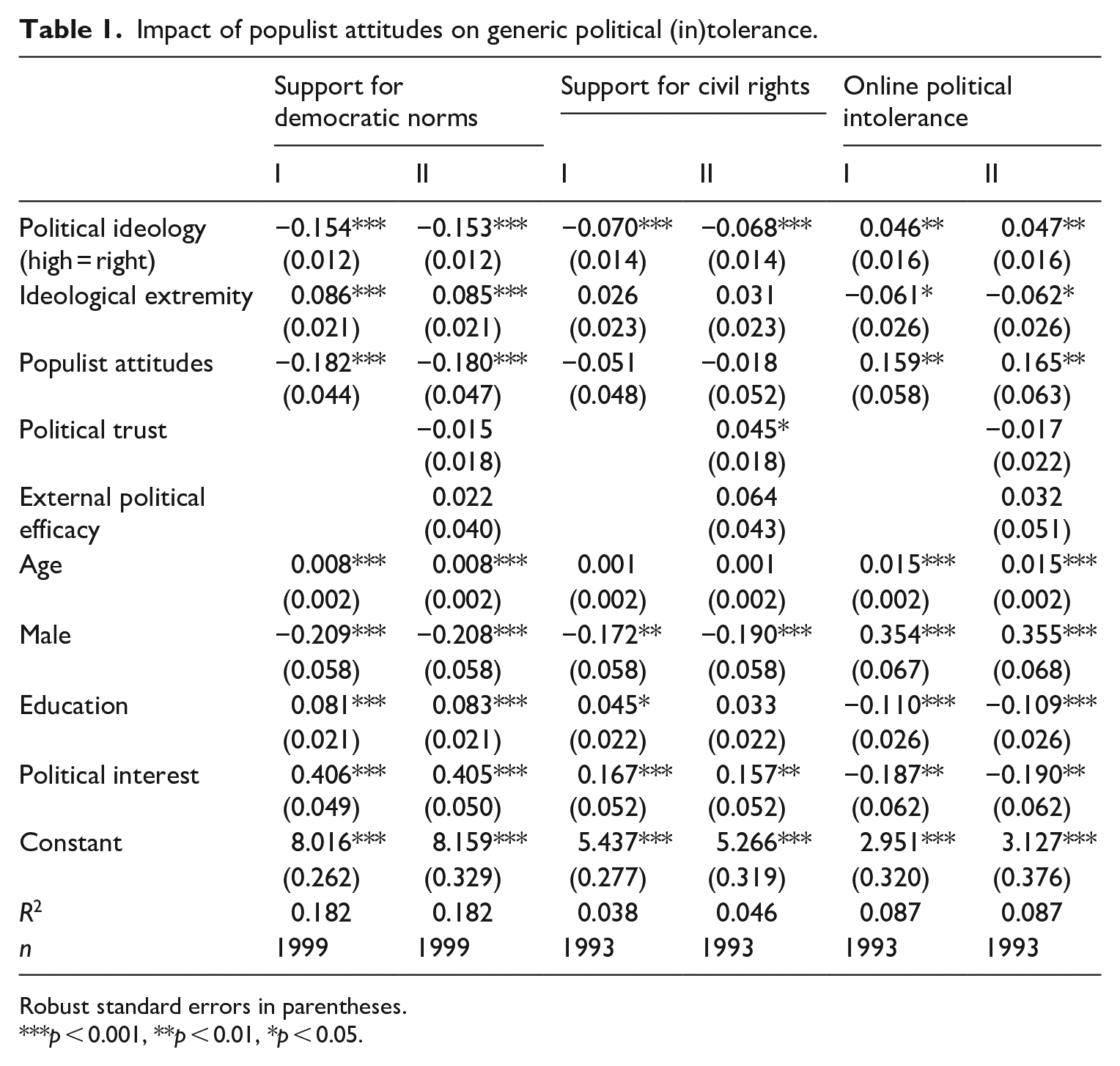
Robust standard errors in parentheses.
p < 0.001, **p < 0.01, *p < 0.05.
The abstract support for individual civil rights is more difficult to explain. Men are more supportive as well as respondents who indicate to be more politically interested. There is a small impact of education in Model I, which disappears in Model II. And right-wing voters are less likely to be supportive of civil rights. However, populist voters are no more or less likely to support individual civil rights, answering RQ1. In Model II, there is a minor positive impact of political trust. 7
In a third step, we investigate the impact of populist attitudes on online political intolerance. Here, the older, the lower educated and less politically interested, and women are more likely be politically intolerant online. Moving on to political explanations, we see that right-wing voters are more likely to be intolerant, while ideological extremists are more tolerant. Again, we find quite a strong impact of populist attitudes, in line with our expectations: voters with stronger populist attitudes are more likely to display intolerance toward people with divergent opinions, supporting H1b. A 1-point increase in populist attitudes leads to a 0.159 increase in online political intolerance. Controlling for political trust and external political efficacy does not change these conclusions.
Focusing on general attitudes, we find that two of three hypotheses are confirmed: voters with stronger populist attitudes are less likely to support democratic norms and more likely to be intolerant of people sharing their divergent opinion online. In a next step, we use a stronger test by exposing respondents to a hypothetical group they disagree with, asking them to support the extension of civil rights to this group.
Study 2
Methods
The second study makes use of the same data as Study 1 and uses the same explanatory variables and controls. For the dependent variables, we follow up on respondents’ position on four contentious issues tapped in Survey C. In the survey, respondents are asked to indicate their opinion on euthanasia (should be forbidden—should be permitted), income differences (should increase—should decrease), multicultural society (immigrants can retain their culture—immigrants should adapt entirely), and European unification (should go further—has already gone too far), tapped on a scale from 1 to 5 with a don’t know option. To tap the intolerance toward antagonists, respondents are randomly allocated to a group they disagree with (i.e. they could not be allocated an issue they had a neutral position on). For each of these positions, we created an out-group we asked respondents to think about, as shown in Table 2.
Out-groups for each issue position.
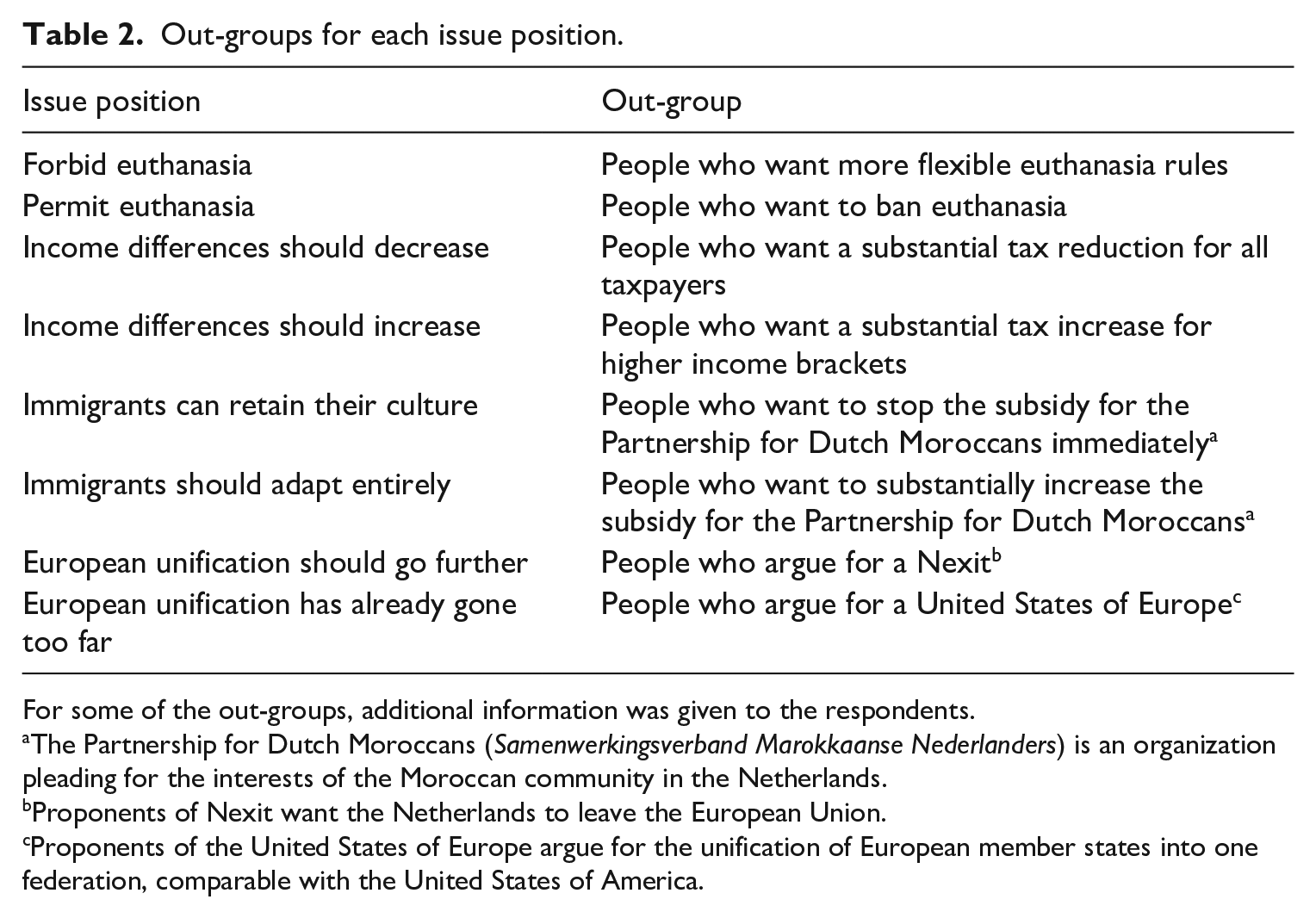
For some of the out-groups, additional information was given to the respondents.
The Partnership for Dutch Moroccans (Samenwerkingsverband Marokkaanse Nederlanders) is an organization pleading for the interests of the Moroccan community in the Netherlands.
Proponents of Nexit want the Netherlands to leave the European Union.
Proponents of the United States of Europe argue for the unification of European member states into one federation, comparable with the United States of America.
Thinking of this, specific out-group respondents were asked to what extent they approved of several (hypothetical) situations, measured on a scale from (1) I disapprove of this to (7) I approve of this (items were ordered randomly—(R) = reverse coded 8 )):
Intol1 A demonstration by [out-group] is blocked by counter-demonstrators.
Intol2 Youngsters demonstrate weekly for 1 year on the Dam Square to call for [out-group opinion] (R).
Intol3 The Dutch Association of Chief Editors refuses to publish a full-page advertisement calling for [out-group opinion].
Intol4 Facebook deletes a page calling for [out-group opinion].
Intol5 An action group pays an influencer to bring [out-group opinion] to the attention of children (R).
Intol6 A school fires a social education teacher because he or she advocates for [out-group opinion].
Intol7 A well-known advocate for [out-group opinion] is appointed judge (R).
Intol8 A municipality refuses an advocate of [out-group opinion] when he or she applies for a position as a civil servant.
An exploratory factor analysis (see Table 3) showed that the eight items did not load on one factor, but instead loaded on two different factors, with for Item Intol4 an insufficient low loading on both factors (<0.500).
Exploratory factor analysis.
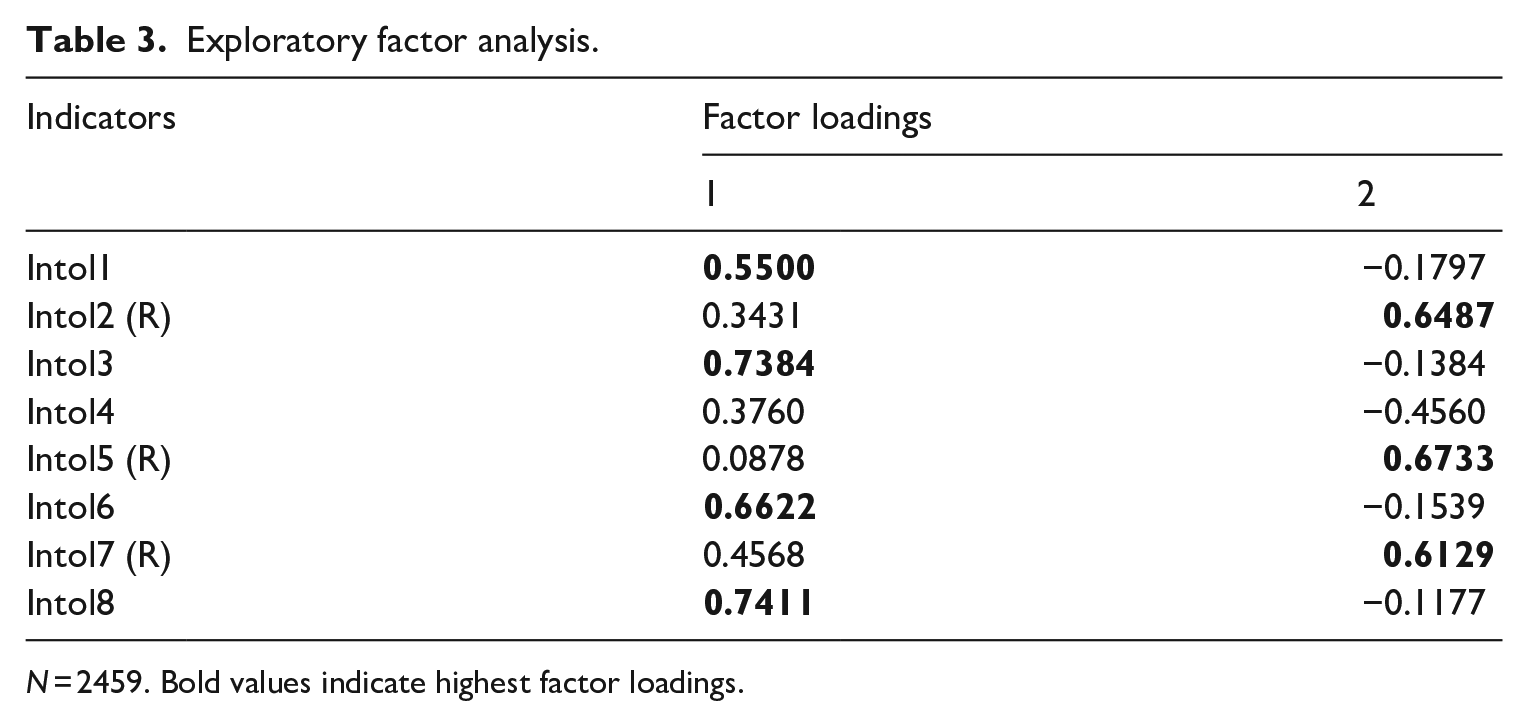
N = 2459. Bold values indicate highest factor loadings.
We therefore proceed with a confirmatory factor analysis to form the most optimal scales for further analysis. Table 4 presents the model fit of subsequent models. We start off with a single-factor model (Model 1) loading all items on one factor. In line with the exploratory factor analysis, the fit of this model is insufficient, as we can see by the fit indices, relying on the cut-off values proposed by Hu and Bentler (1999). 9 In Model 2, we therefore run a two-factor model in which we include the items with the highest factor loadings based on the exploratory factor analysis. Although there is significant improvement in model fit—as indicated by an RMSEA (root mean square error of approximation) value well below the cut-off value, the CFI (comparative fit index) and the SRMR (standardized root mean square residual) are still respectively below and above the proposed cut-off values. In addition, two of the standardized factor loadings are below the threshold of .400 (Intol4 and Intol5 (R)). We remove both items from the two-factor model in Model 3, which leads to a good fit. 10 We therefore proceed with two intolerance scales. The first includes Items 1, 3, 6, and 8, referring to statements in which intolerant measures are taken against antagonists (i.e. blocking a demonstration; refusing to publish an advertisement; firing a teacher; refusing to invite an applicant for a vacancy). We dub this scale support for intolerant measures (M = 3.258, SD = 1.334, α = 0.674). The second scale includes Items 2 and 7, which refer to the support for civil liberties of antagonists (i.e. youth demonstrating weekly and being appointed as judge), reversely coded as intolerance for the opponent (M = 4.536, SD = 1.585, α = 0.533).
Model fit indices for confirmatory factor analysis structure.
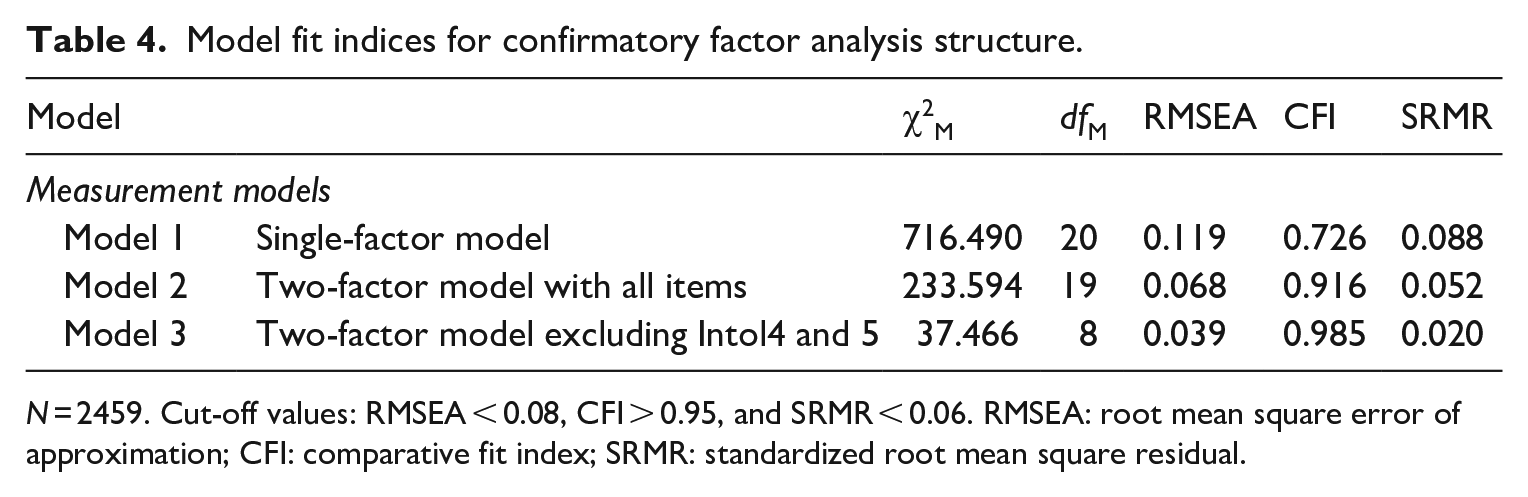
N = 2459. Cut-off values: RMSEA < 0.08, CFI > 0.95, and SRMR < 0.06. RMSEA: root mean square error of approximation; CFI: comparative fit index; SRMR: standardized root mean square residual.
In addition, we tapped support for the opponent’s opinion, by asking respondents what they thought of [out-group], measured on a scale from (1) I disapprove of their opinion to (10) I approve of their opinion (M = 4.047, SD = 2.612).
We run linear regression analyses with robust standard errors, include issue fixed effects, and regress these dependent variables on populist attitudes, as well as the controls presented in Study 1. In addition, we control for the position on the issue, with the liberal position coded as 1 and the conservative position coded as 2 (M = 1.382, SD = 0.486), and the extremity of the position (either 1 or 2) (M = 1.534, SD = 0.499). Finally, in order to conduct a stricter test in the models regressing the support for intolerant measures and intolerance for the opponent on our explanators we control for support for the opponent’s opinion. 11
Results
Table 5 shows the descriptives of the issue-specific intolerance measures. We can see that tolerance for the antagonist not only depends on the measure, but also on the issue. In general, support for the opponent’s opinion is lower than the midpoint on the scale (M = 4.047 on a scale from 1 to 10), but respondents are much more lenient toward the opponent’s opinion on the income differences issue than on the other issues. This trend is persistent over the three measures, with respondents displaying more intolerance toward issues concerning moral and cultural values, more specifically regarding multicultural society and euthanasia. Comparing the two scales tapping the intolerance of respondents, it also becomes clear that, on average, the more explicit an item, the more tolerant the answer. Items about explicitly supporting intolerant measures generate much lower intolerance levels than items measuring intolerance implicitly. A t-test indeed reveals that the means of these items differ significantly (t(2458) = –34.719, p = 0.000). Based on the first scale—support for intolerant measures—21.51% of the sample would be designated as intolerant (scoring above the midpoint of the scale), whereas it is 52.87% based on the second scale—intolerance for the opponent.
Descriptives of issue-specific intolerance measures.
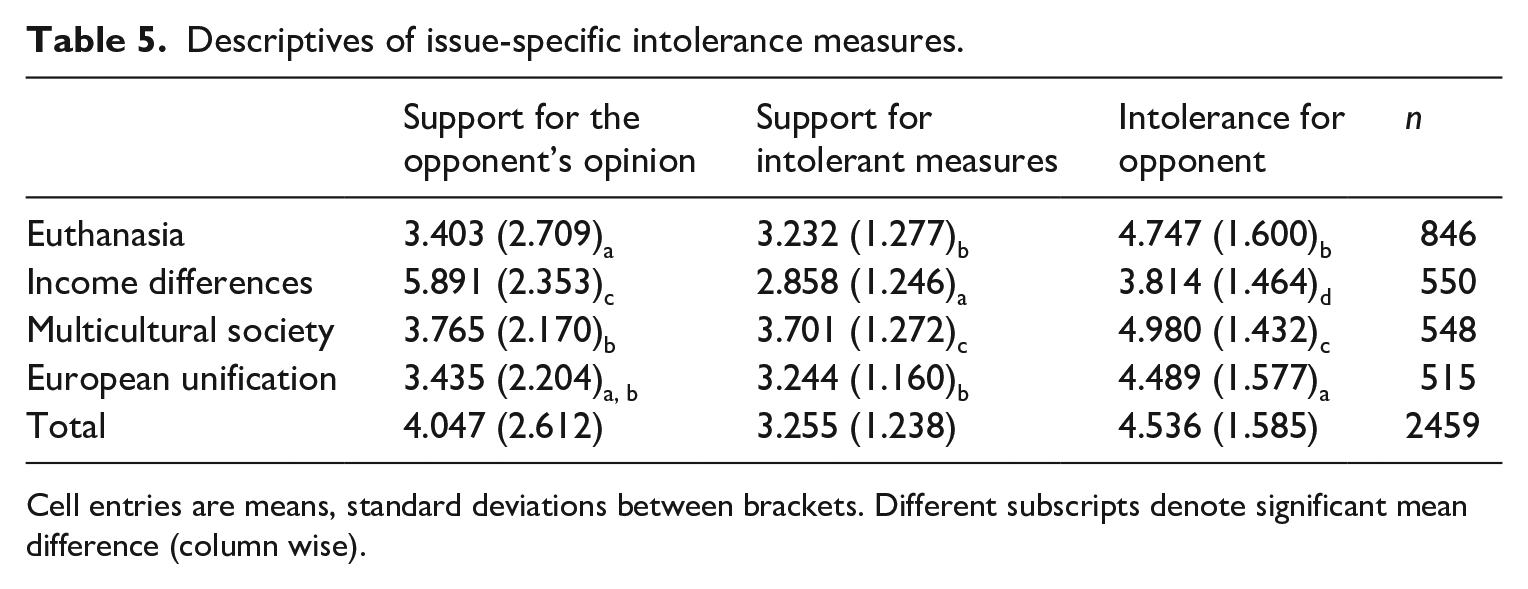
Cell entries are means, standard deviations between brackets. Different subscripts denote significant mean difference (column wise).
The next question of course is, “Who is more likely to be intolerant?” Table 6 gives us the answers. If we look at our first dependent variable, the willingness to be tolerant of the opponent expressing their opinion, it becomes clear that respondents with a more moderate position on the issue are more likely to be tolerant in this regard, as are respondents who are more moderate ideologically speaking. In addition, and contrary to our expectations, respondents with stronger populist attitudes are more likely to be supportive of the opponent’s opinion: a 1-point increase in populist attitudes leads to a 0.310-point increase in support. In Model II, we control for political trust and external political efficacy, which do not affect the dependent variable nor the other coefficients.
Impact of populist attitudes on issue-specific political (in)tolerance.
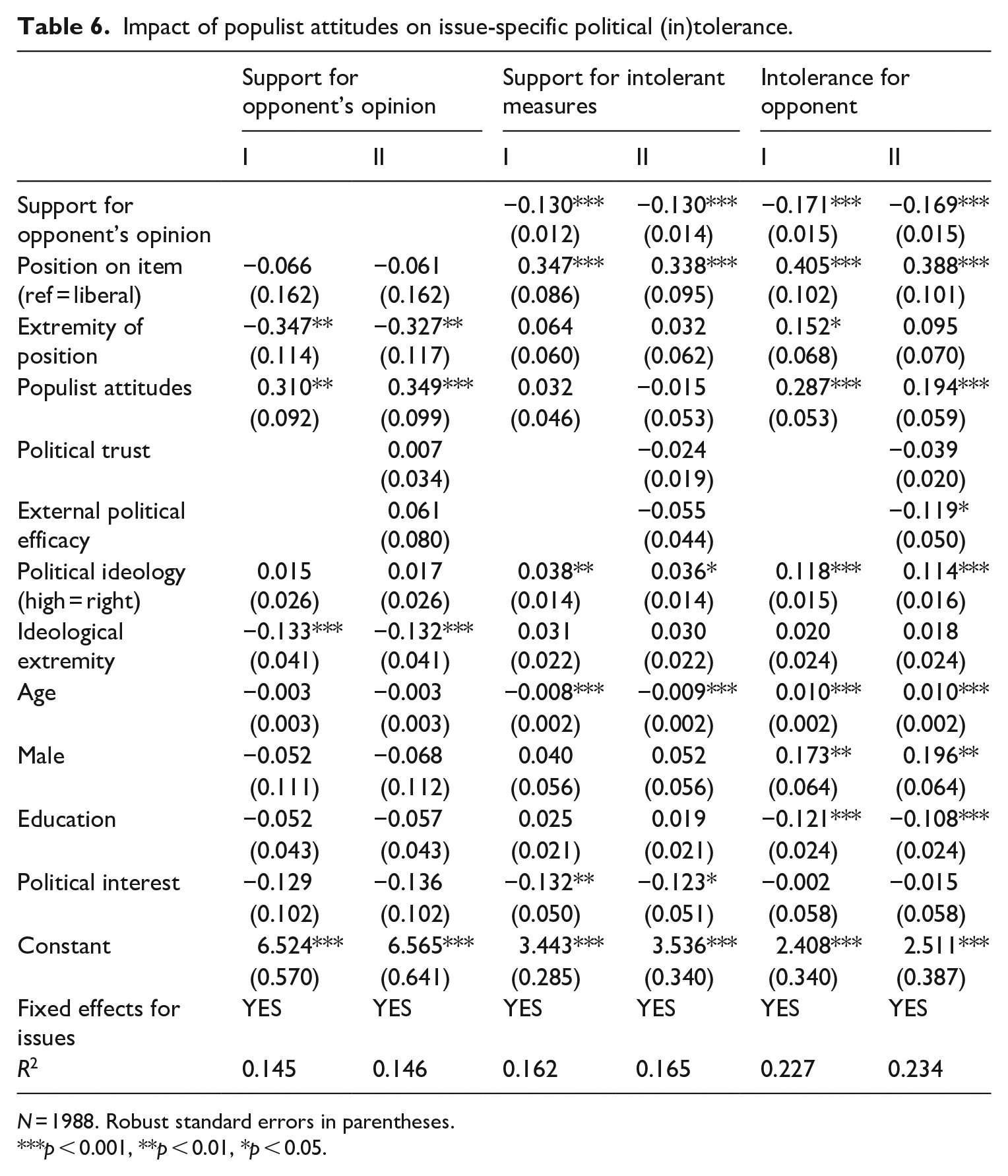
N = 1988. Robust standard errors in parentheses.
p < 0.001, **p < 0.01, *p < 0.05.
We then move on to the support for intolerant measures. We first of all see that respondents who are more supportive of the opponent’s opinion are less likely to support intolerant measures, which is to be expected. In addition, we now discern differences in issue position as well as ideology in correlating with this intolerance measure: respondents on the right of the left–right continuum as well as respondents with a conservative opinion on the issue are more likely to be supportive of intolerant measures. And respondents with stronger populist attitudes are not more or less likely to be intolerant in this regard. In other words, the support for intolerant measures is driven by ideological not populist considerations. Again, controlling for political trust and external political efficacy does not change these results.
In the final models, we regress the more indirect measure intolerance for opponent on the independent variables. Again, we see that more support for the opponent’s opinion leads to less intolerance for the opponent. And again, we find that right-wing respondents and respondents with a conservative opinion on the issue are more likely to be intolerant of the opponent. In addition, respondents with a more extreme position on the issue are more likely to be intolerant. However, in this case, we do find that respondents with stronger populist attitudes are more likely to be intolerant toward the opponent: a 1-point increase in populist attitudes leads to a 0.287-point increase in intolerance, supporting H2. In a next step, we again control for political trust and external political efficacy, which leads to a significant negative impact on tolerance and decreases the impact of populist attitudes. Yet, the results do show that populist attitudes over and above of other anti-establishment measures explain intolerance for opponents. 12
Discussion
Political tolerance is commonly perceived as an important democratic norm that is essential for the existence of liberal democracies (Gibson, 1992; Grzymala-Busse, 2019; Hurwitz and Mondak, 2002; Levitsky and Ziblatt, 2018). For instance, political tolerance is positively related to individual freedom (Gibson, 1992) and facilitates dissent (Claassen and Gibson, 2019). Citizens with populist attitudes arguably have an ambiguous relation with key democratic norms and values. Whereas populist citizens are generally in favor of referendums and deliberative forms of participation (e.g. Zaslove et al., 2021), they tend to hold negative attitudes toward pluralism and are critical of political representation (e.g. Pappas, 2019). Given the popularity of populist parties worldwide, it is relevant to increase our understanding of how this combination of attitudes translates into political intolerance among populist citizens.
Two studies, using data collected within the LISS panel, a Dutch household panel survey, were conducted in order to increase understanding of political intolerance among populists. To measure populist attitudes, we built on recent insights by Wüttke et al. (2020), who define populist attitudes as one’s position on the lowest of three sub-scales (anti-elitism, popular sovereignty, and homogeneity). In Study 1, we investigated whether citizens with populist attitudes hold more intolerant attitudes in general, by focusing on abstract support for norms and rights. The findings show partial support for our first hypothesis. There is a strong negative impact of populist attitudes on support for democratic norms (supporting H1a), meaning that populist citizens show lower support for democratic norms than non-populist citizens. Furthermore, in line with our expectations, we find that voters with stronger populist attitudes are more likely to display intolerance toward people with divergent opinions online (H1b). Both findings cannot be explained by levels of political trust and external political efficacy. Yet, populist voters are no more or less likely to support individual civil rights than citizens without populist attitudes. A potential reason for why populist voters do not seem less supportive of individual civil rights (RQ1) could be that support for individual civil rights was measured by an item about attitudes toward free speech and an item about expanding rights to all people regardless of political opinion. Given that populist citizens often portray themselves as the defenders of free speech (Moffitt, 2017), and that several populist party leaders have been prosecuted for hate speech during the last decades (see, for example, Wichgers et al., 2021), this may explain why populist citizens were not less supportive of individual civil rights than non-populist citizens. Hence, populist citizens seem to “selectively pick-and-choose” (Moffitt, 2017: 117) civil rights they find appropriate and valuable to defend. Future research is advised to include a broader spectrum of individual civil rights to achieve a finer grained measure of this dimension of political intolerance.
To further advance our understanding of the extent to which populist citizens are truly intolerant, it is key to go beyond disregarding general democratic norms and/or civil rights. We used an approach inspired by Arceneaux (2019) to study how much citizens with populist attitudes are willing to extend basic civil rights to people they disagree with (i.e. political antagonists). The findings demonstrated mixed support for H2. In line with our expectations, respondents with stronger populist attitudes are more likely to be intolerant of the opponent. Although controlling for political trust and external political efficacy decreased the impact of populist attitudes, populist attitudes are still a better predictor of intolerance for the opponent than other anti-establishment measures. Hence, while Dutch populists are in favor of free speech, they use their right to free speech to express their wish to limit the freedom of others—including other people’s right to free speech. Or, as Moffitt (2017: 117) comprehensibly describes, “their passion for free speech depends on who is doing the speaking.” Yet, populist citizens are not more or less likely to support intolerant measures. Support for intolerant measures is not driven by populist attitudes, but by ideological considerations: respondents on the right end of the political spectrum and those with conservative opinions, rather than populist voters, are more supportive of intolerant measures. Hence, Study 2 demonstrates that populist citizens seem more intolerant of their antagonist, but not more likely to be supporters of intolerant measures.
Three potential reasons for the different findings regarding populists’ intolerance of the opponent and their support for intolerant measures may be related to the nature of these measures. First, respondents in Study 2 were exposed to a hypothetical group they disagreed with. These hypothetical groups were arguably not as extreme and potentially dangerous as certain existing groups. A common approach in measuring political intolerance is the fixed-group approach (Stouffer, 1955; General Social Survey), where respondents are allocated to one or more commonly disliked groups (e.g. members of the Ku Klux Klan, or communists). Not only can these groups be categorized based on their extreme opinions, but also on factors as antidemocratic viewpoints, the use of violence, or their internal organization. The hypothetical groups in this study are exclusively categorized based on their opinion and may therefore have evoked less extreme responses in political intolerance. In addition, as noted in our theoretical framework, we expected populist voters to be more politically intolerant toward groups that are not regarded as part of “the people.” Our approach ensured that respondents were allocated to a group they disagreed with, but not necessarily to a “populist out-group.”
Second, because the items used to measure political intolerance in Study 2 loaded on two rather than one factor, we used two scales to measure the extent to which respondents extended civil liberties to their antagonist: political intolerance of the opponent and support for intolerant measures. While political intolerance of the opponent is a more indirect, implicit measure, in line with prior research on political intolerance, support for intolerant measures can be understood as a more direct, explicit measure of political intolerance. However, it is possible that the former is in fact more closely linked to prejudice against out-groups rather than to political intolerance. Despite being related, prior research (e.g. Crawford, 2014; Gibson, 2006) warranted for the conceptual distinction between political intolerance and prejudice against out-groups. For instance, whereas symbolic threat is a strong predictor of prejudice against out-groups, it does not strongly predict political intolerance of similar out-groups (Crawford, 2014). Populist citizens may be more likely to demonstrate prejudice against their political antagonist, but may not necessarily support intolerant measures. Given that prejudice toward the out-group is generally more prevalent than political intolerance, this could explain why we only found strong evidence for populists’ intolerance of the opponent. Future research could explore this possibility in further depth, by studying the limits between prejudice toward the out-group and political intolerance, and examining whether there are differences among populist and non-populist citizens. Moreover, future research is recommended to improve the measurement of political intolerance. To account for the contemporary digital era, we adjusted existing scales previously used to measure offline political intolerance while also retaining various original items. Unfortunately, the items did not load on one factor as hoped for, which forced us to use two political intolerance scales.
Third, our findings might be affected by social desirability bias. This is a recognized problem in research on intolerance and prejudice: respondents take social norms into account when publicly expressing prejudice (Crandall et al., 2002). Although the LISS panel surveys are administered online, respondents might perceive tolerant answers to be preferred. While we included positive and negative items in the targeted political intolerance items, these items load on distinct scales and lead to different results and conclusions.
Yet, this study is a valuable addition to existing research. Since prior research on political intolerance is primarily limited to majoritarian systems, the Dutch context, with its extreme proportional representation, presented a unique opportunity for studying political intolerance. Moreover, we are the first to present evidence on political intolerance among populists. The fragmented Dutch political landscape, characterized by the necessity of striking political deals with political opponents, increases the likelihood that there is more political tolerance, also among populists. While this may explain why populists did not show more support for intolerant measures, we still demonstrated that Dutch populist voters on average do seem less supportive of abstract democratic norms and seem less tolerant of their opponent. The fact that we even find political intolerance among Dutch populists increases the robustness of the findings. Yet, we recommend future research to study political intolerance among populists in majoritarian systems, as we anticipate stronger effects due to the highly polarized political context. Comparative research, across various political contexts, would increase our understanding of political intolerance among populists and their relation with key democratic norms and values, which is extremely important given the popularity of populist parties worldwide.
Supplemental Material
sj-docx-1-psx-10.1177_00323217211049299 – Supplemental material for Are Populists Politically Intolerant? Citizens’ Populist Attitudes and Tolerance of Various Political Antagonists
Supplemental material, sj-docx-1-psx-10.1177_00323217211049299 for Are Populists Politically Intolerant? Citizens’ Populist Attitudes and Tolerance of Various Political Antagonists by Linda Bos, Lisanne Wichgers and Joost van Spanje in Political Studies
Footnotes
Declaration of Conflicting Interest
The author(s) declared no potential conflicts of interest with respect to the research, authorship, and/or publication of this article.
Funding

Supplemental Material
Additional Supplementary Information may be found with the online version of this article.
Table S1. Impact of populist attitudes on issue-specific political (in)tolerance (extended scales). Table S2. Impact of populist attitudes on political (in)tolerance items.
Notes
Author Biographies
References
Supplementary Material
Please find the following supplemental material available below.
For Open Access articles published under a Creative Commons License, all supplemental material carries the same license as the article it is associated with.
For non-Open Access articles published, all supplemental material carries a non-exclusive license, and permission requests for re-use of supplemental material or any part of supplemental material shall be sent directly to the copyright owner as specified in the copyright notice associated with the article.
