




Abstract
A widely accepted finding in the literature on political participation is that individuals living in poorer neighbourhoods are less likely to vote than those living in more affluent neighbourhoods. Yet, why some poor residents of the most deprived neighbourhoods are more likely to vote than others is still understudied. This article presents a new theoretical framework arguing that when they believe that most others vote in the neighbourhood, poor citizens are more likely to follow their example than wealthy citizens. To empirically test these claims, I develop a two-level multilevel model using survey data and the Index of Multiple Deprivation for England. My findings point to the higher importance of a social norm of voting for the political behaviour of poor individuals than wealthy individuals. Social norms define which behaviour is right and proper. They are enforced through social interactions with others.
Keywords
Introduction
Research on political participation finds that individuals living in poorer neighbourhoods are less likely to vote than those living in more affluent neighbourhoods. 1 This is problematic as it leads to an unequal representation of the interests of different socioeconomic groups in times of increasing social inequalities in many Western democracies. Scholars have mostly attributed the unequal political participation in these communities to the individual characteristics of the inhabitants, such as their lower socioeconomic background (e.g. Brady et al., 1995; Gallego, 2007; Verba et al., 1995). Provided that these differences in individual characteristics are sufficient to explain variation across communities, we should expect low-income individuals to be equally unlikely to participate in all contexts. Yet, there is considerable subnational variation when it comes to the engagement of less affluent individuals. 2 In a nationally representative survey of the UK, the poor’s intention to vote – aggregated at the neighbourhood level and measured on an 11-point Likert-type scale – varies significantly between the different neighbourhoods, with an average of 7.3 and a standard deviation of 3.2. 3 In this article, I investigate these contextual differences and aim to provide answers to the following research questions: Why are poorer individuals more likely to engage in political actions when living in some neighbourhoods but not in others? What characterises these social contexts?
The article consists of two parts. In the first part, I theorise how social context matters for individual political behaviour among low-income individuals and across disadvantaged neighbourhoods. Specifically, I argue that the poor are more oriented towards others living nearby. Therefore, I expect that the perceived voting behaviour of their neighbours will more strongly affect poorer rather than wealthier individuals. For example, community norms and social pressure should be relatively more important among the poor than the wealthy. Moreover, when living in more deprived neighbourhoods, poor individuals are also more likely to be affected by their neighbours than when they reside in wealthier neighbourhoods, as social ties may be stronger and social monitoring more effective in the former case.
My theoretical expectations are based on the assumption that social ties, and thus the ability to monitor community members socially, should be stronger among poor neighbours within communities in which many poor individuals reside. A recurrent argument in studies on social segregation and neighbourhood context is that local ties matter more for poor individuals than for their more affluent counterparts (cf. van Eijk, 2010). Poor individuals are described as relying more frequently on their neighbours to solve daily problems than wealthier individuals. Also, they typically have less diverse social ties (Andersen et al., 2006). Accordingly, the impact of how others behave politically on the individual’s intention to vote should be higher in more deprived neighbourhoods and among the poor.
In the second part of this article, I test my theoretical arguments empirically using data from the sixth wave of the Understanding Society data set (2014–2015), a longitudinal household survey conducted by the Institute for Social and Economic Research (ISER) at the University of Essex (2019). 4 I further rely on contextual data on neighbourhood deprivation from the Index of Multiple Deprivation (IMD) for England (Ministry of Housing, Communities and Local Government, 2015). 5 In the models presented, I run a multilevel regression to test the impact of individual and neighbourhood-level characteristics on respondents’ voting intentions. I use Lower Layer Super Output Areas (LSOAs), the smallest local units on which data are available, to define neighbourhood boundaries in England. Based on the IMD, I distinguish between less and more deprived neighbourhoods to examine the effect of neighbourhood wealth on individual political behaviour and its potential interaction with other individual-level variables.
The UK shows relatively high levels of income and wealth inequality, with the top 10% of households having a wealth greater than those in the bottom half of all households combined (Office for National Statistics (ONS), 2018). According to official statistics, the UK ranks third among the most unequal EU countries (OECD, 2020). 6 Regional differences within the UK are striking, with the South East ranked as the wealthiest region and the North East as the most impoverished region of the country (ONS, 2018). Moreover, turnout rates vary considerably across areas and between members of different socioeconomic groups, although the participation of low-income voters did increase by seven percentage points between 2010 and 2017 (Goodwin and Heath, 2019). At the same time, the Westminster system is one of the oldest and best-established democratic systems in the world. This makes the UK a particularly interesting case of an established Western democracy, suitable for investigation.
I focus on the neighbourhood level as the neighbourhood is ‘part of the lived experiences of individuals’ (Bartle et al., 2017). Individuals interact socially with others in their neighbourhood daily, which also makes each person experience social inequality more directly at the local level. Previous studies on political participation have shown that the social class composition of the neighbourhood affects individual political behaviour and that this effect is consistent over time (Andersen et al., 2006; Andersen and Heath, 2002; Pattie and Johnston, 1999; Yang et al., 2000). Thus, how others behave should matter more when they live in close proximity than when they live far away.
The impact of a voting social norm on poorer individuals’ behaviour cannot be directly tested in this article, but I suggest that individual perceptions of whether others vote already points in this direction. I argue that perceptions are what matters as they highlight the social orientation towards others who are expected to behave similarly. Following Coleman (1990: 242), social norms ‘specify what actions are regarded by a set of persons as proper or correct, or improper and incorrect’. Unlike a ‘widespread sense of civic duty’, which should similarly affect individual behaviour across communities or groups (Anoll, 2018), social norms are group-specific, as they are experienced through social interactions with others (Gerber et al., 2008; Sinclair, 2012). Therefore, a duty to the state should be different from a social norm of voting within the community (Rosenzweig, 2018). Group-based social norms influence individual behaviour and attitudes (Cialdini and Trost, 1998). In the case of voting, this means that when I believe that most others vote in my neighbourhood, this likely also signals to me that voting is considered as ‘proper or correct’. Thus, beliefs about the behaviour of their neighbours guide the individual’s behaviour more than actual turnout rates, about which the individual may not have any information. In the analysis, I focus on perceptions of whether others vote in the neighbourhood to understand how perceived social norms are driving individual behaviour.
Political Participation and Socioeconomic Status
In most established Western democracies, lower class individuals are generally less likely to turn out to vote or partake in other forms of political participation than their middle- and upper-class counterparts (Barnes and Kaase, 1979; Gallego, 2007; Verba et al., 1978, 1995; Verba and Nie, 1987). This unequal political participation is problematic in many ways. First, the unequal participation of different social groups within society indirectly promotes an unequal representation of interests (Verba et al., 1995). Second, less affluent individuals may lack influence on important political decisions, such as, for example, in the field of social policies. This lack of influence may further strengthen or even increase existing social inequalities between poorer and wealthier individuals in society. Therefore, it is essential to understand under which conditions poorer individuals are more likely to become politically engaged and how this can potentially be supported through such measures as state intervention or non-governmental organisation campaigns.
Previous studies in political participation research have explained the existing social gap in participation by looking at individual characteristics. In particular, they focused on a lack of necessary resources such as time, money and civic skills among individuals of lower socioeconomic status (Armingeon and Schädel, 2015; Brady et al., 1995; Johnston and Pattie, 2005; Verba et al., 1995). Participation is resource costly, so the argument goes, and incentives for the poor are small, which leads to political absenteeism. In the literature, scholars refer to this advancement of the rational choice model as the civic voluntarism or behavioural model (Dalton and Klingemann, 2011; Kern et al., 2015).
Taking a social-psychological perspective, scholars have explained theoretically how a lack of available resources leads to economic vulnerability, which increases the uncertainty in everyday life of poorer individuals (McLeod and Kessler, 1990). This uncertainty causes them to focus on immediate daily problems, and thus to favour immediate benefits and to withdraw from political life (Haushofer and Fehr, 2014; Shah et al., 2012). Denny (2017) shows that financial stress creates what she calls the ‘Good Intention Gap’. Low-income individuals want to participate in political actions, yet, financial stress and the worry of making ends meet decrease individuals’ capacity to think strategically and long-term. They forget to vote and, in the end, abstain from political actions.
Approaches that focus on the individual level are criticised for not recognising individuals as ‘social citizens’ (Sinclair, 2012), who make decisions in interaction with their social environment. Accordingly, behavioural approaches to participation do not provide a full picture of the variation in the poor’s engagement (cf. Miller et al., 1981; Olsen, 1970; Verba and Nie, 1987).
Social Context and Political Behaviour
Individuals do not make decisions independent of external influences but are affected by others in their immediate social environment. From this general finding, we would expect the social context to affect individual political behaviour, including voting intentions. Scholars of the so-called Columbia school (Berelson et al., 1954; Lazarsfeld et al., 1968) were the first to point to the importance of social context for individual political participation. More empirical studies followed, showing that social context and specific neighbourhood characteristics – for example, the social class composition of the neighbourhood – generate differences in individual attitudes and behaviour (Andersen and Heath, 2002; Bartle et al., 2017; Giles and Dantico, 1982; Huckfeldt, 1979; Kenny, 1992; Miller, 1978).
These earlier findings further indicate that social context effects are different, and sometimes larger, for less affluent and working-class individuals than for wealthier individuals. For example, Tingsten (1937) finds that Stockholm’s workers 7 are more likely to vote when living in neighbourhoods with a high percentage of working-class residents. More recent studies on vote choice in the UK show that working-class individuals are more likely to vote for the Labour Party when living in working-class constituencies (Andersen et al., 2006; Andersen and Heath, 2002; Johnston and Pattie, 2005). Some of these previous studies used aggregated neighbourhood-level data, which does not allow the authors to distinguish between individual and contextual effects in their models. Others have used multilevel modelling to test the impact of individual and contextual effects separately (Andersen et al., 2006; Andersen and Heath, 2002). Using time-series data on individual voting from the British Election Survey (1964–1997), Andersen et al. (2006) show that the social class composition of the constituency is predictive of individual vote choice in the UK over time. Yet, this may have changed in recent years with the weakening of class alignment in Europe.
In the US context, scholars find that wealthy individuals are more likely to vote, while poor individuals are less likely to vote, when living in neighbourhoods of a higher socioeconomic status (Giles and Dantico, 1982; Huckfeldt, 1979). Huckfeldt (1979) shows that high-status environments in the US increase participation in socially based modes of engagement among wealthy individuals, yet it decreases participation among poorer individuals. In another study, Bartle et al. (2017) further differentiate between context heterogeneity and segregation. In their models, whereas heterogeneity has a positive impact on individual turnout, segregation negatively affects turnout. The negative effect of segregation is larger for individuals below median income. 8 Based on these findings, the authors suggest that interactions among the poor seem to suppress political participation, while interactions with others from higher social classes encourage participation. These findings stand in contrast to previous results by Huckfeldt (1979) and Giles and Dantico (1982), showing that less affluent individuals are less inclined to participate when living in heterogeneous neighbourhoods.
Social Norms and Obligations
Some of these earlier studies indicate that social pressure and social norms may moderate the relationship between individual wealth and social context. Yet, they were not able to empirically test the mechanisms. In more recent work, scholars use field experiments to examine the effect of social pressure on voting behaviour more generally, yet without paying attention to the varying effects for the different socioeconomic groups (Gerber et al., 2008; Sinclair, 2012). Aytaç and Stokes (2019), for example, argue in their recent book Why bother? Rethinking Participation in Elections and Protest, that social pressure might even induce costs of non-participation or absenteeism that might outweigh existing costs of participation. These findings, again, point to social costs that follow from non-compliance with community habits that have become social obligations.
Others have focused on the impact of household context and peer pressure on voting. Particularly in so-called get-out-the-vote (GOTV) studies, scholars investigate the effects of social pressure from housemates and neighbours on individuals’ likelihood to turn out to vote (Gerber et al.,2008, 2010; Rogers et al., 2017; Sinclair, 2012). Probably the most seminal of these studies was conducted by Gerber et al. (2008). In a large-scale field experiment before the local elections in Michigan in 2007, the authors test the effects of social pressure on voter turnout. They find that turnout rates in the low-salient election significantly increased when people were informed that whether they voted or not would be made publicly available or when they received the voting records of people in their household and their neighbours.
In a more recent follow-up study to the experiment by Gerber et al. (2008), Rogers et al. (2017) investigated the impact of social pressure from neighbours on voter turnout in a high-salience recall election. In their models, effect sizes were smaller but still notable compared with those found in the study by Gerber and colleagues. In addition, the authors showed that whether the wording of the information provided was nonpartisan or opposing, the incumbent did not show significant effects on individual turnout.
These studies indicate that social pressure drives participation. As a result of social pressure and the social norms guiding behaviour, the community can reward or sanction individual compliance. For example, Rosenzweig (2018) shows, in the context of Tanzania, that within a community, a social norm of voting can explain turnout in dominant-party systems. She finds that, in particular, the rural poor will receive rewards for participation or be socially sanctioned in the case of non-participation. In another experimental study, Robison (2017) finds that political interest among university students in the US increases when respondents are told that political engagement helps to create and maintain social relationships.
Social pressure and norms are formed and imposed through the social environment. Yet, most existing scholarship has not paid much attention to exactly how social context shapes norms that translate into individual behaviour and, more specifically, how we expect its impact to differ between socioeconomic groups. A large part of this scholarship was conducted in the US context and, more specifically, with reference to the racial composition of neighbourhoods. Fewer studies have been conducted in Europe and elsewhere.
For example, Anoll (2018) investigates racial differences in how US citizens value political participation. She finds that Blacks see a higher value in voting and participation in political rallies than Whites and that neighbourhood characteristics account for a big part of these differences. She explains this as the result of experiences with political exclusion among the Black population and the resulting importance attached to having political influence. Black communities, where the author expects cohesion to be high, voters and rally attenders are evaluated more positively, suggesting that social incentives are higher for minority group members in these communities.
Research in the UK context has focussed on the social class composition of the neighbourhood and its impact on individual vote choices (Andersen et al., 2006; Andersen and Heath, 2002; Johnston and Pattie, 2005). This earlier work shows that members of the working class are more likely to vote for the Labour Party when living in working-class constituencies. Yet, despite an increasingly robust literature on social context and political behaviour, we still lack a deeper understanding of how social neighbourhood context and individual wealth affect the voting intentions of individuals.
This article contributes to the scholarly debate by investigating more systematically why some economically poor individuals show a higher voting intention than others and how this differs across neighbourhoods. I contribute by investigating social context effects – measured as the neighbours’ perceived behaviour – on voting intentions among poor and wealthy individuals and across more and less deprived neighbourhoods. The model presented below draws on previous findings from different research fields, such as political science, sociology and social psychology, and extends these findings by showing how we should expect them to affect the political behaviour of the individual.
Neighbourhood Social Context and Voting Among the Poor
The existing literature highlights two different explanations for how we would expect poor and wealthy individuals to differ regarding the anticipated effect of social context on individual voting intentions. First, previous work on neighbourhood context shows that poorer individuals have less diverse social ties and fewer social connections to networks outside the neighbourhood (Bridge, 2002; Pinkster, 2007; van Eijk, 2010). This suggests that poorer individuals are more oriented towards their most immediate local environment. When having limited resources, neighbourhood relations may be more critical because resource scarcity creates the necessity to rely more frequently on other community members for help.
Moreover, one of the more robust findings in sociology is that individuals are more likely to socially interact with others who share similar social characteristics (for an overview, see McPherson et al., 2001). From this, we assume that less affluent individuals living in poorer neighbourhoods should interact more frequently with their neighbours. We also expect them to be more reliant on each other in their everyday life than poorer individuals residing in higher status environments. Accordingly, social ties should be stronger between poorer individuals residing in less affluent neighbourhoods than among their more affluent neighbours. Social orientation towards others should be higher in poorer communities, and social pressure should be more effective in guiding individual behaviour.
Following these previous findings, I expect that poorer individuals should be more strongly influenced by others in their local social environment and by descriptive norms (i.e. what their neighbours do). I suggest that this should affect poorer individuals’ engagement in political actions more generally. Accordingly, I hypothesise that whether individuals think that others vote in their neighbourhood should have a higher impact on the voting intentions of poorer individuals and residents of poorer neighbourhoods than on the voting intentions of their wealthier counterparts (see also Table 1).
Expectations about Individual Voting Intentions of Low- and High-Income Individuals.
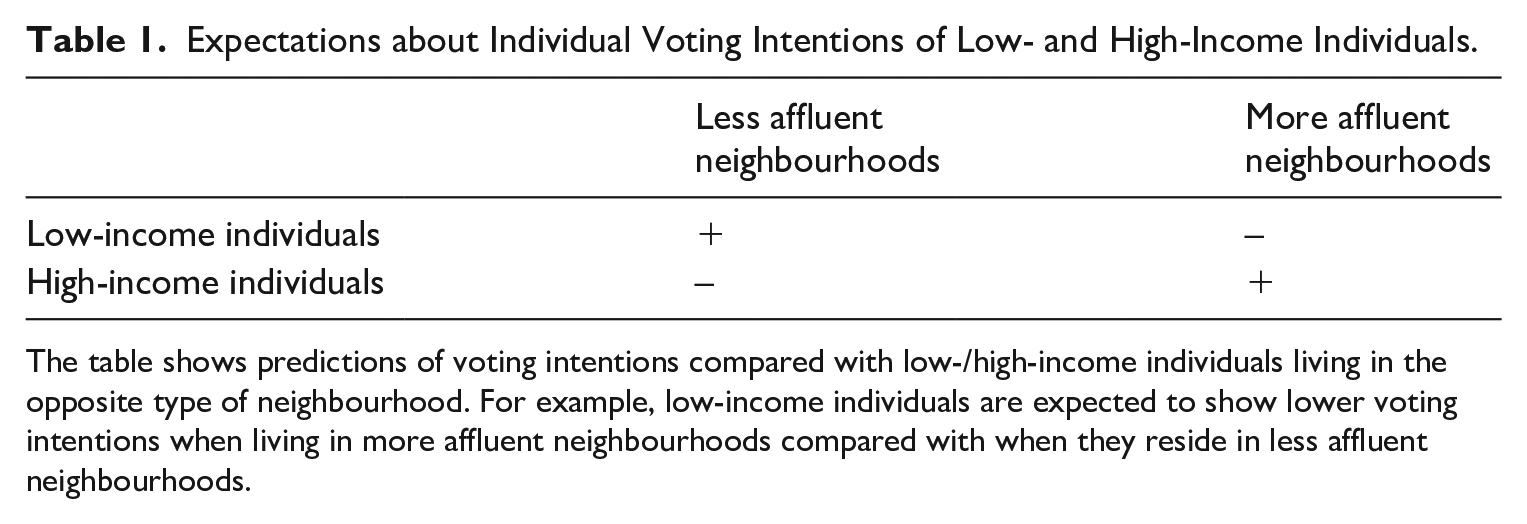
The table shows predictions of voting intentions compared with low-/high-income individuals living in the opposite type of neighbourhood. For example, low-income individuals are expected to show lower voting intentions when living in more affluent neighbourhoods compared with when they reside in less affluent neighbourhoods.
Hypothesis 1: Poorer individuals are more likely to vote if they perceive that people in their neighbourhood vote.
Hypothesis 2: Both poor and wealthy respondents living in more deprived neighbourhoods will be more likely to vote compared with those living in wealthier neighbourhoods when they perceive that people in the neighbourhood vote.
Moreover, I suggest that poor individuals, in particular, who are living in more deprived neighbourhoods should develop denser social ties with their neighbours, who share their social cues. As a result, social pressure and the ability to monitor community members in case of non-compliance with community norms should also be stronger in more deprived neighbourhoods. Hence, I expect the effect of whether others vote to be stronger for poorer individuals than wealthier individuals living in more deprived neighbourhoods and formulate the following hypothesis:
Hypothesis 3: Descriptive norms to vote (i.e. perceptions of what their neighbours do) will have a stronger effect on poor individuals than wealthy individuals when they live in more deprived neighbourhoods.
Contrary to the theoretical framework presented above, the rich literature on social capital and political participation suggests that social capital is higher among wealthier individuals than poorer individuals (Delhey and Newton, 2003; Uslaner and Brown, 2005). Scholars have argued that as members of the same sports clubs and organisations, middle- and upper-class individuals are more trusting in each other. Some say that from this, we should expect that wealthier individuals are more likely to comply with existing social norms and to participate in communal activities (Uslaner and Brown, 2005). It is less clear whether higher levels of social trust among wealthier individuals should also be connected to the neighbourhood. More affluent individuals may be better connected with others in general, but perhaps less so with others living in the same neighbourhood. A more recent study by Pichler and Wallace (2009) finds that wealthier individuals have more formal social capital but not more ‘informal social capital’, that is, capital that is based on social connections with neighbours and friends, than poorer individuals.
Data and Method
I draw on data from Wave 6 of the Understanding Society data set and the IMD from England. The Understanding Society data set is a longitudinal household survey conducted by the ISER at the University of Essex. The sixth wave of the survey, conducted over 24 months in 2014 and 2015, includes individual modules on local neighbourhood and social networks and additional questions on respondents’ political behaviour. The special licence version of the data set entails information on the LSOAs from the 2010 census, which allows me to merge the household survey data with data from the IMD.
The IMD (2015) measures relative deprivation in 32,844 neighbourhoods in England. 9 Similar to the Understanding Society survey for the UK, the Index defines neighbourhoods as LSOAs from the 2010 census. It is based on 37 different indicators from seven domains: income deprivation and employment deprivation; health deprivation; disability, education, skills and training deprivation; barriers to housing and services; living environment deprivation; and crime. All neighbourhoods are ranked according to their level of deprivation. The Index provides information on the deprivation level of local areas and gives an idea of the concentration of less affluent individuals in these areas. More deprived neighbourhoods typically have a higher concentration of less affluent individuals in the neighbourhood. LSOAs have a population size between 1000 and 3000 inhabitants and a mean size of 1500 inhabitants. 10
As my dependent variable, I use responses from the question, ‘Again, thinking of a scale that runs from 0 to 10, where 0 means very unlikely and 10 means very likely, how likely is it that you will vote in the next general election?’ This measures respondents’ intentions to vote on an 11-point Likert-type scale. I exclude individuals who are younger than 18 and respondents who reported that they would not be eligible to vote. I only rely on full surveys from the Understanding Society survey and exclude proxy surveys from the analysis. This leaves me with a sample of 21,955 individuals living in 9686 neighbourhoods in the UK. 11
Similar to some previous studies on social norms and voting (e.g. Gerber and Rogers, 2009), in this article I rely on the intention to vote measure. It provides a modest but imperfect predictor of actual turnout when other measures such as validated vote are not available (Achen and Blais, 2015). Yet, as shown by Achen and Blais (2015), we should expect explanatory coefficients to be larger than for actual turnout. Moreover, though intentions and actual behaviour should be strongly correlated, the intention to vote may not always result in actual voting.
The number of respondents per neighbourhood varies between 1 and 22. Therefore, I decided not to aggregate data from the survey. Instead, I draw on data from the IMD for my second level variable measuring neighbourhood deprivation. I use the variable on deprivation quartiles, which gives each neighbourhood a value between 1 and 10 according to its level of deprivation. I recoded the variable so that the value ten means that a neighbourhood falls into the top 10% of the most deprived neighbourhoods in England. It is included as a continuous variable in my models. 12
At the individual level, I generate a new variable to differentiate between poor versus wealthy respondents in my sample. To construct this variable, I use the values of the equivalised household income for each respondent. I rely on data from the survey on net household income after tax for earnings and calculate the equalised value for each respondent. Equivalence scales are used to account for the number and age of household members when working with household income. I rely on the OECD-modified scale, which gives a value of 1 to the first adult, 0.5 for each additional adult, and an additional value of 0.3 for each child in the household. Based on the equalised values, I calculate who in my sample is less and more affluent. I define who is poor and wealthy based on the relative poverty measure from the Child Poverty Act (2010), which is widely used to determine who can be considered as relatively poor compared with the country mean in Western industrialised countries. An individual is defined as poor when having less than 60% of the median available household income. I use the official numbers for 2014–2015 that were released as households below average income (HBAI) 13 by the UK government. 14
The independent variable on whether others vote in the neighbourhood is measured at the individual level. In the survey, respondents were asked the following: Next, I am going to read you a series of statements about political issues. For each statement that I read, please tell me whether you strongly agree, agree, neither agree nor disagree, disagree or strongly disagree with the statement.// Most people around here usually vote in general elections.
The variable was recoded as a binary variable with ‘most neighbours vote’ and ‘most neighbours do not vote’ as the two response categories. I used multiple imputations to account for missing data in my social context variable. Individuals with a lower voting intention were also less likely to answer the question of whether most others in the neighbourhood vote. I was able to successfully impute 4680 missing observations out of 5038 incomplete observations (see imputation model in the Online Appendix).
I further include some standard control variables that could influence my dependent variable at the individual level (Verba et al., 1995; Verba and Nie, 1987), including gender (male is coded as 0 and female as 1), age, age2 and ethnicity (coded as White, Mixed, African or Caribbean, Asian, Arab, and another ethnic groups, White as the base category). In a separate model, I control for education (coded as a categorical variable showing the highest level of educational qualification; no education as the base category) and some additional individual-level variables. For example, I control for whether the respondent thinks that it is his or her civic duty to vote (recoded as a dummy variable with 0 ‘no civic duty’ and 1 ‘civic duty’). This accounts for whether intentional voting is influenced by what they think others do and not instead by an intrinsic belief that voting would be the right thing to do as a citizen. Moreover, I add variables on whether respondents are interested in politics (recoded as a binary variable with 0 ‘not interested’ and 1 ‘interested’) and whether people would prefer to move to another neighbourhood or stay in their current location (coded as a binary variable with 1 ‘prefer to stay in the neighbourhood’ and 2 ‘prefer to move to another neighbourhood’). Finally, I control for perceived costs of voting in the models. Respondents were asked if they agree with the following statement (coded as a binary variable with 1 ‘strongly agree or agree’ and 0 ‘neither agree nor disagree/strongly disagree or disagree’): ‘It takes too much time and effort to be active in politics and public affairs’.
Multilevel Modelling
This article aims to assess the impact of both social neighbourhood context and individual-level characteristics on individual voting intentions. Given the hierarchical structure of the data, in which individuals are nested within neighbourhoods, I use multilevel modelling. Individuals within the same neighbourhood are likely to be similar to each other due to contextual factors. Yet, we might equally expect them to be different from citizens living in other neighbourhoods. This contradicts one of the assumptions typically required by classical linear regression models, that is, that observations are independent. Multilevel modelling accounts for the dependency of the respondents and minimises the odds of receiving biased parameter estimates (cf. Peugh, 2010).
Responses to my dependent variable, intention to vote, can take a value between 0 and 10 with 0 as ‘not likely at all’ and 10 as ‘very likely’. I run a two-level linear multilevel model to test the impact of individual and neighbourhood-level variables independently, as well as their potential cross-level interactions. I include whether neighbours vote as a possible underlying mechanism in my models, arguing that – where strong social obligations to comply, such as the idea of a social norm of voting, exists within the neighbourhood – citizens should report higher levels of intended voting.
I specify the basic random slope model (M1), in which I allow the effects of individual wealth on individual voting intention to vary

where i represents the individual (respondent) and j the group level (neighbourhood). β0 is the constant, and β1 and β2 are included as fixed effects in my model. u0j represents the random effect on voting intentions. I also include some basic controls (age, age2 and gender) in the fixed part of my model. In the random part, I included individual wealth, by which I allow the slopes for individual wealth to vary. Here, e ij represents the residuals. Model 2 controls for several additional control variables at the individual level.
In Models 3–6, I add the interactions to my basic model to test how the effects of my main variables of interest – individual wealth, neighbours’ perceived voting behaviour and neighbourhood deprivation – interact. After including all interactions, the model specification looks as follows:

Results
Figure 1 plots voting intentions by income groups. It shows that variation in voting intentions is higher for low-income respondents than high-income respondents in the sample. This means that poorer individuals differ to a greater extent in their intention to vote than more affluent respondents, who show a higher intention to vote on average.
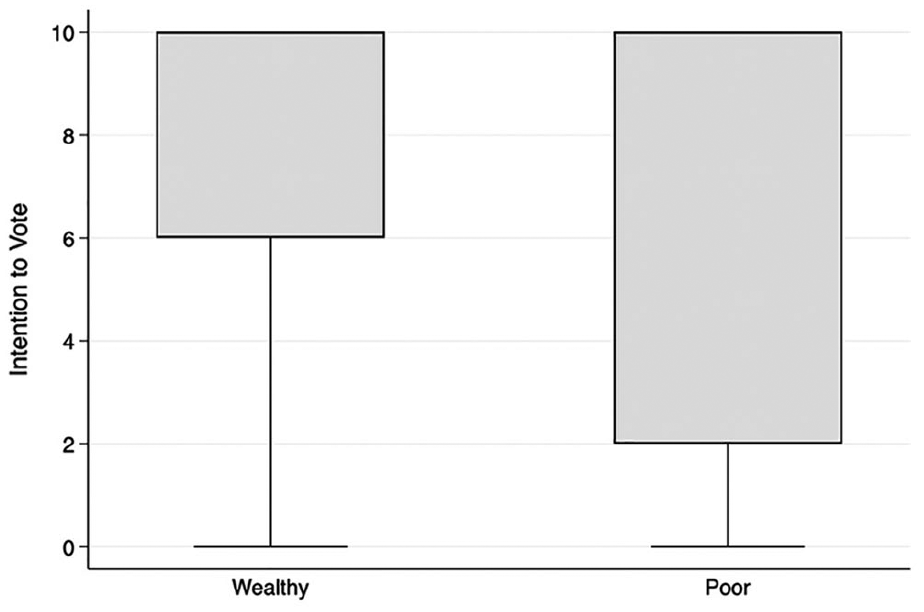
Intention to Vote by Wealth Groups.
When plotting the effect of respondents’ perceptions of neighbours’ voting behaviour over wealth, we see that the variance between poorer individuals is reduced (see Figure 2). At the same time, low-income respondents’ average voting intentions increase. Accordingly, perceptions of whether others in the neighbourhood vote seem to decrease the variance between poor individuals and to increase their average voting intentions. This effect appears to be larger for low-income respondents than for high-income individuals.
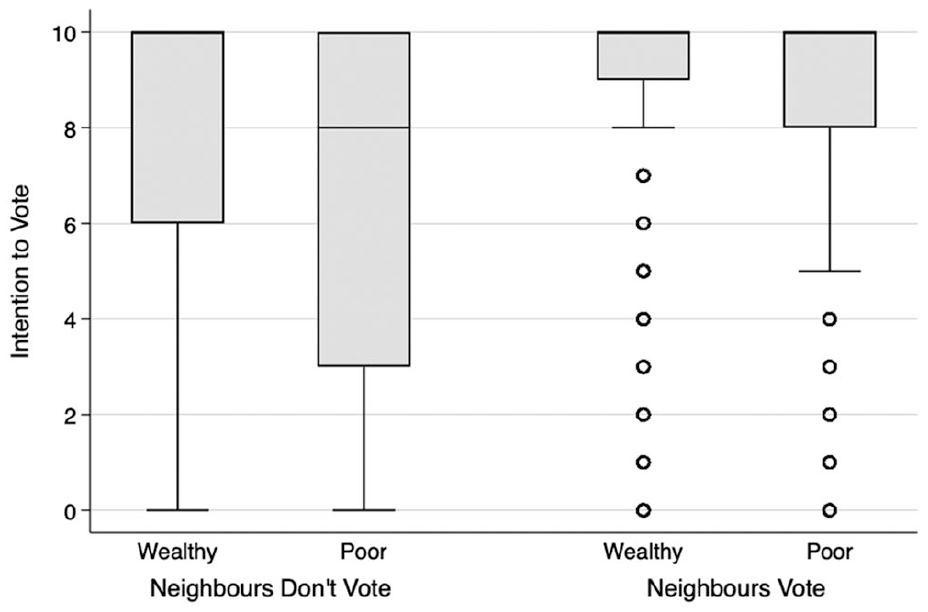
Intention to Vote by Wealth Groups over Whether the Respondents Believe that Most Others Vote in the Neighbourhood.
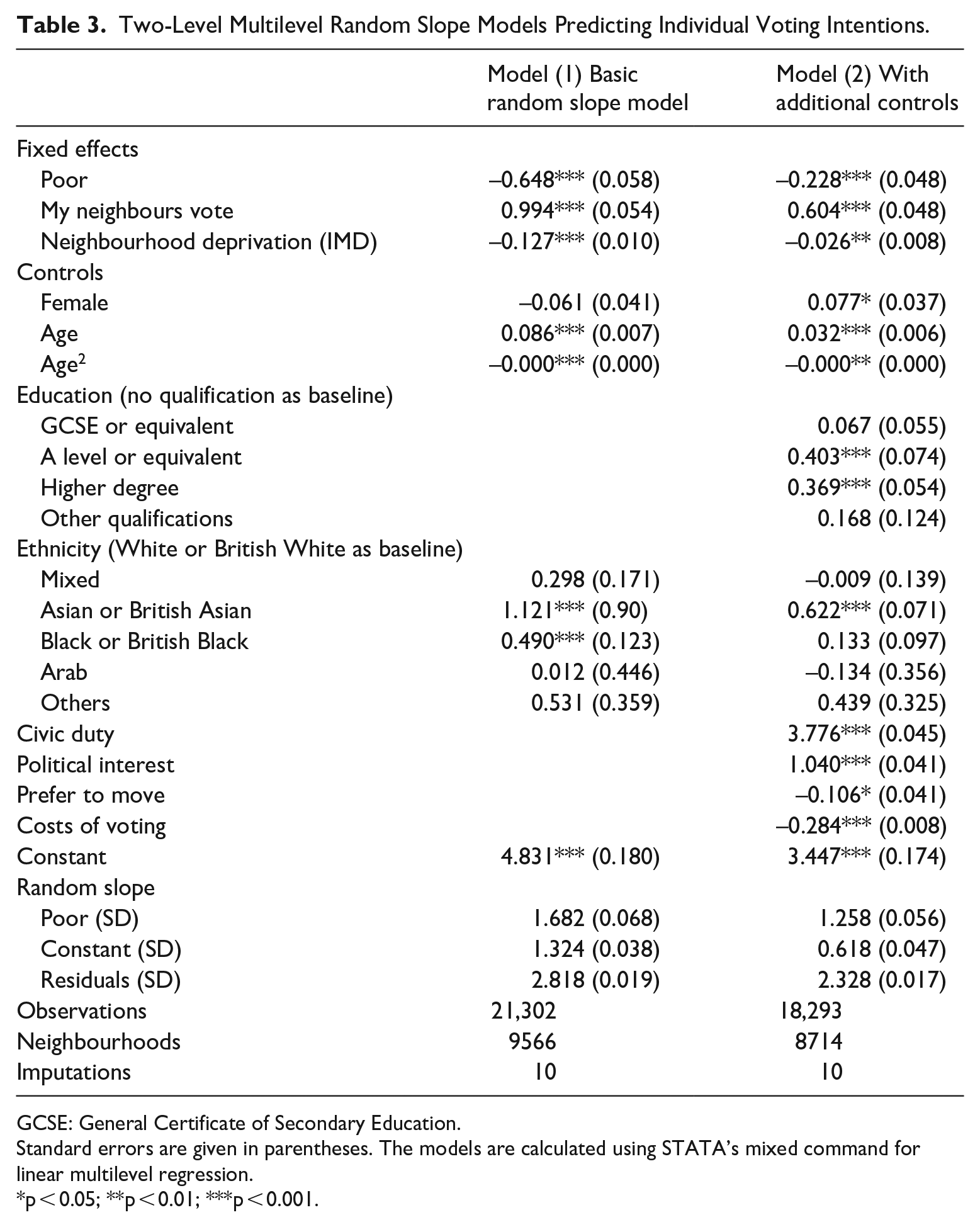
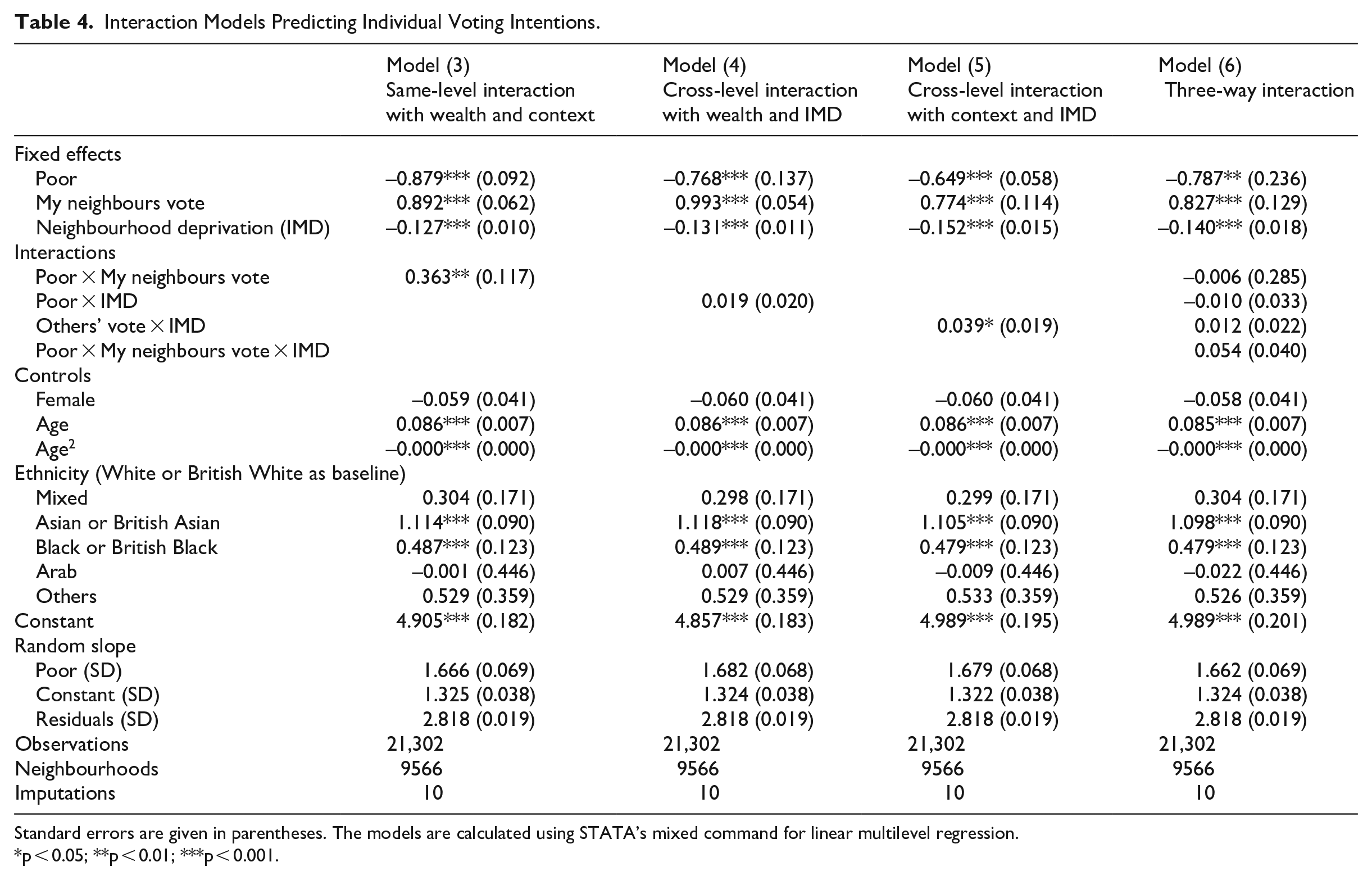
To further investigate the differences between low- and high-income respondents in the sample, I apply multilevel modelling to account for variation at both the individual and neighbourhood levels (see Tables 3 and 4).
Summary Statistics of Independent Variables by Wealth Groups.
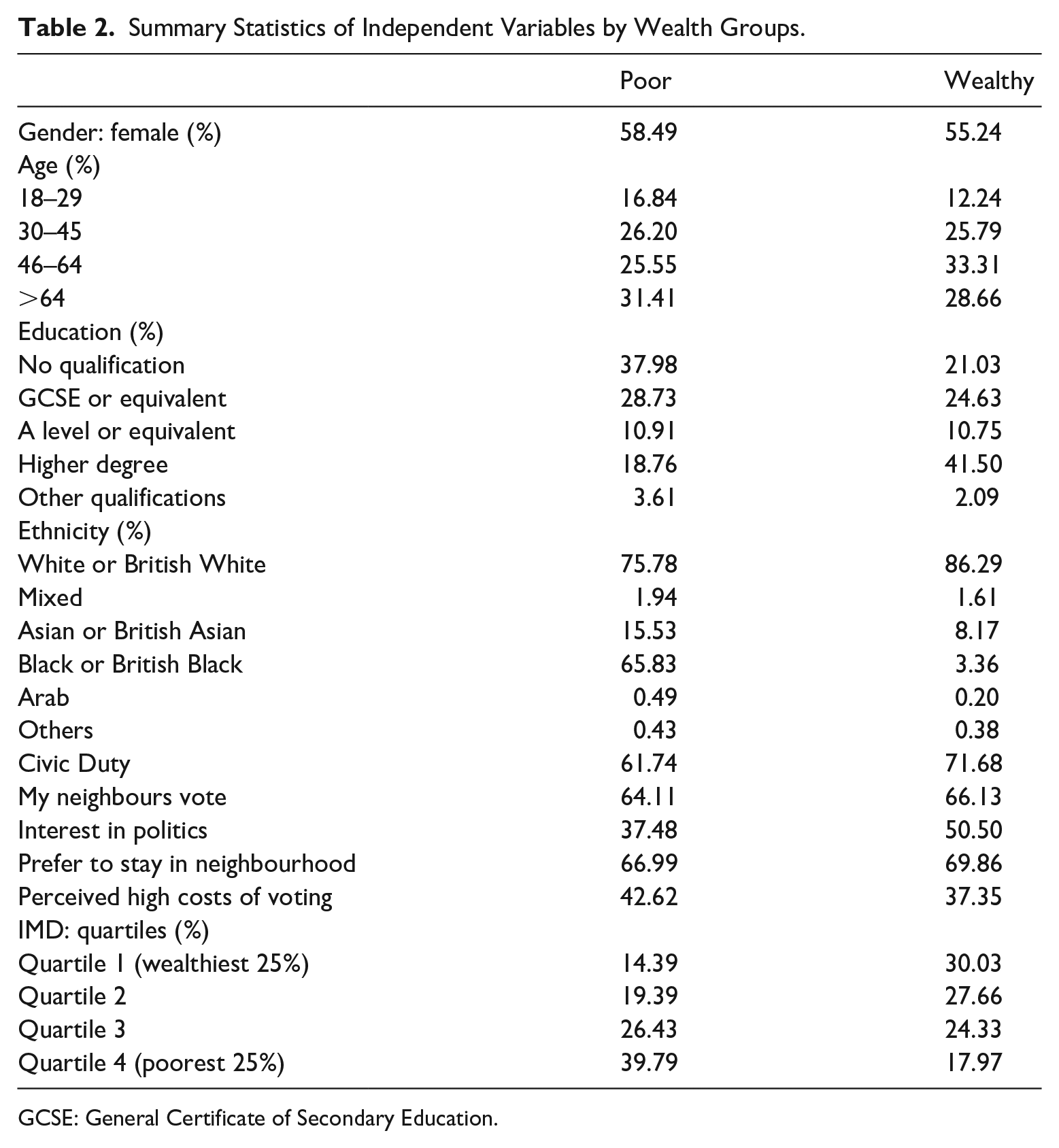
GCSE: General Certificate of Secondary Education.
Two-Level Multilevel Random Slope Models Predicting Individual Voting Intentions.
GCSE: General Certificate of Secondary Education.
Standard errors are given in parentheses. The models are calculated using STATA’s mixed command for linear multilevel regression.
p < 0.05; **p < 0.01; ***p < 0.001.
Interaction Models Predicting Individual Voting Intentions.
Standard errors are given in parentheses. The models are calculated using STATA’s mixed command for linear multilevel regression.
p < 0.05; **p < 0.01; ***p < 0.001.
I rely on the random slopes model, in which I allow the slopes for individual income to vary with respondents’ voting intentions across neighbourhoods as my basic model. 15 In M1, we see that respondents who fall under the relative poverty line in the UK report a lower voting intention than wealthier respondents in the sample. The coefficient for individual income is negative and significant in all models reported in Table 3. Low-income respondents have a lower intention to vote by approximately 6 percentage points. Consistent with ‘conventional wisdom’, the coefficient for perceptions of whether others vote within the neighbourhood is positive and highly significant (p < 0.001) in all models. The effect size in M1 shows that 9 percentage points of difference in individual voting intentions can be attributed to the social context variable – measured as the perceived voting of others in the neighbourhood. The effect of neighbourhood deprivation on voting intention is negative, which means that respondents who live in the more deprived neighbourhoods of the UK show significantly lower voting intentions.
M2 includes additional controls at the individual level. I add controls for respondents’ characteristics such as educational attainment and whether they see it as their civic duty to vote. I include these additional control variables so as to know whether they outweigh the effects of the perceived voting of others in the neighbourhood. The effect sizes of individual wealth, perceived voting of others in the neighbourhood and neighbourhood deprivation decrease but stay significant in the model.
M3–M5 report results after introducing different interaction terms between the main independent variables of interest. I control for individual-level characteristics such as gender, age and ethnicity in the models. 16 M3 reports findings after entering the same level interaction between individual wealth and the perceived voting behaviour of others living in the neighbourhood. I find that the intention to vote increases among poorer individuals when they report that most others vote in their neighbourhood (0.892 + 0.363 = 1.255). The marginal effects are reported in Figure 3.
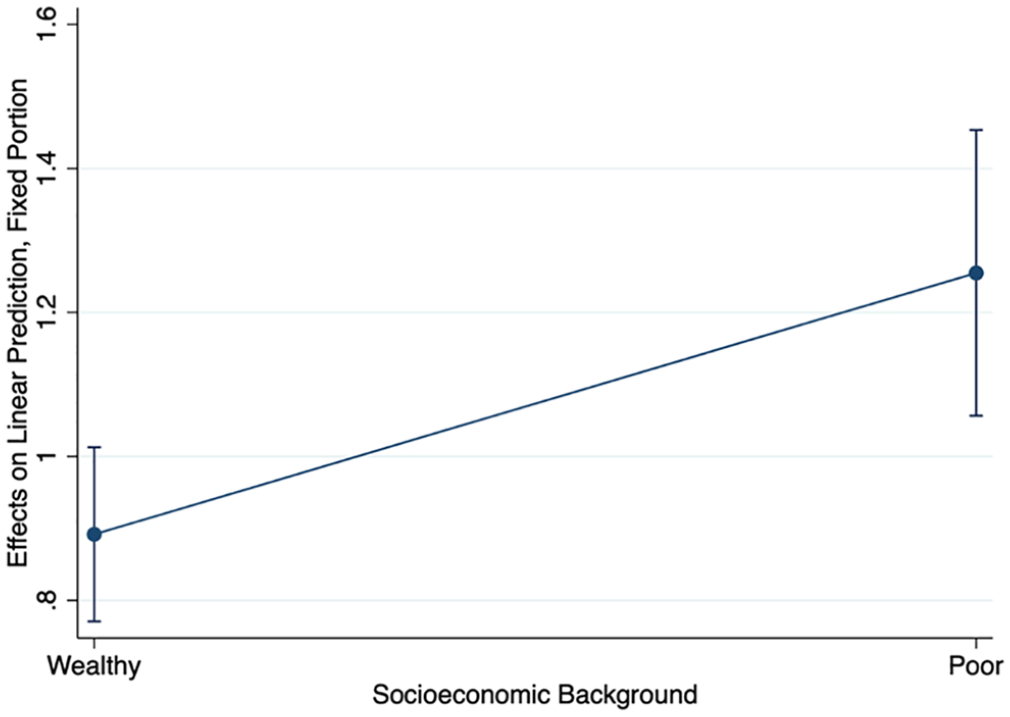
Marginal Effects of Neighbours’ Perceived Voting Behaviour on Intention to Vote for Poor and Wealthy Respondents, with 95% CIs (Model 3).
M4 includes a cross-level interaction between individual wealth (poor) and neighbourhood deprivation (IMD). The results suggest that there is a tendency for poor individuals to have a higher intention to vote when living in less affluent neighbourhoods. However, the effect is not statistically significant, that is, I do not find a significant difference for poor individuals living in either more or less deprived neighbourhoods. This becomes more evident when calculating the marginal effects that are plotted in Figure 4.
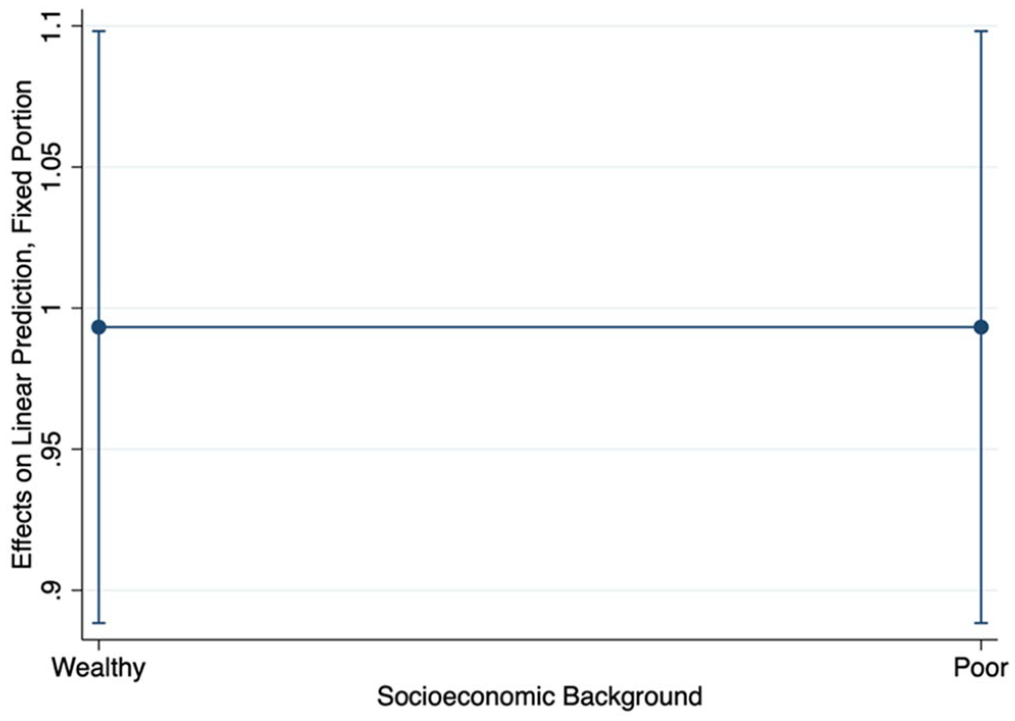
Marginal Effects of Neighbourhood Deprivation on Intention to Vote among Poor and Wealthy Individuals, with 95% CIs (Table 4, Model 4).
M5 introduces a second cross-level interaction to test whether the effect of the expected voting behaviour of others on individual voting intentions depends on the socioeconomic composition of the neighbourhood. I find that perceptions of others’ voting behaviour are positively correlated with individuals’ voting intentions in more deprived neighbourhoods. The effect is small and significant in the model. After calculating the marginal effects, I find that the estimated effect is 1.17 for respondents living in the 10% most deprived neighbourhoods versus 0.77 for respondents living in the 10% least deprived neighbourhoods. The marginal effects of neighbours’ perceived voting behaviour on individual voting intention across neighbourhoods are presented in Figure 5.
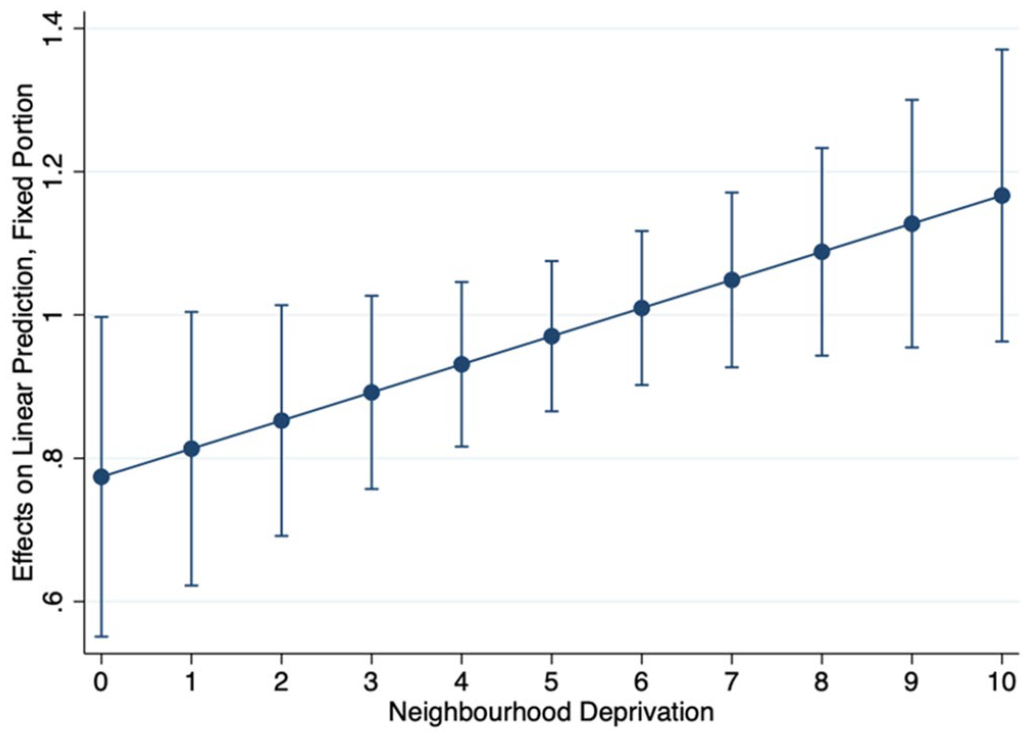
Marginal Effects of Neighbours’ Perceived Voting Behaviour on Intention to Vote across Neighbourhoods, with 95% CIs (Table 4, Model 5).
Finally, I introduce a three-way interaction to test whether the effect of the interaction between a descriptive norm of voting and neighbourhood deprivation is different for less and more affluent individuals in the sample (see Table 4, Model 6). The coefficient is positive but not significant, meaning that the effect of neighbours’ perceived voting on the individual voting intention that we have found to be higher when living in more deprived neighbourhoods does not differ significantly between poorer and wealthier respondents. Or in other words, no matter if you are poor or wealthy, when you live in a poorer neighbourhood, descriptive norms have a higher impact on intended voting. Yet, when looking at the marginal effects, I find that the effect of whether most others vote on voting intention increases more strongly with neighbourhood deprivation for the poor than for the wealthy in the sample (see Figure 6). Especially at the higher levels of neighbourhood deprivation, the difference between poor and wealthy is also significant in the model.
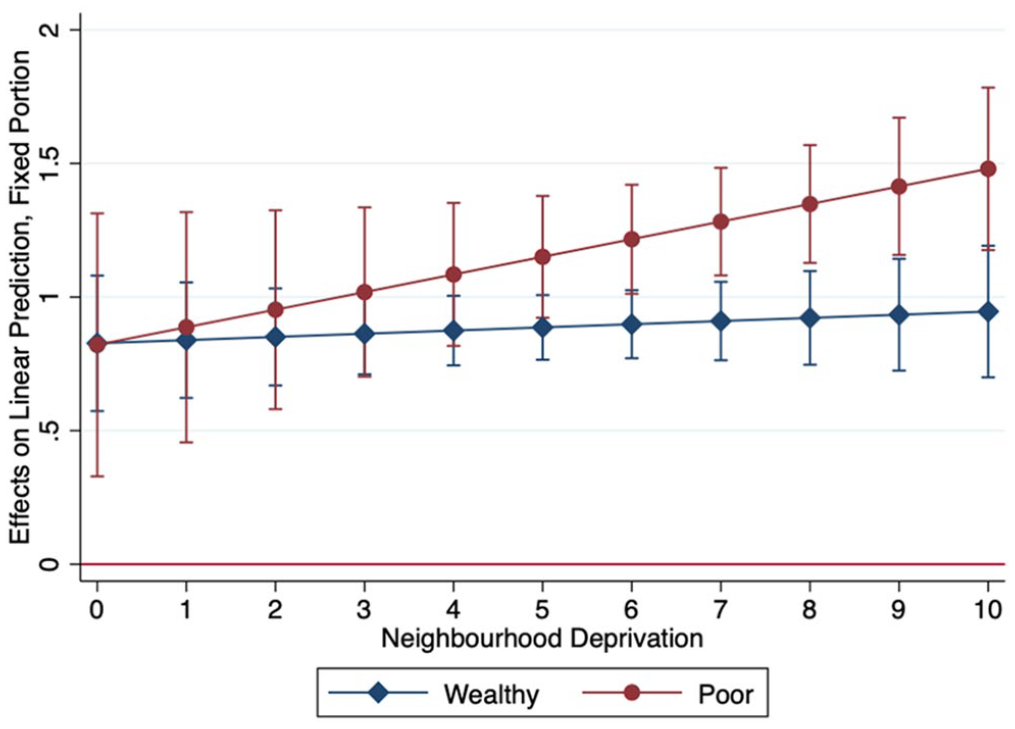
As one of my core assumptions on which my hypotheses are based, I stated that social ties should be stronger among low-income rather than high-income respondents. The idea is that poor individuals are more oriented towards others because they depend on their neighbours more frequently for help than their wealthier counterparts. Alternatively, I explained that the extensive literature on social capital suggests that social capital or generalised trust should be higher among more affluent individuals who are more likely to engage each other in sports clubs and other organisations. To test both potential mechanisms using the available data, I run mixed models using binary logistic regression analysis.
Compared with wealthier individuals, I find that poorer individuals are more likely to report that they have close-knit relations with their neighbours. This provides some initial evidence that social neighbourhood ties are indeed more important for poorer rather than wealthier individuals.
After including the interaction term, I find that, overall both high- and low-income individuals are less likely to have close-knit ties with their neighbours (Table 5, Model 7) when living in more deprived neighbourhoods (Table 5, Model 8). Yet, the negative effect is larger for the wealthy rather than the poor individuals. (Margin plots are added to the Online Appendix).
Close-Knit Neighbourhood Ties.
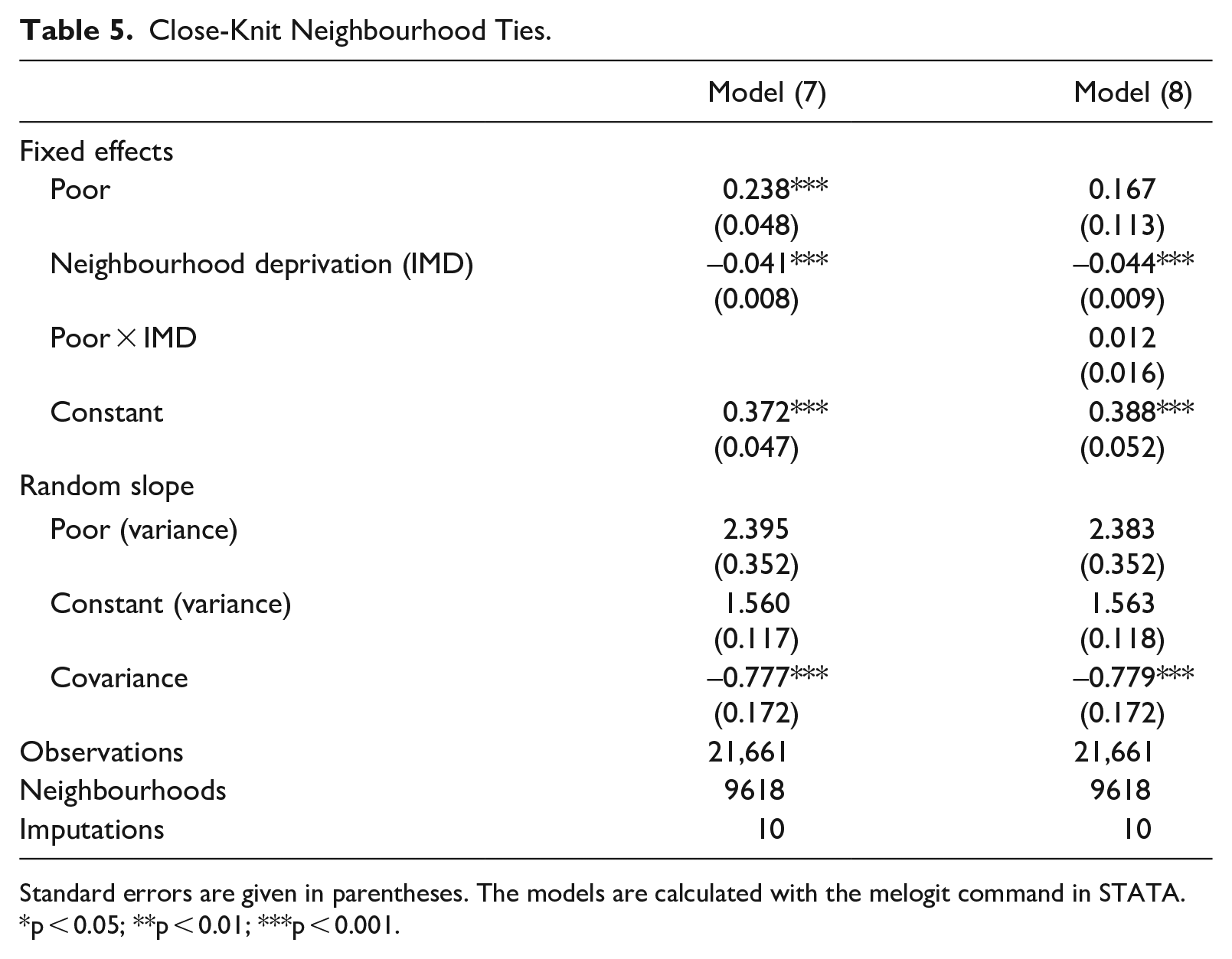
Standard errors are given in parentheses. The models are calculated with the melogit command in STATA.
p < 0.05; **p < 0.01; ***p < 0.001.
By contrast, wealthier individuals show higher levels of trust in their neighbours than poorer individuals (Table 6, Model 9). This result is in line with previous findings on social capital and generalised trust among individuals of different socioeconomic groups.
Trust in Neighbours.
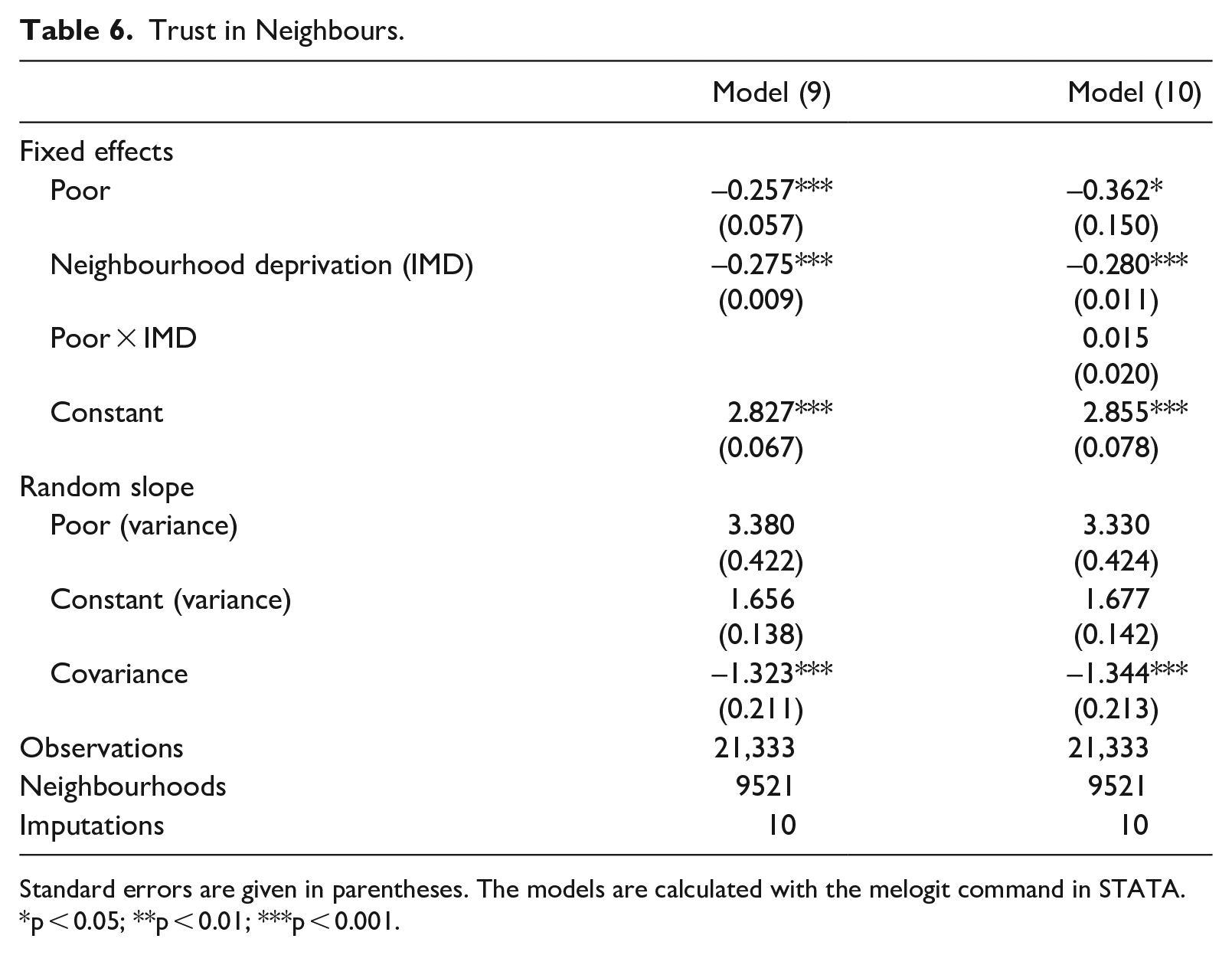
Standard errors are given in parentheses. The models are calculated with the melogit command in STATA.
p < 0.05; **p < 0.01; ***p < 0.001.
When introducing the interaction term, the sign of the coefficient changes, which indicates that, compared with wealthy individuals living in less affluent neighbourhoods, poor individuals are more likely to trust their neighbours when living in less affluent neighbourhoods. Yet the effect is not statistically significant and generally the findings show that both poorer and wealthier individuals are less trusting when living in more deprived neighbourhoods(Table 6, Model 10).
Discussion and Conclusion
My findings indicate that compared with high-income individuals, low-income individuals, in general, show lower voting intentions. Yet, when analysing the differences between poor and wealthy individuals and across neighbourhoods in more depth, the picture is revealed to be much more nuanced.
Similar to previous findings by Gerber and Rogers (2009), I find that the respondent’s perception that most neighbours vote is associated with a higher voting intention of the individual. Moreover, I show that the effect is larger for poor individuals than for wealthy individuals. In this article, I hypothesised that existing social norms and obligations affect individual behaviour, in this case, personal voting intentions, and that this differs between poor and wealthy respondents. My empirical findings indicate that there is evidence for H1 – that the effect is more substantial for poorer respondents than for more affluent respondents. Not surprisingly, I find that respondents, on average, show a lower intention to vote when living in most of the deprived neighbourhoods. Moreover, I find that wealthy individuals show higher voting intentions when living in neighbourhoods that are better off. The opposite seems to be true for poor individuals, yet, the positive coefficients are not significant in my model.
When individuals believe that others vote, then this positively affects individual voting intentions in more deprived neighbourhoods, independent of personal income. In other words, social context effects – measured in the perceived voting habits of others in the neighbourhood – are stronger for individuals living in more deprived neighbourhoods than for those living in wealthier neighbourhoods. This finding provides evidence for H2. However, the effect does not vary significantly between poor and wealthy individuals. When living in the most deprived neighbourhoods, poor and wealthy individuals seem to be equally likely to comply with social norms of voting, according to what they perceive as being the proper behaviour. Thus, based on my findings, I must reject H3.
With the data at hand it was not possible to make claims about social norms more directly. Yet, the findings already highlight the importance of social norms in the community and their varying impact on individuals from different social classes. When individuals believe that their neighbours vote, this, I argue, points to voting being considered as right and proper behaviour. Or in other words, this implies that a social norm of voting exists within the neighbourhood.
An alternative explanation could be that the Labour Party shows an increased effort in mobilising potential voters in the poor neighbourhoods. However, this still would not explain why we observe an increased effect of perceptions about others’ voting behaviour on the intention to vote among poorer voters but not among wealthier voters.
With this cross-sectional study, I also cannot account for temporal variation. For example, some have suggested a weakening of class alignment in the UK, while others show that social identities are still relevant to the individual but less so to the political parties (Andersen et al., 2006; Andersen and Heath, 2002). This may have changed the role of social norms and group identification on voting in lower class neighbourhoods and among individuals of a lower class background over time, but this cannot be explored with the existing design, and should be looked at more systematically in future work using panel data.
My results also show that poor individuals are more likely to have stronger social ties with their neighbours than wealthy individuals. However, this does not mean that they are more trusting but rather that they simply rely more frequently on their more immediate social environment. I do not find support for my assumption that social ties between poor individuals should be higher when living in poorer rather than wealthier neighbourhoods. Yet, additional research is needed to test these mechanisms more convincingly and to understand why high-income individuals are more trusting and also have weaker social ties with their neighbours than low-income individuals. An experimental research design, for example, would allow me to treat the extent to which we observe dense and less dense social ties in the community and to assign the treatment to poor and wealthy respondents randomly. The present study already points in this direction, yet requires further investigation.
Overall, these first results suggest that strengthening social obligations to comply, such as a social norm of voting, could potentially help to reduce existing inequalities in the political participation of less affluent individuals compared with wealthier individuals and between more and less disadvantaged neighbourhoods. This is particularly important in times of increasing social inequalities – strengthened again through the recent Covid-19 pandemic – and low turnout rates combined with the rise of the new populist right in many European countries. Further research is needed to understand how social norms translate into behaviour and why poorer individuals show a higher willingness to comply with their neighbours than wealthier respondents.
Research Data
sj-do-2-psx-10.1177_00323217211027480 – Supplemental material for Where Do the Less Affluent Vote? The Effect of Neighbourhood Social Context on Individual Voting Intentions in England
Supplemental material, sj-do-2-psx-10.1177_00323217211027480 for Where Do the Less Affluent Vote? The Effect of Neighbourhood Social Context on Individual Voting Intentions in England by Prisca Jöst in Political Studies
Supplemental Material
sj-docx-1-psx-10.1177_00323217211027480 – Supplemental material for Where Do the Less Affluent Vote? The Effect of Neighbourhood Social Context on Individual Voting Intentions in England
Supplemental material, sj-docx-1-psx-10.1177_00323217211027480 for Where Do the Less Affluent Vote? The Effect of Neighbourhood Social Context on Individual Voting Intentions in England by Prisca Jöst in Political Studies
Footnotes
Acknowledgements
The author would like to thank Ellen Lust, Mikael Persson, Love Christensen, Stephen Dawson, Moa Frödin Gruneau, Felix Hartmann, Ezgi Irgil, Laura Lungu and the anonymous reviewers for valuable comments and suggestions. She is grateful to the UK data service and the research team at the University of Essex for providing the data.
Availability of Data and Material
The author worked with special licence data from the Understanding Society data set that was provided by the University of Essex. Interested researchers can apply for the special licence version of the data set, which entails information on the Lower Layer Super Output Areas (LSOAs) from the 2010 census on the website of the UK data service (https://ukdataservice.ac.uk). The author is not allowed to share the special licence data. Data from the Index of Multiple Deprivation (2015) are available online (open access):  (24 November 2020).
Code Availability
The STATA do-file for the analysis will be provided together with the supplementary information in the Online Appendix.
Declaration of Conflicting Interests
The author(s) declared no potential conflicts of interest with respect to the research, authorship and/or publication of this article.
Funding
The author(s) disclosed receipt of the following financial support for the research, authorship and/or publication of this article: This work was supported by the Swedish Research Council (Recruitment Grant, Grant number: E0003801).
Supplementary Information
Additional Supplementary Information may be found with the online version of this article.
A. Supplementary Analysis to Main Models
B. Robustness Checks
C. Models using Aggregated Data
Notes
Author Biography
References
Supplementary Material
Please find the following supplemental material available below.
For Open Access articles published under a Creative Commons License, all supplemental material carries the same license as the article it is associated with.
For non-Open Access articles published, all supplemental material carries a non-exclusive license, and permission requests for re-use of supplemental material or any part of supplemental material shall be sent directly to the copyright owner as specified in the copyright notice associated with the article.
