




Abstract
The European Union is increasingly shaped by emergency politics as a mode of rule. Other than the state of exception in domestic constitutions, emergency politics at the European level is largely unregulated—with important negative effects for the integrity and normative quality of the European Union’s legal and political order. This article discusses whether and how a European-level emergency constitution could dampen the costs to constitutionalism by formally pre-regulating the assumption and exercise of emergency powers in the European Union. It proposes design principles that a European emergency constitution would need to meet in order to be desirable. They include prescriptions on who should declare an emergency and who should wield emergency authority up to what constitutional limit. While a European emergency constitution could theoretically alleviate some of the normative concerns about emergency politics, it is plagued by issues of implementation that only a fundamental constitutional overhaul of the European Union could address.
Introduction
The euro crisis revealed a profound democratic predicament in the contemporary state of European integration. On the one hand, processes of economic, political, and social integration have created a political order marked by complex and often self-reinforcing interdependencies. That is, decisions to integrate a policy field and delegate political authority to an institution of the European Union (EU) often set in motion interactive processes that require further EU-level regulation or intervention (see Hale et al., 2013). On the other hand, however, the process of European integration and the increasingly expansive political authority enjoyed by EU institutions also increased the politicization of the EU in general and of authority transfers in particular, rendering further integration more and more difficult (Hooghe and Marks, 2009). In the early 2010s, functional pressures demanded fiscal integration to attend the common currency, yet pathways of formal constitutional change to introduce such capacities were largely blocked by the constraining dissensus among European publics (see also Börzel and Risse, 2018).
In the case of the euro crisis, this impasse was overcome only by way of emergency politics, a mode of rule in which extraordinary acts of authority that break with established norms and rules are justified as necessary to cope with exceptional circumstances (see White, 2015b: 302–303). Concretely, in order to fill the functional gaps in the EU’s authority structure, European decision-makers sought to circumvent public dissent and legal hurdles by resorting to emergency measures outside the legal framework of the EU, by foisting off most delicate political interventions to the politically independent—and democratically unchecked—European Central Bank (ECB), and by resorting to a politics of domination vis-à-vis weaker member states in need of financial support (Joerges, 2014; Lokdam, 2020; Scicluna, 2018; White, 2015b).
Such forms of exceptionalism have increasingly taken hold in the governance repertoire of the EU and its member states, extending well beyond the euro crisis. The migration crisis, for instance, saw the exceptional empowerment of Frontex/the European Border and Coast Guard to conduct extra-legal pushback operations on the Mediterranean and at land borders. It also gave rise to the circumvention of European constitutional constraints by involving NATO and delegating the implementation of contentious policies to Turkey and Libya (White, 2019: 81–82). During the coronavirus crisis, European emergency politics reemerged. The multilateral emergency structures created in the euro crisis, such as the European Stability Mechanism (ESM), the reliance on the informal Eurogroup, and recourse to emergency summitry, were reactivated. Moreover, the health crisis incited the ECB to establish the Pandemic Emergency Purchase Program (PEPP), the latest reinforcement of the bank’s exceptional role of lender of last resort to Eurozone sovereigns. And finally, the economic recovery fund, explicitly introduced as an “exceptional measure,” 1 broke with a foundational norm of the Economic and Currency Union by incurring communalized debt.
Emergency politics is nothing new in itself. In the nation-state context, it has been discussed for centuries as part of debates about the state of exception or state of emergency (e.g. Gross and Ní Aoláin, 2006). In settings beyond the state, however, emergency politics takes on peculiar forms with distinctive consequences. One important difference is that supranational political orders largely fail to recognize and accommodate the emergency problematique institutionally. While domestic constitutions typically include concrete emergency provisions, there are hardly any rules governing emergency conduct in the EU or other international organizations (IOs)—and where there are, they hardly follow the regulative ideal of emergency powers (Kreuder-Sonnen, 2019: 198; Schott, 2008). The transnational politics of emergency is largely unregulated. As I argue in this article, the unregulated nature of European emergency politics is prone to creating considerable short- and long-term costs to democracy and constitutionalism. Not only does unregulated emergency politics open the door to the exercise of unchecked power, it is also likely to leave permanent marks on the EU’s authority structures that undermine its democratic legitimacy.
The COVID-19 pandemic underscores that transboundary crises may require collaborative solutions at the global and European levels that defy the application of conventional rules and procedures. Future crises are no less likely to demand EU-wide responses that are hard to reconcile with the polity’s partial integration. If a transnational politics of exceptionalism thus seems almost inevitable, it is pressing to ask how to contain the normative costs of emergency rule in Europe (see also van ’t Klooster, 2018). A quarter of a century after Dieter Grimm and Jürgen Habermas debated whether Europe needed a constitution (Grimm, 1995; Habermas, 1995), the long decade of European crises prompts a new question of legal order: Does Europe need an emergency constitution? An emergency constitution can be conceived as a constitution’s chapter detailing the polity’s governing mode in times of crisis. It contains the legal rules for constituting and constraining emergency powers, that is, it specifies the procedures to declare an emergency and vest special powers in the executive to contain the emergency, and it specifies the scope and reach of the emergency powers, including the means to keep them in check (e.g. Ferejohn and Pasquino, 2004). The normative appeal of an emergency constitution strongly depends on its design. In order to commit the EU to emergency rule that effectively abides by the standard of proportionality, I propose four key design principles for a European emergency constitution and explore their practical meaning in the EU’s current institutional setup. They pertain to the locus of final authority, procedures of delegation and revocation, the identification of non-derogable rights, and the role of courts.
The article is organized as follows. The first section describes the nature and consequences of unregulated emergency politics in Europe, using the euro crisis as an illustration. It analyzes the normative and empirical implications of the de facto emergency regime that give rise to a demand for regulating European emergency politics. The section “Regulating Europe’s Emergency Politics” therefore studies the option of an emergency constitution for the EU. Building on political theories of emergency powers, it lays out a normative framework and derives four core principles for the design of a European emergency constitution. These principles are each discussed with a view to their institutional implications in the current setup of the EU. In theory, a well-designed European emergency constitution could alleviate some of the normative costs of unregulated emergency politics by providing transparency, legal certainty, as well as judicial and political constraints and correctives to otherwise exceptional measures. However, as discussed in the section “Obstacles to Realizing a European Emergency Constitution,” some empirical preconditions for realizing a European emergency constitution do not seem presently given. Therefore, the conclusion derives several behavioral prescriptions from the ideal emergency constitution that actors could implement without constitutional change to ameliorate the consequences of exceptionalism in the EU.
Unregulated Emergency Politics in Europe
In the political order of the EU, the notion of emergency powers is not enshrined as a regulative ideal to cope with crises. With political authority being diffused across multiple levels of governance and shared between intergovernmental and supranational bodies, the EU is still far from resembling the hierarchically integrated state structures where constitutional provisions to accommodate emergency powers are commonplace. It is thus hardly surprising that decision-makers long overlooked the possible necessity to revert to emergency politics. After all, the “euro crisis was the first crisis of EU integration to really uncover the tensions between the democratic incentives in national politics and the institutional logic and non-democratic demands for quick decisions required to successfully run a supranational currency union” (Parsons and Matthijs, 2015: 225–226). As it happened, the EU thus had no institutional mechanisms in place to deal with the severe crisis it was facing.
As a consequence, the European crisis response took a form of emergency politics characteristic for polities beyond the nation-state (cf. Kreuder-Sonnen, 2019: 38–43; White, 2015a, 2019). Five features stand out in particular:
Self-empowerment: In the absence of rules governing the determination of an emergency and the conferral of emergency powers, the expansion of executive discretion in contravention of existing norms and rules comes about by way of executive self-empowerment. This is visible in the ECB’s authority leap to become a lender of last resort for sovereigns in the eurozone and to demand austere fiscal policies at the domestic level in return (Scicluna and Auer, 2019). But it also counts for the collective enterprise of creating emergency credit facilities such as the European Financial Stability Facility (EFSF) and the ESM in circumvention of the no-bailout clause (Art. 125(1) TFEU). Absent any legal framework to guide emergency empowerment, the process was inherently political and marked by power struggles among member states fighting over the distribution of costs and benefits (Schimmelfennig, 2015). As they were presented as alternativlos (without alternative) domestically, executive self-empowerment went to the detriment of parliamentary control, in general, and of parliaments in southern recipient states, in particular (Crum, 2013).
Rule circumvention: In the absence of constitutional pathways to swiftly adapt institutions and legal rules to fit the exigencies of a crisis situation, the context of international law allows member states to create alternative institutions that may conflict with the norms and rules of the original institution (Morse and Keohane, 2014). Careful not to open flanks to critics in terms of blatantly breaking existing rules, decision-makers may thus choose to circumvent legal norms by shifting to and channeling activities through alternative institutions. The creation of the EFSF and the ESM outside the legal framework of the EU and the establishment of the Fiscal Compact as a separate treaty under international law are examples of this practice in the context of the euro crisis (Tomkin, 2013). The shift outside the constitutional bounds of the European Treaties allowed member states much greater executive leeway at the expense of democratic accountability and judicial oversight (Dawson, 2015). Not only did they implement measures that were legally questionable under EU law, but they also prevented democratic participation in the process of rule change (with lower ratification requirements for international treaties than EU Treaty amendments) and escaped review by the European judiciary that does not have jurisdiction outside the EU Treaties.
Rule bending: A complementary strategy to conceal departures from legal norms in times of crisis is the open or clandestine reinterpretation of rules (Schmidt, 2016). As a matter of regularity, European authority-holders presented their measures as exceptional responses to exceptional threats (White, 2015a), but at the same time claimed that they were perfectly legal and fell within the scope of their competence. The best-known example is ECB President Draghi’s announcement to do “whatever it takes” to save the euro—factually rendering the Bank the lender of last resort to Eurozone governments in 2012—while asserting that this was “within our mandate.” Subscribing to that notion, however, implied a fundamental reinterpretation of that mandate by the ECB itself. When entering office, Draghi initially saw a need to end even the limited bond-buying programs initiated by his predecessor in order not to “circumvent the spirit of the Treaty.” 2 A year later, he turned around 180 degrees and announced the unlimited and indefinite Outright Monetary Transactions (OMT) program, arguing that it was covered by the ECB mandate to guarantee price stability. One supportive claim was that the bond purchasing programs “should not be confused with quantitative easing.” 3 Another 3 years later, however, in 2015, the bank in fact announced a new expanded asset purchase program that undisputedly was precisely that: quantitative easing (Schmidt, 2016). Hence, in the course of the crisis, the rules governing ECB authority have been changed considerably through expedient reinterpretations that factually accorded the bank more and more discretion.
Domination: In the absence of constitutional regulations constraining the reach and intrusiveness of emergency powers, exceptionalism opens the door to the exercise of domination. Particularly if backed by the interests of powerful states, emergency politics of IOs may be directed against weaker states and their societies and impose authority or rule that is arbitrary from the perspective of the addressees (see Eriksen, 2018). That is, their rights as political equals are suspended. Both sovereignty rights of states and the liberal or republican rights of individuals in those states may be compromised. Operations by the Troika during the euro crisis are emblematic for this type of problem in the context of European emergency politics. Entrusted with the task to enforce the political will of the creditor toward the debtor states, the Troika issued detailed reform lists to countries such as Greece, Portugal, and Spain for politically salient issue areas. Given their dependence on the financial aid administered by the Troika, these states could hardly refuse the demands and were thus factually stripped off their fiscal sovereignty and budgetary autonomy (Dawson and de Witte, 2013: 825). As Christian Joerges (2014: 34) concludes, “[t]his exercise of authority is neither based upon democratic process, nor upon an exchange of reasons among = this is an authoritarian type of rule characterized by the kind of decision-making which Carl Schmitt foresaw and asked for in a state of emergency.”
Judicial deference: Given the recurrent extra-legality of emergency powers beyond the state, courts are put in a near to impossible situation when asked to adjudicate on the legality of emergency measures. With no legal regime constituting and constraining extraordinary powers, courts are put between a rock and a hard place. If they stick to the letter of the law and rule the emergency powers unconstitutional, they may contribute to a deterioration of the threat or crisis that the emergency powers were intended to avert. On the contrary, if they rubber-stamp the self-empowerment as legal, they constitutionalize the new authority permanently, including its authoritarian baggage (Suntrup, 2018). In the European case, the Court of Justice of the EU (CJEU) was drawn onto the scene at a time when the crisis was at its peak. Both its landmark judgments in Pringle, regarding the legality of the ESM, and in Gauweiler, regarding the legality of the OMT program, were handed down under severe pressure from states and market actors, who warned that annulments by the Court would have catastrophic consequences. In both situations, the CJEU deferred to the rationale of necessity and accepted the legal reinterpretations of the authority-holders (Joerges, 2016; Kreuder-Sonnen, 2019: 133-135, 148-150; Lokdam, 2020). As a consequence, it contributed to the legal normalization of originally exceptional powers.
Arguably, the substance of several emergency measures adopted during the euro crisis created beneficial outputs that eventually secured the survival of the eurozone. However, the completely unregulated framework in which this took place also created high costs to constitutionalism. Over time, these increased even further because the discretionary measures adopted during the crisis left a lasting authoritarian imprint on the EU’s authority structures. First, the executive self-empowerment by European authority-holders effectuated constitutional change without acquiring appropriate ex ante or ex post democratic legitimation. Constituted powers “usurped” the role of the constituent power (see Patberg, 2018) and thus subverted the basic premises of a democratic political order. Second, the judicial accommodation or constitutionalization of extra-legal emergency powers has transformed exceptional discretion into permanent discretion. While the court formally legalized the exceptional practice, this did not change the authoritarian substance of that practice. Rather, the practice changed the substance of the law by reducing its liberal content—a phenomenon that Diab (2015: 86–93) calls the creation of “authoritarian legality.”
One main implication of this development in the long run is that it adds fuel to the flames of the communitarian backlash against international authority. Arguably, the recent wave of nationalist populism afflicting European societies stands in a mutually reinforcing relationship with unregulated emergency politics (Kreuder-Sonnen, 2018): Since populists feed on the image of distant and unaccountable elites, the non-transparent and undemocratic exercise of discretionary authority plays into their hands (Schmidt, 2020; White, 2019). The authoritarian bent of unregulated emergency politics thus helps their rise. Conversely, growing populist delegitimation of European integration puts greater and greater strains on the possibility to achieve further integration on constitutionally sound paths. Under functional pressures for more integration and “post-functional” barriers to this integration, authority transfers are likely to incite more unregulated emergency politics to circumvent democratic dissent as soon as another crisis appears. From a constitutionalist perspective, evading such a vicious cycle therefore seems of utmost importance.
Regulating Europe’s Emergency Politics
Crises may defy normally applicable norms of democratic procedure and constitutional order. Yet that does not mean that the resulting emergency regime must operate completely outside the law or possess unconstrained authority. It is the signature feature of “accommodation models” of emergency conduct that measures may go beyond constitutional normalcy but remain at least formally within the ambit of constitutional provisions. 4 That is, the constitution actively allows for a derogation from normally protected legal goods and the conferral of special emergency powers (Gross, 2003: 1058–1069; Gross and Ní Aoláin, 2006: 35–79). The normative appeal of accommodation lies in the aspiration to keep the exception within the realm of the law by legally pre-regulating emergency action of government and to reduce its costs to constitutionalism by setting substantive and procedural limits for the exercise of emergency rule. In this section, I will discuss this idea in greater detail. In a first step, I introduce the concept of the emergency constitution and sketch the theoretical and empirical range of possible embodiments. Second, I propose the normative standard of proportionality as aspirational for emergency conduct and derive four basic principles to guide the design of a European emergency constitution in this spirit.
Emergency Constitutions—Ideas and Models
In general terms, the state of exception or state of emergency can be understood as a legal institution regulating the suspension of (certain provisions of) the normally applying constitutional order—the state of normalcy. In theory, the state of emergency is triggered by an emergency situation—an exceptional threat to the state that requires an exceptional response. The central characteristic of this response is the assumption of emergency powers, typically by the executive branch of government that may change both the power relations among legislative, judicial, and executive bodies and the relations between government and the rule-addressees. A state’s capacity to react to an existential crisis shall be increased by allowing for more executive discretion at the expense of individual rights protection and a strict separation of powers (Heymann, 2003: 4–6). The set of legal rules—typically contained in a special chapter of the constitution—that govern the state of emergency is referred to as an emergency constitution (Ackerman, 2004). A fully fledged emergency constitution should provide answers to most of the following questions (Ferejohn and Pasquino, 2004: 230, n. 50): Who decides that an emergency exists and what is to be done about it? Who is entrusted with the exercise of emergency powers? What are the legal limits to the reach and intrusiveness of emergency powers? Who may review and control the exercise of emergency powers based on these legal limits? What are the procedures to terminate an emergency and restore constitutional normalcy?
At the domestic level, states have chosen very different approaches to regulate their government’s emergency powers (Gross and Ní Aoláin, 2006). The German Basic Law, for instance, has carved out a relatively small realm of extraordinary powers for emergency situations. Most notably, with a two-thirds majority, parliament can declare a state of defense that entails an accrual of powers for the chancellor (e.g. direct command over the armed forces), accelerated legislative procedures, and somewhat lower protections of a select number of individual rights (e.g. detention, expropriation) (Erkens, 2017). It ends as soon as a simple majority in parliament declares the state of defense to be over. By contrast, the US Constitution does not include specific emergency provisions. Emergency powers of the President are instead based on an interpretation of implied powers and statutory delegation (Scheppele, 2006). The 1976 National Emergencies Act is the most comprehensive piece of legislation formalizing presidential emergency powers. It entrusts the president with an extensive amount of discretion to declare emergencies and to adopt measures to confront it (Goitein, 2019).
Similarly, normative theories of emergency powers—while all agreeing that some level of deviation from the constitutional baseline might be unavoidable in times of crisis—vary enormously with regard to the degree of disruption that is advocated (see Scheuerman, 2006).
At one end of the continuum are liberal constitutionalist approaches that see emergency powers as a necessary albeit generally unwanted tool of last resort which they seek to keep at bay as far as possible (Ackerman, 2004; Dyzenhaus, 2006; Ferejohn and Pasquino, 2004; Rossiter, 1948; Stone, 2004; Tushnet, 2005). Bruce Ackerman’s (2004) proposal for a terrorism-related emergency constitution in the US is illustrative in this regard: While acknowledging that unilateral acts of the executive can be necessary as an immediate emergency response and that some civil liberties might be restricted when facing terrorist threats, he constructs a dense web of checks and balances to contain emergency powers from the start. At the heart of this proposal is a “supermajoritarian escalator” that enables parliament to end a state of emergency more easily the longer it continues and at the same time deters the executive (dependent on parliamentary approval) from taking measures too strongly encroaching upon civil liberties (Ackerman, 2004: 1045–1056).
At the other end of the spectrum are political realist approaches that see discretionary emergency powers in the hands of the executive as necessary for the state’s survival in the face of extraordinary threats. Their concern is not so much with the excess or perpetuation of executive discretion, but rather with the obstacles posed by constitutional norms and democratic politics for swift and effective emergency reactions. Carl Schmitt is probably the most radical proponent of what has been termed “exceptional absolutism” (McCormick, 2004: 204): the basically unlimited discretion and dictatorial power of the executive to decide on the exception (Schmitt, [1922] 2005). But also contemporary constitutional theorists still find appeal in mostly unbound executive discretion in times of crisis (see Posner and Vermeule, 2007).
These extremes represent the tension between the two main goals inscribed into the regulative ideal of emergency powers, namely, political discretion and constitutional containment: on the one hand, the state of exception is meant to allow for a larger executive room for maneuver to be able to effectively counter existential threats that defy the application of normally valid rules and procedures. On the other hand, exceptional powers are seen to be legitimate only for very specific purposes and under specific conditions. Given the inherent danger in unregulated sovereign power, their commitment to such purposes and conditions needs to be secured by way of legal and institutional arrangements checking the emergency powers. The trick obviously lies in balancing these two goals so as to neither inhibit an effective crisis response nor infringe excessively on liberal and republican rights. As a consequence, the main goal of an emergency constitution should be to find rules and procedures allowing for an extraordinary amount of executive discretion, but at the same time binding executive power to standards of proportionality.
How to Design a European Emergency Constitution
If we accept that political responses to extraordinary threats and challenges may require deviations from the normally applicable legal framework, the standard of proportionality provides normative guidelines to commit those responses to the goal of incurring the lowest possible costs to constitutionalism. In (international) law, proportionality is the main standard applied to assess all kinds of trade-offs, deviations, and derogations from the norm (Peters, 2017). Its intrinsic logic is to allow certain actions only if and so long as the means–end relationship is positive-sum. In zero- or negative-sum constellations, that is, when the costs outweigh the benefits, actions are disproportionate. The standard of proportionality thus provides a normative point of entry to the problem of aligning the simultaneous goals of enabling and constraining emergency political action in times of crisis. As was recently argued, for exceptional measures to be considered proportionate, they would need to be necessary, appropriate, and functional (Kreuder-Sonnen, 2019: 61–63): First, emergency measures deviating from the normal legal framework need to be an ultima ratio. Only if, in face of a severe crisis, the goal of preserving security and political order cannot or no longer be reached by normal means may the executive resort to exceptional measures—and may do so only for the period of time in which this condition applies. Second, the intrusions into the rights of the rule-addressees effectuated by emergency measures may not go beyond what can reasonably be justified as appropriate to confront the problem. In other words, derogations may not be excessive. Third, the emergency measures must show some likelihood of success. That is, if the adopted policy is not at least potentially apt to remedy the issue (or certain aspects of it) underlying the crisis, the constitutional costs would be disproportionate.
The question is how an emergency constitution could be designed in order to best realize these normative guidelines in the context of the EU. In the following, I propose four basic design principles to approach this goal and discuss their practical implications for the EU’s authority structures.
Principle 1: Place the authority to decide on the existence of an emergency (A1) and the authority to decide on the measures to overcome it (A2) in different organs. A1 should be held by a representative body and decided by qualified majority. A2 should be held by an executive organ.
As was already known in the ancient Roman Republic (Rossiter, 1948), the first and foremost measure to prevent abuse of emergency powers and to increase the likelihood of their proportionate exercise is to separate the authority to determine the existence of an emergency (A1) from the authority to wield discretionary power to confront the emergency (A2). Given the increased freedom of action and the additional competencies that executives acquire during states of emergency, there is a clear danger of self-interested or misguided “false positives” in the determination of such states if the proclamation is left to the wielders of emergency powers themselves. The declaration of a state of emergency has potentially far-reaching consequences not only for the constitutional structures in a given polity, but also and especially for political autonomy of the rule-addressees. In order to legitimize such a rupture, it seems therefore necessary to tie the authorization back to democratic institutions as much as possible. A1 should therefore rest in the hands of an inclusive representative body. Moreover, it should be able to exercise A1 only on the basis of a qualified majority that ensures broader than governing coalitions’ support for the determination that an emergency actually exists.
Which European institutions should play which role in an emergency would depend mostly on the executive agent to be empowered. If the scenario is about delegating emergency powers to supranational executives such as the ECB, the Commission, or the European Center for Disease Prevention and Control, both Council and European Parliament (EP) could claim the democratic credentials to assume the authority to declare an emergency and thus confer special powers. Co-decision might provide the soundest basis for the delegation of emergency powers. However, it would also run the risk of fueling the main counter-argument to Principle 1, namely that making the declaration of an emergency subject to democratic deliberation could lead to dangerously long delays in the management of crises and even to potentially fatal “false negatives” in the determination of emergencies (Posner and Vermeule, 2007). Therefore, the most convincing candidate to hold A1 in this scenario is the Council as a body whose representatives are not only (indirectly) linked to domestic electorates, but also combine the intelligence of all national executives and can thus be expected to move more swiftly in the face of impending crisis. In order to address the danger of domination by one group of states over another, the majority requirement for the declaration of an emergency would need to allow less powerful states to amass a blocking minority, short of unanimity.
While the EP would thus take second rank at the moment of activating the emergency constitution, its role in monitoring and potentially rescinding emergency powers should be all the more important (see Principle 2 below). The one constellation where this setup would need to be altered is when the scenario is about delegating emergency powers not to supranational executives but to the Council—or any of its subgroupings—itself. Looking at exceptional measures adopted by the Eurogroup or the exercise of authority through institutions like the EFSF that are the Council but with a different “hat,” it is conceivable that a European emergency constitution might also reserve some exceptional discretion to the Council acting as a collective executive. In this case, the EP would need to be the one declaring the emergency and thus granting extra authority to the council in order to prevent self-empowerment.
The most important benefit of implementing Principle 1 would be to introduce a legal and transparent procedure for the activation of emergency rule. It would provide a clear separation between normal politics and the state of emergency and, by clearly allocating responsibility, allow constituents to hold decision-makers to account. The risk of both self-empowerment and delegation to eschew political blame would be reduced.
Principle 2: Place persistence of emergency powers under reserve of continued acceptance by a representative body; require periodic renewal with increasing majority thresholds over time.
Two major threats to the proportionality of emergency powers are excessive intrusiveness and excessive duration. Excessive intrusiveness refers to executive overreach that fails to meet the standard of appropriateness. This standard is violated if a policy goal could have been reached with a less intrusive measure than the one adopted. Excessive duration refers to the persistence of emergency powers beyond the period in which they are acutely necessary to cope with an ongoing crisis. It is thus about the separation of emergency powers from the empirical circumstances that gave rise to their creation. The most promising avenue to keep both problems of excess at bay is to place the persistence of emergency powers under the reserve of their continuous acceptance by a representative body (Ackerman, 2004). The effect would be that those actors who wish to extend the conditional grant of authority would need to convince a majority of representatives of the necessity, appropriateness, and functionality of the measures. Ceteris paribus, this should increase the likelihood that emergency powers functionally correspond to external crisis conditions and all less intrusive means have been exhausted. The odds are increased in particular by reviewing emergency powers periodically after their initial adoption. Initial emergency declarations often coincide with acute moments of threat and uncertainty in which legislators and the broader public tend to defer to the judgment of the executive and accept greater executive discretion (Dyzenhaus, 2006: 72). Revisiting the initial decision with the benefit of hindsight and under less tumultuous circumstances makes sure that emergency empowerments are not (or at least do not remain) the result of fearful acquiescence to unsubstantiated arguments of security and necessity. Moreover, it ensures continuous oversight and transparency in the exercise of emergency powers. If the body or bodies enjoying A2 wish to have their exceptional powers prolonged, they will have to provide the information that the representatives demand. Finally, this system increases the likelihood that emergency powers are rescinded and the status quo ante reinstated at some point. It thus reduces the risk of an indefinite extension of emergency powers.
In domestic emergency constitutions, the authority to declare an emergency (A1) and thus grant exceptional discretion to government is typically held by the same body that also has the authority to revoke emergency powers (A3) (i.e. Parliament). This is a sensible approach as parliaments conferring emergency powers to the executive disempower themselves almost by implication—and thus have an intrinsic motivation to keep the extraordinary grant of authority as short and shallow as possible. At the EU level, it might be necessary to split A1 and A3, however. As argued above, it makes sense to entrust the Council with A1 that is time-sensitive (in most instances), but it is questionable whether it would also be the best entity to hold A3. Different from domestic parliaments, the Council’s delegation of emergency powers to supranational actors does hardly serve to disempower it. Quite to the contrary, we have seen in past instances of European emergency politics how the Council used the tool of delegation to have policies enacted on its behalf. Arguably, here, the powers of principal and agent grew in tandem. We thus cannot unequivocally assume that the Council has a self-interested motivation to constrain emergency powers. Therefore, the better option is to entrust the EP with A3 in all instances of emergencies declared by either the Council or the EP (see above). Because the EP stands to lose immediate policy control under virtually all circumstances during emergencies, its members should be eager to closely monitor and constrain the exercise of A2.
An additional procedural twist to increase protection from excessive duration and especially excessive intrusiveness lies in premising the periodical renewals of the emergency regime on increasing majority requirements over time—the so-called supermajoritarian escalator (Ackerman, 2004). By making the continuation of emergency powers dependent on the agreement by a growing majority of representatives, emergency powers are not only unlikely to extend beyond the duration of the crisis that has made them necessary, they are also unlikely to be overly intrusive. The requirement to convince ever greater numbers of representatives disincentivizes executive excess. Most importantly, it also progressively reduces the likelihood that emergency measures disproportionately target weaker subjects and underrepresented minorities whose rights the majority may be willing to sacrifice (Stone, 2004: 531). The prospect of requiring also the consent of minorities could deter the holders of A2 from discriminatory emergency measures.
Principle 3: Define a list of non-derogable individual and collective rights. Define areas of exclusive competence to subsidiary levels of governance that are not to be encroached upon by emergency measures.
An additional layer of protection from executive excess in times of emergency consists in the codification of absolute legal boundaries for the reach and intrusiveness of emergency powers. While one purpose of an emergency constitution certainly is to allow for political measures that do not normally fall within the remit of executive authority (thus widening discretion), another purpose is to define final limits even for these exceptional measures (thus delimiting discretion). Apart from an institutional system of checks and balances that is to tie emergency powers to the principle of proportionality politically, the delimiting function is also served by way of legal obligation. Principle 3 works on the assumption that there are legal goods that should be excluded from the reach of emergency powers because of their character as representing “absolute” rights in the view of the affected community. It is assumed that measures encroaching upon these rights cannot be proportionate due to the absolute value accorded to them. According to this principle, the International Covenant for Civil and Political Rights (ICCPR), for example, sets out a number of rights from which states can never derogate, even in times of public emergency (Art. 4 ICCPR). These include, but are not limited to, the right to life, the prohibition of torture, the prohibition of slavery, and the principle of legality in criminal law.
Without ambition to lay out a full list of non-derogable rights to be included in a European emergency constitution here, the specific character of the EU as an IO still allows for a few more general observations. While the EU is the IO with the highest level of political authority worldwide, compared to states, it is still lagging far behind—most importantly, in terms of capacity and enforcement (Genschel and Jachtenfuchs, 2014). It would thus be unwise to model rules for the EU on the domestic example where limits are imposed on democratic governments with the monopoly on the use of force. The constraints on supranational authority should be much more far-reaching. Given the limited reservoir of democratic legitimacy at the EU’s disposal, its authority is already precarious in normal times. Expansions during an emergency should thus be extremely limited in their intrusions on the rights of the rule-addressees—both states and individuals. While it might be proportionate to grant a number of new executive functions or additional tasks to EU agencies that do not normally fall within the scope of their authority, it is hard to see, for example, how an encroachment on individual rights by EU actors could be justified. With the exception of the right to free movement (Art. 45), 5 the entire Charter of Fundamental Rights that includes economic and social rights could be declared non-derogable for EU emergency powers. A further line would need to be drawn with regard to the sovereignty rights of member states. While the problem of domination should be limited by supermajority requirements and other institutional provisions mentioned above, a European emergency constitution should nevertheless define a list of policy areas under the exclusive competence of member states even in times of emergency.
Principle 4: Make all legal acts based on emergency powers subject to judicial review according to provisions of the emergency constitution.
The outer limits of the emergency constitution, that is, the rules delimiting executive conduct even when entrusted with emergency powers, will unfold full traction only if they are judicially enforceable. It is thus of utmost importance to make all the constraints on executive action imposed by the emergency constitution subject to judicial review. Indeed, whether and to what extent courts can and should mount judicial checks on the executive during emergencies is intensely debated. Political realists hold that courts should not interfere with executive discretion in times of crisis, because they would otherwise risk undermining critical capacities to avert a given threat (Posner and Vermeule, 2007). Critical scholars, by contrast, fear that courts might simply defer to executive judgments of necessity in times of crisis, not least due to information asymmetries between the executive and the judiciary (Cole, 2004; Scheppele, 2012). Importantly, however, both concerns have mainly been raised with regard to the US, a legal system that is lacking a formal emergency constitution and where emergencies are a matter of wide executive discretion. Judicial review might in fact hold limited promise in contexts that leave it an open political question where the legal limits to de facto emergency powers lie. More optimism is warranted if an emergency constitution exists that clearly delineates absolute boundaries for emergency powers and specifies procedures for their conferral and control (Ginsburg and Versteeg, 2020). Courts should then be much less likely to bow to executive judgment, since the limits have been drawn up for precisely that purpose.
A European emergency constitution should designate the CJEU to be the final authority adjudicating disputes arising under its provisions. This includes the process of empowerment (i.e. to exclude circumventions of Principle 1) as well as the list of non-derogables (Principle 3). A counterfactual example might illustrate the difference that an emergency constitution could make for judicial review of European emergency conduct. Absent of any formal rules constituting or constraining emergency powers during the euro crisis, the CJEU was an ineffective judicial check. On the one hand, when it came to legal limits on the mandates of European institutions, the Court succumbed to political arguments of necessity and deferred to executive judgment (Joerges, 2016). On the other hand, it arguably lacked jurisdiction to adjudicate on claims of human rights violations by the Troika as these operated outside the legal framework of the EU (Kilpatrick, 2014). A European emergency constitution designed according to the principles proposed here likely would have yielded different results. First, it would have provided the CJEU with both the procedural and the material norms necessary to determine legality with a higher degree of certainty. Boosted by the regulative ideal behind the emergency constitution, the court would have insisted on imposing its legal assessment irrespective of political pressures. Second, the delegation of emergency powers to supranational EU agencies (e.g. in the Troika) would have remained within the remit of EU law. Given the emergency constitution’s explicit prohibition to derogate from the Charter of Rights, the CJEU would not only have heard complaints by affected individuals, it would potentially also have ruled the intrusion into their economic and social rights unconstitutional.
In sum, observing the four principles laid out in this section would yield a European emergency constitution that could theoretically alleviate some of the major concerns about unregulated emergency politics as increasingly witnessed in the EU over the past decade. It would commit crisis responses to the rule of law, increase transparency, and provide political as well as legal accountability. It would not foreclose the possibility of circumvention, but by providing legal avenues to emergency action within the EU’s legal order it would make it much less likely. While allowing for an extraordinary amount of executive discretion and political measures that would not be permitted under the Treaties in normal times, the European emergency constitution would create its own system of checks and balances among the institutions (see Figure 1) that should work to commit the assumption and exercise of emergency powers to the standard of proportionality at all times.
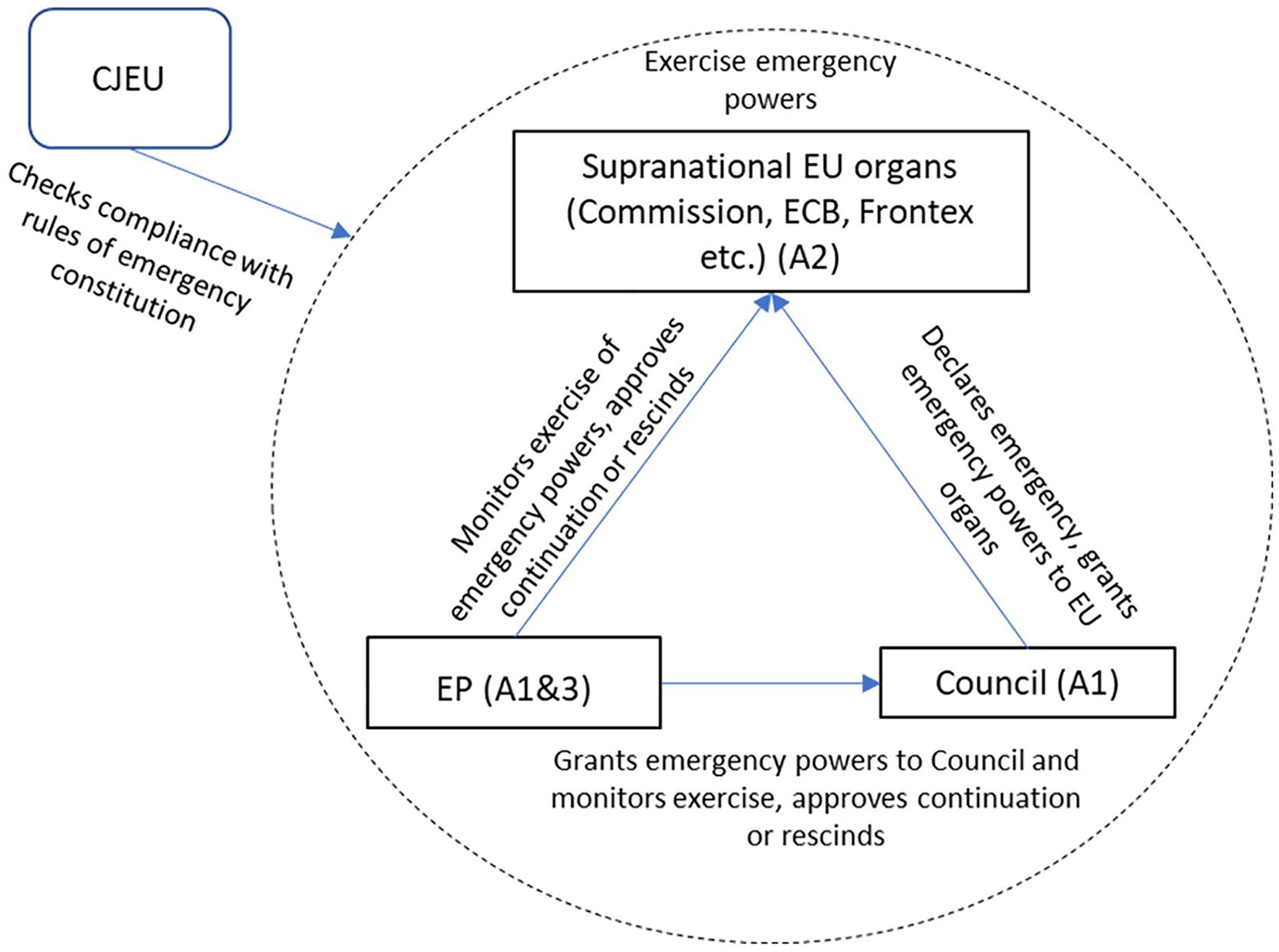
Competence Allocation in European Emergency Constitution.
Obstacles to Realizing a European Emergency Constitution
The contours of a European emergency constitution laid out above emerge from an exercise in normative theorizing that purposefully brackets the question of empirical preconditions and realizability in order to develop a normatively coherent vision. It thus introduces a focal point that political action can orient towards. The question is, of course, whether political actors are likely to do so, and if yes, whether their necessarily incomplete approaches would make things better or worse. This section discusses two of the most challenging problems impeding the introduction of a well-designed European emergency constitution and how they affect the normative goals behind it.
The first problem pertains to political motivation. European decision-makers, both at the member state and the institution level, can be expected to embrace the idea of a European emergency constitution only if it promises to provide an expanded problem-solving capacity. That is, as a precondition for their acceptance of severe constitutional constraints on their authority, the latent powers granted through the emergency constitution would need to seem apt to address the critical policy challenges they anticipate. In two related ways, it is unlikely that this will be the case under current circumstances. First, the crises afflicting the EU in the past decade often resulted from incomplete integration and lacking capacity to address spillovers, for example, from monetary to fiscal policy and vice versa (Scharpf, 2013). The functional response therefore seemed to lie in permanent, not temporary, fixes in order to both address the crisis and root out its source. For instance, making the ECB the lender of last resort to governments of the eurozone was indeed an emergency response. However, it also represented a more permanent institutional shift with the goal to prevent future speculation about sovereign defaults. Rescinding this emergency power could thus arguably plunge the eurozone back into crisis. Truly exceptional authority that is to be revoked as the crisis fades might thus not appeal to decision-makers in such scenarios. Second, crises have always represented windows of political opportunity to advance European integration (Lefkofridi and Schmitter, 2015). The constraining dissensus over European affairs in the public certainly makes emergency politics increasingly appealing as a mode of integration by stealth. As a consequence, it seems unlikely that the predominantly integrationist European political elites would spoil the one remaining avenue for integration progress by subscribing to an emergency constitution that asserts temporal limitations for exceptional measures.
The main implication of this first problem dimension is that both the successful realization of a European emergency constitution and its living up to its promises depend in large parts on a reform of the general constitutional order of the EU in the first place. That is, building an emergency constitution on a European political order in disequilibrium might be both unfeasible and impractical. Effectively regulating emergency powers in the EU would thus presuppose a constitutional revision that reduced functional integration gaps with crisis potential and introduced mechanisms of differentiated integration, alleviating the desire to exploit crises for necessary integration steps. Of course, such far-reaching reforms are not easily implemented and have mostly been of academic interest as yet. The one reason that could encourage executive decision-makers to get behind such an endeavor is of course the prospect of finally exiting the vicious cycle of deepening integration at the cost of reinforcing the constraining dissensus.
The second problem pertains to democracy. It further complicates matters with regard to the process of translating the emergency constitution from abstract idea to institutional reality. For even if a vast majority of member state governments favored the introduction of an emergency constitution, their consent to treaty changes would not be sufficient to legitimize such a far-reaching constitutional overhaul. First, from a normative point of view, it has recently been argued that the implied transfer of political authority from the European people to EU institutions represents an act of constituent power for which the mode of democratic intergovernmentalism is inappropriate (Patberg, 2018). When executive heads decide in multilateral negotiations to reallocate political authority which will ultimately increase their own collective discretion, we arguably face a usurpation of power rather than a democratically legitimate conferral. What would be needed instead is the institution of a constituent assembly of citizen and parliamentary representatives that explicitly exclude incumbent executives (Patberg, 2018). Second, from a sociological perspective, more inclusive and bottom-up processes seem required for the creation of an emergency constitution in order to avoid a legitimacy crisis. Top-down processes of self-empowerment in the EU have been shown to spawn fierce contestation and propel right-wing populist parties that demand a dismantling of European integration (Kreuder-Sonnen and Zangl, 2020). Only if European citizens and their representatives are involved in the process of interest aggregation from the start and actually take over the steering wheel can a further deepening of popular mistrust toward the EU be prevented. Otherwise, a societal backlash against EU authority is likely.
Hence, the introduction of a European emergency constitution hinges on a fundamental procedural innovation for constitutional reform that would bring citizens (back) into the role of principals in the delegation chain. More fundamentally, however, the implication of this problem dimension is that a lot depends on the question of whether the European citizens actually want to endow the EU with emergency powers to solve pressing issues in times of crisis. Given the high degree of politicization of European integration and the currently low appetite for authority transfers in domestic constituencies, this cannot be readily assumed.
In sum, a European emergency constitution could theoretically be very beneficial for the EU, but its empirical preconditions are demanding and not presently given. At the same time, however, the 2020–2021 coronavirus crisis may well represent a critical juncture in the EU’s institutional trajectory, where the constraints on agency are relaxed and change becomes possible. It should be seen as a window of opportunity for a new European “constitutional moment” where time is ripe to feed the idea of an emergency constitution into the political discourse.
Conclusion
Even if the introduction of a comprehensive emergency constitution for Europe seems currently out of reach, the containment of EU-level emergency politics remains an important task. As I intend to show in this concluding part, both the uncovering of the problems of emergency politics and the elaboration of an ideal proposal to keep them in check contain the seeds for behavioral change that can be implemented without institutional reform. The main practical value-added of the above discussion, then, was to raise awareness about the normative and empirical implications of unregulated emergency politics and to emphasize the regulative ideal of emergency powers that actors can and should integrate in their handling of future crises.
At least three different but complementary normative demands follow from this article for different actors. First, parliamentarians, both European and domestic, need to better understand the ramifications of their actions when voting on de facto emergency powers for EU institutions or de novo bodies. All good arguments for decisive action in crisis notwithstanding, they should not rubber-stamp political measures that eschew their control afterwards. To the contrary, parliaments should use their veto position to trade competence for control. That is, transferring additional and extraordinary authority to intergovernmental or supranational institutions should be premised on additional monitoring and control rights for parliament, including the ability to revoke the conditional grant of authority. As a matter of principle, significant political measures during emergencies should be approved only if they contain a sunset clause, allowing democratic institutions to evaluate and reconsider the policy or institutional innovation outside “fast-burning” moments of crisis. Here, political debate is not as easily eclipsed by arguments of necessity. If, nevertheless, there is broad political support to make an emergency competence permanent, it should be effectuated through formal constitutional reform.
Second, the CJEU, too, should be more aware of the implications of its rulings in times of crisis. Often enough, courts are confronted with legal challenges of emergency measures in the midst of a crisis. Absent clear regulations governing emergency powers, they are put between a rock and hard place. Either they squash the measures and risk exacerbating the crisis or they find interpretations of the law that accommodate the measures within the normal legal framework, factually constitutionalizing exceptional measures. Or so the options seem. However, little indicates, for example, that a firm protection of individual rights as outlined above would seriously hamper any European crisis response. In line with its Kadi jurisprudence, the Court should actively seek to protect individual rights against intrusions, even if questions of jurisdiction and competence are not entirely clear. Moreover, in light of the legal creativity deployed by executive authority-holders to assume emergency powers, the judiciary should ponder the option to declare itself incompetent to rule on authority expansions—along the lines of a new political question doctrine. It would allow the CJEU to signal discomfort with giving a constitutional blessing to extra-legal action and force political actors to take responsibility, without, however, undermining the short-term crisis response.
Third, executive actors themselves should realize the extent to which the practice of integration through emergency politics is self-undermining in the long run. If the stealth mechanism of self-empowerment and normalization risks provoking popular backlashes and further losses of legitimacy for the EU, emergency governors should be transparent about what they are doing and in what relation their actions stand to the law. Oren Gross (2003) has denoted as “extra-legal measures model” the normative approach to emergency politics in which executives do what they deem necessary, even if outside the law, but publicly acknowledge that their actions might lie beyond the scope of their constitutional powers of normal times. It is then up to parliament and the wider public to sanction this behavior ex-post—either giving it a democratic blessing or rejecting it as disproportionate. In the EU, acknowledgment by both national and supranational leaders that emergency measures are not always “within our mandate” would open the door to more political accountability and broader deliberation, thus providing less of a target for polity contestation. Of course, this would require political leadership that is not predominantly office-seeking in nature.
Footnotes
Acknowledgements
Earlier versions of this paper were presented at the 2018 Conference of the ECPR Standing Group on the European Union (SGEU) in Paris and the 2018 Congress of the German Political Science Association (DVPW) in Frankfurt. I would like to thank the participants in these forums, in particular Benjamin Braun, Eva M. Hausteiner, and Magnus G. Schoeller, as well as Antonia Baraggia, Cédric Koch, Markus Patberg and Jonathan White for valuable feedback. Substantive revisions of the paper were implemented during a stay at the Minda de Gunzburg Center for European Studies at Harvard University in 2019–2020.
Declaration of Conflicting Interests
The author(s) declared no potential conflicts of interest with respect to the research, authorship, and/or publication of this article.
Funding
The author(s) received no financial support for the research, authorship, and/or publication of this article.
